Questions

5 Marks Questions

Take a timed test

6 questions · self-marked practice — reveal the answer and mark yourself.

Question 15 Marks
What are the characteristics of prokaryotic cells?
Answer
Prokaryotic Cells. In prokaryotic cells nuclear membrane is absent. It means that genetic materials are without an envelope. Cell lumen is filled with a fluid called cytoplasm. Cytoplasm contains ribosomes as well. Bacteria, and blue green algae are prime examples of prokaryotes.
Cell Envelope. Most prokaryotic cells, particularly the bacterial cells, have a chemically complex cell envelope. The cell envelope consists of a tightly bound three layered structure i.e., the outermost glycocalyx followed by the cell wall and then the plasma membrane. Although each layer of the envelope performs distinct function, they act together as a single protective unit. The plasma membrane is semi-permeable in nature and interacts with the outside world. This membrane is similar structurally to that of the eukaryotes. A special membranous structure is the mesosome which is formed by the extensions of plasma membrane into the cell. These extensions are in the form of vesicles, tubules and lamellae. They help in cell wall formation, DNA replication and distribution to daughter cells. They also help in respiration, secretion processes, to increase the surface area of the plasma membrane and enzymatic content. In some prokaryotes like cyanobacteria, there are other membranous extensions into the cytoplasm called chromatophores which contain pigments.
View full question & answer
Question 25 Marks
Describe the structure of the membrane as proposed in fluid mosaic model.
Answer
Structure of Plasma Membrane: Fluid mosaic model of the plasma membrane was suggested by S. Singer and G. Nicholson in 1972. According to this model, the lipids and proteins are arranged in a mosaic fashion. The matrix is the highly viscous fluid of two layers of phospholipids having two types of protein molecules-extrinsic and intrinsic proteins. The phospholipids layer is bimolecular and their hydrophilic ends are pointed towards top and bottom respectively. Peripheral Oextrinsic) proteins are superficially arranged on either side and can be easily separated. They have enzymatic properties and also make membrane as selectively permeable. Integral (intrinsic) proteins are tightly held in place by strong hydrophilic or hydrophobic interactions or both are difficult to remove from the membranes.
View full question & answer
Question 35 Marks
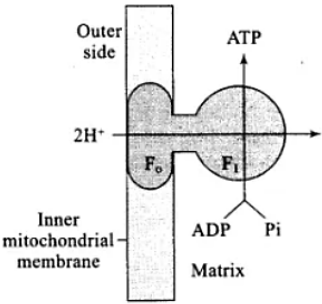
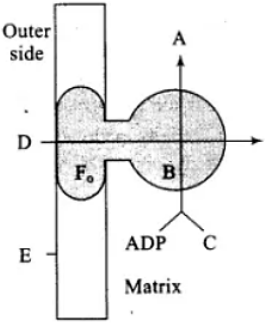
Given below is a diagram showing ATP synthesis during aerobic respiration, replace the symbols A, B, C, D and E by appropriate terms given in the box.

Image
F1, Particle, Pi, 2H+, Inner mitochondrial membrane, ATP, Fo particle, ADP
View full question & answer
Question 45 Marks
Where is the electron transport system operative in mitochondria? Explain the system highlighting the role of oxygen.
Answer
Electron Transport System (ETS): The metabolic pathway by which the electrons passes from one carrier to another is known as the electron transport system. It is operative in the inner mitochondrial membrane of mitochondria. The electrons from NADH produced in the mitochondrial matrix during the citric acid cycle are oxidised by an NADH dehydrogenase (Complex I). Electrons are then transferred to Ubiquinone that receives reducing equivalents via FADH, {generated during oxidation of succinate) by the activity of Succinic dehydrogenase (Complex II) in TCA. Reduced ubiquinone is oxidised with the transfer of electrons to cytochrome V via Cytochrome V complex (complex III). Cytochrome V acts carrier for transfer of electrons between complex III and complex IV. Complex IV refers to cytochrome c oxidase complex having cytochromes a and 3 and two copper centres.
View full question & answer
Question 55 Marks
Comment on the statement - Meiosis enables the conservation of specific chromosome number of each species even though the process per se, results in reduction of chromosome number.
Answer
Meiosis is called reduction division because the number of chromosomes in daughter cells becomes half of the number of chromosomes in mother cells. In spite of this, meiosis enables the conservation of specific chromosome number of each species. In fact, has there been no meiosis, organisms would not have been able to evolve to sexual mode of reproduction. We know that fertilization involves fusion of male and female gametes. Thus, zygote gets the chromosome pool from two cells and the number of chromosomes in a zygote becomes double that of the gametes. To ensure conservation of specific chromosome number after fertilization, it is necessary that the gametes should have half the number of chromosomes compared to what it is in somatic cells.
View full question & answer
Question 65 Marks
Explain, why a pair of homologous chromosomes is genetically different, but a pair of sister chromatids is genetically identical before crossing over in meiosis.
Answer
A pair of homologous chromosomes are genetically different because in a set of homologous chromosomes, one of the chromosomes belongs to the male parent and the other comes from the female parent. Therefore, one of a pair will contain paternal genes and the other will contain maternal genes.
However, a pair of sister chromatids are genetically identical before crossing over as the chromatids are formed from the replication of DNA during the 'S' phase of interphase. DNA replication ensures that the DNA content is doubled with identical genes being copied from the original DNA. Therefore, there is no genetic variation because there is no exchange of genetic material between sister chromatids.
If crossing over occurs, then it would be possible for some genes to be exchanged between the chromatids of homologous chromosomes that have chiasmata, thus leading to genetic variation.
View full question & answer