Questions

M.C.Q (1 Marks)

Take a timed test

12 questions · self-marked practice — reveal the answer and mark yourself.

MCQ 11 Mark
Mark the incorrect statement in context to $O _2$.binding to Hb:
  • A
    Lower temperature
  • B
    Higher pH
  • C
    Lower p$CO _2$
  • D
    Higher p$O _2$
Answer
(b) Higher pH
Explanation: In the alveoli, there is high $pO _2$, low $pCO _2$, lesser $H ^{+}$ concentration and lower temperature, all these factors favour the formation of oxyhaemoglobin. However, higher pH is not a factor for the formation of oxyhaemoglobin.
View full question & answer
MCQ 21 Mark
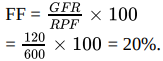
The filtration fraction is the ratio of GFR to RPF where both the values are in ml/min and FF is expressed in percentage. Calculate FF for a normal adult human being, if RPF= 600ml/min:
  • A
    $2.08 \%$
  • B
    $10.38 \%$
  • C
    $20.73 \%$
  • D
    $20.83 \%$
Answer
(d) 20.83%
Explanation: Filtration fraction is the ratio of glomerular filtration rate (GFR) to the renal plasma flow (RPF). GFR of a normal human is 120 ml/min. so,

Image
View full question & answer
MCQ 31 Mark
Cycas is a gymnosperm as it has:
  • A
    Naked seeds
  • B
    Living fossil status
  • C
    Sieve tubes
  • D
    Vessels
Answer
(a) Naked seeds
Explanation: The gymnosperms (Gymnos: naked, Sperma: seeds) are plants in which the ovules are not enclosed by any ovary wall and remain exposed, both before and after fertilization. The seeds that develop post-fertilization, are not covered, i.e., are naked. Since Cycas has naked seeds, it belongs to gymnosperms.
View full question & answer
MCQ 41 Mark
Auxins are mostly produced in:
  • A
    Root
  • B
    Meristematic region
  • C
    Shoot
  • D
    Leaf buds
Answer
(b) Meristematic region
Explanation: Auxins are generally produced in growing apices of shoot and root. These two regions are the meristematic cells that are actively taken part in cell division.
View full question & answer
MCQ 51 Mark
In water, frogs breathe through the skin. What is the name for such kind of respiration?
  • A
    Osmosis
  • B
    Perfusion
  • C
    Percutaneous respiration
  • D
    Cutaneous respiration
Answer
(d) Cutaneous respiration
Explanation: In Cutaneous respiration, the exchange of gases occurs through the skin. Animals undergoing cutaneous respiration usually have moist skin.
View full question & answer
MCQ 61 Mark
Dialysing unit (artificial kidney) contains a fluid which is almost same as plasma except that it has:
  • A
    No urea
  • B
    High uric acid
  • C
    High urea
  • D
    High glucose
Answer
(a) No urea
Explanation: The dialysing unit contains a coiled cellophane tube surrounded by a fluid (dialysing fluid) having the same composition as that of plasma except the nitrogenous wastes like urea.
View full question & answer
MCQ 71 Mark
In sugarcane, $CO _2$ is fixed in malic acid with the help of enzyme __________.
  • A
    PEP carboxylase
  • B
    Ribulose phosphate kinase
  • C
    RuBP carboxylase
  • D
    Fructose phosphotase
Answer
(a) PEP carboxylase
Explanation: In C4 plants, Carbon dioxide is fixed in malic acid with the help of enzyme phosphoenolpyruvate (PEP). Malic acid is a four-carbon compound that later changes into oxaloacetic acid.
View full question & answer
MCQ 81 Mark
What is the name of the membrane covering the lungs?
  • A
    Pleura
  • B
    Oesophagus
  • C
    Gall bladder
  • D
    Liver
Answer
(a) Pleura
Explanation: The pleural membrane is thin, moist, slippery, and has two layers. The outer, or parietal, pleura lines the inside of the rib cage and the diaphragm while the inner, visceral or pulmonary, layer covers the lungs.
View full question & answer
MCQ 91 Mark
In dicot leaves, stomata are present on which surface of the leaf?
  • A
    On the midrib
  • B
    Ventral surface
  • C
    Both surface
  • D
    Dorsal surface
Answer
(b) Ventral surface
Explanation: Stomata distribution in dicot leaves is Hypostomatic i.e., stomata present on the lower surface (Ventral surface) of a leaf.
View full question & answer
MCQ 101 Mark
Many elements are found in living organisms either free or in the form of compounds. Which of the following is not found in living organisms?
  • A
    Magnesium
  • B
    Silicon
  • C
    Iron
  • D
    Sodium
Answer
(b) Silicon
Explanation: Silicon is not found freely in nature, but it does occur in the bounded form as oxides and silicates, whereas magnesium, sodium, and iron are present in living organisms as ions.
View full question & answer
MCQ 111 Mark
Which is the functional unit of kidneys?
  • A
    Nephron
  • B
    Glomerulus
  • C
    Loop of Henle
  • D
    Bowman's capsule
Answer
(a) Nephron
Explanation: The nephronil is the basic structural and functional unit of the kidney. Its chief function is to regulate the concentration of water and soluble substances like sodium salts by filtering the blood, reabsorbing what is needed and excreting the rest as urine.
View full question & answer
MCQ 121 Mark
Example of interspecific hybrid is:
  • A
    Tigon and liger
  • B
    Cat and lion
  • C
    Tigon and tiger
  • D
    Liger and dog
Answer
(a) Tigon and liger
Explanation: Tigon and liger are produced by hybridization of tow interspecific species. Although hybridization generally takes place between the same species.
View full question & answer