Questions

3 Marks Question

Take a timed test

8 questions · self-marked practice — reveal the answer and mark yourself.

Question 13 Marks
Differentiate between right ventricle and left ventricle.
Answer
Right ventricleLeft ventricle
It is smaller than the left ventricle.It is comparatively larger than the right ventricle.
Moderator hand pre-sent in it.Moderator band is lacking in it.
Columnar carneae thicker but less intricate.Columnar carneae is narrower but more intricate.
Receives and pushes deoxygenated blood.Receives and pumps oxygenated blood.
Crescent-shaped.Biconvex in shape.
The wall of the right ventricle is thinner than the left ventricle.The wall of its is thicker than the right ventricle.
View full question & answer
Question 23 Marks
How do you call the conduction of impulse along a myelinated nerve fibre?
Answer
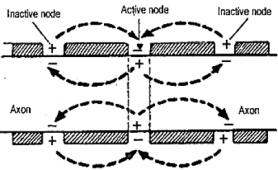
Along a myelinated nerve fibre, the conduction of impulse is called saltatory conduction. This is so because the ionic changes and consequent depolarisation taking place only at the nodes of Ranvier free from myelin sheath leading to the jumping of action potential from one node to the next. 
Image

Figure: Saltatory conduction.
View full question & answer
Question 33 Marks
What is the significance of the time gap in the passage of action potential from the sinoatrial node to the ventricle?
Answer
SA Node has a resting potential of approx. -55 to-60 mV. It is a pacemaker. Cardiac impulses originate in it and atrial contraction proceeds ventricular contraction. This has the highest degree of self-contraction that is approx. 70-75 times per minute. Cardiac impulses reach A.V. Node app. 0.03 second after their origin from SA Node.
View full question & answer
Question 43 Marks
Mention and explain the special properties of muscle.
Answer
Muscles exhibit various special properties, some of them are as follows:
i. Contractibility: The cells of muscle can be shortened considerably and return to the original relaxed state.
ii. Excitability: It is due to the energy stored in the electrical potential difference across the plasma membrane.
iii. Muscles also possess properties of extensibility and elasticity (because of proteins actin and myosin).
View full question & answer
Question 53 Marks
Name one synthetic auxin that can be used as a herbicide. Give one more application of the same.
Answer
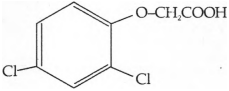
Various types of auxins are used in agriculture for economic gain. Some of the synthetic auxins are used as a herbicide. 2, 4 - dichloro phenoxy acetic acid (2, 4-D) is a dicotyledonous weed killer. 2,4-D is used to kill broad-leaved weeds. It is used to induce flowering in pineapple and litchi. 
Image

The chemical formula of 2,4-D
View full question & answer
Question 63 Marks
What are Lipids? Explain.
Answer
Lipids: They are macro biomolecules. They are organic compounds; insoluble in water but soluble in organic solvents such as chloroform, benzene, and petroleum, ether, etc. They have long chains of aliphatic hydrocarbons or a benzene ring. Oil, butter, ghee, waxes, natural rubber, and cholesterol are either lipids or rich in lipids. Fats form an important structural component of cell membranes, pigments such as carotene and lycopene, menthol, hormones, and vitamins A, E and K. Chemically, fats are compounds of C, H, and O.
View full question & answer
Question 73 Marks
Differentiate between:
i. Acoelomate and pseudocoelomate
ii. Notochord and nerve cord
iii. Polyp and medusa
Answer
i. When the body cavity is absent, the animal is called acoelomate, e.g. platyhelminthes. In some animals; mesoderm is present as scattered pouches between ectoderm and endoderm. Such animals are called pseudocoelomate, e.g. aschelminthes.
ii. The notochord is a flexible rod-shaped body found in embryos of all chordates. It is composed of cells derived from the mesoderm and defines the primitive axis of the embryo. The dorsal nerve cord is a hollow cord dorsal to the notochord. It is formed from a part of the ectoderm that rolls, forming the hollow tube. The notochord is replaced by a vertebral column in higher vertebrates. The nerve cord develops into the central nervous system.
iii. A polyp is a sessile and cylindrical form whereas medusa is umbrella-shaped and free-living. Polyps produce medusae asexually and medusae from the polyps sexually (e.g. Obelia). Examples of polyps are Hydra and Adamasia whereas of medusa is Aurelia.
View full question & answer
Question 83 Marks
Differentiate between the following:
i. Red algae and brown algae
ii. Liverworts and moss
iii. Homosporous and heterosporous pteridophyte
Answer
i. Red algae: The pigment phycoerythrin in Rhodophyceae gives it the unique red colour and hence the name red algae.
Brown algae: The pigment fucoxanthin in phaeophyceae gives it the unique brown colour and hence the name brown algae.
ii. In liverworts there is no protonema stage, while in moss the life cycle begins with the protonema stage.
iii. Majority of pteridophytes are homosporous, while some of them are heterosporous. Selaginella and salvinia are heterosporous. Basically the presence of heterospory in certain pteridophytes is a precursor of seed habits of higher plants, like gymnosperms and angiosperms.
View full question & answer