Questions

5 Marks Questions

Take a timed test

6 questions · self-marked practice — reveal the answer and mark yourself.

Question 15 Marks
Give the biochemical composition of plasma membrane. How are lipid molecules arranged in the membrane?
Answer
Chemically the plasma membrane consists of proteins (20-70%), lipids (20-79%), carbohydrates (1-5%) and water (20%). Nucleic acids (DNA and RNA) are absent in the plasma membrane. The lipids present in the plasma membrane are phospholipids, glycolipids (sugar lipids) and sterols.
Each lipid molecule consists of a three carbon glycerol poles (head) which is hydrophilic (water-loving) in nature and two long tails of fatty acids which are hydrophobic (water-fearing) in nature.
The hydrophilic glycerol poles of lipid are located towards the outside of the lipid bilayer whereas, the hydrophobic fatty acid tails are repelled by water and face towards the inner side of the membrane.
The hydrophilic and hydrophobic forces in lipid molecules cause the membrane to become a bilayer.
View full question & answer
Question 25 Marks
Is there a species or region specific type of plastids? How does one distinguish one from the other?
Answer
Plastids are both region or species-specific. These are as follows
i. Proplastids: These are colourless, rounded but amoeboid plastid precursors, found in meristematic and newly formed cells of plants. It has a double membrane envelope that surrounds a colourless matrix, containing DNA, ribosomes and reserve food. A few vesicles and lamellae also occur in the matrix.
ii. Leucoplasts: These are colourless plastids that occur in non-green plant cells commonly near the nucleus. They are as follows
a. Amyloplasts These leucoplasts store starch, e.g., the tuber of potato, grain of rice and wheat.
b. Elaioplasts These store fats, e.g., rose.
c. Aleuroplasts They are protein storing plastids, e.g., castor endosperm.
iii. Chromoplasts: These are non-photosynthetic coloured plastids which synthesise and store carotenoid pigments. They appear,
orange, red or yellow in colour. These mostly occur in ripe fruits (tomato and chillies) carrot roots, etc.
iv. Chloroplasts: These are photosynthetic plastids, which are green in colour and found in the leaves of all green plants. They have lamellae organised in the form of grana.
View full question & answer
Question 35 Marks
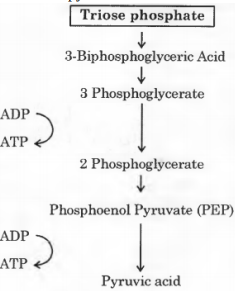
Describe briefly the main steps on glycolysis from triose phosphate onwards. Highlight the reactions which release energy.
Answer
Two moles of triose phosphate are interconvertible. They are dihydroxyacetone phosphate and 3-bi phosphoglyceraldehyde. 3-phosphoglyceraldehyde is converted into 1, 3, bi phosphoglycerate and NAD+ is reduced to NADH. Phosphoglycerate kinase
catalyses the formation of 3-phosphoglycerate and ATP is produced. 3-phosphoglycerate is converted into 2-phosphoglycerate and PEP.
PEP makes pyruvate and releases ATP.

Image
View full question & answer
Question 45 Marks
Enumerate the assumptions that we undertake in making the respiratory balance sheet. Are these assumptions valid for a living system? Compare fermentation and aerobic respiration in this context.
Answer
It is possible to make calculations of the net gain of ATP for every glucose molecule oxidized, but in reality, this can remain only a theoretical exercise.
Following assumptions are made while calculating the respiratory balance sheet:
• Respiration involves a sequential and orderly pathway.
• NADH which is synthesized during glycolysis is transferred to mitochondria where it undergoes oxidative phosphorylation.
• None of the other intermediates in the pathway are utilized to synthesize any other compound.
• Only glucose is undergoing oxidation. No other substrate is being utilized at any intermediate stage.
But these assumptions are not valid for a living system. All pathways work simultaneously and they cannot always work one after another, i.e. in sequence. ATP is utilized as and when needed. Glucose is not the only substrate. In spite of the practical limitations, this calculation is quite useful.
FermentationAerobic respiration
(i) Partial breakdown of glucose happens during (i) Complete breakdown of glucose takes   a process into ethanol. place into carbon   dioxide.
(ii) There is a net gain of only two ATP molecules. (ii) There can be a net gain of 36   molecules of ATP.
(iii) Oxidation of NADH to $NAD ^{+}$ is slow. (iii) Oxidation of NADH to $NAD ^{+}$  is very fast.
View full question & answer
Question 55 Marks
A well-known biologist stated that the life history of an organism can be summed up as gametic fusion, equational division and reductional division. Comment on it.
Answer
The statement of the biologist is correct. Because the life history of an organism can be summed up as gametic fusion, equational division, and reductional division. By the fusion of male and female gametes, the gametic zygote is formed and from the zygote develops the adult. The zygote is formed during sexual reproduction. Half of the chromosome comes from the mother and the other half chromosomes come from the father to bring the character from both the parents. The male and female gametes are formed as a result of meiosis. The body cell divides by mitosis. In prophase of meiosis I, the exchange of segments between the two adjacent non-sister chromatids of the homologous pair at different sites takes place which results in the genetic recombinations.
View full question & answer
Question 65 Marks
Describe the following:
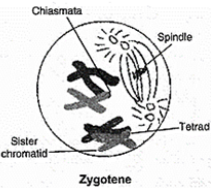
i. synapsis
ii. bivalent
iii. chiasmata
Draw a diagram to illustrate your anwer.
Answer
i. During zygotene of prophase I of meiosis homologous chromosomes pair together. This pairing is called synapsis.Image

ii. Bivalent: The complex formed by homologous chromosomes during zygotene is called a bivalent. They are also known as tetrad
iii. Chiasmata: During diplotene, the paired chromosomes make a X-shaped structure. This is called chiasmata. It is a site where two non-sister chromatids of homologous chromosomes have crossed over.

View full question & answer