Questions

3 Marks Question

Take a timed test

8 questions · self-marked practice — reveal the answer and mark yourself.

Question 13 Marks
Briefly describe the structure of the Brain.
Answer
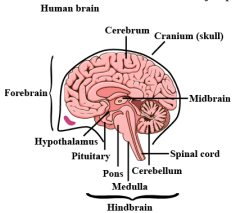
Structure of brain. The human brain is well protected by the skull. Inside the skull, the brain is covered by cranial meanings consisting of an outer layer called dura mater, a very thin middle layer called archnoid and an inner layer called pia mater. The brain can be divided into three major parts. (i) Forebrain (ii) Midbrain and (iii) Hindbrain.

Image
View full question & answer
Question 23 Marks
Why is there no mixing of deoxygenated and oxygenated blood in the human heart normally?
Answer
The human heart is a four-chambered organ two atria and two ventricles. The two auricles are partitioned by a septum into a right auricle receiving only deoxygenated blood and a left auricle receiving only oxygenated blood. Due to further advancement in the human heart, the ventricle is completely partitioned into the right ventricle and left ventricle to prevent mixing of deoxygenated and oxygenated blood.
View full question & answer
Question 33 Marks
Write the differences between:
a. Blood and Lymph
b. Open and Closed system of circulation
c. Systole and Diastole
d. P-wave and T-wave
Answer
a. Blood contains RBCs and hence can transport gases. Lymph doesn't contain RBCs and cannot transport gases. Lymph mainly contains WBCs and play a role in the immune system of the body.
b. The Open Circulatory System is a system in which fluid (called hemolymph) in a cavity called the hemocoel bathes the organs directly with oxygen and nutrients and there is no distinction between blood and interstitial fluid this combined fluid is called hemolymph or haemolymph. The cardiovascular systems of humans are closed, meaning that the blood never leaves the network of blood vessels.
c. Systole is the contraction of heart muscle and diastole is the dilatation of the heart muscle.
d. Each peak in the ECG is identified with a letter from P to T that corresponds to a specific electrical activity of the heart. The P-wave represents the electrical excitation (or depolarisation) of the atria, which leads to the contraction of both the atria. The QRS complex represents the depolarisation of the ventricles, which initiates the ventricular contraction. The contraction starts shortly after Q and marks the beginning of the systole. The T-wave represents the return of the ventricles from excited to normal state (repolarisation). The end of the T-wave marks the end of systole.
View full question & answer
Question 43 Marks
What makes the synovial joint freely movable? List any two types of synovial joints.
Answer
The synovial joints are freely movable joints. The presence of synovial fluid in the synovial cavity makes this joint movable. This fluid lubricates the joint for free and easy movement. The articulating bones provide considerable movement but articulating surfaces are kept in close contact by a fibrous capsule. The examples of synovial joints are:
i. Ankle joint and
ii. Shoulder joint etc.
View full question & answer
Question 53 Marks
State any three functions of indole acetic acid in plants.
Answer
i. It promotes growth and elongation of roots and stems and many fruits.
ii. In many plants, indole acetic acid promotes cell division and induces apical dominance.
iii. It also induces parthenocarpy.
View full question & answer
Question 63 Marks
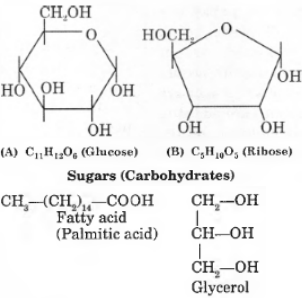
Find and write down structures of 10 interesting small molecular weight biomolecules. Find if there is any industry which manufactures the compounds by isolation. Find out who are the buyers.
Answer
Small Molecular Weight Biomolecules: Lactic acid, simple sugars, pentoses, hexoses, lipids, fatty acids, amino acids and nucleotides.
Sugar and cotton, as well as biotechnological industries, manufactures the compounds by isolation.

Image
View full question & answer
Question 73 Marks
Differentiate between an Insect and Spider.
Answer
An InsectA Spider
The body is divided into head, thorax and abdomen.The body is divided into cephalothorax and abdomen.
Have three pairs of jointed legs.Has four pairs of jointed legs.
Spinning organs absent.The abdomen bears spinning organs.
No carapace.Cephalothorax covered by a carapace.
Generally, have simple eyes.Compound eyes are lacking.
It has varieties of feeding habits.It is a predator.
View full question & answer
Question 83 Marks
The male and female reproductive organs of several pteridophytes and gymnosperms are comparable to floral structures of angiosperms. Make an attempt to compare the various reproductive parts of pteridophytes and gymnosperms with reproductive structures of angiosperms.
Answer
StructurePteridophyteGymnospermAngiosperm
Main reproductive partGametophyte bears antheridia and archegoniaMicrosporophylls and megasporophylls represent the gametophyte.Flower bears antheridium and gynoecium.
Male reproductive

part
Antheridia produce male gamete.The male cone is highly reduced in size.Antheridia are composed of an anther and a slender stalk. Anther produces the pollen grains, i.e. male gametes.
Female reproductiveArchegonia produce the femaleThe megasporophyll is large in size and is easily apparent as theThe gynoecium contains the ovary, style and stigma. The fertilised egg develops inside the ovary and eventually,
partgametefemale coneseeds are produced.
View full question & answer