Questions

5 Marks Questions

Take a timed test

6 questions · self-marked practice — reveal the answer and mark yourself.

Question 15 Marks
Discuss the basic structural organisation of a typical cell.
Answer
The basic structural organisation of a typical cell is as follows:
i. Nucleus, the central part, and brain of the cell, which is spherical in shape. Its number can be one or more per cell. It is denser than the surrounding cytoplasm. The nucleus is composed of chromosomes (contains the genetic material, i.e., DNA), nuclear membrane and centrioles (non-membrane bound organelle present in only animal cells, which helps in cell division).
ii. Cytoplasm, a semi-fluid matrix that occupies the volume of the cell. It is mainly composed of water with free-floating molecules. Inside the cytoplasm, all cellular activities like a gaseous exchange, elimination of wastes, hereditary mechanisms, etc., occur.
Eukaryotic cells also contain another cell membrane-bound distinct structures called cell organelles, like mitochondria, vacuoles, Endoplasmic Reticulum (ER), Golgi complex, etc.
The prokaryotic cells lack all these membrane-bound organelles. It is to be noted that as ribosomes are not bounded by a membrane and are found in all cells. Ribosomes are also found in chloroplasts (in plants) and mitochondria and on rough ER other than the cytoplasm. Animal cells contain another non-membrane bound organelle called centriole, which helps in cell division.
iii. Outer membrane, the boundary of the cell, which provides protection to the cell and controls the exchange of ions, molecules and other components in and out of the cell. The outer membrane of a cell contains cell wall (only in plant cells) and plasma membrane.
View full question & answer
Question 25 Marks
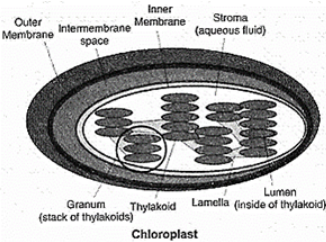
Give a detail description of plastids with the help of suitable diagram.
Answer
Plastids are found in all plant cells and in euglenoids. These are easily observed under the microscope as they are large. They bear some specific pigments, thus imparting specific colours to the plants. Based on the type of pigments plastids can be classified into chloroplasts, chromoplasts and leucoplasts.
i. Chloroplasts: The chloroplasts contain chlorophyll and carotenoid pigments which are responsible for trapping light energy essential for photosynthesis.
ii. Chromoplasts: In the chromoplasts fat-soluble carotenoid pigments like carotene, xanthophylls and others are present. This gives the part of the plant a yellow, orange or red colour.
iii. Leucoplasts: The leucoplasts are the colourless plastids of varied shapes and sizes with stored nutrients: Amyloplasts store carbohydrates (starch), e.g. potato elaioplasts store oils and fats whereas the aleuroplasts store proteins.
iv. Shape and Size of Chloroplasts: Majority of the chloroplasts of the green plants are found in the mesophyll cells of the leaves. These are lens-shaped, oval, spherical, discoid or even ribbon-like organelles having variable length (5-10 nm) and width (2-4nm). Their number varies from 1 per cell of the Chlamydomonas, a green alga to 20-40 per cell in the mesophyll. Image
v. Structure of Chloroplasts: Like mitochondria, the chloroplasts are also double membrane-bound. Of the two, the inner chloroplast membrane is relatively less permeable. The space limited by the inner membrane of the chloroplast is called the stroma. A number of organised flattened membranous sacs called thylakoids are present in the stroma. Thylakoids are arranged in stacks like the piles of coins called grana (singular: granum) or the internal thylakoids. In addition, there are flat membranous tubules called the stroma lamellae connecting the thylakoids of the different grana. The membrane of the thylakoids encloses a space called a lumen. The stroma of the chloroplast contains enzymes required for the synthesis of carbohydrates and proteins. It also contains small, double-stranded circular DNA molecules and ribosomes. Chlorophyll pigments are present in the thylakoids. The ribosomes of the chloroplasts are smaller (70 S) than the cytoplasmic ribosomes (80 S).
View full question & answer
Question 35 Marks
Does pyruvic acid enter the Krebs' cycle directly?
View full question & answer
Question 45 Marks
Differentiate between Aerobic respiration and Fermentation.
Answer
Aerobic respirationAnaerobic Respiration
1. It occurs in presence of oxygen.1. It occurs in absence of oxygen.
2. Glucose is completely oxidized.2. Glucose is partially oxidized.
3. More energy is liberated (36 to 38 ATP)3. Relatively small amount of energy is liberated (2 ATP)
4. Occurs in plant and animal cells4. Occurs in many anaerobic bacteria and human muscle cells
5. $CO _2$ and water is produced as the by product5. Lactic Acid or Alcohol is produced as the by product of respiration
6. Aerobic respiration takes place in both cytoplasm and mitochondria of the cell6. This takes place only in the cytoplasm of the cell.
View full question & answer
Question 55 Marks
Explain, why a pair of homologous chromosomes is genetically different, but a pair of sister chromatids is genetically identical before crossing over in meiosis.
Answer
A pair of homologous chromosomes are genetically different because in a set of homologous chromosomes, one of the chromosomes belongs to the male parent and the other comes from the female parent. Therefore, one of a pair will contain paternal genes and the other will contain maternal genes.
However, a pair of sister chromatids are genetically identical before crossing over as the chromatids are formed from the replication of DNA during the 'S' phase of interphase. DNA replication ensures that the DNA content is doubled with identical genes being copied from the original DNA. Therefore, there is no genetic variation because there is no exchange of genetic material between sister chromatids.
If crossing over occurs, then it would be possible for some genes to be exchanged between the chromatids of homologous chromosomes that have chiasmata, thus leading to genetic variation.
View full question & answer
Question 65 Marks
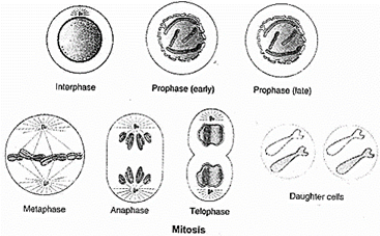
With the help of suitable diagrams describe mitosis.
Answer
Mitosis is divided into the following four stages:
i. Prophase

• Condensation of chromosomal material starts. The chromosomal material becomes untangled during the process of chromatin condensation.
• The centriole, which had undergone duplication during S phase of interphase now begins to move towards opposite poles of the cell.
• At the end of prophase, Golgi complexes, endoplasmic reticulum, nucleolus and the nuclear envelope disappear.

Image

ii. Metaphase
• The metaphase is characterized by all the chromosomes coming to lie at the equator.
• One chromatid of each chromosome connected by its kinetochore to spindle fibres from one pole and its sister chromatid connected by its kinetochore to spindle fibres from the opposite pole.
• The plane of alignment of the chromosomes at metaphase is referred to as the metaphase plate.
iii. Anaphase
• At the onset of anaphase, each chromosome arranged at the metaphase plate is split simultaneously and make the two daughter chromatids.
• They are now referred to as chromosomes of the future daughter nuclei and begin their migration towards the two opposite poles.
• As each chromosome moves away from the equatorial plate, the centromere of each chromosome is towards the pole and hence at the leading edge, with the arms of the chromosome trailing behind.
iv. Telophase
This is the stage which shows the following key events:
• Chromosomes cluster at opposite spindle poles and their identity is lost as discrete elements.
• Nuclear envelope assembles around the chromosome clusters.
• Nucleolus, Golgi complex and ER reform.
v. Cytokinesis
Karyokinesis is followed by cell division to form two daughter cells.This process is called cytokinesis at the end of which cell division is complete.
View full question & answer