Questions

3 Marks Question

Take a timed test

8 questions · self-marked practice — reveal the answer and mark yourself.

Question 13 Marks
Give a description of the structure of neuron.
Answer
A neuron is a microscopic structure composed of three major parts, namely, cell body, dendrites and axon.
Cell Body. The cell body contains cytoplasm with typical cell organelles and certain granular bodies called Nissl's granules.
Dendrites. Short fibres which branch repeatedly and project out of the cell body also contain Nissl's granules and are called dendrites. These fibres transmit impulses towards the cell body.
Axon. The axon is a long fibre, the distal end of which is branched. Each branch terminates as a bulb-like structure called synaptic knob which possess synaptic vesicles containing chemicals called neurotransmitters. The axons transmit nerve impulses away from the cell body to a synapse or to a neuro-muscular junction.
View full question & answer
Question 23 Marks
Differentiate between
i. Myogenic heart and neurogenic heart.
ii. Lymphatic capillaries and blood capillaries.
Answer
i. Difference between Myogenic heart and Neurogenic heart:
 Myogenic heart Neurogenic heart 
 In the myogenic heart, the initiation of the   heartbeat beat is under muscular control. Under nervous control. e.g. Insects,   Crustacea and Annelida.
 e.g. Molluscs and vertebrates. Insects, crustacea, and Annelida.
ii. Difference between Lymphatic capillaries and Blood capillaries:
Lymphatic capillariesBlood capillaries
 They are colourless. They are red.
 They convey lymph, They convey blood.
 They are wider than blood capillaries. They are narrower than the lymphatic   capillaries
 
View full question & answer
Question 33 Marks
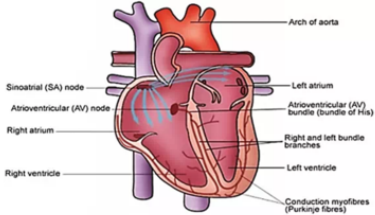
In the diagrammatic presentation of heart given below, mark and label, SAN, AVN, AV bundles, bundle of His and Purkinje fibres.

Image
Answer
The labelled diagram of the human heart is given below:

Image
View full question & answer
Question 43 Marks
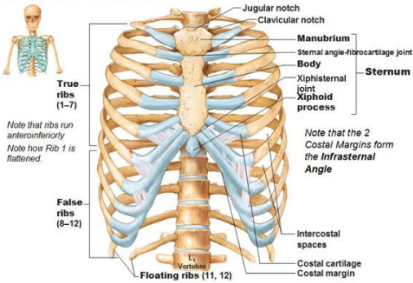
Describe the structure of the rib cage of the human.
Answer
Rib Cage: There are 12 pairs of ribs. Each rib is a thin flat bone connected dorsally to the vertebral column and ventrally to the sternum. It has two articulation surfaces on its dorsal end and is hence called bicephalic. First, seven pairs of ribs are called true ribs. Dorsally, they are attached to the thoracic vertebrae and ventrally connected to the sternum with the help of hyaline cartilage. The $8^{\text {th }} 9^{\text {th }}$ and $10^{\text {th }}$ pairs of ribs do not articulate directly with the sternum but join the seventh rib with the help of hyaline cartilage. These are called vertebrochondral (false) ribs. Last 2 pairs ($11^{ th }$ and $12^{ th }$) of ribs are not connected ventrally and are, therefore, called floating ribs. Thoracic vertebrae, ribs and sternum together form the rib cage.
The Thoracic Cage: Anterior view

Image
View full question & answer
Question 53 Marks
A rubber band stretches and reverts back to its original position. Bubble gum stretches, but it would not return to its original position.
Is there any difference between the two processes? Discuss it with respect to plant growth (Hint: Elasticity (reversible) Plasticity (irreversible))
Answer
A rubber band stretches and reverts back to its original position due to elasticity. However, when bubble gum stretches, but would not return to its original position, it is plasticity.
The meristematic cells are rich in protoplasm, possess large conspicuous nuclei. Their cell walls are primary in nature, thin, cellulosic, and elastic with abundant plasmodesmatal connections.
However. plants follow different pathways in response to the environment or phases of life to form different kinds of structures. This ability is called plasticity.
View full question & answer
Question 63 Marks
Do amino acids exist as Zwitter ion. Give its structure. Why is it formed?
Answer
Yes, amino acids exist as Zwitter ion.

Image
Zwitter ion formation is another particular property of amino acid. It is a neutral molecule $($with positive and negative charge$),$ having the ionisable nature of
$-- NH_2$ and $-- COOH$ groups. Hence, in solutions of different $pHs$, the structure of amino acid changes variably.
View full question & answer
Question 73 Marks
Which features make mammals as the most successful and dominant animals?
Answer
Features which make mammals as dominant and successful animals are as follows:
i. The presence of an insulating and protective hairy exoskeleton.
ii. They are warm-blooded so have a high rate of metabolism.
iii. They are viviparous animals and show placentation and intrauterine development which increases the chances for survival of young ones.
iv. They show a high degree of parental care.
v. They have more developed hearing efficiency due to the presence of pinna, three ear-ossicles and coiled cochlea in the ear.
vi. They are able to speak through indicative/verbal language.
vii. They have a good power of learning due to the presence of a more developed brain.
View full question & answer
Question 83 Marks
Distinguish between Artificial System and Phylogenetic System.
Answer
Artificial System Phylogenetic System
The organisms are categorised on the   basis  of one/few superficial characters.The organisms are categorised on the   basis of relationship with their ancestors.
It was based on Bauhin and Linnaeus's   work.It was on Eichler's system of classification.
Suggested by Theophrastus in his book   named Historia PlantarumSuggested by Darwin and Walace; as the   evolutionary theory was its base.
View full question & answer