Questions

5 Marks Questions

Take a timed test

6 questions · self-marked practice — reveal the answer and mark yourself.

Question 15 Marks
Give the factors that govern the size of the cell.
Answer
Factor Governing Cell Size: Like all other living things, cells have a definite age and a maximum size. This process of cell division goes on in the body all the time. It is on this account, the cells do not grow beyond a certain size and limit.
SurfaceVolume ratio
A6:1
B3:1
C2:1
Volume ratio decreases with the increase in size. The size of the cell is co-related to the functions it performs.
Surface: Volume ratio decreases with the increase in size. The size of the cell is co-related to the functions it performs. As cell increases in volume, its surface area is increased (not to some extent). The volume determines the chemical activity of the cells per unit of time. The surface area determines the amount of absorption as well as the amount of release of waste products by cells. As the living cell grows, its rate of waste product formation and the need for intake of substances from the outside increases at a faster rate than that of the surface area. The small size of the cells of the large/bigger organisms compensates the disproportionate increase in volume and surface area of the cells. The cells are tiny structures. They are small in volume to maintain a large surface area to volume ratio.
View full question & answer
Question 25 Marks
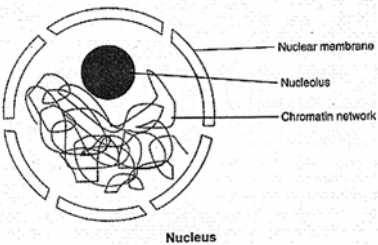
Describe the structure of the following with the help of labelled diagrams.
i. Nucleus
ii. Centrosome
Answer

Image

i. Nucleus: Nucleus is a double membrane structure, with minute pores in the membrane. The pores work like channels for passage of substances. The fluid-filled in the nucleus is called nucleoplasm. There is usually one nucleolus inside the nucleus. Sometimes many nucleoli can be found. There is a fine network of a thread like chromatins inside the nucleus. During the resting stage of a cell, structures inside the nucleus cannot be seen. They become visible only during cell division.
ii. Centrosome: In chromosome, there is one primary constriction, which contains two centromeres. These centromeres comprise the centrosome. Centrosome plays an important role during cell division.
View full question & answer
Question 35 Marks
Explain various steps involved in cellular respiration.
Answer
Steps of cellular respiration:
i. Glycolysis: Glycolysis is the first step in cellular respiration. During glycolysis, glucose undergoes partial oxidation to form pyruvic acid. From 1 molecule of glucose, 2 molecules of pyruvic acid is formed.
ii. Aerobic or Anaerobic respiration:
• In the absence of oxygen pyruvic acid is converted into lactic acid or ethanol.
• Citric Acid Cycle: Under aerobic conditions, the pyruvic acid enters citric acid cycle NADH +$H ^{+}$ and FADH2 which enter into the ETS.
Pyruvic acid + $CoA + NAD ^{+} \xrightarrow{ Mg ^{2+}}$ Acetyl $CoA + NADH + H ^{+}$
iii. Electron Transport System (ETS) and Oxidative Phosphorylation
• Energy stored in $NADH + H ^{+}$ and FADH2 is utilised to form ATP. This is accomplished when they are oxidised through the electron transport system and the electrons are passed on to $O _2$ resulting in the formation of $H _2 O$.
• When the electrons pass from one carrier to another in the electron transport chain, they are coupled to ATP synthase for the production of ATP from ADP and inorganic phosphate.
View full question & answer
Question 45 Marks
Give an account of Glycolysis. Where does it occur? What is the end product? Trace the fate of these products in both aerobic and anaerobic respiration.
Answer
Glycolysis occurs in the cytoplasm of the cell and is present in all living organisms. In this process, glucose undergoes partial oxidation to form two molecules of pyruvic acid. The following are the important step of glycolysis.
• Glucose undergoes phosphorylation to produce glucose-6-phosphate.
• Fructose-6-phosphate is then converted into PGAL. (Phosphoglyceraldehyde).
• Each molecule of PGAL then undergoes several steps to produce Pyruvic Acid.
• There is a net gain of two molecules of ATP during glycolysis of one molecule of glucose.
Fate of Pyruvate: Aerobic Respiration: Pyruvic acid is completely oxidized to produce carbon dioxide and energy.
Anaerobic Respiration: Depending upon the availability of oxygen in some organisms. pyruvic acid is converted into ethanol and carbon dioxide when there is a complete absence of oxygen. In some other organisms, pyruvic acid is converted into lactic acid when there is an incomplete oxygen supply.
View full question & answer
Question 55 Marks
Distinguish anaphase of mitosis from anaphase I of meiosis.
Answer
Anaphase of mitosisAnaphase I of meiosis
The centromere of every chromosome divides.The centromere does not divide.
Separation of sister chromatids takes place.Homologous chromosomes are separated.
Only one chromatid of every chromosome moves to the pole. The number and types of chromosomes at each pole is the same as in the parent nucleus. Chromosomes are single-strandedEach homologous pair of chromosomes moves to
the pole with both the chromatids.chromosomes
are double-stranded
The chromatids moving to one pole are genetically identical to those moving to the opposite pole.The chromosomes moving to one pole are not
genetically identical to those moving to the opposite pole.
View full question & answer
Question 65 Marks
Comment on the statement - Meiosis enables the conservation of specific chromosome number of each species even though the process per se, results in reduction of chromosome number.
Answer
Meiosis is called reduction division because the number of chromosomes in daughter cells becomes half of the number of chromosomes in mother cells. In spite of this, meiosis enables the conservation of specific chromosome number of each species. In fact, has there been no meiosis, organisms would not have been able to evolve to sexual mode of reproduction. We know that fertilization involves fusion of male and female gametes. Thus, zygote gets the chromosome pool from two cells and the number of chromosomes in a zygote becomes double that of the gametes. To ensure conservation of specific chromosome number after fertilization, it is necessary that the gametes should have half the number of chromosomes compared to what it is in somatic cells.
View full question & answer