Questions

M.C.Q (1 Marks)

Take a timed test

12 questions · self-marked practice — reveal the answer and mark yourself.

MCQ 11 Mark
Expiration will take place when there is:
A. Positive intrapulmonary pressure
B. Negative intrapulmonary pressure
C. Less pressure within lungs as compared to atmospheric pressure
  • A
    (C)
  • B
    (A)
  • C
    (B) and (C)
  • D
    (B)
Answer
(b) (A)
Explanation: Expiration is the release of carbon dioxide-rich air from the thoracic cavity. When the volume of air decreases and pressure increase the air from the chest moves out. This kind of pressure is called positive intrapulmonary pressure.
View full question & answer
MCQ 21 Mark
Which of the following animals shows ammonotelic excretion?
  • A
    Cat
  • B
    Sparrow
  • C
    Human
  • D
    Rohu
Answer
(d) Rohu
Explanation: An ammonotelic organism excretes nitrogenous waste as soluble ammonia. Most of the aquatic animals including protozoans, crustaceans, platyhelminths, cnidarians, poriferans, echinoderms, fishes, larvae/tadpoles of amphibians are ammonotelic. Rohu is a species of fish.
View full question & answer
MCQ 31 Mark
Which plant division is known as amphibians __________.
  • A
    Gymnosperms
  • B
    Thallophyta
  • C
    Bryophytes
  • D
    Angiosperms
Answer
(c) Bryophytes
Explanation: Bryophytes are called amphibians of the plant kingdom as they can grow in both land and water. Water is essential for the completion of the life cycle as they release antherozoids into the water where they come in contact with archegonium to produce a zygote.
View full question & answer
MCQ 41 Mark
Plant growth regulator that is used in delay in leaf senescence is __________.
  • A
    Ethylene
  • B
    Cytokinin
  • C
    Auxin
  • D
    ABA
Answer
(b) Cytokinin
Explanation: Cytokinins help overcome apical dominance. They promote nutrient mobilization which helps in the delay of leaf senescence.
View full question & answer
MCQ 51 Mark
The lymph in frog lacks:
  • A
    RBC and plasma
  • B
    Plasma and WBCS
  • C
    WBCs and few proteins
  • D
    RBCs and few proteins
Answer
(d) RBCs and few proteins
Explanation: The lymph is different from the blood. It is known as tissue fluid. Lymph is yellowish in colour as it lacks RBCS and few proteins.
View full question & answer
MCQ 61 Mark
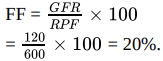
The filtration fraction is the ratio of GFR to RPF where both the values are in ml/min and FF is expressed percentage. Calculate FF for a normal adult human being, if RPF= 600ml/min:
  • A
    $2.08 \%$
  • B
    $10.38 \%$
  • C
    $20.73 \%$
  • D
    $20.83 \%$
Answer
(d) 20.83%
Explanation: Filtration fraction is the ratio of glomerular filtration rate (GFR) to the renal plasma flow (RPF). GFR of a normal human is 120 ml/min. so,

Image
View full question & answer
MCQ 71 Mark
On excitation, the electrons picked up by an electron acceptor is passed to
  • A
    photons
  • B
    cytochromes
  • C
    reaction centre
  • D
    anntenae
Answer
(b) cytochromes
Explanation: Electrons become excited and jump into an orbit farther from the atomic nucleus. These electrons are picked up by an electron acceptor which passes them to an electrons transport of cytochrome.
View full question & answer
MCQ 81 Mark
Which of the following is not correctly matched?
  • A
    Inspired air = Alveolar air
  • B
    Respiration = Physiochemical process
  • C
    TLC = VC + RV
  • D
    Cutaneous respiration = Breathing via skin
Answer
(a) Inspired air = Alveolar air
Explanation: Respiration is a physiological process. Total lung capacity (TLC) includes vital capacity (VC) and residual volume. Cutaneous respiration is breathing via the skin.
View full question & answer
MCQ 91 Mark
In dicot stems, the cells of cambium present between the primary xylem and primary phloem are:
  • A
    Vascular cambium
  • B
    Interfascicular cambium
  • C
    Medullary cells
  • D
    Intrafascicular cambium
Answer
(d) Intrafascicular cambium
Explanation: Intrafascicular Cambium is primary meristem. It develops from the procambium of the stem apex. It is located inside the open vascular bundles, between phloem and xylem patches.
View full question & answer
MCQ 101 Mark
Proteins are made up of __________
  • A
    Nucleosides
  • B
    Monomers
  • C
    Heteropolymers
  • D
    Homopolymers
Answer
(c) Heteropolymers
Explanation: Proteins are made of building blocks which are different. Proteins are heteropolymers made of amino acids.
View full question & answer
MCQ 111 Mark
The adult human kidney is metanephric. So, first embryonic tubules formed in vertebrates during embryonic development are:
  • A
    Pronephric
  • B
    Amphinephric
  • C
    Metanephric
  • D
    Mesonephric
Answer
(a) Pronephric
Explanation: The adult human kidney is metanephric, the third and final excretory organ that develops in a vertebrate embryo. First embryonic tubules formed in vertebrates during embryonic development are pronephric.
View full question & answer
MCQ 121 Mark
International Code of Biological Nomenclature is applied to __________
  • A
    Plants
  • B
    Both Plants and Animals
  • C
    Virus
  • D
    Animals
Answer
(b) Both Plants and Animals
Explanation: Since biology deals with both plants and animals, the international code of biological nomenclature is applied to both plants and animals. Hence, the correct option is Both plant and animals.
View full question & answer