Questions

1 Marks Question

Take a timed test

130 questions · self-marked practice — reveal the answer and mark yourself.

Question 11 Mark
Define the following terms: Perigynous flower.
Answer
Perigynous flower: If gynoecium is situated in the centre and other parts of the flower are located on the rim of the thalamus almost at the same level, it is called perigynous. Here ovary is half superior, e.g., peach, plum.
View full question & answer
Question 21 Mark
Define the following terms: Epipetalous stamen.
Answer
Epipetalous stamen: When stamens are attached to the petals, they are called epipetalous stamens e.g., brinjal.
View full question & answer
Question 41 Mark
Secondary growth does not take place in monocot plants. Give possible reason.
Answer
Monocot plants are perennial plants, i.e. their life span is about one year. So they do not need secondary growth.
View full question & answer
Question 51 Mark
What are the two layers of seed coat?
Answer
Testa is the outer hard layer of seed coat, while tegmen is inner thin layer of seed coat.
View full question & answer
Question 61 Mark
Name two plants whose sub-aerial stems spread to new niches and produce new shoots.
Answer
Grass and strawberry.
View full question & answer
Question 71 Mark
What is pulvinus? Give an example of a plant that has pulvinus.
Answer
  • Pulvinus is the swollen leaf base.
  • It is found in leguminous plants like pea, bean, etc.
View full question & answer
Question 91 Mark
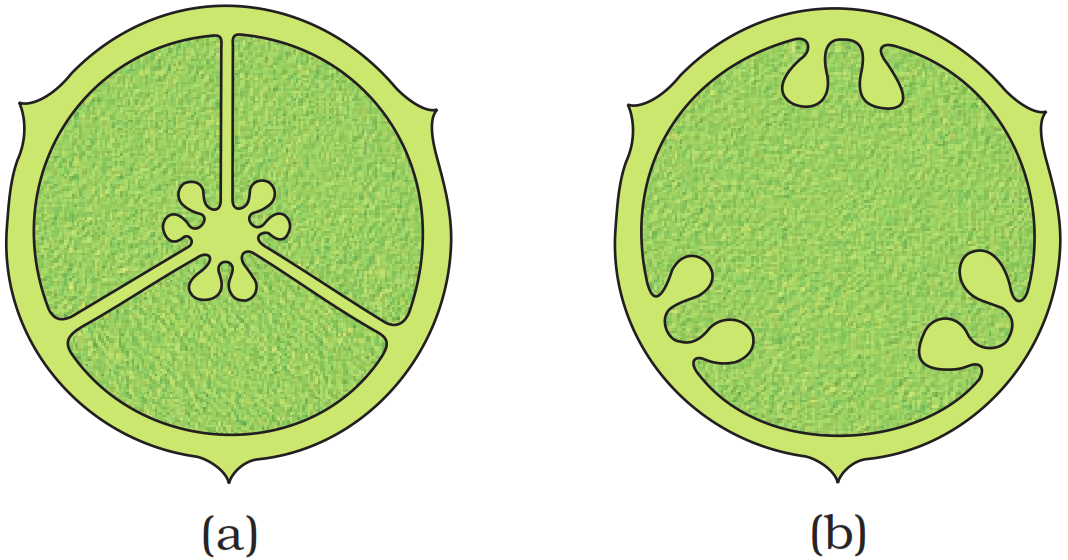
Name the type of placentation shown in the given figures and give one example of each.
Answer
  1. Free-central placentation, e.g. primrose.
  2. Parietal placentation, e.g., mustard.
View full question & answer
Question 111 Mark
Name the following:
  1. The thimble-like structure covering the root apex.
  2. The region in the root tip that is responsible for growth of root in length.
Answer
  1. Root cap.
  2. Region of elongation.
View full question & answer
Question 121 Mark
Why is a flower of Cassia described as Zygomorphic?
Answer
A flower of Cassia is zygomorphic because, it can be cut into two identical halves only along one vertical plane passing through the centre.
View full question & answer
Question 141 Mark
What are adventitious roots?
Answer
The roots which arise from parts of the plant other than the radicle, are called adventitious roots.
View full question & answer
Question 151 Mark
In Alstonia, the phyllotaxy is called whorled. Why?
Answer
The number of leaves arise from a single node in Alstonia, so it is called whorled.
View full question & answer
Question 161 Mark
Write the floral formula of family-Fabaceae and give its two examples.
Answer
Floral formula- $\text{Br}\%\text{K}_{(5)} \text{C}_{1 + 2 + (2)}\text{A}_{(9) + 1} \text{G}_1$Example are- Arachis hypogea (groundnut) and Glycine max (soyabean).
View full question & answer
Question 171 Mark
Write the scientific name of a member of Liliaceae, whose roots are used as blood purifiers.
Answer
Smilax.
View full question & answer
Question 181 Mark
Describe the nature of the stem of Pistia.
Answer
  • Stem of Pistia, is called an offset.
  • It is a lateral branch with short internodes.
  • Each node bears a rosette of leaves and a tuft of roots.
View full question & answer
Question 191 Mark
In aquatic plants like Pistia and Eichhornia, leaves and roots are found near _____________.
Answer
ln aquatic plants like Pistia and Eichhornia, leaves and roots are found near surface of water.
View full question & answer
Question 201 Mark
Name one plant product through which we use phloem fibres commercially.
Answer
Jute fibres are phloem fibres and are used for making gunny sacks.
View full question & answer
Question 211 Mark
Where are root hairs present in root?
Answer
The root bears unicellular root hairs in the zone of maturation.
View full question & answer
Question 251 Mark
Write the common source of oil yielding plants from the family-Fabaceae.
Answer
Groundnut (Arachis hypogea) and soyabean (Glycine max).
View full question & answer
Question 261 Mark
Describe the structure of a fruit with the help of a diagram.
Answer
The fruit is mature ovary develops after fertilisation. Fruit consists of wall named pericarp and seeds. Sometimes pericarp is fleshy and differentiated into outer epicarp, middle mesocarp and inner endocarp.
View full question & answer
Question 271 Mark
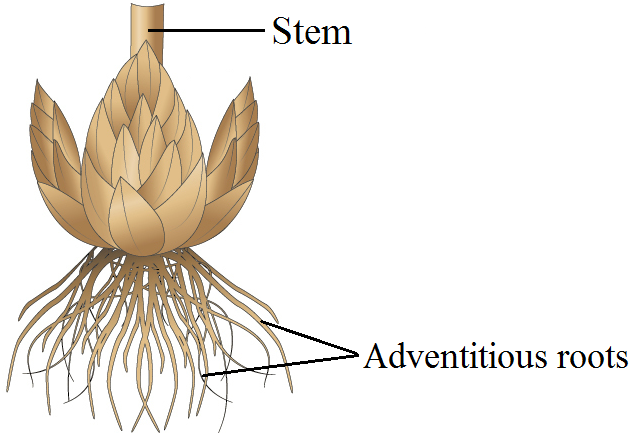
Identify the following diagram and write important features.
Answer
It is a corm. It is a condensed, fleshy, solid and vertically growing stock with large apical buds. The shape of corm is spherical, flattened on top and bottom. It has number of circular nodes with scales and one or more axillary buds, e.g., Colocasia, Amorphophallus, aladiolus, etc.
View full question & answer
Question 281 Mark
In swampy areas like the Sunderbans in West Bengal, plants bear special kind of roots called _____________.
Answer
In swampy areas like the Sunderbans in West Bengal, plants bear special kind of roots called pneumatophores.
View full question & answer
Question 291 Mark
What is micropyle in a seed?
Answer
Micropyle is the opening left by the integuments (seed coat) for entry of pollen tube into female gametophyte.
View full question & answer
Question 301 Mark
Provide the technical term for the following:
  1. The stalk of the leaf.
  2. The pattern of arrangement of leaves on the stem.
Answer
  1. Petiole.
  2. Phyllotaxy.
View full question & answer
Question 321 Mark
Why are flowers of mustard referred to as hypogynous?
Answer
In the flower of mustard, the ovary is situated on the thalamus above all the other floral whorls; hence it is referred to as hypogynous.
View full question & answer
Question 331 Mark
  1. Assign the following plants to their respective plant families and describe the nature of gynoecium in each of them.
  1. Allium cepa (Onion).
  2. Pisum sativum (Pea).
  1. What are coleoptile and coleorhiza?
Answer
  1.  
  1. Liliaceae: the ovary is tricarpellary, syncarpous, superior, trilocular with many ovules on axile placentation.
  2. Fabaceae: the ovary is monocarpellary, superior, unilocular with many ovules on marginal placentation.
  1.  
  • Coleoptile is the sheath that covers and protects the plumule in cereal grains.
  • Coleorhiza is the protective sheath of the radicle in cereal grains.
View full question & answer
Question 341 Mark
  1. Give two general characteristics of sepals.
  2. What is the main function of sepals?
Answer
  1. Sepals are:
  1. Green and.
  2. Leaf-like.
  1. Sepals protect the other parts of the flower in the bud condition.
View full question & answer
Question 351 Mark
What are polyandrous stamens?
Answer
When the stamens are free from one another and also from other floral organs, they are called polyandrous.
View full question & answer
Question 361 Mark
Why insects attract towards pitcher plants?
Answer
In pitcher plants, the leaf apex gives rise to a coloured lid for attracting the insects.
View full question & answer
Question 371 Mark
What makes an axillary bud?
Answer
During elongation of stem some cells are left behind and constitute axillary bud. They make flowers or branches in future.
View full question & answer
Question 391 Mark
What is pulvinus? Give an example of a plant that has pulvinus.
Answer
Pulvinus is the swollen leaf base. It is found in some plants belong to Legumins, e.g., pea, bean, etc.
View full question & answer
Question 411 Mark
Justify that ginger/ Colocasia/ potato is a stem, though it is non-green and underground.
Answer
Ginger/ Colocasia/ potato is a stem because:
  1. It shows nodes and internodes.
  2. There are buds.
View full question & answer
Question 421 Mark
What is meant by polypetalous corolla?
Answer
When the petals of a flower are free from one another, the corolla is called polypetalous.
View full question & answer
Question 431 Mark
Add the missing floral organs of the given floral formula of Fabaceae.
Answer
$\text{C}_{1+2+(2)}\text{A}_{(9+1)}$
View full question & answer
Question 441 Mark
Explain epidermal tissue system of plant.
Answer
Epidermal Tissue System: The epidermal tissue system forms the outermost covering of the whole plant body and comprises epidermal cells, stomata and the epidermal appendages the trichomes and hairs.
View full question & answer
Question 451 Mark
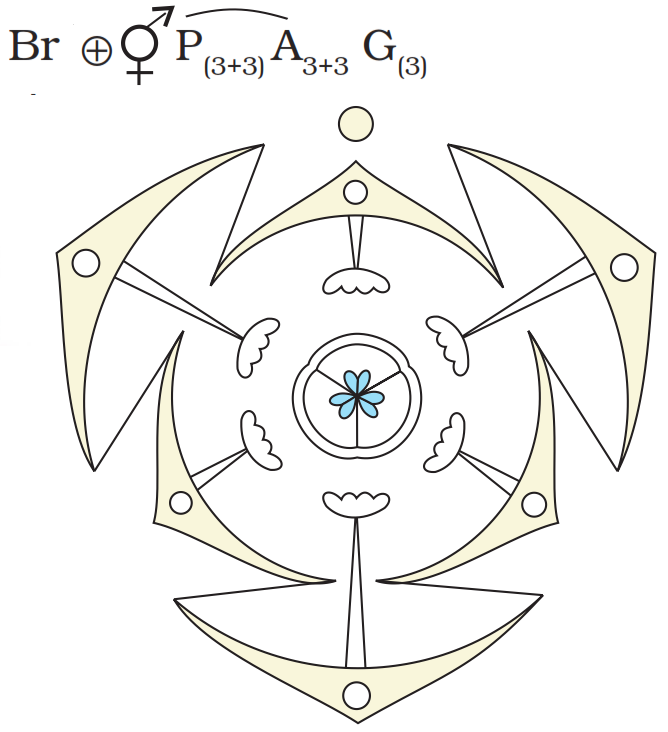
Write the floral fromula of onion plant. Draw its floral diagram. Give the nature of gynoecium of its flower.
Answer
Floral formula:
In onion, the ovary is tricarpellary, syncarpous superior, trilocular with many ovules on axile placentation.
View full question & answer
Question 461 Mark
Mention the functions of underground stems.
Answer
  1. Underground stems store food in them.
  2. They are the organs of perennation to tide over unfavourable conditions.
View full question & answer
Question 471 Mark
Where is mother axis drawn in a floral diagram?
Answer
Mother axis is drawn at the top of floral diagram.
View full question & answer
Question 481 Mark
Name one ornamental plant each of family.Solanceae and Fabaceae.
Answer
Cestrum nocturnum of family Solanaceae and Lupinus of family Fabaceae.
View full question & answer
Question 491 Mark
Name the ornamental plants of lily family.
Answer
Asparagus, Ruscus, Yucca, Aloe, Gloriosa, Smilax, tulips, lilies, etc.
View full question & answer
Question 501 Mark
What type of leaf modification is seen in Australian Acacia?
Answer
The rachis becomes expanded to carry out photosynthesis, as the leaflets are very small and fall off early.
View full question & answer
Question 511 Mark
'X' is the female reproductive part of the flower, which consists of three parts A, B, and C. 'A' is the swollen bottom part and C is the sticky part. Name all X, A, B, and C.
Answer
X is a carpel; A is ovary; B is style and C is stigma.
View full question & answer
Question 521 Mark
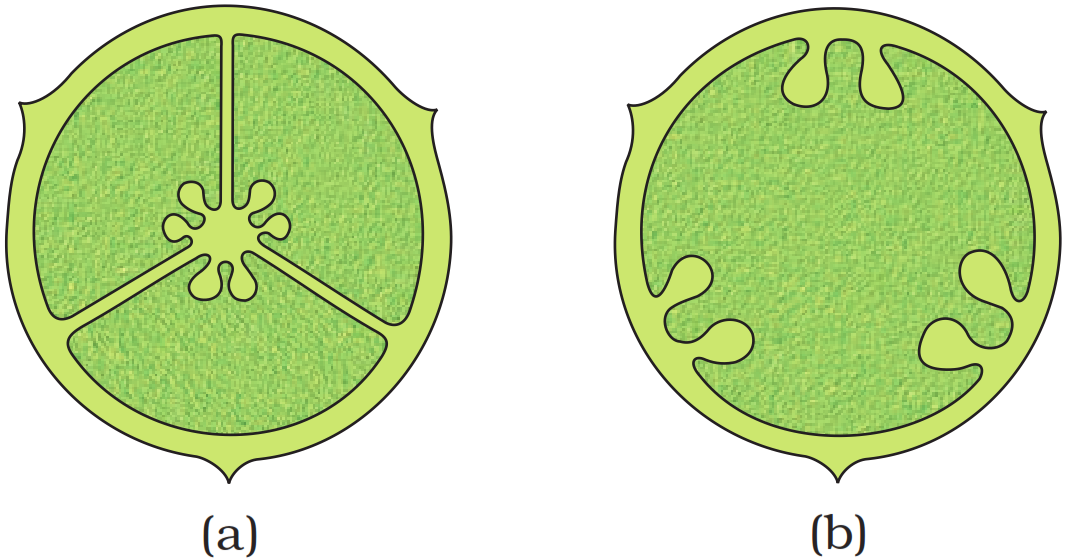
Name the type of placentation shown in the given figures (i) and (ii). Give one example of each type.
Answer
  1. Axile placentation e.g., China rose, lemon.
  2. Parietal placentation e.g., cucumber, watermelon.
View full question & answer
Question 541 Mark
In a longitudinal section of root tip, starting from tip upwards, are the regions of:
  1. Meristem, root cap, cell enlargement, cell maturation.
  2. Cell maturation, cell enlargement, meristem, root cap.
  3. Cell enlargement, cell maturation, root cap, meristem.
  4. Root cap, meristem, cell enlargement, cell maturation.
Answer
  1. Root cap, meristem, cell enlargement, cell maturation.
View full question & answer
Question 551 Mark
Mention the two major functions of stem.
Answer
  1. To spread out the branches bearing leaves, flowers and fruits.
  2. To conduct water and minerals absorbed by the roots and photosynthates from the leaves.
View full question & answer
Question 561 Mark
Why the leaves of Aloe and Agave store water?
Answer
In Aloe and Agave, the leaves store water to resist drought conditions.
View full question & answer
Question 571 Mark
Vinay was going through an industrial area with his grandfather. While on the way, he felt suffocated and dizzy due to the smoke coming out of the factory. Vinay got angry and started shouting that all these factories should be closed. His grandfather calms him down and explained that it is due to large scale cutting of trees for urbanization and industrialization which has disturbed the balance of atmospheric gases. He also explained various economic importance of plants.
  1. Large scale cutting of trees leads to ___________________?
  2. What initiatives should be taken to maintain the atmospheric balance.
  3. Give various economic importance of plants.
  4. What values are shown by his grandfather?
Answer
  1. Large scale cutting of trees leads to deforestation.
  2. The initiatives that should be taken to maintain the atmospheric balance are:
  1. Planting trees at large scale.
  2. Prevent deforestation to.
  3. Run social awareness programmes.
  1. Plants are of economic importance because they provide us:
  1. (a) food, fibres, spices and beverages.
  2. (b) timber and medicines.
  3. (c) add beauty to environment.
  1. Values shown by Vinay's grandfather are concern for nature and environment, informative and knowledgeable.
View full question & answer
Question 581 Mark
How is valvate aestivation different from twisted aestivation?
Answer
Valvate Aestivation
Twisted Aestivation
The margins of the sepals/ petals in a whorl just touch one another, but there is no overlapping of them.
One margin of the sepal/ petal overlaps the margin of the sepal/ petal of the same whorl and one of its margins is overlapped by the next.
View full question & answer
Question 601 Mark
Assign the following to their respect plant families and describe the nature of gynoecium in each of them:
  1. Trifolium.
  2. Petunia.
Answer
  1. Trifolium belongs to Fabaceae: Ovary is monocarpellary, superior, unilocular with many ovules on marginal placentation.
  2. Petunia belongs to Solanaceae: Ovary is tricarpellary, syncarpous superior, trilocular with many ovules on swollen axile placentation.
View full question & answer
Question 611 Mark
Define inflorescence.
Answer
An inflorescence is an axis bearing a number of flowers articular manner.
View full question & answer
Question 621 Mark
Which same plant part has transformed into the following different modifications?
  1. Tendril of pumpkin/ watermelon.
  2. Thorn of Citrus/ Bougainvillea.
Answer
Axillary bud (stem).
View full question & answer
Question 631 Mark
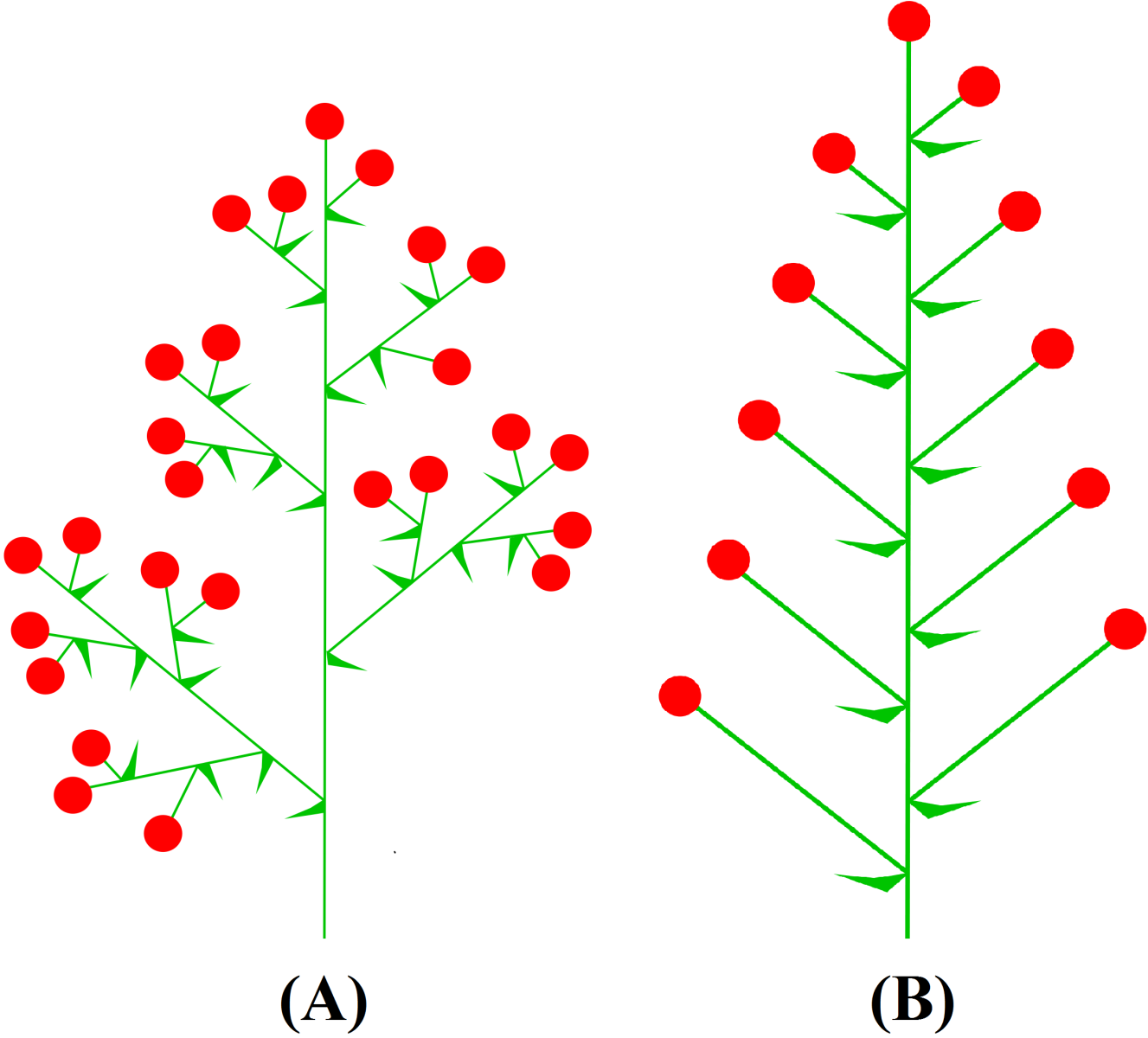
Which kind of inflorescence is shown in following diagram? Describe its feature.
Answer
This is compound corymb. Its axis is branched and each branch bears a corymb-like inflorescence, e.g. cauliflower (Brassica oleracea), Pyrus terminalis, etc.
View full question & answer
Question 651 Mark
Why is a leaf of neem called pinnately compound?
Answer
A neem leaf is pinnately compound because a number of leaflets are arranged along the length of the rachis.
View full question & answer
Question 671 Mark
Mention (a) the symmetry of flower and (b) the characteristic type of fruit, found in Fabaceae.
Answer
  1. Zygomorphic.
  2. Legume.
View full question & answer
Question 681 Mark
Mention the two functions of petiole in a leaf.
Answer
  1. It helps to hold the leaf blade to light.
  2. It allows the leaf blade to flutter in the wind to get a cooling effect and bring fresh air to the leaf surface.
View full question & answer
Question 691 Mark
Which roots are involved in nitrogen-fixation? Name them.
Answer
Nodulated tap roots are involved in nitrogen-fixation, e.g., roots in Pisum sativum.
View full question & answer
Question 721 Mark
What is meant by sheathing leaf base? Which type of plants have it?
Answer
  • When the leaf base expands into a sheath covering the stem partially or wholly, it is called sheathing leaf base.
  • It is found in monocot plants.
View full question & answer
Question 731 Mark
How superior and inferior ovaries are indicated by symbol?
Answer
Superior ovary, e.g., $\underline{\text{G}}$ Inferior ovary, e.g., $\overline{\text{G}}.$
View full question & answer
Question 741 Mark
Why is phyllotaxy in Alstonia described as whorled?
Answer
In Alstonia, phyllotaxy is whorled, as a number of leaves arise from a node.
View full question & answer
Question 761 Mark
What is the role of cork cambium?
Answer
During secondary growth the epidermal layer gets broken and needs to be replaced with new protective layer. The cork cambium helps create a new layer for protection.
View full question & answer
Question 781 Mark
What is root cap? What is its function?
Answer
  • Root cap is the thimble-like structure that covers the root apex/ tip.
  • It protects the tender apex of the root as it penetrates through the soil.
View full question & answer
Question 811 Mark
  1. What is a parthenocarpic fruit?
  2. What are pneumatophores?
Answer
  1. A fruit which develops without fertilisation of the ovary, is called a parthenocarpic fruit.
  2. Pneumatophores are the roots which come out of the ground and grow vertically upwards in plants growing in marshes/ swamps; it is an adaptation to get atmospheric oxygen for respiration.
View full question & answer
Question 821 Mark
What type of leaf modification is seen in Australian Acacia?
Answer
The rachis becomes expanded to carry out photosynthesis, as the leaflets are very small and fall off early.
View full question & answer
Question 831 Mark
Write a short note on two main types of roots.
Answer
Two main type of roots are tap root and adventitious root. Tap root develops from radicle of embryo, e.g., pea, gram, etc. Adventitious root develops from any part of the plant other than the radicle, e.g., wheat, rice, etc.
View full question & answer
Question 841 Mark
Define morphology.
Answer
Morphology is the branch of science/ biology that studies the external features of an organism.
View full question & answer
Question 861 Mark
A maize grain is not a seed. Explain.
Answer
A maize grain is a single-seeded fruit called caryopsis or grain, in which the pericarp (fruit wall) is inseparably fused with testa.
View full question & answer
Question 871 Mark
The scutellum observed in a grain of wheat or maize is comparable to which part of the seed in other monocots.
Answer
Cotyledons.
View full question & answer
Question 881 Mark
What constitute primary meristem? Why?
Answer
Apical meristem and intercalary meristem constitute primary meristem. They are called primary meristem because they appear early in the plant's life.
View full question & answer
Question 891 Mark
Mention two general functions that roots perform.
Answer
Functions of roots:
  1. Roots absorb and conduct water and minerals from the soil.
  2. Roots help in anchorage of the plant to the substratum.
View full question & answer
Question 931 Mark
What are stilt roots? Give two examples.
Answer
Stilt roots are the adventitious roots which arise in clusters from the basal nodes just above the ground; they provide additional support to the plants, e.g., maize, sugar cane.
View full question & answer
Question 961 Mark
What does hilum of a seed represent?
Answer
Hilum is the scar left on the seed coat by the stalk of the ovule with which the seed was attached to the fruit.
View full question & answer
Question 971 Mark
How is a staminode different from a stamen?
Answer
A staminode is a sterile stamen that does not produce pollen grains, while a stamen produces functional pollen grains.
View full question & answer
Question 981 Mark
Why are velamen tissues present in epiphytic roots?
Answer
The velamens are spongy tissues, which help epiphytic roots in absorbing atmospheric water vapours.
View full question & answer
Question 991 Mark
In a typical leaf what kind of cells are usually present in mesophyll?
Answer
Cells containing chlorophylls compose the mesophyll in leaves.
View full question & answer
Question 1011 Mark
What is pericarp? Name its three different regions in a fleshy fruit.
Answer
  • The wall of a true fruit, is called pericarp.
  • Epicarp (outer), mesocarp (middle) and endocarp (inner) are its layers.
View full question & answer
Question 1021 Mark
Can xylem be called a permanent tissue? Why or why not?
Answer
Xylem does not divide further hence it can be called a permanent tissue.
View full question & answer
Question 1041 Mark
How will you show the monocarpellary and unilocular condition of gynoecium of Lathyrus odoratus (sweet pea)?
View full question & answer
Question 1051 Mark
Name two plants with stem thorn. What is the advantage of thorn to the plants?
Answer
  • Stem thorns are found in Bougainvillea and Citrus.
  • The thorns protect the plant from browsing animals.
View full question & answer
Question 1071 Mark
Why are flowers of cucurbits referred to as epigynous?
Answer
Flowers of cucurbits are epigynous because the ovary is situated below all the other floral whorls, inside the cup-like thalamus.
View full question & answer
Question 1081 Mark
Why is the corolla of Solanum described as gamopetalous?
Answer
In Solanum, the corolla is gamopetalous, because all the petals are united.
View full question & answer
Question 1091 Mark
Give example of:
  1. Rhizome.
  2. Tuber.
Answer
  1. Rhizome- Zingiber officinale (ginger).
  2. Tuber- Solanum Tuberosum (potato).
View full question & answer
Question 1101 Mark
List out the three characteristics of modified stem bulb with examples.
Answer
Modified stem bulb is highly reduced disc-like stem. It bears fibrous adventitious roots at its base. Leaf bases form bultslets that grow into new plant, e.g., Allium cepa (onion).
View full question & answer
Question 1111 Mark
Name two plants of Fabaceae that yield each of the following:
  1. Edible oil and.
  2. Foddera.
Answer
  1. Soybean and groundnut.
  2. Sesbania, Trifolium.
View full question & answer
Question 1121 Mark
What is the function of companion cells in phloem?
Answer
Companion cells help in maintaining pressure gradient in sieve tubes. Pressure gradient is important for conduction of materials in phloem.
View full question & answer
Question 1131 Mark
Differentiate family-Solanaceae and Liliaceae SD on the basis of gynoecium.
Answer
Gynoecium in family:
S.No.
Solanaceae
Liliaceae
i.
Bicarpellary, biloculare Placenta swollen with many ovules
Tricarpellary, trilocular Axile placentation
View full question & answer
Question 1141 Mark
Name one plant of Liliaceae as a source for each of the following:
  1. Medicine.
  2. Vegetables.
  3. Colchicine.
Answer
  1. Aloe.
  2. Asparagus.
  3. Colchicum.
View full question & answer
Question 1151 Mark
What are the functions performed by the veins in a leaf?
Answer
  1. Veins provide rigidity and support to the leaf blade.
  2. They act as the channels through which water and food materials are transported.
View full question & answer
Question 1181 Mark
Stomata are present on the ventral side of a dicot leaf. What may be the reason?
Answer
The ventral surface is facing the sun while the dorsal surface is usually away from the sun. Stomata need to be in the direction of sun for facilitating transpiration and absorption of light energy.
View full question & answer
Question 1191 Mark
  1. What are bracteate flowers?
  2. What are parthenocarpic fruits?
  3. Give two examples of non-endospermic seeds? Why are they called so?
Answer
  1. Flowers which bear reduced leaf-like structures, called bracts, at the base of the pedical, are called bracteate flowers.
  2. Parthenocarpic fruits are those fruits which develop from the ovary without fertilisation.
  3.  
  • Pea, bean, groundnut are non-endospormic seed.
  • Since the endosperm is completely used by the developing embryo, the nature seed has no endosperm is hence, called non-endospormic.
View full question & answer
Question 1201 Mark
What is phyllotaxy? Name the type or phyllotaxy found (i) Mustard, (ii) Alstonia and (iii) Calotropis.
Answer
Phyllotaxy refers to the mode of arrangement of leaves on the stem/ branch.
  1. Alternate.
  2. Whorled.
  3. Opposite.
View full question & answer
Question 1211 Mark
Write three similarities between the ovaries of Solanaceae and Liliaceae.
Answer
Similarities:
  1. Ovaries are syncarpouse.
  2. They are superior and.
  3. Placentation is axile, with many ovules.
View full question & answer
Question 1221 Mark
How the runners of grasses can serve as means of vegetative propagation?
Answer
When a runner gets cut incidentally into the several parts and each part can grow independently.
View full question & answer
Question 1231 Mark
What is aleurone layer in a maize grain?
Answer
It is the proteinaceous layer that forms the outer covering of the endosperm and separates the embryo from it.
View full question & answer
Question 1241 Mark
How does the mesocarp of mango differ from that of coconut, though they both are drupes?
Answer
Mesocarp of mango is fleshy and edible, while that of coconut is fibrous.
View full question & answer
Question 1251 Mark
What is root cap? Which any two variations are found in this?
Answer
The apex of each root is covered by a cushion of thin-walled cells known as root cap. Variations:
  1. Multiple root cap is present in Pandanus (screw pine).
  2. In aquatic plants, the root apex is enclosed within a sac-like structure called root packet, e.g. Pistia, Eichhornia, etc.
View full question & answer
Question 1281 Mark
Why development of root branches is Endogenous?
Answer
Root branches develop from the interior (usually pericycle) of the parent root. This origin is called endogenous.
View full question & answer
Question 1301 Mark
You are given two slides having T.S. of roots and stems. How will you identify which slide is of root and which is of stem?
Answer
Presence or absence of hair on the epidermis will give the clue. Those with hair are slides of root. Cuticles will be present on the slide of stem.
View full question & answer