Questions

2 Marks Questions

Take a timed test

62 questions · self-marked practice — reveal the answer and mark yourself.

Question 12 Marks
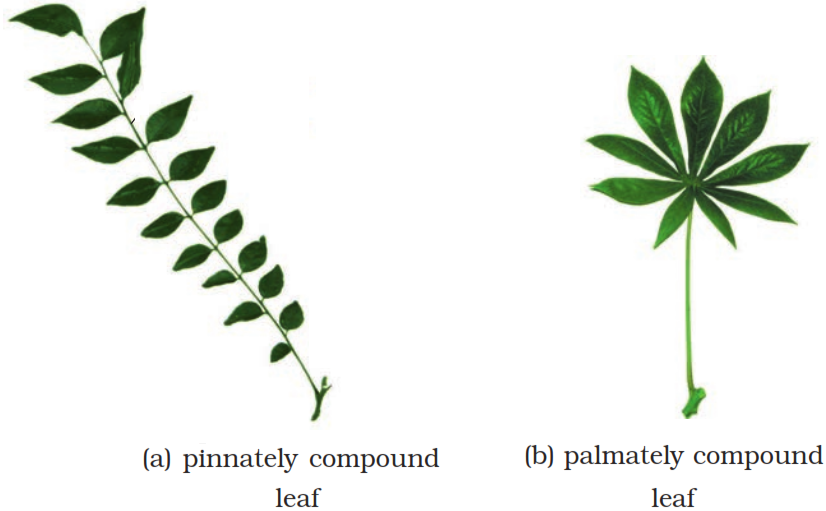
How is a pinnately compound leaf different from a palmately compound leaf?
Answer
Leaflets are present on a common axis (rachis) in case of pinnately compound leaves. In palmately compound leaves, the leaflets originate from the apex of the midrib.
View full question & answer
Question 22 Marks
Differentiate between: Fibrous root and adventitious root.
Answer
 
Fibrous root
 
Adventitious root
1.
In monocots, the primary root which develops from the rsdicle of the seed is short-lived and is replaced by a large number of roots arising from the base of the stem.
1.
These roots arise from any part of the plant other than the radicle of seeds.
2.
It is found in wheat and other cereals.
2.
It is found in babyan monstera, and other plants.
View full question & answer
Question 32 Marks
Define the following terms: Actinomorphic.
Answer
Actinomorphic: When flower can be divided into equal radial halves in any radial plane passing through the centre, it is said to be actinomorphic, e.g., mustard, Datura etc.
View full question & answer
Question 42 Marks
Justify the following statements on the basis of external features: Underground parts of a plant are not always roots.
Answer
Various parts of plants are modified into underground structures to perform various functions such as stems, leaves, and even fruits. The stems in ginger and banana are underground and swollen due to storage of food. They are called rhizomes. Similarly, corm is an underground stem in Colocasia and Zamin-khand. The tips of the underground stem in potato become swollen due to the accumulation of food and forms tuber. Tubers bear eyes, which are subtended by a leaf scar. Basal leaves in onions become fleshy because of the accumulation of food. In peanuts, the flower after fertilization gets pushed inside the soil by growing a flower stalk. The formation of fruits and seeds takes place inside the soil.
View full question & answer
Question 52 Marks
Explain with suitable examples the different types of phyllotaxy.
Answer
Phyllotaxy is the pattern of arrangement of leaves on the stem or branch. It is of three types: alternate, opposite and whorled.
  1. Alternate Arrangement of Leaves: In alternate type of phyllotaxy, a single leaf arises at each node in alternate manner, as in China rose, mustard and sun flower plants.
  2. Opposite Arrangement of Leaves: In opposite type, a pair of leaves arise at each node and lie opposite to each other as in Calotropis and guava plants.
  3. Whorled Arrangement of Leaves: If more than two leaves arise at a node and form a whorl, it is called whorled, as in Alstonia.
View full question & answer
Question 62 Marks
Differentiate between: Apocarpous and syncarpous ovary.
Answer
 
Apocarpous
 
Syncarpous ovary
1.
The flowers with apocarpus ovary have more than one carpel. These carpels are free.
1.
The flowers with syncaprpous ovary have more than one carpel. However, these carpels are fused.
2.
It is found in lotus and rose flowers.
2.
It is found in the flowers of tomato and mustard.
View full question & answer
Question 72 Marks
Differentiate between: Racemose and cymose inflorescence.
Answer
 
Racemose
 
Inflorescence
1.
Younger flowers are persent at the tip while older flowers are arranged at the base of this inflorescence. Such an arrangement is called acropetal succession.
1.
Younger flowers are persent at the tip while older flowers are arranged at the base of the inflorescence, while older flowers are present at the top. Such an arrangement is called basipetal succession.
2.
The main axis in racemose inflorescence continues to grow and produce flowers laterally.
2.
The main axis in cymose inflorescence has limited growth, which later terminates into a flower.
View full question & answer
Question 82 Marks
Define the following terms: Placentation.
Answer
Placentation: The arrangement of ovules within the ovary is known as placentation. The placentations are of different types namely, marginal, axile, parietal, basal, and free central.
View full question & answer
Question 92 Marks
Define the following terms: Superior ovary.
Answer
Superior ovary: In hypogynous flower, the gynoecium occupies the highest position while the other parts are situated below it. The ovary in such flowers is said to be superior, e.g., mustard, brinjal.
View full question & answer
Question 102 Marks
Define the following terms: Aestivation.
Answer
Aestivation: The mode of arrangement of accessory floral organs (sepals and petals) in relation to one another in floral bud is known as aestivation. The main types of aestivation are valvate, twisted, imbricate, and vexillary.
View full question & answer
Question 112 Marks
Define the following terms: zygomorphic.
Answer
Zygomorphic: When a flower can be divided into two similar halves only in one particular vertical plane, it is said to be zygomorphic, e.g., pea, gulmohar, bean, cassia.
View full question & answer
Question 122 Marks
Justify the following statements on the basis of external features: Flower is a modified shoot.
Answer
During the flowering season, the apical meristem gives rise to the floral meristem. The axis of the stem gets condensed, while the internodes lie near each other. Instead of leaves, various floral appendages arise from the node. Therefore, it can be said that the flower is a modified shoot.
View full question & answer
Question 132 Marks
What are the differences between meristematic tissues and permanent tissues?
Answer
Differences between meristematic tissues and permanent tissues:
S.No.
Meristematic Tissues
Permanent Tissues
i.
Cells keep on dividing.
Cells stop dividing.
ii.
Growth is the basic function.
Protection is the basic function.
iii.
Found in tips of roots and stem.
Found in girth and periphery.
View full question & answer
Question 142 Marks
Seeds of some plants germinate immediately after shedding from the plants while in other plants they require a period of rest before germination. The later phenomena is called as dormancy. Give the reasons for seed dormancy and some methods to break it.
Answer
Reasons for seed dormancy:
  1. Hard seed coat.
  2. Impermeable layers prevent uptake of water.
  3. ABA inhibits growth and delays germination.
  4. Some seeds have immature embryo which delays germination.
Methods to break seed dormancy:
  1. Physical dormancy is broken by changes in temperature and other environmental conditions.
  2. Physical dormancy is also broken when the seed passes through the gut of an animal.
  3. Mechanical dormancy is broken by help from some external agents. For example; an animal may break the hard seed coat.
  4. Chemical dormancy is broken by enzymatic actions.
View full question & answer
Question 152 Marks
Why is maize grain usually called as a fruit and not a seed?
Answer
In a maize grain, the seed coat is membranous and is fused with the fruit wall. In fact, a maize grain is a ripened ovary which contains a ripened ovule. Hence, a maize grain is usually called a fruit and not a seed.
View full question & answer
Question 162 Marks
Mention the modified function(s) performed by:
  1. Underground stem of potato.
  2. Axillary bud of watermelon.
Answer
  1.  
  • It stores food materials.
  • It acts as an organ of perennation to tide over unfavourable conditions and helps in vegetative reproduction.
  1.  
  • Axillary bud of watermelon is modified into tendril, which helps the plant to climb on the support.
View full question & answer
Question 172 Marks
What are bracteate and ebracteate flowers?
Answer
  • Bract is a small reduced leaf-like structure, found at the base of the pedicel of the flower.
  • If a flower has a bract, it is called bracteate.
  • If a flower does not have a bract, it is called ebracteate.
View full question & answer
Question 182 Marks
Roots obtain oxygen from air in the soil for respiration. In the absence or deficiency of $O _2$, root growth is restricted or completely stopped. How do the plants growing in marshlands or swamps obtain their $O _2$ required for root respiration?
Answer
Plants found in the marshlands have root modifications called Pneumatophores which are negatively geotropic that is they come out of the ground and grow vertically upwards to take up oxygen from the atmosphere.
View full question & answer
Question 192 Marks
Name one member of Solanaceae that yields each of the following:
  1. Medicine.
  2. Fumigatory.
  3. Spice.
  4. Vegetable.
Answer
  1. Belladonna, Ashwagandha.
  2. Tobacco.
  3. Chilli.
  4. Potato, tomato, brinjal.
View full question & answer
Question 202 Marks
Justify the following statements on the basis of external features.
  1. Underground parts of a plant are not always roots.
  2. Flower is a modified shoot.
Answer
  1. Underground parts of a plant are not always roots. Sometimes stem or stem branches occur underground to perform some special functions. For example, potato tuber is a modified stem which is underground. A potato tuber shows nodes and internodes, scale leaves and buds at the nodes. It also has an apical bud at the tip of potato tuber which confirms it as a stem.
  2. Flower is a modified shoot consisting of a highly reduced stem branch to form thalamus in which the nodes are borne only towards the tip. The floral parts, i.e., sepals, petals, stamens and carpels are arranged in their respective whorls and arise from nodes. The growing point of floral bud is used up in the production of floral organs.
View full question & answer
Question 212 Marks
How do you represent the following by symbols in a floral formula?
  1. Bisexual.
  2. Zygomorphic.
  3. Actionomorphic.
  4. Superior ovary
View full question & answer
Question 222 Marks
Mention key differences between xylem and phloem.
Answer
Differences between xylem and phloem:
S.No.
Xylem
Phloem
i.
Composed of tracheids, vessels and xylem parenchyma.
Composed of sieve tubes, companion cells and phloem parenchyma.
ii.
Facilitate conduction of water and minerals from roots.
2. Facilitate conduction of food from leaves.
View full question & answer
Question 242 Marks
Flower is a reproductive unit of a plant.
  1. It is morphologically called shoot. Explain.
  2. On which part, floral whorls are arranged?
Answer
  1. Flower is the reproductive unit of plant. It is considered, as a shoot because the position of the buds of both flower and shoot is same and can be terminal or axillary in position.
  2. Floral whorls are arranged on the thalamus, swollen end of axis.
View full question & answer
Question 252 Marks
Sunflower is not a flower. Explain.
Answer
Sunflower is not a single flower rather it represents a complete inflorescence, called capitulum or racemose head. Small sessile flowers called florets develop compactly over discoid peduncle. They open in centripetal order. They are surrounded and protected by an involucre of bracts. The florets are of two types namely, ray florets and disc florets. Ray florets are usually female and zygomorphic and disc florets are bisexual and actionomorphic. In Helianthus, the ray florets are towards the periphery and disc florets are at the centre of the inflorescence.
View full question & answer
Question 262 Marks
Describe the inflorescence type of Solanaceae family.
Answer
Solitary, axillary or terminal, umbellate or occasionally helicoid and scorpoid cyme.
View full question & answer
Question 272 Marks
Name a plant from family-Fabaceae which yield the following.
  1. Timber.
  2. Dye.
  3. Vegetable.
  4. Fodder.
Answer
  1. Dalbergia sisso.
  2. Indigofera tinctoria.
  3. Vicia faba (broad bean).
  4. Medicago sativa (alfalfa).
View full question & answer
Question 282 Marks
Differentiate between Solanaceae and Fabaceae, with respect to their gynoecium.
Answer
S. No
Solanaceae
Fabaceae
(i)
Ovary is bicarpellary, syncarpous.
Ovary is monocarpellary.
(ii)
Ovules are present on swollen axile placenta.
Ovules are present on marginal placenta.
(ii)
Ovary is bilocular.
Ovary is unilocular.
View full question & answer
Question 292 Marks
Differentiate between. Pollen and pollenium.
Answer
Differences between pollen and pollinium are as follows:
 
Pollen
Pollinium
i.
Pollen or Pollen grain is single microspore and represents male gametophyte. Polliniumk represents group of pollen grains held together.
ii.
Pollen grains are found in number of angisopermic families viz. Liliaceae, Convulvulaceae, Malvaceae, etc. Pollinium is found in Orchidaceae and Asclepiadaceae.
View full question & answer
Question 302 Marks
Write the name of units of these flower parts.
  1. Calyx.
  2. Corolla.
  3. Androecium.
  4. Gynoecium.
Answer
  1. Calyx-Sepals.
  2. Corolla-Petals.
  3. Androecium-Stamens.
  4. Gynoecium-Carpels.
View full question & answer
Question 322 Marks
Mention the characteristics of the cells in the region of meristem in roots.
Answer
  • Cells are small.
  • They are thin-walled.
  • They have dense protoplasm.
  • They divide repeatedly.
View full question & answer
Question 332 Marks
Give a brief overview of structure and function of parenchyma.
Answer
  • Structure of Parenchyma: It is composed of round, spherical or polygonal cells. Cells are isodiametric with thin walls. The tissue has intracellular spaces.
  • Function: Photosynthesis, food storage and secretion.
View full question & answer
Question 342 Marks
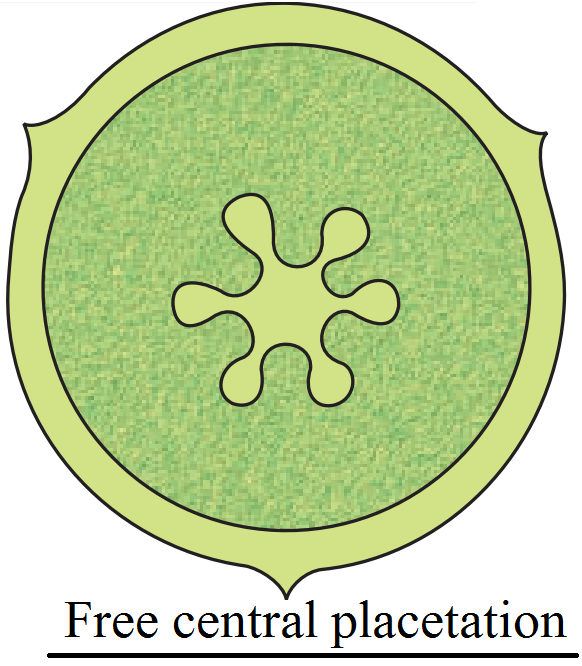
How can you differentiate between free central and axile placentation?
Answer
Differences between free central and axile placentation are as follows:
  1. In axile placentation, ovary is partitioned into chambers whereas in free central placentation ovary is single chambered.
  2. The ovule bearing column occurs in the central region where septa meet in axile placentation whereas in free central placentation ovule bearing column lies free in the centre of ovary and septa are absent.
​​​​​​​
View full question & answer
Question 352 Marks
Rashi, a class VII student was sitting with her mother (who is an editor for Biology). Her mother was insisting her to have some fruits to which Rashi refused repeatedly. Her mother tried convincing her by saying that proper diet is important for growth. Rashi argued saying that even plants grow without taking any food. To this, her mother smiled and explained her how plants make food with the help of leaves.
  1. Name the term used for the process of food production in plants.
  2. What are the factors required by plants for this process?
  3. What are the additional function of leaves.
  4. What values are shown by Rashi's mother?
Answer
  1. Photosynthesis.
  2. The factors are $CO _2$, water, temperature, light, etc.
  3. Additional functions of leaves are interchange of gases (through stomata) and evaporation of water.
  4. Values shown are caring nature and concern for her child's health as well as knowledge of the subject.
View full question & answer
Question 362 Marks
Reticulate venation is found in dicot leaves while in monocot leaves venation is of parallel type. Mention one exception to this generalization.
Answer
Reticulate venation is a characteristic of dicots but there are exceptions and they are also found in some monocots like Alocasia, Smilax etc, while parallel venation is a characteristic if monocots but they are alsofound in dicots like corymbium, calophyllum etc as exceptions.
View full question & answer
Question 372 Marks
Provide the scientific term for the following:
  1. The flat and expended portion of a leaf.
  2. The roots which come above the surface of soil LEE to absorb air.
  3. The sepals which are united.
  4. The roots which arise from parts of the plant other than the radicle.
Answer
  1. Lamina.
  2. Pneumatophores.
  3. Gamosepalous.
  4. Adventitious roots.
View full question & answer
Question 382 Marks
Give one basic difference between the following:
  1. Reticulate venation and parallel venation.
  2. Thorn and spine.
Answer
  1.  
S. No
Reticulate Venation
Parallel Venation
(i)
When the midrib and its branches make a network (reticulum) on the lamina, it is called reticulate venation.
When the veins on the lamina run parallel to one another, it is called parallel venation.
(ii)
It is characteristically found in dicot plants.
It is characteristically found in monocot plants.
  1.  
  • Thorn is a stem modified into a woody, straight and pointed structure.
  • Spine is a leaf modification in arid plants to reduce water loss and protection of plants from browsing animals.
View full question & answer
Question 402 Marks
Differentiate androecium of Solanaceae and Liliaceae.
Answer
Difference between androecium of Solanaceae and Liliaceae are:
S.No.
Solanaceae
Liliaceae
i.
Five stamens, epipetalous, filaments of unequal length, Anther dithecous, connivent (in contact with each other), introse.
Stamen 6, arranged in two whorls of three each, epipetalous, anthers dithecous, dorsifixed or versatile, introse.
View full question & answer
Question 412 Marks
Differentiate between. Stamen and staminoid.
Answer
Differences between stamen and stami-node are as follows:
 
Stamen
Stami-node
i.
It is fully developed male reproductive part of a flower. It is under developed male reproductive part of a flower.
ii.
Its anther contains functional pollen grains. Fuctional pollen grains are absent.
View full question & answer
Question 422 Marks
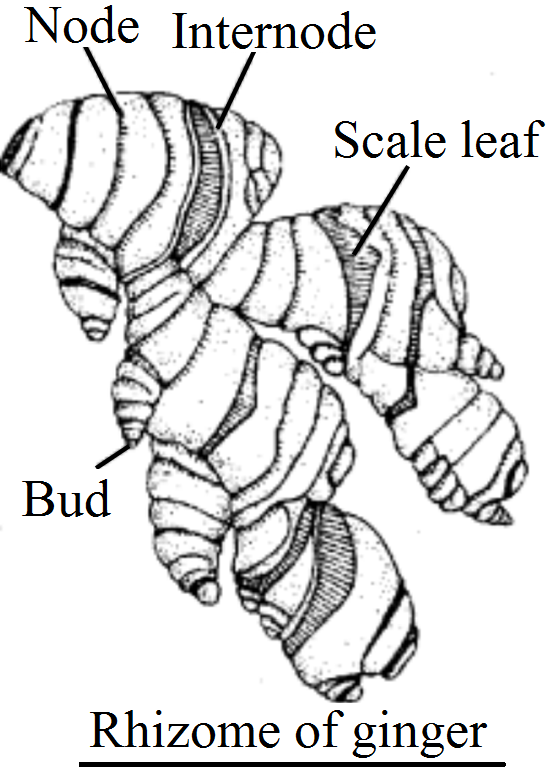
Rhizome of ginger is like the roots of other plants that grows underground. Despite this fact ginger is a stem and not a root. Justify.
Answer
Rhizome is a type of underground stem, these are modified plant structures derived from stem tissues but they exists under the soil surface. In Plants, seedlings shows two axes of growth, structures that developed downward called as roots and those developed upward out of the soil called stems. In ginger plant development is upward out of the soil and hence, the stems are modified to store energy, these stems have nodes with buds where leaves and flowers arise at specific location. Rhizome usually produces aerial stem and underground roots from these buds. So, it looks like and acts like a root but is different because it grows horizontally.
View full question & answer
Question 432 Marks
Differentiate between. Pedicel and peduncle.
Answer
Differences between pedicel and peduncle are as follows:
 
Pedicel
Peduncle
i.
It is stalk of the flower. It is flower bearing axis of the inflorescence.
ii.
A pedicel bears a single flower. A peduncle generally bears several flowers.
View full question & answer
Question 442 Marks
Give two examples of roots that develop from different parts of the angiospermic plant other than the radicle.
Answer
The root that arise from parts of plant other than radicle are called adventitious roots. Pneumatophores-for respiration, Stilt roots-for support, Prop roots-for support.
View full question & answer
Question 452 Marks
Differentiate between the androecium of Fabaceae and Solanaceae.
Answer
S. No
Fabaceae
Solanaceae
(i)
There are ten stamens.
There are generally five stamens.
(ii)
Stamens are free from the corolla.
Stamens are attached to petals-epipetalous.
(iii)
Nine stamens are united by their filaments and one is free-diadelphous.
Stamens are free from one another.
View full question & answer
Question 462 Marks
In Opuntia the stem is modified into a flattened green structure to perform the function of leaves (i.e., photosynthesis). Cite two other examples of modifications of plant parts for the purpose of photosynthesis.
Answer
Some plants of arid regions modify their stems into flattened {Opuntia), or fleshy cylindrical {Euphorbia) structures. These modified stems of indefinite growth are called phylloclades. They contain chlorophyll and carry out photosynthesis.
View full question & answer
Question 472 Marks
Explain Collenchyma.
Answer
  • Structure of Collenchyma: The cells are round, spherical or polygonal. Intracellular space is present in the tissue. Cells are thickened at corners due to cellulose, hemicellulose or pectin dposition. They are found in young stem and petiole of leaf.
  • Function: Provide mechanical support to growing parts of a plant.
View full question & answer
Question 482 Marks
Name the type of stem tendrils found in these plants.
  1. Passiflora.
  2. Luffa.
  3. Vitis.
  4. Antigonon.
Answer
  1. Passiflora- Axillary.
  2. Luffa- Extra-axillary.
  3. Vitis- Apical.
  4. Antigonon- Floral.
View full question & answer
Question 492 Marks
Differentiate between bract and bracteole.
Answer
Differences between bract and bracteole are:
S.No.
Bract
Bracteole
i.
It is a small leaf-like structure borne on the mother axis from where a flower develops.
it is a small leaf-like structure present on the pedicel of a flower.
ii.
It bears a flower in its axil.
It is borne over the stalk of the flower.
iii.
A single bract occurs at one place.
Generally two bracteoles occur over the pedicel of a flower.
View full question & answer
Question 502 Marks
Differentiate between a dicot (gram) seed and a maize grain.
Answer
S. No
Dicot Seed (Gram)
Maize Grain
(i)
The seed coat is distinct from the pericarp.
The seed coat and the pericarp are completely fused.
(ii)
There are two cotyle dons, attached laterally on the embryonal axis.
There is a single coty ledon, called scutellum, pushed towards one side.
(iii)
There is no protective covering for the plumule and radicle.
Plumule is covered by coleoptile and radicle by coleorhizae.
(iv)
Food is stored in cotyledons.
Food is stored in the endosperm.
View full question & answer
Question 512 Marks
Represent diagrammatically a pinnately compound leaf and a palmately compound leaf. Name an example of each.
Answer
e.g., Neem, Rose. e.g., Silk cotton.
View full question & answer
Question 522 Marks
Dissemination of seeds is necessary for better growth of plants of the next generation, because it helps in getting access to necessary resources for growth. Which of the following is similar to this statement? How can we correlate this with our life?
  1. We should go out and play outdoor games, instead of sticking to our computer screens.
  2. One should travel a lot because traveling is a good way to learn about things around us.
  3. One should get rid of home-sickness and leave his home-town to grab most of the opportunities available.
Answer
  1. One should get rid of home-sickness and leave his home-town to grab most of the opportunities available.
If someone becomes home-sick and remains confined at the place he is familiar with, his vision does not become wide. The person lives like as if living inside a cocoon; isolated from the outer world. When we see new places, we get the opportunity to learn many new things. We learn how to make friends with strangers in a strange place. Learning to live in unfamiliar environment also gives some survival benefits as it makes the person more adaptive to the changed situation.
View full question & answer
Question 532 Marks
How do you distinguish between hypogeal germination and epigeal germination? What is the role of cotyledon (s) and the endosperm in the germination of seeds?
Answer
No Hypogeal germination No Epigeal germination
(i) Rapid growth and elongation of epicotyl. (i) Rapid growth and elongation of hypocotyl.
(ii) Cotyledons remain non-green and non- photosynthetic. (ii) Cotyledons become green and photosynthetic.
(iii) Examples: Castor, bean (iii) Examples: Maize, rice
Role of cotyledons and endosperm: Cotyledons and endosperm act as food reservoir. food in them becomes available to the embryo during germination. Once the first set of leaves emerge, the sapling begins photosynthesis. Till then, food is supplied by endosperm and cotyledons.
View full question & answer
Question 542 Marks
Differentiate between reticulate venation and parallel venation.
Answer
Differences between reticulate and parallel venation are:
S.No.
Reticulate Venation
Parallel Venation
i.
Veins are not oriented parallel to one another.
Veins are oriented parallel to one another.
ii.
Smaller veins produce a network or reticulum.
A reticulum is not produced.
iii.
It is the characteristic feature of dicotyledons.
it is the characteristic feature of monocotyledons.
View full question & answer
Question 552 Marks
Why are stamens of.
  1. Brinjal called epipetalous and.
  2. Lily, called epiphyllous?
Answer
  1. Stamens of brinjal are epipetalous, as the stamens are attached to the petals.
  2. Stamens of lily are epiphyllous, as the stamens are attached to the tepals, that make up the perianth.
View full question & answer
Question 562 Marks
What are trimerous flowers? Which group of plants has trimerous flowers?
Answer
  • Trimerous flowers are those where the floral appendages are in threes or multiples of three.
  • Monocotyledonous plants like lily, orchids, etc. generally have trimerous flowers.
View full question & answer
Question 572 Marks
What is the difference between open vascular bundle and closed vascular bundle?
Answer
Cambium is present between xylem and phloem, in open vascular bundle. They have the capability to undergo secondary growth. They are found in dicot stems. Cambium is absent in closed vascular bundle. They don't have the capability to undergo secondary growth. They are found in monocot stems.
View full question & answer
Question 582 Marks
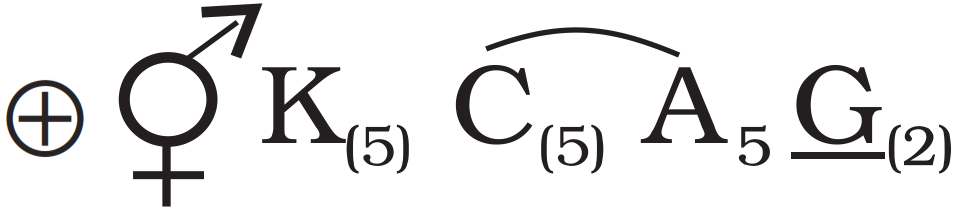
Given below are floral formulae of some well-known plants. Identify and write to which plants these belong.
Answer
  1. Solanum nigrum.
  2. Pisum sativum.
View full question & answer
Question 592 Marks
Venation is the network of veins on the lamina of a leaf.
  1. What is its use?
  2. Name its types.
Answer
  1. The use of network of veins on lamina is to conduct water, mineral salts and food as they contain vascular tissues.
  2. Venation is of two types, reticulate venation and parallel venation.
View full question & answer
Question 602 Marks
Differentiate between. Spike and spadix.
Answer
Differences between spike and spadix are as follows:
 
Spike
Spadix
i.
A spathe-like covering is absent. The inflorescence is covered by a large bract called spathe.
ii.
The peduncle is nonfleshy. The peduncle is fleshy.
iii. The whole penducle is covered by flowers. The apical part of peduncle, called appendix, is naked, i.e., without flowers.
View full question & answer
Question 612 Marks
Tendrils are found in the following plants. Identify whether they are stem tendrils or leaf tendrils.
  1. Cucumber.
  2. Pea.
  3. Pumpkin.
  4. Grapevine.
Answer
  1. Cucumber-Stem tendril.
  2. Pea-Leaf or leaflet tendril.
  3. Pumpkin-Stem tendrilla.
  4. Grapevine-Stem tendrils.
View full question & answer
Question 622 Marks
What is the difference between simple tissue and complex tissue in plants?
Answer
Simple tissues are composed of similar cells. Complex tissues are composed of dissimilar cells. Simple tissues provide bulk and mechanical support to plants. Complex tissues are meant for transportation of substances and they also provide mechanical support.
View full question & answer