Questions

M.C.Q (1 Marks)

Take a timed test

152 questions · auto-graded multiple-choice test.
MCQ 11 Mark
Bicarpellary gynoecium and oblique ovary occurs in:
  • A
    Mustard.
  • B
    Banana.
  • C
    Pisum.
  • Brinjal.
Answer
Correct option: D.
Brinjal.
View full question & answer
MCQ 21 Mark
Which one of the following plants does not have root $–$ pockets:
  • A
    Pistia.
  • B
    Lemna.
  • Ficus.
  • D
    Eichhornia.
Answer
Correct option: C.
Ficus.
View full question & answer
MCQ 31 Mark
In a longitudinal section of root tip, starting from tip upwards, are the regions of:
  • A
    Meristem, root cap, cell enlargement, cell maturation.
  • B
    Cell maturation, cell enlargement, meristem, root cap.
  • C
    Cell enlargement, cell maturation, root cap, meristem.
  • Root cap, meristem, cell enlargement, cell maturation.
Answer
Correct option: D.
Root cap, meristem, cell enlargement, cell maturation.
View full question & answer
MCQ 51 Mark
Exceptional roots of Cuscuta are:
  • Haustorial.
  • B
    Coralloid.
  • C
    Mucorhizal.
  • D
    All of the above.
Answer
Correct option: A.
Haustorial.
View full question & answer
MCQ 61 Mark
Which of the following contains bigger sieve tubes?
  • A
    Protophloem.
  • Metaphloem.
  • C
    Protoxylem.
  • D
    Metaxyleme.
Answer
Correct option: B.
Metaphloem.
View full question & answer
MCQ 71 Mark
Which of the following is a dead tissue?
  • Sclerenchyma.
  • B
    Chollenchyma.
  • C
    Parenchyma.
  • D
    Cortex.
Answer
Correct option: A.
Sclerenchyma.
View full question & answer
MCQ 81 Mark
The petiole is swollen and spongy in.
  • A
    Nepenthes.
  • Trapa.
  • C
    Clematis.
  • D
    All of the above.
Answer
Correct option: B.
Trapa.
View full question & answer
MCQ 91 Mark
In Mirabilis the roots are:
  • Tuberous
  • B
    Conical
  • C
    Epiphytic
  • D
    Nodulose
Answer
Correct option: A.
Tuberous
Mirabilis roots are tuberous roots because these plants store food in them, So they can perennate through dry and cold periods.
View full question & answer
MCQ 101 Mark
Which is not a product of root?
  • A
    Sugarbeet
  • B
    Carrot
  • C
    Radish
  • Potato
Answer
Correct option: D.
Potato
Potato is not a product of root because it is a modification of underground stem called stolons where food is stored and becomes tuberous.
View full question & answer
MCQ 111 Mark
Thors and spines are:
  • Homologous organs.
  • B
    Analogous organs.
  • C
    Thron is homologous, while spine is analogous.
  • D
    Spine is homologous while is analogous.
Answer
Correct option: A.
Homologous organs.
View full question & answer
MCQ 121 Mark
Insectivorous plants grow in:
  • A
    Magnesium deficient soil.
  • B
    Calcium deficient soil.
  • C
    Carbon deficient soil.
  • Nitrogen deficient soil.
Answer
Correct option: D.
Nitrogen deficient soil.
View full question & answer
MCQ 131 Mark
In Ipomoea $-$ batatus$/$ Sweet Potato the food is stored in:
  • Root tuber
  • B
    Stem tuber
  • C
    Bud
  • D
    Leaves
Answer
Correct option: A.
Root tuber
View full question & answer
MCQ 141 Mark
Epipetalous and syngenesious stamens occur in:
  • A
    Solanaceae.
  • B
    Brassicaceae.
  • C
    Fabaceae.
  • Asteraceae.
Answer
Correct option: D.
Asteraceae.
View full question & answer
MCQ 151 Mark
Feathery stigma is called $............$
  • A
    Spur
  • B
    Stylopodium
  • Plumose
  • D
    Calyculus
Answer
Correct option: C.
Plumose
View full question & answer
MCQ 161 Mark
Angiosperm to which the largest flowers belong is:
  • A
    Total stem parasite.
  • B
    Partial stem parasite.
  • Total root parasite.
  • D
    Partial root parasite.
Answer
Correct option: C.
Total root parasite.
View full question & answer
MCQ 171 Mark
What is the role of the guard cells?
  • Controls opening and closing of stomata.
  • B
    Protects stomatal opening.
  • C
    Prevents dust from entering leaves.
  • D
    All of the above.
Answer
Correct option: A.
Controls opening and closing of stomata.
View full question & answer
MCQ 181 Mark
In Dahlia, the roots are:
  • A
    Fibrous
  • B
    Stilt
  • C
    Moniliform
  • Fasciculated tuberous
Answer
Correct option: D.
Fasciculated tuberous
View full question & answer
MCQ 211 Mark
Scutellum is $a/ an:$
  • Shield$-$shaped cotyledon.
  • B
    Endosperm of gymnosperms.
  • C
    Protective covering of plumule.
  • D
    Protective covering of radicle.
Answer
Correct option: A.
Shield$-$shaped cotyledon.
View full question & answer
MCQ 221 Mark
The technical term used for the androecium in a flower of China rose $($Hibiscus rosa sinensis$)$ is:
  • Monadelphous.
  • B
    Diadelphous.
  • C
    Polyandrous.
  • D
    Polyadelphous.
Answer
Correct option: A.
Monadelphous.
View full question & answer
MCQ 231 Mark
Annual ring consists of which of the following?
  • A
    Spring wood.
  • B
    Autumn wood.
  • Both $(a)$ and $(b).$
  • D
    Sap wood.
Answer
Correct option: C.
Both $(a)$ and $(b).$
View full question & answer
MCQ 241 Mark
When gynoecium is present in the top most position of thalamus, the flower is known as:
  • A
    Epigynous.
  • B
    Perigynous.
  • Hypogynous.
  • D
    Inferior.
Answer
Correct option: C.
Hypogynous.
View full question & answer
MCQ 251 Mark
In which of the following plant, one plant penetrate its root into the host plant?
  • A
    Cactus
  • B
    Banyan
  • C
    Sugarcane
  • Cuscuta
Answer
Correct option: D.
Cuscuta
View full question & answer
MCQ 261 Mark
Dicot leaves are also known as?
  • A
    Dorsal Leaves.
  • Dorsiventral Leaves.
  • C
    Bilateral Leaves.
  • D
    Isobilateral Leaves.
Answer
Correct option: B.
Dorsiventral Leaves.
View full question & answer
MCQ 281 Mark
In an inflorescence where flowers are borne laterally in an acropetal succession, the position of the youngest floral bud in the floral axis shall be.
  • A
    Proximal.
  • Distal.
  • C
    Intercalary.
  • D
    Any where.
Answer
Correct option: B.
Distal.
View full question & answer
MCQ 291 Mark
Which of the following statement is correct?
  • A
    Flower is a modified root.
  • Flower is a modified shoot.
  • C
    Flower is a modified leaf.
  • D
    Flower is a modified inflorescence.
Answer
Correct option: B.
Flower is a modified shoot.
View full question & answer
MCQ 301 Mark
In which of the following type of flowers stamens are superior in position?
  • A
    Perigynous.
  • B
    Hypogynous.
  • Epigynous.
  • D
    Protogynous.
Answer
Correct option: C.
Epigynous.
View full question & answer
MCQ 311 Mark
Wood of Aschynomene is:
  • A
    Lighter like cork
  • Lighter than cork
  • C
    Heavier like iron wood
  • D
    Heavier than iron wood
Answer
Correct option: B.
Lighter than cork
View full question & answer
MCQ 321 Mark
Photosynthetic roots are recorded in:
  • A
    Jussiaea
  • B
    Rhizophora
  • C
    Bryophyllum
  • Tinospora
Answer
Correct option: D.
Tinospora
View full question & answer
MCQ 331 Mark
The coloured part of a Bougainuillea flower is the:
  • A
    Corolla.
  • B
    Calyx.
  • Bracts.
  • D
    Androecium.
Answer
Correct option: C.
Bracts.
View full question & answer
MCQ 351 Mark
Which is correct pair for edible part?
  • A
    Tomato $—$ Thalamus.
  • B
    Maize $—$ Cotyledons.
  • C
    Guava $—$ Mesocarp.
  • Date palm $—$ Pericarp.
Answer
Correct option: D.
Date palm $—$ Pericarp.
View full question & answer
MCQ 361 Mark
Find out the incorrect match:
  • A
    Free stamens $–$ Polyandrous.
  • B
    Stamens attached to petals $–$ Epipetalous.
  • C
    Sterile stamen $–$ Staminode.
  • Stamens attached to perianth $–$ Episepalous.
Answer
Correct option: D.
Stamens attached to perianth $–$ Episepalous.
View full question & answer
MCQ 371 Mark
A fibrous root system is efficient in:
  • A
    Food storage
  • B
    Nitrogen fixation
  • Good anchorage
  • D
    Absorption for deep soil layers
Answer
Correct option: C.
Good anchorage
View full question & answer
MCQ 381 Mark
Floating roots are characteristic of:
  • A
    Tinospora.
  • Jussiaea.
  • C
    Viscum.
  • D
    Vanda.
Answer
Correct option: B.
Jussiaea.
View full question & answer
MCQ 391 Mark
In Lathyrus, the leaves are modified into:
  • A
    Thorns.
  • B
    Cladodes.
  • Tendrils.
  • D
    Spines.
Answer
Correct option: C.
Tendrils.
View full question & answer
MCQ 401 Mark
Floral features are chiefly used in angiosperms identification because:
  • A
    Flowers are of various colours.
  • B
    Flowers can be safely pressed.
  • Reproductive parts are more stable and conservative than vegetative parts.
  • D
    Flowers are nice to work with.
Answer
Correct option: C.
Reproductive parts are more stable and conservative than vegetative parts.
View full question & answer
MCQ 411 Mark
The $13 -$ celled male gametophyte of Selaginella shows:
  • A
    $8$ cells of the antheridium $+ 5$ prothallial cells.
  • B
    $9$ cells of the antheridium $+ 4$ prothallial cells.
  • C
    $10$ cells of the antheridium $+ 3$ prothallial cells.
  • $8$ jacket cell $+ 4$ androgenic $+ 1$ prothallial cells.
Answer
Correct option: D.
$8$ jacket cell $+ 4$ androgenic $+ 1$ prothallial cells.
View full question & answer
MCQ 421 Mark
Plant having column of vascular tissues, bearing fruits and having a tap root system is:
  • A
    Monocot.
  • Dicot.
  • C
    Gymnosperm or dicot.
  • D
    Gymnosperm or monocot.
Answer
Correct option: B.
Dicot.
View full question & answer
MCQ 431 Mark
Which of the following family has plants with nodulated roots?
  • Fabaceae
  • B
    Solanaceae
  • C
    Liliaceae
  • D
    All of the above
Answer
Correct option: A.
Fabaceae
View full question & answer
MCQ 441 Mark
Pineapple $($ananas$)$ fruit develops from:
  • A
    A multipistillate syncarpous flower.
  • A cluster of compactly borne flowers on a common axis.
  • C
    A multilocular monocarpellary flower.
  • D
    A unilocular polycarpellary flower.
Answer
Correct option: B.
A cluster of compactly borne flowers on a common axis.
View full question & answer
MCQ 451 Mark
The gynoecium where carpels are free is called:
  • Apocarpoust.
  • B
    Polycarpic.
  • C
    Syncarpouse.
  • D
    Multicarpellary.
Answer
Correct option: A.
Apocarpoust.
View full question & answer
MCQ 461 Mark
Oil reserve of groundnut is present in:
  • A
    Embryo.
  • Cotyledons.
  • C
    Endosperm.
  • D
    Underground tubers.
Answer
Correct option: B.
Cotyledons.
View full question & answer
MCQ 471 Mark
In tamarind, the pinnate leaf is:
  • Bipinnate.
  • B
    Tripinnate.
  • C
    Paripinnate.
  • D
    Imparipinnate.
Answer
Correct option: A.
Bipinnate.
View full question & answer
MCQ 481 Mark
Mango juice is got from:
  • A
    Epicarp.
  • Mesocarp.
  • C
    Endocarp.
  • D
    Pericarp and thalamus.
Answer
Correct option: B.
Mesocarp.
View full question & answer
MCQ 501 Mark
The arrangement of sepals or petals in floral bud is called:
  • A
    Placentation.
  • Aestivation.
  • C
    Bracteate.
  • D
    Phyllotaxy.
Answer
Correct option: B.
Aestivation.
View full question & answer
MCQ 511 Mark
Nicotiana and potato belongs to:
  • A
    Malvaceae
  • B
    Liliaceae
  • Solanaceae
  • D
    Cruciferae
Answer
Correct option: C.
Solanaceae
View full question & answer
MCQ 531 Mark
The term phyllotaxy is used to describe the:
  • A
    Type of ovary in a plant.
  • Mode of arrangement of leaves.
  • C
    Type of roots.
  • D
    Arrangement of sepals and petals.
Answer
Correct option: B.
Mode of arrangement of leaves.
View full question & answer
MCQ 541 Mark
Apical meristem is found at which of the following organs in plant?
  • A
    Roots Tips.
  • B
    Shoot Tips.
  • Both $(a)$ and $(b).$
  • D
    Leaf Tips.
Answer
Correct option: C.
Both $(a)$ and $(b).$
View full question & answer
MCQ 551 Mark
The “Eyes” of the potato tuber are:
  • A
    Root buds.
  • B
    Flower buds.
  • C
    Shoot buds.
  • Axillary buds.
Answer
Correct option: D.
Axillary buds.
View full question & answer
MCQ 561 Mark
The edible part of groundnut is buried in the soil and morphologically it is a:
  • A
    Root
  • B
    Stern
  • Fruit
  • D
    Leaf
Answer
Correct option: C.
Fruit
View full question & answer
MCQ 571 Mark
Vegetative propagation in Pistia occurs by:
  • Offset.
  • B
    Runner.
  • C
    Sucker.
  • D
    Stolen.
Answer
Correct option: A.
Offset.
View full question & answer
MCQ 581 Mark
Edible part of banana is:
  • A
    Epicarp.
  • Mesocarp and less developed endocarp.
  • C
    Endocarp and less developed mesocarp.
  • D
    Epicarp and mesocarp.
Answer
Correct option: B.
Mesocarp and less developed endocarp.
View full question & answer
MCQ 601 Mark
All floral leaves are placed on the $..........$ of flower.
  • Thalamus
  • B
    Petal
  • C
    Sepal
  • D
    Ovule
Answer
Correct option: A.
Thalamus
Thalamus is the broad base of the on which other organs of the flower rest.
The thalamus bears four types of organs $-$ sepals, petals, carpels and the stamens.
Petals are colored accessory floral organs which lie above sepals and they may also provide protection to centrally placed reproductive organs $($stamens and carpel$).$
Sepals are the green outermost leaf like floral organs which protect the flower in bud stage and provide support to outer floral organs.
Ovule is the structure that gives rise to and contains the female reproductive cells.
View full question & answer
MCQ 611 Mark
A perennial plant differs from biennial in:
  • A
    Having underground perennating structure.
  • B
    Having asexual reproductive structures.
  • C
    Being tree species.
  • Not dying after seasonal production of flowers.
Answer
Correct option: D.
Not dying after seasonal production of flowers.
View full question & answer
MCQ 621 Mark
Open bundle is found in which of the following?
  • A
    Monocot stem.
  • B
    Monocot Root.
  • Dicot Stem.
  • D
    Dicot Leaf.
Answer
Correct option: C.
Dicot Stem.
View full question & answer
MCQ 631 Mark
Reproductive tap roots occur in:
  • Dalbergia
  • B
    Peepal
  • C
    Acacia
  • D
    Banyan
Answer
Correct option: A.
Dalbergia
Dalbergia roots are called reproductive tap root because these modified roots develop and grow into a new plant.
View full question & answer
MCQ 641 Mark
Stomata is found in which tissue system?
  • Epidermal Tissue System.
  • B
    Ground Tissue System.
  • C
    Vascular Tissue System.
  • D
    Stomatal Tissue System.
Answer
Correct option: A.
Epidermal Tissue System.
View full question & answer
MCQ 651 Mark
Long filamentous threads protruding at the end of the young cob of maize are:
  • Styles.
  • B
    Ovaries.
  • C
    Hairs
  • D
    Anthers
Answer
Correct option: A.
Styles.
View full question & answer
MCQ 661 Mark
Which is the position of intercalary meristem?
  • A
    Between mature tissues.
  • B
    In mature tissues.
  • Between two inter nodes.
  • D
    In the calyx.
Answer
Correct option: C.
Between two inter nodes.
View full question & answer
MCQ 671 Mark
In dicot leaves stomata is present on which surface of the leaf?
  • A
    Dorsal Surface.
  • Ventral Surface.
  • C
    Both Surfaces.
  • D
    On the midrib.
Answer
Correct option: B.
Ventral Surface.
View full question & answer
MCQ 681 Mark
Primary function of the stem is $.........$
  • A
    Support plant body
  • Bearing and holding of leaves
  • C
    Absorbing of water and minerals
  • D
    Vegetative propogation
Answer
Correct option: B.
Bearing and holding of leaves
View full question & answer
MCQ 691 Mark
The fruit is chambered, developed from inferior ovary and has seeds with succulent testa in:
  • Pomegranate.
  • B
    Orange.
  • C
    Guava.
  • D
    Cucumber.
Answer
Correct option: A.
Pomegranate.
View full question & answer
MCQ 701 Mark
In albuminous seeds, food is stored in:
  • A
    Cotyledon$(s).$
  • B
    Perisperm.
  • Endosperm.
  • D
    Embryo
Answer
Correct option: C.
Endosperm.
View full question & answer
MCQ 711 Mark

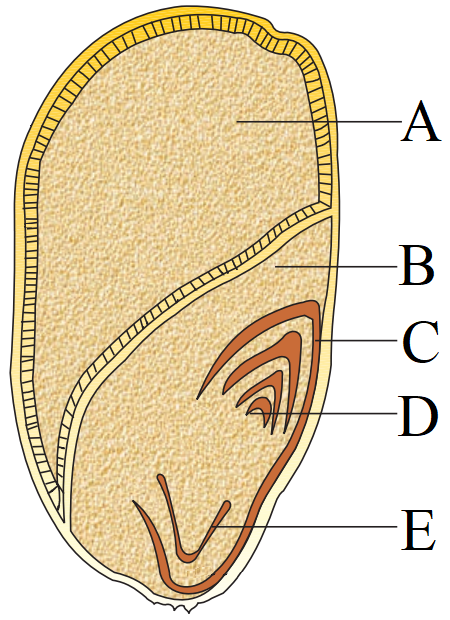
Label the parts of a monocot seed.
  • A
    $A.$ Endosperm$, B.$ Scutellum$, C.$ Radicle$, D.$ Coleoptile$, E.$ Plumule.
  • B
    $A.$ Endosperm$, B.$ Coleoptile$, C.$ Scutellum$, D.$ Radicle$, E.$ Plumule.
  • C
    $A.$ Endosperm$, B.$ Scutellum$, C.$ Coleoptile$, D.$ Radicle$, E.$ Plumule.
  • $A.$ Endosperm$, B.$ Scutellum$, C.$ Coleoptile$, D.$ Plumule$, E.$ Radicle.
Answer
Correct option: D.
$A.$ Endosperm$, B.$ Scutellum$, C.$ Coleoptile$, D.$ Plumule$, E.$ Radicle.
View full question & answer
MCQ 721 Mark
Companion cells are found in which tissue?
  • A
    Xylem Dies.
  • Phloem.
  • C
    Both xylem and phloem.
  • D
    None of these.
Answer
Correct option: B.
Phloem.
View full question & answer
MCQ 731 Mark
What happens when stomata opens?
  • Water and Potassium exit from the guard cell.
  • B
    Water enters the guard cell and Potassium exits from it.
  • C
    Water exits from guard cell and Potassium enters it.
  • D
    Water and Potassium enter the guard cell.
Answer
Correct option: A.
Water and Potassium exit from the guard cell.
View full question & answer
MCQ 741 Mark
Potato tuber is an underground stem because:
  • A
    It lacks chlorophyll.
  • B
    It is swollen.
  • It possesses axillary buds.
  • D
    It stores starch as reserve food material.
Answer
Correct option: C.
It possesses axillary buds.
View full question & answer
MCQ 761 Mark
Which part of the coconut produces coir?
  • A
    Seed coat.
  • Mesocarp.
  • C
    Epicarp.
  • D
    Pericarp.
Answer
Correct option: B.
Mesocarp.
View full question & answer
MCQ 771 Mark
Monocotyledonous root differs from dicot root in which of the following internal features $(a$ to $d)?$
  • Presence of large and well$-$developed pith.
  • B
    Presence of parenchymatous cortex without intercellular spaces.
  • C
    Absence of fewre xylem bundl.
  • D
    Presence of parenchymatous pericycle.
Answer
Correct option: A.
Presence of large and well$-$developed pith.
View full question & answer
MCQ 781 Mark
Plant that reserves its food in its roots system is:
  • A
    Brinjal
  • B
    Bean
  • Carrot
  • D
    Sugarcane
Answer
Correct option: C.
Carrot
View full question & answer
MCQ 791 Mark
A flower having superior ovary is:
  • A
    Epigynous.
  • Hypogynous.
  • C
    Perigynous.
  • D
    Sessile.
Answer
Correct option: B.
Hypogynous.
View full question & answer
MCQ 801 Mark
The number of fine outgrowths present on the surface of roots is called $..........$
  • A
    Root nodes
  • B
    Rootlets
  • Root hairs
  • D
    Tap root
Answer
Correct option: C.
Root hairs
The roots give out fine hair$-$like outgrowths called the root hairs that absorb water and minerals
View full question & answer
MCQ 811 Mark
In banana, the stem is:
  • Underground only.
  • B
    Both underground and aerial.
  • C
    Absent.
  • D
    Aerial only.
Answer
Correct option: A.
Underground only.
View full question & answer
MCQ 821 Mark
Which of the following is not a part of the xylem tissues?
  • A
    Xylem parenchyma.
  • B
    Trachieds.
  • C
    Vessels.
  • Sieve tubes.
Answer
Correct option: D.
Sieve tubes.
View full question & answer
MCQ 831 Mark
Which of the plant is not related to Leguminosae:
  • A
    Green gram
  • B
    Saraca
  • Paddy
  • D
    Tamarind
Answer
Correct option: C.
Paddy
View full question & answer
MCQ 841 Mark
Which of the following tissues is responsible for secondary growth?
  • A
    Vascular Cambium.
  • B
    Cork Cambium.
  • C
    Secondary Cambium.
  • Both $(a)$ and $(b).$
Answer
Correct option: D.
Both $(a)$ and $(b).$
View full question & answer
MCQ 851 Mark
Heterospory and seed habit are often discussed in relation to a structure called:
  • A
    Spathe.
  • B
    Bract.
  • C
    Petiole.
  • Ligule.
Answer
Correct option: D.
Ligule.
View full question & answer
MCQ 861 Mark
Gynoecium of solanaceae is:
  • A
    Monocarpellary
  • B
    Bicarpellary apocarpous
  • Bicarpellary syncarpous
  • D
    Polycarpellary syncarpous
Answer
Correct option: C.
Bicarpellary syncarpous
View full question & answer
MCQ 871 Mark
Velamen is found in:
  • A
    Leaves of Ficus elastica.
  • Only aerial roots of orchids.
  • C
    Aerial and terrestrial roots of orchids.
  • D
    Roots of screwpine.
Answer
Correct option: B.
Only aerial roots of orchids.
View full question & answer
MCQ 881 Mark
Keel is characteristic of the flowers of:
  • A
    Gulmohur.
  • B
    Cassia.
  • C
    Calotropis.
  • Bean.
Answer
Correct option: D.
Bean.
View full question & answer
MCQ 891 Mark
Inner layer of pericarp is hard and stony in:
  • A
    Dateplam, Almond.
  • B
    Wood, apple, Pea.
  • Mango, Coconut.
  • D
    Pear, Litchi.
Answer
Correct option: C.
Mango, Coconut.
View full question & answer
MCQ 901 Mark
Tetradynamous stamens are found in family:
  • A
    Malvaceae.
  • B
    Solanaceae.
  • Cruciferae.
  • D
    Liliaceae.
Answer
Correct option: C.
Cruciferae.
View full question & answer
MCQ 911 Mark
Many pulses of daily use belong to one of the families below $($tick the correct answer$).$
  • A
    Solanaceae.
  • Fabaceae.
  • C
    Liliaceae.
  • D
    Poceae.
Answer
Correct option: B.
Fabaceae.
View full question & answer
MCQ 921 Mark
A fruit developed from hypanthodium inflorescence is called:
  • A
    Syconus.
  • Caryopsis.
  • C
    Hesperidium.
  • D
    Sorosis.
Answer
Correct option: B.
Caryopsis.
View full question & answer
MCQ 931 Mark
Which of the following is a correct pair?
  • Cuscuta $—$ Parasite.
  • B
    Dischidia $—$ Insectivorous.
  • C
    Opuntia $—$ Predator.
  • D
    Capsella $—$ Hydrophyte.
Answer
Correct option: A.
Cuscuta $—$ Parasite.
View full question & answer
MCQ 951 Mark
The placenta is attached to the developing seed near the.
  • A
    Testa.
  • Hilum.
  • C
    Micropyle.
  • D
    Chalaza.
Answer
Correct option: B.
Hilum.
View full question & answer
MCQ 961 Mark
In unilocular ovary with a single ovule the placentation is:
  • A
    Marginal.
  • Basal.
  • C
    Free Centra.
  • D
    Axile.
Answer
Correct option: B.
Basal.
View full question & answer
MCQ 981 Mark
Perisperm is:
  • Part of endospermpart.
  • B
    Remnant of embryo.
  • C
    Persistant nucellus.
  • D
    Remnant of endosperm.
Answer
Correct option: A.
Part of endospermpart.
View full question & answer
MCQ 991 Mark
In which condition roots are modified for respiration?
  • A
    Desert
  • B
    Mountain
  • Saline marshy
  • D
    None of the above
Answer
Correct option: C.
Saline marshy
View full question & answer
MCQ 1001 Mark
Which one of the following statements is correct?
  • A
    In tomato, fruit is a capsule.
  • B
    Seeds of orchids have oil$-$rich endosperm.
  • C
    Placentation in Primrose is basal.
  • Flower of tulip is a modified shoot.
Answer
Correct option: D.
Flower of tulip is a modified shoot.
View full question & answer
MCQ 1011 Mark
Match the following and choose the correct option :
  Column $I$   Column $II$
$A.$ Aleurone layer $i.$ without fertilization
$B.$ Parthenocarpic fruit $ii.$ Nutrition
$C.$ Ovule $iii.$ Double fertilization
$D.$ Endosperm $iv.$ Seed
Options:
  • A
    $\text{A-i, B-ii, C-iii, D-iv}$
  • $\text{A-ii, B-i, C-iv, D-iii}$
  • C
    $\text{A-iv, B-ii, C-i, D-iii}$
  • D
    $\text{A-ii, B-iv, C-i, D-iii}$
Answer
Correct option: B.
$\text{A-ii, B-i, C-iv, D-iii}$
View full question & answer
MCQ 1021 Mark
Select the pair which contains monocotyledonous families:
  • A
    Fabaceae and Asteraceae.
  • Liliaceae and Poaceae.
  • C
    Solanaceae and Brassicaceae.
  • D
    None of these.
Answer
Correct option: B.
Liliaceae and Poaceae.
View full question & answer
MCQ 1031 Mark
Velamen is found in:
  • A
    Leaves of Ficus elastica.
  • Only aerial roots of orchids.
  • C
    Aerial and terrestrial roots of orchids.
  • D
    Roots of screwpine.
Answer
Correct option: B.
Only aerial roots of orchids.
View full question & answer
MCQ 1051 Mark
Artabotrys is a hook climber in which the hooks are modified:
  • Inflorescence axis.
  • B
    Petiole.
  • C
    Roots.
  • D
    Stipules.
Answer
Correct option: A.
Inflorescence axis.
View full question & answer
MCQ 1071 Mark
Climbing roots are found in:
  • A
    Banyan
  • B
    Pandanus
  • Piper
  • D
    Sugarcane
Answer
Correct option: C.
Piper
Climbing roots are found in Piper because piper is a weak $-$ stemmed plant, so it requires the additional support to grow properly.
View full question & answer
MCQ 1101 Mark
Match the following and indicate which is correct?
  • A
    Cucurbitaceae $—$ Orange.
  • Malvaceae $—$ Cotton.
  • C
    Brassicaceae $—$ Wheat.
  • D
    Leguminosae $—$ Sunflower.
Answer
Correct option: B.
Malvaceae $—$ Cotton.
View full question & answer
MCQ 1111 Mark
The mature seeds of plants such as gram and peas, possess no endosperm, because.
  • A
    These plants are not angiosperms.
  • B
    There is no double fertilization in them.
  • C
    Endosperm is not formed in them.
  • Endosperm gets used up by the developing embryo during seed development.
Answer
Correct option: D.
Endosperm gets used up by the developing embryo during seed development.
View full question & answer
MCQ 1121 Mark
Ovary is said to be half inferior in which of the following conditions?
  • Perigynous.
  • B
    Hypogynous.
  • C
    Epigynous.
  • D
    None of these.
Answer
Correct option: A.
Perigynous.
View full question & answer
MCQ 1131 Mark
The plant, which bears clinging roots, is:
  • A
    Trapa.
  • Orchid.
  • C
    Screw pine.
  • D
    Podostemon.
Answer
Correct option: B.
Orchid.
View full question & answer
MCQ 1141 Mark
Certain plants called as runners can be easily propagated. This is due to the fact:
  • A
    They are numerous in numbers.
  • B
    They store the ready food.
  • C
    They lie horizontally on the soil.
  • They can produce adventitious roots quite readily at the nodes.
Answer
Correct option: D.
They can produce adventitious roots quite readily at the nodes.
View full question & answer
MCQ 1151 Mark
What type of placentation is seen in sweet pea?
  • A
    Axile.
  • B
    Free central.
  • Marginal.
  • D
    Basal.
Answer
Correct option: C.
Marginal.
View full question & answer
MCQ 1161 Mark
The type of placentation in which ovary is syncarpous, unilocular and ovules on sutures is called:
  • A
    Apical placentation.
  • Parietal placentation.
  • C
    Marginal placentation.
  • D
    Superficial placentation.
Answer
Correct option: B.
Parietal placentation.
View full question & answer
MCQ 1181 Mark
The fleshy receptacle of syconous of fig encloses a number of:
  • Achenes.
  • B
    Samaras.
  • C
    Berries.
  • D
    Mericarps.
Answer
Correct option: A.
Achenes.
View full question & answer
MCQ 1191 Mark
The largest petal overlaps the lateral ones in $.........$ aestivation.
  • Papilionaceous.
  • B
    Valvate.
  • C
    Twisted.
  • D
    Imbricate.
Answer
Correct option: A.
Papilionaceous.
View full question & answer
MCQ 1201 Mark
Fibrous root system is better adopted than tap root system for:
  • Anchorage of plant to soil.
  • B
    Storage of food.
  • C
    Absorption of water and mineral.
  • D
    Transport of organic matter.
Answer
Correct option: A.
Anchorage of plant to soil.
View full question & answer
MCQ 1211 Mark
In monocot leaves stomata is present on which surface of the leaf?
  • A
    Dorsal Surface.
  • B
    Ventral Surface.
  • Both Surfaces.
  • D
    On the midrib.
Answer
Correct option: C.
Both Surfaces.
View full question & answer
MCQ 1221 Mark
What is eye of potato?
  • Axillary bud.
  • B
    Accessory bud.
  • C
    Adventitious bud.
  • D
    Apical bud.
Answer
Correct option: A.
Axillary bud.
View full question & answer
MCQ 1231 Mark
Venation is a term used to describe the pattern of arrangment of.
  • A
    Floral organs.
  • B
    Flower in infloresence.
  • Veins and veinlets in a lamina.
  • D
    All of them.
Answer
Correct option: C.
Veins and veinlets in a lamina.
View full question & answer
MCQ 1241 Mark
Roots of which plant contains an oxidising agent?
  • A
    Carrot.
  • Soyabean.
  • C
    Mustard.
  • D
    Radish.
Answer
Correct option: B.
Soyabean.
View full question & answer
MCQ 1251 Mark
Dry indehiscent single$-$seeded fruit formed from bicarpellary syncarpous inferior ovary is:
  • A
    Caryopsis.
  • Cypsela.
  • C
    Berry.
  • D
    Cremocarp.
Answer
Correct option: B.
Cypsela.
View full question & answer
MCQ 1261 Mark
Part of Glycyrrhiza glabra having expectorant properties is:
  • A
    Flower
  • B
    Fruit
  • C
    Shoot
  • Root
Answer
Correct option: D.
Root
View full question & answer
MCQ 1271 Mark
A fleshy root which is tapering at both ends is:
  • Fusiform
  • B
    Conical
  • C
    Napiform
  • D
    Tuberous
Answer
Correct option: A.
Fusiform
The fleshy root which is tapering at both ends is fusiform roots because they give a spindle $-$ shaped appearance.
View full question & answer
MCQ 1281 Mark
Milky water of green coconut is:
  • A
    Liquid nucellus.
  • B
    Liquid of female gametophyte.
  • Liquid endosperm.
  • D
    Liquid embryo.
Answer
Correct option: C.
Liquid endosperm.
View full question & answer
MCQ 1291 Mark
Male and female gametophytes are independent and free$-$living in:
  • A
    Mustard.
  • B
    Castor.
  • Pinus.
  • D
    Sphagnum.
Answer
Correct option: C.
Pinus.
View full question & answer
MCQ 1301 Mark
The tendrils in Pisum are modified:
  • Leaflets.
  • B
    Terminal buds.
  • C
    Stipules.
  • D
    Axillary buds.
Answer
Correct option: A.
Leaflets.
View full question & answer
MCQ 1311 Mark
In which of the following plants stems do not store the food material:
  • A
    Potato.
  • B
    Ginger.
  • Onion.
  • D
    Colocasia.
Answer
Correct option: C.
Onion.
View full question & answer
MCQ 1321 Mark
Srem modified to perform the function of a leaf and having many internodes is called as:
  • Phylloclade.
  • B
    Cladode.
  • C
    Offset.
  • D
    Phyllode.
Answer
Correct option: A.
Phylloclade.
View full question & answer
MCQ 1331 Mark
A family delimited by type of inflorescence is:
  • A
    Fabaceae.
  • Asteraceae.
  • C
    Solanaceae.
  • D
    Liliaceae.
Answer
Correct option: B.
Asteraceae.
View full question & answer
MCQ 1341 Mark
The embryo in sunflower has:
  • A
    One cotyledon.
  • Two cotyledons.
  • C
    Many cotyledons.
  • D
    No cotyledon.
Answer
Correct option: B.
Two cotyledons.
View full question & answer
MCQ 1351 Mark
In onion, food is stored in:
  • A
    Discoidal stem.
  • Fleshy scale leaves.
  • C
    Adventitious roots.
  • D
    Scape type of stem.
Answer
Correct option: B.
Fleshy scale leaves.
View full question & answer
MCQ 1361 Mark
Endosperm, a product of double fertilization in angiosperms is absent in the seeds of.
  • A
    Coconut.
  • Orchids.
  • C
    Maize.
  • D
    Castor
Answer
Correct option: B.
Orchids.
View full question & answer
MCQ 1371 Mark
Botanical name of cauliflower is:
  • A
    Brassica oleracea var. capitata.
  • B
    Brassica campestris.
  • Brassica oleracea var. botrytis.
  • D
    Brassica oleracea var. gemmifera.
Answer
Correct option: C.
Brassica oleracea var. botrytis.
View full question & answer
MCQ 1381 Mark
In a cereal grain the single cotyledon of embryo is represented by:
  • A
    Coleoptile.
  • B
    Prophyll.
  • Scutellum.
  • D
    Coleorrhiza.
Answer
Correct option: C.
Scutellum.
View full question & answer
MCQ 1391 Mark
In which of the following plant roots are modified for the respiration?
  • A
    Carrot
  • B
    Beet root
  • Avicennia
  • D
    Dahlia
Answer
Correct option: C.
Avicennia
View full question & answer
MCQ 1401 Mark
Epiphytes like Vanda, develop special layer of absorptive tissue velamen consisting of $4$ or $5$ layers of long polygonal cells. Velamen is formed by:
  • A
    Prop roots
  • B
    Stem
  • C
    Clinging roots
  • Hanging roots
Answer
Correct option: D.
Hanging roots
The adventitious roots found in the epiphytes are known as the epiphytic root.
These roots hang freely in the air and absorb the moisture from the air by a special type of tissue called as velamen.
Epiphytic plants are sometimes called as air plants because they do not have roots in the soil $e.g.,$ Vanda.
View full question & answer
MCQ 1411 Mark
Which of the following plants is used to extract the blue dye?
  • A
    Trifolium.
  • Indigofera.
  • C
    Lupin.
  • D
    Cassia.
Answer
Correct option: B.
Indigofera.
Blue dye is obtained from Indigofera tinctoria which belongs to family fabaceae.
View full question & answer
MCQ 1431 Mark
In a cereal grain the single cotyledon of embryo is represented by:
  • Scutellum.
  • B
    Prophyll.
  • C
    Coleoptile.
  • D
    Coleorhiza.
Answer
Correct option: A.
Scutellum.
View full question & answer
MCQ 1441 Mark
Roots developed from parts of the plant other than radicle are called.
  • A
    Taproots.
  • B
    Fibrous roots.
  • Adventitious roots.
  • D
    Nodular roots
Answer
Correct option: C.
Adventitious roots.
Taproots and fibrous roots emerge from radicle. Nodular roots arise from root nodules. Adventitious roots usually arise from stems and sometimes from leaves.
View full question & answer
MCQ 1461 Mark
The primary function of stem is $..........$
  • To bear and expose leaves to sunlight.
  • B
    To anchor the plant in soil.
  • C
    To absorb water and mineral salts from the soil.
  • D
    To help in vegetative propagation
Answer
Correct option: A.
To bear and expose leaves to sunlight.
View full question & answer
MCQ 1471 Mark
The axillary buds arise:
  • A
    Endogenously from the pericycle.
  • Exogenously from the tissues of the shoot apex.
  • C
    Endogenously from the cambium tissues.
  • D
    Exogenously from the innermost layers of cortex.
Answer
Correct option: B.
Exogenously from the tissues of the shoot apex.
View full question & answer
MCQ 1481 Mark
Rearrange the following zones as seen in the root in vertical section and choose the correct option.
  1. Root hair zone.
  2. Zone of meristems.
  3. Rootcap zone.
  4. Zone of maturation.
  5. Zone of elongation.
Options:
  • $\text{C, B, E, A, D}$
  • B
    $\text{A, B, C, D, E}$
  • C
    $\text{D, E, A, C, B}$
  • D
    $\text{E, D, C, B, A}$
Answer
Correct option: A.
$\text{C, B, E, A, D}$
A typical root possesses five parts or regions:
  1. Root cap covers the root meristem. The cells of the root cap secrete mucilage which lubricates the passage of root through the soil. Cells of root cap possess starch grains which are believed to take part in graviperception. Function cap is the protection of root meristem from soil particles.
  2. Growing point or meristematic zone produces new cells for the root cap and basal region of the root. Therefore, it is essential for the growth of the root.
  3. Cells of zone of elongation are newly formed cells which lose the power of division. They elongate rapidly which increases length of the root. The external cells possess the power of absorption of water and mineral salts from the soil.
  4. Root hair zone also represents the zone of differentiation or maturation. Most of the water absorption occurs in this region. Some of the outer cells of this zone give rise tq lateral tubular outgrowths called root hairs. The root hairs increase the exposed surface of the root for absorption.
  5. Region or zone of mature cells forms the bulk of the root without undergoing any $–$ further change. The outermost layer of this region cannot help the root in water absorption because they have thick walled or impermeable cells. Its only function is to anchor the plant firmly in the soil. Lateral roots also arise from the interior of this region.
View full question & answer
MCQ 1491 Mark
Which one of the following is a true fruit?
  • A
    Cashew nut.
  • Coconut.
  • C
    Apple.
  • D
    None of these.
Answer
Correct option: B.
Coconut.
View full question & answer
MCQ 1501 Mark
Monocarpellary ovary with marginal placentation and diadelphous stamens are characteristic of the family:
  • A
    Solanaceae.
  • B
    Liliaceae.
  • Fabaceae.
  • D
    Brassicaceae.
Answer
Correct option: C.
Fabaceae.
View full question & answer
MCQ 1511 Mark
Juicy hair$-$like structures observed in the lemon fruit develop from:
  • A
    Mesocarp and endocarp.
  • B
    Exocarp.
  • C
    Mesocarp.
  • Endocarp.
Answer
Correct option: D.
Endocarp.
View full question & answer
MCQ 1521 Mark
Vegetative reproduction of Agave occurs through:
  • A
    Rhizome.
  • B
    Stolon.
  • Bulbils.
  • D
    Sucker.
Answer
Correct option: C.
Bulbils.
View full question & answer