Questions

M.C.Q (1 Marks)

Take a timed test

152 questions · auto-graded multiple-choice test.

MCQ 11 Mark
The structural and functional unit of nerve tissue is:
  • A
    Nephron
  • Neuron
  • C
    Axon
  • D
    Cyton
Answer
Correct option: B.
Neuron
View full question & answer
MCQ 21 Mark
Potential difference across resting membrane is negative. This is due to differential distribution of the following ions :
  • $Na^+$ and $K^+$ions.
  • B
    $CO^{3++}$ and $CI$ ions.
  • C
    $Ca^{++}$ and $Mg^{++}$ ions.
  • D
    $Ca^{++}4$ and $CI^-$.
Answer
Correct option: A.
$Na^+$ and $K^+$ions.
Potential difference across resting membrane is negatively charged. This is due to differential distribution of $Na^+$ and $K^+$ions.
View full question & answer
MCQ 31 Mark
Longest cell in the human body is:
  • Nerve cell
  • B
    Leg muscle cell
  • C
    Bone cell
  • D
    Heart muscle cell
Answer
Correct option: A.
Nerve cell
View full question & answer
MCQ 41 Mark
Which of the following prevents internal reflection of light within the eye?
  • A
    Cornea
  • Choroid
  • C
    Sclera
  • D
    Conjunctiva
Answer
Correct option: B.
Choroid
View full question & answer
MCQ 51 Mark
Which one of the following does not act as a neurotransmitter?
  • Cortisone
  • B
    Epinephrine
  • C
    Acetylcholine
  • D
    Norepinephrine
Answer
Correct option: A.
Cortisone
View full question & answer
MCQ 61 Mark
During excited stage the axonal membrane is more permeable to which ion?
  • A
    Potassium.
  • B
    Calcium.
  • Sodium.
  • D
    Magnesium.
Answer
Correct option: C.
Sodium.
View full question & answer
MCQ 71 Mark
One function of parasympathetic nervous system is:
  • A
    Contraction of hair muscles.
  • B
    Stimulation of sweat glands.
  • C
    Acceleration of heart beat.
  • Constriction of pupil.
Answer
Correct option: D.
Constriction of pupil.
View full question & answer
MCQ 81 Mark
Function of iris is to:
  • A
    Move lens forward and backward.
  • B
    Refract light rays.
  • C
    Bring about movements of eye lids.
  • Alter the size of pupil.
Answer
Correct option: D.
Alter the size of pupil.
View full question & answer
MCQ 91 Mark
Unidirectional transmission of a nerve impulse through nerve fibres is due to the fact that:
  • A
    Nerve fibre is insulated by myelin sheath.
  • B
    Sodium pump starts operating only at the cyton and then continues into the nerve fibre.
  • Neurotransmitters are released by the axon endings and not by dendrites.
  • D
    Neurotransmitters are released by dendrites and not by axons.
Answer
Correct option: C.
Neurotransmitters are released by the axon endings and not by dendrites.
View full question & answer
MCQ 101 Mark
The part of internal ear responsible for hearing is:
  • A
    Cochlea.
  • B
    Semicircular canal.
  • C
    Utriculus.
  • Sacculus.
Answer
Correct option: D.
Sacculus.
View full question & answer
MCQ 111 Mark
Which of the following contains both afferent and efferent axon?
  • A
    Sensory nerves
  • B
    Motor nerves
  • Mixed nerves
  • D
    All of the above
Answer
Correct option: C.
Mixed nerves
View full question & answer
MCQ 121 Mark
The outermost layer of the brain is called:
  • A
    Piamater
  • Duramater
  • C
    Pericardium
  • D
    Grey matter
Answer
Correct option: B.
Duramater
View full question & answer
MCQ 131 Mark
$\text{CNS}$ is mostly made of:
  • A
    Motor neurons and sensory neurons.
  • B
    Sensory neurons and association neurons.
  • Association neurons.
  • D
    Motor neurons and association neurons.
Answer
Correct option: C.
Association neurons.
View full question & answer
MCQ 141 Mark
Coloured $($pigmented$)$ layer of eye is:
  • Choroid
  • B
    Sclerotic
  • C
    Retina
  • D
    All of the above
Answer
Correct option: A.
Choroid
View full question & answer
MCQ 151 Mark
During resting stage the axonal membrane is more permeable to which ion?
  • Potassium.
  • B
    Calcium.
  • C
    Sodium.
  • D
    Magnesium.
Answer
Correct option: A.
Potassium.
View full question & answer
MCQ 161 Mark
Which of the following is not controlled by medulla oblongata?
  • A
    Cardiovascular reflexes.
  • B
    Breathing.
  • C
    Gastric Reflexes.
  • Reflex Action.
Answer
Correct option: D.
Reflex Action.
View full question & answer
MCQ 171 Mark
A touch on the right hand stimulates neurons in:
  • Left somatic sensory area
  • B
    Right somatic sensory area
  • C
    Both $(a)$ and $(b)$
  • D
    None of these
Answer
Correct option: A.
Left somatic sensory area
View full question & answer
MCQ 191 Mark
The purplish red pigment rhodopsin contained in the rods type of photoreceptor cells of the human eye, is a derivative of:
  • Vitamin $A.$
  • B
    Vitamin $B_1$.
  • C
    Vitamin $D.$
  • D
    Vitamin $C.$
Answer
Correct option: A.
Vitamin $A.$
View full question & answer
MCQ 201 Mark
White matter consists of:
  • Nerve fibres with myelinated sheath
  • B
    Nerve fibres without myelinated sheath
  • C
    Scattered areolar tissue
  • D
    Nerve fibre with blood vessels
Answer
Correct option: A.
Nerve fibres with myelinated sheath
View full question & answer
MCQ 211 Mark
The function of vagus nerve innervating the heart is to:
  • A
    Initiate the heart beat.
  • Reduce the heart beat.
  • C
    Accelerate the heart beat.
  • D
    Maintain constant heart beat.
Answer
Correct option: B.
Reduce the heart beat.
View full question & answer
MCQ 221 Mark
The sympathetic nerves, in mammals arise from:
  • A
    Sacral nerves.
  • B
    Cervical nerves.
  • Thoraco$-$lumbar nerves.
  • D
    $\text{III, VII, IX}$ and $\text{X}$ cranial nerves.
Answer
Correct option: C.
Thoraco$-$lumbar nerves.
View full question & answer
MCQ 231 Mark
Third ventricle of brain is also known as:
  • A
    Metacoel
  • B
    Rhinocoel
  • C
    Paracoel
  • Diacoel
Answer
Correct option: D.
Diacoel
View full question & answer
MCQ 241 Mark
The nerve transmitter, produced at the synapse and neuromuscular junction, is:
  • A
    $\text{GTP}$
  • B
    $\text{ATP}$
  • Acetylcholine
  • D
    Phosphokinase
Answer
Correct option: C.
Acetylcholine
View full question & answer
MCQ 251 Mark
Chemicals which are released at the synaptic junction are called:
  • A
    Hormones.
  • Neurotransmitters.
  • C
    Cerebrospinal fluid.
  • D
    Lymph.
Answer
Correct option: B.
Neurotransmitters.
View full question & answer
MCQ 261 Mark
Iris is part of:
  • A
    Sclerotic.
  • B
    Choroid$/$ uvula.
  • Choroid and retina.
  • D
    Sclerotic and choroid.
Answer
Correct option: C.
Choroid and retina.
View full question & answer
MCQ 271 Mark
An area in the brain which is associated with strong emotions is:
  • A
    Cerebral cortex.
  • B
    Cerebellum.
  • Limbic system.
  • D
    Medulla.
Answer
Correct option: C.
Limbic system.
View full question & answer
MCQ 281 Mark
When we migrate from dark to light, we fail to see for some time but after a time visibility becomes normal. It is an example of:
  • A
    Accommodation
  • Adaptation
  • C
    Mutation
  • D
    Photoperiodism
Answer
Correct option: B.
Adaptation
View full question & answer
MCQ 291 Mark
The size of pupil is controlled by the:
  • A
    Ciliary muscles
  • B
    Suspensory ligaments
  • C
    Cornea
  • Iris muscles
Answer
Correct option: D.
Iris muscles
View full question & answer
MCQ 301 Mark
The layer of actively dividing cells of skin is termed as:
  • A
    Stratum compactum.
  • B
    Stratum corneum.
  • Stratum Malpighi$/$ stratum germinativum.
  • D
    Stratum lucidum.
Answer
Correct option: C.
Stratum Malpighi$/$ stratum germinativum.
View full question & answer
MCQ 311 Mark
Human eyeball consists of three layers and it encloses:
  • A
    Lens, iris, optic nerve.
  • Lens, acquous humor and vitreous humor.
  • C
    Cornea, lens, iris.
  • D
    Cornea, lens, optic nerve.
Answer
Correct option: B.
Lens, acquous humor and vitreous humor.
Human eye ball consist of three$, i.e.,$ layers sclera, choroid and retina and these layer enclose lens, aqueous humor and vitreous humor.
View full question & answer
MCQ 321 Mark
The cutaneous plexus and the papillary plexus consist of:
  • A
    Specialized cells for cutaneous sensations.
  • B
    A network of arteries to provide dermal supply.
  • A network of nerves to provide dermal sensation.
  • D
    Gland cells that release cutaneous secretions.
Answer
Correct option: C.
A network of nerves to provide dermal sensation.
View full question & answer
MCQ 341 Mark
Nissl's granules are characteristically found in the?
  • A
    Nephrons
  • B
    Neurons
  • Cytons
  • D
    Dendrites
Answer
Correct option: C.
Cytons
View full question & answer
MCQ 351 Mark
Myelin sheath is produced by $..........:$
  • A
    Neurons
  • B
    Nissl's granules
  • Schwann cells
  • D
    None of the above
Answer
Correct option: C.
Schwann cells
View full question & answer
MCQ 361 Mark
Outermost part of eye is called as:
  • Cornea
  • B
    Pupil
  • C
    Lris
  • D
    Lens
Answer
Correct option: A.
Cornea
Cornea is the Outermost part of the eye . It lies in front of the iris, the coloured part of the eye.
View full question & answer
MCQ 371 Mark
Frequency of sound is discriminated by:
  • A
    The type of fluid $-$ perilymph or endolymph.
  • The site at the cochlear coi.
  • C
    The intensity of movement of basilar fibres of cochlea.
  • D
    All of these.
Answer
Correct option: B.
The site at the cochlear coi.
View full question & answer
MCQ 381 Mark
Ecdysis is shedding of:
  • Stratum corneum.
  • B
    Epidermis.
  • C
    Dermis.
  • D
    Stratum Malpighi.
Answer
Correct option: A.
Stratum corneum.
View full question & answer
MCQ 391 Mark
Saltatory conduction of nerve impulse takes place through.
  • Myelinated fibre.
  • B
    Non$-$myelinated fibre.
  • C
    Grey fibres.
  • D
    None of these.
Answer
Correct option: A.
Myelinated fibre.
View full question & answer
MCQ 401 Mark
The threshold of a neuron is:
  • A
    The amount of excitatory neurotransmitter required to elicit an action potential.
  • B
    The membrane voltage at which an axon potential will be suppressed.
  • The membrane voltage at which the membrane potential develops into an action potential.
  • D
    The amount of inhibitory neurotransmitter required to inhibit an action potential.
Answer
Correct option: C.
The membrane voltage at which the membrane potential develops into an action potential.
View full question & answer
MCQ 411 Mark
Bipolar nerve cells and ganglion cells are found in the:
  • A
    Sclera
  • B
    Cochlea
  • Retina
  • D
    Cristae
Answer
Correct option: C.
Retina
View full question & answer
MCQ 421 Mark
The whitish part of eye mainly:
  • A
    Provides characteristic colour to the eye
  • Acts as protective layer for the eye
  • C
    Regulates the amount of light entering into the eye
  • D
    Perceives the sensations
Answer
Correct option: B.
Acts as protective layer for the eye
View full question & answer
MCQ 431 Mark
Which portion of the brain is responsible for various emotions such as pleasure, fear, and happiness?
  • A
    Thalamus.
  • B
    Reticular formation.
  • C
    Hypothalamus.
  • Limbic system.
Answer
Correct option: D.
Limbic system.
View full question & answer
MCQ 441 Mark
Which one of the followings is the function of parasympathetic nervous system?
  • A
    Stimulates oil and sweat glands in the skin
  • Pupil constriction.
  • C
    Acceleration of heart beat.
  • D
    Contraction of hair muscles.
Answer
Correct option: B.
Pupil constriction.
View full question & answer
MCQ 451 Mark
The gelatinous membrane covering the sensorys hair cells of the ear is known as:
  • A
    Reissner's membrane.
  • B
    Basilar membrane.
  • Tectorial membrane.
  • D
    Neuro$-$sensory membrane.
Answer
Correct option: C.
Tectorial membrane.
View full question & answer
MCQ 461 Mark
Nerve cells do not divide because they do not have:
  • A
    Mitochondria.
  • Centrosome.
  • C
    Nucleus.
  • D
    Golgi body.
Answer
Correct option: B.
Centrosome.
View full question & answer
MCQ 481 Mark
The black pigment in the eye which reduces the internal reflection is located in:
  • A
    Cornea
  • B
    Iris
  • C
    Sclerotic
  • Retina
Answer
Correct option: D.
Retina
View full question & answer
MCQ 491 Mark
Which of the following carry the pulses from the brain or spinal cord to the muscles?
  • A
    Mixed nerves
  • Motor nerves
  • C
    Sensory nerves
  • D
    All of the above
Answer
Correct option: B.
Motor nerves
A motor nerve is a nerve that carries information from central nervous system or spinal nerves to the effector organ or gland to give response to the stimulus.
View full question & answer
MCQ 501 Mark
There are $...........$ pairs of cranial nerves arising from the brain.
  • A
    $8$
  • $12$
  • C
    $18$
  • D
    $25$
Answer
Correct option: B.
$12$
View full question & answer
MCQ 511 Mark
Which of the following is regarded as a unit of nervous tissue?
  • A
    Myelin sheath.
  • B
    Axons.
  • C
    Dendrites.
  • Neurons.
Answer
Correct option: D.
Neurons.
View full question & answer
MCQ 521 Mark
In humans, visceral organs are innervated by:
  • A
    Sympathetic nerves and are under conscious control.
  • B
    Parasympathetic nerves and are under conscious control.
  • Both $(a)$ and $(b).$
  • D
    Both sympathetic and parasympathetic nerves but are not under conscious control.
Answer
Correct option: C.
Both $(a)$ and $(b).$
View full question & answer
MCQ 531 Mark
Which of the following is regarded as a unit of nervous tissue?
  • A
    Axons
  • B
    Dendrites
  • Neurons
  • D
    Myelin sheath
Answer
Correct option: C.
Neurons
A neuron is the structural and functional unit of the nervous system. Neurons are similar to other cells in the human body in a number of ways, but there is one key difference between neurons and other cells. Neurons are specialized to transmit information throughout the body.
View full question & answer
MCQ 541 Mark
Which structure of internal ear is responsible for balance of body?
  • A
    Tympanum.
  • Semicircular canals.
  • C
    Cochlea.
  • D
    Stapes.
Answer
Correct option: B.
Semicircular canals.
View full question & answer
MCQ 561 Mark
Hair present in the skin are:
  • Epidermal in origin and made of dead cells.
  • B
    Epidermal in origin and made of living cells.
  • C
    Dermal in origin and made of living cells.
  • D
    Dermal in origin and made of dead cells.
Answer
Correct option: A.
Epidermal in origin and made of dead cells.
View full question & answer
MCQ 571 Mark
Which of the following is under control of hypothalamus?
  • Body temperature.
  • B
    Breathing.
  • C
    Heart Rate.
  • D
    Fight and Flight Response.
Answer
Correct option: A.
Body temperature.
View full question & answer
MCQ 581 Mark
You are sitting in biology class daydreaming. Yourintrinsic heartbeat is controlled by:
  • A
    The medulla.
  • B
    The cerebrum.
  • C
    The spinal cord.
  • Levels of adrenaline in the blood.
Answer
Correct option: D.
Levels of adrenaline in the blood.
View full question & answer
MCQ 591 Mark
Vestibular apparatus is made up of three semi$-$circular canals. These canals lies at $...........$ degree angle to each other.
  • A
    $30$
  • B
    $45$
  • C
    $60$
  • $90$
Answer
Correct option: D.
$90$
Semi$-$circular canals lies at right angle to each other.
View full question & answer
MCQ 601 Mark
The junction between the axon of one neuron and the dendrite of the next is called.
  • A
    Junction point.
  • A synapse.
  • C
    A joint.
  • D
    Constant bridge.
Answer
Correct option: B.
A synapse.
View full question & answer
MCQ 621 Mark
The iris of eye is:
  • Photosensitive
  • B
    Chemoreceptor
  • C
    Both $A$ and $B$
  • D
    All of the above
Answer
Correct option: A.
Photosensitive
View full question & answer
MCQ 631 Mark
During stress condition which of the following nerves start working?
  • A
    Parasympathetic nerves.
  • B
    Autonomic nerves.
  • Sympathetic nerves.
  • D
    Cranial nerves.
Answer
Correct option: C.
Sympathetic nerves.
View full question & answer
MCQ 641 Mark
Wax secreting gland present in the ear canal is called:
  • A
    Sweat gland.
  • B
    Prostate gland.
  • C
    Cowper’s gland.
  • Ceruminous gland.
Answer
Correct option: D.
Ceruminous gland.
Ear canal is lined by hairy skin and ceruminous glands $($wax glands$).$ These $–$ glands secrete a waxy substance cerumen $($ear wax$)$ which prevents the foreign bodies entering the ear.
View full question & answer
MCQ 651 Mark
Alzheimer disease in humans is associated with the deficiency of:
  • A
    Glutamic acid.
  • Acetylcholine.
  • C
    Dopamine.
  • D
    None of these.
Answer
Correct option: B.
Acetylcholine.
View full question & answer
MCQ 661 Mark
The enzyme required for the conduction of nerve impulse across synapse is:
  • A
    Succinic dehydrogenase.
  • B
    Peroxidase.
  • Choline acetylase.
  • D
    Ascorbic acid oxidase.
Answer
Correct option: C.
Choline acetylase.
View full question & answer
MCQ 671 Mark
Which cranial nerve has the highest number of branches?
  • A
    Facial nerve.
  • B
    Trigeminal.
  • Vagus nerve.
  • D
    None of these.
Answer
Correct option: C.
Vagus nerve.
View full question & answer
MCQ 681 Mark
Which one of the following is the correct statement regarding the particular psychotropic drug specified?
  • A
    Barbiturates cause relaxation and temporary euphoria.
  • Hashish causes after thought perceptions and hallucinations.
  • C
    Opium stimulates nervous system and causes hallucinations.
  • D
    Morphine leads to delusions and disturbed emotions.
Answer
Correct option: B.
Hashish causes after thought perceptions and hallucinations.
View full question & answer
MCQ 691 Mark
Which neuroglia cells produce a fatty insulating material called myelin?
  • A
    Satellite cells.
  • Schwann cells.
  • C
    Both $(A)$ and $(B).$
  • D
    Neither $(A)$ nor $(B).$
Answer
Correct option: B.
Schwann cells.
View full question & answer
MCQ 701 Mark
Functions of smooth muscles, cardiac muscles, organs, and glands are regulated by $.........$ system.
  • A
    Parasympathetic.
  • B
    Sympathetic.
  • C
    Central nervous.
  • Autonomic.
Answer
Correct option: D.
Autonomic.
View full question & answer
MCQ 721 Mark
Which cells are affected in case of vitamin $A$ deficiency?
  • Rod cells.
  • B
    Cone cells.
  • C
    Both $(a)$ and $(b).$
  • D
    Neither $(a)$ nor $(b).$
Answer
Correct option: A.
Rod cells.
View full question & answer
MCQ 731 Mark
hich system transmits impulses between different parts of the body?
  • A
    Musculoskeletal system
  • B
    Endocrine system
  • C
    Nervous system
  • Reproductive system
Answer
Correct option: D.
Reproductive system
View full question & answer
MCQ 741 Mark
Which part of human brain is concerned with the regulation of body temperature?
  • A
    Cerebrum.
  • Hypothalamus.
  • C
    Medulla Oblongata.
  • D
    Cerebellum.
Answer
Correct option: B.
Hypothalamus.
View full question & answer
MCQ 751 Mark
Which neuron sends signal to the spinal cord and brain?
  • A
    Associated neuron
  • B
    Motor neuron
  • C
    Both $A$ and $B$
  • Sensory neuron
Answer
Correct option: D.
Sensory neuron
View full question & answer
MCQ 761 Mark
Which of the following nerves carry the impulse from sense organ to spinal cord or brain?
  • Sensory nerves
  • B
    Motor nerves
  • C
    Mixed nerves
  • D
    All of the above
Answer
Correct option: A.
Sensory nerves
View full question & answer
MCQ 771 Mark
Reflex action in a vertebrate is an essential display exhibited by:
  • A
    Sympathetic nerve
  • Motor nerve
  • C
    Sensory nerve
  • D
    Autonomic response
Answer
Correct option: B.
Motor nerve
View full question & answer
MCQ 781 Mark
The function of our visceral organs is controlled by:
  • A
    Sympathetic and somatic neural system.
  • Sympathetic and para sympathetic neural system.
  • C
    Central and somatic nervous system.
  • D
    None of the above.
Answer
Correct option: B.
Sympathetic and para sympathetic neural system.
View full question & answer
MCQ 791 Mark
Which part of the donor's eye is used for grafting in order to cure certain cases of blindness?
  • A
    Retina
  • B
    Lens
  • Cornea
  • D
    The entire eye ball
Answer
Correct option: C.
Cornea
View full question & answer
MCQ 811 Mark
The constant body temperature in humans is controlled by:
  • Hypothalamus.
  • B
    Cerebrum.
  • C
    Cerebellum.
  • D
    Midbrain.
Answer
Correct option: A.
Hypothalamus.
View full question & answer
MCQ 821 Mark
Endolymph is present in:
  • Scala media.
  • B
    Scala vestibule.
  • C
    Scala tympanii.
  • D
    Vestibule.
Answer
Correct option: A.
Scala media.
View full question & answer
MCQ 831 Mark
Which of the following is not related to the autonomic nervous system?
  • A
    Peristalsis.
  • B
    Digestion.
  • C
    Excretion.
  • Memory and learning.
Answer
Correct option: D.
Memory and learning.
View full question & answer
MCQ 841 Mark
The optic lobes in humans are represented by the corpora:
  • A
    Bigemina
  • B
    Arenacea
  • C
    Striata
  • Quadrigemina
Answer
Correct option: D.
Quadrigemina
View full question & answer
MCQ 851 Mark
The generation of excitation$-$contraction coupling involves all the following events except.
  • A
    Generation of end$-$plate potential.
  • Release of calcium from troponin.
  • C
    Formation of cross$-$linkages between actin and myosin.
  • D
    Hydrolysis of $\text{ATP}$ to $\text{ADP}.$
Answer
Correct option: B.
Release of calcium from troponin.
View full question & answer
MCQ 861 Mark
The point in the retina of mammalian eyes from which optic nerves and blood vessels leave the eye ball, is called:
  • Blind spot.
  • B
    Fovea.
  • C
    Yellow spot.
  • D
    Iris.
Answer
Correct option: A.
Blind spot.
View full question & answer
MCQ 871 Mark
Parkinson’s disease $($characterized by tremors and progressive rigidity of limbs$)$ is caused by degeneration of brain neurons that are involved in movement control and make use of neurotransmitter.
  • A
    Acetylcholine
  • B
    Norepinephrine
  • Dopamine
  • D
    $\text{GABA}$
Answer
Correct option: C.
Dopamine
View full question & answer
MCQ 881 Mark
Eustachian tube connects.
  • A
    Internal pharyax.
  • B
    External ear with internal ear.
  • Middle ear with pharynx.
  • D
    External ear with middle ear.
Answer
Correct option: C.
Middle ear with pharynx.
View full question & answer
MCQ 901 Mark
Which of the following cranial nerves can regulate heart beat?
  • $\text{X}$
  • B
    $\text{IX}$
  • C
    $\text{VIII}$
  • D
    $\text{VII}$
Answer
Correct option: A.
$\text{X}$
View full question & answer
MCQ 911 Mark
Resting membrane potential is maintained by:
  • A
    Hormones.
  • B
    Neurotransmitters.
  • Ion pump.
  • D
    None of the above.
Answer
Correct option: C.
Ion pump.
View full question & answer
MCQ 921 Mark
Which of the following actions is controlled by parasympathetic neural system?
  • A
    Breathing.
  • B
    Increased heart rate during stress.
  • C
    Increased breathing.
  • Digestion.
Answer
Correct option: D.
Digestion.
View full question & answer
MCQ 931 Mark
The local depolarization of a receptor$-$cell membrane is called as:
  • Action potential.
  • B
    Resting potential.
  • C
    Threshold potential.
  • D
    None of these.
Answer
Correct option: A.
Action potential.
View full question & answer
MCQ 941 Mark
Which of the following actions is controlled by sympathetic neural system?
  • A
    Breathing.
  • Increased heart rate during stress.
  • C
    Increased breathing.
  • D
    Digestion.
Answer
Correct option: B.
Increased heart rate during stress.
View full question & answer
MCQ 951 Mark
The cochlea of ear contains.
  • A
    Only endolymph.
  • B
    Aqueous humour.
  • Perilymph and endolymph.
  • D
    Perilymph.
Answer
Correct option: C.
Perilymph and endolymph.
View full question & answer
MCQ 971 Mark
In frog, “fenestra ovalis” is:
  • The opening in the auditory capsule which separates the middle ear from internal ear.
  • B
    The air$-$filled cavity of the middle ear.
  • C
    The communication between the pharynx and the tympanic cavity.
  • D
    The external opening of the tympanic cavity which is covered by the tympanic membrane.
Answer
Correct option: A.
The opening in the auditory capsule which separates the middle ear from internal ear.
View full question & answer
MCQ 981 Mark
Which part of the eye controls the amount of light entering in it?
  • A
    Cornea
  • B
    Ciliary body
  • Iris
  • D
    Suspensory ligament
Answer
Correct option: C.
Iris
View full question & answer
MCQ 991 Mark
The basic cyclic pattern of inspiration and expiration are established by a respiratory center within the $.........$
  • A
    Cerebellum.
  • Medulla oblongata.
  • C
    Cerebral cortex.
  • D
    Thalamus.
Answer
Correct option: B.
Medulla oblongata.
View full question & answer
MCQ 1001 Mark
Four healthy people in their twenties got involved in injuries resulting in damage and death of a few cells of the following. Which of the cells are least likely to be replaced by new cells.
  • A
    Osteocytes.
  • B
    Malpighian layer of the skin.
  • C
    Liver cells.
  • Neurons.
Answer
Correct option: D.
Neurons.
View full question & answer
MCQ 1021 Mark
Cornea transplant in human is almost never rejected. This is because:
  • A
    Its cells are least penetrable by bacteria.
  • It has no blood supply.
  • C
    It is composed of enucleated cells.
  • D
    It is a non$-$living layer.
Answer
Correct option: B.
It has no blood supply.
View full question & answer
MCQ 1031 Mark
Cornea transplantation is outstandingly successful because:
  • A
    Cornea is easy to preserve.
  • Cornea is not linked up with blood vascular and immune systems.
  • C
    The technique involved is very simple.
  • D
    Cornea is easily available.
Answer
Correct option: B.
Cornea is not linked up with blood vascular and immune systems.
View full question & answer
MCQ 1041 Mark
Which among the following is not part of the actual structure of a neuron?
  • A
    Dendrite
  • B
    Axon
  • Schwann cells
  • D
    Nissl's body
Answer
Correct option: C.
Schwann cells
View full question & answer
MCQ 1051 Mark
Which of the following is not a neurotransmitter?
  • Morphine.
  • B
    Epinephrine.
  • C
    Dopamine.
  • D
    Norepinephrine.
Answer
Correct option: A.
Morphine.
View full question & answer
MCQ 1061 Mark
What is the intensity of sound in normal conversation?
  • A
    $10-20 \ dB$
  • $35-60\ dB$
  • C
    $70-90\ dB$
  • D
    $120-150\ dB$
Answer
Correct option: B.
$35-60\ dB$
View full question & answer
MCQ 1071 Mark
Rods and cones of eyes are modified.
  • Bipolar neuron.
  • B
    Multipolar neuron.
  • C
    Unipolar neuron.
  • D
    None of these.
Answer
Correct option: A.
Bipolar neuron.
View full question & answer
MCQ 1081 Mark
The thin and convoluted outer layer of gray matter that covers the cerebral hemispheres is:
  • A
    Medulla oblongata.
  • B
    Thalamus.
  • Cerebral cortex.
  • D
    Meninges.
Answer
Correct option: C.
Cerebral cortex.
View full question & answer
MCQ 1091 Mark
Mark the incorrect statement.
  • Opsin $($of Rhodopsin$)$ develops from vitamin $A.$
  • B
    The pressure on ear drum is equalized by eustachian tube.
  • C
    Otolith organ consists of saccule and utricle.
  • D
    None of these.
Answer
Correct option: A.
Opsin $($of Rhodopsin$)$ develops from vitamin $A.$
View full question & answer
MCQ 1101 Mark
One of the examples of the action of the autonomous nervous system is:
  • A
    Knee$-$jerk response.
  • B
    Pupillary reflex.
  • C
    Swallowing of food.
  • Peristalsis of the intestine.
Answer
Correct option: D.
Peristalsis of the intestine.
View full question & answer
MCQ 1111 Mark
Sympathetic nervous system induces.
  • Heart beat.
  • B
    Secretion of digestive juices.
  • C
    Secretion of saliva.
  • D
    All of the above.
Answer
Correct option: A.
Heart beat.
View full question & answer
MCQ 1131 Mark
Which one of the following is correctly matched pair of the given secretion and its primary role in human physiology?
  • A
    Sebum $-$ Sexual attraction.
  • Sweat $-$ Thermoregulation.
  • C
    Saliva $-$ Tasting food.
  • D
    Tears $-$ Excretion of salts.
Answer
Correct option: B.
Sweat $-$ Thermoregulation.
View full question & answer
MCQ 1141 Mark
Bowman’s glands are located in the:
  • A
    Proximal end of uriniferous tubules.
  • B
    Anterior pituitary.
  • C
    Female reproductive system of cockroach.
  • Olfactory epithelium of our nose.
Answer
Correct option: D.
Olfactory epithelium of our nose.
View full question & answer
MCQ 1151 Mark
Which structure of eye works like an aperture?
  • A
    Iris.
  • Pupil.
  • C
    Cornea.
  • D
    Sclera.
Answer
Correct option: B.
Pupil.
View full question & answer
MCQ 1161 Mark
Which of the following is not involved in Knee$-$jerk reflex?
  • A
    Muscle spindle.
  • B
    Motor neuron.
  • Brain.
  • D
    Interneurons.
Answer
Correct option: C.
Brain.
Knee$-$jerk reaction is controlled at the level of nerve cord.
View full question & answer
MCQ 1171 Mark
In the chemistry of vision in mammals, the photosensitive substance is called.
  • A
    Sclerotin
  • B
    Retinal
  • Rhodopsin
  • D
    Melanin
Answer
Correct option: C.
Rhodopsin
View full question & answer
MCQ 1181 Mark
Among which one of the following groups of chemicals, all are neurotransmitters?
  • A
    Noradrenaline, somatostatin, threonine.
  • B
    Somatostatin, serotonin, acetylcholine.
  • C
    Glycine, dopamine, melatonin.
  • Acetylcholine, noradrenaline, dopamine.
Answer
Correct option: D.
Acetylcholine, noradrenaline, dopamine.
View full question & answer
MCQ 1191 Mark
Arbor vitae is composed of:
  • A
    Neuroglea cells.
  • White matter.
  • C
    Grey matter.
  • D
    All of these.
Answer
Correct option: B.
White matter.
View full question & answer
MCQ 1201 Mark
Which of the following nerves is the largest of all the cranial nerves?
  • A
    Abducens nerve.
  • B
    Oculomotor nerve.
  • C
    Olfactory nerve.
  • Trigeminal nerve.
Answer
Correct option: D.
Trigeminal nerve.
View full question & answer
MCQ 1211 Mark
In a man, abducens nerve is injured. Which one of the following functions will be affected?
  • Movement of the eye ball.
  • B
    Swallowing.
  • C
    Movement of the tongue.
  • D
    Movement of the neck.
Answer
Correct option: A.
Movement of the eye ball.
View full question & answer
MCQ 1221 Mark
Retina is most sensitive at:
  • A
    Optic disc.
  • B
    Periphery.
  • C
    Macula lutea.
  • Fovea centralis.
Answer
Correct option: D.
Fovea centralis.
View full question & answer
MCQ 1231 Mark
Find the odd one.
  • A
    Schwann cells.
  • B
    Nissl s granules.
  • Nephrons.
  • D
    Synaptic knob.
Answer
Correct option: C.
Nephrons.
Schwann cells, Nissls granules and synaptic knobs are the parts of neurons.
View full question & answer
MCQ 1241 Mark
When a neuron is in resting state $i.e.$ not conducting any impulse, the axonal membrane is:
  • Comparatively more permeable to $K^+$ ions and nearly impermeable to $Na^+$ ions.
  • B
    Comparatively more permeable to $Na^+$ ions and nearly impermeable to $K^+$ ions.
  • C
    Equally permeable to both $Na^+$ and $K^+$ ions.
  • D
    Impermeable to both $Na^+$ and $K^+$ ions.
Answer
Correct option: A.
Comparatively more permeable to $K^+$ ions and nearly impermeable to $Na^+$ ions.
View full question & answer
MCQ 1251 Mark
Animals possess nerve network or nervous system to respond to their environment. But the single called Amoeba does not possesses any nerve cell, So, How it come to know whether a particle it encounters is a grain or sand and not its dinner?
  • By chemotaxis
  • B
    By skin
  • C
    By hormones
  • D
    All of these
Answer
Correct option: A.
By chemotaxis
View full question & answer
MCQ 1261 Mark
Which one of the following not act as a neurotransmitter?
  • A
    Acetylcholine
  • B
    Epinephrine
  • C
    Norepinephrine
  • Cortisone
Answer
Correct option: D.
Cortisone
View full question & answer
MCQ 1271 Mark
Afferent nerve fibres carry impulses from:
  • A
    Effector organs to $\text{CNS}.$
  • Receptors to $\text{CNS}.$
  • C
    $\text{CNS}$ to receptors.
  • D
    $\text{CNS}$ to muscles.
Answer
Correct option: B.
Receptors to $\text{CNS}.$
View full question & answer
MCQ 1281 Mark
The smallest bone in rabbit's or man's skeleton is:
  • A
    Nasal
  • Stapes
  • C
    Patella
  • D
    Palatine
Answer
Correct option: B.
Stapes
View full question & answer
MCQ 1291 Mark
Bowman’s glands are found in:
  • Olfactory epithelium.
  • B
    External auditory canal.
  • C
    Cortical nephrons only.
  • D
    Juxtamedullary nephrons.
Answer
Correct option: A.
Olfactory epithelium.
View full question & answer
MCQ 1301 Mark
Which is right combination of names of ear ossicles?
  • A
    Malleus, incus and cochlus.
  • Malleus, incus and stapes.
  • C
    Magnus, incus and stapes.
  • D
    Malleus, incus and cochlea.
Answer
Correct option: B.
Malleus, incus and stapes.
View full question & answer
MCQ 1311 Mark
Which one of the following statements is correct?
  • Neurons regulate endocrine activity, but not vice versa.
  • B
    Endocrine glands regulate neural activity and nervous system regulates endocrine glands.
  • C
    Neither hormones control neural activity nor the neurons control endocrine activity.
  • D
    Endocrine glands regulate neural activity, but not vice versa.
Answer
Correct option: A.
Neurons regulate endocrine activity, but not vice versa.
View full question & answer
MCQ 1321 Mark
In human cochlea, the scala vestibuli and scala media are separated by:
  • A
    Basilar membrane.
  • Reissner's membrane.
  • C
    Otolith membrane.
  • D
    Tectorial membrane.
Answer
Correct option: B.
Reissner's membrane.
View full question & answer
MCQ 1331 Mark
Which of the following is true about chemical synapse?
  • A
    There is gap between membranes of two axons.
  • There is lesser gap between membranes of two axons.
  • C
    Chemical synapse is primarily responsible for the action of parasympathetic neural system.
  • D
    Chemical synapse is primarily responsible for the action of sympathetic neural system.
Answer
Correct option: B.
There is lesser gap between membranes of two axons.
View full question & answer
MCQ 1341 Mark
The organ of corti is a structure present in:
  • A
    External ear.
  • B
    Middle ear.
  • C
    Semi circular canal.
  • Cochlea.
Answer
Correct option: D.
Cochlea.
Organ of corti are present on the sensory ridge of basilar membrane of cochlea. Hair cells which act as auditory receptors are present in organ of corti.
View full question & answer
MCQ 1351 Mark
Synapses store:
  • A
    Stimulating chemicals
  • B
    Inhibitory chemicals
  • C
    Conducting chemicals
  • All of the above
Answer
Correct option: D.
All of the above
A synapse is a structure, that permits a neuron to pass an electrical or chemical signal to another neuron. These chemical or electrical signals can be inhibitory or stimulatory or conducting in nature.
View full question & answer
MCQ 1361 Mark
Ivan Pavlov performed experiments on:
  • A
    Simple reflexes.
  • Conditioned reflexes.
  • C
    Cardiac reflexes.
  • D
    Origin of life.
Answer
Correct option: B.
Conditioned reflexes.
View full question & answer
MCQ 1371 Mark
In a similarity with photographic camera, retina acts as:
  • A
    Shutter
  • B
    Lens
  • C
    Diaphragm
  • Film
Answer
Correct option: D.
Film
In a photographic camera, image is formed on the film. Similarly, in eye, image is formed on the retina which is the light sensitive surface in the eye. The light rays enter the eye through an aperture called pupil. The eye lens which is biconvex, focus the light rays on the retina and an image is formed. Both the camera and eye have the ability to regulate the amount of light for image formation.
View full question & answer
MCQ 1381 Mark
What is the name of the node between two myelin sheaths?
  • A
    Nissl's Granules.
  • B
    Schwan Cell.
  • Nodes of Ranvier.
  • D
    None of these.
Answer
Correct option: C.
Nodes of Ranvier.
View full question & answer
MCQ 1391 Mark
Which of the following actions are controlled by $\text{ANS}?$
  • Swallowing
  • B
    Sleeping
  • C
    Dancing
  • D
    None of the above
Answer
Correct option: A.
Swallowing
Autonomic Nervous System controls involuntary muscles. Swallowing is an involuntary action
View full question & answer
MCQ 1401 Mark
Which layer is in contact with brain tissues?
  • Piamater.
  • B
    Arachnoid.
  • C
    Duramater.
  • D
    Piamater and Arachnoid.
Answer
Correct option: A.
Piamater.
View full question & answer
MCQ 1411 Mark
At a neuromuscular junction, synaptic vesicles discharge $........$
  • Acetylcholine.
  • B
    Epinephrine.
  • C
    Adrenaline.
  • D
    None of these.
Answer
Correct option: A.
Acetylcholine.
View full question & answer
MCQ 1421 Mark
The region of the vertebrate eye, where the optic nerve passes out of the retina, is called the,
  • A
    Fovea
  • B
    Iris
  • Blind spot
  • D
    Optic chaisma
Answer
Correct option: C.
Blind spot
Blind spot is the part where the optic nerve passes out of the retina. Photoreceptors are absent from this region.
View full question & answer
MCQ 1431 Mark
Which of the following defines the functions of autonomic nervous system?
  • A
    Efferent
  • B
    Afferent
  • Both (A) and (B)
  • D
    None of the above
Answer
Correct option: C.
Both (A) and (B)
View full question & answer
MCQ 1441 Mark
Injury to vagus nerve in human is not likely to affect.
  • Tongue movements.
  • B
    Gastrointestinal movements.
  • C
    Pancreatic secretion.
  • D
    Cardiac movements.
Answer
Correct option: A.
Tongue movements.
View full question & answer
MCQ 1451 Mark
Myelin sheath is formed by:
  • A
    Nissl's granules
  • B
    Muscle cells
  • Schwann cells
  • D
    Axon
Answer
Correct option: C.
Schwann cells
View full question & answer
MCQ 1461 Mark
Select the correct statement from the ones given below.
  • A
    Cocaine is given to patients after surgery as it stimulates recovery.
  • B
    Barbiturates when given to criminals make them tell the truth.
  • Morphine is often given to persons who have undergone surgery as a pain killer.
  • D
    Chewing tobacco lowers blood pressure and heart rate.
Answer
Correct option: C.
Morphine is often given to persons who have undergone surgery as a pain killer.
View full question & answer
MCQ 1471 Mark
Characteristic feature of human cornea is that:
  • A
    It is secreted by conjunctiva and glandular tissue.
  • B
    It is lacrimal gland which secretes tears.
  • Blood circulation is absent in cornea.
  • D
    In old age it become hard and white layer deposits on it which causes the cataract.
Answer
Correct option: C.
Blood circulation is absent in cornea.
View full question & answer
MCQ 1481 Mark
During resting state, fluid outside axon contains.
  • Low concentration of $K^+$
  • B
    Low concentration of $Na^+$
  • C
    Low concentration of $Cl^-$
  • D
    High concentration of $Cl^-$
Answer
Correct option: A.
Low concentration of $K^+$
During resting state $($when neuron is not conducting any impulse$),$ axoplasm inside the axon contains high concentration of $K^+$
The fluid outside axon contains low concentration of $K^+$.
View full question & answer
MCQ 1491 Mark
In human brain, the centre for smell, is located in:
  • A
    Mid brain.
  • Olfactory lobes.
  • C
    Medulla.
  • D
    Cerebellum.
Answer
Correct option: B.
Olfactory lobes.
View full question & answer
MCQ 1501 Mark
Mark the vitamin present in Rhodopsin:
  • Vit $A.$
  • B
    Vit $B$.
  • C
    Vit $C.$
  • D
    Vit $D.$
Answer
Correct option: A.
Vit $A.$
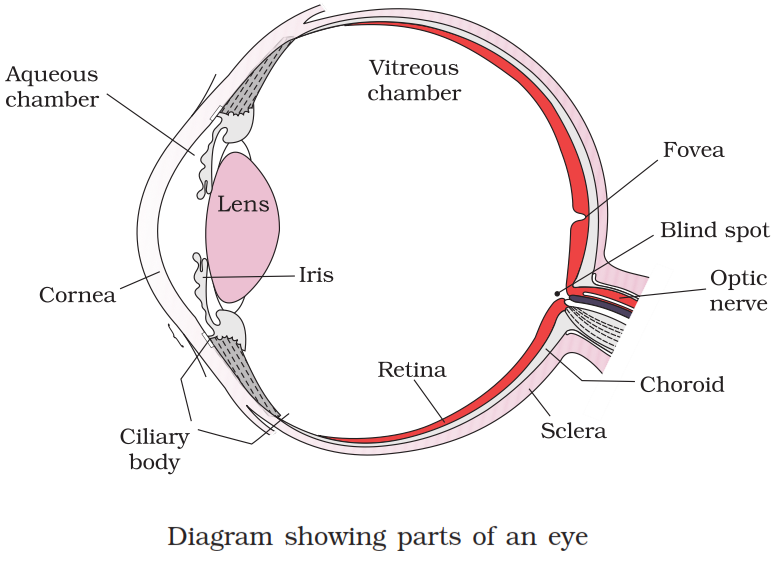
The rods contain a purplish red protein called the rhodopsin. It is a photosensitive compound in eye that is composed of opsin $($a protein$)$ and retinal $($an aldehyde of vitamin$-A)$, whereas vitamin$-B, C$ and $D$ not directly related with vision.
View full question & answer
MCQ 1511 Mark
A bipolar neuron has:
  • A
    Two axons and one dendrite.
  • B
    Two dendrites and one axon.
  • C
    Two axons and two dendrites.
  • One axon and one dendrite.
Answer
Correct option: D.
One axon and one dendrite.
View full question & answer
MCQ 1521 Mark
Respiratory centre is situated in:
  • A
    Cerebellum.
  • Medulla oblongata.
  • C
    Hypothalamus.
  • D
    Cerebrum.
Answer
Correct option: B.
Medulla oblongata.
View full question & answer