Questions

3 Marks Question

Take a timed test

6 questions · self-marked practice — reveal the answer and mark yourself.

Question 13 Marks
Describe the different stages found in the sexual cycle of fungi.
Answer
The following three steps are found in the sexual cycle of fungi:
1. Fusion of protoplasm of two mobile or immobile gametes. This action is called plasmogamy.
2. Fusion of two nuclei is called nuclear fusion (Karyogamy)
3. Formation of haploid spores due to meiosis in the zygote.
When a fungus reproduces sexually, two haploid hyphae of compatible mating types come together and fuse. In some fungi the fusion of two haploid cells immediately results in diploid cells (2n). However, in other fungi (ascomycetes and basidiomycetes), an intervening dikaryotic stage (n + n. i.c., two nuclei per cell) occurs, such a condition is called a dikaryon and the phase is called dikaryophase of fungus. Later, the parental nuclei fuse and the cells become diploid. The fungi form fruiting bodies in which reduction division occurs, leading to formation of haploid spores.
View full question & answer
Question 23 Marks
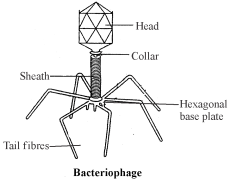
What is bacteriophage? Describe it by drawing a picture.
Answer
Bacteriophage: Viruses that attack bacteria are called bacteriophages.
Their external outline is similar to that of a tadpole or sperm. Its body can be divided into hexagonal head, neck and tail. The head contains a central core of DNA, which is surrounded by a protein coat. Its DNA is double helical.
Image
At the end of its cylindrical tail, 6 long thread-like tail fibres are found which help the bacteriophage to bind bacteria. Lysozyme enzyme is found in bacteriophage. This virus shows similarity with bacteriophages in morphology and behaviour.
View full question & answer
Question 33 Marks
Tell the main symptoms of Viroid.
Answer
Its main symptoms are as follows:
(1) Only single-stranded circular RNA is present in them.
(2) RNA molecule is smaller, in which approximately 246 to 388 nucleotides are found.
(3) Capsid is absent
(4) Due to the absence of protein coat in them, they are also called naked viruses.
(5) They are capable of replicating themselves.
(6) The viroids discovered so far cause diseases only in plants.
View full question & answer
Question 43 Marks
Write the general characteristics of Protista class.
Answer
The characteristics of Protista class are as follows
(i) Most protists are aquatic, unicellular and eukaryotic microorganisms.
(ii) Duplication of chromosomes has a clear role in cell division.
(iii) Some protists are photosynthetic but some are predators or are parasites and some saprophytes.
(iv) Organelles are present and membrane bound and 80 S types of ribosomes are found.
(v) Asexual reproduction occurs by binary fission or multiple fission.
(vi) Sexual reproduction occurs by the fusion of two nuclei i.c. by syngamy
(vii) Movement occurs through cilia, flagellum, pseudopodia or contractile fibrils.
View full question & answer
Question 53 Marks
Write any four important characteristics of fungi.
Answer
The important characteristics of fungi are as follows :
(1) With the exception of yeasts which are unicellular, fungi are filamentous. Their bodies consist of long, slender thread-like structures called hyphae.
(2) Some hyphae are continuous tubes filled with multinucleated cytoplasm-these are called coenocytic hyphae.
(3) There may be holes in the septa of some fungal hyphae, through which this the cytoplasm can flow freely.
(4) The network of hyphae is known as mycelium. Their cell wall is made of chitin and polysaccharides.
(5) Mycelia may be spread at the subsurface or on the ground. So much so that they extend for many kilometres.
(6) Both asexual and sexual types of reproduction occur in fungi.
(7) Most fungi are heterotrophic and absorb soluble organic matter from dead substrates and hence are called saprophytes. Those that depends on living plants and animals are called parasites. They can also live as symbionts-in association with algae as lichens and with roots of higher plants as mycorrhiza.
View full question & answer
Question 63 Marks
Write any four symptoms of Mycoplasma.
Answer
Following are the four symptoms of Mycoplasma:
(1) Mycoplasma is the smallest organism.
(2) They are parasites or saprophytes.
(3) They lack cell wall.
(4) These are the smallest living cells.
(5) They can survive even without oxygen.
(6) Mycoplasmas are pathogenic for animals and plants.
View full question & answer