Questions

2 Marks Questions

Take a timed test

13 questions · self-marked practice — reveal the answer and mark yourself.

Question 12 Marks
Draw a labelled diagram showing the posterior view of a muscle, indicating muscle bundles and muscle fibres.
Answer
self
View full question & answer
Question 22 Marks
What is a joint? Provide examples of hinge joint and gliding joint.
Answer
(i) Example of hinge joint : The odontoid process of the axis (second cervical vertebra) allows the complete rotation of the skull.
(ii) Example of gliding joint : The articulation between the radius and ulna of the forelimb, the wrist joint, and the centrum of the vertebra.
View full question & answer
Question 42 Marks
What is Osteoporosis?
Answer
Osteoporosis is a bone disorder. Its literal meaning is "porous bones." Bones become fragile and brittle due to a loss of tissue and bone density. With osteoporosis, bones become thinner, more porous, and weaker, losing their strength and resilience. This condition is more prevalent in ageing individuals, particularly in elderly women due to a deficiency in estrogen hormone levels. Hormonal imbalances such as alterations in hormones like calcitonin, parathyroid, glucocorticoids, sex hormones, along with deficiencies in calcium, vitamin C , and D , are primary causes of this condition.
View full question & answer
Question 52 Marks
Write any four characteristics or qualities of muscular tissue.
Answer
The characteristics of muscular tissue are :
(1) Muscular tissue originates from mesoderm, (2) Excitability, (3) Contractility, (4) Elasticity.
View full question & answer
Question 62 Marks
What is the source of energy for muscle contraction?
Answer
The energy source for muscle contraction is obtained through ATP (Adenosine Triphosphate). During contraction, the conversion of ADP back into ATP occurs with the assistance of creatine phosphate. The synthesis of ATP in muscles occurs through the oxidation of stored glycogen and obtained glucose and fatty acids. Myoglobin in red muscles stores oxygen which aids in ATP production. Prolonged contraction causes the accumulation of lactic acid in muscles due to anaerobic conditions, leading to muscle pain.
View full question & answer
Question 72 Marks
Briefly describe the cardiac muscle.
Answer
Cardiac Muscle : These muscles are found only on the walls of the heart in mammals. Cardiac muscles are small, spindle-shaped, and branched. Due to their branching nature, they form an interlocking network. These muscles have a central nucleus in their sarcoplasm. Intercalated discs are found in them, which cause them to remain divided into small sections. Similar to skeletal muscle fibres, each section of cardiac muscle fibres has deep and light stripes. These muscles are not under voluntary control; hence, they are involuntary muscles.
These heart muscles contract rhythmically and continuously without pausing, and this rhythmic contraction is termed as the heartbeat.
View full question & answer
Question 82 Marks
In muscle contraction, which type of nerve is stimulated?
Answer
The stimulus for muscle contraction is provided by the motor nerves through the release of a chemical called acetylcholine at the neuromuscular junction. This chemical increases the permeability of sodium ions in the muscle fibre membrane. Sodium ions enter the muscle cell, creating a positive charge on the interior surface of the plasma membrane. This positive charge spreads throughout the entire plasma membrane and generates an action potential. Consequently, the action potential spreads across the entire plasma membrane, leading to the production of an active force on the muscle. This is how muscles are stimulated for contraction.
View full question & answer
Question 92 Marks
What is the rib cage? Write its importance.
Answer
Rib Cage (Thoracic cage or thoracic basket) : The basket-like structure formed by the chest bones and the sternum when combined is referred to as the rib cage. It is also known as the thoracic basket.
In humans, 12 pairs of ribs are found, among which 7 pairs are true ribs that are actually connected to the chest bones on one side and to the sternum on the other side. They assist in breathing.After these, three pairs of ribs are interconnected, known as false ribs. The last two pairs of ribs do not attach to the sternum or other ribs. Hence, these ribs are called Floating ribs.
Importance : The rib cage provides protection to the heart, major blood vessels, lungs, bronchi, the posterior part of the diaphragm, the lateral parts, and the lower surfaces.
View full question & answer
Question 102 Marks
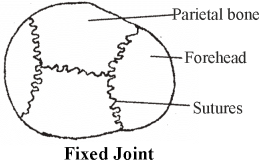
Explain one similarity and one difference between the Ball and Socket Joint and the Hinge Joint. Make a labelled diagram of an immovable joint.
View full question & answer
Question 112 Marks
What effect will it have if all joints in the human arm become immobile?
Answer
If all joints in the human arm become immobile, the movement and functioning of the arm will stop and no work will be done by the hands.
View full question & answer
Question 122 Marks
Write four characteristics of striated muscles not found in smooth muscles.
Answer
The characteristics not found in smooth muscles but present in striated muscles are :
(i) These muscles are usually attached to bones and are called skeletal muscles.
(ii) They are cylindrical in shape.
(iii) They are striated due to the presence of light and dark bands.
(iv) They are voluntary and can be moved as desired.
(v) They are connected to both motor and sensory nerve. Hence they feel tired.
View full question & answer
Question 132 Marks
If the olecranon process of the human radioulna bone is removed, what effect will it have?
Answer
The olecranon process of the human radio-ulna bone fits into the olecranon groove of the humerus, forming a hinge joint. If the olecranon process is removed, the ulna may turn inward but not outward, affecting the proper functioning of the arm.
View full question & answer