Questions

5 Marks Questions

Take a timed test

8 questions · self-marked practice — reveal the answer and mark yourself.

Question 15 Marks
Give comparative depscription in detail about striated, unstriated and cardiac muscles.
Answer
Comparative description about striated, unstriated and cardiac muscle :
S.No.CharactersStriated muscleUnstriated muscleCardiac muscle
1.ShapeCylindricalSpindle shapedMicro cylindrical
2.SynonymsVoluntary striped and skeletal muscleInvoluntary and smooth muscleCasdiac and involuntary muscle
3.StriationsBoth transverse and longitudinalOnly longitudinalBoth transverse and longitudinal
4.SarcolemmaClear and firmUnclearUnclear
5.NucleusMultiple and uninucleateSingle and nuclearSingle and nuclear
6.BranchingAbsentAbsentPresent
7.Nerve supplyAnterior part of spinal cordAutonomic nervous systemAutonomic nervous system
8.ContractibilityQuick and fastSlow speedMedium speed
9.ConductivityQuickSlow rateMedium rate
10.RhythmicityAbsentPresentPresent
11.Refractory periodVery littleMediumMaximum
12.TetanuspossiblePartially possibleImpossible
13.All-or-none-lawFalseTrueTrue
14.TonicityPresent and depends on nerve distributionPresent and independent of nerve distributionPresent and independent of nerve distribution
15.Intercalated discAbsentPresentPresent
16.Size of muscle fibre$3-4 cm$$0.02-0.2 mm$$50-120 \mu$
17.Formation of lactic acidYesNoNo
View full question & answer
Question 25 Marks
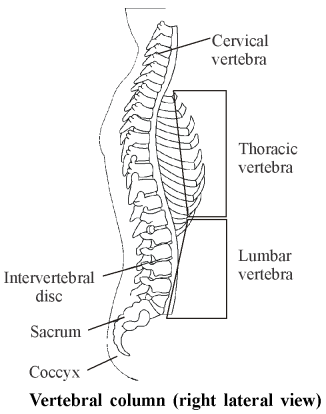
Create an annotated diagram of the vertebral column in humans and describe its four functions.
Answer
Vertebral Column : The vertebral column is composed of 26 individual bones, including 24 separate vertebrae, one fused sacrum, and one fused coccyx. In reality, the sacrum comprises five fused vertebrae, while the coccyx comprises four fused vertebrae. Hence, the total vertebrae count equals 33 . The vertebral column acts as the main axis of the body and provides support to the spine. It is connected by ligaments between the vertebrae (as depicted in the illustration below).
Intervertebral discs made of fibrocartilage are present between adjacent vertebrae, ensuring the flexibility of the vertebral column. Each typical vertebra has a heavy anterior portion known as the centrum and a posterior portion called the neural arch. The shape of the centrum of each vertebra, including humans, is amphiplatyan or acoelous. To attach to adjacent vertebrae, pre-zygapophysis and postzygapophysis are found in them. The neural canals, formed by the sequential arrangement of vertebral bones, form a hollow canal where the spinal cord remains protected. The nomenclature of the vertebrae is based on their location in the body. In humans, there are 7 cervical vertebrae in the neck region, 12 thoracic vertebrae in the thoracic region, 5 lumbar vertebrae in the lumbar region, onesacrum, and one coccyx formed from the fusion of five and four vertebrae respectively. The first cervical vertebra is called the atlas, the second is the axis, and the remaining five cervical vertebrae are referred to as typical cervical vertebrae. The presence of joints for the attachment of muscles, the peculiar posterior arch in the cervical vertebrae, the presence of the vertebral foramen in the vertebral centrum, and the body's curvature in the lumbar vertebrae are specific features.
Image
The main functions of the vertebral column are as follows :
1. The axis provides a definite shape to the organism in the form of skeleton.
2. Supports the head by supporting the weight of the skull and gives it some freedom of movement.
3. It keeps the internal organs located in the body cavity intact and protects them.
4. Provides the animal with the ability to bend, turn, twist, etc. a little here and there.
5. Surrounds the spinal cord and protects it from external shocks.
6. Provides space for attachment of muscles related to locomotion towards the back.
7. Helps in locomotion by supporting the girdles.
8. Helps in respiration.

View full question & answer
Question 75 Marks
What are muscular tissues? Describe the various types of muscles based on their structure. Provide a description for each type.
Answer
self
View full question & answer
Question 85 Marks
Explain the differences between bone and cartilage.
Answer
Differences between Bone and Cartilage :
S. No.BoneCartilage
1. It is strong, firm, and rigid. It is flexible and soft.
2. Its matrix is made of ossein. Cartilage matrix is made of chondrin.
3. The matrix is solid. The matrix is semi-solid.
4. The cells are irregularly shaped. The cells are semi-circle.
5. Bone cells increase due to the division of osteoblasts. Cartilage cell numbers increase through division.
6. Formation of Haversian systems occurs. Haversian systems are not formed.
7. Red blood cells (RBCs) are formed in   bones. Red blood cells (RBCs) are not formed in cartilage.
8. Examples: include the humerus and the   radius and ulna bones. Examples: include hyaline cartilage, elastic cartilage (found) in earlobes, tip of the nose, and epiglottis).
View full question & answer