Questions

3 Marks Question

Take a timed test

20 questions · self-marked practice — reveal the answer and mark yourself.

Question 13 Marks
What is the basis of classification of algae?
Answer
Fritsch (1935) has classified algae considering phylogeny, affinities and inter-relationships of various forms. He classified algae mainly on the basis of the characters like structure of plant body, nature of the pigments, reserve food material, number and position of flagella, chemistry of cell wall and methods of reproduction etc. Algae are divided into 11 classes but among them 3 main classes are Chlorophyceae, Phaeophyceae and Rhodophyceae.
View full question & answer
Question 23 Marks
What is the advantage of development of seed habits in seed plants?
Answer
Seed habit developed in extinct pteridosperms or Cycadofilicales. It is a group intermediate between cycads and ferns. The habit made the seed plants independent of the requirement of external sources of water at the time of fertilisation. In seedless vascular plants, the gametophyte must develop on moist soil with a thin sheet of water. The latter is required for the swimming of sperms for reaching the female sex organs. As a result, seedless vascular plants could never become true land plants. They were popularly called as amphibian of plant kingdom.
View full question & answer
Question 33 Marks
Describe the type of photosynthetic pigments in red algae, green algae and brown algae.
Answer
  1. Red algae: The photosynthetic pigments are located in the chromatophores are chlorophyll-a, d, and $\alpha,\ \beta-$carotenes, xanthophyll and biliproteins.
  2. Green algae: Chromoplasts contain chlorophyll-a, b, carotene and xanthophylla.
  3. Brown algae: The chromatophores contain chlorophyll-a, c and $\beta,\ \alpha-$carotenes and xanthophyll.
View full question & answer
Question 43 Marks
Write short notes on:
  1. Importance of carbon fixation by algae.
  2. Importance of Gymnosperms.
  3. Importance of Angiosperms.
  4. Medicinal Use of Algae.
Answer
  1. About 50% of carbon fixation is done by algae. This enables majority of sea organisms to get the required food.
  2. Gymnosperms are mainly used as decorative plants. Certain paints are prepared from Gymnosperm plants.
  3. Angiosperms are the major providers of food-grains to the mankind.
  4. Spirullina is made by algae and is used as a nutritional supplement.
View full question & answer
Question 53 Marks
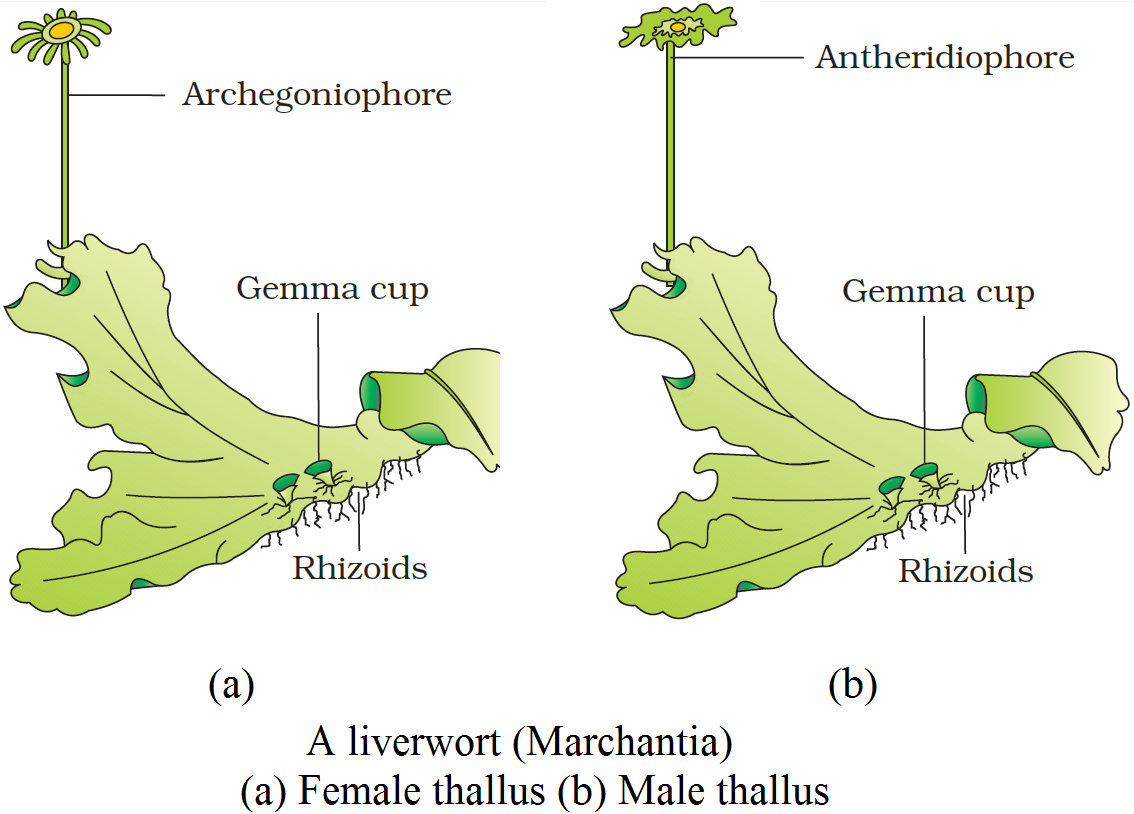
What is the most common liverwort? Draw itswell-labelled diagram. What is the nature of itsthallus?
Answer
The most common example of liverworts is Marchantia. The vegetative plant body of Marchantia is a dorsiventral lobed thallus.
View full question & answer
Question 63 Marks
Amrita while playing with her friend, near the pond noticed in the pond that a green colour covering is floating on the surface of the water. She discussed this with her friend and both got surprised. Next day in the school Amrita asked her teacher about the same. Teacher told her, that was nothing, but green algae which occur both in fresh and marine water habitats.
  1. Mention the economic importance of algae.
  2. Why green algae are considered to be the ancestors of all land plants. Justify the statement by giving reasons.
  3. What values as a good biology student are reflected from Amrita's character.
Answer
  1.  
  1. Algae are used as source of agar-agar which is solidifying medium of culture media, jams and jellies.
  2. Many algae like Chlorella and Spirulina are good sources of protein.
  1. There are many evidences shown by many algal genera which show that these are connecting link between them and bryophytes. Many members of Phaeophyta can survive in low tidal areas of sea and show adaptations to terrestrial habitat.
  2. Amrita is a good observer, curious and has scientific bend of mind.
View full question & answer
Question 73 Marks
What is the general structure of Pteridophytes?
Answer
  1. The main plant body is a sporophyte which is differentiated into true root, stem and leaves. These organs possess well-differentiated vascular tissues.
  2. The leaves in pteridophyta are small (microphylls) as in Selaginella or large (macrophylls) as in ferns.
  3. The sporophytes bear sporangia that are subtended by leaf-like appendages called sporophylls. In some cases sporophylls may form distinct compact structures called strobili or cones (Selaginella, Equisetum).
View full question & answer
Question 83 Marks
Each plant or group of plants has some phylogenetic significance in relation to evolution: Cycas, one of the few living members of gymnosperms is called as the ‘relic of past’. Can you establish a phylogenetic relationship of Cycas with any other group of plants that justifies the above statement?
Answer
Cycas as the relic of past Cycas is an evergreen plant which looks like a palm. It has un branched stem and large compound leaf. It exhibit phylogenetic relationship with pteridophyte. Its evolutionary characters are:
  1. Slow growth.
  2. Shedding of seed when the embryo is still immature.
  3. Little secondary growth and manoxylic wood.
  4. Leaf like mega sporophyllus.
  5. Flagellate sperms even when pollen tube is present.
  6. Persistent leaf bases.
  7. Circinate ptysix.
  8. Arrangement of micro sporangia is well defined archegonia.
View full question & answer
Question 103 Marks
Double fertilisation is an unique event to angiosperms. Explain the event and its possible significance.
Answer
Double fertilisation is unique to angiosperms:
  1. In this phenomenon, two male gametes are discharged by a pollen tube into the embryo sac of an ovule.
  2. One male gamete fuses with the female gamete to form a zygote; this fusion is called syngamy.
  3. A second male gamete fuses with the secondary nucleus to form the primary endosperm nucleus; this is called triple fusion.
View full question & answer
Question 113 Marks
Write a brief account of mosses.
Answer
Mosses are widely distributed from the Arctic through the tropics to parts of Antarctica. The gametophytic plant body is with leafy axis and shows a radial symmetry. The rhizoid are multicellular, branched and have oblique septa. Sex organs, i.e., antheridia and archegonia are usually borne in groups at the apices of reproductive branches. The sporophyte is usually differentiated into foot, seta and capsule.
View full question & answer
Question 123 Marks
Angiosperms are the most advanced among plants and show more variety than any other division of plants. Additionally, most of the useful plants for us belong to the division angiosperm. Which of the following lessons can be taken from this? What are the benefits of learning multiple skills in our life?
  1. A diverse group of students is always good for academic learning.
  2. If a student knows multiple skills, then he is more likely to become relevant for the society.
  3. A student with better physical features is likely to be a better student.
Answer
  1. If a student knows multiple skills, then he is more likely to become relevant forthe society. It is an old saying, “Life is not a bed of roses”. Living a successful life is a challenge in many ways. One not only needs to excel at academics but also at other aspects of personality. A person who learns various skills can handle many roles and responsibilities. That person can take bigger responsibilities in future. He can make friends and can influence people and thus can become successful; both professionally and personally.
View full question & answer
Question 133 Marks
What is the general structure of Bryophytes?
Answer
Structure of Bryophytes: It is thallus-like and prostrate or erect, and attached to the substratum by unicellular or multicellular rhizoids. They lack true roots, stem or leaves. They may possess root-like, leaf-like or stem-like structures.
View full question & answer
Question 143 Marks
Photosynthesis not only facilitates production of food but also cleans up the environment. Which of the following is similar to this multipronged effect of photosynthesis? Explain how deforestation affects our environment.
  1. An automobile not only carries people but also releases carbon dioxide in the air.
  2. A cow not only gives milk but also produces methane which is a greenhouse gas.
  3. A cow not only gives milk but also produces cowdung which can be used as kitchen fuel.
Answer
  1. A cow not only gives milk but also produces cowdung which can be used as kitchen fuel. Deforestation is defined as mindless cutting of trees. We know that trees hold the topsoil in place and make the soil porous. This helps in natural recharge of groundwater and thus deforestation has adverse effect on groundwater reservoirs. Additionally, trees also contribute a lot towards atmospheric moisture and thus towards precipitation. Reduced forest cover can lead to draught like situation in the region. Trees also take carbon dioxide and release oxygen in the atmosphere and thus maintain the balance of oxygen and carbon dioxide in the atmosphere. Deforestation can result in increased level of air pollution.
View full question & answer
Question 153 Marks
What are the main differences among Chlorophyceae, Phaeophyceae and Rhodophyceae?
Answer
S.No
Characteristics
Chlorophyceae
Phaeophyceae
Rhodophyceae
1.
Pigments
Chlorophyll a and b
Chlorophyll a, c and fucoxanthin
Chlorophyll a, d and phycoerythrin
2.
Stored Food
Starch
Mannitol and Laminarin
Floridean Starch
3.
Cell Wall
Cellulose
Cellulose and Algin
Cellulose
4.
Flagellar number and position of insertion
2-8, equal apical
2, unequal lateral
Absent
View full question & answer
Question 163 Marks
Why Ginkgo biloba is called living fossil?Explain how is it useful for horticulturists. What are its important features? Why horticulturists prefer to grow only male plants?
Answer
Ginkgo biloba has not changed for last several millions of years, Since its appearance in triassic period. So, it is also called living fossil. Horticulturists are interested in Ginkgo as it has natural immunity to several plant diseases. Important features are as follows:
  1. The plant is a tall tree of up to 30m height.
  2. Leaves are fan-shaped.
  3. Leaves have furcate venation.
  4. Dwarf shoots of female plant bear distinct megasporangiate structures.
  5. Endosperm of roasted seed is edible.
Horticulturists prefer to grow only male plants, as female plants give unpleasant smell.
View full question & answer
Question 183 Marks
Enumerate the economic significance of bryophytes.
Answer
  1. Some mosses provide food to herbivorous mammals.
  2. Sphagnum provides peat, which has been used as fuel.
  3. Due to their water-holding capacity, species of Sphagnum are used as packing material for transshipment of living materials.
  4. Some mosses are the pioneer species to colonise rocks along with lichens and bring about ecological succession.
  5. Mosses form dense mats on the soil and prevent soil erosion by reducing the impact of falling rain water.
View full question & answer
Question 193 Marks
The heterosporous pteridophytes show certain characteristics, which are precursor to the seed habit in gymnosperms. Explain.
Answer
Heterosporous pteridophytes are the plants that produce two types of spores i.e. microspores and megaspores. These plants posses some of the characteristics which are precursors of the seed habit and these are:
  1. Retention of the female gametophyte within the megasporangium on the parent plant for proper parental care of new embryo.
  2. Development of the zygote inside the female gametophyte.
View full question & answer
Question 203 Marks
Give one example each of Chlorophyceae, Phaeophyceae and Rhodophyceae.
Answer
Chlorophyceae Spirogyra, Phaeophyceae Sargassum and Rhodophyceae Porphyra. State the ploidy of gametophyte and sporophyte of a bryophytic plant. Ans. Cells of gametophyte have (n) number of chromosomes whereas sporophyte have (2n) number of chromosomes.
View full question & answer