MCQ 11 Mark
Match List $I$ with List $II$ :
| List $I$ (Sub Phases of Prophase $I$) |
List $II$ |
| $A.$ Diakinesis |
$I.$ Synaptonemal complex formation |
| $B.$ Pachytene |
$II.$ Completion of terminalisation of chiasmata |
| $C.$ Zygotene |
$III.$ Chromosomes look like thin threads |
| $C.$ Leptotene |
$IV.$ Appearance of recombination nodules |
Choose the correct answer from the options given below
- A
$A-I, B-II, C-IV, D-III$
- ✓
$A-II, B-IV, C-I, D-III$
- C
$A-IV, B-III, C-II, D-I$
- D
$A-IV, B-II, C-III, D-I$
AnswerCorrect option: B. $A-II, B-IV, C-I, D-III$
b
($A$) Diakinesis - Completion of terminalisation of chiasmata
($B$) Pachytene - Appearance of recombination nodules
($C$) Zygotene - Synaptonemal complex formation
($D$) Leptotene - Chromosomes look like thin threads
$A-II, B-IV, C-I, D-III$
View full question & answer→MCQ 21 Mark
Given below are two statements:
Statement $I$: Chromosomes become gradually visible under light microscope during leptotene stage.
Statement $II$ : The beginning of diplotene stage is recognized by dissolution of synaptonemal complex.
In the light of the above statements, choose the correct answer from the options given below:
- A
Both Statement $I$ and Statement $II$ are false
- B
Statement $I$ is true but Statement $II$ is false
- C
Statement $I$ is false but Statement $II$ is true
- ✓
Both Statement $I$ and Statement $II$ are true
AnswerCorrect option: D. Both Statement $I$ and Statement $II$ are true
d
- During leptotene stage the chromosomes become gradually visible under the light microscope.
- The beginning of diplotene is recognised by the dissolution of the synaptonemal complex and the tendency of the recombined homologous chromosomes of the bivalents to separate from each other except at the site of crossover.
Thus both statement $I$ and $II$ are correct.
View full question & answer→MCQ 31 Mark
Spindle fibers attach to kinetochores of chromosomes during
Answera
Spindle fibers attach to kinetochores of chromosome in metaphase stage.
View full question & answer→MCQ 41 Mark
Following are the stages of cell division :
$A$. Gap $2$ phase $B$. Cytokinesis
$C$. Synthesis phase $D$. Karyokinesis
$E$. Gap $1$ phase
Choose the correct sequence of stages from the options given below :
- A
$E-B-D-A-C$
- B
$B-D-E-A-C$
- ✓
$E-C-A-D-B$
- D
$C-E-D-A-B$
AnswerCorrect option: C. $E-C-A-D-B$
c
The correct sequence of stages of cell division is Gap $1$ phase $\rightarrow$ Synthesis phase $\rightarrow$ Gap $2$ phase ($E$) ($C$) ($A$)
$\rightarrow$ Karyokinesis $\rightarrow$ Cytokinesis ($D$) ($B$)
The correct sequence will be $\rightarrow \mathrm{E} \rightarrow \mathrm{C} \rightarrow \mathrm{A} \rightarrow \mathrm{D} \rightarrow \mathrm{B}$
View full question & answer→MCQ 51 Mark
Select the correct statements.
$A$. Tetrad formation is seen during Leptotene.
$B$. During Anaphase, the centromeres split and chromatids separate.
$C$. Terminalization takes place during Pachytene.
$D$. Nucleolus, Golgi complex and ER are reformed during Telophase.
$E$. Crossing over takes place between sister chromatids of homologous chromosome. Choose the correct answer from the options given below:
- A
$B$ and $E$ only
- B
$A$ and $C$ only
- ✓
$B$ and $D$ only
- D
$A,C$ and $E$ only
AnswerCorrect option: C. $B$ and $D$ only
c
- Tetrad formation is seen during zygotene stage
- During Anaphase, the centromeres split and chromatids separate.
- Terminalisation of chiasmata takes place during diakinesis.
- Nucleolus, golgi complex and ER are reformed during telophase.
- Crossing over takes place between non-sister chromatids of homologus chromosomes.
View full question & answer→MCQ 61 Mark
Given below are two statements:
Statement $I$ : During Go phase of cell cycle, the cell is metabolically inactive.
Statement $II$ : The centrosome undergoes duplication during S phase of interphase.
In the light of the above statements, choose the most appropriate answer from the options given below:
- ✓
Statement $I$ is incorrect but Statement $II$ is correct.
- B
Both Statement $I$ and Statement $II$ are correct
- C
Both Statement $I$ and Statement $II$ are incorrect.
- D
Statement $I$ is correct but Statement $II$ is incorrect.
AnswerCorrect option: A. Statement $I$ is incorrect but Statement $II$ is correct.
a
Cells in the $G _0$ stage remain metabolically active but no longer proliferate unless called on to do so depending on the requirement of the organism.
In animal cells, during the S-phase, DNA replication begins in the nucleus, and the centriole duplicates in the cytoplasm.
View full question & answer→MCQ 71 Mark
Among eukaryotes, replication of $DNA$ takes place in:
- A
$G _2$ phase
- B
$M$ phase
- ✓
$S$ phase
- D
$G_1$ phase
AnswerCorrect option: C. $S$ phase
c
Replication of $DNA$ takes place in S-phase of cell cycle in eukaryotes. Most of the cell organelles duplicate in $G _1$ phase.
View full question & answer→MCQ 81 Mark
Which stage of meiosis can last for months or years in the oocytes of some verterbrates?
MCQ 91 Mark
Regarding Meiosis, which of the statements is incorrect?
- ✓
DNA replication occurs in $S$ phase of Meiosis$-II$
- B
Pairing of homologous chromosomes and recombination occurs in Meiosis$-I$
- C
Four haploid cells are formed at the end of Meiosis$-II$
- D
There are two stages in Meiosis, Meiosis$-I$ and $II$
AnswerCorrect option: A. DNA replication occurs in $S$ phase of Meiosis$-II$
View full question & answer→MCQ 101 Mark
The appearance of recombination nodules on homologous chromosomes during meiosis characterizes:
- A
- ✓
Sites at which crossing over occurs
- C
- D
AnswerCorrect option: B. Sites at which crossing over occurs
View full question & answer→MCQ 111 Mark
Which one of the following never occurs during mitotic cell division?
- A
Movement of centrioles towards opposite poles
- ✓
Pairing of homologous chromosomes
- C
Coiling and condensation of the chromatids
- D
Spindle fibres attach to kinetochores of chromosomes
AnswerCorrect option: B. Pairing of homologous chromosomes
View full question & answer→MCQ 121 Mark
Select the incorrect statement with reference to mitosis:
- ✓
Spindle fibres attach to centromere of chomosomes.
- B
Chromosomes decondense at telophase.
- C
Splitting of centromere occurs at anaphase.
- D
All the chromosomes lie at the equator at metaphase.
AnswerCorrect option: A. Spindle fibres attach to centromere of chomosomes.
View full question & answer→MCQ 131 Mark
The fruit fly has $8$ chromosomes $(2 n)$ in each cell. During interphase of Mitosis if the number of chromosomes at $\mathrm{G}_{1}$ phase is $8 ,$ what would be the number of chromosomes after $S$ phase ?
View full question & answer→MCQ 141 Mark
The centriole undergoes duplication during :
- ✓
$S-$phase
- B
- C
- D
$\mathrm{G}_{2}$ phase
AnswerCorrect option: A. $S-$phase
View full question & answer→MCQ 151 Mark
Match List $- I$ with List $- II.$
| List $- I$ |
List $- II$ |
| $(a)$ $S$ phase |
$(i)$ Proteins are synthesized |
| $(b)$ $G_2$ phase |
$(ii)$ Inactive phase |
| $(c)$ Quiescent stage |
$(iii)$ Interval between mitosis and initiation of $DNA$ replication |
| $(d)$ $\mathrm{G}_{1}$ phase |
$(iv)$ $DNA$ replication |
Choose the correct answer from the options given below.
$(a) -(b) -(c)- (d)$
- A
$(iii)- (ii)- (i) -(iv)$
- B
$(iv)- (ii)- (iii)- (i)$
- ✓
$(iv)- (i) -(ii) -(iii)$
- D
$(ii) -(iv)- (iii)- (i)$
AnswerCorrect option: C. $(iv)- (i) -(ii) -(iii)$
View full question & answer→MCQ 161 Mark
During Meiosis I, in which stage synapsis takes place?
Answerc
Synapsis is a process by which homologous chromosomes come to lie side by side in pairs.
The process of synapsis takes place during zygotene stage of prophase-I of meiosis-I.
View full question & answer→MCQ 171 Mark
Match the following with respect to meiosis:
$(a)$ Zygotene $(i)$ Terminalization
$(b)$ Pachytene $(ii)$ Chiasmata
$(c)$ Diplotene $(iii)$ Crossing over
$(d)$ Diakinesis $(iv)$ Synapsis
Select the correct option from the following:
$(a)\quad(b)\quad(c)\quad(d)$
- A
$( ii )\quad(iv)\quad(iii)\quad(i)\quad$
- B
$(iii)\quad(iv)\quad(i)\quad(ii)$
- ✓
$(iv)\quad(iii)\quad(ii)\quad(i)$
- D
$(i)\quad(ii)\quad(iv)\quad(iii)$
AnswerCorrect option: C. $(iv)\quad(iii)\quad(ii)\quad(i)$
c
$(iv)\quad(iii)\quad(ii)\quad(i)$
View full question & answer→MCQ 181 Mark
Attachment of spindle fibers to kinetochores of chromosomes becomes evident in
Answera
Spindle fibres attach to kinetochore of chromosome in metaphase and are clearly evident here.
View full question & answer→MCQ 191 Mark
Match the following events that occur in their respective phases of cell cycle and select the correct option :
| Column $I$ |
Column $II$ |
| ($a$) $G _{1}$ phase |
($i$) Cell grows and organelle duplication |
| ($b$) $S$ phase |
($ii$) $DNA$ replication and chromosome duplication |
| ($c$) $G _{2}$ phase |
($iii$)Cytoplasmic growth |
| ($d$) Metaphase in $M$-phase |
($iv$) Alignment of chromosomes |
- ✓
$(a)-(i),(b)-(i i),(c)-(i i i),(d)-(i v)$
- B
$(a)-(i i),(b)-(i i i),(c)-(i v),(d)-(i)$
- C
$(a)-(i i i),(b)-(i v),(c)-(i),(d)-(i i)$
- D
$(a)-(i v),(b)-(i),(c)-(i i),(d)-(i i i)$
AnswerCorrect option: A. $(a)-(i),(b)-(i i),(c)-(i i i),(d)-(i v)$
a
Phases of cell cycle and their respective events are:
(a) $G _{1}$ phase- Cell grows and cell organelle duplication
(b) $S$ phase- DNA replication and chromosome duplication
(c) $G _{2}$ phase- Cytoplasmic growth
(d) Metaphase in M-phase- Alignment of chromosomes
View full question & answer→MCQ 201 Mark
Some dividing cells exit the cell cycle and enter vegetative inactive stage. This is called quiescent stage $\left( G _{0}\right) .$ This process occurs at the end of
- A
$G _{2}$ phase
- ✓
$G _{1}$ phase
- C
$G _{0}$ phase
- D
$S$ phase
AnswerCorrect option: B. $G _{1}$ phase
b
$M$ phase /$G _{1}$ phase
View full question & answer→MCQ 211 Mark
Identify the correct statement with regard to $G _{1}$ phase $(Gap\,1)$ of interphase.
- A
Nuclear Division takes place.
- B
$DNA$ synthesis or replication takes place.
- C
Reorganisation of all cell components takes place.
- ✓
Cell is metabolically active, grows but does not replicate its $DNA.$
AnswerCorrect option: D. Cell is metabolically active, grows but does not replicate its $DNA.$
d
Cell is metabolically active, grows but does not replicate its $DNA.$
View full question & answer→MCQ 221 Mark
After meiosis $I$, the resultant daughter cells have
- A
Same amount of $DNA$ as in the parent cell in $S$ phase
- ✓
Twice the amount of $DNA$ in comparison to haploid gamete.
- C
Same amount of $DNA$ in comparison to haploid gamete
- D
Four times the amount of $DNA$ in comparison to haploid gamete
AnswerCorrect option: B. Twice the amount of $DNA$ in comparison to haploid gamete.
View full question & answer→MCQ 231 Mark
Crossing over takes place between which chromatids and in which stage of the cell cycle ?
- A
Non-sister chromatids of non-homologous chromosomes at Zygotene stage of prophase $I.$
- ✓
Non-sister chromatids of homologous chromosomes at Pachytene stage of prophase $I.$
- C
Non-sister chromatids of homologous chromosomes at Zygotene stage of prophase $I.$
- D
Non-sister chromatids of non-homologous chromosomes at Pachytene stage of prophase $I.$
AnswerCorrect option: B. Non-sister chromatids of homologous chromosomes at Pachytene stage of prophase $I.$
View full question & answer→MCQ 241 Mark
In meiosis crossing over is initiated at
Answerc
(c) : Crossing over is a process of exchange of genetic material or chromatid segments between two homologous chromosomes. It is initiated during pachytene stage of meiosis.
View full question & answer→MCQ 251 Mark
Match the stages of meiosis in column I to their characteristic features in column II and select the correct option using the codes given below.
| Column $-I$ |
Column $-II$ |
| $(A)$ Pachytene |
$(i)$ Pairing of homologous chromosomes |
| $(B)$ Metaphase$-I$ |
$(ii)$ Terminalisation ofchiasmata |
| $(C)$ Diakinesis |
$(iii)$ Crossing-over takes place |
| $(D)$ Zygotene |
$(iv)$ Chromosomes align at equatorial plate |
- ✓
$A(iii), B(iv), C(ii), D(i)$
- B
$A(i), B(iv), C(ii), D(iii)$
- C
$A(ii), B(iv), C(iii), D(i)$
- D
$A(iv), B(iii), C(ii), D(i)$
AnswerCorrect option: A. $A(iii), B(iv), C(ii), D(i)$
View full question & answer→MCQ 261 Mark
Which of the following is not a characteristic feature during mitosis in somatic cells?
- A
- ✓
- C
- D
Disappearance of nucleolus
Answerb
(b) : Synapsis is the process of association of homologous chromosomes. It takes place during zygotene stage of prophase $I$ of meiosis. This stage is not seen during mitosis.
View full question & answer→MCQ 271 Mark
Select the correct option.Column IColumn II
| Column $I$ |
Column $II$ |
| $A.$ Synapsis aligns homologous chromosomes |
$(i)$ Anaphase $II$ |
| $B.$ Synthesis of $RNA$ and protein |
$(ii)$ Zygotene |
| $C.$ Action of enzyme recombinase |
$(iii)$ $G_2$ phase |
| $D.$ Centromeres do not separate but chromatids move towards opposite poles |
$(iv)$ Anaphase $I$ |
| |
$(v)$ Pachytene |
- A
$A(i), B(ii), C(v), D(iv)$
- B
$A(ii), B(iii), C(iv), D(v)$
- C
$A(ii), B(i), C(iii), D(iv)$
- ✓
$A(ii), B(iii), C(v), D(iv)$
AnswerCorrect option: D. $A(ii), B(iii), C(v), D(iv)$
d
(d) : Synapsis aligns homologous chromosomes-Zygotene
Synthesis of $RNA$ and protein -$G_2$ phase
Action of enzyme recombinase -Pachytene
Centromeres do not separate but chromatidsmove towards opposite poles -Anaphase $I$
View full question & answer→MCQ 281 Mark
Arrange the following events of meiosis in correct sequence
$(i)$ Crossing over
$(ii)$ Synapsis
$(iii)$ Terminalisation of chiasmata
$(iv)$ Disappearance of nucleolus
- A
$(i), (ii), (iii), (iv)$
- B
$(ii), (iii), (iv), (i)$
- C
$(ii), (i), (iv), (iii)$
- ✓
$(ii), (i), (iii), (iv)$
AnswerCorrect option: D. $(ii), (i), (iii), (iv)$
d
(d) : ProphaseI of meiosis has been divided into five substages which occur in the sequence as : Leptotene Zygotene Pachytene Diplotene Diakinesis. Synapsis $i.e.$, pairing of homologous chromosomes occurs during zygotene. Crossing over $i.e.$, exchange of chromatid segments occurs during pachytene. Terminalisation of chiasmata $i.e.$, shifting of chiasmata towards the ends of chromosomes and complete disappearance ofnucleolus take place during diakinesis.
View full question & answer→MCQ 291 Mark
A somatic cell that has just completed the $S$ phase of its cell cycle, as compared to gamete of the same species, has
- ✓
twice the number of chromosomes and four times the amount of $DNA$
- B
four times the number of chromosomes and twice the amount of $DNA$
- C
twice the number of chromosomes and twice the amount of $DNA$
- D
same number of chromosomes but twice the amount of $DNA.$
AnswerCorrect option: A. twice the number of chromosomes and four times the amount of $DNA$
a
(a) : In diploid cells (somatic cells) during $G_1$ phase, $DNA$ content is $2C$ and chromosome number is $2n$ whereas in haploid cells (gamete) during $G_1$ phase, $DNA$ content is $1C$ and chromosome number is $n$. $S$ phase is marked by replication of $DNA$ and the amount of $DNA$ per cell is doubled $i.e.$, it becomes $4C$ in somatic cells, whereas chromosome number remains same $i.e.$, $2n$. Thus, a somatic cell which has just completed $S$ phase, will have $4C\ DNA$ content but $2n$ chromosome number, while the gamete cell has $1C\ DNA$ content and $n$ chromosome number.
View full question & answer→MCQ 301 Mark
The enzyme recombinase is required at which stage of meiosis?
Answera
(a) : Pachytene is characterized bythe appearance of recombination nodules, the sites at which crossing over occurs between non-sister chromatids of the homologous chromosomes. Nodules contain multienzyme complex called recombinase. Recombinase is made of endonuclease, exonuclease, unwindase, R-protein, etc.
View full question & answer→MCQ 311 Mark
In $‘S’$ phase of the cell cycle
- ✓
amount of $DNA$ doubles in each cell
- B
amount of $DNA$ remains same in each cell
- C
chromosome number is increased
- D
amount of $DNA$ is reduced to half in each cell.
AnswerCorrect option: A. amount of $DNA$ doubles in each cell
a
(a) : In $‘S’$ phase of cell cycle the $DNA$ content doubles, $i.e.$, $1\ C$ to $ 2 \ C$ for haploid cells and $2\ C$ to $4\ C$ for diploid cells. However, the number of chromosomes does not increase.
View full question & answer→MCQ 321 Mark
During which phase(s) of cell cycle, amount of $DNA$ in a cell remains at $4C$ level if the initial amount is denoted as $2C$ ?
- A
$G_0$ and $G_1$
- B
$G_1$ and $S$
- ✓
Only $G_2$
- D
$G_2$ and $M$
AnswerCorrect option: C. Only $G_2$
c
(c) : A cell cycle is divided into $G S, G$ and $M\ (CM)$ which lies between $G_2$ and Mphase).$G_1$ or first growth phase is followed by $S$ phase or synthesis phase. $DNA$ replication occurs in $S$ phase and $DNA$ amount doubles up $i.e.$, a cell with $2C\ DNA $ in $G_1$ phase will now have $4C\ DNA$. $G_2$ phase is second growth phase where $DNA$ content remains $4C$. $M$ phase is the phase of division where $DNA$ content either regains $2C$ level (mitosis) or becomes halved.
$i.e.$ $1C$ (in meiosis). $G_0$ phase is the phase of differentiation where cell contains $DNA$ as in the same amount as its parent cell and does not divide further.
View full question & answer→MCQ 331 Mark
Answerc
(c) : Gemmule and conidia are asexual propagules thus no meiosis takes place in them. Megaspores are haploid which are formed as a result of meiosis of diploid megaspore mother cell. Meiocyte is any cell that undergoes meiosis.
View full question & answer→MCQ 341 Mark
During meiosis $I$, the chromosomes start pairing at
Answera
(a) : During zygotene or zygonema of meiotic prophase $I$ the chromosomes become shorter and thicker. The homologous chromosomes come to lie sidebyside in pairs. This pairing of homologous chromosomes is known as synapsis, or syndesis. A pair of homologous chromosomes lying together is called a bivalent.
View full question & answer→MCQ 351 Mark
The complex formed by a pair of synapsed homologous chromosomes is called
Answera
(a) : During zygotene stage chromosomes start pairing together and this process of association is called synapsis. Such paired chromosomes are called homologous chromosomes. Electron micrographs of this stage indicate that chromosome synapsis is accompanied by the formation of complex structure called synaptonemal complex. The complex formed by a pair of synapsed homologous chromosomes is called a bivalent or a tetrad.
View full question & answer→MCQ 361 Mark
During the metaphase stage of mitosis, spindle fibres attach to chromosomes at
- ✓
- B
both centromere and kinetochore
- C
centromere, kinetochore and areas adjoining centromere
- D
Answera
(a) : In metaphase, chromosomes consisting of two sister chromatids get arranged at equator. Discontinuous fibres radiate out from two spindle poles and get connected to the disc shaped structure at the surface of the centromere called kinetochores. These are known as chromosome fibres or tractile fibrils. A kinetochore is a complex protein structure that is analogous to a ring for the microtubule hook; it is the point where microtubules attach themselves
View full question & answer→MCQ 371 Mark
A stage in cell division is shown in the figure. Select the answer which gives correct identi fication of the stage with its characteristics.
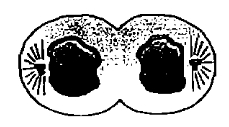
- A
Cytokinesis $⇒$ Cell plate formed,mitochondria distributed between two daughter cells.
- B
Telophase $⇒$ Endoplasmic reticulumand nucleolus not reformed yet.
- ✓
Telophase $⇒$ Nuclear envelopereforms,Golgi complex reforms.
- D
Late anaphase $⇒$ Chromosomes moveaway from equatorial plate, Golgi complex not present.
AnswerCorrect option: C. Telophase $⇒$ Nuclear envelopereforms,Golgi complex reforms.
c
(c) : The figure given in the question shows a stage of mitotic cell division called as telophase stage. The individual chromosomes are no longer seen and chromatin material tends to collect in a mass at the two poles. This is the stage which shows the following key events:
-Chromosomes cluster at opposite spindle poles and their identity is lost as discrete elements.
-Nuclear envelope assembles around the chromosome clusters.
-Nucleolus, Golgi complex and $ER$ reform.
View full question & answer→MCQ 381 Mark
A stage of mitosis is shown in the diagram. Which stage is it and what are its characteristics?
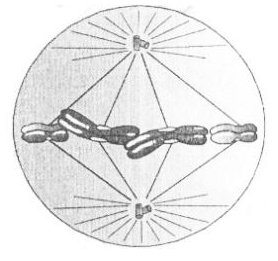
- A
Metaphase - Spindle fibers attached to kinetochores, centromeres split and chromatids separate.
- ✓
Metaphase - Chromosomes moved to spindle equator, chromosomes made up of two sister chromatids.
- C
Anaphase - Centromeres split and chromatids separate and start moving away.
- D
Late prophase - Chromosomes move to spindle equator.
AnswerCorrect option: B. Metaphase - Chromosomes moved to spindle equator, chromosomes made up of two sister chromatids.
b
(b) : In metaphase, chromosomes consisting of two sister chromatids get arranged at equator. Discontinuous fibres radiate out from two spindle poles and get connected to the disc shaped structure at the surface of the centromere called kinetochores. These are known as chromosome fibres or tractile fibrils. A kinetochore is a complex protein structure that is analogous to a ring for the microtubule hook; it is the point where microtubules attach themselves
View full question & answer→MCQ 391 Mark
Find out the wrong statement
AnswerCorrect option: C. Synaptonemal complex and nuclear membrane completely disappear in diplotene
c
Synaptonemal complex and nuclear envelope completely disappear in the end of diakinesis.
View full question & answer→MCQ 401 Mark
AnswerCorrect option: A. Reformation of $ER$ and golgi complex -Telophase
a
Invisible phase of cell cycle -Interphase Polar movement of chromatids -Anaphase Recombination nodules formation -Pachytene
View full question & answer→MCQ 411 Mark
Select the matched ones.
$I.$ S-phase - $DNA$ replication
$II.$ Zygotene - Synapsis
$III.$ Diplotene - Crossing over
$IV.$ Meiosis - Shown by haploid and diploid cells
$V.$ $G_{2}$-phase - Quiescent stage
- ✓
$I$ and $II$ only
- B
$III$ and $IV$ only
- C
$III$ and $V$ only
- D
$I,III$ and $V$ only
AnswerCorrect option: A. $I$ and $II$ only
a
$S$ or synthetic phase marks the period during which $DNA$ synthesis or replication takes place. During this phase, the amount of $DNA$ per cell doubles.
The second stage of prophase$-I$ is called zygotene. During this stage, chromosomes start pairing together and this process of association is called synapsis. Such paired chromosomes are called homologous chromosomes. Synapsis is accompanied by the formation of a complex structure called synaptonemal complex. Crossing over happens in PAchytene. Meiosis occurs only in diploid cells. Go phase is the quiscent phase
View full question & answer→MCQ 421 Mark
$A-$ in cell cycle the division of a cell, $DNA$ replication and cell growth occur.
$R-$ At the end of the meiosis there are $4$ daughter cell with a new form.
- ✓
$A$ and $R$ both are correct
- B
$A$ and $R$ both are incorrect
- C
$A$ correct and $R$ incorrect
- D
$A$ incorrect and $R$ correct
AnswerCorrect option: A. $A$ and $R$ both are correct
View full question & answer→MCQ 431 Mark
- ✓
Metaphase $-II$ : The centromere of all chromosomes is arranged on one surface.
- B
Metaphase $-I$ : The centromere of all chromosomes is arranged on one surface.
- C
Metaphase : Homologous chromosomes are arranged in two equator plate of centromere cell.
- D
Anaphase $-I$ : End of this phase nucleus is seen.
AnswerCorrect option: A. Metaphase $-II$ : The centromere of all chromosomes is arranged on one surface.
View full question & answer→MCQ 441 Mark
$A-DNA$ replication in the meiosis only one time
$R-$ Exchange of $DNA$ in chromosome seen in mitosis.
- ✓
$A$ correct and $R$ incorrect
- B
$A$ and $R$ both are incorrect
- C
$A$ and $R$ both are correct
- D
$A$ incorrect and $R$ correct
AnswerCorrect option: A. $A$ correct and $R$ incorrect
View full question & answer→MCQ 451 Mark
$A -$ The number of chromosome in human reproductive cells is $2n.$
$R -$ All organisms doing asexual reproduction.
- A
$A$ and $R$ both are correct
- ✓
$A$ and $R$ both are incorrect
- C
$A$ correct and $R$ incorrect
- D
$A$ incorrect and $R$ correct
AnswerCorrect option: B. $A$ and $R$ both are incorrect
View full question & answer→MCQ 461 Mark
$A-$ In meiosis, during anaphase $I$ homologous chromosomes move to the opposite poles
$R-$ Each pole receive half chromatids numbers in Anaphase
- A
$A$ and $R$ both correct
- ✓
$A$ and $R$ both incorrect
- C
$A$ correct and $R$ incorrect
- D
$A$ incorrect and $R$ correct
AnswerCorrect option: B. $A$ and $R$ both incorrect
View full question & answer→MCQ 471 Mark
Which of the following sentences are correct ?
$a -$ cell cycle can vary from organisation to organism and also from cell type to cell type.
$b -$ $DNA$ synthesis occurs only in pachytene.
$c-G_1$ phase corresponds to the interval between mitosis and initiation of $DNA $ reproduction.
- A
$b$ and $c$
- ✓
$a$ and $c $
- C
$a$ and $b $
- D
AnswerCorrect option: B. $a$ and $c $
View full question & answer→MCQ 481 Mark
AnswerCorrect option: D. $G_1$ phase
View full question & answer→MCQ 491 Mark
Match the following :
$\begin{array}{|p{0.3\linewidth}|p{0.6\linewidth}|} \hline Column\,\,-I & Column\,\,-II \\ \hline A.\,\,G_2-\,\,phase & 1.\,\,First\,\,phase\,\,of\,\,prophase\,\,-I \\ \hline B.\,\,Anaphase & 2.\,\,Proteins\,\,are\,\,synthesized\,\,in\,\,preparation\,\,for\,\,mitosis \\ \hline C.\,\,Leptoteme & 3.\,\,Terminalisation\,\,of\,\,chismata \\ \hline D.\,\,Diakinesis & 4.\,\,Contromeres\,\,split\,\,and\,\,chromatids\,\,separate \\ \hline \end{array}$
- A
$(A-1),(B-2),(C-3), (D-4) $
- ✓
$(A-2),(B-4),(C-1),(D-3) $
- C
$(A-3),(B-1),(C-2),(D-4) $
- D
$(A-4),(B-3),(C-2),(D-1) $
AnswerCorrect option: B. $(A-2),(B-4),(C-1),(D-3) $
View full question & answer→MCQ 501 Mark
Mitosis and meiosis take place respectively in
- ✓
- B
- C
Permanent tissues and secretory tissues
- D
Secretory tissues and permanent tissues
View full question & answer→MCQ 511 Mark
The paradox of meiosis is
AnswerCorrect option: A. Conservation of specific chromosome number from generation to generation
a
Meiosis reduces chromosome number to half in gametes thus maintains same chromosome number in species.
View full question & answer→MCQ 521 Mark
Meiosis occurs in which of the following cells?
Answera
Meiosis reduces chromosome number from diploid $(2 n)$ to haploid ( $n$ ). It occurs in germ cells (eggs or sperm)
View full question & answer→MCQ 531 Mark
Significance of meiosis..........
- A
Mother cell produce four cells containing as much chromosome.
- B
It is occur in all cells of body.
- ✓
It maintain chromosomal number in specific species.
- D
AnswerCorrect option: C. It maintain chromosomal number in specific species.
View full question & answer→MCQ 541 Mark
It is correct for importance of meiosis.
$(i)$ It increases the genetic variability in the population of organisms from one generation to the next.
$(ii)$ It decreases genetic variability
$(iii)$ It occurs in all cells of our body.
$(iv)$ Important process of evolution.
- A
$i, ii $
- B
$ii, iii $
- ✓
$i, iv $
- D
$iii, iv $
AnswerCorrect option: C. $i, iv $
View full question & answer→MCQ 551 Mark
$X -$ It is very important for the process of evolution
$Y -$ Crossing over is the exchange of genetic material between two homologous chromosomes.
- A
Both are true for mitosis
- ✓
Both are true for meiosis
- C
$X$ is true for mitosis, $Y -$ is true for meiosis
- D
$X$ is true for meiosis, $Y -$ is true for mitosis
AnswerCorrect option: B. Both are true for meiosis
View full question & answer→MCQ 561 Mark
Constancy of the chromosome number in successive generations is brought by the process of
MCQ 571 Mark
Meiosis is significant because
AnswerCorrect option: B. It restores the original number of chromosomes (after fertilization)
View full question & answer→MCQ 581 Mark
In which of the following meiosis takes place
Answerc
(c) Because pollen grain formed from pollen mother cells by meiosis.
View full question & answer→MCQ 591 Mark
Crossing over is advantageous because it brings about
MCQ 601 Mark
The significance of meiosis lies in
- A
Reduction of the diploid number of chromosomes to haploid
- B
Maintaining constancy in the number of diploid chromosomes during sexual reproduction
- C
Production of genetic variability in the population of a species
- ✓
View full question & answer→MCQ 611 Mark
Answerb
(b)The most important role of meiosis is to maintain haploid phase.
View full question & answer→MCQ 621 Mark
$A$ : Chiasmata counting stage is diplotene.
$R$ : Dissolution of the synaptonemal complex occurs except at the sites of cross overs.
- ✓
Assertion and Reason both are correct and also correct explanation.
- B
Assertion and Reason both are correct but not explanation of assertion.
- C
Assertion is correct, but Reason is incorrect.
- D
Both Assertion and Reason are incorrect.
AnswerCorrect option: A. Assertion and Reason both are correct and also correct explanation.
a
Chiasmata represents the site of crossing over.
View full question & answer→MCQ 631 Mark
$A$ : Anaphase-$I$ is actual phase of reduction in number of chromosomes.
$R$ : Homologous chromosomes move to the opposite poles with both their chromatids.
- ✓
Assertion and Reason both are correct and also correct explanation.
- B
Assertion and Reason both are correct but not explanation of assertion.
- C
Assertion is correct, but Reason is incorrect.
- D
Both Assertion and Reason are incorrect.
AnswerCorrect option: A. Assertion and Reason both are correct and also correct explanation.
a
Anaphase-$I$ involves splitting of homologous chromosome
View full question & answer→MCQ 641 Mark
$A$ : Each chromosome of bivalent attaches with two spindles in metaphase.
$R$ : In metaphase bivalents migrate towards metaphasic plate.
- A
Assertion and Reason both are correct and also correct explanation.
- B
Assertion and Reason both are correct but not explanation of assertion.
- C
Assertion is correct, but Reason is incorrect.
- ✓
Both Assertion and Reason are incorrect.
AnswerCorrect option: D. Both Assertion and Reason are incorrect.
d
Each chromosomes of bivalent attaches with a single spindle in Metaphase $I$ In metaphase $I$ one chromosome from each homologus pair migrate towards pole.
View full question & answer→MCQ 651 Mark
$A$ : Dictyotene stage occurs in female only.
$R$ : Gametogenesis rests for a long period at diplotene stage in female.
- ✓
Assertion and Reason both are correct and also correct explanation.
- B
Assertion and Reason both are correct but not explanation of assertion.
- C
Assertion is correct, but Reason is incorrect.
- D
Both Assertion and Reason are incorrect.
AnswerCorrect option: A. Assertion and Reason both are correct and also correct explanation.
a
Dictyotene occurs in oocyctes.
View full question & answer→MCQ 661 Mark
The beginning of which stage of prophase is marked by complete terminalisation of chiasmata and inhibition of $RNA$ synthesis?
Answerc
Chiasmata slips towards the end of chromosome.
View full question & answer→MCQ 671 Mark
When synapsis is complete all along the chromosome, the cells are said to have entered a stage of prophase $I$, where exchange of genetic material takes place between homologous chromosomes. The stage is called
Answerb

View full question & answer→MCQ 681 Mark
In oocytes, which stage can last for months or years, since at this stage the chromosomes decondense and are engaged in $RNA$ synthesis
Answerc
Longest phase of prophase $I$-Diplotene
View full question & answer→MCQ 691 Mark
The recombination nodules which mediate for chromosome recombination appear at intervals on the synaptonemal complex during
Answerc
Stage of crossing over $\rightarrow$ Pachytene stage
View full question & answer→MCQ 701 Mark
Diplotene phase of meiosis is also characterised by
$a$. Desynapsis $b$. Complete terminalisation of chiasmata $c$. Dictyotene stage
$d$. Complete disappearance of nuclear membrane and nucleoli
$e$. Complete development of astral rays and aster $f$. Longest phase of prophase-$I$
- A
$(a), (b), (c)$ and $(e)$
- B
$(b), (d), (e)$ and $(f)$
- ✓
$(a), (c)$ and $(f)$
- D
$(b), (d)$ and $(f)$
AnswerCorrect option: C. $(a), (c)$ and $(f)$
c
$\begin{aligned} \text { i.e., } a & \rightarrow \text { Desynapsis } \\ c & \rightarrow \text { Dictyotene stage } \\ f & \rightarrow \text { Longest phase of Prophase-l } \end{aligned}$
View full question & answer→MCQ 711 Mark
All chromosomes of a cell are directed towards one side and are attached to the nuclear membrane, can be observed in
Answera
Leptotene $\rightarrow$ Bouquet stage
View full question & answer→MCQ 721 Mark
To produce $102$ pollen grains, how many meiotic divisions are required?
Answerc
Because $1$ meiotic division will produce $4$ haploid cell
For $102$ $\Rightarrow$ Number of meiotic division (n)
$\Rightarrow$ But $\frac{102}{4}=25.5$. But a division cannot be $0.5$ so it must be $26$.
View full question & answer→MCQ 731 Mark
In the meiotic cell division, $56$ daughter cells are produced by two successive divisions in which
- A
First division is equational, second is reductional
- ✓
First division is reductional, and second is equational
- C
Both divisions are reductional
- D
Both divisions are equational
AnswerCorrect option: B. First division is reductional, and second is equational
b
First division is reductional i.e., Meiosis $I$ and second is equational division i.e., Meiosis $II$
View full question & answer→MCQ 741 Mark
All are the essential stages that take place during meiosis, except
AnswerCorrect option: D. Number of chromosomes in daughter cells after meiosis $II$ is reduced to half but the amount of $DNA$ remains the same
d
Amount of $DNA$ is also reduced to half after meiosis $II$.
View full question & answer→MCQ 751 Mark
Bivalent chromosomes align themselves at the equator during
- ✓
Metaphase $I$
- B
Prophase $I$
- C
Metaphase $II$
- D
Anaphase $II$
AnswerCorrect option: A. Metaphase $I$
a
Pair of homologus chromosomes are termed as bivalents.

View full question & answer→MCQ 761 Mark
Terminalisation of chiasmata occurs during
- ✓
Prophase-$I$
- B
Metaphase-$I$
- C
Anaphase-$I$
- D
Telophase-$I$
AnswerCorrect option: A. Prophase-$I$
a
In Diplotene stage terminalisation of chiasmata occurs.

View full question & answer→MCQ 771 Mark
In pachytene, each tetrad contains
Answerc
Two homologus (i.e., homologus pair) chromosome each having $2$ chromatids.

View full question & answer→MCQ 781 Mark
In meiosis-$I$, condensation and coiling of chromatin fibres started during
Answerb
Leptotene which is the first stage of prophase $I$.
View full question & answer→MCQ 791 Mark
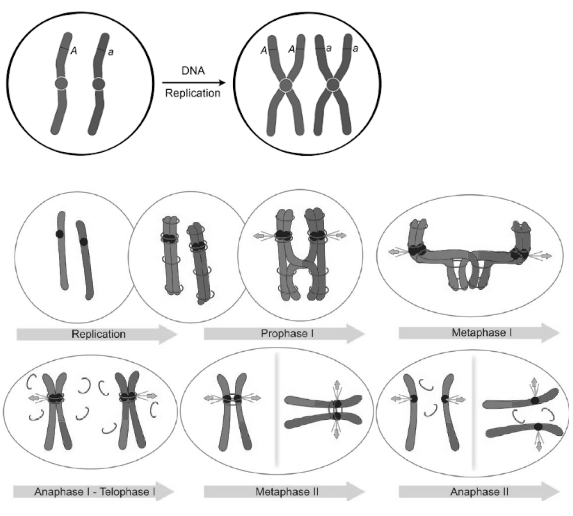
When number of chromosomes is already reduced to half in the first reductional division of meiosis, what is the necessity of second meiotic division?
- A
The division is required for the formation of four gametes
- B
Divisions ensures equal distribution of haploid chromosomes
- C
Division ensures equal distribution of genes on chromosomes
- ✓
Division is required for segregation of replicated chromosomes
AnswerCorrect option: D. Division is required for segregation of replicated chromosomes
d
The first meiotic division leads to reduction of chromosome number of half and the second meiotic division to segregate the replicated chromosomes.
View full question & answer→MCQ 801 Mark
Give the name of the phases of meiosis, in which
$I.$ the chromosome number is reduced to haploid state
$II.$ the amount of $DNA$ is reduced to haploid state
The correct option is
- A
Anaphase$-II$; anaphase$-I$
- B
Anaphase$-I$, metaphase$-II$
- ✓
Anaphase$-I$, anaphase$-II$
- D
Anaphase$-II$, metaphase$-I$
AnswerCorrect option: C. Anaphase$-I$, anaphase$-II$
c
Anaphase$-I$, anaphase$-II$.
In anaphase$-I$ chromosome become half in number. Chromosomes split and move to opposite ends of the cell, both in anaphase$-I$ and anaphase$-II$. The difference is that in anaphase$-I$, homologous pairs of chromosomes are split and in anaphase$-II$, sister chromatids are split
View full question & answer→MCQ 811 Mark
Arrange the following events of meiosis in the correct sequence.
$I.$ Terminalization $II.$ Crossing over
$III.$ Synapsis $IV.$ Disjunction of genomes
The correct sequence is
- A
$4,3,2,1$
- ✓
$3,2,1,4$
- C
$2,1,4,3$
- D
$1,4,3,2$
AnswerCorrect option: B. $3,2,1,4$
b
The correct sequence is:
Synapsis $\rightarrow$ Crossing over $\rightarrow$ Terminalization $\rightarrow$ Disjunction of genomes
View full question & answer→MCQ 821 Mark
Which of the following statement(s) is/are not correct about meiosis?
$I.$ Meiosis involves pairing of homologous chromosomes and recombinatio between them
$II.$ Two diploid cells are formed at the end of meiosis-$II$
$III.$ Meiosis involves two sequential cycles of nuclear and cell division calle meiosis-$I$ and meiosis-$II$, but only a single cycle of $DNA$ replication
$IV$. Meiosis-$I$ is initiated after the parental chromosome replication which produce identical sister chromatids at the S-phase
The correct option is
- A
$I$ only
- ✓
$II$ only
- C
$III$ only
- D
$IV$ only
AnswerCorrect option: B. $II$ only
b
During meiosis, four haploid cells are produced by reductional division from a single diploid cell. Parent cell contains replicated chromosomes, but the daughter cells contains unreplicated chromosomes
View full question & answer→MCQ 831 Mark
Phenomenon of crossing over in diploid organisms is responsible for
- A
- ✓
Recombination between linked genes
- C
Segregation between genes
- D
AnswerCorrect option: B. Recombination between linked genes
b
Recombination of genes on the same chromosome is accomplished by crossing over, a process by which parts of homologous chromosomes are interchanged. Crossing over takes place between non-sister chromatids of homologous chromosomes in pachytene stage of meiosis$-I.$
View full question & answer→MCQ 841 Mark
Meiosis can be observed in
Answerd
Meiosis is a reductional division, in which chromosome number is reduced to half, i.e, haploid. It is generally observed in sex cells, i.e., male and female gametes. In bryophyte or pteridophyte, meiosis occurs in generative cells like spore mother cells.
View full question & answer→MCQ 851 Mark
In meiosis, the daughter cells are not similar to that of parent because of
Answera
In meiosis, the daughter cells are not similar to that of parent genetically because of crossing over. Crossing over is the mutual exchange of homologous chromosomal regions between non-sister chromatids during the first prophase of meiosis.
View full question & answer→MCQ 861 Mark
Recombination is involved in the process of
Answerc
During pachytene substage of prophase$-I$ of meiosis, the non-sister chromatids of homologues exchange segments between themselves. This exchange of chromatid segments is called crossing over, which involves proper breakage and then fusion of broken ends oppositely and hence, results in the recombination.
View full question & answer→MCQ 871 Mark
Chiasmata are formed due to
- ✓
Crossing over of same part between homologous chromosomes
- B
Crossing over of same part between non-homologous chromosomes
- C
Duplication of homologous and non-homologous chromosomes
- D
Loss of some part of chromosomes
AnswerCorrect option: A. Crossing over of same part between homologous chromosomes
a
During diplotene substage of meiotic division, the force of attraction between homologous chromosomes reduced and later on they move apart.
View full question & answer→MCQ 881 Mark
Which one of the following stages corresponds to Mendel's law of independent assortment?
- A
Anaphase$-II$
- ✓
Anaphase$-I$
- C
Metaphase$-I$
- D
Telophase$-I$
AnswerCorrect option: B. Anaphase$-I$
b
Independent Assortment of Chromosomes The paternal and maternal chromosomes of each homologous pairs segregates during anaphase$-I$ independently of the other chromosomes. Anaphase$-I$ is the cytological event that corresponds to Mendel's law of independent assortment.
Although the paternal and maternal chromosomes of a homologous pair have the genes for the same traits, either chromosome of a pair may carry different alleles of the same genes. Therefore, independent assortment of homologous chromosomes in anaphase$-I$ introduces genetic variability
View full question & answer→MCQ 891 Mark
Identify the phases of mieosis fro the given options
AnswerCorrect option: A. $I-$ reductional and $II -$ equational
a
In meiosis$-I$, division is reductional while $II$ equational.
View full question & answer→MCQ 901 Mark
The non-sister chromatids twist around and exchange segments with each other during
Answerd
Pachytene or thick thread or pachynema substage is the longest substage of prophase$-I$ of meiosis. It is characterised by the process of crossing over during which the non-sister chromatids twist around and exchange segments with each other by proper breakage and then fusion of broken ends.
View full question & answer→MCQ 911 Mark
In meiosis$-I$, a bivalent is an association of
- A
Four chromatids and four centromeres
- B
Two chromatids and two centromeres
- C
Two chromatids and one centromeres
- ✓
Four chromatids and two centromeres
AnswerCorrect option: D. Four chromatids and two centromeres
d
Meiosis is a double division, which occurs in a diploid cell (nucleus) and gives rise to four haploid cells (nuclei), each having half the number of chromosomes as compared to the parent cell. In meiosis-I, bivalent is an association of four chromatids and two centromeres.
View full question & answer→MCQ 921 Mark
During which stage of meiosis, do tetrads line up at the equator?
- A
Prophase$-I$
- B
Telophase$-I$
- ✓
Metaphase$-I$
- D
Anaphase$-I$
AnswerCorrect option: C. Metaphase$-I$
c
During metaphase$-I$ of meiosis, tetrads line up at the equator.
View full question & answer→MCQ 931 Mark
The stage between two meiotic division is called
Answerc
The stage between two meiotic divisions is called interkinesis. It is generally short lived and is followed by prophase$-II$, a much simpler prophase than prophase-I of meiosis$-I$.
View full question & answer→MCQ 941 Mark
- A
A male and a female gamete
- B
$mRNA$ and ribosomes
- C
Spindle fibres and centromere
- ✓
Two homologous chromosomes
AnswerCorrect option: D. Two homologous chromosomes
d
In zygotene of prophase$-I$, homologous chromosomes pair up. This process is called synapsis. One chromosome of the pair is from the male parent and other from the female parent.
View full question & answer→MCQ 951 Mark
In meiosis, chromosome number becomes
- ✓
Half of its parent chromosome
- B
Same as that of parent chromosome
- C
One fourth of its parent chromosome
- D
AnswerCorrect option: A. Half of its parent chromosome
a
In meiosis (meiotic$-I$), chromosome number becomes half to that of parent chromosome.
View full question & answer→MCQ 961 Mark
What is the nature of cells formed at the end of meiosis$-II$?
Answera
Reduces by half.
Meiosis start with one diploid containing copies of chromosome, one from mother and one from father. The cell divides twice, producing up to four haploid cells containing one copy of each chromosome
View full question & answer→MCQ 971 Mark
Crossing over is also an enzyme mediated process and the enzyme involved is called
Answerc
Crossing over is also an enzyme mediated process and the enzyme involved is called recombinase
View full question & answer→MCQ 981 Mark
Answerc
During pachytene substage of prophase$-I$ of meiosis, the chromosomes are tetravalent i.e., contain two chromatids with each chromosome arms. Crossing over during this substage, which involves the exchange of segments between the non-sister chromatid of homologues.
View full question & answer→MCQ 991 Mark
Chiasma shows the sites of
Answerc
Chiasma is an attachment of two non-sister chromatids in a bivalent in diplotene stage of prophase$-I$ of meiosis. Each chiasma results in the exchange of genetic material between non-sister chromatids, i.e., crossing over.
View full question & answer→MCQ 1001 Mark
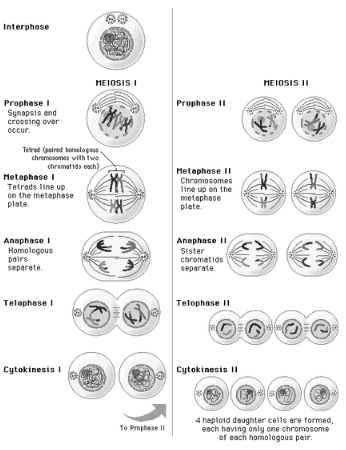
During which stage of meiosis, do the sister chromatids begin to move towards the poles?
- A
$Prophase-I$
- B
$Telophase-I$
- ✓
$Anaphase-II$
- D
$Anaphase-I$
AnswerCorrect option: C. $Anaphase-II$
c
The chromatids separate when the centromere splits like in Mitosis, i.e. Meiosis $II$ ( as phase $II$ of meisosis is just like mitosis $=$ equational division)
View full question & answer→MCQ 1011 Mark
Which of the following stage of meiosis is responsible for deciding genetic constitution of gametes?
- A
$Metaphase-II$
- B
$Anaphase-II$
- C
$Metaphase-I$
- ✓
$Anaphase-I$
AnswerCorrect option: D. $Anaphase-I$
d
The paternal and maternal chromosomes of each homologous pair segregates during anaphase$-I$. Although, both (maternal and paternal) chromosomes of a homologous pair have the genes for the same traits, either chromosome of a pair may carry different alleles of the same genes. Therefore, in anaphase$-I$, homologous chromosomes introduces genetic variability
View full question & answer→MCQ 1021 Mark
Choose correct answer for following sentences.
$(I)$ Diakinesis is middle phase of prophase $-I$
$(II)$ Diakinesis is marked by terminalisation of chiasmata
$(III)$ Meiotic spindle not formed during diakinesis
$(IV)$ By the end of diakinesis, the nucleolus disappears.
- A
Only $I$
- ✓
$II$ and $IV$
- C
$I, II$ and $III $
- D
$I, III$ and $IV $
AnswerCorrect option: B. $II$ and $IV$
View full question & answer→MCQ 1031 Mark
Identify given figure.
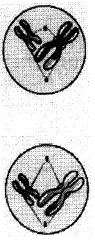
- A
- B
- C
Metaphase $-II$
- ✓
Prophase $-II$
AnswerCorrect option: D. Prophase $-II$
View full question & answer→MCQ 1041 Mark
Choose correct pair.
$\begin{array}{|p{0.3\linewidth}|p{0.5\linewidth}|} \hline Column\,\,-I & Column\,\,-II \\ \hline 1.\,\,Leptotene & p.\,\,Homologous\,\,chromosomes\,\,are\,\,separated \\ \hline 2.\,\,Diakinesis & q.\,\,Nucleolus\,\,reappear \\ \hline 3.\,\,Pachytene & r.\,\,Chromosome\,\,can\,\,observed\,\,in\,\,microscope \\ \hline 4.\,\,Anaphase\,\,-I & s.\,\,Nucleolus\,\,disappear \\ \hline & t.\,\,Crossing\,\,over \\ \hline \end{array}$
- ✓
$(1-r),(2-s),(3-t), (4-p) $
- B
$(1-t), (2-q),(3-r),(4-s) $
- C
$(1-p),(2-r),(3-r), (4-s)$
- D
$(1-q),(2-r),(3-s),(4-t) $
AnswerCorrect option: A. $(1-r),(2-s),(3-t), (4-p) $
View full question & answer→MCQ 1051 Mark
Choose correct sentences.
$1.$ meiosis is important process for evolution.
$2.$ in meiosis $-II$ mother cell is haploid.
$3.$ In anaphase $-II$ homologous chromosomes are differentiate.
$4.$ after meiosis, each daughter cell has same $DNA$ strands.
- A
Only $1 $
- B
$2$ and $4$
- ✓
$1$ and $2 $
- D
$1$ and $3$
AnswerCorrect option: C. $1$ and $2 $
View full question & answer→MCQ 1061 Mark
$A -$ During formation of reproductive cells meiotic cell division occurs.
$R-$ During meiosis the genetic material is replicated twice and cell divides twice.
- A
$A$ and $R$ both are correct
- B
$A$ and $R$ both are incorrect
- ✓
$A$ correct and $R$ incorrect
- D
$A$ incorrect and $R$ correct
AnswerCorrect option: C. $A$ correct and $R$ incorrect
View full question & answer→MCQ 1071 Mark
$A-$ genetic material can not replicated between two meiotic divisions
$R-$ Theoretical second meiosis is similar to themitosis.
- ✓
$A$ and $R$ both are correct
- B
$A$ and $R$ both are incorrect
- C
$A$ correct and $R$ incorrect
- D
$A$ incorrect and $R$ correct
AnswerCorrect option: A. $A$ and $R$ both are correct
View full question & answer→MCQ 1081 Mark
In which phase synapsis process start?
- A
End of $3^{rd}$ stage prophase $- I$
- B
Starting of $1^{st}$ stage of prophase $-I$
- ✓
During $2^{nd}$ stage of prophase $-I$
- D
Starting of $5^{th}$ stage of prophase $-I$
AnswerCorrect option: C. During $2^{nd}$ stage of prophase $-I$
View full question & answer→MCQ 1091 Mark
If $n=16$ in plant cell then how many chromosomes are present in each cell in metaphase $-I$ of meiosis?
- ✓
$16$ chromosome
- B
$32$ chromosome
- C
$8$ chromosome
- D
$32$ chromatids
AnswerCorrect option: A. $16$ chromosome
View full question & answer→MCQ 1101 Mark
The final stage of meiotic prophase $-I$ is ......
View full question & answer→MCQ 1111 Mark
$A -$ Meiosis is called the reduction division
$R-$ It reduce the chromosomes number by half while making the gametes.
- ✓
$A$ and $R$ both correct
- B
$A$ and $R$ both incorrect
- C
$A$ correct and $R$ incorrect
- D
$A$ incorrect and $R$ correct
AnswerCorrect option: A. $A$ and $R$ both correct
View full question & answer→MCQ 1121 Mark
The process involved only in meiosis.
- ✓
Pairing of homologous chromosomes.
- B
Condensation of chromosomes.
- C
Reformation of nuclear envelope.
- D
AnswerCorrect option: A. Pairing of homologous chromosomes.
View full question & answer→MCQ 1131 Mark
-Marked by terminalisation of chiasmata.
- Chromosomes are fully condensed.
- by the end of this stage, the nucleolus disappear.
Identify this stage.
MCQ 1141 Mark
Identify figure
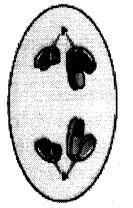
- A
Prophase $- I$
- B
Metaphase $- I$
- C
Telophase $- I$
- ✓
Anaphase $- I$
AnswerCorrect option: D. Anaphase $- I$
View full question & answer→MCQ 1151 Mark
Choose incorrect statement
- A
Diakines is is marked by terminalisation of chismata.
- B
In oocytes of some vertebrates, diplotene can last for months or years.
- ✓
In animal cell, cytokinesis starts in the centre of the cell and grows outward.
- D
Prephase - I further divided into the five phase based on chromosomal behaviour.
AnswerCorrect option: C. In animal cell, cytokinesis starts in the centre of the cell and grows outward.
View full question & answer→MCQ 1161 Mark
- ✓
Prophase $- II$ $\rightarrow$ The nuclear membrane disappears by the end of this phase
- B
Metaphase $-II$ $\rightarrow$ Chromatids move towards opposite poles of the cell
- C
Telophase $-I$ $\rightarrow$ The bivalent chromosome align to the equatorial plate
- D
Anaphase $\rightarrow$ Nuclear envelope assembles around the chromosome clusters
AnswerCorrect option: A. Prophase $- II$ $\rightarrow$ The nuclear membrane disappears by the end of this phase
View full question & answer→MCQ 1171 Mark
In initial stage of meiosis a cell has $42$ chromosome then how many chromosome are present in the end of meiosis $- II$ ?
View full question & answer→MCQ 1181 Mark
Identify figure :
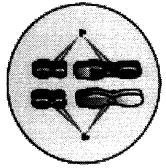
- A
Telophase $-I$
- B
Prophase $-I$
- ✓
Metaphase $-I$
- D
Prophase $- II$
AnswerCorrect option: C. Metaphase $-I$
View full question & answer→MCQ 1191 Mark
Identify figure :
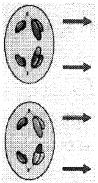
- A
- B
- C
Metaphase $-I$
- ✓
Anaphase $-II$
AnswerCorrect option: D. Anaphase $-II$
View full question & answer→MCQ 1201 Mark
In oocytes of some vertebrates, this stage can Iast for months or years.
MCQ 1211 Mark
- ✓
Telophase - $I$ $\rightarrow$ Nuclear membrane and nucleolus reappear
- B
Anaphase - $II$ $\rightarrow$ Chromosomes align at the equator
- C
Metaphase - $II$ $\rightarrow$ Splitting of the centromere of each chromosomes.
- D
Prophase - $II$ $\rightarrow$ Chromatids move towards opposite poles of the cell.
AnswerCorrect option: A. Telophase - $I$ $\rightarrow$ Nuclear membrane and nucleolus reappear
View full question & answer→MCQ 1221 Mark
When a cell with $40$ chromosomes undergoes meiosis, each of the four resulting cells has
- ✓
$20$ chromosomes
- B
$40$ chromosomes
- C
$80$ chromosomes
- D
$10$ chromosomes
AnswerCorrect option: A. $20$ chromosomes
a
(a)$20$ chromosomes; because in meiosis cell division chromosome number becomes halved.
View full question & answer→MCQ 1231 Mark
- A
Chromosomes are thin and long
- ✓
Homologous chromosomes undergo crossing over and chiasmata are seen
- C
Bivalents become very short and chaismata move towards ends of chromosomes
- D
Chromosomes have reached poles
AnswerCorrect option: B. Homologous chromosomes undergo crossing over and chiasmata are seen
b
(b)Homologous chromosomes moves apart they remain attached to one another of specific points called chiasmata.
View full question & answer→MCQ 1241 Mark
Crossing-over occurs in the
Answerb
(b) Crossing over occurs at pachytene sub-stage of prophase $I$ of meiosis.
View full question & answer→MCQ 1251 Mark
In meiosis the daughter cells are not similar to that of parent because of
MCQ 1261 Mark
Homologous pairing in prophase $I$ of meiosis $I$ is called
View full question & answer→MCQ 1271 Mark
View full question & answer→MCQ 1281 Mark
At which phase of meiosis, the two cells, each with separated sister chromatids move towards opposite poles
- A
Metaphase $I$
- B
Metaphase $II$
- C
Anaphase $I$
- ✓
Anaphase $II$
AnswerCorrect option: D. Anaphase $II$
d
(d) Separation of sister chromatids or movement of them to the opposite pole is carried out at anaphase $- II$. In anaphase $- I$ chromosome separation and movement take place.
View full question & answer→MCQ 1291 Mark
In which of the following stage, the chromosome is thin and like long thread
Answera
(a)Leptotene is a stage in the prophase $I$ of meiosis. In this stage chromosome appears thin and long.
View full question & answer→MCQ 1301 Mark
The points at which crossing over has taken place between homologous chromosomes are called
MCQ 1311 Mark
Meiosis can be observed in
AnswerCorrect option: C. Anther ($PMC$)
c
(c) As a result of it pollen grains formed.
View full question & answer→MCQ 1321 Mark
In one meiotic cell division, the cell divides
MCQ 1331 Mark
View full question & answer→MCQ 1341 Mark
Answera
(a)Pachytene is the $3^{rd}$ stage of cell division in prophase $-I$ of meiosis in which each chromosome splits in two halves $(bivalent).$
View full question & answer→MCQ 1351 Mark
If for a species $2n = 16$, then during Ist prophase and IInd prophase of meiotic division of a cell, how many tetrads and diads will be formed
- A
$4$ and $4$
- B
$8$ and $4$
- ✓
$8$ and $8$
- D
$4$ and $8$
AnswerCorrect option: C. $8$ and $8$
View full question & answer→MCQ 1361 Mark
Prophase of reduction division is divided into number of stages. The correct chronological sequence is
- A
Leptotene — pachytene — zygotene — diplotene — diakinesis
- B
Leptotene — diplotene — pachytene — zygotene — diakinesis
- C
Leptotene — zygotene — diplotene — pachytene — diakinesis
- ✓
Leptotene — zygotene — pachytene — diplotene — diakinesis
AnswerCorrect option: D. Leptotene — zygotene — pachytene — diplotene — diakinesis
View full question & answer→MCQ 1371 Mark
The process by which the chromosomes are separated in the sex cells and their number reduced from the diploid to haploid condition is known as
MCQ 1381 Mark
The homologous chromosomes follow the process of synapsis in the stage or Pairing of homologous chromosome takes place in
Answerb
(b) In zygotene of prophase of meiosis, chromosomes pairing occurs for crossing over.
View full question & answer→MCQ 1391 Mark
Meiosis and mitosis differ from each other because in meiosis
- A
The four nuclei formed are not similar to parental ones
- B
Homologous chromosomes pair are exchange parts
- C
Number of chromosomes gets halved
- ✓
Answerd
(d) All the above; four nuclei formed are not similar to parent ones because they are haploid in nature. Homologous chromosome pairs are exchange parts because in crossing over exchange of chromatid arms takes place and number of chromosomes gets halved.
View full question & answer→MCQ 1401 Mark
When, during the meiotic division, do the homologous chromosomes pair with each other
Answerc
(c) During meiosis prophase-$I$ in leptotene stage, chromosomes appear as beaded thread like structure and in next stage zygotene, homologous chromosomes pair up and become shortened. It is the initial stage of crossing over.
View full question & answer→MCQ 1411 Mark
During the first metaphase of meiosis the centromeres
- A
- ✓
- C
Divide but do not separate
- D
View full question & answer→MCQ 1421 Mark
Chiasmata formation occurs during
MCQ 1431 Mark
A cell in prophase of mitosis can be distinguished from a cell in prophase-$I$ of meiosis by
- A
The presence of only half as many chromosomes in the meiotic cell
- ✓
The formation of tetrads in the meiotic cell
- C
The presence of twice as many chromosomes in the meiotic cell
- D
AnswerCorrect option: B. The formation of tetrads in the meiotic cell
View full question & answer→MCQ 1441 Mark
During cell division, sometimes there will be failure of separation of sister chromatids. This event is called
MCQ 1451 Mark
Terminalization occurs in which stage
Answerd
(d)Diakinesis is the last process of prophase-$I$ in which cross over separates called terminalization.
View full question & answer→MCQ 1461 Mark
MatchList $I$ and List $II$ and select the correct answer using the code given below in the lists :
|
List $I$
(Phase of meiosis)
|
List $II$
(Event that occurs)
|
|
1. Prophase $I$
|
Crossing over occurs
|
|
2. Metaphase $I$
|
Sister chromatids migrate to opposite poles
|
|
3. Anaphase $I$
|
Homologous line up at equator in pairs Code
|
- A
$1$, $2$ and $3$ are correct
- B
$1$ and $2$ are correct, $3$ is false
- ✓
$1$ is correct, $2$ and $3$ are false
- D
$1$ and $3$ are correct, $2$ is false
AnswerCorrect option: C. $1$ is correct, $2$ and $3$ are false
View full question & answer→MCQ 1471 Mark
Which one of the following pairs is correctly matched
- ✓
|
Anaphase $I$
|
Homologous chromosomes are separated
|
- B
|
Metaphase $I$
|
Pairing of maternal and paternal homologous chromosomes takes place
|
- C
|
Interphase
|
A nuclear envelope encloses each haploid set of chromo somes
|
- D
|
Prophase $I$
|
Non-homologous chromosomes are separated
|
AnswerCorrect option: A.
|
Anaphase $I$
|
Homologous chromosomes are separated
|
View full question & answer→MCQ 1481 Mark
The number of chromosome groups at the equatorial plate in metaphase-$I$ of meiosis in a plant with $2n = 50$ shall be
Answerb
(b) One chromosome forms one chromosome group in metaphase-$I$ after splitting of tetravalent condition.
View full question & answer→MCQ 1491 Mark
Four chromatids and two centromeres which are homologous occurs in
MCQ 1501 Mark
In meiosis, the centromere divides during
- A
Prophase-$I$
- B
Metaphase-$I$
- C
Anaphase-$I$
- ✓
Anaphase-$II$
AnswerCorrect option: D. Anaphase-$II$
d
(d) In meiosis $II$ division is equational division; thus centromere divides and chromatid move towards the pole during anaphase-$II$.
View full question & answer→MCQ 1511 Mark
If at the end of meiosis, the $4$ daughter cells have $4$ chromosomes, how many chromosomes were in the mother cell
View full question & answer→MCQ 1521 Mark
If there were $4$ chromosomes present during prophase, how many chromosomes are there in each cell at the end of anaphase $II$
View full question & answer→MCQ 1531 Mark
At what phase of meiosis are there two cells, each with sister chromatids aligned at the spindle equator
- A
Anaphase $II$
- ✓
Metaphase $II$
- C
Metaphase $I$
- D
Anaphase $I$
AnswerCorrect option: B. Metaphase $II$
View full question & answer→MCQ 1541 Mark
The meiotic process by which homologous chromosomes are paired during prophase $I$ is called
View full question & answer→MCQ 1551 Mark
The second division in meiosis is called
MCQ 1561 Mark
Recombination of genes occur at
AnswerCorrect option: B. Prophase $I$ in meiosis
b
(b) The crossing over of homologous chromosome occurs in Pachytene of prophase first of meiosis. It is known as recombination.
View full question & answer→MCQ 1571 Mark
The spindle fibre contracts in
- A
Metaphase $I$
- ✓
Anaphase $II$
- C
Prophase $II$
- D
Telophase $II$
AnswerCorrect option: B. Anaphase $II$
View full question & answer→MCQ 1581 Mark
In pachytene stage of meiosis the chromosomes appear
Answerd
(d) During the pachytene, chromosomes get crossed with each other and forms a four stranded or tetrad appearance.
View full question & answer→MCQ 1591 Mark
Repulsion of homologous chromosomes takes place in
Answerd
(d) In meiosis, crossing over takes place in pachytene, after that chromosome get repulsion in diplotene.
View full question & answer→MCQ 1601 Mark
- ✓
- B
Pairs of non-homologous chromosomes
- C
Pairs of several chromatids
- D
Pairs of homozygous chromosomes
Answera
(a) Bivalent formation occurs in pachytene of meiosis, In this stage, two chromatids of homologous chromosome (Bivalent) later on forms a cross and now showing a tetravalent or tetrad stage.
View full question & answer→MCQ 1611 Mark
Four daughter cells formed after meiosis are
Answerb
(b) During meiosis, daughter cells has the half number of chromosomes with respect to parent cells. Therefore daughter cell will be genetically different.
View full question & answer→MCQ 1621 Mark
Recombinant nodules are found during which of the following
Answerb
(b) Knot like structure ‘Chromomeres’ found in the stage leptotene of prophase first of meiosis.
View full question & answer→MCQ 1631 Mark
- A
- B
Non homologous chromosomes
- C
- ✓
Answerd
(d) Synapsis takes place always in homologous chromosomes take place in zygotene sub-stage, which is due to small amount of $DNA$ replication at this stage.
View full question & answer→MCQ 1641 Mark
Which stage connecting link between Meiosis $I$ and Meiosis $II$
- A
Interphase $I$
- B
Interphase $II$
- ✓
- D
Anaphase $I$
View full question & answer→MCQ 1651 Mark
Condensation of chromosomes occurs in
- ✓
Prophase $I$
- B
Prophase $II$
- C
- D
AnswerCorrect option: A. Prophase $I$
a
(a) Condensation of chromosomes occurs in the prophase-I. After that chromosome moves toward the poles.
View full question & answer→MCQ 1661 Mark
A cell plate is laid down during
Answera
During cytokinesis in plant cells spindle fibres do not degenerate and forms phragmoplast and cell plate.
View full question & answer→MCQ 1671 Mark
The division of the cytoplasm is termed as
Answerc
There are two main ways of cell division i.e., mitosis and meiosis. In each case, division of the nucleus, called karyokinesis, occurs before the division of the cytoplasm, termed as cytokinesis
View full question & answer→MCQ 1681 Mark
It is not a part of Mitosis but it completes cell division
MCQ 1691 Mark
Liquid endosperm in coconut is example of ...........
MCQ 1701 Mark
Karyokinesis differ from cytokinesis because it involves
- A
- B
Division of the nucleus and cytoplasm
- ✓
- D
View full question & answer→MCQ 1711 Mark
In animal cell cytokinesis takes place by
- ✓
- B
- C
Both $(a)$ and $(b)$
- D
No cytokinesis takes place
View full question & answer→MCQ 1721 Mark
Cytokinesis in plants takes place by the formation of
MCQ 1731 Mark
Mitosis is a process by which eukaryotic cells
- A
- B
Get specialized in structure
- ✓
- D
View full question & answer→MCQ 1741 Mark
Which type of cell division helps in regeneration of cells?
Answera
Mitosis is one of the types of cell division, which helps in regeneration. Because it keeps all the somatic cells of an organism genetically similar, so that they are able to regenerate a part or whole of the organism
View full question & answer→MCQ 1751 Mark
Significance of mitosis is in
MCQ 1761 Mark
- A
- B
The growth of multicellular organisms occurs
- C
Plant grows continuous through out their life
- ✓
View full question & answer→MCQ 1771 Mark
$A$ : The complete disintegration of the nuclear envelope marks the start of metaphase.
$R$ : Chromosomes are distinct with two chromatids at this stage.
- A
Assertion and Reason both are correct and also correct explanation.
- ✓
Assertion and Reason both are correct but not explanation of assertion.
- C
Assertion is correct, but Reason is incorrect.
- D
Both Assertion and Reason are incorrect.
AnswerCorrect option: B. Assertion and Reason both are correct but not explanation of assertion.
b
Complete disintegration of the nuclear envelope marks begining of metaphase chromosomes at this phase have two distinct chromatids.
View full question & answer→MCQ 1781 Mark
$A$ : Golgi bodies and $ER$ disappear in early prophase.
$R$ : Their reorganisation stage is anaphase.
- A
Assertion and Reason both are correct and also correct explanation.
- B
Assertion and Reason both are correct but not explanation of assertion.
- C
Assertion is correct, but Reason is incorrect.
- ✓
Both Assertion and Reason are incorrect.
AnswerCorrect option: D. Both Assertion and Reason are incorrect.
d
Golgi bodies and $ER$ disappear in Late prophase. Their reorganisation occurs in telophase.
View full question & answer→MCQ 1791 Mark
Select an incorrect statement w.r.t. metaphase
- A
Spindle fibres are attached to small disc shaped structures at the surface of centromeres called kinetochores
- ✓
The plane of alignment of the homologous pair of chromosomes at metaphase is referred to as the metaphasic plate
- C
Chromosome appears to be made up of two sister chromatids
- D
The size of chromosomes can be studied in this phase
AnswerCorrect option: B. The plane of alignment of the homologous pair of chromosomes at metaphase is referred to as the metaphasic plate
b
Homologous pair of chromosome forms double metaphasic plate.
View full question & answer→MCQ 1801 Mark
The two daughter cells formed during mitosis contains
- A
The same amount of $DNA$ but a set of chromosomes different from those of parental cells
- ✓
The same amount of $DNA$ and the same set of chromosomes as those of the parent cell
- C
Half the amount of $DNA$ and the same set of chromosomes as those of the parent cell
- D
Double the amount of $DNA$ and a set of chromosomes different from those of the parent cell
AnswerCorrect option: B. The same amount of $DNA$ and the same set of chromosomes as those of the parent cell
b
Because mitosis is equational division occuring in somatic cells.
View full question & answer→MCQ 1811 Mark
What will be the total number of mitotic divisions in the formation of $64$ daughter cells?
Answerc
Number of cell = $64$
Number of divisions $= n -1 = 64 -1 = 63$
View full question & answer→MCQ 1821 Mark
.....................phase marks the end of $M$-phase.
Answerc
$M$-phase begins with karyokinesis and ends with cytokinesis.
View full question & answer→MCQ 1831 Mark
The nuclear envelope reassembles during
Answerb
Telophase is marked by reassembling of nuclear envelope.
View full question & answer→MCQ 1841 Mark
Decondensation of chromosomes occurs during
Answerd
Telophase shows decondensation of chromosome, and reapperance of chromatin.
View full question & answer→MCQ 1851 Mark
The mitotic spindle disappears in
Answerd
Because proper division and distribution of $DNA$ has been done, so now there is no further use of spindle appratus.
View full question & answer→MCQ 1861 Mark
Chromosomes move towards the pole during
Answerd
Poleward movement is also called anaphasic movement.

View full question & answer→MCQ 1871 Mark
Read the following statements
$(a)$ Complete disintegration of the nuclear envelope marks the start of the second phase of mitosis.
$(b)$ Metaphase chromosome is made up of one sister chromatid.
- A
Only $(b)$ is correct
- B
Both $(a)\, \& \,(b)$ are incorrect
- ✓
Only $(a)$ is correct
- D
Both $(a)\, \& \,(b)$ are correct
AnswerCorrect option: C. Only $(a)$ is correct
c
Complete disintegration of nuclear envelope marks the start of the second phase of mitosis. i.e., Metaphase. Metaphasic chromosome has two sister chromatids.
View full question & answer→MCQ 1881 Mark
The chromosomes are shortest and thickest during
Answerb
Because condensation is completed.

View full question & answer→MCQ 1891 Mark
The first phase of mitosis which follows interphase is
Answerb
Prophase is the first phase of mitosis.
View full question & answer→MCQ 1901 Mark
- A
- B
Undifferentiated germ cells
- C
- ✓
More than one option is correct
AnswerCorrect option: D. More than one option is correct
d
Mitosis occurs in both somatic cells and undifferentiated germ cells of both plants and animals.
View full question & answer→MCQ 1911 Mark
A cell division in which a diploid somatic cell divides into two identical daughter cells is called
- A
Meiosis $I$
- B
Meiosis $II$
- ✓
- D
Answerc
Mitosis (equational division) occurs in somatic cells.
View full question & answer→MCQ 1921 Mark
Two daughter cells formed after mitosis are
- A
Non-identical to each other
- ✓
- C
- D
Answerb
Identical to each other because mitosis is an equational division.
View full question & answer→MCQ 1931 Mark
Most dramatic period of cell cycle is
- A
$G_1$ phase
- B
$G_2$ phase
- C
$S$ phase
- ✓
$M$ phase
AnswerCorrect option: D. $M$ phase
d
Because during mitotic phase movement of chromosomes is visible.
View full question & answer→MCQ 1941 Mark
After the separation of centromeres during mitosis, the chromatids move towards opposite poles of the spindle. Name the term used for these chromatids
Answera
Chromosomes that results from the separation of sister chromatids during cell division are called daughter chromosomes. During anaphase of mitosis, paired chromosomes (sister chromatids) separates to form daughter chromosomes.
Each daughter chromosome migrates to centromere, toward the opposite ends of the cell. At the end of cell division, two distinct daughter cells are formed from a single cell
View full question & answer→MCQ 1951 Mark
See the diagrams carefully and identify the different stages of mitosis $(A-C)$ by choosing appropriate options given below
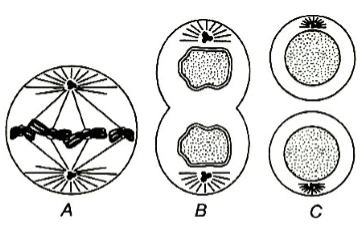
- ✓
$A-$Metaphase; $B-$Telophase; $C-$Interphase
- B
$A-$Telophase; $B-$Metaphase; $C-$Prophase
- C
$A-$Anaphase; $B-$Telophase; $C-$Interphase
- D
$A-$Telophase; $B-$Anaphase; $C-$Prophase
AnswerCorrect option: A. $A-$Metaphase; $B-$Telophase; $C-$Interphase
a
$A.$ Metaphase Spindle fibres attaches to kinetochores of chromosomes
Chromosomes are moved to spindle equator and get aligned along metaphase plate through spindle fibres of both poles
$B.$ Telophase Chromosomes cluster at opposite spindle poles and their identify is lost as discrete elements
Nuclear envelope assembles around the chromosome clusters
Nucleolus, Golgi complex and $ER$ reform
$C.$ Interphase It is the duration which is a variable depending on the function of cell.
Just before nuclear division, the $DNA$ of chromosome replicates thus, it becomes doubled.
During this phase, chromosome material is in the form of very loosely coiled threads called chromatin
View full question & answer→MCQ 1961 Mark
Choose the correct combination of options to select the correct statement for prophase
$I.$ Chromosomal material condenses to form compact mitotic chromosomes
$II.$ The assembly of mitotic spindle is initiated by the microtubules
$III.$ Cells do not show organelles when viewed under the prophase
$IV.$ The nucleolus or nucleoli degenerate completely
- A
$I$ only
- B
$II$ and $III$
- C
$I$ and $II$
- ✓
Answerd
At the end of prophase, several characteristic events can be observed. Chromosomal material condenses to form compact mitotic chromosomes. Two chromatids attach together to form chromosomes
Assembly of mitotic spindle is initiated by, microtubules (proteinaceous components) of the cell cytoplasm. When observed under the microscope cells at the last stage of prophase, do not shows cell organelles like, Golgi complexes, endoplasmic reticulum, nucleolus and the nuclear envelope
View full question & answer→MCQ 1971 Mark
Which of the following statements (events) is/are true for mitotic telophase?
Answerd
Telophase is the reverse stage of prophase. During this phase, the cytoplasmic viscosity decreases and the two chromosome groups reorganize themselves into nuclei. A nucleae envelope appears outside the nucleoplasm collected in the area of chromatin. Spindle fibres disappear around the poles and Golgi complex and endoplasmic reticulum are reformed
View full question & answer→MCQ 1981 Mark
Answerc
Mitosis is divided into four stages
$A-$Prophase, $B-$Metaphase, $C-$Anaphase, $D-$Telophase
View full question & answer→MCQ 1991 Mark
In the process of mitotic division during interphase, chromosome material remains in the form of very loosely coiled threads called
Answerb
During interphase, the chromosome material ($DNA$ of chromosome) replicates and becomes doubled. Chromosome material in the form of very loosely coiled threads is called chromatin
View full question & answer→MCQ 2001 Mark
When dividing cells are examined under a light microscope, chromosomes become visible in
- A
- B
$S-$phase
- ✓
- D
$G_{1}$-phase
Answerc
The $S$ and $G_{2}$-phases of interphase are followed by prophase. Prophase is marked by the initiation of condensation of chromosomal material. The chromosomal material become untangled during the process of chromatin condensation. Centriole, now begins to move towards opposite poles of the cell.
Therefore, when dividing cells are examined under a light microscope, in prophase only the chromosomes become visible
View full question & answer→MCQ 2011 Mark
Given diagram indicates which of the following phase of mitosis? Choose the correct option
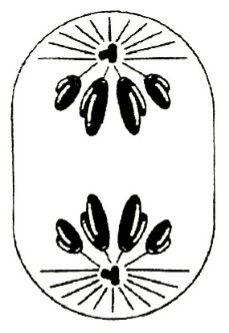
Answerd
At the onset of anaphase, each chromosome arranged at the metaphase plate is split simultaneously and the two daughter chromatids, now referred to as chromosomes of the future daughter nuclei, begin their migration towards the two opposite poles. As each chromosome moves away from the equatorial plate, the centromere of each chromosome is towards the pole and hence at the leading edge, with the arms of the chromosome trailing behind. Thus, anaphase stage is chracterised by the following key events
$1.$ Centromeres split and chromatids separate
$2.$ Chromatids move to opposite poles
View full question & answer→MCQ 2021 Mark
What is not seen during mitosis in somatic cells?
- A
- B
- C
Disappearance of nucleolus
- ✓
Answerd
Synapsis is the pairing of homologous chromosomes during zygotene stage of prophase$-I$ of meiotic division$-I$. These homologous chromosomes come from mother and father.
View full question & answer→MCQ 2031 Mark
Which stages of mitosis is known for occurrence of cytokinesis?
Answerb
Cytokinesis is thought to be the final part of telophase, however, it is a separate process that begins at the same time as telophase.
In telophase, new membranes forms around the daughter nuclei, when chromatids arrive at opposite poles of cell.
The chromosomes disperse and are no longer visible under the light microscope. The spindle fibres disperse and cytokinesis or the partitioning of the cell also begin during their stage
View full question & answer→MCQ 2041 Mark
Small disc-shaped structures at the surface of the centromeres that appear during metaphase are
Answera
Kinetochores serve as the sites of attachment of spindle fibres to the chromosomes that are moved into position at the centre of the cell.
View full question & answer→MCQ 2051 Mark
The plane of alignment of chromosome at the metaphase stage of cell cycle is referred to as the
Answerb
The plane of alignment of the chromosomes at metaphase is referred to as the metaphase plat. They key features of metaphase are
($i$) Spindle fibres attach to kinetochores of chromosomes
($ii$) Chromosomes are moved to spindle equator and get aligned along metaphase plate through spindle fibres to both poles
View full question & answer→MCQ 2061 Mark
The complete disintegration of nuclear envelope in a cell cycle marks the
- A
Start of prophase of mitosis
- ✓
Start of metaphase of mitosis
- C
End of anaphase of mitosis
- D
Start of telophase of mitosis
AnswerCorrect option: B. Start of metaphase of mitosis
b
The complete disintegration of the nuclear envelope marks the start of the second phase of mitosis, i.e., metaphase. Hence the chromosomes are spread through the cytoplasm of the cell. By this stage, condensation of chromosomes is completed and they can be observed clearly under the microscope. This then, is the stage of which morphology of chromosomes is most easily studied. At this stage, metaphase chromosomes are made up of two sister chromatids, which are held together by the centromere
View full question & answer→MCQ 2071 Mark
During mitosis, number of chromosomes gets
- A
- ✓
- C
May be change if cell is mature
- D
May be change if cell is immature
Answerb
Mitosis was first observed by Strasburger and termed by W Flemming. During mitosis, chromosome number remain same in the daughter cells. During meiosis (reduction division), the chromosome number reduced to half in the daughter cells.
View full question & answer→MCQ 2081 Mark
The major event that occurs during the anaphase of mitosis, which brings about the equal distribution of chromosomes is
- A
Replication of the genetic material
- B
Splitting of the chromatids
- ✓
Splitting of the centromeres
- D
Condensation of the chromatin
AnswerCorrect option: C. Splitting of the centromeres
c
Anaphase is characterised by splitting of the centromeres and separation of chromatids. Chromatids move to opposite poles from the equatorial plates.
View full question & answer→MCQ 2091 Mark
Congression is a phenomenon of
- A
Movement of sister chromatids towards the poles
- B
Pairing of homologous chromosomes
- C
Separation of paired chromosomes
- ✓
Bringing the chromosomes on equator of spindle apparatus
AnswerCorrect option: D. Bringing the chromosomes on equator of spindle apparatus
d
The directed movement of the chromosomes into position at the metaphase plate is termed as congression.
View full question & answer→MCQ 2101 Mark
In which stage of cell division, chromosomes are most condensed?
Answerb
n metaphase, chromosomes are shortest and show maximum condensation. Chromosomes are arranged at equatorial metaphasic plate. Structure, size and number of chromosomes are best studied at metaphase.
View full question & answer→MCQ 2111 Mark
Mitosis is characterized by
- A
- ✓
- C
Both ($a$) and ($b$)
- D
Absence of spindle formation
Answerb
M-phase (mitosis) is the most important period of cell cycle. Since, the number of chromosomes in the parent and progeny cells is the same, it is also called as equal division
View full question & answer→MCQ 2121 Mark
The following is true for the given figure, except that,
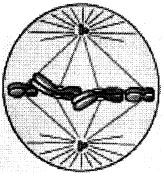
- A
Kinetochore of chromosome attached with spindle fiber.
- ✓
The cells become centrally located around chromosomes.
- C
Chromosomes are arranged on equator plate.
- D
Morphology of chromosomes is most easily studied.
AnswerCorrect option: B. The cells become centrally located around chromosomes.
View full question & answer→MCQ 2131 Mark
Choose correct sentences for telophase.
$1.$ Chromosomes are arranged at the equator.
$2.$ Formation of nuclear membrane.
$3.$ At the end of this phase, nuclear membrane Golgi, complex and endoplasmic reticulum are reformed.
$4.$ End of contraction of chromosome.
$5.$ This phase start with chromosome.according to their vertical contraction.
- A
$1,2 $
- ✓
$2,3 $
- C
$4,5 $
- D
$2,4$
AnswerCorrect option: B. $2,3 $
View full question & answer→MCQ 2141 Mark
How many number of chromosomes are present in new formed child cells of human being at the end of mitosis?
MCQ 2151 Mark
Identify figure.
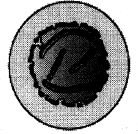
MCQ 2161 Mark
In haploid plant, which type of cell division is useful for gametes formation
MCQ 2171 Mark
Identify figure ($A$ and $B$).
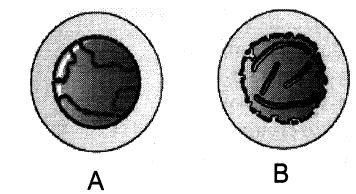
- A
$A -$ Metaphase, $B -$ Early prophase.
- B
$A -$ Late prophase, $B -$ Metaphase.
- ✓
$A-$ Early prophase, $B -$ Late prophase.
- D
$A -$ Inter phase, $B -$ Metaphase.
AnswerCorrect option: C. $A-$ Early prophase, $B -$ Late prophase.
View full question & answer→MCQ 2181 Mark
Arrange these events of mitosis in their sequence.
$a -$ Nuclear envelope assembles around chromosomes clusters.
$b -$ Spindle fibers attach to kinetochores of chromosomes.
$c-$ Condensation of chromosomes.
$d -$ Centromeres split and chromatids separate.
- A
$b \rightarrow c \rightarrow a \rightarrow d$
- B
$a \rightarrow b \rightarrow d\rightarrow c$
- C
$c \rightarrow d \rightarrow b \rightarrow a$
- ✓
$c \rightarrow b \rightarrow d \rightarrow a$
AnswerCorrect option: D. $c \rightarrow b \rightarrow d \rightarrow a$
View full question & answer→MCQ 2191 Mark
At the beginning of telophase, what is decondance ?
MCQ 2201 Mark
Mitosis in plants is seen in....
MCQ 2211 Mark
A bacterium divides every $35$ minutes. If a culture containing $10^5$ cells per $ml$ is grown for $175$ minutes, what will be the cell concentration per $ml$ after $175$ minutes
- A
$5 \times 10^5$ cells
- B
$35 \times 10^5$ cells
- ✓
$32 \times 10^5$ cells.
- D
$175 \times 10^5$ cells
AnswerCorrect option: C. $32 \times 10^5$ cells.
View full question & answer→MCQ 2221 Mark
This process does not occurs in mitosis
- A
Condensation of chromosomes
- B
Arrangement of chromosomes in equator
- ✓
- D
Centromere move to opposite poles
View full question & answer→MCQ 2231 Mark
Telophase shows the following key events :
$1.$ Chromosomes cluster at opposite spindle poles
$2.$ Spindle fibres attach to kinetochores of chromosomes
$3.$ Nuclear envelope assembles around the chromosomes clusters.
AnswerCorrect option: C. $1,3 $
View full question & answer→MCQ 2241 Mark
At the begining of this stage, the chromosomes that have reached their respectives poles decondense and lose thier individuality
MCQ 2251 Mark
Identify the following diagram
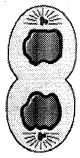
MCQ 2261 Mark
- A
Prophase - Centriole move towards opposite poles
- B
Metaphase - Chromosomes are moved to spindle equator
- C
Anaphase - Chromatids move to opposite poles.
- ✓
Telophase - Spindle fiber attach to chromosome
AnswerCorrect option: D. Telophase - Spindle fiber attach to chromosome
View full question & answer→MCQ 2271 Mark
Match the following:
$\begin{array}{|l|l|} \hline Column\;-I & Column\;-II \\ \hline 1.\;Metaphase & p.\;Chromosomal\;material\;condensed \\ \hline 2.\;Prophase & q.\;Nucleolus\;reform \\ \hline 3.\;Anaphase & r.\;Spindle\;fibre\;attach\;to\;kinetochores \\ \hline 4.\;Telophase & s.\;Chromatids\;move\;to\;opposite\;poles \\ \hline \end{array}$
- A
$(1-p),(2-q),(3-r),(4-s) $
- ✓
$(1-r),(2-p),(3-s),(4-q) $
- C
$(1-q),(2-s),(3-r),(4-p) $
- D
$(1-s),(2-p),(3-q),(4-r)$
AnswerCorrect option: B. $(1-r),(2-p),(3-s),(4-q) $
View full question & answer→MCQ 2281 Mark
Select the correct option, on the basis of following events.
$(I)$ Chromosome cluster at opposite spindle poles.
$(II)$ Nuclear envelope assembles around the chromosome clusters.
$(III)$ Golgi complex and $ER$ reform.
View full question & answer→MCQ 2291 Mark
Identify the given diagram
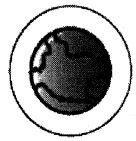
MCQ 2301 Mark
Diploid living organism develops from zygote by repeated cell divisions is called
MCQ 2311 Mark
During the meiotic division the
- ✓
Homologous chromosomes are separated
- B
- C
The homologous chromosomes do not segregate
- D
AnswerCorrect option: A. Homologous chromosomes are separated
View full question & answer→MCQ 2321 Mark
Which is not true for anaphase
- ✓
Golgi body and ER are reformed
- B
Chromosomes move to opposite poles
- C
Spindle poles move farther apart
- D
Centromeres split and chromatids separate
AnswerCorrect option: A. Golgi body and ER are reformed
View full question & answer→MCQ 2331 Mark
An acrocentric chromosome at metaphase will be
- ✓
Condensed and lie near the equator
- B
Irregularly shaped and lie at one of the poles
- C
Condensed and lie at poles
- D
Coiled and get attached to spindle fibre
AnswerCorrect option: A. Condensed and lie near the equator
View full question & answer→MCQ 2341 Mark
The nuclear membrane disappears in
MCQ 2351 Mark
Cellular structure always disappears during mitosis is
MCQ 2361 Mark
- A
Many divisions of a nucleus
- B
- ✓
Nuclear and cytoplasmic division
- D
Formation of a paternal nucleus
AnswerCorrect option: C. Nuclear and cytoplasmic division
View full question & answer→MCQ 2371 Mark
During mitosis chromosomes go to their poles in a stage called
MCQ 2381 Mark
How many meiotic divisions will be necessary to produce two hundred pollen grains
Answera
(a) Because one cell produces $4$ daughter cells after meiotic division, thus $50$ cells produce $50 × 4 = 200$ daughter cells.
View full question & answer→MCQ 2391 Mark
The process of mitosis is divided into $4$ phases. Identify the correct order in which these phases appear in mitosis
- A
Anaphase, metaphase, telophase and prophase
- B
Telophase, anaphase, metaphase and prophase
- C
Metaphase, prophase, anaphase and telophase
- ✓
Prophase, metaphase, anaphase and telophase
AnswerCorrect option: D. Prophase, metaphase, anaphase and telophase
View full question & answer→MCQ 2401 Mark
Between mitosis a cell is called to be in the
MCQ 2411 Mark
In mitosis nucleolus and nuclear membrane disappear at
MCQ 2421 Mark
In mitosis the movement of chromosomes requires
Answerc
(c) Because they are thread like structures, which contract to pull the chromosome towards pole.
View full question & answer→MCQ 2431 Mark
Chromosome start separating at which stage of mitosis
MCQ 2441 Mark
An anaphase chromosome contains
- ✓
$1 \,DNA$ molecule
- B
$3 \,DNA$ molecule
- C
$2\, DNA$ molecule
- D
$4\, DNA $ molecule
AnswerCorrect option: A. $1 \,DNA$ molecule
View full question & answer→MCQ 2451 Mark
In which phase of mitosis the chromosomes are arranged around the equator of the spindle
MCQ 2461 Mark
- A
Reduction in chromosome number
- B
Doubling of chromosome number
- ✓
Constant chromosome number
- D
AnswerCorrect option: C. Constant chromosome number
View full question & answer→MCQ 2471 Mark
How may mitotic divisions must occur in a cell of root tip to form $256$ cells
Answerb
(b) $1\,{\text{cells}}\xrightarrow{I}2\,{\text{cells}}\xrightarrow{{II}}4\,{\text{cells}}\xrightarrow{{III}}8\,{\text{cells}}\xrightarrow{{IV}}$ $16\,{\text{cells}}\xrightarrow{V}3{\text{2}}\,{\text{cells}}\xrightarrow{{VI}}64\,{\text{cells}}\xrightarrow{{VII}}$ $128\,{\text{cells}}\xrightarrow{{VIII}}256\,{\text{cells}}.$
View full question & answer→MCQ 2481 Mark
Which is not the character of mitosis
Answerd
(d) Leptotene, zygotene, pachytene, diplotene and diakinesis all are successive stages of meiosis.
View full question & answer→MCQ 2491 Mark
Spindle apparatus is formed during which stage of mitosis
MCQ 2501 Mark
AnswerCorrect option: C. Both $(a)$ and $(b)$
View full question & answer→MCQ 2511 Mark
The structure that duplicates in synthesis phase of cell division is/are
Answerc
In the diploid organism (plants and animals) the chromosome or $DNA$ number becomes double just before the cell division in $S$ phase
View full question & answer→MCQ 2521 Mark
$A :$ $G_2$-phase is pre-mitotic phase.
$R :$ Chromosomes undergo condensation in this phase.
- A
Assertion and Reason both are correct and also correct explanation.
- B
Assertion and Reason both are correct but not explanation of assertion.
- ✓
Assertion is correct, but Reason is incorrect.
- D
Both Assertion and Reason are incorrect.
AnswerCorrect option: C. Assertion is correct, but Reason is incorrect.
c
Proteins and organelles like mitochondria and chloroplast duplicate in $G_2$-phase.
View full question & answer→MCQ 2531 Mark
What will be the content of $DNA$ in a somatic cell at $G_2$ if its meiotic products have $20$ picogram of $DNA$?
- A
$40 \;pg$
- B
$20 \;pg$
- ✓
$80 \;pg$
- D
$160 \;pg$
AnswerCorrect option: C. $80 \;pg$
c
Diploid cell will have $2C$ and after $S$ phase it will become $4C$
$4 × 20 = 480 \;pg$
View full question & answer→MCQ 2541 Mark
If egg of an organism has $10$ $pg$ of $DNA$ in its nucleus. How much $DNA$ would a diploid cell of same organism have in $G_2$ phase of meiosis?
- A
$10 \;pg$
- B
$5 \;pg$
- C
$20 \;pg$
- ✓
$40 \;pg$
AnswerCorrect option: D. $40 \;pg$
d
Egg of an organism = $10$ pg $DNA$ because egg is haploid
i.e., $(C) = 10 \;pg$
Amount of $DNA$
Diploid cell = $2C$ after $S$-phase $DNA$ contents doubles
in $G_2$ phase = $DNA$ content = $4C$
$(4) = 4 × 10$
$= 40 \;Pg$
View full question & answer→MCQ 2551 Mark
Chromatin fibres duplication, Genetic material- $4$$C$, Histone protein synthesis, Membranous organelle duplication, $DNA$ replication, centriole duplication.
How many of the above features are associated with synthesis phase of cell cycle?
Answerb
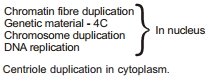
View full question & answer→MCQ 2561 Mark
Identify the mismatched pair
- A
$A$ -Starts with karyokinesis and ends with cytokinesis
- ✓
$B$ -Stage where cells are inactive metabolically
- C
$C$ -Cell grows and carries out normal metabolism
- D
$D$ -Period of cytoplasmic growth
AnswerCorrect option: B. $B$ -Stage where cells are inactive metabolically
b
$A$ -$M$-phase $B$ -$G_0$ phase $C$ -$G_1$ phase $D$ -$G_2$ phase
View full question & answer→MCQ 2571 Mark
Which phase of interphase is the most important point in regulation of the cell cycle, during which it must decide whether the cell will start a new cycle or will enter in $G_0$ phase?
- ✓
$G_1$ phase
- B
$S$ phase
- C
$G_2$ phase
- D
AnswerCorrect option: A. $G_1$ phase
a
During this phase if cell is signalled not to divide further then it enters quiescent stage where cell remains metabolically active but do not proliferate unless they are called to do so.
View full question & answer→MCQ 2581 Mark
What is not true about cell cycle?
$a$. During $G_1$ phase there is active synthesis of $RNA$ and proteins but no change in its $DNA$ content
$b$. In synthesis or $S$ phase, each chromosome carries a duplicate set of genes
$c$. During $G_2$ phase, a cell contains double the amount $(4C)$ of $DNA$ present in the original diploid cell $(2C)$
$d$. In $S$-phase a cell doubles the original diploid $(2n)$ chromosome number
- A
$(c)\, \& \,(d)$
- B
$(b)\, \& \,(c)$
- ✓
$(d)$ only
- D
$(b)$, $(c)\, \& \,(d)$
AnswerCorrect option: C. $(d)$ only
c
Chromosome number remains same only $DNA$ content doubles in $S$-phage of cell cycle.
View full question & answer→MCQ 2591 Mark
Select an incorrect statement w.r.t. cell cycle
AnswerCorrect option: A. Duplication of genes occurs twice in meiosis
a
Duplication of genes or chromosome occurs only once during $S$-phase of interphase.
View full question & answer→MCQ 2601 Mark
What will be the amount of $DNA$ in meiosis $II$ products if meiocyte contains $430$ $pg$ $DNA$ in $G_1$ phase?
- A
$30$ $pg$
- B
$60$ $pg$
- ✓
$15$ $pg$
- D
$120$ $pg$
AnswerCorrect option: C. $15$ $pg$
c
Meiocyte $(2 n, 2 c)=30 pg \stackrel{\text { meiosis }}{\longrightarrow}\left(\begin{array}{c} n \\ c \end{array}\right)\left(\begin{array}{c} n \\ 2 c \end{array}\right) \stackrel{\text { meiosis }}{ II } \rightarrow\left(\frac{ n }{ c }\right)\left(\frac{ n }{ c }\right)\left(\frac{ n }{ c }\right)\left(\frac{ n }{ c }\right)$
Therefore, $15 \;pg$
View full question & answer→MCQ 2611 Mark
A phase of the cell cycle which lasts more than $95\%$ of the total duration is
Answerb
Because cell prepares itself for division during this phase.
View full question & answer→MCQ 2621 Mark
The number of chromosomes in $G_1$ phase is $36$, the number of chromosomes in $S$ phase is
Answera
Because after $S$ phase only $DNA$ content duplicates not the number therefore, each chromosome will be having two chromatids.
View full question & answer→MCQ 2631 Mark
If the initial amount of $DNA$ is $8$ $C$, then after $S$ phase the amount of $DNA$ would be
- A
$4$ $C$
- B
$8$ $C$
- C
$64$ $C$
- ✓
$16$ $C$
AnswerCorrect option: D. $16$ $C$
d
Because $DNA$ duplicates during $S$ phase.
View full question & answer→MCQ 2641 Mark
Non-dividing cells enter the
- A
$G_S$ phase
- B
$M$ phase
- ✓
$G_0$ phase
- D
$S$ phase
AnswerCorrect option: C. $G_0$ phase
c
$G_0$ phase also known Quiescent phase.
View full question & answer→MCQ 2651 Mark
Interphase is called the resting phase because
- A
It is the most active phase of the cell cycle
- ✓
There is no apparent activity related to cell division
- C
It does not prepare cell for cell division
- D
It is the phase where cell rests before entering into mitosis
AnswerCorrect option: B. There is no apparent activity related to cell division
b
Interphase stage of cell cycle involves growth of cell and does not involves division of cell.
View full question & answer→MCQ 2661 Mark
A biosynthetic phase where cell organelle duplicate itself is
Answera
While
Prophase : Condensation of chromatin begin.
Anaphase : Centromere splits and chromatid separation
Metaphase : Condensed chromosome align themselves at equator.
View full question & answer→MCQ 2671 Mark
How many chromosomes will the cell the cell have at $G_{1}$, after $S$ and after Mphase respectively, if it has $14$ chromosomes at interphase?
- A
$14,14,7$
- ✓
$14,14,14$
- C
$7,7,7$
- D
$7,14,14$
AnswerCorrect option: B. $14,14,14$
b
Replication of $DNA$ takes place at $S$-phase of cell cycle. The number of chromosomes reduced only in meiosis. So, the number remain $14,14$, and $14$ in $G_{1}$ after $S$ and after $M$-phase.
View full question & answer→MCQ 2681 Mark
Which of the following statements are correct for $G_{1}$-phase?
$I.$ It is the last substage of interphase
$II.$ Cell organelles do not increase in number
$III.$ Cell grows in size and content both
$IV.$ It synthesizes $RNAs$, proteins and other biochemical for cell growth and subsequent replication of $DNA$
Choose the correct option
- A
$I$ and $II$
- ✓
$III$ and $IV$
- C
$I$ and $III$
- D
$II$ and $III$
AnswerCorrect option: B. $III$ and $IV$
View full question & answer→MCQ 2691 Mark
In ...$A$.... phase, there is synthesis of $RNAs$ and proteins that are needed for cell growth and replication of $DNA$. While it is ...$B$... phase, where synthesis of protein occur that is needed for spindle formation and mitosis to continue.
Identify $A$ and $B$ to complete the given statement
- A
$A - G ; B - S$
- B
$A -G_{2} ; B - S$
- ✓
$A - G _{1} ; B -G_{2}$
- D
AnswerCorrect option: C. $A - G _{1} ; B -G_{2}$
c
$A-G_{1} ; B-G_{2}$
View full question & answer→MCQ 2701 Mark
Select the correct statements regarding S-phase of interphase
$I.$ Occurs between $G_{1}$ and $G_{2}$
$II.$ $DNA$ replication begins in the nucleus
$III.$ Centrioles duplicate in the cytoplasm
$IV.$ As $DNA$ is doubled, number of chromosomes also doubles
The option with correct statements is
- A
$IV$ and $III$
- B
$I, II, III$ and $IV$
- C
$II, III$ and $IV$
- ✓
$I, II$ and $III$
AnswerCorrect option: D. $I, II$ and $III$
d
S-phase is the sub-phase between $G_{1}$-phase and $G_{2}$-phase, during which $DNA$ synthesis or replication takes place.
In animal cells, during the S-phase, $DNA$ replication begins in the nucleus and the centriole duplication in the cytoplasm. The amount of $DNA$ per cell doubles in the nucleus. If the initial amount of $DNA$ is denoted as $2 C$, then it increases to $4 C$. However, there is no increase in the chromosome number
View full question & answer→MCQ 2711 Mark
Which is synthesized in $G_{1}$-phase?
- ✓
$DNA$ polymerase
- B
- C
Nucleolar $DNA$
- D
AnswerCorrect option: A. $DNA$ polymerase
a
During $G_{1}$-phase of the cell cycle, the synthesis of biochemicals like $RNAs$, proteins, and enzymes ($DNA$ polymerase) are synthesized that are required for $DNA$ synthesis. Histone proteins are formed during S phase along the duplication of $DNA$
View full question & answer→MCQ 2721 Mark
Karyokinesis refers to the division of
- A
- ✓
- C
- D
all constituents of the cell
Answerb
There are two main ways of cell division i.e., mitosis and meiosis. In each case, division of the nucleus, called karyokinesis, occurs before the division of the cytoplasm, termed as cytokinesis
View full question & answer→MCQ 2731 Mark
Which of the following phase of cell cycle is also known as the resting phase?
Answerc
The interphase is also called the resting phase. It is the time during which the cell gets prepared for division by undergoing both cell and $DNA$ replication in an orderly manner
View full question & answer→MCQ 2741 Mark
Given diagram represents the events occurring in cell cycle. Identify $A, B, C$ and $D$ and select the correct option
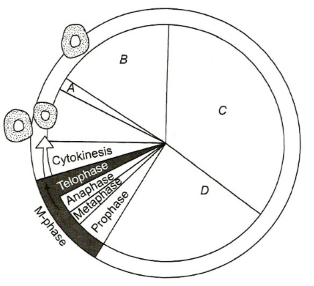
- ✓
$G_{0} G_{1} S G_{2}$
- B
$G_{1} G_{0} S G_{2}$
- C
$S G_{0} G_{1} G_{2}$
- D
$G_{1} S G_{2} G_{0}$
AnswerCorrect option: A. $G_{0} G_{1} S G_{2}$
a
A typical eukaryotic cell in a culture divides once in approximately $24\; hrs$. The duration of cell cycle can vary from organism to organism and also from cell to cell type
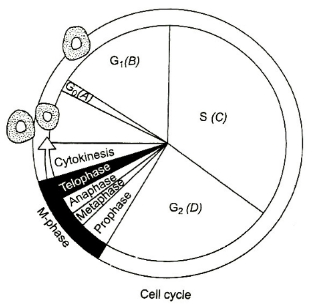
View full question & answer→MCQ 2751 Mark
The sequence of events by which a cell duplicates its genome, synthesizes the other constituents of the cell and eventually divides into two daughter cells is termed as
Answerb
Cell cycle was described by Howard and Pelc in $1953 .$ The sequence of events by which a cell duplicates its genome, synthesizes the other constituents of the cell and eventually divides into two daughter cells is termed as cell cycle
View full question & answer→MCQ 2761 Mark
In which of the following phase of cell cycle, mitotic division got arrested?
- A
$G_{2}-$ phase
- ✓
$G_{0}$-phase
- C
- D
AnswerCorrect option: B. $G_{0}$-phase
b
$G_{0}$-phase.
Some cells that do not divide further, exit $G_{1}$-phase and enter an inactive stage called quiescent stage $\left(G_{0}\right)$ of the cell cycle. Cells in this stage remains metabolically active but no longer proliferate unless called on to do so depending on the requirement of the organism
View full question & answer→MCQ 2771 Mark
What would be the change in the chromosome number, during $S-$phase?
- ✓
- B
The number of chromosome doubles
- C
The number of chromosome doubles only in case of diploid cell
- D
The number of chromosome doubles only in case of haploid cell
Answera
During S-phase, there is no increase in the chromosomes number. If the cell has diploid or $2 n$ number of chromosomes at $G_{1}$, even after S-phase the number of chromosomes remains the same, i.e., $2 n$
View full question & answer→MCQ 2781 Mark
Sequence of four phases of cell cycle is
- ✓
$G_{1} \rightarrow S \rightarrow G_{2} \rightarrow M$
- B
$G_{1} \rightarrow G_{2} \rightarrow S \rightarrow M$
- C
$S \rightarrow G_{1} \rightarrow G_{2} \rightarrow M$
- D
$M \rightarrow G_{1} \rightarrow G_{2} \rightarrow S$
AnswerCorrect option: A. $G_{1} \rightarrow S \rightarrow G_{2} \rightarrow M$
a
The correct sequence of cell cycle phases is
$G_{1} \rightarrow S \rightarrow G_{2} \rightarrow M$
View full question & answer→MCQ 2791 Mark
In $G_{1}$-phase of cell cycle, what would be the change in $DNA$ content of the cell?
- A
$DNA$ content increases to double
- B
$DNA$ content gets reduced
- C
Four fold increase of $DNA$ content
- ✓
No change in $DNA$ content
AnswerCorrect option: D. No change in $DNA$ content
d
$G_{1}$-phase corresponds to the interval between mitosis and initiation of $DNA$ replication. During $G_{1}$-phase, the cell is metabolically active and continuously grows but do not replicate its $DNA$
View full question & answer→MCQ 2801 Mark
Which of the following statement is true for cells in $G_{0}$ stage of cell cycle?
AnswerCorrect option: C. Cells are metabolically active but no longer proliferate in normal condition
c
During the $G_{0}$-phase, cells are metabolically active but no longer proliferate in normal condition
View full question & answer→MCQ 2811 Mark
Choose the correct sequence of two main events in mitosis Karyokinesis followed by
- ✓
- B
Cytokinesis followed by karyokinesis
- C
Karyokinesis followed by non separation of the daughter cells
- D
Cytokinesis followed by separation of the daughter cells
Answera
There are two main events in mitosis, karyokinesis or duplication of the nucleus, followed by division of the cytoplasm called cytokinesis. This is followed by the separation of the daughter cells
View full question & answer→MCQ 2821 Mark
$DNA$ replicates
AnswerCorrect option: B. Only once in each cell cycle
b
$DNA$ replicates only once in each cell cycle ($S-$phase)
View full question & answer→MCQ 2831 Mark
In plant cell has $12$ chromosomes at the end of mitosis. How many chromosomes would it have in the $G_{2}$-phase of its next cell cycle?
Answerc
In $G_{2}$-phase / any phase the chromosome number remains same, so the right answer is $12$ chromosomes.
View full question & answer→MCQ 2841 Mark
The $S-$phase of cell cycle is characterized by
- A
Duplication of chromosome no.
- B
- ✓
Duplication of $DNA$
- D
Duplication of cell organelles
AnswerCorrect option: C. Duplication of $DNA$
c
Synthesis phase or $S-$phase is the phase in cell cycle during which $DNA$ is replicated. The synthesis of histone proteins and $RNA$ also takes place in this phase in this phase and each chromosome has two chromatids.
View full question & answer→MCQ 2851 Mark
Mature nerve cells are incapable of cell division. These cell are probably considered in
- A
$G_{2}-$phase
- B
$S-$phase
- C
- ✓
$G_{0}-$phase
AnswerCorrect option: D. $G_{0}-$phase
d
Some cells in the adult animals do not appear to exhibit division ( $e \cdot g$., heart cells, and many other cells divide only occasionally $e . g .$, when there is need to replace cells that have been lost due to injury or cell death. These cells that do not divide further and exit $G_{1}$-phase to enter an inactive stage called quiescent stage $\left(G_{0}\right)$ of the cell cycle. Cells in this stage remains metabolically active but no longer proliferate
View full question & answer→MCQ 2861 Mark
The number of $DNA$ strands in chromosome at $G_{2}$-stage is
Answerb
The number of $DNA$ strands( chromatids) in chromosome at $G_{2}$-stage of cell cycle is two due to the replication of $DNA$ during $S-phase$.
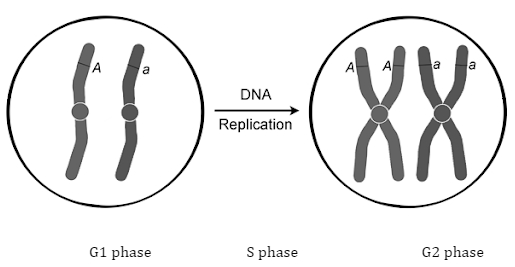
View full question & answer→MCQ 2871 Mark
Differentiated cell remains at which stage?
- A
$G_{1}$
- B
$G_{2}$
- ✓
$G_{0}$
- D
$M$
AnswerCorrect option: C. $G_{0}$
c
The cells, which do not divide further, do not proceed beyond the $G_{1}$-phase and start undergoing differentiation into specific type are said to be in $G_{0}$ phase.
View full question & answer→MCQ 2881 Mark
Which of the following events occurs during $G_{1}$-phase?
- A
$DNA$ replication
- ✓
Growth and normal function of cell
- C
- D
AnswerCorrect option: B. Growth and normal function of cell
b
$G_{1}$-phase is called as pre-synthetic phase or post-mitotic phase. It is the longest phase of cell cycle. In $G_{1}$-phase, a cell has two options:
$1.$ Continues cycle and enters $S-$phase
$2.$ Stops cell cycle and enters $G_{0}$-phase for undergoing differentiation.
View full question & answer→MCQ 2891 Mark
If the cell has $14$ chromosomes at interphase. Then how many chromosomes will the cell have at $G_{1}$-phase of cell cycle?
Answerb
Replication of $DNA$ takes place during $S-$ phase of cell cycle. The number of chromosomes reduced only after $M -$ phase that too only in meiosis. So, the number remains $14$ in $G_{1}$-phase
View full question & answer→MCQ 2901 Mark
Bacterial cell divides every one minute. It takes $15$ minutes a cup to be one-fourth full. How much time will it take to fill the cup?
- A
$30$ minutes
- B
$45$ minutes
- C
$60$ minutes
- ✓
$17$ minutes
AnswerCorrect option: D. $17$ minutes
d
$\frac{1}{4}$ of cup $=15$ minutes
$\frac{1}{2}$ of cup $=16$ minutes
Cup of bacteria $=17$ minutes
View full question & answer→MCQ 2911 Mark
In the $24$ hour average duration of cell cycle of a human cell.........
- A
Cell division proper lasts for only $6$ hour.
- B
Cell differentiation proper lasts for only $8$ hour
- ✓
Cell division proper lasts for only $1$ hour
- D
Cell division proper lasts for not only $1$ hour
AnswerCorrect option: C. Cell division proper lasts for only $1$ hour
View full question & answer→MCQ 2921 Mark
The $M-$ phase of the cell cycle involves....
- A
$G_1, S$ and $G_2$ phase
- ✓
Prophase, metaphase, anaphase, telophase
- C
Interphase, prophase, metaphase, anaphase, telophase
- D
AnswerCorrect option: B. Prophase, metaphase, anaphase, telophase
View full question & answer→MCQ 2931 Mark
- A
The cell cycle is basically stimulating cell division with a series of changes that come out of the cell.
- B
The cell cycle is basically stimulating cell differentiation and tissue formation with a series of changes that come out of the cell.
- C
The cell cycle is basically stimulating cell division and cell differentiation with series of changes that come out of cell.
- ✓
The cell cycle is the series of events that takes place inside a cell thus leading to cell division and cell duplication.
AnswerCorrect option: D. The cell cycle is the series of events that takes place inside a cell thus leading to cell division and cell duplication.
View full question & answer→MCQ 2941 Mark
In which cells are biosyntheticaly active but they can not divided ?
- A
$S$ phase
- B
$G_1$ phase
- ✓
$G_0$ phase
- D
$G_2$ phase
AnswerCorrect option: C. $G_0$ phase
View full question & answer→MCQ 2951 Mark
What stage is there before the cell enters in the cell mitosis?
MCQ 2961 Mark
Select the correct statement regarding $S-$ phase of interphase
$I.$ Occurs between $G_1$ and $G_2$
$II.$ $DNA$ replication begins in the nucleus
$III.$ Centrioles duplicate in the cytoplasm
$IV.$ As $DNA$ s doubled, number of chromosomes also doubles Option are
- A
$IV$ and $III$
- ✓
$I, II,$ and $III$
- C
$II, III$ and $IV $
- D
$I, II, III$ and $IV $
AnswerCorrect option: B. $I, II,$ and $III$
View full question & answer→MCQ 2971 Mark
During which phase the cell is metabolically active and continuously grows but does not replicate its $DNA$ ?
- ✓
$G_1$ phase
- B
$G_2$ phase
- C
$S$ phase
- D
$G_0$ phase
AnswerCorrect option: A. $G_1$ phase
View full question & answer→MCQ 2981 Mark
The cell cycle is divided into two basic phase, that phase one
- ✓
Interphase and $M$ phase
- B
$G_1$ and $G_2$ phase
- C
$G_1$ and $M$ phase
- D
$G_1$ and $M_1$ phase
AnswerCorrect option: A. Interphase and $M$ phase
View full question & answer→MCQ 2991 Mark
Which of the following process occurred during cell division
AnswerCorrect option: A. $DNA$ replication and cell growth
View full question & answer→MCQ 3001 Mark
During the ${G_1}$ phase of cell division
- ✓
$RNA$ and proteins are synthesized
- B
$DNA$ and proteins are synthesized
- C
Cell prepares for $M-$ phase
- D
Cell undergoes duplication
AnswerCorrect option: A. $RNA$ and proteins are synthesized
View full question & answer→MCQ 3011 Mark
In which phase proteins for spindle fibre formation are synthesized
- A
$G_1$ phase
- ✓
$G_2$ phase
- C
$S-$ phase
- D
AnswerCorrect option: B. $G_2$ phase
View full question & answer→MCQ 3021 Mark
If nucleus represents its large size in proportion to cytoplasm of cell, it indicates that
AnswerCorrect option: C. The nucleus has entered $S$-phase of interphase
View full question & answer→MCQ 3031 Mark
The replication of centrioles occurs during
Answerd
(d) During cell division the centrosome had undergone replication in interphase and then begans to move toward opposite poles of the cell.
View full question & answer→MCQ 3041 Mark
The decision for division occurs in a cell at
- A
$S$ phase
- B
$G_2$ phase
- ✓
$G_1$ phase
- D
AnswerCorrect option: C. $G_1$ phase
View full question & answer→MCQ 3051 Mark
Interphase of mitosis in man takes
- A
$12$ hours
- B
$10$ hours
- C
$3$ hours
- ✓
$23$ hours
AnswerCorrect option: D. $23$ hours
View full question & answer→MCQ 3061 Mark
Which of the following is the shortest phase of the cell cycle
- A
$S$ phase
- B
$G_1$ phase
- C
$G_2$ phase
- ✓
$M$ phase
AnswerCorrect option: D. $M$ phase
d
(d) $M-$ phase takes only $1.5 -10\%$ time of the total time of the cell cycle.
View full question & answer→MCQ 3071 Mark
Which out of the following is not a divisional stage
MCQ 3081 Mark
$DNA$ replication occurs during
Answerd
(d) Because interphase is the growth phase of cell.
View full question & answer→MCQ 3091 Mark
At $G_1$ stage which phenomenon takes place
- A
$DNA$ synthesis
- ✓
$RNA$ synthesis
- C
- D
AnswerCorrect option: B. $RNA$ synthesis
View full question & answer→MCQ 3101 Mark
Normal cellular activities, such as protein synthesis occur primarily during
MCQ 3111 Mark
During interphase, $RNA$ and proteins are synthesized in
AnswerCorrect option: D. In both $G_1$ and $G_2$ phases
View full question & answer→MCQ 3121 Mark
In a cell that is not dividing, the chromosomes are visible as a tangle of fine threads called
MCQ 3131 Mark
A bacterial cell undergoes binary fission every twenty minutes. Starting with a single bacterium how many bacteria will be produced at the end of $ 3 $ hours
- A
$128$
- B
$256$
- ✓
$512$
- D
$1022$
View full question & answer→MCQ 3141 Mark
How many bacteria are produced in four hours if a bacterium divides once in half an hour
Answerd
(d) $1$ $\xrightarrow{{30\,\min }}$ $2$ $\xrightarrow{{30\,\min }}$ $4$ $\xrightarrow{{30\,\min }}$ $8$ $\xrightarrow{{30\,\min }}$ $16$ $\xrightarrow{{30\,\min }}$ $32$ $\xrightarrow{{30\,\min }}$ $64$ $\xrightarrow{{30\,\min }}$ $128$ $\xrightarrow{{30\,\min }}$ $256$.
View full question & answer→MCQ 3151 Mark
Bacterial cell divides in every minute it takes one hour to fill up a cup. How much time will be taken to fill half the cup
- ✓
$59 $ minutes
- B
$30 $ minutes
- C
$60 $ minutes
- D
$29$ minutes
AnswerCorrect option: A. $59 $ minutes
a
(a)The number of bacteria becomes double after each division.
View full question & answer→MCQ 3161 Mark
If a cell has a chromosome number after first meiosis equal to $48$. The chromosome number in the daughter cells after the completion of meiosis will be
Answera
Meiosis occurs in two stages: meiosis I and meiosis II. During meiosis I, homologous chromosomes separate and the number of chromosomes in daughter cells get reduced to one half. This division is known as reduction division. During meiosis II, centromere splits and the chromosome number remains the same in the daughter cells and hence, meiosis II is known as equational division. If number of chromosomes in a cell after meiosis I is 48 then after meiosis II, the daughter cells will also have 48 chromosomes as because meiosis II is an equational division.
View full question & answer→MCQ 3171 Mark
Identify the meiotic stage in which the homologous chromosomes separate while the sister chromatids remain associated at their centromeres.
- A
Metaphase $I$
- B
Metaphase $II$
- ✓
Anaphase $I$
- D
Anaphase $II$
AnswerCorrect option: C. Anaphase $I$
c
(c) : During anaphase $I$, from each tetrad two chromatids of a chromosome move as a unit (dyad) to one pole of a spindle, and the remaining two chromatids of its homologue migrate to the opposite pole. Thus, the homologous chromosomes ofeach pair, rather than the chromatids of a chromosome, are separated. As a result, half of the chromosomes, which appear in early prophase, go to each pole. Thus the paternal and maternal chromosomes of each homologous pair segregate during anaphase $I$ independently of the other chromosomes.
View full question & answer→MCQ 3181 Mark
During gamete formation, the enzyme recombinase participates during
- A
metaphase $I$
- B
anaphase $II$
- ✓
prophase $I$
- D
prophase $II.$
AnswerCorrect option: C. prophase $I$
c
(c) : During gamete formation, the enzyme recombinase participates during pachytene stage of prophase $I$. This stage is characterized by the appearance of recombination nodules, the sites at which crossing over occurs between nonsister chromatids of the homologous chromosomes. Crossing over is the exchange of genetic material between two homologous chromosomes. Crossing over is also an enzymemediated process and the enzyme involved is called recombinase.
View full question & answer→MCQ 3191 Mark
At metaphase, chromosomes are attached to the spindle fibres by their
Answerc
(c) : The key feature of metaphase is the attachment of spindle fibres to kinetochores of chromosomes. Kinetochores are discshaped structures at the surface of the centromeres. These structures serve as the sites of attachment of spindle fibres to the chromosomes that are moved into position.
View full question & answer→MCQ 3201 Mark
Select the correct option with respect to mitosis.
- A
Chromatids separate but remain in the cen tre of the cell in anaphase
- B
Chromatids start moving towards opposite poles in telophase
- C
Golgi complex and endoplasmic reticulum are still visible at the end of prophase.
- ✓
Chromosomes move to the spindle equator and get aligned along equatorial plate in metaphase.
AnswerCorrect option: D. Chromosomes move to the spindle equator and get aligned along equatorial plate in metaphase.
d
(d) : The plane of alignment of the chromosomes at metaphase is referred to as the metaphase plate. The key features of metaphase are, $(1)$ Spindle fibres attach to kinetochores of chromosomes $(2)$ Chromosomes are moved to spindle equator and get aligned along metaphase plate through spindle fibres to both poles.
View full question & answer→MCQ 3211 Mark
During mitosis, $ER$ and nucleolus begin to disappear at
Answerd
(d) : During early prophase of mitosis, nucleus and cell become spheroid. Viscocity and refractivity of cytoplasm increases. $DNA$ molecules condense to form shortened chromosome. Endoplasmic reticulum and nucleolus starts disappearing.
View full question & answer→MCQ 3221 Mark
$DNA$ and histone proteins are synthesized during the following phase of cell cycle
- ✓
$S$ phase
- B
$G_2$ phase
- C
$G_1$ phase
- D
AnswerCorrect option: A. $S$ phase
View full question & answer→MCQ 3231 Mark
Which one of the following precedes re-formation of the nuclear envelope during $M$ phase of the cell cycle
- A
Formation of the contractile ring, and formation of the phragmoplast
- B
Formation of the contractile ring, and transcription from chromosomes
- ✓
Decondensation from chromosomes, and reassembly of the nuclear lamine
- D
Transcription from chromosomes, and ressembly of the nuclear lamina
AnswerCorrect option: C. Decondensation from chromosomes, and reassembly of the nuclear lamine
View full question & answer→MCQ 3241 Mark
The best stage to count the number of chromosomes during mitosis is or structure of chromosomes can be best seen at
Answerb
(b) Because in metaphase, chromosomes are present in bivalent form on equator. Chromosomes are much condence and well visible.
View full question & answer→MCQ 3251 Mark
In the somatic cell cycle
- A
A short interphase is followed by a long mitotic phase
- B
$G_2$ phase follows mitotic phase
- C
In $G_1$ phase $DNA$ content is double the amount of $DNA$ present in the original cell
- ✓
$DNA$ replication takes place in $S$ -phase
AnswerCorrect option: D. $DNA$ replication takes place in $S$ -phase
d
(d) In the somatic cell cycle $S$ -phase is a stage of replication of each chromosome by synthesis of a new $DNA$ molecule on the template of existing $DNA$.
View full question & answer→MCQ 3261 Mark
The process of mitosis can be studied in
MCQ 3271 Mark
Synaptonemal complex is formed during
Answera
(a) Synaptonemal complex is formed during meiotic prophase first.
View full question & answer→MCQ 3281 Mark
Exchange of chromosome segments between maternal and paternal chromatids during meiosis is called
MCQ 3291 Mark
When, during the meiotic division, do the centromeres divide
- A
- B
Metaphase $-I$
- C
- ✓
Anaphase $-II$
AnswerCorrect option: D. Anaphase $-II$
d
(d) Anaphase $-II$ is simple mitotic division of meiosis; in this process centromeres divide and form two separate chromosomes.
View full question & answer→MCQ 3301 Mark
Mitosis is the process by which eukaryotic cells
- A
Expose the genes for protein synthesis
- B
Become specialized in structure and function
- ✓
- D
View full question & answer→MCQ 3311 Mark
A bacterium divides every $ 35$ minutes. If a culture containing $10^5$ cells / ml is grown for $175 $ minutes. What will be the cell concentration / ml after $ 175 $ minutes
- A
$175 × 10^5$ cells
- B
$85 × 10^5$ cells
- C
$35 × 10^5$ cells
- ✓
$32 × 10^5$ cells
AnswerCorrect option: D. $32 × 10^5$ cells
d
(d) As we know that bacterium divides after every $35$ minutes through simple mitotic division therefore number of divisions are$\frac{{175}}{{35}} = 5$
Since one bacterium on division produces two cells so cell concentration after $ 175$ minutes will be
$ = {10^5} \times {(2)^5}$ $ = 32 \times {10^5}$
View full question & answer→MCQ 3321 Mark
During cell division in apical meristem nuclear membrane reappears in
MCQ 3331 Mark
How many mitotic divisions are needed for a single cell to make $128$ cells
Answera
(a) A single mitotic division results in the production of two cells from a single one.
View full question & answer→MCQ 3341 Mark
The number of chromatids in a chromosome at anaphase is
- A
$2$ in mitosis and $1$ in meiosis
- ✓
$1$ in mitosis and $2$ in meiosis
- C
$2$ each in mitosis and meiosis
- D
$2$ in mitosis and $4$ in meiosis
AnswerCorrect option: B. $1$ in mitosis and $2$ in meiosis
View full question & answer→MCQ 3351 Mark
Match the stages of meiosis in column $I$ to their characteristic features in Column $II$ and select the correct option using the codes given below.
| Column $I$ |
Column $II$ |
| $A .$ Diakinesis |
$1.$ Crossing over takes place |
| $B.$ Pachytene |
$2 .$ Terminalisation of chiasmata |
| $C .$ Zygotene |
$3 .$ Chromosomes align at equatorial place |
| $D .$ Metaphase |
$4 .$ Pairing of homologous chromosomes |
Codes
$A \quad B \quad C \quad D$
- A
$1 \quad 2 \quad 3 \quad 4$
- B
$2 \quad 4 \quad 1 \quad 3$
- C
$4 \quad 3 \quad 1 \quad 3$
- ✓
$2 \quad 1 \quad 4 \quad 3$
AnswerCorrect option: D. $2 \quad 1 \quad 4 \quad 3$
d
$A.$ Diakinesis - Terminalisation of chiasmata
$B.$ Pachytene - Crossing over takes place
$C.$ Zygotene - Pairing of homologous chromosomes
$D.$ Metaphase - Chromosomes align at equatorial plate
View full question & answer→MCQ 3361 Mark
Match the description (given in column $I$) with correct stage of prophase $I$ (given column $II$) and choose the correct option.
| |
Column $I$ |
|
Column $II$ |
| $A$ |
Chromosomes are
moved to spindle
equator |
$I$ |
Pachytene |
| $B$ |
Centromere splits and
chromatids move apart |
$II$ |
Zygotene |
| $C$ |
Pairing between
homologous
chromosomes takes
place |
$III$ |
Anaphase |
| $D$ |
Crossing between
homologous
chromosomes |
$IV$ |
Metaphase |
- A
$A -I; B -II; C -III; D -IV$
- B
$A -II; B -III; C -IV; D -I$
- ✓
$A -IV; B -III; C -II; D -I$
- D
$A -III; B -I; C -IV; D -II$
AnswerCorrect option: C. $A -IV; B -III; C -II; D -I$
c
$A -IV; B -III; C -II; D -I$
Metaphase -Chromosomes are moved to spindle fibre.
Anaphase -Centromere splits and chromatids move apart.
Zygotene -Pairing between homologous chromosomes takes place.
Pachytene -Crossing between homologous chromosomes occurs
View full question & answer→MCQ 3371 Mark
Assertion : The stage between two mitotic divisions is called interkinesis.
Reason : Interkinesis is generally short lived
- A
If both Assertion and Reason are correct and the Reason is a correct explanation of the Assertion.
- B
If both Assertion and Reason are correct but Reason is not a correct explanation of the Assertion.
- C
If the Assertion is correct but Reason is incorrect.
- ✓
If both the Assertion and Reason are incorrect.
AnswerCorrect option: D. If both the Assertion and Reason are incorrect.
d
Interkinesis or interphase $II$ is a period of rest that cells of some species enter during meiosis, between meiosis $I$ and meiosis $II$. No $DNA$ replication occurs during interkinesis however it does occur during the interphase $I$ stage of meiosis. Interkinesis is generally short lived.
View full question & answer→MCQ 3381 Mark
Assertion : Diplotene is characterized by the presence of chiasmata.
Reason : Diplotene can last for months and years in oocytes of some vertebrates
- A
If both Assertion and Reason are correct and the Reason is a correct explanation of the Assertion.
- ✓
If both Assertion and Reason are correct but Reason is not a correct explanation of the Assertion.
- C
If the Assertion is correct but Reason is incorrect.
- D
If both the Assertion and Reason are incorrect.
AnswerCorrect option: B. If both Assertion and Reason are correct but Reason is not a correct explanation of the Assertion.
b
Diplotene is the longest and most active subphase of prophase $I$ of meiosis. The beginning of diplotene is recognized by the dissolution of synaptonemal complex and the tendency of the recombined homologous chromosomes of the bivalents to separate from each other except at the sites of crossovers. These $X-$ shaped structures are called chiasmata. Diplotene can last for months and years in oocytes of some vertebrate.
View full question & answer→MCQ 3391 Mark
Assertion : During zygotene, chromosomes show bivalent stage.
Reason : Bivalent is half the number of chromosomes
- A
If both Assertion and Reason are correct and the Reason is a correct explanation of the Assertion.
- ✓
If both Assertion and Reason are correct but Reason is not a correct explanation of the Assertion.
- C
If the Assertion is correct but Reason is incorrect.
- D
If both the Assertion and Reason are incorrect.
AnswerCorrect option: B. If both Assertion and Reason are correct but Reason is not a correct explanation of the Assertion.
b
During zygotene, because of the pairing of the homologues, the nucleus contains half the number of chromosomes. Each unit is a bivalent composed of two homologous chromosomes.
View full question & answer→MCQ 3401 Mark
The stage of meiosis where centromere separate
- A
metaphase $I$
- B
metaphase $II$
- C
anaphase $I$
- ✓
anaphase $II$
AnswerCorrect option: D. anaphase $II$
View full question & answer→MCQ 3411 Mark
Assertion : Interphase is resting stage.
Reason : The interphase cell is metabolically inactive
- A
If both Assertion and Reason are correct and the Reason is a correct explanation of the Assertion.
- B
If both Assertion and Reason are correct but Reason is not a correct explanation of the Assertion.
- ✓
If the Assertion is correct but Reason is incorrect.
- D
If both the Assertion and Reason are incorrect.
AnswerCorrect option: C. If the Assertion is correct but Reason is incorrect.
c
Previously interphase is called resting stage because there is no apparent activity related to cell division. The interphase cell is metabolically quite active. Interphase consist of three subphases ($G_1 , G_2$ and $S$). Synthesis of $DNA$ occurs in $S$ phase. $G_1$ is the period between the end of mitosis and the start of $S$ phase. $G_2$ is the phase between $S$ phase and the next mitosis. As the synthesis of $DNA$ and proteins occurs in interphase so, it is considered as metabolically active phase.
View full question & answer→MCQ 3421 Mark
Assertion : Meiosis $II$ is known as equational or homotypic division
Reason :Meiosis $II$ produces same number of chromosome in cell.
- ✓
If both Assertion and Reason are correct and the Reason is a correct explanation of the Assertion.
- B
If both Assertion and Reason are correct but Reason is not a correct explanation of the Assertion.
- C
If the Assertion is correct but Reason is incorrect.
- D
If both the Assertion and Reason are incorrect.
AnswerCorrect option: A. If both Assertion and Reason are correct and the Reason is a correct explanation of the Assertion.
a
Meiosis $II$ is known as equational or homotypic division like mitosis. It ensures the maintenance of constant number of chromosomes from generation to generation on a species.
View full question & answer→MCQ 3431 Mark
During which stages (or prophase $I$ substages) of meiosis do you expect to find the bivalents and $DNA$ replication respectively?
- A
Pachytene and interphase (between two meiotic divisions)
- B
Pachytene and interphase (just prior to prophase $I$)
- C
Pachytene and $S$ phase (of interphase just prior to prophase $I$)
- ✓
Zygotene and $S$ phase (of interphase prior to prophase $I$)
AnswerCorrect option: D. Zygotene and $S$ phase (of interphase prior to prophase $I$)
d
In bivalent formation of chromosomes during meiosis, the homologous chromosomes are arranged in pairs. The phenomenon is called synapsis and it occurs during zygotene stage. $DNA$ replication occurs during $S$ phase or synthetic phase which is the second phase of interphase.
View full question & answer→MCQ 3441 Mark
Which one of the following precedes reformation of the nuclear envelope during $M-$ phase of the cell cycle?
- ✓
Decondensation from chromosomes and reassembly of the nuclear lamina
- B
Transcription from chromosomes and reassembly of the nuclear lamina.
- C
Formation of the contractile ring and formation of the phragmoplast
- D
Formation of the contractile ring and transcription from chromosomes.
AnswerCorrect option: A. Decondensation from chromosomes and reassembly of the nuclear lamina
a
In most eukaryotes, the nuclear envelope that separates the $DNA$ from the cytoplasm disassembles. The chromosomes align themselves in a line spanning the cell. Microtubules, essentially miniature strings, pulls out from opposite ends of the cell and shorten, pulling apart the sister chromatids of each chromosome. As a matter of convention, each sister chromatid is now considered a chromosome, so they are renamed to sister chromosomes. As the cell elongates, corresponding sister chromosomes are pulled toward opposite ends. A new nuclear envelope forms around the separated sister chromosomes
View full question & answer→MCQ 3451 Mark
When synapsis is complete all along the chromosome, the cell is said to have entered a stage called
Answerb
(b) The synapsis, pairing of homologous chromosomes takes place during zygotene.
Synapsis results in the formation of bivalents during zygotene.
The formation of special proteinaceous structure called synaptonemal complex occur.
After zygotene stage cell entered in pachytene stage in which the bivalents become spiralled, shortened and thickened.
View full question & answer→MCQ 3461 Mark
Assertion: Meiosis results in production of haploid cells.
Reason: Synapses occurs during leptotene.
- A
If both Assertion and Reason are correct and the Reason is a correct explanation of the Assertion.
- B
If both Assertion and Reason are correct but Reason is not a correct explanation of the Assertion.
- ✓
If the Assertion is correct but Reason is incorrect.
- D
If both the Assertion and Reason are incorrect.
AnswerCorrect option: C. If the Assertion is correct but Reason is incorrect.
c
Synapsis occurs during zygotene stage. Synapsis is the pairing of homologous chromosomes which leads to formation of bivalents.
View full question & answer→MCQ 3471 Mark
The study of chromosomes at meiotic diplotene shows that
- A
The intimately paired chromosomes repel each other and begin to separate
- B
The pairing of homologous chromosomes which had initiated in the earlier stage is completed
- ✓
The homologous chromosomes remain united by chiasmata
- D
AnswerCorrect option: C. The homologous chromosomes remain united by chiasmata
c
(c)This occurs for the exchange of genetic material during crossing over.
View full question & answer→MCQ 3481 Mark
“$G_0$” state of cells in eukaryotic cell cycle denotes
- A
Check point before entering the next phase
- B
Pausing in the middle of a cycle to cope with a temporary delay
- C
- ✓
Exit of cells from cell cycle
AnswerCorrect option: D. Exit of cells from cell cycle
d
(d) When cells are not to divide after ${G_1}$ phase and start undergoing differentiation into specific types of cells such cells are said to be in $G_0$ phase $G_0$ state.
View full question & answer→