MCQ 11 Mark
Given below are two statements:
Statement $I$: In $\mathrm{C}_3$ plants, some $\mathrm{O}_2$ binds to $\mathrm{RuBisCO}$, hence $\mathrm{CO}_2$ fixation is decreased.
Statement $II$: In $\mathrm{C}_4$ plants, mesophyll cells show very little photorespiration while bundle sheath cells do not show photorespiration.
In the light of the above statements, choose the correct answer from the options given below:
- A
Both Statement $I$ and Statement $II$ are false
- ✓
Statement $I$ is true but Statement $II$ is false
- C
Statement $I$ is false but Statement $II$ is true
- D
Both Statement $I$ and Statement $II$ are true
AnswerCorrect option: B. Statement $I$ is true but Statement $II$ is false
b
photorespiration does not occur in $\mathrm{C}_4$ plants as they lack RuBis$CO$ in mesophy$ll$. Hence statement $I$ is the only correct option.
View full question & answer→MCQ 21 Mark
How many molecules of $ATP$ and $NADPH$ are required for every molecule of $\mathrm{CO}_2$ fixed in the Calvin cycle?
- A
$2$ molecules of $ATP$ and $2$ molecules of $NADPH$
- B
$3$ molecules of $ATP$ and $3$ molecules of $NADPH$
- ✓
$3$ molecules of $ATP$ and $2$ molecules of $NADPH$
- D
$2$ molecules of $ATP$ and $3$ molecules of $NADPH$
AnswerCorrect option: C. $3$ molecules of $ATP$ and $2$ molecules of $NADPH$
c
For fixation of $1$ molecule of $\mathrm{CO}_2$ in Calvin cycle $3$ $ATP$ molecules and $2 \mathrm{NADPH}$ molecules are required.
View full question & answer→MCQ 31 Mark
Which of the following are required for the dark reaction of photosynthesis?
$A$. Light $B$. Chlorophyll $C$. $\mathrm{CO}_2$ $D$. $ATP$ $E$. $NADPH$
Choose the correct answer from the options given below:
- A
$B, C$ and $D$ only
- ✓
$C, D$ and $E$ only
- C
$D$ and E only
- D
$A$, $B$ and $C$ only
AnswerCorrect option: B. $C, D$ and $E$ only
b
For dark reaction of photosynthesis there are the requirement of
${CO}_2 $
$\text { ATP } $
$\text { NADPH }$
View full question & answer→MCQ 41 Mark
How many $ATP$ and $NADPH _2$ are required for the synthesis of one molecule of Glucose during Calvin cycle?
- A
$18\,ATP$ and $16\,NADPH _2$
- B
$12\,ATP$ and $12\,NADPH _2$
- ✓
$18\,ATP$ and $12\,NADPH _2$
- D
$12\,ATP$ and $16\,NADPH _2$
AnswerCorrect option: C. $18\,ATP$ and $12\,NADPH _2$
c
For every $CO _2$ molecule entering the Calvin cycle, 3 molecules of ATP and 2 of $NADPH _2$ are required. To make one molecule of glucose, 6 turns of the cycle are required. Thus, $ATP$ and $NADPH _2$ molecules required for synthesis of one molecule of glucose during Calvin cycle will be
$\rightarrow 6 \times\left[\begin{array}{l}3 ATP \\ 2 NADPH _2\end{array}\right]=\frac{18 ATP \text { and }}{12 NADPH _2}$
View full question & answer→MCQ 51 Mark
Which of the following combinations is required for chemiosmosis?
- A
Proton pump, electron gradient, NADP synthase
- ✓
Membrane, proton pump, proton gradient, ATP synthase
- C
Membrane, proton pump, proton gradient, NADP synthase
- D
Proton pump, electron gradient, ATP synthase
AnswerCorrect option: B. Membrane, proton pump, proton gradient, ATP synthase
b
Chemiosmosis requires a membrane, a proton pump, a proton gradient and ATP synthase.
View full question & answer→MCQ 61 Mark
The reaction centre in $PS$ $II$ has an absorption maxima at $............\,nm$
Answerb
In PS$-I$, the reaction centre chlorophyll a has an absorption peak at $700\,nm$, while in PS$-II$, reaction centre has an absorption maxima at $680\,nm$.
View full question & answer→MCQ 71 Mark
What is the role of large bundle shealth cells found around the vascular bundles in $C _{4}$ plants?
- ✓
To increase the number of chloroplast for the operation of Calvin cycle
- B
To enable the plant to tolerate high temperature
- C
To protect the vascular tissue from high light intensity
- D
To provide the site for photorespiratory pathway
AnswerCorrect option: A. To increase the number of chloroplast for the operation of Calvin cycle
View full question & answer→MCQ 81 Mark
Given below are two statements:
Statement $I$:The primary $CO _{2}$ acceptor in $C _{4}$ plants is phosphoenolpyruvate and is found in the mesophyll cells.
Statement $II:$Mesophyll cells of $C _{4}$ plants lack RuBisCo enzyme.
In the light of the above statements, choose the correct answer from the options given below:
- A
Both Statement $I$ and Statement $II$ are incorrect
- B
Statement $I$ is correct but Statement $II$ is incorrect
- C
Statement $I$ is incorrect but Statement $II$ is correct
- ✓
Both Statement $I$ and Statement $II$ are correct
AnswerCorrect option: D. Both Statement $I$ and Statement $II$ are correct
View full question & answer→MCQ 91 Mark
Which one of the following is not true regarding the release of energy during ATP synthesis through chemiosmosis ? It involves:
AnswerCorrect option: A. Breakdown of electron gradient
View full question & answer→MCQ 101 Mark
When one $CO _2$ molecule is fixed as one molecule of triose phosphate, which of the following photochemically made, high energy chemical intermediates are used in the reduction phase?
- ✓
$1\,ATP + 1\,NADPH$
- B
$1\,ATP + 2\,NADPH$
- C
$2\,ATP + 1\,NADPH$
- D
$2\,ATP + 2\,NADPH$
AnswerCorrect option: A. $1\,ATP + 1\,NADPH$
View full question & answer→MCQ 111 Mark
The first stable product of $\mathrm{CO}_{2}$ fixation in sorghum is:
View full question & answer→MCQ 121 Mark
Which of the following statements is incorrect?
- A
Both $ATP$ and $NADPH$ $+H^+$ are synthesized during non-cyclic photophosphorylation.
- B
Stroma lamellae have $PS- I$ only and lack $NADP$ reductase.
- C
Grana lamellae have both $PS- I$ and $PS- II.$
- ✓
Cyclic photophosphorylation involves both $PS- I$ and $PS- II.$
AnswerCorrect option: D. Cyclic photophosphorylation involves both $PS- I$ and $PS- II.$
View full question & answer→MCQ 131 Mark
Which of the following statements is incorrect?
- A
$RuBisCO$ action requires $ATP$ and $NADPH$
- B
$RuBisCO$ is a bifunctional enzyme
- ✓
In $C _{4}$ plants, the site of $RuBisCO$ activity is mesophyli cell
- D
The substrate molecule for $RuBisCO$ activity is a $5$-earbon compound
AnswerCorrect option: C. In $C _{4}$ plants, the site of $RuBisCO$ activity is mesophyli cell
c
In $C _{4}$ plants, the site of RuBisCO activity is bundle sheath cells.
View full question & answer→MCQ 141 Mark
The oxygenation activity of $RuBisCo$ enzyme in photorespiration leads to the formation of
- A
$1$ molecule of $4 -$ $C$ compound and $1$ molecule of $2- C$ compound.
- B
$2$ molecules of $3- C$ compound
- ✓
$1$ molecule of $3- C$ compound
- D
$1$ molecule of $6- C$ compound
AnswerCorrect option: C. $1$ molecule of $3- C$ compound
c
$1$ molecule of $3 -C$ compound
View full question & answer→MCQ 151 Mark
During non-cyclic photophosphorylation, when electrons are lost from the reaction centre at $PS$ $II$, what is the source which replaces these electrons?
Answerc
The electrons lost from reaction centre of photosystem II are replaced by water.
View full question & answer→MCQ 161 Mark
In light reaction, plastoquinone facilitates the transfer of electrons from
AnswerCorrect option: B. $PS-II$ to Cytb$_{6} f$ complex
b
$PS-II$ to Cytb$_{6} f$ complex
View full question & answer→MCQ 171 Mark
Which of the following is not a product of light reaction of photosynthesis?
- ✓
$NADH$
- B
$ATP$
- C
$NADPH$
- D
$Oxygen$
AnswerCorrect option: A. $NADH$
a
$ATP, NADPH$ and oxygen are products of light reaction, while $NADH$ is a product of respiration process.
View full question & answer→MCQ 181 Mark
Oxygen is $not$ produced during photosynthesis by
AnswerCorrect option: A. $Green\,sulphur\,bacteria$
View full question & answer→MCQ 191 Mark
Phosphoenol pyruvate $(PEP) $ is the primary $CO_2$ acceptor in
- ✓
$C_4$ plants
- B
$C_2$ plants
- C
$C_3$ and $C_4$ plants
- D
$C_3 $ plants.
AnswerCorrect option: A. $C_4$ plants
View full question & answer→MCQ 201 Mark
A plant in your garden avoids photorespiratory losses, has improved water use efficiency, shows high rates of photosynthesis at high temperatures and has improved efficiency of nitrogen utilisation. In which of the following physiological groups would you assign this plant ?
MCQ 211 Mark
Water vapour comes out from the plant leaf through the stomatal opening. Through the same stomatal opening carbon dioxide diffuses into the plant during photosynthesis. Reason out the above statements using one of following options.
AnswerCorrect option: D. Both processes can happen together because the diffusion coefficient of water and $CO_2$ is different.
View full question & answer→MCQ 221 Mark
In photosynthesis, the lightindependent reactions take place at
- A
photosystem $ II$
- ✓
- C
- D
photosystem $I$.
Answerb
(b) : The lightindependent reactions (dark or Blackman’s reactions) of photosynthesis take place in stroma or matrix of chloroplasts. These reactions are enzymatic reactions which catalyse assimilation of $CO_2$ into carbohydrates.
View full question & answer→MCQ 231 Mark
Chromatophores take part in
Answerc
(c) : Chromatophores are the internal membrane systems of photosynthetic forms which possess photosynthetic pigments. They occur in photoautotrophic bacteria, $e.g.$, purple bacteria and green bacteria.
View full question & answer→MCQ 241 Mark
$A$ : Assimilatory power in photosynthesis is generated in $ETS$ occuring in thylakoid membrane.
$R$ : They are needed for $CO_2$ reduction and $RuBP$ regeneration.
- A
Assertion and Reason both are correct and also correct explanation.
- ✓
Assertion and Reason both are correct but not explanation of assertion.
- C
Assertion is correct, but Reason is incorrect.
- D
Both Assertion and Reason are incorrect.
AnswerCorrect option: B. Assertion and Reason both are correct but not explanation of assertion.
b
$ATP4$ produced is required for carrying out different metabolic activities, biosynthetic reaction taking place in stroma, responsible for fixation of $CO_2$ and synthesis of sugar.
View full question & answer→MCQ 251 Mark
$A$ : Dark reactions of photosynthesis are temperature controlled processes.
$R$ : Most of the reactions are enzymatic in nature.
- ✓
Assertion and Reason both are correct and also correct explanation.
- B
Assertion and Reason both are correct but not explanation of assertion.
- C
Assertion is correct, but Reason is incorrect.
- D
Both Assertion and Reason are incorrect.
AnswerCorrect option: A. Assertion and Reason both are correct and also correct explanation.
a
Enzyme reactions are controlled by temperature.
View full question & answer→MCQ 261 Mark
$A$ : In $C_4$ plants, chloroplasts of bundle sheath cells are granal.
$R$ : $PS$ $II$ is mostly found in appressed part of granum.
- A
Assertion and Reason both are correct and also correct explanation.
- B
Assertion and Reason both are correct but not explanation of assertion.
- C
Assertion is correct, but Reason is incorrect.
- ✓
Both Assertion and Reason are incorrect.
AnswerCorrect option: D. Both Assertion and Reason are incorrect.
d
In Bundle sheath cells $PS$ $II$ absent which implies agranal chloroplast.
View full question & answer→MCQ 271 Mark
Identify the correct sequence of enzymes given below which participate in the regeneration phase of Calvin cycle.
$I.$ Ribulose-$5$-phosphate isomerase $II.$ Ribulose-$5$-phosphate epimerase
$III.$ Transketolase $IV.$ Triose phosphate isomerase
- A
$VI, I, III, II$
- B
$III, IV, II, I$
- ✓
$IV, III, I, II$
- D
$II, I, IV, III$
AnswerCorrect option: C. $IV, III, I, II$
c
Triose phosphate isomerase enzyme converts glyceraldehydes-$3$ phase molecule into dihydroxy acetone phosphate. Then an enzyme transketolase comes, which acts on sedoheptulose-$7$-phosphate molecule and changes it into ribulose-$5$-phosphate and xylulose-$5$-phosphate. Then ribulose-$5$-phosphate isomerase enzyme comes and acts on ribulose-$5$-phosphate. This reactionhas a molecule of ribulose-$5$-phosphate, while xylulose-$5$-phosphate molecule is also converted into ribulose-$5$-phosphate by ab other enzyme, ribulose-5phosphate epimerase.
View full question & answer→MCQ 281 Mark
Stroma lamellae membrane lacks
$I.PS-II$ $II$. $NADP$ reductase $III$. non-cyclic photophosphorylation
Select the correct option
- A
$I$ and $II$
- B
$II$ and $III$
- C
$III$ and $I$
- ✓
$I, II$ and $III$
AnswerCorrect option: D. $I, II$ and $III$
d
Stroma lamellae lacks both $PS-II$ and $NADP$ reductase due to the occurrence of cyclic photophosphorylation
View full question & answer→MCQ 291 Mark
AnswerCorrect option: C. Both $(a)$ and $(b)$
c
Water is one of the reactant in the light reaction. The effect of water on photosynthesis is seen in the stress condition when water availability is very low. Water is also used in dark reaction of photosynthesis.
View full question & answer→MCQ 301 Mark
$I.$ Initial $CO _{2}$ acceptor $II.$ Extent of photorespiration
$III.$ Enzyme catalyzing reaction that fixes $CO _{2}$ $IV.$ Presence of Calvin cycle
$V.$ Leaf anatomy
Which one does not differ in a $C_{3}$ and $C_{4}$-plants?
- A
$I$ and $V$
- ✓
Only $IV$
- C
$II$ and $III$
- D
Only $II$
AnswerCorrect option: B. Only $IV$
b
The Calvin cycle is common between the $C_{3}$ and $C_{4}$-cycle. $\operatorname{In} C_{4}$, it takes place in bundle sheath and in $C_{4}$, it takes place in mesophyll cells
View full question & answer→MCQ 311 Mark
Plants in which the first product of $CO _{2}$ fixation is $C_{3}$ acid, i.e., the ... $A$... pathway, and those in which the first product was $C_{4}$ acid $(OAA)$, i.e., the ...$B$... pathway
Complete the given statement by filling appropriate options in the given blanks
AnswerCorrect option: B. $A -C_{3} ; B -C_{4}$
b
$CO _{2}$ assimilation during photosynthesis generally takes place in two ways in plants
$(i)$ $C_{3}$ pathway Those plants in which the first product of $CO _{2}$ fixation is a $C_{3}$ acid $( PGA ), i . e$, the $C_{3}$ pathway
$(ii)$ $C_{4}$ pathway Those plants in which the first product $C_{4}$ acid $(OAA)$, i.e,, the $C_{4}$ pathway
View full question & answer→MCQ 321 Mark
Which of the following statements with regard to photosynthesis is/are correct?
$I$.In $C_{4}$-plants, the primary $C O_{2}$ acceptor is $P E P$.
$II$. In the photosynthetic process, PS-II absorbs energy at or just below $680 \;nm$.
$III$. The pigment that is present in the Pigment System-$I$ is $P$ $680$ .
- A
$II$ and $III$ only
- B
$I$ only
- C
$III$ only
- ✓
$I$ and $II$ only
AnswerCorrect option: D. $I$ and $II$ only
d
$C_{4}$-plants show Kranz anatomy. In these plants, the primary carbon dioxide acceptor in mesophyll cells is phosphoenol pyruvate $(PEP)$. In light reaction of photosynthesis, $PS-II$ absorbs energy at or just below $680 \;nm$, while $PS-I$ absorbs energy at $700 \;nm$
View full question & answer→MCQ 331 Mark
$I.$ In $C_{3}$-plant, Calvin pathway takes place in mesophyll cell
$II.$ In $C_{4}$-plant, Calvin pathway takes place in the mesophyll cell
Which of the following statements true?
Choose the correct option
- A
Statement $I$ is incorrect, $II$ is correct
- ✓
Statement $II$ is incorrect, $I$ is correct
- C
- D
AnswerCorrect option: B. Statement $II$ is incorrect, $I$ is correct
b
In $C_{4}$-plants the Calvin cycle takes place in bundle sheath cells
View full question & answer→MCQ 341 Mark
Substance which is essential for the respiration as well as photosynthesis is
Answera
Cytochromes are iron containing pigments. These acts as electron transporter or electron acceptor in respiration and photosynthesis
View full question & answer→MCQ 351 Mark
$A-$ In the photo respiratory pathway there is synthesis of $ATP$ or $NADPH$
$R -$ In $C_4$ plants photorespiration dose note occur.
- A
$A$ and $R$ both are correct.
- B
$A$ and $R$ both are incorrect.
- C
$A$ is correct, $R$ is incorrect.
- ✓
$A$ is incorrect, $R$ is correct.
AnswerCorrect option: D. $A$ is incorrect, $R$ is correct.
View full question & answer→MCQ 361 Mark
$A-$ In stroma, enzymatic reactions synthesise protein which in turn forms stach.
$R-$ The membrane system of chloroplast is not responsible for trapping the light energy and also for the synthesis of $ATP$ and $NADPH.$
- A
$A$ and $R$ both are correct.
- ✓
$A$ and $R$ both are incorrect.
- C
$A$ is correct, $R$ is incorrect.
- D
$A$ is incorrect, $R$ is correct.
AnswerCorrect option: B. $A$ and $R$ both are incorrect.
View full question & answer→MCQ 371 Mark
Which elements are helpful in splitting of water?
- A
$Ca^{+2}, Mg^{+2}$
- B
$Ca^{+2}, K$
- ✓
$Mn^{+2}, Cl^-$
- D
$Cl^-, P$
AnswerCorrect option: C. $Mn^{+2}, Cl^-$
View full question & answer→MCQ 381 Mark
Match the following.
$\begin{array}{|p{0.6\linewidth}|p{0.3\linewidth}|} \hline Column\,\,-I & Column\,\,-II \\ \hline (p)\,\,Grana\,\,region\,\,of\,\,chloroplast & (i)\,\,Krab's\,\,cycle \\ \hline (q)\,\,Stroma\,\,region\,\,of\,\,chloroplast & (ii)\,\,Light\,\,reaction \\ \hline (r)\,\,Cytoplasm & (iii)\,\,Dark\,\,reaction \\ \hline (s)\,\,Cytoplasm\,\,of\,\,mitochondria & (iv)\,\,Glycolysis \\ \hline \end{array}$
- ✓
$(P-ii), (Q-iii), (R-iv),(S-i) $
- B
$(P-i),(Q-ii), (R-iii), (S-iv) $
- C
$(P-i),(Q-i), (R-iv),(S-iii)$
- D
$(P-iii), (Q-iv),(R-i),(S-ii) $
AnswerCorrect option: A. $(P-ii), (Q-iii), (R-iv),(S-i) $
View full question & answer→MCQ 391 Mark
$A-$ In $C_4$ plants carboxylation take place in chloroplast of mesophyll cell and bundle sheath cells.
$R -$ In $C_3$ plants $CO_2$ occurs in mesophyll cells and bundle sheath cells.
AnswerCorrect option: B. $A$ is true but $R$ is false.
View full question & answer→MCQ 401 Mark
$A -$ Calvin cycle starts with carboxylation of $RuBP.$
$R -$ Photorespiration starts with oxygenation of $RuBP.$
AnswerCorrect option: A. $A$ and $R$ are true.
View full question & answer→MCQ 411 Mark
$A-$ Productivity of $C_4$ plant is higher than $C_3$ plant.
$R -$ Photorespiration Occurs in $C_3$ plants.
AnswerCorrect option: D. $A$ is false but $R$ is true.
View full question & answer→MCQ 421 Mark
match the following column.
$\begin{array}{|p{0.3\linewidth}|p{0.6\linewidth}|} \hline Column\,\,-I & Column\,\,-II \\ \hline A.\,\,PGA & P.\,\,Act\,\,as\,\,oxigenase\,\,enzyme \\ \hline B.\,\,OAA & Q.\,\,Primary\,\,acceptor\,\,of\,\,CO_2 \\ \hline C.\,\,RuBisCO & R.\,\,First\,\,product\,\,of\,\,C_4\,\,pathway \\ \hline D.\,\,RuBP & S.\,\,First\,\,product\,\,of\,\,C_3\,\,pathway \\ \hline \end{array}$
$A - B - C - D$
- A
$Q - P - S - R$
- B
$R - Q - S - P$
- C
$R - S - P - Q$
- ✓
$S - R - P - Q$
AnswerCorrect option: D. $S - R - P - Q$
View full question & answer→MCQ 431 Mark
Match the following columns
|
Column $-I$
|
Column $-II$
|
|
$A.$ Light reaction
|
$1.$ Membranous system
|
|
$B.$ Dark reaction
|
$2.$ $NADPH$ and $ATP$ product
|
|
|
$3.$ Starch
|
$A - B$
- ✓
$1, 2 - 3 $
- B
$3- 1,2$
- C
$1,3 - 2 $
- D
$2 - 1,3 $
AnswerCorrect option: A. $1, 2 - 3 $
View full question & answer→MCQ 441 Mark
Select the correct statement
- ✓
stroma lamella membrane lack $PSII$ aswell as $NADP$ reductase enzyme
- B
$ATP$ ase enzyme consist two part $Fo-$ protrudes toward the stroma and $F_1-$ is embedded in the membrane
- C
$T.W.$ Engelman- used vibgyor spectrum on Chlamydomonas algae
- D
$C_4$ pathway is starts by the decarboxylation of first product of it ($C_4$ cycle)
AnswerCorrect option: A. stroma lamella membrane lack $PSII$ aswell as $NADP$ reductase enzyme
View full question & answer→MCQ 451 Mark
What effect would occur on photosynthesis, if the amount of oxygen in the atmosphere decreases
- A
Increase in $C_3$ cycle and decrease in $C_4$ cycle
- B
Increase in $C_4$ cycle and decrease in $C_4$ cycle
- ✓
Increase in $C_3$ cycle and no change in $C_4$ cycle
- D
Increase in $C_4$ cycle and no change in $C_3$ cycle
AnswerCorrect option: C. Increase in $C_3$ cycle and no change in $C_4$ cycle
View full question & answer→MCQ 461 Mark
Isotopes popularly known to have been used in the study of photosynthesis are
- ✓
$C^{14}$ and $O^{18}$
- B
$C^{11}$ and $C^{32}$
- C
$C^{16}$ and $N^{15}$
- D
$P^{32}$ and $ C^{15}$
AnswerCorrect option: A. $C^{14}$ and $O^{18}$
a
(a) ${C^{14}}$ isotopes use for knowing carbon path and ${O^{18}}$ used for verified that source of ${O_2}$ in photosynthesis is ${H_2}O$, not $C{O_2}$.
View full question & answer→MCQ 471 Mark
Sorghum and sugarcane plants show saturation at about
- A
$50\%$ of full sunlight
- B
$10\%$ of full sunlight
- ✓
$360$ $ppm$ of $CO_2$
- D
$500$ $ppm$ of $CO_2$
AnswerCorrect option: C. $360$ $ppm$ of $CO_2$
c
Both sugarcane and Sorghum are $C_4$ plants.
View full question & answer→MCQ 481 Mark
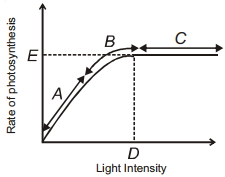
Choose the correct labelling for given figure
- ✓
$D$-Saturation point, $E$-Maximum photosynthesis
- B
$A$-Achieved at high light intensity
- C
$D$-$10\%$ of total sunlight, $E$-Compensation point
- D
$A$-Light saturation at $10 \%$ of total sunlight
AnswerCorrect option: A. $D$-Saturation point, $E$-Maximum photosynthesis
a
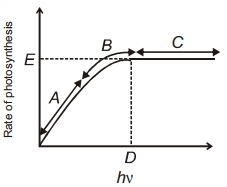
$D$-Saturation point $\rightarrow$ Because after this point there is no increase.
$E$-Maximum photosynthesis $\rightarrow$ Max. value.
View full question & answer→MCQ 491 Mark
Linear relationship exists between incident light and rate of $CO_2$ fixation at/in
- A
- B
- C
- ✓
More than one option is correct
AnswerCorrect option: D. More than one option is correct
d
Rate of photosynthesis increases at high $CO_2$ concentration and high light intensities.
View full question & answer→MCQ 501 Mark
The $CO_2$ concentration at which $C_4$ plants show saturation is about
- ✓
$360$ $ppm$
- B
$380$ $ppm$
- C
$450$ $ppm$
- D
$500$ $ppm$
AnswerCorrect option: A. $360$ $ppm$
a
In $C_4$ plants $CO_2$ compensation point is $360$ $ppm$.
View full question & answer→MCQ 511 Mark
Which of the following would rarely be a limiting factor for photosynthesis?
Answerb
Available from sunlight, required in least amount.
View full question & answer→MCQ 521 Mark
...$A$... plants have the higher temperature optimum than the plants adapted to ....$B$...climate
Here $A$ and $B$ refer to
- A
$A-Desert; B-Tropical$
- B
$A-Temperature; B-Tropical$
- ✓
$A-Tropical; B-Temperate$
- D
$A-Desert; B-Temperature$
AnswerCorrect option: C. $A-Tropical; B-Temperate$
c
$A$-Tropical, $B$-Temperate. Tropical plants have a higher temperature optimum than the plants adopted to temperate climate
View full question & answer→MCQ 531 Mark
Beyond saturation point, the photosynthesis begins to decline because of
$I$.Photo inbibition $II$. Photo-oxidation $III$. Photo-reduction
Select the/correct option which matches with statement
- A
$I$ and $III$
- B
$III$ and $II$
- C
$I, II,$ and $III$
- ✓
$I$ and $II$
AnswerCorrect option: D. $I$ and $II$
d
Beyond the saturation point (the light intesity at which plant can achieve maximum photosynthesis), the rate of photosynthesis begin to decline (solarisation : decline in rate) due to $2$ reasons
$1.$ Photo inhibition: It is due to the reduction in hydration and closure of stomata
$2.$ Photooxidation : oxidation of photosynthetic pigments and enzymes
View full question & answer→MCQ 541 Mark
Water stress causes the stomata to ...$A$... hence reducing the ...$B$... availability.
Here $A$ and $B$ refer to
AnswerCorrect option: C. $A$-close; $B - CO _{2}$
c
$A$-Close, $B - CO _{2} .$ Water stress causes the stomata to close hence, reducing the $CO _{2}$ availability
View full question & answer→MCQ 551 Mark
If a chemical process is affected by more than one factors then its rate will be determined by
- A
Two closely related factors
- ✓
Only one factor, which is close to its minimal value
- C
Only one factor, which is close to its maximum value
- D
Only one factor, which is close to its appropriate value
AnswerCorrect option: B. Only one factor, which is close to its minimal value
b
Only on factor, which is close to the minimal value. Law of limiting factor was proposed by $F. F.$ Blackman. $(1905)$. It stated that when a process is conditioned as to its rapidly by number of separate factors, the rate of the process is limited by the pace of the slowest factor (i.e, the factor present in minimum amount
View full question & answer→MCQ 561 Mark
The energy required to hydrolyse water during photosynthesis comes from
Answerc
The energy required to hydrolyse the water comes from oxidising chlorophyll. Oxidation of chlorophyll occurs due to the release a high energy electrons from the chlorophyll
View full question & answer→MCQ 571 Mark
Which is the most important limiting factor in normal condition for photosynthesis?
Answerb
Law of limiting factor was proposed by Blackman in $1905.$ He started that when a process is conditional as to its rapidly by a number of separate factors, then the rate of the process is determined by the pace of slowest factor: Carbon dioxide is usually a limiting factor in photosynthesis under field conditions particularly on clear summer days under adequate water supply.
View full question & answer→MCQ 581 Mark
Plants adapted to low light intensity have
- ✓
Larger photosynthetic unit size than the sun plants
- B
Higher rate of carbon dioxide fixation than the sun plants
- C
More extended root system
- D
Leaves modified to spines
AnswerCorrect option: A. Larger photosynthetic unit size than the sun plants
a
Plants adapted to low light intensity have larger photosynthetic unit size than the sun plants.
View full question & answer→MCQ 591 Mark
The concentration of $CO _{2}$ in atmosphere is between
- A
$0.03-0.04 \%$
- B
$300-400 \;ppm$
- C
$400-600 \;ppm$
- ✓
Either $(a)$ or $(b)$
AnswerCorrect option: D. Either $(a)$ or $(b)$
d
Carbon dioxide is the major limiting factor for photosynthesis. The concentration of $C O_{2}$ is very low in the atmosphere (Between $0.03$ to $0.04 \%$ or $300-400 \;ppm ) .$ Increase in concentration up to $0.05 \%$ can cause an increase in $C O_{2}$ fixation rates.Beyond this, the levels can become damaging over longer periods
View full question & answer→MCQ 601 Mark
Water stress makes plant leaves ...$A$... thus, ...$B$... the surface area of leaves and their metabolic activity as well
Here $A$ and $B$ refer to
- A
$A-wilt, B-increases$
- ✓
$A-wilt, B-decreases$
- C
$A-fall, B-decreases$
- D
$A-fall, B-increases$
AnswerCorrect option: B. $A-wilt, B-decreases$
b
$A$-with, $B$-decrease. Water stages leaves with thus reducing the surface area of leaves and their metabolic activity as well
View full question & answer→MCQ 611 Mark
Blackman's law is concerned with
MCQ 621 Mark
Choose incorrect statement.
- A
Increase in incident light beyond a point causes the breakdown of chlorophyll and a decrease in photosynthesis.
- B
$C_3$ plant responds to increased $CO_2$ was concentration and saturation is seen only beyond $450$ $1L^{-1}.$
- C
$C_3$ plants respond to higher $CO_2$ concentration by showing increased rates of photosynthesis.
- ✓
$C_4$ plants show saturation at about $260$ $1L^{-1}$
AnswerCorrect option: D. $C_4$ plants show saturation at about $260$ $1L^{-1}$
View full question & answer→MCQ 631 Mark
$A-$ The $C_3$ and $C_4$ plants respond differently to $CO_2$ concentrations.
$R -$ The concentration of $CO_2$ is between $0.03$ and $0.04$ percent. Increase in concentration upto $0.005$ percent can cause an increase in $CO_2$ fixation rates.
- A
$A$ and $R$ both are correct.
- B
$A$ and $R$ both are incorrect.
- ✓
$A$ is correct and $R$ is incorrect.
- D
$A$ is incorrect and $R$ is correct.
AnswerCorrect option: C. $A$ is correct and $R$ is incorrect.
View full question & answer→MCQ 641 Mark
Identify wrong sentences
$(I)$ Humidity in atmosphere is relatively more in the area where light become limiting factor for plants
$(II)$ Increase in light as factor affecting photosynthesis beyond a point causes breakdown of chlorophyll and a decrease in photosynthesis occurs
$(III)$ The $C_4$ plants respond to higher temperatures and show higher rates of photosynthesis while $C_3$ plants have a much lower temperature optimum
- A
$I, II$
- B
$I, III $
- C
Only $III$
- ✓
View full question & answer→MCQ 651 Mark
Which are green house crops ?
MCQ 661 Mark
For which of the following plants light is a rarely limiting factor ?
- A
- ✓
- C
- D
Plants growing on water surface
View full question & answer→MCQ 671 Mark
Photosynthesis will proceed upto
MCQ 681 Mark
Which factor not limiting in normal conditions for photosynthesis
MCQ 691 Mark
Rate of photosynthesis is independent of
MCQ 701 Mark
Main factor which limits the rate of photosynthesis on a clear day is
AnswerCorrect option: C. $CO_2$
View full question & answer→MCQ 711 Mark
When a photosynthetic plant is transferred to an atmosphere of enriched $O_2$, its rate of
- A
Photosynthesis would increase
- ✓
Photosynthesis would decrease
- C
Respiration would decrease
- D
AnswerCorrect option: B. Photosynthesis would decrease
View full question & answer→MCQ 721 Mark
In nature the photosynthesis should proceed upto the limit of
MCQ 731 Mark
Which one of the following is not a limiting factor for photosynthesis
MCQ 741 Mark
Photosynthesis takes place
- A
- B
- ✓
In the visible light obtained from any source
- D
Only in very high intensity of light
AnswerCorrect option: C. In the visible light obtained from any source
View full question & answer→MCQ 751 Mark
In cold and foggy areas, the limiting factor is
AnswerCorrect option: C. Both $(a)$ and $(b)$
View full question & answer→MCQ 761 Mark
Why the rate of photosynthesis declines at very strong light intensities. It may be due to
- A
- B
- ✓
Photo-oxidation of chlorophyll
- D
AnswerCorrect option: C. Photo-oxidation of chlorophyll
View full question & answer→MCQ 771 Mark
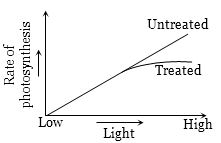
The graph given below shows the effect of potassium cyanide on the rate of photosynthesis of Chlorella at different light intensities. Which one of the following can be deduced from the graph
- A
Potassium cyanide appears to inhibit the light (Hill) reaction
- B
Potassium cyanide appears to absorb more light at high light intensities
- C
Potassium cyanide appears to inhibit photosynthesis equally at high and low light intensities
- ✓
Potassium cyanide appears to have no inhibiting effect on photosynthesis at low light intensities
AnswerCorrect option: D. Potassium cyanide appears to have no inhibiting effect on photosynthesis at low light intensities
View full question & answer→MCQ 781 Mark
Blackman demonstrated that increasing illumination increased the photosynthetic rate upto a point when $CO_2$ becomes limiting. If light was not limiting, temperature becomes limiting. Emerson found that maximum $CO_2$ fixation could be achieved with brief flashes of light. Mark the correct statement in the following
AnswerCorrect option: B. Photosynthesis consists of a light and dark reaction
b
(b) Blackman proposed the 'law of limiting factor and also proved that photosynthesis is photochemical reaction $(light\ reaction)$ and biochemical reaction $(dark\ reaction)$.
View full question & answer→MCQ 791 Mark
During photorespiration, phosphorylation as well as oxidation both occurs in
Answerd
Phosphorylation and oxidation occur in the chloroplast during photorespiration.
View full question & answer→MCQ 801 Mark
- A
- B
In $C_3$ plants
- C
In co-operation with chloroplasts, peroxisomes and mitochondria
- ✓
Answerd
Photorespiration occurs during presence of light in $C_3$ plants.
View full question & answer→MCQ 811 Mark
In photorespiration, release of $CO_2$ occurs in
Answera
$CO_2$ release in mitochondria.
View full question & answer→MCQ 821 Mark
Identify the incorrect match.
- A
Regeneration of $PEP$ -Mesophyll cells
- B
$RuBP$ oxygenase activity -Chloroplast
- ✓
Photorespiratory loss of $CO_2$ -Cytoplasm
- D
Photorespiratory loss of $CO_2$ -Cytoplasm
AnswerCorrect option: C. Photorespiratory loss of $CO_2$ -Cytoplasm
c
It is initiated in chloroplast $\rightarrow$ Peroxisome - Mitochondria.
View full question & answer→MCQ 831 Mark
Choose incorrect w.r.t. photosynthesis
- A
It is a physico-chemical process
- ✓
Oxygen is evolved as a by-product in all photosynthetic organisms
- C
Occurs in unicellular and multicellular photoautotrophs
- D
Anabolic and reductive process
AnswerCorrect option: B. Oxygen is evolved as a by-product in all photosynthetic organisms
b
In some bacteria, $H_2S$ is used instead of $H_2O$. So $O_2$ is not released.
View full question & answer→MCQ 841 Mark
Find out the reason that creates an important difference between $C_{3}$ and $C_{4}$-plant
Answera
In $C_{3}$-plants, photorespiration takes place but this pathway is absent in $C_{4}$-plants
View full question & answer→MCQ 851 Mark
Which of the following organelles is/are not related to photorespiration?
$I.$ Lysosome $II.$ Chloroplast $III.$ Peroxisome $IV.$ Mitochondria
Choose the correct option
- ✓
Only $I$
- B
Only $II$
- C
Only $III$
- D
Only $IV$
AnswerCorrect option: A. Only $I$
a
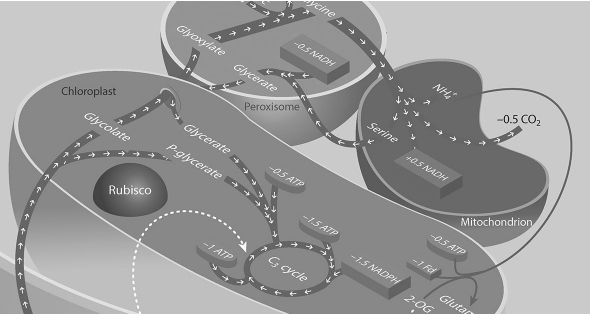
The site for photorespiration is chloroplast. Peroxisomes and mitochondria are required for completing the process. This happens at high temperature and high oxygen concentration. Lysosome are not involved in photorespiration
View full question & answer→MCQ 861 Mark
In photorespiration, what is the role of peroxisome?
AnswerCorrect option: A. Helps in oxidation of glycolate
a
The site for photorespiration is chloroplast. Peroxisome and mitochondria are required for completion of the process. It is a cyclic process. Glycolate is formed in chloroplast, which usually passes into peroxisome of the mesophyll cell where it is oxidised to glyoxylate. Glyoxylate is aminated and gives rise to amino acid glycine that enters to mitochondrion.
View full question & answer→MCQ 871 Mark
Photorespiration could easily be detected in
- ✓
$C_{3}$-plants
- B
$C_{4}$ - plants
- C
Both $(a)$ and $(b)$
- D
AnswerCorrect option: A. $C_{3}$-plants
a
Photorespiration takes place only in $C_{3}$-plants.
View full question & answer→MCQ 881 Mark
Answerc
Loss of energy occurs during photorespiration. Photorespiration is light induced oxidation of photosynthetic intermediates with the help of oxygen and release of carbon dioxide. Energy is not released during photorespiration
View full question & answer→MCQ 891 Mark
In plants, glycolate metabolism takes place in
- A
Low concentration of carbon dioxide
- B
High concentration of oxygen
- C
Low concentration of oxygen
- ✓
Both $(a)$ and $(b)$
AnswerCorrect option: D. Both $(a)$ and $(b)$
d
In low carbon dioxide concentration, glycolic acid or glycolate is formed, which is the substrate for photorespiration or $C_{2}$-cycle or glycolate metabolism. Conditions which affect photorespiration Altered substrate availability: lowered $CO _{2}$ or increased $O _{2}$ bIncreased temperature.
View full question & answer→MCQ 901 Mark
Glycolate diffuses out of chloroplast and entersthe organelle called ......... . Here it is...... and becomes ..........which is used in the synthesis of ..............
- A
Mitochondria, oxidised, glycine, serine.
- B
Peroxisome, oxidised, serine glyoxylate.
- C
Mitochondria, reduction glyoxylate, glycine
- ✓
Peroxisome, oxidised, glyoxylate, glycine.
AnswerCorrect option: D. Peroxisome, oxidised, glyoxylate, glycine.
View full question & answer→MCQ 911 Mark
In photorespiration ......... not found.
- ✓
Synthesis of $ATP $
- B
Production of $CO_2$
- C
Use of $O_2$
- D
AnswerCorrect option: A. Synthesis of $ATP $
View full question & answer→MCQ 921 Mark
Which condition is for photorespiration ?
AnswerCorrect option: A. Excess amount of $O_2.$
View full question & answer→MCQ 931 Mark
$I-$ It is the characteristic of $C_4-$ plants
$II-$ It is the characteristic of $C_3-$ plants
$III-$ It occurs in chloroplast
$IV-$ It occurs in day time
$V-$ It occurs in night
Select the correct option in relation, to photorespiration
Correct Sentences $-$ Incorrect Sentences
- A
$(I, IV)$ $-$ $(II, III, V) $
- ✓
$(II, III, IV)$ $-$ $(I, V) $
- C
$(I, II, III)$ $-$ $(IV, V)$
- D
$(IV, V)$ $-$ $(I,II, III)$
AnswerCorrect option: B. $(II, III, IV)$ $-$ $(I, V) $
View full question & answer→MCQ 941 Mark
Which statement is wrong about photorespiration ?
- A
Photorespiration occurs in $C_3$ plants and not $C_4$ plants.
- B
There is no synthesis of $ATP$ or $NADPH $
- C
$RuBisCO$ has higher affinity for $CO_2$ than $O_2$
- ✓
$RuBP$ binds with $O_2$ to form two molecules of glycolate
AnswerCorrect option: D. $RuBP$ binds with $O_2$ to form two molecules of glycolate
View full question & answer→MCQ 951 Mark
How many carbons are found in phosphoglycolate ?
MCQ 961 Mark
A pyrophosphate cleavage takes place when
- A
$ATP$ is converted into $AMP$
- ✓
$ATP$ is converted into $ADP$
- C
$ADP$ is converted into $AMP$
- D
$AMP$ is converted into $ATP$
AnswerCorrect option: B. $ATP$ is converted into $ADP$
View full question & answer→MCQ 971 Mark
Which one is false about kranz anatomy
AnswerCorrect option: B. Mesophyll cells have large chloroplast and more
View full question & answer→MCQ 981 Mark
Photorespiration takes place is
- A
Chloroplast, mitochondria
- B
- ✓
Chloroplasts, peroxisome, mitochondria
- D
Chloroplasts, cytoplasm, mitochondria
AnswerCorrect option: C. Chloroplasts, peroxisome, mitochondria
View full question & answer→MCQ 991 Mark
Peroxisome are related with
Answerb
(b)The process of photorespiration involves the involvement of chloroplast, peroxisomes and mitochondria.
View full question & answer→MCQ 1001 Mark
Photorespiration takes place only in
- A
- ✓
- C
Mitochondria of plant cell
- D
Answerb
(b) Photorespiration takes place in the photosynthetic cells. e.g., green parts of plant in the presence of light energy.
View full question & answer→MCQ 1011 Mark
Identify the reaction for which the $C_4$ plants require some extra $ATP$ molecules in comparison to $C_3$ plants
- A
Conversion of $PEP$ to $OAA$
- ✓
Conversion of Pyruvate to $PEP$
- C
Conversion of Malate to Oxaloacetate
- D
Conversion of $PEP$ to Malate
AnswerCorrect option: B. Conversion of Pyruvate to $PEP$
b
During conversion of pyruvate to $PEP$.
View full question & answer→MCQ 1021 Mark
$C_4$ plants can tolerate saline conditions due to
AnswerCorrect option: A. Occurrence of organic acids
a
It tolerates due to accumulation of organic acids.
View full question & answer→MCQ 1031 Mark
$C_4$ plants are less efficient at low temperature due to
- A
Low $O_2$ affinity of $PEP$case
- ✓
Cold sensitivity of $PEP$ synthetase enzyme
- C
Reduced rate of decarboxylation of organic acids
- D
High energy requirement for $CO_2$ fixation
AnswerCorrect option: B. Cold sensitivity of $PEP$ synthetase enzyme
b
$\therefore$ Optimum temp. is $30 -40°C$
View full question & answer→MCQ 1041 Mark
In $C_4$ plants, the bundle sheath cells
AnswerCorrect option: D. Have a high density of chloroplasts
d
Due to presence of Kranz anatomy
View full question & answer→MCQ 1051 Mark
In $C_4$ plants, mesophyll cells and bundle sheath cells are specialised to perform respectively
- ✓
Light reaction and dark reaction
- B
Dark reaction and light reaction
- C
Light reaction and photorespiration
- D
Photorespiration and dark reaction
AnswerCorrect option: A. Light reaction and dark reaction
a
$C_4$ $\rightarrow$ Light reaction
$C_3$ $\rightarrow$ Dark reaction
View full question & answer→MCQ 1061 Mark
$CO_2$ concentrating steps are found in
Answerb
Due to dissociation of malic acid
View full question & answer→MCQ 1071 Mark
Choose the correct sequence of steps involved in $C_4$ cycle.
- A
$CO_2$ fixation $\rightarrow$ Regeneration $\rightarrow$ Transport
- B
$CO_2$ fixation $\rightarrow$ Recarboxylation $\rightarrow$ Decarboxylation
- C
Transport $\rightarrow$ Regeneration $\rightarrow$ $CO_2$ fixation
- ✓
$CO_2$ fixation $\rightarrow$ Transport $\rightarrow$ Decarboxylation
AnswerCorrect option: D. $CO_2$ fixation $\rightarrow$ Transport $\rightarrow$ Decarboxylation
d
$CO_2$ fixation occurs first of all in mesophyll cell then transport into bundle sheath cell, where decarboxylation takes place.
View full question & answer→MCQ 1081 Mark
$PEP$case and $RuBisCO$ in $C_4$ plants are present respectively in
Answerd
$PEP$case in cytoplasm and $RuBisCO$ in the stroma.
View full question & answer→MCQ 1091 Mark
The primary acceptor of $CO_2$ in $C_4$ plants is
Answerb
In mesophyll cell of $C_4$ plant primary acceptor of $CO_2$ is $PEP$.
View full question & answer→MCQ 1101 Mark
$RuBisCO$ in $C_4$ plants shows minimum oxygenase activity due to
AnswerCorrect option: C. Decarboxylation of $C_4$ acid
c
Due to decarboxylation of $C_4$ acid, $CO_2$ evolved in Bundle sheath cell.
View full question & answer→MCQ 1111 Mark
Which of the following statement is correct regarding the $C_4$ plants?
AnswerCorrect option: D. More than one option is correct
d
In $C_4$ plants, $RuBisCO$ enzyme absent in mesophyll cell, $PEP$ carboxylase present in mesophyll cell.
View full question & answer→MCQ 1121 Mark
The enzyme required for the $CO_2$ fixation in the $C_4$ cycle is
- ✓
$PEP$ carboxylase
- B
$RuBP$ oxygenase
- C
$RuBP$ carboxylase
- D
$PGA$ dehydrogenase
AnswerCorrect option: A. $PEP$ carboxylase
a
In mesophyll cell, $PEP$ carboxylase required for $CO_2$ fixation.
View full question & answer→MCQ 1131 Mark
The $CO_2$ fixation during the Hatch and Slack pathway occurs in
- A
- ✓
- C
- D
Bundle sheath cell cytoplasm
Answerb
$C_4$ pathway occurs in mesophyll cells.
View full question & answer→MCQ 1141 Mark
Which one of the following is a $C_4$ plant?
Answerc
Maize is a $C_4$ plant.
View full question & answer→MCQ 1151 Mark
The $C_4$ and $C_3$ plants differ from each other in
AnswerCorrect option: B. The primary acceptor of $CO_2$ during carbon fixation
b
In $C_3$ plant primary $CO_2$ accepter is $RUBP$ white in $C_4$ plant it is $PEP$.
View full question & answer→MCQ 1161 Mark
In $C_4$ plants, sugar is produced in
Answera
In $C_4$ plants sugar synthesized in bundle sheath cell.
View full question & answer→MCQ 1171 Mark
In $C_4$ plants, first stable product of $CO_2$ fixation is
Answera
Oxalo acetic acid is first stable product in $C_4$ plants.
View full question & answer→MCQ 1181 Mark
Which of the following statements is not true regarding the $C_4$ plants?
AnswerCorrect option: C. Granal chloroplast is present in bundle sheath cells.
c
In Bundle sheath cells agranal chloroplast present.
View full question & answer→MCQ 1191 Mark
Identify $A , B , C$ and $D$ in the given figure and choose the correct option accordingly
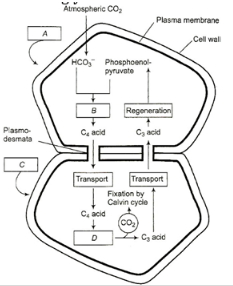
- ✓
$A-Mesophyll cell, B-Fixation, C-Bundle sheath cell, D-Decarboxylation$
- B
$A- Mesophyll cell, B-Decarboxylation, C-Bundle sheath cell, D-Fixation$
- C
$A-Chloroplast, B-Decarboxylation, C-Bundle sheath cell, D-Fixation$
- D
$A-Chloroplast, B-Fixation, C-Bundle sheath cell, D-Fixation$
AnswerCorrect option: A. $A-Mesophyll cell, B-Fixation, C-Bundle sheath cell, D-Decarboxylation$
a
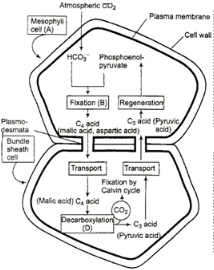
In the hatch and Slack pathway $b$-cycle), the first stable compound is $C_{4}$ organic acid called oxaloacetic acid
View full question & answer→MCQ 1201 Mark
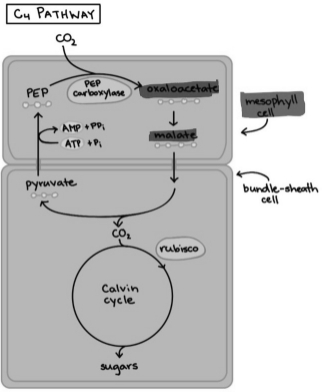
Malic acid or aspartic acid and oxaloacetic acid both are found in
Answera
View full question & answer→MCQ 1211 Mark
$I.$ They have special leaf anatomy $II.$ They tolerate high temperature
$III.$ Lack photorespiration $IV.$ Greater productivity of biomass
These are the probable characters of
- A
$C_{2}$-plant
- B
$C_{3}-$ plant
- ✓
$C_{4}-$ plant
- D
AnswerCorrect option: C. $C_{4}-$ plant
c
$C_{4}$-plants are special They have a special type of leaf anatomy, they tolerate higher temperature, they show a response to high light intensities, they lack a process called photorespiration and have greater productivity of biomass
View full question & answer→MCQ 1221 Mark
During $C_{4}$-cycle, the acid formed are
$I$. Picric acid $II$. $O AA$
$III$. Malic acid $IV$. Aspartic acid
Select the correct option
- A
$I, II, III$ and $IV$
- ✓
$II, III$ and $IV$
- C
$I, IV$ and $II$
- D
$I, III$ and $IV$
AnswerCorrect option: B. $II, III$ and $IV$
b
During $C_{4}$-cycle, the first $C_{4}$ acid formed is oxaloacetic acid in chlorophyll of mesophyll cells. Then this oxaloacetic acid changes into another $C_{4}$ acids like malic and aspartic acid in mesophyll and bundle sheath cells respectively
View full question & answer→MCQ 1231 Mark
Which of the following characteristics out of $I, II, III, IV$ are exhibited by $C_{4}$-plant?
$I$. Kranz anatomy $II$. Oxaloacetic acid $III$. Large bundle sheath cells
$IV$. Found only in desert area
- ✓
$I, II$ and $III$
- B
$I, II$ and $IV$
- C
$II, III$ and $IV$
- D
$III, I$ and $IV$
AnswerCorrect option: A. $I, II$ and $III$
a
Kranz anatomy, i.e., chloroplast containing mesophyll cells and bundle sheath cells. The phosphoenol pyruvate in mesophyll cells combine with $C O_{2}$ in presence of $PEP$ carboxylase and forms oxaloacetic acid and large bundle sheath are the characters of $C_{4}$ plants
View full question & answer→MCQ 1241 Mark
Which of the following statements regarding $C_{4}$-plants is false?
AnswerCorrect option: A. The primary $CO _{2}$ acceptor is a $5$ -carbon molecule
a
In $C_{4}$ plants, primary $C O_{2}$ acceptor is $3$ $C$-compound, phosphoenol pyruvate $(PEP)$ and is present in the mesophyll cells. The enzyme responsible for this fixation is $PEP$ carboxylase or $PEP$case.
View full question & answer→MCQ 1251 Mark
$PEP$ case has an advantage over $RuBisCo.$ The advantage is
- ✓
$RuBisCo$ combines with $O_{2}$ but $PEP$ case do not
- B
$RuBisCo$ combines with $N O_{2}$ but $PEP$ case do not
- C
$RuBisCo$ conserve energy but $PEP$ case do not
- D
$PEP$ case is present in both mesophyll cells and bundle sheath cells but $RuBisCo$ is not
AnswerCorrect option: A. $RuBisCo$ combines with $O_{2}$ but $PEP$ case do not
a
$PEP$ case has an advantage over the RuBisCo because $PEP$case does not bind to the oxygen. But $RuBisCo$ binds with oxygen and does the photorespiration, which is a harmful and wastage process and leads to decrease in photosynthetic yields
View full question & answer→MCQ 1261 Mark
What happens to $C_{4}$ acid in the bundle sheath cells?
- A
Aspartic acid is deaminated
- B
Malic acid decarboxylated
- ✓
Either $(a)$ or $(b)$
- D
Both $(a)$ and $(b)$
AnswerCorrect option: C. Either $(a)$ or $(b)$
View full question & answer→MCQ 1271 Mark
In $C_{4}$-plants, the bundle sheath cells
- A
Have cells density of chloroplast
- B
Are rich in $PEP$ case
- ✓
Have large number of Rubisco
- D
Are large sized having transferase
AnswerCorrect option: C. Have large number of Rubisco
c
In the leaves of $C_{4}$-plants, the bundle sheath consists of thick walled cylindrical cells. These cells have a granal chloroplast so density is low
View full question & answer→MCQ 1281 Mark
In $C_{4}$-pathway, the first product identified was
- A
$3-PGA$
- ✓
$OAA$
- C
$2-PGA$
- D
$1-3DPGA$
Answerb
$CO _{2}$ assimilation during photosynthesis generally takes place in two ways in plants
$(i)$ $C_{3}$ pathway Those plants in which the first product of $CO _{2}$ fixation is a $C_{3}$ acid $(PGA)$, i.e, the $C_{3}$ pathway $(ii)$ $C_{4}$ pathway Those plants in which the first product $C_{4}$ acid $(OAA)$, i.e,, the $C_{4}$ pathway
View full question & answer→MCQ 1291 Mark
Radioactive $C^{14}$ is given to carbon dioxide and released to atmosphere. This carbon dioxide is taken by $RuBP$ in a $C_{3}$-plants. First radioactive $C^{14}$ is seen, in which compound?
- A
$PGAL$
- B
$PEP$
- C
$RMP$
- ✓
$PGA$
Answerd
$C ^{14}$ Is an isotope of carbon. It has been used to draw the path of carbon fixation in the process of photosynthesis. This lebelled $C^{14}$ becomes incorporated with ${ }^{14} CO _{2}$, which is accepted by $RuBP$ and $3$ carbon compounds, phosphoglyceric acid $(3-PGA)$ is formed. $3-PGA$ is the first stable compound.
View full question & answer→MCQ 1301 Mark
In Hatch and Slack pathway,
- A
Chloroplasts are of same type
- B
Kranz anatomy occurs where mesophyll have small chloroplasts whereas bundle sheath have granal chloroplasts
- ✓
Kranz anatomy occurs where mesophyll have small chloroplasts whereas bundle sheath have larger agranal chloroplasts
- D
Kranz anatomy where mesophyll cells are diffused
AnswerCorrect option: C. Kranz anatomy occurs where mesophyll have small chloroplasts whereas bundle sheath have larger agranal chloroplasts
c
$C_{4}$ Plants have 'Kranz type' anatomy. Vascular bundles are surrounded by bundle sheath cells. The chloroplasts are dimorphic. The cells of bundle sheath have very large chloroplasts. They lack grana and contain starch grains. They are centripetally arranged white mesophyll cells have small and granal chloroplast.
View full question & answer→MCQ 1311 Mark
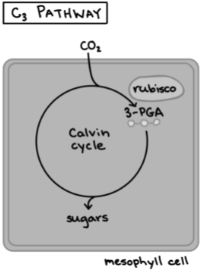
Carbondioxide fixation in Calvin cycle is catalyzed by
- A
$PEP$ carboxylase
- ✓
$RUBISCO$
- C
- D
Both $(b)$ and $(c)$
AnswerCorrect option: B. $RUBISCO$
b
$RuBP$ carboxylase oxygenase $=$ $RUBISCO$
View full question & answer→MCQ 1321 Mark
Bundle sheath cells are rich in which enzyme
Answerd
In bundle sheath cell $C_{3}$-cycle performed. So, these cells have high number of RuBisCo as compared to other cells
View full question & answer→MCQ 1331 Mark
In $C_{4}$-plants Rubisco enzyme is present in
Answerb
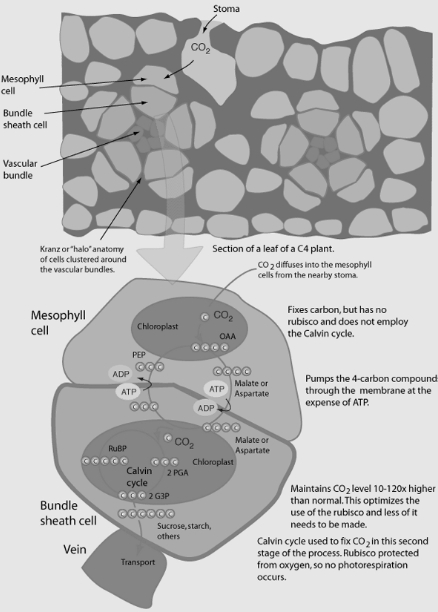
In mesophyll cells the $PEP$ carboxylase is present and RuBisCo is absent. In bundle sheath cells the RuBisCo is present and $PEP$ carboxylase is absent
View full question & answer→MCQ 1341 Mark
Presence of bundle sheath is a characteristic of
- A
- B
- ✓
$C_{4}$-plants
- D
$C_{3}-$ plants
AnswerCorrect option: C. $C_{4}$-plants
c
$C_{4}$-plants have Kranz anatomy in their leaves. In this leaf, the vascular bundle is surrounded by bundle sheath and mesophyll cells. Chloroplasts in the bundle sheath cells lack grana, while mesophyll chloroplasts are normal, e.g. sugarcane, maize, Euphorbia, Amaranthus, Sorghum, Portulacaand Chenopodium.
View full question & answer→MCQ 1351 Mark
Select the incorrect match for $C_4$ cycle.
AnswerCorrect option: A. Primary $CO_2$ fixation product $- PGA $
View full question & answer→MCQ 1361 Mark
Choose correct statement.
$(1)$ $C_4$ plants do not tolerate higher temperature.
$(2)$ $C_4$ plants show a response to high light intensities
$(3)$ $C_4$ plants lack a process called photorepiration.
$(4)$ Productivity of $C_4$ plants is less than $C_3$ plants.
$(5)$ $C_4$ acid $OAA$ is formed in the mesophyll in cells.
- A
$1,4$
- B
$1,3,5$
- ✓
$2,3,5 $
- D
$3,4,5$
AnswerCorrect option: C. $2,3,5 $
View full question & answer→MCQ 1371 Mark
Choose incorrect sentence. (For $C_4-$ plants)
- A
The particularly large cells around the vascular bundles of the $C_4$ pathway plants are called bundle sheath cells.
- B
The light reaction takes place in mesophyll cells while $CO_2$ fixation occurs in bundle sheath cells.
- ✓
In $C_4$ plants bundle sheath cells are having thick walls, imprevious to gaseous exchange and intercellular spaces.
- D
The chloroplasts in mesophyll cells exhibit granna organization.
AnswerCorrect option: C. In $C_4$ plants bundle sheath cells are having thick walls, imprevious to gaseous exchange and intercellular spaces.
View full question & answer→MCQ 1381 Mark
- A
Cell type in which the Calvin cycle takes place in $C_3$ plants - one.
- B
Cell type in which the Calvin cycle takes place in $C_4$ plants - two.
- C
First product in $C_3$ plant $- PGA.$
- ✓
First $CO_2$ acceptor in $C_4$ plant $- RuBP.$
AnswerCorrect option: D. First $CO_2$ acceptor in $C_4$ plant $- RuBP.$
View full question & answer→MCQ 1391 Mark
Which is first product of $C_4$ path?
- A
$RuBP$
- B
$PGA $
- C
$PEP $
- ✓
$OAA$
View full question & answer→MCQ 1401 Mark
Photorespiration is catalyzed by
MCQ 1411 Mark
Choose incorrect sentences for bundle sheath cell.
- ✓
Bundle sheath cells having thick walls impervious to gaseous exchange and with intercellular spaces."
- B
'Kranz' anatomy found in bundle sheath cells
- C
They do possess thylakoids but they are not arranged into grana.
- D
Carbo fixation occurs in bundle sheath cells.
AnswerCorrect option: A. Bundle sheath cells having thick walls impervious to gaseous exchange and with intercellular spaces."
View full question & answer→MCQ 1421 Mark
In first phase of $C_4$ pathway.
AnswerCorrect option: A. $CO_2$ binds with $PEP. $
View full question & answer→MCQ 1431 Mark
Kranz anatomy is found in ............
MCQ 1441 Mark
Which is incorrect for photosynthesis ?
AnswerCorrect option: C. It is characteristic of $C_4$ plants.
View full question & answer→MCQ 1451 Mark
Enzyme RuBiSCO acts as both carboxylase and oxygenase, so why you say that RuBisCO in $C_4$ plant do more carboxylation ?
- ✓
More sites are present attachment of $CO_2.$
- B
Kranz anatomy present in $C_4$ plants.
- C
$C_4$ plant had seen on equatorial region
- D
More number of chloroplast present in $C_4$ plants.
AnswerCorrect option: A. More sites are present attachment of $CO_2.$
View full question & answer→MCQ 1461 Mark
Match the following.
$\begin{array}{|p{0.6\linewidth}|p{0.3\linewidth}|} \hline Column\,\,-I & Column\,\,-II \\ \hline (1)\,\,Molecule\,\,transport\,\,from\,\,chloroplast\,\,to\,\,peroxisome. & (p)\,\,Glycine \\ \hline (2)\,\,Molecule\,\,transport\,\,from\,\,peroxisome\,\,to\,\,mitochondria & (q)\,\,serine \\ \hline (3)\,\,molecule\,\,transport\,\,from\,\,mitochondria\,\,to\,\,peroxisome & (r)\,\,Glycerate \\ \hline (4)\,\,Molecule\,\,transport\,\,from\,\,peroxisome\,\,to\,\,chloroplast & (s)\,\,Glycolate \\ \hline \end{array}$
- A
$(1-s), (2-r),(3-q), (4-p)$
- B
$(1-r), (2-q),(3-p), (4-s) $
- ✓
$(1-s), (2-p),(3-q), (4-r)$
- D
$(1-p), (2-q),(3-r), (4-s)$
AnswerCorrect option: C. $(1-s), (2-p),(3-q), (4-r)$
View full question & answer→MCQ 1471 Mark
Which was the first product in light reaction of $C_4$ plants?
View full question & answer→MCQ 1481 Mark
For the observation of Kranz anatomy which plant is useful?
MCQ 1491 Mark
In the Hatch-Slack path which is used for formaion of sugar with the help of $CO_2$?
AnswerCorrect option: D. $RuBP$ carboxylase oxygenase
View full question & answer→MCQ 1501 Mark
In the $C_4$ cycle more food (carbohydrates) will be produced. The reason is
- A
Presence of $CO_2$
- B
Because presence of malic acid
- ✓
Absence of photorespiration.
- D
Presence of enzyme RuBiSCO
AnswerCorrect option: C. Absence of photorespiration.
View full question & answer→MCQ 1511 Mark
Sugarcane having highest $CO_2$ fixation capacity among all because ........... it follows.
- A
- B
$EMP$ path
- ✓
- D
$TCA$ cycle
View full question & answer→MCQ 1521 Mark
Which process is required for the formation of oxaloacetic acid from phosphoenol pyruvic acid ?
MCQ 1531 Mark
Which one is correct for $C_4 -$ plants ?
Mesophy $II$ $-$ Bundle sheath
- ✓
$PEP$ case $C_4$ cycle $-$ RuBisco $C_3$cycle
- B
$PEP$ case Calvin cycle $-$ RuBisco $C_4$ cycle
- C
RuBisco $C_4$ cycle $-$ $PEP$ case $C_3$ cycle
- D
RuBisco $C_2$ cycle $-$ $PEP$ case $C_3$ cycle
AnswerCorrect option: A. $PEP$ case $C_4$ cycle $-$ RuBisco $C_3$cycle
View full question & answer→MCQ 1541 Mark
$C_4$ plants are more efficient in photosynthesis than $C_3$ plants due to
- A
- B
Presence of lover number of choloroplasts in the leaf cells
- C
- ✓
Lower rate of photorespiration
AnswerCorrect option: D. Lower rate of photorespiration
View full question & answer→MCQ 1551 Mark
The enzyme which fixes $CO_2$ in $C_4$ plants is
- A
- ✓
$PEP$ carboxylase
- C
- D
$RuBP$ carboxylase
AnswerCorrect option: B. $PEP$ carboxylase
View full question & answer→MCQ 1561 Mark
Characters of bundle sheath cell in $C_4$ plants.
$1.$ Thick wall.
$2.$ Intercellular space is present.
$3.$ Impervious to gaseous exchange.
$4.$ Contain grana.
$5.$ Contain thyllakoid.
- A
$2,4 $
- B
$1,2,3 $
- ✓
$1,3,5 $
- D
$2,3,5$
AnswerCorrect option: C. $1,3,5 $
View full question & answer→MCQ 1571 Mark
The evolution of $C_4$ photosynthetic system is probably one of the strategies for
AnswerCorrect option: B. Maximizing the availability of $CO_2$
View full question & answer→MCQ 1581 Mark
Which of the following is not correct for $C_4-$ plants ?
AnswerCorrect option: C. Bundle sheet cells are rich in an enzyme $PEP$ case but lack RuBisco
View full question & answer→MCQ 1591 Mark
The first product of $CO_2$ fixation in Hatch and Slack ($C_4$) cycle in plants is
AnswerCorrect option: D. Formation of oxaloacetate by carboxylation of phosphoenol pyruvate $(PEP)$ in the mesophyll cells
d
(d) $CO_2$ taken from the atmosphere is accepted by posphoenolpyruvic acid ($PEP$) present in the chloroplast of mesophyll cells of these leaves, leading to the formation of a $4-C$ compound, oxaloacetic acid ($OAA$).
View full question & answer→MCQ 1601 Mark
$C_4$ plant shows efficiency even in
- ✓
Low $CO_2$ concentration
- B
- C
High $O_2$ concentration
- D
AnswerCorrect option: A. Low $CO_2$ concentration
a
(a) In $C_4$ plants poor supply of $CO_2$ because there is a internal supply of $CO_2$. So these plants can survive in poor $C{O_2}$ conditions.
View full question & answer→MCQ 1611 Mark
In Hatch and Slack pathway
- A
Chloroplast are of same type
- ✓
Occurs in Kranz anatomy where mesophyll have small chloroplast whereas bundle sheath have agranal chloroplast
- C
Occurs in Kranz anatomy when mesophyll have small chloroplast where a bundle sheath have larger chloroplast
- D
Kranz anatomy where mesophyll cell are diffused
AnswerCorrect option: B. Occurs in Kranz anatomy where mesophyll have small chloroplast whereas bundle sheath have agranal chloroplast
b
(b) Bundle sheath chloroplast larger in size, lack grana $(Agranal\ chloroplast)$ and contain starch grains. Mesophyll chloroplast small in size, contain grana and lack starch grains.
View full question & answer→MCQ 1621 Mark
No. of carboxylation in ${C_4}$ cycle is/are
Answerb
(b) Two times carboxylation occur in $C_4$ cycle first carboxylation is done by phosphoenole pyruvate and second in bundle sheath cell by Ribulose $1, 5 $ biphosphate.
View full question & answer→MCQ 1631 Mark
Which of the following is not a $C_4$ plant
View full question & answer→MCQ 1641 Mark
In which type of plants $PEP$ is the $CO_2$ receptor
- A
$C_3$
- ✓
$C_4$
- C
Both $(a)$ and $(b)$
- D
View full question & answer→MCQ 1651 Mark
Photosynthesis in ${C_4}$ plants is relatively less limited by atmospheric $C{O_2}$ levels because
- A
Four carbon acids are the primary initial $C{O_2}$ fixation products
- ✓
The primary fixation of $C{O_2}$ is mediated via $PEP$ carboxylase
- C
Effective pumping of $C{O_2}$ into bundlesheath cells
- D
Rubisco in ${C_4}$ plants has higher affinity for $C{O_2}$
AnswerCorrect option: B. The primary fixation of $C{O_2}$ is mediated via $PEP$ carboxylase
View full question & answer→MCQ 1661 Mark
In ${C_4}$ plants, $C{O_2}$ combines with
View full question & answer→MCQ 1671 Mark
Which of the following cells of $C_4$ plants are prominently loaded with starch
Answerc
(c) Because bundle sheath cells have longer parenchymatous cells which are also called as storage cells.
View full question & answer→MCQ 1681 Mark
How many types of photosynthetic cells occur in $C_4$ plant
Answerb
(b)First is compact mesophyll around the vascular bundle (bundle sheath) and second is dimorphic chloroplast.
View full question & answer→MCQ 1691 Mark
Which one of the following is $C_4$ plant
View full question & answer→MCQ 1701 Mark
Dimorphism of chloroplast is found in
- ✓
$C_4$ plants
- B
$C_3$ plants
- C
$CAM$ plants
- D
AnswerCorrect option: A. $C_4$ plants
View full question & answer→MCQ 1711 Mark
- A
$C_3$ plant
- ✓
$C_4$ plant-
- C
$CAM$ plant
- D
AnswerCorrect option: B. $C_4$ plant-
View full question & answer→MCQ 1721 Mark
Tropical plant like sugarcane show high efficiency of $CO_2$ fixation because of
Answerb
(b) In $1965$ kortschak, Hart and Burr working with ${C^{14}}{O_2}$ on sugarcane leaves found ${C_4}$ dicarboxylic acid, malate and asparlate to be the major labelled products in very short periods of photosynthesis.
This observation was confirmed by M.D. Hatch and C.R., Slack in $1967$. The Hatch-slack pathway, as this alternative $C{O_2}$ fixation is called, has been found to occur in tropical and sub-tropical grasses and some dicotyledons.
View full question & answer→MCQ 1731 Mark
$C_4$ plants are also known as
Answera
(a) The detailed study of ${C_4}$ cycle was introduced by M.D. Hatch and C.R. Slack $(1966)$. So it is called as "Hatch and slack cycle".
View full question & answer→MCQ 1741 Mark
In case of $C_4$ pathway
- A
$CO_2$ combines with $PGA$
- ✓
$CO_2$ combines with $PEP$
- C
$CO_2$ combines with $RuDP$
- D
$CO_2$ combines with $ RMP$
AnswerCorrect option: B. $CO_2$ combines with $PEP$
b
(b) One of the basic features of ${C_4}$ plants is that $C{O_2}$ is trapped by a $C{O_2}$ acceptor, phosphoenol pyruvic acid present in the $(PEP)$ chloroplasts of mesophyll cells of these leaves, leading to the formation of a $4-C$ compound oxaloactic acid.
View full question & answer→MCQ 1751 Mark
In $C_4$ plants mesophyll cells are connected with bundle sheath cells with the help of
- A
- B
Special connecting tissues
- ✓
- D
Connection is not essential
View full question & answer→MCQ 1761 Mark
Which of the following is required for transformation of oxaloacetic acid into malic acid
- A
$NADP$
- ✓
$NADPH_2$
- C
Both $(a)$ and $(b)$
- D
AnswerCorrect option: B. $NADPH_2$
View full question & answer→MCQ 1771 Mark
Which of the following enzyme is responsible for the conversion of oxaloacetic acid into malic acid
- A
$PEP$ oxidase
- B
$PEP$ reductase
- C
$PEP$ dismutase
- ✓
View full question & answer→MCQ 1781 Mark
Conversion of oxaloacetic acid into malic acid is
Answerb
(b) $OAA $ is reduced to malic acid in presence of enzyme malic dehydrogenase with the help of $NADPH_2$. This malic acid (produced by acidification) is stored in vacuole.
View full question & answer→MCQ 1791 Mark
Which of the chloroplast does not contain grana
- A
- B
- ✓
Bundle sheath of sugarcane leaf
- D
AnswerCorrect option: C. Bundle sheath of sugarcane leaf
View full question & answer→MCQ 1801 Mark
The enzymes of dark reaction in $C_4$ plants are found in
- A
Bundle sheath chloroplast
- B
- ✓
Both $(a)$ and $(b)$
- D
AnswerCorrect option: C. Both $(a)$ and $(b)$
c
(c) Ribulose biphosphate and the enzymes of the calvin cycle are present in the bundle sheath cells only whereas the mesophyll cells contain the enzymes of the hatch-slack cycle.
View full question & answer→MCQ 1811 Mark
In $C_4$ plants, $CO_2$ combine with $PEP$ in presence of
- ✓
$PEP$ carboxylase
- B
$RuBP$ carboxylase
- C
$RuBP$ oxygenase
- D
AnswerCorrect option: A. $PEP$ carboxylase
View full question & answer→MCQ 1821 Mark
Path of carbon in photosynthesis was found by using
Answerb
(b) Ruben and Kamen used ${C^{14}}$ radioactive isotopes in chlorella for knowing path of carbon in photosynthesis.
View full question & answer→MCQ 1831 Mark
The path of $CO_2$ in the dark reaction of photosynthesis was successfully traced by the use of the following or The dark reaction is traced by
- A
$O_2^{18}$
- ✓
$C^{14}O_2$
- C
$P^{36}$
- D
$X$ -rays
AnswerCorrect option: B. $C^{14}O_2$
b
(b) Calvin traced the path in photosynthesis associated with dark reaction. Radioactive isotope of carbon $({C^{14}})$ is used, it is observed that $({C^{14}}{O_2})$ reduction of $C{O_2}$ is definitely in dark reaction.
View full question & answer→MCQ 1841 Mark
Who proposed the cycle of events leading to the fixation of $CO_2$ in mesophyll and its reduction in bundle sheath
Answerc
(c) Hatch and Slack $ (1965)$ discovered the $C_4$ pathway for $CO_2$ fixation in certain tropical grasses.
View full question & answer→MCQ 1851 Mark
The enzyme which catalyzes the photosynthetic $C_4$ cycle is
- A
$RuDP$ carboxylase
- ✓
$PEP$ carboxylase
- C
- D
AnswerCorrect option: B. $PEP$ carboxylase
View full question & answer→MCQ 1861 Mark
Which of the following is maximum in chloroplast
MCQ 1871 Mark
$A$ : Tropical plants are more efficient in $CO_2$ utilization.
$R$ : $C_3$ plants ensure that $RuBisCO$ functions as carboxylase minimising oxygenase activity.
- A
Assertion and Reason both are correct and also correct explanation.
- ✓
Assertion and Reason both are correct but not explanation of assertion.
- C
Assertion is correct, but Reason is incorrect.
- D
Both Assertion and Reason are incorrect.
AnswerCorrect option: B. Assertion and Reason both are correct but not explanation of assertion.
b
At high $CO_2$ concentration $RuBisCO$ enzyme acts as carboxylase enzyme.
View full question & answer→MCQ 1881 Mark
$A$ : For every $CO_2$ molecule entering $C_3$ cycle, three molecules of $ATP$ and two $NADPH$ are required.
$R$ : Cyclic photophosphorylation takes place to meet the difference in number of $ATP$.
- A
Assertion and Reason both are correct and also correct explanation.
- ✓
Assertion and Reason both are correct but not explanation of assertion.
- C
Assertion is correct, but Reason is incorrect.
- D
Both Assertion and Reason are incorrect.
AnswerCorrect option: B. Assertion and Reason both are correct but not explanation of assertion.
b
Cyclic photophosphorylation is needed to meet difference in number of $ATP$ but no correlation with Ist statement.
View full question & answer→MCQ 1891 Mark
To reduce $1$ $CO_2$ in $C_3$ cycle, assimilatory power needed is
- ✓
$3 ATP , 2 NADPH + H ^{+}$
- B
$2 ATP , 3 NADPH + H ^{+}$
- C
$5 ATP , 2 NADPH + H ^{+}$
- D
$6.5 ATP , 2 NADPH + H ^{+}$
AnswerCorrect option: A. $3 ATP , 2 NADPH + H ^{+}$
a
$1 CO _{2}$ requires $3 ATP , 2 NADPH + H ^{+}$
View full question & answer→MCQ 1901 Mark
$C_3$ cycle (reductive pentose phosphate cycle) is basically a
- ✓
$CO_2$ reduction cycle
- B
$CO_2$ oxidising cycle
- C
- D
Both $(b)\, \& \,(c)$
AnswerCorrect option: A. $CO_2$ reduction cycle
a
It occurs during reduction of $CO_2$ into glucose.
View full question & answer→MCQ 1911 Mark
The enzyme $RuBP$ carboxylase
AnswerCorrect option: A. Activity occurs in $C_3$ and $C_4$ plants
a
$RUBP$ carboxylase is used in both plants.
View full question & answer→MCQ 1921 Mark
Regeneration of four molecules of $RuBP$ in $C_3$ cycle requires the expenditure of _____ $ATP$.
Answerb
For $1$ molecule of $RUBP$ $\rightarrow$ $1ATP$
For $4$ molecule of $RUBP$ $\rightarrow$ $4ATP$
View full question & answer→MCQ 1931 Mark
The enzyme responsible for carboxylation reaction ($CO_2$ fixation) in $C_3$ plants is
- A
$RuBP$ oxygenase
- B
- ✓
$RuBP$ carboxylase
- D
$PEP$ carboxylase
AnswerCorrect option: C. $RuBP$ carboxylase
c
In $C_3$ plant carboxylation reaction is catalysed by enzyme $RuBP$ carboxylase.
View full question & answer→MCQ 1941 Mark
Which among the following is not a step in Calvin cycle?
Answerc
Photophosphorylation is the step of light reaction.
View full question & answer→MCQ 1951 Mark
In $C_3$ plants, first stable product of $CO_2$ fixation is
AnswerCorrect option: A. $3-PGA$
a
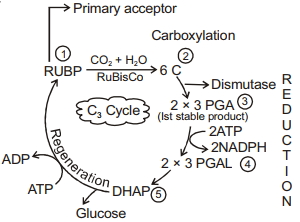
View full question & answer→MCQ 1961 Mark
The $CO_2$ acceptor in $C_3$ plants is
- ✓
$RuBP$
- B
$PGA$
- C
$PEP$
- D
$OAA$
AnswerCorrect option: A. $RuBP$
a
In $C_3$ plants, $CO_2$ acceptor is Ribulose $1-5$, bi-phosphate.
View full question & answer→MCQ 1971 Mark
In $C_{3}$ plant, when $O_{2}$ concentration is more, the $O_{2}$ binds to Rubisco and $RuBP$ gets changed to
AnswerCorrect option: D. One molecule each of phosphoglycerate and phosphoglycolate
d
The site for photorespiration is chloroplast. RuBP carboxylase function as oxygenase and instead of fixing carbon dioxide, it convert oxidase ribulose $1-5$ biphosphate (RuBP) to produce phosphoglycerate and phosphoglycolate
$R u B P+O_{2} R u B P P G A+i$ Phosphoglycolate
View full question & answer→MCQ 1981 Mark
How many Calvin cycles are required to produce $5$ molecules of glucose?
Answerc
Glucose is a hexose sugar. It's one molecule contains six carbon atoms. As Calvin cycle takes in only one carbon (as $C O_{2} i$ at a time, six turns of this cycle will be required to produce one molecule of glucose $(6 C )$. Hence, for producing $5$ molecules of glucose ($30$ molecules of carbon), $30$ turns of Calvin cycle are required.
View full question & answer→MCQ 1991 Mark
During the dark reaction, the acceptor of $CO _{2}$ is
- A
$NADP H _{2}$
- ✓
$R u B P$
- C
$PGA$
- D
$CO _{2}$
AnswerCorrect option: B. $R u B P$
b
During the dark reaction the acceptor of $CO _{2}$ is RuBP (Ribulose $1-5$ diphosphate). After accepting, it forms the intermediately six carbon compound, which breaks down into two three carbon stable compound. It is called $3$ $PGA$
View full question & answer→MCQ 2001 Mark
The enzyme responsible for primary carboxylation in $C_{3}$-plants is
- A
- B
- C
- ✓
RuBP carboxylase oxygenase
AnswerCorrect option: D. RuBP carboxylase oxygenase
d
$RuBP$ carboxylase/ oxygenase $(RUBISCO)$ is an enzyme present in the stroma of chloroplast. This enzyme is responsible for primary carboxylation in $C_{3}$-plants as a $5 C$ sugar RuBP acts as carbon dioxide acceptor in the presence of this enzyme and produces $6 C$ unstable compound which then splits into two molecules of $3$ -phosphoglyceric acid ($3C$ compound), the first stable product of $C_{3}$-cycle.
View full question & answer→MCQ 2011 Mark
Calvin cycle can be described under three stages. These stages are
$I.$carboxylation $II.$ ligation $III.$ reduction $IV.$ regeneration
Select the correct option
- A
$II, III$ and $IV$
- ✓
$I, III$ and $IV$
- C
$I, II$ and $IV$
- D
$I, II$ and $III$
AnswerCorrect option: B. $I, III$ and $IV$
b
For the ease of understanding Calvin cycle can be described under three stages
$(i)$ Carboxylation is the fixation of $CO _{2}$ into stable organic intermediate
$(ii)$ Reduction is a series of reactions that lead to the formation of glucose
$(iii)$ Regenerationof $C O_{2}$ acceptor molecule, RuBP is main, part of this stage
View full question & answer→MCQ 2021 Mark
In dark reaction, regeneration of $RuBP$ needs
- A
$2$ molecule of $ATP$
- ✓
$1$ molecule of $ATP$
- C
$3$ molecule of $ATP$
- D
$4$ molecule of $ATP$
AnswerCorrect option: B. $1$ molecule of $ATP$
b
The Calvin cycle proceeds in three stages $(1)$ carboxylation, during which $C O_{2}$ combines with ribulose $1,5$ bisphosphate; $(2)$ reduction, during which carbohydrate are formed at the expense of the photochemically made $ATP$ and $NADPH$; and $(3)$ regeneration during, $C O_{2}$ acceptor is ribulose $1,5$ -bisphosphate is formed again so that the cycle continues. Regeneration of the $C O_{2}$ acceptor molecule, RuBP is crucial if the cycle is to continue uninterrupted. The regeneration steps require one $ATP$ for phosphorylation to form $RuBP$
View full question & answer→MCQ 2031 Mark
What is the advantage of light reactions producing $ATP$ and $NADPH _{2}$ on stromal side of thylakoid membrane?
- ✓
Calvin cycle consumes $ATP$ and $NADPH _{2}$ from stroma
- B
Light reaction occurs in stroma
- C
Dark reaction occurs in grana need $ATP + NADPH _{2}$
- D
$CO _{2}$ is produced in stroma
AnswerCorrect option: A. Calvin cycle consumes $ATP$ and $NADPH _{2}$ from stroma
a
Energy formed on the stroma side thylakoids membrane during light reaction, ie., $NADPH$ $+H^{+i}$ of $ATP$, is used by the Calvin cycle or dark reaction to form the starch or carbohydrates
View full question & answer→MCQ 2041 Mark
Which of the following is concerned with carbon dioxide fixation?
Answerb
Conversion of carbon dioxide to simple (reduced) organic compounds is called carbon dioxide fixation or carbon dioxide assimilation or carbon fixation. This fixation pathway was elucidated by Melvin Calvin and is often called as Calvin cycle.
View full question & answer→MCQ 2051 Mark
Number of carboxylation occurs in Calvin cycle is
Answerb
The Calvin cycle occurs in the stroma of chloroplast of $C_{3}$ plants and consists of three main parts, i.e., carboxylation, reduction and regeneration. Carboxylation involves addition of carbon dioxide to ribulose $1,5-$ bisphosphate in presence of $RUBISCO$ enzyme to form $3$-$PGA$ ($3$-phosphoglyceric acid), i.e., single carboxylation occurs in Calvin cycle.
View full question & answer→MCQ 2061 Mark
In which of the following form glucose is usually stored in plants?
Answerd
Julius von Sachs provided evidence for the production of glucose when plants grow. Glucose is usually stored as starch. His later studies showed that the green substance in plants (chlorophyll as we know it now) is located in special bodies (later called chloroplast) within plant cells. He found that the green parts in plants are where glucose is made, and that the glucose is usually stored as starch
View full question & answer→MCQ 2071 Mark
In $C_{3}$ plants, the first stable product of photosynthesis during dark reaction is
- A
$PGAL$
- B
$RuBP$
- ✓
$PGA$
- D
$OAA$
Answerc
The first step in dark reaction of $C_{3}$ plants is carboxylation of ribulose $1-5$ biposphate by atmosphere $CO _{2}$ in presenic of enzyme, Rubisco to form PGA Ribulose $1-5$ bisphosphate $+ CO _{2}+ H _{2} O \rightarrow 3 PGA$.
View full question & answer→MCQ 2081 Mark
$C_{3}$-plant show optimum photosynthesis at
AnswerCorrect option: B. High $CO _{2}$
b
The $C_{3}$-plant shows optimum photosynthesis at high $CO _{2}$ concentration
View full question & answer→MCQ 2091 Mark
In Calvin cycle, if one molecule of $RuBP$ is carboxylated then how many $PGA$ molecule will be formed?
Answera
Carboxylation of one molecule of $RuBP$ leads to the formation of $2$ molecules of $PGA$
$RuBP + CO _{2} RuBP 2-\hat{\omega}$ carboxyl $3$ -keto $1-5$, bisphosphoribotol.
$2$-carboxyl $3$-Keto $1-5$-bisphosphoribotol $+ H _{2} O \rightarrow 2 PGA$
View full question & answer→MCQ 2101 Mark
Which enzyme is responsible for primary carboxylation in $C_3$ plants ?
- A
- ✓
$RuBP$ carboxylase
- C
- D
$PEP$ carboxylase
AnswerCorrect option: B. $RuBP$ carboxylase
View full question & answer→MCQ 2111 Mark
Which $C_3$ plants are used in green house crops ?
View full question & answer→MCQ 2121 Mark
$A-$ In chloroplast, the membrane system is responsible for trapping the light energy and also synthesis of $ATP$ and $NADPH.$ This is called dark reaction.
$R-$ In stroma, enzymatic reactions incorporate $CO_2$ into the plant leading to the synthesis of sugar.
- A
$A$ and $R$ both are correct.
- B
$A$ and $R$ both are incorrect.
- C
$A$ is correct and $R$ is incorrect.
- ✓
$A$ is incorrect and $R$ is correct.
AnswerCorrect option: D. $A$ is incorrect and $R$ is correct.
View full question & answer→MCQ 2131 Mark
$A-$ RuBisCO that is the most abundant enzyme in the world is characterised by the fact that its active site can bind to both $CO_2$ and $O_2$
$R-$ RuBisCo is the most abundant enzyme in the world.
- ✓
$A$ and $R$ correct
- B
$A$ and $R$ incorrect
- C
$A$ correct, $R$ incorrect
- D
$A$ incorrect, $R$ correct
AnswerCorrect option: A. $A$ and $R$ correct
View full question & answer→MCQ 2141 Mark
In Calvin cycle ......... $ATP$ and ......... $NADPH$ are required for formation of four molecules of glucose and cycle turns for …….
- ✓
$72\, ATP, 48\, NADPH, 24$ times
- B
$36 \,ATP, 24\, NADPH, 24$ times
- C
$54\, ATP, 48\, NADPH, 12$ times
- D
$72\, ATP, 24\, NADPH, 24$ times
AnswerCorrect option: A. $72\, ATP, 48\, NADPH, 24$ times
View full question & answer→MCQ 2151 Mark
$ATP$ and $NADH,$ which synthesized in photochemical reaction, they are used in which phase ?
- ✓
- B
- C
Cyclic photophosphorylation
- D
View full question & answer→MCQ 2161 Mark
Product of dark reactions,
- A
$CO_2$
- ✓
$C_6H_{12}O_6$
- C
$ATP $
- D
$NADPH$
AnswerCorrect option: B. $C_6H_{12}O_6$
View full question & answer→MCQ 2171 Mark
When a $CO_2$ molecule enters in Calvin cycle at that time $3$ molecules of ........... and $2$ molecules of .............. are required.
- A
$CO_2, NADPH $
- ✓
$ATP, NADPH$
- C
$PGA, NAD$
- D
$CO_2, NH_3$
AnswerCorrect option: B. $ATP, NADPH$
View full question & answer→MCQ 2181 Mark
Photorespiration is a characteristic of which plant?
MCQ 2191 Mark
How many $ATP$ and $NADPH$ molecule will be required to make one molecule of glucose in $C_3$ path?
- A
$3\, ATP$ and $2\, NADPH $
- ✓
$18\, ATP$ and $12\, NADPH $
- C
$28\, ATP$ and $22 \,NADPH$
- D
$38\, ATP$ and $32\, NADPH$
AnswerCorrect option: B. $18\, ATP$ and $12\, NADPH $
View full question & answer→MCQ 2201 Mark
It is not product of dark reaction.
- ✓
$6CO_2$
- B
$18\, ADP $
- C
$C_6H_{12}O_6$
- D
$12 \,NADP $
AnswerCorrect option: A. $6CO_2$
View full question & answer→MCQ 2211 Mark
View full question & answer→MCQ 2221 Mark
$C_3$ plant show optimum photorynthesis at
AnswerCorrect option: B. High $CO_2$
View full question & answer→MCQ 2231 Mark
The carbon dioxide acceptor in Calvin cycle$/C_3 -$ plants is
- A
Phospho-enol pyruvate $(PEP)$
- ✓
Ribulose $1, 5-$ diphosphate $(RuBP) $
- C
Phosphoglyceric acid $(PGA)$
- D
Ribulose monophosphate $(RMP)$
AnswerCorrect option: B. Ribulose $1, 5-$ diphosphate $(RuBP) $
View full question & answer→MCQ 2241 Mark
How many $NADPH$ are required for synthesis of one glucose molecule in Calvin cycle?
View full question & answer→MCQ 2251 Mark
Which of the following is most crucial step of the calving cycle.
MCQ 2261 Mark
Calvin's cycle is found in
- A
Only $C_3$ plants
- B
Only photophillous plants
- C
All $C_4$ plants
- ✓
All photosynthetic plants
AnswerCorrect option: D. All photosynthetic plants
View full question & answer→MCQ 2271 Mark
During dark reaction for fixation of carbon, the three carbon atoms of each molecule of $3$ -phosphoglyceric acid $(PGA)$ are derived from
- A
$RuBP$ only
- B
$CO_2$ only
- ✓
$RuBP + CO_2$
- D
$RuBP + CO_2 + PEP$
AnswerCorrect option: C. $RuBP + CO_2$
c
(c) In carboxylation Ribulose -$1, 5$ -biphosphate $(RuBP)$ (= Ribulose diphosphate) acts as $CO_2$ acceptor and $6$ mols of $RuBP$ react with $6$ mols of $CO_2$ and mols of water giving rise to $12$ mols of $3$ - phosphoglyceric acid.
View full question & answer→MCQ 2281 Mark
Which of the following is the main product in the photorespiration of $C_3$ plants
Answerb
(b) ${O_2} + RuBP\xrightarrow{{RuBP\,oxygenose}}$ phosphoglycolate
View full question & answer→MCQ 2291 Mark
Radioactive $C_{14}$ is given to $CO_2$ and released to atmosphere. This $CO_2$ is taken by $RuBP$ in a $C_3$ plant. First radioactive $C_{14}$ is seen in which compound
- A
$PGAL$
- B
$PEP$
- C
$RMP$
- ✓
$PGA$
View full question & answer→MCQ 2301 Mark
Which of the following is the first compound that accepts carbon dioxide during dark phase of photosynthesis
AnswerCorrect option: B. $RuBP$
View full question & answer→MCQ 2311 Mark
Which of the following is required for conversion of $3PGAL$ and dihydroxy acetone phosphate to fructose $1, 6 $ diphosphate
Answerb
(b) $\mathop {\mathop {{\text{3}} - {\text{Phosphoglyce raldehyde}}}\limits_{{\text{PGAL}}} }\limits_{{\text{[4}}\,{\text{Molecules]}}} \mathop {\xrightarrow{{Triose\,phosphate}}}\limits_{Isomerase} $ $\mathop {\mathop {{\text{Dihydroxy acetone}}\,{\text{ phosphate}}}\limits_{{\text{(DHAP)}}} }\limits_{{\text{[4}}\,{\text{Molecules]}}} $
$\mathop {{\text{Dihydroxy acetone}}\,{\text{ phosphate}}}\limits_{{\text{[2}}\,{\text{molecules]}}} + {\text{3}} - \mathop {{\text{phosphoglyce ral}}}\limits_{{\text{2}}\,{\text{molecules}}} $ ${\text{dehyde}}\xrightarrow{{{\text{Aldolase}}}}{\text{fructose}} - \mathop {{\text{1,}}\,{\text{6}} - {\text{diphosphate}}}\limits_{{\text{[2}}\,{\text{molecules]}}} $
View full question & answer→MCQ 2321 Mark
Number of carboxylation occur in Calvin cycle, is
Answerb
(b) Calvin cycle is divided into three distinct phase but carboxylation occur only one time.
View full question & answer→MCQ 2331 Mark
Mesophyll chloroplast of which plant alone is capable of synthesising starch or sucrose
- ✓
$C_3$ plant
- B
$C_4$ plant
- C
$(a)$ and $(b)$ both
- D
Neither $C_3$ nor $C_4$
AnswerCorrect option: A. $C_3$ plant
View full question & answer→MCQ 2341 Mark
The first step in dark reaction of photosynthesis is
AnswerCorrect option: C. Attachment of $C{O_2}$ to a pentose sugar
c
(c) Ribulose $1, 5$ diphosphate (also known as ribulose biphosphate) a phosphorylated $5$ carbon sugar (pentose sugar) it is first attached with $CO_2$ in photosynthesis.
View full question & answer→MCQ 2351 Mark
The first stable compound of dark reaction of photosynthesis is
MCQ 2361 Mark
Carbon dioxide is fixed in
MCQ 2371 Mark
View full question & answer→MCQ 2381 Mark
Dark reaction of photosynthesis take place in
MCQ 2391 Mark
During dark reaction of photosynthesis
AnswerCorrect option: B. $CO_2$ is reduced to organic compounds
b
(b) The new name of dark reaction is carbon assimilation, in which $C{O_2}$ gas reacting with ${H_2}O$ $(liquid)$ synthesizes solid glucose.
View full question & answer→MCQ 2401 Mark
Answera
(a) Calvin cycle occurs in the stroma of chloroplasts where the products of light reaction (assimilatory power $NADP.2H + ATP$ ) are used to form $CO_2$ to carbohydrate and it has enzymes essential for fixation of $CO_2$ and synthesis of sugar.
View full question & answer→MCQ 2411 Mark
Ribulose diphosphate carboxylase enzyme catalyses the carboxylation reaction between
- A
Oxaloacetic acid and acetyl $ CoA$
- ✓
$CO_2$ and ribulose $1, 5$ diphosphate
- C
Ribulose diphosphate and phosphoglyceraldehyde
- D
$PGA$ and dihydroxy acetone phosphate
AnswerCorrect option: B. $CO_2$ and ribulose $1, 5$ diphosphate
View full question & answer→MCQ 2421 Mark
During photosynthesis when $PGA$ is changed into phosphoglyceraldehyde, which of the following reaction occur
Answerb
(b) During photosynthesis $PGA$ is reduced by $NADP. 2H$ into phosphoglyceraldehyde.
View full question & answer→MCQ 2431 Mark
The initial enzyme of Calvin cycle is
AnswerCorrect option: A. Ribulose $1, 5$ diphosphate carboxylase
a
(a) Ribulose $1, 5$ diphosphate carboxylose enzyme is first enzyme of calvin cycle convert Ribulose - $1, 5$ diphosphate into $3$ phosphoglyceric acid.
View full question & answer→MCQ 2441 Mark
Dark reaction of photosynthesis is called so because
- A
It can also occur in dark
- ✓
It does not require light energy
- C
Cannot occur during day time
- D
It occurs more rapidly in night
AnswerCorrect option: B. It does not require light energy
b
(b) Dark reaction is independent of light hence it is called dark reaction. However it depends upon the products of light reaction of photosynthesis i.e., $NADP.2H$ and $ATP$.
View full question & answer→MCQ 2451 Mark
Which one of the following is the product of dark reaction of photosynthesis
Answerd
(d) Phosphoglyceraldehyde is a product of dark reaction which is formed by the $1, 3$ biphosphoglyceric acid react with $12$ mols of $NADP, 2H$
$1, 3$ biphosphoglycoric acid $+12 NADP.2H$ $\xrightarrow{{{\text{Triose}}\,{\text{phosphate}}\,{\text{dehydrogenase}}}}$ 3 phosphoglyceraldehyde $+ 12NADP^+ + 12H_3PO_4$.
View full question & answer→MCQ 2461 Mark
In dark reaction, first reaction is the
Answera
(a) Addition of carbon dioxide in to a compound is called carboxylation. Carboxylation is a first reaction of dark reaction.
$6$ Ribulose - $1, 5$ biphosphate + $6$ $CO_2$ +$6H_2O$ $\mathop {\xrightarrow{{{\text{Carboxydimutatase}}}}}\limits_{RuBP\,{\text{carboxylatase}}} $ $\mathop {3\ {\text{phospholglyceric}}}\limits_{(12\,mols)} \,{\text{acid}}$
View full question & answer→MCQ 2471 Mark
Phosphatase enzymes in $C_3$ cycle participate in
- A
- ✓
- C
- D
The enzyme is not concerned with removal or addition of phosphate
Answerb
(b) Fructose - $1, 6$ biphosphate $\mathop {\xrightarrow{{Phosphatase}}}\limits_{{H_2}O} $ Fructose - $6$. phosphate +${H_3}P{O_4}$
View full question & answer→MCQ 2481 Mark
First stable product of Calvin cycle has
- A
$2$ carbon atoms
- ✓
$3$ carbon atoms
- C
$4$ carbon atoms
- D
$6$ carbon atoms
AnswerCorrect option: B. $3$ carbon atoms
b
(b) Ribulose -$1, 5$ biphosphate $(RuBP)$ acts as $CO_2$ acceptor and $6$ mols $RuBP$ react with $6$ mols of $CO_2$ and given rise to $3$ - phosphoglyceric acid, $3\ PGA$ is a first stable compound in $C_3$ cycle (a $3$ carbon atom).
View full question & answer→MCQ 2491 Mark
In $C_3$ plants, phosphoketopentose epimerage is required for converting
AnswerCorrect option: B. Xylulose to ribulose $1,5$ Di $PO_4$
View full question & answer→MCQ 2501 Mark
Ribulose diphosphate carboxylase oxygenase is located in
Answerb
(b) Rubisco constitutes $16\%$ of chloroplast protein. It is the most abundant protein on this planet.
View full question & answer→MCQ 2511 Mark
$A$ : Light harvesting complexes $(LHC)$ on thylakoid membrane broaden the range of light absorption.
$R$ : They transfer e-to reaction centre.
- A
Assertion and Reason both are correct and also correct explanation.
- B
Assertion and Reason both are correct but not explanation of assertion.
- ✓
Assertion is correct, but Reason is incorrect.
- D
Both Assertion and Reason are incorrect.
AnswerCorrect option: C. Assertion is correct, but Reason is incorrect.
c
Antenna molecules transfer electron to Reaction Centre.
View full question & answer→MCQ 2521 Mark
Select the correct option for photosynthesis in $C_3$-plants.
- A
Bifunctional nature of $PEP$case enzyme
- B
Regeneration of each $RUBP$ requires $6$ $ATP$
- ✓
First stable product of Calvin cycle undergoes phosphorylation in dark reaction
- D
Optimum temperature is $30-40°C$
AnswerCorrect option: C. First stable product of Calvin cycle undergoes phosphorylation in dark reaction
c
$2 \times 3 PGA \longrightarrow{2 ATP \rightarrow 2 ADP } \longrightarrow 2 \times 3 PGAL$
View full question & answer→MCQ 2531 Mark
$CO_2$ acceptor, and carboxylating enzyme in $C_3$ plants are respectively
- A
$PEP, PEPCO$
- ✓
$RuBP, RUBISCO$
- C
$OAA, RUBISCO$
- D
$3$ $PGA, RUBISCO$
AnswerCorrect option: B. $RuBP, RUBISCO$
b
$RuBP$ is $CO_2$ acceptor and enzyme is $RUBISCO$.
View full question & answer→MCQ 2541 Mark
$ATP$ synthesis in chloroplast and mitochondria is due to proton gradient across the membrane. Select correct statement w.r.t. $ATP$ formation in chloroplast
$(a)$ Proton accumulates in lumen of thylakoid
$(b)$ Splitting of water occurs on inner side of membrane
$(c)$ Proton accumulates in stroma side of chloroplast
$(d)$ $NADP$ reductase is located on stroma side of membrane
- A
Only $(a)$ and $(b)$ are correct
- B
Only $(b)$ and $(c)$ are correct
- C
Only $(c)$ and $(d)$ are correct
- ✓
$(a), (b)$ and $(d)$ are correct
AnswerCorrect option: D. $(a), (b)$ and $(d)$ are correct
d
Proton accumulates in lumen of thylakoid.
View full question & answer→MCQ 2551 Mark
Which is not true regarding cyclic electron transfer system $(ETS)$ in thylakoid membrane of higher plants?
AnswerCorrect option: D. External electron donor is required
d
No, $PS$ $II$ donates electron.
View full question & answer→MCQ 2561 Mark
Examine the figure given below and select the right option giving all the four parts $(a, b, c, d)$ correctly identified.
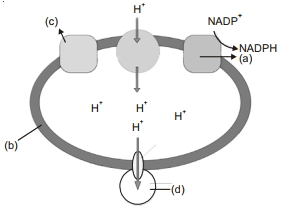
- A
(a) - Photosystem-$II$ (b) - Thylakoid membrane (c) - Photosystem-$I$ (d) - $ATP$ synthetase
- ✓
(a) - Photosystem=$I$ (b) - Thylakoid membrane (c) - Photosystem=$II$ (d) - $F_{1}$
- C
(a) - Photosystem-$I$ (b) - Inner chloroplast membrane (c) - Photosystem-$II$ (d) - $F_{0}$
- D
(a) - Photosystem-$II$ (b) - Thylakoid membrane (c) - Cytochrome $(b)$ $\&$ $(f)$ (d) - $F _{1}$
AnswerCorrect option: B. (a) - Photosystem=$I$ (b) - Thylakoid membrane (c) - Photosystem=$II$ (d) - $F_{1}$
b
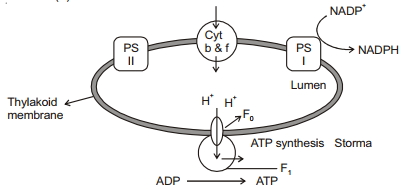
View full question & answer→MCQ 2571 Mark
In non-cyclic photophosphorylation
- A
$ATP$ is synthesised only
- B
Last electron donor is ferredoxin
- ✓
$NADP$ reductase activity requires $H^+$ from stroma
- D
There is involvement of $PS-I$ only
AnswerCorrect option: C. $NADP$ reductase activity requires $H^+$ from stroma
c
$NADP + H ^{+} \longrightarrow NADPH ^{+}$
View full question & answer→MCQ 2581 Mark
$Z$-scheme in thylakoid membrane of plants is concerned with
- A
Reduction of $NAD+$
- B
Reduction of $CO_2$
- ✓
- D
Answerc
$Z$-scheme is related with pathway of electron during non-cyclic photophosphorylation.
View full question & answer→MCQ 2591 Mark
Electric charge separation or quantum conversion occurs at
Answerc
It is involved in "Quantum conversion" where energy of light is converted to chemical energy possessed by emited electron.
View full question & answer→MCQ 2601 Mark
How many components listed below are part of cyclic $ETS$ ?
$P _{700}, P _{680}$, $NADP$ reductase, Hydrogen carrier, $PSI$, Water Splitting Complex, $PSII$
Answerb
$P _{700}$, $PSI$, Hydrogen carrier.
View full question & answer→MCQ 2611 Mark
Read the following statements:
$(a)$ $F_{0}$ part of $ATP$ase is associated with breakdown of proton gradient.
$(b)$ A $H^+$carrier contributes in creation of proton gradient.
$(c)$ Movement of electrons in $ETS$ is coupled to pumping of protons into the lumen.
$(d)$ Formation of $NADPH + H+$ is related with the creation of proton gradient.
How many of the above statements are correct?
Answerc
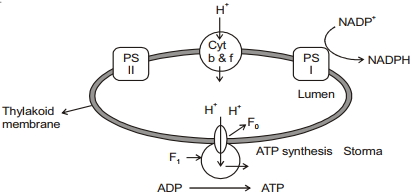
View full question & answer→MCQ 2621 Mark
$NADPH$ is generated through
- A
- B
Cyclic photophosphorylation
- ✓
Non-cyclic photophosphorylation
- D
AnswerCorrect option: C. Non-cyclic photophosphorylation
c
$PS$ $I$ reduces $NADP+$ to $NADPH$ in the stroma by action $NADP$ reductase enzyme.
View full question & answer→MCQ 2631 Mark
The photosystem connected with splitting of water is
- ✓
$PS$ $II$
- B
$PS$ $I$
- C
- D
$P700$
AnswerCorrect option: A. $PS$ $II$
a
Photolysis of $H_2O$ occurs at $PS$ $II.$
View full question & answer→MCQ 2641 Mark
The protons formed by splitting of water are released in the
- ✓
- B
Outer side of the membrane
- C
Both $(a)\, \& \,(b)$
- D
Answera
When a photon of light strikes the reaction centre of $PS$ $II$, it emites an electron. Two $H_2O$ molecules bind to an enzyme at reaction centre and enzyme splits the water and $H+$ are released in the lumen and also $O_2$ is produced.
View full question & answer→MCQ 2651 Mark
The assimilatory power produced during light reaction in green algae is
- ✓
$ATP$, $NADPH + H ^{*}$
- B
$NAD ^{+}$
- C
$NADP$
- D
$ATP\; \& \; NADH$
AnswerCorrect option: A. $ATP$, $NADPH + H ^{*}$
a
Light reaction gives two assimilatory product.
View full question & answer→MCQ 2661 Mark
The movement of electrons as per $Z$-scheme in light reaction is
- A
From low to high energy level
- B
Uphill in redox potential scale
- C
Downhill in redox potential scale
- ✓
Both $(b)\, \& \,(c)$
AnswerCorrect option: D. Both $(b)\, \& \,(c)$
d
It can occur uphill / downhill in redox potential scale.
View full question & answer→MCQ 2671 Mark
The following $(I-IV)$ are the main steps of chemosynthetic $ATP$ synthesis in the light reaction. Arrange them in correct order
$I$. $H^{+i i}$ concentration gradient established
$II$. $H^{+i i}$ diffuses through $ATP$ synthetase
$III.$ Carriers use energy from electrons to move $H^{+i i}$ across the membrane
$IV$. Electrons from $PS-II$ pass along electron transport chain
$V.$ Light excites electrons in $PS-II$
$VI.$ Energy of $H^{+i 6}$ flow is used by $ATP$ synthetase to make $ATP$
- A
$I, II, III, IV, V, IV$
- B
$II, IV, V, III, II, VI$
- ✓
$V, IV, III, I, II, VI$
- D
$V, VI, III, IV, II, I$
AnswerCorrect option: C. $V, IV, III, I, II, VI$
c
Steps in chemosynthetic $ATP$ synthesis are
$(i)$ Light excites electron in $PS-II4$
$(ii)$ Electrons from $PS-II$ pass along electron to move $H^{+i \text { across the membranes }}$
$(iii)$ Carriers use energy from electrons to move $H^{+i i}$ across the membrane
$(iv)$ $H^{+i,}$ concentration gradients is established
$(v)$ $H^{+i i}$ diffuses through $ATP$ synthesis
$(vi)$ Energy of $H^{+i i}$ flow is used by $ATP$ synthesis to make $ATP$
View full question & answer→MCQ 2681 Mark
Identify $A, B, C$ and $D$ in the given diagram of $z$-scheme of light reaction and choose the correct option accordingly
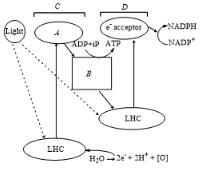
- ✓
$A$-e $^{-i i}$ acceptor, $B-ETS$, $C-PS-II$, $D-PS-I$
- B
$A$-e $^{-i i}$ acceptor, $B-ETS$, $C-PS-I$, $D-PS-II$
- C
$A-ETS$, $B$-e $^{-i \overline{6}}$ acceptor, $C-PS-I$, $D-PS-II$
- D
$A-ETS$, $B$-e $^{-i 6}$ acceptor, $C-PS-II$, $D-PS-I$
AnswerCorrect option: A. $A$-e $^{-i i}$ acceptor, $B-ETS$, $C-PS-II$, $D-PS-I$
a
Transport of electrons in photosynthesis takes place from the $PS-II$ to $PS-I$ through electrons transport system. In the electron transport system, there are various cytochrome, which carries electrons to the down hill potential of redox scale
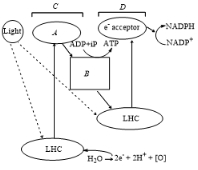
View full question & answer→MCQ 2691 Mark
$I.$ Photosystem-$I$ is a photosynthetic pigment system located on the appressed part of grana and thylakoids
$II.$ Photosystem-$II$ is a photosynthesis pigment located on the non-appressed part of stroma only
Identify wheather the given statements are correct or incorrect and choose the correct accordingly
- A
Statement $I$ is correct, while $II$ is incorrect
- B
Statement $II$ is correct, while $I$ is incorrect
- C
Both statements are correct
- ✓
Both statements are incorrect
AnswerCorrect option: D. Both statements are incorrect
d
$PS-I$ (photosystem-$I$) is a photosynthetic pigment system along which some electron carriers that is located on both the non-appressed parts of grana thylakoids as well as stroma thylakoids. $PS-II$ (Photosystem-$II$) is the photosynthetic pigment system along with some electrons carriers that is located in the appressed part of grana thylakoid
View full question & answer→MCQ 2701 Mark
In photo system$-I$, the first electron acceptor is
Answerd
In photosystem-$I$, the primary electron acceptor is probably a $Fe-S$ protein. The reduced primary acceptor transfers the electrons to secondary electrons acceptor (most probably ferradoxin).
View full question & answer→MCQ 2711 Mark
In photosynthesis, what does occur in $PS-II$?
- A
It takes longer wavelength of light and $e^{-i, 6}$ from $H _{2} O$
- ✓
It takes shorter wavelength of light and $e^{-i i}$ from $H _{2} O$
- C
It takes longer wavelength of light and $e^{-i t}$ from $NADP$
- D
It takes shorter wavelength of light and $e^{-i i}$ from $NADP$
AnswerCorrect option: B. It takes shorter wavelength of light and $e^{-i i}$ from $H _{2} O$
b
$PS-II$ absorbs maximum $680 \;nm$ wavelength of light, thus reaction centreis $P_{\infty 0} \cdot P_{t B 0}$ $(PS-II)$ extracts an electron from water, returning to its unexcited state because hydrolysis of water occurs in $PS-II$. Oxygen evolved in $PS-II$ comes from water:
View full question & answer→MCQ 2721 Mark
Which of the following statements is true with regard to the light reaction of photosynthesis?
- A
In $PS-II$ the reaction centre chlorophyll- $\alpha$ has an absorption peak at $700 \;nm$ hence, is called $P_{\pi 00}$
- B
In $PS-I$ the reaction centre chlorophyll- $\alpha$ has an absorption maxima at $680 \;nm$ and is called $P_{c \infty 0}$
- C
The spitting of water molecule is associated with $PS-I4$
- ✓
Photosystems-$I$ and $II$ are involved in $Z$ scheme
AnswerCorrect option: D. Photosystems-$I$ and $II$ are involved in $Z$ scheme
d
Photophosphorylation is the synthesis of $ATP$ from $ADP$ and inorganic phosphate in the presence of sun-light. When the two photosystems work in series, first $PS-II$ and then the $PS-I$, a process called non-cyclic Photophosphorylation occurs. The two photosystems are connected through an electron transport chain in the electron flow.
View full question & answer→MCQ 2731 Mark
Photolysis of water releases
$I$.electron $II$. proton $III$. oxygen
Select the correct option
- A
$I$ and $II$
- B
$II$ and $III$
- ✓
$I, II$ and $III$
- D
$I$ and $III$
AnswerCorrect option: C. $I, II$ and $III$
c
During the photolysis of water, the release of electrons, protons and oxygen takes place. Reaction during the photolysis of water is follows
$2 H _{2} O \rightarrow 4 H ^{* i+0_{2}+4 e^{-\prime}}$
View full question & answer→MCQ 2741 Mark
$PS-I$ in cyclic photophosphorylation is involved in the formation of ...$A$... by ...$B$... movement of electrons
What does $A$ and $B$ refer here?
- ✓
$A-ATP$; $B$-down hill redox potential
- B
$A-ADP$; $B$-up hill redox potential
- C
$A-NADH$ $+H^{+i} ;$ $B$-down hill energy
- D
$A-NADPH$ $+H^{+i i} ;$ $B$-down hill energy
AnswerCorrect option: A. $A-ATP$; $B$-down hill redox potential
a
Only $PS-I$ is involved in cyclic photophosphorylation the formation of $ATP$ when the electrons move down hill in term of redox potential
View full question & answer→MCQ 2751 Mark
Proton gradient is very important across the membrane because
AnswerCorrect option: D. Breakdown of proton gradient release energy
d
Proton gradient is important because it is the break down of this gradient that leads to release of energy. The gradient is broken down due to movement of protons across the membrane to the stroma through the transmembrane channel of the $F_{0}$ of the $ATP$ase. The energy released during the breaking down of proton gradient is used in formation of $ATP$
View full question & answer→MCQ 2761 Mark
In photosystem $II$, the reaction centre chlorophyll-a absorbs ...$A$... nm wave length of red light causing electrone to become excited and jump into an orbit farther from the atomic nucleus. These electrons are picked up by an ...$B$..., which passes them to an electron transport system constisting of ...$C$...
Pick the right choice for $A, B$ and $C$
- A
$A-680 \;nm, B-electron donor, C-cytochromes$
- B
$A-780 \;nm, B-electron acceptor, C-cytochromes$
- ✓
$A-680 \;nm, B-electron acceptor, C-cytochromes$
- D
$A-780 \;nm, B-electron donor, C-cytochromes$
AnswerCorrect option: C. $A-680 \;nm, B-electron acceptor, C-cytochromes$
View full question & answer→MCQ 2771 Mark
The mechanism of $ATP$ formation both in chloroplast and mitochondria is explained by
- A
Relay pump theory of Godlewski
- B
- ✓
- D
Munch's mass-flow hypothesis
Answerc
As per Peter Mitchell's Chemiosmotic coupling hypothesis, outward pumping of protons across the inner chloroplast or mitochondrial membrane results in accumulation of protons between outer membrane and inner membrane. A proton gradient is thus established. As protons now flow back passively down the gradient, the proton motive force is utilised to synthesis $ATP.$
View full question & answer→MCQ 2781 Mark
Which one of the following is not true about the light reactions of photosynthesis?
- A
Light energy provides energy for the photolysis of water through excitation of the reaction centre of $PS-II$
- B
The flow of electrons from water to $NADP$ in non-cyclic electron transport produces one $ATP$
- C
Reactions of the two photosystems are needed for the reduction of $NADP$
- ✓
$P_{\infty 0}$ and $P_{\pi x}$ are the reaction centres of $PS-I$ and $PS-II$ respectively
AnswerCorrect option: D. $P_{\infty 0}$ and $P_{\pi x}$ are the reaction centres of $PS-I$ and $PS-II$ respectively
d
In photosystem-$I$, the photocentre is a special chlorophyll-a molecule called $P_{\pi 0}$, which is active in both red and far-red light, while a very small amount of special from of chlorophyll-a called $P_{t=0}$, constitutes the reaction centre of photo system-$II$. $PS-II$ is inactive in far-red light (beyond $680 \;nm$ ).
View full question & answer→MCQ 2791 Mark
$ATP$ase has
- ✓
Channel that allows $H^{\text {*ii }}$ diffusion
- B
Has channel that allows electron diffusion
- C
Channel that allows diffusion $O _{2}$ molecule diffusion
- D
Channel that allows $CO _{2}$ molecule
AnswerCorrect option: A. Channel that allows $H^{\text {*ii }}$ diffusion
a
$ATP$ase has two parts- $F_{0}$ and $F_{1} . F_{0}$ part has channels through, which the diffusion of protons takes place
View full question & answer→MCQ 2801 Mark
$I$. $PS-I$ has more chlorophyll-a than chlorophyll-b
$II$. $PS-II$ has more chlorophyll- $b$ than chlorophyll-a
Choose the correct option
- A
$I$ statement is wrong, $II$ is right
- ✓
$II$ statement is wrong, $I$ is right
- C
- D
Both statements are rightight
AnswerCorrect option: B. $II$ statement is wrong, $I$ is right
b
$(i)$ $PS-I$ has more (about twice) chlorophyll-a than chlorophyll- b. $PS-II$ has about equal amount of chlorophyll-a and chlorophyll-b
View full question & answer→MCQ 2811 Mark
Photophosphorylation is the
- A
Formation of $ADP$ in the presence of light
- B
Formation of $ATP$ in the presence of chemicals
- ✓
Formation of $ATP$ in the presence of light
- D
Formation of $ATP$ in the presence of reducing agents
AnswerCorrect option: C. Formation of $ATP$ in the presence of light
c
Photophosphorylation is the formation of $ATP$ from $ADP$ and inorganic phosphate in the presence of light. When the two phosphates work in a series. (first $PS-II$ and then $PS-I$) then non-cyclic photophosphorylation occurs. The two photosystems are connected through an electron transport chain. Both $ATP$ and $NADPH$ are synthesised by this kind of electron flow
View full question & answer→MCQ 2821 Mark
Chemiosmosis requires
$I$. a membrane $II$. a proton pump $III$. a proton gradient
Select the correct option
- A
$II$ and $III$
- B
$I$ and $III$
- C
$I$ and $II$
- ✓
$I, II$ and $III$
AnswerCorrect option: D. $I, II$ and $III$
d
Chemiosmosis requires a membrane, a proton pump, a proton gradient for making $ATP$ through $ATP$ase enzyme
View full question & answer→MCQ 2831 Mark
Cyclic photophosphorylation results only in the
AnswerCorrect option: A. Formation of $ATP$
a
During the cyclic phosphorylation, the electrons does not pass to the $N A D P^{+i i}$ but cycled back to PS-I through electron transport chain. This cyclic flow hence, results only in the synthesis of $ATP$ but no of $NADPH +H^{+i \bar{i}}$. Cyclic photophosphorylation occurs when only light of wavelength beyond $700 \;nm$ is available for excitation
View full question & answer→MCQ 2841 Mark
$ATP$ and $NADPH$ produced in light reaction by the movement of electrons in $ETC$ are used immediately for
- A
Oxidation of carbohydrate
- B
- C
Reduction of carbon dioxide
- ✓
Both $(b)$ and $(c)$
AnswerCorrect option: D. Both $(b)$ and $(c)$
View full question & answer→MCQ 2851 Mark
In non-cyclic photophosphorylation, there is photolysis of $12$ water molecules. How many $H ^{+}$are formed?
- A
$24 H ^{+}$
- B
$36 H ^{+}$
- ✓
$12 H ^{+}$
- D
$32 H ^{+}$
AnswerCorrect option: C. $12 H ^{+}$
c
In non-cyclic photophosphorylation, evolutions of oxygen take place. It becomes possible due to photolysis of water molecules into $H ^{+}$and $OH$ ions. Later on $OH$ ion reassociate and form water and oxygen, while $H ^{+}$ions go to $NADP ^{+}$ (a hydrogen acceptor).
Each water molecule on photolysis yields one $H ^{+}$and oH"ion
$H _{2} O \rightleftharpoons HO ^{- H ^{-\cdots}}$
$2 OH +2 OH \rightleftharpoons 2 H _{2} O + O _{2} \uparrow$
So, $12 H _{2} O \rightleftharpoons 12 OH ^{-i+12 H ^{*}}$
View full question & answer→MCQ 2861 Mark
In grana of chloroplast, the reaction $A D P+P_{1}=ATP$ during day shows
- A
Oxidative phosphorylation
- ✓
- C
Substrate level phosphorylation
- D
Answerb
During Photophosphorylation, $ATP$ is formed.
View full question & answer→MCQ 2871 Mark
Light Harvesting Complex $(LHC)$ is
AnswerCorrect option: C. Hundreds of pigment molecules bound to proteins
c
The light harvesting complex is made up of hundreds of pigment molecules bounded to protems
View full question & answer→MCQ 2881 Mark
Which activity is performed by $PS-I$ in light reaction?
AnswerCorrect option: B. Reduction of $NADP$ $^{+}$
b
Reduce NADP $^{+}$
Light reaction begins with the $PS-II$. In photosystem-$II$ the reaction centre chlorophyll-a absorb $680 \;nm .$ wavelength of red light causing electrons to become excited and jump into orbit further from the nucleus. These electrons are picked up by an electron acceptor, which passes them to an electron system consisting of cytochromes.
The movement of electrons in $ETS$ of photosynthesis is down hill in terms of oxidation reduction or redox potential scale. The electrons are not used up as they pass through the electron transport chain, but they passed on the pigments of photosystem $I$. Simultaneously, electrons in the reaction centre of $PS-I$ are also excited, when they receive red light of wavelength $700 \;nm$ and are transferred to another acceptor molecule that has greater redox potential. These electrons than are moved down hill again this time to a molecule of energy rich $NAD P^{+i i}$.
The addition of these electrons reduces the $NAD P ^{+i \text { i }}$ to $NADPH + H ^{+i 6}$
View full question & answer→MCQ 2891 Mark
Electrons are transferred by splitting of $H _{2} O$ through $ETC$ during light reaction and reduces
- A
$NAD$ to $N A D H+H^{+i i}$
- B
$NADPH$ to $H^{+i i}$
- ✓
$N A D P^{+i,}$ to $N A D P H+H^{+i i}$
- D
$NAD$ to $NADPH +H^{+i \bar{i}}$
AnswerCorrect option: C. $N A D P^{+i,}$ to $N A D P H+H^{+i i}$
c
$N A D P^{+\omega}$ to $N A D P H+H^{+i b}$
During the light reaction
$(i)$ Formation of $ATP$ from $ADP$ takes place or phosphorylation of $ADP$ to $ATP$ takes place $(ii)$ Reduction of $N A D P^{+i i}$ to $N A D P H+H^{+i}$ takes place by PS-I through electron transport system
View full question & answer→MCQ 2901 Mark
The electrons in the reaction centre of $PS-I$ are
- A
Excited simultaneous with $PS-II$
- B
Excited simultaneously with $P_{\text {tao }}$
- C
Excited simultaneously with $P_{\pi 0}$
- ✓
Either $(a)$ or $(b)$
AnswerCorrect option: D. Either $(a)$ or $(b)$
d
Excited simultaneously with $PS-II$ $\left(P_{c 00}\right)$
The movement of electrons in $ETS$ of photosynthesis is down hill in terms of oxidation reduction or redox potential scale. The electrons are not used up as they pass through the electron transport chain, but they passed on the pigments of photosystem $I$. Simultaneously, electrons in the reaction centre of $PS-I$ are also excited, when they received red light of wavelength $700 \;nm$ and are transferred to another acceptor molecule that has greater redox potential. These electrons than are moved down hill again this time to a molecule of energy rich $N A D P^{+i i}$. The addition of these electrons reduces the $N A D P^{+i i}$ to $NADPH + H ^{+\omega i}$
View full question & answer→MCQ 2911 Mark
$PS-I$ is located on the
- A
Non-appressed part of a grana thylakoids
- B
- C
Appressed part of grana thylakoids
- ✓
Both $(a)$ and $(b)$
AnswerCorrect option: D. Both $(a)$ and $(b)$
d
$PS-I$ is present on both the non-appressed part of grana thylakoids as well as on stroma thylakoids
View full question & answer→MCQ 2921 Mark
Which of the following factors affecting photosynthesis do not have a direct
$I$. Light $II$. Water $III$. Temperature $IV$. Carbon Dioxide
Select the correct option
Answerb
The rate of photnsynthesis is very important in determining the yicld of plants tncluding crop plants. Phnensynthesis is under the inflacnce of several factors, hoth internal (plant) and cxternal.
$INTERNAL$.
$2$
$EXTERNAL$
The ecernal factors indude the avalabilitr of suni ght, te-perature, $co$ concentration and water.
Light it is an exsential factor for photacynthesia. It affects the rate of ghotowynthesis $2:$ rate does not show further increase as other factors becomelimitirz The light saturation occurs at $10$ percent of the total sunlight avalable to plants. Increase in the incident light bepond a point causes the breakdown of chlorophyl and thua resul ting in the decrease in ohoteaynthesis. Hence, ecespt for plants in shade or in derse forests, Iigtt rarsly become a limiting factor.
Light cuality: Light between $400-700$ nm wavelengtha constitute the photosynthetically active radiation ($PAR$). Maximum photocynthesis tales place in red and blue light of the vis ble spectrum and minimum photocynthesis taks place in the green ight.
Duration of light Light duration does not affect the rate of photosynthesis, but it atfects the cveral photosyntheric.
Carbon Diocide Corcentration lt is a major li-riting factor influencing the rate of photosynthesic. The concentration of $co$ isvery low in the atmocchere which is far below the requirement for octimum photocynthesiz increaze in concentration up to $0.05$ percent can casse an inerease in the rate of photooynthesic. But beyond thic ievel, it becomes damaging over longer periods.
Temperature Photonynthesis can take place over a wide rarge of temperat.ure: Thelight reactions are temperature sencitive, butthey are affected to a much lemer exestt. The darkreactions being ertymatic are temperature controlled. Again, the temperature optimum for photoaynthecic also depends on the habitat the plants are adapted to. The $C$ plants respond to higher temperatures and they show the higher rate of photocynthesis, whilec plants have muchloner temperature optimum. abrerbed by a plant, hence it is rarely a limiting factoe in photesynthesin. Water stress causes the stemata to clese, hence reducing the co aval ability as gaseous excharge could not ecevr. Alse, water stress makes lewes wilt, thus reducing the surface area of the lewes and the metabolle. activity reduces as well. Thus, the elfect of water as a factor is mere through its effect an the plant, rather than directly an photosynthess.
View full question & answer→MCQ 2931 Mark
During non-cycle photophosphorylation, in which of the following $4=$ produced through photolysis will enter?
- ✓
$PS-II$
- B
$PC$
- C
$PQ$
- D
$PS-I$
AnswerCorrect option: A. $PS-II$
a
Non-cyclic photophosphorylation includes both photo system $II$ and $I$. The process requires an external electron donor. The electrons released during photolysis of water are picked up by photocentre of $PS-II$ called $P_{c \infty}$. The flow of electrons is unidirectional. Electrons are not cycled back and are used in the reduction of $NADP$ to $NADP H _{2} .$ In this, high energy electrons released from ' $P_{\infty 00}$ ' do not return to ' $P_{\text {wo }}$ ' but pass through phaeophytin, plastoquinone, cytochrome- $b_{6}-f$ complex, plastocyanion and then enter $P_{\pi 0} .$ In transfer of electrons from $P Q$ to Cytochrome $-b_{6}-f$ complex, $ATP$ is synthesised.
View full question & answer→MCQ 2941 Mark
Photophosphorylation differs from oxidative phosphorylation in requiring input of energy in the form of
Answera
Photophosphorylation is differ from oxidative phosphorylation in requiring the input of energy in the form of light to create a good electron donor.
View full question & answer→MCQ 2951 Mark
Flow of electrons in non-cyclic photo phosphorylation is
AnswerCorrect option: D. Unidirectional (from $PS-II$ to $PS-I$)
d
Flow of electrons in the non-cyclic photophosphorylation is always unidirectionally, from $PS-II$ to the $PS-I$
View full question & answer→MCQ 2961 Mark
The $ATP$ase enzyme consists of
$I$. $F_{0}$ II. $F_{1}$ III. $F_{2}$
Select the correct option
- A
$I$ and $III$
- ✓
$I$ and $II$
- C
Only $I$
- D
$II$ and $III$
AnswerCorrect option: B. $I$ and $II$
b
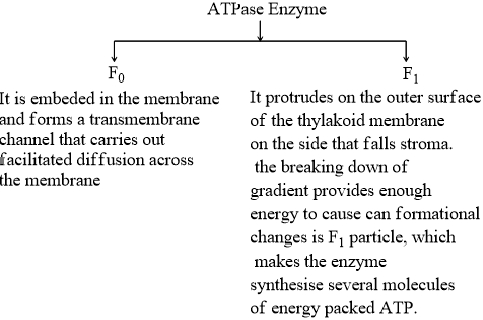
View full question & answer→MCQ 2971 Mark
During the light reaction, the water splits into
- ✓
$2 H ^{+}, \frac{1}{2} O_{2}+2$ electrons
- B
$H _{2}, O _{2}+2$ electrons
- C
$2 H ^{+}, O _{2}+2$ electrons
- D
$\frac{1}{2} H_{2}, \frac{1}{2} O_{2}+2$ electrons
AnswerCorrect option: A. $2 H ^{+}, \frac{1}{2} O_{2}+2$ electrons
a
During the light reaction, the splitting of water gives two proton, one oxygen and two electrons. Protons are used in the formation of protein gradient across the thylakoid membrane. Oxygen is liberated as byproduct. Electrons goes to the $PS-II$ and to the electron transport chain
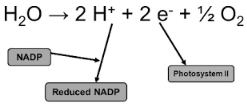
View full question & answer→MCQ 2981 Mark
The water splitting complex is associated with
AnswerCorrect option: B. $PS-II$
b
The electrons that were moved from photosystem $II$ must be replaced. This is achieved by electrons available due to splitting of water. The splitting of water is associated with the $PS-II$. Water is split into $H^{+i i}, 0$ and electrons. This creates oxygen, one of the net products of photosynthesis. The electrons that are needed to replace those removed from photosystem-$I$ are provided by photosystem-$II$
$2 H _{2} O \rightarrow 4 H^{* i+0_{2}+4 e^{-2}}$
View full question & answer→MCQ 2991 Mark
Which chemical compound/molecule supplies electrons continuously to $PS-II$?
- A
$CO _{2}$
- B
$O_{2}$
- ✓
$H _{2} O$
- D
$NADPH$
AnswerCorrect option: C. $H _{2} O$
c
Electron excited by $PS-I$ used in the formation of $N A D P H+H^{+i i}$. These electrons come ultimately from $H _{2} O$ through photosynthesis
View full question & answer→MCQ 3001 Mark
Light reaction of photosynthesis occurs inside
Answerb
Grana are the stacks of thylakoids which contain photosynthetic pigments. Therefore, grana are the sites of light reaction.
View full question & answer→MCQ 3011 Mark
Electrons which gets excited in $PS-I$ must replaced. These replacement ultimately come from
- A
$ATP$
- ✓
$H _{2} O$
- C
$PS-II$
- D
$NAD$
AnswerCorrect option: B. $H _{2} O$
b
Electron excited by $PS-I$ used in the formation of $N A D P H+H^{+i i}$. These electrons come ultimately from $H _{2} O$ through photosynthesis
View full question & answer→MCQ 3021 Mark
Which is used to study photosynthesis ?
- A
$^{13}C$
- ✓
$^{14}C $
- C
$^{15}C $
- D
$^{11}C$
AnswerCorrect option: B. $^{14}C $
View full question & answer→MCQ 3031 Mark
Which is required for chemiosmosis ?
MCQ 3041 Mark
Photophosphorylation means synthesis of
- ✓
$ATP$ from $ADP. $
- B
$NADP$
- C
$ADP$ from $ATP $
- D
$PGA$
AnswerCorrect option: A. $ATP$ from $ADP. $
View full question & answer→MCQ 3051 Mark
Choose incorrect sentence.
- A
The pigments are organized into two discrete photochemical light harvesting complexes $(LHC)$ within the photosystem $II$$(PS - II).$
- ✓
The $LHC$ are made up of hundreds of pigment molecules bound to carbohydrates.
- C
The reaction center is different in both the photosystems.
- D
In photosystem II the reaction center absorbs $680\, nm$ wavelength of red light causing.
AnswerCorrect option: B. The $LHC$ are made up of hundreds of pigment molecules bound to carbohydrates.
View full question & answer→MCQ 3061 Mark
Which are incorrect sentences for non-cyclic photophosphorylation ?
$(1)$ $Z$ shape is formed when all the carriers are placed in a sequence on a redox potential scale.
$(2)$ The $4e^-$ released are accepted by various electron acceptors and finally enter into $PS-II$ instead of returning to $PS-I.$
$(3)$ In this process both $PS-I$ and $PS-II$ take part
$(4)$ As the electrons released in various ways do not return to their original donors, such an electron transport is called non-cyclic electron transport.
- A
$(1)$ and $(3)$
- B
Only $(3)$
- C
$(1), (3)$ and $(4)$
- ✓
Only $(2)$
AnswerCorrect option: D. Only $(2)$
View full question & answer→MCQ 3071 Mark
Choose incorrect sentences for chloroplast.
$(1)$ In chloroplast membranous system consisting of grana and the fluid stroma.
$(2)$ Pigments are present in stroma.
$(3)$ In stoma, enzymatic reactions in corporate $O_2$ into the plant leading to the synthesis of sugar.
$(4)$ Light is not required for formation of sugarin stroma.
- A
$(1), (2)$ and $(4)$
- ✓
$(2)$ and $(3)$
- C
$(3), (4) $
- D
$(2)$ and $(4)$
AnswerCorrect option: B. $(2)$ and $(3)$
View full question & answer→MCQ 3081 Mark
During $ATP$ synthesis e are transport through
View full question & answer→MCQ 3091 Mark
What happens when proton gradient breakdown ?
AnswerCorrect option: D. More amount of $H^+$ released.
View full question & answer→MCQ 3101 Mark
Chemiosmosis explains .......
AnswerCorrect option: A. $ATP$ synthesis in chloroplast
View full question & answer→MCQ 3111 Mark
$ADP + Pi = ATP$ formation in grana is called......
- A
- B
Only photophosphorylation
- ✓
- D
View full question & answer→MCQ 3121 Mark
Photophosphorylation is process in which.
AnswerCorrect option: D. Light energy converted into chemical energy and $ATP$ are synthesized.
View full question & answer→MCQ 3131 Mark
in plants uptake of $CO_2$ and release of $O_2$ this process is called.........
View full question & answer→MCQ 3141 Mark
Match appropriate pair.
$\begin{array}{|p{0.6\linewidth}|p{0.3\linewidth}|} \hline Column\,\,-I & Column\,\,-II \\ \hline (1)\,\,cyclic\,\,photopho & (a)\,\,Only\,\,PS\,\,-\,\,I \\ \hline (2)\,\,Non-cycli\,\,photo-\,\,phosphorylation & (b)\,\,ATP\,\,formed \\ \hline (3)\,\,C_4\,\,-\,\,cycle & (c)\,\,Meristemtic\,\,tissue \\ \hline & (d)\,\,High\,\,productivity \\ \hline \end{array}$
- ✓
$(1-A), (2-B), (3-D) $
- B
$(1-D),(2-C), (3-B) $
- C
$(1-C), (2-D), (3-A)$
- D
$(1-B),(2-C),(3-D) $
AnswerCorrect option: A. $(1-A), (2-B), (3-D) $
View full question & answer→MCQ 3151 Mark
In non-cycle photophosphorylation, $\overline e $ releated by $PS -I$ is accepted by ..........
- ✓
$NADP $
- B
$ATP $
- C
- D
Photosystem $-II$
AnswerCorrect option: A. $NADP $
View full question & answer→MCQ 3161 Mark
Chemiosmosis requires
$I.$ a membrane,
$II$ proton pump,
$III$ proton gradient
- A
$II$ and $III$ only
- B
$I$ and $III$ only
- C
$I$ and $II$ only
- ✓
$I, II,$ and $III$
AnswerCorrect option: D. $I, II,$ and $III$
View full question & answer→MCQ 3171 Mark
$X-$ In $PS -I$ Chlorophyll $a$ has an absorption peak at $680\, nm.$
$Y -$ In $PS -II$ it has absorption maxima at $700\, nm.$
- A
$X -Y$ correct
- B
$X -$ incorrect, $Y-$ correct
- C
$X-$ correct, $Y -$ incorrect
- ✓
$X -Y$ incorrect
AnswerCorrect option: D. $X -Y$ incorrect
View full question & answer→MCQ 3181 Mark
$NADP$ reductase is located
- ✓
On stroma side of membrane
- B
On outer membrane of chloroplast
- C
- D
AnswerCorrect option: A. On stroma side of membrane
View full question & answer→MCQ 3191 Mark
Which of the following is not required for chemiosmosis in chloroplast?
AnswerCorrect option: D. $CO_2$
View full question & answer→MCQ 3201 Mark
Non-cyclic photophosphorylation involves
- A
$PS$ $-I$
- B
$PS$ $-II $
- ✓
Both $A$ and $B$
- D
AnswerCorrect option: C. Both $A$ and $B$
View full question & answer→MCQ 3211 Mark
Which is the evidence to show that $O_2$ is released in photosynthesis comes from water
- A
Isotopic $O_2$ supplied as $H_2O$ appears in the $O_2$ released in photosynthesis
- B
Isolated chloroplast in water releases $O_2$ if supplied potassium ferrocyanide or some other reducing agent
- C
Photosynthetic bacteria use $H_2S$ and $CO_2$ to make carbohydrates
- ✓
View full question & answer→MCQ 3221 Mark
Photosynthesis consists of essentially two biological reaction systems, one followed by the other, the second of these systems does which of the following
- ✓
Fixes $CO_2$
- B
- C
- D
Works only in the presence of light
AnswerCorrect option: A. Fixes $CO_2$
View full question & answer→MCQ 3231 Mark
In photosynthesis, photolysis of water is used in
- ✓
Reduction of $NADP$
- B
Oxidation of $NADP$
- C
Oxidation of $FAD$
- D
AnswerCorrect option: A. Reduction of $NADP$
View full question & answer→MCQ 3241 Mark
When the two pigment systems absorb light, in what direction does the energy flow between them
- A
$PS-I → PS-II$
- ✓
$PS-II → PS-I$
- C
$PS-II \neq PS-I$
- D
AnswerCorrect option: B. $PS-II → PS-I$
View full question & answer→MCQ 3251 Mark
Which of the following conditions are favourable for cyclic photophosphorylation
- A
- B
Aerobic and optimum light
- C
Aerobic and low light intensity
- ✓
Anaerobic and low light intensity
AnswerCorrect option: D. Anaerobic and low light intensity
View full question & answer→MCQ 3261 Mark
Which of the following photosynthetic bacteria have both $PS-I$ and $PS-II$
- A
- B
- ✓
- D
Purple non-sulphur bacteria
View full question & answer→MCQ 3271 Mark
Which of the following method is responsible for $ATP$ production by green plants cells in the presence of sunlight
- A
- B
By oxidative phosphorylation only
- C
By only substrate level phosphorylation
- ✓
View full question & answer→MCQ 3281 Mark
Photosynthesis of light reaction occur in
- A
- B
- ✓
Presence and absence of light
- D
Absent of light in maximum intensity
AnswerCorrect option: C. Presence and absence of light
View full question & answer→MCQ 3291 Mark
Which of the following occurs first in the light reaction
MCQ 3301 Mark
Photophosphorylation differs from oxidative phosphorylation in
MCQ 3311 Mark
The light energy passes in the form of
MCQ 3321 Mark
In non-cyclic photophosphorylation, there are
- A
$24 H^+$
- B
$36 H^+$
- ✓
$12 H^+$
- D
$32 H^+$
AnswerCorrect option: C. $12 H^+$
View full question & answer→MCQ 3331 Mark
$ATP$ is produced during
- A
Cyclic photosphosphorylation
- B
None cyclic photosphosphorylation
- ✓
- D
View full question & answer→MCQ 3341 Mark
In noncyclic photophosphorylation, the pigment molecule first excited is
- ✓
${P_{680}}$
- B
${P_{700}}$
- C
Chlorophyll-$b$
- D
AnswerCorrect option: A. ${P_{680}}$
a
(a) Green plants and algae use two types of photosystems, $PS-I$ with chl. $P_{700}$ in its reaction centre and $PS-II$ with $P_{680}$ in its reaction centre.
The two photosystems are linked by a chain of electron carriers. Light excites $P_{680}$ of $PS-II$ to activated $P_{680}$.
View full question & answer→MCQ 3351 Mark
Cyclic photophosphorylation produces
AnswerCorrect option: C. ${\rm{ATP}}$
View full question & answer→MCQ 3361 Mark
Non-cyclic photophosphorylation involves
- A
$PS-I$ or $PS-II$
- B
$PS-I$ only
- ✓
$PS-II$ only
- D
AnswerCorrect option: C. $PS-II$ only
View full question & answer→MCQ 3371 Mark
$ATP$ formation in photosynthesis is known as
- A
- ✓
- C
Oxidative phosphorylation
- D
Answerb
(b) During light reaction not only reduced $NADP$ is formed and $O_2$ is evolved but $ATP$ is also formed. This formation of high energy phorphates ($ATP$) is dependent on light hence called photophosphorylation.
View full question & answer→MCQ 3381 Mark
${O_2}$ evolution is directly associated with
AnswerCorrect option: B. $PS -II$
b
(b) The photosystem-$II$ (Reaction centre of $P-680$) extracts an $e^-$ from water returning to its unexcited state.
The removal of four $e^-$ from two molecules of water requires $4$ quanta of light to fall on $PS-II$ and leads to the production of $4H^+$ ions and one molecules of $O_2$.
View full question & answer→MCQ 3391 Mark
Photosystem I and Photosystem II are found in
- A
- ✓
- C
- D
Inner membrane of mitochondria
View full question & answer→MCQ 3401 Mark
In light reaction which is formed
MCQ 3411 Mark
$P_{700}$ is a special form of which pigment
- A
Chlorophyll $b$
- B
- ✓
Chlorophyll $a$
- D
AnswerCorrect option: C. Chlorophyll $a$
c
(c) Chl.-$a$ $700$ or $P_{700}$ is the reaction centre of $PS-I$.
View full question & answer→MCQ 3421 Mark
In photosynthesis light energy is utilized in
- A
Converting $ATP$ into $ADP$
- B
Changing $ CO_2$ into carbohydrate
- ✓
Converting $ADP$ into $ATP$
- D
AnswerCorrect option: C. Converting $ADP$ into $ATP$
c
(c) Phosphate is coupled with $ADP$ to produce $ATP$ using light energy during photosynthesis.
View full question & answer→MCQ 3431 Mark
Splitting of water in photosynthesis is called
Answerc
(c) Photolysis means splitting of water molecules to release oxygen. This occurs in photosynthesis, $i.e.$, Photosystem-$II.$
View full question & answer→MCQ 3441 Mark
In which stage of photosynthesis, light is directly necessary
- ✓
- B
For reduction of $CO_2$
- C
For regulating photosystem
- D
For cyclic photophosphorylation
View full question & answer→MCQ 3451 Mark
Photolysis of water takes place in
MCQ 3461 Mark
The first electron carrier molecule from $P_{700}$ to $NADP^+$ is believed to be
AnswerCorrect option: C. $FeS$ protein/ferredoxin
View full question & answer→MCQ 3471 Mark
Absorption of light by chlorophyll of $PS - II$ causes
- A
Recuction of $CO_2$
- ✓
Photolysis of $H_2O$
- C
- D
AnswerCorrect option: B. Photolysis of $H_2O$
View full question & answer→MCQ 3481 Mark
- A
Chl $a$, Chl $b$, carotenoid and $P_{680}$
- B
Chl $a$, Chl $b$ and $P_{690}$
- ✓
Chl $a$, Chl $b$ and $P_{700}$
- D
Chl $a$, xanthophyll and $P_{700}$
AnswerCorrect option: C. Chl $a$, Chl $b$ and $P_{700}$
c
(c) The important pigments of this system are chlorophyll $a\, 670$, chlorophyll $a \,683$, chlorophyll $a \,695$, $P_{700}$. Some physiologist also include carotenes and chlorophyll $b$ in pigment system $I$. $P_{700}$ act as the reaction centre.
View full question & answer→MCQ 3491 Mark
Results of light reaction is/are
- A
Only $ATP$
- B
Only $NADPH_2$
- ✓
$ATP$ and $NADPH_2$
- D
Only $FAD$
AnswerCorrect option: C. $ATP$ and $NADPH_2$
c
(c) During light reaction energy from sun light is absorbed and converted to chemical energy which is stored in $ATP$ and $NADPH + H^+$.
View full question & answer→MCQ 3501 Mark
The reaction centre for $PS-I$ and $PS- II$ are
- ✓
$P_{700}$ and $P_{680}$ respectively
- B
$P_{680}$ and $P_{700}$ respectively
- C
$P_{580}$ and $P_{700}$ respectively
- D
$P_{700}$ and $P_{580}$ respectively
AnswerCorrect option: A. $P_{700}$ and $P_{680}$ respectively
a
(a) The reaction centers of $PS- I$ and $PS- II$ can be denoted as ${P_{{{700}^ + }}}$ and ${P_{{{680}^ + }}}$ respectively. Positively charged reaction centers act as attractants for electrons.
View full question & answer→MCQ 3511 Mark
Chlorophyll a molecule lost $1$ electron from its outer orbit and gain
View full question & answer→MCQ 3521 Mark
During photochemical reactions of photosynthesis
- A
Liberation of oxygen takes place
- B
Formation of $ATP$ and $NADPH_2$ take place
- ✓
Liberation of $O_2$ and formation of $ATP$ and $NADPH_2$ take place
- D
Assimilation of $CO_2$ takes place
AnswerCorrect option: C. Liberation of $O_2$ and formation of $ATP$ and $NADPH_2$ take place
c
(c) $ATP$ and $NADPH_2$ produced in this light reaction and liberation of oxygen requires $Cl$ and $C{a^{2 + }}$.
View full question & answer→MCQ 3531 Mark
Through which of the following substances the photosystem-$I$ passes an electron to $NADP$ during light reactions
View full question & answer→MCQ 3541 Mark
- A
On the surface of chloroplast
- B
In the stroma of chloroplast
- ✓
In the grana of chloroplast
- D
Dispersed throughout the chloroplast
AnswerCorrect option: C. In the grana of chloroplast
View full question & answer→MCQ 3551 Mark
Light is necessary during photosynthesis for
Answerb
(b) It is the first stage of photosynthesis which consists of light driven splitting of water or photolysis. Photolysis requires light energy.
View full question & answer→MCQ 3561 Mark
Photophosphorylation is a process in which
- ✓
Light energy is converted into chemical energy in the form of $ATP$
- B
$NADP$ is formed
- C
Chemical energy is used to produce $ATP$
- D
$CO_2$ is reduced to carbohydrate
AnswerCorrect option: A. Light energy is converted into chemical energy in the form of $ATP$
View full question & answer→MCQ 3571 Mark
Pigment system-$II$ is concerned with
View full question & answer→MCQ 3581 Mark
Pigment system-$I$ conducts
- ✓
Cyclic photophosphorylation
- B
Non-cyclic photophosphorylation
- C
Both $(a)$ and $(b)$
- D
AnswerCorrect option: A. Cyclic photophosphorylation
View full question & answer→MCQ 3591 Mark
When a cell convert light energy into chemical energy, which of the following reaction would take place
- ✓
$ADP + IP = ATP$
- B
$ATP -IP = ADP$
- C
$AMP + IP = ADP$
- D
$GDP + P = GTP$
AnswerCorrect option: A. $ADP + IP = ATP$
View full question & answer→MCQ 3601 Mark
In cyclic photophosphorylation which one of the following is formed
Answera
(a) In cyclic photophosphorylation per turn, $2$ $ATP$ molecules are produced.
View full question & answer→MCQ 3611 Mark
Quantasomes are present in
- A
Pigment system -$I$
- B
Pigment system -$II$
- ✓
Both $(a)$ and $(b)$
- D
AnswerCorrect option: C. Both $(a)$ and $(b)$
View full question & answer→MCQ 3621 Mark
What is the absorption maxima of $P-700$
- A
$700\, Å$
- B
$683 \,nm$
- C
$700 \,cm$
- ✓
$700\, nm$
AnswerCorrect option: D. $700\, nm$
d
(d) Clayton $(1966) $ discovered another form of chlorophyll $a$ which has absorption maximum at $700 \,nm$. This chlorophyll is called $P-700$.
View full question & answer→MCQ 3631 Mark
How many molecules of water should be photolysed to form a $NADPH_2$ molecule
View full question & answer→MCQ 3641 Mark
Chlorophyll molecule $(PS-II)$ when excited and electron so released passes first into
- ✓
- B
- C
- D
Ferredoxin reducing substrate
View full question & answer→MCQ 3651 Mark
Which of the following product of photosynthesis is produced first
MCQ 3661 Mark
Which of the following wavelength occur in red part of the spectrum
- A
$470\, nm$
- B
$390\, nm$
- ✓
$680\, nm$
- D
$830\, nm$
AnswerCorrect option: C. $680\, nm$
c
(c) Wavelength occur in red part of the spectrum is $650-760 \,nm$.
View full question & answer→MCQ 3671 Mark
In light reaction of photosynthesis, chlorophyll is subjected to
MCQ 3681 Mark
Unidirectional flow of electrons in photophosphorylation takes place in
MCQ 3691 Mark
Which type of phosphorylation takes place in photosynthesis
AnswerCorrect option: C. Both $(a)$ and $(b)$
View full question & answer→MCQ 3701 Mark
View full question & answer→MCQ 3711 Mark
During the course of photosynthesis
- ✓
$ATP$ is formed
- B
$ATP$ is not formed
- C
Oxygen evolved comes from carbon dioxide
- D
Water is required as medium but it does not take part in photosynthetic reactions
AnswerCorrect option: A. $ATP$ is formed
a
(a) $2\ ATP$ molecules are produced in cyclic photopohsphorylation and $1\ ATP$ molecule is formed in non cyclic photophosphorylation of light reaction.
View full question & answer→MCQ 3721 Mark
Phenomenon which converts light energy into chemical energy is
MCQ 3731 Mark
Photosynthetic phosphorylation is
Answerb
(b) The formation of high energy phosphates $(ATP)$ is dependent on light hence called photosynthetic phosporylation or photophosphorylation.
View full question & answer→MCQ 3741 Mark
$A$ : Most of the photosynthesis takes place in the blue and red region of spectrum.
$R$ : Action spectrum shows the amount of energy of different wavelength of light absorbed by pigments.
- A
Assertion and Reason both are correct and also correct explanation.
- B
Assertion and Reason both are correct but not explanation of assertion.
- ✓
Assertion is correct, but Reason is incorrect.
- D
Both Assertion and Reason are incorrect.
AnswerCorrect option: C. Assertion is correct, but Reason is incorrect.
c
Action spectrum depicts the magnitude of a response of biological system to light as function of wavelength. For e.g., $\rightarrow$ action spectrum of photosynthesis can be constructed from measurements of $O_2$ evolution at different wavelengths.
View full question & answer→MCQ 3751 Mark
$A$ : Carotenoids protect plant from excessive heat and prevent photooxidation of chlorophyll.
$R$ : Carotenoids enable a wider range of wavelength of incoming light to be utilised for photosynthesis.
- A
Assertion and Reason both are correct and also correct explanation.
- ✓
Assertion and Reason both are correct but not explanation of assertion.
- C
Assertion is correct, but Reason is incorrect.
- D
Both Assertion and Reason are incorrect.
AnswerCorrect option: B. Assertion and Reason both are correct but not explanation of assertion.
b
Carotenoids provide protection to chlorophyll from nascent oxygen.
View full question & answer→MCQ 3761 Mark
In the chloroplast, the stroma lamellae lack the
- A
$PS$ $I$, $NADP$ reductase
- B
$PS$ $II$, $PS$ $I$
- C
$NADP$ reductase enzyme, $P700$
- ✓
$NADP$ reductase, $PS$ $II$
AnswerCorrect option: D. $NADP$ reductase, $PS$ $II$
d
$PS$ $II$ and $NADP$ reductase absent in the stromo lamellae of the chloroplast.
View full question & answer→MCQ 3771 Mark
Photosystem is composed of
Answerd
$PS$ has $LHC$ $I$ or $II$, Reaction Centre, Accessory pigments.
View full question & answer→MCQ 3781 Mark
Grana present in chloroplast refers to
- A
- B
- ✓
- D
Double membranous envelope
Answerc
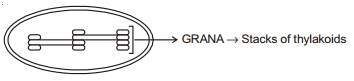
View full question & answer→MCQ 3791 Mark
Consider the following statements.
$I.$The portion of the spectrum between $300-500 \;nm$ is also referred to as Photosynthetically Active Radiation $(PAR)$.
$II.$ Magnesium, calcium and chloride ions play prominent roles in the photolysis of water:
$III.$ In cyclic photophosphorylation, oxygen is not released (as there is no photolysis of water) and $NADPH$ is also not produced.
- A
$I$ is true; but $II$ and $III$ are false
- ✓
$I$ and $II$ are false; but $III$ is true
- C
$II$ is true; but $I$ and $III$ are false
- D
$I$ and $II$ are true; but $III$ is false
AnswerCorrect option: B. $I$ and $II$ are false; but $III$ is true
b
The portion of spectrum between $400-700 \;nm$ is referred to as Photosynthetically Active Radiation. Manganese and chloride ions play prominent role in photolysis of water.
View full question & answer→MCQ 3801 Mark
Which statement about photosynthesis is false?
AnswerCorrect option: C. The enzymes required for carbon fixation are located only in the grana of chloroplasts
c
The carbon dioxide fixation takes place in the stroma of chloroplasts because it has enzymes essential for fixation of carbon dioxide and synthesis of sugar.
View full question & answer→MCQ 3811 Mark
Correct sequence of rate of photosynthesis in different light is
- ✓
Red$>$ Blue $>$ Green
- B
Blue $>$ Red$>$ Green
- C
Green $>$ Blue $>$ Red
- D
Green $>$ Red $>$ Blue
AnswerCorrect option: A. Red$>$ Blue $>$ Green
a
Maximum photosynthesis rate has been observed in the full spectrum. Regarding the effect of different wavelengths, maximum photosynthesis occurs in red light ( $660 \;nm$ ), second maximum in blue $(440 \;nm )$ and minimum in green
View full question & answer→MCQ 3821 Mark
We are created by chloroplast. This statement suggest the idea
- A
All the life form possesses chloroplast
- ✓
All the life form depend on photosynthesis
- C
All the life form is plant
- D
Plants are the first organism on earth
AnswerCorrect option: B. All the life form depend on photosynthesis
b
All the life forms are supported by the plants, whether, it is herbivore or carnivore. Chloroplast present in plants traps the solar energy and changes it to starch. This process is called photosynthesis. So, we are created by chloroplast means that all life forms depends on photosynthesis
View full question & answer→MCQ 3831 Mark
In photosystem, antennae includes all pigments except
MCQ 3841 Mark
By which plant pigment maximum absorption of radiation takes place in the blue and red regions of absorption spectrum?
- ✓
Chlorophyll-$a$
- B
Chlorophyll- $b$
- C
- D
AnswerCorrect option: A. Chlorophyll-$a$
View full question & answer→MCQ 3851 Mark
The enzymatic reactions incorporate $C O_{2}$ into the plants leading to the synthesis of sugar in
Answera
In stroma, enzymatic reactions incorporate $C O_{2}$ into the plant leading to the synthesis of sugar; which in turn forms the starch
View full question & answer→MCQ 3861 Mark
What is the function performed by plant pigments?
- A
Absorb $CO _{2}$
- B
Absorb $O_{2}$
- C
Absorb $H _{2} O$
- ✓
Answerd
Pigments are substances that have an ability to absorb light at specific wavelength. Among all pigments, chlorophyll-a absorb the maximum wavelength in the blue and red region. In these region, the chlorophyll-a does the maximum photosynthesis. Thus, chlorophyll-a is called the main photosynthetic pigment
View full question & answer→MCQ 3871 Mark
What happen to the chloroplast pigment when they absorb light?
- A
- ✓
- C
They lose potential energy
- D
Calvin cycle is triggered
Answerb
Light reaction begins with the $PS-II$. In photosystem-$II$ the reaction centre chlorophyll-a absorb $680$ $nm$. wavelength of red light causing electrons to become excited and jump into orbit further from the nucleus. These electrons are picked up by an electron acceptor, which passes them to an electron system consisting of cytochromes
View full question & answer→MCQ 3881 Mark
Which of the following statement is false in case of $C_4$-plant?
AnswerCorrect option: A. $CO _{2}$ acceptor is RuBisCo in mesosphyll cell
a
$C_{4}$-plants have Kranz anatomy, which includes bundle sheath cells and mesophyll cells. In case of $C_{4}$ plants, the primary $C O_{2}$ acceptor is a $3$ -carbon molecule. i.e. phosphoenol pyruvate and is present in the mesophyll cells
View full question & answer→MCQ 3891 Mark
Absorption spectrum of chlorophyll and the action spectrum of photosynthesis is identical because
- A
carotenoids act as antennary molecules in blue spectrum
- B
chlorophyll is the cheif pigment of absorption of light in red spectrum
- ✓
chlorophyll absorbs maximum light in blue and red spectrum which also show higher rate of photosynthesis
- D
maximum photosynthesis is observed in green light
AnswerCorrect option: C. chlorophyll absorbs maximum light in blue and red spectrum which also show higher rate of photosynthesis
c
Action Spectrum is the curve depicting the relative rate of photosynthesis at different wave-length of light. It shows that the maximum photosynthesis occur at the blue red region. These regions are the absorption region of chlorophyll- $a$. So, the action spectrum of photosynthesis is almost identical to the absorption spectrum of chlorophyll-a
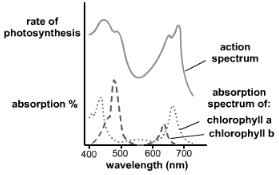
View full question & answer→MCQ 3901 Mark
It is not accessory pigment.
- A
Chlorophyll $- b$
- B
- C
- ✓
Chlorophyll $- a$
AnswerCorrect option: D. Chlorophyll $- a$
View full question & answer→MCQ 3911 Mark
Identify $X$ and $Y$ from figure.
$X$ $-$ $Y$
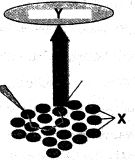
- A
Reaction centre $-$ pigment molecules
- ✓
Pigment molecules $-$ primary acceptor
- C
Reaction centre $-$ photon
- D
Primary acceptor $-$ reaction center
AnswerCorrect option: B. Pigment molecules $-$ primary acceptor
View full question & answer→MCQ 3921 Mark
It is accessory pigments for photosynthesis.
MCQ 3931 Mark
Match following columns.
|
Column $-I$
|
Column $-II$
|
|
$a.$ Yellow to yellow orange
|
$1.$ Chlorophyll $-a$
|
|
$b.$ Green
|
$2.$ Xanthophyll
|
|
$c.$ Yellow
|
$3.$ Carotenoids
|
- A
$(a-1), (b-3), (c-2)$
- ✓
$(a-3), (b-1), (c-2) $
- C
$(a-2), (b-1), (c-3)$
- D
$(a-3), (b-2), (c-1)$
AnswerCorrect option: B. $(a-3), (b-1), (c-2) $
View full question & answer→MCQ 3941 Mark
In photosynthesis process which molecule act as reaction center?
- A
- B
Chlorophyll $-b$
- C
- ✓
Chlorophyll $-a$
AnswerCorrect option: D. Chlorophyll $-a$
View full question & answer→MCQ 3951 Mark
- A
Chlorophyll $-a \rightarrow$ Reaction centre
- B
Chlorophyll $-a \rightarrow$ green in colour
- C
Carotenoids $\rightarrow$ Yellow to yellow -orange colour
- ✓
View full question & answer→MCQ 3961 Mark
Maximum photosynthesis occurs in.......
MCQ 3971 Mark
In photosystem, antennae includes all pigments except
- ✓
chlorophyll $-a $
- B
chlorophyll $-b $
- C
- D
AnswerCorrect option: A. chlorophyll $-a $
View full question & answer→MCQ 3981 Mark
View full question & answer→MCQ 3991 Mark
Chromatophores take part in
MCQ 4001 Mark
The electron transport chain of photosynthetic process is
- A
In the stroma of the chloroplast
- ✓
Bound to the thylakoid membranes
- C
Present in the outer membrane of the chloroplast
- D
AnswerCorrect option: B. Bound to the thylakoid membranes
View full question & answer→MCQ 4011 Mark
What is meant by fret membrane
- A
- B
- ✓
- D
Outer membranes of chloroplast
Answerc
(c) Grana are connected with the help of tubular connections called stroma lamellae or frets.
View full question & answer→MCQ 4021 Mark
In which of the following the rate of photosynthesis is decreased and is known as red drop
- A
- B
- ✓
Red light more than $680 \,nm$
- D
Red light less than $680\, nm$
AnswerCorrect option: C. Red light more than $680 \,nm$
c
(c) R. Emerson and C.M. Lewis $(1943)$ observed that the quantum yield of photosynthesis decreased towards the far red end of the spectrum ($680\,nm$ or longer).
View full question & answer→MCQ 4031 Mark
Which of the following wavelength of light is absorbed maximum for photosynthesis
Answerb
(b) Because blue colour comes first in spectrum light.
View full question & answer→MCQ 4041 Mark
Photosynthetic pigments in bacteria are located in
MCQ 4051 Mark
Which pigment is present universally in all green plants
- ✓
Chlorophyll-$a$
- B
Chlorophyll-$b$
- C
Chlorophyll-$c$
- D
Chlorophyll-$m$
AnswerCorrect option: A. Chlorophyll-$a$
a
(a) Chlorophyll-$a$ is widely distributed in green plant and it is also called primary photosynthetic pigment and universal photosynthetic pigment.
View full question & answer→MCQ 4061 Mark
The chlorophylls absorb visible light in the region of following wavelengths
- A
$400$ $nm$ to $500$ $nm$ only
- B
$600$ $nm$ to $800$ $nm$ only
- ✓
$400$ $nm$ to $500$ $nm$ and $600$ $nm$ to $700$ $nm$
- D
$300$ $nm$ to $400$ $nm$ only
AnswerCorrect option: C. $400$ $nm$ to $500$ $nm$ and $600$ $nm$ to $700$ $nm$
View full question & answer→MCQ 4071 Mark
AnswerCorrect option: A. Particle of photosynthetic pigments
a
(a) Grana are the sites for light reaction of photosynthesis and consist of photosynthetic unit "quantosomes" Park and Biggins ($1964$) gave the term quantosome for photosynthetic units is equivalent to $230$ chlorophyll molecules.
View full question & answer→MCQ 4081 Mark
Chlorophyll ‘$a$’ and ‘$b$’ shows maximum absorption in
- A
- B
- ✓
- D
Yellow and violet regions
Answerc
(c) The absorption spectrum of chlorophyll $a$ and chlorophyll $b$ indicate that these pigments mainly absorb blue and red lights. Action spectrum shows that maximum photosynthesis takes place in blue and red regions of spectrum.
View full question & answer→MCQ 4091 Mark
In higher plants, the photosynthetic pigments are
- A
Chl $a$ + Chl $b$ + anthocyanins
- B
Chl $a$ + carotenoid
- ✓
Chl $a$ + Chl $b$ + carotenoid
- D
Chl $b$ + carotenoid + phycobilins
AnswerCorrect option: C. Chl $a$ + Chl $b$ + carotenoid
View full question & answer→MCQ 4101 Mark
- ✓
Light energy into chemical
- B
Chemical energy into light
- C
Light energy into electrical
- D
Electrical energy into food
AnswerCorrect option: A. Light energy into chemical
a
(a) The main compound involved in the conversion of light energy in to chemical energy are the photosynthetic pigments that exist in the chloroplast.
View full question & answer→MCQ 4111 Mark
Where does the primary photochemical reaction occur in chloroplast or Where does the light reactions of photosynthesis take place or Light reaction takes place in
AnswerCorrect option: C. Quantasome or thylakoids $(Grana)$
View full question & answer→MCQ 4121 Mark
Pigment system -$I$ recieves radiant energy and releases electron
- A
Chlorophyll-$683$
- B
Chlorophyll-$673$
- C
Chlorophyll-$695$
- ✓
$P-700$
AnswerCorrect option: D. $P-700$
View full question & answer→MCQ 4131 Mark
The brown colour of some algae is due to the presence of pigments
Answerd
(d) Fucoxanthin is another important xanthophyll present in phaeophyceae $(Brown\ algae)$.
View full question & answer→MCQ 4141 Mark
The specific function of light energy in the process of photosynthesis is to
MCQ 4151 Mark
The site of oxygen evolution and photosynthetic phosphorylation in chloroplast are
- A
- ✓
- C
Inner wall of chloroplast
- D
View full question & answer→MCQ 4161 Mark
Which of the chlorophyll type ejects the electron during photophosphorylation
AnswerCorrect option: B. Chlorophyll ‘$a$’
View full question & answer→MCQ 4171 Mark
The first step in photosynthesis is
AnswerCorrect option: C. Excitation of an electron of chlorophyll by a photon of light
View full question & answer→MCQ 4181 Mark
The first event in photosynthesis is
- A
Synthesis of $ATP$
- ✓
Photoexcitation of chlorophyll and ejection of electron
- C
- D
AnswerCorrect option: B. Photoexcitation of chlorophyll and ejection of electron
b
(b) When photon of light energy falls on chlorophyll molecule, one of the electrons pair from ground or singlet state passes in to higher energy level called excited singlet state.
View full question & answer→MCQ 4191 Mark
Quantasome are present in
Answerb
(b) Grana are the sites for light reaction of photosynthesis and consist of photosynthetic unit 'quantasomes' (Found in surface of thylakoids).
View full question & answer→MCQ 4201 Mark
Photosynthetically least efficient radiation is
Answerc
(c) Maximum photosynthesis has been observed in red light than in blue light. The green light has minimum effect. On the other hand, red algae shows maximum photosynthesis in green light.
View full question & answer→MCQ 4211 Mark
Match the sites in column I with the processes in column II and choose the correct combination from the options
| Column $-I$ |
Column $-II$ |
| $(A)$ Grana of chloroplast |
$(1)$ Kreb's cycle |
| $(B)$ Stroma of chloroplast |
$(2)$ Light reaction |
| $(C)$ Cytoplasm |
$(3)$ Dark reaction |
| $(D)$ Mitochondrial matrix |
$(4)$ Glycolysis |
- A
$A-4, B-3, C-2, D-1$
- B
$A-1, B-2, C-4, D-3$
- C
$A-2, B-1, C-3, D-4$
- ✓
$A-2, B-3, C-4, D-1$
AnswerCorrect option: D. $A-2, B-3, C-4, D-1$
View full question & answer→MCQ 4221 Mark
Which process is related with photosynthesis
Answera
(a) The addition of phosphate group to ADP and AMP called phosphorylation.
$ADP$ + $iP$ $→$ $ATP$
By this process $ATP$ is formed which is used in dark reaction.
View full question & answer→MCQ 4231 Mark
The gas released in photosynthesis is
- A
Pure $CO_2$
- ✓
Pure $O_2$
- C
Mainly $CO_2$
- D
Mainly $O_2$
AnswerCorrect option: B. Pure $O_2$
b
(b) Because this $O_2$ is evolved by photolysis of $H_2O$ and $H^+$ ions are oxidised further in $H_2O$ and remaining $O^-$ produces $O_2$.
View full question & answer→MCQ 4241 Mark
Light energy is converted into chemical energy in the presence of
MCQ 4251 Mark
The process of photosynthesis takes place in
- A
- B
- C
- ✓
Chlorophyll containing cells only
AnswerCorrect option: D. Chlorophyll containing cells only
d
(d) Chlorophyll is essential for photosynthesis. In variegated leaves photosynthesis occurs in green parts of the leaf because reaction centre of photosynthesis is formed of chlorophyll $a$.
View full question & answer→MCQ 4261 Mark
- A
$O_2$
- B
$H_2$
- ✓
$CO_2$
- D
$N_2$
AnswerCorrect option: C. $CO_2$
c
(c) Chloroplast fixes $CO_2$ in to carbohydrates. The amount of $CO_2$ fixed by a gram of chlorophyll in an hour is called photosynthetic number or assimilation number.
View full question & answer→MCQ 4271 Mark
Solar energy is converted into $ATP$ in
Answerb
(b) The main function of chloroplast is photosynthesis, in which radiant energy of sun is converted in to chemical form of energy $(ATP)$, which is utilized by all living organisms to perform their life activities.
View full question & answer→MCQ 4281 Mark
Extraction and separation of chlorophylls and carotenoids tackles by
- A
Moll's half-leaf experiment
- ✓
Paper chromatography method
- C
- D
AnswerCorrect option: B. Paper chromatography method
b
(b) Paper chromatography makes possible the separation of cartenoid by sheet of filter paper.
View full question & answer→MCQ 4291 Mark
The oxygen liberated during the photosynthesis comes from
Answerb
$H _{2} O \rightarrow H ^{+}+ O _{2}$
When a photon of light strikes the reaction centre of $PS$ $II$, it emites an electron. Two $H _{2} O$ molecules bind to an enzyme at reaction centre and enzyme splits the water and $H ^{+}$are released in the lumen and also $O _{2}$ is produced.
View full question & answer→MCQ 4301 Mark
Curve showing the effectiveness of different wavelength of light in photosynthesis was first given by Engelmann using all, except
- A
Filamentous green alga Cladophora
- ✓
Unicellular green alga Chlorella
- C
Suspension of aerobic bacteria
- D
Prism to split the light in its components
AnswerCorrect option: B. Unicellular green alga Chlorella
b
Hill used chlorella for proving that photosynthesis completed in two phase i.e., light and dark phase.
View full question & answer→MCQ 4311 Mark
The essential role of air in the growth of green plants was revealed by
Answera
Role of air in the growth of green plants is experimently proved by Priestley
View full question & answer→MCQ 4321 Mark
Who discovered that light is essential for releasing oxygen in plants?
Answerc
Using a similar set up as used by Priestley but by placing it once in a dark and once in a sunlight, Jan Ingen Housz $(1730-1799)$ showed that sunlight is essential to plant process that purifies air
View full question & answer→MCQ 4331 Mark
In photosynthesis, action and absorption spectrum were related by
Answerb
Englemann studied the effect of different region of the visible spectrum on the rate of photosynthesis of different algae. The amount of oxygen release was found to be maximum in blue and red absorption bands of chlorophyll.
View full question & answer→MCQ 4341 Mark
The scientist who showed that only the green part of the plants that could release oxygen.
MCQ 4351 Mark
Which sentence is concern with Cornelius Van Niel ?
AnswerCorrect option: C. In green plant $O_2$ released is from water, not from $CO_2 $
View full question & answer→MCQ 4361 Mark
Which sentence is given by Julius Von Sachs ?
AnswerCorrect option: C. He found that the green parts in plants is where glucose is made and that the glucose is usually stored as starch.
View full question & answer→MCQ 4371 Mark
Engelman illuminated spectrum on which algae ?
MCQ 4381 Mark
Name the scientist, who demonstrated by belljar experiment that plants purified the air.
MCQ 4391 Mark
$1.$ From the experiment of T. W. Engleman we state that chlorophyl present in algae absorbs light of green and orange colour and split water molecule by photolysis and released $O_2.$
$2.$ Aerobic bacteria find oxygen near the algae toutilize $O_2$
- A
$1, 2$ true
- B
$1, 2$ false
- C
$1 -$ true, $2-$ false
- ✓
$1-$ false, $2-$ true
AnswerCorrect option: D. $1-$ false, $2-$ true
View full question & answer→MCQ 4401 Mark
Who provided evidence for production of glucose when plants grow?
MCQ 4411 Mark
Match the following:
$\begin{array}{|p{0.45\linewidth}|p{0.45\linewidth}|} \hline Column\,\,-I & Column\,\,-II \\ \hline 1.\,\,\,1733\,\,-\,\,1804 & p.\,\,Jan\,\,Ingen\,\,house \\ \hline 2.\,\,\,1730\,\,-\,\,1799 & q.\,\,T.W\,\,Engelman \\ \hline 3.\,\,\,1897\,\,-\,\,1985 & r.\,\,Joseph\,\,Priestley \\ \hline 4.\,\,\,1843\,\,-\,\,1909 & s.\,\,Cornelius\,\,Van\,\,Niel \\ \hline \end{array}$
- A
$(1-p),(2-q),(3-r),(4-s)$
- B
$(1-q),(2-p),(3-s),(4-r) $
- ✓
$(1-r),(2-p),(3-s),(4-q) $
- D
$(1-s),(2-r),(3-p),(4-q) $
AnswerCorrect option: C. $(1-r),(2-p),(3-s),(4-q) $
View full question & answer→MCQ 4421 Mark
The cellular respiration differs from breathing in that in cellular respiration
AnswerCorrect option: A. Glucose is oxidised to $C{O_2}$ and water with release of energy
a
(a) In cellular respiration the energy is released by the oxidation of glucose.
View full question & answer→MCQ 4431 Mark
The two waste products of oxidation in cells are
- A
$C{O_2}$ and ${N_2}$
- B
$C$ and $O$
- ✓
$C{O_2}$ and water
- D
Water and ${N_2}$
AnswerCorrect option: C. $C{O_2}$ and water
c
(c)Respiration is the process of oxidation by which food material are oxidized and produce $C{O_2}$ and water as waste product.
View full question & answer→MCQ 4441 Mark
An organism that photosynthesizes but do not release any molecular oxygen during the process is
- A
Algal component of a lichen
- B
- ✓
- D
Answerc
(c) Green sulphur bacteria uses ${H_2}S$ or other reduced organic and inorganic substances. No utilization of ${H_2}O$ occurs in this bacteria hence there is no evolution of ${O_2}$.
View full question & answer→MCQ 4451 Mark
Which of the following would happen if the supply of $O_2$ is decreased to an illuminated wheat plant
- A
Its photosynthesis would decrease
- B
Its respiration would increase
- ✓
Its photosynthesis would increase
- D
All the physiological process would stop
AnswerCorrect option: C. Its photosynthesis would increase
c
(c) If the amount of oxygen in the atmosphere decreases then photosynthesis will increase in $C_3$ cycle $(wheat)$ and no change in $C_4$ cycle.
View full question & answer→MCQ 4461 Mark
Englemann $(1882)$ observed accumulation of aerobic bacteria around blue and red illumination of chloroplast in green alga Cladophora. He therefore concluded that
- A
Chlorophyll absorbs green light
- ✓
Absorption spectrum of $O_2$ evolution is blue and red
- C
$O_2$ is released from $H_2O$ in light reaction
- D
$O_2$ is released from $CO_2$ in light reaction
AnswerCorrect option: B. Absorption spectrum of $O_2$ evolution is blue and red
View full question & answer→MCQ 4471 Mark
Under conditions of constant illumination, the compensation period for a whole aquarium would be of infinite length when
- A
The biomass of animals equals the biomass of plants
- B
The respiratory exchanges of the animals are equal to the photosynthetic exchanges of the plants
- C
The oxygen intake of the animals equals of oxygen output of photosynthesis
- ✓
The carbon dioxide output of the animals and plants equals to the photosynthetic intake of the plants
AnswerCorrect option: D. The carbon dioxide output of the animals and plants equals to the photosynthetic intake of the plants
View full question & answer→MCQ 4481 Mark
What is the bye-product of bacterial photosynthesis
MCQ 4491 Mark
In the bacterial photosynthesis, hydrogen donor is
- ✓
$H_2S$
- B
$NH_2$
- C
$H_2O$
- D
$H_2SO_4$
AnswerCorrect option: A. $H_2S$
a
(a) $C{O_2} + 2{H_2}S\xrightarrow{{{\text{Sunlight}}}}(C{H_2}O) + 2S + {H_2}O + {\text{Energy}}$
View full question & answer→MCQ 4501 Mark
The source of O2 liberated in photosynthesis in green plants is
- A
- B
Carbohydrate present in leaf
- ✓
- D
View full question & answer→MCQ 4511 Mark
Algae float in the water during day time and sink during night time because
- A
They become buoyant due to consumption of food materials in respiration
- B
They loose weight at night
- C
They come up to enjoy sunshine
- ✓
They become buoyant in light due to accumulation of oxygen bubbles released in photosynthesis
AnswerCorrect option: D. They become buoyant in light due to accumulation of oxygen bubbles released in photosynthesis
View full question & answer→MCQ 4521 Mark
The gas absorbed during photosynthesis is
MCQ 4531 Mark
$CO_2$ is formed in all of the following except
Answerc
(c) Burning of sugar, respiration in plants and heating of limestone is responsible for the liberation of $CO_2$ but in photosynthesis green plants take in $CO_2$ and release $O_2$ thus purifying the air.
View full question & answer→MCQ 4541 Mark
Besides water and light, which is more essential as a raw material for food formation
AnswerCorrect option: B. $CO_2$
b
(b) $CO_2$ is more essential as a raw material because it is reduced in carbohydrates $(Food\ material).$
View full question & answer→MCQ 4551 Mark
For photosynthesis (i.e. for the synthesis of organic matter), the green plants need only
Answerd
(d) Light, chlorophyll, $CO_2$ and water all are essential in photosynthesis.
In photosynthesis process energy rich compounds like carbohydrates are synthesized from simple inorganic compounds like carbon dioxide and water in the presence of chlorophyll and sunlight with liberation of $O_2$.
View full question & answer→MCQ 4561 Mark
In photosynthesis, oxygen is liberated due to
- A
Reduction of carbon dioxide
- B
Hydrolysis of carbohydrate
- ✓
- D
View full question & answer→MCQ 4571 Mark
- ✓
Stacks of thylakoids in plastids of higher plants
- B
A constant in quantum equation
- C
- D
Bye product of photosynthesis
AnswerCorrect option: A. Stacks of thylakoids in plastids of higher plants
View full question & answer→MCQ 4581 Mark
Assimilatory power refers to
AnswerCorrect option: A. Generation of $ATP$ and $NADPH_2$
a
(a) Arnon $(1956) $ used the tern 'Assimilatory powers' for $ATP$ and $NADPH_2$. ($NADPH_2$ alone is called reducing power).
View full question & answer→MCQ 4591 Mark
Which of the following is the bye-product of photosynthesis
MCQ 4601 Mark
- A
Both $CO_2$ and water get oxidized
- B
Both $CO_2$ and water get reduced
- C
Water is reduced and $CO_2$ is oxidized
- ✓
Carbon dioxide gets reduced and water get oxidised
AnswerCorrect option: D. Carbon dioxide gets reduced and water get oxidised
d
(d) Photosynthesis is an oxidation reduction process where $H_2O$ is oxidized by photolysis in to $O_2$ and $CO_2$ is reduced in to carbohydrates.
View full question & answer→MCQ 4611 Mark
The balance between $CO_2$ and $O_2$ is brought about by
Answerb
(b) $CO_2$ is used and $O_2$ is released in photosynthesis and in respiration $CO_2$ is released and $O_2$ is used.
View full question & answer→MCQ 4621 Mark
In presence of light, green plants convert carbon dioxide and water into food stuffs. Which of the following is likely to be the first substance that a green plant makes in photosynthesis
MCQ 4631 Mark
Which of the following equation can be more appropriate for photosynthesis
- A
$6C{O_2} + 6{H_2}O\mathop {\xrightarrow{{{\text{Light}}}}}\limits_{{\text{Chlorophyll}}} {C_2}{H_{12}}{O_6} + 6{O_2}$
- ✓
$6C{O_2} + 12{H_2}O\mathop {\xrightarrow{{{\text{Light}}}}}\limits_{{\text{Chlorophyll}}} {C_6}{H_{12}}{O_6} + 6{H_2}O + 6{O_2}$
- C
$12C{O_2} + 6{H_2}O\mathop {\xrightarrow{{{\text{Light}}}}}\limits_{{\text{Chlorophyll}}} 2{C_6}{H_{12}}{O_6} + 6{O_2}$
- D
AnswerCorrect option: B. $6C{O_2} + 12{H_2}O\mathop {\xrightarrow{{{\text{Light}}}}}\limits_{{\text{Chlorophyll}}} {C_6}{H_{12}}{O_6} + 6{H_2}O + 6{O_2}$
b
(b) Photosynthesis reaction shows that "formation of carbohydrates from $CO_2$ and $H_2O$ by illuminated green cells of plants, $O_2$ and $H_2O$ are the bye products.
View full question & answer→MCQ 4641 Mark
Engelmann's experiment with Spirogyra demonstrated that
- A
The full spectrum of sunlight is needed for photosynthesis
- B
Only red wavelengths are effective in causing photosynthesis
- C
Only blue wavelengths are effective
- ✓
Both blue and red wavelengths are effective
AnswerCorrect option: D. Both blue and red wavelengths are effective
d
(d) Both blue and red wavelength are affective because the amount of oxygen released was found to be maximum in blue and red absorption band s of the chlorophyll.
View full question & answer→MCQ 4651 Mark
Two plants $A$ and $B$ are supplied with $CO_2$ with $H_2O^{18}$ and ${CO_2}^{18}$ with $H_2O$ respectively which of the following plant releases $O_{18}$ type oxygen in photosynthesis
AnswerCorrect option: A. $A$ plant
a
(a) During photosynthesis ${O_2}$ evolved by the hydrolysis of water. If ${H_2}{O^{18}}$ is used in ‘$A$’ plant then it become true that ${O^{18}}$ type oxygen evolved from ‘$A$’ plant during photosynthesis.
View full question & answer→MCQ 4661 Mark
What plant is used in an experiment commonly performed in laboratory in demonstrate evolution of oxygen in photosynthesis
MCQ 4671 Mark
When a rat was placed into a closed container, it got suffocated and died but when a plant was also introduced into it, the rat survived. Who performed this experiment
MCQ 4681 Mark
During photosynthesis, the oxygen in glucose comes from
MCQ 4691 Mark
Which of the following is obtained from $ CO_2$ during glucose manufacture
AnswerCorrect option: C. Both $(a)$ and $(b)$
View full question & answer→MCQ 4701 Mark
During formation of glucose which of the following is obtained from water
- A
- ✓
- C
Both $(a) $ and $(b)$
- D
Answerb
(b) During formation of glucose water is oxidised and hydrogen obtain from water.
$2{H_2}O$ ⇌ $4{H^ + } + {O_2}$
View full question & answer→MCQ 4711 Mark
Which of the following radioactive oxygen was used to detect the source of oxygen in photosynthesis
- A
$O^{12}$
- B
$O^{16}$
- ✓
$O^{18}$
- D
$O^{15}$
AnswerCorrect option: C. $O^{18}$
c
(c) Ruben ad Kamen used isotopes of oxygen in water, $i.e.$, ${H_2}{O^{18}}$ instead of ${H_2}O$ (normal) and noticed that librated oxygen contains $O^{18}$ of water and not of $CO_2$.
$6C{O_2} + 12{H_2}{O^{18}}\mathop {\xrightarrow{{{\text{Light}}}}}\limits_{{\text{Chalorophyll}}} {C_6}{H_{12}}{O_6} + 6O_2^{18} + 6{H_2}O$
View full question & answer→MCQ 4721 Mark
The scientist, who proved that bacteria use $H_2S$ gas and $CO_2$ to synthesize carbohydrate, is
Answera
(a) In $1930$ C.B. Van Niel proved that, sulphur bacteria use ${H_2}S$ (in place of water) and $C{O_2}$ to synthesize carbohydrates as follows :
$6C{O_2} + 12{H_2}S\xrightarrow{{}}{C_6}{H_{12}}{O_6} + 6{H_2}O + 12S$
This led Van Niel to the pastulation that in green plants, water ($H_2O$) is utilized in place of ${H_2}S$ and ${O_2}$ is evolved in place of sulphur ($S$). He indicated that water is electron donar in photosynthesis.
$6C{O_2} + 12{H_2}O\xrightarrow{{}}{C_6}{H_{12}}{O_6} + 6{H_2}O + 6{O_2}$
View full question & answer→MCQ 4731 Mark
The first important biological investigation which led to the conclusion that plant makes its substance from water and not from soil was carried out by
Answerc
(c) Helmont concluded that "all food of the plant is derived from rain water and not from soil and all parts of the plant develop from water".
View full question & answer→MCQ 4741 Mark
‘‘The amount of $CO_2$ absorbed and $O_2$ released during photosynthesis are in equal volumes” was proved by
Answerd
(d) Bousingault $(1860) $ reported that amount of $O_2$ evolved in photosynthesis is equal to amount of $CO_2$ absorbed and both these processes occur simultaneously as soon as light is given.
View full question & answer→MCQ 4751 Mark
The significance of light and chlorophyll in photosynthesis was discovered by
Answerb
(b) According to Jan Ingen-Housz $(1779)$, both green parts and sunlight are required for air purification and plant nourishment.
View full question & answer→MCQ 4761 Mark
Photosynthesis is
$I.$ Endergonic process $II.$ Exergonic process $III.$ Chemical process $IV.$ Physical process
Select the correct option
- A
$II, III$ and $IV$
- ✓
$I, III$ and $IV$
- C
$I, II$ and $IV$
- D
$I, II$ and $III$
AnswerCorrect option: B. $I, III$ and $IV$
b
Photosynthesis is the endergonic used, i.e, energy is used during physiochemical process in which the light gets converted into the high energy. Chemical bonds are used in the formation of sugar
View full question & answer→MCQ 4771 Mark
Synthesis of one molecule of glucose requires
- ✓
$6 CO _{2}, 18 ATP$ and $12 NADPH$
- B
$6 CO _{2}, 12 ATP$ and $18 NADPH$
- C
$6 CO _{2}, 30 ATP$ and $12 NADPH$
- D
$6 CO _{2}, 38 ATP$ and $12 NADPH$
AnswerCorrect option: A. $6 CO _{2}, 18 ATP$ and $12 NADPH$
a
In Calvin cycle for every carbon dioxide molecule, $3$ molecules of $ATP$ and $2$ $NADPH$ are required. To make one molecule of glucose $6$ turns of the cycle are required. Thus, $18$ $ATP$ and $12$ $NADPH$ molecules will be required to make one molecule of glucose through Calvin cycle.
View full question & answer→MCQ 4781 Mark
Maximum number of chloroplast are found in
Answerc
Maximum number of chloroplast is found in leaves
View full question & answer→MCQ 4791 Mark
Which of the following is/are the raw material for photosynthesis?
$I$. $H _{2} O$ $II$. $CO _{2}$ $III$. Light $IV$. Chlorophyll
Choose the correct option
- A
$II, III$ and $IV$
- B
$I$ and $IV$
- C
$I, II$ and $III$
- ✓
$I, II, III$ and $IV$
AnswerCorrect option: D. $I, II, III$ and $IV$
d
$H _{2} O , CO _{2}$, light, chlorophyll all are the raw material for photosynthesis
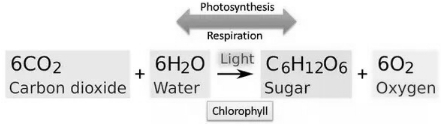
View full question & answer→MCQ 4801 Mark
Green plants carry out 'photosynthesis', $a$ ...$1$.....process by which they use light energy to drive the synthesis of ...$2$... compound.
$1 - 2$
- A
Only physical $-$ inorganic
- ✓
Physico chemical $-$ organic
- C
Only chemical $-$ organic
- D
Physico chemical $-$ inorganic
AnswerCorrect option: B. Physico chemical $-$ organic
View full question & answer→MCQ 4811 Mark
View full question & answer→MCQ 4821 Mark
- A
Oxidative, exergonic, catabolic
- ✓
Reductive, endergonic, anabolic
- C
Reductive, exergonic, anabolic
- D
Reductive, endergonic, catabolic
AnswerCorrect option: B. Reductive, endergonic, anabolic
b
(b) Reduction of carbon anabolised organic compound will give $ATP$ during respiration.
View full question & answer→MCQ 4831 Mark
In photosynthesis, plants
- A
Absorb ${O_2}$ and release $C{O_2}$
- ✓
Absorb $C{O_2}$and release ${O_2}$
- C
Absorb $N{H_3}$ and release ${N_2}$
- D
Absorb ${N_2}$ and release $N{H_3}$
AnswerCorrect option: B. Absorb $C{O_2}$and release ${O_2}$
b
(b) $C{O_2} + 2{H_2}O\mathop {\xrightarrow{{{\text{Light}}\,{\text{energy}}}}}\limits_{{\text{Chlorophyll}}} {(C{H_2}O)_n} + {H_2}O + {O_2} \uparrow $
View full question & answer→MCQ 4841 Mark
Plants are known as purifiers of air due to process of
Answerb
(b) Because $CO_2$ is utilized in photosynthesis process by plants.
View full question & answer→MCQ 4851 Mark
The most vital process for the existence of life on earth is
- A
- ✓
- C
Reproduction in plants and animals
- D
Answerb
(b) Photosynthesis by plants is most vital process for the existence of life on earth because photosynthesis helps to maintain the equilibrium position of ${O_2}$ and $C{O_2}$ in the atmosphere. It purifies the air and synthesize foods for all living beings.
View full question & answer→MCQ 4861 Mark
Sugar produced in photosynthesis is converted into starch in
Answerb
(b) Because starch is highly stable and water insoluble product of carbohydrate.
View full question & answer→MCQ 4871 Mark
The detectable end product of photosynthesis is
Answerd
(d) Starch is the detectable end product of photosynthesis because glucose is converted and stored in the form of starch.
View full question & answer→MCQ 4881 Mark
How many molecules of water are needed by a green plant to produce one molecule of hexose/ reduce $6$ molecules of $CO_2$
Answerb
(b) $6C{O_2} + 12{H_2}O\mathop {\xrightarrow{{{\text{Sunlight}}}}}\limits_{{\text{Chlorophyll}}} {C_6}{H_{12}}{O_6} + 6{O_2} + 6{H_2}O$
View full question & answer→MCQ 4891 Mark
What is the unique process which has supported life on this planet
Answerb
(b) Because photosynthetic end products are organic materials and $O_2$ for respiration.
View full question & answer→MCQ 4901 Mark
Aerobic atmosphere is maintained by
Answerc
(c) Because $O_2$ is released during photosynthesis.
View full question & answer→MCQ 4911 Mark
Photosynthesis is a process in which
AnswerCorrect option: A. $CO_2$ is reduced to carbohydrate
View full question & answer→MCQ 4921 Mark
Importance of photosynthesis is due to
- A
- B
Purification of atmosphere
- C
Provided vast resources of energy
- ✓
View full question & answer→MCQ 4931 Mark
Which one of the following is due energy currency of the cell or The common immediate source of energy in cellular activity is
Answerb
(b) $ATP$ $(adenosine\ triphosphate) $ is called energy currency of cells. $ATP$ is energy rich compound where energy is present in terminal pyrophosphate bonds.
View full question & answer→MCQ 4941 Mark
For the process of photosynthesis all except one of the following items are essential. Point out the exception
MCQ 4951 Mark
Two chief functions of leaves are
- A
Photosynthesis and respiration
- ✓
Photosynthesis and transpiration
- C
Transpiration and respiration
- D
Respiration and digestion
AnswerCorrect option: B. Photosynthesis and transpiration
b
(b) Photosynthesis and transpiration both are equally essential processes because photosynthesis helps to maintain the equilibrium position of $O_2$ and $CO_2$ in the atmosphere and transpiration maintains the atmospheric temperature.
View full question & answer→MCQ 4961 Mark
Leaves appear green because they
- ✓
- B
- C
Both reflect and absorb green light
- D
Answera
(a) Leaves appear green because chlorophylls do not absorb green light. The same is reflected and transmitted through leaves.
View full question & answer→MCQ 4971 Mark
Answerc
(c) Photosynthesis is an anabolilc and endothermic reaction. It is a mechanism of synthesis of food.
View full question & answer→MCQ 4981 Mark
Photosynthesis is a process of
- A
- ✓
- C
Both $(a)$ and $(b)$
- D
Answerb
(b) Green plants are unique in the character that they are able to synthesize foods for all living beings.
View full question & answer→MCQ 4991 Mark
The diagram below shows three plants with identical leaf surface areasAssuming all other conditions were identical for all three plants, which of the plants would likely to photosynthesize slowest, and which fastest
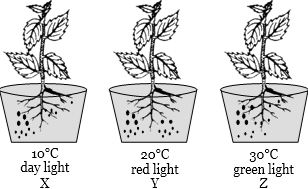
- A
$Y$ slowest, $Z$ fastest
- B
$Z$ slowest, $X$ fastest
- C
$X$ slowest, $Z$ fastest
- ✓
$Z$ slowest, $Y$ fastest
AnswerCorrect option: D. $Z$ slowest, $Y$ fastest
d
(d) According to Vant Hoff's law, the rate increases with increase in temperature within this range. Up to $30^°C$ the rate of photosynthesis doubles with each increase of $10^°C$.
View full question & answer→MCQ 5001 Mark
In kranz anatomy, the bundle sheath cells have
- A
thin walls, many intercellular spaces and no chloroplasts
- ✓
thick walls, no intercellular spaces and large number of chloroplasts
- C
thin walls, no intercellular spaces and several chloroplasts
- D
thick walls, many intercellular spaces and few chloroplasts.
AnswerCorrect option: B. thick walls, no intercellular spaces and large number of chloroplasts
b
(b) : The $C_4$ plants are adapted to dry tropical regions and have greater productivity of biomass. They have special type of leaf anatomy known as Kranz anatomy. In this type of anatomy the bundlesheath cells form several layers around the vascular bundles; they are characterised by having a large number of chloroplasts, thick walls impervious to gaseous exchange and no intercellular spaces.
View full question & answer→