Questions

M.C.Q (1 Marks)

Take a timed test

412 questions · auto-graded multiple-choice test.

MCQ 11 Mark
Given below are two statements :

Statement $I$: In the nephron, the descending limb of loop of Henle is impermeable to water and permeable to electrolytes.

Statement $II$ : The proximal convoluted tubule is lined by simple columnar brush border epithelium and increases the surface area for reabsorption.

In the light of the above statements, choose the correct answer from the option given below :

  • Both Statement $I$ and Statement $II$ are false
  • B
    Statement $I$ is true but Statement $II$ is false
  • C
    Statement $I$ is false but Statement $II$ is true
  • D
    Both Statement $I$ and Statement $II$ are true
Answer
Correct option: A.
Both Statement $I$ and Statement $II$ are false
a
Correct answer is option ($1$) because

Statement $I$ is false as the descending limb of loop of Henle is permeable to water and almost impermeable to electrolytes.

Statement $II$ is false as proximal convoluted tubule is lined by simple cuboidal brush border epithelium which increases the surface area for reabsorption.
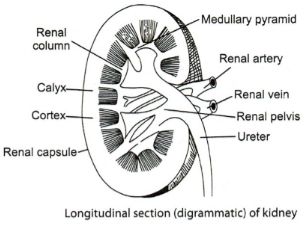
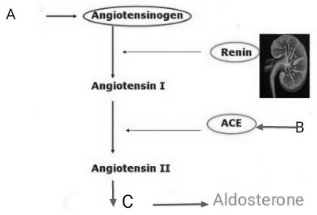
View full question & answer
MCQ 21 Mark
Choose the correct statement given below regarding juxta medullary nephron.
  • A
    Renal corpuscle of juxta medullary nephron lies in the outer portion of the renal medulla.
  •  Loop of Henle of juxta medullary nephron runs deep into medulla.
  • C
    Juxta medullary nephrons outnumber the cortical nephrons.
  • D
    Juxta medullary nephrons are located in the columns of Bertini.
Answer
Correct option: B.
 Loop of Henle of juxta medullary nephron runs deep into medulla.
b
The correct answer is option no, ($2$) because the length of loop of Henle of juxta medullary nephron is longer than the length of loop of Henle of cortical nephron and runs deep into medulla.

Option ($1$) is incorrect because renal corpuscle of juxta medullary nephron lies in inner cortical region.

Option ($3$) is incorrect as juxta medullary nephrons are lesser in number than cortical nephrons.

Option ($4$) is incorrect as juxta medullary nephron are not present in columns of Bertini.

View full question & answer
MCQ 31 Mark
Which of the following statements are correct?

$A$. An excessive loss of body fluid from the body switches off osmoreceptors.

$B$. $ADH$ facilitates water reabsorption to prevent diuresis.

$C$. ANF causes vasodilation.

$D$. $ADH$ causes increase in blood pressure.

$E$. $A D H$ is responsible for decrease in $GFR$.

Choose the correct answer from the options given below:

  • A
    $C,D$ and $E$ only
  • B
    $A$ and $B$ only
  • $B,C$ and $D$ only
  • D
    $A,B$ and $E$ only
Answer
Correct option: C.
$B,C$ and $D$ only
c
Option (3) is the correct answer because statements $B,C$ and $D$ are true statements. $ADH$ facilitates water reabsorption from $DCT$ of nephron to prevent diuresis, which causes increase in blood pressure. $ANF$ which is secreted by the heart is a vasodilator.

Options (1), (2) and (4) are not correct because statements A and E are false. Excessive loss of body fluid from the body switches on the osmoreceptors.

View full question & answer
MCQ 41 Mark
Given below are two statements: one is labelled as Assertion $A$ and the other is labelled as Reason $R$.

Assertion $A$: Nephrons are of two types: Cortical and Juxta medullary, based on their relative position in cortex and medulla.

Reason $R$: Juxta medullary nephrons have short loop of Henle whereas, cortical nephrons have longer loop of Henle.

In the light of the above statements, choose the correct answer from the options given below:

  • A
    $A$ is false but $R$ is true.
  • B
    Both $A$ and $R$ are true and $R$ is the correct explanation of $A$.
  • C
    Both $A$ and $R$ are true but $R$ is NOT the correct explanation of $A$.
  • $A$ is true but $R$ is false.
Answer
Correct option: D.
$A$ is true but $R$ is false.
d
The correct answer is option (4) because Assertion is true as there are two types of nephrons, i.e., cortical nephrons and juxtamedullary nephrons based on their relative position in the cortex and medulla. Reason is not correct as loop of Henle in juxtamedullary nephrons is very long and runs deep into the medulla. Therefore, Assertion is true but Reason is false.
View full question & answer
MCQ 51 Mark
Match List $I$ with List $II$. 

List $I$ List $II$
$A$. Taenia $I$. Nephridia
$B$. Paramoecium $II$. Contractile vacuole
$C$. Periplaneta $III$. Flame cells
$D$. Pheretima $IV$. Urecose gland

Choose the correct answer from the options given below:

  • A
    A-II, B-I, C-IV, D-III
  • B
    A-I, B-II, C-III, D-IV
  • C
    A-I, B-II, C-IV, D-III
  • A-III, B-II, C-IV, D-I
Answer
Correct option: D.
A-III, B-II, C-IV, D-I
d
Option (4) is the correct answer because protonephridia or flame cells are the excretory structures in platyhelminthes. Nephridia are the tubular excretory structures of earthworms (Pheretima) and other annelids. Single celled organisms like Paramoecium have contractile vacuoles for excretion. Urecose glands are present in cockroach
View full question & answer
MCQ 61 Mark
Nitrogenous waste is excreted in the form of pellet or paste by :
  • A
    Salamandra
  • B
    Hippocampus
  • Pavo
  • D
    Ornithorhynchus
Answer
Correct option: C.
Pavo
c
View full question & answer
MCQ 71 Mark
Select the correct statement
  • Reduction in Glomerular Filtration Rate activates $JG$ cells to release renin.
  • B
    Atrial Natriuretic Factor increases the blood pressure.
  • C
    Angiotensin $II$ is a powerful vasodilator.
  • D
    Counter current pattern of blood flow is not observed in vasa recta.
Answer
Correct option: A.
Reduction in Glomerular Filtration Rate activates $JG$ cells to release renin.
a
The correct answer is option (1) because a fall in GFR/blood flow can activate the JG cells to release renin.

Option (2) is incorrect statement as ANF causes vasodilation and thereby decrease the blood pressure.

Option (3) is incorrect statement as Angiotensin $II$, being a powerful vasoconstrictor, increases blood pressure.

Option (4) is incorrect statement as counter current pattern is observed between Henle's loop and vasa recta.

View full question & answer
MCQ 81 Mark
Presence of which of the following conditions in urine are indicative of Diabetes Mellitus$?$
  • A
    Renal calculi and Hyperglycaemia
  • B
    Uremia and Ketonuria
  • C
    Uremia and Renal Calculi
  • Ketonuria and Glycosuria
Answer
Correct option: D.
Ketonuria and Glycosuria
d
Ketonuria and Glycosuria
View full question & answer
MCQ 91 Mark
Which of the following would help in prevention of diuresis$?$
  • A
    Decrease in secretion of renin by $JG$ cells
  • B
    More water reabsorption due to undersecretion of $ADH$
  • Reabsorption of $Na ^{+}$ and water from renal tubules due to aldosterone
  • D
    Atrial natriuretic factor causes vasoconstriction
Answer
Correct option: C.
Reabsorption of $Na ^{+}$ and water from renal tubules due to aldosterone
c
Reabsorption of $Na ^{+}$ and water from renal tubules due to aldosterone
View full question & answer
MCQ 101 Mark
The increase in osmolarity from outer to inner medullary interstitium is maintained due to :
$(i)$ Close proximity between Henle's loop and vasa recta
$(ii)$ Counter current mechanism
$(iii)$ Selective secretion of $HCO _{3}^{-}$ and hydrogen ions in PCT
$(iv)$ Higher blood pressure in glomerular capillaries
  • $(i)$ and $(ii)$
  • B
    Only $(ii)$
  • C
    $(iii)$ and $(iv)$
  • D
    $(i), (ii)$ and $(iii)$
Answer
Correct option: A.
$(i)$ and $(ii)$
a
The correct answer is option (1) as both the statements (i) and (ii) are correct because counter current mechanism is based on special arrangement of Henle's loop and vasa recta and this mechanism maintain a concentration gradient in the medullary interstitium.

Statement (iii) is incorrect as PCT helps in selective secretion of $H ^{+}$, ammonia and $K ^{+}$ ions and reabsorption of $HCO _{3}^{-\text {from it. }}$

Statement (iv) i.e. blood pressure in glomerular capillaries is responsible for glomerular filtration and not for counter current mechanism.

View full question & answer
MCQ 111 Mark
Cuboidal epithelium with brush border of microvilli is found in :
  • A
    eustachian tube
  • B
    lining of intestine
  • C
    ducts of salivary glands
  • proximal convoluted tubule of nephron
Answer
Correct option: D.
proximal convoluted tubule of nephron
d
proximal convoluted tubule of nephron
View full question & answer
MCQ 121 Mark
Use of an artificial kidney during hemodialysis may result in

$(a)$ Nitrogenous waste build-up in the body

$(b)$ Non-elimination of excess potasslum ions

$(c)$ Reduced absorption of calcium ions from gastrointestinal tract

$(d)$ Reduced $RBC$ production

Which of the following options is the most appropiate?

  • A
     $(a)$ and $(b)$ are correct
  • B
    $(b)$ and $(c)$ are correct
  • $(c)$ and $(d)$ are correct
  • D
    $(a)$ and $(d)$ are correct
Answer
Correct option: C.
$(c)$ and $(d)$ are correct
c
View full question & answer
MCQ 131 Mark
Match the following parts of a nephron with their function

$(a)$ Descending limb of Henle's loop $(i)$ Reabsorption of salts only
$(b)$ Proximal Convoluted tubule $(ii)$ Reabsorption of water only
$(c)$ Ascending limb of Henle's loop  $(iii)$ Conditional reabsorption of sodium ion and water
$(d)$ Distal convoluted tubule  $(iv)$ Reabsorption of ion, water and organic nutrients

Select the correct option from the following

  • A
    $(a)-(i), (b)-(iii), (c)-(ii), (d)-(iv)$
  • $(a)-(ii), (b)-(iv), (c)-(i), (d)-(iii)$
  • C
    (a)-(i), (b)-(iv), (c)-(ii), (d)-(iii)
  • D
    $(a)-(iv), (b)-(i), (c)-(iii), (d)-(ii)$
Answer
Correct option: B.
$(a)-(ii), (b)-(iv), (c)-(i), (d)-(iii)$
b
View full question & answer
MCQ 141 Mark
Which of the following factors is responsible for the formation of concentrated urine?
  • A
    Low levels of antidiuretic hormone.
  • Maintaining hyperosmolarity towards inner medullary interstitium in the kidneys.
  • C
    Secretion of erythropoletin by juxtaglomerular complex.
  • D
    Hydrostatic pressure during glomenular filtration
Answer
Correct option: B.
Maintaining hyperosmolarity towards inner medullary interstitium in the kidneys.
b
View full question & answer
MCQ 151 Mark
Match the items given in Column $I$ with those in Column $II$ and select the correct option given below:

Column $I$ $(Function)$

Column $II$ $(Part of Excretory System)$

$(a)$ Ultrafiltration

$(i)$ Henle’s loop

$(b)$ Concentration of urine

$(ii)$ Ureter

$(c)$ Transport of urine

$(iii)$ Urinary bladder

$(d)$Storage of urine

$(iv)$ Malpighian corpuscle


$(v)$Proximal convoluted tubule

  • A
    $a-v,b-iv,c-i,d-iii$
  • B
    $a-iv,b-v,c-ii,d-iii$
  • C
    $a-v,b-iv,c-i,d-ii$
  • $a-iv,b-i,c-ii,d-iii$
Answer
Correct option: D.
$a-iv,b-i,c-ii,d-iii$
d
View full question & answer
MCQ 161 Mark
Match the items given in Column $I$ with those in Column $II$ and select the correct option given below:

Column$I$

Column $II$

$(a)$ Glycosuria

$(i)$ Accumulation of uric acid in joints

$(b)$ Gout

$(ii)$ Mass of crystallised salts within the kidney

$(c)$ Renal calculi

$(iii)$  Inflammation in glomeruli

$(d)$ Glomerular nephritis

$(iv)$ Presence of glucose in urine

  • $a-iv,b-i,c-ii,d-iii$
  • B
    $a-iii,b-ii,c-iv,d-i$
  • C
    $a-ii,b-iii,c-i,d-iv$
  • D
    $a-i,b-ii,c-iii,d-iv$
Answer
Correct option: A.
$a-iv,b-i,c-ii,d-iii$
a
View full question & answer
MCQ 171 Mark
Which of the following does not favour the formation of large quantities of dilute urine?
  • Renin
  • B
    Atrial­natriuretic factor
  • C
    Alcohol
  • D
    Caffeine
Answer
Correct option: A.
Renin
a
(a) : Angiotensinogen is an $\alpha$-­globulin protein produced by liver. Renin serves as an enzyme in the conversion of the plasma protein angiotensinogen into angiotensin. This protein stimulates the adrenal cortex to produce aldosterone which acts on the cells of the ascending limb of the loop of Henle, and increases the rate of reabsorption of $Na^+$. Reabsorption of $Na^+$ brings about the uptake of an osmotically equivalent amount of water. Absorption of sodium and water increases blood volume and pressure.
View full question & answer
MCQ 181 Mark
Removal of proximal convoluted tubule from the nephron will result in
  • A
    no change in quality and quantity of urine
  • B
    no urine formation
  • C
    more diluted urine
  • more concentrated urine.
Answer
Correct option: D.
more concentrated urine.
d
(d) : About $65\%$ of the glomerular filtrate is normally reabsorbed in proximal convoluted tubule before reaching the loop of Henle. It absorbs glucose, amino acids, vitamins, hormones, $Na, K, Cl$, phosphates, bicarbonates, water and urea etc. If it is removed, then more concentrated urine with high osmolarity will be produced.
View full question & answer
MCQ 191 Mark
Select the true statement
  • A
    In fishes kidney play a major role in ammonia excretion
  • B
    Ammonia is $100,000$ times less toxic than urea
  • Sharks retain a large amount of urea in the blood as a major osmolyte to balance the osmolarity of the body fluids
  • D
    Most terrestrial reptile excrete ammonia
Answer
Correct option: C.
Sharks retain a large amount of urea in the blood as a major osmolyte to balance the osmolarity of the body fluids
c
Most terrestrial reptiles excrete uric acid.

•     In fishes gills play a major role in excretion of nitrogenous waste by diffusion.
•     Urea is less toxic than ammonia by $1,00,000$ times.
•     Shark retains urea and $TMAO$ to maintian the osmolarity

View full question & answer
MCQ 201 Mark
Which one of the following statement is incorrect?
  • A
    The medullary zone of kidney is divided into a few conical masses called medullary pyramids projecting into calyces
  • Inside the kidney the cortical region extends in between the medullary pyramids as renal pelvis
  • C
    Glomerulus along with Bowman’s capsule is called the renal corpuscle
  • D
    Renal corpuscle, proximal convoluted tubule $(PCT)$ and distal convoluted tubule $(DCT)$ of the nephron are situated in the cortical region of kidney
Answer
Correct option: B.
Inside the kidney the cortical region extends in between the medullary pyramids as renal pelvis
b
Inside kidney, cortical region that extends in between the medullary region are known as columns of Bertini.
View full question & answer
MCQ 211 Mark
Identify the true statements and choose the correct option accordingly

$I.$ Blood vessel leading to the glomerulus is called efferent arteriole

$II.$ Vasa-recta, peritubular capillaries and glomerulus, all have blood

$III.$ Cortical nephrons have highly reduced vasa-recta

$IV.$ Vasa-recta runs parallel to the Henle's loop in the juxta-medullary nephron

  • A
    $I, II$ and $ III$
  • B
    $I, II$ and$ IV$
  • C
    $I, III$ and$ IV$
  • $II, III $and $IV$
Answer
Correct option: D.
$II, III $and $IV$
d
Blood vessels, which supply blood to glomerulus is called the afferent arteriole and the outgoing or exit is done by efferent arteriole
View full question & answer
MCQ 221 Mark
Choose the mismatched part of nephron with their function
  • A
    Bowman's capsule $-$ Glomerular filtration
  • B
    $PCT$ $-$ Absorption of $N a^{+ i i}$ and $K^{+i i}$
  • $DCT$ $-$ Absorption of glucose
  • D
    Loop of Henle $-$ Urine concentration
Answer
Correct option: C.
$DCT$ $-$ Absorption of glucose
c
Distal Convoluted Tubule $(DCT)$ Conditional reabsorption of $N a^{+ i i}$ and water takes place in this segment. $DCT$ is also capable of reabsorption of $H C O_{3}^{-i i}$ and selective secretion of hydrogen and potassium ions and $N H_{3}$ to maintain the $pH$ and sodium-potassium balance in blood
View full question & answer
MCQ 231 Mark
Which one is mismatched?
  • A
    Bowman's capsule- $i$ Glomercular filtration
  • B
    $PCT$ - $6$ Absorption of $Na ^{+i \omega}$ and $K^{+i i}$
  • $DCT$-$i$ Absorption of glucose
  • D
    None of the above
Answer
Correct option: C.
$DCT$-$i$ Absorption of glucose
c
The urine formation includes glomerular filtration. Selective reabsorption and tubular secretion. The glucose is reabsorbed at proximal convoluted tubules.
View full question & answer
MCQ 241 Mark
Identify the correct statements

$I.$ The outer layer of the kidney is called capsule  $II.$ Kidney is divided into outer cortex and inner medulla

$III.$ Medulla is divided into medullary pyramids

$IV.$ The cortex extends in between the medullary pyramids which is called as columns of Bertini Choose the correct option accordingly

  • A
    $I, III$ and $IV$
  • B
    $I$ and $IV$
  • C
    $I, II$ and $III$
  • $I, II, III$ and $IV$
Answer
Correct option: D.
$I, II, III$ and $IV$
d
The outer layer of the kidney is a tough capsule. Inside the kidney, there are two zones-cortex and medulla. Medulla is divided into few conical masses called medullary pyramids. The cortex extends in between the medullary pyramids as renal columns called columns of Bertini
View full question & answer
MCQ 251 Mark
$A -$ Malfunctioning of kidneys can lead to accumulation of urea in blood, a condition called ureamia.

$R -$ Blood drained from a convenient artery is pumped into dialyzing unit after adding anti heparin.

  • A
    Both $A$ and $R$ are true
  • B
    Both $A$ and $R$ are false
  • C
    $A$ is false, $R$ is true
  • $A$ is true, $R$ is false
Answer
Correct option: D.
$A$ is true, $R$ is false
d
View full question & answer
MCQ 261 Mark
Select incorrect sentence from below.
  • A
    Approximately $200\, ml\, CO_2/$ minute and also $H_2O$ passed out by lungs.
  • B
    $NaCl,$ urea etc are removed by sebaceous gland
  • C
    Some amount of nitrogenous substances released by saliva
  • Execration of degraded steroid, hormones, fatty acids, vitamins and drugs by Liver
Answer
Correct option: D.
Execration of degraded steroid, hormones, fatty acids, vitamins and drugs by Liver
d
View full question & answer
MCQ 271 Mark
Which is not correct sentence?
  • A
    In most of the nephrons Henle's loop are short and extend to a short distant into the medulla.
  • B
    In some nephrons Henles loop is too longer and extend to a deeper into the medulla.
  • C
    Bowman's capsule and tuft of capillaries of known as Renal granules.
  • Bunch of small blood capillaries of efferent arteriole is called glomerulus.
Answer
Correct option: D.
Bunch of small blood capillaries of efferent arteriole is called glomerulus.
d
View full question & answer
MCQ 281 Mark
Which of the following pair is incorrect?
  • A
    $PCT -$ Helps to maintain the $pH$ and ionic balance
  • Henle's loop - Selective reabsortpion in this segment is maximum
  • C
    $DCT -$ Conditional reabsorption of $Na^+$ and $H_2O$ take place
  • D
    Collecting duct - large amout of water is reabsorbed from this segments.
Answer
Correct option: B.
Henle's loop - Selective reabsortpion in this segment is maximum
b
View full question & answer
MCQ 301 Mark
Choose the correct pair (Urine formation)
  • A
    Reabsorption - Occurs in glomerulus
  • Tubular secretion - Secretion of $H^+, K^+$ and ammonia into the filtrate
  • C
    Glomerular filtration - Occurs in $DCT.$
  • D
    $GFR -1100$ to $1200\, ml$ per minute.
Answer
Correct option: B.
Tubular secretion - Secretion of $H^+, K^+$ and ammonia into the filtrate
b
View full question & answer
MCQ 311 Mark
What will happen if one kidney of a person is removed
  • He will still survive and remain normal
  • B
    He will die due to blood poisoning
  • C
    Urea will go on accumulating in blood
  • D
    Urination will stop
Answer
Correct option: A.
He will still survive and remain normal
a
(a) Other kidney will enlarge in size to perform extra work of missing kidney $(compensatory\,\, hypertrophy)$.
View full question & answer
MCQ 321 Mark
Match the excretory functions of section $I$ with the parts of the excretory system in section $II$. Choose the correct combinations from among the answers given 

Section $I$

Section $II$

$(i)$  Ultrafiltration

$(a)$ Henle’s loop

$(ii)$Concentration of urine

$(b)$ Ureter

$(iii)$ Transport of urine

$(c)$ Urinary bladder

$(iv)$ Storage of urine

$(d)$ Malpighian corpuscles


$(e)$ Proximal convoluted tubules

  • $(i) -(d), (ii) -(a), (iii) -(b), (iv) -(c)$
  • B
    $(i) -(d), (ii) -(c), (iii) -(b), (iv) -(a)$
  • C
    $(i) -(e), (ii) -(d), (iii) -(a), (iv) -(c)$
  • D
    $(i) -(e), (ii) -(d), (iii) -(a), (iv) -(b)$
Answer
Correct option: A.
$(i) -(d), (ii) -(a), (iii) -(b), (iv) -(c)$
a
It’s obvious.
View full question & answer
MCQ 331 Mark
Which have minimum concentration of urea in blood
  • A
    Renal arteries
  • Renal vein
  • C
    Aortic arteries
  • D
    Vena cava
Answer
Correct option: B.
Renal vein
b
It’s obvious.
View full question & answer
MCQ 341 Mark
Which is mismatched
  • A
    Bowman's capsule - Glomerular filteration
  • B
    $PCT$ -Absorption of $N{a^ + }$ and ${K^ + }$
  • $DCT$ -Absorption of glucose
  • D
    None of these
Answer
Correct option: C.
$DCT$ -Absorption of glucose
c
(c) Distal convoluted tubule is another segment of selective secretion and reabsorption.

It helps in regulation of blood $pH$ by the reabsorption of $HCO_3$ an important buffer.

The distal tube also function in $K^+$ and $Na^+$ homeostasis.

View full question & answer
MCQ 351 Mark
Which one of the following statements is not correct
  • A
    Network of blood vessels paralleling the loop of Henle is called as vasa rectae
  • In proximal convoluted tubule water, glucose, amino acids and vitamin $C$ are absorbed without the utilization of energy
  • C
    Ascending part of loop of Henle is impermeable to water
  • D
    Fresh water fishes eliminate hypotonic urine in order to get rid off excess of water
Answer
Correct option: B.
In proximal convoluted tubule water, glucose, amino acids and vitamin $C$ are absorbed without the utilization of energy
b
It’s obvious.
View full question & answer
MCQ 361 Mark
Why do we pass more urnie in wet and cold season
  • A
    Because uriniferous tubules not absorb water
  • B
    Kidney becomes over active
  • Not much water is lost from the body through sweating
  • D
    All the above
Answer
Correct option: C.
Not much water is lost from the body through sweating
c
(c) In winters, the output of urine increases because the loss of metabolic water by means of sweat gland is reduced considerably.

Kidneys have to speed up filtration of water.

View full question & answer
MCQ 371 Mark
In the kidney, the formation of urine involve the following processes arranged as
  • Glomerular filtration, reabsorption and tubular secretion
  • B
    Reabsorption, filtration and secretion
  • C
    Secretion, absorption and filtration
  • D
    Filtration, secretion and reabsorption
Answer
Correct option: A.
Glomerular filtration, reabsorption and tubular secretion
a
It’s obvious.
View full question & answer
MCQ 381 Mark
$A :$ Diabetes insipidus is marked by excessive urination and too much thrist of water.

$R :$ Anti-diuretic hormone $(ADH)$ is synthesized by the posterior lobe of pituitary gland.

  • A
    Assertion and Reason both are correct and also correct explanation.
  • B
    Assertion and Reason both are correct but not explanation of assertion.
  • Assertion is correct, but Reason is incorrect.
  • D
    Both Assertion and Reason are incorrect.
Answer
Correct option: C.
Assertion is correct, but Reason is incorrect.
c
$ADH$ is synthesized by neurosecretory cells of Hypothalamus in posterior lobe of pituitary
View full question & answer
MCQ 391 Mark
The presence of glucose and ketone bodies in urine are indicative of
  • Diabetes mellitus
  • B
    Diabetes insipidus
  • C
    Renal calculi
  • D
    Glomerulonephritis
Answer
Correct option: A.
Diabetes mellitus
a
In diabetes, the excretion of glucose is due to imbalance in glucose metabolism due to absence or deficiency of insulin.
Due to deficiency of glucose inside the cells, cells hydrolyse fats and proteins, leading to formation of ketone bodies.
 
View full question & answer
MCQ 401 Mark
During hemodialysis process

$I.$ blood drained from a convenient artery and anticoagulant is added (heparin)

$II.$ removal of nitrogenous waste from blood

$III.$ blood is passed through a coiled porous cellophane membrane of tube bathing in dialysis fluid $IV.$ blood is mixed with anti heparin and passed into vein

Arrange the steps

  • A
    $I \rightarrow II \rightarrow III \rightarrow IV$
  • B
    $IV \rightarrow III \rightarrow II \rightarrow I$
  • $I \rightarrow III \rightarrow II \rightarrow IV$
  • D
    $I \rightarrow IV \rightarrow II \rightarrow III$
Answer
Correct option: C.
$I \rightarrow III \rightarrow II \rightarrow IV$
c
Haemodialysis During dialysis, the blood drained from a convenient artery is pumped into a dialysing unit after adding anticoagulant like heparin. The unit contains a coiled cell phone tube surrounded by a fluid (dialysing fluid) having the same composition as that of plasma except the nitrogenous wastes. The porous cell phone membrane of the tube allows the passage of molecules based on concentration gradient. As nitrogenous wastes are absent in dialysing fluid these substances freely move out, there by clearing the blood. The cleared blood is pumped back to the body through a vein after adding antiheparin to it. This method is a boon for thousands of uremia patient all over the world
View full question & answer
MCQ 411 Mark
Presence of which of the following in urine indicates that person is suffering from diabetes mellitus
  • A
    Presence of glucose in urine
  • B
    Presence of ketone bodies in urine
  • C
    Presence of amino acid in urine
  • Both $(a)$ and $(b)$
Answer
Correct option: D.
Both $(a)$ and $(b)$
d
Analysis of urine helps in clinical diagnosis of many metabolic disorders as well as malfunctioning of the kidney. For example, presence of glucose (glycosuria) and ketone bodies (ketonuria) in urine are indicative of diabeties mellitus
View full question & answer
MCQ 421 Mark
The condition where urea accumulates in blood is
  • A
    Glycosuria
  • Uremia
  • C
    Ketonuria
  • D
    Acidosis
Answer
Correct option: B.
Uremia
b
Malfunctioning of kidney can lead to accumulation of urea in blood a condition called uremia, which is highly harmful and may lead to kidney failure. In such patients, urea can be removed by a process called haemodialysis.
View full question & answer
MCQ 431 Mark
Uremia is accumulation of urea in
  • A
    Liver
  • Blood
  • C
    Kidney
  • D
    Bone joints
Answer
Correct option: B.
Blood
b
Malfunctioning of kidneys can lead of the accumulation of urea in blood, this condition is called uremia which is very harmful and may lead to kidney failure. In such patient urea can be removed by process called haemodialysis
View full question & answer
MCQ 441 Mark
Renal calculi is
  • A
    Soluble mass of crystallised salts in kidney
  • B
    Soluble mass of protein in kidney
  • C
    Insoluble mass of proteins in kidney
  • Insoluble mass of crystallisedsalts in kidney
Answer
Correct option: D.
Insoluble mass of crystallisedsalts in kidney
d
Renalcaluli stones or insoluble mass of crystallised salts (oxalates, etc.) formed with in the kidneys
View full question & answer
MCQ 451 Mark
Haemodialysis is associated with
  • A
    Liver
  • B
    Spleen
  • C
    Kidney
  • Stomach
Answer
Correct option: D.
Stomach
d
When the kidneys completely damaged and do not function, the patient often receives haemodialysis (treatment with an artificial kidney). Haemodialysis is the separation of certain substances ($e.g.,$ urea, uric acid, creatinine, etc) from blood by use of a selective permeable membrane
View full question & answer
MCQ 461 Mark
In ......... disease inflammation of glomeruli of kidney occur.
  • A
    Renal calculi
  • B
    Glycosuria
  • C
    Uremia
  • Glomerulonephritis
Answer
Correct option: D.
Glomerulonephritis
d
View full question & answer
MCQ 471 Mark
Uremia is the occurrence of
  • A
    Blood in urine
  • Excess of urea in blood
  • C
    Excess of sugar in blood
  • D
    Deficiency of sugar
Answer
Correct option: B.
Excess of urea in blood
b
View full question & answer
MCQ 481 Mark
Choose correct pair
  • A
    Glomerulonephritis - Inflammation of glomeruli
  • B
    Renal Calculi - Oxalates formed with in kidney
  • C
    Arthritis - Inflammation of joints
  • All given
Answer
Correct option: D.
All given
d
View full question & answer
MCQ 491 Mark
Inflammation of glomeruli of kidney is
  • Glomerulo nephritis
  • B
    Renal calculi
  • C
    Uremia
  • D
    Arteriosclerosis
Answer
Correct option: A.
Glomerulo nephritis
a
View full question & answer
MCQ 501 Mark
Diuresis is a specific pathological condition which leads to
  • Increased volume of urine excretion
  • B
    Decreased volume of urine excretion
  • C
    Increased glucose excretion
  • D
    Decreased electrolyte concentration
Answer
Correct option: A.
Increased volume of urine excretion
a
It’s obvious.
View full question & answer
MCQ 511 Mark
The artificial kidney is designed according to the principle of
  • A
    Hydrolysis
  • Dialysis
  • C
    Lysis
  • D
    Secretion
Answer
Correct option: B.
Dialysis
b
(b)Such a process of separating small solutes from macromolecular colloids with the helps of a selectively permeable membrane is called dialysis.
View full question & answer
MCQ 521 Mark
Diabetes is a disease in which the urine contains
  • Sugar
  • B
    Salt
  • C
    Fat
  • D
    Protein
Answer
Correct option: A.
Sugar
a
(a) Presence of glucose in urine is known as glycosuria. It occus in Diabetes mellitus.
View full question & answer
MCQ 531 Mark
Dialysis is used when the patient suffers from
  • A
    Heart failure
  • B
    Liver failure
  • C
    Lung failure
  • Kidney failure
Answer
Correct option: D.
Kidney failure
d
It’s obvious.
View full question & answer
MCQ 541 Mark
Haemodialysis helps in the patient having
  • Uremia
  • B
    Anaemia
  • C
    Diabetes
  • D
    Goitre
Answer
Correct option: A.
Uremia
a
(a) Uremia is a condition of high concentration of urea, uric acid in blood etc.

Through haemodialysis, waste molecules diffuse into dialysis fluid and the blood is then returned to the patient body.

View full question & answer
MCQ 551 Mark
Blood dialysis is called
  • A
    Artificial lung
  • Artificial kidney
  • C
    Artificial heart
  • D
    Artificial brain
Answer
Correct option: B.
Artificial kidney
b
(b) Artificial kidney is used to filter the blood of a person whose kidneys are damaged.
View full question & answer
MCQ 561 Mark
Uremia is a disease related to the
  • A
    Failure of $ADH$ secretion
  • B
    Excess of $ADH$ secretion
  • Failure of kidney
  • D
    Low blood pressure
Answer
Correct option: C.
Failure of kidney
c
It’s obvious.
View full question & answer
MCQ 571 Mark
Kidney stones are produced due to deposition of uric acid and
  • A
    Silicates
  • B
    Minerals
  • C
    Calcium carbonate
  • Calcium oxalate
Answer
Correct option: D.
Calcium oxalate
d
(d)Deposition of crystallized chemical lead to kidney stone like uric acid, calcium oxalate and calcium phosphate .
View full question & answer
MCQ 581 Mark
Sweat contains
  • A
    $NaCl$
  • B
    $Lactic acid$
  • C
    $Small \;amount \;of \;urea$
  • $All \;of \;these$
Answer
Correct option: D.
$All \;of \;these$
d
Sweat contains :
 Salt $e.g., NaCl$
 Lactic acid
 Small amount of urea
 
View full question & answer
MCQ 591 Mark
Which of the following is excretory product of liver?
  • A
    Carbon dioxide
  • B
    Bilirubin
  • C
    Biliverdin
  • More than one option is correct
Answer
Correct option: D.
More than one option is correct
d
Bilirubin and biliverdin are the excretory product of the liver formed by the destruction of Haemoglobin which are secreted in the bile.
View full question & answer
MCQ 601 Mark
Composition of urine

$I.$ Water ...$A\%$   $II.$ Urea ...$B\%$  $III.$ Uric acid ...$C\%$   $IV.$ Salt ...$D\%$

Choose the right options for $A , B , C$ and $D$ from given options

  • A
    $A-90 ; B-2,0 ; C-1 ; D-2$
  • $A-95 ; B-2.6 ; C-0.3 ; D-1.5$
  • C
    $A -80 ; B -2.6 ; C -0.3 ; D -1.5$
  • D
    $A-85; B- 2.6 ; C-0.3; D-1.5$
Answer
Correct option: B.
$A-95 ; B-2.6 ; C-0.3 ; D-1.5$
b
Composition of urine Water $-95 \%$ Urea - $2.6\%$ Uric acid $-0.3 \%$ (derived from nucleic acid metabolism) Salts $( NaCl )-1.5 \%$
View full question & answer
MCQ 611 Mark
Sweat produced by sweat glands is a watery fluid which contain
  • A
    $NaCl$
  • B
    Urea
  • C
    Lactic acid
  • All of the above
Answer
Correct option: D.
All of the above
d
Sweat produced by sweat gland is a watery fluid containing $NaCl$, small amounts of urea, lactic acid, etc. Though the primary function of sweat is to facilitate a cooling effect on the body surface
View full question & answer
MCQ 631 Mark
Who secrets Sebum?
  • A
    Salivary gland
  • Sebaceous gland
  • C
    Sweat gland
  • D
    Liver
Answer
Correct option: B.
Sebaceous gland
b
View full question & answer
MCQ 641 Mark
In what way is the liver involved in excretion
  • A
    It converts glycogen into glucose
  • B
    It converts urea into urine
  • It excretes bile pigments
  • D
    It converts urea into uric acid
Answer
Correct option: C.
It excretes bile pigments
c
It’s obvious.
View full question & answer
MCQ 651 Mark
Kidneys are not the only organs of excretion; their work is supplimented by
  • A
    Lungs
  • B
    Large intestine
  • Skin
  • D
    Liver
Answer
Correct option: C.
Skin
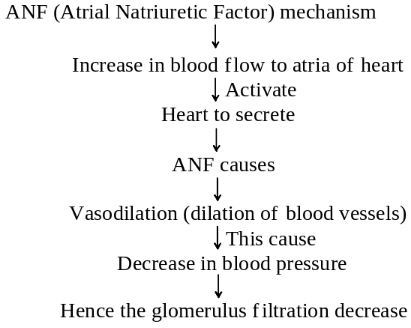
c
(c)Sweat glands present in the skin pass out sweat which consists of water, a small quantity of sodium chloride and traces of urea, amino acids, lactic acid and glucose.
View full question & answer
MCQ 661 Mark
Micturition is
  • A
    Removal of faecal matter
  • B
    Removal of $NH_3$
  • C
    Removal of urea
  • Removal of urine
Answer
Correct option: D.
Removal of urine
d
Micturition : Voiding of urine form the urinary bladder.
Defaecation / Egestion : Removal of faecal matter
Deamination : Removal of $NH_3$
 
View full question & answer
MCQ 671 Mark
Urine formed by nephrons is ultimately carried to ...$A$... where at stored fill a voluntary signal is given by the ...$B$.... This signal is initiated by ... $C \ldots$ of urinary bladder as it gets filled with urine.

Choose the correct option for $A, B$ and $C$ to complete the given $NCERT$ statement

  • A
    $A-urethra, B-CNS, C-PNS$
  • $A-urinary bladder, B-CNS, C-stretching$
  • C
    $A-urethra, B-CNS, C-stretching$
  • D
    $A-urethra, B-CNS, C-ANS$
Answer
Correct option: B.
$A-urinary bladder, B-CNS, C-stretching$
b
View full question & answer
MCQ 681 Mark
The outline of principal event of urination is given below in unorder manner

$I.$ Stretch receptors on the wall of urinary bladder send signal to the $CNS$

$II.$ The bladder fills with urine and becomes distended

$III.$ Micturition

$IV.$ $CNS$ passes on motor messenger to initiate the contraction smooth muscles of bladder and simultaneous relaxation of urethral sphincter

The correct order of steps for urination is

  • $II \rightarrow I \rightarrow IV \rightarrow III$
  • B
    $IV \rightarrow III \rightarrow II \rightarrow I$
  • C
    $II \rightarrow I \rightarrow III \rightarrow IV$
  • D
    $III \rightarrow II \rightarrow I \rightarrow IV$
Answer
Correct option: A.
$II \rightarrow I \rightarrow IV \rightarrow III$
a
Steps for Urination Bladder fills with urine and becomes distended. Stretch receptors on the wall of urinary bladder send signal to the $CNS.$ $CNS$ possess on motor message to initial messengers to initiate the contraction smooth muscle of bladder and simultaneous relaxation of urethral sphincter causing the release of urine
View full question & answer
MCQ 691 Mark
Micturition reflex is a neural mechanism to
  • A
    Release sweat
  • B
    Formation of urine
  • Release urine
  • D
    Release inorganic substance to the urine
Answer
Correct option: C.
Release urine
c
Release Urine.

Micturition is a reflex of voiding urine. If the urine content of urinary bladder reaches more than $300\, mL$ micturition reflex starts. Neural mechanism of micturition is called micturition reflex

View full question & answer
MCQ 701 Mark
What happens in micturition?
  • A
    Contraction of smooth muscles of bladder
  • B
    Relaxation of the urethral sphincter
  • C
    Release of urine
  • All of the above
Answer
Correct option: D.
All of the above
d
All of these.

Steps for Urination Bladder fills with urine and becomes distended. Stretch receptors on the wall of urinary bladder send signal to the $CNS.$

$CNS$ posses on motor message to initial messengers to initiate the contraction smooth muscle of bladder and simultaneous relaxation of urethral sphincter causing the release of urine

View full question & answer
MCQ 711 Mark
Reabsorption of water in $DCT$ and $CT$ part of nephron is function of
  • A
    Prolactin
  • B
    Oxytocin
  • Vasopressin
  • D
    Luteinising hormone
Answer
Correct option: C.
Vasopressin
c
View full question & answer
MCQ 721 Mark
The rupture of urinary bladder is prevented by
  • A
    Pseudostratified epithelium
  • B
    stratified columnar epithelium
  • C
    Stratified cuboidal epithelium
  • Transitional epithelium
Answer
Correct option: D.
Transitional epithelium
d
Transitional epithelium occurs, when there is a great degree of distension or expansion in the body, $e . g .,$ urinary bladder and uterus. It appears stratified with $4$ to $6$ layers. This epithelium prevents rupture of urinary bladder by permitting distension. It is a type of specialized epithelia.
View full question & answer
MCQ 731 Mark
The expulsion of urine from the urinary bladder is called
  • A
    Uricolysis
  • Micturition
  • C
    Ornithine
  • D
    None of these
Answer
Correct option: B.
Micturition
b
The expulsion of urine from the urinary bladder is called micturition.
View full question & answer
MCQ 741 Mark
An adult, human excretes, on average, …...liters of urine per day. On an average, ............. of urea is excreted out per day.
  • A
    $1 -15\, liter, 30 -25\, gm $
  • B
    $1 -5\, liter, 25 - 30 \,gm $
  • $1 - 1.5\, liter, 25 -30\, gm$
  • D
    $1 - 1.5 \,liter, 20 -25\, gm $
Answer
Correct option: C.
$1 - 1.5\, liter, 25 -30\, gm$
c
View full question & answer
MCQ 751 Mark
Process of release of urine
  • Micturition
  • B
    Filtration
  • C
    Remedial action
  • D
    Inflammation
Answer
Correct option: A.
Micturition
a
View full question & answer
MCQ 761 Mark
Choose the correct sequence. (Urine transport)
  • $DCTs$ $\rightarrow$ Collecting duct $\rightarrow$ Medullary pyramid $\rightarrow$ calysis $\rightarrow$ Renal pelvis.
  • B
    Collecting duct $\rightarrow$ Medullary pyramid $\rightarrow$ Calysis $\rightarrow$ $DCTs$ $\rightarrow$ Renal pelvis.
  • C
    Medulary pyramid $\rightarrow$ Collecting duct $\rightarrow$ $DCTs$ $\rightarrow$ Calysis $\rightarrow$ Renal pelvis.
  • D
    $DCTs$ $\rightarrow$ Calysis $\rightarrow$ Renal pelvis $\rightarrow$ Collecting tubule $\rightarrow$ Medullary pyramid.
Answer
Correct option: A.
$DCTs$ $\rightarrow$ Collecting duct $\rightarrow$ Medullary pyramid $\rightarrow$ calysis $\rightarrow$ Renal pelvis.
a
View full question & answer
MCQ 771 Mark
The control centres of micturition lies in
  • A
    Cortex
  • B
    Hypothalamus
  • Brain stem and spinal centres
  • D
    All the above
Answer
Correct option: C.
Brain stem and spinal centres
c
It’s obvious.
View full question & answer
MCQ 781 Mark
In micturition
  • Urethra relaxes
  • B
    Ureter contracts
  • C
    Ureter relaxes
  • D
    Urethra contracts
Answer
Correct option: A.
Urethra relaxes
a
(a)Process of passing out of urine is called micturition. During discharge of urine urethral sphincters relaxes and smooth muscles of bladder wall contract gradually.
View full question & answer
MCQ 791 Mark
Substance which is finally excreted in the urine
  • A
    Amino acid
  • Urea
  • C
    Glucose & Glycogen
  • D
    Uric acid
Answer
Correct option: B.
Urea
b
It’s obvious.
View full question & answer
MCQ 801 Mark
Human urine is invariably acidic because
  • A
    The blood entering the kidney is acidic
  • B
    Kidneys selectively filter out the acidic substances of blood into urine
  • Kidneys secrete acids to keep urine acidic
  • D
    Urine is made acidic in urinary bladder
Answer
Correct option: C.
Kidneys secrete acids to keep urine acidic
c
It’s obvious.
View full question & answer
MCQ 811 Mark
If we remove the pressure receptors from the urinary bladder wall
  • Their will be no micturition
  • B
    Micturition will continue
  • C
    There will be no collection of urine in bladder
  • D
    Urine will collect in the bladder
Answer
Correct option: A.
Their will be no micturition
a
It’s obvious.
View full question & answer
MCQ 821 Mark
In a recently found continuous ambulatory peritoneal dialysis $(CAPD)$ the dialysing membrane used is
  • A
    Cellophane membrane
  • B
    Egg membrane
  • Peritoneum membrane
  • D
    All the above
Answer
Correct option: C.
Peritoneum membrane
c
It’s obvious.
View full question & answer
MCQ 831 Mark
pH value of human urine is
  • A
    $7.5$
  • B
    $4.5$
  • $6$
  • D
    $2$
Answer
Correct option: C.
$6$
c
(c) $pH$ range of human urine is $5.0-7.5$. Normal urine is slightly acidic of $6.00$.
View full question & answer
MCQ 841 Mark
Angiotensinogen $\stackrel{\mathrm{x}}{\longrightarrow}$ Angiotensin$-I.$

            $(A)$                                   $(B)$

$X$ in the given statement refers to

  • A
    Angiotensin$-II$
  • B
    Aldosterone
  • Renin
  • D
    Rennin
Answer
Correct option: C.
Renin
c
Angiotensinogen $\stackrel{\text { Renin }}{\longrightarrow}$ Angiotensin $I$

Rennin is a proteolytic enzyme found is the stomach.

View full question & answer
MCQ 851 Mark
$A :$ Atrial Natriuretic factor is released by wall of atria.

$R :$ It inhibits the release of renin from Juxta glomerular apparatus
 

  • A
    Assertion and Reason both are correct and also correct explanation.
  • Assertion and Reason both are correct but not explanation of assertion.
  • C
    Assertion is correct, but Reason is incorrect.
  • D
    Both Assertion and Reason are incorrect.
Answer
Correct option: B.
Assertion and Reason both are correct but not explanation of assertion.
b
$ANF$ released by atria in response to increase in blood pressure and volume followed by inhibition of renin formation.
View full question & answer
MCQ 861 Mark
When the volume of body fluid falls below normal, $ADH$
  • A
    Decreases permeability of distal convoluted tubule and collecting tubule
  • Increases permeability of distal convoluted tubule and collecting tubule
  • C
    Has nothing to do with permeability of convoluted tubule
  • D
    Decreases permeability of proximal convoluted tubule
Answer
Correct option: B.
Increases permeability of distal convoluted tubule and collecting tubule
b
Increase in the permeability of $DCT$ and collecting duct known as conditional reabsorption of water regulated by amount of $ADH$.
View full question & answer
MCQ 871 Mark
Angiotensin $- II$ increases the blood volume by
  • A
    Signalling $PCT$ to reabsorb more $NaCl$ and water
  • B
    Stimulating adrenal gland to release aldosterone
  • C
    By stimulating the release of $ADH$
  • More than one option is correct
Answer
Correct option: D.
More than one option is correct
d
Angiotensin $II$ stimulates :
$(i)$ Adrenal gland $\rightarrow$ Aldosterone $\rightarrow$ Uptake of $Na^+$ from $DCT$ and collecting duct.
$(ii)$ Signalling $PCT$ to absorb more water.
View full question & answer
MCQ 881 Mark
Which one influences the activity of kidney?
  • A
    Vasopressin
  • B
    Thyroxine
  • Vasopressin and aldosterone
  • D
    Gonadotrophin
Answer
Correct option: C.
Vasopressin and aldosterone
c
Vasopressin and aldosterone influence the activity of kidney.
View full question & answer
MCQ 891 Mark
Which of the following statement is incorrect?
  • A
    $ADH$ is a vasoconstrictor
  • B
    Aldosterone facilitates water reabsorption
  • $ANF$ enhances sodium reabsorption
  • D
    $ANF$ causes vasodilation
Answer
Correct option: C.
$ANF$ enhances sodium reabsorption
c
$ANF$ (antinatriuretic factor) secreted by heart which facilitates $Na^+$/salt excretion in opposition to the increase in blood pressure/$GFR.$
View full question & answer
MCQ 901 Mark
Hormone responsible for the absorption of water in $DCT$ is
  • $ADH$
  • B
    $ACTH$
  • C
    $Oxytocin$
  • D
    $Insulin$
Answer
Correct option: A.
$ADH$
a
$ADH$(antidiuretic hormone) is secreted by neurosecretory cells of hypothalamus which is released from posterior pituitary.
View full question & answer
MCQ 911 Mark
Which of the following is also known as antidiuretic hormone?
  • A
    Oxytocin
  • Vasopressin
  • C
    Adrenaline
  • D
    Aldosterone
Answer
Correct option: B.
Vasopressin
b
Vasopressin is also known as $ADH$ (antidiuretic hormone)
View full question & answer
MCQ 921 Mark
Choose the correct option for $A, B, C$ from given option
  • A
    $A-$Adrenal cortex, B-Liver, $C-$Lung
  • B
    $A-$Lung, $B-$Liver, $C-$Adrenal cortex
  • $A-$Liver, $B-$ Lung, $C- $Adrenal Cortex
  • D
    $A-$Lungs, $B-$Adrenal cortex, $C-$Liver
Answer
Correct option: C.
$A-$Liver, $B-$ Lung, $C- $Adrenal Cortex
c
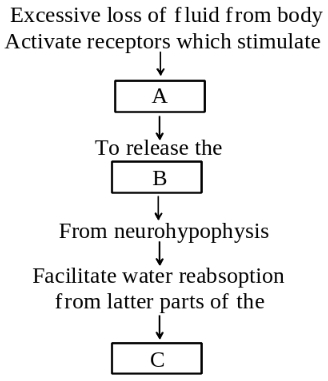
Excessive loss of fluid activate the receptor, which stimulate hypothalamus to release the $ADH$ from posterior lobe of pituitary. Facilitate the water reabsorption of water from the lateral part of tubule $(DCT$ and $CT)$
View full question & answer
MCQ 931 Mark
$RASS$ secretes which of the following hormone?
  • Mineralocorticoids
  • B
    Glucocorticoids
  • C
    Both $(a)$ and $(b)$
  • D
    None of the above
Answer
Correct option: A.
Mineralocorticoids
a
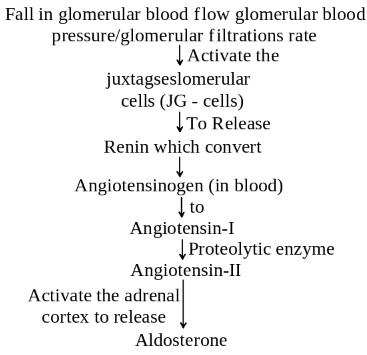
Juxtaglomerular apparatus $(JGA)$ operates a multihormonal Renin-Angiotensin-Aldosterone System $RAAS$. $JGA$ releases an enzyme renin in the blood, which initiates chemical reactions that produces angiotensin-$II$, a potential stimulator of aldosterone (mineralocorticoids) release by the glomerulosa cell. It increases blood pressure, blood volume and completes the feedback circuit by supporting the release of renin.
View full question & answer
MCQ 941 Mark
$ANF$ mechanism checks on
  • A
    Oxytocin - renin mechanism
  • B
    Counter - current mechanism
  • Renin - angiotensin mechanism
  • D
    Oxytocin - angiotensin mechanism
Answer
Correct option: C.
Renin - angiotensin mechanism
c
Renin angiotensin mechanism.

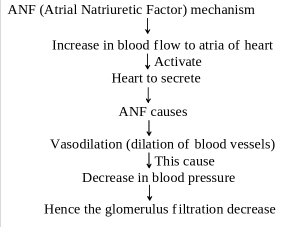
$ANF -$ mechanism therefore, acts as a check on renin-angiotensin mechanism

View full question & answer
MCQ 951 Mark
Which of the following is responsible for excretion of dilute urine?
  • A
    More secretion of insulin
  • Less secretion of vasopressin
  • C
    More secretion of Aldosterone
  • D
    Less secretion of glucagon
Answer
Correct option: B.
Less secretion of vasopressin
b
$ADH$ (Antidiuretic hormone) or vasopressin produced in the hypothalamus of the brain and released into the blood steam from the pituitary gland, enhances fluid retention by making the kidneys to reabsorb more water. Hyposecretion of vasopressin leads no water absorption in the collecting ducts, which results in secretion of dilute urine.
View full question & answer
MCQ 961 Mark
Juxtaglomerular cells of renal cortex synthesize an enzyme called
  • A
    $ADH$
  • B
    Oxytocin
  • Renin
  • D
    Urochrome
Answer
Correct option: C.
Renin
c
Juxtaglomerular cells of the kidney secrete an enzyme renin, which converts angiotensinogen in liver into angiotensin$-I,$ which is then converted into angiotensin$-II.$ Thus, this renin-angiotensin pathway stimulates the adrenal cortex to produce aldosterone, which maintains $N a^{+i i}$ and water concentration and controls the blood pressure.
View full question & answer
MCQ 971 Mark
Renin is secreted from
  • Juxtaglomerular cells
  • B
    Podocytes
  • C
    Nephridia
  • D
    Stomach
Answer
Correct option: A.
Juxtaglomerular cells
a
Rennin is an enzyme which is released by Juxtaglomerular cells of kidneys when blood pressure becomes low. It plays an important role in reabsorption of sodium.
View full question & answer
MCQ 981 Mark
Vasopressin released from the neurohypophysis is mainly responsible for
  • A
    Facultative reabsorption of water through Henle's loop
  • B
    Obligatory reabsorption of water through Bowman's capsule
  • Facultative reabsorption of water through $DCT$
  • D
    Obligatory reabsorption of water through $PCT$
Answer
Correct option: C.
Facultative reabsorption of water through $DCT$
c
$ADH$ released from the posterior pituitary plays an important role in regulating the amount of urine passed out by affecting the permeability of the $DCT.$ Water absorption in $DCT$ mediated by $ADH$ is called facultative water reabsorption.
View full question & answer
MCQ 991 Mark
Angiotensin-II activates the ....$A$.... and release ...... $B$......

Choose the correct option for $A$ and $B$ to complete the given statement

  • $A-$adrenal cortex; $B-$aldosterone
  • B
    $A-$adrenal medulla; $B-$aldosterone
  • C
    $A-$adrenal capsule; $B-$aldosterone
  • D
    $A-$adrenal medulla; $B-$oxytocin
Answer
Correct option: A.
$A-$adrenal cortex; $B-$aldosterone
a
$A-$adrenal cortex; $B-$aldosterone
View full question & answer
MCQ 1001 Mark
$ADH$ is secreted by
  • A
    Anterior lobe of pituitary
  • B
    Middle lobe of pituitary
  • Posterior lobe of pituitary
  • D
    All of the above
Answer
Correct option: C.
Posterior lobe of pituitary
c
Posterior lobe of pituitary (neuro hypophysis)
View full question & answer
MCQ 1011 Mark
Renin is released by
  • A
    Hypothalamus
  • B
    Posterior lobe of pituitary
  • C
    Anterior lobe of pituitary
  • J G cells
Answer
Correct option: D.
J G cells
d
Renin-angiotensin mechanism

$[Image]$

(Causes reabsorption of $Na ^{+}$and water from distal parts of tubule this also leads to an increase in blood pressure in $GFR.$ This complex mechanism is generally known as renin-angiotensin mechanism.)

View full question & answer
MCQ 1021 Mark
$ANF$ (Anti Natriuretic Factor) is released by
  • A
    Lung
  • B
    Kidney
  • Heart
  • D
    All of the above
Answer
Correct option: C.
Heart
c
$ANF -$ mechanism therefore, acts as a check on renin-angiotensin mechanism
View full question & answer
MCQ 1031 Mark
An increase in blood flow to the atria of the heart can cause the release of ............ and it cause ............ in blood vessels.
  • A
    Angiotensin $- II,$ contraction
  • $ANF,$ vasodilation
  • C
    $ANF,$ contraction
  • D
    Angiotensin $- II,$ contraction
Answer
Correct option: B.
$ANF,$ vasodilation
b
View full question & answer
MCQ 1041 Mark
An excessive loss of fluid from the body can activate osmoreceptors which stimulate the hypothalamus to release .............. from the neurohypophysis.
  • $ADH$
  • B
    Aldosterone
  • C
    Renin
  • D
    $AFN$
Answer
Correct option: A.
$ADH$
a
View full question & answer
MCQ 1051 Mark
A fall in $GFR$ can activate the $JG$ cells to release ......which can stimulate the glomerular blood flow and there by the $GFR$ back to normal.
  • A
    Urea
  • B
    Ammonia
  • Renin
  • D
    Resin
Answer
Correct option: C.
Renin
c
View full question & answer
MCQ 1071 Mark
Choose incorrect sentence.
  • A
    Descending limb of Henle's loop is permeable for water.
  • B
    Hydrogen, potassium and ammonia secreted by $DCT.$
  • C
    $H^+$ and $K^+$ selectively secreted by collecting duct.
  • Ascending limb of Henle's loop is impermeable for electrolytes.
Answer
Correct option: D.
Ascending limb of Henle's loop is impermeable for electrolytes.
d
View full question & answer
MCQ 1081 Mark
Which does not take part regulation of kidney ?
  • A
    Hypothalamus
  • B
    $JG -$ Cells
  • C
    Heart
  • Stomach
Answer
Correct option: D.
Stomach
d
View full question & answer
MCQ 1091 Mark
Which hormone produced by the help of angiotenogin $-II$?
  • A
    $ANF $
  • Aldosterone
  • C
    $ADH$
  • D
    Peptidase
Answer
Correct option: B.
Aldosterone
b
View full question & answer
MCQ 1111 Mark
In the renal tubules the permeability of the distal convoluted tubule and collecting duct to water is controlled by
  • Vasopressin
  • B
    Amylase
  • C
    Growth hormone
  • D
    Renin
Answer
Correct option: A.
Vasopressin
a
View full question & answer
MCQ 1121 Mark
Which one of the following statements is correct with respect to kidney function regulation?
  • When someone drinks lot of water, $ADH$ release is suppressed.
  • B
    Exposure to cold temperature blood flow stimulates formation of Angiotensin $II.$
  • C
    An increase in glomerular blood flow stimulates formaton of Angiotensis $II$
  • D
    During summer when body loses lot of water by evaporation the release of $ADH$ is suppressed.
Answer
Correct option: A.
When someone drinks lot of water, $ADH$ release is suppressed.
a
View full question & answer
MCQ 1131 Mark
Another effect of angiotensin $II$ is.
  • A
    Contraction of lungs.
  • B
    Secrete gastric juice.
  • Stimulate adrenal cortex.
  • D
    Secrete bile juice from liver.
Answer
Correct option: C.
Stimulate adrenal cortex.
c
View full question & answer
MCQ 1141 Mark
Vasopressin stimulates reabsorption of water and reduction of urine secretion. Hence vasopressin is otherwise called
  • A
    Sinovial fluid
  • Antidiuretic hormone
  • C
    Neurotransmitter
  • D
    Growth regulating substance
Answer
Correct option: B.
Antidiuretic hormone
b
It’s obvious.
View full question & answer
MCQ 1151 Mark
If $ADH$ level of blood is less
  • A
    Volume of urine increases
  • B
    Volume of urine decreases
  • C
    Volume of urine is normal
  • Volume of urine is unaffected
Answer
Correct option: D.
Volume of urine is unaffected
d
It’s obvious.
View full question & answer
MCQ 1161 Mark
$ADH$ controls water permeability of
  • A
    Collecting tube
  • Distal convolulated tubule and collecting duct
  • C
    Proximal convolulated tubule
  • D
    Bowman’s capsule
Answer
Correct option: B.
Distal convolulated tubule and collecting duct
b
(b) $ADH$ or vasopressine is effective in reabsorption of water by changing permeability of terminal part of $DCT$ $(distal\,\, convoluted \,\,tubules)$ and collecting ducts.
View full question & answer
MCQ 1171 Mark
Permeability of wall of collecting tubules is regulated by
  • A
    Renin
  • $ADH$
  • C
    Aldosterone
  • D
    Testosterone
Answer
Correct option: B.
$ADH$
b
It’s obvious.
View full question & answer
MCQ 1181 Mark
Which of the following influences the activity of kidney
  • A
    Gonadotrophins
  • B
    Vasopressin
  • Vasopressin and adrenalin
  • D
    Thyroxine
Answer
Correct option: C.
Vasopressin and adrenalin
c
It’s obvious.
View full question & answer
MCQ 1191 Mark
Vasopressin is related with
  • A
    Dilution of urine
  • B
    Quick digestion
  • Concentration of urine
  • D
    Slow heart beat
Answer
Correct option: C.
Concentration of urine
c
(c) About $19\%$ water is reabsorbed by the action of the posterior pituitary Anti diuretic hormone $(ADH)$ or vasopressin.
View full question & answer
MCQ 1201 Mark
Volume of urine is regulated by
  • A
    Aldosterone
  • B
    Aldosterone, $ADH$ and testosterone
  • Aldosterone and $ADH$
  • D
    $ADH$ alone
Answer
Correct option: C.
Aldosterone and $ADH$
c
(c) Water is reabsorbed in $DCT$ under the influence of $ADH$ secreated by posterior lobe of pituitary gland.

This make the filtrate isotonic to blood plasma and aldosterone is associated with the excretion of $K+$ and $H+$ ions some $Cl-$ ions are also reabsorbed.

View full question & answer
MCQ 1211 Mark
$ADH$ influences water permeability in the
  • A
    Proximal tubule
  • Distal tubule
  • C
    Collecting tubule
  • D
    Both $(a)$ and $(b)$
Answer
Correct option: B.
Distal tubule
b
(b) Antidiuretic hormone $(ADH)$ produced by neurosecretory cells in the paraventricular and supraoptic nuclei of the hypothalamus that stimulates water reabsorption from (in $DCT$ part of nephron) kidney tubules cells into the blood and vasocontraction of arterioles.
View full question & answer
MCQ 1221 Mark
What is the osmolarity of the filtrate at the hairpin bend of loop of Henle?
  • A
    $300\; mOsmL^{-1}$
  • $1200 \;mOsmL^{-1}$
  • C
    $600\; mOsmL^{-1}$
  • D
    $800 \;mOsmL^{-1}$
Answer
Correct option: B.
$1200 \;mOsmL^{-1}$
b
Osmolarity of the filtrate at the hair pin bend of loop of Henle $ -\;1200 \;mOsmL^{-1}.$
View full question & answer
MCQ 1231 Mark
We can produce a concentrated urine. This is facilitated by a special mechanism. Identify the mechanism.
  • A
    Reabsorption from $PCT$
  • B
    Reabsorption from collecting duct
  • C
    Reabsorption/secretion in $DCT$
  • Counter current mechanism in Henle’s loop/vasa recta
Answer
Correct option: D.
Counter current mechanism in Henle’s loop/vasa recta
d
Countercurrent mechanism : The arrangement of loop of Henle and the vasa recta in which opposite direction
of flow of the filtrate and blood respectively facilitates increasing osmolarity towards the inner medullary
interstitium from $300 \;mOsmL^{-1}$ in the cortex to about $1200\; mOsmL^{-1}$ in the inner medulla.
View full question & answer
MCQ 1241 Mark
The osmoreceptors of body are activated by....
  • A
    Changes in blood volume.
  • B
    Changes in body fluid volume.
  • C
    Changes in lonic concentration.
  • Given all above condition.
Answer
Correct option: D.
Given all above condition.
d
View full question & answer
MCQ 1251 Mark
Which structures takes part in counter current mechanism ?
  • A
    Bowman's capsule and glomerulus. .
  • B
    $DCT$ and collecting tube.
  • C
    Vasa recta and collecting tube.
  • Henle's loop and vasa recta.
Answer
Correct option: D.
Henle's loop and vasa recta.
d
View full question & answer
MCQ 1261 Mark
The function of kidney in mammals is to excrete
  • Excess salts, urea and excess water
  • B
    Excess salts, excess water and excess amino acids
  • C
    Excess water, urea and amino acids
  • D
    Excess urea, salts and excess water
Answer
Correct option: A.
Excess salts, urea and excess water
a
It’s obvious.
View full question & answer
MCQ 1271 Mark
Which of the following statement is/are true

$(1)$ Urine is hypertonic is distal convoluted tubule

$(2)$ When the urine passes into collecting tubule, it becomes hypotonic

$(3)$ Urine is isotonic in proximal convoluted tubule

$(4)$ Urine becomes more and more hypotonic as it passes through Henle’s loop

  • A
    $1$ and $4$
  • B
    $1, 2$ and $3$
  • C
    $2$ and $3$
  • $3$ only
Answer
Correct option: D.
$3$ only
d
(d) The filtrate is isotonic to blood plasma $(in\,\, proximal \,\,convoluted \,\,tubule)$ and the filtrate becomes hypertonic to blood plasma $(in descending limb of loop of Henle)$

The filtrate is hypotonic to blood plasma (in ascending limb at loop of Henle) in distal convoluted tubule $ADH$ make the filtrate isotonic to blood plasma.

View full question & answer
MCQ 1281 Mark
Counter-current mechanism operates in
  • Vasa rectae and Henle's loop
  • B
    Henle's loop
  • C
    Proximal convoluted tubule
  • D
    Distal convoluted tubule
Answer
Correct option: A.
Vasa rectae and Henle's loop
a
(a) Counter current mechanism operated by the Henle’s loop of juxtamedullary nephrons and vasa recta.
View full question & answer
MCQ 1291 Mark
The counter-current multiplier system changes the isotonic glomerular filtrate into
  • A
    Hypertonic urine
  • Hypotonic urine
  • C
    Isotonic urine
  • D
    None of the above
Answer
Correct option: B.
Hypotonic urine
b
It’s obvious.
View full question & answer
MCQ 1301 Mark
The blood constituents that remain unchanged in quantity after circulating through the kidney are
  • A
    Urea and glucose
  • Glucose and proteins
  • C
    Urea and proteins
  • D
    Urea and uric acid
Answer
Correct option: B.
Glucose and proteins
b
(b)Proteins are not filtered through glomerulus and glucose is totally reabsorbed in renal tubule.
View full question & answer
MCQ 1311 Mark
$A :$ Tubular secretion is of considerable importance in marine teleost fishes.

$R :$ These have aglomerular kidney $i.e.$, no filtration occurs and tubular secretion is the only way of excretion.

  • Assertion and Reason both are correct and also correct explanation.
  • B
    Assertion and Reason both are correct but not explanation of assertion.
  • C
    Assertion is correct, but Reason is incorrect.
  • D
    Both Assertion and Reason are incorrect.
Answer
Correct option: A.
Assertion and Reason both are correct and also correct explanation.
a
Tubular secretion is of considerable importance in teleosts as they have aglomerular kidney.
Their adaptation is so as to release less urine while excretion of excess salts out.
View full question & answer
MCQ 1321 Mark
$A : $ The final reabsorption of water from urine into blood occurs through the collecting duct of a mammalian nephron, resulting in the production of hyperosmotic urine.

$R :$ The loop of Henle is responsible for the formation of a sodium gradient across the depth of the medullary intersitium of a mammalian kidney

  • A
    Assertion and Reason both are correct but not explanation of assertion.
  • Assertion and Reason both are correct but not explanation of assertion.
  • C
    Assertion is correct, but Reason is incorrect.
  • D
    Both Assertion and Reason are incorrect.
Answer
Correct option: B.
Assertion and Reason both are correct but not explanation of assertion.
b
Reabsorption of filtrate occurs in collecting duct while loop of Henle forms sodium gradient by being selectively permeable to salts in different parts of the loop of Henle.
View full question & answer
MCQ 1331 Mark
$A :$ In the descending limb of loop of Henle, the urine is hypertonic, while in ascending limb of loop of Henle,
the urine is hypotonic.

$R :$ Descending limb is impermeable to $Na^+$, while ascending limb is impermeable to $H_2O.$

  • Assertion and Reason both are correct and also correct explanation.
  • B
    Assertion and Reason both are correct but not explanation of assertion.
  • C
    Assertion is correct, but Reason is incorrect.
  • D
    Both Assertion and Reason are incorrect.
Answer
Correct option: A.
Assertion and Reason both are correct and also correct explanation.
a
Desending loop of Henle is permeable to water, so hypertonic filtrate is there while ascending loop of Henle is more permeable to salt and thus hypotonic filtrate is there.
View full question & answer
MCQ 1341 Mark
The parts of nephron situated in cortical region of kidney are
  • A
    Loop of Henle, $PCT$ and collecting duct
  • B
    Collecting duct, $PCT$ and malpighian corpuscle
  • C
    $PCT, DCT$ and Loop of Henle
  • $PCT, DCT$ and Malpighian corpuscle
Answer
Correct option: D.
$PCT, DCT$ and Malpighian corpuscle
d
Cortex : $PCT, DCT,$ malpighian body.
Medulla : Loop of Henle.
View full question & answer
MCQ 1351 Mark
In which segment of the nephron, reabsorption is minimum?
  • A
    Proximal convoluted tubule $(PCT)$
  • B
    Distal convoluted tubule $(DCT)$
  • Loop of Henle
  • D
    Both $(a)$ and $(b)$
Answer
Correct option: C.
Loop of Henle
c
Reabsorption is maximum in the $PCT$ while reabsorption is minimum in ascending limb of the loop of Henle.
View full question & answer
MCQ 1361 Mark
Maximum water reabsorption occurs in
  • A
    $DCT$
  • $PCT$
  • C
    $Collecting \;duct$
  • D
    Descending limb of loop of Henle
Answer
Correct option: B.
$PCT$
b
$70-80\;\%$ of electrolytes, all of the nutrients and most of the water are reabsorbed in the proximal convoluted
tubule $(PCT)$. This is obligatory reabsorption.
View full question & answer
MCQ 1371 Mark
Which of the following component of blood does not enter into the nephron?
  • A
    Water
  • B
    Glucose
  • C
    Urea
  • Plasma proteins
Answer
Correct option: D.
Plasma proteins
d
Plasma proteins are not filtered out during ultrafiltration in the glomerular capsule.
Filtrate = Plasma -Plasma proteins.
View full question & answer
MCQ 1381 Mark
Glucose and amino acids in the filtrate are reabsorbed by tubular epithelial cells through
  • Active transport
  • B
    Passive transport
  • C
    Both $(a)$ and $(b)$
  • D
    Osmosis
Answer
Correct option: A.
Active transport
a
Glucose and amino acids in the filtrate are reabsorbed in the proximal convoluted tubule via active transport.
View full question & answer
MCQ 1391 Mark
Choose the correct statement
  • A
    The juxta medullary nephrons have reduced Henle's loop
  • B
    Vasa recta is well developed in cortical nephrons
  • C
    The $PCT $and $DCT$ are situated in the medulla of the kidney
  • The ascending limb of the Henle's loop extends as the $DCT$
Answer
Correct option: D.
The ascending limb of the Henle's loop extends as the $DCT$
d
The ascending limb of Henle's loop (the next part of renal tubule) continue as another highly coiled tubular region called Distal Convoluted Tubule $(DCT).$

The juxta medullarly nephrons have long Henle's loop.

Vasa recta is absent or highly reduced in cortical nephrons.

Bowman's capsule encloses the glomerulus.

The Malpighian corpuscles, proximal convoluted tubule $(PCT)$ and distal convoluted tubule $(DCT)$ are situated in the cortical region of the kidney, whereas the Henel's loop in the medulla.

View full question & answer
MCQ 1401 Mark
Which of the following structures are situated in the cortical region of the kidney?

$I.$ Malpighian corpuscle

$II.$ $PCT $(Proximal Convoluted Tubules)

$III.$ $DCT$ (Distal Convoluted Tubules)

$IV.$ Loop of Henle

$V.$ Collecting duct

  • $I, II$ and $III$
  • B
    $III, IV$ and$ V$
  • C
    $II, III $and $IV$
  • D
    $IV, V$ and $I$
Answer
Correct option: A.
$I, II$ and $III$
a
The malpighian corpuscle, $PCT$ and $DCT $of the nephrons are situated in the cortex or cortical part of the kidney whereas the loop of Henle dips into the medullary part of the kidney
View full question & answer
MCQ 1411 Mark
Out of

$I.$ $PCT$ $II.$ $DCT$

$III.$ Loop of Henle $IV.$ Collecting duct

Which contributes most in maintaining $pH$ of blood?

  • $I$ and $II$
  • B
    $II$ and $III$
  • C
    $III$ and $IV$
  • D
    $I$ and $IV$
Answer
Correct option: A.
$I$ and $II$
a
$PCT$ helps to maintain the pH and ionic balance of the body fluid by selective secretion of hydrogen ion, ammonia and potassium ion into filtrate and by absorption of $HC O _{3}^{-i i}$ from it.

$DCT$ capable of reabsorption of $H C O_{3}^{-i i}$ and selective secretion of hydrogen and potassium and $N H_{3}$ to maintain the $pH$ and sodium-potassium balance in blood

View full question & answer
MCQ 1421 Mark
$I.$ Reabsorption of water occurs passively in the initial segment of nephron

$II.$ Nitrogenous waste are absorbed by active transport

$III.$ Conditional reabsorption of $Na ^{+}$and water takes place in $DCT$

$IV.$ $DCT$ reabsorbs glucose

$V.$ $DCT$ is capable of selective secretion of $H ^{+}, K ^{+}$and $NH _{3}$ to maintain $pH$ and $Na ^{+}- K ^{+}$ balance in blood

$VI.$ Substances like glucose, amino acids, $Na ^{+}$, etc, in the filtrate are reabsorbed actively

Choose the option with incorrect statements

  • A
    $I$ and $II$
  • B
    $III$ and $IV$
  • C
    $V$ and $VI$
  • $II$ and $IV$
Answer
Correct option: D.
$II$ and $IV$
d
$DCT$ reabsorbs $\rightarrow Na ^{+}, K ^{+}, HCO _{3}, NH _{3}$ and water.

Nitrogenous wastes are absorbed by passive transport. Reabsorption of water also occurs passively in the initial segment of nephron

View full question & answer
MCQ 1431 Mark
$I.$ Glucose $II.$ Amino acid $III.$ $N a^{t i i}$ $IV.$ Nitrogenous waste

Which of them reabsorbed actively in the nephron?

Choose the correct option

  • A
    $I$ and $II$
  • $I, II$ and $III$
  • C
    $I$ and $III$
  • D
    Only $I$
Answer
Correct option: B.
$I, II$ and $III$
b
Glucose, amino acid, $N a^{+i i}$ are absorbed actively in the nephron
View full question & answer
MCQ 1441 Mark
Which one of the following correctly explains the function of a specific part of a human nephron?
  • A
    Henle's loop  $-$ Most reabsorption of the major substances from the glomerular filtrate
  • B
    Distal convoluted tubule $-$ Reasorption of ions into the surrounding blood capillaries
  • C
    Afferent arteriole  $-$ Carries the blood away from the glomerulus towards renal vein
  • Podocytes $-$ Creat minute spaces (slit pores) for the filtration of blood into the Bowman's
Answer
Correct option: D.
Podocytes $-$ Creat minute spaces (slit pores) for the filtration of blood into the Bowman's
d
Podocytes or visceral epithelial cells are the cells in Bowman's capsule in the kidney that wrap around the capillaries of glomerular. They create minute pores (site pores) for the filtration of blood into the Bowman's capsule.
View full question & answer
MCQ 1451 Mark
$PCT$ helps in the maintenance of $pH$ in the body fluid by
  • A
    Selective secretion of $H^{+i x}$ ions
  • B
    Selective secretion of ammonia
  • C
    Selective secretion of $K^{+i i}$ ions
  • All of the above
Answer
Correct option: D.
All of the above
d
Nearly all of the essential nutrients and $70-80$ per cent of electrolytes and water are reabsorbed by this segment. $PCT$ also helps to maintain the $pH$ and ionic balance of the body fluids by selective secretion of hydrogen ion and potassium ions into the filtrate and by absorption of $HC O _{3}^{-i i}$ from it
View full question & answer
MCQ 1461 Mark
During urine formation, which of the following processes create high osmotic pressure in the uriniferous tubule?
  • Active $Na ^{+}$absorption, followed by absorption of $Cl ^{-}$
  • B
    Active $cl$ absorption, followed by absorption of $Na ^{+}$
  • C
    Active secretion of $Na ^{+}$into efferent arteriole followed by absorption of $Cl ^{-}$into efferent renal arteriole
  • D
    Active secretion of $cl ^{-}$and absorption of $Na ^{+}$into efferent renal arteriole
Answer
Correct option: A.
Active $Na ^{+}$absorption, followed by absorption of $Cl ^{-}$
a
Osmotic pressure is a measure of tendency to take in water by osmosis. During urine formation, approximately two-thirds of the $NaCl ^{-i i}$ and water filtered into Bowman's capsule is immediately reabsorbed across the walls of proximal convoluted tubule. This reabsorption is driven by active transport of $Na ^{+}$out of the filtrate and into surrounding peritubular capillaries. $Cl ^{-}$follows $Na ^{+}$passively because of electric attraction and water follows them both because of osmosis.
View full question & answer
MCQ 1471 Mark
Collecting duct of nephron extends kidney from cortex to
  • A
    Capsule region
  • Inner part of medulla
  • C
    Outer part of medulla
  • D
    Middle part of medulla
Answer
Correct option: B.
Inner part of medulla
b
Collecting duct

$(i)$ This is the long ducts extends from cortex of the kidney to the inner parts of medulla $(ii)$ Large amount of water reabsorbed from this region $(iii)$ Concentrated urine production takes place

View full question & answer
MCQ 1481 Mark
Choose the correct order of urine formation in human
  • A
    $PCT \rightarrow ALH \rightarrow DLH \rightarrow DCT \rightarrow CD$
  • B
    $ACH \rightarrow DLH \rightarrow PCT \rightarrow DCT \rightarrow CD$
  • $PCT \rightarrow DLH \rightarrow ALH \rightarrow DCT \rightarrow CD$
  • D
    $CD \rightarrow DCT \rightarrow ACH \rightarrow DLH \rightarrow PCT$
Answer
Correct option: C.
$PCT \rightarrow DLH \rightarrow ALH \rightarrow DCT \rightarrow CD$
c
Proximal Convoluted Tubule $(PCT)$

             $\downarrow$

Descending Lop of Henle $(DLH)$

             $\downarrow$

Ascending Loop of Henle $(ALH)$

          $\downarrow$

Distal convoluted Tubule $(DCT)$

          $\downarrow$

Collecting Duct $(CD)$

View full question & answer
MCQ 1491 Mark
The function of Henle's loop is
  • A
    Passage of urine
  • B
    Formation of urine
  • Conservation of water
  • D
    Filtration of water
Answer
Correct option: C.
Conservation of water
c
Loop of Henle, also called nephron loop, is a U-shaped tube that extends from the proximal tubule. It plays a role in the transport of ions and water and the concentration of urine.
View full question & answer
MCQ 1501 Mark
Accessory excretory organs are

$I.$ skin $II.$ lungs

$III.$ liver $IV.$ sebaceous gland

Choose the correct option

  • A
    $I$ and $II$
  • B
    $II$ and $III$
  • C
    $III$ and $IV$
  • $I, II, III$ and $IV$
Answer
Correct option: D.
$I, II, III$ and $IV$
d
Accessory excretory organs are the organs, which have their own specific functions but carry out excretion as a secondary activity, $e.g.,$ lung, skin, liver
View full question & answer
MCQ 1511 Mark
Transport of electrolytes through loop of Henle takes place by
  • A
    Actively
  • B
    Passively
  • Both $(a)$ and $(b)$
  • D
    Diffusion
Answer
Correct option: C.
Both $(a)$ and $(b)$
c
Active and passive both are the ways to transport electrolyte through loop of Henle
View full question & answer
MCQ 1521 Mark
Which of the following statements is/are true?

$I.$ Urine is hypertonic while entering distal convoluted tubule.

$II.$ When the urine moves in the collecting tubule, it becomes hypertonic.

$III. $ Urine is isotonic in proximal convoluted tubule.

$IV.$ Urine becomes more and more hypotonic as it passes through the descending Henle's loop.

  • A
    $I$ and $IV$
  • B
    $I, II $and $III$
  • $II$ and $ III$
  • D
    $I$ only
Answer
Correct option: C.
$II$ and $ III$
c
the renal medullary interstitium is hypertonic due to water reabsorption from loop of henle and collecting duct. the other renal tubules show isoosmolar concentration with renal medulla
View full question & answer
MCQ 1531 Mark
Urine is concentrated in which part of nephron
  • $CT$
  • B
    $PCT$
  • C
    Bowman's capsule
  • D
    $JGA$
Answer
Correct option: A.
$CT$
a
Maximum water absorption occurs in collecting ducts$(CT)$ and hence, concentrated urine is present in $CT.$
View full question & answer
MCQ 1541 Mark
Henle's loop of nephron plays a significant role in maintaining a high osmolarity in
  • A
    Interstitial fluid of hilum
  • Medullary interstitial fluid
  • C
    Cortex interstitial fluid
  • D
    All of the above
Answer
Correct option: B.
Medullary interstitial fluid
b
Medullary interstitial fluid
View full question & answer
MCQ 1551 Mark
Glucose is mainly absorbed in
  • $PCT$
  • B
    $DCT$
  • C
    Henle's loop
  • D
    Nephron
Answer
Correct option: A.
$PCT$
a
Proximal convoluted tubule $(PCT)$ is involved with complete reabsorption of glucose by active transport and reabsorption of most of the amino acids and vitamin$-C,$ $Na ^{+}(70\, \%), K ^{+}(75\, \%)$ and a large amount of $Ca ^{2+}$ from glomerular filtrate.
View full question & answer
MCQ 1561 Mark
In which part of nephron, reabsorption is minimum from filtrate?
  • Henle's loop
  • B
    Proximal convoluted tubule
  • C
    Distal convoluted tubule
  • D
    Collecting duct
Answer
Correct option: A.
Henle's loop
a
View full question & answer
MCQ 1571 Mark
During urine formation, the tubular cells secrete substance like ........... into the filterate.
  • A
    $Na^+, H^+, K^+$
  • B
    $NaCl, H_2O, HCO_3^-$
  • C
    Urea, $NaCl, H_2O$
  • $H^+, K^+,$ ammonia
Answer
Correct option: D.
$H^+, K^+,$ ammonia
d
View full question & answer
MCQ 1581 Mark
The part of nephron involved in active reabsoprtion of sodium is
  • A
    distal convoluted tubule
  • proximal convoluted tubule
  • C
    Bowman's capsule
  • D
    descending limb of Hente' loop
Answer
Correct option: B.
proximal convoluted tubule
b
View full question & answer
MCQ 1591 Mark
Removal of proximal convoluted tubule from the nephron will result in
  • A
    More concentrated urine
  • B
    No change in quality and quantity of urine
  • C
    No urine formation
  • More diluted urine
Answer
Correct option: D.
More diluted urine
d
View full question & answer
MCQ 1601 Mark
In the descending loop of henle filtrate pass down word it.....
  • A
    Becomes more diluted
  • Becomes more concentrated
  • C
    No change in concentration
  • D
    Filterate size decrease
Answer
Correct option: B.
Becomes more concentrated
b
View full question & answer
MCQ 1611 Mark
Which feature enables the mammalian kidney to concentrate urine in the medullary region
  • Maintaining a high osmotic pressure in the tissues between the tubules
  • B
    Rapid removal of sodium ions from the medullary tissues
  • C
    Rapid flow of blood through the medulla
  • D
    High oxidative metabolism of medullary cells
Answer
Correct option: A.
Maintaining a high osmotic pressure in the tissues between the tubules
a
It’s obvious.
View full question & answer
MCQ 1621 Mark
In the kidney, glucose is mainly absorbed in
  • A
    Loop of Henle
  • Proximal convoluted tubules
  • C
    Distal convoluted tubules
  • D
    Bowman's capsule
Answer
Correct option: B.
Proximal convoluted tubules
b
(b)Complete reabsorption by active transport takes places for glucose in the proximal convoluted tubules.
View full question & answer
MCQ 1631 Mark
The function of loop of Henle is
  • A
    Dilution of urine
  • B
    Removal of water
  • C
    Remove salt
  • Counter current multiplier system
Answer
Correct option: D.
Counter current multiplier system
d
(d)Henle’s loop play the role of countercurrent multipliers the vasa recta play the role of countercurrent exchanges.
View full question & answer
MCQ 1641 Mark
The main function of Henle’s loop is
  • Conservation of water
  • B
    Filtration of blood
  • C
    Passage of urine
  • D
    Formation of urine
Answer
Correct option: A.
Conservation of water
a
(a) Loop of henle is a $‘U’$ shaped segment of nephron located in the renal medulla.

It helps in conservation of water during counter current mechanism.

View full question & answer
MCQ 1651 Mark
Active transport is
  • A
    Formation of $ATP$
  • Against the gradient using $ATP$
  • C
    Along gradient without using $ATP$
  • D
    Against the gradient without using $ATP$
Answer
Correct option: B.
Against the gradient using $ATP$
b
(b) Active transport in movement across the cell membrane against the gradient with the use of $ATP$.
View full question & answer
MCQ 1661 Mark
What for the ascending limb of Loop of Henle is permeable
  • A
    Glucose
  • B
    $N{H_3}$
  • $N{a^ + }$
  • D
    Water
Answer
Correct option: C.
$N{a^ + }$
c
It’s obvious.
View full question & answer
MCQ 1671 Mark
A patient who excretes large quantity of sodium in urine has
  • A
    Diseased adrenal medulla
  • Diseased adrenal cortex
  • C
    Diseased thymus
  • D
    Diseased parathyroid
Answer
Correct option: B.
Diseased adrenal cortex
b
It’s obvious.
View full question & answer
MCQ 1681 Mark
Which of the following is correct
  • A
    Afferent arteriole is narrower than efferent arteriole
  • B
    Afferent venule is narrower than efferent venule
  • Efferent arteriole is narrower than afferent arteriole
  • D
    Efferent venule is narrower than afferent venule
Answer
Correct option: C.
Efferent arteriole is narrower than afferent arteriole
c
(c)Afferent arteriole carries blood to glomerulus while efferent arteriole collects blood from it so the diameter of afferent arteriole is much more than that of efferent arteriole.
View full question & answer
MCQ 1691 Mark
Potassium
  • Ions are reabsorbed in the proximal convoluted tubules
  • B
    Transport is primarily by diffusion
  • C
    Reabsorption in tubules is insulin dependent
  • D
    Transport depends on $N{a^ + }$ transport
Answer
Correct option: A.
Ions are reabsorbed in the proximal convoluted tubules
a
It’s obvious.
View full question & answer
MCQ 1701 Mark
Reabsorption of substances according to the needs of body is called
  • A
    Obligatory reabsorption
  • Facultative reabsorption
  • C
    Glomerular reabsorption
  • D
    None of the above
Answer
Correct option: B.
Facultative reabsorption
b
It’s obvious.
View full question & answer
MCQ 1711 Mark
Passive transport occurs in the case of
  • A
    Cations
  • Chloride ions
  • C
    $(a)$ and $(b)$ both
  • D
    None of the above
Answer
Correct option: B.
Chloride ions
b
(b)The sodium ions are absorbed actively therefore chloride ions are followed passively.
View full question & answer
MCQ 1721 Mark
Active transport takes place in absorption of
  • A
    Sodium chloride
  • B
    Bicarbonate ions
  • C
    Amino acids
  • All the above
Answer
Correct option: D.
All the above
d
(a)Glucose, amino acids, vitamins, hormones, sodium potassium, chlorides, phosphates and bicarbonates much of water and some urea from the filtrate are absorbed by active transport.
View full question & answer
MCQ 1731 Mark
Match the following

         $'A'$                                                                    $'B'$

$A.$ Loop of Henle                                    $1.$ Carries blood into the kidney

$B.$ Renal artery                                       $2.$ Area where a consider able amount of                                                                             reabsorption takes place

$C.$ Proximal convoluted                       $3.$ Main area of secretiontubule

$D.$ Glomerulus                                        $4.$ Filtration of blood

$E.$ Distal convoluted                               $5.$ Plays a role in tubule concentration of                                                                       urineThe correct pairing sequence is

  • $5, 1, 2, 4, 3$
  • B
    $5, 1, 2, 3, 4$
  • C
    $1, 5, 3, 4, 2$
  • D
    None of the above
Answer
Correct option: A.
$5, 1, 2, 4, 3$
a
It’s obvious.
View full question & answer
MCQ 1741 Mark
Reabsorption of glucose from the glomerular filtrate in the kidney tubule is carried out by
  • Active transport
  • B
    Osmosis
  • C
    Brownian movement
  • D
    Diffusion
Answer
Correct option: A.
Active transport
a
(a)Reabsorption of glucose from the glomerlular filrate in the kidney tubule is carried out by active transport.
View full question & answer
MCQ 1751 Mark
Glucose and $80\%$ water is absorbed in
  • Proximal convoluted tubule
  • B
    Loop of Henle
  • C
    Distal convoluted tubule
  • D
    Collecting tubule
Answer
Correct option: A.
Proximal convoluted tubule
a
It’s obvious.
View full question & answer
MCQ 1761 Mark
The substance which is completely reabsorbed from the filtrate in the renal tubule under normal conditions is
  • A
    Urea
  • B
    Salt
  • Glucose
  • D
    Water
Answer
Correct option: C.
Glucose
c
(c) Complete reabsorption by active transport takes places for glucose in the $PCT$.
View full question & answer
MCQ 1771 Mark
In distal convoluted tubule of the nephrons
  • Na reabsorption requires energy
  • B
    Secretion of K ions does not require energy
  • C
    Water reabsorption requires energy
  • D
    Ammonia is secreted
Answer
Correct option: A.
Na reabsorption requires energy
a
(a)Reabsorption of $N{a^ + }$ in the tubules is an active process.
View full question & answer
MCQ 1781 Mark
Sodium, water and phosphate reabsorption is maximum in
  • A
    Loop of Henle
  • Proximal tubule
  • C
    Distal tubule
  • D
    Collecting tubule
Answer
Correct option: B.
Proximal tubule
b
(b) About $65$ percent of the glomerular filtrate is normally reabsorbed in the proximal convoluted tubule before reaching the loop of Henle.

Glucose, amino acids, vitamins, hormone, sodium, potassium, chlorides, phasphates, bicarbonates, much of water and some urea from the filtrate are absorbed.

View full question & answer
MCQ 1791 Mark
In the distal convoluted tubule of the nephrons
  • Sodium reabsorption requires energy
  • B
    Secretion of potassium ions does not requires energy
  • C
    Water reabsorption requires energy
  • D
    Water reabsorption does not requires energy
Answer
Correct option: A.
Sodium reabsorption requires energy
a
(a) Energy comes from the mitochondria in the cells of the tubules.
View full question & answer
MCQ 1801 Mark
In the kidney of the rabbit, the Loop of Henle is the part of
  • A
    Glomerulus
  • B
    Collecting duct
  • C
    Bowman's capsule
  • Uriniferous tubule
Answer
Correct option: D.
Uriniferous tubule
d
It’s obvious.
View full question & answer
MCQ 1811 Mark
Loop of Henle is meant for absorption of
  • A
    Potassium
  • B
    Glucose
  • Water
  • D
    $C{O_2}$
Answer
Correct option: C.
Water
c
It’s obvious.
View full question & answer
MCQ 1821 Mark
In which part of excretory system of mammals can you first use the term 'urine' for contained fluid
  • A
    Bowman's capsule
  • B
    Loop of Henle
  • Collecting tubule
  • D
    Urinary bladder
Answer
Correct option: C.
Collecting tubule
c
It’s obvious.
View full question & answer
MCQ 1831 Mark
$A :$ Inner wall of Bowman’s capsule is lined with specialized cells - podocytes having a number of projections.

$R : $ These projections increases the surface area for absorptions

  • A
    Assertion and Reason both are correct and also correct explanation.
  • B
    Assertion and Reason both are correct but not explanation of assertion.
  • Assertion is correct, but Reason is incorrect.
  • D
    Both Assertion and Reason are incorrect.
Answer
Correct option: C.
Assertion is correct, but Reason is incorrect.
c
Podocytes are present in the inner wall of the Bowman's capsule. Prodocytes projection is to limit the size of filtrate solutes.
View full question & answer
MCQ 1841 Mark
On an average, ______ ml of blood is filtered by the kidneys per minute which constitute roughly ______ of the blood pumped out by each ventricle of the heart in a minute.
  • A
    $500-600, 1/5^{th}$
  • B
    $1100-1200, 1/3^{rd}$
  • C
    $500-600, 1/3^{rd}$
  • $1100-1200, 1/5^{th}$
Answer
Correct option: D.
$1100-1200, 1/5^{th}$
d
$1100-1200\; ml $ of blood/min; $1/5^{th}$ of the blood pumped out by each ventricle.
View full question & answer
MCQ 1851 Mark
If one liter of water is introduced in human blood, then
  • A
    $GFR $ decreases
  • $RBC$ collapses and urine production increases
  • C
    $RBC$ collapses and urine production decreases
  • D
    $GFR$ shows no change
Answer
Correct option: B.
$RBC$ collapses and urine production increases
b
If one litre of water is introduced in human blood then $RBCs$ absorbs it (as water is hypotonic to their internal environment) swell up and burst. Besides of this, there is also increases in the urine production as more water is passed in the nephric filtrate.
View full question & answer
MCQ 1861 Mark
When does glomerular filtration occurs in Bowman's capsule?
  • A
    When hydrostatic pressure of blood in the glomerulus is higher than capsular hydrostatic pressure $\&$ osmotic pressure
  • B
    When hydrostatic pressure of blood in the glomerulus is less than capsular hydrostatic pressure $\&$ osmotic pressure
  • When hydrostatic pressure of blood in the glomerulus is equal to capsular hydrostatic pressure $\&$ osmotic pressure
  • D
    When capsular hydrostatic pressure $\&$ osmotic pressure is higher than glomerular blood hydostatic pressure
Answer
Correct option: C.
When hydrostatic pressure of blood in the glomerulus is equal to capsular hydrostatic pressure $\&$ osmotic pressure
c
Glomerular filtration occurs in Bowman's capsule when hydrostatic pressure of blood in the glomerulus is $55\, mm\, Hg$ and net filtrate pressure is $10$ $mm\, Hg$
View full question & answer
MCQ 1871 Mark
$JGA$ (Juxta Glomerular Apparatus), a sensitive region, which regulates the glomerular filtration rate is present near the
  • A
    $DCT$ and $ PCT$
  • B
    $DCT$ and efferent arteriole
  • $DCT$ and afferent arteriole
  • D
    Loop of Henle's and $DTC$
Answer
Correct option: C.
$DCT$ and afferent arteriole
c
The kidneys have built in mechanisms for the regulation of glomerular filtration rate. One such efficient mechanism is carried out by juxta glomerular apparatus $(JGA).$ $JGA$ is the special sensitive region formed by cellular modification in the distal convoluted tubule and the afferent arteriole at the location of their contact. A fall in $GFR$ can activate the $JG$ cells to release renin, which can stimulate the glomerular blood flow and there by $GFR$ back to normal
View full question & answer
MCQ 1881 Mark
What is the obligatory water reabsorption?
  • A
    Reabsorption of water from $PCT$
  • B
    Reabsorption of water from loop of Henle
  • Both $(a)$ and $(b)$
  • D
    Water secretion by Bowman's capsule
Answer
Correct option: C.
Both $(a)$ and $(b)$
c
Large quantity of water is reabsorbed in $PCT$ and loop of Henle. About $80 \%$ of water is reabsorbed in $PCT$ and loop of Henle. This is called obligatory water reabsorption
View full question & answer
MCQ 1891 Mark
$A$ fall in the $GFR$ rate activates the
  • $JG$ cells to release reni
  • B
    $JG$ cells to release aldosterone
  • C
    $JG$ cells to release epinephrine
  • D
    $JG$ cells to release nor-epinephrine
Answer
Correct option: A.
$JG$ cells to release reni
a
The kidneys have built in mechanisms for the regulation of glomerular filtration rate. One such efficient mechanism is carried out by juxta glomerular apparatus $(JGA)$, $JGA$ is the special sensitive region formed by cellular modification in the distal convoluted tubule and the afferent arteriole at the location of their contact. A fall in $GFR$ can activate the $JG$ cells to release renin, which can stimulate the glomerular blood flow and there by $GFR$ back to normal
View full question & answer
MCQ 1901 Mark
Human kidneys can produce urine nearly
  • A
    Three times concentrated than initial filtrate
  • Four times concentrated than initial filtrate
  • C
    Five times concentrated than initial filtrate
  • D
    Six times concentrated than initial filtrate
Answer
Correct option: B.
Four times concentrated than initial filtrate
b
Presence of interstitial gradient helps in an easy passage of water from the collecting tubule there by concentrating the filtrate (urine). Human kidney can produce nearly four times concentrated than the initial filtrate formed
View full question & answer
MCQ 1911 Mark
Ultrafiltrate generated by the glomerulus is having all the constituent of the blood plasma except
  • A
    Proteins
  • B
    $RBC$
  • C
    $WBC$
  • All of these
Answer
Correct option: D.
All of these
d
Blood of filtered so finely through the these membranes (three layers) that almost all the constituents of the plasma except the proteins, $RBC$ and $WBC$ pass into the lumen of the Bowman's capsule. Therefore, it is considered as the process of ultra filtration
View full question & answer
MCQ 1921 Mark
Filtration in Malpighian body of the nephrons involves
  • A
    One layer
  • B
    Two layer
  • Three layer
  • D
    Four layer
Answer
Correct option: C.
Three layer
c
Glomerular capillary blood pressure causes the filtration of the blood through three layers, $i.e.,$

$(i)$ The endothelium of the glomerular blood vessels

$(ii)$ Epithelium of Bowman's capsule

$(iii)$ Basement membrane between these two layers

The epithelium of the Bowman's capsule called podocytes are arranged in an intricate manner so as to leave some minute spaces called podocytes

View full question & answer
MCQ 1931 Mark
Which substance is in higher concentration in blood than in glomerular filtrate?
  • A
    Water
  • B
    Glucose
  • C
    Urea
  • Plasma proteins
Answer
Correct option: D.
Plasma proteins
d
The plasma fluid that filters out from glomerular capillaries into Bowman's capsule of nephrons is called glomerular filtrate. It is a non-colloidal part and possesses urea, water, glucose, amino acids, vitamins, fatty acid, uric acid, creatinine salts, etc. $RBCs, WBCs$ platelets and plasma proteins are the colloidal parts of the blood and do not filtrated out from glomerulus. Thus, plasma proteins are higher in concentration in blood than in glomerular filtrate.
View full question & answer
MCQ 1941 Mark
How much percentage of the filtrate is reabsorbed in the renal tubules?
  • A
    $5\, \%$
  • B
    $25\, \%$
  • C
    $90 \,\%$
  • $99 \,\%$
Answer
Correct option: D.
$99 \,\%$
d
A comparison of the volume of the filtrate formed per day ( $180\, litre$ per day) with that of the urine released ($1.5\, litres$), suggests that nearly $99\, \%$ of this filtrate has to be reabsorbed by the renal tubules. This process is called reabsorption
View full question & answer
MCQ 1951 Mark
Glomerular filtrate rate per day is
  • A
    $150\, L$
  • B
    $190 \,L$
  • C
    $170 \,L$
  • $180\, L$
Answer
Correct option: D.
$180\, L$
d
The $GFR$ in a normal adult person is $125 \,mL$ of plasma per minute or $180\, litre$ of plasma per day.
View full question & answer
MCQ 1961 Mark
Find the incorrect option regarding mechanism of urine formation in man.
  • A
    The glomerular filtration rate is about $125\, mL / min$
  • B
    The ultra filtration is opposed by the colloidal osmotic pressure of plasma
  • Tubular secretion takes place in the $PCT$ only
  • D
    Aldosterone induces greater reabsorption of sodium
Answer
Correct option: C.
Tubular secretion takes place in the $PCT$ only
c
Tubular secretion takes place in both $PCT$ and $DCT$
View full question & answer
MCQ 1971 Mark
$GFR$ is a healthy individual is
  • $125\, mL / min$
  • B
    $150\, L /$ day
  • C
    $125 \,mL / sec$
  • D
    $135 \,L /$ day
Answer
Correct option: A.
$125\, mL / min$
a
$GFR$ of a healthy person is $125\, mL / min$ or $180\, L$ per day
View full question & answer
MCQ 1981 Mark
Malpighian body or renal corpuscle is/are
  • A
    Bowman's capsule
  • B
    Glomerulus
  • Both $(a)$ and $(b)$
  • D
    Proximal convoluted tubule
Answer
Correct option: C.
Both $(a)$ and $(b)$
c
View full question & answer
MCQ 1991 Mark
............ cells of Bowman's capsule called …..... are arranged in an intricate manner so as to leave some minute spaces called slit pores.
  • A
    Endothelium, podocytes
  • Epithelium, podocytes
  • C
    Basement membrane, $JGA -$ cells
  • D
    Epithelium $JGA -$ cells
Answer
Correct option: B.
Epithelium, podocytes
b
View full question & answer
MCQ 2001 Mark
What is the $GFR$ in healthy person ?
  • A
    $1100 -1200\, ml / min. $
  • $125 \,ml/min. $
  • C
    $180 \,ml / min.$
  • D
    $410\, ml/min $
Answer
Correct option: B.
$125 \,ml/min. $
b
View full question & answer
MCQ 2011 Mark
The volume of the filtrate per day is .....$X$.....liter and released of urine per day ...$Y$.... It means about ....$Z$... $\%$ of filtrate is reabsorbed by the process of reabsorption.
  • A
    $X-99, Y-1.5,Z-180 $
  • B
    $X-1.5,Y-99,Z-140 $
  • $X-180,Y-1.5,Z-99$
  • D
    $X-180,Y-2.5,Z-80 $
Answer
Correct option: C.
$X-180,Y-1.5,Z-99$
c
View full question & answer
MCQ 2021 Mark
A large amount of about $180\,L$ of fluid is filtered by the human kidneys per day. Which one of the following renal corpuscle features does not justify this?
  • A
    The glomerular capillaries have a large surface area.
  • B
    The glomerular capillaries are fenestrated and hence leakier than other capillaries.
  • C
    The glomerular capillaries have a higher blood pressure than the other capillaries of the body.
  • The efferent arteriole is wider than the afferent arteriole causing easier outflow of blood from glomerulus.
Answer
Correct option: D.
The efferent arteriole is wider than the afferent arteriole causing easier outflow of blood from glomerulus.
d
View full question & answer
MCQ 2031 Mark
$GFR$ means.......
  • A
    The amount of the filtrate formed by the kidneys per $10$ minutes.
  • B
    The amount of filtrate formed by the kidneys per hour.
  • The amount of filtrate formed by the kidneys per minute.
  • D
    The amount of filtrate formed by one kidney per minute.
Answer
Correct option: C.
The amount of filtrate formed by the kidneys per minute.
c
View full question & answer
MCQ 2041 Mark
On an average, how much blood is filtered by the kidneys per minute
  • A
    $100 - 200 \,ml$
  • B
    $500 - 1000 \,ml$
  • $1100 - 1200 \,ml$
  • D
    $1500 -2000\, ml $
Answer
Correct option: C.
$1100 - 1200 \,ml$
c
View full question & answer
MCQ 2051 Mark
Glomerulus is formed by
  • A
    Branch from renal vein
  • Branch from renal artery 
  • C
    Uriniferous tubule
  • D
    Coiling of proximal part of uriniferous tubule
Answer
Correct option: B.
Branch from renal artery 
b
(b)Each nephron or uriniferous tubule contain a network of blood capillaries, the glomerulus, connected with afferent arteriole on one side and an efferent arteriole on the other side. Glomerulus and Bowman’s capsule together from a renal or malpighian corpuscle.
 
View full question & answer
MCQ 2061 Mark
Difference between glomerular filtrate and blood plasma is of
  • Proteins
  • B
    First is concentrated and second is dilute
  • C
    First is white and second is yellow
  • D
    Difference of potassium
Answer
Correct option: A.
Proteins
a
(a)The glomerular filtrate and blood plasma are similar except that glomerular filtrate does not have protein and fats
View full question & answer
MCQ 2071 Mark
What causes the liquid part of the blood to filter out from the glomerulus into the renal tubule
  • A
    Osmosis
  • High $(hydrostatic)$ pressure
  • C
    Diapedesis
  • D
    Dialysis
Answer
Correct option: B.
High $(hydrostatic)$ pressure
b
(b) The glomerular capillaries are narrower than the afferent renal arterioles.

Therefore the blood pressure in the glomerular capillaries become very high so that the liquid part of blood to fitter out from the glomerulus in to the renal tubule.

View full question & answer
MCQ 2081 Mark
Glomerular filtrate contains
  • Blood without blood cells and proteins
  • B
    Plasma without sugar
  • C
    Blood with proteins but without cells
  • D
    Blood without urea
Answer
Correct option: A.
Blood without blood cells and proteins
a
It’s obvious.
View full question & answer
MCQ 2091 Mark
Glomerular hydrostatic pressure is present in
  • A
    Tubule of kidney
  • B
    Bowman’s capsule
  • Glomerulus of uriniferous tubule
  • D
    Malpighian tubule
Answer
Correct option: C.
Glomerulus of uriniferous tubule
c
It’s obvious.
View full question & answer
MCQ 2101 Mark
Glomerular filtrate is
  • Deproteinised plasma
  • B
    Proteinised plasma
  • C
    Blood plasma
  • D
    Urine stored in urinary bladder
Answer
Correct option: A.
Deproteinised plasma
a
It’s obvious.
View full question & answer
MCQ 2111 Mark
Which one do not filter out from blood to Bowman’s capsule in glomerular ultrafiltration
  • A
    Amino acids
  • Polypeptide
  • C
    Glucose
  • D
    Fatty acids
Answer
Correct option: B.
Polypeptide
b
It’s obvious.
View full question & answer
MCQ 2121 Mark
The normal blood flowing through renal arteries in human being is about
  • A
    $10$ litres/hour
  • B
    $25$ litres/hour
  • $50$ litres/hour
  • D
    $100$ litres/hour
Answer
Correct option: C.
$50$ litres/hour
c
It’s obvious.
View full question & answer
MCQ 2131 Mark
In which of the following ways does the blood leaving the glomerulus of a mammalian kidney tubule differ from the blood entering the glomerulus
  • A
    It has a lower concentration of plasma proteins
  • B
    It contains fewer corpuscles per unit volume
  • It has a lower concentration of crystalloids
  • D
    It has a higher concentration of crystalloids
Answer
Correct option: C.
It has a lower concentration of crystalloids
c
It’s obvious.
View full question & answer
MCQ 2141 Mark
Pressure gradient is determined by
  • A
    Glomerular hydrostatic pressure
  • B
    Blood osmotic pressure
  • C
    Capsular hydrostatic pressure
  • All the above
Answer
Correct option: D.
All the above
d
It’s obvious.
View full question & answer
MCQ 2151 Mark
High blood pressure is maintained in glomeruli than in other capillaries because
  • The variability of the diameters of arterioles causes higher resistance to blood flowing out of the glomeruli than to out of the capillaries
  • B
    Glomeruli has low hydrostatic pressure than capillary
  • C
    Capillary has less diameter than glomeruli
  • D
    All the above
Answer
Correct option: A.
The variability of the diameters of arterioles causes higher resistance to blood flowing out of the glomeruli than to out of the capillaries
a
It’s obvious.
View full question & answer
MCQ 2161 Mark
The maximum quantity of water required per day by a human body is
  • A
    $10$ litres
  • $5$ litres
  • C
    $1$ litres
  • D
    $6$ litres
Answer
Correct option: B.
$5$ litres
b
It’s obvious.
View full question & answer
MCQ 2171 Mark
The extraction of urine from blood takes place through
  • A
    Glomerulus
  • Bowman's capsule
  • C
    Henle loop
  • D
    Pelvis
Answer
Correct option: B.
Bowman's capsule
b
It’s obvious.
View full question & answer
MCQ 2181 Mark
Ultrafiltration takes place in
  • A
    Blood capillaries
  • B
    Tissue fluid
  • Glomerulus
  • D
    Urinary bladder
Answer
Correct option: C.
Glomerulus
c
(c) Ultrafiltration takes place through semipermeable walls of glomerulus and Bowman’s capsule.
View full question & answer
MCQ 2191 Mark
The vessel leading blood $(containing\,\, nitrogenous\,\, waste)$ into the Bowman's capsule is known as
  • Afferent arteriole
  • B
    Efferent arteriole
  • C
    Renal artery
  • D
    Renal vein
Answer
Correct option: A.
Afferent arteriole
a
It’s obvious.
View full question & answer
MCQ 2201 Mark
The glomerular filtrate contains
  • Blood minus cells and proteins
  • B
    Blood minus cells
  • C
    Blood minus proteins
  • D
    Plasma minus cells and proteins
Answer
Correct option: A.
Blood minus cells and proteins
a
(a) $Glomerular\,\, filtrate$ =

    $Blood$ -$(Blood\,\, corpuscles + plasma\,\, proteins)$

 = $Blood\,\, plasma -proteins$

View full question & answer
MCQ 2211 Mark
A man excretes about ........ urine in $24$ hours
  • A
    $1$ litre
  • $1.5$ litres
  • C
    $2$ litres
  • D
    $2.5$ litres
Answer
Correct option: B.
$1.5$ litres
b
(b) A normal adult person secretes about $1.5$ liter of urine in $24$ hours.
View full question & answer
MCQ 2221 Mark
Filteration into the kidney tubule is accomplished by means of
  • A
    Active transport by renal tubule
  • Hydrostatic blood pressure in glomerulus
  • C
    An osmotic potential gradient
  • D
    Secretion by renal tubule
Answer
Correct option: B.
Hydrostatic blood pressure in glomerulus
b
(b)The glomerular hydrostatic pressure is the blood pressure in glomerular capillaries. It is the chief determinant of effective filtration pressure, ie the main driving force to cause filtration.
View full question & answer
MCQ 2231 Mark
Which one of the following substances is actively secreted into the glomerular filtrate of the kidney tubule
  • Potassium ions
  • B
    Amino acids
  • C
    Sodium ions
  • D
    Chloride ions
Answer
Correct option: A.
Potassium ions
a
It’s obvious.
View full question & answer
MCQ 2241 Mark
High threshold substances are the substances which can be
  • A
    Ultrafiltered in the glomerulus
  • B
    Excreted by the nephrons
  • C
    Secreted actively
  • Reabsorbed actively
Answer
Correct option: D.
Reabsorbed actively
d
(d) Some substances such as glucose and amino acids are reabsorbed actively into the blood by the active transport and therefore, they do not appear in the urine.

These substances are called the high threshold substance.

View full question & answer
MCQ 2251 Mark
Bowman's capsule is part of
  • Uriniferous tubule
  • B
    Renal artery
  • C
    Renal portal vein
  • D
    Ureter
Answer
Correct option: A.
Uriniferous tubule
a
It’s obvious.
View full question & answer
MCQ 2261 Mark
Renin is secreted by
  • A
    Cortex
  • B
    Medulla
  • Juxta glomerular cells
  • D
    Podocytes
Answer
Correct option: C.
Juxta glomerular cells
c
(c) Renin is an enzyme released by the juxtramedullary cells into plasma where it converts angiotensinogen into angiotensin I.
View full question & answer
MCQ 2271 Mark
Primary role of cortical nephrons is
  • A
    Water reabsorption
  • Sodium reabsorption
  • C
    Both $(a)$ and $(b)$
  • D
    None of the above
Answer
Correct option: B.
Sodium reabsorption
b
It’s obvious.
View full question & answer
MCQ 2281 Mark
A severe fall in blood pressure disturbs the function of kidneys and reduces
  • Glomerular filtration
  • B
    Reabsorption of useful substances
  • C
    Renal filtration
  • D
    Secretion of nitrogenous waste
Answer
Correct option: A.
Glomerular filtration
a
It’s obvious.
View full question & answer
MCQ 2291 Mark
Podocytes are the cells present in
  • Bowman's capsule
  • B
    Loop of Henle
  • C
    Duct of Bellini
  • D
    Distal convoluted tubule
Answer
Correct option: A.
Bowman's capsule
a
(a) The inner, invaginated wall of Bowman’s capsule is composed of special less flattened cells bearing distinct finger like process.

These cells- called podycyte, entwine around the capillaries of the glomerulus.

View full question & answer
MCQ 2301 Mark
Bowman's capsule and glomerulus together constitute
  • A
    Nothing
  • B
    A nephron
  • Malpighian corpuscle
  • D
    Nephric corpuscle
Answer
Correct option: C.
Malpighian corpuscle
c
(c) Malpighian corpuscle $(renal\,\, corpuscle)$ consists of Bowman’s capsule and glomerulus.
View full question & answer
MCQ 2311 Mark
The liquid which is collected in the cavity of Bowman's capsule is
  • A
    Concentrated urine
  • Blood plasma minus blood proteins
  • C
    Glycogen and water
  • D
    Sulphates and water
Answer
Correct option: B.
Blood plasma minus blood proteins
b
It’s obvious.
View full question & answer
MCQ 2321 Mark
The glomerular filtrate consists of
  • A
    Urea, sodium chloride, fibrinogen and water
  • B
    Glucose, amino acids, urea, oxytocin and calcitonin
  • C
    Both $(a)$ and $(b)$
  • Urea, glucose, salts and water
Answer
Correct option: D.
Urea, glucose, salts and water
d
It’s obvious.
View full question & answer
MCQ 2331 Mark
$A :$ Kidneys are retroperitoneal in position.

$R :$ Kidneys are covered with peritoneum only on ventral surface.

  • Assertion and Reason both are correct and also correct explanation.
  • B
    Assertion and Reason both are correct but not explanation of assertion.
  • C
    Assertion is correct, but Reason is incorrect.
  • D
    Both Assertion and Reason are incorrect.
Answer
Correct option: A.
Assertion and Reason both are correct and also correct explanation.
a
Kidneys are fused to the dorsal wall, so peritoneum covers only the ventral side. This is called retroperitoneal arrangement of kidney
View full question & answer
MCQ 2341 Mark
Which of the following is correct?
  • A
    Afferent arteriole is narrower than the efferent arteriole
  • B
    Efferent venule is narrower than vein
  • Efferent arteriole is narrower than afferent arteriole
  • D
    Both afferent and efferent arteriole are of same diameter
Answer
Correct option: C.
Efferent arteriole is narrower than afferent arteriole
c
Efferent arteriole is narrower than the afferent arteriole to add to the glomerular filtration pressure for ultrafiltration.
View full question & answer
MCQ 2351 Mark
Henle’s loops are found in those animals which excrete hypertonic urine. One of the following does not have Henle’s loop
  • A
    Birds
  • B
    Mammals
  • Frogs
  • D
    Reptiles
Answer
Correct option: C.
Frogs
c
Frogs are aquatic and have mesonephric kidney and they excrete out dilute urine.
Loop of Henle is absent.
View full question & answer
MCQ 2361 Mark
Nitrogenous metabolic wastes in our body are the products of
  • A
    Carbohydrates
  • Proteins
  • C
    Lipids
  • D
    Vitamins
Answer
Correct option: B.
Proteins
b
Nitrogenous wastes are the products of protein metabolism.
View full question & answer
MCQ 2371 Mark
Podocyte cells occur in
  • A
    Glomerular capillaries
  • Neck region of nephron
  • C
    Inner wall of Bowman’s capsule
  • D
    Outer wall of Bowman’s capsule
Answer
Correct option: B.
Neck region of nephron
b

View full question & answer
MCQ 2381 Mark
Malpighian body or renal corpuscle is
  • A
    Glomerulus along with collecting duct
  • B
    Glomerulus along with $DCT$
  • Glomerulus along with Bowman’s capsule
  • D
    Glomerulus along with Loop of Henle
Answer
Correct option: C.
Glomerulus along with Bowman’s capsule
c
Malpighian body or Renal corpuscle = Glomerulus + Bowman's capsule
View full question & answer
MCQ 2391 Mark
$I.$ Ureter $II.$ Renal pelvis, $III.$ Calyx $IV.$ Urinary bladder $V.$ Urethra Choose the correct sequence of urine route to outside
  • A
    $I \rightarrow II \rightarrow III \rightarrow IV \rightarrow V$
  • B
    $V \rightarrow IV \rightarrow III \rightarrow II \rightarrow I$
  • C
    $V \rightarrow III \rightarrow IV \rightarrow I \rightarrow II$
  • $III \rightarrow II \rightarrow I \rightarrow IV \rightarrow V$
Answer
Correct option: D.
$III \rightarrow II \rightarrow I \rightarrow IV \rightarrow V$
d
Sequence of urine route

Calyx $\rightarrow$ Renal pelvis $\rightarrow$ Ureter $\rightarrow$ Urinary bladder $\rightarrow$ Urethra

View full question & answer
MCQ 2401 Mark
Identify the wrong statements about human excretory system and choose the option accordingly

$I.$ Kidneys are reddish brown and bean-shaped structure

$II.$ Kidneys are situated between the last thoracic and third lumber vertebra

$III.$ Each kidney of an adult human measures $10-12\, cm$ in length, $5-7\, cm$ in width, $2-3 \,cm$ thickness, and average weight $120-170$ $gram$

  • A
    $I$ and $II$
  • B
    $II$ and $III$
  • C
    $III$ and $I$
  • None of these
Answer
Correct option: D.
None of these
d
Kidneys are the main excretory organ in humans. Kidneys are reddish-brown, bean-shaped structure situated between the levels of the last thoracic and third lumber vertebrae closer to the dorsal inner wall of the abdominal cavity.

Each kidney is $10-12 \,cm$ long, $5-7\, cm$ width, $2-3 \,cm$ in thickness. The average weight of the kidney is $120$ to $170\, gm$

View full question & answer
MCQ 2411 Mark
Each nephron has two parts, which are
  • A
    Bowman's capsule and $P C T$
  • Glomerulus and renal tubule
  • C
    Glomerulus and Bowman's capsule
  • D
    Bowman's capsule and renal tubule
Answer
Correct option: B.
Glomerulus and renal tubule
b
View full question & answer
MCQ 2421 Mark
The structural unit of human kidney is
  • Nephron
  • B
    Ureter
  • C
    Loop of Henle
  • D
    Bowman's capsule
Answer
Correct option: A.
Nephron
a
Nephron is the structural unit of human kidney.
View full question & answer
MCQ 2431 Mark
Juxta glomerular apparatus is modification in the
  • A
    Afferent atriole and $PCT$
  • Afferent atriole and $DCT$
  • C
    Efferent atriole and $DCT$
  • D
    Efferent atriole and $PCT$
Answer
Correct option: B.
Afferent atriole and $DCT$
b
Juxta glomerular apparatus is a modification in afferent arteriole and distal convoluted tubule for regulation of osmoregulation in body
View full question & answer
MCQ 2441 Mark
In humans majority of nephrons have their the loop of Henle in the
  • Cortical region of the kidney
  • B
    Medullary region of the kidney
  • C
    Both $(a)$ and $(b)$
  • D
    Pelvis region of the kidney
Answer
Correct option: A.
Cortical region of the kidney
a
About $80\, \%$ of the nephrons have, loop of Henle, which is too short, therefore it is present in the cortical region of the kidney, $20\, \%$ nephron have long loop of Henle, which dips into the medulla of the kidney
View full question & answer
MCQ 2451 Mark
Identify $A$ to $D$ in the given structure and choose the correct option accordingly
  • $A-$Calyx, $B-$Cortex, $C-$Renal column, $D-$Ureter
  • B
    $A-$Calyx, $B-$Cortex, $C-$Renal column, $D-$Urethra
  • C
    $A-$Urethra, $B-$Cortex, $C-$Renal column, $D-$Calyx
  • D
    $A-$Urethra, $B-$Calyx, $C-$Renal column, $D-$Cortex
Answer
Correct option: A.
$A-$Calyx, $B-$Cortex, $C-$Renal column, $D-$Ureter
a
$A - $Calyx

$B - $Cortex

$C - $Renal column

$D - $Ureter

View full question & answer
MCQ 2461 Mark
Part of the kidney through which the ureter, blood vessels and nerves enters into it is
  • A
    Renal cortex
  • B
    Renal medulla
  • Hilum
  • D
    Urethra
Answer
Correct option: C.
Hilum
c
Towards the centre of the inner concave surface of the kidney, there is a notch called hilum through which ureter, blood vessels and nerves enter. Inner to the hilum is a broad funnel-shaped space called the renal pelvis with the projections called calyces
View full question & answer
MCQ 2471 Mark
In some of the nephrons, the loop of henle is very long and runs deep into the medulla. These nephrons are called
  • A
    Malpighian tubules
  • B
    Cortical nephrons
  • Juyxta medullary nephrons
  • D
    Vasa recta
Answer
Correct option: C.
Juyxta medullary nephrons
c
View full question & answer
MCQ 2481 Mark
Choose incorrect sentence.

$(I)$ Malpighian corpuscles, $PCT$ and $DCT$ the nephron are situated in medulla of the kidney

$(II)$ The loop of henle dips into medulla.

$(III)$ In juxta medullary nephrons, the loop of henle is too short and extends very little into the medulla.

$(IV)$ Vasa recta is absent or highly reduced in cortical nephrons.

  • A
    $I, II $
  • B
    $II, IV $
  • $I, III $
  • D
    $III, IV$
Answer
Correct option: C.
$I, III $
c
View full question & answer
MCQ 2491 Mark
The cortex extends in between the medullary pyramids as renal columns called
  • A
    Calyces
  • B
    Nephrons
  • C
    Renal pelvis
  • Column of Bertini
Answer
Correct option: D.
Column of Bertini
d
View full question & answer
MCQ 2511 Mark
.......... is absent or highly reduced in cortical nephrons
  • A
    Henle's loop.
  • Vasa recta
  • C
    Collecting duct
  • D
    $PCT$
Answer
Correct option: B.
Vasa recta
b
View full question & answer
MCQ 2521 Mark
Which is the correct ?
  • In cortical nephrons, loop of Henle is too short and extends only very little into the medulla.
  • B
    In juxta medullary nephrons loop of Henle is too short and runs deep into the medulla.
  • C
    In cortical nephrons loop of Henle is very long and extends only very little into themedulla.
  • D
    In juxta medullary nephrons loop of Henle is very long and Extends only very liltle in the medulla.
Answer
Correct option: A.
In cortical nephrons, loop of Henle is too short and extends only very little into the medulla.
a
View full question & answer
MCQ 2531 Mark
First phase of urine formation takes place here.
  • A
    Descending loop of Henle
  • B
    Glomerulus
  • C
    $DCT$
  • Collecting duct
Answer
Correct option: D.
Collecting duct
d
View full question & answer
MCQ 2541 Mark
Inner to hilum of the kidney, there is a broad funnel-shaped space called
  • Renal pelvis
  • B
    Medulla
  • C
    Cortex
  • D
    Adrenal gland
Answer
Correct option: A.
Renal pelvis
a
View full question & answer
MCQ 2551 Mark
Figure shown human urinary system with structures labeled $A$ to $D$ select option which correctly identifies them and gives their characteristics and / or functions
  • A
    $B-$ pelvis-broad funnel shaped space inner to hilum, directly connected to loops of Henle.
  • $C-$ Medulla-inner zone of kidney and contains complex nephrons
  • C
    $D-$ Cortex - outer part of kidney and do not contain any part of nephrons
  • D
    $A-$ Thyroid gland-located at the anterior part of kidney. Secrete Catecholamines which stimulates glycogenolysis
Answer
Correct option: B.
$C-$ Medulla-inner zone of kidney and contains complex nephrons
b
View full question & answer
MCQ 2561 Mark
The basic functional unit of the human kidney is
  • nephron
  • B
    nephridia
  • C
    pyramid
  • D
    Henle's loop
Answer
Correct option: A.
nephron
a
View full question & answer
MCQ 2571 Mark
Which of the following is not a part of a kidney
  • A
    Peritubular capillaries
  • B
    Convoluted tubules
  • C
    Collecting ducts
  • Urinary bladder
Answer
Correct option: D.
Urinary bladder
d
View full question & answer
MCQ 2581 Mark
What is correct for a kidney of an adult human?

Width $-$ Length $-$ Thickness

  • A
    $10$ to $12 \,cm$ $-$ $5$ to $7 \,cm$ $-$ $2$ to $3\, cm $
  • $5$ to $7 \,cm$ $-$ $10$ to $12\, cm$ $-$ $2$ to $3 \,cm $
  • C
    $2$ to $3 \,cm$ $-$ $5$ to $7 \,cm$ $-$ $10$ to $12 \,cm$
  • D
    $10$ to $12 \,cm$ $-$ $2$ to $3\, cm$ $-$ $5$ to $ 7 \,cm$
Answer
Correct option: B.
$5$ to $7 \,cm$ $-$ $10$ to $12\, cm$ $-$ $2$ to $3 \,cm $
b
View full question & answer
MCQ 2591 Mark
The portion of nephron which is relatively impermeable to water is
  • A
    Collecting tubule
  • Duct of Bellini
  • C
    Distal tubule
  • D
    Loop of Henle
Answer
Correct option: B.
Duct of Bellini
b
It’s obvious.
View full question & answer
MCQ 2601 Mark
Other function performed by kidney apart from excretion is
  • Osmoregulation
  • B
    Temperature regulation
  • C
    Hormonal regulation
  • D
    Spermatogenesis
Answer
Correct option: A.
Osmoregulation
a
(a) Besides removing the metabolic wastes and impurities from the blood the kidney also perform the important function of osmoregulation $(regulation\,\, of\,\, osmolality)$ by regulating the amount of water in body fluids.
View full question & answer
MCQ 2611 Mark
Integumentary nephridia are also called
  • A
    Enteronephric
  • Exonephric
  • C
    Sometimes enteronephic and sometimes exonephric
  • D
    Both $(a)$ and $(b)$
Answer
Correct option: B.
Exonephric
b
(b) Integumentory nephridia are also called exonephric nephrida.

These are smallest $V$ -shaped and without nephrostome.

Integumentory nephridia are scattered in body wall of Pheretima.

View full question & answer
MCQ 2621 Mark
Which one of the following body functions is not performed by kidneys
  • A
    Excretion
  • B
    Osmoregulation
  • C
    Regulation of blood volume
  • Destruction of dead blood corpuscles
Answer
Correct option: D.
Destruction of dead blood corpuscles
d
(d)Kidney is an excretory organ performing osmoregulation and regulation of blood volume and along with excretion of nitrogenous wastes but never associated with phagocytosis.
View full question & answer
MCQ 2641 Mark
What is the characteristic of metanephric kidney
  • A
    Hypotonic urine production
  • B
    Excess secretion of uric acid
  • Loop of Henle
  • D
    Hormone production
Answer
Correct option: C.
Loop of Henle
c
It’s obvious.
View full question & answer
MCQ 2651 Mark
In the diagram of excretory system of human beings given below, different parts have been indicated by alphabets; choose the answer in which these alphabets have been correctly matched with the parts which they represent
  • $A$ = Kidney, $B$ = Abdominal aorta, $C$ = Ureters, $D$ = Urinary bladder, $E$ = Urethra, $F$ = Renal pelvis
  • B
    $A$ = Kidney, $B$ = Abdominal aorta, $C$ = Urethra, $D$ = Urinary bladder, $E$ = Ureters, $F$ = Renal pelvis
  • C
    $A$ = Kidney, $B$ = Renal pelvis, $C$ = Urethra, $D$ = Urinary bladder, $E$ = Ureters, $F$ = Abdominal aorta
  • D
    $A$ = Kidney, $B$ = Abdominal aorta, $C$ = Urethra, $D$ = Urinary bladder, $E$ = Renal pelvis, $F$ = Ureters
Answer
Correct option: A.
$A$ = Kidney, $B$ = Abdominal aorta, $C$ = Ureters, $D$ = Urinary bladder, $E$ = Urethra, $F$ = Renal pelvis
a
It’s obvious.
View full question & answer
MCQ 2661 Mark
Kidneys are organs of excretion in
  • All chordates
  • B
    Mammals only
  • C
    Mammals, reptiles and amphibians only
  • D
    Mammals, reptiles and amphibians only
Answer
Correct option: A.
All chordates
a
It’s obvious.
View full question & answer
MCQ 2671 Mark
In nephrons there is complete absorption of
  • A
    Urea
  • B
    Salt
  • Glucose
  • D
    Water
Answer
Correct option: C.
Glucose
c
(c) Complete reabsorption by active transport takes places for glucose in the $PCT$.
View full question & answer
MCQ 2681 Mark
Cortical nephrons are ...... in number to juxtamedullary nephrons
  • More
  • B
    Less
  • C
    Equal
  • D
    Depends on species to species
Answer
Correct option: A.
More
a
(a) Nephrons in a mammalian kidney are of two types i.e. cortical nephrons $(80\%)$ and juxtamedullary nephrons $(20\%)$.
View full question & answer
MCQ 2691 Mark
The glomeruli are confined to the
  • A
    Medulla
  • B
    Calyces
  • Cortex
  • D
    Renal capsule
Answer
Correct option: C.
Cortex
c
(c) The glomeruli is limited to the cortex.

The renal capsule forms outermost layer of the kidney.

View full question & answer
MCQ 2701 Mark
The Bowman's capsule is
  • A part of uriniferous tubule and is the site of filtration of various blood constituents during the formation of urine
  • B
    A part of uriniferous tubule and is the site of reabsorption of water and glucose
  • C
    Present in the liver and is the site of secretion of the bile juice
  • D
    Associated with liver and is the site of the storage of the bile juice
Answer
Correct option: A.
A part of uriniferous tubule and is the site of filtration of various blood constituents during the formation of urine
a
It’s obvious.
View full question & answer
MCQ 2711 Mark
Which of the following is not a function of kidneys
  • A
    Regulation of blood pressure
  • B
    Removal of urea
  • C
    Regulation of acidity of fluids
  • Secretion of antibiotics
Answer
Correct option: D.
Secretion of antibiotics
d
It’s obvious.
View full question & answer
MCQ 2721 Mark
Human kidney has
  • A
    Ciliated nephron
  • B
    No loop of Henle
  • C
    Mesonephric duct
  • Glomeruli concentrated in the cortex
Answer
Correct option: D.
Glomeruli concentrated in the cortex
d
It’s obvious.
View full question & answer
MCQ 2731 Mark
In mammalian kidney Henle's loop is present in
  • A
    Cortex
  • B
    Caput epididymus
  • Medulla
  • D
    Ureter
Answer
Correct option: C.
Medulla
c
(c)Renal medulla contains loop of henle, Collecting tubules and duct of Bellini.
View full question & answer
MCQ 2741 Mark
Maximum absorption of water in mammals is in
  • A
    Lungs
  • B
    Skin
  • Kidneys
  • D
    Small intestine
Answer
Correct option: C.
Kidneys
c
It’s obvious.
View full question & answer
MCQ 2751 Mark
In man, the kidneys are
  • A
    Archinephros
  • B
    Pronephros
  • C
    Mesonephros
  • Metanephros
Answer
Correct option: D.
Metanephros
d
(d) Posterior one-third part of nephrostome $(embryonic\,\, tissue)$ forms kidney.
View full question & answer
MCQ 2761 Mark
Kidneys of mammals are present on either side of vertebral column at the level of
  • A
    ${10^{th}}$ thoracic to ${3^{rd}}$ lumbar vertebrae
  • B
    ${12^{th}}$ thoracic to ${5^{th}}$ lumbar vertebrae
  • ${12^{th}}$ thoracic to ${3^{rd}}$ lumbar vertebrae
  • D
    ${10^{th}}$ thoracic to ${5^{th}}$ lumbar vertebrae
Answer
Correct option: C.
${12^{th}}$ thoracic to ${3^{rd}}$ lumbar vertebrae
c
(c) Kidney are present in the anterior part of abdominal cavity, below the diaphragm, one on either side of the median line of the body.

Kidney extend between $12^{th}$ thoracic and $3^{rd}$ lumbar vertebrae.

View full question & answer
MCQ 2771 Mark
Loop of Henle is concerned with
  • Excretory system
  • B
    Reproductive system
  • C
    Nervous system
  • D
    Muscular system
Answer
Correct option: A.
Excretory system
a
It’s obvious.
View full question & answer
MCQ 2781 Mark
The collecting tubules lead into ducts called
  • A
    Tertiary duct
  • Duct of Bellini
  • C
    Henle's loop
  • D
    Bowman's duct
Answer
Correct option: B.
Duct of Bellini
b
It’s obvious.
View full question & answer
MCQ 2791 Mark
Malpighian tubules are the excretory structures of
  • Insects
  • B
    Mammals
  • C
    Birds
  • D
    Reptiles
Answer
Correct option: A.
Insects
a
Insects

A survey of animal kingdom presented a variety of excretory structures

$(i)$ Invertebrate have simple tubular type of excretory organs

$(ii)$ Vertebrate have complex tubular form called the kidney

$(iii)$ Platyhelminthes (Flatworm planaria) Protonephridia of flame cells are excretory organs

$(iv)$ Some Annelids and Cephalochordate Protonephridia concerned primarily osmoregulations

$(v)$ Earthworm and Annelids Nephridia is the excretory organ

$(vi)$ Insect Malpighian tubules are the excretory organs. Antennal glands or green glands performs the excretory functions in crustaceans like prawn

View full question & answer
MCQ 2801 Mark
Choose correct pair.

$\begin{array}{|p{0.3\linewidth}|p{0.6\linewidth}|} \hline Column\,\,-I  & Column\,\,-II  \\ \hline (a)\,\,Protonephridial & (I)\,\,In\,\,crustaceans\,\,like\,\,prawns. \\ \hline (b)\,\,Nephridia & (II)\,\,In\,\,Platyhelminthes,\,\,rotifers,\,\,amphioxus. \\ \hline (c)\,\,Malpighian\,\,tubules & (III)\,\,In\,\,insects\,\,including\,\,cockroaches. \\ \hline (d)\,\,Green\,\,glands & (IV)\,\,In\,\,earthworms\,\,and\,\,other\,\,annelids \\ \hline \end{array}$


  • A
    $a -1, b- II, c- III, d -IV$
  • B
    $a - II, b - III, c-I, d- IV $
  • $a - II, b-IV, c- III, d -I$
  • D
    $a -IV, b-I, c- II, d - III $
Answer
Correct option: C.
$a - II, b-IV, c- III, d -I$
c
View full question & answer
MCQ 2811 Mark
Excretory organ found in earthworm and other annelids is
  • A
    Flame cells
  • Nephridia
  • C
    Kidney
  • D
    Malpighian tubules
Answer
Correct option: B.
Nephridia
b
View full question & answer
MCQ 2821 Mark
Select the option which shows correct matching of animal with its excretory organ and excretory product.
  • A
    Labeo (Rohu) $⇒$ Nephridial tubes $⇒$ Ammonia
  • Salamander $⇒$ Kidneys $⇒$ Urea
  • C
    Peacock $⇒$ Kidneys $ ⇒$ Urea
  • D
    Housefly $⇒$ Renal tubules $⇒$ Uric acid
Answer
Correct option: B.
Salamander $⇒$ Kidneys $⇒$ Urea
b
(b) : In salamander, kidneys (mesonepheric) are the excretory organs and the excretory matter is urea. In Labeo, mesonephric kidney is the excretory organ and excretion is ammonotelic.Peacock has metanephric kidneys with excretory matter being uric acid. In housefly, excretion takes place by Malpighian tubules. Excretory waste is uric acid chiefly.
View full question & answer
MCQ 2831 Mark
Fresh water bony fishes maintain water balance by
  • Excreting a hypotonic urine
  • B
    Excreting salt across their gills
  • C
    Drinking small amount of water
  • D
    Excreting wastes in the form of uric acid
Answer
Correct option: A.
Excreting a hypotonic urine
a
(a) Fresh water bony fishes take a large amount of water.

To get rid of excess water, they pass out hypotonic urine (which is more dilute than blood plasma).

View full question & answer
MCQ 2841 Mark
Green glands, present in some arthropods, help in
  • A
    Respiration
  • Excretion
  • C
    Digestion
  • D
    Reproduction
Answer
Correct option: B.
Excretion
b
(b) Some arthropods like crustaceans have a pair of green glands for excretion and osmoregulation.
View full question & answer
MCQ 2851 Mark
Match the excretory organs listed under column $I$ with the animals given under column $II$. Choose the answer which gives the correct combination of alphabets of the two columns. 

Column $I$

$(Excretory\, organs)$

Column $II$

$(Animals)$

$A.$ Nephridia                

$p$ Hydra

$B.$ Malpighian tubules     

$q$ Leech

$C.$ Protonephridia

$r$ Shark

$D.$ Kidneys

$s$ Round worms

$t$ Cockroach

  • A = q; B = t; C = s; D = r
  • B
    $A = s; B = q; C = p; D = t$
  • C
    $A = t; B = q; C = s; D = r$
  • D
    $A = q; B = s; C = t; D = p$
Answer
Correct option: A.
A = q; B = t; C = s; D = r
a
It’s obvious.
View full question & answer
MCQ 2861 Mark
Correct order of excretory organs in Cockroach, Earthworm and Rabbit respectively
  • A
    Skin, malpighi tubules, kidney
  • Malpighi tubules, nephridia, kidney
  • C
    Nephridia, malpighi tubule, kidney
  • D
    Nephridia, kidney, green gland
Answer
Correct option: B.
Malpighi tubules, nephridia, kidney
b
It’s obvious.
View full question & answer
MCQ 2871 Mark
Which one of the following is associated with osmoregulation in amoeba
  • A
    Endoplasm
  • B
    Mitochondria
  • Contractile vacuole
  • D
    Plasma membrane
Answer
Correct option: C.
Contractile vacuole
c
(c)Contractile vacuole found in Amoeba acts osmoregul-atory processes.
View full question & answer
MCQ 2881 Mark
Urinary bladder is absent in
  • A
    Lizards
  • Snakes
  • C
    Crocodiles
  • D
    All the above
Answer
Correct option: B.
Snakes
b
It’s obvious.
View full question & answer
MCQ 2891 Mark
Similar structure $(in\,\, function)$ to human kidney in amoeba is
  • A
    Nucleus
  • Contractile vacuole
  • C
    Plasmodesmata
  • D
    Plasma membrane
Answer
Correct option: B.
Contractile vacuole
b
(b)Both are osmoregulatory in function.
View full question & answer
MCQ 2901 Mark
Green glands are excretory in function which are found in
  • A
    Spiders
  • B
    Moths
  • C
    Scorpions
  • Cray fishes (Prawn)
Answer
Correct option: D.
Cray fishes (Prawn)
d
(d) In crustaceans, antennary gland or green gland is the chief excretory organs which eliminate ammonia form the animal body.
View full question & answer
MCQ 2911 Mark
$A :$ Uric acid is produced by metabolism of purine and pyrimidine.

$R :$ Uric acid has high toxicity and soluble in water.

  • A
    Assertion and Reason both are correct and also correct explanation.
  • B
    Assertion and Reason both are correct but not explanation of assertion.
  • C
    Assertion is correct, but Reason is incorrect.
  • Both Assertion and Reason are incorrect.
Answer
Correct option: D.
Both Assertion and Reason are incorrect.
d
Uric acid is formed from purine and is least toxic and insoluble in water.
View full question & answer
MCQ 2921 Mark
The kidneys not only remove the waste products from the blood but also play a very important role in maintaining
  • A
    Equilibrium of the body
  • B
    Temperature of the body
  • Constant composition of the blood irrespective of the nature of the food or fluid intake
  • D
    Blood pressure constant
Answer
Correct option: C.
Constant composition of the blood irrespective of the nature of the food or fluid intake
c
Kidneys also maintain the osmolarity by excretion of excess salts or uptake of salts from filtrate.
View full question & answer
MCQ 2931 Mark
Which of the following pairs is wrong?
  • A
    Uricotelic -Birds
  • Ureotelic -Insects
  • C
    Ammonotelic -Bony fishes
  • D
    Ureotelic -Elephant
Answer
Correct option: B.
Ureotelic -Insects
b
Insects are uricotelic
View full question & answer
MCQ 2941 Mark
Blood which leaves liver and passes towards heart has higher concentration of
  • A
    $Bile$
  • B
    $Oxygen$
  • C
    $RBCs$
  • $Urea$
Answer
Correct option: D.
$Urea$
d
Blood that leaves liver and passes to the heart has high concentration of urea because urea is synthesised in the hepatocytes.
View full question & answer
MCQ 2951 Mark
Uric acid is an excretory product of

$(a)$ Cockroach $(b)$ Sparrow $(c)$ Terrestrial reptiles $(d)$ Man

  • A
    $(a) \;and\; (d)$
  • B
    $(b)\; and \;(d)$
  • $(a), (b)\; and \;(c)$
  • D
    $(a), (c)\; and \;(d)$
Answer
Correct option: C.
$(a), (b)\; and \;(c)$
c
Uric acid : Insects, birds and terrestrial reptiles.
View full question & answer
MCQ 2961 Mark
Human beings are
  • A
    Uricotelic
  • Ureotelic
  • C
    Ammonotelic
  • D
    Both $(b)$ and $(c)$
Answer
Correct option: B.
Ureotelic
b
Ureotelic -Human beings
Uricotelic -Insects, birds
Ammonotelic -Tadpole
View full question & answer
MCQ 2971 Mark
The most toxic nitrogenous waste excreted by many bony fishes, aquatic amphibians and aquatic insects is
  • Ammonia
  • B
    Urea
  • C
    Uric acid
  • D
    Both $(b)$ & $(c)$
Answer
Correct option: A.
Ammonia
a
The most toxic waste excreted by many bony fishes, aquatic amphibians and aquatic insects is ammonia; the urea is comparatively less toxic and uric acid is least toxic.
View full question & answer
MCQ 2981 Mark
Marine teleost fishes excrete
  • A
    Urea
  • Ammonia
  • C
    Uric acid
  • D
    Amino acid
Answer
Correct option: B.
Ammonia
b
teleost fish is a bony fish which have ammonia as their principal excretory product. Though the excretory products are both ammonia and urea but they are reprted ammonotelic
View full question & answer
MCQ 2991 Mark
The characteristic that is shared by urea, uric acid and ammonia is/are

$I.$ They are nitrogenous wastes.

$II.$ They all need very large amount of water for excretion.

$III.$ They are all equally toxic.

$IV.$ They are equally in the kidneys.

  • A
    $I$ and $III$
  • B
    $I$ and $IV$
  • C
    $I, III$ and $IV$
  • $I$ only
Answer
Correct option: D.
$I$ only
d
Urea, uric acid and ammonia all are nitrogenous wastes. Ammonia is highly toxic and soluble in water, therefore, requires a large amount of water for excretion. Urea is less toxic and less soluble in water than ammonia. Uric acid crystals are nontoxic and almost insoluble in water.
View full question & answer
MCQ 3001 Mark
For brain cells the ammonia is very toxic because
  • Ammonia ( $N H_{4}^{* i i}$ ions) affect the brain cell functioning by changing polarity of cell membrane
  • B
    Ammonia is not very toxic to the other cell than brain cells
  • C
    Ammonia is highly stable in brain cells
  • D
    Ammonia penetrate the cell membrane of brain cells
Answer
Correct option: A.
Ammonia ( $N H_{4}^{* i i}$ ions) affect the brain cell functioning by changing polarity of cell membrane
a
Ammonia $\left(N H_{4}^{+i i}\right)$ affect the brain cell by changing the polarity of cell membrane of brain. Change in polarity affects transport across the cell membrane
View full question & answer
MCQ 3011 Mark
The principle nitrogenous excretory compound in humans is synthesized
  • A
    In kidneys, but eliminated mostly through liver
  • B
    In kidneys as well as eliminated by kidneys
  • C
    In liver and also eliminated by the same through bile
  • In the liver, but eliminated mostly through kidneys
Answer
Correct option: D.
In the liver, but eliminated mostly through kidneys
d
In humans, the principle nitrogenous excretory compound ($1$.e., urea) is synthesized in liver by ornithine cycle. Urea is eliminated mostly through kidney as excretory product.
View full question & answer
MCQ 3021 Mark
Animal which excrete urea, produced during metabolism of amino acid, belongs to
  • Ureotelism
  • B
    Uricotelism
  • C
    Ammonotelism
  • D
    Aminotelism
Answer
Correct option: A.
Ureotelism
a
Urea is generally excreted outside the body through Nephridia or kidney. Animals, which produce urea are known as ureotelic and excretion as ureotelism, $e . g .,$ mammals, adults amphibian, etc.
View full question & answer
MCQ 3031 Mark
Select the right option
  • A
    Nitrogenous excretory products are synthesised in kidney and eliminated in liver
  • B
    Nitrogenous excretory products are synthesised in kidney, and eliminated also
  • C
    Nitrogenous excretory products are synthesised in liver, and eliminated via bile juice
  • Nitrogenous excretory products are synthesised in liver eliminated by kidney
Answer
Correct option: D.
Nitrogenous excretory products are synthesised in liver eliminated by kidney
d
In humans, the principal nitrogenous excretory compound (urea) is synthesised in liver by ornithine cycle. Urea is eliminated mostly through kidney as excretory product
View full question & answer
MCQ 3041 Mark
A bird excretes nitrogenous waste materials in the form of
  • Uric acid
  • B
    Ammonia
  • C
    Urea
  • D
    Amino acids
Answer
Correct option: A.
Uric acid
a
The excretion of nitrogen in the form of uric acid (excretory product) is called Uricotelism and the concerned animals are called Uricotelic, $e.g.,$ insects, birds and reptiles. Uric acid is the end product of purine metabolism and is excreted in semi-solid form.
View full question & answer
MCQ 3051 Mark
Which of the following organs synthesises urea?
  • A
    Duodenum
  • B
    Kidney
  • Liver
  • D
    Pancreas
Answer
Correct option: C.
Liver
c
Synthesis of urea takes place in liver through ornithine on Krebs-Henseleit cycle.

Ornithine $+ NH _{3}+ CO _{2} \rightarrow$ Citrulline $+$ water

Crnithine $+ NH _{3} \rightarrow$ Arginine $+ H _{2} O$

Arginine $\rightarrow$ Urea $+$ Ornithine

View full question & answer
MCQ 3061 Mark
The conversion of dangerous nitrogenous waste into less toxic excretory matter is carried out in man in the
  • A
    Blood
  • Liver
  • C
    Kidney
  • D
    Skin
Answer
Correct option: B.
Liver
b
Ornithine cycle or KerbsHenseleit cycle takes place in liver cells. It continuously removes dangerously toxic ammonia, some $CO _{2}$ from blood and releases less toxic urea into the blood. Kidney continuously remove urea from blood to excrete it in urine.
View full question & answer
MCQ 3071 Mark
The excretory material of bony fish is
  • A
    Urea
  • B
    Protein
  • Ammonia
  • D
    Amino acid
Answer
Correct option: C.
Ammonia
c
The excretory material of bony fishes like Hippocampus is ammonia.
View full question & answer
MCQ 3081 Mark
Which one is not correct?
  • A
    Humans-Ureotelic
  • B
    Birds-Uricotelic
  • C
    Lizards-Uricotelic
  • Whale-Ammonotelic
Answer
Correct option: D.
Whale-Ammonotelic
d
Ureotelic animals include man and all other mammals and aquatic mammals like whales. So, whale is ureotelic not ammonotelic.
View full question & answer
MCQ 3091 Mark
Choose correct pair.

Column $-I$

Column $-II$

$(a)$ Ureotelic

$(I)$ Bony fishes, aquatic amphibians and aquatic insects

$(b)$ Ammonotelic

$(II)$ Mammals, marine fishes

$(c)$ Uricotelic

$(III)$ Reptiles, birds, land snails and insects

  • A
    $a-I, b-II, c-III $
  • B
    $a-III, b-I, c-II$
  • $a-II, b-I, c-III $
  • D
    $a-I, b-III, c-II$
Answer
Correct option: C.
$a-II, b-I, c-III $
c
View full question & answer
MCQ 3101 Mark
Arrange the proper pair.

Column $-I$

Column $-II$

$(a)$ Land snail

$(1)$ Urea

$(b)$ Cartilaginous fishes

$(2)$ Uric acid

$(c)$ Marine fishes

$(3)$ Ammonia

  • A
    $a-1, b-3, c-2 $
  • $a-2, b-3, c-1$
  • C
    $a-3, b-2, c-1 $
  • D
    $a-1, b-2, c-3 $
Answer
Correct option: B.
$a-2, b-3, c-1$
b
View full question & answer
MCQ 3111 Mark
It required large amount of water for its elimination.
  • A
    Urea
  • B
    Uric acid
  • Ammonia
  • D
    None of the above.
Answer
Correct option: C.
Ammonia
c
View full question & answer
MCQ 3121 Mark
Which one of the following options gives the correct categorization of six animals according to the type of nitrogenous wastes $(A, B, C)$ they give out?

$A-$ Ammo - notelic, $B-$ Ureotelic, $C-$ Uricotelic

  • A
    $A-$ Pigeon, Humans, $B-$ Aquatic Amphibia, Lizards, $C-$ Cockroach, Frog
  • B
    $A-$ Frog, Lizards, $B-$ Aquatic Amphibia, human, $C-$ cockroach, Pigeon
  • $A-$ Aquatic Amphibia, $B-$ Frog, Humans, $C-$ Pigeon, Lizards, cockroach
  • D
    $A-$ Aquatic Amphibia, $B-$ cockroach, Humans, $C-$ Frog, Pigeon, Lizards
Answer
Correct option: C.
$A-$ Aquatic Amphibia, $B-$ Frog, Humans, $C-$ Pigeon, Lizards, cockroach
c
View full question & answer
MCQ 3131 Mark
Match the following and select the correct option:

 $\begin{array}{|l|l|} \hline A  & B \\ \hline (a)\,\,Bony\,\,fish  & (1)\,\,Crustaceans \\ \hline (b)\,\,Terrestrial\,\,amphibiany & (2)\,\,Ammonotelic \\ \hline (c)\,\,Land\,\,snails & (3)\,\,Ureotelic \\ \hline (d)\,\,Prawn & (4)\,\,Uricotelic \\ \hline \end{array}$


  • $(a-2), (b-3), (c-4), (d-1) $
  • B
    $(a-1), (b-2), (c-3), (d-4) $
  • C
    $(a-2), (b-4), (c-3), (d-1)$
  • D
    $(a-1), (b-4), (c-2), (d-3)$
Answer
Correct option: A.
$(a-2), (b-3), (c-4), (d-1) $
a
View full question & answer
MCQ 3141 Mark
Order of toxicity among ammonia, urea and uric acid (from lower to higher) is
  • Uric acid $ < $ urea $ < $ ammonia
  • B
    Uric acid $ < $ ammonia $ < $ urea
  • C
    Urea $ < $ uric acid $ < $ ammonia
  • D
    Ammonia $ < $ urea $ < $ uric acid
Answer
Correct option: A.
Uric acid $ < $ urea $ < $ ammonia
a
View full question & answer
MCQ 3151 Mark
Nitrogen waste products are eliminated mainly as
  • A
    urea in tadpole and ammonia in adult frog
  • ammonia in tadpole and urea in adult frog
  • C
    urea in both tadple and adult frog
  • D
    urea in tadpole and uric acid in adult frog
Answer
Correct option: B.
ammonia in tadpole and urea in adult frog
b
View full question & answer
MCQ 3161 Mark
Uricotelic mode of passing out nitrogenous wastes is found in
  • Reptiles and Birds
  • B
    Birds and Marine fishes
  • C
    Aquatic amphibians and Reptiles
  • D
    Insects and amphibians
Answer
Correct option: A.
Reptiles and Birds
a
View full question & answer
MCQ 3171 Mark
What is correct for the organ responsible to convert ammonia into urea in ureotelic organism?
  • A
    Useful in absorption of digested food
  • B
    Contain digestive enzyme and they digest food in duodenum.
  • It contain glissoon's capsule
  • D
    It has parietal cells which secretes intrinsic factor.
Answer
Correct option: C.
It contain glissoon's capsule
c
View full question & answer
MCQ 3181 Mark
It is excreted in the form of pellet or paste with a minimum loss of water
  • Uric acid
  • B
    Urea
  • C
    Ammonia
  • D
    Sebum
Answer
Correct option: A.
Uric acid
a
View full question & answer
MCQ 3191 Mark
How many are ammonotelic from following?

Aves, terrestrial snail, marine fishes, Many bony fishes, Mammals

  • A
    $3 $
  • B
    $4 $
  • $1 $
  • D
    $2 $
Answer
Correct option: C.
$1 $
c
View full question & answer
MCQ 3201 Mark
Blood leaving liver and moving to heart will have more concentration of
  • A
    Bile
  • Urea
  • C
    Glycogen
  • D
    Amino acid
Answer
Correct option: B.
Urea
b
It’s obvious.
View full question & answer
MCQ 3211 Mark
Choose the correct statement for biosynthesis of urea
  • A
    Uric acid is starting material for biosynthesis of urea
  • B
    Urea is synthesized inside lysosomes
  • Urea cycle enzyme are located inside mitochondria
  • D
    Urea is synthesized in kidney
Answer
Correct option: C.
Urea cycle enzyme are located inside mitochondria
c
It’s obvious.
View full question & answer
MCQ 3221 Mark
When certain marine organisms are placed in distilled water, they ultimately die. Which could be the most likely explanation
  • A
    Loss of water from the tissue
  • Excess of water in the tissues
  • C
    Loss of salts
  • D
    Loss of permeability of some membranes
Answer
Correct option: B.
Excess of water in the tissues
b
(b) When marine organism is placed in distilled water $(hypotonic\,\, solution)$, the concentration of fluids inside the body of the organism is higher than the concentration of distilled water; as a result endosmosis will takes place and water molecules will move inside the body and ultimately organism will die due to increase in size of cells which will brust.
View full question & answer
MCQ 3231 Mark
Transamination process takes place in
  • Liver
  • B
    Kidney
  • C
    Heart
  • D
    All the above
Answer
Correct option: A.
Liver
a
(a)Transamination means transference of an amino group $( - N{H_2})$ from an amino acid to another substance. This process is essential for growth and in case of vertebrates it takes place in liver.
View full question & answer
MCQ 3241 Mark
Deamination is a process in which
  • A
    Poisonous urea is removed from the blood and it occurs in kidney
  • B
    Amino acid is absorbed from the digested food and it occurs in intestinal villi
  • C
    Amino acid combines with ammonia to form protein
  • Amino acids are broken down to release $C{O_2}$ and $N{H_3}$
Answer
Correct option: D.
Amino acids are broken down to release $C{O_2}$ and $N{H_3}$
d
It’s obvious.
View full question & answer
MCQ 3251 Mark
The least toxic nitrogen waste of urine is
  • A
    Ammonia
  • B
    Allantois
  • C
    Urea
  • Uric acid
Answer
Correct option: D.
Uric acid
d
(d) Nitrogenous waste substances such as Ammonia, urea, or uric acid are produced during protein metabolism according to the species.

Small amount of nitrogenous waste substance are also produced during the metabolism of nucleic acids.

Ammonia is the most toxic followed by urea and uric acid the latter is the least toxic.

View full question & answer
MCQ 3261 Mark
Protein rich diet brings about relatively no change in one of the following constituents of urine
  • A
    Urea
  • B
    Creatinine
  • C
    Uric acid
  • Ammonium salts
Answer
Correct option: D.
Ammonium salts
d
It’s obvious.
View full question & answer
MCQ 3271 Mark
Two examples in which the nitrogenous wastes are excreted from body in the form of uric acid are
  • Birds and lizards
  • B
    Mammals and mollusc
  • C
    Insects and bony fishes
  • D
    Frogs and cartilaginous fishes
Answer
Correct option: A.
Birds and lizards
a
(a)Animals like birds and lizards, which live in dry conditions, have to conserve water for their survival. So, they excrete nitrogenous waste in the form of uric acid.
View full question & answer
MCQ 3281 Mark
Shifting of ammonotelism to ureotelism is seen in
  • A
    Fishes
  • Frog
  • C
    Protopterus
  • D
    Snake
Answer
Correct option: B.
Frog
b
(b) In the todpole, the end product of nitrogen metabolism is ammonia which is easily disposed off by diffusion in water.

After metamorphosis, however the frog excrete most of their nitrogen in the form of urea and only small amount as ammonia,

View full question & answer
MCQ 3291 Mark
Those animals which excrete a large amount of $N{H_3}$are
  • A
    Terrestrial
  • B
    Egg laying
  • C
    Amphibious
  • Aquatic
Answer
Correct option: D.
Aquatic
d
(d)Excretion of ammonia requires a large amount of water, so carried out only by aquatic organism.
View full question & answer
MCQ 3301 Mark
The chief nitrogenous waste in urine of rabbit or terrestrial mammals is
  • Urea
  • B
    Uric acid
  • C
    Ammonia
  • D
    None
Answer
Correct option: A.
Urea
a
It’s obvious.
View full question & answer
MCQ 3311 Mark
Ammonia is the chief excretory substance in
  • A
    Camel and whale
  • B
    Cartilaginous fishes
  • C
    Whale and porpoise
  • Fresh water fishes
Answer
Correct option: D.
Fresh water fishes
d
It’s obvious.
View full question & answer
MCQ 3321 Mark
In aquatic organisms, the end product of nitrogen exchange is
  • A
    Urea
  • B
    Nitrogen
  • Ammonia
  • D
    Allantois
Answer
Correct option: C.
Ammonia
c
It’s obvious.
View full question & answer
MCQ 3331 Mark
Which of the following animal is not excrete nitrogen as urea
  • Tadpole
  • B
    Frog
  • C
    Toad
  • D
    Elesmobranch fish
Answer
Correct option: A.
Tadpole
a
It’s obvious.
View full question & answer
MCQ 3341 Mark
Ureotelism is found in
  • Mammals
  • B
    Aquatic insects
  • C
    Tadpoles
  • D
    Birds
Answer
Correct option: A.
Mammals
a
It’s obvious.
View full question & answer
MCQ 3351 Mark
Man is
  • Ureotelic
  • B
    Uricotelic
  • C
    Ammonotelic
  • D
    Both $(b)$ and $(c)$
Answer
Correct option: A.
Ureotelic
a
It’s obvious.
View full question & answer
MCQ 3361 Mark
If liver from body is removed then which component of blood increases
  • Ammonia
  • B
    Protein
  • C
    Urea
  • D
    Uric acid
Answer
Correct option: A.
Ammonia
a
It’s obvious.
View full question & answer
MCQ 3371 Mark
Urea is directly produced in mammals from
  • Ammonia released by oxidative deamination
  • B
    Oxidative deamination of purines
  • C
    Breakdown of ornithine
  • D
    Breakdown of arginine
Answer
Correct option: A.
Ammonia released by oxidative deamination
a
It’s obvious.
View full question & answer
MCQ 3381 Mark
The main nitrogenous waste of Hydra is
  • Ammonia only
  • B
    Urea only
  • C
    Uric acid only
  • D
    Both $(a)$ and $(c)$
Answer
Correct option: A.
Ammonia only
a
(a) The main nitrogenous waste of Hydra is ammonia.

Hydra has no organ of excretion, therefore, excretion of waste nitrogenous matter occurs directly by diffusion through all membrane.

View full question & answer
MCQ 3391 Mark
The most abundant, harmful and universal waste product of metabolism is
  • $CO_2$
  • B
    Uric acid
  • C
    $H_2O$
  • D
    None of these
Answer
Correct option: A.
$CO_2$
a
(a) $C{O_2}$ and ${H_2}O$ are the end product of complete aerobic oxidation of food through kerb’s cycle and electron transport chain $(E.T.C.)$ $C{O_2}$ is most abundant, harmful and universal waste product of metabolism.
View full question & answer
MCQ 3401 Mark
Animal which excrete urea produced during metabolism of amino acids is
  • Ureotelism
  • B
    Uricotelism
  • C
    Ammonotelism
  • D
    Aminotelism
Answer
Correct option: A.
Ureotelism
a
It’s obvious.
View full question & answer
MCQ 3411 Mark
Excretory waste of birds and reptiles are
  • A
    Urea
  • B
    Urea and uric acid
  • Uric acid
  • D
    Ammonia and uric acid
Answer
Correct option: C.
Uric acid
c
It’s obvious.
View full question & answer
MCQ 3421 Mark
Which one is not correct
  • A
    Humans -Uriotelic
  • B
    Birds -Uricotelic
  • C
    Lizards -Uricotelic
  • Whale -Ammonotelics
Answer
Correct option: D.
Whale -Ammonotelics
d
(d)Whale is ureotelic.
View full question & answer
MCQ 3431 Mark
Excretion of nitrogenous waste products in semisolid form occur in
  • A
    Ureotelic animals
  • B
    Ammonotelic animals
  • Uricotelic animals
  • D
    Amniotes
Answer
Correct option: C.
Uricotelic animals
c
It’s obvious.
View full question & answer
MCQ 3441 Mark
Which of the following is a metabolic waste of protein metabolism
  • A
    $N{H_3},$ urea and $C{O_2}$
  • B
    Urea, Oxygen and ${N_2}$
  • C
    Urea, ammonia and alanine
  • Urea, ammonia and creatinine
Answer
Correct option: D.
Urea, ammonia and creatinine
d
It’s obvious.
View full question & answer
MCQ 3451 Mark
The blood leaving the kidney is significantly lower in
  • A
    ${O_2}$
  • B
    Glucose
  • Urea
  • D
    $C{O_2}$
Answer
Correct option: C.
Urea
c
(c)Blood leaving the kidney is lower in urea, ${O_2}$ and glucose, but higher in $C{O_2}$. In other organs urea contents of blood would increase but in kidney urea will be filtered from blood.
View full question & answer
MCQ 3461 Mark
Urea in human urine is derived from the break down of
  • A
    Glucose
  • Amino acids
  • C
    Fats
  • D
    Uric acid
Answer
Correct option: B.
Amino acids
b
It’s obvious.
View full question & answer
MCQ 3471 Mark
Excretory product of mammals is
  • Urea
  • B
    Uric acid
  • C
    Ammonia
  • D
    All
Answer
Correct option: A.
Urea
a
(a)Ureotelism is a type of excretion in which main nitrogenous waste is urea and animals showing ureotelism, are called ureotelic animals. It is a common method of excretion in man and all other mammals.
View full question & answer
MCQ 3481 Mark
Surplus of amino acids are broken down to form urea in
  • A
    Kidney
  • B
    Sweat gland
  • C
    Spleen
  • Liver
Answer
Correct option: D.
Liver
d
(d)Deamination is the removal of surplus protein or amino acid or removal of amino group form carboxyl group with the formation of ammonia and keto acid. Process deamination occurs in liver.
View full question & answer
MCQ 3491 Mark
Excretion means
  • Removal of useless substances and substances present in excess
  • B
    Formation of those substances which have some role in the body
  • C
    Removal of such substances which have never been part of the body
  • D
    All of these
Answer
Correct option: A.
Removal of useless substances and substances present in excess
a
(a)Excretion involves the processes in which substances of no further use or those present in excess qualities are thrown out of the body.
View full question & answer
MCQ 3501 Mark
Which one of the following is likely to accumulate in a dangerous proportion in the blood of a person whose kidney is not working properly
  • A
    Lysine
  • B
    Ammonia
  • C
    Sodium chloride
  • Urea
Answer
Correct option: D.
Urea
d
(d)Because kidney removes urea.
View full question & answer
MCQ 3511 Mark
Which one of the following blood vessels in mammals would normally carry the largest amount of urea
  • A
    Hepatic portal vein
  • Hepatic vein
  • C
    Renal artery
  • D
    Hepatic artery
Answer
Correct option: B.
Hepatic vein
b
(b)Since urea formation takes place in liver.
View full question & answer
MCQ 3521 Mark
A man takes large amount of protein. He is likely to excrete more amount of
  • A
    Water
  • B
    Glucose
  • Urea and uric acid
  • D
    Salts
Answer
Correct option: C.
Urea and uric acid
c
(c)Because they are the ultimate products of protein catabolism.
View full question & answer
MCQ 3531 Mark
Uricotelism is a method of conserving
  • A
    $N{a^ + }$and ${K^ + }$
  • B
    Space
  • Water
  • D
    Energy
Answer
Correct option: C.
Water
c
(c)Excretion of uric acid is of greater advantage to land animals which have limited access to water. So uricotelism is an adaptation to terrestrial mode of life. Uric acid is expelled in solid state
View full question & answer
MCQ 3541 Mark
Blood leaving liver and moving to the heart has usually high concentration of
  • Urea
  • B
    Bile
  • C
    Glucose
  • D
    Erythrocytes
Answer
Correct option: A.
Urea
a
It’s obvious.
View full question & answer
MCQ 3551 Mark
Frog is
  • A
    Aminotelic
  • B
    Ammonotelic
  • Ureotelic
  • D
    Uricotelic
Answer
Correct option: C.
Ureotelic
c
(c)Frog is ureotelic because nitrogenous excretory product is usually urea.
View full question & answer
MCQ 3561 Mark
Insects are
  • A
    Amminotelic
  • B
    Ammonotelic
  • C
    Ureotelic
  • Uricotelic
Answer
Correct option: D.
Uricotelic
d
It’s obvious
View full question & answer
MCQ 3571 Mark
The major excretory product of arthropods is
  • A
    Ammonia
  • B
    Urea
  • Uric acid
  • D
    Trimethylamine oxide
Answer
Correct option: C.
Uric acid
c
(c)The major excretory product of insects is uric acid, so they are uricotelic.
View full question & answer
MCQ 3581 Mark
Major nitrogenous excertory material of Earthworm by
  • A
    Uric acid
  • B
    Ammonia
  • Urea
  • D
    Amino acids.
Answer
Correct option: C.
Urea
c
(c)Excretory products of earthworm are urea (about $50$ %), ammonia (about  $40$ %) and traces of creatinin.
View full question & answer
MCQ 3591 Mark
Identify correct option:


Renal vein

Pulmonary artery

Hepatic portal vein

Main Aortic arch

$(a)$

$PO_2 =$ $95\, mm\,Hg$

$PCO_2 =$ $40 \,mm\,Hg$

Less concentration of ions in blood

More fatty acid and glycerol in the blood

$PO_2 =$ $95\, mm\,Hg$

$PCO_2 =$ $40 \,mm\,Hg$

$(b)$

Blood $pH = 7.4$

Less excretory substances than other blood vessels

More nutritive  substances

More oxygen than pulmomary artery

$(c)$

Less excretory wastes

$PO_2 =$ $40\, mm\,Hg$

$PCO_2 =$ $45 \,mm\,Hg$

Less amount of fatty acid and glycerol compare to other blood vessels

More excretory substances than renal vein

$(d)$

More oxygen than pulmonary artery

More excretory waste than renal vein

$PO_2 = $ $95\, mm\,Hg$

$PCO_2 =$ $ 40 \,mm\,Hg$

Less excretory waste than hepatic portal vein

  • A
    $(a)$
  • B
    $(b)$
  • $(c)$
  • D
    $(d)$
Answer
Correct option: C.
$(c)$
c
View full question & answer
MCQ 3601 Mark
The maximum amount of electrolytes and water $(70 -80\ \% )$ from the glomerular filtrate is reabsorbed in which part of the nephron?
  • A
    Ascending limb of loop of Henle
  • B
    Distal convoluted tubule
  • Proximal convoluted tubule
  • D
    Descending limb of loop of Henle
Answer
Correct option: C.
Proximal convoluted tubule
c
(c) : During glomerular filtration in kidneys, ultrafiltration of blood occurs $i.e.$, almost all the constituents of plasma except proteins pass onto the Bowman’s capsule. Then nearly $99\%$ of the filtrate is reabsorbed by renal tubules. Proximal convoluted tubules shows maximum reabsorption and nearly all the essential nutrients and $70-80\%$ of electrolytes and water are reabsorbed by this segment.
View full question & answer
MCQ 3611 Mark
A fall in glomerular filtration rate $(GFR)$ activates
  • juxtaglomerular cells to release renin
  • B
    adrenal cortex to release aldosterone
  • C
    adrenal medulla to release adrenaline
  • D
    posterior pituitary to release vasopressin.
Answer
Correct option: A.
juxtaglomerular cells to release renin
a
(a) : The amount of the filtrate formed by the kidneys per minute is called glomerular filtration rate $(GFR)$. $GFR$ in a healthy individual is approximately $125\ ml/minute$, $i.e$., $180\ litres$ per day.The kidneys have built­in mechanisms for the regulation of glomerular filtration rate. One such efficient mechanism is carried out by juxtaglomerular apparatus $(JGA)$. $JGA$ is a special sensitive region formed by cellular modifications in the distal convoluted tubule and the afferent arteriole at the location of their contact. A fall in $GFR$ can activate the $JG$ cells to release renin which can stimulate the glomerular blood flow and thereby the $GFR$ come back to normal.
View full question & answer
MCQ 3621 Mark
Which one of the following options gives the correct categorization of six animals according to the type of nitrogenous waste they give out ? AmmonotelicUreotelicUricotelic

  Ammonotelic Ureotelic Uricotelic
$(a)$ Pigeon, human Aquatic amphibia, lizards Cockroach, frog
$(b)$ Frog, lizards Aquatic amphibia, humans Cockroach, pigeon
$(c)$ Aquatic amphibia Frog, human Pigeon, lizards, cockroach
$(d)$ Aquatic amphibia Cockroach, humans Frog, pigeon, lizards


  • A
    $(a)$
  • B
    $(b)$
  • $(c)$
  • D
    $(d)$
Answer
Correct option: C.
$(c)$
c
(c)
View full question & answer
MCQ 3631 Mark
Which one of the following correctly explains the function of a specific part of the human nephron ?
  • Podocytes : create minute spaces (slit pores) for the filtration of blood into the Bowman’s capsule
  • B
    Henle’s loop : most reabsorption of the major substances from the glomerular filtrate
  • C
    Distal convoluted tubule : reabsorption of $K^+$ ions into the surrounding blood capillaries
  • D
    Afferent arteriole : carries the blood away from the glomerulus towards renal vein.
Answer
Correct option: A.
Podocytes : create minute spaces (slit pores) for the filtration of blood into the Bowman’s capsule
a
(a) : The visceral layer of Bowman’s capsule surrounds the glomerulus and is composed of special type of cells, the podocytes. The podocytes are so called because they possess foot like processes (projection), the pedicels. The space between pedicels are called slit pores (= filtration slits) through which the glomerular filtrate filters.
View full question & answer
MCQ 3641 Mark
Which one of the following statements is correct with respect to kidney function regulation?
  • When someone drinks lot of water, $ADH$ release is suppressed.
  • B
    Exposure to cold temperature stimulates $ADH$ release.
  • C
    An increase in glomerular blood flow stimulates formation of angiotensin $II.$
  • D
    During summer when body loses lot of water by evaporation, the release of $ADH$ is suppressed.
Answer
Correct option: A.
When someone drinks lot of water, $ADH$ release is suppressed.
a
(a) : Antidiuretic hormone $(ADH)$ or vasopressin increases the reabsorption of water in the distal convoluted tubule, collecting tubules and collecting ducts of the nephrons of the kidneys. As a result, the reabsorption of water from the glomerular filtrate is increased. When someone drinks lot of water, requirement of absorption of water decreases, so $ADH$ release is suppressed.
View full question & answer
MCQ 3651 Mark
Which one of the following correctly explains the function of a specific part of human nephron ?
  • Podocytes : Create minute spaces (Slite pores) for the filtration of blood into the Bowman's capsule
  • B
    Henle's loop : Most reabsorption of the major substances from the glomerular filtrate
  • C
    Distal convoluted tubule : Reabsorption of $K^+$ ions from the surrounding blood capillaries
  • D
    Afferent arteriole: Carries the blood away from the glomerular towards renal vein.
Answer
Correct option: A.
Podocytes : Create minute spaces (Slite pores) for the filtration of blood into the Bowman's capsule
a
View full question & answer
MCQ 3661 Mark
Which one of the following is not a part of a renal pyramid ?
  • A
    Peritubular capillaries
  • Convoluted tubules
  • C
    Collecting ducts
  • D
    Loop of Henle
Answer
Correct option: B.
Convoluted tubules
b
(b) : The medulla of kidney is divided into a number of conical areas, the medulla pyramids or renal pyramids. Peritubular capillaries, loop of Henle and collecting ducts lie in the medulla (renal pyramids) while convoluted tubules lie in the cortex of kidney.
View full question & answer
MCQ 3671 Mark
Which one of the following characteristics is common both in humans and adult frogs?
  • A
    Four chambered heart
  • B
    Internal fertilization
  • C
    Nucleated $RBCs$
  • Ureotelic mode of excretion
Answer
Correct option: D.
Ureotelic mode of excretion
d
(d) : Excretion of urea is known as ureotelism and the animals which excrete urea are called ureotelic. Ureotelic animals include Ascaris , earthworm (both are ammonotelic and ureotelic), cartilaginous fishes like sharks and sting rays, semi­ aquatic amphibians such as frogs and toads, aquatic or semi­ aquatic reptiles like turtles, terrapins and alligators, and man and all other mammals. Urea is less toxic and less soluble in water than ammonia. Hence, it can stay for some time in the body. Amphibian tadpole ($e.g.$, tadpole of frog) excrete ammonia but after metamorphosis frog excretes urea.
View full question & answer
MCQ 3681 Mark
The principal nitrogenous excretory compound in humans is synthesised
  • A
    in kidneys but eliminated mostly through liver
  • B
    in kidneys as well as eliminated by kidneys
  • C
    in liver and also eliminated by the same through bile
  • in the liver, but eliminated mostly through kidneys.
Answer
Correct option: D.
in the liver, but eliminated mostly through kidneys.
d
(d) : The principle nitrogenous excretory compound in humans is urea. Urea is produced in a series of reactions (urea cycle) which take place in the mitochondrial matrix and cytosol of liver cells. Urea cycle (ornithine cycle) is the series of biochemical reactions that converts ammonia, which is highly toxic, and carbon dioxide to the much less toxic urea during the excretion of metabolic nitrogen derived from the deamination of excess amino acids. The urea is ultimately excreted in solution in urine.
View full question & answer
MCQ 3691 Mark
A person is undergoing prolonged fasting. His urine will be found to contain abnormal quantities of
  • A
    Fats
  • B
    Aminoacids
  • C
    Glucose
  • Ketones
Answer
Correct option: D.
Ketones
d
It’s obvious.
View full question & answer
MCQ 3701 Mark
A terrestrial animals must be able to
  • A
    Actively pump salts out through the skin
  • B
    Excrete large amounts of salts in urine
  • C
    Excrete large amounts of water in urine
  • Conserve water
Answer
Correct option: D.
Conserve water
d
(d) Uric acid is least soluble nitrogenous waste and one gm of uric acid needs only $10 \,ml$ of water to be expelled out of body.

So excretion of uric acid is of greater advantage to land animals which have limited access to water. So uricotelism is an adaptation to terrestrial mode of life.

View full question & answer
MCQ 3711 Mark
If Henle's loop were absent from mammalian nephron, which of the following is to be expected
  • The urine will be more dilute
  • B
    There will be no urine formation
  • C
    There will be hardly any change in the quality and quantity of urine formed
  • D
    The urine will be more concentrated
Answer
Correct option: A.
The urine will be more dilute
a
(a)The main function of loop of Henle is absorption of water . Hence, in its absence, water is not absorbed and dilute urine is passed out.
View full question & answer
MCQ 3721 Mark
Which of the following nitrogenous substance is highly toxic
  • A
    Urea
  • B
    Uric acid
  • C
    Amino acid
  • Ammonia
Answer
Correct option: D.
Ammonia
d
(d) The ammonia is highly toxic because it has high $pH$, So, it must either be metabolised or expelled immediately out of body, so its concentration remains low in the blood.
View full question & answer
MCQ 3731 Mark
Intestinal excretory organs of Pheretima has a function of
  • A
    Locomotion
  • B
    Respiration
  • C
    Water balance
  • Excretion of nitrogenous waste
Answer
Correct option: D.
Excretion of nitrogenous waste
d
It’s obvious.
View full question & answer
MCQ 3741 Mark
Aquatic reptiles are
  • A
    Ammonotelic
  • B
    Ureotelic over land
  • Ureotelic
  • D
    Ureotelic in water
Answer
Correct option: C.
Ureotelic
c
(c) Ureotelic animals include mainly amphibion and mammals besides its annelids $(earthworm)$ elasmo branch fishes $(shark)$ and aquatic animals are ureotelic.
View full question & answer
MCQ 3751 Mark
The basic functional unit of human kidney is
  • Nephron
  • B
    Pyramid
  • C
    Nephridia
  • D
    Henle's loop
Answer
Correct option: A.
Nephron
a
(a) Nephron is the structural and functional units of kidney, which extract wastes from the blood. It is also called renal tubules or tubule.

Each nephron is about $6\,cm$ long and is formed of two parts i.e., Bowman's capsule and body of renal tubule.

View full question & answer
MCQ 3761 Mark
In ureotelic animals, urea is formed by
  • Ornithine cycle
  • B
    Coris cycle
  • C
    Krebs cycle
  • D
    $EMP$ pathway
Answer
Correct option: A.
Ornithine cycle
a
It’s obvious.
View full question & answer
MCQ 3771 Mark
One of the following does the same work as is done by nephridia in earthworm
  • Flame cells in liverfluke
  • B
    Myotomes in fish
  • C
    Statocysts in prawn
  • D
    Parotid gland in toad
Answer
Correct option: A.
Flame cells in liverfluke
a
(a) Flame cells remove water and nitrogenous wastes in platyhelminthes.
View full question & answer
MCQ 3781 Mark
If excess water passes out from the tissue without being restored by the kidneys, the cells would
  • A
    Not be affected at all
  • Shrivel and die
  • C
    Burst open and die
  • D
    Take water from the plasma
Answer
Correct option: B.
Shrivel and die
b
It’s obvious.
View full question & answer
MCQ 3791 Mark
The yellow colour of urine of the vertebrates is due to
  • A
    Cholesterol
  • Urochrome
  • C
    Uric acid
  • D
    Melanin
Answer
Correct option: B.
Urochrome
b
(b) Urine is a transparent, light yellow liquid with a slightly acid pH (average $pH\, 6.0$) the colour of urine is caused by the pigment urochrome,

which is a breakdown product of haemoglobin from worn out red blood corpuscles.

View full question & answer
MCQ 3801 Mark
The glomerular filtration rate in a normal adult is nearly
  • A
    $200$ ml/minute
  • B
    $250$ ml/minute
  • $120$ ml/minute
  • D
    $170$ ml/minute
Answer
Correct option: C.
$120$ ml/minute
c
(c) About $120\, ml$ of glomerular filtrate is formed in one minute.

Out of this only $1$ ml goes as urine $(0.8\%)$.

View full question & answer
MCQ 3811 Mark
Each human kidney has nearly
  • A
    $10,000$ nephrons
  • B
    $50,000$ nephrons
  • C
    $1,00,000$ nephrons
  • $1$ million nephrons
Answer
Correct option: D.
$1$ million nephrons
d
(d) Nephrons are morphological and physiological units of kidney.

Man has $10-12$ lac $(106)$ nephrons in each kidney.

View full question & answer
MCQ 3821 Mark
Columns of Bertini'' in the kidney of mammals are formed as the extension of
  • A
    Medulla into cortex
  • Cortex into medulla
  • C
    Medulla into pelvis
  • D
    Pelvis into ureter
Answer
Correct option: B.
Cortex into medulla
b
(b) The renal columns of Bertini is the part of cortex continued inside medulla between pyramids.
View full question & answer
MCQ 3831 Mark
Waste products of adenine and guanine metabolism are excreted by man as
  • A
    Ammonia
  • B
    Urea
  • Uric acid
  • D
    Allantois
Answer
Correct option: C.
Uric acid
c
(c)Main sources of uric acid are purines. Purines like adenine and Guanine change into xanthine which changes into uric acid

${\rm{Adenine}} \to {\rm{xanthine}} \to {\rm{uric}}\,{\rm{acid}}$
View full question & answer
MCQ 3841 Mark
Kidney crystals are solid clusters of
  • A
    Calcium nitrate and uric acid
  • Phosphate and uric acid
  • C
    Calcium carbonate and uric acid
  • D
    Calcium metabisulphite and uric acid
Answer
Correct option: B.
Phosphate and uric acid
b
It’s obvious.
 
View full question & answer
MCQ 3851 Mark
Proximal and distal convoluted tubules are parts of a
  • Nephron
  • B
    Oviduct
  • C
    Vas deferens
  • D
    Caecum
Answer
Correct option: A.
Nephron
a
(a) A nephron is made of two parts malpighian corpuscle and tubule.

Tubule consists of proximal convoluted tubule $(PCT)$, loop of Henle and Distal convoluted tubule.

View full question & answer
MCQ 3861 Mark
Reabsorption of useful substances back into the blood from the filtrate in a nephron occurs in
  • Proximal convoluted tubule
  • B
    Loop of Henle
  • C
    Distal convoluted tubule
  • D
    Collecting duct
Answer
Correct option: A.
Proximal convoluted tubule
a
(a) $100\%$ reabsorption of useful substances e.g. glucose takes place at proximal convoluted tubules.
View full question & answer
MCQ 3871 Mark
The proximal convoluted tubule has a brush border which is due to
  • Microvilli
  • B
    Minute hairs
  • C
    Endothelium
  • D
    Folded tubes
Answer
Correct option: A.
Microvilli
a
(a) The epithelial cells of $PCT$ have brush border due to the presence of abundant microvilli .
View full question & answer
MCQ 3881 Mark
What is the function of Bowman's capsule and Glomerulus
  • Filteration of blood
  • B
    Reabsorption of ions from blood
  • C
    Reabsorption of hormones from blood
  • D
    Reabsorption of water from blood
Answer
Correct option: A.
Filteration of blood
a
Bowman's capsule and glomerulus are known as the essential part of nephron that plays a functional role in ultrafiltration of blood. The fluids present in blood in the glomerulus are collected in the Bowman's capsule, which is further filtered to form urine.
View full question & answer
MCQ 3891 Mark
Assertion : In the descending limb of loop of Henle, the urine is hypertonic, whereas in ascending limb of loop of Henle, the urine is hypotonic.
Reason : Descending limb is impermeable to sodium, while ascending limb is impermeable to water.
  • If both Assertion and Reason are correct and the Reason is a correct explanation of the Assertion.
  • B
    If both Assertion and Reason are correct but Reason is not a correct explanation of the Assertion.
  • C
    If the Assertion is correct but Reason is incorrect.
  • D
    If both the Assertion and Reason are incorrect.
Answer
Correct option: A.
If both Assertion and Reason are correct and the Reason is a correct explanation of the Assertion.
a
Descending limb of Henle is permeable to water but not to sodium. Consequently water moves out into interstitium and concentration of sodium in tubular filtrate rises making filtrate hypertonic. Ascending loop is impermeable to water but permeable to sodium and makes the filtrate hypotonic.
View full question & answer
MCQ 3901 Mark
Which blood vessel in mammals would normally carry the largest amount of urea?
  • A
    Dorsal aorta
  • Hepatic vein
  • C
    Hepatic portal vein
  • D
    Renal vein
Answer
Correct option: B.
Hepatic vein
b
View full question & answer
MCQ 3911 Mark
If Henle’s loop were absent from mammalian nephron which of the following is to be expected
  • A
    there will be no urine formation
  • B
    there will be hardly any change in the quality and quantity of urine formed
  • C
    the urine will be more concentrated
  • the urine will be more dilute
Answer
Correct option: D.
the urine will be more dilute
d
Henle's loop is responsible for the reabsorption of water and sodium chloride from the urine. Hence, in the absence of Henle's loop the urine will become more dilute.
View full question & answer
MCQ 3921 Mark
Assertion : Hemodialysis can save and prolong the life of uremic patients.
Reason : Waste products like urea can be removed from the blood by the process of hemodialysis.
  • If both Assertion and Reason are correct and the Reason is a correct explanation of the Assertion.
  • B
    If both Assertion and Reason are correct but Reason is not a correct explanation of the Assertion.
  • C
    If the Assertion is correct but Reason is incorrect.
  • D
    If both the Assertion and Reason are incorrect.
Answer
Correct option: A.
If both Assertion and Reason are correct and the Reason is a correct explanation of the Assertion.
a
The blood urea level rises abnormally (uremia) in patients suffering from renal failures. In uremia patients an artificial kidney is used for removing accumulated waste products like urea from the blood by a process called hemodialysis. In this way, hemodialysis saves and prolongs the life of many uremic patients
View full question & answer
MCQ 3931 Mark
Which one of the following statements in regard to the excretion by the human kidneys is correct?
  • A
    Ascending limb of Loop of Henle is impermeable to electrolytes
  • B
    Descending limb of Loop of Henle is impermeable to water
  • C
    Distal convoluted tubule is incapable of reabsorbing $HCO_3^-$
  • Nearly $99$ percent of the glomerular filtrate is reabsorbed by the renal tubules
Answer
Correct option: D.
Nearly $99$ percent of the glomerular filtrate is reabsorbed by the renal tubules
d
View full question & answer
MCQ 3941 Mark
Assertion : Main constituent of human urine is ammonia.
Reason : If human urine is allowed to stand for some time, it smells strongly of ammonia
  • A
    If both Assertion and Reason are correct and the Reason is a correct explanation of the Assertion.
  • B
    If both Assertion and Reason are correct but Reason is not a correct explanation of the Assertion.
  • C
    If the Assertion is correct but Reason is incorrect.
  • If both the Assertion and Reason are incorrect.
Answer
Correct option: D.
If both the Assertion and Reason are incorrect.
d
Urea is the chief nitrogenous constituent of human urine, though it possesses small amount of ammonia. But when the urine is allowed to stand for sometime, bacterial degradation occurs and it leads to the production of ammonia from urine. And thus it smells strongly.
View full question & answer
MCQ 3951 Mark
In which of the following minimum content of urea is present ?
  • A
    Hepatic portal vein
  • B
    Portal vein
  • Renal vein
  • D
    Vena cava
Answer
Correct option: C.
Renal vein
c
Renal veins connects the kidney to inferior vena cava. They carry the blood purified by the kidney and carry minimum quantity of urea.
View full question & answer
MCQ 3961 Mark
Assertion : In vertebrates, the liver is also referred as an accessory excretory organ.
Reason : Liver helps kidneys in the secretion of urine.
  • A
    If both Assertion and Reason are correct and the Reason is a correct explanation of the Assertion.
  • B
    If both Assertion and Reason are correct but Reason is not a correct explanation of the Assertion.
  • If the Assertion is correct but Reason is incorrect.
  • D
    If both the Assertion and Reason are incorrect.
Answer
Correct option: C.
If the Assertion is correct but Reason is incorrect.
c
In vertebrates, the lungs, liver and skin are referred as accessory excretory organs because besides the urinary system these organs also participate in the removal of waste products from the body. The liver is the principal organ for the excretion of cholesterol, bile pigments (bilirubin and biliverdin) and inactivated products of steroid hormones, some vitamins and many drugs. It secretes these substances in the bile and indirectly helps by formation of urea through amino acids in ornithine cycle. It has no role in secretion of urine.
View full question & answer
MCQ 3971 Mark
Assertion :Ultrafiltration takes place in presence of effective filtration pressure.
Reason : In ultrafiltration process, blood is filtered in Bowman’s capsule, filtered fluid contain protein and blood corpuscles also.
  • A
    If both Assertion and Reason are correct and the Reason is a correct explanation of the Assertion.
  • B
    If both Assertion and Reason are correct but Reason is not a correct explanation of the Assertion.
  • If the Assertion is correct but Reason is incorrect.
  • D
    If both the Assertion and Reason are incorrect.
Answer
Correct option: C.
If the Assertion is correct but Reason is incorrect.
c
Ultrafiltration takes place in renal corpuscle of uriniferous tubule. It takes place in presence of effective filtration pressure. During the process, blood is filtered and contains only blood plasma $-$ proteins. The filtered blood entering into Bowman’s capsule is called glomerular filtrate. Glomerular filtrate $=$ Blood $-$ (Blood corpuscles $+$ plasma proteins)
View full question & answer
MCQ 3981 Mark
Assertion : Secreting hypotonic urine is effective in reducing urinary loss of water.
Reason : Hypotonic urine is more concentrated and higher in osmotic pressure than the blood
  • A
    If both Assertion and Reason are correct and the Reason is a correct explanation of the Assertion.
  • B
    If both Assertion and Reason are correct but Reason is not a correct explanation of the Assertion.
  • C
    If the Assertion is correct but Reason is incorrect.
  • If both the Assertion and Reason are incorrect.
Answer
Correct option: D.
If both the Assertion and Reason are incorrect.
d
Hypotonic urine means concentration of urine is less than that of blood. Hypertonic urine is more concentrated than blood and has high osmotic pressure than the blood, therefore it helps in reducing the loss of water with urine. The urine is filtered by the Bowman's capsule. The tubules of nephrons reabsorb a large quantity of water making urine more concentrated.
View full question & answer
MCQ 3991 Mark
Assertion : Aldosterone is a steroid hormone and is important in the control of sodium and potassium ion concentration in mammals.
Reason : It upgrades sodium ion concentration in the $ECF$ by promoting reabsorption of sodium ions from renal tubules and excretion of potassium ions in urine.
  • If both Assertion and Reason are correct and the Reason is a correct explanation of the Assertion.
  • B
    If both Assertion and Reason are correct but Reason is not a correct explanation of the Assertion.
  • C
    If the Assertion is correct but Reason is incorrect.
  • D
    If both the Assertion and Reason are incorrect.
Answer
Correct option: A.
If both Assertion and Reason are correct and the Reason is a correct explanation of the Assertion.
a
Aldosterone is one of the important mineralocorticoids in humans secreted by adrenal cortex. Its main function is to regulate sodium content of the body . It increases sodium ion concentration in the blood by absorbing sodium ions from renal tubules. Excessive production of aldosterone causes a disease aldosteronism. Its symptoms include high blood pressure, high blood volume
View full question & answer
MCQ 4001 Mark
Which one of the following statements is correct with respect to salt water balance inside the body of living organisms
  • When water is not available camels do not produce urine but store urea in tissues
  • B
    Salmon fish excretes lot of stored salt through gill membrane when in fresh water
  • C
    Paramecium discharges concentrated salt solution by contractile vacuoles
  • D
    The body fluids of fresh water animals are generally hypotonic to surrounding water
Answer
Correct option: A.
When water is not available camels do not produce urine but store urea in tissues
a
(a)Camels produce nearly dry foeces and highly concentrated urin. In the scarcity of water they use only metabolic water and store urea in their body tissue.
View full question & answer
MCQ 4011 Mark
Excretion in cockroach takes place by
  • A
    Nephridium
  • B
    Coxal glands
  • C
    Parotid gland
  • Malpighian tubules
Answer
Correct option: D.
Malpighian tubules
d
(d) Excretory organs of cockroach are malpighian tubules open at the junction of mid gut and hind gut $(ileum)$
View full question & answer
MCQ 4021 Mark
Which of the following are uricotelic animals
  • A
    Rohu and frog
  • Lizard and crow
  • C
    Camel and frog
  • D
    Earthworm and eagle
Answer
Correct option: B.
Lizard and crow
b
(b) The animals which excrete mainly uric acid are uricotelic.

Terrestrial reptiles $(lizards\,\, and \,\,snakes)$, birds, most insects are uricotelic animals.

View full question & answer
MCQ 4031 Mark
Assertion : During physiology of excretion, deamination does not take place in liver.
Reason : Deamination is a process to make use of excess of amino acids which cannot be incorporated into protoplasm.
  • A
    If both Assertion and Reason are correct and the Reason is a correct explanation of the Assertion.
  • B
    If both Assertion and Reason are correct but Reason is not a correct explanation of the Assertion.
  • C
    If the Assertion is correct but Reason is incorrect.
  • If both the Assertion and Reason are incorrect.
Answer
Correct option: D.
If both the Assertion and Reason are incorrect.
d
Deamination is the process of converting amino acid to keto acid with the release of $NH_3$. It occurs in the liver.
View full question & answer
MCQ 4041 Mark
Reabsorption in the tubules of nephrons occurs by the process of
  • A
    Osmosis
  • B
    Diffusion
  • C
    Filtration
  • Active transport
Answer
Correct option: D.
Active transport
d
It’s obvious.
View full question & answer
MCQ 4051 Mark
Mechanism of uric acid excretion in a nephron is
  • A
    Osmosis
  • B
    Diffusion
  • C
    Secretion
  • Ultrafiltration
Answer
Correct option: D.
Ultrafiltration
d
It’s obvious.
View full question & answer
MCQ 4061 Mark
All Bowman's capsules of the kidney are found in
  • Cortex
  • B
    Medulla
  • C
    Pelvis
  • D
    None of these
Answer
Correct option: A.
Cortex
a
It’s obvious.
View full question & answer
MCQ 4071 Mark
Urinary excretion of $Na$ is regulated by
  • A
    Anterior pituitary
  • B
    Posterior pituitary
  • Adrenal cortex
  • D
    Adrenal medulla
Answer
Correct option: C.
Adrenal cortex
c
(c)Through mineralocorticoids which is secreted by adrenal cortex.
View full question & answer
MCQ 4081 Mark
Due to insufficient filtration in the Bowman's capsule, all are likely to happen except
  • A
    Accumulation of fluid in the body
  • B
    Increase in blood pressure
  • C
    Increase in blood urea level
  • Loss of glucose through urine
Answer
Correct option: D.
Loss of glucose through urine
d
(d)Insufficient filtration will increase the blood urea level because all the quantity of urea produced by liver would not be filtered through glomerular capsule. Loss of glucose through urine always takes place due to insufficient reabsorption.
View full question & answer
MCQ 4091 Mark
When a person is suffering from poor renal reabsorption then which of the following will not help in the maintenance of blood volume
  • A
    Decreased glomerular filtration
  • B
    Increased $ADH$ secretion
  • C
    Decreased arterial pressure in kidney
  • Increased arterial pressure in kidney
Answer
Correct option: D.
Increased arterial pressure in kidney
d
(d) Increased arterial pressure in kidney will promote the filtration but the person is suffering from poor renal reabsorption,

so the volume of glomerular filtrate and urine will increase and person would be unable to maintain the volume of blood.

View full question & answer
MCQ 4101 Mark
If the diameter of the afferent renal arteriole is decreased and that of efferent renal arteriole is increased, the ultrafiltration will
  • A
    Be faster
  • Be slower
  • C
    Not take place
  • D
    Take place with the same speed
Answer
Correct option: B.
Be slower
b
It’s obvious.
View full question & answer
MCQ 4111 Mark
The major nitrogenous waste $(S)$ in the respective animals is/are
  • A
    Urea and uric acid in cow, frog and lion
  • Uric acid in parrot, cockroach and garden lizard
  • C
    Ammonia in elephant, sea horse and turtle
  • D
    Urea in scorpion, earthworm and shark
Answer
Correct option: B.
Uric acid in parrot, cockroach and garden lizard
b
It’s obvious.
View full question & answer
MCQ 4121 Mark
An advantage of excreting nitrogenous wastes in the form of uric acid is that
  • Uric acid can be excreted in almost solid form
  • B
    The formation of uric acid requires a great deal of energy
  • C
    Uric acid is the first metabolic breakdown products of acids
  • D
    Uric acid may be excreted through the lungs
Answer
Correct option: A.
Uric acid can be excreted in almost solid form
a
(a)The animals which excrete mainly uric acid are uricotelic. Uric acid can be stored or excreted in crystalline form.
View full question & answer