Questions

M.C.Q (1 Marks)

Take a timed test

238 questions · auto-graded multiple-choice test.

MCQ 11 Mark
Given below are two statements:

Statement $I$: The cerebral hemispheres are connected by nerve tract known as corpus callosum.

Statement $II$: The brain stem consists of the medulla oblongata, pons and cerebrum.

In the light of the above statements, choose the most appropriate answer from the options given below:

  • A
     Both Statement $I$ and Statement $II$ are incorrect.
  • Statement $I$ is correct but Statement $II$ is incorrect.
  • C
    Statement $I$ is incorrect but Statement $II$ is correct.
  • D
    Both Statement $I$ and Statement $II$ are correct.
Answer
Correct option: B.
Statement $I$ is correct but Statement $II$ is incorrect.
b
The correct answer is option ($2$) as statement $I$ is correct but statement $II$ is incorrect.

In human brain, a deep cleft divides the cerebrum longitudinally into two halves, which are termed as the left and right cerebral hemispheres. The cerebral hemispheres are connected by a tract of nerve fibres called corpus callosum.

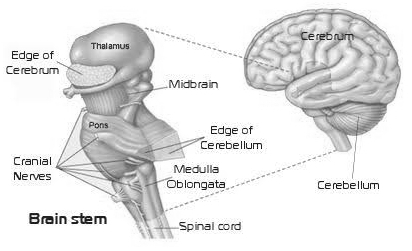
Three major regions make up the brain stem i.e. mid brain, pons and medulla oblongata.

Cerebrum is a part of forebrain which does not form brain stem.

Options ($1$), ($3$) and ($4$) are incorrect.
View full question & answer
MCQ 21 Mark
Match List $I$ with List $II$

List $I$ List $II$
$A.$ Pons $I.$ Provides additional space for Neurons, regulates posture and balance.
$B.$ Hypothalamus $II.$ Controls respiration and gastric secretions.
$C.$ Medulla $III.$ Connects different regions of the brain.
$D.$ Cerebellum $IV.$ Neuro secretory cells

Choose the correct answer from the options given below :

  • $ A-III, B-IV, C-II, D-I$
  • B
    $ A-I, B-III, C-II, D-IV$
  • C
    $A-II, B-I, C-III, D-IV$
  • D
    $A-II, B-III, C-I, D-IV$
Answer
Correct option: A.
$ A-III, B-IV, C-II, D-I$
a
The correct answer is option ($1$) as
$A.$ Pons $-$ Part of hindbrain, it connects different regions of the brain.
$B.$ Hypothalamus $-$ Also have neuro secretory cells which secrete hormones.
$C.$ Medulla $-$ Part of hindbrain which controls respiration and gastric secretions.
$D.$ Cerebellum $-$ Part of hindbrain with convoluted surface which provides additional space for neurons, also regulates posture and balance.
View full question & answer
MCQ 31 Mark
The parts of human brain that helps in regulation of sexual behaviour, expression of excitement, pleasure, rage, fear etc. are:
  • A
    Corpus callosum and thalamus
  • Limbic system and hypothalamus
  • C
    Corpora quadrigemina and hippocampus
  • D
    Brain stem and epithalamus
Answer
Correct option: B.
Limbic system and hypothalamus
b
Option $(2)$ is the correct answer because limbic system along with hypothalamus regulate the sexual behaviour, expression of excitement, pleasure, rage, fear, etc.

Option $(1),(3)$ and $(4)$ are not correct because corpora quadrigemina is a part of the midbrain and consists of four round swellings. Corpus callosum is a tract of nerve fibres that connects right and left cerebral hemispheres. Thalamus is a major coordinating centre in the forebrain for sensory and motor signalling. Midbrain, pons and medulla oblongata together form the brain stem.

View full question & answer
MCQ 41 Mark
Select the incorrect statement regarding synapses :
  • A
    Electrical current can flow directly from one neuron into the other across the electrical synapse
  • B
    Chemical synapses use neurotransmitters
  • Impulse transmission across a chemical synapse is always faster than that across an electrical synapse
  • D
    The membranes of presynaptic and postsynaptic neurons are in close proximity in an electrical synapse
Answer
Correct option: C.
Impulse transmission across a chemical synapse is always faster than that across an electrical synapse
c
View full question & answer
MCQ 51 Mark
Which part of the brain is responsible for thermoregulation?
  • A
    Cerebrum
  • Hypothalamus
  • C
    Corpus callosum
  • D
    Medulla oblongata
Answer
Correct option: B.
Hypothalamus
b
View full question & answer
MCQ 61 Mark
Which of the following structures or regions is incorrectly paired with its function?
  • A
    Corpus callosum : band of fibers connecting left and right cerebral hemispheres
  • B
    Medulla oblongata: Controls respiration and cardiovascular reflexes
  • C
    Hypothalamus: Production of releasing hormones and regulation of temperature, hunger and thirst
  • Limbic system: Consists of fibre tracts that interconnect different regions of brain; controls movement.
Answer
Correct option: D.
Limbic system: Consists of fibre tracts that interconnect different regions of brain; controls movement.
d
View full question & answer
MCQ 71 Mark
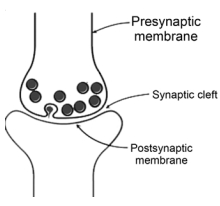
Receptor sites for neurotransmitters are present on
  • A
    pre­synaptic membrane
  • B
    tips of axons
  • post­synaptic membrane
  • D
    membranes of synaptic vesicles.
Answer
Correct option: C.
post­synaptic membrane
c
(c) : Neurotransmitter is a chemical substance responsible for transmission of nerve impulse across synapse. It is released by synaptic vesicle into the synaptic cleft. Neurotransmitter binds with protein receptor molecule present on post synaptic membrane causing its depolarisation and generation of action potential.
View full question & answer
MCQ 81 Mark
Which of the following regions of the brain is incorrectly paired with its function?
  • A
    Corpus callosum $⇒$­ communication between the left and right cerebral cortices
  • B
    Cerebrum $⇒$­ calculation and contemplation
  • C
    Medulla oblongata $⇒$­ homeostatic control
  • Cerebellum $⇒$­ language comprehension
Answer
Correct option: D.
Cerebellum $⇒$­ language comprehension
d
(d) : Language comprehension is a function of cerebrum. Cerebellum coordinates and controls rapid muscular activities such as running, typing etc. Although it does not initiate such voluntary movements, but it is an important centre for coordinating movements and for controlling posture and balance. Cerebellum’s function is almost exclusively motor; but it is also implicated in some forms of learning.
View full question & answer
MCQ 91 Mark
Injury localized to the hypothalamus would most likely disrupt
  • A
    short ­- term memory
  • B
    co-­ordination during locomotion
  • C
    executive functions, such as decision making
  • regulation of body temperature.
Answer
Correct option: D.
regulation of body temperature.
d
(d) : Hypothalamus lies at the base of the thalamus. It provides anatomical connection between the nervous and endocrine systems by its relationship to the pituitary gland. Hypothalamus is thermoregulatory centre. Hence, it is called “thermostat” of the body. It keeps body temperature at roughly $37^°C$ by means of a complex thermostat system. Any localised injury to hypothalamus will, hence, disrupt regulation of body temperature.
View full question & answer
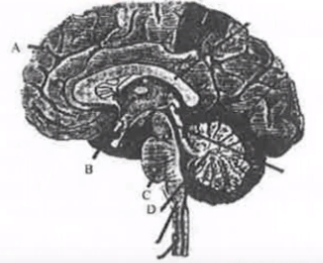
MCQ 101 Mark
A sagittal section of human brain is shown here. Identify at least two labels from $A-­D$.
  • A
    $C$ - ­Mid brain, $D$ - ­Cerebellum
  • $A$ - ­Cerebrum, $C$ - ­Pons
  • C
    $B$ - ­Corpus callosum, $D$ - ­Medulla
  • D
    $A$ - ­Cerebral hemispheres, $B$ - ­Cerebellum
Answer
Correct option: B.
$A$ - ­Cerebrum, $C$ - ­Pons
b
(b) : $A$ -­ Cerebral hemisphere

$B$ -­ Thalamus

$C$ -­ Pons varolii

$D$ -­ Cerebellum

View full question & answer
MCQ 111 Mark
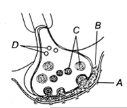
The figure shows an axon terminal and synapse. Select the option giving correct identification of labels $A-­D$.
  • A
    $A$ - ­Action potential, $C$ - ­Neurotransmitter
  • B
    $B$ - ­Neurotransmitter, $D$ -­ Receptor capsules
  • $C$ - ­Receptor, $D$ - ­Synaptic vesicles
  • D
    $A$ - ­Axon terminal, $B$ -­ Serotonin complex
Answer
Correct option: C.
$C$ - ­Receptor, $D$ - ­Synaptic vesicles
c
(c) : $A$ -­ Action potential

$B$ -­ Neurotransmitter

$C$ -­ Receptor

$D$ -­ Synaptic vesicles

View full question & answer
MCQ 121 Mark
The most abundant intracellular cation is
  • A
    $H^+$
  • $K^+$
  • C
    $Na^+$
  • D
    $Ca^{++}$
Answer
Correct option: B.
$K^+$
b
(b) : $K^+$ ions predominate in the intracellular fluid whereas $Na^+$ ions predominate in extracellular fluid.
View full question & answer
MCQ 131 Mark
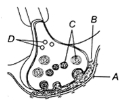
A diagram showing axon terminal and synapse is given. Identify correctly at least two of $A - D$.
  • A
    $A$ -­ Neurotransmitter, $B$ -­ Synaptic cleft
  • B
    $C$ -­ Neurotransmitter, $D$ -­ $Ca^{++}$
  • $A$ -­ Receptor, $C$ -­ Synaptic vesicles
  • D
    $B$ -­ Synaptic connection, $D$ -­ $K^+$
Answer
Correct option: C.
$A$ -­ Receptor, $C$ -­ Synaptic vesicles
c
(c)
View full question & answer
MCQ 141 Mark
$A$ : Presence of myelin sheath increases the rate of conduction of nerve impulse.

$R$ : Ionic channels are absent in the area covered by myelin sheath therefore, depolarization occurs only at the nodes of Ranvier, resulting in saltatory or jumping conduction.

  • A
    Assertion and Reason both are correct and also correct explanation.
  • B
    Assertion and Reason both are correct but not explanation of assertion.
  • Assertion is correct, but Reason is incorrect.
  • D
    Both Assertion and Reason are incorrect.
Answer
Correct option: C.
Assertion is correct, but Reason is incorrect.
c
Presence of myelin sheath causes fast conduction ionic channels are less in between nodes of Ranvier and concentrated more in node of Ranvier.
View full question & answer
MCQ 151 Mark
Which of the following is not related to the autonomic nervous system?
  • A
    Peristalsis
  • B
    Digestion
  • C
    Excretion
  • Memory and learning
Answer
Correct option: D.
Memory and learning
d
Cerebrum of forebrain (central nervous system) is the centre for memory and learning.
View full question & answer
MCQ 161 Mark
Choose incorrect statement.
  • A
    Myelinated nerve fibres are found in spinal and cranial nerves.
  • B
    Unmylinated nerve fibre is commonly found in autonomous and the somatic neural systems.
  • A neuron is a microscopic structure composed of cyton only
  • D
    The afferent nerve fibres transmit impulses from tissues/organs to $CNS.$
Answer
Correct option: C.
A neuron is a microscopic structure composed of cyton only
c
View full question & answer
MCQ 171 Mark
Match the following:

Column $-I$

Column $-II$

$(a)$ Uni polar neurons

$(1)$ Amygdala and Hippocamus

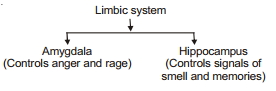
$(b)$ Lymbic system

$(2)$ Centre for control of body

$(c)$ Hypothalamus temperature

$(3)$ Embryonic stage

  • A
    $(a-1), (b-3), (c-2) $
  • $(a-3), (b-1), (c-2) $
  • C
    $(a-2), (b-1), (c-3)$
  • D
    $(a-3), (b-2), (c-1)$
Answer
Correct option: B.
$(a-3), (b-1), (c-2) $
b
View full question & answer
MCQ 181 Mark
$I.$ The endocrine system provide chemical integration through hormones.

$II.$ The neural system provides an organized network of point to point connection for a quick coordination.

$III.$ The neural organization is very complex in lower invertebrates.

$IV.$ The human neural system includes $CNS$ and $PNS$

Select the correct statements.

  • A
    Only $I$
  • B
    $I$ and $II $
  • $I, II$ and $IV$
  • D
    $I,$ and $III $
Answer
Correct option: C.
$I, II$ and $IV$
c
View full question & answer
MCQ 191 Mark
Which of the following are the properties of neural system?
  • A
    Conductivity and elasticity
  • B
    Excitability and elasticity
  • C
    Flexibility and excitability
  • Excitability and conductivity
Answer
Correct option: D.
Excitability and conductivity
d
View full question & answer
MCQ 201 Mark
Autonomic nervous system is
  • Paired chain ganglia
  • B
    Brain and spinal cord
  • C
    Sense organs
  • D
    Cerebral hemispheres
Answer
Correct option: A.
Paired chain ganglia
a
(a)In which sympathetic nerve fibres are included.
View full question & answer
MCQ 211 Mark
Which is a wrong relation
  • Conditioned reflex -Hodgkins
  • B
    Blood circulation -W. Harvey
  • C
    DNA double helix model -Watson and Crick
  • D
    None
Answer
Correct option: A.
Conditioned reflex -Hodgkins
a
(a)Conditional reflexes were first demonstrated by the Russian scientist. Pavlov in dogs.
View full question & answer
MCQ 221 Mark
Which part of the brain is like a defense castle controlling moods and plays an important role in emotional behaviour, such as aggression and remembering fear?
  • A
    Hippocampus
  • Amygdala
  • C
    Limbic system
  • D
    Thalamus
Answer
Correct option: B.
Amygdala
b
The emotional reaction such as aggression and fear is controlled by amygdala of the limbic system
View full question & answer
MCQ 231 Mark
The canal passing through the midbrain is called
  • A
    Medulla oblongata
  • Cerebral aqueduct
  • C
    Eustachian tube
  • D
    Aqueous chamber
Answer
Correct option: B.
Cerebral aqueduct
b
There is no ventricle in the midbrain, instead a passage is present which connects $III^{rd}$ ventricle to the $IV^{rth}$ ventricle and is known as cerebral aqueduct or iter
View full question & answer
MCQ 241 Mark
The part of human brain located between thalamus/ hypothalamus and pons is
  • A
    Forebrain
  • Midbrain
  • C
    Hindbrain
  • D
    Vestibular apparatus
Answer
Correct option: B.
Midbrain
b
Midbrain is located between thalamus of forebrain and pons of hindbrain
View full question & answer
MCQ 251 Mark
The limbic system is formed by
  • A
    The hypothalamus, epithalamus, amygdala and hippocampus
  • Hypothalamus, amygdala and limbic system
  • C
    Corpora quadrigemina and hippocampus
  • D
    Midbrain and hindbrain
Answer
Correct option: B.
Hypothalamus, amygdala and limbic system
b
Limbic system is comprised of hypothalamus, amygdala and hippocampus
View full question & answer
MCQ 261 Mark
The association areas are not responsible for
  • A
    Intersensory associations
  • B
    Communication
  • Regulation of sexual behaviour
  • D
    Memory
Answer
Correct option: C.
Regulation of sexual behaviour
c
Limbic system is responsible for the regulation of sexual behaviour. Association areas regulate intersensory association, communication and memory
View full question & answer
MCQ 271 Mark
The association areas are present in the
  • Cerebral cortex
  • B
    Corpus callosum
  • C
    Amygdala
  • D
    Hypothalamus
Answer
Correct option: A.
Cerebral cortex
a
Cerebral cortex is comprised of three regions:-
$(a)$ Sensory areas
$(b)$ Motor areas
$(c)$ Association areas (which helps in the association of sensory and moter nerve impulses)
View full question & answer
MCQ 281 Mark
All of the following are parts of forebrain, except
  • Cerebellum
  • B
    Corpus callosum
  • C
    Association areas
  • D
    Hypothalamus
Answer
Correct option: A.
Cerebellum
a
Cerebellum is the part of the hind brain, while corpus callosum, association areas and hypothalamus are part of forebrain
View full question & answer
MCQ 291 Mark
Which of the following meninges is in contact with the brain tissue?
  • A
    Duramater
  • B
    Arachnoid
  • Piamater
  • D
    No meninx is in contact with the brain tissue
Answer
Correct option: C.
Piamater
c
Duramater - Outermost layer of meninx
Piamater - Innermost layer of meninx which is in contact with the brain tissue
View full question & answer
MCQ 301 Mark
Which of the following is/are controlled by the human brain?

$(a)$. Balance of the body

$(b)$. Circadian rhythm of the body

$(c)$. Human behaviour

$(d)$. Functioning of heart and kidneys
 

  • A
    $Only \;d$
  • B
    $a \;and \;d$
  • C
    $a, b\; and \;c$
  • $a, b, c, d$
Answer
Correct option: D.
$a, b, c, d$
d

View full question & answer
MCQ 311 Mark
Along with hypothalamus, limbic system is involved in the

$I.$ thermoregulation

$II.$ regulation of sexual behavior

$III.$ expression of emotional reactions (e.g., excitement, pleasure, rage and fear)

$IV.$ memory

Choose the correct option

  • All except $I$
  • B
    All except $II$
  • C
    All except $III$
  • D
    All except $IV$
Answer
Correct option: A.
All except $I$
a
All except $I.$

The inner parts of cerebral hemisphere and a group of associated deep structures like amygdala, hippocampus, etc. form a complex structure called the limbic lobe or limbic system along with hypothalamus. It is involved in the regulation of sexual behavior expression of emotional reactions, $(e . g .,$, excitement, pleasure, rage and fear) and motivation

View full question & answer
MCQ 321 Mark
A man is admitted in a hospital. He is suffering from an abnormally low body temperature, loss of appetite and extreme thirst. His brain scan would probably show a tumour in
  • A
    Medulla oblongata
  • B
    Pons Varolii
  • C
    Cerebellum
  • Hypothalamus
Answer
Correct option: D.
Hypothalamus
d
Hypothalamus is a control centre for hunger, thirst, sweating, sleep, fatigue, temperature, anger, pleasure, love, hate and satisfaction. Thus, if a man is suffering from the given abnormalities, he has a tumour in his hypothalamus.
View full question & answer
MCQ 331 Mark
Read the following statements carefully and select the correct option

$I.$ The medulla is connected to the spinal cord

$II.$ Medulla contains controlling centres for respiration, cardiovascular reflexes and gastric secretion

$III.$ Cerebellum has very convoluted surface in order to provide the additional space for more neurons

  • $I$ and $II$
  • B
    $II$ and $III$
  • C
    $I$ and $III$
  • D
    $I, II$ and $III$
Answer
Correct option: A.
$I$ and $II$
a
Cerebrum is highly convuluted to form sulci and gyri
View full question & answer
MCQ 341 Mark
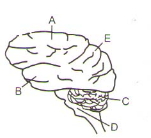
In the diagram of the lateral view of the human brain, parts are indicated by alphabets. Choose the answer in which these alphabets have been correctly matched with the part which they indicate.
  • A
    $A-$ Temporal lobe  ;  $B-$ Parietal lobe  ;  $C-$ Cerebellum  ;  $D-$ Medulla oblongata  ;  $E- $ Frontal lobe
  • B
    $A-$ Frontal lobe  ;  $B-$ Temporal lobe  ;  $C-$ Cerebrum  ;  $D-$ Medulla oblongata  ;  $E-$ Occipital lobe
  • C
    $A-$ Temporal lobe  ;  $B-$ Parietal lobe  ;  $C-$ Cerebrum  ;  $D-$ Medulla oblongata  ;  $E-$ Frontal lobe
  • $A-$ Frontal lobe  ;  $B-$ Temporal lobe  ;  $C-$ Cerebellum  ;  $D-$ Medulla oblongata  ;  $E-$ Parietal lobe
Answer
Correct option: D.
$A-$ Frontal lobe  ;  $B-$ Temporal lobe  ;  $C-$ Cerebellum  ;  $D-$ Medulla oblongata  ;  $E-$ Parietal lobe
d
$1.$ Frontal lobe
$2.$Temporal lobe
$3.$ Cerebellum
$4.$ Medulla oblongata
$5.$ Parietal lobe
View full question & answer
MCQ 351 Mark
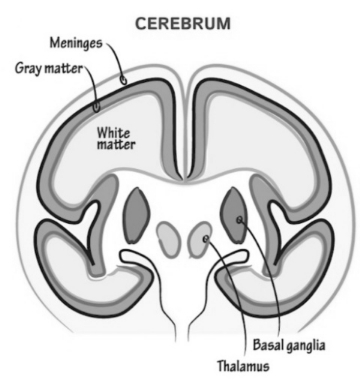
Which of the following statements are correct about the cortex of cerebrum? Choose the correct codes given below

$(I)$. It consists of grey matter

$(II)$. It shows prominent folds

$(III)$. It consists of white matter

$(IV)$. It contains motor areas, sensory areas and association areas Codes

  • A
    $(I),(II)$ and $(III)$
  • B
    $(II),(III)$ and $(IV)$
  • $(I), (II), (III)$ and $(IV)$
  • D
    None of these
Answer
Correct option: C.
$(I), (II), (III)$ and $(IV)$
c
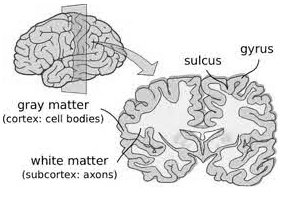
The $CORTEX$ outer part consists of grey mater that is highly folded to form sulci and gyri and Inner part of cerebral hemisphere consists of the white matter, due to the fibres of the tracts covered with the myelin sheath.


The cerebral cortex contains motor areas, sensory areas and large regions that are neither clearly sensory motor in function. These regions are called as the association areas.

View full question & answer
MCQ 361 Mark
Brain controls the
  • A
    Voluntary movements
  • B
    Balance of the body
  • C
    Functioning of vital involuntary organs
  • All of the above
Answer
Correct option: D.
All of the above
d
Brain acts as the command and control system and it controls the voluntary movements, balance of the body, functioning of vital involuntary organs $(e . g .,$, lungs, heart, kidneys, etc.), thermoregulation, hunger and thrist, circadian ($24$  hours) rhythms of our body, activities of several endocrine glands and human behavior.


It is the site for processing of vision, hearing, speech, memory, intelligence, emotions and thoughts

View full question & answer
MCQ 371 Mark
Functions of association areas in cerebral cortex includes
  • A
    Intersensory associations
  • B
    Memory
  • C
    Communication
  • All of the above
Answer
Correct option: D.
All of the above
d
The cerebral cortex contains motor areas, sensory areas and large regions that are neither clearly sensory motor in function. These regions are called as the association areas. These are responsible for complex functions like intersensory associations, memory and communication
View full question & answer
MCQ 381 Mark
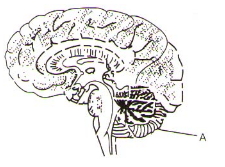
In the given diagram, what does '$A$' represents?
  • A
    Pons Varolii
  • Cerebellum
  • C
    Medulla oblongata
  • D
    Midbrain
Answer
Correct option: B.
Cerebellum
b
Cerebellum consists of two lateral cerebellar hemispheres. A cross section of cerebellar hemisphere shows a branching tree-like arrangement of grey and white matter called the arbor vitae. It is the second largest part of brain. It helps control body posture, maintenance of muscle tone, coordinate voluntary muscular activties and equilibrium of body.
View full question & answer
MCQ 391 Mark
Which of the following statements are correct about the midbrain?

$(I)$. Located between the thalamus/hypothalamus

$(II)$. Has a canal named cerebral aqueduct passes through

$(III)$. Dorsal part consists of $4$ lobes

Choose the correct option

  • A
    $(I)$ and $(II)$
  • B
    $(II)$ and $(III)$
  • C
    $(I)$ and $(III)$
  • $(I), (II)$ and $(III)$
Answer
Correct option: D.
$(I), (II)$ and $(III)$
d
Midbrain is located between the thalamus/hypothalamus of the forebrain and pons of the hindbrain. A canal, called the cerebral aqueduct passess through the midbrain. The dorsal portion of the midbrain consists of four round swellings (lobes) called corpora quadrigemina
View full question & answer
MCQ 401 Mark
Inner part of cerebral cortex is referred as
  • White matter
  • B
    Grey matter
  • C
    Both $(a)$ and $(b)$
  • D
    Non-myelinated nerve fibres
Answer
Correct option: A.
White matter
a
Cerebrum forms the major part of the human brain. A deep cleft divides the cerebrum longitudinally into two halves, termed as the left and right cerebrum hemispheres. The layer of cells, which covers the cerebral hemisphere is called cerebral cortex. Cerebral cortex is referred to as the grey matter. While the inner part is made up of white matter
View full question & answer
MCQ 411 Mark
The forebrain develops into
  • A
    Diencephalon and pons
  • B
    Diencephalon and medulla
  • Diencephalon and cerebrum
  • D
    Diencephalon and cerebellum
Answer
Correct option: C.
Diencephalon and cerebrum
c
Forebrain, also known as prosencephalon forms the greater part of the brain. It consists of three regions-olfactory lobes, cerebral hemisphere (cerebrum) and diencephalon
View full question & answer
MCQ 421 Mark
Memory is the responsibility of
  • A
    Grey matter
  • B
    White matter
  • Cerebrum
  • D
    Cerebellum
Answer
Correct option: C.
Cerebrum
c
Cerebrum is formed of one pair largest sized lobes called cerebral hemisphere. These form $80 \%$ weight of brain. Cerebral hemisphere controls all the voluntary activities of body. It is seat of memory, will, intelligency, reasoning and learning.
View full question & answer
MCQ 431 Mark
Inside the skull, the brain is covered by
  • A
    Arachnoid
  • Cranial meninges
  • C
    Piamater
  • D
    Duramater
Answer
Correct option: B.
Cranial meninges
b
The human brain is well protected by the skull. Inside the skull, the brain is covered by cranial meninges, consisting of an outer layer called duramater, a very thin middle layer called arachnoid and an inner layer called piamater
View full question & answer
MCQ 441 Mark
On the basis of nature of nerve fibres, the nerves are
  • A
    Medullated and non-medullated nerves
  • B
    Myelinated and non-myelinated nerves
  • Sensory, motor and mixed nerves
  • D
    Sensory and motor nerves
Answer
Correct option: C.
Sensory, motor and mixed nerves
c
On the basis of nature of nerve fibres, the nerves are of three types

$(i)$ Sensory (Afferent) Nerves These contains only sensory nerve fibres

$(ii)$ Motor (Efferent) Nerves These contains only motor nerve fibres

$(iii)$ Mixed nerves These contains both sensory and motor nerve fibres

View full question & answer
MCQ 451 Mark
Association areas are regions found in
  • A
    Cerebrum
  • Cerebral cortex
  • C
    Cerebellum
  • D
    Diencephalon
Answer
Correct option: B.
Cerebral cortex
b
Association areas the neither sensory nor motor in function and are found in the cerebral cortex
View full question & answer
MCQ 461 Mark
The medulla contains centres which control
  • A
    Respiration
  • B
    Cardiovascular reflexes
  • C
    Gastric secretions
  • All of the above
Answer
Correct option: D.
All of the above
d
The medulla is also called as the medulla oblongata. The medulla contains centres which control respiration, cardiovascular reflexes and gastric secretions
View full question & answer
MCQ 471 Mark
The central information processing organ of our body is
  • A
    Heart
  • B
    Spinal cord
  • Brain
  • D
    All of the above
Answer
Correct option: C.
Brain
c
The brain is the central information processing organ of our body
View full question & answer
MCQ 481 Mark
Respiratory control centre is
  • Medulla oblongata
  • B
    Cerebellum
  • C
    Spinal cord
  • D
    cerebrum
Answer
Correct option: A.
Medulla oblongata
a
Medulla oblongata controls involuntary functions of body through a number of centres like cardiac centre, respiratory centre, vasomotor centres (contraction of blood vessels) salivary centres etc.
View full question & answer
MCQ 491 Mark
The tract of nerve fibres which connects the cerebral hemisphere is
  • A
    Corpus luteum
  • Corpus callosum
  • C
    Corpora quadrigemina
  • D
    Cerebral aqueduct
Answer
Correct option: B.
Corpus callosum
b
Cerebrum forms the major part of the human brain. A deep cleft divided the cerebrum longitudinally into two halves-left and right cerebral hemispheres. The hemispheres are connected by a tract of nerve fibres called corpus callosum.
View full question & answer
MCQ 501 Mark
Hypothalamus does not control
  • A
    Hunger and satiety
  • B
    Thermoregulation
  • Diurnal Rhythm
  • D
    Emotions
Answer
Correct option: C.
Diurnal Rhythm
c
Hypothalamus is a control centre of autonomic nervous system. It controls hunger, thirst, thermoregulation, emotions like love, anger, pleasure, etc.
View full question & answer
MCQ 511 Mark
Brains acts as the ...$A$... and ...$B$... system.

Here, $A$ and $B$ refer to

  • Command; control
  • B
    Voluntary; involuntary
  • C
    Compound; voluntary
  • D
    Control; involuntary
Answer
Correct option: A.
Command; control
a
Brain acts as the command and control system
View full question & answer
MCQ 521 Mark
The cerebral cortex is referred to as the grey matter due to its greyish appearance. The ........... are concentrated here giving the colour.
  • A
    Axons
  • Neuron cell bodies
  • C
    Dendrites
  • D
    Synaptic cleft
Answer
Correct option: B.
Neuron cell bodies
b
View full question & answer
MCQ 531 Mark
Brain stem is formed by .........
  • A
    Fore brain and hind brain
  • B
    Fore brain and mid brain
  • C
    Fore brain, mid brain and hind brain
  • Mid brain and hind brain
Answer
Correct option: D.
Mid brain and hind brain
d
View full question & answer
MCQ 541 Mark
The medulla contains centers which control
  • A
    Respiration
  • B
    Cardio vascular reflexes
  • $AB$ correct
  • D
    $AB$ incorrect
Answer
Correct option: C.
$AB$ correct
c
View full question & answer
MCQ 551 Mark
Corpora quadrigemina is a part of......
  • Mid brain
  • B
    Corpus callosum
  • C
    Retina
  • D
    Hind brain
Answer
Correct option: A.
Mid brain
a
View full question & answer
MCQ 561 Mark
Association areas of brain are responsible for

$a.$ Memory

$b.$ Communication

$c.$ Blood pressure

  • A
    $b$ and $c$
  • B
    $c$ and $a$
  • C
    only $c$
  • $a$ and $b$
Answer
Correct option: D.
$a$ and $b$
d
View full question & answer
MCQ 571 Mark
Choose the correct sequence for cranial menings. (Outer to inner)
  • A
    Arachnoid $\rightarrow$ Duramater $\rightarrow$ Pia mater
  • Dura mater $\rightarrow$ Arachnoid $\rightarrow$ Pia mater
  • C
    Piamater $\rightarrow$ Arachnoid $\rightarrow$ Duramater
  • D
    Duramater $\rightarrow$ Pia mater $\rightarrow$ Arachnoid.
Answer
Correct option: B.
Dura mater $\rightarrow$ Arachnoid $\rightarrow$ Pia mater
b
View full question & answer
MCQ 581 Mark
What is correct for association area of cerebral cortex ?
  • Intersensory association, memory and communication.
  • B
    Memory, Emotional, reaction, Reflex action
  • C
    Biological clock, Sexual behavior, memory
  • D
    Communication, biological clock intersensory communication
Answer
Correct option: A.
Intersensory association, memory and communication.
a
View full question & answer
MCQ 591 Mark
Pons of the brain connect the
  • cerebellum and medulla
  • B
    Cerebrum and cerebellum
  • C
    Spinal cord with the brain
  • D
    Two cerebral hemisphere
Answer
Correct option: A.
cerebellum and medulla
a
View full question & answer
MCQ 601 Mark
Hypothalamus controls

$I.$ Urge for eating and drinking

$II.$ Body temperature

$III.$ Hormones production that regulates the secretion of pituitary gland.

$IV.$ Creative thinking and consciousness.

  • A
    $I$ and $IV$ are correct
  • B
    Only $II$ and $III$ are correct
  • C
    $IV$ and $II$ are correct
  • $I, II$ and $III$ are correct
Answer
Correct option: D.
$I, II$ and $III$ are correct
d
View full question & answer
MCQ 611 Mark
Association areas of the brain are
  • A
    Always sensory areas
  • B
    Always motor areas
  • Large regions that neither sensory nor motor areas
  • D
    None of the above
Answer
Correct option: C.
Large regions that neither sensory nor motor areas
c
View full question & answer
MCQ 621 Mark
Read the following statements carefully and select the correct option.

$I.$ The medulla is connected to the spinal cord.

$II.$ Medulla contains controlling centers for respiration, cardiovascular reflexes and gastric secretion.

$III.$ Cerebellum has very convoluted surface in order to provide the additional space for more neurons.

  • A
    Only $I$
  • B
    Only $I$ and $III$
  • C
    Only $III $
  • $I, II, III$
Answer
Correct option: D.
$I, II, III$
d
View full question & answer
MCQ 631 Mark
Association areas are responsible for complex function like.
  • A
    Intersensory association
  • B
    Memory
  • C
    Communication
  • All of the above
Answer
Correct option: D.
All of the above
d
View full question & answer
MCQ 641 Mark
Brain stem consists of
  • A
    Medulla, pons, cerebellum
  • B
    Cerebellum, hypothalamus, mid brain
  • Pons, cerebellum, medulla and mid brain.
  • D
    $A$ and $B$ both
Answer
Correct option: C.
Pons, cerebellum, medulla and mid brain.
c
View full question & answer
MCQ 651 Mark
Which of the following part contains centers, control respiration cardiovascular reflexes and gastric secretions
  • A
    Cerebral aqueduct
  • B
    Pons
  • C
    Cerebellum
  • Medulla
Answer
Correct option: D.
Medulla
d
View full question & answer
MCQ 661 Mark
Which part of the brain is involved in loss of control when a person drinks alcohol
  • Cerebellum
  • B
    Cerebrum
  • C
    Medulla oblongata
  • D
    Pons varoli
Answer
Correct option: A.
Cerebellum
a
(a) Because cerebellum is not concerned with conscious sensations. It maintains equilibrium.
View full question & answer
MCQ 671 Mark
Hypothalamus does not control
  • A
    Hunger and satiety
  • B
    Thermoregulation
  • C
    Libido
  • Creative thinking and consciousness
Answer
Correct option: D.
Creative thinking and consciousness
d
(d)Hypothalamus contains higher nerve centre for temperature regulation, hunger, thirst and osmoregulation.
View full question & answer
MCQ 681 Mark
Physiological state of body is controlled by
  • A
    Thalamus
  • B
    Cerebellum
  • Hypothalamus
  • D
    All of the above
Answer
Correct option: C.
Hypothalamus
c
(c)Hypothalamus controls the physiological state of body such as eating, drinking, body temperature etc.
View full question & answer
MCQ 691 Mark
That part of the brain which is involved in interpreting an input, storing input information and initiating a response in the light of similar past experience is
  • A
    Motor area
  • B
    Sensory area
  • Association area
  • D
    Pons
Answer
Correct option: C.
Association area
c
It's Obvious
View full question & answer
MCQ 701 Mark
Which of the following is not correctly matched
  • A
    Rhinocephalon - Olfaction
  • B
    Hypothalamus - Pituitary
  • C
    Cerebellum - Balance
  • Medulla oblongata - Temperature regulation
Answer
Correct option: D.
Medulla oblongata - Temperature regulation
d
(d)Medulla oblongata controls blood pressure, heart beat etc.
View full question & answer
MCQ 721 Mark
Medulla oblongata controls
  • Blood pressure
  • B
    Synapse
  • C
    High temperature
  • D
    Low temperature
Answer
Correct option: A.
Blood pressure
a
It's Obvious
View full question & answer
MCQ 731 Mark
Breathing is controlled by
  • A
    Lungs
  • B
    Trachea
  • Medulla oblongata
  • D
    Hypothalamus
Answer
Correct option: C.
Medulla oblongata
c
(c) Medulla oblongata contains centre for the autonomic reflex control of respiration,

heart beat and these centre are called vital centres because demage to them is usually total.

View full question & answer
MCQ 741 Mark
Main function of cerebellum is
  • Balancing
  • B
    To see
  • C
    To hear
  • D
    Remembering
Answer
Correct option: A.
Balancing
a
It's Obvious
View full question & answer
MCQ 751 Mark
Ventilation is controlled by
  • A
    Cerebellum
  • Medulla oblongata
  • C
    Cerebrum
  • D
    Mesencephalon
Answer
Correct option: B.
Medulla oblongata
b
It's Obvious
View full question & answer
MCQ 761 Mark
Which of the following forms the covering of the central nervous system of man
  • A
    Duramater and piamater
  • B
    Duramater and arachnoid membrane
  • C
    Arachnoid membrane and piamater
  • Duramater, arachnoid mater and piamater
Answer
Correct option: D.
Duramater, arachnoid mater and piamater
d
(d)Central nervous system comprises the brain and spinal cord, both are surrounded by the three protective membranes. These are piamater, arachnoid and dura mater.
View full question & answer
MCQ 771 Mark
Which part of the human brain controls homeostasis
  • A
    Cerebrum
  • B
    Cerebellum
  • C
    Medulla oblongata
  • Hypothalamus
Answer
Correct option: D.
Hypothalamus
d
(d)It integrates and controls the visceral activities. It maintains homeostasis.
View full question & answer
MCQ 781 Mark
Cerebral hemisphere is the centre of
  • A
    Thinking
  • B
    Will power
  • C
    Reasoning
  • All of these
Answer
Correct option: D.
All of these
d
(d) Cerebrum $(cerebral\,\, hemisphere)$ is centre of thinking, will power reasoning and memory experience and learning knowledge and articulate speech.
View full question & answer
MCQ 791 Mark
In which part of the following, the vomiting centre is situated
  • A
    Cerebrum
  • B
    Cerebellum
  • Medulla oblongata
  • D
    Hypothalamus
Answer
Correct option: C.
Medulla oblongata
c
(c) Medulla oblongata contains center that regulate heart rate, B.P., breathing, vomiting, sneezing and some other involuntary movements.
View full question & answer
MCQ 801 Mark
Cerebral hemispheres are the centres of
  • Thinking
  • B
    Balance
  • C
    Smell
  • D
    Taste
Answer
Correct option: A.
Thinking
a
It's Obvious
View full question & answer
MCQ 811 Mark
In mammals, the corpus callosum connects
  • A
    Bone to a muscle
  • B
    Bone to a bone
  • The two cerebral hemispheres
  • D
    The two optic lobes
Answer
Correct option: C.
The two cerebral hemispheres
c
(c)Corpus callosum is a large commissure of fibres inter connecting the two cerebral hemispheres in mammals.
View full question & answer
MCQ 821 Mark
The arachnoid membrane covers the
  • A
    Spinal cord
  • B
    Otic capsule
  • Piamater
  • D
    None of the above
Answer
Correct option: C.
Piamater
c
(c)Arachnoidmater lies between the duramater and piamater.
View full question & answer
MCQ 831 Mark
The membranes enclosing the brain and spinal cord are known as
  • Meninges
  • B
    Meningitis
  • C
    Nephron
  • D
    Axon
Answer
Correct option: A.
Meninges
a
(a) Brain and spinal cord are surrounded by three meninges -duramater and piamater, arachnoid in mammals.
View full question & answer
MCQ 841 Mark
Reflexes for maintaining vital functions like blood pressure are localised in
  • Hind brain
  • B
    Mid brain
  • C
    Fore brain
  • D
    Cerebrum
Answer
Correct option: A.
Hind brain
a
(a) Medulla oblongata of hind brain it contains centres that regulate heart beat, blood pressure breathing swallowing, salivation,

sneezing vomiting and coughing and some other involuntary movements.

View full question & answer
MCQ 851 Mark
The innermost meninx surrounding the central nervous system in frog and man respectively are
  • Piamater and piamater
  • B
    Arachnoid and piamater
  • C
    Piamater and duramater
  • D
    Arachanoid and duramater
Answer
Correct option: A.
Piamater and piamater
a
It's Obvious
View full question & answer
MCQ 861 Mark
Which is correct about human brain
  • A
    It is covered by two membranes
  • B
    There is no blood brain barrier
  • C
    Largest number of cranial nerves originate from cerebral hemisphere
  • Cerebral cortex is highly developed
Answer
Correct option: D.
Cerebral cortex is highly developed
d
It's Obvious
View full question & answer
MCQ 871 Mark
What is found in the periphery of spinal cord
  • A
    Grey matter
  • B
    Myelinated nerve
  • White matter
  • D
    Notochord
Answer
Correct option: C.
White matter
c
(c)The thick wall of spinal cord consists of an inner zone of gray matter and a peripheral zone of white matter.
View full question & answer
MCQ 881 Mark
An injury to diencephalon may result in
  • A
    Loss of understanding
  • B
    Loss of learning
  • C
    Loss of intelligence
  • Loss of heat sensation
Answer
Correct option: D.
Loss of heat sensation
d
(d)Due to damage in thermoreceptor.
View full question & answer
MCQ 891 Mark
Which part of the brain can distinguish the perfume smell
  • A
    Temporal cortex
  • B
    Olfactory bulb
  • C
    Olfactory tract
  • Olfactory lobe
Answer
Correct option: D.
Olfactory lobe
d

olfactory bulb found in base of fore brain process the smell signal received through sensory nerve.


View full question & answer
MCQ 901 Mark
White matter consists of
  • Nerve fibres with myelinated sheath
  • B
    Nerve fibres without myelinated sheath
  • C
    Scattered areolar tissue
  • D
    Nerve fibres with blood vessels
Answer
Correct option: A.
Nerve fibres with myelinated sheath
a
(a) White matter is formed of medullated nerve fibres and large amount of myelin.
View full question & answer
MCQ 911 Mark
The duramater and piamater are referred as
  • A
    Peritoneal epithelium
  • B
    Serosa
  • C
    Endothelium
  • Meninges
Answer
Correct option: D.
Meninges
d
(d) Brain and spinal cord are surrounded by two meninges $(duramater\,\, and \,\,piamater)$ in frog and three meninges $(duramater, arachnoid\,\, and \,\,piamater)$ in mammals.
View full question & answer
MCQ 921 Mark
The largest number of neurons are found in
  • Brain
  • B
    Retina
  • C
    Spinal cord
  • D
    Tongue
Answer
Correct option: A.
Brain
a
(a)Largest number of cell bodies of neurons in our body is found in brain. They are three major groups unipolar, bipolar and multipolar.
View full question & answer
MCQ 931 Mark
Which part of the brain is directly concerned with the control of heart
  • A
    Cerebrum
  • B
    Diencephalon
  • C
    Pons verolii
  • Medulla oblongata
Answer
Correct option: D.
Medulla oblongata
d
(d) Medulla oblongata controls involuntary functions of body through a number of centres like cardiac centres $(heart\,\, beat)$.
View full question & answer
MCQ 941 Mark
Learning is related to which part of the human brain
  • A
    Medulla oblongata
  • B
    Hypothalamus
  • Cerebrum
  • D
    Cerebellum
Answer
Correct option: C.
Cerebrum
c
(c) It is the highest centre of learning $(intelligence\,\, and\,\, memory)$.
View full question & answer
MCQ 951 Mark
White matter is composed of
  • A
    Ependyma
  • B
    Nerve cells
  • Nerve fibres
  • D
    None of these
Answer
Correct option: C.
Nerve fibres
c
(c) A dense network of white medullated nerve fibres constitute the white matter.
View full question & answer
MCQ 961 Mark
The impulse for voluntary muscles for forced breathing starts in
  • A
    Medulla
  • B
    Vagus nerve
  • Cerebrum
  • D
    Cerebellum
Answer
Correct option: C.
Cerebrum
c
It’s obvious.
View full question & answer
MCQ 971 Mark
Respiration mechanism is controlled by
  • Central nervous system
  • B
    Autonomic nervous system
  • C
    Sympathetic nervous system
  • D
    Parasympathetic nervous system
Answer
Correct option: A.
Central nervous system
a
(a) Because the respiratory centres are located in the medulla oblongata and pons varoli in the hind brain.
View full question & answer
MCQ 981 Mark
A synapse is formed by
  • A
    Pre-synaptic membrane 
  • B
    Post-synaptic membran
  • C
    Synaptic cleft
  • All of these
Answer
Correct option: D.
All of these
d
A synapse is comprised of
$(a)$ Pre-synaptic membrane $(B)$ Synaptic cleft $(C)$ Post-synaptic membrane
View full question & answer
MCQ 991 Mark
Which of the following is correct regarding electrical synapses?

$I.$ Pre and postsynaptic membrane neurons are in very close proximity at electric synapse

$II.$ Electric current are involved in the transmission of impulses

$III.$ Transmission of an impulse across electrical synapses is very similar to impulse conduction along a single axon

$IV.$ Impulse transmission is always faster in electric synapse than that across a chemical synapse

$V.$ Electrical synapses are rare in our system

The correct option is

  • A
    $I, II, III$ and $IV$
  • B
    $I, III, IV$ and $V$
  • C
    $I, II$ and $IV$
  • $I, II, III, IV$ and $V$
Answer
Correct option: D.
$I, II, III, IV$ and $V$
d
There are two types of synapses namely electrical synapses and chemical synapses. At electrical synapses, the membrane of pre and post synaptic neuron are in very close proximity transmission of an impulse across electrical synapses is very similar to impulse conduction along a single axon
View full question & answer
MCQ 1001 Mark
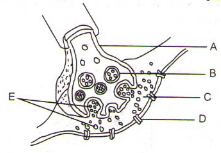
In the following diagram showing axon terminal and synapse $A, B, C, D$ and $E$ respectively represents
  • A
    $A-$ axon terminal $B-$ synaptic cleft $C-$ synaptic vesicles $D-$ neurotransmitters $E-$ receptors
  • $A-$ axon terminal $B-$ synaptic vesicles $C-$ synaptic cleft $D-$ receptors $E-$ neurotransmitters
  • C
    $A-$ synaptic cleft $B-$ synaptic vesicles $C-$ axon terminal Dneurotransmitters $E-$ receptors
  • D
    $A-$ synaptic cleft $B-$ axon terminal $C-$ synaptic vesicles Dneurotransmitters $E-$ receptors
Answer
Correct option: B.
$A-$ axon terminal $B-$ synaptic vesicles $C-$ synaptic cleft $D-$ receptors $E-$ neurotransmitters
b
$A-$ axon terminal, $B-$ synaptic vesicles, $C-$ synaptic cleft, $D-$ receptors $E-$ neurotransmitters
View full question & answer
MCQ 1011 Mark
The movement of the nerve impulse across synaptic cleft is primarily
  • A chemical event
  • B
    A physical event
  • C
    An electrical event
  • D
    A biological event
Answer
Correct option: A.
A chemical event
a
Movement of the nerve impulse across synaptic cleft is primarily a chemical event mediated by neurotransmitters such as acetycholine ($Acl.$), gamma-amino butyric acid ($GABA$), nor-epinephrine and serotonin.
View full question & answer
MCQ 1021 Mark
True about electrical synapses

$(I)$. pre and postsynaptic neurons are in very close proximity

$(II)$. pre and postsynaptic neurons are separated by synaptic cleft

$(III)$. impulse transmission is very fast

$(IV)$. electrical synapses are common in our system

Select the correct option

  • A
    $(I)$, $(II)$, $(III)$ and $(IV)$
  • $(I)$ and $(III)$
  • C
    $(II)$ and $(IV)$
  • D
    $(I)$ and $(II)$
Answer
Correct option: B.
$(I)$ and $(III)$
b
A nerve impulse is transmitted from one neuron to another through junctions called synapses. A synapse is formed by the membranes of a presynaptic neuron and a postsynaptic neuron, which may or may not be separated by a gap called synaptic cleft

There are two types of synapses, i.e., electrical synapses and chemical synapses. At electrical synapses, the membrane of pre- and postsynaptic neurons are in very close proximity. Electrical current can flow directly from one neuron into the other across these synapses

Transmission of an impulse across electrical synapses is very similar to impulse conduction along a single axon. Impulse transmission across an electrical synapse is always faster than the across a chemical synapse. Electrical synapses are rare in our system

At a chemical synapse, the membranes of the pre-and postsynaptic neurons are separated by fluid-filled space called synaptic cleft. Chemicals called neurotransmitters are involved in the transmission of impulses at these synapses

View full question & answer
MCQ 1031 Mark
Synaptic vesicle is found in
  • Pre-synaptic neuron
  • B
    Post-synaptic neuron
  • C
    Synaptic cleft
  • D
    None of these
Answer
Correct option: A.
Pre-synaptic neuron
a
Synaptic vesicle, containings neurotransmitter, is found in pre-synaptic neuron.
View full question & answer
MCQ 1041 Mark
Synaptic knob possesses
  • A
    Granular vesicles
  • B
    Nissl's vesicles
  • Synaptic vesicles
  • D
    None of these
Answer
Correct option: C.
Synaptic vesicles
c
Synaptic knob possess synaptic vesicles containing chemicals called neurotransmitters
View full question & answer
MCQ 1051 Mark
The joint between axon of a neuron and the dendrite of the next is called
  • Synapse
  • B
    Bridge
  • C
    Junction
  • D
    Joint
Answer
Correct option: A.
Synapse
a
A synapse is the link between one neuron and another. There is no physical contact between one neuron and the next, instead there is a tiny gap called synaptic cleft.
View full question & answer
MCQ 1061 Mark
A nerve impulse is transmitted from one neuron to another through the junctions called
  • A
    Neuromuscular junction
  • B
    Neuroeceptor junction
  • Neurosynaptic junction
  • D
    Neuroglandular junction
Answer
Correct option: C.
Neurosynaptic junction
c
View full question & answer
MCQ 1071 Mark
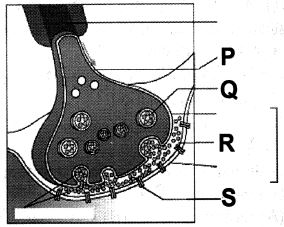
Axon terminal is idicated by which alphabet in given figure ?
  • A
    $R$
  • $P $
  • C
    $S $
  • D
    $Q$
Answer
Correct option: B.
$P $
b
View full question & answer
MCQ 1081 Mark
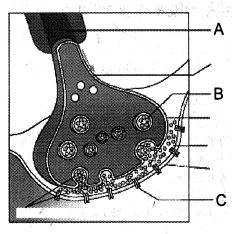
Identify the labelled part $A, B$ and $C$ from the given diagram
  • $A-$ Axon, $B-$ Spnaptic vesicles, $C-$ Receptors
  • B
    $A-$ Axon, $B-$ Axon terminal, $C-$ Receptors
  • C
    $A-$ Axon terminal, $B-$ Receptor, $C-$ Axon
  • D
    $A-$ Synapse, $B-$ Axon, $C-$ Axon terminal
Answer
Correct option: A.
$A-$ Axon, $B-$ Spnaptic vesicles, $C-$ Receptors
a
View full question & answer
MCQ 1091 Mark
In the dual innervation of a organ
  • A
    Bath nerve fibres show stimulatory response
  • B
    Both nerve fibres show inhibitory response
  • One show stimulation and other inhibition
  • D
    Response have selective
Answer
Correct option: C.
One show stimulation and other inhibition
c
It's Obvious
.
View full question & answer
MCQ 1101 Mark
The neuron terminates in the muscles, the terminal part is known as
  • A
    Button
  • B
    Synapse
  • End plate
  • D
    Terminal plate
Answer
Correct option: C.
End plate
c
It's Obvious
View full question & answer
MCQ 1111 Mark
Which one of the following statement in regard to nerve activity is true
  • A
    The synaptic cleft does not prevent direct propagation of action potential from presynaptic neuron to post synaptic cell
  • Information across the synaptic cleft is transmitted by means of a chemical neurotransmitter in small vesicle
  • C
    Combination of neurotransmitter with receptor site changes membrane potential without changing membrane potentiality
  • D
    In tetanus the excitatory impulse to muscles are inhibited leading to lock jaw
Answer
Correct option: B.
Information across the synaptic cleft is transmitted by means of a chemical neurotransmitter in small vesicle
b
It's Obvious
View full question & answer
MCQ 1121 Mark
Space between the two adjoining neurons where the chemical transmitter is released is known as
  • A
    Synaptic vesicle
  • B
    Synapse
  • Synaptic cleft
  • D
    Terminal button
Answer
Correct option: C.
Synaptic cleft
c
(c) The space between pre-synaptic and post-synaptic bag is called as synaptic cleft.
View full question & answer
MCQ 1131 Mark
$A$ :In the nervous system generation of action potential depends upon influx of sodium ion into axoplasm.

$R$ : Influx of sodium ion during nerve impulse generation is due to efflux of potassium ions.

  • A
    Assertion and Reason both are correct and also correct explanation.
  • B
    Assertion and Reason both are correct but not explanation of assertion.
  • Assertion is correct, but Reason is incorrect.
  • D
    Both Assertion and Reason are incorrect.
Answer
Correct option: C.
Assertion is correct, but Reason is incorrect.
c
In nervous system generation of acton potential is due to influx of sodium ions. During action potential $K^+$ leaky channel are closed.
View full question & answer
MCQ 1141 Mark
Which of the following act is responsible for the depolarisation of the neuron?
  • A
    Opening of voltage gated $K^+$ channel
  • Opening of voltage gated $Na^+$ channel
  • C
    Closure of voltage gated $K^+$ channel
  • D
    Closure of voltage gated $Na^+$ channel
Answer
Correct option: B.
Opening of voltage gated $Na^+$ channel
b
The depolarisation of the neuron is due to the opening of $Na^+$ channels due to which inner membrane of the neuron becomes less negative, henceforth change the membrane potential known as depolarisation.
View full question & answer
MCQ 1151 Mark
On application of a stimulus on the axonal membrane,
  • A
    There is a rapid influx of $K^+$ at that site
  • B
    There is a rapid efflux of $Na^+$ at that site
  • There is a rapid influx of $Na^+$ at that site
  • D
    There is a rapid efflux of $K^+$ at that site
Answer
Correct option: C.
There is a rapid influx of $Na^+$ at that site
c
On application of a stimulus on the axonal membrane, there is rapid influx of $Na^+$ ions from outside due to opening of $Na^+$ voltage gated channels
View full question & answer
MCQ 1161 Mark
Action potential is also termed as
  • Nerve impulse
  • B
    Reflex action
  • C
    Repolarisation
  • D
    Polarisation
Answer
Correct option: A.
Nerve impulse
a
The transmission of a nerve impulse called an action potential
View full question & answer
MCQ 1171 Mark
The ionic gradients across the resting membrane are maintained by the
  • A
    Ion channels
  • Sodium-potassium pumps
  • C
    Electrical synapses
  • D
    Chemical synapses
Answer
Correct option: B.
Sodium-potassium pumps
b
The ionic gradients across the resting membrane is due to opening of $K^+$ leaky channels but is maintained because of $Na^+ \;K^+$ pump which continuously pump $3Na^+$ ions outwards in exchange of $2K^+$ inwards at the expense of energy.
View full question & answer
MCQ 1181 Mark
In a resting neuron, the axonal membrane is
  • A
    Nearly impermeable to potassium ions $(K^+)$
  • B
    Impermeable to positively charged proteins present in the axoplasm
  • Comparatively more permeable to $K^+$
  • D
    Completely permeable to sodium ions $(Na^+)$
Answer
Correct option: C.
Comparatively more permeable to $K^+$
c
At resting state, axonal membrane is more permeable to $K^+$ ions due to opening of $K^+$ leaky channels
View full question & answer
MCQ 1191 Mark
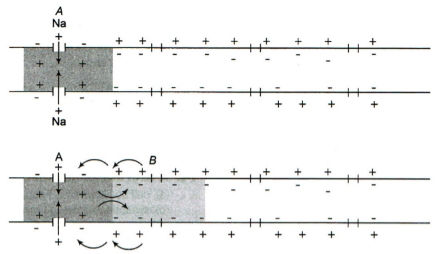
Given is the diagrammatic representation of impulse conduction through an axon (at points $A$ and $B$). View the diagram and arrange the steps of impulse conduction

$I.$ The polarity of the membrane at site $A$ is reversed and depolarized, i.e., the outer surface becomes negatively charged and the innerside becomes positively charged, generating nerve impulse

$II$. A stimulus causes disturbance to the membrane at site of $A$ nerve fibre resulting in leakage of $N a^{+i i}$ ions inside the nerve fibre

$III.$ On the outer surface, current flows from site $B$ to site $A$ to complete the circuit of current flow. Hence, the polarity at the site is reversed, and an action potential is generated at site $B.$ The impulse (action potential) generated at site $A$ arrives at site $B .$ The sequence is repeated along the length of the axon and consequently the impulse is conducted

$IV.$ Immediately ahead, the axon $(e \cdot g .$, site $B )$ membrane has a positive charge on the outer surface and a negative charge on its inner surface. As a result, a current flows on the inner surface from site $A$ to site $B$

  • A
    $I \rightarrow II \rightarrow IV \rightarrow III$
  • B
    $II \rightarrow I \rightarrow III \rightarrow IV$
  • $II \rightarrow I \rightarrow IV \rightarrow III$
  • D
    $I \rightarrow IV \rightarrow III \rightarrow II$
Answer
Correct option: C.
$II \rightarrow I \rightarrow IV \rightarrow III$
c
$II \rightarrow I \rightarrow IV \rightarrow III$
View full question & answer
MCQ 1201 Mark
In the resting stage of a neuron, concentration gradient generates due to
  • High concentration of $K^{+i i}$ and low concentration of $N a^{+i i}$ inside the axon
  • B
    High concentration of $N a^{+i i}$ and low concentration of $K^{+i i}$ inside the axon
  • C
    low concentration of $N a^{+i i}$ outside the axon
  • D
    low concentration of $K^{+i i}$ outside the axon
Answer
Correct option: A.
High concentration of $K^{+i i}$ and low concentration of $N a^{+i i}$ inside the axon
a
High concentration of $K^{+i i}$ and low concentration of $N^{+i i}$ inside the axon.

Both $A$ and $R$ true and $R$ is the correct explanation of $A .$

When a neuron is not conducting any impulse, i.e., resting, the axonal membrane is comparatively more permeable to potassium ions $\left(K^{+i i}\right)$ and nearly impermeable to sodium ions $\left(N a^{+i i}\right) .$ Similarly, the membrane is impermeable to negatively charged proteins present in the axoplasm. Consequently, the axoplasm inside the axon contains high concentration of $K^{+i i}$ and negatively charged proteins and low concentration of $N a^{+i i} .$ In contrast, the fluid outside the axon contains a low concentration of $K^{+i i}$, a high concentration of $N a^{+i i}$ and thus form a concentration gradient

View full question & answer
MCQ 1211 Mark
Which of these processes occur during repolarisation of nerve fibre?

$(I)$. Open $N a^{+i i}$ channel

$(II)$. Closed $N a^{+i i}$ channel

$(III)$. Closed $K^{+i i}$ channel

$(IV)$. Open $K^{+i i}$ channel

  • $(II)$ and $(IV)$
  • B
    $(I)$ and $(III)$
  • C
    $(II)$ and $(III)$
  • D
    $(I)$ and $(II)$
Answer
Correct option: A.
$(II)$ and $(IV)$
a
In neurons, the restoration of resting potential is called repolarization. After depolarization, with the increase of sodium ions inside the nerve fibre, the membrane becomes less permeable to $N a^{+i i}$ and more to $K^{+i i} .$ the $N a^{+i i}$ channels of axon membrane close and $K^{+i i}$ channels open. $N a^{+i i}$ influx stops and $K^{+i i i}$ outflow starts until the original resting state of ionic concentration is achieved. Thus, resting potential is restored, which is called repolarization of the membrane. Until repolarization occurs, neuron cannot conduct another impulse. The time taken for this restoration is called refractory period.
View full question & answer
MCQ 1221 Mark
Maintenance of the ionic gradients across the resting membrane is done by the
  • Active transport of ions
  • B
    Passive transport of ions
  • C
    Active transport of proteins
  • D
    Passive transport of proteins
Answer
Correct option: A.
Active transport of ions
a
One $ATP$ is used to transfer $3 N a^{+i i}$ outside and $2 K^{+i i}$ inside by $N a^{+i i}$ pump, i.e, active transport of ions
View full question & answer
MCQ 1231 Mark
The nerve fibre in its resting stage is
  • More permeable to $K^{* i i}$
  • B
    Semi-permeable to $K^{+i i}$
  • C
    Less permeable to $K^{* i i}$
  • D
    All of these
Answer
Correct option: A.
More permeable to $K^{* i i}$
a
In resting nerve fibre (a nerve fibre that is not conducting an impulse), sodium ions ( $N a^{* i i}$ ) predominate in the extra cellular fluid, whereas potassium ions $\left(K^{* i i}\right)$ predominate in the intracellular fluid (within the fibre). This result in the fact that, the resting membrane has only a poor permeability for $N a^{* i i}$ although it has a higher permeability for $K^{* i i}$.
View full question & answer
MCQ 1241 Mark
Neurons are excitable cells because...
  • A
    They lack myeline sheath
  • B
    They possess myeline sheath
  • Their membranes are in polarized state
  • D
    All given
Answer
Correct option: C.
Their membranes are in polarized state
c
View full question & answer
MCQ 1251 Mark
Resting membrane potential is maintained by
  • A
    Hormone
  • B
    Neurotransmitter
  • lon pumps
  • D
    None of these
Answer
Correct option: C.
lon pumps
c
View full question & answer
MCQ 1261 Mark
For the maintenance of ionic gradients across the resting membrane, the sodium -potassium pump transports
  • $3Na^+$ outwards for $2K^+$ into the cell
  • B
    $2Na^+$ outwards for $2K^+$ into the cell
  • C
    $3Na^+$ inwards for $2K^+$ out the cell
  • D
    $2Na^+$ inwards for $2K^+$ out the cell
Answer
Correct option: A.
$3Na^+$ outwards for $2K^+$ into the cell
a
View full question & answer
MCQ 1271 Mark
Which of the following processes are responsible for the transport of $Na^+$ from out side to inner side ?
  • A
    Stimulus
  • B
    Permeability of membrane
  • C
    Negatively charged proteins and low concentration of $Na^+$
  • All of the above.
Answer
Correct option: D.
All of the above.
d
View full question & answer
MCQ 1281 Mark
In which condition, the axonal membrane is comparatively more permeable to potassium ions and nearly impermeable to sodium ions.
  • Resting condition
  • B
    Active condition
  • C
    $A$ and $B$ both
  • D
    None of the above
Answer
Correct option: A.
Resting condition
a
View full question & answer
MCQ 1291 Mark
The conduction of nerve impulse is a
  • A
    Biochemical phenomenon
  • Electrochemical phenomenon
  • C
    Physical phenomenon
  • D
    Bio-physiological phenomenon
Answer
Correct option: B.
Electrochemical phenomenon
b
(b)Nature of nerve impulse or conduction of nerve impulse is an electro-chemical process.
View full question & answer
MCQ 1301 Mark
For visual sense, the nerve impulse is generated by
  • A
    Depolarisation
  • B
    Repolarisation
  • C
    Hyper polarisation
  • Depolarisation and repolarisation
Answer
Correct option: D.
Depolarisation and repolarisation
d
(d) Nerve impulse is a self propagating wave of depolarization and repolarization.
View full question & answer
MCQ 1311 Mark
Sodium- potassium pump is
  • A
    A hormone
  • B
    An enzyme
  • A protein carrier
  • D
    An organelle
Answer
Correct option: C.
A protein carrier
c
It's Obvious
View full question & answer
MCQ 1321 Mark
Nerve impulse initiates with the movements of
  • A
    ${K^ + }$
  • B
    $M{g^ + }$
  • C
    $C{a^ + }$
  • $N{a^ + }$
Answer
Correct option: D.
$N{a^ + }$
d
(d)$N{a^ + }$enters in the axoplasm leading to depolarization of the nerve.
View full question & answer
MCQ 1331 Mark
Neuron becomes an electrically charged cell by the diffusion of
  • A
    $K$
  • $Na$
  • C
    $P$
  • D
    $Ca$
Answer
Correct option: B.
$Na$
b
It's Obvious
View full question & answer
MCQ 1341 Mark
The mineral necessary for nervous conduction is
  • A
    Iron
  • Sodium
  • C
    Phosphorus
  • D
    Magnesium
Answer
Correct option: B.
Sodium
b
(b)The mineral necessary for nervous conduction is sodium.
View full question & answer
MCQ 1351 Mark
When a nerve fibre is stimulated the inside of the membrane becomes
  • A
    Negatively charged
  • Positively charged
  • C
    Depolarised
  • D
    Filled with acetylcholine
Answer
Correct option: B.
Positively charged
b
It's Obvious
View full question & answer
MCQ 1361 Mark
Depolarization of a stimulated nerve is maintained by
  • A
    $C{a^{ + + }}$
  • B
    $C{l^ - }$
  • C
    $M{g^{ + + }}$
  • ${K^ + }$
Answer
Correct option: D.
${K^ + }$
d
(d) Efflux of ${K^ + }$ causes repolarization.

Therefore it is the movement of ${K^ + }$ that maintains the depolarized state.

View full question & answer
MCQ 1371 Mark
The potential difference between outside and inside of a nerve before excitation is known as
  • A
    Resting potential
  • Action potential
  • C
    Spike potential
  • D
    Reaction potential
Answer
Correct option: B.
Action potential
b
It's Obvious
View full question & answer
MCQ 1381 Mark
The rate of rise of action potential and its amplitude are determined by the concentration of
  • A
    ${K^ + }$
  • B
    $C{l^ - }$
  • $N{a^ + }$
  • D
    $O{H^ - }$
Answer
Correct option: C.
$N{a^ + }$
c
It's Obvious
View full question & answer
MCQ 1391 Mark
When an impulse passes, the membrane is depolarized and the charge of the cells is
  • A
    Outside positive and inside negative
  • Inside positive and outside negative
  • C
    Both sides have zero potential
  • D
    Both sides are electronegative
Answer
Correct option: B.
Inside positive and outside negative
b
(b)During depolarization the membrane is negatively charged on the outside and positively charged on the inside.
View full question & answer
MCQ 1401 Mark
The potential difference in the membrane which is responsible for the conduction of an impulse is brought about by a change in the membrane
  • Permeability
  • B
    Structure
  • C
    Anions
  • D
    Concentration
Answer
Correct option: A.
Permeability
a
(a)Permeability for $N{a^ + }$ and ${K^ + }$.
View full question & answer
MCQ 1411 Mark
Conduction of an impulse along the axon is associated with the
  • A
    Resting potential
  • B
    $C{l^ - }$concentration
  • C
    Strength of an impulse
  • Action potential
Answer
Correct option: D.
Action potential
d
(d) The wave of depolarization travelling down a nerve fibre is called action potential.

Infact, the action potential “moves” in the manner of a spark moving along a fuse.

View full question & answer
MCQ 1421 Mark
During the transmission of nerve impulse, which of the following takes place
  • Flux of $N{a^ + }$ inwards and ${K^ + }$ outwards
  • B
    Flux of ${K^ + }$ inwards and $N{a^ + }$ outwards
  • C
    Flux of ${K^ + }$ inwards and $N{a^ + }$ inwards
  • D
    Flux of ${K^ + }$ outwards and $N{a^ + }$ outwards
Answer
Correct option: A.
Flux of $N{a^ + }$ inwards and ${K^ + }$ outwards
a
It's Obvious
View full question & answer
MCQ 1431 Mark
When a neuron is stimulated to generate nerve impulse, the electrical potential on the inside of the nerve membrane changes
  • A
    From negative to positive and remains positive
  • From negative to positive and back to negative
  • C
    From positive to negative and remains negative
  • D
    From positive to negative and back to positive
Answer
Correct option: B.
From negative to positive and back to negative
b
It's Obvious
View full question & answer
MCQ 1441 Mark
A nerve impulse will travel through a nerve fibre only if the membrane suddenly becomes more permeable to
  • A
    Chloride ions
  • B
    Potassium ions
  • Sodium ions
  • D
    Calcium ions
Answer
Correct option: C.
Sodium ions
c
(c) Membrane permeability of the nerve fibre for sodium ions is a state of depolarisation.
View full question & answer
MCQ 1451 Mark
Reversal potential
  • A
    Is always negative
  • Is always positive
  • C
    Is always neutral
  • D
    Never develops until death
Answer
Correct option: B.
Is always positive
b
It's Obvious.
View full question & answer
MCQ 1461 Mark
Multipolar neurons are found in the
  • A
    Retina of eye
  • B
    Embryonic stage
  • C
    Both $(a)$ and $(b)$
  • Cerebral cortex
Answer
Correct option: D.
Cerebral cortex
d
Multipolar neurons-cerebral cortex
Bipolar neurons - retina of eye
Unipolar neurons -embryonic stage
View full question & answer
MCQ 1471 Mark
The Nissl’s granules are present ina.

$(a)$.Cell body     $(b)$. Axon   $(c)$. Dendrites    $(d)$. Glial cells

  • A
    $a\; only$
  • B
    $a, b \;and\; c$
  • $a\; and\; c$
  • D
    $a, b, c \;and\; d$
Answer
Correct option: C.
$a\; and\; c$
c
Nissle's granules are found in the cyton as well as the dendrites but are absent in axon.
View full question & answer
MCQ 1481 Mark
Cytoplasm with typical cell organelles and Nissl’s granule is present in the
  • A
    Axon Hillock
  • Cell body
  • C
    Axon
  • D
    Synaptic vesicles
Answer
Correct option: B.
Cell body
b
Cytoplasm with cell organelles and Nissl's granule is a characteristic of cyton/cell body part of axoplasm but absent in the axon
View full question & answer
MCQ 1491 Mark
Which of the following statements is true?
  • A
    Saltatory conduction is seen in non-myelinated nerve fibres
  • B
    Nissl's granules are found in muscles fibres
  • Non-myelinated nerve fibres do not possess nodes of Ranvier
  • D
    Non-myelinated nerve fibres are completely enclosed by myelin sheath
Answer
Correct option: C.
Non-myelinated nerve fibres do not possess nodes of Ranvier
c
In myelinated nerve fibre, the myelin sheath is not continuous and remains interrupted at some places. These are known as nodes of Ranvier. These help in the saltatory conduction of nerve impulse. The non-myelinated nerve fibres do not possess nodes of Ranvier.
View full question & answer
MCQ 1501 Mark
Which of the following statements are correct?

$I$. Dendrites are long fibre, with branched distal end

$II$. Axons are short fibres which arise from the cell body

$III$. Cell body of a neuron contains cytoplasm, nucleus with cell organelles and Nissl's granules

$IV$. The dendrites transmits nerve impulses away from the cell body to a synapse

The correct option is

  • Only $III$
  • B
    $I$ and $II$
  • C
    $I, II$ and $III$
  • D
    $I, II$ and $IV$
Answer
Correct option: A.
Only $III$
a
A neuron comprises of cell body, axon and dendrites. The cell body contains cytoplasm, nucleus with organelles and Nissl's granules

The axons are long fibres which arises from the cell body. Dendrites are the short fibres with branched distal end

View full question & answer
MCQ 1511 Mark
Which of the following statements is correct about the nodes of ranvier?
  • A
    Axolemma is discontinuous
  • Myelin sheath is discontinuous
  • C
    Both neurilemma and myelin sheath are discontinuous
  • D
    Covered by myelin sheath
Answer
Correct option: B.
Myelin sheath is discontinuous
b
Myelin sheath is interrupted at some places to form gaps. These gaps are called nodes of Ranvier.
View full question & answer
MCQ 1521 Mark
Which of the following statements are correct for a nerve cell?

$(I)$. Each neuron has a cell body

$(II)$. Each neuron has a single axon

$(III)$. Neurons are the functional units of nervous system

Select the correct option

  • A
    $(I)$ and $(II)$
  • B
    $(II)$ and $(III)$
  • C
    All are incorrect
  • All are correct
Answer
Correct option: D.
All are correct
d
$I, II, III$ all are correct.

Each neuron is made up of a cell body, an axon and one or many dendrites. These three components of a neuron make it a functional unit for the production of nerve impulse

View full question & answer
MCQ 1531 Mark
The cell body of neuron contains of
  • A
    Cytoplasm
  • B
    Cell organelles
  • C
    Granular bodies
  • All of these
Answer
Correct option: D.
All of these
d
The cell body contains cytoplasm with typical cell organelles and certain granular bodies called Nissl's granules
View full question & answer
MCQ 1541 Mark
Which of the following parts of a neuron is covered by fatty sheath?
  • Axon
  • B
    Cyton
  • C
    Dendrite
  • D
    Node of Ranvier
Answer
Correct option: A.
Axon
a
Neuron or nerve cell is the longest cell and and forms unit of nervous tissue.

Neurons consists of two main parts:

$(i)$ Main body, which has cell organelles like nucleus, cyton.

$(ii)$ Long process, known as axon, which conducts impulse away from the cell body and remains covered by a fatty sheath known as myelin sheath.

Dendrites are processes that arise from the cell body.

View full question & answer
MCQ 1551 Mark
Dendrites transmit impulses towards the
  • Cell body
  • B
    Axon
  • C
    Both $(a)$ and $(b)$
  • D
    None of these
Answer
Correct option: A.
Cell body
a
Dendrites transmit impulses towards the cell body
View full question & answer
MCQ 1561 Mark
The ..... nerve fibres are enveloped with Schwann cells, which form a myelin sheath around the axon
  • Myelinated
  • B
    Non-myelinatd
  • C
    Afferent
  • D
    Efferent
Answer
Correct option: A.
Myelinated
a
The myelinated nerve fibres are enveloped with Schwann cells, which form a myelin sheath around the axon
View full question & answer
MCQ 1571 Mark
Unipolar neurons with an axon and no dendrite are present in
  • Embryos
  • B
    Dorsal root ganglia of spinal cord
  • C
    Brain
  • D
    Retina
Answer
Correct option: A.
Embryos
a
Unipolar neurons have only one axon, but no dendron. Such neurons are found in early embryo.
View full question & answer
MCQ 1581 Mark
It is not found in or a part of myelinated nerve fibres
  • A
    Schwann cell
  • B
    Node of ranvier
  • Nissl's granules
  • D
    Synaptic knob
Answer
Correct option: C.
Nissl's granules
c
View full question & answer
MCQ 1591 Mark
A structure of neuron comprises of
  • A
    Cell body, synaptic knob, ganglia
  • B
    Synaptic vesicles, ganglia, dendrites
  • C
    Cell body, dendrites, ganglia
  • Cell body, dendrites, axon
Answer
Correct option: D.
Cell body, dendrites, axon
d
View full question & answer
MCQ 1601 Mark
Synaptic knob is bulb-like structure which is present.
  • At the end of axon terminal
  • B
    At the node of Ranvier
  • C
    In the cell body
  • D
    At the end of dendrites
Answer
Correct option: A.
At the end of axon terminal
a
View full question & answer
MCQ 1611 Mark
Dendrites are
  • A
    Branched short fibers
  • B
    Projections out of the cell body
  • C
    Nissi's granules containing body
  • All of the above
Answer
Correct option: D.
All of the above
d
View full question & answer
MCQ 1621 Mark
Match the following:

 $\begin{array}{|p{0.3\linewidth}|p{0.6\linewidth}|} \hline Column\,\,-I & Column\,\,-II   \\ \hline 1.\,\,Cell\,\,body & p.\,\,Transmit\,\,impulses\,\,towords\,\,the\,\,cell\,\,body \\ \hline 2.\,\,Dendrites & q.\,\,Transmit\,\,impulses\,\,away\,\,from\,\,the\,\,cell\,\,body \\ \hline 3.\,\,Synaptic\,\,vesicles & r.\,\,Contain\,\,Cytoplasm\,\,and\,\,granular\,\,bodies  \\ \hline  & s.\,\,Neurotransmitters   \\ \hline \end{array}$


  • A
    $(1-p),(2-q),(3-r) $
  • B
    $(1-p),(2-q),(3-s)$
  • $(1-r),(2-p),(3-s) $
  • D
    $(1-r),(2-q),(3-p) $
Answer
Correct option: C.
$(1-r),(2-p),(3-s) $
c
View full question & answer
MCQ 1631 Mark
Cerebral cortex have ....... type of neurons.
  • A
    Unipolar
  • Multipolar
  • C
    Bipolar
  • D
    Unipolar, bipolar, multipolar
Answer
Correct option: B.
Multipolar
b
View full question & answer
MCQ 1641 Mark
Select the incorrect pair :
  • A
    Multipolar - Cerebral cortex
  • B
    Unipolar - embryonic staye
  • C
    Bipolar - Retina
  • Neuron - Composed of four major part
Answer
Correct option: D.
Neuron - Composed of four major part
d
View full question & answer
MCQ 1651 Mark
Axon part of the neuron is highly modified for which of the following function
  • A
    Reception of stimuli from neurons
  • B
    Conduction for neuron
  • C
    Reception of internal stimuli
  • Conduction of impulse away from neurons
Answer
Correct option: D.
Conduction of impulse away from neurons
d
(d)Axons are modified for the conduction of impulses away from  $ CNS.$
View full question & answer
MCQ 1661 Mark
The medullary sheath of the nerve fibre is interrupted at intervals by
  • A
    Septa
  • Nodes of Ranvier
  • C
    Synapses
  • D
    Glia
Answer
Correct option: B.
Nodes of Ranvier
b
(b) Nodes of Ranvier are not surrounded by medullary sheath as schwann cells are absent in the zone.
View full question & answer
MCQ 1671 Mark
The dendrite carries impulses
  • Towards the cyton
  • B
    Away from cyton
  • C
    Across the body
  • D
    From one neuron to another
Answer
Correct option: A.
Towards the cyton
a
(a) The dendrites contain neurofibril, neurotubule and Nissl’s granules.

They conduct nerve impulse towards the cell body $(cyton)$.

View full question & answer
MCQ 1681 Mark
Nissl’s granules are found in
  • A
    Liver cells
  • Nerve cells
  • C
    Intestinal cells
  • D
    Kidney
Answer
Correct option: B.
Nerve cells
b
(b) Nissl’s granules are found only in cyton and Dendron of nerve cell.
View full question & answer
MCQ 1691 Mark
Nissl’s granules are absent in
  • Axon
  • B
    Cyton
  • C
    Dendron
  • D
    Both  $ ‘a’$ and  $ ‘b’$
Answer
Correct option: A.
Axon
a
(a)Axon is a single long process of uniform thickness. It contain neurofibrils and neurotubules but lack nissle’s granules, golgi complex ribosomes etc.
View full question & answer
MCQ 1701 Mark
Myelin sheath covers
  • A
    Muscle fibre
  • Nerve fibre
  • C
    Collagen fibre
  • D
    Tendon
Answer
Correct option: B.
Nerve fibre
b
(b)The medullary sheath, or myelin sheath is continuous around the nerve fibres in the $CNS $ but in the nerve fibres of $ PNS$  it is absent.
View full question & answer
MCQ 1711 Mark
Which of the following has non-myelinated nerve fibres
  • A
    Optic nerves
  • B
    Cranial nerves
  • C
    Spinal nerves
  • Autonomic nerves
Answer
Correct option: D.
Autonomic nerves
d
It's Obvious
View full question & answer
MCQ 1721 Mark
Largest cell in body is
  • A
    Lymph
  • B
    Osteoctyte
  • Neuron
  • D
    Chromatophore
Answer
Correct option: C.
Neuron
c
(c)Largest cell in the body is neuron. Certain neurons may almost equal the length of body itself.
View full question & answer
MCQ 1741 Mark
Which type of neurons are found in the retina
  • A
    Unipolar
  • B
    Pseudo-unipolar
  • C
    Multipolar
  • Bipolar
Answer
Correct option: D.
Bipolar
d
(d) Bipolar neurons are typically spindle shaped, having the axon at one pole and a dendron at the other.

They are found in the retina, spiral ganglian of the cochlea, vestibular gangtion and olfactory neuro epithelium.

View full question & answer
MCQ 1751 Mark
Which of the following structures, are the speciality of nerve cells
  • A
    Nucleus and cytoplasm
  • Axon and dendrites
  • C
    Vacuoles and fibres
  • D
    Synapse and ganglia
Answer
Correct option: B.
Axon and dendrites
b
It's Obvious.
View full question & answer
MCQ 1761 Mark
Node of Ranvier is found in
  • A
    Right auricle
  • B
    Muscle bundles
  • C
    Dendrite
  • Axon
Answer
Correct option: D.
Axon
d
(d) The myelin sheath surrounding the axon is interrupted at regular intervals, forming Nodes of Ranvier.
View full question & answer
MCQ 1771 Mark
The junction between Schwann cells is known as
  • A
    Plasmalemma
  • Node of Ranvier
  • C
    Dendrons
  • D
    Synapse
Answer
Correct option: B.
Node of Ranvier
b
(b) Schwann's cell secrete a segment of myelinated fibre called internode.
View full question & answer
MCQ 1781 Mark
Axons form nerve in
  • A
    Autonomic nervous system
  • B
    Central nervous system
  • C
    Peripheral nervous system
  • All of the above
Answer
Correct option: D.
All of the above
d
It's Obvious.
View full question & answer
MCQ 1791 Mark
Schwann cells and Node of Ranvier are found in
  • Nervous tissue
  • B
    Osteoblast
  • C
    Chondrioblast
  • D
    Gland cells
Answer
Correct option: A.
Nervous tissue
a
(a) Nervous tissue present in the nervous system, like brain, spinal cord and ganglia. Nerve fibres consists typically of a central core $(axon)$ surrounded by a tubular myelin sheath.

In peripheral nerve fibre the myelin sheath is interrupted at regular intervals; these interruptions constitute the node of Ranvier.

View full question & answer
MCQ 1801 Mark
Most of the neurons of our body are
  • A
    Unipolar
  • B
    Bipolar
  • C
    Pseudounipolar
  • Multipolar
Answer
Correct option: D.
Multipolar
d
(d) Multipolar neurons have several dendrites and one axon. Most neurons in the brain and spinal cord of our body are of this type.
View full question & answer
MCQ 1811 Mark
Find out the correct statement.
  • A
    The $PNS$ is the site of information processing and control
  • B
    All the nerves of the body associated with the $PNS$ comprise the $CNS$
  • The autonomic neural system relays impulses from the $CNS$ to the involuntary organs of the body
  • D
    The $CNS$ is divided into two divisions called sympathetic neural system and parasympathetic neural system
Answer
Correct option: C.
The autonomic neural system relays impulses from the $CNS$ to the involuntary organs of the body
c
$CNS$ is the site of information processing centre
$CNS$ and $PNS$, collectively constitutes the nervous system
The autonomic nervous system can be classified into sympathetic and parasympathetic nervous system
View full question & answer
MCQ 1821 Mark
The autonomic neural system is a division of
  • A
    Sympathetic neural system
  • B
    Central neural system
  • Peripheral neural system
  • D
    Somatic neural system
Answer
Correct option: C.
Peripheral neural system
c

View full question & answer
MCQ 1831 Mark
The somatic neural system relays impulses
  • A
    From $CNS$ to involuntary organs
  • From $CNS$ to skeletal muscles
  • C
    From $PNS$ to smooth muscles
  • D
    From $PNS$ to voluntary organs
Answer
Correct option: B.
From $CNS$ to skeletal muscles
b
Somatic neural system : $CNS$ to voluntary muscles (skeletal)
Autonomic neural system : $CNS$ to involuntary muscles
View full question & answer
MCQ 1841 Mark
Which of the following statement is incorrect?
  • A
    $CNS$ is the site of information processing and control
  • B
    $CNS$ includes brain and spinal cord
  • C
    The $PNS$ consists of the nerves and ganglia outside the brain and spinal cord.
  • None of the above
Answer
Correct option: D.
None of the above
d

View full question & answer
MCQ 1851 Mark
The system that transmits impulse from the $CNS$ to the involuntary organs and smooth muscles of the body
  • A
    Sympathetic neural system
  • B
    Parasympathetic neural system
  • C
    Somatic neural system
  • Autonomic neural system
Answer
Correct option: D.
Autonomic neural system
d
Autonomic nervous system, a type of peripheral nervous system transmits impulses from the $CNS$ to the involuntary organs and smooth muscles of the body
View full question & answer
MCQ 1861 Mark
The human neural system comprises
  • A
    $PNS$ only
  • B
    $CNS$ only
  • Both $(a)$ and $(b)$
  • D
    None of these
Answer
Correct option: C.
Both $(a)$ and $(b)$
c
The human neural system comprises of $PNS$ and $CNS$ both. $PNS$ consists of all the nerves (cranial nerves and spinal nerves) associated with $CNS$. $CNS$ is the site of information processing and control
View full question & answer
MCQ 1871 Mark
Choose the correct pair :
  • $CNS =$ Brain $+$ Spinal cord
  • B
    $PNS =$ Sympathatic neural system $+$ Parasympathatic neural system
  • C
    Autonomic neural system $= CNS + PNS$
  • D
    Hind brain $=$ Thalamus $+$ Cerebrum $+$ Hypothalamus
Answer
Correct option: A.
$CNS =$ Brain $+$ Spinal cord
a
View full question & answer
MCQ 1881 Mark
The sympathetic and parasympathetic neural system combines from
  • A
    Somatic neural system
  • Autonomic neural system
  • C
    Central neural system
  • D
    Endocrine system
Answer
Correct option: B.
Autonomic neural system
b
View full question & answer
MCQ 1891 Mark
A motor nerve carries impulses from
  • CNS to the effectors
  • B
    Effectors to the CNS (central nervous system)
  • C
    Cranial nerves to the effectors
  • D
    Effectors to the cranial nerves
Answer
Correct option: A.
CNS to the effectors
a
(a) Motor nerves form efferent nerve fibres which conduct nerve impulse from CNS to peripheral tissue.
View full question & answer
MCQ 1901 Mark
Nerve impulse is
  • A
    Carried by afferent and efferent fibres
  • B
    Is not carried by any afferent or efferent fibres
  • C
    Is carried away by afferent fibres and brought about by efferent fibres
  • Is brought by afferent fibres and carried by efferent fibres
Answer
Correct option: D.
Is brought by afferent fibres and carried by efferent fibres
d
It's Obvious
View full question & answer
MCQ 1911 Mark
The self governing nervous system is known as
  • A
    Central nervous system
  • B
    Peripheral nervous system
  • Autonomic nervous system
  • D
    Sympathetic nervous system
Answer
Correct option: C.
Autonomic nervous system
c
It's Obvious
View full question & answer
MCQ 1921 Mark
Which one of the following is responsible for the control of reflex action
  • A
    Sensory nerves
  • B
    Motor nerves
  • C
    Sympathetic nervous system
  • Central nervous system
Answer
Correct option: D.
Central nervous system
d
(d) Reflex action is an immediate involuntary response to a stimulus with out the intervention of brain,

controlled by spinal cord of central nervous system.

View full question & answer
MCQ 1931 Mark
The autonomic nervous system has control over
  • A
    Reflex action
  • B
    Skeletal muscles
  • C
    Sense organs
  • Internal organs
Answer
Correct option: D.
Internal organs
d
(d) Autonomic nervous system regulates and coordinates involuntary activities like heart beating, homeostasis, body temperature, breathing, gut peristalsis and secretion of glands.
View full question & answer
MCQ 1941 Mark
Which of the following organ systems jointly coordinate and integrate all the activities of the body organs?
  • A
    Neural system and sensory system
  • B
    Digestive system and respiratory system
  • Neural system and endocrine system
  • D
    Circulatory system and respiratory system
Answer
Correct option: C.
Neural system and endocrine system
c
Neural system and endocrine system are the two systems that help in coordination and integration of the activities of the body organs
View full question & answer
MCQ 1951 Mark
Select the correct statements
  • Neurons regulates endocrine activity but not vice-versa
  • B
    Endocrine glands regulates neural activity but not vice-versa
  • C
    Neither hormones control neural activity nor the neurons control the endocrine activity.
  • D
    All of these
Answer
Correct option: A.
Neurons regulates endocrine activity but not vice-versa
a
Neurons regulates the endocrine gland activity but endocrine gland secretions do not regulate the functioning of neurons
View full question & answer
MCQ 1961 Mark
The system, responsible for providing an organized network of point to point connections for a quick coordination, is called
  • A
    Endocrine system
  • B
    Circulatory system
  • C
    Digestive system
  • Neural system
Answer
Correct option: D.
Neural system
d
The system, which is responsible for providing an organized network of point to point connection for a quick coordination is called neural system. This system is made up of highly specialized cells called neurons, which detects the stimuli throughout the body and transmit it to the brain
View full question & answer
MCQ 1971 Mark
Which of the following is the correct function of endocrine system with reference to chemical coordination?
  • A
    Provides neural integration through hormones
  • Provides chemical integration through hormones
  • C
    Provides an organized network of point to point connections for a quick coordination
  • D
    None of the above
Answer
Correct option: B.
Provides chemical integration through hormones
b
Endocrine system provides chemical coordination via hormones
View full question & answer
MCQ 1981 Mark
The highly specialized cells called neurons can
  • A
    Detect stimuli
  • B
    Receive stimuli
  • C
    Transmit stimuli
  • All of the above
Answer
Correct option: D.
All of the above
d
The plasma membrane of neuron is polarized due to difference in the concentration of positive ions across it. This difference is actively maintained by $N a^{+i / K^{+i} i}$ pump. When any deflection in this condition happens, it can be easily detected by plasma membrane and it further transmitted to other neurons
View full question & answer
MCQ 1991 Mark
When we do physical exercises, the energy demand is
  • Increased
  • B
    Decreased
  • C
    Not effected
  • D
    Both $(a)$ and $(b)$
Answer
Correct option: A.
Increased
a
When we do physical exercise, the energy demand is increased to maintain the increased muscular activity
View full question & answer
MCQ 2001 Mark
In which of the following very simple neural organization is found ?
  • A
    Insect
  • Hydra
  • C
    Frog
  • D
    Human
Answer
Correct option: B.
Hydra
b
View full question & answer
MCQ 2011 Mark
Select the correct arrangement of neural organization, according to the increasing degree of complexity.
  • A
    Lower invertebrates $\rightarrow$ Vertebrates $\rightarrow$ Insects
  • Lower invertebrates $\rightarrow$ Insects $\rightarrow$ Vertebrates
  • C
    Vertebrates $\rightarrow$ Insects $\rightarrow$ Lower vertebrates
  • D
    Vertebrates $\rightarrow$ Lower invertebrates $\rightarrow$ Insects
Answer
Correct option: B.
Lower invertebrates $\rightarrow$ Insects $\rightarrow$ Vertebrates
b
View full question & answer
MCQ 2021 Mark
Which of the following system provides the fastest means of communication within the body?
  • A
    Reproductive system
  • Nervous system
  • C
    Circulatory system
  • D
    Digestive system
Answer
Correct option: B.
Nervous system
b
View full question & answer
MCQ 2031 Mark
In Hydra, neural organization is comprises of
  • Network of neurons
  • B
    $CNS$ and $PNS$
  • C
    $CNS$
  • D
    Nerve ganglia
Answer
Correct option: A.
Network of neurons
a
View full question & answer
MCQ 2041 Mark
What is the function of neurons ?
  • A
    Detect different kind of stimuli
  • B
    Receive different kind of stimuli
  • C
    Transmit different kind of stimuli
  • All of the above
Answer
Correct option: D.
All of the above
d
View full question & answer
MCQ 2051 Mark
Intercellular communication in multicellular organism occurs through
  • A
    Digestive system only
  • B
    Respiratory system only
  • C
    Nervous system only
  • Both nervous and endocrine system
Answer
Correct option: D.
Both nervous and endocrine system
d
(d) Animals have two system of co-ordination i.e., nervous system and endocrine system.

Neurones are the basic structural and functional units of the nervous system which spread through out the organism forming a complex communication network.

Endocrine system release hormone for intercellular communication.

View full question & answer
MCQ 2061 Mark
The nervous system and endocrine glands are
  • A
    Antagonistic
  • B
    Synchronous
  • C
    Independent
  • Interdependent
Answer
Correct option: D.
Interdependent
d
It's Obvious
View full question & answer
MCQ 2071 Mark
Identify correct pair

Part $-$ Function

  • A
    Hypothalmus $-$ Regulation of sex behaviour Expression of emotional reactions
  • Association area of Cerebrum $-$ Memory and communication Intersensory association
  • C
    Hypothalamus and Limbic system $-$ Body temperature, urge for eating and drinking
  • D
    Myeline sheath neurom $-$ Passes impulse to another in neuron
Answer
Correct option: B.
Association area of Cerebrum $-$ Memory and communication Intersensory association
b
View full question & answer
MCQ 2081 Mark
Chemical which are released at the synaptic junction are called
  • A
    Hormone
  • Neurotransmitter
  • C
    Cerebrospinal fluid
  • D
    Lymph
Answer
Correct option: B.
Neurotransmitter
b
View full question & answer
MCQ 2091 Mark
Identify $A$ and $B$ from figure and what is function of labelled part as $C$?
  • A
    $A-$ Schwann's cell, $B-$ Axon, $C-$ Transport impulses in any direction
  • $A-$ Schwann's cell, $B-$ Node of ranvier, $C-$ Transport impulses to cell body
  • C
    $A-$ Nucleus, $B-$ Schwann's cell, $C-$ Only collect the impulses
  • D
    $A-$ Node of ranvier, $B-$ Schwann's cell, $C-$ Transport impulses to cell body
Answer
Correct option: B.
$A-$ Schwann's cell, $B-$ Node of ranvier, $C-$ Transport impulses to cell body
b
View full question & answer
MCQ 2101 Mark
The human hind brain comprises three parts, one of which is
  • A
    spinal cord
  • B
    corpus callosum
  • cerebellum
  • D
    hypothalamus.
Answer
Correct option: C.
cerebellum
c
(c) : Brain is the anterior most part of central nervous system. Human brain can be divided into three parts: forebrain, midbrain and hindbrain. Human hindbrain comprises pons, cerebellum and medulla (also called the medulla oblongata).
View full question & answer
MCQ 2111 Mark
When a neuron is in resting state $i.e.$, not conducting any impulse, the axonal membrane is
  • A
    comparatively more permeable to $Na^+$ ions and nearly impermeable to $K^+$ ions
  • B
    equally permeable to both $Na^+$ and $K^+$ ions
  • C
    impermeable to both $Na^+$ and $K^+$ ions
  • comparatively more permeable to $K^+$ ions and nearly impermeable to $Na^+$ ions.
Answer
Correct option: D.
comparatively more permeable to $K^+$ ions and nearly impermeable to $Na^+$ ions.
d
(d) : When a neuron is not conducting any impulse, $i.e.$, resting, the axonal membrane is comparatively more permeable to potassium ions $(K^+)$ and nearly impermeable to sodium ions $(Na^+)$.
View full question & answer
MCQ 2121 Mark
Select the answer with correct matching of the structure, its location and function.
  • A
    Eustachian $⇒$ Anterior part of internal ear $⇒$ Equalizes air pressure on either sides of tympanic membrane
  • B
    Cerebellum $⇒$ Mid brain $⇒$ Controls respiration and gastric secretions
  • Hypothalamus $⇒$ Fore brain $⇒$ Contrils body temperature, urge for eating and drinking
  • D
    Blind spot $⇒$ Near the place where optic nerve leaves the eye $⇒$ Rods and cones are present but inactive here
Answer
Correct option: C.
Hypothalamus $⇒$ Fore brain $⇒$ Contrils body temperature, urge for eating and drinking
c
(c) : Hypothalamus is the region of the forebrain in the floor of the third ventricle, linked with the thalamus above and the pituitary gland below. It contains several important centres controlling body temperature, thirst, hunger, and eating, water balance, and sexual function. It is also closely connected with emotional activity and sleep and functions as a centre for the integration of hormonal and autonomic nervous activity through its control of the pituitary secretions.
View full question & answer
MCQ 2131 Mark
The nerve centres which control the body temperature and the urge for eating are contained in
  • hypothalamus
  • B
    pons
  • C
    cerebellum
  • D
    thalamus.
Answer
Correct option: A.
hypothalamus
a
(a) : Hypothalamus is the region of the forebrain in the floor of the third ventricle, linked with the thalamus above and the pituitary gland below. It contains several important centres controlling body temperature, thirst, hunger, and eating, water balance, and sexual function. It is also closely connected with emotional activity and sleep and functions as a centre for the integration of hormonal and autonomic nervous activity through its control of the pituitary secretions.
View full question & answer
MCQ 2141 Mark
During the propagation of a nerve impulse, the action potential results from the movement of
  • A
    $K^+$ ions from intracellular fluid to extracellular fluid
  • $Na^+$ ions from extracellular fluid to intracelluar fluid
  • C
    $K^+$ ions from extracellular fluid to extracellular fluid
  • D
    $Na^+$ ions from intracellular fluid to extracellular fluid.
Answer
Correct option: B.
$Na^+$ ions from extracellular fluid to intracelluar fluid
b
(b) : Action potential is the change in electrical potential that occurs across a plasma membrane during the passage of a nerve impulse. As an impulse travels in a wavelike manner along the axon of a nerve, it causes a localized and transient switch in electric potential across the membrane from -$60\ mV$ (millivolts; the resting potential) to $+ 45\ mV$. It is due to the fact that the sodium channels open and the potassium channels remain closed. As a result, sodium channels permit the influx of $Na^+$ by diffusion from extracellular fluid to intracellular fluid.
View full question & answer
MCQ 2151 Mark
During the transmission of nerve impulse through a nerve fibre, the potential on the inner side of the plasma membrane has which type of electric change?
  • A
    First positive, then negative and continue to be negative
  • B
    First negative, then positive and continue to be positive
  • C
    First positive, then negative and again back to positive
  • First negative, then positive and again back to negative.
Answer
Correct option: D.
First negative, then positive and again back to negative.
d
(d) : Nerve is a strand of tissue comprising many nerve fibres plus supporting tissue enclosed in a connective tissue sheath. The signal that travels along the length of a nerve fibre and is the means by which information is transmitted through the nervous system is called nerve impulse. It is marked by the flow of ions across the membrane of the axon caused by changes in the permeability of the membrane, producing a reduction in potential difference that can be detected as the action potential. The strength of the impulse produced in any nerve fibre is constant.
View full question & answer
MCQ 2161 Mark
Which one of the following pairs of structures distinguishes a nerve cell from other types of cell?
  • A
    Vacuoles and fibres
  • B
    Flagellum and medullary sheath
  • C
    Nucleus and mitochondria
  • Perikaryon and dendrites
Answer
Correct option: D.
Perikaryon and dendrites
d
(d) : Neuron (nerve cell) is one of the basic functional units of the nervous system. Neuron is a cell specialized to transmit electrical nerve impulse and so carry information from one part of the body to another. Each neuron has an enlarged portion, the cell body (perikaryon), containing the nucleus; from the body extend several processes (dendrites) through which impulses enter from their branches. A longer process, the nerve fibre, extends outward and carries impulses away from the cell body. This is normally unbranched except at the nerve ending. The point of contact of one neuron with another is known as a synapse.
View full question & answer
MCQ 2171 Mark
The junction between the axon of one neuron and the dendrite of the next is called
  • A
    A joint
  • A synapse
  • C
    Constant bridge
  • D
    Junction point
Answer
Correct option: B.
A synapse
b
It's Obvious.
View full question & answer
MCQ 2181 Mark
Which of the following is regarded as a unit of nervous tissue
  • A
    Axons
  • B
    Dendrites
  • Neurons
  • D
    Myelin sheath
Answer
Correct option: C.
Neurons
c
(c) Neurons are structural and functional units of nerve tissue. Their number is quite high, more than $1 \times {10^{12}}$ in brain alone.
View full question & answer
MCQ 2191 Mark
Neural stimulation in visceral organ in human being is done by
  • Sympathetic and parasympathetic nerves and is under involuntary action
  • B
    Sympathetic nerves and is under voluntary action
  • C
    Sympathetic and parasympathetic nerves and is under voluntary action
  • D
    Parasympathetic nerves and is under voluntary action
Answer
Correct option: A.
Sympathetic and parasympathetic nerves and is under involuntary action
a
It's Obvious
View full question & answer
MCQ 2201 Mark
The control of blood sugar level, osmoregulation and thermoregulation are the function of
  • A
    Medulla oblongata
  • B
    Cerebellum
  • Hypothalamus
  • D
    Diencephalon
Answer
Correct option: C.
Hypothalamus
c
It's Obvious
View full question & answer
MCQ 2211 Mark
The hind brain consists of
  • A
    Pons + cerebellum
  • B
    Hypothalamus + cerebellum
  • C
    Medulla oblongata + cerebellum
  • Medulla oblongata + cerebellum + pons
Answer
Correct option: D.
Medulla oblongata + cerebellum + pons
d
(d) Hind brain has two distinct part  $(i)$ metencephalon $(medulla\,\, oblongata)$ $(ii)$ myelencephalon $(cerebellum)$, transverse band of white matter called pons varoli.
View full question & answer
MCQ 2221 Mark
If a person has lost his memory in an accident, the following part of the brain have got injured
  • A
    Diencephalon
  • B
    Medulla oblongata
  • C
    Cerebellum
  • Cerebrum
Answer
Correct option: D.
Cerebrum
d
(d) A mammal, from whose brain cerebrum is removed loses all responses that depend upon consciousness and memory.
View full question & answer
MCQ 2231 Mark
Afferent nerve fibres carry impulses from
  • A
    Effector organs to central nervous system
  • Receptors to central nervous system
  • C
    Central nervous system to muscles
  • D
    Central nervous system to receptors
Answer
Correct option: B.
Receptors to central nervous system
b
(b)Nerve impulse carry through afferent nerve fibres from receptors to central nervous system.
View full question & answer
MCQ 2241 Mark
Choose the incorrect statements for autonomic nervous system.
  • Acts on skeletal muscles.
  • B
    Acts on smooth muscles.
  • C
    Consists of ganglia formed by pre and post ganglionic neurons.
  • D
    Consists of sympathetic and parasympathetic nervous system.
Answer
Correct option: A.
Acts on skeletal muscles.
a
The autonomic nervous system transmits impulses from the $CNS$ to the involuntary organs and smooth muscles of the body. It is classified into sympathetic and parasympathetic nervous system.
View full question & answer
MCQ 2251 Mark
Neurotransmitter released by
  • Axon terminal
  • B
    Dendrite
  • C
    Cell body
  • D
    Myelin sheath
Answer
Correct option: A.
Axon terminal
a
Axon terminal is one of the parts of nerve cells. It contains neurotransmitters and releases the neurotransmitter at the synapse.
View full question & answer
MCQ 2261 Mark
Assertion : The axonal membrane of the neuron is more permeable to sodium ion $(Na^+)$ and nearly impermeable to potassium $(K^+)$.
Reason : In a resting state neuron does not conduct any impulse
  • A
    If both Assertion and Reason are correct and the Reason is a correct explanation of the Assertion.
  • B
    If both Assertion and Reason are correct but Reason is not a correct explanation of the Assertion.
  • C
    If the Assertion is correct but Reason is incorrect.
  • If both the Assertion and Reason are incorrect.
Answer
Correct option: D.
If both the Assertion and Reason are incorrect.
d
The axonal membrane of neuron is more permeable to potassium ions $(K^+)$ and nearly impermeable to sodium ions $(Na^+)$. In a resting state neuron does not conduct any impulse. In the resting state the period during which a neuron is not conducting the fluids outside the cell membrane carry a relatively high positive charge. The fluids inside the cell membrane. Carry a less positive, or relatively negative, charge.
View full question & answer
MCQ 2271 Mark
Which of the following ions are required for nerve conduction ?
  • $Ca^{++}, Na^+$ and $K^+$
  • B
    $Ca^{++}$ and $Mg^{++}$
  • C
    $Mg^{++}$ and $K^+$
  • D
    $Na^+$ and $K^+$
Answer
Correct option: A.
$Ca^{++}, Na^+$ and $K^+$
a
View full question & answer
MCQ 2281 Mark
Assertion : The chemical stored in the synaptic vesicles are termed as neurotransmitters.
Reason : Synaptic vesicles release these chemicals in the synaptic cleft
  • A
    If both Assertion and Reason are correct and the Reason is a correct explanation of the Assertion.
  • If both Assertion and Reason are correct but Reason is not a correct explanation of the Assertion.
  • C
    If the Assertion is correct but Reason is incorrect.
  • D
    If both the Assertion and Reason are incorrect.
Answer
Correct option: B.
If both Assertion and Reason are correct but Reason is not a correct explanation of the Assertion.
b
The axon terminal of the neuron contains many membrane bound vesicles called synaptic vesicles, in its cytoplasm. Within these vesicles, chemical substances such as adrenaline and acetylcholine remain stored. These chemicals are called neurotransmitters, because they help to transmit nerve impulses across the synapses. When a nerve impulse passes the axon terminal, its synaptic vesicles release their stored chemicals to the synaptic cleft. These diffuse through the cleft to reach the membrane of the next neuron, stimulating the latter. This causes the nerve impulse to be transmitted along the next neuron
View full question & answer
MCQ 2291 Mark
Neurons receive signals through their __________ and send signals to other neurons through their __________.
  • A
    dendrites ... receptors
  • B
    end feet ... cell bodies and dendrites
  • cell bodies and dendrites ... axons
  • D
    transmitter vesicles ... axons
Answer
Correct option: C.
cell bodies and dendrites ... axons
c
Dendrites generally receive inputs and conduct signals toward the cell body, whereas axons conduct signals away from the cell body.
View full question & answer
MCQ 2301 Mark
Assertion : The brain stem contains centres for controlling activities.
Reason : Brain stem is very sensitive
  • A
    If both Assertion and Reason are correct and the Reason is a correct explanation of the Assertion.
  • If both Assertion and Reason are correct but Reason is not a correct explanation of the Assertion.
  • C
    If the Assertion is correct but Reason is incorrect.
  • D
    If both the Assertion and Reason are incorrect.
Answer
Correct option: B.
If both Assertion and Reason are correct but Reason is not a correct explanation of the Assertion.
b
The brain stem consists of pons varoli, medulla oblongata, mid brain and diencephalon. The brain stem is the connection between brain and spinal cord. It contains centres for controlling many vital activities like respiration, body temperature, urge for eating and drinking etc. It also carries nerve tracts between the spinal cord and the higher brain structure
View full question & answer
MCQ 2311 Mark
Bipolar nerve cells are present in
  • A
    Skin tactile corpuscles
  • B
    Spinal cord
  • Retina of eye
  • D
    All the above
Answer
Correct option: C.
Retina of eye
c
Bipolar nerve cells are present in retina of eye. Bipolar nerve cell posses one axon and one dendron
View full question & answer
MCQ 2321 Mark
Assertion : A cerebellum is related with skillful voluntary movement and involuntary activity like body balance, equilibrium, etc.
Reason : It is part of hind brain and it is situated behind the pons.
  • A
    If both Assertion and Reason are correct and the Reason is a correct explanation of the Assertion.
  • If both Assertion and Reason are correct but Reason is not a correct explanation of the Assertion.
  • C
    If the Assertion is correct but Reason is incorrect.
  • D
    If both the Assertion and Reason are incorrect.
Answer
Correct option: B.
If both Assertion and Reason are correct but Reason is not a correct explanation of the Assertion.
b
Hind brain consists of cerebellum located dorsally to medulla oblongate and pons varolii. It contains centres for maintenance of posture and equilibrium of the body and for the muscle tone. All activities of the cerebellum are involuntary but may involve learning in their early stages.
View full question & answer
MCQ 2331 Mark
Unidirectional transmission of a nerve impulse through nerve fibre is due to the fact that
  • A
    Nerve fibre is insulated by a medullary sheath
  • B
    Sodium pump starts operating only at the cyton and then continues into the nerve fibre
  • C
    Neurotransmitters are released by dendrites and not by axon endings
  • Neurotransmitters are released by the axon endings and not by dendrites
Answer
Correct option: D.
Neurotransmitters are released by the axon endings and not by dendrites
d
It's Obvious
View full question & answer
MCQ 2341 Mark
Assertion: The imbalance in concentration of $Na^+, K^+$ and proteins generates resting potential.
Reason: To maintain the unequal distribution of $Na^+$ and $K^+$, the neurons use electrical energy
  • A
    If both Assertion and Reason are correct and the Reason is a correct explanation of the Assertion.
  • B
    If both Assertion and Reason are correct but Reason is not a correct explanation of the Assertion.
  • If the Assertion is correct but Reason is incorrect.
  • D
    If both the Assertion and Reason are incorrect.
Answer
Correct option: C.
If the Assertion is correct but Reason is incorrect.
c
Resting potential is due to differential distribution of ions on two sides of cell membrane.
View full question & answer
MCQ 2351 Mark
Assertion : Transmission of nerve impulse across a synapse is accomplished by neurotransmitters.
Reason : Transmission across a synapse usually requires neurotransmitters because there is a small space, i.e., synaptic cleft, that separates one neuron from another
  • If both Assertion and Reason are correct and the Reason is a correct explanation of the Assertion.
  • B
    If both Assertion and Reason are correct but Reason is not a correct explanation of the Assertion.
  • C
    If the Assertion is correct but Reason is incorrect.
  • D
    If both the Assertion and Reason are incorrect.
Answer
Correct option: A.
If both Assertion and Reason are correct and the Reason is a correct explanation of the Assertion.
a
Transmission of nerve impulse access synapses is accomplishes by neurotransmitter because synapses comprises of a synaptic cleft between the end of one nerve fibres and the beginning of the next.
View full question & answer
MCQ 2361 Mark
The nerves leading to the central nervous system are called
  • A
    Efferent
  • Afferent
  • C
    Motor
  • D
    None
Answer
Correct option: B.
Afferent
b
(b)Nerve that connect only receptor organs to the  $ CNS$  are purely sensory or afferent nerve because these contain only sensory nerve fibres.
View full question & answer
MCQ 2371 Mark
The thermoregulatory centre is situated in
  • A
    Spinal cord
  • B
    Pituitary body
  • C
    Cerebellum
  • Hypothalamus
Answer
Correct option: D.
Hypothalamus
d
(d)Hypothalamus contains higher nerve centres for temperature regulation, hunger, thirst and emotional reactions.
View full question & answer
MCQ 2381 Mark
Preparation of the type of stimulus depends on the
  • A
    Strength of the nerve impulse
  • B
    Specificity of connection to receptor organs
  • C
    Rate of the nerve impulse
  • Ionic change moving in and out of the nerve
Answer
Correct option: D.
Ionic change moving in and out of the nerve
d
It's Obvious
View full question & answer