Questions

M.C.Q (1 Marks)

Take a timed test

500 questions · auto-graded multiple-choice test.

MCQ 11 Mark
Read the following statements and choose the set of correct statements: In the members of Phaeophyceae,

$A$. Asexual reproduction occurs usually by biflagellate zoospores.

$B$. Sexual reproduction is by oogamous method only.

$C$. Stored food is in the form of carbohydrates which is either mannitol or laminarin.

$D$. The major pigments found are chlorophyll $a$, $c$ and carotenoids and xanthophyll.

$E$. Vegetative cells have a cellulosic wall, usually covered on the outside by gelatinous coating of algin.

Choose the correct answer from the options given below:

  • A
    $B, C, D$ and $E$ only
  • $A, C , D$ and $E$ only
  • C
    $A, B, C$ and $E$ only
  • D
    $A, B, C$ and $D$ only
Answer
Correct option: B.
$A, C , D$ and $E$ only
b
$A, B, C$ and $D$ only
View full question & answer
MCQ 21 Mark
Given below are two statements : One labelled as Assertion $A$ and the other labelled as Reason $R$ :

Assertion $A:$ In gymnosperms the pollen grains are released from the microsporangium and carried by air currents.

Reason $R$ : Air currents carry the pollen grains to the mouth of the archegonia where the male gametes are discharged and pollen tube is not formed.

In the light of the above statements, choose the correct answer from the options given below :

  • A
    $A$ is false but $R$ is true
  • B
    Both $A$ and $R$ are true and $R$ is the correct explanation of $A$
  • C
    Both $A$ and $R$ are true but $R$ is NOT the current explanation of $A$
  • $A$ is true but $R$ is false
Answer
Correct option: D.
$A$ is true but $R$ is false
d
$A$ is true but $R$ is false
View full question & answer
MCQ 31 Mark
Given below are two statements : One labelled as Assertion $A$ and the other labelled as Reason $R$:

Assertion $A$ : The first stage of gametophyte in the life cycle of moss is protonema stage.

Reason $R$: Protonema develops directly from spores produced in capsule.

In the light of the above statements, choose the most appropriate answer from options given below:

  • A
    $A$ is not correct but $R$ is correct
  • Both $A$ and $R$ are correct and $R$ is the correct explanation of $A$
  • C
    Both $A$ and $R$ are correct but $R$ is NOT the correct explanation of $A$
  • D
    $A$ is correct but $R$ is not correct
Answer
Correct option: B.
Both $A$ and $R$ are correct and $R$ is the correct explanation of $A$
b
The predominant stage of the life cycle of a moss is the gametophyte which consists of two stages. The first stage is the protonema stage, which develops directly from a spore. Capsule of the sporophyte contains spore which gives rise to protonema. Thus, reason correctly explains the assertion.
View full question & answer
MCQ 41 Mark
Match List$- I$ with List $- II$ :

List$- I$ List $- II$
$a$ Chlamydomonas $i$ Moss
$b$ Cycas $ii$ Pteridophyte
$c$ Selaginella $iii$ Alga
$d$ Sphagnum $iv$ Gymnosperm

Choose the correct answer from the options given below :

  • A
    $(a) - (iii), (b) - (i), (c) - (ii), (d) - (iv)$
  • $(a) - (iii), (b) - (iv), (c) - (ii), (d) - (i)$
  • C
    $(a) - (iii), (b) - (ii), (c) - (i), (d) - (iv)$
  • D
    $(a) - (ii), (b) - (iii), (c) - (i), (d) - (iv)$
Answer
Correct option: B.
$(a) - (iii), (b) - (iv), (c) - (ii), (d) - (i)$
b
View full question & answer
MCQ 51 Mark
Match the plant with the kind of life cycle it exhibits:

$List-I$ $List - II$
$(a)$ Spirogyra $(i)$ Dominant diploid sporophyte vascular plant, with highly reduced male or female gametophyte
$(b)$ Fern $(ii)$ Dominant haploid free-living gametophyte
$(c)$ Funaria $(iii)$ Dominant diploid sporophyte alternating with reduced gametophyte called prothallus
$(d)$ Cycas $(iv)$ Dominant haploid leafy gametophyte alternating with partially dependent

Choose the correct answer from the options given below:

  • $(a) - (ii), (b) - (iii), (c) - (iv), (d) - (i)$
  • B
    $(a) - (iii), (b) - (iv), (c) - (i), (d) - (ii)$
  • C
    $(a) - (ii), (b) - (iv), (c) - (i), (d) - (iii)$
  • D
    $(a) - (iv), (b) - (i), (c) - (ii), (d) - (iii)$
Answer
Correct option: A.
$(a) - (ii), (b) - (iii), (c) - (iv), (d) - (i)$
a
View full question & answer
MCQ 61 Mark
Which of the following is incorrectly matched?
  • Ullothrix - Mannitol
  • B
    Porphyra - Floridian Starch
  • C
    Volvox - Starch
  • D
    Ectocarpus - Fucoxanthin
Answer
Correct option: A.
Ullothrix - Mannitol
a
aEctocarpus - Fucoxanthin
View full question & answer
MCQ 71 Mark
Hydrocolloid carrageen is obtained from :
  • A
    Phaeophyceae and Rhodophyceae
  •  Rhodophyceae only
  • C
    Phaeophyceae only
  • D
    Chlorophyceae and Phaeophyceae
Answer
Correct option: B.
 Rhodophyceae only
b
bChlorophyceae and Phaeophyceae
View full question & answer
MCQ 81 Mark
Which of the following statements is incorrect about gymnosperms?
  • A
    Their seeds are not covered
  • B
    They are heterosporous
  • Male and female gametophytes are free living
  • D
    Most of them have narrow leaves with thick cuticle
Answer
Correct option: C.
Male and female gametophytes are free living
c
Most of them have narrow leaves with thick cuticle
View full question & answer
MCQ 91 Mark
Which of the following pairs is of unicellular algae$?$
  • Chlorella and Spirulina
  • B
    Laminaria and Sargassum
  • C
    Gelidium and Gracilaria
  • D
    Anabaena and Volvox
Answer
Correct option: A.
Chlorella and Spirulina
a
Anabaena and Volvox
View full question & answer
MCQ 101 Mark
Floridean starch has structure similar to:
  • A
    Laminarin and cellulose
  • B
    Starch and cellulose
  • Amylopectin and glycogen
  • D
    Mannitol and algin
Answer
Correct option: C.
Amylopectin and glycogen
c
Mannitol and algin
View full question & answer
MCQ 111 Mark
Male and female gametophytes do not have an independent free living existence in
  • A
    Bryophytes
  • B
    Pteridophytes
  • C
    Algae
  • Angiosperms
Answer
Correct option: D.
Angiosperms
d
Male and female gametophytes do not have free living existence in angiosperms
View full question & answer
MCQ 121 Mark
Strobili or cones are found in
  • Equisetum
  • B
    Salvinia
  • C
    Pteris
  • D
    Marchantia
Answer
Correct option: A.
Equisetum
a
Marchantia
View full question & answer
MCQ 131 Mark
Phycoerythrin is the major pigment in
  • A
    Brown algae
  • Red algae
  • C
    Blue green algae
  • D
    Green algae
Answer
Correct option: B.
Red algae
b
Green algae
View full question & answer
MCQ 141 Mark
Pinus seed cannot germinate and establish without fungal association. This is because
  • A
    its embryo is immature
  • it has obligate association with mycornhizae.
  • C
    it has very hard seed coat.
  • D
    its seeds contain inhibitors that prevent germination.
Answer
Correct option: B.
it has obligate association with mycornhizae.
b
bits seeds contain inhibitors that prevent germination.
View full question & answer
MCQ 151 Mark
From evolutionary point of view, retention of the female gametophyte with developing young embryo on the parent sporophyte for some time, is first observed in 
  • A
    Liverworts
  • B
    Mosses
  • Pteridophytes
  • D
    Gymnosperms
Answer
Correct option: C.
Pteridophytes
c
Gymnosperms
View full question & answer
MCQ 161 Mark
Which one is $wrongly$ matched?
  • Unitlagellate gametes -Polysiplwnia
  • B
    Unicellular organism -Chlorella
  • C
    Gemma cups -Marchantia
  • D
    Bitlagellate zoospores -Brown algae
Answer
Correct option: A.
Unitlagellate gametes -Polysiplwnia
a
aBitlagellate zoospores -Brown algae
View full question & answer
MCQ 171 Mark
Which of the following statements is $correct$?
  • A
    Stems are usually unbranched in both $Cycas$ and $Cedrus.$
  • B
    $Selaginella$ is heterosporous, while $Salvinia$, is homosporous.
  • C
    Horsetails are gymnosperms
  • Ovules are not enclosed by ovary wall in gymnosperms.
Answer
Correct option: D.
Ovules are not enclosed by ovary wall in gymnosperms.
d
dOvules are not enclosed by ovary wall in gymnosperms.
View full question & answer
MCQ 181 Mark
Life cycles of Ectocarpus and Fucus respectively are
  • A
    diplontic, haplodiplontic
  • haplodiplontic, diplontic
  • C
    haplodiplontic, haplontic
  • D
    haplontic, diplontic.
Answer
Correct option: B.
haplodiplontic, diplontic
b
(b) : Ectocarpus possesses haplodiplontic whereas Fucus possesses diplontic life cycle.
View full question & answer
MCQ 191 Mark
Select the mismatch.
  • A
    Cycas-Dioecious
  • B
    Salvinia-Heterosporous
  • C
    Equisetum-Homosporous
  • Pinus-Dioecious
Answer
Correct option: D.
Pinus-Dioecious
d
(d) : Pinus is a monoecious plant, $i.e.$, in Pinus the male and female cones or strobili are borne on the same plant.
View full question & answer
MCQ 201 Mark
Zygotic meiosis is characteristic of
  • A
    Fucus
  • B
    Funaria
  • Chlamydomonas
  • D
    Marchantia.
Answer
Correct option: C.
Chlamydomonas
c
(c) : In Chlamydomonas, zygote divides by meiosis. It exhibits haplontic type of life cycle.
View full question & answer
MCQ 211 Mark
Select the correct statement.
  • Sequoia is one of the tallest trees.
  • B
    The leaves of gymnosperms are not well adapted to extremes of climate.
  • C
    Gymnosperms are both homosporous and heterosporous.
  • D
    Salvinia, Ginkgo and Pinus all are gymnosperms.
Answer
Correct option: A.
Sequoia is one of the tallest trees.
a
(a) : Sequoia sempervirens is the tallest gymnosperm. The leaves of gymnosperms are well adapted to extremes of climate. This is the reason for gymnosperm to flourish in cold areas where instead of rain, snow is the source of water. Gymnosperms are heterosporous $i.e.$, produce two different kinds of spores­microspores and megaspores. Salvinia is an aquatic pteridophyte.
View full question & answer
MCQ 221 Mark
Which one of the following statements is wrong?
  • A
    Algae increase the level of dissolved oxygen in the immediate environment.
  • Algin is obtained from red algae, and carrageenan from brown algae.
  • C
    Agar­agar is obtained from Gelidium andGracilaria.
  • D
    Laminaria and Sargassum are used as food.
Answer
Correct option: B.
Algin is obtained from red algae, and carrageenan from brown algae.
b
(b) : Alginic acid is obtained from brown algae whereas carrageenan is obtained from red algae.
View full question & answer
MCQ 231 Mark
Read the following five statements $(A$ to $E)$ and select the option with all correct statements.

$A.$ Mosses and lichens are the first organisms to colonise a bare rock.

$B.$ Selaginella is a homosporous pteridophyte.

$C.$ Coralloid roots in Cycas have $VAM$.

$D.$ Main plant body in bryophytes is gametophytic, whereas in pteridophytes it is sporophytic.

$E.$ In gymnosperms, male and female gametophytes are present within sporangia located on sporophyte.

  • $A, D$ and $E$
  • B
    $B, C$ and $E$
  • C
    $A, C$ and $D$
  • D
    $B, C$ and $D$
Answer
Correct option: A.
$A, D$ and $E$
a
(a) : Selaginella is a heterosporous pteridophyte. Corralloid roots of Cycas harbour blue green algae like Nostoc, Anabaena and are not a type of $VAM$ (vesicular arbuscular mycorrhiza) which is a symbiotic association with fungus.
View full question & answer
MCQ 241 Mark
In which of the following, gametophyte is not independent free living ?
  • A
    Pteris
  • Pinus
  • C
    Funaria
  • D
    Marchantia
Answer
Correct option: B.
Pinus
b
(b) : In gymnosperms (like Pinus), the male and female gametophyte do not have an independent free living existence. They remain within the sporangia retained on the sporophytes $i.e.$, female gametophyte (within megasporangium) and male gametophyte (within microsporangium).
View full question & answer
MCQ 251 Mark
Male gametes are flagellated in
  • Ectocarpus
  • B
    Spirogyra
  • C
    Polysiphonia
  • D
    Anabaena.
Answer
Correct option: A.
Ectocarpus
a
(a) : Ectocarpus produces biflagellate gametes. Anabaena is a cyanobacteria and does not reproduce sexually. Spirogyra produces non­flagellated male gamete during conjugation, where entire cell content functions as gamete. Polysiphonia also produces non­ flagellated spermatia.
View full question & answer
MCQ 261 Mark
An alga which can be employed as food for human being is
  • A
    Ulothrix
  • Chlorella
  • C
    Spirogyra
  • D
    Polysiphonia.
Answer
Correct option: B.
Chlorella
b
(b) : Chlorella is a single celled chlorophycean alga with rich protein content. It is considered as a source of $SCP$ (single cell protein) and also as food source during long space travels.
View full question & answer
MCQ 271 Mark
Which one of the following shows isogamy with non-­flagellated gametes?
  • A
    Sargassum
  • B
    Ectocarpus
  • C
    Ulothrix
  • Spirogyra
Answer
Correct option: D.
Spirogyra
d
(d) : Sexual reproduction in algae takes place through fusion of two gametes. In Spirogyra, the gametes are similar in size (isogamy) and non­ flagellated (non­motile).
View full question & answer
MCQ 281 Mark
What is common in all the three, Funaria, Dryopteris and Ginkgo?
  • Presence of archegonia
  • B
    Well developed vascular tissues
  • C
    Independent gametophyte
  • D
    Independent sporophyte
Answer
Correct option: A.
Presence of archegonia
a
(a) : In Funaria (Bryophyta), Dryopteris (Pteridophyta) and Ginkgo (Gymnosperm) female sex organ archaegonium is formed. Funaria lacks independent sporophyte and vascular tissues while independent gametophyte is absent in Ginkgo.
View full question & answer
MCQ 291 Mark
Which one of the following is wrongly matched?
  • Spirogyra ­ Motile gametes
  • B
    Sargassum ­ Chlorophyll
  • C
    Basidiomycetes ­ Puffballs
  • D
    Nostoc ­ Water blooms
Answer
Correct option: A.
Spirogyra ­ Motile gametes
a
(a) : In Spirogyra, gametes are non­motile and sexual reproduction takes place by conjugation. Sargassum belongs to Phaeophyceae group of algae. They are commonly called as ‘brown algae’ and contain photosynthetic pigments chlorophyll a andc. Puffballs are Basidomycetes with a stalked rounded structure that sends out puffs of spores, e.g., Lycoperdon oblongisporum. Nostoc is a colonial cyanobacterium. It enriches its habitat with nitrogen by fixing atmospheric nitrogen and also causes water bloom.
View full question & answer
MCQ 301 Mark
Besides paddy fields, cyanobacteria are also found inside vegetative part of
  • A
    Equisetum
  • B
    Psilotum
  • C
    Pinus
  • Cycas.
Answer
Correct option: D.
Cycas.
d
(d) : Coralloid roots of Cycas have symbiotic association with blue­green algae like Nostoc and Anabaena. Coralloid roots are irregular, negatively geotropic, dichotomously branched coral like roots which do not possess root hairs and root caps.
View full question & answer
MCQ 311 Mark
Read the following statements $(A-E)$ and answer the question which follows them.

$(A)$ Inliverworts,mossesandferns gametophytes are free­living.

$(B)$ Gymnosperms and some ferns are heterosporous.

$(C)$ Sexual reproduction in Fucus, Volvox andAlbugo is oogamous.

$(D)$ The sporophyte in liverworts is more elaborate than that in mosses.

$(E)$ Both, Pinus and Marchantia are dioecious. How many of the above statements are correct?

  • Three
  • B
    Four
  • C
    One
  • D
    Two
Answer
Correct option: A.
Three
a
(a)
View full question & answer
MCQ 321 Mark
The plant body is thalloid in
  • A
    Sphagnum
  • B
    Salvinia
  • Marchantia
  • D
    Funaria.
Answer
Correct option: C.
Marchantia
c
(c) : Sphagnum and Funaria belong to Class Bryopsida of Division Bryophyta. They are typically mosses. The plant body has radial symmetry and is essentially leafy.Salvinia belongs to division Pteridophyta. It has a sporophyte plant body with true leaves, stem and roots. Marchantia belongs to Class Hepaticopsida of Division Bryophyta. They are also called liverworts. The plant body is a dorsoventrally flattened thallus.
View full question & answer
MCQ 331 Mark
Syngamy can occur outside the body of the organism in
  • A
    mosses
  • algae
  • C
    ferns
  • D
    fungi.
Answer
Correct option: B.
algae
b
(b) : Syngamy is the complete and permanent fusion of male and female gametes to form the zygote. When fertilization occurs outside the body of the organism, this type of gametic fusion is called external fertilization or external syngamy. In majority of algae, external fertilization occurs.
View full question & answer
MCQ 341 Mark
Isogamous condition with non­flagellated gametes is found in
  • A
    Volvox
  • B
    Fucus
  • C
    Chlamydomonas
  • Spirogyra.
Answer
Correct option: D.
Spirogyra.
d
(d) : Chlamydomonas has flagellated gametes which are similar or dissimilar in size. In Volvox and Fucus, non­motile female gametes and motile male gametes are produced (oogamy). Spirogyra has gametes that are similar in size (isogamous) and are non­flagellated.
View full question & answer
MCQ 351 Mark
Select the wrong statement.
  • In Oomycetes, female gamete is smaller and motile, while male gamete is larger and non­ motile.
  • B
    Chlamydomonas exhibits both isogamy and anisogamy and Fucus shows oogamy.
  • C
    Isogametes are similar in structure, function and behaviour.
  • D
    Anisogametes differ either in structure, function or behaviour.
Answer
Correct option: A.
In Oomycetes, female gamete is smaller and motile, while male gamete is larger and non­ motile.
a
(a) : In oomycetes, like other oogamous organisms female gamete is large and non­ motile, while male gamete is small and motile.
View full question & answer
MCQ 361 Mark
Identify correct pair :

 $\begin{array}{|l|l|} \hline Column\,\,-\,\,I & Column\,\,-\,\,II \\ \hline (1)\,\,Gymnosperm & (p)\,\,Sphegnum \\ \hline (2)\,\,Angiosperml & (q)\,\,Sellaginella \\ \hline (3)\,\,Bryophytes & (r)\,\,Pinus \\ \hline (4)\,\,Pteridophyte & (s)\,\,Eucalyptus \\ \hline \end{array}$

  • A
    $(A-R),(B-P),(C-Q),(D-S) $
  • B
    $(A-P), (B-R),(C-Q),(D-S) $
  • $(A-R),(B-S),(C-P),(D-Q) $
  • D
    $(A-R),(B-S),(C-Q),(D-P)$
Answer
Correct option: C.
$(A-R),(B-S),(C-P),(D-Q) $
c
View full question & answer
MCQ 371 Mark
Spirogyra, Volvox and Chlamydomonas shows
  • Haplontic life cycle
  • B
    Diplontic life cycle
  • C
    Haplo-diplontic life cycle
  • D
    Diplobiontic life cycle
Answer
Correct option: A.
Haplontic life cycle
a
Haplontic life cycle is primitive type of life cycle. Haplontic life cycle is followed by algae such as Spirogyra. Volvox and Chlamydomonas
View full question & answer
MCQ 381 Mark
In this algae haplodiplontic life cycle is observed.
  • Polysiphonia
  • B
    Volvox
  • C
    Some species of chlamydomonas
  • D
    Spirogyra
Answer
Correct option: A.
Polysiphonia
a
View full question & answer
MCQ 391 Mark
Flowering plants are more successful than other members of the plant world because
  • A
    They are large and have a good vascular tissue system
  • B
     They carry out variety of pollination mechanism
  • C
    The protected plant embryo can survive in the period of unfavourable conditions
  • All of these
Answer
Correct option: D.
All of these
d
Flowering plants are more successful

- Large and have a good vascular system

- Variety of pollination

- Embryo can survive in the period of unfavourable conditions

View full question & answer
MCQ 401 Mark
Conifers differ from grasses in the
  • A
    Production of seeds from ovules
  • B
    Lack of xylem tracheids
  • C
    Absence of pollen tubes
  • Formation of endosperm before fertilization
Answer
Correct option: D.
Formation of endosperm before fertilization
d
View full question & answer
MCQ 411 Mark
Angiospermic plants are characterised by

$I.$ double fertilisation $II.$ triploid endosperm $III.$ Diploid endosperm

Choose the correct option from the following regarding above statements

  • $I$ and $II$ are correct
  • B
    $I$ and $III$ are correct
  • C
    $II$ and $III$ are correct
  • D
    $I$, $II$ and $III$ are correct
Answer
Correct option: A.
$I$ and $II$ are correct
a
Double fertilisation is characteristic feature of angiosperms. It was discovered by $SG$ Nawaschin in $1898.$ In double fertilisation, one male gamete fused with ovum to form diploid zygote and the second male gamete fused with diploid secondary nucleus to form the triploid primary endosperm nucleus, which develops into endosperm. The endosperm provides, nutrition to the developing embryo
View full question & answer
MCQ 421 Mark
The endosperm in angiosperms develops from
  • A
    Zygote
  • Secondary nucleus
  • C
    Chalazal polar nucleus
  • D
    Micropylar polar nucleus
Answer
Correct option: B.
Secondary nucleus
b
Endosperm in angiosperms develops as a fusion product of secondary nucleus with male gamete. Secondary nucleus is diploid structure formed by fusion of haploid chalazal polar nucleus and haploid micropylar polar nucleus. Zygote is formed by the fusion of male gamete with egg
View full question & answer
MCQ 431 Mark
Cycas resembles angiosperms in having
  • A
    Circinate vernation in leaves
  • B
    Vessels
  • C
    Motile sperms
  • Ovules
Answer
Correct option: D.
Ovules
d
It’s obvious.
View full question & answer
MCQ 441 Mark
What is the similarity between gymnosperms and angiosperms
  • A
    Phloem of both have companian cells
  • B
    Endosperm is formed before fertilization in both
  • C
    Origin of ovule and seed is similar in both
  • Both have leaves, stem and roots
Answer
Correct option: D.
Both have leaves, stem and roots
d
(d) Main plant body sporophyte of gymnosperm and angiosperm are made up of root, stem and leaves.
View full question & answer
MCQ 451 Mark
Coralloid roots have a symbiotic association with
  • A
    Photosynthetic green algae
  • Nitrogen-fixing cyanobacteria
  • C
    Fungus
  • D
    Photosynthetic brown algae
Answer
Correct option: B.
Nitrogen-fixing cyanobacteria
b
Photosynthetic brown algae
View full question & answer
MCQ 461 Mark
Consider the following statements regarding gymnosperms and choose the correct option.

$I.$ In gymnosperms, the male and female gametophytes have an independent existence.

$II.$ The multicellular female gametophyte is retained within the megasporangium.

$III.$ The gymnosperms are heterosporous.

Of these statements

  • A
    $I$ and $II$ are true but $III$ is false
  • B
    $I$ and $III$ are true but $II$ is false
  • C
    $II$ and $III$ are false but $I$ is true
  • $II$ and $III$ are true but $I$ is false
Answer
Correct option: D.
$II$ and $III$ are true but $I$ is false
d
$II$ and $III$ are true but $I$ is false
View full question & answer
MCQ 471 Mark
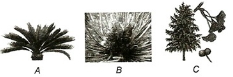
The correct names of gymnospermic plant $A, B$ and $C$ shown in figure below are
  • A
    $A$-Cycas, $B$-Ginkgo, $C$-Pinus
  • $A$-Cycas, $B$-Pinus, $C$-Ginkgo
  • C
    $A$-Ginkgo, $B$-Cycas, $C$-Pinus
  • D
    $A$-Pinus, $B$-Cycas, $C$-Ginkgo
Answer
Correct option: B.
$A$-Cycas, $B$-Pinus, $C$-Ginkgo
b
b$A$-Pinus, $B$-Cycas, $C$-Ginkgo
View full question & answer
MCQ 481 Mark
Roots is some gymnospermic genera have fungal association in the form of ...$A$... in ...$B$... Here, $A$ and $B$ refers to
  • $A-mycorrhiza; B-Pinus$
  • B
    $A-mycorrhiza; B-Cycas$
  • C
    $A-lichen; B-Pinus$
  • D
    $A-lichen; B-Cycas$
Answer
Correct option: A.
$A-mycorrhiza; B-Pinus$
a
$A-lichen; B-Cycas$
View full question & answer
MCQ 491 Mark
In gymnosperms, the ovule is naked because
  • Ovary wall is absent
  • B
    Integuments are absent
  • C
    Perianth is absent
  • D
    Nucellus is absent
Answer
Correct option: A.
Ovary wall is absent
a
aNucellus is absent
View full question & answer
MCQ 501 Mark
What is common in all these three, Bryophytes Dryopteris and Ginkgo?
  • A
    Independent sporophyte
  • Presence of archegonia
  • C
    Well developed vascular tissues
  • D
    Independent gametophyte
Answer
Correct option: B.
Presence of archegonia
b
b Independent gametophyte
View full question & answer
MCQ 511 Mark
Small specialized roots called coralloid roots associated with $N_2$ - fixing cyanobacteria. This is characteristic of...........
  • A
    Angiosperms - Wolffia
  • Gymnosperms - Cycas
  • C
    Pteridophytes - Dryopteris
  • D
    Bryophytes - Polytrichum
Answer
Correct option: B.
Gymnosperms - Cycas
b
bBryophytes - Polytrichum
View full question & answer
MCQ 521 Mark
$A$- In conifers, leaves reduce the surface area.

$R$- Conifers have needle like leaves.

  • $A$ and $R$ both correct.
  • B
    $A$ and $R$ both incorrect.
  • C
    $A$ is correct, $R$ is incorrect.
  • D
    $A$ is incorrect, $R$ is correct.
Answer
Correct option: A.
$A$ and $R$ both correct.
a
a$A$ is incorrect, $R$ is correct.
View full question & answer
MCQ 531 Mark
In gymnosperm root system is ......$A$...... In pinus symbiosis is observed between ....$B$.... and fungi which is called .....$C$....
  • A
    $A$ - Fibrous, $B$ - Root, $C$ - Lichen
  • B
    $A$ - Taproot, $B$ - Leaf, $C$ - Mycorrhizae
  • C
    $A$- Fibrous, $B$ - Root, $C$- Antheridia
  • $A$ - Tap root, $B$ - Root, $C$ - Mycorrhizae
Answer
Correct option: D.
$A$ - Tap root, $B$ - Root, $C$ - Mycorrhizae
d
d$A$ - Tap root, $B$ - Root, $C$ - Mycorrhizae
View full question & answer
MCQ 541 Mark
Which one of the following sets of structure in Pinus belong entirely to the gametophytic generation
  • A
    Ovuliferous scale, embryo, bract scale
  • B
    Bract scale, prothallial cells in pollen, integument
  • C
    Embryo, endosperm, pollen
  • Endosperm, sperm, megaspore
Answer
Correct option: D.
Endosperm, sperm, megaspore
d
(d) Endosperm in Pinus is haploid as it develops from haploid megaspore sperm and megaspore are also haploid.
View full question & answer
MCQ 551 Mark
Coralloid roots help Cycas in
  • Fixation and absorption of nitrogen
  • B
    Absorption of water
  • C
    Absorption of minerals
  • D
    Respiration
Answer
Correct option: A.
Fixation and absorption of nitrogen
a
(a)Coralloid roots of cycas possess a symbiotic alga.
View full question & answer
MCQ 561 Mark
In Cycas, the endosperm is
  • A
    Sporophytic structure
  • Gametophytic structure
  • C
    New structure
  • D
    Formed after fertilization
Answer
Correct option: B.
Gametophytic structure
b
(b)The 'endospoerm' in cycas is a haploid gametophytic tissue formed before fertilization.
View full question & answer
MCQ 571 Mark
Cycas leaflets are
  • A
    Sessile, straight, oval
  • Sessile, straight, linear-lanceolate
  • C
    Sessile, straight, spiny
  • D
    Sessile, smooth, twisted
Answer
Correct option: B.
Sessile, straight, linear-lanceolate
b
It’s obvious.
View full question & answer
MCQ 581 Mark
In Pinus male and female reproductive structures occur
  • On different branches of the same plant
  • B
    On different plants
  • C
    On same branch
  • D
    None of these
Answer
Correct option: A.
On different branches of the same plant
a
(a)Monoecious
View full question & answer
MCQ 591 Mark
In Pinus megaspore on germination forms
  • A
    Pollen tube with two motile sperms
  • Endosperm with archegonia
  • C
    Endosperm with sperms
  • D
    Endosperm with embryo sac
Answer
Correct option: B.
Endosperm with archegonia
b
It’s obvious.
View full question & answer
MCQ 601 Mark
Which of the following is not the feature of gymnosperms
  • A
    Parallel venation
  • B
    Perennial plants
  • C
    Distinct branches $(long \,and \,short\, branches)$
  • Xylem with vessels
Answer
Correct option: D.
Xylem with vessels
d
It’s obvious.
View full question & answer
MCQ 611 Mark
Fruits are not found in gymnosperms plants because
  • A
    They are seedless plants
  • B
    They are not pollinated
  • They have no ovary
  • D
    Process of fertilization does not take place in them
Answer
Correct option: C.
They have no ovary
c
It’s obvious.
View full question & answer
MCQ 621 Mark
Most of the gymnosperms have
  • A
    Only antheridia
  • B
    Both antheridia and archegonia
  • Archegonia but no antheridia
  • D
    Both absent
Answer
Correct option: C.
Archegonia but no antheridia
c
(c)Archegonia is found in bryophytes, pteridophytes and gymnosperms and antheridia occurs in bryophytes and pteridophytes.
View full question & answer
MCQ 631 Mark
Which groups depend on external source of free water
  • Algae, mosses and ferns
  • B
    Algae, mosses and gymnosperms
  • C
    Mosses, ferns and gymnosperms
  • D
    Only algae and mosses
Answer
Correct option: A.
Algae, mosses and ferns
a
(a)Water is essential for fertilization because sperms are flagellated and cannot move without water.
View full question & answer
MCQ 641 Mark
Funaria may be differentiated from Pinus by the character
  • A
    No fruits are produced
  • No seeds are produced
  • C
    Antheridia and archegonia are present
  • D
    Presence of sporophyte
Answer
Correct option: B.
No seeds are produced
b
It’s obvious.
View full question & answer
MCQ 651 Mark
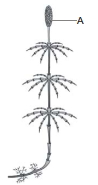
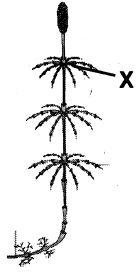
Mark the correct statement for the organism given below in figure.
  • A
    The structure labelled $A$ is male cone
  • It is member of sphenopsida
  • C
    Nodes are hollow while internodes are solid
  • D
    This is commonly called as stonewort
Answer
Correct option: B.
It is member of sphenopsida
b
This is commonly called as stonewort
View full question & answer
MCQ 661 Mark
The evolutionary advanced features of Selaginella are

$(a)$ Heterospory

$(b)$ Endosporic development of gametophyte

$(c)$ Reduced gametophyte

$(d)$ Localization of sporangium bearing appendages in strobili

$(e)$ Unisexual gametophytes

$(f)$ Fertilization with the help of water

  • A
    All are correct
  • All except $(f)$ is correct
  • C
    All except $(e)$ and $(f)$ are correct
  • D
    All except $(c)$ is correct
Answer
Correct option: B.
All except $(f)$ is correct
b
All except $(c)$ is correct
View full question & answer
MCQ 671 Mark
In Pteridophytes, reduction division occurs when
  • A
    Prothallus is formed
  • B
    Sex organs are formed
  • Spores are formed
  • D
    Gametes are formed
Answer
Correct option: C.
Spores are formed
c
Gametes are formed
View full question & answer
MCQ 681 Mark
The dominant photosynthetic phase in the life cycle of pteridophyta is equivalent to the
  • Gametophytic phase of bryophyta
  • B
    Sporophytic phase of bryophyta
  • C
    Gametophytic phase of pteridophytes
  • D
     Gametophytic phase of gymnosperm
Answer
Correct option: A.
Gametophytic phase of bryophyta
a
 Gametophytic phase of gymnosperm
View full question & answer
MCQ 691 Mark
Find correct statement for the prothallus of fern
  • A
    Monoecious, protandrous with multicellular rhizoides
  • Monoecious, protandrous with unicellular rhizoides
  • C
    Dioecious, with unicellular rhizoides
  • D
     Monoecious, protandrous with apical antheredia and basal archegonia on ventral surface
Answer
Correct option: B.
Monoecious, protandrous with unicellular rhizoides
b
 Monoecious, protandrous with apical antheredia and basal archegonia on ventral surface
View full question & answer
MCQ 701 Mark
Algae, bryophytes and pteridophytes resemble with each other in which one of the following feature?
  • A
    Gametophytic plant body
  • Dependence on water for fertilisation
  • C
    Haplontic alternation of generation
  • D
    Presence of embryo
Answer
Correct option: B.
Dependence on water for fertilisation
b
Presence of embryo
View full question & answer
MCQ 711 Mark
In some pteridophytes, sporophyll form distinct compact structures called ...$A$... in ...$B$... and ...$C$... Here $A, B$ and $C$ refers to
  • A
    $A-sporocarp, B-Pogonatum, C-Selaginella$
  • B
    $A-spikelet, B-Riccia, C-Marchantia$
  • $A-strobilus, B-Selaginella, C-Equisetum$
  • D
    $A-spike, B-Fern, C-Salvinia$
Answer
Correct option: C.
$A-strobilus, B-Selaginella, C-Equisetum$
c
$A-spike, B-Fern, C-Salvinia$
View full question & answer
MCQ 721 Mark
In case of heteroporous pteridophyte the gametophyte is
  • Always dioecious
  • B
    Monoecious
  • C
    May be monoecious or dioecious
  • D
    Vascular
Answer
Correct option: A.
Always dioecious
a
Vascular
View full question & answer
MCQ 731 Mark
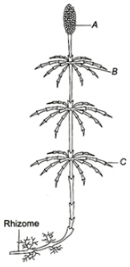
Identify $A, B$ and $C$ in the following figure and choose the correct option
  • A
    $A-Strobilus, B-Node, C-Leaves$
  • $A-Strobilus, B-Node, C-Branch$
  • C
    $A-Sporophyll, B-Node, C-Internode$
  • D
    $A-Sporophyll, B-Internode, C-Node$
Answer
Correct option: B.
$A-Strobilus, B-Node, C-Branch$
b
$A-Sporophyll, B-Internode, C-Node$
View full question & answer
MCQ 741 Mark
A fern differs from a moss in having
  • A
    Swimming archegonia
  • B
    Swimming antherozoids
  • C
    Independent gametophytes
  • Independent sporophytes
Answer
Correct option: D.
Independent sporophytes
d
Independent sporophytes
View full question & answer
MCQ 751 Mark
Which of the following is pteridophytes belong to class-Pteropsida?
  • A
    Equisetum and Psilotum
  • B
    Lycopodium and Adiantum
  • C
    Selaginella and Pteris
  • Pteris and Adiantum
Answer
Correct option: D.
Pteris and Adiantum
d
Pteris and Adiantum
View full question & answer
MCQ 761 Mark
Which of the following pteridophytes is heterosporous in nature?
  • Selaginella and Salvinia
  • B
    Adiantum and Equisetum
  • C
    Psilotum and Lycopodium
  • D
    Adiantum and $P$ silotum
Answer
Correct option: A.
Selaginella and Salvinia
a
Adiantum and $P$ silotum
View full question & answer
MCQ 771 Mark
In which plant seed does not formed ?
  • Nephrolepis, Funaria
  • B
    Funaria, Maize
  • C
    Chlamydomonas, maize
  • D
    Sunflower, Zamia
Answer
Correct option: A.
Nephrolepis, Funaria
a
Sunflower, Zamia
View full question & answer
MCQ 781 Mark
$A$ - Selaginella and salvinia produce heterospore

$R$ - Cones are developed in selaginella and Equisetum.

  • $A$ and $R$ both correct.
  • B
    $A$ and $R$ both incorrect.
  • C
    $A $ is correct, $R$ is incorrect.
  • D
    $A$ is incorrect, $R$ is correct.
Answer
Correct option: A.
$A$ and $R$ both correct.
a
$A$ is incorrect, $R$ is correct.
View full question & answer
MCQ 791 Mark
Match the following:
Column $- I$ Column $- II$
$(1)$ Psilopsida A. Sellaginella
$(2)$ Lycopsida $(B)$ Adiantum
$(3)$ Sphenopsida $(C)$ Equisetum
$(4)$ Pteropsida $(D)$ Psilotum
  • A
    $(1-D), (2-A),(3-B),(4-C) $
  • B
    $(1-D),(2-C),(3-B),(4-A) $
  • $(1-D),(2-A),(3-C),(4-B)$
  • D
    $(1-C),(2-A),(3-D),(4-B) $
Answer
Correct option: C.
$(1-D),(2-A),(3-C),(4-B)$
c
$(1-C),(2-A),(3-D),(4-B) $
View full question & answer
MCQ 801 Mark
Choose correct pair :
  • A
    Pteropsida - Sellaginella
  • B
    Lycopsida - Adiantum
  • Sphenopsida - Equisatum
  • D
    Psilopsida -pteris
Answer
Correct option: C.
Sphenopsida - Equisatum
c
Psilopsida -pteris
View full question & answer
MCQ 811 Mark
Horsetail and fern are
  • A
    Bryophytes
  • Pteridophyte
  • C
    Angiosperm
  • D
    Gymnosperm
Answer
Correct option: B.
Pteridophyte
b
Gymnosperm
View full question & answer
MCQ 821 Mark
The main plant body of Selaginella sp. is
  • A
    Gametophyte
  • Sporophyte
  • C
    Both gametophyte and sporophyte
  • D
    Halophyte
Answer
Correct option: B.
Sporophyte
b
Halophyte
View full question & answer
MCQ 831 Mark
One character common for Selaginella and fern is
  • A
    Heterospory
  • B
    Protostele
  • C
    Development of sporangium
  • Absence of ovule
Answer
Correct option: D.
Absence of ovule
d
Absence of ovule
View full question & answer
MCQ 841 Mark
In Dryopteris
  • A
    Sporophyte is parasitic over gametophyte
  • B
    Sporophyte is independent
  • C
    Gametophyte is independent
  • Both $(b)$ and $(c)$
Answer
Correct option: D.
Both $(b)$ and $(c)$
d
Both $(b)$ and $(c)$
View full question & answer
MCQ 851 Mark
Common characteristic between bryophytes and pteridophytes is
  • A
    Vascularisation
  • B
    Terrestrial habit
  • Water for fertilization
  • D
    Independent sporophyte
Answer
Correct option: C.
Water for fertilization
c
Independent sporophyte
View full question & answer
MCQ 861 Mark
Spore of fern represents
  • A
    Sporophytic stage
  • Gametophytic stage
  • C
    Sporophytic and gametophytic stage
  • D
    Apomictic stage
Answer
Correct option: B.
Gametophytic stage
b
Apomictic stage
View full question & answer
MCQ 871 Mark
Pteridophytes are characterized by
  • A
    Presence of vascular system
  • B
    Absence of flowers
  • C
    Absence of fruits
  • All the above
Answer
Correct option: D.
All the above
d
All the above
View full question & answer
MCQ 881 Mark
Heterosporous pteridophytes always produce
  • A
    Monoecious gametophytes
  • Dioecious gametophytes
  • C
    Homothallic gametophytes
  • D
    None of the above
Answer
Correct option: B.
Dioecious gametophytes
b
None of the above
View full question & answer
MCQ 891 Mark
In which of the following plant diploid stage generally dominates
  • A
    Algae
  • Ferns
  • C
    Mosses
  • D
    Fungi
Answer
Correct option: B.
Ferns
b
Fungi
View full question & answer
MCQ 901 Mark
Bryophytes differ from pteridophytes in
  • A
    Swimming antherozoids
  • B
    An independent gametophyte
  • C
    Archegonia
  • Lack of vascular tissue
Answer
Correct option: D.
Lack of vascular tissue
d
Lack of vascular tissue
View full question & answer
MCQ 911 Mark
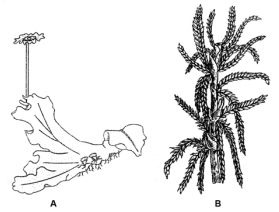
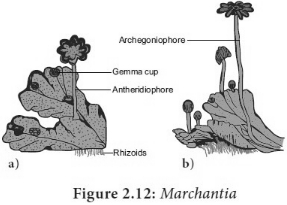
Identify the plants $A$ and $B$ in the figures given below
  • A
    $A$ - Female Marchantia, $B$ - Sphagnum
  • B
    $A$ - Female Marchantia, $B$ - Sphagnum
  • C
    $A$ - Marchantia, $B$ - Funaria
  • $A$ - Male Marchantia, $B$ - Sphagnum
Answer
Correct option: D.
$A$ - Male Marchantia, $B$ - Sphagnum
d
Plant '$A$' -Male Marchantia
Plant '$B$' -Sphagnum
View full question & answer
MCQ 921 Mark
Bryophytes are not characterised by
  • A
    Sporophyte parasitic over gametophyte
  • B
    Independent gametophyte
  • C
    Absence of vascular tissues
  • Independent sporophyte
Answer
Correct option: D.
Independent sporophyte
d
Bryophytes -Independent sporophytes absent
View full question & answer
MCQ 931 Mark
Which of the following statement is incorrect regarding bryophytes?
  • A
    They are dependent on water for sexual reproduction
  • The main plant body is diploid
  • C
    They usually occur in damp, humid and shaded localities
  • D
    They play an important role in plant succession on bare rocks
Answer
Correct option: B.
The main plant body is diploid
b
The main plant body in bryophytes is haploid.
View full question & answer
MCQ 941 Mark
Mosses (along with lichen) are of great ecological importance because
  • A
    They colonise on barren rocks and decompose rock
  • B
    Its contribution to prevent soil erosion
  • C
    Its contribution in ecological succession
  • All of the above
Answer
Correct option: D.
All of the above
d
Bryophytes shows considerable economic importance. They colonise on barren rocks along with lichens and decomposed rocks. When they grow on rocks, the help in soil formation. Some bryophytes also work as soil binders when they grow in aggregations
View full question & answer
MCQ 951 Mark
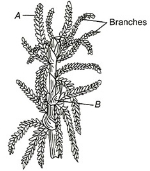
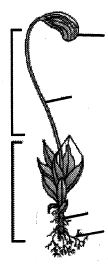
$A$ and $B$ in given figure represents
  • A
    $A-Gametophyte branch, B-Sporophyte branch$
  • $A-Antheridial branch, B-Archegonial branch$
  • C
    $A-Archegonial branch, B-Antheridial branch$
  • D
    $A-Sporophyte branch, B-Gametophyte branch$
Answer
Correct option: B.
$A-Antheridial branch, B-Archegonial branch$
b
View full question & answer
MCQ 961 Mark
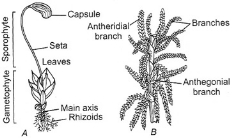
Which of the following options correctly identifies the plants their groups from the following structure?
  • $A$-Funarria-Moss; $B$-Sphagnum-Moss
  • B
    $A$-Funaria-Liverwort; $B$-Sphagnum-Moss
  • C
    $A$-Selaginella-Bryophytes; $B$-Funaria-Liverwort
  • D
    $A$-Selaginella-Pteridophytes; $B$-Funaria-Moss
Answer
Correct option: A.
$A$-Funarria-Moss; $B$-Sphagnum-Moss
a
View full question & answer
MCQ 971 Mark
Which of the following statement is true about the sporophytic stage in plant life cycle?
  • A
    The haploid generation
  • B
    Generation that produces the gametes
  • Generation that produces the spores
  • D
    Generation that produces vascular
Answer
Correct option: C.
Generation that produces the spores
c
The plant life cycle has both a sporophyte and a gametophyte generation. The stage of a plant life cycle, that produces spores by meiosis and alternate with the gametophyte stage is called sporophytic stage
View full question & answer
MCQ 981 Mark
Choose the correct statements about protonema
  • A
    Juvenile stage of moss is protonema
  • B
    It consists of slender; green, branching system of filaments
  • C
    Develops directly from a spore
  • All of the above
Answer
Correct option: D.
All of the above
d
Juvenile stage of moss is protonema, which develops directly from a spore. It is a creeping, green, slender, branched and frequently filamentous stage
View full question & answer
MCQ 991 Mark
Which is wrong in respect to bryophytes?
  • A
    Water is essential for sexual reproduction
  • B
    Presence of antheridium
  • C
    Presence of flagellated sperms
  • Presence of autotrophic independent sporophyte
Answer
Correct option: D.
Presence of autotrophic independent sporophyte
d
In bryophytes the diploid sporophyte is short lived and dependent upon the gametophyte
View full question & answer
MCQ 1001 Mark
Which of the following statement is correct about the gametophytic stage in the alteration of generation with in the life cycle?
  • Generation that produces the gametes
  • B
    Generation that produces the spores
  • C
    Generation that produces vascular tissue
  • D
    The diploid generation
Answer
Correct option: A.
Generation that produces the gametes
a
Gametophyte is gamete bearing, haploid multicelled stage of many plants, beginning with haploid spores and ending at fertilisation
View full question & answer
MCQ 1011 Mark
In moss, the sporophyte is differentiated into
  • A
    Seta and capsule
  • B
    Foot and seta
  • C
    Protonema, foot and capsule
  • Foot, seta and capsule
Answer
Correct option: D.
Foot, seta and capsule
d
In moss, the sporophyte is differentiated into foot, seta and capsule
View full question & answer
MCQ 1021 Mark
In liverworts asexual reproduction takes place by
  • Gemmae and fragmentation of thalli
  • B
    Fragmentation and zoospores
  • C
    Gemmae formation and spores formation
  • D
    Isogamy and anisogamy
Answer
Correct option: A.
Gemmae and fragmentation of thalli
a
Liverworts reproduce asexually by the formation of specialised structure called gemmae or through fragmentation of thalli. Gemmae are asexual buds, which originate from small receptacles called gemma cups
View full question & answer
MCQ 1031 Mark
The amphibians of plant kingdom are
  • A
    Multicellular non-motile algae
  • Bryophytes with simple internal organization
  • C
    Unicellular motile algae
  • D
    Pteridophytes with complex internal organization
Answer
Correct option: B.
Bryophytes with simple internal organization
b
Though bryophytes are the land plants but water is essential for fertilization. It provides a medium of transport for antherozoids to reach archegonia. Hence, bryophytes are called amphibians of plant kingdom
View full question & answer
MCQ 1041 Mark
Bryophytes are called amphibians of plant kingdom because
  • Their reproductive phase requires water
  • B
    Their sex organs are multicellular and jacketed
  • C
    They have tracheids
  • D
    All of the above
Answer
Correct option: A.
Their reproductive phase requires water
a
View full question & answer
MCQ 1051 Mark
In a moss the sporophyte
  • A
    Produces gametes that give rise to be gametophyte
  • B
    Arises from a spore produced from the gametophyte
  • C
    Manufactures food for itself as well as for the gametophyte
  • Is partially or totally parasitic on the gametophyte
Answer
Correct option: D.
Is partially or totally parasitic on the gametophyte
d
View full question & answer
MCQ 1061 Mark
Which one of the following is common to multicellular fungi, filamentous algae and protonema of moses
  • A
    Diplontic life cycle
  • B
    Members of kingdom plantae
  • C
    Mode of nutrition
  • Multiplication by fragmentation
Answer
Correct option: D.
Multiplication by fragmentation
d
View full question & answer
MCQ 1071 Mark
Which of the following mechanism of mosses is more elaborate?
  • Spore dispersal
  • B
    Gametophyte is divided into two stages.
  • C
    After fertilization, the zygote develops into sporophyte.
  • D
    All of the above.
Answer
Correct option: A.
Spore dispersal
a
View full question & answer
MCQ 1081 Mark
Which of the following species of a moss, provide peat?
  • Some of the Sphagnum.
  • B
    Some of the Rhizobium.
  • C
    Some of the Pyrenoids.
  • D
    All of the species of moss.
Answer
Correct option: A.
Some of the Sphagnum.
a
View full question & answer
MCQ 1091 Mark
What is correct for funaria ?
  • A
    Pteridophytes - embryonic development from zygote
  • B
    Gymnosperm - pressence of coralloid
  • Bryophytes - known as amphibiun plant
  • D
    Algae - contain red coloured pigments.
Answer
Correct option: C.
Bryophytes - known as amphibiun plant
c
View full question & answer
MCQ 1101 Mark
Which statement is true
  • A
    Spores and gametes are invariably diploids
  • Spores and gametes are invariably haploids
  • C
    Only gametes are invariably haploids
  • D
    Only spores are invariably diploids
Answer
Correct option: B.
Spores and gametes are invariably haploids
b
It’s obvious.
View full question & answer
MCQ 1111 Mark
Funaria has
  • A
    Unicellular simple rhizoids
  • B
    Tuberculated rhizoids
  • C
    Distinct branched coenocytic rhizoids
  • Multicellular, oblique septate rhizoids
Answer
Correct option: D.
Multicellular, oblique septate rhizoids
d
(d)On the lower portion of leafy gametophore, there are present branched, multicellular rhizoids with oblique septa.
View full question & answer
MCQ 1121 Mark
In Riccia / Bryophytes
  • Sporophyte is parasitic over gametophyte
  • B
    Gametophyte is parasitic over sporophyte
  • C
    Sporophyte is independent of gametophyte
  • D
    Sporophyte is semiparasite
Answer
Correct option: A.
Sporophyte is parasitic over gametophyte
a
(a) The sporophytic is parasitic over gametophyte.

Thus there is heteromorphic or heterologous alternation of generations in Riccia. So life cycle in Riccia is diplohaplontic.

View full question & answer
MCQ 1131 Mark
In Riccia / Marchantia the rhizoids are
  • A
    Branched unicellular
  • B
    Branched multicellular
  • C
    Unbranched multicellular
  • Unbranched unicellular
Answer
Correct option: D.
Unbranched unicellular
d
It’s obvious.
View full question & answer
MCQ 1141 Mark
The body of Funaria is
  • A
    Simple rosette thallus
  • B
    Differentiated into root, central axis and leaves
  • Differentiated into rhizoids, stem and leaves
  • D
    None of the above
Answer
Correct option: C.
Differentiated into rhizoids, stem and leaves
c
(c)The main plant body of funaria is gametophyte and is differentiated in to stem leaves and numerous rhizoids.
View full question & answer
MCQ 1151 Mark
Mosses show
  • A
    Isomorphic alternation of generation
  • Heteromorphic alternation of generation
  • C
    Haplobiontic life cycle
  • D
    None of the above
Answer
Correct option: B.
Heteromorphic alternation of generation
b
(b) There are two generations in life-cycle of funaria i.e., gametophytic generation $(haploid)$ which is independent and complex and sporophytic generation $(diploid)$ which is partially dependent upon gametophytic generation.

These two generations follow each other in regular sequence.

View full question & answer
MCQ 1161 Mark
In mosses
  • A
    Gametophyte is independent of sporophyte
  • B
    Sporophyte is partly dependent on gameto~phyte
  • Both $(a)$ and $(b)$
  • D
    None of the above
Answer
Correct option: C.
Both $(a)$ and $(b)$
c
It’s obvious.
View full question & answer
MCQ 1171 Mark
Funaria is a bryophyte because it
  • A
    Has no roots and stems
  • Has sporophyte attached to the gametophyte
  • C
    Is vascular
  • D
    All the above
Answer
Correct option: B.
Has sporophyte attached to the gametophyte
b
It’s obvious.
View full question & answer
MCQ 1181 Mark
Which of the following is a diploid
  • Capsule of moss
  • B
    Gametophyte, archegonia and egg of moss
  • C
    Gametophyte, antheridia and sperm of moss
  • D
    Gametophyte and spore of moss
Answer
Correct option: A.
Capsule of moss
a
(a) The capsule of moss is a diploid because the mature sporogonium $(sporophyte) $ diploid in nature.
View full question & answer
MCQ 1191 Mark
The protonema of moss differs from green alga in having
  • A
    Buds
  • B
    Colourless rhizoids
  • C
    Oblique septa and discoid chloroplast
  • All of the above
Answer
Correct option: D.
All of the above
d
(d) Protonema of moss looks like a green filamentous alga but differs from it in having buds, oblique septa and colourless rhizoidal branches.
View full question & answer
MCQ 1201 Mark
In moss $(Funaria)$ sporophyte is differentiated into
  • A
    Stem and leaves
  • B
    Root, stem and leaves
  • C
    Rhizoid, stem and leaves
  • None of the above
Answer
Correct option: D.
None of the above
d
(d) Sporophyte of Funaria is differentiated into foot, seta and capsule.
View full question & answer
MCQ 1211 Mark
What is incorrect for bryophytes
  • A
    Vascular tissue lacking
  • B
    Independent sporophyte absent
  • Gametophyte reduced and dependent
  • D
    Asexual reproduction by zoospores absent
Answer
Correct option: C.
Gametophyte reduced and dependent
c
(c) The main plant of bryophyta is gametophyte. Gametophytic stage is independent.
View full question & answer
MCQ 1221 Mark
Among the following which is not characteristic feature of bryophyta
  • A
    Motile sperms
  • B
    Presence of archegonium
  • C
    Water essential for fertilization
  • Photosynthetically independent sporophyte
Answer
Correct option: D.
Photosynthetically independent sporophyte
d
(d) Sporophyte is dependent on gametophyte.
View full question & answer
MCQ 1231 Mark
Bryophytes are of
  • A
    Great economic value
  • B
    No value at all
  • Great ecological importance
  • D
    A lot of aesthetic value
Answer
Correct option: C.
Great ecological importance
c
(c) They are called pollution indicators.

They prevent soil erosion by running water.

View full question & answer
MCQ 1241 Mark
Algae differ from Bryophyta in possessing
  • Naked sex organs
  • B
    Sex organs covered with sterile covering
  • C
    Chlorphylls $\alpha$ and $\beta$
  • D
    Aerobic respiration
Answer
Correct option: A.
Naked sex organs
a
(a) Algae differ from bryophyta because in algae sex organs are usually non-jacketed and in bryophyta sex organs are jacketed with sterile jacket.
View full question & answer
MCQ 1251 Mark
Algae with floridean starch as reserve food material is also characterised by
  • A
    Presence of chlorophyll b
  • B
    Stacked thylakoids
  • C
    Nonsulphated phycocolloids
  • Nonflagellate nature
Answer
Correct option: D.
Nonflagellate nature
d
Nonflagellate nature
View full question & answer
MCQ 1261 Mark
Most algal genera are haplontic some of them such as ...$A$... ...$B$... and ...$C$... are haplo-diplontic. Here $A, B$ and $C$ refers to
  • $A-Ectocarpus, B-Polysiphonia, C-Kelps$
  • B
    $A-Volvox, B-Spirogyra, C-Kelps$
  • C
    $A-Spirogyra, B-Polysiphonia, C-Ectocarpus$
  • D
    $A-Volvox, B-Kelps, C-Ectocarpus$
Answer
Correct option: A.
$A-Ectocarpus, B-Polysiphonia, C-Kelps$
a
a$A-Volvox, B-Kelps, C-Ectocarpus$
View full question & answer
MCQ 1271 Mark
Consider the following statements regarding the major pigments and stored food in the different groups of algae and select the correct options given.

$I.$ In Chlorophyceae, the stored food material is starch and the major pigments are chlorophyll-a and chlorophyll - d

$II$. In Phaeophyceae, laminarian is the stored food and major pigments are chlorophyll-a and chlorophyll b

$III$. In Rhodophyceae, floridean starch is the stored food and major pigments are chlorophylla-a,d and phycoerythrin.

  • A
    $I$ is correct, but $II$ and $III$ are incorrect
  • B
    $I$ and $II$ are correct, but $III$ is incorrect
  • C
    $I$ and $III$ are correct, but $II$ is incorrect
  • $III$ is correct, but $I$ and $II$ are incorrect
Answer
Correct option: D.
$III$ is correct, but $I$ and $II$ are incorrect
d
$III$ is correct, but $I$ and $II$ are incorrect
View full question & answer
MCQ 1281 Mark
Which of the following is not correctly matched?
  • A
    Chlamydomonas - Unicellular flagellated
  • B
    Laminaria - Flattened leaf-like thallus
  • C
    Chlorella - Unicellular non-flagellated
  • Volvox - Colonial form, non-flagellated
Answer
Correct option: D.
Volvox - Colonial form, non-flagellated
d
Volvox - Colonial form, non-flagellated
View full question & answer
MCQ 1291 Mark
Algae include unicellular forms like $\ldots A$..., filamentous like ...$B$... and colonical forms like ...$C$.... Here $A, B$ and $C$ refer to
  • A
    $A-Chlamydomonas, B-Volvox, C-Ulothrix$
  • B
    $A-Ulothrix, B-Volvox, C-Chlamydomonas$
  • C
    $A-Volvox, B-Ulothrix, C-Chlamydomonas$
  • $A-Chlamydomonas, B-Ulothrix, C-Volvox$
Answer
Correct option: D.
$A-Chlamydomonas, B-Ulothrix, C-Volvox$
d
$A-Chlamydomonas, B-Ulothrix, C-Volvox$
View full question & answer
MCQ 1301 Mark
Mosses occur in moist place because
  • A
    The cannot grow on land
  • Their gamete fuses in water
  • C
    They lack vascular tissue
  • D
    They lack root and stomata
Answer
Correct option: B.
Their gamete fuses in water
b
They lack root and stomata
View full question & answer
MCQ 1311 Mark
In which of the following, all listed genera belong to the same class of algae?
  • A
    Chara, Fucus, Polysiphonia
  • Volvox, Spirogyra, Chlamydomonas
  • C
    Porphyra, Ectocarpus, Ulothrix
  • D
    Sargassum, Laminaria, Gracillaria
Answer
Correct option: B.
Volvox, Spirogyra, Chlamydomonas
b
Sargassum, Laminaria, Gracillaria
View full question & answer
MCQ 1321 Mark
Laminarin and manitol of class-Phaeophyceae (brown algae) are
  • A
    Proteins
  • Complex carbohydrates
  • C
    Lipoproteins
  • D
    Fat
Answer
Correct option: B.
Complex carbohydrates
b
Fat
View full question & answer
MCQ 1331 Mark
Chlamydomonas, Volvox, Ulothrix, Spirogyra and Chara are the examples of
  • Class-Chlorophyceae (green algae)
  • B
    Class-Phaeophyceae (brown algae)
  • C
    Class-Rhodophyceae (red algae)
  • D
    Class-Cyanophyceae (blue-green algae) and Chlorphyceae
Answer
Correct option: A.
Class-Chlorophyceae (green algae)
a
Class-Cyanophyceae (blue-green algae) and Chlorphyceae
View full question & answer
MCQ 1341 Mark
The moss plant is
  • A
    Sometimes gametophyte and sometimes sporophyte
  • Predominantly gametophyte with sporophyte attached to it
  • C
    Gametophyte
  • D
    Sporophyte
Answer
Correct option: B.
Predominantly gametophyte with sporophyte attached to it
b
Sporophyte
View full question & answer
MCQ 1351 Mark
Storage bodies, pyrenoids in the chloroplast contain
  • Protein and starch
  • B
    Carbohydrate and protein
  • C
    Polysaccharide and protein
  • D
    Starch and lipid
Answer
Correct option: A.
Protein and starch
a
Starch and lipid
View full question & answer
MCQ 1361 Mark
Acetabularia is a
  • Single-celled marine green alga
  • B
    Multicelled marine green alga
  • C
    Single-celled freshwater green alga
  • D
    Multicelled freshwater green alga
Answer
Correct option: A.
Single-celled marine green alga
a
Multicelled freshwater green alga
View full question & answer
MCQ 1371 Mark
Incorrect character of brown alga is
  • Chlorophyll- $a \wedge b$ present
  • B
    They remain attached
  • C
    Chlorophyll- $a \wedge c$ present
  • D
    Presence of fucoxanthin
Answer
Correct option: A.
Chlorophyll- $a \wedge b$ present
a
Presence of fucoxanthin
View full question & answer
MCQ 1381 Mark
What is correct for porphyra and Leminaria
  • A
    One is fungi and another is a member ofplantane kingdom
  • B
    One is algae and another is anangiosperm plant
  • C
    One is lichem and another is algae
  • Both are algae used as food
Answer
Correct option: D.
Both are algae used as food
d
dBoth are algae used as food
View full question & answer
MCQ 1391 Mark
In spirogyra gametes are
  • non-flagellated but similar in size
  • B
    flagellated and similar in size
  • C
    non flagellated and dissimilar in size
  • D
    flagellated but dissimilar in size
Answer
Correct option: A.
non-flagellated but similar in size
a
aflagellated but dissimilar in size
View full question & answer
MCQ 1401 Mark
Which one of the following statements is wrong?
  • A
    Agar-agar is obtained from Gelidium and Gracilaria
  • B
    Chlorella and Spirulina are used as space food
  • Mannitol is stored food in Rhodophyceae
  • D
    Algin and carrageen are products of algae
Answer
Correct option: C.
Mannitol is stored food in Rhodophyceae
c
cAlgin and carrageen are products of algae
View full question & answer
MCQ 1411 Mark
Which is correct for Chlorophyceae ?
  • A
    Chlorophyll a and b both are absent
  • Food stored in pyrenoids
  • C
    Vegetative reproduction not occur.
  • D
    Chloroplast only in spiral shaped.
Answer
Correct option: B.
Food stored in pyrenoids
b
bChloroplast only in spiral shaped.
View full question & answer
MCQ 1421 Mark
Choose correct pair.
  • A
    Unicellular algae - kelps
  • B
    Colonial algae - Chlamydomonas
  • Filamentous algae - Ulothrix
  • D
    Isogamous reproduction - fucus
Answer
Correct option: C.
Filamentous algae - Ulothrix
c
cIsogamous reproduction - fucus
View full question & answer
MCQ 1431 Mark
Choose correct pair.

 $\begin{array}{|l|l|} \hline Column-I & Column-II \\ \hline 1.\,\,Phaeophyceae & A.\,\,Chara \\ \hline 2.\,\,Chlorophyceae & B.\,\,Wolffia \\ \hline 3.\,\,Rhodophyceae & C.\,\,Porphyra \\ \hline 4.\,\,Angiosperms & D.\,\,Ectocarpus \\ \hline \end{array}$


  • A
    $(1-D),(2-A),(3-B),(4-C) $
  • B
    $(1-D),(2-C),(3-B),(4-A) $
  • $(1-D),(2-A),(3-C),(4-B) $
  • D
    $(1-C),(2-A),(3-D),(4-B)$
Answer
Correct option: C.
$(1-D),(2-A),(3-C),(4-B) $
c
c$(1-C),(2-A),(3-D),(4-B)$
View full question & answer
MCQ 1441 Mark
Which of the following algae are used as food supplements by space travellers?
  • A
    Gellidium
  • Chlorella and Spirullina
  • C
    Algin and Carrageen
  • D
    Chlamydomonas and Spirogyra
Answer
Correct option: B.
Chlorella and Spirullina
b
bChlamydomonas and Spirogyra
View full question & answer
MCQ 1451 Mark
What is correct for chlorophycae ?
  • A
    Gellatenous algin layer surrounds celluloic cell wall.
  • B
    Menitol layer that surrounds celluloic cellwall.
  • Pectose layer surround cell wall.
  • D
    Leminarin is available as stored food.
Answer
Correct option: C.
Pectose layer surround cell wall.
c
cLeminarin is available as stored food.
View full question & answer
MCQ 1461 Mark
Ectocarpus and dictyota are example of
  • A
    Rhodophycae
  • Pheopyycae
  • C
    Chlorophycae
  • D
    Choloroycae and pheophycae respectively
Answer
Correct option: B.
Pheopyycae
b
bCholoroycae and pheophycae respectively
View full question & answer
MCQ 1471 Mark
Heterospory is production of
  • A
    Sexual and asexual spores
  • Large and small spores
  • C
    Haploid and diploid spores
  • D
    Diploid and tetraploid spores
Answer
Correct option: B.
Large and small spores
b
(b) Production of two types of spore (A large number of microspores and few megaspores) with in sporangium are called Heterospory.
View full question & answer
MCQ 1481 Mark
Pigments present in Ulothrix are
  • A
    Chl. $a$, Chl $b$ and phycocyanin
  • B
    Chl $a$, Chl $c$, phycocyanin and fucoxanthin
  • Chl. $a$, Chl $b$, carotenes and xanthophylls
  • D
    Chl $a$ and fucoxanthin
Answer
Correct option: C.
Chl. $a$, Chl $b$, carotenes and xanthophylls
c
(c) Ulothrix is green algae.
View full question & answer
MCQ 1491 Mark
Spirogyra is a
  • Fresh water and free floating alga
  • B
    Marine and free floating alga
  • C
    Fresh water and locomotory alga
  • D
    None of the above
Answer
Correct option: A.
Fresh water and free floating alga
a
(a) Spirogyra is a free floating, filamentous, green, freshwater alga which is popularly called pond silk, hair of princess because its filaments are slimy to touch and shine in water.
View full question & answer
MCQ 1501 Mark
Filaments of Spirogyra are
  • Uniseriate and unbranched
  • B
    Uniseriate and branched
  • C
    Multiseriate and unbranched
  • D
    Multiseriate and branched
Answer
Correct option: A.
Uniseriate and unbranched
a
It’s obvious.
View full question & answer
MCQ 1511 Mark
Spirogyra cells contain
  • A
    One chloroplast and one pyrenoid
  • B
    One or more chloroplast, each with one pyrenoid
  • One or more chloroplast, each with many pyrenoids
  • D
    None of the above
Answer
Correct option: C.
One or more chloroplast, each with many pyrenoids
c
(c) Spirogyra cell contain one $(e.g., S. sahnii)$ to more ($sixteen$ in S. $rectispora$) ribbon-shaped spirally coiled chloroplasts $(wavy\, margin)$ each with a row of many pyrenoids (seat of $synthesis$ and $storage$ of starch).

Connected together by a narrow ridge.

View full question & answer
MCQ 1521 Mark
Sex organs of thallophytes are generally
  • Unicellular
  • B
    Multicellular surrounded by a sterile jacket
  • C
    Multicellular but not surrounded by any jacket
  • D
    Unicellular with a sterile jacket
Answer
Correct option: A.
Unicellular
a
(a) Sex organs of thallophytes are generally unicellular and non-jacketed and when multicellular, each cell is fertile.
View full question & answer
MCQ 1531 Mark
Which among the following do you consider as the best evidence to show that two species of algae are closely related
  • A
    They both respire and release $CO_2$
  • B
    They both are found in the same habitat
  • C
    They both reproduce asexually
  • They both have same type of pigments
Answer
Correct option: D.
They both have same type of pigments
d
It’s obvious.
View full question & answer
MCQ 1541 Mark
Which one of the following statements concerning the algae is wrong
  • A
    Most algae are photosynthetic
  • B
    Algae can be classified according to their pigments
  • All algae are filamentous
  • D
    Spirogyra does not produce zoospores
Answer
Correct option: C.
All algae are filamentous
c
It’s obvious.
View full question & answer
MCQ 1551 Mark
Coenobium means
  • A hollow spherical colony
  • B
    A group of filaments
  • C
    Palmelloid form
  • D
    None of the above
Answer
Correct option: A.
A hollow spherical colony
a
(a) Coenobium : It is an assemblage of unicellular algae $(daughter \,colony)$ e.g., Volvox, Eudorina, Pandorina etc.
View full question & answer
MCQ 1561 Mark
The classification of algae is based on
  • A
    Type of pigment
  • B
    Nature of cell wall material
  • C
    Nature of reserve food
  • All the above
Answer
Correct option: D.
All the above
d
It’s obvious.
View full question & answer
MCQ 1571 Mark
$A$ : Sexual reproduction shows considerable variation in the type and formation of sex cells in members of chlorophyceae.
$R$ : It may be isogamous, anisogamous and oogamous
  • Assertion and Reason both are correct and also correct explanation.
  • B
    Assertion and Reason both are correct but not explanation of assertion.
  • C
    Assertion is correct, but Reason is incorrect.
  • D
    Both Assertion and Reason are incorrect.
Answer
Correct option: A.
Assertion and Reason both are correct and also correct explanation.
a
Assertion and Reason both are correct and Reason has correct explanation
View full question & answer
MCQ 1581 Mark
The Bentham and Hooker’s classification is
  • Classification of taxa based on actual examination
  • B
    Artificial system of classification
  • C
    Phylogenetic system of classification
  • D
    Based on evolution
Answer
Correct option: A.
Classification of taxa based on actual examination
a
Bentham and Hooker's classification is based on actual examination
View full question & answer
MCQ 1591 Mark
Sexual system of classification is
  • A
    Artificial system 
  • B
    Based on stamens characters
  • C
    Based on corolla and carpels characters
  • Both $(a)$ $\&$ $(b)$
Answer
Correct option: D.
Both $(a)$ $\&$ $(b)$
d
Sexual system of classification is
-Artificial system
-Based on stamens characters
View full question & answer
MCQ 1601 Mark
$DNA$ sequence is the basis of grouping organisms in
  • A
    Karyotaxonomy
  • B
    Cytotaxonomy
  • C
    Phenetics
  • Chemotaxonomy
Answer
Correct option: D.
Chemotaxonomy
d
Chemotaxonomy involves grouping of organisms on the basis of :

- $DNA$ sequence

- $RNA$ sequence

- Chemical nature of protein etc.

View full question & answer
MCQ 1611 Mark
Classification of organisms on the basis of fossils record that play important role in elucidation of evolutionary relationships is
  • A
    Earliest systems
  • Phylogenetic systems
  • C
    Morphotaxonomy
  • D
    Artificial system
Answer
Correct option: B.
Phylogenetic systems
b
Phylogenetic system plays important role in elucidation of 'evolutionary relationships.
View full question & answer
MCQ 1621 Mark
Which of the following systems of classification involves usage of one or few morphological characters for grouping of organisms?
  • Artificial system
  • B
    Natural system
  • C
    Phylogenetic system
  • D
    Bentham and Hooker's system
Answer
Correct option: A.
Artificial system
a
Artificial system of classification involves usage of one or few morphological characters.
View full question & answer
MCQ 1631 Mark
Artificial system of classification was given by ... $A$... and based on ...$B$...

Fill the blanks with respect to $A$ and $B$. choose the correct option

  • A
    $A-Aristotle; B-anatomical characters$
  • B
    $A-Linnaeus; B-cytological information$
  • $A-Linnaeus; B-morphological characters$
  • D
    $A-Haeckel; B-morphological characters$
Answer
Correct option: C.
$A-Linnaeus; B-morphological characters$
c
Artificial system of classification was given by Linnaeus and based on morphological characters such as habit, colour, number and shape of leaves, etc
View full question & answer
MCQ 1641 Mark
Kingdom-Plantae includes
  • A
    Algae, bryophytes and pteridophytes
  • Algae, bryophytes, pteridophytes, gymnosperms and angiosperms
  • C
    Algae, fungi, peteridophytes, gymnosperms and angiosperms
  • D
    Algae, pteridophytes, gymnosperms and angiosperms
Answer
Correct option: B.
Algae, bryophytes, pteridophytes, gymnosperms and angiosperms
b
The kingdom-Plantae includes algae, bryophytes pteridophytes, gymnosperms and flowering plants (angiosperms). They are common on land, on sea shore and in freshwater
View full question & answer
MCQ 1651 Mark
Natural system of classification was developed by
  • A
    Linnaeus
  • B
    Engler and Prantl
  • Bentham and Hooker
  • D
    Aristotle
Answer
Correct option: C.
Bentham and Hooker
c
Natural system of classification was developed by George Bentham and Joseph Dalton Hooker based on natural affinities among the organism. It was based on both external and internal features like phytochemistry, anatomy, ultra-structure, embryology
View full question & answer
MCQ 1661 Mark
Which classification method is depended on evolutionary relation?
  • A
    Chemotaxonomy
  • B
    Cytotaxonomy
  • C
    Numerical taxonomy
  • Phyllogenetic taxonomy
Answer
Correct option: D.
Phyllogenetic taxonomy
d
View full question & answer
MCQ 1671 Mark
It is based on information like chromosome number, structure, behaviour.
  • Cytotaxonomy
  • B
    Numerical taxonomy
  • C
    Phylogenetic taxonomy
  • D
    Chemotaxonomy
Answer
Correct option: A.
Cytotaxonomy
a
View full question & answer
MCQ 1681 Mark
Karyotaxonomy is the modern branch of classification which is based on
  • A
    Number of chromosomes
  • Bands found on chromosomes
  • C
    Organic evolution
  • D
    Trinomial nomenclature
Answer
Correct option: B.
Bands found on chromosomes
b
It’s obvious.
View full question & answer
MCQ 1691 Mark
Thallophyta includes
  • A
    Fungi and bryophyta
  • B
    Algae and bryophyta
  • C
    Algae, fungi and bryophyta
  • Algae and fungi
Answer
Correct option: D.
Algae and fungi
d
It’s obvious.
View full question & answer
MCQ 1701 Mark
Karyotaxonomy is the modern branch of classification which is based on
  • A
    Number of chromosomes
  • Bands found on chromosomes
  • C
    Organic evolution
  • D
    Trinomial nomenclature
Answer
Correct option: B.
Bands found on chromosomes
b
(b) Karyotaxonomy is based up on nucleus and band on chromosomes.
View full question & answer
MCQ 1711 Mark
Phylogeny tells about
  • A
    Life history of animals
  • B
    Group of phyla
  • Evolutionary history of a species from its ancestors
  • D
    Castes of files
Answer
Correct option: C.
Evolutionary history of a species from its ancestors
c
It's Obvious.
View full question & answer
MCQ 1721 Mark
Group embryophyta includes
  • A
    Bryophyta
  • B
    Pteridophyta
  • C
    Spermatophyta
  • All the above
Answer
Correct option: D.
All the above
d
(d) Embryophyta means those plants which have well developed embryo from which new plant originates.
View full question & answer
MCQ 1731 Mark
Classification based on chromosome number is
  • Cytotaxonomy
  • B
    Numeral taxonomy
  • C
    Chromotaxonomy
  • D
    Biochemical
Answer
Correct option: A.
Cytotaxonomy
a
It's Obvious.
View full question & answer
MCQ 1741 Mark
Chemotaxonomy is connected with
  • A
    Classification of chemicals found in plants
  • Use of phytochemical data in systematic botany
  • C
    Application of chemicals on herbarium sheets
  • D
    Use of statistical methods in chemical yielding plants
Answer
Correct option: B.
Use of phytochemical data in systematic botany
b
It's Obvious.
View full question & answer
MCQ 1751 Mark
Taxonomy based on determination of genetic relationships is
  • A
    Cytotaxonomy
  • B
    Numerical taxonomy
  • C
    Biochemical taxonomy
  • Experimental taxonomy
Answer
Correct option: D.
Experimental taxonomy
d
(d) Experimental taxonomy based on the experimental determination of the genetic relationship, environmental impact and evolutionary divergence within a group.
View full question & answer
MCQ 1761 Mark
Phylogenetic system bring out
  • A
    Reproductive similarities
  • B
    Grouping according to morphological characters
  • C
    Grouping on the basis of increasing complexities
  • Grouping according to evolutionary trends
Answer
Correct option: D.
Grouping according to evolutionary trends
d
It's Obvious.
View full question & answer
MCQ 1771 Mark
Plant classification proposed by Carolus Linnaeus was artificial because it was based on
  • Only a few morphological characters
  • B
    Evolutionary tendencies which are diverse
  • C
    Anatomical characters which are adaptive in nature
  • D
    Physiological traits alongwith morphological characters
Answer
Correct option: A.
Only a few morphological characters
a
It's Obvious.
View full question & answer
MCQ 1781 Mark
Natural system of classification differs from artifical system in
  • A
    Employing only one floral trait
  • B
    Taking only one vegetative trait
  • Bringing out similarities and dissimilarities
  • D
    Developing evolutionary trends
Answer
Correct option: C.
Bringing out similarities and dissimilarities
c
It's Obvious.
View full question & answer
MCQ 1791 Mark
Classical systematics embodies/concept of classical taxonomist is
  • A
    Biological concepts
  • Species concept
  • C
    Typological concept
  • D
    All the above
Answer
Correct option: B.
Species concept
b
It's Obvious.
View full question & answer
MCQ 1801 Mark
Cytotaxonomy is connected with
  • A
    Chemical composition of cytoplasm
  • Cell organelles
  • C
    Cytochromes
  • D
    Shape and size of cells
Answer
Correct option: B.
Cell organelles
b
(b) Cytotaxonomy based on information about cytological structure, chromosomes numbers, structure and behaviour during meiosis and cell organelles.
View full question & answer
MCQ 1811 Mark
Phylogeny and inter-relationship found between taxa on the basis of number, type and arrangement of chromosomes is
  • A
    Cytotaxonomy
  • B
    Chromotaxonomy
  • Karyotaxonomy
  • D
    Chemotaxonomy
Answer
Correct option: C.
Karyotaxonomy
c
It's Obvious.
View full question & answer
MCQ 1821 Mark
Natural system of classification is based on
  • A
    Morphology
  • B
    Phylogeny
  • Morphology and affinities
  • D
    Ontogeny
Answer
Correct option: C.
Morphology and affinities
c
(c) Natural system of classification based on the large number of morphological characters and natural affinities of organism.
View full question & answer
MCQ 1831 Mark
The recent branch of taxonomy is
  • Karyotaxonomy
  • B
    Cytotaxonomy
  • C
    Morphotaxonomy
  • D
    Taxidermy
Answer
Correct option: A.
Karyotaxonomy
a
It's Obvious.
View full question & answer
MCQ 1841 Mark
The binomial nomenclature laid the foundation of
  • A
    Artificial classification
  • B
    Ancient classifiction
  • Modern classification
  • D
    Natural classification
Answer
Correct option: C.
Modern classification
c
(c) Because modern system of classification based on binomial nomenclature of organisms.
View full question & answer
MCQ 1851 Mark
Studies under karyotaxonomy are based upon
  • A
    Nature of $DNA$
  • B
    Shape of the nucleus
  • Structure or number of chromosomes
  • D
    Contents of karyoplasm
Answer
Correct option: C.
Structure or number of chromosomes
c
It's Obvious.
View full question & answer
MCQ 1861 Mark
Read the following five statements and answer the question.

$(a)$ In equisetum the female gametophyte is retained on the parent sporophyte.

$(b)$ In Ginkgo male gametophyte is not independent.

$(c)$ The sporophyte in Riccia is more developed than that in Polytrichum.

$(d)$ Sexual reproduction in Volvox is isogamous.

$(e)$ The spores of slime molds lack cell walls.

How many of the above statement are correct?

  • A
    Two
  • B
    Three
  • C
    Four
  • One
Answer
Correct option: D.
One
d
View full question & answer
MCQ 1871 Mark
Read the following statements and answer the question which follows them

$(1)$ In liverworts, mosses and ferns gametophytes are free-living

$(2)$ Gymnosperms and some ferns are heterosporous

$(3)$ Sexual reproduction in Fucus, Volvoxand albugo is oogamous

$(4)$ The sporophyte in liveworts is more elaborate than that in mosses

$(5)$ Both Pinus and Marchantia aredioecious

How many of the above statements are correct?

  • A
    Two
  • Three
  • C
    Four
  • D
    One
Answer
Correct option: B.
Three
b
View full question & answer
MCQ 1881 Mark
Read the following five statements ($a$ to $e$)and select the option with all correct statements :

$(a)$ Mosses and Lichens are the firstorganisms to colonise a bare rock

$(b)$ Selaginella is a homosporous pteridophyte

$(c)$ Coralloid roots in Cycas have VA Micorrhizae

$(d)$ Main plant body in bryophytes isgametophytic, whereas in pteridophytes it is sporophytic

$(e)$ In gymnosperms, male and female gametophytes are present within sporangia located on sporophyte

  • A
    $(b), (c)$ and $(d) $
  • $(a), (d)$ and $(e)$
  • C
    $(b), (c)$ and $(e) $
  • D
    $(a), (c)$ and $(d)$
Answer
Correct option: B.
$(a), (d)$ and $(e)$
b
View full question & answer
MCQ 1891 Mark
$A.$ Heterospory is found in all members of pteropsida

$B.$ Selaginella is advance among pteridophytes as it produces seeds

$C.$ Pinus leaves are monomorphic, pinnate compound and have sunken stomata as adaptation against transpiration

$D.$ Sporic meiosis is characteristic of life cycle in many organisms like Volvox, Chlamydomonas and Ulothrix.

  • All are incorrect
  • B
     Both $B$ and $C$ are correct
  • C
    Only $B$ is correct
  • D
    Only $D$ is incorrect
Answer
Correct option: A.
All are incorrect
a
View full question & answer
MCQ 1901 Mark
An alga which exhibits diplontic life cycle is
  • A
    Spirogyra
  • Fucus
  • C
    Polysiphonia
  • D
    Ulothrix
Answer
Correct option: B.
Fucus
b
Fucus
-Algae
-Diplontic life cycle
View full question & answer
MCQ 1911 Mark
Haplontic life cycle is represented by
  • Volvox
  • B
    Cycas
  • C
    Selaginella
  • D
    Salvinia
Answer
Correct option: A.
Volvox
a
Volvox -Haplontic life cycle
View full question & answer
MCQ 1921 Mark
Haplo-diplontic condition is exhibited by
  • A
    Most algae
  • Bryophytes
  • C
    Angiosperms
  • D
    Gymnosperms
Answer
Correct option: B.
Bryophytes
b
Bryophytes -Haplo-diplontic
View full question & answer
MCQ 1931 Mark
The diploid sporophyte is dominant in life cycle of
  • A
    Volvox
  • B
    Spirogyra
  • C
    Chlamydomonas
  • Eucalyptus
Answer
Correct option: D.
Eucalyptus
d
Eucalyptus :
$\bullet$ Angiosperm
$\bullet$ Diploid sporophyte dominant
View full question & answer
MCQ 1941 Mark
In the alternation of generations the sporophytic generations is ...$A$... and the gametophytic generation is ...$B$.... Here $A$ and $B$ refer to
  • $A -2 n ; B -n$
  • B
    $A -n ; B -2 n$
  • C
    $A -n ; B -n$
  • D
    $A -2 n ; B -2 n$
Answer
Correct option: A.
$A -2 n ; B -n$
a
In the alternation of generations the sporophytic generation is $2 n$ and the gametophytic generation is $n$
View full question & answer
MCQ 1951 Mark
In haplontic life cycle, the dominant generation is
  • A
    Sporophyte
  • Gametophyte
  • C
    Both $(a)$ and $(b)$
  • D
    None of the above
Answer
Correct option: B.
Gametophyte
b
In haplontic life cycle gametophyte is dominant and sporophyte is single celled zygote. Haplonts are

$(i)$ Most fungi $(ii)$ Some green algae, e.g., Chlamydomonas $(iii)$ Many Protozoa, e.g., Plasmodium

View full question & answer
MCQ 1961 Mark
Haplontic life cycle is followed by
  • Algae
  • B
    Bryophytes
  • C
    Gymnosperms
  • D
    Pteridophytes
Answer
Correct option: A.
Algae
a
Haplontic life cycle is followed by algae such as Spirogyra
View full question & answer
MCQ 1981 Mark
Heteromorphic alternation of generations is found in
  • A
    Spirogyra
  • B
    Mucor
  • Selaginella
  • D
    Pinus
Answer
Correct option: C.
Selaginella
c
(c)In Selaginella, sporophytic and gametophytic generation are morphologically as well as genetically differ.
View full question & answer
MCQ 1991 Mark
Distinct alternation of generation is found in
  • A
    Rhizopus
  • B
    Bacteria
  • C
    Viruses
  • Pteris $(Fern)$
Answer
Correct option: D.
Pteris $(Fern)$
d
(d) In ferns, heteromorphic alternation of generation is present.
View full question & answer
MCQ 2001 Mark
Heteromorphic alternation of generation is commonly found in
  • A
    Algae
  • B
    Fungi
  • Bryophyta
  • D
    All the above
Answer
Correct option: C.
Bryophyta
c
(c) In bryophytes, morphologically and genetically sporophytic stage is totally different from gametophytic stage.
View full question & answer
MCQ 2011 Mark
Zygotic meiosis takes place in
  • A
    Selaginella
  • Spirogyra
  • C
    Pinus
  • D
    Brassica
Answer
Correct option: B.
Spirogyra
b
(b) Plant body of Spirogyra is haploid but after gametic fusion, diploid zygospore is formed, thus zygotic meiosis takes place.
View full question & answer
MCQ 2021 Mark
In chlamydomonas the meiosis occurs in
  • A
    Gamete
  • Zygote
  • C
    Sporogonium
  • D
    Zoospore
Answer
Correct option: B.
Zygote
b
It’s obvious.
View full question & answer
MCQ 2031 Mark
Meiotic division in zygote takes place in
  • Thallophyta
  • B
    Angiosperms
  • C
    Gymnosperms
  • D
    Pteridophyta
Answer
Correct option: A.
Thallophyta
a
It’s obvious.
View full question & answer
MCQ 2041 Mark
In angiosperms, male gametes are formed from
  • A
    Antipodals
  • B
    Prothallial cell
  • C
    Tube cell
  • Generative cell
Answer
Correct option: D.
Generative cell
d
In angiosperms, male gametes are formed from generative cell.
View full question & answer
MCQ 2051 Mark
Endosperm of gymnosperm is ontogenetically similar to angiospermic
  • A
    Endosperm
  • Embryo sac
  • C
    Archegonium
  • D
    Megasporangia
Answer
Correct option: B.
Embryo sac
b
Endosperm of gymnosperm is ontogenetically similar to angiospermic embryo sac.
View full question & answer
MCQ 2061 Mark
Which of the following is not a dicot?
  • A
    Eucalyptus
  • B
    Sunflower
  • C
    Acacia
  • Banana
Answer
Correct option: D.
Banana
d
Banana -Monocot
View full question & answer
MCQ 2071 Mark
Endosperm of angiosperm is
  • A
    diploid
  • triploid
  • C
    Haploid
  • D
    Tetraploid
Answer
Correct option: B.
triploid
b
Endosperm of angiosperm is triploid $(3 n)$.
View full question & answer
MCQ 2081 Mark
In angiosperms the sporophylls are organised into
  • A
    Seeds
  • B
    Fruits
  • Flowers
  • D
    Seed coats
Answer
Correct option: C.
Flowers
c
In angiosperms the sporophylls are organised into flowers.
View full question & answer
MCQ 2091 Mark
Angiosperms differ from gymnosperms in having
  • Fruits
  • B
    Cotyledon
  • C
    Tracheids
  • D
    Broad leaves
Answer
Correct option: A.
Fruits
a
The major difference between angiosperms and gymnosperms is found on the seed. This is where angiosperm seeds are coated with in the fruits. While on the other hand, gymnosperm seeds are exposed
View full question & answer
MCQ 2101 Mark
Which of the following is incorrect with respect to angiosperms?
  • A
    Endosperm - Triploid
  • Megaspore - Diploid
  • C
    Pollen grain - Haploid
  • D
    Synergid - Haploid
Answer
Correct option: B.
Megaspore - Diploid
b
Megaspores are haploid in nature formed by meiosis in megaspore mother cell ( $2 n$ ) inside ovule.
View full question & answer
MCQ 2111 Mark
Eight nucleated female gametophyte is found in
  • A
    Bryophytes
  • B
    Gymnosperms
  • Angiosperms
  • D
    Pteridophytes
Answer
Correct option: C.
Angiosperms
c
Polygonum type of embryo sac is the most common in angiosperms. It is $7$-celled and $8$ -nucleate. The nuclei are arranged in such a way that three organised at micropylar end and form egg apparatus (one egg and two synergides,) two nuclei migrate to centre and form polar nuclei in a single central cell and three nuclei at chalazal pole organised into antipodal cells
View full question & answer
MCQ 2121 Mark
How many organisms in the list given below show autrophic nutrition method ?

Lactobacillus, Nostoc, Chara, wolffia, Nistrosomonas, Nitrobacter, porphyra Streptococus, Saccharomyces, Trypanosoma,

  • A
    Four
  • B
    Five
  • Six
  • D
    Three
Answer
Correct option: C.
Six
c
Autotrophic bacteria synthesize their cell constituents using carbon dioxide as the carbon source.

From the list, autotrophic bacteria include a total of six as Chara, Nostoc, Porphyra, Wolfia, Nitrosomonas, Nitrobacter.

Of these Chara, Nostoc, Porphyra, Wolfia is photoautotrophs while Nitrosomonas, Nitrobacter are chemoautotrophs.

The other four (Lactobacillus, Streptomyces, Saccharomyces, Trypanosoma) are heterotrophs meaning they utilize organic compounds as a source of food.

View full question & answer
MCQ 2141 Mark
Wolfia is an example of....
  • A
    Gymnosperms
  • Angiosperms
  • C
    Pteridophytes
  • D
    Bryophytes
Answer
Correct option: B.
Angiosperms
b
View full question & answer
MCQ 2161 Mark
Seed are found in
  • Angiosperm
  • B
    Bryophyta
  • C
    Pteridophyta
  • D
    Algae
Answer
Correct option: A.
Angiosperm
a
It’s obvious.
View full question & answer
MCQ 2171 Mark
Angiosperms and gymnosperms resemble in having
  • A
    Vessels in wood
  • B
    Mode of fertilization
  • Siphonogamy
  • D
    Nature of endosperm
Answer
Correct option: C.
Siphonogamy
c
(c)Fertilization occurs by siphonogamy. The male gametes are carried to the archegonia through pollen tube.
View full question & answer
MCQ 2181 Mark
An angiosperm is different from a gymnosperm in the absense of
  • A
    Vascular tissue
  • B
    Ovary
  • C
    Seed
  • Naked ovule
Answer
Correct option: D.
Naked ovule
d
(d)In Angiosperm seeds are enclosed with in a hollow ovary.
View full question & answer
MCQ 2191 Mark
Triploid condition is only present in
  • A
    Bryophytes
  • B
    Pteridophytes
  • C
    Gymnosperms
  • Angiosperms
Answer
Correct option: D.
Angiosperms
d
(d) Endosperm is only triploid  $ (3x) $ structure found in angiosperms, which is formed after double fertilization.
View full question & answer
MCQ 2201 Mark
Which group dominates land at present
  • A
    Bryophyta
  • B
    Pteridophyta
  • C
    Gymnosperms
  • Angiosperms
Answer
Correct option: D.
Angiosperms
d
(d)Angiosperms dominates land at present because it has enclosed seeds, fruits and flowers.
View full question & answer
MCQ 2211 Mark
Which one constitutes the dominant vegetation in colder regions?
  • A
    Monocots
  • B
    Dicots
  • C
    Legumes
  • Gymnosperms
Answer
Correct option: D.
Gymnosperms
d
Gymnosperms
View full question & answer
MCQ 2221 Mark
Which of the following plants possess naked seeds?
  • A
    Bryophytes
  • Gymnosperms
  • C
    Pteridophytes
  • D
    Angiosperms
Answer
Correct option: B.
Gymnosperms
b
Angiosperms
View full question & answer
MCQ 2231 Mark
Which of the following has both the male and female cones on same plant body?
  • A
    Cycas
  • B
    Ginkgo
  • C
    Eucalyptus
  • Pinus
Answer
Correct option: D.
Pinus
d
Pinus
View full question & answer
MCQ 2241 Mark
Gymnosperms have
  • Tap root system
  • B
    Seeds enclosed within the fruit
  • C
    Rhizoids
  • D
    'Braniched stems always
Answer
Correct option: A.
Tap root system
a
'Braniched stems always
View full question & answer
MCQ 2251 Mark
The first seeded plants are the
  • A
     Bryophytes
  • Gymnosperms
  • C
     Algae
  • D
    Pteridophytes
Answer
Correct option: B.
Gymnosperms
b
Pteridophytes
View full question & answer
MCQ 2261 Mark
Which of the following plant does not have Rhizoblum containing root nodules?
  • A
    Phaseolus
  • Pinus
  • C
    Pisum
  • D
    Cicer
Answer
Correct option: B.
Pinus
b
Cicer
View full question & answer
MCQ 2271 Mark
In gymnosperm, the leaves are well-adapted to withstand extremes of temperature, humidity and wind. What are the xeric characters in conifers?
  • A
    Needle-like leaves
  • B
    Thick cuticle
  • C
    Sunken stomata
  • All of these
Answer
Correct option: D.
All of these
d
All of these
View full question & answer
MCQ 2281 Mark
In gymnosperms, during pollination pollen grains are released from the microsporangium and transferred to
  • Opening of the ovule
  • B
    Archegonia
  • C
    Ovary
  • D
    Stigma
Answer
Correct option: A.
Opening of the ovule
a
Stigma
View full question & answer
MCQ 2291 Mark
Which of the following gymnospermic coralloid roots are associated with $N_{2}$-fixing cyanobacteria?
  • A
    Pinus
  • Cycas
  • C
    Cedrus
  • D
    Ginkgo
Answer
Correct option: B.
Cycas
b
Ginkgo
View full question & answer
MCQ 2301 Mark
In gymnosperm the roots are generally
  • A
    Respiratory root
  • B
    Prop root
  • Tap root
  • D
    Adventitious root
Answer
Correct option: C.
Tap root
c
Adventitious root
View full question & answer
MCQ 2311 Mark
Corolloid roots are found in
  • A
    Bryophytes
  • B
    Pteridophytes
  • Gymnosperms
  • D
    Angiosperms
Answer
Correct option: C.
Gymnosperms
c
Angiosperms
View full question & answer
MCQ 2321 Mark
Gymnosperms produce neither flower nor fruit because they do not possess
  • A
    Embryo
  • Ovary
  • C
    Ovule
  • D
    Seed
Answer
Correct option: B.
Ovary
b
Seed
View full question & answer
MCQ 2331 Mark
In Pinus, male cone bears a large number of
  • A
    Ligules
  • B
    Anthers
  • Microsporophylls
  • D
    Megasporophylls
Answer
Correct option: C.
Microsporophylls
c
Megasporophylls
View full question & answer
MCQ 2341 Mark
The giant red wood tree (Sequoia) is a/an
  • A
    Angiosperm
  • B
    Fern
  • C
    Pteridophyte
  • Gymnosperm
Answer
Correct option: D.
Gymnosperm
d
Gymnosperm
View full question & answer
MCQ 2351 Mark
Which of the following plants produces seeds but not flowers ?
  • A
    Maize
  • B
    Mint
  • C
    Peepal
  • Pinus
Answer
Correct option: D.
Pinus
d
dPinus
View full question & answer
MCQ 2361 Mark
Conifers are adapted to tolerate extreme environmental conditions because of
  • A
    Broad hardy leaves
  • B
    Superficial stomata
  • Thick cuticle
  • D
    The presence of vessels
Answer
Correct option: C.
Thick cuticle
c
cThe presence of vessels
View full question & answer
MCQ 2371 Mark
In which one of the following male and female gametophytes do not have free living independent existence ?
  • A
    Pteris
  • B
    Funaria
  • C
    Polytrichum
  • Cedrus
Answer
Correct option: D.
Cedrus
d
d Cedrus
View full question & answer
MCQ 2381 Mark
In which of the following gametophyte is not independent free living ?
  • A
    Marchantia
  • B
    moss
  • Pinus
  • D
     Funaria
Answer
Correct option: C.
Pinus
c
c Funaria
View full question & answer
MCQ 2391 Mark
Consider the following four statements which they are wrong?

$(a)$ The sporophyte in liverworts is more elaborate than that in mosses

$(b)$ Salvinia is heterosporous

$(c)$ The life cycle in all seed-bearingplants is diplontic

$(d)$ In pinus male and female cones areborne on different trees

  • A
    Statement $(a)$ and $(c)$
  • Statement $(a)$ and $(d)$
  • C
    Statement $(b)$ and $(c)$
  • D
    Statement $(a)$ and $(b)$
Answer
Correct option: B.
Statement $(a)$ and $(d)$
b
bStatement $(a)$ and $(b)$
View full question & answer
MCQ 2401 Mark
The gametophyte is not an independent free living generation in
  • A
    Polytrichum
  • B
    Adiantum
  • C
    Marchantia
  • Pinus
Answer
Correct option: D.
Pinus
d
dPinus
View full question & answer
MCQ 2411 Mark
Nitrogen fixation occurs is coralloids of cycus with the help of
  • Cyanobacteria
  • B
    Methanogens
  • C
    Anabena
  • D
    Nostoc
Answer
Correct option: A.
Cyanobacteria
a
aNostoc
View full question & answer
MCQ 2421 Mark
In which plant male cones and megasporophylls are borne on different trees?
  • A
    Pinus
  • Cycas
  • C
    Pteris
  • D
    Psilotum
Answer
Correct option: B.
Cycas
b
bPsilotum
View full question & answer
MCQ 2431 Mark
Symbiosis of fungi with root of pinus is known
  • Michorrhizae
  • B
    Lichen
  • C
    Coralloid
  • D
    Prothallus
Answer
Correct option: A.
Michorrhizae
a
aProthallus
View full question & answer
MCQ 2441 Mark
The roots of sequoia are generally...
  • A
    Adventitious root
  • Tap roots
  • C
    Fibrous root
  • D
    Root system is absent
Answer
Correct option: B.
Tap roots
b
bRoot system is absent
View full question & answer
MCQ 2451 Mark
What is correct for conifers?

$I$ - leaf is like needle, $II$ - Thick cuticle, $III$ - Thin cuticle, $IV$ - Sunken stomata, $V$ - Stomata absent

  • A
    $III, V$
  • B
    $I, II, III $
  • C
    $III, IV, V$
  • $I, II, IV $
Answer
Correct option: D.
$I, II, IV $
d
d$I, II, IV $
View full question & answer
MCQ 2461 Mark
$A. $ Heterospory

$B$ .Seed formation

$C$ .Fertilization process

What is appropriate for gymnosperms

  • A
    $AB$  true $ C$  false
  • B
    $BC$  true  $A$  false
  • $ABC$  all true
  • D
    $ABC$  all false
Answer
Correct option: C.
$ABC$  all true
c
(c)Heterospory, seed formation and fertilization are found in gymnosperm.
View full question & answer
MCQ 2471 Mark
The male cone of Pinus is formed of
  • A
    Anthers
  • B
    Megasporophylls
  • C
    Ligules
  • Microsporophylls
Answer
Correct option: D.
Microsporophylls
d
(d) The male cones are borne in a cluster on a branch of unlimited growth behind the apical bud, in the axil of a scale leaf.

A cone consists of a central axis bearing $ 60-135 $ microsporophylls in spiral manner.

It is therefore, comparable female flower of angiosperm.

View full question & answer
MCQ 2481 Mark
If the haploid number of chromosomes in Pinus is $ 12$ , the number in its endo~sperm cells will be
  • $12$
  • B
    $24$
  • C
    $36$
  • D
    $6$
Answer
Correct option: A.
$12$
a
(a)Because endosperms of Pinus are always haploid and is formed before fertilization in ovules.
View full question & answer
MCQ 2491 Mark
Pinus seed is originated in
  • A
    Capsule
  • B
    Microsporophyll
  • C
    Microsporangia
  • Megasporophyll
Answer
Correct option: D.
Megasporophyll
d
(d) Seeds are formed after fertilization and consequent enlargement of the ovule.

Two ovule or megasporangium are present on the adaxial side of ouvliferous scale.

The ovuliferous scale and bracts constitute the megasporophyll.

View full question & answer
MCQ 2501 Mark
Which of the following is the tallest tree of the world
  • Sequoia sempervirens
  • B
    Eucalyptus regnans
  • C
    Pinus logifolia
  • D
    Pinus roxburgii
Answer
Correct option: A.
Sequoia sempervirens
a
It’s obvious.
View full question & answer
MCQ 2511 Mark
Coralloid roots is the feature of
  • Cycas
  • B
    Mosses
  • C
    Pinus
  • D
    Selaginella
Answer
Correct option: A.
Cycas
a
(a) In cycas coralloid roots are greenish with negatively geotroic.
View full question & answer
MCQ 2521 Mark
The microsporophyll of Cycas represents a
  • A
    Male gamete
  • Stamen
  • C
    Pollen grain
  • D
    Pollinium
Answer
Correct option: B.
Stamen
b
(b) Each microsporophyll $(equivalent$ to $stamen$ of $angioserm)$ is hard, leafy triangular and bears a number $ (700$  to  $ 1160) $ of microsporangia $(pollen\, sac)$ on lower $(abaxial)$ side.
View full question & answer
MCQ 2531 Mark
Coralloid roots of Cycas possess a symbiotic alga
  • A
    Aulosira
  • B
    Spirogyra
  • C
    Ulothrix
  • Anabaena
Answer
Correct option: D.
Anabaena
d
(d)Anabaena with coralloid roots is an example of symbiosis. It helps in $ N_2 $ fixation.
View full question & answer
MCQ 2541 Mark
Cycas is
  • A
    Hermaphrodite
  • Dioecious
  • C
    Monoecious
  • D
    None of these
Answer
Correct option: B.
Dioecious
b
(b)Cycas is dioecious in which male and female sex organs are present in a single plant.
View full question & answer
MCQ 2551 Mark
Cycas is a ………. plant
  • Unisexual
  • B
    Bisexual
  • C
    Hermaphrodite
  • D
    Gynandrous
Answer
Correct option: A.
Unisexual
a
(a)Plant of cycas is sporophyte and dioecious.
View full question & answer
MCQ 2561 Mark
Megasporophylls are found in
  • A
    Male Cycas
  • Female Cycas
  • C
    Male Pinus
  • D
    Female Pinus
Answer
Correct option: B.
Female Cycas
b
(b)The megasporophylls are spirally borne in acropetal order on the female plant.
View full question & answer
MCQ 2571 Mark
Coralloid roots of Cycas are useful in
  • $N_2$-fixation
  • B
    Absorption
  • C
    Transpiration
  • D
    Fixation
Answer
Correct option: A.
$N_2$-fixation
a
(a)Anabaena, Nostoc and bacteria are found in coralloid roots hence it helps in fixation absorption of nitrogen.
View full question & answer
MCQ 2591 Mark
Female cone of Pinus can be compared to which part of the plant
  • A
    Flower
  • B
    Megasporophyll
  • Inflorescence
  • D
    Microsporophyll
Answer
Correct option: C.
Inflorescence
c
It’s obvious.
View full question & answer
MCQ 2601 Mark
Which one of the following alternatives represents the gametophytic phase in Pinus
  • A
    Pinus plant
  • B
    Zygote
  • Micro and megaspores
  • D
    Male and female cones
Answer
Correct option: C.
Micro and megaspores
c
(c) The sporogenesis results in the formation of micro and megaspores representing the first gametophyte cells.

They undergo gametogenesis so as to form the male and female gametophytes respectively.

View full question & answer
MCQ 2611 Mark
Pinus produces
  • A
    No seeds
  • B
    Flowers
  • C
    No vascular tissues
  • Naked seeds in cones
Answer
Correct option: D.
Naked seeds in cones
d
(d)Because Pinus is gymnosperm plant.
View full question & answer
MCQ 2621 Mark
Needle like foliage leaves are found in
  • A
    Mosses
  • B
    Selaginella
  • C
    Fern
  • Pinus
Answer
Correct option: D.
Pinus
d
(d) Foliage leaves (long, needle -like green structure) are present only at the apex of dwarf shoots.
View full question & answer
MCQ 2631 Mark
Antheridia and archegonia are most reduced in
  • A
    Bryophyta
  • B
    Selaginella
  • C
    Ferns
  • Pinus
Answer
Correct option: D.
Pinus
d
(d) Because in Pinus on the place of antheridia and archegonia, well developed male pollen grains and female egg cell is found.
View full question & answer
MCQ 2641 Mark
Vessels are found in
  • Ephedra
  • B
    Selaginella
  • C
    Funaria
  • D
    All gymnosperms
Answer
Correct option: A.
Ephedra
a
(a) Gnetum, Ephedra $(Jointed\, fir)$ and Welwitschia.

This is the only order in gymnosperms, where vessels are present in xylem.

View full question & answer
MCQ 2651 Mark
Fruitless flowering plants are called
  • A
    Sterile plants
  • B
    Angiosperms
  • C
    Primitive
  • Gymnosperms
Answer
Correct option: D.
Gymnosperms
d
It’s obvious.
View full question & answer
MCQ 2661 Mark
The roots of gymnosperms is
  • Tap root
  • B
    Adventitious roots
  • C
    Rhizoid
  • D
    Rhizophores
Answer
Correct option: A.
Tap root
a
It’s obvious.
View full question & answer
MCQ 2681 Mark
Gymnosperms do not have
  • A
    Trees
  • B
    Shrubs
  • C
    Lianas
  • Herbs
Answer
Correct option: D.
Herbs
d
(d)Gymnosperms are perennial trees and shurbs and woody large trees.
View full question & answer
MCQ 2691 Mark
Primary development of male and female gametophytes takes place in the sporangia itself in
  • A
    Selaginella
  • B
    Fern
  • C
    Pinus
  • Both $(a)$ and $(c)$
Answer
Correct option: D.
Both $(a)$ and $(c)$
d
It’s obvious.
View full question & answer
MCQ 2701 Mark
Megasporangium of Selaginella is equivalent to which structure of Pinus
  • A
    Ovule
  • Nucellus
  • C
    Female gametophyt
  • D
    Seed
Answer
Correct option: B.
Nucellus
b
(b) Nucellus is the megasporangium of Pinus.
View full question & answer
MCQ 2711 Mark
In some of the pteridophytes and gymnosperms the sporophyll aggregate at the apices of the main stem or its branches to form definite compact structures. The compact structures are called
  • A
    Sporangiophore
  • B
    Sorus
  • C
    Sporangium
  • Strobilus or cone
Answer
Correct option: D.
Strobilus or cone
d
It’s obvious.
View full question & answer
MCQ 2721 Mark
Mycorrhiza is a relationship of roots of Pinus and
  • Fungus
  • B
    Alga
  • C
    Bacteria
  • D
    Ants
Answer
Correct option: A.
Fungus
a
It's Obvious
View full question & answer
MCQ 2731 Mark
In pteridophytes, fusion of gametes takes place in
  • A
    External medium
  • B
    Antheridium
  • C
    Sporangium
  • Archegonium
Answer
Correct option: D.
Archegonium
d
Archegonium
View full question & answer
MCQ 2741 Mark
The main plant body is differentiated into true root, stem and leaves in
  • A
    Green algae
  • B
    Bryophytes
  • C
    Blue green algae
  • Pteridophytes
Answer
Correct option: D.
Pteridophytes
d
Pteridophytes
View full question & answer
MCQ 2751 Mark
Which of the following possess vascular tissues but lacks seeds?
  • A
    Mosses
  • B
    Volvox
  • Ferns
  • D
    Liverworts
Answer
Correct option: C.
Ferns
c
Liverworts
View full question & answer
MCQ 2761 Mark
The development of young embryos of pteridophytes within the female gametophytes is a precursor to the
  • A
    Aquatic habit
  • B
    Autotrophic habit
  • Seed habit
  • D
    Parasitic habit
Answer
Correct option: C.
Seed habit
c
Parasitic habit
View full question & answer
MCQ 2771 Mark
In pteridophytes, the megaspore germinates to form
  • A
    Pollen grain
  • B
    Embryo
  • C
    Seed
  • Female gametophyte
Answer
Correct option: D.
Female gametophyte
d
Female gametophyte
View full question & answer
MCQ 2781 Mark
In Selaginella the embryo develops into
  • A
    Gametophyte
  • Sporophyte
  • C
    Archegonium
  • D
    Antheridium
Answer
Correct option: B.
Sporophyte
b
Antheridium
View full question & answer
MCQ 2791 Mark
In pteridophytes, spores germinate to give rise to
  • Prothallus
  • B
    Protonema
  • C
    Leafy stage
  • D
    Strobili
Answer
Correct option: A.
Prothallus
a
Strobili
View full question & answer
MCQ 2801 Mark
Read carefully the following statement about the sexual reproduction in ferns

$I.$ Water is essential for fertilisation

$II.$ Male gametophyte bears antheridia, while female gametophyte bears archegonium, which produces antherozoids and egg cell, respectively

$III.$ Antherozoids and egg cell fuses to give rise zygote. Zygote develops into young embryo. Embryo give rise to sporophyte

Which of the statements given above are correct?

  • A
    $I$ and $II$
  • B
    $II$ and $III$
  • C
    $I$ and $III$
  • $I, II$ and $III$
Answer
Correct option: D.
$I, II$ and $III$
d
$I, II$ and $III$
View full question & answer
MCQ 2811 Mark
Which of the following plant group is considered as first terrestrial plants to possess vascular tissues xylem and phloem?
  • A
    Bryophytes
  • Pteridophytes
  • C
    Gymnosperm
  • D
    Angiosperm
Answer
Correct option: B.
Pteridophytes
b
Angiosperm
View full question & answer
MCQ 2821 Mark
Which has vascular tissue, produces spores but does not have seeds?
  • A
    Bryophyta
  • Pteridophyta
  • C
    Gymnosperms
  • D
    Angiosperms
Answer
Correct option: B.
Pteridophyta
b
Angiosperms
View full question & answer
MCQ 2831 Mark
Sporophytic generation is dominant phase in the life cycle of
  • A
    Marchantia
  • Ferns
  • C
    Mosses
  • D
    Liverworts
Answer
Correct option: B.
Ferns
b
Liverworts
View full question & answer
MCQ 2841 Mark
First vascular plant is
  • A
    Thallophyta
  • B
    Bryophyta
  • Pteridophyta
  • D
    Spermatophyta
Answer
Correct option: C.
Pteridophyta
c
Spermatophyta
View full question & answer
MCQ 2851 Mark
The heart-shaped form of prothallus represents
  • A
    Dioecious
  • B
    Monoecious sporophyte
  • Monoecious gametophyte
  • D
    None of the above
Answer
Correct option: C.
Monoecious gametophyte
c
None of the above
View full question & answer
MCQ 2861 Mark
Prothallus of the fern produces
  • A
    Spores
  • Gametes
  • C
    Both $(a) \;and \;(b)$
  • D
    Cones
Answer
Correct option: B.
Gametes
b
Cones
View full question & answer
MCQ 2871 Mark
Horse tails and ferns are belongs to
  • A
    Gymnosperms
  • B
    Bryophytes
  • C
    Mosses
  • Pteridophytes
Answer
Correct option: D.
Pteridophytes
d
Pteridophytes
View full question & answer
MCQ 2881 Mark
In which group of the following would you place the plants having vascular tissue and lacking seeds?
  • A
    Angiosperms
  • B
    Gymnosperms
  • C
    Bryophytes
  • Pteridophytes
Answer
Correct option: D.
Pteridophytes
d
Pteridophytes
View full question & answer
MCQ 2891 Mark
It included in sphenopsida
  • A
    Ginkgo
  • B
    Marchantia
  • C
    Cedrus
  • Equisetum
Answer
Correct option: D.
Equisetum
d
Equisetum
View full question & answer
MCQ 2901 Mark
Meiosis is seen in pteridophytes during which process
  • Gemetogenesis
  • B
    Sporogenesis
  • C
    Post-gametogenesis
  • D
    Post-sporogenesis
Answer
Correct option: A.
Gemetogenesis
a
Post-sporogenesis
View full question & answer
MCQ 2921 Mark
In bryophytes and pteridophytes, transport of male gametes requires :
  • A
    Birds
  • Water
  • C
    Wind
  • D
    Insects
Answer
Correct option: B.
Water
b
Insects
View full question & answer
MCQ 2931 Mark
Select the correct option, on the basis of correctsentence for given sentence of $(i)$ red algae $(ii)$ green algae $(iii)$ bryophytes $(iv)$ Pteridophytes

$(P)$ Their gametophytes is called prothallus.

$(Q)$ Rhizoid present but it is not true root.

$(R)$ Pyranoid contain protein besides starch.

$(S)$ Red pigment, $r$-phycoerythin present in their body.

  • A
    $P-Q-R-S $
  • B
    $Q-P-S-R $
  • $S-R-Q-P $
  • D
    $R-S-P-Q$
Answer
Correct option: C.
$S-R-Q-P $
c
$R-S-P-Q$
View full question & answer
MCQ 2941 Mark
Arrange the following example from their simple to complex form in ascending order.

$(1)$ Equisetum $(2)$ Chlamydomonas $(3)$ Sphagnum

  • A
    $1,3,2 $
  • B
    $3,1,2$
  • C
    $1,3,2 $
  • $2,3,1 $
Answer
Correct option: D.
$2,3,1 $
d
$2,3,1 $
View full question & answer
MCQ 2951 Mark
Identify pteridophyte
  • Lycopodium
  • B
    Red wood tree
  • C
    Funaria
  • D
    Sphagnum
Answer
Correct option: A.
Lycopodium
a
Sphagnum
View full question & answer
MCQ 2961 Mark
Pteridophytes are further classified into....... groups
  • A
    $1$
  • B
    $2 $
  • C
    $3 $
  • $4$
Answer
Correct option: D.
$4$
d
$4$
View full question & answer
MCQ 2971 Mark
$A$- In bryophytes gametophyte is dominant and haploid

$B$ - In pteridophyte gametophyte is multicellular,short lived and haploid

  • A
    Both are incorrect
  • B
    $A$-correct, $B$ - wrong
  • C
    $ A$ - wrong, $B$ - correct
  • Both are correct
Answer
Correct option: D.
Both are correct
d
Both are correct
View full question & answer
MCQ 2981 Mark
The gametophytic generation in pteridophytes is commonly called
  • A
    Thallus
  • B
    Plant body
  • Prothallus
  • D
    Protonema
Answer
Correct option: C.
Prothallus
c
Protonema
View full question & answer
MCQ 2991 Mark
If the number of chromosomes, in the foot of fern embryo is  $8 $ what should be the number in its spores
  • $4$
  • B
    $8$
  • C
    $16$
  • D
    $23$
Answer
Correct option: A.
$4$
a
$23$
View full question & answer
MCQ 3001 Mark
Microphyllous leaves are produced in
  • A
    Moss
  • Selaginella
  • C
    Pteridium
  • D
    Pinus
Answer
Correct option: B.
Selaginella
b
Pinus
View full question & answer
MCQ 3011 Mark
Physiological heterospory is seen in
  • A
    Chlamydomonas
  • B
    Rhizopus
  • Selaginella
  • D
    Hycopodium
Answer
Correct option: C.
Selaginella
c
Hycopodium
View full question & answer
MCQ 3021 Mark
Heterosporous condition and ligulate leaves are found in
  • A
    Funaria
  • Selaginella
  • C
    All pteridophytes
  • D
    All bryophytes
Answer
Correct option: B.
Selaginella
b
All bryophytes
View full question & answer
MCQ 3041 Mark
Which is the most important group on earth
  • A
    Mosses
  • Tracheophyta
  • C
    Bryophyta
  • D
    Liverworts
Answer
Correct option: B.
Tracheophyta
b
Liverworts
View full question & answer
MCQ 3051 Mark
During fertilization in ferns, male gamete reaches the female gamete through the agency of
  • Water
  • B
    Insects
  • C
    Chemicals
  • D
    Winds
Answer
Correct option: A.
Water
a
Winds
View full question & answer
MCQ 3061 Mark
To which of the groups would you assign plant which has a vascular supply, lacks ovules and reproduces by means of spores
  • A
    Gymnosperms
  • B
    Thallophyta
  • C
    Bryophyta
  • Pteridophyta
Answer
Correct option: D.
Pteridophyta
d
Pteridophyta
View full question & answer
MCQ 3071 Mark
Female gametophyte in heterosporous ferns is
  • A
    Archegonium
  • B
    Protonema
  • Prothallus
  • D
    Megasporangium
Answer
Correct option: C.
Prothallus
c
Megasporangium
View full question & answer
MCQ 3081 Mark
Which pteridophyte is called as horse-tail
  • Equisetum
  • B
    Lycopodium
  • C
    Marsilea
  • D
    Selaginella
Answer
Correct option: A.
Equisetum
a
Selaginella
View full question & answer
MCQ 3091 Mark
The gametophyte of fern bears
  • A
    True roots
  • B
    Antheridia
  • C
    Archegonia
  • Both $(b)$ and $(c)$
Answer
Correct option: D.
Both $(b)$ and $(c)$
d
Both $(b)$ and $(c)$
View full question & answer
MCQ 3101 Mark
Heart shaped prothallus of fern bears
  • A
    Male sex organs
  • B
    Female sex organs
  • Bisexual
  • D
    None of these
Answer
Correct option: C.
Bisexual
c
None of these
View full question & answer
MCQ 3111 Mark
Fern plant is a
  • A
    Haploid gametophyte
  • B
    Diploid gametophyte
  • Diploid sporophyte
  • D
    Haploid sporophyte
Answer
Correct option: C.
Diploid sporophyte
c
Haploid sporophyte
View full question & answer
MCQ 3121 Mark
Fern prothallus is developed from
  • A
    Elaters
  • B
    Spore mother cells
  • Spore
  • D
    Zygote
Answer
Correct option: C.
Spore
c
Zygote
View full question & answer
MCQ 3131 Mark
The prothallus of fern is
  • A
    Heart-shaped
  • B
    Dorsiventral
  • C
    Green
  • All of the above
Answer
Correct option: D.
All of the above
d
All of the above
View full question & answer
MCQ 3141 Mark
In fern, sporangia are borne on the
  • Margin of leaf
  • B
    Abaxial side of leaf
  • C
    Adaxial side of leaf
  • D
    Only on the tip of leaf
Answer
Correct option: A.
Margin of leaf
a
Only on the tip of leaf
View full question & answer
MCQ 3151 Mark
The cells of fern prothallus contains nucleus with
  • A
    $4n$  chromosomes
  • B
    $3n$  chromosomes
  • C
    $2n$  chromosomes
  • $n$  chromosomes
Answer
Correct option: D.
$n$  chromosomes
d
$n$  chromosomes
View full question & answer
MCQ 3161 Mark
In fern, spores are formed in
  • Sporangium
  • B
    Oogonium
  • C
    Archegonium
  • D
    Stomium
Answer
Correct option: A.
Sporangium
a
Stomium
View full question & answer
MCQ 3171 Mark
Which of the following is not involved in the fertilization of fern
  • Pollen tube
  • B
    Water
  • C
    Archegonia
  • D
    Flagellated sperms
Answer
Correct option: A.
Pollen tube
a
Flagellated sperms
View full question & answer
MCQ 3181 Mark
Fern prothallus is
  • Homothallic
  • B
    Heterothallic
  • C
    Heterotrophic
  • D
    Heteromorphic
Answer
Correct option: A.
Homothallic
a
Heteromorphic
View full question & answer
MCQ 3191 Mark
Most primitive living vascular plants are
  • A
    Brown algae
  • B
    Sphagnum
  • Ferns
  • D
    Cycads
Answer
Correct option: C.
Ferns
c
Cycads
View full question & answer
MCQ 3201 Mark
Which of the following helps in coal formation
  • A
    Bacteria
  • B
    Gymnosperm
  • Pteridophytes
  • D
    Archaebacteria
Answer
Correct option: C.
Pteridophytes
c
Archaebacteria
View full question & answer
MCQ 3211 Mark
Which of the following is not a pteridophyte
  • Ginkgo
  • B
    Selaginella
  • C
    Polypodium
  • D
    Azolla
Answer
Correct option: A.
Ginkgo
a
Azolla
View full question & answer
MCQ 3221 Mark
The main plant body of pteridophyte is
  • A
    Gametophyte
  • Sporophyte
  • C
    Sporangium
  • D
    Prothallus
Answer
Correct option: B.
Sporophyte
b
Prothallus
View full question & answer
MCQ 3231 Mark
The condition where a pteriodophyte produces two kinds of spores and sporangia is termed as
  • A
    Homospory
  • B
    Homothallism
  • Heterospory
  • D
    Apospory
Answer
Correct option: C.
Heterospory
c
Apospory
View full question & answer
MCQ 3241 Mark
Dominant generation in pteridophytes is
  • A
    Haploid
  • B
    Gametophytic
  • Diploid
  • D
    Triploid
Answer
Correct option: C.
Diploid
c
Triploid
View full question & answer
MCQ 3251 Mark
Ferns are characterised by
  • A
    Heterospory
  • B
    Seed bearing
  • Homospory
  • D
    Tracheids and vessels
Answer
Correct option: C.
Homospory
c
Tracheids and vessels
View full question & answer
MCQ 3261 Mark
Fern's prothallus normally is
  • Haploid
  • B
    Diploid
  • C
    Triploid
  • D
    Tetraploid
Answer
Correct option: A.
Haploid
a
Tetraploid
View full question & answer
MCQ 3271 Mark
Which one of the following belongs to vascular cryptogams
  • A
    Bryophyta
  • Pteridophyta
  • C
    Gymnosperms
  • D
    Angiosperms
Answer
Correct option: B.
Pteridophyta
b
Angiosperms
View full question & answer
MCQ 3281 Mark
Find set of features related to Funaria
$a.$ Protonema $b.$ Prothallus
$c.$ Gametophore $d.$ Prostate thallus body
$e.$ NCC in antheridium $f.$ Haplodiplontic
$g.$ True plant organs in sporophyte
$h.$ Fragmentation
  • A
    $b, d, e, g$
  • B
    $a, d, f, g$
  • C
    $a, c, f, g, h$
  • $a, c, f, h $
Answer
Correct option: D.
$a, c, f, h $
d
Features of Funaria
-Protonema
-Gametophore
-Haplodiplontic
-Fragmentation
View full question & answer
MCQ 3291 Mark
is used by gardeners to keep cut plants moist during transportation and propagation.
  • A
    Marchantia
  •  Sphagnum
  • C
    Equisetum
  • D
    Funaria
Answer
Correct option: B.
 Sphagnum
b
Sphagnum is used for seedling of cut plants.
View full question & answer
MCQ 3301 Mark
Liverworts reproduce asexually by
  • A
    Gemmae
  • B
    Fragmentation
  • C
    Mitospores
  • Both $(a)$ $\&$ $(b)$
Answer
Correct option: D.
Both $(a)$ $\&$ $(b)$
d
Liverworts reproduce asexually by gemmae and fragmentation.
View full question & answer
MCQ 3311 Mark
Peat is obtained from
  • Sphagnum
  • B
     Funaria
  • C
    Riccia
  • D
    Marchantia
Answer
Correct option: A.
Sphagnum
a
Peat is obtained from Sphagnum.
View full question & answer
MCQ 3321 Mark
Choose the correct statements for the sporophyte of bryophytes,

$I$. sporophyte is multicellular, not free living but attached to the gametophyte for nourishment from it

$II$. some cells of the sporophyte undergo meiosis to produce haploid spores

$III$. these spores germinate to produce gametophyte

  • A
    $I$ and $II$
  • B
    $I$ and $III$
  • C
    $II$ and $III$
  • $I, II$ and $III$
Answer
Correct option: D.
$I, II$ and $III$
d
All the statements are correct

The life cycle of bryophytes consists of two distinct phases

$(i)$ The gametophytic phases   $(ii)$ The sporophytic phase

The haploid gametophyte is dominant, long lived, green and independent, whereas the diploid sporophyte is short lived and dependent upon the gametophyte some cells of the sporophyte under go meiosis to produce haploid spores. These spores germinate the produce gametophyte

View full question & answer
MCQ 3331 Mark
Consider the following statements

$I.$ The plants have magnificent property of retaining water. They can withhold water two hundred times more than their own weight. Hence, they are widely used by gardeners to keep cut plant parts moist during transportation and propagation

$II.$ These plants grow as semiaquatic or submerged in acidic marshes. The older portions of plant die but do not decay due to peculiar germicidal properties

The above statements belongs to which of the following bryophitic plant?

  • A
    Pogonatum
  • B
    Funaria
  • Sphagnum
  • D
    Marchantia
Answer
Correct option: C.
Sphagnum
c
View full question & answer
MCQ 3341 Mark
Choose the correct statement about liverworts

$I.$ In liverworts sexual reproduction occurs by the fusion of antherozoids and egg, which are produced in anthridium and archegonium, respectively

$II$. Both male and female sex organs may be present on same thalli or different thalli

$III.$ Zygote give rise to sporophyte, which is differentiated into food, seta and capsule

$IV$. Some cells of capsule undergoes meiosis and give rise to haploid spores

  • A
    $I, II$ and $III$
  • B
    $II, III$ and $IV$
  • C
    $I, III$ and $IV$
  • $I, II, III$ and $IV$
Answer
Correct option: D.
$I, II, III$ and $IV$
d
All the statements are correct.

Sexual reproduction occurs by the formation of sex organs born on special branches. The male antheridia are produced on antheridiophore and the female reproductive organs are 'archegonia'. They are borne on special stalked structures called archegoniophore. Both male and female sex organ may be present on same thalli or different thalli. After fertilisation, the egg becomes zygote, which grow to form sporophyte. It is differentiated into foot, seta and capsule. Inside the capsule, the diploid spore mother cells divide by meiosis and produce haploid spores. These spores germinate to form free-living gametophytes

View full question & answer
MCQ 3351 Mark
Read carefully the following statements

$I.$ Funaria possesses unicellular and unbranched rhizoids

$II.$ Gemmae are asexual buds, which originate from small receptacles called gemma cups

$III.$ The Sphagnum plants have magnificent property of retaining water

$IV.$ Mosses along with lichens are the first organisms to colonise rocks

Which of the statements given above are correct?

  • A
    $I, II$ and $III$
  • B
    $I, III$ and $IV$
  • $II, III$ and $IV$
  • D
    $I, II, III$ and $IV$
Answer
Correct option: C.
$II, III$ and $IV$
c
The rhizoids in Funaria arise from the basal region of the stem, which functions as roots. These are multicellular and branched. The gemmae are multicellular, green and biconvex lens shaped bodies produced in gemma cup. Sphagnum is used as a packing material in the transportation of flower, live plants, tubers, bulbs seedlings, etc. It is also used in seed-beds and in moss-sticks. Mosses colonise on barren rocks along with lichens decompose rocks
View full question & answer
MCQ 3361 Mark
In mosses the second gametophytic stage is leafy stage. Consider the following statements about leafy stage

$I.$ Leafy stage is produced from the secondary protonema as a lateral bud

$II.$ They consist of upright, slender axes bearing spirally arranged leaves

$III.$ They are attached to the soil through multicellular rhizoids

$IV.$ This leafy stage bears the sex organ

Which of the statements given above are correct?

  • A
    $I, II$ and $III$
  • B
    $I, III$ and $IV$
  • C
    $II, III$ and $IV$
  • $I, II, III$ and $IV$
Answer
Correct option: D.
$I, II, III$ and $IV$
d
All the statements are correct.

In mosses vegetative reproduction occurs through fragmentation or through bud in secondary protonema

View full question & answer
MCQ 3371 Mark
Gametophyte is the dominant phase in the life cycle of
  • A
    Hibiscus
  • B
    Nephrolepis
  • C
    Cycas
  • Riccia
Answer
Correct option: D.
Riccia
d
View full question & answer
MCQ 3381 Mark
Which of the statement is correct about Marchantia?

$I.$ Plant body is thallus-like and closely attached to substrate 

$II.$ Sporophyte is differentiated into foot, seta and capsule 

$III.$ Gemma cup located on the thalli

  • A
    $I$ and $II$
  • B
    $I$ and $III$
  • C
    $II$ and $III$
  • $I, II$ and $III$
Answer
Correct option: D.
$I, II$ and $III$
d
The vegetative plant body of Marchantia is a dorsiventral lobed thallus. The sporophyte of bryophytes is known as sporogonium. The Sporogonium of Marchentia is differentiated into foot, seta and capsule. Asexual reproduction in Marchantia is takes place by the formation of gemmae, which are located on the thalli
View full question & answer
MCQ 3391 Mark
Consider the following statements

$I.$ The liverworts grow usually in moist, shady habitats such as banks of streams, marshy ground, damp soil, bark of trees and deep in the woods

$II.$ The leafy members of liverwort have tiny leaf-like appendages in two rows on the stem-like structures

Choose the correct option

  • A
    $I$ is true, $II$ is false
  • B
    $I$ is false, $II$ is true
  • $I$ and $II$ are true
  • D
    $I$ and $II$ are false
Answer
Correct option: C.
$I$ and $II$ are true
c
Both statements are true
View full question & answer
MCQ 3401 Mark
Moss spore germinate to form
  • A
    Sporophyte
  • Protonema
  • C
    Seta
  • D
    Capsule
Answer
Correct option: B.
Protonema
b
Haploid spore is the first cell of gametophytic generation. The spores of moss germinate to form protonema. The cells of protonema contain chloroplasts
View full question & answer
MCQ 3411 Mark
In Bryophtya, the adult plant body is
  • A
    Sporophyte
  • B
    Epiphyte
  • C
    Sporophyll
  • Gametophyte
Answer
Correct option: D.
Gametophyte
d
Adult plant body of bryophyta is called gametophyte. Gametophyte is haploid that produces gametes.
View full question & answer
MCQ 3421 Mark
Peat moss is
  • A
    Funaria
  • B
    Fern
  • C
    Algae
  • Sphagnum
Answer
Correct option: D.
Sphagnum
d
Sphagnum and other mosses are the chief constituent of peat, that is why Sphagnum is called peat moss.
View full question & answer
MCQ 3431 Mark
Which of the following plant group lack true roots, stem and leaves?
  • A
    Angiosperms
  • B
    Gymnosperms
  • C
    Pteridophytes
  • Bryophytes
Answer
Correct option: D.
Bryophytes
d
View full question & answer
MCQ 3441 Mark
Bryophytes include
  • Liverworts and mosses
  • B
    Lycopods and mosses
  • C
    Lycopods and liverworts
  • D
    Liverworts and Volvox
Answer
Correct option: A.
Liverworts and mosses
a
Bryophytes including liverworts, hornworts and mosses shown alteration of generations
View full question & answer
MCQ 3451 Mark
Archegoniophore is present in .
  • Marchantia
  • B
    Chara
  • C
    Adiantum
  • D
    Archaebacteria
Answer
Correct option: A.
Marchantia
a
View full question & answer
MCQ 3461 Mark
They are called amphibians of the plant kingdom.
  • A
    Algae
  • B
    Pteridophyte
  • Bryophytes
  • D
    Gymnosperm
Answer
Correct option: C.
Bryophytes
c
View full question & answer
MCQ 3481 Mark
Marchantia is an example of.
  • A
    Pteridophytes
  • B
    Brown algae
  • C
    Mosses
  • Liverwort
Answer
Correct option: D.
Liverwort
d
View full question & answer
MCQ 3521 Mark
The sporophytic is subsidary and parasites on gametophyte in
  • Bryophytes
  • B
    Pteridophyte
  • C
    Gymnosperm
  • D
    Angiosperm
Answer
Correct option: A.
Bryophytes
a
View full question & answer
MCQ 3531 Mark
Funaria is attached to substratum by
  • A
    Roots
  • Rhizoids
  • C
    Haustoria
  • D
    Stem
Answer
Correct option: B.
Rhizoids
b
(b)Funaria is attached to substratum by rhizoids are branched, multicellular, arise from base of axis and have oblique septa to increase.
 
View full question & answer
MCQ 3541 Mark
Which one of the following is absent in sporophyte of Funaria
  • A
    Foot
  • B
    Seta
  • Elaters
  • D
    Columella
Answer
Correct option: C.
Elaters
c
(c)Foot, seta and central sterile portion of theca is called columella found in Funaria.
View full question & answer
MCQ 3551 Mark
Riccia gametophyte develops from spore and ends in
  • A
    Thallus
  • B
    Capsule
  • Zygote
  • D
    Spore
Answer
Correct option: C.
Zygote
c
(c) In Riccia antherozoids may enter into the archegonium and fuse with single egg to form zygote $(2n)$, which is ending of gametophyte phase.
View full question & answer
MCQ 3561 Mark
Plant body of Riccia is
  • A
    Sporophyte
  • Gametophyte
  • C
    Aquatic
  • D
    Sporophyte
Answer
Correct option: B.
Gametophyte
b
It’s obvious.
View full question & answer
MCQ 3571 Mark
Meiosis (reduction division) in Funaria occurs in
  • A
    Egg
  • B
    Zygote
  • C
    Antherozoids
  • Spore mother cells
Answer
Correct option: D.
Spore mother cells
d
(d)Meiosis takes place in spore mother cells which results four haploid spores are formed.
View full question & answer
MCQ 3581 Mark
In Funaria $(moss)$ spore germinates to produce
  • Protonema
  • B
    Prothallus
  • C
    Proembryo
  • D
    Embryo
Answer
Correct option: A.
Protonema
a
(a) Protonema is the branched filamentous portion which is produced by germination of spores.
View full question & answer
MCQ 3591 Mark
The sporophyte of Funaria begins development within
  • A
    Antheridia
  • B
    Capsule
  • C
    Protonema
  • Archegonium
Answer
Correct option: D.
Archegonium
d
It’s obvious.
View full question & answer
MCQ 3601 Mark
Which of the following stage of Funaria is haploid
  • Gametophyte
  • B
    Sporophyte
  • C
    Both $(a)$ and $(b)$
  • D
    None of these
Answer
Correct option: A.
Gametophyte
a
(a)Gametophyte stage of funaria is haploid because the main plant body is gametophyte.
View full question & answer
MCQ 3611 Mark
The development of Funaria gametophyte always initiated from
  • A
    Antheredium
  • Protonema
  • C
    Archegonia
  • D
    Capsule
Answer
Correct option: B.
Protonema
b
(b)Spore is the first cell of gametophytic generation In funaria the spore germinates to form protonema.
View full question & answer
MCQ 3621 Mark
Spore mother cells in Funaria are
  • A
    Haploid
  • B
    Tetraploid
  • Diploid
  • D
    Triploid
Answer
Correct option: C.
Diploid
c
(c)The mature sporophyte, diploid in nature so spore mother cells in funaria are diploid.
View full question & answer
MCQ 3631 Mark
Protonema of Funaria is
  • A
    Thalloid
  • B
    Foliose
  • Filamentous
  • D
    Crustaceous
Answer
Correct option: C.
Filamentous
c
It’s obvious.
View full question & answer
MCQ 3641 Mark
Spores of Funaria gives rise to
  • A
    Prothallus
  • B
    Sporophyte
  • Protonema
  • D
    Gametophyte
Answer
Correct option: C.
Protonema
c
(c)Protonema is the branched filamentous portion which is produced by germination of spores.
View full question & answer
MCQ 3651 Mark
The capsule of Funaria is
  • A
    Symbiont
  • Semiparasite
  • C
    Total parasite
  • D
    Saprophyte
Answer
Correct option: B.
Semiparasite
b
(b)The capsule of Funaria is called semi-parasite if it is attached to gametophyte through foot and seta and take mineral and water from stem but it can manufacture its own food.
View full question & answer
MCQ 3661 Mark
Female sex organ in Funaria is called
  • A
    Paraphysis
  • B
    Oospores
  • Archegonium
  • D
    Artheridium
Answer
Correct option: C.
Archegonium
c
(c) Female sex organs $(archegonia)$ are borne at the tip of female branch which is larger than male shoot.
View full question & answer
MCQ 3671 Mark
Vegetative reproduction in Funaria takes place by
  • A
    Primary protonema
  • B
    Gemmae
  • C
    Secondary protonema
  • All the above
Answer
Correct option: D.
All the above
d
It’s obvious.
View full question & answer
MCQ 3681 Mark
The sporophytic phase in Funaria is well developed and is composed of
  • Foot, seta and capsule
  • B
    Spore sac
  • C
    Capsule only
  • D
    Foot and capsule
Answer
Correct option: A.
Foot, seta and capsule
a
(a) In funaria fully developed sporophyte $(sporangium)$ is made of three regions, i.e., Basal foot, seta and capsule.
View full question & answer
MCQ 3691 Mark
In Funaria the following is not connected with spore dispersal
  • A
    Seta
  • B
    Peristome
  • C
    Annulus
  • Foot
Answer
Correct option: D.
Foot
d
(d) Foot is the part of sporophyte which joins sporophyte to gametophyte.
View full question & answer
MCQ 3701 Mark
If a moss protonema is developed from few cells of the moss capsule wall, then most probably it will be
  • A
    Haploid
  • Diploid
  • C
    Triploid
  • D
    Polyploid
Answer
Correct option: B.
Diploid
b
(b) Capsule wall is a diploid part of sporophyte, if protonema is develops from its cells, it must be diploid.
View full question & answer
MCQ 3711 Mark
In moss, reduction division takes place in
  • Capsule
  • B
    Archegonia
  • C
    Antheridium
  • D
    At the tip of rhizoids
Answer
Correct option: A.
Capsule
a
(a) When the capsule approaches maturity the sporogenous cells cease to divide, separate from one another and they are known as spore mother cells.

Each spore mother cell undergoes two successive divisions, first of which is meiotic and forms four spores with haploid number of the chromosomes.

View full question & answer
MCQ 3721 Mark
Have capacity of absorbing water, used to replace cotton and used as a fuel is
  • A
    Marchantia
  • B
    Riccia
  • Sphagnum
  • D
    Funaria
Answer
Correct option: C.
Sphagnum
c
It’s obvious.
View full question & answer
MCQ 3731 Mark
A bryophyte suddenly started reproducing parthenogenetically. The number of chromosomes of the second generation compared to parent plant will be
  • Same
  • B
    One-half
  • C
    Double
  • D
    Triple
Answer
Correct option: A.
Same
a
(a) The number of chromosomes of the second generation will be same because no reduction division take place.
View full question & answer
MCQ 3741 Mark
In Bryophyta the adult plant body is
  • A
    Sporophyte
  • B
    Epiphyte
  • C
    Sporophyll
  • Gametophyte
Answer
Correct option: D.
Gametophyte
d
It’s obvious.
View full question & answer
MCQ 3751 Mark
Female reproductive part of bryophytes is
  • A
    Antheridium
  • B
    Oogonium
  • Archegonium
  • D
    Sporangium
Answer
Correct option: C.
Archegonium
c
(c) Female sex organ is called archegonium which is flask shaped with a tubular neck and a swollen venter.
View full question & answer
MCQ 3761 Mark
Which of the following reproduces vegetatively under favourable conditions
  • A
    Algae
  • B
    Fungi
  • C
    Bryophyta
  • All the above
Answer
Correct option: D.
All the above
d
It’s obvious.
View full question & answer
MCQ 3771 Mark
Gemmae are vegetative reproductive structures found in
  • A
    Angiosperms
  • Bryophytes
  • C
    Algae
  • D
    Gymnosperms
Answer
Correct option: B.
Bryophytes
b
(b) Mostly bryophytes the vegetative reproductive structures are Gemmae. Gemmae are green, multicellular asexual buds.
View full question & answer
MCQ 3781 Mark
In bryophytes diploid chromosome number occurs in
  • Spore mother cell
  • B
    Gametes
  • C
    Spores
  • D
    Meiospores
Answer
Correct option: A.
Spore mother cell
a
(a) In bryophytes diploid chromosome number occurs in spore mother cell.

In the spore sac spore mother cells are borne, which after reduction division give rise to haploid spores.

View full question & answer
MCQ 3791 Mark
Along the sea-coast which of the following is least likely to be found
  • A
    Brown algae
  • B
    Red algae
  • Mosses
  • D
    All the above
Answer
Correct option: C.
Mosses
c
(c) Mosses are epiphytic vegetation.
View full question & answer
MCQ 3801 Mark
Last stage of gametophytic generation is
  • Gametes
  • B
    Zygote
  • C
    Spore mother cells
  • D
    Spores
Answer
Correct option: A.
Gametes
a
(a) The haploid gametophyte is dominant long lived, green and independent.

Gametophytic stage produces gametes $(sex \,organs)$.

View full question & answer
MCQ 3811 Mark
In which of the following groups would you place a plant which produces spores and embryos but lacks seeds and vascular tissue
  • A
    Fungi
  • Bryophytes
  • C
    Pteridophytes
  • D
    Gymnosperms
Answer
Correct option: B.
Bryophytes
b
(b) The vascular tissue (i.e., $xylem$ and $phloem$) are completely absent water and nutrients enter the cell by diffusion.

Sporangium produces spores by meiosis.

The zygote develops to form an embryo which produces the sporophyte.

View full question & answer
MCQ 3821 Mark
Which one of the following is a non-vascular embryophyte
  • A
    Thallophyta
  • Bryophyta
  • C
    Pteridophyta
  • D
    All the above
Answer
Correct option: B.
Bryophyta
b
(b) In bryophyta, xylem and phloem is not found, so they are called as non-vascular embryophyta.
View full question & answer
MCQ 3831 Mark
Spirogyra differs from moss protonema in having
  • Pyrenoid
  • B
    Branched filament
  • C
    Discoid chloroplast
  • D
    Rhizoidal branches
Answer
Correct option: A.
Pyrenoid
a
It’s obvious.
View full question & answer
MCQ 3841 Mark
Some characters of algae are given below
$a.$ Floridean starch
$b.$ Sulphated phycocolloids in cell wall
$c.$ Alginic acid
$d.$ Trumpet hypha
$e.$ Haplodiplontic life cycle
$f.$ Isomorphic alternation of generation
$g.$ Fucoxanthin
$h.$ Phycoerythrin
$i.$ Zygotic meiosis
$j.$ Two anterior flagella
Which of the given set of characters belongs to Laminaria?
  • A
    $a, b, e, f, h$
  • $c, d, e, g$
  • C
    $b, c, d, e, f, g, i$
  • D
    $c, d, e, f, g, i$
Answer
Correct option: B.
$c, d, e, g$
b
$c, d, e, f, g, i$
View full question & answer
MCQ 3851 Mark
Non-motile gametes are characteristically found in
  • A
    Cyanophyta
  • Rhodophyta
  • C
    Phaeophyta
  • D
    Chlorophyta
Answer
Correct option: B.
Rhodophyta
b
Chlorophyta
View full question & answer
MCQ 3861 Mark
The thallus organisation of Volvox is
  • A
    Multicellular and coccoid
  • B
    Colonial and nonflagellate
  • C
    Unicellular
  • Colonial and motile
Answer
Correct option: D.
Colonial and motile
d
Colonial and motile
View full question & answer
MCQ 3871 Mark
In algae, the photosynthetic pigments are present in
  • A
    Pyrenoids
  • B
    Cell wall
  • Chloroplast
  • D
    Vacuole
Answer
Correct option: C.
Chloroplast
c
Vacuole
View full question & answer
MCQ 3881 Mark
In Gracilaria, sexual reproduction is
  • A
    Isogamous
  • B
    Anisogamous
  • Oogamous
  • D
    Both $(a)$ and $(b)$
Answer
Correct option: C.
Oogamous
c
Both $(a)$ and $(b)$
View full question & answer
MCQ 3891 Mark
Laminarin is the stored food in
  • Dictyota
  • B
    Volvox
  • C
    Polysiphonia
  • D
    Chlamydomonas
Answer
Correct option: A.
Dictyota
a
Chlamydomonas
View full question & answer
MCQ 3901 Mark
Kelps are massive
  • Brown algae
  • B
    Amphibious plants
  • C
    Flowering plants
  • D
    Plants with naked seeds
Answer
Correct option: A.
Brown algae
a
Plants with naked seeds
View full question & answer
MCQ 3911 Mark
Cell wall of Spirogyra is composed of
  • A
    Peptidoglycan
  • B
    Pectin
  • C
    Cellulose
  •  Both $(b)$ $\&$ $(c)$
Answer
Correct option: D.
 Both $(b)$ $\&$ $(c)$
d
 Both $(b)$ $\&$ $(c)$
View full question & answer
MCQ 3921 Mark
Plants which are not differentiated into roots, stems and leaves are
  • Algae
  • B
    Gymnosperms
  • C
     Pteridophytes
  • D
    Angiosperms
Answer
Correct option: A.
Algae
a
Angiosperms
View full question & answer
MCQ 3931 Mark
Consider the following statements regarding reproduction in class-Chloropyceae.

$I.$ Asexual reproduction is mainly by flagellated zoospores produced in zoosporangia.

$II.$ The sexual reproduction shows considerable variation in the type and formation of sex cells and it may be isogamous, anisogamous and oogamous.

Which of the statements given above are correct?

  • A
    Only $I$
  • B
    Only $II$
  • $I$ and $II$
  • D
    None of these
Answer
Correct option: C.
$I$ and $II$
c
None of these
View full question & answer
MCQ 3941 Mark
Read carefully the given statements about algae and choose the correct option

$I$. The plant body is thalloid    $II$. Mainly aquatic   

$III.$ Reproduction takes place by vegetative, asexual and sexual   

$IV.$ Volvox and Ulothrix are the colonial form of algae

  • $I, II$ and $III$
  • B
    $II, III$ and $IV$
  • C
    $I, III$ and $IV$
  • D
    $I, II, III$ and $IV$
Answer
Correct option: A.
$I, II$ and $III$
a
$I, II, III$ and $IV$
View full question & answer
MCQ 3951 Mark
Consider the following statements

$I.$ In red algae vegetative reproduction takes place by fragmentation 

$II.$ In red algae the food is stored as floridean starch, which is very similar to amylopectin and glycogen is structure 

$III.$ Cell wall of red algae consists of chitin

Which of the statements given above are correct?

  • $I$ and $II$
  • B
    $I$ and $III$
  • C
    $II$ and $III$
  • D
    All of these
Answer
Correct option: A.
$I$ and $II$
a
All of these
View full question & answer
MCQ 3961 Mark
Consider the following statements

$I$. They reproduce asexually by non-motile spores and sexually by non-motile gametes

$II$. In this class, sexual reproduction is oogamous and accompanied by complex post-fertilisation developments

$III$. The common members are Polysiphonia, Porphyra, Gracilaria and Gelidium

The above characteristics are belongs to which class of algae

  • A
    Chlorophyceae
  • B
    Phaeophyceae
  • C
    Both $(a)$ and $(b)$
  • Rhodophyceae
Answer
Correct option: D.
Rhodophyceae
d
Rhodophyceae
View full question & answer
MCQ 3971 Mark
In algae asexual reproduction occurs by the production of different types of spores. The most common type of spore is
  • A
    Aplanospore
  • B
    Endospore
  • Zoospore
  • D
    Oospore
Answer
Correct option: C.
Zoospore
c
Oospore
View full question & answer
MCQ 3981 Mark
From which of the following algae, agar-agar is commercially extracted?

$I.$ Gracilaria $II.$ Fucus $III.$ Sargassum $IV.$ Gelidium $V.$ Turbinaria

  • A
    $III$ and $V$
  • B
    $II$ and $III$
  • C
    $IV$ and $V$
  • $I$ and $IV$
Answer
Correct option: D.
$I$ and $IV$
d
$I$ and $IV$
View full question & answer
MCQ 3991 Mark
The body structure of green algae may be
  • A
    Colonial
  • B
    Unicellular
  • C
    Filamentous
  • All of these
Answer
Correct option: D.
All of these
d
All of these
View full question & answer
MCQ 4001 Mark
In algae, sexual reproduction takes place through the fusion of two
  • A
    Spores
  • B
    Fragments
  • Gametes
  • D
    Zoospores
Answer
Correct option: C.
Gametes
c
Zoospores
View full question & answer
MCQ 4011 Mark
Fusion of morphologically dissimilar gametes, which may be motile or non-motile
  • A
    Oogamy
  • B
    Isogamy
  • Anisogamy
  • D
    Zoogamy
Answer
Correct option: C.
Anisogamy
c
Zoogamy
View full question & answer
MCQ 4031 Mark
Agar-agar is obtained from
  • A
    Chlorella
  • B
    Spirogyra
  • C
    Ulothrix
  • Gelidium
Answer
Correct option: D.
Gelidium
d
Gelidium
View full question & answer
MCQ 4041 Mark
Kelp (branched form) and Sargassam (filamentous form) belongs to
  • A
    Green algae
  • Brown algae
  • C
    Red algae
  • D
    Blue-green algae
Answer
Correct option: B.
Brown algae
b
Blue-green algae
View full question & answer
MCQ 4051 Mark
Moss peat s used as a packing material for sending flowers and live plants to distant places because
  • A
    It is easily available
  • It is hygroscopic
  • C
    It reduces transpiration
  • D
    It serves as a disinfectant
Answer
Correct option: B.
It is hygroscopic
b
It serves as a disinfectant
View full question & answer
MCQ 4061 Mark
The algae used in space research is
  • A
    Cephaleuros
  • B
    Gelidium
  • Chlorella
  • D
    Gracilaria
Answer
Correct option: C.
Chlorella
c
Gracilaria
View full question & answer
MCQ 4071 Mark
Floridian starch is reserve food in
  • Rhodophyceae
  • B
    Phaeophyceae
  • C
    Chlorophyceae
  • D
    Xanthophyceae
Answer
Correct option: A.
Rhodophyceae
a
Xanthophyceae
View full question & answer
MCQ 4081 Mark
Green alga contains
  • A
    Chlorophyll-$a \wedge b$
  • B
    Starch
  • C
    Carotenoid
  • All of these
Answer
Correct option: D.
All of these
d
All of these
View full question & answer
MCQ 4091 Mark
In brown algae, brown colour is due to presence of
  • A
    Carotenoids
  • Fucoxanthin
  • C
    Phycoerythrin
  • D
    Chlorophyll
Answer
Correct option: B.
Fucoxanthin
b
Chlorophyll
View full question & answer
MCQ 4101 Mark
Which of the following pigment is present in cyanobacteria?
  • Chlorophyll $'a'$
  • B
    Chlorophyll $'b'$
  • C
    Chlorophyll ' $c$ '
  • D
    Chlorophyll $'d'$
Answer
Correct option: A.
Chlorophyll $'a'$
a
Chlorophyll $'d'$
View full question & answer
MCQ 4111 Mark
A research student collected certain algaand found that its cells contained both chlorophy$ll\ a$ and chlorophy $ll\ d$ as well as phycoerythrin the alga belongs to
  • Rhodophyceae
  • B
    Bacillariophyceae
  • C
    $(A)$ and $(B)$ correct
  • D
    Phaeophyceae
Answer
Correct option: A.
Rhodophyceae
a
aPhaeophyceae
View full question & answer
MCQ 4121 Mark
Male gemetes are flagellated in
  • A
    Anabaena
  • Ectocarpus
  • C
    Spirogyra
  • D
    Polysiphonia
Answer
Correct option: B.
Ectocarpus
b
bPolysiphonia
View full question & answer
MCQ 4141 Mark
The alga used by space traveller
  • A
    Cephaleuros
  • B
    Gelidium
  • Chlorela
  • D
    Graci laria
Answer
Correct option: C.
Chlorela
c
cGraci laria
View full question & answer
MCQ 4151 Mark
Isogamous condition withnon-flagellated gametes are found in
  • Spirogyra
  • B
    Volvax
  • C
    Fucus
  • D
    Chlamydomonas
Answer
Correct option: A.
Spirogyra
a
aChlamydomonas
View full question & answer
MCQ 4161 Mark
What is Chlamydomonas ?
  • A
    Types of chloroplast
  • Algae
  • C
    Chlorophyll
  • D
    Organelle
Answer
Correct option: B.
Algae
b
bOrganelle
View full question & answer
MCQ 4171 Mark
Which pigment is present in red algae in higher proportion ?
  • r-phycoerythrin
  • B
    Xanthophyll
  • C
    Chloriden
  • D
    Carotenoids
Answer
Correct option: A.
r-phycoerythrin
a
aCarotenoids
View full question & answer
MCQ 4191 Mark
......... is example of Phaeophyceae.
  • A
    Polysiphonia
  • B
    Chara
  • C
    Gracilaria
  • Sargassum
Answer
Correct option: D.
Sargassum
d
dSargassum
View full question & answer
MCQ 4201 Mark
Reproduction occurs through fragmentation in
  • Chlamydomonas
  • B
    Human
  • C
    Mango
  • D
    Bat
Answer
Correct option: A.
Chlamydomonas
a
aBat
View full question & answer
MCQ 4211 Mark
Select the correct option from given below.

$(1)$ Rhodophyceae - Pyrenoids

$(2)$ Pheiophyceae - Laminarin

$(3)$ Bryophytes - Mannitol

$(4)$ Chlorophyceae - Floridean starch

  • A
    $1$ and $4$
  • B
    $2$ and $3$
  • Only $2$
  • D
    $3$ and $4$
Answer
Correct option: C.
Only $2$
c
c$3$ and $4$
View full question & answer
MCQ 4221 Mark
It is a unicellular and small algae
  • A
    Porphyra
  • B
    , Fucus
  • C
    Dictiyota
  • Chlamydomonas
Answer
Correct option: D.
Chlamydomonas
d
dChlamydomonas
View full question & answer
MCQ 4231 Mark
Stored food in polysiphonia is
  • Floriden starch
  • B
    pyrenoids
  • C
    Pectose
  • D
    Menitol
Answer
Correct option: A.
Floriden starch
a
aMenitol
View full question & answer
MCQ 4241 Mark
It's cell wall is made up of cellulose and algin
  • Pheophycae
  • B
    Basidiomycetes
  • C
    Chlorophycae
  • D
    Ascomycetis
Answer
Correct option: A.
Pheophycae
a
aAscomycetis
View full question & answer
MCQ 4251 Mark
In Rhodophycae, Stored food is available as
  • A
    Menitol
  • B
    Leminarin
  • Floriden starch
  • D
    Glycogen
Answer
Correct option: C.
Floriden starch
c
cGlycogen
View full question & answer
MCQ 4261 Mark
Which algae is likely to be found in the deepest water?
  • A
    Brown algae
  • Red algae
  • C
    Green algae
  • D
    None of the above
Answer
Correct option: B.
Red algae
b
bNone of the above
View full question & answer
MCQ 4271 Mark
Make correct pair

$A.$ Cyanophyceae                       $a.$ Green colour

$B.$ Chlorophyceae                       $b.$ Blue green colour

$C.$ Phaeophyceae                       $c.$ Red colour

$D.$ Rhodophyceae                       $d.$ Brown colour

  • A
    $Aa, Bb, Cc, Dd$
  • B
    $Ab, Bc, Cd, Da$
  • $Ab, Ba, Cd, Dc$
  • D
    $Ad, Bd, Ca, Db$
Answer
Correct option: C.
$Ab, Ba, Cd, Dc$
c
(c) $(A)$ Cyanophyceae -The blue-green colour is due to presence of a phycobilin pigment c-phycocyanin (also  $ c-$ $phycoerythrin$).

$(B)$ Chlorophyceae -The green colour is due to presence of a chl  $ -a$ ,   $chl. -b,$  xanthophylls and carotens.

$(C)$ Phaeophyceae -Brown colour is due to presence of pigment 'fucoxanthin'.

$(D)$ Rhodophyceae -Colour is red due to presence of a red pigment ($r-$ $phycocyanin$) in the chromatophores.

View full question & answer
MCQ 4281 Mark
Which one of the following is not a member of thallophyta
  • A
    Spirogyra
  • B
    Mucor
  • Moss
  • D
    Both $(b)$ and $(c)$
Answer
Correct option: C.
Moss
c
(c) Plant body of Funaria $(Moss)$ is not thalloid.
View full question & answer
MCQ 4291 Mark
Ulothrix occurs in
  • Running fresh water
  • B
    Stagnant fresh water
  • C
    Running salt water
  • D
    Stagnant salt water
Answer
Correct option: A.
Running fresh water
a
(a) Ulothrix is mostly found in aerated fresh water of rain puddles, lakes, coldsprings or slow running water of streams.
View full question & answer
MCQ 4301 Mark
Number of flagella present in the gametes of Ulothrix is
  • A
    Four
  • B
    Three
  • C
    One
  • Two
Answer
Correct option: D.
Two
d
(d) The gametes are motile and biflagellate.
View full question & answer
MCQ 4311 Mark
Ulothrix produces
  • Isogametes
  • B
    Anisogametes
  • C
    Ascospores
  • D
    Heterogametes
Answer
Correct option: A.
Isogametes
a
(a) Ulothrix produces isogametes i.e., gametes are biflagellate and similar $(size, shape)$ but different in nature.
View full question & answer
MCQ 4321 Mark
Which of the following produces non-motile gametes
  • A
    Ulothrix
  • B
    Cladophora
  • Spirogyra
  • D
    Anabaena
Answer
Correct option: C.
Spirogyra
c
It’s obvious.
View full question & answer
MCQ 4331 Mark
Pyrenoid is found in one of the following part of Spirogyra
  • A
    Cytoplasm
  • B
    Cell wall
  • Chloroplast
  • D
    Nucleus
Answer
Correct option: C.
Chloroplast
c
It’s obvious.
View full question & answer
MCQ 4341 Mark
Cells of Spirogyra are
  • Uninucleate
  • B
    Binucleate
  • C
    Multinucleate
  • D
    None of the above
Answer
Correct option: A.
Uninucleate
a
(a) Cells of spirogyra are uninucleate.

Nucleus occurs inside the central vacuole where it is suspended by means of cytoplasmic strands.

View full question & answer
MCQ 4351 Mark
Which of the following is a flagellated alga
  • Chlamydomonas
  • B
    Ulothrix
  • C
    Spirogyra
  • D
    Acetabularia
Answer
Correct option: A.
Chlamydomonas
a
It’s obvious.
View full question & answer
MCQ 4361 Mark
The pigment phycoerythrin is characteristic of
  • A
    Green algae
  • B
    Brown algae
  • Red algae
  • D
    Blue green algae
Answer
Correct option: C.
Red algae
c
(c) In red algae or Rhodophyceae colour is red due to presence of a red pigment ($r$-phycoerythrin) and a blue pigment ($r$-phycocyanin) in chromatophores.
View full question & answer
MCQ 4371 Mark
Alginic acid is obtained from
  • A
    Red algae
  • B
    Green algae
  • C
    Diatoms
  • Brown algae
Answer
Correct option: D.
Brown algae
d
(d) Alginic acid is a non sulphated phycocolloid extracted from middle lamella/cell walls of Laminaria, Lessonia, Fucus etc.
View full question & answer
MCQ 4381 Mark
Which of the following form contain algae
  • A
    Equisetum
  • B
    Selaginella
  • C
    Marsilea
  • None of these
Answer
Correct option: D.
None of these
d
(d) These are pteridophytes.
View full question & answer
MCQ 4391 Mark
Reserve food material of algae is
  • Starch
  • B
    Glycogen
  • C
    Fat
  • D
    Sugar
Answer
Correct option: A.
Starch
a
(a) In algae reserve food material is floridean starch.
View full question & answer
MCQ 4401 Mark
Agar agar is obtained from
  • A
    Green algae
  • Red algae
  • C
    Brown algae
  • D
    Blue green algae
Answer
Correct option: B.
Red algae
b
It’s obvious.
View full question & answer
MCQ 4411 Mark
The thallus of Volvox is called
  • A
    Trichome
  • Coenobium
  • C
    Coenocyte
  • D
    Parenchymatous
Answer
Correct option: B.
Coenobium
b
(b) Volvox hollow ball like colony with a fixed number of cells is called coenobium.
View full question & answer
MCQ 4421 Mark
Most primitive members of the plant kingdom are
  • Thallophytes
  • B
    Bryophytes
  • C
    Pteridophytes
  • D
    Gymnosperms
Answer
Correct option: A.
Thallophytes
a
(a) Thallophytes are simplest seedless, flowerless, nonvascular plants.

The plant body is thallus which is haploid ($n$) gametophytic and does not show any differentiation into roots, stem or leaves.

View full question & answer
MCQ 4431 Mark
Thallophytes are
  • A
    Always autotrophic
  • B
    Always heterotrophic
  • Both $(a)$ and $(b)$
  • D
    None of the above
Answer
Correct option: C.
Both $(a)$ and $(b)$
c
It’s obvious.
View full question & answer
MCQ 4441 Mark
Sexual reproduction in algae results in the formation of
  • A
    Oospore
  • B
    Zoospore
  • C
    Zygote
  • Zygospore
Answer
Correct option: D.
Zygospore
d
(d) Fusion of gametes results in the formation of zygote, which by secreting a thick wall acts as perennating spore ($zygospore$) and helps in perennation, dispersal and multiplication.
View full question & answer
MCQ 4451 Mark
Chlamydomonas does not occur in
  • A
    Fresh water
  • B
    Pond and lake
  • C
    River
  • Ocean
Answer
Correct option: D.
Ocean
d
It’s obvious.
View full question & answer
MCQ 4461 Mark
Smallest plant which contain green pigment such as higher green plant is
  • A
    Schizomycetes
  • B
    Rhodophyceae
  • Chlorophyceae
  • D
    Phaeophyceae
Answer
Correct option: C.
Chlorophyceae
c
(c) Chlorophyll $a$ and $b$ pigments are found in chlorophyceae.
View full question & answer
MCQ 4471 Mark
Stomata are not found in
  • Algae
  • B
    Mosses
  • C
    Ferns
  • D
    Gymnosperm
Answer
Correct option: A.
Algae
a
(a) Stomata are originated with the origin of bryophytes ($Amphibian\, group$).

Algae are primitive than bryophytes.

View full question & answer
MCQ 4481 Mark
Which of the following pigments is present in all algae
  • Chlorophyll-$a$
  • B
    Chlorophyll-$b$
  • C
    Chlorophyll-$c$
  • D
    Chlorophyll-$d$
Answer
Correct option: A.
Chlorophyll-$a$
a
It’s obvious.
View full question & answer
MCQ 4491 Mark
Amongst plants which one of the following group has been classified on the basis of pigments
  • Algae
  • B
    Fungi
  • C
    Bryophyta
  • D
    Pteridophyta
Answer
Correct option: A.
Algae
a
(a) Algae are classified on the basis of pigments.
View full question & answer
MCQ 4501 Mark
The giant algae or sea weeds belong to class
  • Phaeophyceae
  • B
    Rhodophyceae
  • C
    Chlorophyceae
  • D
    Xanthophyceae
Answer
Correct option: A.
Phaeophyceae
a
(a) The larger $(giant)$ parenchymatous forms of brown algae called kelps or sea weed or trees of seas or forest of sea. Sea weed may be marine.
View full question & answer
MCQ 4511 Mark
Pyrenoids are characteristically found in the chloroplast of
  • A
    Fungi
  • Algae
  • C
    Pteridophytes
  • D
    Angiosperms
Answer
Correct option: B.
Algae
b
It’s obvious.
View full question & answer
MCQ 4521 Mark
Floridean starch is found in
  • A
    Chlorophyceae
  • Rhodophyceae
  • C
    Myxophyceae
  • D
    Cyanophages
Answer
Correct option: B.
Rhodophyceae
b
(b) In Rhodophyceae reserve food products are polysaccharides i.e., Floridean starch (which stains red with iodine solution) and also soluble sugar called floridoside.
View full question & answer
MCQ 4531 Mark
All cells of sex organs are formed gametes in
  • Algae
  • B
    Bryophyta
  • C
    Pteridophyta
  • D
    Gymnosperm
Answer
Correct option: A.
Algae
a
It’s obvious.
View full question & answer
MCQ 4541 Mark
Zygospore is
  • A
    Haploid
  • B
    Polyploid
  • Diploid
  • D
    None of the above
Answer
Correct option: C.
Diploid
c
(c) Zygospores are product of sexual reproduction which are diploid.
View full question & answer
MCQ 4551 Mark
In the Chlorophyta, the reserve food of protein surrounded by starch, form a compact body termed
  • A
    Paramylum
  • Pyrenoid
  • C
    Volutin
  • D
    Eye spot
Answer
Correct option: B.
Pyrenoid
b
It’s obvious.
View full question & answer
MCQ 4561 Mark
Rhodophyceae is red coloured due to
  • A
    Xanthophyll
  • B
    Carotenoids
  • $\gamma$-phycoerythrin
  • D
    $\gamma$-phycocyanin
Answer
Correct option: C.
$\gamma$-phycoerythrin
c
It’s obvious.
View full question & answer
MCQ 4571 Mark
The simplest green plants are
  • A
    Yeast
  • B
    Bacteria
  • Algae
  • D
    Lactobacillus
Answer
Correct option: C.
Algae
c
(c) Chloroplast not found in yeast, bacteria and Lactobacillus.
View full question & answer
MCQ 4581 Mark
Pyrenoids are the centre of formation of
  • A
    Enzymes
  • B
    Proteins
  • C
    Fats
  • Starch
Answer
Correct option: D.
Starch
d
(d) Pyrenoids are the rounded bodies found in the chloroplast of green algae and are the centres of conversion of glucose to starch and also collection of starch.
View full question & answer
MCQ 4591 Mark
Algae which form motile colony is
  • Volvax
  • B
    Nostoc
  • C
    Spirogyra
  • D
    Chlamydomonas
Answer
Correct option: A.
Volvax
a
It’s obvious.
View full question & answer
MCQ 4601 Mark
An example of agarophyte is
  • A
    Dictyota
  • B
    Fucus
  • C
    Nostoc
  • Gelidium
Answer
Correct option: D.
Gelidium
d
(d) Gelidium is a red algae which produces agar-agar.
View full question & answer
MCQ 4611 Mark
Algal cell wall is composed of
  • A
    Chitin
  • B
    Cutin
  • Cellulose
  • D
    Suberin
Answer
Correct option: C.
Cellulose
c
It’s obvious.
View full question & answer
MCQ 4621 Mark
Gametes formed by meiosis are called
  • A
    Coenogametes
  • Meiogametes
  • C
    Mitogametes
  • D
    None of these
Answer
Correct option: B.
Meiogametes
b
It’s obvious.
View full question & answer
MCQ 4631 Mark
A motile flagellated asexual cell is called
  • A
    Sperm
  • Zoospore
  • C
    Oospore
  • D
    Androspore
Answer
Correct option: B.
Zoospore
b
(b) Under favourable conditions zoospores are formed and on bursting of mother cell ($Zoosporangium$) gives rise to new plants.

e.g., Ulothrix, Oedogonium etc.

View full question & answer
MCQ 4641 Mark
Which one of the following is not a accessory pigment
  • Chlorophyll '$a$'
  • B
    Chlorophyll '$e$'
  • C
    Phycocyanin
  • D
    Xanthophyll
Answer
Correct option: A.
Chlorophyll '$a$'
a
(a) Chlorophyll $'a'$ is a necessary pigment, not accessory.
View full question & answer
MCQ 4651 Mark
In the life cycle of which group flagellated cells are not formed
  • A
    Chlorophyceae
  • B
    Phaeophyceae
  • Rhodophyceae
  • D
    Both $(b)$ and $(c)$
Answer
Correct option: C.
Rhodophyceae
c
(c) In members of rhodophyceae spores and gametes are non-motile.
View full question & answer
MCQ 4661 Mark
Agar-Agar is obtained from
  • A
    Gigartina
  • B
    Gelidium
  • C
    Gracillaria
  • All the above
Answer
Correct option: D.
All the above
d
(d) Agar-agar is a jelly like substance.

It is a non-nitrogenous carbohydrate consisting of two polysaccharides namely agarose and agaropectin. It is obtained from several red algae.

e.g., Gracillaria, Gelidium, Gigartinia. It was discovered by Lady Hesse and used by Robert Koch to solidify culture medium.

View full question & answer
MCQ 4671 Mark
$A$ : Thallophytes are non-vascular, non-archegoniate and non-cormophytic plants.
$R$ : Thallophytes lack vascular bundles, archegonia and differentiated plant body.
  • Assertion and Reason both are correct and also correct explanation.
  • B
    Assertion and Reason both are correct but not explanation of assertion.
  • C
    Assertion is correct, but Reason is incorrect.
  • D
    Both Assertion and Reason are incorrect.
Answer
Correct option: A.
Assertion and Reason both are correct and also correct explanation.
a
Both Assertion and Reason are incorrect.
View full question & answer
MCQ 4681 Mark
Identify the given figures of algae and select the correct option
  • A
    $A-Volvox, B-Chlamydomonas, C-Chara, D-Porphyra$
  • $A-Fucus, B- Polysiphonia, C-Porphyra, D-Dictyota$
  • C
    $A-Fucus, B-Dictyota, C-Porphyra, D-Polysiphonia$
  • D
    $A- Dictyota, B-Porphyra, C-Fucus, D-Polysiphonia$
Answer
Correct option: B.
$A-Fucus, B- Polysiphonia, C-Porphyra, D-Dictyota$
b
b$A- Dictyota, B-Porphyra, C-Fucus, D-Polysiphonia$
View full question & answer
MCQ 4691 Mark
Oogamous means
  • A
    Fusion between female and male gametes. Both are similar in size
  • B
    Fusion between one large female gamete and a smaller non-motile male gamete
  • Fusion between one large female gamete and a smaller motile male gamete
  • D
    Fusion between one smaller female gamete and a large motile male gamete
Answer
Correct option: C.
Fusion between one large female gamete and a smaller motile male gamete
c
Fusion between one smaller female gamete and a large motile male gamete
View full question & answer
MCQ 4701 Mark
Select the wrong statement :
  • A
    Anisogametes differ either in structure. functions or behaviour
  • In Oogamous female gamete is smallerand motile, while male gamete is largerand non-motile.
  • C
    Chalmydomonas exhibits both isogamyand anisogamy and Fucus shows oogamy
  • D
    Isogametes are similar in structure function and behaviour.
Answer
Correct option: B.
In Oogamous female gamete is smallerand motile, while male gamete is largerand non-motile.
b
bIsogametes are similar in structure function and behaviour.
View full question & answer
MCQ 4711 Mark
Which one is wrong statement ?
  • Mucor has biflagellate zoospores
  • B
    Haploid endosperm is typical feature of gymnosperms
  • C
    Brown algae have chlorophyll a and c and fucoxanthin
  • D
    Archegonia are found in Bryophyta, Pteridophyta and Gymnosperms.
Answer
Correct option: A.
Mucor has biflagellate zoospores
a
a Archegonia are found in Bryophyta, Pteridophyta and Gymnosperms.
View full question & answer
MCQ 4721 Mark
A filament of an alga can be differentiated from that of a fungus by
  • A
    Cells are uninucleate in algae whereas they are multinucleate in fungi
  • B
    Chlorophyll present in algae and absent in fungi
  • The presence of cellulose cell wall and chlorophyllous cells in algae while chitinous cell wall and non-chlorophyllous cells in fungi
  • D
    The algae are green and fungi are non-green
Answer
Correct option: C.
The presence of cellulose cell wall and chlorophyllous cells in algae while chitinous cell wall and non-chlorophyllous cells in fungi
c
It’s obvious.
View full question & answer
MCQ 4731 Mark
Algae are important, we should study algae because
  • A
    They are good organisms to experiment with
  • B
    They can be grown in large tank cultures
  • They may form important constituent of human food (diet) in future
  • D
    They produce oxygen and organic acids
Answer
Correct option: C.
They may form important constituent of human food (diet) in future
c
(c) Many algae important constituent of human food in future because the algae can grow easily and obtained protein, lipid carbohydrates and vitamins. e.g., Chlorella, Ulva.
View full question & answer
MCQ 4741 Mark
Which one of the following is common to multicellular fungi, filamentous algae and protonema of mosses?
  • A
    Diplontic life cycle
  • B
    Members of Kingdom Plantae
  • C
    Mode of nutrition
  • Multiplication by fragmentation
Answer
Correct option: D.
Multiplication by fragmentation
d
(d) : Algae and moss are included in plant kingdom while fungi constitute a separate kingdom. Among them, mosses invariably show diplontic life cycle while others may or may not. Algae and moss are autotrophic while fungi are heterotrophs. But they all show multiplication by fragmentation.
View full question & answer
MCQ 4751 Mark
How many organisms in the list given below are autotrophs?

Lactobacillus, Nostoc, Chara, Nitrosomonas, Nitrobacter, Streptomyces, Saccharomyces,Trypanosoma, Porphyra, Wolffia

  • A
    Four
  • B
    Five
  • Six
  • D
    Three
Answer
Correct option: C.
Six
c
(c) : Autotrophic nutrition involves manufacture of organic materials from inorganic raw materials with the help of energy obtained from outside sources. It is of two types -chemosynthesis and photosynthesis. The organisms which are able to manufacture their organic food from inorganic raw materials with the help of energy derived from exergonic chemical reactions are called chemoautotrophs. Nitrosomonas and Nitrobacter are chemoautotrophic nitrifying bacteria.Those organisms who can manufacture organic compounds from inorganic raw materials with the help of solar energy in the presence of photosynthetic pigments are called photoautotrophs. $ E.g.$, Nostoc, Chara, Porphyra and Wolffia.
View full question & answer
MCQ 4761 Mark
Read the following five statements $(A-E)$ and answer as asked next to them.

$(A)$ In Equisetum, the female gametophyte is retained on the parent sporophyte.

$(B)$ In Ginkgo, male gametophyte is not independent.

$(C)$ The sporophyte in Riccia is more developed than that in Polytrichum.

$(D)$ Sexual reproduction in Volvox is isogamous.

$(E)$ The spores of slime moulds lack cell walls.How many of the above statements are correct?

  • A
    Two
  • B
    Three
  • C
    Four
  • One
Answer
Correct option: D.
One
d
(d) : Equisetum is a pteridophyte and in pteridophytes, the main plant body is a sporophyte which is differentiated into true root, stem and leaves. Gametophytes are small or inconspicuous and free living, mostly photosynthetic thalloid called prothallus. Riccia is a liverwort and Polytrichum is a moss. The sporophyte in mosses is more elaborate than that in liverworts. Volvox shows oogamous type of sexual reproduction, $i.e.$, fusion between one large, non motile (static) female gamete and a smaller, motile male gamete. During unfavourable conditions, the slime mould differentiates and forms fruiting bodies bearing spores at their tips. The spores possess true walls. They are extremely resistant and survive for many years, even under adverse conditions.
View full question & answer
MCQ 4771 Mark
Cycas and Adiantum resemble each other in having
  • A
    seeds
  • motile sperms
  • C
    cambium
  • D
    vessels.
Answer
Correct option: B.
motile sperms
b
(b) : Cycas is a gymnosperm and Adiantum is a pteridophyte. Cambium and seeds are absent in pteridophytes, while vessels are absent in both of these two groups. Both Cycas and Adiantum resemble each other in having multi­ciliated sperms.
View full question & answer
MCQ 4781 Mark
Which one of the following pairs is wrongly matched?
  • A
    Ginkgo-Archegonia
  • Salvinia-Prothallus
  • C
    Viroids-$RNA$
  • D
    Mustard-Synergids
Answer
Correct option: B.
Salvinia-Prothallus
b
Mustard-Synergids
View full question & answer
MCQ 4791 Mark
Which one of the following is a correct statement?
  • A
    Pteridophyte gametophyte has a protonemal and leafy stage.
  • B
    In gymnosperms, female gametophyte is free­living.
  • C
    Antheridiophores and archegoniophores are present in pteridophytes.
  • Origin of seed habit can be traced in pteridophytes.
Answer
Correct option: D.
Origin of seed habit can be traced in pteridophytes.
d
Origin of seed habit can be traced in pteridophytes.
View full question & answer
MCQ 4801 Mark
Compared with the gametophytes of the bryophytes, the gametophytes of vascular plants tend to be
  • A
    smaller but to have larger sex organs
  • B
    larger but to have smaller sex organs
  • C
    larger and to have larger sex organs
  • smaller and to have smaller sex organs.
Answer
Correct option: D.
smaller and to have smaller sex organs.
d
(d) : In bryophytes, the dominant phase of life cycle is gametophytic plant body. In contrast, vascular plants have sporophytic plant body in most of their life cycle and reduced, smaller gametophyte which have smaller sex organs.
View full question & answer
MCQ 4811 Mark
Consider the following four statements whether they are correct or wrong.

$A.$ The sporophyte in liverworts is more elaborate than that in mosses.

$B.$ Salvinia is heterosporous.

$C.$ The life­cycle in all seed­bearing plants is diplontic.

$D.$ In Pinus male and female cones are borne on different trees.The two wrong statements together are

  • A
    $A$ and $C$
  • $A$ and $D$
  • C
    $B$ and $C$
  • D
    $A$ and $B$
Answer
Correct option: B.
$A$ and $D$
b
(b) : The sporophyte in mosses is more elaborate than that in liverworts. The male and female cones or strobili is borne on same tree in (Pinus). In Cycas male cones and megasporophylls are borne on different trees.
View full question & answer
MCQ 4821 Mark
A prokaryotic autotrophic nitrogen fixing symbiont is found in
  • A
    Alnus
  • Cycas
  • C
    Cicer
  • D
    Pisum.
Answer
Correct option: B.
Cycas
b
(b) : Cycas forms facultative symbiotic association with autotrophic nitrogen fixing cyanobacteria. Cycas provides fix carbon and a stable environment to the cyanobacteria in exchange for fixed nitrogen. These cyanobacteria are endosymbionts and live within the roots of Cycas. In addition to normal roots, Cycas develops specialised symbiotic organs at a young age called pre­coralloid roots which transform into coralloid roots upon successful colonisation by cyanobacteria.
View full question & answer
MCQ 4831 Mark
Selaginella and Salvinia are considered to represent a significant step toward evolution of seed habit because
  • A
    female gametophyte is free and gets dispersed like seeds.
  • B
    female gametophyte lacks archegonia.
  • C
    megaspores possess endosperm and embryo surrounded by seed coat.
  • embryo develops in female gametophyte which is retained on parent sporophyte.
Answer
Correct option: D.
embryo develops in female gametophyte which is retained on parent sporophyte.
d
embryo develops in female gametophyte which is retained on parent sporophyte.
View full question & answer
MCQ 4841 Mark
Examine the figure given below and select the correct option giving all the four parts $(A, B, C$ and $D) $ rightly identified.
  • $(a)$-Archego­-niophore, $(b)$-Female-thallus, $(c)$-Gemma cup, $(d)$-Rhizoids
  • B
    $(a)$-Archego­-niophore, $(b)$-Female-thallus, $(c)$-Bud, $(d)$-Foot
  • C
    $(a)$-Seta, $(b)$-Sporo-phyte, $(c)$-Proto-nema, $(d)$-Rhizoids
  • D
    $(a)$-Antherid-iophore, $(b)$-Male-thallus, $(c)$-Globule, $(d)$-Roots
Answer
Correct option: A.
$(a)$-Archego­-niophore, $(b)$-Female-thallus, $(c)$-Gemma cup, $(d)$-Rhizoids
a
(a) : The given figure is of female thallus of Marchantia (bryophyte) in which $A, B, C$  and $D$ are archegoniophore, female thallus, gemma cup and rhizoids respectively.
View full question & answer
MCQ 4851 Mark
Examine the figures $A, B, C$ and $D$. In which one of the four options all the items $A, B, C$ and $D$ are correct ?
  • A
    $(a)$-Chara, $(b)$-Marchantia, $(c)$-Fucus, $(d)$-Pinus
  • B
    $(a)$-Equisetum, $(b)$-Ginkgo, $(c)$-Selaginella, $(d)$-Lycopodium
  • $(a)$-Selaginella, $(b)$-Equisetum, $(c)$-Salvinia, $(d)$-Ginkgo
  • D
    $(a)$-Funaria, $(b)$-Adiantum, $(c)$-Salvinia, $(d)$-Riccia
Answer
Correct option: C.
$(a)$-Selaginella, $(b)$-Equisetum, $(c)$-Salvinia, $(d)$-Ginkgo
c
$(a)$-Funaria, $(b)$-Adiantum, $(c)$-Salvinia, $(d)$-Riccia
View full question & answer
MCQ 4861 Mark
Which one of the following has haplontic life cycle ?
  • A
    Polytrichum
  • B
    Funaria
  • C
    Wheat
  • Ustilago
Answer
Correct option: D.
Ustilago
d
(d) : Funaria exhibits gametophytic $(n)$ as well as sporophytic $(2n)$ generation in its life cycle. The gametophytic generation is represented by a short lived protonema which produces spermatozoids in antheridium of male shoot and egg in archegonium of female shoot. Egg and spermatozoids are fused to form zygote. From zygote diploid sporophyte is produced. The capsule of sporophyte produces haploid spores. Then the haploid gametophyte is produced from the haploid spores. So, the zygote is the only diploid stage in the life cycle. Hence, the life cycle is haplontic life cycle.
View full question & answer
MCQ 4871 Mark
Which one of the following is a vascular cryptogam?
  • A
    Ginkgo
  • B
    Marchantia
  • C
    Cedrus
  • Equisetum
Answer
Correct option: D.
Equisetum
d
Equisetum
View full question & answer
MCQ 4881 Mark
Mannitol is the stored food in
  • A
    Porphyra
  • Fucus
  • C
    Gracillaria
  • D
    Chara.
Answer
Correct option: B.
Fucus
b
(b) : Fucus is a brown algae $i.e.$ belongs to Class Phaeophyta. In this alga the accumulation product of photosynthesis is D­mannitol (a sugar alcohol) and the reserve food material is laminarin.
View full question & answer
MCQ 4891 Mark
Select one of the following pairs of important features distinguishing Gnetum from Cycas and Pinus and showing affinities with angiosperms.
  • A
    Perianth and two integuments
  • B
    Embryo development and apical meristem
  • C
    Absence of resin duct and leaf venation
  • Presence of vessel elements and absence of archegonia
Answer
Correct option: D.
Presence of vessel elements and absence of archegonia
d
(d) : In gymnosperm except Order Gnetales (Gnetum) xylem consist of xylem parenchyma and tracheids with bordered pits but lacks vessels. So, Gnetales are the most advanced among gymnosperms. They lack archegonia in female gametophyte thus showing similarity with angiosperm and act as connecting link between the two.
View full question & answer
MCQ 4901 Mark
In which one of the following male and female gametophytes do not have free living independent existence?
  • A
    Polytrichum
  • Cedrus
  • C
    Pteris
  • D
    Funaria
Answer
Correct option: B.
Cedrus
b
(b) : In gymnosperm (like Cedrus) the male and female gametophyte do not have an independent free living existence. They remain within the sporangia retained on the sporophytes $i.e.$, female gametophyte with megasporangium and male gametophyte within microsporangium.
View full question & answer
MCQ 4911 Mark
If you are asked to classify the various algae into distinct groups, which of the following characters you should choose?
  • A
    Nature of stored food materials in the cell
  • B
    Structural organization of thallus
  • C
    Chemical composition of the cell wall
  • Types of pigments present in the cell
Answer
Correct option: D.
Types of pigments present in the cell
d
(d): Algae are a group of chlorophyllous, non­ vascular plants with thallose plant body. Different algae show different pigments present in the cell like chlorophyll ­ $a, b,$  xanthophylls, carotenes, etc. These pigments provide the base for classification of various groups of algae into different classes. Members of Chlorophyceae possess chlorophyll ­$ a, b$ pigments, Bacillariophyceae contains diatomin pigment whereas that of Phaeophyceae has fucoxanthin, Rhodophyceae has r­phycocyanin and $r$­phycoerythrin and cyanophyceae has phycobilin pigment.
View full question & answer
MCQ 4921 Mark
Spore dissemination in some liverworts is aided by
  • A
    indusium
  • B
    calyptra
  • C
    peristome teeth
  • elaters.
Answer
Correct option: D.
elaters.
d
(d) : An elater is a cell (or structure attached to a cell) that is hygroscopic, and therefore will change shape in response to changes in moisture in the environment. Elaters come in a variety of forms, but are always associated with plant spores. In plants that do not have seeds, they function in dispersing the spores to a new location. In the liverworts, elaters are cells that develop in the sporophyte alongside the spores. They are complete cells, usually with helcial thickenings at maturity that respond to moisture content. In most liverworts, the elaters are unattached, but in some leafy species (such as Frullania) a few elaters will remain attached to the inside of the sporangium (spore capsule). The elaters by hygroscopic movement help in spore dispersal.
View full question & answer
MCQ 4931 Mark
In gymnosperms, the pollen chamber represents
  • A
    a cavity in the ovule in which pollen grains are stored after pollination
  • B
    an opening in the megagametophyte through which the pollen tube approaches the egg
  • the microsporangium in which pollen grains develop
  • D
    a cell in the pollen grain in which the sperms are formed.
Answer
Correct option: C.
the microsporangium in which pollen grains develop
c
(c) : In gymnosperms, pollen chamber represents the microsporangium in which pollen grains develop. The microspore is generally a globular sac like structure having large number of microspores. The microspores are also termed as pollen grains.
View full question & answer
MCQ 4941 Mark
In a moss, the sporophyte
  • A
    manufactures food for itself, as well as for the gametophyte
  • is partially parasitic on the gametophyte
  • C
    produces gametes that give rise to the gametophyte
  • D
    arises from a spore produced from the gametophyte.
Answer
Correct option: B.
is partially parasitic on the gametophyte
b
(b)
View full question & answer
MCQ 4951 Mark
Peat moss is used as a packing material for sending flowers and live plants to distant places because
  • A
    it serves as a disinfectant
  • B
    it is easily available
  • it is hygroscopic
  • D
    it reduces transpiration.
Answer
Correct option: C.
it is hygroscopic
c
(c) : The partially decomposed Sphagnum mass accumulates to form compressed mass called peat, which after drying is used as coal. So it is also called peat moss. Sphagnum has the capacity to retain water for long periods and thus it is used to cover plant roots during transportation.
View full question & answer
MCQ 4961 Mark
Match items in

Column I with those in    Column II

Column I                                               Column II 

(A) Peritrichous flagellation                        (J) Ginkgo

(B) Living fossil                                           (K) Macrocystes

(C) Rhizophore                                           (L) Escherichia coli

(D) Smallest flowering plant                       (M) Selaginella

(E) Largest perennial alga                          (N) Wolffia Select the correct answer from the following


  • $A -L; B -J; C -M; D -N; E -K$
  • B
    $A -K; B -J; C -L; D -M; E -N$
  • C
    $A -N; B -L; C -K; D -N; E -J$
  • D
    $A -J; B -K; C -N; D -L; E -K$
Answer
Correct option: A.
$A -L; B -J; C -M; D -N; E -K$
a
It’s obvious.
 
View full question & answer
MCQ 4971 Mark
Cycas has two cotyledons but is not included under angiosperms because it has
  • A
    Circinate ptyxis
  • B
    Compound leaves
  • C
    Monocot like stem
  • Naked seeds
Answer
Correct option: D.
Naked seeds
d
(d)In cycas seeds are naked because it is not covered by ovary.
View full question & answer
MCQ 4981 Mark
Sporangia and spore bearing leaf in fern is called as
  • A
    Ramentum
  • B
    Sorus
  • C
    Indusium
  • Sporophyll/Frond
Answer
Correct option: D.
Sporophyll/Frond
d
Sporophyll/Frond
View full question & answer
MCQ 4991 Mark
Which of the following is grouped under phanerogams
  • A
    Pteridophytes
  • B
    Gymnosperms
  • C
    Angiosperms
  • Both $(b)$ and $(c)$
Answer
Correct option: D.
Both $(b)$ and $(c)$
d
(d) Gymnosperms and angiosperms both are grouped under phanerogams because both are bearing seeds.
View full question & answer
MCQ 5001 Mark
Which of the following is obtained from algae
  • A
    Wax
  • B
    Butter
  • C
    Chocolate
  • Carragenin
Answer
Correct option: D.
Carragenin
d
(d) Carragenin is obtained from chondrus. It is member of Rhodophyceae.
View full question & answer