Questions

M.C.Q (1 Marks)

Take a timed test

500 questions · auto-graded multiple-choice test.

MCQ 11 Mark
The following are the statements about non-chordates:

$A$. Pharynx is perforated by gill slits.

$B$. Notochord is absent.

$C$. Central nervous system is dorsal.

$D$. Heart is dorsal if present.

$E$. Post anal tail is absent.

Choose the most appropriate answer from the options given below:

  • A
    $ A, B , D$ only
  •  $B, D, E$ only
  • C
    $B, C, D$ only
  • D
    $A , C$ only
Answer
Correct option: B.
 $B, D, E$ only
b
The correct answer is option no. ($2$) as the features of non-chordates among the given statements are:

$B$. Notochord is absent.

$D$. Heart is dorsal if present.

$E$. Post anal tail is absent.

Statements $A$ and $C$ are features of chordates.

Hence, option ($2$) is correct and options ($1$), ($3$) and ($4$) are incorrect.
View full question & answer
MCQ 21 Mark
Match List $I$ with List $II$ :

List $I$ List $II$
$A$ Pterophyllum $I$ Hag fish
$B$ Myxine $II$ Saw fish
$C$ Pristis $III$ ngel fish
$D$ Exocoetus $IV$ Flying fish

Choose the correct answer from the options given below :

  • $A-III, B-I, C-II, D-IV$
  • B
    $A-IV, B-I, C-II, D-III$
  • C
    $A-III, B-II, C-I, D-IV$
  • D
    $ A-II, B-I, C-IIII, D-IV$
Answer
Correct option: A.
$A-III, B-I, C-II, D-IV$
a
The correct option is option no. ($1$) as Pterophyllum is the scientific name for Angel fish.

Myxine is the scientific name for Hag fish.

Pristis is the scientific name for Saw fish.

Exocoetus is the scientific name for Flying fish.

View full question & answer
MCQ 31 Mark
Match List $I$ with List $II$ :

List $I$ List $II$
$A.$ Pleurobrachia $I.$ Mollusca
$B.$ Radula $II.$ Ctenophora
$C.$ Stomochord $III.$ Osteichthyes
$D.$ Air bladder $IV.$ Hemichordata

Choose the correct answer from the options given below :

  • $A-II, B-I, C-IV, D-III$
  • B
    $A-II, B-IV, C-I, D-III$
  • C
    $A-IV, B-III, C-II, D-I$
  • D
    $A-IV, B-II, C-III, D-I$
Answer
Correct option: A.
$A-II, B-I, C-IV, D-III$
a
 The correct answer is option ($1$) as 

$A$. Pleurobrachia -  is a member of phylum Ctenophora.

$B$.  Radula -  is a rasping feeding organ present in phylum Mollusca.

$C$. Stomochord -   Rudimentary structure similar to notochord found in the collar region of 

$D$. Air bladder -  is found in Osteichthyes which provides them buoyancy.

View full question & answer
MCQ 41 Mark
Select the correct statements with reference to chordates.

$A$. Presence of a mid-dorsal, solid and double nerve cord.

$B$. Presence of closed circulatory system.

$C$. Presence of paired pharyngeal gill slits.

$D$. Presence of dorsal heart

$E$. Triploblastic pseudocoelomate animals.

Choose the correct answer from the options given below:

  • A
    $C,D$ and $E$ only
  • B
    $A,C$ and $D$ only
  • $B$ and $C$ only
  • D
    $B,D$ and $E$ only
Answer
Correct option: C.
$B$ and $C$ only
c
Option (3) is the correct answer because statements B and C only are correct. Option (2), (3) and (4) are not correct. The chordate characters are presence of closed circulatory system and presence of pharyngeal gill slits. Nerve cord is dorsal, hollow and single. Heart is ventral. They are triploblastic and coelomate.
View full question & answer
MCQ 51 Mark
The unique mammalian characteristics are:
  • A
    pinna, monocondylic skull and mammary glands
  • B
    hairs, tympanic membrane and mammary glands
  • hairs, pinna and mammary glands
  • D
    hairs, pinna and indirect development
Answer
Correct option: C.
hairs, pinna and mammary glands
c
Option (3) is correct answer because presence of hairs, pinna and mammary glands are unique features of mammals.

Options (2), (3) and (4) are not correct because, monocondylic skull is present in reptiles and aves whereas mammals have dicondylic skull. Tympanic membrane is present in amphibians also, so it is not considered as unique feature.

Indirect development is not seen in mammals.

View full question & answer
MCQ 61 Mark
In which of the following animals, digestive tract has additional chambers like crop and gizzard ?
  • A
    Bufo, Balaenoptera, Bangarus
  • B
    Catla, Columba, Crocadilus
  • Pavo, Psittacula, Corvus
  • D
    Corvus, Columba, Chameleon
Answer
Correct option: C.
Pavo, Psittacula, Corvus
c
View full question & answer
MCQ 71 Mark
Given below are two statements : one is labelled as Assertion $(A)$ and the other is labelled as Reason $(R)$.

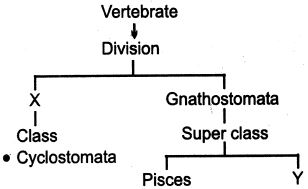
Assertion $(A)$:All vertebrates are chordates but all chordates are not vertebrates.

Reason $(R)$:Notochord is replaced by vertebral column in the adult vertebrates.

In the light of the above statements, choose the most appropriate answer from the options given below:

  • A
    Both $(A)$ and $(R)$ are correct and $(R)$ is the correct explanation of $(A)$
  • B
    $(A)$ is correct but $(R)$ is not correct
  • C
    $(A)$ is not correct but $(R)$ is correct
  • Both $(A)$ and $(R)$ are correct but $(R)$ is not the correct explanation of $(A)$
Answer
Correct option: D.
Both $(A)$ and $(R)$ are correct but $(R)$ is not the correct explanation of $(A)$
d
View full question & answer
MCQ 81 Mark
Exoskeleton of arthropods is composed of :
  • A
    Cellulose
  • Chitin
  • C
    Glucosamine
  • D
     Cutin
Answer
Correct option: B.
Chitin
b
View full question & answer
MCQ 91 Mark
Match the following:

List $- I$ List $-II$
$(a)$ Physalia $(i)$ Pearl oyster
$(b)$ Limulus $(ii)$ Portuguese Man of War
$(c)$ Ancylostoma $(iii)$ Living fossil
$(d)$ Pinctada $(iv)$ Hookworm

Choose the correct answer from the options given below.

$(a) -(b) -(c) -(d)$

  • A
    $(ii)- (iii) -(i)- (iv)$
  • B
    $(iv)- (i) -(iii)- (ii)$
  • $(ii) -(iii)- (iv)- (i)$
  • D
    $(i) -(iv)- (iii) -(ii)$
Answer
Correct option: C.
$(ii) -(iii)- (iv)- (i)$
c
View full question & answer
MCQ 101 Mark
Read the following statements.

$(a)$ Metagenesis is observed in Helminths.

$(b)$ Echinoderms are triploblastic and coelomate animals.

$(c)$ Round worms have organ-system level of body organization.

$(d)$ Comb plates present in ctenophores help in digestion.

$(e)$ Water vascular system is characteristic of Echinoderms.

Choose the correct answer from the options given below.

  • A
    $(c), (d)$ and $(e)$ are correct
  • B
    $(a), (b)$ and $(c)$ are correct
  • C
    $(a), (d)$ and $(e)$ are correct
  • $(b), (c)$ and $(e)$ are correct
Answer
Correct option: D.
$(b), (c)$ and $(e)$ are correct
d
View full question & answer
MCQ 111 Mark
Which one of the following organisms bears hollow and pneumatic long bones?
  • Neophron
  • B
    Hemidactylus
  • C
    Macropus
  • D
    Ornithorhynchus
Answer
Correct option: A.
Neophron
a
View full question & answer
MCQ 121 Mark
Match the following group of organisms with their respective distinctive characteristics and select the correct option:
Organisms   Characteristics
($a$) Platyhelminthes ($i$) Cylindrical body with no segmentation
($b$) Echinoderms ($ii$) Warm blooded animals with direct development
($c$) Hemichordates ($iii$) Bilateral symmetry with incomplete digestive system
($d$) Aves ($iv$) Radial symmetry with indirect development
  • A
    $(a)-(i), (b)-(ii), (c)-(iii), (d)-(iv)$
  • $(a)-(iii), (b)-(iv), (c)-(i), (d)-(ii)$
  • C
    $(a)-(ii), (b)-(iii), (c)-(iv), (d)-(i)$
  • D
    $(a)-(iv), (b)-(i), (c)-(ii), (d)-(iii)$
Answer
Correct option: B.
$(a)-(iii), (b)-(iv), (c)-(i), (d)-(ii)$
b
Option (2) is the correct answer.

Birds and mammals are homeotherms (warm blooded). Metameric segmentation is present in annelids, Arthropods and chordates.

Adult echinoderms are radially symmetrical but larvae are bilaterally symmetrical.

In most of the platyhelminths, single opening of digestive system serves the function of both mouth and anus.

View full question & answer
MCQ 131 Mark
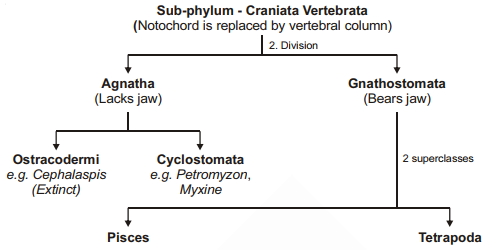
All vertebrates are chordates but all chordates are not vertebrates, why?
  • A
    All chordates possess notochord throughout their life.
  • Notochord is replaced by vertebral column in adult of some chordates
  • C
    Ventral hollow nerve cord remains throughout life in some chordates.
  • D
    All chordates possess vertebral column.
Answer
Correct option: B.
Notochord is replaced by vertebral column in adult of some chordates
b
The correct answer is option (2) because the members of subphylum vertebrata possess notochord during the embryonic period.

So, all vertebrates are chordates.

The notochord is replaced by a cartilaginous or bony vertebral column in the adult vertebrates.

In protochordates, vertebral column is not formed. In urochordates, notochord is present only in tail region in larval stage and in cephalochordates, it persists throughout life
so all chordates are not vertebrates.

View full question & answer
MCQ 141 Mark
Match the following columns and select the correct option :
Column $I$ Column $II$
($a$) Aptenodytes ($i$) Flying fox
($b$) Pteropus  ($ii$) Angel fish
($c$) Pterophyllum ($iii$) Lamprey
($d$) Petromyzon  ($iv$) Penguin
  • A
    $(a)-(ii), (b)-(i), (c)-(iv), (d)-(iii)$
  • B
    $(a)-(iii), (b)-(iv), (c)-(ii), (d)-(i)$
  • C
    $(a)-(iii), (b)-(iv), (c)-(i), (d)-(ii)$
  • $(a)-(iv), (b)-(i), (c)-(ii), (d)-(iii)$
Answer
Correct option: D.
$(a)-(iv), (b)-(i), (c)-(ii), (d)-(iii)$
d
Option (4) is the correct answer. Aptenodytes is penguin (a bird) and is classified under Aves.

Pteropus is categorised under Mammalia.

Pterophyllum is a bony fish classified under osteichthyes. Petromyzon is categorised as a cyclostome.

View full question & answer
MCQ 151 Mark
Bilaterally symmetrical and acoelomate animals are exemplified by
  • A
    Annelida
  • B
    Ctenophora
  • Platyhelminthes
  • D
    Aschelminthes
Answer
Correct option: C.
Platyhelminthes
c
Platyhelminthes
View full question & answer
MCQ 161 Mark
Match the following columns and select the correct option.

Column $-I$                                             Column $-II$

$(a)$ $6-15$ pairs of gill slits                   $(i)$ Trygon

$(b)$ Heterocercal caudal fin                   $(ii)$ Cyclostomes

$(c)$ Air Bladder                                      $(iii)$ Chondrichthyes

$(d)$ Poison sting                                    $(iv)$ Osteichthyes

  • A
    $(i)\quad(iv)\quad(iii)\quad(ii)$
  • $(ii)\quad(iii)\quad(iv)\quad(i)$
  • C
    $(iii)\quad(iv)\quad(i)\quad(ii)$
  • D
    $(iv)\quad(iii)\quad(iv)\quad(i)$
Answer
Correct option: B.
$(ii)\quad(iii)\quad(iv)\quad(i)$
b
$(ii)\quad(iii)\quad(iv)\quad(i)$
View full question & answer
MCQ 171 Mark
Which of the following options does correctly represent the characteristic features of phylum Annelida?
  • A
    Diploblastic, mostly marine and radially symmetrical.
  • B
    Triploblastic, unsegmented body and bilaterally symmetrical.
  • Triploblastic, segmented body and bilaterally symmetrical.
  • D
    Triploblastic, flattened body and acoelomate condition.
Answer
Correct option: C.
Triploblastic, segmented body and bilaterally symmetrical.
c
Option (3) is the correct answer as members of phylum Annelida are segmented worms exhibiting triploblasty.

Acoelomate condition and bilateral symmetry are seen in members of phylum Platyhelminthes.

View full question & answer
MCQ 181 Mark
Match the following genera with their respective phylum

$(a)$ Ophura $(i)$ Mollusca
$(b)$ Physalia $(ii)$ Platyhelminthes
$(c)$ Pinctada $(iii)$ Echinodermata
$(d)$ Planaria $(iv)$ Coelenterata

Select the correct option

  • A
    $(a)-(iv), (b)-(i), (c)-(iii), (d)-(ii)$
  • $(a)-(iii), (b)-(iv), (c)-(i), (d)-(ii)$
  • C
    $(a)-(i), (b)-(iii), (c)-(iv), (d)-(ii)$
  • D
    $(a)-(iii), (b)-(iv), (c)-(ii), (d)-(i)$
Answer
Correct option: B.
$(a)-(iii), (b)-(iv), (c)-(i), (d)-(ii)$
b
View full question & answer
MCQ 191 Mark
Match the following organisms with thelr respective characteristics

$(a)$ Pila  $(i)$ Flame cells
$(b)$ Bombyx $(ii)$ Comb plates
$(c)$ Pleurobrachla $(iii)$ Radula
$(d)$ Taenla $(iv)$ Malpighlan tubules

Select the correct option from the following

$(a) \quad (b)\quad (c)\quad (d)$

  • A
    $(iii)\quad  (ii)\quad  (i) \quad (iv)$
  • $(iii) \quad (iv)\quad  (ii)\quad  (i)$
  • C
    $(ii) \quad (iv)\quad  (iii)\quad  (i)$
  • D
    $(iiii)\quad  (ii) \quad (iv) \quad (i)$
Answer
Correct option: B.
$(iii) \quad (iv)\quad  (ii)\quad  (i)$
b
View full question & answer
MCQ 201 Mark
Which of the following animals are true coelomates with bilateral symmetry?
  • A
    Adult Echinoderms
  • B
    Aschelminthes
  • C
    Platyhelminthes
  • Annelids
Answer
Correct option: D.
Annelids
d
View full question & answer
MCQ 211 Mark
Which one of these animals is not a homeotherm?
  • A
    Psittacula
  • B
    Macropus
  • C
    Camelus
  • Chelone
Answer
Correct option: D.
Chelone
d
View full question & answer
MCQ 221 Mark
Identify the vertebrate group of animals characterized by crop and gizzard in its digestive system.
  • A
    Osteichthyes
  • B
    Amphibja
  • Aves
  • D
    Reptilia
Answer
Correct option: C.
Aves
c
View full question & answer
MCQ 231 Mark
Choose the correct statement.
  • A
    All mammals are viviparous.
  • All cyclostomes do not possess jaws and paired fins.
  • C
    All reptiles have a three­chambered heart.
  • D
    All pisces have gills covered by an operculum.
Answer
Correct option: B.
All cyclostomes do not possess jaws and paired fins.
b
(b) : Ornithorhynchus and Tachyglossus are oviparous mammals. Crocodile is a reptile which possesses four chambered heart. In cartilaginous fish (except Chimaera) gills are not covered by an oper­ culum.
View full question & answer
MCQ 241 Mark
Which of the following features is not present in the Phylum Arthropoda?
  • Parapodia
  • B
    Jointed appendages
  • C
    Chitinous exoskeleton
  • D
    Metameric segmentation
Answer
Correct option: A.
Parapodia
a
(a) : Parapodia are flattened, fleshy, vertical flap­ like outgrowths of body wall found in annelids on lateral sides of trunk segments. These are hollow structures enclosing coelom which is continuous with that of trunk segments. These serve the dual purpose of locomotion and respiration.
View full question & answer
MCQ 251 Mark
Which of the following characteristics is mainly responsible for diversification of insects on land?
  • Exoskeleton
  • B
    Eyes
  • C
    Segmentation
  • D
    Bilateral symmetry
Answer
Correct option: A.
Exoskeleton
a
(a) : Exoskeleton made of cuticle has enabled insects to live on land and to diversify to almost all the possible habitats. It gives them protection, support and also helps to prevent desiccation.
View full question & answer
MCQ 261 Mark
Which of the following represents the correct combination without any exception ?

Option Characteristics  Class
$(a)$ Sucking and circular mouth; jaws absent, integument without scales; paired appendages. Cyclostomata
$(b)$ Body covered with feathers; skin moist and glandular, fore-lims form wings; lungs with air sacs. Aves
$(c)$ Mammary gland; hair on body; pinnae; two pairs of limbs. Mammalia
$(d)$ Mouth ventral; gills without operculum; skin with placoid scales; persistent notochord. Chondrichthyes


  • A
    $(a)$ and $(b)$
  • B
    $(b)$ and $(c)$
  • C
    $(c)$ and $(d)$
  • none of the above.
Answer
Correct option: D.
none of the above.
d
None of the options is correct.

Cyclostomes do not have paired appendages. Skin in Aves is neither moist nor glandular. Only preen gland is present at the base of tail. Chondrichthyes members have gills without operculum, except Chimaera. Prototherian mammals do not have ear pinnae and aquatic mammals lack hindlimbs (like whales and dolphins).

View full question & answer
MCQ 271 Mark
Which of the following animals is not vivipa­ rous?
  • Platypus
  • B
    Whale
  • C
    Flying fox (Bat)
  • D
    Elephant
Answer
Correct option: A.
Platypus
a
(a) : Duck­billed platypus is an egg laying mammal. It is found in the rivers in eastern Australia and Tasmania. It is a beaver like monotreme about $50-­60\ cm$ long and well adapted to live in water. Usually, two eggs are laid at a time. The female curls around them for incubation and remains inactive for about two weeks. Newly hatched young ones are very immature, naked, blind and each is $2.5\ cm$ long.
View full question & answer
MCQ 281 Mark
Metagenesis refers to
  • A
    occurrence of a drastic change in form dur­ ing post­embryonic development
  • B
    presence of a segmented body and parthe­ nogenetic mode of reproduction
  • C
    presence of different morphic forms
  • alternation of generation between asexual and sexual phases of an organism.
Answer
Correct option: D.
alternation of generation between asexual and sexual phases of an organism.
d
(d) : An alternation of generation between asexual and sexual phases of an organism is referred to as metagenesis. $E.g.$ in Obelia (a coelenterate), polyps reproduce asexually and medusae reproduce sexually.
View full question & answer
MCQ 291 Mark
Which group of animals belong to the same phylum?
  • Prawn, Scorpion, Locusta
  • B
    Sponge, Sea anemone, Starfish
  • C
    Malarial parasite, Amoeba, Mosquito
  • D
    Earthworm, Pinworm, Tapeworm
Answer
Correct option: A.
Prawn, Scorpion, Locusta
a
(a) : Prawn, Scorpion and Locusta belong to the phylum Arthropoda. All other animals categories are given below:

Sponge $→$ Porifera

Sea anemone $→$ Coelenterata

Starfish $→$ Echinodermata

Malarial parasite, Amoeba $→$ Protozoa

Mosquito $→$ Arthropoda

Earthworm $→$ Annelida

Pinworm $→$ Aschelminthes

Tapeworm $→$ Platyhelminthes

View full question & answer
MCQ 301 Mark
The characteristics of Class Reptilia are
  • A
    body covered with moist skin which is devoid of scales, the ear is represented by a tympanum, alimentary canal, urinary and reproductive tracts open into a common cloaca
  • B
    fresh water animals with bony endoskeleton, air­bladder to regulate buoyancy
  • C
    marine animals with cartilaginous endos­ keleton, body covered with placoid scales
  • body covered with dry and cornified skin, scales over the body are epidermal, they do not have external ears.
Answer
Correct option: D.
body covered with dry and cornified skin, scales over the body are epidermal, they do not have external ears.
d
(d) : Reptiles represent the first class of vertebrates fullyadapted for life in dry places on land. The characters of reptiles are in fact a combination of characters that are found in fish and amphibians on one hand and birds and mammals on the other. Their exoskeleton is of horny epidermal scales, shields, plates and scutes. The skin is dry, cornified and devoid of glands. Reptiles lack external ears and have immovable eyelids.
View full question & answer
MCQ 311 Mark
Sharks and dogfishes differ from skates and rays because
  • A
    gill slits are ventrally placed
  • B
    head and trunk are widened considerably
  • C
    distinct demarcation between body and tail
  • their pectoral fins distinctly marked off from cylindrical bodies.
Answer
Correct option: D.
their pectoral fins distinctly marked off from cylindrical bodies.
d
(d) : Sharks and dogfishes have cylindrical body while skates and rays have both of their pectoral fins fused. It gives a wing­like appearance and are not distinct from body.
View full question & answer
MCQ 321 Mark
Which one of the following groups of animals reproduces only by sexual means?
  • A
    Cnidaria
  • B
    Porifera
  • C
    Protozoa
  • Ctenophora
Answer
Correct option: D.
Ctenophora
d
(d) : In ctenophores, asexual reproduction is absent. They are monoecious and fertilization is generally external. In cnidaria, asexual reproduction (budding) is found in the polyps and sexual reproduction is found in the medusa form. Both asexual and sexual reproduction occur in porifera (sponges). Asexual reproduction occurs by budding and gemmules. In protozoa, asexual reproduction takes place by binary fission, budding etc. and sexual reproduction takes place by syngamy and conjugation.
View full question & answer
MCQ 331 Mark
$A$ : True coelom originated for the first time in phylum Annelida.

$R$ : It allowed the animal to have an alimentary canal longer than the body & space for storing gametes.

  • A
    Assertion and Reason both are correct and also correct explanation.
  • Assertion and Reason both are correct but not explanation of assertion.
  • C
    Assertion is correct, but Reason is incorrect.
  • D
    Both Assertion and Reason are incorrect.
Answer
Correct option: B.
Assertion and Reason both are correct but not explanation of assertion.
b
Assertion is true, True coelom (lined by mesoderm) on both sides for first time originated in phyla annelida.
Reason is true, Annelids have longer alimentary canal than body and space for storing gametes.
Both Assertion and Reason are correct, but Reason is not correct explanation for Assertion.
View full question & answer
MCQ 341 Mark
$A$ : Annelids, arthropods and molluscs are protostomial coelomates.

$R$ : All the three phyla include members with bilateral symmetry and true coelom.

  • A
    Assertion and Reason both are correct and also correct explanation.
  • Assertion and Reason both are correct but not explanation of assertion.
  • C
    Assertion is correct, but Reason is incorrect.
  • D
    Both Assertion and Reason are incorrect.
Answer
Correct option: B.
Assertion and Reason both are correct but not explanation of assertion.
b
Assertion is true $i.e.$ Annelids, arthropods and molluscs are protostomial coelomates.
In all three mouth develops first in embryonic digestive tube.
Reason is also true $i.e.$ all three phyla include members with bilateral symmetry and true coelom.
But reason is not correct explanation for assertion.
View full question & answer
MCQ 351 Mark
Match the animals in Column$-I$with their common names in Column$-II$
Column$-I$ Column$-II$
$(a)$. Limulus $(i)$ Tusk shell
$(b)$. Ophiura $(ii)$ Tapeworm
$(c)$. Taenia $(iii)$ Brain coral
$(d)$. Meandrina $(iv)$ King crab
$(e)$. Dentalium $(v)$ Brittle star
  • A
    $a(v), b(iv), c(ii), d(iii), e(i)$
  • $a(iv), b(v), c(ii), d(iii), e(i)$
  • C
    $a(v), b(ii), c(iii), d(i), e(iv)$
  • D
    $a(iv), b(v), c(iii), d(i), e(ii)$
Answer
Correct option: B.
$a(iv), b(v), c(ii), d(iii), e(i)$
b
$(a)$. Limulus -King crab -Living fossil
$(b)$. Ophiura -Brittle star -Phylum Echinodermata
$(c)$. Taenia -Tapeworm -Phylum Platyhelminthes
$(d)$. Meandrina -Brain coral -Class Anthozoa, Phylum -Cnidaria
$(e)$. Dentalium -Tusk shell -Class Scaphopoda, Phylum -Mollusca
View full question & answer
MCQ 361 Mark
Which of the following statements is not true?
  • A
    All members of the kingdom Animalia are multicellular
  • B
    Nature of coelom is used as one of the basis of animal classification
  • There is no need of classification now as over a million species of animals have been described till now
  • D
    The arrangement of cells in the body is one of the classifying feature of the animals
Answer
Correct option: C.
There is no need of classification now as over a million species of animals have been described till now
c
In kingdom animalia, till now over a million species have been described. Animalia is largest kingdom, with over $1.2$ million members. Due to such large number of member species, the need for classification becomes more important.
View full question & answer
MCQ 371 Mark
"Triploblastic, unsegmented, acoelomate exhibiting bilateral symmetry and reproducing both asexually and sexuality, with some parasitic forms".

The above description is the characteristic of phylum

  • A
    Annelida
  • B
    Ctenophore
  • C
    Cnidaria
  • Platyhelminthes
Answer
Correct option: D.
Platyhelminthes
d
Phylum-Platyhelminthes (flatworms) are the only forms, with triploblastic, unsegmented, acoelomate and bilateral symmetry. They reproduce both sexually and asexually and also have some parasitic forms, e.g., Fasciola, Taenia, etc.
View full question & answer
MCQ 381 Mark
Arms are absent in
  • A
    Sea urchin
  • B
    Sea cucumber
  • Both ($a$) and ($b$)
  • D
    None of these
Answer
Correct option: C.
Both ($a$) and ($b$)
c
Arms are absent in the class-Echinoidea (e.g., sea urchins and sand dollars) and holothuroidea (e.g., sea cucumbers).
View full question & answer
MCQ 391 Mark
Which of the following groups of animals have the following feature?

$I.$ Diploblastic

$II.$ Acoelomate

$III.$ Radial symmetry

  • A
    Planaria, Physalia, Aurelia
  • B
    Taenia, Fasciola, Wuchereria
  • Adamsia, Berore, Meandrina
  • D
    Fasciola, Sycon, Sea walnut
Answer
Correct option: C.
Adamsia, Berore, Meandrina
c
Only Coelenterates and Ctenophora and diploblastic acoelomates, with radial symmetry. Adamsia is sea anemone, which belong to phylum-Coelenterates and Meandrinasinuosa belongs to phylum-Coelenterates. Berore is a Ctenophora
View full question & answer
MCQ 401 Mark
In which of the following organisms, self-fertilization is rarely seen?
  • A
    Fish
  • B
    Roundworm
  • C
    Earthworm
  • Liver fluke
Answer
Correct option: D.
Liver fluke
d
Generally, cross-fertilization takes place in liver fluke (Fasciola hepatica), rarely self-fertilization takes place. Fertilization is internal in liver fluke.
View full question & answer
MCQ 411 Mark
Which one of the following is a matching set of phylum and its three examples?
  • A
    Cnidaria - Bonellia, Physalia, Aurelia
  • B
    Platyhelminthes - Planaria, Schistosoma, Enterobius
  • Mollusca - Loligo, Teredo, Octopus
  • D
    Porifera - Spongilla, Euplectella, Pennatula
Answer
Correct option: C.
Mollusca - Loligo, Teredo, Octopus
c
Loligo, Teredo and Octopus are the members of phylum-Mollusca.
View full question & answer
MCQ 421 Mark
What is true about Scorpion, cockroach and silver fish?
  • A
    They all have jointed paired appendages
  • B
    They all possess dorsal heart
  • None of them is aquatic
  • D
    They all belong to the same phylum
Answer
Correct option: C.
None of them is aquatic
c
Nereis living in burrows in sand or mud often with clams. Scorpion are abundant in deserts. Cockroaches are found in warmth, dampness and plenty of organic food to devour. Lepisma (sliver fish) residing in damp coal places and feeding on starch of starchly matter.
View full question & answer
MCQ 431 Mark
Which of the following is not correctly matched?
  • A
    Sycon - Canal system
  • B
    Starfish - Radial symmetry
  • Ascaris - Flame cell
  • D
    Prawn - Haemocoel
Answer
Correct option: C.
Ascaris - Flame cell
c
Flame cells are excretory organ of Platyhelminthes. The excretory organ of Ascaris is protonephridia.
View full question & answer
MCQ 441 Mark
Select the correct statement.
  • A
    Birds are poikilothermic.
  • B
    Flatworms are coelomic animals.
  • Earthworm is metamerically segmented.
  • D
    Fishes are radially symmetrical.
Answer
Correct option: C.
Earthworm is metamerically segmented.
c
Earthworm ($Pheretimaposthuma$) has segmented body. It belongs to phylumAnnelida.
View full question & answer
MCQ 451 Mark
The jawless vertebrate is
  • A
    Crocodile
  • B
    Loris
  • C
    Hyla
  • Petromyzon
Answer
Correct option: D.
Petromyzon
d
Petromyzon is the jawless vertebrate. It is also known as sea lamprey.
View full question & answer
MCQ 461 Mark
Choose the group of parasitic animal
  • A
    Wuchereria - Pheretima - Nereis
  • B
    Liverfluke - Dugesia - Ascaris
  • Fasciola - Taenia - Ancylostoma
  • D
    Wuchereria - Fasciola - Dugesia
Answer
Correct option: C.
Fasciola - Taenia - Ancylostoma
c
Dugesia or Planaria is a free living Platyhelminthes, Pheretima is earthworm and Nereis are both non-parasitic animals. Fasciola, Taenia and Ancylostoma are all parasitic
View full question & answer
MCQ 471 Mark
Secondary radial symmetry is found in
  • A
    Cnidaria
  • B
    Jelly fish
  • Echinodermata
  • D
    Hemichordata
Answer
Correct option: C.
Echinodermata
c
Secondary radial symmetry is found in phylum-Echinodermata. The members of this phylum are exclusively marine forms, in which the larvae are bilaterally symmetrical but later on, the symmetry of adults usually becomes pentamerous radial.
View full question & answer
MCQ 481 Mark
Choose the correct option
  • A
    Phylum-Mollusca is the third largest phylum
  • B
    Phylum-Arthropoda is the second largest phylum
  • C
    Phylum-Mollusca is the largest phylum
  • Phylum-Arthropoda is the largest phylum of Animalia
Answer
Correct option: D.
Phylum-Arthropoda is the largest phylum of Animalia
d
Phylum-Arthropoda is the first largest phylum. Phylum-Mollusca is the second largest phylum
View full question & answer
MCQ 491 Mark
Which of the following animals is not viviparous?
  • A
    Elephant
  • Platypus
  • C
    Whale
  • D
    Flying fox (Bat)
Answer
Correct option: B.
Platypus
b
View full question & answer
MCQ 501 Mark
Which of the following represents the correct combination without any exception ?

Characteristics - Class

  • Mouth ventral, gills without operculum, skin with placoidscales, persistent notochord - Chondrichthyes
  • B
    Sucking and circular mouth, jaws absent, integument without scales paired appendages - Cyclostomata
  • C
    Body covered with feathers, skin moist and glandular, forelimbs form wing lungs with air sacs - Aves
  • D
    Mammary gland, hair on body; pinnae; two pairs of Limbs - Mammalia
Answer
Correct option: A.
Mouth ventral, gills without operculum, skin with placoidscales, persistent notochord - Chondrichthyes
a
View full question & answer
MCQ 511 Mark
Which of the following characteristic features always holds true for the corresponding group of animals ?
  • A
    Possess a mouth with an upper and a lower jaw - Chordata
  • B
    3-chambered heart with one incompletely divided ventricle - Reptilia
  • Cartilaginous endoskeleton - Chondrichthyes
  • D
    Viviparous -Mammalia
Answer
Correct option: C.
Cartilaginous endoskeleton - Chondrichthyes
c
View full question & answer
MCQ 521 Mark
Firstly kidneys are present as excretory organ in
  • Hemichordata
  • B
    Chordata
  • C
    Echinodermata
  • D
    Mollusca
Answer
Correct option: A.
Hemichordata
a
View full question & answer
MCQ 531 Mark
Match the following columns

 $\begin{array}{|l|l|} \hline Column\,\,I & Column\,\,II \\ \hline A.\,\,Physallia & 1.\,\,Liver\,\,fluke \\ \hline B.\,\,Taenia & 2.\,\,Sycon  \\ \hline C.\,\,Fasciola & 3.\,\,Tape\,\,worm \\ \hline D.\,\,Scypha & 4.\,\,Portugese\,\,man\,\,of\,\,war \\ \hline \end{array}$

$A\ \ B\ \ C\ \ D$

  • A
    $2\ \ 1\ \ 3\ \ 4$
  • $4\ \ 3\ \ 1\ \ 2$
  • C
    $1\ \ 3\ \ 2\ \ 4$
  • D
    $1\ \ 2\ \ 3\ \ 4$
Answer
Correct option: B.
$4\ \ 3\ \ 1\ \ 2$
b
View full question & answer
MCQ 541 Mark
List the phyla in the correct order of their placement in classification

$I$. Chordata                 $II$. Annelida

$III$. Arthropoda        $IV$. Platyhelminthes

$V$. Ctenophora           $VI$. Aschelminthes

  • A
    $VI, I, V, IV, III, II $
  • B
    $II, III, IV, V, VI, I$
  • $V, IV, VI, II, III, I$
  • D
    $III, II, VI, I, V, IV$
Answer
Correct option: C.
$V, IV, VI, II, III, I$
c
View full question & answer
MCQ 551 Mark
Which of the following are correctly matched with respect to their taxonomic classification ?
  • A
    Nereis, spider, scorpion-insecta
  • House fly, butterfly, culex insecta
  • C
    Seahorse, sea urchin, sea pen, cucumber-Echinodermata
  • D
    Flying fish, Ichthyofish, whale-pisces (fish)
Answer
Correct option: B.
House fly, butterfly, culex insecta
b
View full question & answer
MCQ 561 Mark
Match the name of the animal

(column-$I$) with one characteristic

(column $II$), and the phylum/class

(column $III$) to which it belongs

Column $I$ - Column $II$ - Column $III$

  • A
    Ichthyophis - terrestrial - Reptilia
  • B
    Limulus - body covered by chitinous exoskeleton - Pisces
  • C
    Adamsia - radially symmerical - Porifera
  • Petromyzon -ectoparasite -Cyclostomata
Answer
Correct option: D.
Petromyzon -ectoparasite -Cyclostomata
d
View full question & answer
MCQ 571 Mark
Choose incorrect statement
  • A
    Annelids possess double ventral nerve cord
  • B
    Platyhelminthus have organ level of organisation
  • C
    Reptiles are poikilotherms
  • Heart is two chambered in Amphibians
Answer
Correct option: D.
Heart is two chambered in Amphibians
d
View full question & answer
MCQ 591 Mark
Match the following.

 $\begin{array}{|l|l|} \hline Column\,\,-\,\,I & Column\,\,-\,\,II \\ \hline (a)\,\,Trygon & (i)\,\,Echinodermata \\ \hline (b)\,\,Ascidia & (ii)\,\,Viviparous \\ \hline (c)\,\,Asterias & (iii)\,\,Chondrichthyes \\ \hline (d)\,\,Kangaroo & (iv)\,\,Oviparous \\ \hline (e)\,\,Penguin & (v)\,\,Urochordata \\ \hline \end{array}$


  • A
    $(a-v), (b-iii), (c-i), (d-ii), (e-iv)$
  • B
    $(a-iii), (b-v), (c-i), (d-iv), (e-ii) $
  • $(a-iii), (b-v), (c-i), (d-ii), (e-iv)$
  • D
    $(a-v), (b-iii), (c-i), (d-iv), (e-ii) $
Answer
Correct option: C.
$(a-iii), (b-v), (c-i), (d-ii), (e-iv)$
c
View full question & answer
MCQ 601 Mark
Select the incorrect option with respect to features present in three phylum

Characters -Arthropoda -Mollusca - Chordata

  • Coelom -Absent -Absent - Absent
  • B
    Segmentation -Present -Absent - Present
  • C
    Digestive system - Complete - Complete - Complete
  • D
    Circulatory system -Present - Present - Present
Answer
Correct option: A.
Coelom -Absent -Absent - Absent
a
View full question & answer
MCQ 611 Mark
In males pelvic fins bear claspers in
  • Pristis
  • B
    Petromyzone
  • C
    Hagfish
  • D
    Lamprey
Answer
Correct option: A.
Pristis
a
View full question & answer
MCQ 631 Mark
Choose correct pair :

class - Character

  • A
    Mammal - Poikilotherms
  • B
    Reptile - Homoiothermous
  • Amphibians - Oviparous and external fertilization
  • D
    Aves - Three chambered heart
Answer
Correct option: C.
Amphibians - Oviparous and external fertilization
c
View full question & answer
MCQ 641 Mark
Make correct pair.

 $\begin{array}{|l|l|} \hline Column-I  & Column-II \\ \hline 1.\,\,Osculum & p.\,\,Fasciola \\ \hline 2.\,\,Hypostom  & q.\,\,Ctenoplana \\ \hline 3.\,\,Comb\,\,jellies & r.\,\,Spongilla \\ \hline 4.\,\,Hook\,\,and\,\,sucker & s.\,\,Meandrina \\ \hline \end{array}$


  • $(1-r),(2-s),(3-q),(4-p)$
  • B
    $(1-p),(2-q),(3-r),(4-s) $
  • C
    $(1-s),(2-p),(3-q),(4-r)$
  • D
    $(1-q),(2-r),(3-s),(4-p) $
Answer
Correct option: A.
$(1-r),(2-s),(3-q),(4-p)$
a
View full question & answer
MCQ 661 Mark
Which of the following represent the correct  match of feature with the given animal ?

Feature - Animal

  • Oviparous - Ornithorhynchus
  • B
    Viviparous - Columba
  • C
    Scale - Bufo
  • D
    Tympanum - Angel fish
Answer
Correct option: A.
Oviparous - Ornithorhynchus
a
View full question & answer
MCQ 691 Mark
Which of the following pairs are correctly matched ?

  Animals Morphological features
$(i)$ Crocodile­ $4$-­chambered heart
$(ii)$ Sea urchin Parapodia
$(iii)$ Obelia­ Metagenesis
$(iv)$ Lemur­ Thecodont


  • A
    $(ii), (iii)$ and $(iv)$
  • B
    only $(i)$ and $(iv)$
  • C
    only $(i)$ and $(ii)$
  • $(i), (iii)$ and $(iv)$
Answer
Correct option: D.
$(i), (iii)$ and $(iv)$
d
(d) : Reptiles have two auricles and a partly divided ventricle except crocodiles which have four­ chambered heart. Obelia shows metagenesis $i.e.$, alternation of generations which may be defined as a phenomenon in which diploid asexual phase alternates with haploid sexual phase. Lemur has a thecodent teeth $i.e.$, the teeth are embedded in the sockets of the jaw bone.
View full question & answer
MCQ 701 Mark
Choose the correct combination of the following
  • Annelida and porifera-phyla
  • B
    Aves and chordata-classes
  • C
    Mollusca and hydrozoa-classes
  • D
    Oligochaeta and arthropoda-phyla
Answer
Correct option: A.
Annelida and porifera-phyla
a
It’s obvious
View full question & answer
MCQ 711 Mark
Which one is a poikilothermic $(cold blooded)$  animal
  • A
    Penguin
  • B
    Whale
  • C
    Otter
  • Tortoise
Answer
Correct option: D.
Tortoise
d
(d)That vertebrate animals who can’t change their body temperature according to environmental temperature. Except birds and mammals rest are cold blooded animals.
View full question & answer
MCQ 721 Mark
Temperature regulation is founds in
  • Rat
  • B
    Fish
  • C
    Frog
  • D
    Lizard
Answer
Correct option: A.
Rat
a
(a)The body temperature is constant in homeothermal $(warm-blooded)$ animal such as Birds and mammals. These animal don’t change their body temperature according to environmental temperature.
View full question & answer
MCQ 731 Mark
An animal having diploblastic acoelomic condition is
  • A
    Ascaris
  • Sea Anemone
  • C
    Planaria
  • D
    Periplaneta
Answer
Correct option: B.
Sea Anemone
b
It’s obvious
View full question & answer
MCQ 741 Mark
Constant body temperature is found in
  • A
    Earthworm
  • B
    Snake
  • C
    Frog
  • Cow
Answer
Correct option: D.
Cow
d
It’s obvious
View full question & answer
MCQ 751 Mark
Which of the following is a matching set in taxonomy
  • Man, chimpanzee, monkey
  • B
    Cuttle fish, jelly fish, silver fish
  • C
    Bat, pigeon, crow
  • D
    Oyster, octopus, star fish
Answer
Correct option: A.
Man, chimpanzee, monkey
a
It’s obvious
View full question & answer
MCQ 761 Mark
Which of the following is rightly matched
  • Mammalia - Human beings
  • B
    Mollusca - Centipede
  • C
    Pisces - Silver fish
  • D
    Echinoderm - Echidna
Answer
Correct option: A.
Mammalia - Human beings
a
It’s obvious
View full question & answer
MCQ 771 Mark
Double circulatory heart is present in
  • A
    Birds only
  • B
    Mammals only
  • C
    Reptilia only
  • Both $(a) $ and $(b)$
Answer
Correct option: D.
Both $(a) $ and $(b)$
d
It’s obvious
View full question & answer
MCQ 791 Mark
Whose skin colour does not change
  • A
    Chameleon
  • Horse
  • C
    Garden lizard
  • D
    Two of the above
Answer
Correct option: B.
Horse
b
(b)Colour changing power is present in pisces, amphibians and reptiles but absent in aves and mammals.
View full question & answer
MCQ 801 Mark
Mark the odd member from the following
  • A
    Turtle
  • B
    Lizard
  • Dolphin
  • D
    Crocodile
Answer
Correct option: C.
Dolphin
c
It’s obvious
View full question & answer
MCQ 811 Mark
Common name of fish Anguilla is
  • Eel
  • B
    Rohu
  • C
    Hilsa
  • D
    Bombay duck
Answer
Correct option: A.
Eel
a
(a)Anguilla is commonly known as freshwater eel.
View full question & answer
MCQ 831 Mark
Animals which show viviparity include
  • Whales
  • B
    Bony fishes
  • C
    Turtles
  • D
    Running birds
Answer
Correct option: A.
Whales
a
(a)All Eutherian $(whales)$ are viviparous.
View full question & answer
MCQ 841 Mark
Homeothermic animals is
  • A
    Toad
  • B
    Lizard
  • Rabbit
  • D
    Frog
Answer
Correct option: C.
Rabbit
c
(c)Homeothermous animals are also known as warmblooded or endothermal animals. With constant body temperature, body heat is produced by the metabolic reaction taking place within the body. e.g. Aves and mammals.
View full question & answer
MCQ 851 Mark
                          Column $I$          Column $II$
    $(A)$  Limbless reptile   $(i)$ Lamprey
   $ (B)$ Jawless vertebrate  $(ii)$ Salamander
  $ (C)$  Amphibian  $(iii)$  Snake
  $(D)$ Cartilaginous fish  $(iv)$ Shark
  $ (E)$ Flightless bird    $(v)$ Ostrich

Match items in column I with those give in column II

  • A
    $(a) -(i), (b) -(ii), (c)-(iii), (d)-(iv), (e) -(v)$
  • B
    $(a) -(ii), (b)-(i), (c) -(iii), (d) -(iv), (e) -(v)$
  • $(a) -(iii), (b) -(i), (c) -(ii), (d) -(iv),(e)-(v)$
  • D
    $(a) -(v), (b) -(ii), (c) -(iii), (d)-(iv), (e)-(i)$
Answer
Correct option: C.
$(a) -(iii), (b) -(i), (c) -(ii), (d) -(iv),(e)-(v)$
c
It’s obvious
View full question & answer
MCQ 861 Mark
Match the animals list with names under Column $-I$ with the animals listed with regular zoological name given under Column $-II;$ choose the answer which gives the correct combination of the alphabets of the two columns.


Column $-I$                                                 Column $-II$

(Animals with common name)                 Animals with zoological name)

$A $        Starfish                                          $p$     Sepia

$B$        Jellyfish                                          $q  $   Astropecten

$C   $     Devilfish                                          $r  $   Aurelia

$D $       Cuttlefish                                       $ s $    Octopus

  • A
    $A = r, B = s, C = p, D = q$
  • B
    $A = r, B = p, C = s, D = q$
  • $A = q, B = r, C = s, D = p$
  • D
    $A = q, B = p, C = s, D = r$
Answer
Correct option: C.
$A = q, B = r, C = s, D = p$
c
It’s obvious
View full question & answer
MCQ 871 Mark
Which is unrelated
  • A
    Sea Cucumber
  • B
    Sea Star
  • C
    Sea Urchin
  • Sea Squid
Answer
Correct option: D.
Sea Squid
d
(d) Sea squid $ (loligo)$  belong to class cephalopoda of phylum mollusca.
View full question & answer
MCQ 881 Mark
Which one of the following is not correctly matched
  • A
    Flame cells - Platyhelminthes
  • B
    Sting cells - Coelenterata
  • Metameric segmentation - Mollusca
  • D
    Gill slits -Chordata
Answer
Correct option: C.
Metameric segmentation - Mollusca
c
(c)Metameric segmentation is the characteristic feature of phylum annelida.
View full question & answer
MCQ 891 Mark
As per classification which of the following is correct
  • A
    Ascaris, Pheretima, Grasshopper
  • B
    Hydra, Pteriod, Leucosolenia
  • C
    Starfish, Grasshopper, Solen
  • Pila, Dentalium, Octopus
Answer
Correct option: D.
Pila, Dentalium, Octopus
d
It’s obvious
View full question & answer
MCQ 901 Mark
Structure common between earthworm and Cockroach is
  • A
    Cocoon
  • B
    Ommatidia
  • C
    Dorsal nerve cord
  • Ventral nerve cord
Answer
Correct option: D.
Ventral nerve cord
d
It’s obvious
 
View full question & answer
MCQ 911 Mark
Animals of which set belongs to same phylum
  • Scorpion, Locusta, prawn
  • B
    Scorpion, cockroach, and earthworm
  • C
    Leech, oyster, scorpion
  • D
    Earthworm, leech, cancer
Answer
Correct option: A.
Scorpion, Locusta, prawn
a
It’s obvious
View full question & answer
MCQ 921 Mark
Pick up the mismatched
  • Annelida -Hydra
  • B
    Nemathelminthes -Ascaris
  • C
    Arthropoda -Cockroach
  • D
    Echinodermata -Starfish
Answer
Correct option: A.
Annelida -Hydra
a
It’s obvious.
 
View full question & answer
MCQ 931 Mark
A mismatch is
  • A
    Odd toe–Horse
  • Pheretima–parapodia
  • C
    Hydra–Cnidaria
  • D
    Cartilaginous Fish–Shark
Answer
Correct option: B.
Pheretima–parapodia
b
It’s obvious.
 
View full question & answer
MCQ 941 Mark
Closed circulatory system occurs in
  • Earthworm
  • B
    Cockroach
  • C
    Grasshopper
  • D
    Housefly
Answer
Correct option: A.
Earthworm
a
It’s obvious.
View full question & answer
MCQ 951 Mark
Pheritima posthuma and Periplanata are similar in which aspect
  • A
    Both have nephredia as excretory organs
  • Both have ventral nerve cord
  • C
    Both belong to same taxonomical group
  • D
    All the above
Answer
Correct option: B.
Both have ventral nerve cord
b
(b) Both annelids and arthropods possess ventral nerve cord.
View full question & answer
MCQ 961 Mark
Which one of the following is not hermaphrodite animal
  • A
    Leeches
  • Polychaetes
  • C
    Flatworms
  • D
    Earthworm
Answer
Correct option: B.
Polychaetes
b
It’s obvious.

View full question & answer
MCQ 971 Mark
Body is segmented in
  • A
    Coelenterate
  • Annelida
  • C
    Porifera
  • D
    Mollusca
Answer
Correct option: B.
Annelida
b
It’s obvious.
View full question & answer
MCQ 981 Mark
The animal in which sexes can be differentiated from external morphology is
  • A
    Taenia
  • B
    Krait
  • Ascaris
  • D
    Sea Anemone
Answer
Correct option: C.
Ascaris
c
It’s obvious.

View full question & answer
MCQ 991 Mark
All worms are
  • Triploblastic
  • B
    Segmented
  • C
    Endo-parasites
  • D
    Free-living
Answer
Correct option: A.
Triploblastic
a
It’s obvious.
View full question & answer
MCQ 1001 Mark
Give the correct match in the following 
column $-I$ column $-II$
$(A)$ Flame Cells $(p)$ sponges
$(B)$ Collar Cells $(q)$ Hydra
$(C)$ stinging cell $(r)$ Planaria
  $(s)$ Ascaris
  • ${\rm{A}} = r,{\rm{B}} = p,\,\,{\rm{C}} = q$
  • B
    ${\rm{A}} = r,{\rm{B}} = p,\,\,{\rm{C}} = s$
  • C
    ${\rm{A}} = r,{\rm{B}} = s,\,\,{\rm{C}} = p$
  • D
    ${\rm{A}} = r,B = q,\,\,{\rm{C}} = s$
Answer
Correct option: A.
${\rm{A}} = r,{\rm{B}} = p,\,\,{\rm{C}} = q$
a
It’s obvious.
View full question & answer
MCQ 1011 Mark
Pick up the correctly matched
  • A
    Water vascular system-Sponge
  • B
    Blubber-Kangaroo
  • C
    Marsupium-Platypus
  • Flame cell-Flatworm
Answer
Correct option: D.
Flame cell-Flatworm
d
It’s obvious.

View full question & answer
MCQ 1021 Mark
Which constitutes the correct pairing
  • Flatworm-Planaria
  • B
    Dogfish-Sea Urchin
  • C
    Fish-Snail
  • D
    None of the above
Answer
Correct option: A.
Flatworm-Planaria
a
(a) Mostly flatworms are included in class Turbellaria of phylum platyhelminthes e.g. planaria.
View full question & answer
MCQ 1031 Mark
A list of animals is given below. Identify the animals with open circulatory system and choose the correct answer.

$(A)$ Ascidia            $(B)$ Cockroach

$(C)$ Earthworm      $(D)$ Prawn

$(E)$ Sliverfish          $(F)$ Snail

$(G)$ Squid

  • A
    $B, D, F$
  • B
    $A, B, D, F$
  • C
    $C, D, E, G$
  • $B, D, E, F$
Answer
Correct option: D.
$B, D, E, F$
d
It’s obvious.


View full question & answer
MCQ 1041 Mark
Which of the following statements is false
  • A
    Male roundworm is smaller than female
  • B
    Earthworms are hermaphrodite
  • Echinoderms are protostomous coelomates
  • D
    Human teeth are anatomically comparable to scales of shark
Answer
Correct option: C.
Echinoderms are protostomous coelomates
c
It’s obvious.
View full question & answer
MCQ 1051 Mark
Radial symmetry is not found in
  • A
    Hydra
  • B
    Starfish
  • C
    Sponge
  • Spider
Answer
Correct option: D.
Spider
d
It’s obvious.
View full question & answer
MCQ 1061 Mark
Which of the following is a group of warm blooded animals
  • Birds
  • B
    Fishes
  • C
    Amphibians
  • D
    Reptiles
Answer
Correct option: A.
Birds
a
It’s obvious.
View full question & answer
MCQ 1071 Mark
Which one of the following does not have larvae in its life cycle
  • A
    Prawn
  • Earthworm
  • C
    Crab
  • D
    Cockroach
Answer
Correct option: B.
Earthworm
b
It’s obvious.
View full question & answer
MCQ 1081 Mark
An animal devoid of anus is
  • A
    Unio
  • Fasciola
  • C
    Pheretima
  • D
    Periplaneta
Answer
Correct option: B.
Fasciola
b
(b)Anus absent in fasciola hepatica. Indigestible food materials is either probably ejected through the mouth or diffused into excretory system.
View full question & answer
MCQ 1091 Mark
Choose the correct combination
  • Annelida and Porifera ........... Phyla
  • B
    Oligochaeta and Arthropoda.........Phyla
  • C
    Mollusca and Hydrozoa........Classes
  • D
    Aves and Chordata...........Classes
Answer
Correct option: A.
Annelida and Porifera ........... Phyla
a
It’s obvious.

 
View full question & answer
MCQ 1101 Mark
A phylum with triploblastic acoelomate animals is
  • Platyhelminthes
  • B
    Aschelminthes
  • C
    Annelida
  • D
    All the above
Answer
Correct option: A.
Platyhelminthes
a
(a)From evolutionary point of view platyhelminthes are first triploblastic animals but do not contain coelom.
View full question & answer
MCQ 1111 Mark
Radial symmetry occurs in
  • A
    Fishes
  • B
    Molluscs
  • Star Fishes
  • D
    Sponges
Answer
Correct option: C.
Star Fishes
c
It’s obvious.
View full question & answer
MCQ 1121 Mark
Body does not show any segmentation in
  • A
    Frog
  • B
    Cockroach
  • C
    Earthworm
  • Star Fish/Hydra
Answer
Correct option: D.
Star Fish/Hydra
d
It’s obvious.
View full question & answer
MCQ 1131 Mark
Metamerism is characteristic of
  • A
    Platyhelminthes
  • B
    Mollusca
  • C
    Porifera
  • Annelida
Answer
Correct option: D.
Annelida
d
(d)Annelids are characterised by metameric segmentation. The body is divided externally by ring like grooves the annulei and internally by transverse septa. Segments are called metameres.
View full question & answer
MCQ 1141 Mark
$A$ : Bats and whales are classified as mammals.

$R$ : Bats and whales show echolocation and four chambered heart.

  • A
    Assertion and Reason both are correct and also correct explanation.
  • Assertion and Reason both are correct but not explanation of assertion.
  • C
    Assertion is correct, but Reason is incorrect.
  • D
    Both Assertion and Reason are incorrect.
Answer
Correct option: B.
Assertion and Reason both are correct but not explanation of assertion.
b
Assertion is correct as bats (chiroptera order) and whales (cetacea order) are classified as mammals.
Reason is correct as bats and whales show echolocation and possess four chambered heart.
Both Assertion and Reason are correct but Reason is not a correct explanation for Assertion.
View full question & answer
MCQ 1151 Mark
What is common between parrot, Platypus and kangaroo?
  • Homeothermy
  • B
    Toothless jaws
  • C
    Functional post-anal tail
  • D
    Ovoparity
Answer
Correct option: A.
Homeothermy
a
Parrot (birds), platypus and kangaroo (both mammals) are homeothermic animals
View full question & answer
MCQ 1161 Mark
Which of the following characteristics is not shared by birds and mammals?
  • Viviparity
  • B
    Warm blooded nature
  • C
    Ossified endoskeleton
  • D
    Breathing using lungs
Answer
Correct option: A.
Viviparity
a
View full question & answer
MCQ 1171 Mark
Frog differ from humans in term of
  • A
    Paired Limbs
  • Respiration
  • C
    Phyllum
  • D
    Kingdom
Answer
Correct option: B.
Respiration
b
View full question & answer
MCQ 1191 Mark
Which is the common character between all the mammals
  • A
    They are oviparous
  • B
    They are herbivorous
  • C
    They are carnivorous
  • They have seven cervical vertebrae
Answer
Correct option: D.
They have seven cervical vertebrae
d
(d)The presence of seven cervical vertebrae is common feature of mammals.
View full question & answer
MCQ 1201 Mark
Select the correct set of animals of class-mammalia
  • A
    Lion, hippopotamus, penguin, bat
  • B
    Lion, bat, whale, ostrich
  • C
    Hippopotamus, penguin, whale, kangaroo
  • Whale, bat, kangaroo, hippopotamus
Answer
Correct option: D.
Whale, bat, kangaroo, hippopotamus
d
It’s obvious
View full question & answer
MCQ 1211 Mark
Which character is not same in aves and mammals
  • A
    Single systemic arch
  • B
    Metanephric kidney
  • Seven cervical vertebrae
  • D
    Homoiotherms
Answer
Correct option: C.
Seven cervical vertebrae
c
(c)Except a few, only mammals possess seven cervical (neck) vertebrae.
View full question & answer
MCQ 1221 Mark
All mammals
  • A
    Give birth to live young
  • B
    Have a thick coat of hair
  • Nourish their young with milk
  • D
    Have a uterus
Answer
Correct option: C.
Nourish their young with milk
c
It’s obvious


View full question & answer
MCQ 1231 Mark
Which of the following is not a mammalian character
  • A
    Hairy skin
  • B
    Muscular diaphragm
  • $3-$ chamberd heart
  • D
    $RBCs$  enucleated
Answer
Correct option: C.
$3-$ chamberd heart
c
(c)  $3-$ chamberd Heart is found in only members of class Amphibia and Reptilia.
View full question & answer
MCQ 1241 Mark
Which pair of characters are found without exception in all mammals
  • A
    Hair and viviparity
  • B
    Viviparity and mammary glands
  • C
    Viviparity and internal fertilization
  • Mammary glands and internal fertilization
Answer
Correct option: D.
Mammary glands and internal fertilization
d
(d)Most important character of mammals is the presence of mammalary gland and internal fertilization.
View full question & answer
MCQ 1251 Mark
Which of the following is largest mammals
  • Whale
  • B
    Elephant
  • C
    Camel
  • D
    Dinosaur
Answer
Correct option: A.
Whale
a
It’s obvious
View full question & answer
MCQ 1261 Mark
Ornithorhynchus is a
  • A
    A fossil bird
  • B
    Duck
  • Monotreme mammal
  • D
    Dinosaur
Answer
Correct option: C.
Monotreme mammal
c
It’s obvious
View full question & answer
MCQ 1281 Mark
When embryo develops in the body of female but it does not obtain nutrients from the mother
  • Ovo-viviparous
  • B
    Viviparous
  • C
    Oviparous
  • D
    None of these
Answer
Correct option: A.
Ovo-viviparous
a
It’s obvious
View full question & answer
MCQ 1291 Mark
The following mammal lays eggs
  • A
    Porcupine
  • Platypus
  • C
    Kangaroo
  • D
    Koala
Answer
Correct option: B.
Platypus
b
It’s obvious
View full question & answer
MCQ 1301 Mark
The class of phylum chordata to which bat belongs
  • Mammalia
  • B
    Reptilia
  • C
    Aves
  • D
    Amphibia
Answer
Correct option: A.
Mammalia
a
It’s obvious
View full question & answer
MCQ 1311 Mark
Bats are included in the same taxonomial group as
  • A
    Birds
  • B
    Butterflies
  • C
    Flying lizards
  • Whales
Answer
Correct option: D.
Whales
d
(d)Bats and whales are included in the class mammalia.
View full question & answer
MCQ 1321 Mark
Which pair of the animal groups, has oxygenated and de-oxygenated blood in the heart separately
  • A
    Amphibians and reptiles
  • Birds and Mammals
  • C
    Reptiles and Birds
  • D
    Reptiles and Mammals
Answer
Correct option: B.
Birds and Mammals
b
(b) Birds and mammals have four chambered heart. The venous blood is completely separated from arterial blood.
View full question & answer
MCQ 1331 Mark
Largest animals belong to class
  • A
    Arthropoda
  • B
    Pisces
  • Mammalia
  • D
    Reptilia
Answer
Correct option: C.
Mammalia
c
(c)The class mammalia includes whale which is the largest living animal.
View full question & answer
MCQ 1341 Mark
Milk glands are found in
  • A
    All vertebrates
  • All mammals
  • C
    All placental mammals
  • D
    All prototherians
Answer
Correct option: B.
All mammals
b
It’s obvious
View full question & answer
MCQ 1351 Mark
Chief distinguishing features of the mammals are
  • A
    Hairy skin and ovipary
  • Hairy skin and mammary glands
  • C
    Mammary glands and teeth
  • D
    Pinna and teeth
Answer
Correct option: B.
Hairy skin and mammary glands
b
(b)Presence of mammary glands $(milk glands) $ to nourish the young ones in all mammals.
View full question & answer
MCQ 1361 Mark
To which of the taxonomic group does whale belong
  • A
    Fishes
  • B
    Reptilia
  • Mammalia
  • D
    Arthropoda
Answer
Correct option: C.
Mammalia
c
It’s obvious
View full question & answer
MCQ 1371 Mark
External ears are characteristics of
  • A
    Birds
  • Mammals
  • C
    Birds and mammals
  • D
    Mammals and reptiles
Answer
Correct option: B.
Mammals
b
It’s obvious

View full question & answer
MCQ 1381 Mark
‘Bat’ is classified as a mammal because
  • It has hairs
  • B
    It can fly
  • C
    It has pinna
  • D
    It has testes
Answer
Correct option: A.
It has hairs
a
It’s obvious
View full question & answer
MCQ 1391 Mark
A fish differs from whale in having
  • A
    Blubber
  • B
    Lungs
  • C
    Teeth
  • Gills
Answer
Correct option: D.
Gills
d
It’s obvious
View full question & answer
MCQ 1401 Mark
Birds and mammals have
  • A
    Three chambered heart
  • Four chambered heart
  • C
    Six chambered heart
  • D
    None of the above
Answer
Correct option: B.
Four chambered heart
b
It’s obvious
View full question & answer
MCQ 1411 Mark
$A$ : The lungs of birds are provided with air sacs.

$R$ : Air sacs supplement respiration.

  • A
    Assertion and Reason both are correct and also correct explanation.
  • Assertion and Reason both are correct but not explanation of assertion.
  • C
    Assertion is correct, but Reason is incorrect.
  • D
    Both Assertion and Reason are incorrect.
Answer
Correct option: B.
Assertion and Reason both are correct but not explanation of assertion.
b
Assertion is true as air sacs are connected to lungs in birds. To bring fresh air to lungs, birds use eight or nine air sacs situated on either side of lungs.
Reason is also true as air sacs makes ventilation in birds highly effecient. Air sacs ensure passage of air over the gas exchange surface in only one direction and does not allow mixing of air. Thus air sacs supplement respiration in birds.
Both Assertion and Reason is true, but Reason is not correct explanation for Assertion.
View full question & answer
MCQ 1421 Mark
Largest living flightless bird is
  • A
    Eagle
  • B
    Rhea
  • C
    Humming bird
  • Ostrich
Answer
Correct option: D.
Ostrich
d
Ostrich (Struthio) belong to super order Ratitae, sub-class Neornithes class Aves, is a largest living flightless bird.
View full question & answer
MCQ 1431 Mark
Choose the option which comprises of oviparous animals.
  • A
    Ostrich, eagle, whale
  • B
    Bat, pigeon, crow
  • Parrot, vulture, sparrow
  • D
    Kite, platypus, kangaroo
Answer
Correct option: C.
Parrot, vulture, sparrow
c
Birds/Aves are oviparous animals with direct development. Majority of mammals are viviparous with few exceptions $e.g.$ platypus is oviparous.
Whale, Bat, Kangaroo are mammals and viviparous.
View full question & answer
MCQ 1441 Mark
Read the following statement and choose the correct characteristic feature of Aves
  • A
    Skin of birds have glands
  • B
    Air sacs help in excretion
  • C
    Heart is having three auricle and one ventricle
  • Preen gland is present at the base of tail
Answer
Correct option: D.
Preen gland is present at the base of tail
d
Skin in Aves is dry and without glands, except oil gland and spleen gland at base of tail for lubrication of feathers. Air sacs in Aves help in respiration and excretory function in Aves is mediated by kidneys. Heart is completely four chambered in birds.
View full question & answer
MCQ 1451 Mark
Which of the following is true of Aves?
  • A
    They are poikilotherms and have a three chambered heart
  • Tiny pebbles eaten by some birds and are used in crushing
  • C
    They have $10$ pairs of cranial nerves
  • D
    All of the above
Answer
Correct option: B.
Tiny pebbles eaten by some birds and are used in crushing
b
Aves have two additional chambers to the alimentary canal: the crop and the gizzard. Birds eat tiny pebbles that lodge in the gizzard and help the muscular gizzard in crushing food. Birds have $12$ pairs of cranial nerves
View full question & answer
MCQ 1461 Mark
Which of the following is a flightless bird?
  • A
    Columba and corvussplendes
  • Struthio and penguin
  • C
    Tyto and psittacula
  • D
    All of the above
Answer
Correct option: B.
Struthio and penguin
b
Struthio is the ostrich, it runs very fast but is a flightless bird, as is also penguin which is adapted for swimming due to its habitat in polar region
View full question & answer
MCQ 1471 Mark
The character of birds without exception is
  • A
    Omnivorous
  • B
    Flying wings
  • Beak without teeth
  • D
    Lay eggs with calcareous shell
Answer
Correct option: C.
Beak without teeth
c
Beak or bill of birds is formed due to prolonged growth in jaw bones. Beak of birds never bears teeths, rest three options may become exception in birds.
View full question & answer
MCQ 1481 Mark
The fore limbs are modified into wings in
  • A
    Platypus
  • B
    Panthera leo
  • Aptenodytes
  • D
    Alligator
Answer
Correct option: C.
Aptenodytes
c
View full question & answer
MCQ 1491 Mark
Apart from mammals, other group of animals maintaining a high and constant body temperature is
  • A
    Insects
  • B
    Fishes
  • C
    Worms
  • Birds
Answer
Correct option: D.
Birds
d
(d)Because birds are homeothermic or warm-blooded animals.
View full question & answer
MCQ 1501 Mark
Characteristic features such as four-chambered heart, feather and pneumatic bone is applicable to the class of vertebrate
  • A
    Cyclostomata
  • Aves
  • C
    Reptilia
  • D
    Mammals
Answer
Correct option: B.
Aves
b
It’s obvious

View full question & answer
MCQ 1511 Mark
Which is not aerial adaptation of Birds
  • A
    Single ovary
  • B
    Pneumatic bone
  • Gizzard
  • D
    Keeled sternum
Answer
Correct option: C.
Gizzard
c
It’s obvious
View full question & answer
MCQ 1521 Mark
The presence of feathers and power of flight are characteristic feature of
  • Aves
  • B
    Reptilia
  • C
    Mammals
  • D
    Amphibians
Answer
Correct option: A.
Aves
a
It’s obvious
View full question & answer
MCQ 1541 Mark
Birds have bipedal locomotion as it
  • A
    Reduces body weight
  • B
    Increases rate of locomotion
  • C
    Provides more support to the body
  • Spares forelimbs for flight
Answer
Correct option: D.
Spares forelimbs for flight
d
(d)Birds have bipedal locomotion because fore limbs are modified into wings.
View full question & answer
MCQ 1551 Mark
If a bird is transfered from $ 30^o C $ to  $10^o C$. The body temperature will change to
  • A
    $10^o C$
  • B
    $30^o C$
  • C
    $15^o C$
  • Remain unchanged
Answer
Correct option: D.
Remain unchanged
d
It’s obvious
View full question & answer
MCQ 1561 Mark
Monocondylic skull, warm blooded animals with air sacs are present in
  • A
    Reptilia
  • Birds
  • C
    Amphibia
  • D
    Mammalia
Answer
Correct option: B.
Birds
b
It’s obvious
View full question & answer
MCQ 1571 Mark
Which one is characteristic for birds
  • A
    They are flying animals
  • B
    They are warm blooded
  • They are Bipedal and have feathres
  • D
    They are quadruped and have scales
Answer
Correct option: C.
They are Bipedal and have feathres
c
It’s obvious
View full question & answer
MCQ 1581 Mark
Pneumatic bones of birds
  • A
    Increase the respiratory rate
  • B
    Increase the heart beat rate
  • C
    Increase the $CO_2$ output
  • Increase the buoyancy
Answer
Correct option: D.
Increase the buoyancy
d
It’s obvious
View full question & answer
MCQ 1591 Mark
A pigeon in the absence of down feathers will not be able to
  • Fly for long distance
  • B
    Protect against ectoparasites
  • C
    Exhibit secondary sexual dimorphism
  • D
    Keep the body warm
Answer
Correct option: A.
Fly for long distance
a
It’s obvious
View full question & answer
MCQ 1601 Mark
Which of the following group of animals maintain high and constant body temperature such as mammals
  • A
    Reptiles
  • B
    Amphibians
  • Birds
  • D
    Fishes
Answer
Correct option: C.
Birds
c
It’s obvious
View full question & answer
MCQ 1611 Mark
Characteristic feature of aves is
  • A
    Presence of beak and features
  • B
    Ability to lay eggs
  • C
    Air spaces in lungs
  • All the above
Answer
Correct option: D.
All the above
d
It’s obvious
View full question & answer
MCQ 1621 Mark
Which animals have a beak with jaws but no teeth
  • Aves
  • B
    Snakes
  • C
    Mammals
  • D
    All the above
Answer
Correct option: A.
Aves
a
It’s obvious
View full question & answer
MCQ 1631 Mark
Out of the following, reptiles and birds differ in only one, which is it
  • A
    The skin possesses scales
  • B
    They lay eggs
  • C
    Capacity of laying hard shelled eggs
  • There is regulation of the body temperature
Answer
Correct option: D.
There is regulation of the body temperature
d
(d)Reptiles are poikilothermic $ (cold blooded) $ whereas birds are homeothermic $(warm blooded).$
View full question & answer
MCQ 1641 Mark
Poikilothermous animals having single occipital condyle will belong to
  • A
    Amphibia
  • Reptiles
  • C
    Aves
  • D
    Mammals
Answer
Correct option: B.
Reptiles
b
Poikilotherms are organisms who change internal body temperature with surroundings
Amphibia -Dicondylic, Poikilotherms
Reptilia -Monocondylic, Poikilotherms
Aves -Homeotherms (maintain constant body temperature), Monocondylic
Mammals -Homeotherms, Dicondylic
View full question & answer
MCQ 1651 Mark
All of them are characters of reptiles except
  • A
    Lizards shed their scales as skin cast
  • B
    Scutes are present on their body
  • Heart is three-chambered in all reptiles
  • D
    They are poikilotherms
Answer
Correct option: C.
Heart is three-chambered in all reptiles
c
Heart is usually three chambered in reptiles, but four chambered heart is present in crocodiles.
View full question & answer
MCQ 1661 Mark
Features common to the animals belonging to class-Amphibia and classReptilia are
  • A
    Presence of scales with internal fertilisation and usually four chambered heart
  • Presence of tympanum, poikilotherms and usually three chambered heart
  • C
    Presence of cloaca, oviparous and external fertilisation
  • D
    Skin is moist
Answer
Correct option: B.
Presence of tympanum, poikilotherms and usually three chambered heart
b
Class-Amphibia and class-Reptilia share the following features. Presence of tympanum is seen in both classes, which represents the ear. Animals of both classes are cold-blooded or poikilotherms and usually have a three-chambered heart with the exception of a crocodile
View full question & answer
MCQ 1671 Mark
Dry skin with scales or scutes without gland is a characteristic of
  • A
    Fishes
  • Reptilia
  • C
    Amphibia
  • D
    Aves
Answer
Correct option: B.
Reptilia
b
The skin of reptiles is dry, cornified and devoid of glands.
View full question & answer
MCQ 1681 Mark
Reptiles are different from amphibians in
  • A
    The skin
  • B
    Structure of the heart
  • C
    Development stages
  • All of these
Answer
Correct option: D.
All of these
d
Reptiles are different in their integuments. Amphibians have smooth moist skin, while the reptilian skin is scaly, rough and dry, and is periodically shed off by a process of moulting. The amphibian heart is three-chambered, while the reptilian heart is four-chambered. The amphibian larva usually undergoes metamorphosis unlike reptilian young one
View full question & answer
MCQ 1691 Mark
Reptilia are differ from Amphibians in this matter
  • A
    Skin
  • B
    Structure of Heart
  • C
    Developing stage
  • Given all
Answer
Correct option: D.
Given all
d
View full question & answer
MCQ 1701 Mark
A snake can be distinguished from a lizard by the absence of
  • A
    Limbs and tympanum
  • B
    Limbs and girdles
  • C
    Limbs, girdles and tympanum
  • Limbs, girdles, tympanum and sternum
Answer
Correct option: D.
Limbs, girdles, tympanum and sternum
d
It’s obvious
View full question & answer
MCQ 1711 Mark
Zoological name of common Indian Krait is
  • Bungarus coeruleus
  • B
    Ophiopagus hannah
  • C
    Viper russeli
  • D
    Naja naja
Answer
Correct option: A.
Bungarus coeruleus
a
It’s obvious
View full question & answer
MCQ 1721 Mark
Crocodile heart is
  • A
    Single chambered
  • B
    $2-$ chambered
  • C
    $3-$ chambered
  • $4-$ chambered
Answer
Correct option: D.
$4-$ chambered
d
(d)In crocodiles heart is completely  $ 4-$ chambered.
View full question & answer
MCQ 1731 Mark
The heart is $3 $ or $4$ chambered in the vertebrate group
  • A
    Fishes
  • B
    Amphibia
  • Reptilia
  • D
    Aves
Answer
Correct option: C.
Reptilia
c
(c)In reptiles, heart is usually $3-$ chambered or partially $4-$ chambered. Interventricular septum incomplete.
View full question & answer
MCQ 1741 Mark
Common trait amongst fishes, amphibians and reptiles is
  • Laying of eggs
  • B
    Shelled eggs
  • C
    Gills
  • D
    Scales
Answer
Correct option: A.
Laying of eggs
a
It’s obvious
View full question & answer
MCQ 1751 Mark
Monocondylic skull, dry skin and procoelus vertebrae are present in
  • A
    Amphibia
  • Reptilia
  • C
    Birds
  • D
    Mammals
Answer
Correct option: B.
Reptilia
b
It’s obvious
View full question & answer
MCQ 1761 Mark
Members of class Reptilia are
  • A
    Homoiothermic and amniotic
  • B
    Homoiothermic and anamniotic
  • Poikilothermic and amniotic
  • D
    Poikilothermic and anamniotic
Answer
Correct option: C.
Poikilothermic and amniotic
c
(c)Reptiles have body temperature which varies with that of its surroundings and embryos have amnion, chorion and allantois.
View full question & answer
MCQ 1771 Mark
Tortoise are
  • A
    Viviparous
  • Oviparous
  • C
    Bisexual
  • D
    Parthenogenic
Answer
Correct option: B.
Oviparous
b
It’s obvious
View full question & answer
MCQ 1781 Mark
The most highly advanced character in crocodile $(reptilia)$ is the presence of
  • A
    Powerful jaws
  • B
    Shelled eggs
  • C
    Thecodont dentition
  • Four chambered heart
Answer
Correct option: D.
Four chambered heart
d
It’s obvious
View full question & answer
MCQ 1791 Mark
Which of the following is true for all amphibians?
  • A
    All have tail
  • Excretion by kidneys
  • C
    Alimentary canal and urinary and reproductive tracts open into different chambers to the exterior
  • D
    Heart is three-chambered with two ventricles
Answer
Correct option: B.
Excretion by kidneys
b
Tails is not present in all amphibian, $e.g.$ class Anura is without tail. Bufo (Toad), Rana (Frog)
Excretion occurs by mesonephric kidneys in Amphibians
In amphibians alimentary canal, urinary and reproduction tract open into common chamber called cloaca
Heart is three-chambered in amphibians with two auricles and one ventricle
View full question & answer
MCQ 1801 Mark
Which of the feature is not present in amphibia?
  • Scales are present
  • B
    Most of them have two pairs of limbs for locomotion
  • C
    Eyes have eyelids
  • D
    Organisms are cold-blooded
Answer
Correct option: A.
Scales are present
a
Option $(a)$ is incorrect as skin in amphibians is without scales, but if scales present ($e.g.$ caecilians) are hidden beneath the skin.
View full question & answer
MCQ 1811 Mark
Heart in amphibians is
  • A
    Two-chambered with one auricle and one ventricle
  • Three-chambered with two auricles and one ventricle
  • C
    Three-chambered with one auricle and two ventricles
  • D
    Four-chambered with two auricles and two ventricles
Answer
Correct option: B.
Three-chambered with two auricles and one ventricle
b
$a$. Two-chambered heart with one auricles and one ventricle is present in pisces
$b$. Three-chambered heart, having two auricles and one ventricle is present in amphibians and reptiles (except crocodile)
$c$. Four-chambered heart with two auricles and ventricles are present in crocodile aves and mammals.
View full question & answer
MCQ 1821 Mark
The limbless amphibian is
  • $Ichthyophis$
  • B
    $Hyla$
  • C
    $Rana$
  • D
    $Salamandra$
Answer
Correct option: A.
$Ichthyophis$
a
Ichthyophis belongs to order-Gymnophiona, sub-class-Lissamphibia, class-Amphibia of phylum-Chordata. The member of this order are limbless, blind, elongated worm like, burrowing tropical forms and are known as caecilians or blind worms.
View full question & answer
MCQ 1831 Mark
Identify amphibians
  • . Ichthiophis
  • B
    Angel fish
  • C
    Fighting fish
  • D
    Dog fish
Answer
Correct option: A.
. Ichthiophis
a
View full question & answer
MCQ 1841 Mark
Choose correct sentence for Amphibia.
  • Fertilization is external and development is indirect.
  • B
    They are oviparous or viviparous.
  • C
    The animal dies after breeding.
  • D
    The skin is scaly.
Answer
Correct option: A.
Fertilization is external and development is indirect.
a
View full question & answer
MCQ 1851 Mark
Which is correct for given figure ?
  • Notochord converted into spinal cord.
  • B
    Notochord not produced.
  • C
    Germinal layers do not made.
  • D
    Notochord only found during embryonicperiod.
Answer
Correct option: A.
Notochord converted into spinal cord.
a
View full question & answer
MCQ 1861 Mark
Which statement is wrong about amphibia ?
  • A
    They have two pairs of limbs
  • B
    Body is divided into head and trunk
  • C
    Skin is moist and eyes have eyelids
  • Heart is two chambered (One auricle and one ventricle)
Answer
Correct option: D.
Heart is two chambered (One auricle and one ventricle)
d
View full question & answer
MCQ 1871 Mark
In amphibians the heart is
  • A
    Venous
  • B
    With double circulation
  • C
    With open circulation
  • With arterial and venous circulation
Answer
Correct option: D.
With arterial and venous circulation
d
(d)The amphibian heart receives pulmonary circuit having arterial blood in the left auricle, whereas it receives systemic blood having venous blood in right auricle.
View full question & answer
MCQ 1881 Mark
Frog is called amphibian because
  • A
    It has no tail
  • B
    It has got lungs
  • C
    Its young one, tadople is aquatic in its habitat
  • It lives both on land and water
Answer
Correct option: D.
It lives both on land and water
d
It’s obvious

View full question & answer
MCQ 1891 Mark
The skull of frog is
  • A
    Tricondylic
  • B
    Monocondylic
  • Dicondylic
  • D
    Noncondylic
Answer
Correct option: C.
Dicondylic
c
It’s obvious
View full question & answer
MCQ 1901 Mark
Rana Tigerinum is the zoological name of
  • Frog
  • B
    Garden lizard
  • C
    Tiger
  • D
    Krait
Answer
Correct option: A.
Frog
a
It’s obvious
View full question & answer
MCQ 1911 Mark
A frog has
  • A
    Hands but no fingers
  • Ears but no pinnae
  • C
    Eyes but no lids
  • D
    Jaws but no teeth
Answer
Correct option: B.
Ears but no pinnae
b
(b)A frog has ears $(middle ear)$ but no pinnae.
View full question & answer
MCQ 1921 Mark
Neck is absent in frog. This helps frog in
  • A
    Catching prey
  • B
    Respiration
  • C
    Swimming in water
  • Jumping on ground
Answer
Correct option: D.
Jumping on ground
d
(d)Neck is absent in a frog, this helps the frog in jumping on the ground.
View full question & answer
MCQ 1931 Mark
A hibernating frog respires with
  • A
    Lung
  • B
    Diaphragm
  • C
    Buccal epithelium
  • Skin
Answer
Correct option: D.
Skin
d
(d)In hibernating, frogs metabolic rate is minimum and oxygen $({O_2})$ requirment is less, hence carry out cutaneous respiration.
View full question & answer
MCQ 1941 Mark
An animal having pentadactyl limbs without claws belongs to the class
  • Amphibia
  • B
    Reptilia
  • C
    Aves
  • D
    Mammalia
Answer
Correct option: A.
Amphibia
a
(a)The amphibians have two pairs of pentadactyl limbs. They are used for walking and swimming. Fore limbs generally end in four digits $(Fingers)$  while hind limbs have five digits $(Toes)$. Digits do not have claws nor nails.
View full question & answer
MCQ 1951 Mark
Frog which lives on the trees
  • A
    Alytes
  • B
    Bufo
  • Hyla
  • D
    Rana
Answer
Correct option: C.
Hyla
c
(c)Hyla is also known as tree frog.
View full question & answer
MCQ 1961 Mark
Capacity of amphibians to change colour is called
  • Metachrosis
  • B
    Metachronous
  • C
    Synchronous
  • D
    None of these
Answer
Correct option: A.
Metachrosis
a
(a)Ability to change colour as in amphibians by expansion and contraction of pigment cells is called metachrosis.
View full question & answer
MCQ 1981 Mark
Salamander belongs to the class
  • A
    Reptilia
  • Amphibia
  • C
    Aves
  • D
    Mammalia
Answer
Correct option: B.
Amphibia
b
(b)Salamender is a semiterrestrial lizard-like tailed carnivorous and nocturnal amphibian.
View full question & answer
MCQ 1991 Mark
Air bladder is
  • Hydrostatic organ of bony fishes
  • B
    Excretory organs of mammals
  • C
    Respiratory organs of birds
  • D
    Respiratory organ of reptiles
Answer
Correct option: A.
Hydrostatic organ of bony fishes
a
Air bladder or swim bladder regulates buoyancy. Air bladder is absent in cartilaginous fishes (chondrichthyes) so those fishes have to swim continuously to avoid sinking. Air bladder is present in bony fishes.
View full question & answer
MCQ 2001 Mark
Which of the following belong to class osteichthyes?
$a$. Sea urchin

$b$. Seahorse

$c$. Flying fish

$d$. Sawfish

$e$. Dogfish

  • $b$ and $c$
  • B
    $a, b$ and $e$
  • C
    $b$ and $e$
  • D
    $a, d$ and $e$
Answer
Correct option: A.
$b$ and $c$
a
$a$. Sea-urchin (Echinus) -Class-Echinoidea, Phylum-Echinodermata (nonchordate)
$b$. Sea-horse (Hippocampus) -Class-Osteichthyes, Superclass-Pisces, Division-Gnathostomata, Subphylum-Vertebrata, Chordata
$c$. Flying fish (Exocoetus) -Class-Osteichthyes, Superclass-Pisces, Division-Gnathostomata, SubphylumVertebrata, Phylum-Chordata
$d$. Sawfish (Pristis) -Class-Chondrichthyes, Superclass-Pisces, Division-Gnathostomata, SubphylumVertebrata, Phylum-Chordata
$e$. Dogfish (Scoliodon) -Class-Chondrichthyes, Superclass-Pisces, Division-Gnathostomata, SubphylumVertebrata, Phylum-Chordata
View full question & answer
MCQ 2011 Mark
Bony fishes are
  • A
    Marine
  • B
    Fresh water dwelling
  • C
    Estuary dweller
  • Both $(a)$ and $(b)$
Answer
Correct option: D.
Both $(a)$ and $(b)$
d
Bony fishes (Ostrichthyes) are both marine and fresh water fishes with streamlined body. Whereas cartilaginous fishes (chondrichthyes) are marine fishes.
View full question & answer
MCQ 2021 Mark
Operculum is present in.
  • A
    Chondrichthyes
  • Osteichthyes
  • C
    Mammals
  • D
    Amphibians
Answer
Correct option: B.
Osteichthyes
b
View full question & answer
MCQ 2031 Mark
Which one of the following combination is generally recommended for composite fish farming in India
  • A
    Catla, Cyprinus, Clarias
  • Catla, Labeo, Cirrhinus
  • C
    Cirrhinus, Cyprinus, Channa
  • D
    Clarias, Chanos, Cyprinus
Answer
Correct option: B.
Catla, Labeo, Cirrhinus
b
(b)Catla, Labeo and cirrhinus are fresh water fishes. These are important cultiable species in india.
View full question & answer
MCQ 2041 Mark
Which fins are paired in fishes
  • A
    Dorsal fin and anal fin
  • B
    Pelvic fin and ventral fin
  • Pectoral fin and pelvic fin
  • D
    Caudal fin and dorsal fin
Answer
Correct option: C.
Pectoral fin and pelvic fin
c
It’s obvious
View full question & answer
MCQ 2051 Mark
Salmon is
  • Anadromous fish
  • B
    Catadromous fish
  • C
    Mollusca
  • D
    Insect
Answer
Correct option: A.
Anadromous fish
a
It’s obvious
View full question & answer
MCQ 2061 Mark
Which of the following are first Gnathostomes
  • Fish
  • B
    Amphibians
  • C
    Aves
  • D
    Mammalians
Answer
Correct option: A.
Fish
a
It’s obvious
View full question & answer
MCQ 2071 Mark
Sea horse is
  • Fish
  • B
    Reptile
  • C
    Mammal
  • D
    Bird
Answer
Correct option: A.
Fish
a
(a)Sea horse or hippocampus is a fish.
View full question & answer
MCQ 2081 Mark
Fishes are
  • A
    Homoiothermic
  • Poikilothermic
  • C
    Both $ (a)$ and $(b)$
  • D
    None of these
Answer
Correct option: B.
Poikilothermic
b
(b)Pisces, amphibia and reptiles are unable to maintain constant body temperature hence, called poikilothermic or cold blooded animal.
View full question & answer
MCQ 2091 Mark
Hippocampus $(Sea Horse) $ belongs to the class
  • A
    Agnatha
  • Osteichthyes
  • C
    Chondrichtyes
  • D
    Mammalia
Answer
Correct option: B.
Osteichthyes
b
It’s obvious
View full question & answer
MCQ 2101 Mark
Heart of fishes is
  • A
    One chambered
  • Two chambered
  • C
    Three chambered
  • D
    Four chambered
Answer
Correct option: B.
Two chambered
b
(b)One auricle and one ventricle.
View full question & answer
MCQ 2111 Mark
Teeth are modified ________ scales which are backwardly directly
  • A
    Ctenoid
  • B
    Cycloid
  • Placoid
  • D
    Ganoid
Answer
Correct option: C.
Placoid
c
In cartilaginous fishes (chondrichthyes), placoid scales are modified into teeth which are backwardly directed.
View full question & answer
MCQ 2121 Mark
Which type of scales are found on the skin of cartilaginous fishes?
  • A
    Ganoid
  • Placoid
  • C
    Ctenoid
  • D
    Cycloid
Answer
Correct option: B.
Placoid
b
In cartilaginous (chondrichthyes) fishes placoid scales are present which backwardly directed. Cycloid, ctenoid and ganoid scales are observed in bony (ostrichthyes) fishes.
View full question & answer
MCQ 2131 Mark
Teeth in chondrichthyes are modified
  • Placoid scales
  • B
    Cycloid scales
  • C
    Ctenoid scales
  • D
    Rhomboid scales
Answer
Correct option: A.
Placoid scales
a
Chondrichthyes are cartilaginous fishes.
In chondrichthyes, teeth are modified placoid scales which are backwardly directed.
View full question & answer
MCQ 2141 Mark
Choose the correct option with regards to Chondrichthyes
  • A
    Presence of swim bladders that help them to maintain buoyancy
  • B
    These are usually ammoniotelic animals
  • C
    Statement ($b$) is true, but ($a$) is false
  • Both statements ($a$) and ($b$) are false
Answer
Correct option: D.
Both statements ($a$) and ($b$) are false
d
Chondrichthyes lacks swim bladders, that help them to maintain bouyancy hence must swim constantly to avoid sinking. Chondrichthyes are ureotelic animals. Both statements ($a$) and ($b$) are false for Chondrichthyes
View full question & answer
MCQ 2151 Mark
In chondrichthyes, heart possesses.
  • A
    Two auricle and two ventricle
  • One auricle and one ventricle
  • C
    One auricle and two ventricle
  • D
    Two auricle and one ventricle
Answer
Correct option: B.
One auricle and one ventricle
b
View full question & answer
MCQ 2161 Mark
Match the following

 $\begin{array}{|l|l|} \hline Column\,\,-\,\,I & Column\,\,-\,\,II  \\ \hline (1)\,\,Scolidon & (p)\,\,Saw\,\,fish \\ \hline (2)\,\,Pristis & (q)\,\,Sting\,\,fish  \\ \hline (3)\,\,Carcharodon & (r)\,\,Dog\,\,fish \\ \hline (4)\,\,Trygon & (s)\,\,Great\,\,white\,\,shark \\ \hline \end{array}$


  • A
    $(1-p), (2-q),(3-r),(4-s) $
  • B
    $(1-q),(2-r),(3-p),(4-s) $
  • $(1-r),(2-p),(3-s),(4-q)$
  • D
    $(1-s),(2-p),(3-q),(4-r)$
Answer
Correct option: C.
$(1-r),(2-p),(3-s),(4-q)$
c
View full question & answer
MCQ 2171 Mark
Trygon has
  • A
    two chambered heart
  • B
    the males have claspers
  • C
    presence of placoid scales
  • All of the above
Answer
Correct option: D.
All of the above
d
View full question & answer
MCQ 2181 Mark
Heart pumps impure blood in case of
  • Shark
  • B
    Whale
  • C
    Frog
  • D
    Lizard
Answer
Correct option: A.
Shark
a
(a)The heart is two chambered and has only veneous blood.
View full question & answer
MCQ 2191 Mark
Cartilaginous fishes are characterised by the presence of
  • A
    Terminal mouth
  • B
    Ventral mouth
  • C
    A homocercal tail
  • A heterocercal tail
Answer
Correct option: D.
A heterocercal tail
d
It’s obvious
View full question & answer
MCQ 2201 Mark
Swim bladder or air bladder is present only in
  • Fish
  • B
    Amphibia
  • C
    Aquatic reptilia
  • D
    Aquatic mammals
Answer
Correct option: A.
Fish
a
(a)Swim bladder or Air bladder found in only fishes. It is a hydrostatic organ.
View full question & answer
MCQ 2211 Mark
Which is a true fish
  • Dog fish
  • B
    Jelly fish
  • C
    Cuttle fish
  • D
    Silver fish
Answer
Correct option: A.
Dog fish
a
(a)Catfish is a true fish. It has sensory barbels is without scales.
View full question & answer
MCQ 2221 Mark
A fish is characterised by the presence of
  • A
    Dermal scales
  • B
    Paired fins
  • C
    Pharyngeal gills
  • All the above
Answer
Correct option: D.
All the above
d
It’s obvious

View full question & answer
MCQ 2231 Mark
Electric organs are found in
  • A
    Sharks
  • B
    Porpoises
  • C
    Goldfish
  • Torpedo
Answer
Correct option: D.
Torpedo
d
(d)Torpedo  $(Astrope)$ is the electric ray. Their electric organs are highly modified masses of muscles cells.
View full question & answer
MCQ 2241 Mark
Which one of the following is a cartilaginous fish
  • A
    Silver fish
  • Dog fish
  • C
    Cray fish
  • D
    Star fish
Answer
Correct option: B.
Dog fish
b
(b)Elasmobranchii is an alternative name for cartilaginous fish or chondrichthyes. The name refers to the fact that the gill-slits are exposed and not covered by an operculum.
View full question & answer
MCQ 2251 Mark
How many gill slits are present in Cyclostomata ?
  • A
    $6 -15$
  • $12 -30$
  • C
    $14 - 28 $
  • D
    $7 -14$
Answer
Correct option: B.
$12 -30$
b
View full question & answer
MCQ 2261 Mark
Characteristic features of cyclostomata are
  • A
    Elongated cylindrical body
  • B
    Round mouth
  • Round mouth without jaws and paired appendages
  • D
    Round mouth with jaw and unpaired appendages
Answer
Correct option: C.
Round mouth without jaws and paired appendages
c
(c)Presence of circular mouth bounded by suctorial funnel but jawless is a characteristic feature of cyclostomata.
View full question & answer
MCQ 2271 Mark
Petromyzon belongs to
  • Agnatha
  • B
    Gnathostomata
  • C
    Protochordata
  • D
    Euchordata
Answer
Correct option: A.
Agnatha
a
It’s obvious
View full question & answer
MCQ 2281 Mark
Which among the following is the only vertebrate osmoconformer
  • A
    Rabbit
  • Hagfish
  • C
    Bird
  • D
    None of these
Answer
Correct option: B.
Hagfish
b
It’s obvious
View full question & answer
MCQ 2291 Mark
The jawless vertebrate is
  • A
    Crocodile
  • B
    Loris
  • C
    Hyla
  • Petromyzon
Answer
Correct option: D.
Petromyzon
d
It’s obvious
View full question & answer
MCQ 2301 Mark
The petromyzon belongs to
  • A
    Chondrichthyes
  • B
    Osteichthyes
  • Cyclostomata
  • D
    Amphibia
Answer
Correct option: C.
Cyclostomata
c
(c)Petromyzon has circular mouth, which is a characteristic feature of class cyclostomata.
View full question & answer
MCQ 2311 Mark
Lampreys are
  • A
    Jawless fishes
  • Jawless primitive vertebrates
  • C
    Jawed fishes
  • D
    Fishes with a spherical mouth
Answer
Correct option: B.
Jawless primitive vertebrates
b
It’s obvious

View full question & answer
MCQ 2321 Mark
Which of the following sets of animals belong to class cyclostomata
  • A
    Herdmania and petromyzon
  • Petromyzone and myxine
  • C
    Amphioxus and balanoglossus
  • D
    Herdmania and myxine
Answer
Correct option: B.
Petromyzone and myxine
b
(b)In cyclostomata, body eel shaped with scales jaw and lateral fins. Mouth rounded and suctorial. e.g. Petromyzon and myxine.
View full question & answer
MCQ 2331 Mark
Petromyzon is a connecting link between
  • A
    Balanoglossus and Amphioxus
  • Amphioxus and cyclostoma
  • C
    Cyclostoma and pisces
  • D
    Pisces and amphibians
Answer
Correct option: B.
Amphioxus and cyclostoma
b
It’s obvious
View full question & answer
MCQ 2341 Mark
The lamprey $(Petromyzon)$ is included in the same taxonomic class as the
  • A
    Chamaeleon $(Anolis)$
  • Hag fish $ (Myxine)$
  • C
    Salamander $(Ambystoma)$
  • D
    Lung fish $(Neoceratodus)$
Answer
Correct option: B.
Hag fish $ (Myxine)$
b
(b)Both are included in class cyclostomata.
View full question & answer
MCQ 2351 Mark
$A$ : All chordates have kidneys as excretory organs.

$R$ : Kidneys help in removal of metabolic wastes along with regulating the osmolarity of body fluids.

  • A
    Assertion and Reason both are correct and also correct explanation.
  • B
    Assertion and Reason both are correct but not explanation of assertion.
  • C
    Assertion is correct, but Reason is incorrect.
  • Both Assertion and Reason are incorrect.
Answer
Correct option: D.
Both Assertion and Reason are incorrect.
d
Assertion is false, all chordates does not possess kidneys as excretory organs.
$e.g.$ Urochordata -neural glands for excretion
Cephalochordata -protonephridia for excretion
In vertebrates and some other chordates, a specialized organ, kidney function in both osmoregulation and excretion.
$\therefore$  Assertion is false, Reason is true.
View full question & answer
MCQ 2361 Mark
Cyclostomata belongs to which division?
  • A
    Pisces
  • Agnatha
  • C
    Acraniata
  • D
    Tetrapoda
Answer
Correct option: B.
Agnatha
b

View full question & answer
MCQ 2371 Mark
All of them are characteristics of urochordates, except
  • A
    Neural gland as excretory organ
  • B
    Open type of circulatory system
  • C
    Cranium is absent
  • Development is direct
Answer
Correct option: D.
Development is direct
d
In urochordata, development is indirect. Larva of urochordata is free swimming which shows retrogressive metamorphosis.
View full question & answer
MCQ 2381 Mark
Body of the urochordate is enclosed in a
  • A
    Mantle
  • Test or tunic
  • C
    Shell
  • D
    Shield
Answer
Correct option: B.
Test or tunic
b
In urochordates adult body is enclosed with in a leathery test or tunic formed of cellulose like organic substances termed tunicin, therefore urochordata is called tunicata.
View full question & answer
MCQ 2391 Mark
Which one of the following structure is present in all adult vertebrates?
  • A
    Notochord
  • Dorsal tubular nerve cord
  • C
    Pharyngeal gill slits
  • D
    Renal portal system
Answer
Correct option: B.
Dorsal tubular nerve cord
b
In adult vertebrate, notochord is replaced by bony or cartilaginous vertebral column.
In adult vertebrate, nerve cord is represented by central nervous system.
Pharyngeal gill slits occur during embryo stage in all vertebrates, but disappear in adults. However in some fishes and amphibians, gill slits occur in adults also.
Renal portal system is well developed in fishes and amphibians, reduced in reptiles and birds and is absent in mammals.
View full question & answer
MCQ 2401 Mark
Which one of the following is not a characteristic feature of all the chordates?
  • A
    Presence of coelom
  • A diaphragm separating thorax from abdomen
  • C
    Dorsal nerve cord
  • D
    Pharyngeal gill slits in the early embryonic stages
Answer
Correct option: B.
A diaphragm separating thorax from abdomen
b
Diaphragm is not a characteristic feature of all chordates. Body of mammals is internally divided into two portion thorax and abdomen by transverse circular partition called diaphragm. Incomplete diaphragm between thorax and abdomen is present in crocodiles. However diaphragm is not observed in other members of phylum chordate.
 
View full question & answer
MCQ 2411 Mark
One of the primary characters of chordates is
  • A
    Ganglionated nerve cord
  • B
    Paired nerve cord
  • C
    Solid ventral nerve cord
  • Dorsal hollow nerve cord
Answer
Correct option: D.
Dorsal hollow nerve cord
d
Primary characteristic of chordates is presence of dorsal hollow nerve cord. Nerve cord is a part of nervous system and is found in both chordates and non-chordates. Nerve cord is ventral in position in non-chordates and dorsal in chordates.
View full question & answer
MCQ 2421 Mark
One of the following can’t be taken as the character of non-chordates
  • A
    Absence of notochord
  • Heart is ventral
  • C
    Gill slits are absent
  • D
    Chitinous exoskeleton present
Answer
Correct option: B.
Heart is ventral
b
$(a)$. Absence of notochord -in non-chordates, notochord is absent
$(b)$. Heart is present in dorsal in position in non-chordates
$(c)$. Gills slits are absent
$(d)$. In some non chordate $e.g.$ arthropod, chitin exoskeleton is present
Heart is dorsal, not ventral in non chordates.
View full question & answer
MCQ 2431 Mark
All chordates have the following characteristics
  • A
    Bilaterally symmetrical, presence of coelom, triploblastic, closed or open circulatory system
  • B
    Bilaterally symmetrical, presence of coelom, diploblastic or triploblastic
  • C
    Open circulatory system, diploblastic or triploblastic, coelom and bilaterally symmetrical
  • Bilaterally symmetrical, coelom, present, triploblastic with closed circulatory system
Answer
Correct option: D.
Bilaterally symmetrical, coelom, present, triploblastic with closed circulatory system
d
All chordates are bilaterally symmetrical, coelomates, triploblastic with closed circulatory system and organ system level of organisation
View full question & answer
MCQ 2441 Mark
Petromyzon belongs to
  • Agnatha
  • B
    Gnathostomata
  • C
    Protochordata
  • D
    Euchordata
Answer
Correct option: A.
Agnatha
a
Petromyzon (lamprey) belongs to phylum-Chordata, group-Craniata, subphylum-Agnatha and order-Petromyzontia.
View full question & answer
MCQ 2461 Mark
Branchiostoma is an example of
  • A
    Cyclostomata
  • B
    Chondrichthyes
  • Cephalochordata
  • D
    Osteichthyes
Answer
Correct option: C.
Cephalochordata
c
View full question & answer
MCQ 2471 Mark
Select the correct option for Non-chordates

$(I)$ Central nervous system is ventral, solid and double

$(II)$ Gill slits are absent

$(III)$ Heart is ventral

$(IV)$ Post anal tail is absent

  • A
    Only $I$
  • B
    Only $I$ and $II$
  • C
    $I, II$ and $III $
  • $I, II$ and $IV$
Answer
Correct option: D.
$I, II$ and $IV$
d
View full question & answer
MCQ 2481 Mark
Select the correct option for the labeled part $X$ and $Y$ from the given diagram.

$X-Y$

  • A
    Agnatha - Osterichthyes
  • B
    Cyclostomata - Tetrapoda
  • Agnatha - Tetrapoda
  • D
    Cyclostomata - Amphibia
Answer
Correct option: C.
Agnatha - Tetrapoda
c
View full question & answer
MCQ 2491 Mark
The animal group, where the adults are degenerated but larvae are well developed, is
  • A
    Agnatha
  • Tunicates
  • C
    Amphibians
  • D
    Cephalo chordates
Answer
Correct option: B.
Tunicates
b
(b)Tunicates $(Herdmania) $ shows retrogressive metamorphosis which results in the degeneration in adult.
View full question & answer
MCQ 2501 Mark
Which of the following group of characters is present in all chordates in some or other stage in their life
  • A
    Mammary glands, hair and gill slits
  • Notochord, gill slits and dorsal tubular nervous system
  • C
    Notochord, scales and dorsal tubular nervous system
  • D
    Gill slits, vertebral column and notochord
Answer
Correct option: B.
Notochord, gill slits and dorsal tubular nervous system
b
(b)Presence of notochord, Dorsal tubular nerve cord, Pharyngeal gill clefts, post anal tail, RBCs and hepatic portal system is distinguising feature of chordates.
View full question & answer
MCQ 2511 Mark
In which of the following groups the members are exclusively marine
  • A
    Aquatic vertebrates
  • B
    Tetrapoda
  • C
    Pisces
  • Protochordata
Answer
Correct option: D.
Protochordata
d
(d)Protochordates are premitive chordate. All protochordates are marine.
View full question & answer
MCQ 2521 Mark
The most important distinctive character of chordata is the presence of
  • A
    Vertebral column
  • B
    Hairy skin
  • Notochord
  • D
    All the above
Answer
Correct option: C.
Notochord
c
It’s obvious
View full question & answer
MCQ 2531 Mark
All chordates at one or the other stage possess
  • A
    Vertebral column
  • Pharyngeal gills-slits
  • C
    Two pairs of pentadactyle limb
  • D
    A movable jaw
Answer
Correct option: B.
Pharyngeal gills-slits
b
It’s obvious
View full question & answer
MCQ 2541 Mark
Which of the following statements is true
  • A
    All chordats are vertebrates
  • All vertebrates are chordates
  • C
    Nonchordates have a vertebral column
  • D
    Invertebrates possess a tubular nerve cord
Answer
Correct option: B.
All vertebrates are chordates
b
(b)All vertebrates are chordates but all chordates are not vertebrates.
View full question & answer
MCQ 2551 Mark
Which of the following is not a character of Chordata
  • A
    Dorsal tubular nerve cord
  • B
    Pharyngeal gill slits
  • C
    Presence of notochord
  • Presence of spinal cord
Answer
Correct option: D.
Presence of spinal cord
d
It’s obvious
View full question & answer
MCQ 2561 Mark
In which of the following notochord is absent
  • Adult Herdmania and Balanoglossus
  • B
    Adult Herdmania and adult Branchiostoma
  • C
    Larva of Herdmania and Branchiostoma
  • D
    Larva of Herdmania and Balanoglossus
Answer
Correct option: A.
Adult Herdmania and Balanoglossus
a
It’s obvious
View full question & answer
MCQ 2571 Mark
In Urochordata notochord is found in
  • A
    Head of adult
  • B
    Tail of adult
  • Tail of larva
  • D
    Test of adult
Answer
Correct option: C.
Tail of larva
c
(c)In urochordata, notochord and nerve cord is found only tail region in tadpole like larva.
View full question & answer
MCQ 2581 Mark
Which of the following is the smallest taxonomic group of animals having a cranium, vertebral column, ventral heart, pulmonary respiration and two pairs of limbs
  • A
    Gnathostomata
  • Tetrapoda
  • C
    Vertebrata
  • D
    Chordata
Answer
Correct option: B.
Tetrapoda
b
It’s obvious
View full question & answer
MCQ 2591 Mark
Vertebral column is derived from
  • Notochord
  • B
    Dorsal nerve cord
  • C
    Ventral nerve cord
  • D
    Outgrowth of cranium
Answer
Correct option: A.
Notochord
a
(a)In vertebrata, notochord is replaced partly or fully by a jointed vertebral column $(back bone) $ i.e. vertebral column is derived from notochord.
View full question & answer
MCQ 2601 Mark
Which of the following show relationship of echinoderms and chordates
  • Balanoglossus
  • B
    Archaeopteryx
  • C
    Peripatus
  • D
    None of these
Answer
Correct option: A.
Balanoglossus
a
It’s obvious
View full question & answer
MCQ 2611 Mark
One of the primary character of chordates is
  • A
    Solid ventral nerve cord
  • Dorsal tubular nerve cord
  • C
    Paired nerve cord
  • D
    Ganglionated nerve cord
Answer
Correct option: B.
Dorsal tubular nerve cord
b
It’s obvious
View full question & answer
MCQ 2621 Mark
Animals having a built-in thermostat to maintain constant body temperature are known as
  • A
    Biothermic
  • B
    Poikilothermic
  • C
    Oligothermic
  • Homoiothermic
Answer
Correct option: D.
Homoiothermic
d
(d)Homeothermic or warm blooded animals are able to maintain constant body temperature. e.g. Aves and Mammals.
View full question & answer
MCQ 2631 Mark
Notochord is restricted to the anterior part of body proboscis in animals of which group
  • Hemichordata
  • B
    Urochordata
  • C
    Cephalochordata
  • D
    Chordata
Answer
Correct option: A.
Hemichordata
a
It’s obvious
View full question & answer
MCQ 2641 Mark
Chordates are distinguished from non-chordates by the presence of
  • A
    Ventral nerve cord
  • B
    Dorsal nerve cord
  • C
    Brain
  • Dorsal tubular nerve cord
Answer
Correct option: D.
Dorsal tubular nerve cord
d
(d)The central nervous system of chordates is present dorsally in the body. It is in the form of a longitudinal, hollow or tubular nerve cord laying just above the notochord and extending lengthwise in the body.
View full question & answer
MCQ 2651 Mark
Cold blooded animals are those having
  • A
    Cold blood
  • Variable body temperature according to the temperature of atmosphere
  • C
    Always constant temperature
  • D
    Blood, which can flow even below  $ 4°C$
Answer
Correct option: B.
Variable body temperature according to the temperature of atmosphere
b
It’s obvious
View full question & answer
MCQ 2661 Mark
Notochord is restricted to tail region only in
  • A
    Hemichordata
  • B
    Cephalochordata
  • Tunicata
  • D
    None of these
Answer
Correct option: C.
Tunicata
c
(c)In tunicates the notochord is present in tail of the larva only.
View full question & answer
MCQ 2671 Mark
Agnatha includes
  • Hag fishes
  • B
    Fishes
  • C
    Jelly fishes
  • D
    Flying fishes
Answer
Correct option: A.
Hag fishes
a
(a)Agnatha means without jaws $(Gk. a = without; Gnathos = jaws)$, lamprey and hag fish $(class -cyclostomata) $ are included in this division  $(Agnatha).$
View full question & answer
MCQ 2681 Mark
Branchiostoma belongs to
  • A
    Urochordata
  • Cephalochordata
  • C
    Hemichordata
  • D
    Protochordata
Answer
Correct option: B.
Cephalochordata
b
It’s obvious
View full question & answer
MCQ 2691 Mark
In which of the following jaws are found
  • A
    Herdmania
  • Fish
  • C
    Petromyzon
  • D
    Amphioxus
Answer
Correct option: B.
Fish
b
(b)On the basis of presence or absence of jaw subphylum vertebrate is classified into Agnathostomata and Gnathostomata. In ganathostomata all that animals are included in which jaw is present.
View full question & answer
MCQ 2701 Mark
Which of the following animals is not a vertebrate
  • A
    Oryctolagus
  • B
    Eurotyphlis
  • C
    Sparrow
  • Amphioxus
Answer
Correct option: D.
Amphioxus
d
(d)In Amphioxus, notochord does not replaced into vertebral column.
View full question & answer
MCQ 2711 Mark
What is the basis of classification of Protochordata
  • A
    Gut
  • B
    Brain
  • C
    Gills
  • Notochord
Answer
Correct option: D.
Notochord
d
(d)Phylum chordata is devided into two group. Acrania $ (Protochordata)$ and Craniata $(Euchordata). $ Protochordats are classified into three subphylum. Hemichordata urochordates and cephalochordates.
View full question & answer
MCQ 2721 Mark
Which of the following is not found in vertebrates
  • A
    Bilateral symmetry
  • B
    Gill opening
  • C
    Body scales
  • Cnidoblasts
Answer
Correct option: D.
Cnidoblasts
d
(d)Cnidoblasts $(nematoblast)$  are specialised and modified interstitial cells which are found in coelenterate animals. The cnidoblasts are organs of defence and offence.
View full question & answer
MCQ 2731 Mark
Non-chordates have
  • A
    Notocord
  • B
    Dorsal tubular nerve chord
  • C
    Pharyngeal gills cleft
  • Absence of hepatic portal system
Answer
Correct option: D.
Absence of hepatic portal system
d
It’s obvious.
View full question & answer
MCQ 2741 Mark
$A$ : In Balanoglossus, proboscis is involved in excretion.

$R$ : Glomerulus is present is probosis.

  • Assertion and Reason both are correct and also correct explanation.
  • B
    Assertion and Reason both are correct but not explanation of assertion.
  • C
    Assertion is correct, but Reason is incorrect.
  • D
    Both Assertion and Reason are incorrect.
Answer
Correct option: A.
Assertion and Reason both are correct and also correct explanation.
a
Assertion is true $i.e.$ In Balanoglossus, proboscis is involved in excretion.
Balanoglossus belong to phylum hemichordate where proboscis gland perform excretory function.
Reason is also true $i.e.$ Glomerulus is present in proboscis which is responsible or mediate excretory function of proboscis gland. Both Assertion and reason are correct and reason is correct explanation for assertion.
View full question & answer
MCQ 2751 Mark
Which of the following is not a character of phylum Hemichordata?
  • Presence of stomochord which is mesodermal in origin
  • B
    Presence of stomochord which is mesodermal in origin
  • C
    Circulatory system is open
  • D
    Respiration takes place through gills
Answer
Correct option: A.
Presence of stomochord which is mesodermal in origin
a
Stomochord in hemichordata is not mesodermal in origin, hence they are grouped in non-chordates. From roof of buccal cavity, arises blind projection called buccal diverticulum or stomochord. Earlier stomochord was considered equivalent to notochord but is not a notochord.
View full question & answer
MCQ 2761 Mark
Proboscis gland is a/an
  • A
    Endocrine organ
  • Excretory organ
  • C
    Feeding organ
  • D
    Reproductive organ
Answer
Correct option: B.
Excretory organ
b
Excretion of nitrogenous waste in hemichordates takes place through proboscis gland. The gland collects waste from blood and pass it into coelom of proboscis from where it is excreted through proboscis pore, at anterior region of proboscis.
View full question & answer
MCQ 2771 Mark
The phylum which was earlier considered as a sub-phylum under chordata but now placed as a separate phylum, in non-chordates is
  • A
    Urochordata
  • Hemichordata
  • C
    Cephalochordata
  • D
    Vertebrata
Answer
Correct option: B.
Hemichordata
b
Name hemichordates literally means half chordates and act as link between chordate and non chordate.
Hemichordata was earlier considered as sub phylum under phylum chordata, but now it is placed as separate phylum under non-chordata.
View full question & answer
MCQ 2781 Mark
Which of the following fundamental feature is common to Balanoglossus, Anopheles and Laccifer without any exception?
  • A
    Marine habitat
  • B
    Members of largest phylum of animal kingdom
  • Open circulatory system
  • D
    External fertilisation
Answer
Correct option: C.
Open circulatory system
c
Balanoglossus -Belongs to phylum Hemichordata.
Anopheles -Belongs to phylum Arthropoda
Laccifer -Belongs to phylum Arthropoda

Both Hemichordate and Arthropoda have open circulatory system, without any exception.

View full question & answer
MCQ 2791 Mark
The body of hemichordates is divided into
  • A
    Head, muscular foot and visceral hump
  • B
    Head, thorax and abdomen
  • Proboscis, collar and trunk
  • D
    Proboscis and trunk
Answer
Correct option: C.
Proboscis, collar and trunk
c
Body of hemichordate is divisible into proboscis, collar and trunk.
View full question & answer
MCQ 2801 Mark
Cylindrical bodied, worm-like marine animals belong to the phylum:
  • A
    Echinodermata
  • B
    Mollusca
  • C
    Coelenterata
  • Hemichordata
Answer
Correct option: D.
Hemichordata
d
Hemichordates have soft, fragile worm like appearance. The body is cylindrical in shape and is divisible in three
parts:
Proboscis, collar and trunk.
View full question & answer
MCQ 2811 Mark
Chose the correct pair :
  • A
    Open circulatory system - Annelida
  • B
    Close circulatory system - Protists
  • Open circulatory system - Hemi chordata
  • D
    Close circulatory system - Arthropods
Answer
Correct option: C.
Open circulatory system - Hemi chordata
c
View full question & answer
MCQ 2821 Mark
Which animal is ‘‘Non-chordate-protochordata’’
  • A
    Herdamania
  • Balanoglossus
  • C
    Branchiostoma
  • D
    Botryllus
Answer
Correct option: B.
Balanoglossus
b
It’s obvious
View full question & answer
MCQ 2831 Mark
Members of Hemichordata are
  • A
    Burrowing animals
  • Exclusively marine
  • C
    Fresh water worms
  • D
    Terrestrial
Answer
Correct option: B.
Exclusively marine
b
(b)Members of hemichordata are exclusively marine, solitary or colonial, mostly tubicolous.
View full question & answer
MCQ 2841 Mark
Balanoglossus belongs to
  • Hemichordata
  • B
    Cephalochordata
  • C
    Urochordatra
  • D
    Cyclostomata
Answer
Correct option: A.
Hemichordata
a
(a)In animals of Hemichordata, notochord is doubtful short, confined to proboscis and nonhomologous with that of chordates.
View full question & answer
MCQ 2851 Mark
$A$ : Echinoderms are the only radially symmetrical animals with true coelom.

$R$ : Echinoderms have secondarily adapted to radial symmetry.

  • A
    Assertion and Reason both are correct and also correct explanation.
  • Assertion and Reason both are correct but not explanation of assertion.
  • C
    Assertion is correct, but Reason is incorrect.
  • D
    Both Assertion and Reason are incorrect.
Answer
Correct option: B.
Assertion and Reason both are correct but not explanation of assertion.
b
Assertion is true, Echinoderms are only radially symmetrical animals with true coelom.
Reason is also true as echinoderms have secondarily adapted to radial symmetry, because larval forms of echinoderm is bilaterally symmetric but adults are radially symmetric.
Both assertion and reason are correct, but reason is not correct explanation for assertion.
View full question & answer
MCQ 2861 Mark
The echinoderms are
  • A
    Arborial insects
  • Marine animals
  • C
    Terrestrial insects
  • D
    Freshwater worms
Answer
Correct option: B.
Marine animals
b
All existing species of Echinodermata are marine.
View full question & answer
MCQ 2871 Mark
Find the odd example.
  • A
    Sea lily
  • Sea fan
  • C
    Sea cucumber
  • D
    Sea urchin
Answer
Correct option: B.
Sea fan
b
Sea fan ($Gorgonia$) belongs to phylum-Coelenterata, whereas sea cucumber ($Cucumaria$), sea urchin ($Echinus$) and sea lily ($Antedon$) belong to phylumEchinodermata.
View full question & answer
MCQ 2881 Mark
Higher phylum like echinoderms are
  • triploblastic animals without notochord
  • B
    Terrestrial animals
  • C
    diploblastic animals
  • D
    Monoeious only
Answer
Correct option: A.
triploblastic animals without notochord
a
View full question & answer
MCQ 2891 Mark
Phyllum of Asterias is
  • Echinodermata
  • B
    Arthropods
  • C
    Coelantra
  • D
    Porifera
Answer
Correct option: A.
Echinodermata
a
View full question & answer
MCQ 2901 Mark
Which one of the following features is found in chordates but not in non-chordates
  • A
    Gills
  • B
    Spiracles
  • Post anal tail
  • D
    Chitinous exoskeleton
Answer
Correct option: C.
Post anal tail
c
(c)A post anal tail occurs in most chordates at least in embryonic stage. In majority of the chordates it helps in balancing. Tail provides protection to genital and anal regions.
View full question & answer
MCQ 2911 Mark
Echinodermata is a group of animals which are
  • A
    Coelomate, horny, marine
  • Coelomate, spiny, marine
  • C
    Acoelomate, spiny, fresh water
  • D
    Joint legged, marine
Answer
Correct option: B.
Coelomate, spiny, marine
b
It’s obvious
View full question & answer
MCQ 2921 Mark
Absence of head, unsegmented body and endoskeleton of dermal calcareous plate are the characters of
  • A
    Mollusca
  • B
    Arthropoda
  • Echinodermata
  • D
    None of these
Answer
Correct option: C.
Echinodermata
c
It’s obvious
View full question & answer
MCQ 2931 Mark
Triploblastic, organ system grade body, coelomate and unsegmented animals are of
  • A
    Coelenterata
  • Echinodermata
  • C
    Mollusca
  • D
    Arthropoda
Answer
Correct option: B.
Echinodermata
b
It’s obvious
View full question & answer
MCQ 2941 Mark
An animal that transforms from bilateral to radial symmetry in its life history is
  • A
    Hydra
  • B
    Obelia
  • Starfish
  • D
    Sponge
Answer
Correct option: C.
Starfish
c
(c)Adult echinodermata $ (Star fish) $ show pentameousradial symmetry while larvae are show bilateral symmetry.
View full question & answer
MCQ 2951 Mark
Animals of which group are not fresh water
  • A
    Crustacea
  • B
    Insecta
  • Echinodermata
  • D
    Sponge
Answer
Correct option: C.
Echinodermata
c
(c)Echinoderms are exclusively marine most members are bottom dwellers or banthonic some are pelagic while a few are sedentary.
View full question & answer
MCQ 2961 Mark
An animal with unsegmented coelom, superficial radial symmetry and bilateral symmetrical larva belongs to
  • A
    Arthropoda
  • B
    Mollusca
  • Echinodermata
  • D
    Annelida
Answer
Correct option: C.
Echinodermata
c
It’s obvious
View full question & answer
MCQ 2971 Mark
In which phylum is water vascular system found
  • A
    Protozoa
  • B
    Arthropoda
  • C
    Porifera
  • Echinodermata
Answer
Correct option: D.
Echinodermata
d
It’s obvious
View full question & answer
MCQ 2981 Mark
Water vascular system (ambulacral system) is typically found in
  • A
    Hydra
  • B
    Sponge
  • C
    Earthworm
  • Star fish
Answer
Correct option: D.
Star fish
d
(d)Presence of Ambulacral system $(Water vascular system) $ is uniqe feature of echinodermata. It is associated with locomotion.
View full question & answer
MCQ 2991 Mark
The term not applicable to echinodermata
  • A
    Madreporite
  • B
    Podia
  • C
    Marine
  • Bilateral symmetry
Answer
Correct option: D.
Bilateral symmetry
d
(d)Echinodermates are pentamerous radially symmetrical animals.
View full question & answer
MCQ 3001 Mark
Which one occurs in mollouscs but not in echinoderms
  • A
    Flame cells
  • B
    Malpighian tubules
  • Kidney
  • D
    None of the above
Answer
Correct option: C.
Kidney
c
(c)In mollusca, excretion occurs through paired sac like kidneys $ (or metanephridia) $  but in echinodermata kidneys are absent and excretion occurs partly by diffusion through body surface and partly by amoeboid coelomocytes.
View full question & answer
MCQ 3011 Mark
Which organ system is lacking in the animals that bear water vascular system?
  • A
    Nervous system
  • Excretory system
  • C
    Circulatory system
  • D
    Sensory system
Answer
Correct option: B.
Excretory system
b
Water vascular system is characteristic feature of echinoderms. In echinoderms, specialised excretory system is absent. The excretory products diffuse out from the body tissue into coelomic fluid from where waste is eliminated out.
View full question & answer
MCQ 3021 Mark
Precious pearls are obtained from which of the following animals?
  • Pinctada
  • B
    Dentalium
  • C
    Sepia
  • D
    Aplysia
Answer
Correct option: A.
Pinctada
a
Pinctada belonging to class Pelecypoda (Bivalvia) of phylum mollusca are famous for pearl formation. Pinctada is also called as pearl oyster.
View full question & answer
MCQ 3031 Mark
Which of the following structure helps in excretion and respiration in molluscs?
  • A
    Nephridia
  • Feather-like gills
  • C
    Flame cells
  • D
    Tentacles
Answer
Correct option: B.
Feather-like gills
b
The mantle cavity of molluscs, encloses feather like gills which help in respiration as well as excretion.
View full question & answer
MCQ 3041 Mark
Body of molluscs is
  • A
    Unsegmented
  • B
    Covered by a calcareous shell
  • C
    Divided into distinct head, muscular foot and visceral hump
  • All of these
Answer
Correct option: D.
All of these
d
Molluscs have unsegmented body, can be covered by shell made of calcium carbonate. Body of mollusc is normally divided into head, foot and visceral mass.
View full question & answer
MCQ 3051 Mark
The phylum-Mollusca lack, which one of the following
  • A
    Visceral hump
  • Malpighian tubules
  • C
    Gills
  • D
    Radula
Answer
Correct option: B.
Malpighian tubules
b
Phylum-Mollusca lack Malpighian tubules, instead have feather like gills in the mantle cavity that are useful for respiration and excretion
View full question & answer
MCQ 3061 Mark
The feeding organ in phylum-Mollusca is
  • A
    Ctenedia
  • B
    Undulating membrane
  • C
    Sucker
  • Radula
Answer
Correct option: D.
Radula
d
The feeding organ in phylum-Mollusca is a radula, it is a file like rasping organ. Undulating membranes and suctorial organs are present in ciliated protozoans
View full question & answer
MCQ 3071 Mark
Development of Mollusca is
  • A
    With a larvae named trocophore
  • B
    Always direct without larval stages
  • With larvel stage called glochidium
  • D
    With larval stage called wriggler
Answer
Correct option: C.
With larvel stage called glochidium
c
Development may be direct or with larval stages called glochidium or veliger
View full question & answer
MCQ 3081 Mark
The animal's body belonging to phylum-Mollusca is divided into
  • A
    Head, thorax and abdomen
  • B
    Head, muscular foot $\&$ abdomen
  • C
    Head, thorax and visceral hump
  • Head, muscular foot and visceral hump
Answer
Correct option: D.
Head, muscular foot and visceral hump
d
The body of animals belonging to phylum-Arthropoda are divided into head, thorax and abdomen, while animals belonging to phylum-Mollusca are divided into head, muscular foot and visceral hump
View full question & answer
MCQ 3091 Mark
The generic name of tusk shell is
  • Dentalium
  • B
    Chaetoderma
  • C
    Chiton
  • D
    Neopilina
Answer
Correct option: A.
Dentalium
a
The generic name of tusk shell is Dentalium.
View full question & answer
MCQ 3101 Mark
Mollusca is
  • A
    Triploblastic, Acoelomate
  • Triploblastic, coelomate
  • C
    Diploblastic, Acoelomate
  • D
    Diploblastic, coelomate
Answer
Correct option: B.
Triploblastic, coelomate
b
Phylum-Mollusca is the second largest phylum of animals. These are mostly aquatic, triploblastic, coelomate animals with organ system level of organisation.
View full question & answer
MCQ 3111 Mark
Second largest animal phylum is
  • A
    Annelids
  • Mollusca
  • C
    Ctenophora
  • D
    Arthropods
Answer
Correct option: B.
Mollusca
b
View full question & answer
MCQ 3121 Mark
“Shell of mollusc is produced by its
  • A
    Radula
  • B
    Thorax
  • Mantle
  • D
    Abdomen
Answer
Correct option: C.
Mantle
c
(c)Mantle secrets a calcareous shell which is generally external but may be internal an supportive or absent.
View full question & answer
MCQ 3131 Mark
Annedlida and mollusca resemble in many embryonic features because both have
  • A
    Spiral cleavage and mesoderm formation
  • Identical conspicuous segmentation in body, muscles and nervous system
  • C
    Meroblastic cleavage and ectoderm formation
  • D
    Special types of mouth parts
Answer
Correct option: B.
Identical conspicuous segmentation in body, muscles and nervous system
b
It’s obvious
View full question & answer
MCQ 3141 Mark
Mollusca is differentiated from other by
  • A
    Bilateral symmetry and external skeleton
  • B
    Mantle and gill
  • C
    Shell and nonsegmented body
  • Mantle and nonsegmented body.
Answer
Correct option: D.
Mantle and nonsegmented body.
d
(d)The body is surrounded by a secretory fold of body wall called mantle or pallium and nonsegmented body etc. is the characteristic feature of mollusca.
View full question & answer
MCQ 3151 Mark
Cuttle Fish is a member of
  • Mollusca
  • B
    Echinodermata
  • C
    Pisces
  • D
    Amphibia
Answer
Correct option: A.
Mollusca
a
(a)Loligo is a commonly known as “cuttle-fish”. It is belong to phylum mollusca.
View full question & answer
MCQ 3161 Mark
Respiration by gills and lungs or pulmonary sac is present in
  • A
    Annelida
  • B
    Arthropoda
  • Mollusca
  • D
    Echinodermata
Answer
Correct option: C.
Mollusca
c
(c)Some molluscan animals shows both aquatic as well as aerial modes of respiration. The animal possesses a gill for a quatic respiration and a pulmonary sac or lung for aerial respiration.
View full question & answer
MCQ 3171 Mark
Open type of blood vascular system, presence of auricle and ventricle and presence of haemocyanin respiratory pigment are the characters of
  • Mollusca
  • B
    Arthropoda
  • C
    Echinodermata
  • D
    Annelida
Answer
Correct option: A.
Mollusca
a
It’s obvious
View full question & answer
MCQ 3181 Mark
Secondarily asymmetrical type of symmetry is present in
  • A
    Unio
  • Snail
  • C
    Holothuria
  • D
    Star fish
Answer
Correct option: B.
Snail
b
It’s obvious
View full question & answer
MCQ 3191 Mark
'Sea hare' is
  • Aplysia
  • B
    Pila
  • C
    Teredo
  • D
    Septa
Answer
Correct option: A.
Aplysia
a
(a)Aplysia is commonly known as ‘sea-hare’.
View full question & answer
MCQ 3201 Mark
Which one belongs to the class of sea here
  • A
    Sea cow
  • B
    Sea squirt
  • Snail
  • D
    Sepia
Answer
Correct option: C.
Snail
c
(c)Sea hare $(Aplysia punctata) $ and snail $(Helix)$ belong to same class gastropoda of phylum mollusca.
View full question & answer
MCQ 3211 Mark
The elephant tusk shell is
  • Dentalium
  • B
    Nautilus
  • C
    Limax
  • D
    Octopus
Answer
Correct option: A.
Dentalium
a
(a)Dentalium is commonly known as ‘elephant’s tusk-shell’.
View full question & answer
MCQ 3221 Mark
Most mollusc are
  • A
    Terrestrial
  • B
    Fresh water
  • Marine
  • D
    None of these
Answer
Correct option: C.
Marine
c
It’s obvious
View full question & answer
MCQ 3231 Mark
$A$ : Chitinous exoskeleton is a characteristic feature of arthropods.

$R$ : It allows diffusion of water vapour from atmosphere to the body.

  • A
    Assertion and Reason both are correct and also correct explanation.
  • B
    Assertion and Reason both are correct but not explanation of assertion.
  • Assertion is correct, but Reason is incorrect.
  • D
    Both Assertion and Reason are incorrect.
Answer
Correct option: C.
Assertion is correct, but Reason is incorrect.
c
Assertion is true, Chitinous exoskeleton is a characteristic feature of arthropods.
Reason is false as chitin is impermeable to water and does not allow diffusion of water vapour from atmosphere to body or vice-versa.
Assertion is true but Reason is false.
View full question & answer
MCQ 3241 Mark
Which set includes Arthropods of economic importance providing useful products to man?
  • A
    Anopheles, Culex, tse-tse fly
  • Apis, Bombyx, Laccifer
  • C
    Limulus, Peripatus
  • D
    Locusta, Grasshopper
Answer
Correct option: B.
Apis, Bombyx, Laccifer
b
Apis (honey bee) -Forms two main products-honey which is used as food as well as medicines, other product is bee wax which is used in paints and cosmetics.            Bombyx (silk worm) -Provides silk for making shawls, sarees and other garments Laccifer (Lac insect) -Provides lac, which acts as sealing wax and used in making bangles, toys, etc.
View full question & answer
MCQ 3251 Mark
Match Column$-I$with Column$-II$
Column$-I$ Column$-II$
$(a)$. A vector of disease $(i)$ Bombyx
$(b)$. A gregarious pest $(ii)$ Limulus
$(c)$. A living fossil $(iii)$ Locusta
$(d)$. An economically important insect $(iv)$ Culex
  • A
    $a(iii), b(ii), c(i), d(iv)$
  • B
    $a(i), b(ii), c(iii), d(iv)$
  • C
    $a(ii), b(iv), c(iii), d(i)$
  • $a(iv), b(iii), c(ii), d(i)$
Answer
Correct option: D.
$a(iv), b(iii), c(ii), d(i)$
d
$(a)$. A vector of disease -Culex mosquito -(Vector of filarial worm causes filariasis)
$(b)$. A gregarious pest -Locusta -(Live in group, but not help each other)
$(c)$. A living fossil -Limulus -Limulus (king crab or horse shoe crab)
$(d)$. An economically important insect-Bombyx -Produces silk
View full question & answer
MCQ 3261 Mark
The phylum Arthropoda is named so because of presence of
  • Jointed appendages
  • B
    Segmentation
  • C
    Chitinous exoskeleton
  • D
    Organ-system level of organisation
Answer
Correct option: A.
Jointed appendages
a
Arthro means jointed and Poda means appendages.
So arthropoda have jointed appendages which is characteristic feature of all arthropods and gives the phylum its name.
View full question & answer
MCQ 3271 Mark
Which function is served by the tracheal system in insects?
  • A
    Sensation
  • Respiration
  • C
    Both $(a)$ and $(b)$
  • D
    Digestion
Answer
Correct option: B.
Respiration
b
Various types of respiratory structures are present in different groups of arthropods.
Tracheal system is a network of air tubes which constitute main organ of respiration in many arthropods including insects.
View full question & answer
MCQ 3281 Mark
Mark what is incorrect regarding to the phylum-Arthropoda
  • A
    Open type of circulatory system
  • B
    Bilaterally symmetrical, coelomate animals
  • Diploblastic with head, thorax and abdomen
  • D
    Presence of Malpighian tubules and antennae
Answer
Correct option: C.
Diploblastic with head, thorax and abdomen
c
All statements are true except ($c$). Although body of arthropods is divided into head, thorax and abdomen but arthropods are triploblastic, coelomate animals
View full question & answer
MCQ 3291 Mark
Taxonomically, which of the following set belongs to Arthropoda?
  • A
    Cattle fish, jelly fish, silver fish
  • B
    Bat, pigeon, kite
  • Lobsters, spider, shrimps
  • D
    Oyster, otter, Octopus
Answer
Correct option: C.
Lobsters, spider, shrimps
c
Lobsters, spiders and shrimps all belong to same taxonomic group, i.e, Arthropoda.
View full question & answer
MCQ 3301 Mark
Maximum diversity is found in which of the following phylum?
  • A
    Chordata
  • Arthropoda
  • C
    Protozoa
  • D
    Annelida
Answer
Correct option: B.
Arthropoda
b
Phylum-Arthropoda is the largest phylum of animal kingdom including about $900,000$ species in all habitats, which constitute about $70 \%$ of all the known species of animals.
View full question & answer
MCQ 3311 Mark
Book lungs and book gills are found in which of the following animals, respectively?
  • A
    Prawns and lobsters
  • B
    Cockroaches and cuttle fish
  • C
    Pila and crabs
  • Scorpion and king crabs
Answer
Correct option: D.
Scorpion and king crabs
d
Book lungs and book-gills are organs for respiration found in scorpion and king crabs, respectively
View full question & answer
MCQ 3321 Mark
Exoskeleton of which phylum consists of a chitinous cuticle?
  • A
    Annelida
  • B
    Porifera
  • Arthropoda
  • D
    Echinodermata
Answer
Correct option: C.
Arthropoda
c
Exoskeleton of arthropods has chitinous cuticle that sheds at intervels called ecdysis for growth and development.
View full question & answer
MCQ 3331 Mark
Arthropods are characterized by
  • A
    Jointed appendages
  • B
    Open blood vascular system
  • C
    Triploblastic
  • All of the above
Answer
Correct option: D.
All of the above
d
Arthropoda is the largest phylum. Arthropoda are characterized by the following features-bilateral symmetrical body, triploblastic and metamerically segmented, jointed, appendages open circulatory system etc.
View full question & answer
MCQ 3351 Mark
Which group of animal belong to the same phylum ?
  • A
    Earthworm, Liverfluke, Tapewarm
  • Prawn, Scorpion, Locusta
  • C
    Sponge, Sea anemone, Starfish
  • D
    Malarial parasite, Amoeba, Mosquito
Answer
Correct option: B.
Prawn, Scorpion, Locusta
b
View full question & answer
MCQ 3361 Mark
Which one of the following have the highest number of species in nature ?
  • A
    Fungi
  • Insects
  • C
    Birds
  • D
    Mammals
Answer
Correct option: B.
Insects
b
View full question & answer
MCQ 3371 Mark
In which phylum segmentation is shown ?
  • A
    Chordata
  • B
    Mollusca
  • C
    $(A)$ and $(B)$ both
  • Arthropoda
Answer
Correct option: D.
Arthropoda
d
View full question & answer
MCQ 3381 Mark
Which one is not a true fossil
  • A
    Placoderm
  • Limulus
  • C
    Archeopteryx
  • D
    Therapside
Answer
Correct option: B.
Limulus
b
(b)Limulus is a living arthropod.
View full question & answer
MCQ 3391 Mark
Which one of the following is a living fossil
  • A
    Demosponge
  • B
    Aurelia
  • Limulus
  • D
    Amphioxus
Answer
Correct option: C.
Limulus
c
It's Obvious
View full question & answer
MCQ 3401 Mark
Universal character of insect is
  • A
    Two pair of wings
  • B
    Compound eyes
  • C
    Three pair of legs
  • Both $ (b)$  and $(c)$
Answer
Correct option: D.
Both $ (b)$  and $(c)$
d
It’s obvious
View full question & answer
MCQ 3411 Mark
Which of the following is an insect
  • Moth
  • B
    Mites
  • C
    Prawn
  • D
    Scorpion
Answer
Correct option: A.
Moth
a
It’s obvious
View full question & answer
MCQ 3421 Mark
Common feature in earthworm and cockroach is
  • A
    Cuticle (Exoskeleton)
  • Solid and ventral nerve cord
  • C
    Nephridia
  • D
    Malpighian tubules
Answer
Correct option: B.
Solid and ventral nerve cord
b
(b)In earthworm as well as cockroach, a ventral nerve cord extends back along the midventral axis from the sub pharyngeal ganglion.
View full question & answer
MCQ 3431 Mark
Chitin is found in
  • A
    Mollusca
  • Arthropoda
  • C
    Echinodermata
  • D
    Coelenterata
Answer
Correct option: B.
Arthropoda
b
(b)Exoskeleton of arthropod is light weight, tough and composed of structural polysaccharide chitin.
View full question & answer
MCQ 3441 Mark
Which of the following respires by gills
  • Prawn
  • B
    Frog
  • C
    Crocodile
  • D
    Whale
Answer
Correct option: A.
Prawn
a
It’s obvious


View full question & answer
MCQ 3451 Mark
Which of the following belongs to Phylum Arthropoda
  • A
    Star fish
  • B
    Gold fish
  • Silver fish
  • D
    Cuttle fish
Answer
Correct option: C.
Silver fish
c
(c)Silver fish (Lepisma) is a primitive wingless insect without metamorphosis. It is belong to the phylum arthropoda.
View full question & answer
MCQ 3461 Mark
Which is not economically useful
  • A
    Apis dorsata
  • B
    Lac insect
  • C
    Bombyx mori
  • Lepisma
Answer
Correct option: D.
Lepisma
d
It’s obvious
View full question & answer
MCQ 3471 Mark
Arthropoda is differentiated from annelids by
  • A
    Segmented body
  • Absence of nephridia
  • C
    Eyes
  • D
    None of the above
Answer
Correct option: B.
Absence of nephridia
b
(b)Nephridia are absent in arthropoda.
View full question & answer
MCQ 3481 Mark
Which is wrong for an insect
  • Cephalization and unjointed appendages
  • B
    Chitinous exoskeleton and wings
  • C
    Cephalisation and complete metamorphosis
  • D
    Well developed sensory organs and haemocoel
Answer
Correct option: A.
Cephalization and unjointed appendages
a
It’s obvious
View full question & answer
MCQ 3491 Mark
Green glands found in some arthropods take part in
  • Excretion
  • B
    Repiration
  • C
    Digestion
  • D
    Both $(a)$ and $ (b)$
Answer
Correct option: A.
Excretion
a
(a)Excretory system of some arthropods $(crustacean) $ consist of green gland and maxillary gland. The green gland remove the harmful nitrogenous substance from the blood.
View full question & answer
MCQ 3501 Mark
Swarming is found in
  • A
    Houseflies
  • B
    Mosquitoes
  • Locusts
  • D
    Pyrilla
Answer
Correct option: C.
Locusts
c
(c)Locusts is herbivorous in diet and gregarious in nature, migrating or swarming in great number.
View full question & answer
MCQ 3511 Mark
Which is common amongst Fly, Mosquito and Cockroach
  • A
    Open exretory system
  • B
    Two pairs of wings
  • All belong to class insecta
  • D
    $13-$ chambered heart
Answer
Correct option: C.
All belong to class insecta
c
It’s obvious
View full question & answer
MCQ 3521 Mark
Casting off of old skeleton during growth of an animal is
  • A
    Skinning
  • B
    Moulting
  • C
    Ecdysis
  • Both $(b) $ and $ (c)$ 
Answer
Correct option: D.
Both $(b) $ and $ (c)$ 
d
Ecdysis or moulting is the process of casting off the dead rigid outer covering of the animal body during its growth. A new loose covering is formed below for accommodating growth.
View full question & answer
MCQ 3531 Mark
Set of useful insects is
  • A
    Wasp, Anopheles and Bed Bug
  • B
    Bed Bug, Silk Moth and Anopheles
  • C
    Honey Bee, Bed Bug and Locust
  • Cochineal Insect, Lac Insect and Honey Bee.
Answer
Correct option: D.
Cochineal Insect, Lac Insect and Honey Bee.
d
It’s obvious
View full question & answer
MCQ 3541 Mark
Bilateral symmetry, metameric segmentation coelom and open circulatory system are the characters of
  • A
    Annelida
  • Arthropoda
  • C
    Mollusca
  • D
    Echinodermata
Answer
Correct option: B.
Arthropoda
b
It’s obvious
View full question & answer
MCQ 3551 Mark
Segmented body, exoskeleton of chitinised cuticle and presence of haemocoel are the characteristics of
  • A
    Annelida
  • Arthropoda
  • C
    Mollusca
  • D
    None of these
Answer
Correct option: B.
Arthropoda
b
It’s obvious
View full question & answer
MCQ 3561 Mark
Which of the following classes has largest number of animals
  • A
    Mammalia
  • B
    Pisces
  • Insecta
  • D
    Reptilia
Answer
Correct option: C.
Insecta
c
(c)The class insect has largest number of animals. It has about $ 7,75,000$  species.
View full question & answer
MCQ 3571 Mark
In which of the following sets all are vectors
  • A
    Physalia, Musca domestica, Anopheles
  • B
    Amoeba, Physalia, Musca
  • Anopheles, Musca, Culex
  • D
    All of the above
Answer
Correct option: C.
Anopheles, Musca, Culex
c
It’s obvious
View full question & answer
MCQ 3581 Mark
An important character of Arthropoda is
  • Jointed legs
  • B
    Unsegmented body
  • C
    Shell over the body
  • D
    Three pair of legs
Answer
Correct option: A.
Jointed legs
a
(a)Occurance of jointed appendages and limbs are the unique feature of arthropoda.
View full question & answer
MCQ 3591 Mark
Which of the following is not an insect
  • A
    Cockroach
  • Tick
  • C
    Beetle
  • D
    Wasp
Answer
Correct option: B.
Tick
b
(b)Tick belongs to class arachnida.
View full question & answer
MCQ 3601 Mark
Which of the following is not an insect
  • A
    Cockroach
  • B
    Bed bug
  • C
    Mosquito
  • Spider
Answer
Correct option: D.
Spider
d
(d)Spider belongs to class arachnida.
View full question & answer
MCQ 3611 Mark
The haemocoel of an insect is actually a
  • A
    Modified blood vessel
  • True coelom
  • C
    Pseudocoelom
  • D
    Schizocoelom
Answer
Correct option: B.
True coelom
b
It’s obvious
View full question & answer
MCQ 3621 Mark
Insects have blood which
  • A
    Resembles human blood in colour
  • B
    Circulates through arteries and veins
  • Circulates through an open system
  • D
    Has haemoglobin in the cells
Answer
Correct option: C.
Circulates through an open system
c
(c)Open type of vascular system is found in arthropoda, in which blood does not flow in definite vessels. These are present irregular spaces known as lacunae or sinuses.
View full question & answer
MCQ 3631 Mark
The arthropods do not possess
  • A
    True coelom
  • B
    Exoskeleton
  • C
    Haemocoel
  • Malpighian body
Answer
Correct option: D.
Malpighian body
d
(d)Malpighian body is related with kidney of higher chordates animals. It consist of glomerulus and bowman capsule.
View full question & answer
MCQ 3641 Mark
The biggest phylum in regard to the number of species is
  • Arthropoda
  • B
    Platyhelminthes
  • C
    Chordata
  • D
    Protozoa
Answer
Correct option: A.
Arthropoda
a
(a)Arthropoda is largest phylum and includes about $80$ % of total animals. It includes about $9,00,000 $ species.
View full question & answer
MCQ 3651 Mark
An animal which comes out at night and hides during day time is
  • A
    Diurnal
  • Nocturnal
  • C
    Cursorial
  • D
    Arboreal
Answer
Correct option: B.
Nocturnal
b
It’s obvious.
View full question & answer
MCQ 3661 Mark
In contrast to Annelids, the Platyhelminthes show
  • Absence of body cavity
  • B
    Bilateral symmetry
  • C
    Radial symmetry
  • D
    Presence of pseudocoel
Answer
Correct option: A.
Absence of body cavity
a
Platyhelminthes does not have body cavity lined with mesoderm, hence are aceolomate but annelids are schizocoelomate, true coelomate, body cavity is lined by mesoderm.
View full question & answer
MCQ 3671 Mark
..................... in the earthworm perform the function similar to flame cells in Taenia.
  • A
    Parapodia
  • Nephridia
  • C
    Metameres
  • D
    Ganglia
Answer
Correct option: B.
Nephridia
b
As Taenia (platyhelminthes) have specialized flame cells for excretion, similarly earthworm have coiled specialized cells called nephridia for excretion of wastes
View full question & answer
MCQ 3681 Mark
The phylum-Annelida is named so because of
  • A
    More organs are placed towards anterior part of the body
  • B
    The presence of antenna
  • C
    Anteriorly placed neural system
  • The presence of metameres
Answer
Correct option: D.
The presence of metameres
d
Phylum-Annelida is so named because the animals belonging to this phylum has the body which/has is marked into distinct segments or metameres
View full question & answer
MCQ 3691 Mark
The point by which Annelida advanced over Nematoda is
  • A
    True coelom
  • B
    Metameric segmentation
  • C
    Closed circulation
  • All of the above
Answer
Correct option: D.
All of the above
d
Annelids have true coelom, metameric segmentation and closed circulation.
View full question & answer
MCQ 3701 Mark
Which one of the following exhibits concentric '$tube\; within\; tube$' plan?
  • A
    Cnidaria
  • Annelida
  • C
    Platyhelminthes
  • D
    Nematode
Answer
Correct option: B.
Annelida
b
In annelids, alimentary canal is straight with anterior mouth and posterior anus. Due to spacious, fluid filled body cavity between body wall and alimentary canal, the body appears like a tube within a tube in section.
View full question & answer
MCQ 3711 Mark
Choose the correct option
  • Annelida - Exhibit bilateral symmetry, metamerism and coelom
  • B
    Echinodermata - Exhibit tissue level organisation and radial symmetry
  • C
    Arthropoda - Exhibit, incomplete digestive system and segmentation
  • D
    Notochord is present on ventral side in vertebrte
Answer
Correct option: A.
Annelida - Exhibit bilateral symmetry, metamerism and coelom
a
View full question & answer
MCQ 3721 Mark
Which phylum do not show radial symmetry?
  • A
    Coelenterates
  • B
    Echinoderms
  • Annelids
  • D
    Ctenophores
Answer
Correct option: C.
Annelids
c
View full question & answer
MCQ 3731 Mark
Choose the false option
  • A
    Sponges-Asymmetrical
  • B
    Coelenterates-Diploblastic, radial symmetry non-chordates
  • C
    Chordates-Petromyzon, Ornithorhynchus, Equus
  • Annelid-Pseudocoelomate
Answer
Correct option: D.
Annelid-Pseudocoelomate
d
View full question & answer
MCQ 3741 Mark
The distinctive feature of annelida is
  • A
    Worm like structure with proboscis
  • Body segmentation is like rings
  • C
    Often worm shaped
  • D
    Flat body and sucker
Answer
Correct option: B.
Body segmentation is like rings
b
View full question & answer
MCQ 3751 Mark
It does not show open circulatory system
  • A
    Ades mosquitoes
  • B
    Balanoglosus
  • C
    Succoglossus
  • Nereis
Answer
Correct option: D.
Nereis
d
View full question & answer
MCQ 3761 Mark
In the evolution of animals a heart to pump the blood is found for the first time in
  • Annelids
  • B
    Roundworms
  • C
    Arthropods
  • D
    Flat worms
Answer
Correct option: A.
Annelids
a
(a) In earthworm, an annelid, $4$ pairs of thick, muscular, pulsatile hearts are present.
View full question & answer
MCQ 3771 Mark
Leech secretes which of the following anticoagulant
  • Hirudin
  • B
    Heparin
  • C
    Serotonin
  • D
    Histamine
Answer
Correct option: A.
Hirudin
a
It’s obvious.
View full question & answer
MCQ 3781 Mark
Bilateral symmetry, blastopore mouth and true coelom occur in
  • A
    Echinodermata
  • B
    Chordata
  • Annelida
  • D
    Platyhelminthes
Answer
Correct option: C.
Annelida
c
It’s obvious.
View full question & answer
MCQ 3791 Mark
Animals with metameric segmentation, bilateral symmetry and closed circulatory system belong to phylum
  • Annelida
  • B
    Echinodermata
  • C
    Arthropoda
  • D
    Mollusca
Answer
Correct option: A.
Annelida
a
It’s obvious.
View full question & answer
MCQ 3801 Mark
In Earthworm, neurons are
  • A
    Sensory
  • B
    Motor
  • Both $(a) $ and $(b)$
  • D
    Mixed
Answer
Correct option: C.
Both $(a) $ and $(b)$
c
(c)Neurons in earthrorm are motor, sensory and adjuster (association neurons).
View full question & answer
MCQ 3811 Mark
Leeches are
  • A
    Phytophagous animals
  • Blood sucking animals
  • C
    Insectivorous animals
  • D
    Soil eating animals
Answer
Correct option: B.
Blood sucking animals
b
It’s obvious.

View full question & answer
MCQ 3821 Mark
Haemoglobin is dissolved in blood plasma of
  • A
    Frog
  • B
    Rabbit
  • C
    Cockroach
  • Earthworm
Answer
Correct option: D.
Earthworm
d
It’s obvious.
View full question & answer
MCQ 3831 Mark
Excertory organs of Earthworm are
  • A
    Coelom
  • B
    Flame cells
  • Nephridia
  • D
    Gizzard
Answer
Correct option: C.
Nephridia
c
It’s obvious.
View full question & answer
MCQ 3841 Mark
Suctorial mouth occurs in
  • A
    Butterfly
  • Leech
  • C
    Taenia
  • D
    Cockroach
Answer
Correct option: B.
Leech
b
(b)In leech, a triradiate mouth is found at its bottom. The mouth is used for puncturing the skin of the host. It is also suctorial.
View full question & answer
MCQ 3851 Mark
Pheretima is
  • A
    Sterile
  • Hermaphrodite
  • C
    Radially symmetrical
  • D
    Dioecious
Answer
Correct option: B.
Hermaphrodite
b
(b)Earthworms are monoecious or hermaphrodites but fertilization is crossed type due to protendrous condition.
View full question & answer
MCQ 3861 Mark
True coelom appeared first in the course of evolution in
  • A
    Echinodermata
  • Annelida
  • C
    Chordata
  • D
    Aschelminthes
Answer
Correct option: B.
Annelida
b
(b)In Annelida, true coelom appeared for the first time in the course of evolution.
View full question & answer
MCQ 3871 Mark
In which of the following the segmentation is best represented
  • A
    Ascaris
  • B
    Fish
  • Leech
  • D
    Scorpion
Answer
Correct option: C.
Leech
c
It’s obvious.

View full question & answer
MCQ 3881 Mark
Members of which phylum exhibit adaptations to widely varied environmental conditions
  • Annelida
  • B
    Platyhelminthes
  • C
    Echinodermata
  • D
    Mollusca
Answer
Correct option: A.
Annelida
a
It’s obvious.
View full question & answer
MCQ 3891 Mark
Which is not a feature of Annelid
  • A
    Metameric segmentation
  • B
    Nephridia
  • Pseudocoelom
  • D
    Clitellum
Answer
Correct option: C.
Pseudocoelom
c
(c) Pseudocoelom or false coelom is found in Ascaris.
View full question & answer
MCQ 3901 Mark
Metamerism or metameric segmentation is characteristic feature of
  • A
    Porifera
  • B
    Mollusca
  • Annelida
  • D
    Platyhelminthes
Answer
Correct option: C.
Annelida
c
It’s obvious.
View full question & answer
MCQ 3911 Mark
A definite number of body segments is found in
  • Leech
  • B
    Earthworm
  • C
    Tapeworm
  • D
    Slug
Answer
Correct option: A.
Leech
a
(a) The body of a leech is divided metamerically into  $ 33$  true segments, somites or metameres.
View full question & answer
MCQ 3921 Mark
Which of the following belongs to the phylum annelida
  • A
    Octopus
  • B
    Ant
  • Nereis
  • D
    Crab
Answer
Correct option: C.
Nereis
c
It’s obvious.

View full question & answer
MCQ 3931 Mark
Annelids are
  • A
    Radially symmetrical
  • B
    Externally segmented
  • Triploblastic
  • D
    Pseudocoelomate
Answer
Correct option: C.
Triploblastic
c
(c)The annelids are triploblastic, i.e., having three germ layers-ectoderm, mesoderm and endoderm.
View full question & answer
MCQ 3941 Mark
An animal with metameric segmentation/metamerism is
  • A
    Housefly
  • Earth worm
  • C
    Roundworm
  • D
    Planaria
Answer
Correct option: B.
Earth worm
b
It’s obvious.
View full question & answer
MCQ 3951 Mark
Ascaris has all of the following features, except
  • A
    Complete digestive system
  • B
    Indirect development
  • External fertilisation
  • D
    Parasitic life
Answer
Correct option: C.
External fertilisation
c
Ascaris belong to phylum Aschelminthes. Ascaris have complete oligestive system with two openings, mouth and anus. Development is indirect with rhabditoid or rhabditiform larvae.
Ascaris is common endoparasite in small intestine of man and undergo internal fertilisation only.
There is no external fertilisation in Ascaris.
View full question & answer
MCQ 3961 Mark
Mesoderm is present as scattered pouches in between the ectoderm and endoderm in
  • A
    Annelids
  • B
    Echinoderms
  • C
    Molluscs
  • Aschelminthes
Answer
Correct option: D.
Aschelminthes
d
Aschelminthes are pseudocoelomate where body cavity is present but it is not completely lined by mesoderm, but mesoderm is present as scattered pouches between ectoderm and endoderm.
View full question & answer
MCQ 3971 Mark
All flatworms differ from all roundworms in having
  • A
    Triploblastic body
  • Solid mesoderm
  • C
    Bilateral symmetry
  • D
    Metamorphosis in the life history
Answer
Correct option: B.
Solid mesoderm
b
Flatworms (Platyhelminthes) and roundworms (Aschelminthes) both possess triploblastic body, bilateral symmetry and metamorphosis in the life history. But flat worms differ from all roundworms in having solid mesoderm. The mesodermally derived tissue includes a loose tissue called parenchyma and this tissue includes fills the body space, i.e., space between the body wall and more specialized tissue or organs.
View full question & answer
MCQ 3981 Mark
Choose the correct option for characters of roundworm.

$(I)$ Body is circular in cross-section.

$(II)$ Parasite found in animals and plants.

$(III)$ Organ-system level of body organization.

$(IV)$ Incomplete digestive system.

  • A
    Only $I$
  • B
    $I$ and $II$
  • $I, II$ and $III$
  • D
    $II, III $ and $IV$
Answer
Correct option: C.
$I, II$ and $III$
c
View full question & answer
MCQ 3991 Mark
All Platyhelminthes are differ from Aschelminthes, how?
  • A
    Bilateral symmatry
  • B
    Tripoblastic
  • Absent of coelomatc
  • D
    Internal fertilization
Answer
Correct option: C.
Absent of coelomatc
c
View full question & answer
MCQ 4001 Mark
Body cavity surrounding alimentary canal but it is not lined by cellular layer in which of the following
  • Nematodes
  • B
    Platyhelminthes
  • C
    Annelids
  • D
    Echinoderms
Answer
Correct option: A.
Nematodes
a
Pseudocoelom formed by blastocoel surrounds the alimentary canal in Nematodes $(Ascaris).$
View full question & answer
MCQ 4011 Mark
Roundworms differ from flatworms in having a
  • A
    Circulatory system
  • Pseudocoel
  • C
    Dorsal nerve cord
  • D
    Circular muscle layer
Answer
Correct option: B.
Pseudocoel
b
(b) Round worms have pseudocoel whereas flat worms are acoelomate.
View full question & answer
MCQ 4021 Mark
Which one of the following phylum is characterized by the absence of a true coelom
  • A
    Echinodermata
  • B
    Mollusca
  • C
    Annelida
  • Nematoda
Answer
Correct option: D.
Nematoda
d
It’s obvious.
View full question & answer
MCQ 4031 Mark
Ascaris lumbricoides is commonly called
  • Roundworm
  • B
    Hookworm
  • C
    Seat worm
  • D
    Pinworm
Answer
Correct option: A.
Roundworm
a
It’s obvious.
View full question & answer
MCQ 4041 Mark
Animal group with pseudocoelom is
  • A
    Echinoderms
  • B
    Molluscs
  • Aschelminthes/Nematodes
  • D
    Annelids
Answer
Correct option: C.
Aschelminthes/Nematodes
c
It’s obvious.

View full question & answer
MCQ 4051 Mark
One of the following is pseudocoelomate
  • A
    Leech
  • B
    Liver fluke
  • Hookworm
  • D
    Jelly fish
Answer
Correct option: C.
Hookworm
c
(c)Body cavity of Hookworm is pseudocoelom so it is called pseudocoelomate.
View full question & answer
MCQ 4061 Mark
The first and last moults of Ascaris occur in
  • A
    Heart
  • B
    Kindey
  • C
    Liver
  • Intestine
Answer
Correct option: D.
Intestine
d
It’s obvious.
View full question & answer
MCQ 4071 Mark
Which is true of Ascaris
  • A
    Host
  • B
    Aquatic
  • Unisexual
  • D
    Bisexual
Answer
Correct option: C.
Unisexual
c
It’s obvious.

View full question & answer
MCQ 4081 Mark
Which of the following groups have one or more animals which are not pseudocoelomate
  • Ascaris, taenia
  • B
    Enterobius, wuchereria
  • C
    Ancylostoma, dracunculus
  • D
    Ascaris, ancylostoma
Answer
Correct option: A.
Ascaris, taenia
a
(a)Taenia is grouped into phylum platyhelminthes and is acoelomate.
View full question & answer
MCQ 4091 Mark
Female Ascaris differs from the male in
  • A
    Having pineal setae
  • B
    Curvature of tail
  • Body length
  • D
    None of these
Answer
Correct option: C.
Body length
c
(c)Female ascaris is $20-40 cm$  in length while male is  $15-30 cm $ in length.
View full question & answer
MCQ 4101 Mark
Pseudocoelom is not found in
  • A
    Ascaris
  • B
    Ancylostoma
  • Fasciola
  • D
    None of the
Answer
Correct option: C.
Fasciola
c
It’s obvious.
View full question & answer
MCQ 4111 Mark
Which of the following is not a characteristic feature of phylum Nemathelminthes?
  • A
    Bilateral symmetry, triploblastic, pseudocoelomate.
  • B
    They are possibly most abundant amongst the animals
  • C
    The false body cavity allows body wall muscles and digestive tract muscles to act independently of each other
  • The bodywall has longitudinal muscles, circular muscles and an elastic cuticle
Answer
Correct option: D.
The bodywall has longitudinal muscles, circular muscles and an elastic cuticle
d
In phylum Nemathelminthes/Aschelminthes only longitudinal muscle fibres are present, circular muscle fibres are absent.
View full question & answer
MCQ 4121 Mark
Hookworm is the common name of
  • A
    Wuchereria
  • Ancylostoma
  • C
    Taenia
  • D
    Fasciola
Answer
Correct option: B.
Ancylostoma
b
Common name for Wuchereria is filarial worm
Common name for Ancyclostoma is hook worm
Common name for Taenia soluim is pork tapeworm
Common name for Fasciola is liver fluke
View full question & answer
MCQ 4131 Mark
Which of the following is true about phylum-Platyhelminthes?
  • A
    They are mostly ectoparasites
  • B
    They are mostly free-living
  • C
    They are mostly commensals
  • They are mostly endoparasites
Answer
Correct option: D.
They are mostly endoparasites
d
Most members of phylum-Platyhelminthes are endoparasites characterised by the presence of hooks and suckers for attachment inside the host
View full question & answer
MCQ 4141 Mark
Platyhelminthes are also called
  • A
    Roundworms
  • Flatworms
  • C
    Ringworms
  • D
    Hookworms
Answer
Correct option: B.
Flatworms
b
Platyhelminthes are also called flatworms, as they are dorso-ventrally flattened
View full question & answer
MCQ 4151 Mark
Excretory organs in Taenia are
  • Flame cells
  • B
    Nephridia
  • C
    Nephrons
  • D
    Kidneys
Answer
Correct option: A.
Flame cells
a
The excretory system of Taenia solium consists of lateral longitudinal canals, secondary canals, capillaries and flame cells.
View full question & answer
MCQ 4161 Mark
Which of the following does not belong to phylum-Platyhelminthes?
  • A
    Fasciola
  • B
    Taenia
  • Wuchereria
  • D
    Planaria
Answer
Correct option: C.
Wuchereria
c
Fasciola or liverfluke, Planaria and Taenia or tapeworm are examples of animal that belonging to phylum-Platyhelminthes. Wuchereria of filiarial worm is an example of phylum-Aschelminthes
View full question & answer
MCQ 4171 Mark
Flame cells are excretory organ of
  • Planaria
  • B
    Hydra
  • C
    Hydrilla
  • D
    Cockroach
Answer
Correct option: A.
Planaria
a
Flame cells are the specialized hollow excretory or osmo-regulatory structures. These are found in Planarians.
View full question & answer
MCQ 4181 Mark
Planaria possesses high capacity of
  • A
    Metamophosis
  • Regeneration
  • C
    Alternation of generation
  • D
    Bio leuminence
Answer
Correct option: B.
Regeneration
b
View full question & answer
MCQ 4191 Mark
Which one of the following kinds of animal are triploblastic ?
  • Flat worms
  • B
    Sponges
  • C
    Ctenophores
  • D
    Corals
Answer
Correct option: A.
Flat worms
a
View full question & answer
MCQ 4201 Mark
Taenia and Fasciola are
  • A
    Autotrophs
  • B
    Ecto parasites
  • Endoparasites
  • D
    $A$ and $B$ both
Answer
Correct option: C.
Endoparasites
c
View full question & answer
MCQ 4211 Mark
Among the following is a freeliving flatworm
  • A
    Taenia
  • B
    Fasciola
  • C
    Schistosoma
  • Planaria
Answer
Correct option: D.
Planaria
d
It’s obvious.
View full question & answer
MCQ 4221 Mark
“Triploblastic, unsegmented, acoelomate exhibiting bilateral symmetry and reproducing both asexually and sexually with parasitic forms.” The above description is characteristic of phylum
  • Platyhelminthes
  • B
    Annelida
  • C
    Ctenophora
  • D
    Cnidaria
Answer
Correct option: A.
Platyhelminthes
a
It’s obvious.
View full question & answer
MCQ 4231 Mark
Bilaterally symmetrical but acoelomate animal is
  • Liver fluke
  • B
    Jelly fish
  • C
    Round worms
  • D
    Crab
Answer
Correct option: A.
Liver fluke
a
(a)Platyhelminthes $(liver-fluke)$ are first acoelomate animals, which have organ system organization and bilateral symmetry.
View full question & answer
MCQ 4241 Mark
Which of the following takes food but has no alimentary canal
  • A
    Leech
  • B
    Liver Fluke
  • C
    Ascaris
  • Taenia
Answer
Correct option: D.
Taenia
d
It’s obvious.

View full question & answer
MCQ 4251 Mark
Fasciola hepatica lives in
  • Liver of sheep
  • B
    Blood of sheep
  • C
    Intestine of sheep
  • D
    Spleen of sheep
Answer
Correct option: A.
Liver of sheep
a
(a)Life history of liver fluke is digenetic, primary host is liver of sheep and secondary host is snail.
View full question & answer
MCQ 4261 Mark
Which is true to Taenia
  • A
    Anterior proglottides contain male organs while ripe proglottides have uterus filled with eggs
  • All proglottides have both male and female organs
  • C
    Female organs are confined to anterior proglottides
  • D
    Male organs are confined to posterior proglottides
Answer
Correct option: B.
All proglottides have both male and female organs
b
It’s obvious.
 
View full question & answer
MCQ 4271 Mark
Both alternation of generations and alternation of hosts are present in
  • A
    Wuchereria
  • Fasciola
  • C
    Taenia
  • D
    Ascarils
Answer
Correct option: B.
Fasciola
b
It’s obvious.
View full question & answer
MCQ 4291 Mark
Regeneration power can best be studied in
  • Planaria/Dugesia
  • B
    Amphioxus
  • C
    Earthworm
  • D
    Sponge
Answer
Correct option: A.
Planaria/Dugesia
a
(a)Planaria/Dugesia is a free living leaf like flatworm found in fresh water ponds. It has high power of regeneration so it is used in regeneration experiments.
View full question & answer
MCQ 4301 Mark
What is true of Taenia solium
  • A
    It sucks food from host by means of oral suckers
  • B
    It has head, neck and thorax. An abdomen is absent
  • C
    Onchospheres are highly resistant and can withstand boiling temperature
  • The animal has no mouth, alimentary canal and anus
Answer
Correct option: D.
The animal has no mouth, alimentary canal and anus
d
It’s obvious.
View full question & answer
MCQ 4311 Mark
The first true organ system grade body organisation is developed in
  • annelida


  • B
    Coelenterata
  • C
    Platyhelminthes
  • D
    Arthropoda
Answer
Correct option: A.
annelida


a
It’s obvious.
View full question & answer
MCQ 4321 Mark
Mostly hermaphrodite animals are present in
  • A
    Coelenterata
  • B
    Nematoda
  • C
    Annelida
  • Platyhelminthes
Answer
Correct option: D.
Platyhelminthes
d
(d) In phylum platyhelminthes, mostly animals are hermaphrodite but their anatomy favours the cross-fertilization.
View full question & answer
MCQ 4331 Mark
Triploblastic acoelomate animals are
  • A
    Nematodes
  • Platyhelminthes
  • C
    Some arthropods
  • D
    Both $(a)$ and $ (b)$ 
Answer
Correct option: B.
Platyhelminthes
b
(b) From flatworm to mammales, gastrulla have three germ layers, ecto, meso and endoderm, but coelom is absent in platyhelminthes, So these are acoelomate.
View full question & answer
MCQ 4341 Mark
Most efficient reproductive system is present in the animals of
  • A
    Coelenterata
  • B
    Nematoda
  • C
    Some annelida
  • Platyhelminthes
Answer
Correct option: D.
Platyhelminthes
d
It’s obvious.

View full question & answer
MCQ 4351 Mark
Which of the following does not have any alimentary canal
  • A
    Earthworm
  • B
    Frog
  • Taenia
  • D
    Ascaris
Answer
Correct option: C.
Taenia
c
(c) Taenia solium belong to class cestoda. In class cestoda all animals are endoparasite. They absorb $(osmotrops)$  their food materials from host through body surface. So they lacks alimentary canal.
View full question & answer
MCQ 4361 Mark
Flatworms are
  • Acoelomates
  • B
    Pseudocoelomates
  • C
    Haemocoelomates
  • D
    Coelomates
Answer
Correct option: A.
Acoelomates
a
(a)Among invertebrates upto platyhelminthes $(flatworm)$, they have no coelom and are called acoelomate animals.
View full question & answer
MCQ 4371 Mark
The excretory organs of flatworms are
  • Flame cells
  • B
    Nephridia
  • C
    Malpighian tubules
  • D
    Rennate glands
Answer
Correct option: A.
Flame cells
a
It’s obvious.

View full question & answer
MCQ 4381 Mark
Tapeworms obtain their food from
  • A
    Mouth
  • B
    Suckers
  • Outer surface
  • D
    All the above
Answer
Correct option: C.
Outer surface
c
(c) Digested food which is found in host's intestine is absorbed by whole body surface.
View full question & answer
MCQ 4391 Mark
Flame cells are excretory organ of
  • Planaria
  • B
    Hydra
  • C
    Hydrilla
  • D
    Cockroach
Answer
Correct option: A.
Planaria
a
(a)Solenocytes are flame cells like structures attached within the body of nephridium. Each cell has nucleus, cytoplasm and long flagellum that runs through tubules.
View full question & answer
MCQ 4401 Mark
Platyhelminthes are called as
  • A
    Round worms
  • Flat worms
  • C
    Blind worms
  • D
    Tubicolous worms
Answer
Correct option: B.
Flat worms
b
(b)The name ‘platyhelminthes’ has been derived from two Greek words -platys meaning broad or flat; and helmins or helminthos means worms. The name ‘platyhelminthes' was first proposed by Gegenbauer in  $1859$.
View full question & answer
MCQ 4411 Mark
Which of the following is a free living flat worm
  • Planaria
  • B
    Taenia
  • C
    Fasciola
  • D
    Pheretima
Answer
Correct option: A.
Planaria
a
(a)Planaria $(Dugesia)$  belong to class Turbellaria of phylum platyhelminthes. Mostly free living flatworms are placed in class Turbellaria.
View full question & answer
MCQ 4421 Mark
Biradial symmetry and lack of cnidoblasts are the characteristics of
  • A
    Hydra and Aurelia
  • B
    Aurelia and Adamsia
  • Ctenoplana and Pleurobrachia
  • D
    Aurelia and Paramoecium
Answer
Correct option: C.
Ctenoplana and Pleurobrachia
c
Biradial symmetry and lack of cnidoblast is feature of ctenophora phylum. Ctenoplana and Pleurobrachia belong to class ctenophora.
View full question & answer
MCQ 4431 Mark
Ctenoplana belongs to a group of animals which are best described as
  • A
    Unicellular with tissue level of organisation
  • Multicellular with radially symmetrical body
  • C
    Multicellular with organ level of organisation
  • D
    Unicellular with bilaterally symmetrical bodies
Answer
Correct option: B.
Multicellular with radially symmetrical body
b
Ctenoplana belong to phylum ctenophora. Ctenophores are multicellular animals, which are radially symmetric and have tissue level of organization.
View full question & answer
MCQ 4441 Mark
The ciliated comb plates in Pleurobrachia are meant for
  • A
    Reproduction
  • B
    Digestion
  • C
    Protection
  • Locomotion
Answer
Correct option: D.
Locomotion
d
Pleurobrachia (Sea gooseberry) belongs to phylum ctenophora. Ctenophores bear eight median comb plates. These comb plates bear cilia which are fused to make these plates ciliated. The ciliated comb plates help in locomotion.
View full question & answer
MCQ 4451 Mark
Comb jellies are ..................... and jelly fishes are .................. respectively.
  • A
    Echinoderms, Ctenophores
  • B
    Ctenophores, Echinoderms
  • Ctenophores, Cnidarians
  • D
    Cnidarians, Echinoderms
Answer
Correct option: C.
Ctenophores, Cnidarians
c
Comb jellies belong to phylum ctenophora. Comb jellies bear eight median comb plates. These comb plates bear cillia which fuses to form ciliated plates, giving them comb like appearance.
Jelly fishes belong to phylum cnidaria.
View full question & answer
MCQ 4461 Mark
Which statement is incorrect about pleurobrachia ?
  • A
    They are diploblastic
  • B
    They have tissue level organisation
  • C
    They have comb plates
  • They are triploblastic
Answer
Correct option: D.
They are triploblastic
d
Pleurobrachia belongs to phylum-Ctenophora. Ctenophora are diploblastic, with tissue level of organisation and presence of comb plates. Comb plates is characteristic feature of phylum-Ctenophora, Plurobrachia are not triploblastic
View full question & answer
MCQ 4471 Mark
Bioluminence is a characteristic of which phylum?
  • A
    Platyhelminthes
  • Ctenophora
  • C
    Aschelminthes
  • D
    Annelid
Answer
Correct option: B.
Ctenophora
b
View full question & answer
MCQ 4481 Mark
Ctenophoras are exclusively marine, ...$X$..., ....$Y$....organisms with tissue level of organisation

$X$ - $Y$

  • Radial symmetrical - Diploblastic
  • B
    Bilateral symmetrical - Triploblastic
  • C
    Radial symmetrical - Triploblastic
  • D
    Bilateral symmetrical - Diploblastic
Answer
Correct option: A.
Radial symmetrical - Diploblastic
a
View full question & answer
MCQ 4491 Mark
What is correct for phyllum which show bioluminescene?
  • A
    Sexes are separate
  • Diploblastic
  • C
    Triploblastic
  • D
    Coelomate
Answer
Correct option: B.
Diploblastic
b
View full question & answer
MCQ 4501 Mark
In bioluminesence storage, energy changes into
  • Light energy
  • B
    Radiant energy
  • C
    Chemical energy
  • D
    Mechanical energy
Answer
Correct option: A.
Light energy
a
(a)In bioluminescence, stored chemical energy on oxidation emits lights.
View full question & answer
MCQ 4511 Mark
Ctenophores have similarities with members
  • A
    Porifera
  • Coelenterata
  • C
    Arthropoda
  • D
    Annelida
Answer
Correct option: B.
Coelenterata
b
(b) Ctenophores have certain characteristics in common with the coelenterates, but there is no evidence that they were derived from the latter.
View full question & answer
MCQ 4521 Mark
Why does the Ctenophora is a minor phylum
  • A
    It includes small sized animals
  • It includes only few genera
  • C
    It does not include animals of economic importance
  • D
    It was included earlier in cnidaria
Answer
Correct option: B.
It includes only few genera
b
It’s obvious.

View full question & answer
MCQ 4531 Mark
The phylum of comb jelly is
  • A
    Mollusca
  • B
    Echinodermata
  • C
    Coelenterata
  • Ctenophora
Answer
Correct option: D.
Ctenophora
d
(d) The ctenophora is a small phylum of marine animals, which are commonly known as comb jellies or sea walnuts. The phylum takes its name from two Greek words, ketos = comb and phoros = bearing, as the animals possess eight comb like for locomotion.
View full question & answer
MCQ 4541 Mark
Coelenterates are
  • Acoelomate
  • B
    Coelomate
  • C
    Pseudocoelomate
  • D
    None of these
Answer
Correct option: A.
Acoelomate
a
(a)Coelenterata has no separate body cavity or coelom, so it is called Acoelomate
View full question & answer
MCQ 4551 Mark
Obelia is characterised by
$A$. Ciliated free swimming planula larva $B$. Metagenesis
$C$. Acraspedote medusa $D$. Statocysts present in medusoid stage
  • A
    $A \; and \; B$
  • B
    $B \;only$
  • $A, B \; and \; D$
  • D
    $A, B, C\; and \;D$
Answer
Correct option: C.
$A, B \; and \; D$
c
Obelia (sea fur) belong to class hydrozoa, phylum cnidaria. After fertilization in Obelia ciliated free swimming larva-planula is formed. Obelia show alternation of generations or metagenesis. Medusae are sexual forms and bear true velum, marked by narrow they like ridge. Such medusa are called craspedote medusae.
View full question & answer
MCQ 4561 Mark
Which of the following cells are present only in the epidermis of Hydra?
$(A)$ Interstitial cells $(B)$ Cnidoblasts
$(C)$ Sensory cells $(D)$ Germ cells
  • A
    $B \;and \;C$
  • B
    $B \;only$
  • $B \;and \;D$
  • D
    $A, B, C \;and\; D$
Answer
Correct option: C.
$B \;and \;D$
c
Interstitial cells -Totipotent cells which give rise to all different cells of body in epidermis layer of cnidarians

Cnidoblast -Are stinging cells, in epidermis layer of cnidarians cnidoblast in characteristic feature of cnidarians

Sensory cells -Scattered through out epidermis, but sensory cells are also observed in animals of other phyla

View full question & answer
MCQ 4571 Mark
Digestion in coelenterates is
  • A
    Only intracellular
  • B
    Only extracellular
  • Both extracellular and intracellular
  • D
    Not required
Answer
Correct option: C.
Both extracellular and intracellular
c
Digestion is both extracellular as well as intracellular in cnidaria. Firstly there is extracellular digestion in gastrovascular cavity and then intracellular digestion involving gastrodermal muscular endothelial cells.
View full question & answer
MCQ 4581 Mark
Coelenterates are
  • A
    Asymmetric animals
  • Radially symmetric animals
  • C
    Bilaterally symmetric animals
  • D
    Spherically symmetric animals
Answer
Correct option: B.
Radially symmetric animals
b
Coelenterates are radially symmetric animals. In radially symmetric animals any plane passing through centre, divide organism in two identical halves.
View full question & answer
MCQ 4591 Mark
Which of the following is not the function of cnidoblasts?
  • Digestion of food
  • B
    Anchorage
  • C
    Defense
  • D
    Capture of prey
Answer
Correct option: A.
Digestion of food
a
Cnidoblast are stinging cells of phylum cnidaria/ctenophora. Projecting cnidoblast act as organ for offence and defense.
Cnidoblast help in capturing the prey by coiling around the prey.
Cnidoblast protect cnidarian by either paralyzing or killing other animal with help of toxin and spines.
Cnidoblast secrete sticky substances which provide anchorage for locomotion.
View full question & answer
MCQ 4601 Mark
Characteristic of coelenterate is occurrence of
  • Nematocysts
  • B
    Polymorphism
  • C
    Flame cells
  • D
    Choanocytes
Answer
Correct option: A.
Nematocysts
a
Coelenterates have nematocysts as its characteristics feature.
View full question & answer
MCQ 4611 Mark
'$Portuguese\; man\; of\; war$' is
  • A
    Obelia
  • Physalia
  • C
    Aurelia
  • D
    Branchiostoma
Answer
Correct option: B.
Physalia
b
Physalia (Hydrozoa) is also known as '$Portuguese\; man\; of\; war$'. It belongs to phylum-Cnidaria.
View full question & answer
MCQ 4621 Mark
Nematoblasts of Hydra are
  • Sensory
  • B
    Complicated
  • C
    With nematocyst apparatus
  • D
    All of the above
Answer
Correct option: A.
Sensory
a
Nematoblasts ($cnidoblasts$) are sensory in nature and acts as a organ for offence and defence.
View full question & answer
MCQ 4631 Mark
Sea fan belongs to
  • Coelenterata
  • B
    Porifera
  • C
    Echinodermata
  • D
    Mollusca
Answer
Correct option: A.
Coelenterata
a
Sea fan ($Gorgonia$) belongs to phylum-Coelenterata.
View full question & answer
MCQ 4641 Mark
Body forms present in Cnidarians are
  • A
    Cylindrical and umbrella-shaped
  • B
    Corals and coral reefs
  • Polyp and medusa
  • D
    Cnidoblasts and nematocytes
Answer
Correct option: C.
Polyp and medusa
c
Polyp and medusa are the two basic body forms present in Cnidarians
View full question & answer
MCQ 4651 Mark
Medusa is the reproductive structure of
  • A
    Hydra ;
  • Obelia
  • C
    Sea anemone
  • D
    Star fish
Answer
Correct option: B.
Obelia
b
View full question & answer
MCQ 4661 Mark
Select the taxon mentioned that represents both marine and fresh water species
  • A
    Mammals
  • B
    Ctenophora
  • C
    Cephalochordata
  • Cnidaria
Answer
Correct option: D.
Cnidaria
d
View full question & answer
MCQ 4671 Mark
Function of nematory in phylum cnidaria.
  • A
    Only for stability
  • B
    Defence and digest
  • C
    Defence the capture of prey and excretion.
  • Defence and capture of prey.
Answer
Correct option: D.
Defence and capture of prey.
d
View full question & answer
MCQ 4681 Mark
What is incorrect for Physalia ?
  • A
    It is diploblastic
  • It shows cellular level organization
  • C
    Nomatocytes are present in its tentacles.
  • D
    Its gastro vascular cavity open by a hole is called hypostome.
Answer
Correct option: B.
It shows cellular level organization
b
View full question & answer
MCQ 4691 Mark
Hydra is
  • A
    Triploblastic, radial symmetry and acoelomate
  • B
    Triploblastic, radial symmetry and coelomate
  • Diploblastic, radial symmetry and acoelomate
  • D
    Diploblastic, radial symmetry and coelomate
Answer
Correct option: C.
Diploblastic, radial symmetry and acoelomate
c
It’s obvious.
View full question & answer
MCQ 4701 Mark
Sea anemone belongs to phylum
  • A
    Protozoa
  • B
    Porifera
  • Coelenterata
  • D
    Echinodermata
Answer
Correct option: C.
Coelenterata
c
It’s obvious.
View full question & answer
MCQ 4711 Mark
Which of the following during respiration obtain water dissolved oxygen by diffusion through their body surface
  • Cnidarians
  • B
    Fishes
  • C
    Amphibians
  • D
    Reptiles
Answer
Correct option: A.
Cnidarians
a
It’s obvious.
View full question & answer
MCQ 4721 Mark
Which of the following symmetry is found in adult sea-anemone
  • Radial
  • B
    Biradial
  • C
    Bilateral
  • D
    Spherical
Answer
Correct option: A.
Radial
a
It’s obvious.
View full question & answer
MCQ 4731 Mark
Which of the following is not found in Hydra
  • A
    Epithelio-muscular cells
  • B
    Cnidocyte
  • Choanocyte
  • D
    Nerve cells
Answer
Correct option: C.
Choanocyte
c
(c)Choanocytes cells is a characteristic feature of sponge which are also known as collar cells.
View full question & answer
MCQ 4741 Mark
Hydra recognises its prey by
  • Nematocyst
  • B
    Chemical stimulus
  • C
    Smell
  • D
    Sensitivity
Answer
Correct option: A.
Nematocyst
a
It’s obvious.
View full question & answer
MCQ 4751 Mark
Bilateral symmetry does not occur in
  • A
    Frog
  • B
    Octopus
  • C
    Mammal
  • Obelia
Answer
Correct option: D.
Obelia
d
It’s obvious.


View full question & answer
MCQ 4761 Mark
Which is correct about nematocyst in Hydra
  • A
    It is re-used
  • B
    Ejection is conditioned reflex
  • Ejection occurs in response to contact and pierces the prey
  • D
    Prevents coming in contact with other Hydra
Answer
Correct option: C.
Ejection occurs in response to contact and pierces the prey
c
It’s obvious.
View full question & answer
MCQ 4771 Mark
Hydra is
  • A
    Coral
  • B
    Worm
  • Polyp
  • D
    Medusa
Answer
Correct option: C.
Polyp
c
(c) Hydra is a polyp-like or polypoid coelenterate with a tubular or cylindrical body.
View full question & answer
MCQ 4781 Mark
Hydra is famous for a type of reproduction
  • Budding
  • B
    Gametogenesis
  • C
    Position of sex organs
  • D
    Both $(b) $ and $(c)$
Answer
Correct option: A.
Budding
a
It’s obvious.
 
View full question & answer
MCQ 4791 Mark
Characteristic feature of coelenterata is
  • A
    All are marine
  • B
    Presence of tentacles around mouth
  • C
    Polyp
  • Gastrovascular cavity
Answer
Correct option: D.
Gastrovascular cavity
d
It’s obvious.
View full question & answer
MCQ 4801 Mark
If Hydra is broken into pieces
  • A
    Hydra will die
  • Every fragment will grow into complete Hydra
  • C
    Some fragments will form complete
  • D
    Hydra will undergo sexual reproduction
Answer
Correct option: B.
Every fragment will grow into complete Hydra
b
(b)The hydra has a great power of regeneration, the power of replacing lost tissues. If a living hydra is cut into two or more very small fragments, every fragments develops into a new individual.
View full question & answer
MCQ 4811 Mark
Portuguese Man of War is
  • A
    Pennatula
  • B
    Coral
  • Physalia
  • D
    Obelia
Answer
Correct option: C.
Physalia
c
(c)Physalia is commonly known as ‘portuguese man of war’ due to sudden appearance and disappearance like active Navy ships of portugal which is pelagic, marine swimming animal.
View full question & answer
MCQ 4821 Mark
Nematocysts are activated by
  • A
    Water
  • Touch
  • C
    Brain
  • D
    None of the above
Answer
Correct option: B.
Touch
b
(b)A mechanical stimulation of cnidocil by contact with an object is essential, but not sufficient, for discharge.
View full question & answer
MCQ 4831 Mark
Sea fan belongs to
  • A
    Echinodermata
  • Crinoidea
  • C
    Mollusca
  • D
    Coelentrata
Answer
Correct option: B.
Crinoidea
b
It’s obvious.

View full question & answer
MCQ 4841 Mark
Nematocysts take part in
  • A
    Locomotion
  • B
    Offence and defence
  • C
    Food capture
  • All the above
Answer
Correct option: D.
All the above
d
(d)Nematocyst plays an important role in locomotion, food capture both offence and defence.
View full question & answer
MCQ 4851 Mark
Body cavity of Hydra is called
  • A
    Enterocoel
  • B
    Coelenteron
  • C
    Gastrovascular cavity
  • Both $(b)$ and $ (c)$
Answer
Correct option: D.
Both $(b)$ and $ (c)$
d
It’s obvious.
View full question & answer
MCQ 4861 Mark
The gastrovascular cavity of Hydra provides for
  • A
    Digestion and storage
  • B
    Storage and circulation
  • C
    Excretion and storage
  • Digestion and circulation
Answer
Correct option: D.
Digestion and circulation
d
It’s obvious.
View full question & answer
MCQ 4871 Mark
Which of the following has no segmentation
  • Hydra
  • B
    Earthworm
  • C
    Cockroach
  • D
    Centipede
Answer
Correct option: A.
Hydra
a
It’s obvious.

View full question & answer
MCQ 4881 Mark
In which phylum nerve cells are found but nerves are absent
  • A
    Porifera
  • Coelenterata
  • C
    Platyhelminthes
  • D
    Nemathelminthes
Answer
Correct option: B.
Coelenterata
b
It’s obvious.
View full question & answer
MCQ 4891 Mark
Diploblastic acoelomate condition is found in
  • A
    Planaria
  • B
    Ascaris
  • C
    Rotifer
  • Sea anemone
Answer
Correct option: D.
Sea anemone
d
It’s obvious.
View full question & answer
MCQ 4901 Mark
Hydra has
  • A
    Endoskeleton
  • No endoskeleton
  • C
    Sometimes $(a) $ sometimes $(b)$
  • D
    None of these
Answer
Correct option: B.
No endoskeleton
b
It’s obvious.
View full question & answer
MCQ 4911 Mark
Which one of the following animals is a coelenterate
  • A
    Sea cow
  • B
    Sea horse
  • C
    Sea cucumber
  • Sea pen
Answer
Correct option: D.
Sea pen
d
(d)Sea pen are pen-like colonial coelenterates.
View full question & answer
MCQ 4921 Mark
Main cavity in the body of Hydra is called
  • Gastrovascular cavity
  • B
    Schizocoel
  • C
    Haemocoel
  • D
    Pseudocoelom
Answer
Correct option: A.
Gastrovascular cavity
a
(a)Body cavity of hydra is called coelenteron or gastrovascular cavity. It is surrounded by the body wall. The mouth leads into this cavity.
View full question & answer
MCQ 4931 Mark
'Portuguese man of war' is
  • A
    Soldier of World War $-I$
  • B
    Portuguese soldier
  • C
    A sponge
  • A polymorphic, colonial coelenterate
Answer
Correct option: D.
A polymorphic, colonial coelenterate
d
It’s obvious.
 
View full question & answer
MCQ 4941 Mark
One of the special characters of coelenterata only is the occurrence of
  • A
    Hermaphroditism
  • B
    Flame cells
  • C
    Polymorphism
  • Nematocysts
Answer
Correct option: D.
Nematocysts
d
(d)Special type of cells called nematocytes are present in only coelenterata. These cells are used for food catching, defensive and offensive purposes.
View full question & answer
MCQ 4951 Mark
Which is not applicable to coelenterata
  • A
    Coelenteron
  • Choanocytes
  • C
    Nematoblasts
  • D
    Radial symmetry
Answer
Correct option: B.
Choanocytes
b
(b)Presence of choanocytes $(collar cells)$  is a characteristic feature of phylum porifera.
View full question & answer
MCQ 4961 Mark
Corals belong to the phylum
  • A
    Protozoa
  • B
    Porifera
  • Cnideria
  • D
    Mollusca
Answer
Correct option: C.
Cnideria
c
It’s obvious.

View full question & answer
MCQ 4971 Mark
Which of the following does not belong to phylum Coelenterata
  • A
    Sea pen
  • B
    Sea feather
  • Sea cucumber
  • D
    Sea fan
Answer
Correct option: C.
Sea cucumber
c
(c)Sea cucumber is the common name of Cucumaria. It is belong to phylum Echinodermata.
View full question & answer
MCQ 4981 Mark
Most appropriate term to designate the life cycle of Obelia is
  • A
    Neoteny
  • Metagenesis
  • C
    Metamorphosis
  • D
    None of these
Answer
Correct option: B.
Metagenesis
b
(b)Obelia shows alternation of asexual and sexual phase (both phase are diploid). The asexual phase is represented by the colony while the sexual phase is medusa. The two alternate in life cycle. Such an alternation between asexual and sexual phases is called metagenesis.
View full question & answer
MCQ 4991 Mark
Which of the following is a polymorphic coelenterate
  • Physalia
  • B
    Fungia
  • C
    Hydra
  • D
    All of these
Answer
Correct option: A.
Physalia
a
It’s obvious.

View full question & answer
MCQ 5001 Mark
Which group is commonly called as 'sea stick'
  • A
    Arthropoda
  • B
    Echinodermata
  • Coelenterata
  • D
    Porifera
Answer
Correct option: C.
Coelenterata
c
It’s obvious.
View full question & answer