Questions

M.C.Q (1 Marks)

Take a timed test

407 questions · auto-graded multiple-choice test.

MCQ 11 Mark
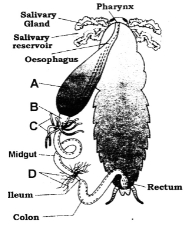
Match List $I$ with List $II$ related to digestive system of cockroach.

List $I$ List $II$
$A$ The structures used for storing of food $I$ Gizzard
$B$ Ring of $6-8$ blind tubules at junction of foregut and midgut. $II$ Gastric Caeca
$C$ Ring of $100-150$ yellow coloured thin filaments at junction of midgut and hindgut. $III$ Malpighian tubules
$D$ The structures used for grinding the food. $IV$ Crop

Choose the correct answer from the options given below:

  • A
    $A-I, B-II, C-III, D-IV$
  • B
    $A-IV, B-III, C-II, D-I$
  • C
    $ A-III, B-II, C-IV, D-I$
  • $ A-IV, B-II, C-III, D-I$
Answer
Correct option: D.
$ A-IV, B-II, C-III, D-I$
d
The correct answer is option no. ($4$) as

The structure used for griding the food particles - Gizzard
The structure used for storing of food - Crop
Ring of $6-8$ blind tubules at junction of foregut and midgut which assists in secretion of digestive juices - Gastric Caeca 
Ring of $100-150$ yellow coloured thin filaments at junction of midgut and hindgut which assists in elimination of nitrogenous wastes - Malpighian tubules


View full question & answer
MCQ 21 Mark
In both sexes of cockroach, a pair of jointed filamentous structures called anal cerci are present on
  •  $10^{\text {th }}$ segment
  • B
    $8^{\text {th }}$ and $9^{\text {th }}$ segment
  • C
     $11^{\text {th }}$ segment
  • D
     $5^{\text {th }}$ segment
Answer
Correct option: A.
 $10^{\text {th }}$ segment
a
Correct answer is option ($1$), because in both sexes of cockroach, $10^{\text {th }}$ segment bears a pair of jointed filamentous structures called anal cerci.

Options ($2$), ($3$) and ($4$) are incorrect because $5^{\text {th }}, 8^{\text {th }}$ and $9^{\text {th }}$ segments do not bear such structures. In adult cockroaches only $10^{\text {th }}$ segments are present in abdomen. $11^{\text {th }}$ abdominal segment is absent.

View full question & answer
MCQ 31 Mark
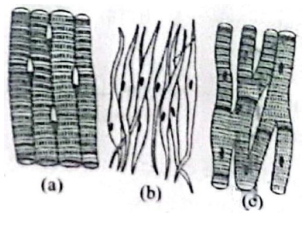
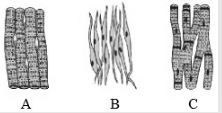
Three types of muscles are given as $a, b$ and $c$. Identify the correct matching pair along with their location in human body:

$Image$

Name of muscle/location

  • ($a$) Skeletal - Triceps

    ($b$) Smooth - Stomach

    ($c$) Cardiac - Heart

  • B
    ($a$) Skeletal - Biceps

    ($b$) Involuntary - Intestine

    ($c$) Smooth - Heart

  • C
    ($a$) Involuntary - Nose tip

    ($b$) Skeletal - Bone

    ($c$) Cardiac - Heart

  • D
    ($a$) Smooth - Toes

    ($b$) Skeletal - Legs

    ($c$) Cardiac - Heart

Answer
Correct option: A.
($a$) Skeletal - Triceps

($b$) Smooth - Stomach

($c$) Cardiac - Heart

a
The correct answer is option ($1$) as

Figure ($a$) represents skeletal muscle fibres which are closely attached to skeletal bones. In a typical muscle such as triceps and biceps, striated muscle fibres are bundled together in a parallel fashion.

Figure ($b$) represents smooth muscle fibres which are present in the wall of internal organs such as the blood vessels, stomach and intestine.

Figure ($c$) represents cardiac muscle fibres which are exclusively present in the heart.

View full question & answer
MCQ 41 Mark
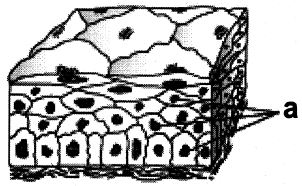
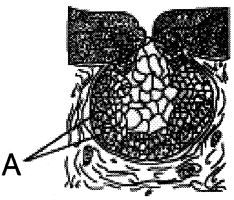
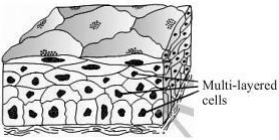
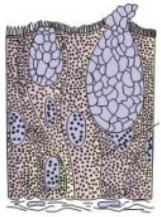
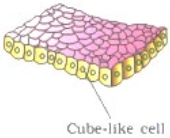
Match List $I$ with List $II$: 

List $I$ List $II$
$A$ Unicellular glandular epithelium $I$ Salivary glands
$B$ Compound epithelium  $II$ Pancreas
$C$ Multicellular glandular epithelium $III$ Goblet cells of alimentary canal
$D$ Endocrine glandular epithelium $IV$ Moist surface of buccal cavity

  choose the correct answer from the options given below:

  • A
    $A-IV, B-III, C-I, D-II$
  • $A-III, B-IV, C-I, D-II$
  • C
    $A-II, B-I, C-IV, D-III$
  • D
    $A-II, B-I, C-III, D-IV$
Answer
Correct option: B.
$A-III, B-IV, C-I, D-II$
b
The correct answer is option no. ($2$) as

$A$  Unicellular glandular epithelium $I$  Goblet cells of alimentary canal
$B$  Compound epithelium $II$  Lines moist surface of buccal cavity
$C$  Multicellular glandular epithelium $III$  Salivary glands
$D$  Endocrine glandular epithelium $IV$  Pancreas


View full question & answer
MCQ 51 Mark
In cockroach, excretion is brought about by-

$A$. Phallic gland    $B$. Urecose gland    $C$. Nephrocytes    $D$. Fat body     $E$. Collaterial glands

Choose the correct answer from the options given below :

  • A
    $B$ and $D$ only
  • B
    $A$ and $E$ only
  • C
    $A,B$ and $E$ only
  • $B,C$ and $D$ only
Answer
Correct option: D.
$B,C$ and $D$ only
d
Option (4) is the answer because,

In cockroach, excretion is brought about by Malpighian tubules, fat body, nephrocytes and urecose glands.

Urecose glands are present in male cockroach of some species. They synthesise uric acid. Nephrocytes are large, colourless, ovoid, binucleate cells attached to the dorsal diaphragm in the body cavity. Fat body accumulates, produces and stores uric acid.

Phallic gland is the structure of male reproductive system of cockroach and it secretes the outer layer of spermatophore. Collaterial gland is the structure of female reproductive system of cockroach and it secretes the hard egg-case or ootheca around fertilised eggs.

View full question & answer
MCQ 61 Mark
Which of the following is characteristic feature of cockroach regarding sexual dimorphism?
  • A
    Presence of anal cerci
  • B
    Dark brown body colour and anal cerci
  • Presence of anal styles
  • D
    Presence of sclerites
Answer
Correct option: C.
Presence of anal styles
c
Option (3) is the correct answer because anal styles are present in male cockroaches and absent in female cockroaches.

Option (1), (2) and (4) are not the correct answers because sclerites, anal cerci and dark brown body colour are common features of both male and female cockroaches.

View full question & answer
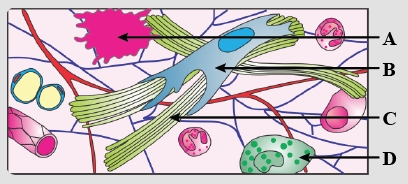
MCQ 71 Mark
Match List $I$ with List $II$.

List $I$ List $II$
$A$. Mast cells $I$. Ciliated epithelium
$B$. Inner surface of bronchiole $II$. Areolar connective tissue
$C$. Blood $III$. Cuboidal epithelium
$D$. Tubular parts of nephron $IV$. Specialised connective tissue

Choose the correct answer from the options give below:

  • A
    A-III, B-IV, C-II, D-I
  • B
    A-I, B-II, C-IV, D-III
  • C
    A-II, B-III, C-I, D-IV
  • A-II, B-I, C-IV, D-III
Answer
Correct option: D.
A-II, B-I, C-IV, D-III
d
Option (4) is the correct answer because,

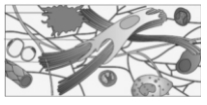
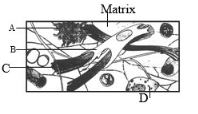
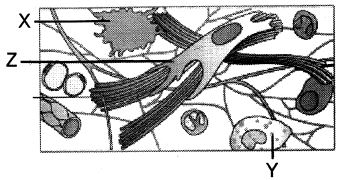
- Areolar connective tissue contains fibroblasts (cells that produce and secrete fibres), macrophages and mast cells.

- Inner surface of bronchioles is lined by ciliated epithelium.

- Blood is a specialised connective tissue.

- Tubular parts of nephron are lined by cuboidal epithelium.

View full question & answer
MCQ 81 Mark
Given below are two statements:

Statement $I$: Ligaments are dense irregular tissue.

Statement $II$: Cartilage is dense regular tissue.

In the light of the above statements, choose the correct answer from the options given below:

  • A
    Statement $I$ is false but Statement $II$ is true
  • B
    Both Statement $I$ and Statement $II$ are true
  • Both Statement $I$ and Statement $II$ are false
  • D
    Statement $I$ is true but Statement $II$ is false
Answer
Correct option: C.
Both Statement $I$ and Statement $II$ are false
c
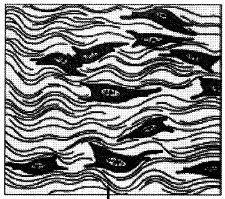
Option (3) is the correct answer because ligament is an example of dense regular connective tissue so Statement I is incorrect and cartilage is an example of specialised connective tissue and not dense regular tissue. Therefore Statement II is also incorrect.
View full question & answer
MCQ 91 Mark
Match List $- I$ with List $- II$ 

$List - I$ $List - II$
$(a)$ Bronchioles  $(i)$ Dense Regular Connective Tissue
$(b)$ Goblet cell $(iI)$Loose Connective Tissue
$(c)$ Tendons $(iii)$Glandular Tissue
$(d)$ Adipose Tissue $(iv)$ Ciliated Epithelium

Choose the correct answer from the options given below:

  • A
    $(a) - (i), (b) - (ii), (c) - (iii), (d) - (iv)$
  • B
    $(a) - (ii), (b)-(i), (c)-(iv), (d) - (iii)$
  • C
    $(a) - (iii), (b) - (iv), (c) - (ii), (d) - (i)$
  • $(a) - (iv), (b) - (iii), (c) - (i), (d) - (ii)$
Answer
Correct option: D.
$(a) - (iv), (b) - (iii), (c) - (i), (d) - (ii)$
d
View full question & answer
MCQ 101 Mark
Tegmina in cockroach, arises from :
  • Mesothorax
  • B
    Metathorax
  • C
    Prothorax and Mesothorax
  • D
    Prothorax
Answer
Correct option: A.
Mesothorax
a
View full question & answer
MCQ 111 Mark
Which of the following is not a connective tissue?
  • A
    Adipose tissue
  • B
    Cartilage
  • Neuroglia
  • D
    Blood
Answer
Correct option: C.
Neuroglia
c
View full question & answer
MCQ 121 Mark
Which of the following characteristics is incorrect with respect to cockroach?
  • A ring of gastric caeca is present at the junction of midgut and hind gut.
  • B
    Hypopharynx lies within the cavity enclosed by the mouth parts.
  • C
    In females, $7^{\text {th }}-9^{\text {th }}$ sterna together form a genital pouch.
  • D
    $10^{\text {th }}$ abdominal segment in both sexes, bears a pair of anal cerci.
Answer
Correct option: A.
A ring of gastric caeca is present at the junction of midgut and hind gut.
a
View full question & answer
MCQ 131 Mark
Which of the following statements wrongly represents the nature of smooth muscle?
  • A
    These muscle have no striations
  • B
    They are involuntary muscles
  • Communication among the cells is performed by intercalated discs
  • D
    These muscles are present in the wall of blood vessels
Answer
Correct option: C.
Communication among the cells is performed by intercalated discs
c
View full question & answer
MCQ 141 Mark
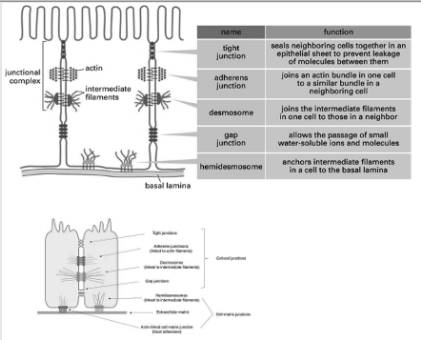
Identify the types of cell junctions that help to stop the leakage of the substances across a tissue and facilitation of communication with neighbouring cells via rapid transfer of ions and molecules.
  • A
    Gap junctions and Adhering junctions, respectively.
  • Tight junctions and Gap junctions, respectively.
  • C
    Adhering junctions and Tight junctions, respectively.
  • D
    Adhering junctions and Gap junctions, respectively.
Answer
Correct option: B.
Tight junctions and Gap junctions, respectively.
b
View full question & answer
MCQ 151 Mark
Match the following columns with reference to cockroach and select the correct option:
Column $I$ Column $II$
($a$) Grinding of the food particies ($i$) Hepatic caecae
($b$) Secrete gastric juice ($ii$) $10^{\text {th }}$ segment
($c$) $10$ pairs ($iii$) Proventriculus
($d$) Anal Cerci ($iv$) Spiracles
  ($v$) Alary muscles
  • A
    $( a )-( ii ),( b )-( iii ),( c )-( i ),( d )-( iv )$
  • $( a )-( iii ),( b )-( i ),( c )-( iv ),( d )-( ii )$
  • C
    $( a )-( iv ),( b )-( iii ),( c )-( v ),( d )-( ii )$
  • D
    $( a )-( i ),( b )-( iv ),( c )-( iii ),( d )-( ii )$
Answer
Correct option: B.
$( a )-( iii ),( b )-( i ),( c )-( iv ),( d )-( ii )$
b
The correct answer is option (2) because proventriculus or gizzard has an outer layer of thick circular muscles and thick inner cuticle forming six highly chitinous plate called teeth which help in grinding of food particles.

Hepatic caecae secrete gastric juice. Spiracles are 10 pairs in number.

In both male and female cockroach, $10^{\text {th }}$ segment bears a pair of jointed filamentous structures called anal cerci.

View full question & answer
MCQ 161 Mark
If the head of cockroach is removed, it may live for few days because
  • A
    the head holds a $1 / 3^{\text {rd }}$ of a nervous system while the rest is situated along the dorsal part of its body.
  • B
    the supra$-$oesophageal ganglia of the cockroach are situated in ventral part of abdomen.
  • C
    the cockroach does not have nervous system.
  • the head holds a small proportion of a nervous system while the rest is situated along the ventral part of its body.
Answer
Correct option: D.
the head holds a small proportion of a nervous system while the rest is situated along the ventral part of its body.
d
the head holds a small proportion of a nervous system while the rest is situated along the ventral part of its body.
View full question & answer
MCQ 171 Mark
Select the incorrectly matched pair from following
  • A
    Ostcocytes - Bone cells
  • Chondrocytes - Smooth muscle cells
  • C
    Neurons - Nerve cells
  • D
    Fibroblast - Areolar tissue
Answer
Correct option: B.
Chondrocytes - Smooth muscle cells
b
The correct answer is option (2) because chondrocytes are not present in smooth muscles but are cells present in cartilage.

Chondrocytes are enclosed in small cavities within the matrix secreted by them.

View full question & answer
MCQ 181 Mark
In cockroach, identify the parts of the foregut in correct sequence
  • Mouth $\rightarrow$ Pharynx $\rightarrow$ Oesophagus $\rightarrow$ Crop $\rightarrow$ Gizzard
  • B
    Mouth $\rightarrow$ Oesophagus $\rightarrow$ Pharynx $\rightarrow$ Crop $\rightarrow$ Gizzard
  • C
    Mouth $\rightarrow$ Crop $\rightarrow$ Pharynx $\rightarrow$Oesophagus $\rightarrow$ Gizzard
  • D
    Mouth $\rightarrow$ Gizzard $\rightarrow$ Crop $\rightarrow$ Pharynx $\rightarrow$
    Oesophagus
Answer
Correct option: A.
Mouth $\rightarrow$ Pharynx $\rightarrow$ Oesophagus $\rightarrow$ Crop $\rightarrow$ Gizzard
a
Option (1) is the correct answer as the correct sequence of parts of the foregut in cockroach are 

Mouth $\rightarrow$ Pharynx $\rightarrow$ Oesophagus $\rightarrow$ Crop $\rightarrow$ Gizzard.

View full question & answer
MCQ 191 Mark
Which of the following statements is incorrect?
  • Cockroaches exhibit mosaic vision with less sensitivity and more resolution
  • B
    A mushroom- shaped gland is present in the $6^{th}- 7^{th}$ abdominal segments of male cockroach.
  • C
    A pair of spermatheca is present in the $6^{th}$ segment of female cockroach.
  • D
    Female cockroach possesses sixteen ovarioles in the ovaries.
Answer
Correct option: A.
Cockroaches exhibit mosaic vision with less sensitivity and more resolution
a
View full question & answer
MCQ 201 Mark
Select the correct sequence of organs in the alimentary canal of cockroach starting from mouth
  • Pharynx $\rightarrow$ Oesophagus $\rightarrow$ Crop $\rightarrow$ Gizzard $\rightarrow$ Ileum $\rightarrow$ Colon $\rightarrow$ Rectum
  • B
    Pharynx $\rightarrow$ Oesophagus $\rightarrow$ Gizzard $\rightarrow$ Crop $\rightarrow$ Ileum $\rightarrow$ Colon $\rightarrow$ Rectum
  • C
     Pharynx $\rightarrow$ Oesophagus $\rightarrow$ Gizzard $\rightarrow$ lleum $\rightarrow$ Crop $\rightarrow$ Colon $\rightarrow$ Rectum
  • D
    Pharynx $\rightarrow$ Oesophagus $\rightarrow$ lleum $\rightarrow$ Crop $\rightarrow$ Gizzard $\rightarrow$ Colon $\rightarrow$ Rectum
Answer
Correct option: A.
Pharynx $\rightarrow$ Oesophagus $\rightarrow$ Crop $\rightarrow$ Gizzard $\rightarrow$ Ileum $\rightarrow$ Colon $\rightarrow$ Rectum
a
View full question & answer
MCQ 211 Mark
Match the following cell structure with its characteristic feature

(a) Tight junctions (i) Cement neighbouring cells together to form sheet
(b) Adhering Junctions (ii) Transmit information through chemical to another cells
(c) Gap junctions (iii) Establish a barrier to prevent leakage of fluid across epithelial cells
(d) Synaptic junctions (iv) Cytoplasmic channels to facilitate communication between adjacent cells

Select correct option from the following

  • A
    $(a)-(ii), (b)-(iv), (c)-(i), (d)-(iii)$
  • B
    $(a)-(iv), (b)-(ii), (c)-(i), (d)-(iii)$
  • $(a)-(iii), (b)-(i), (c)-(iv), (d)-(ii)$
  • D
    $(a)-(iv), (b)-(iii), (c)-(i), (d)-(ii)$
Answer
Correct option: C.
$(a)-(iii), (b)-(i), (c)-(iv), (d)-(ii)$
c
View full question & answer
MCQ 221 Mark
The ciliated epithelial cells are required to move particles or mucus in a specific direction. In humans, these cells are mainly present in
  • A
    Bile duct and Bronchioles
  • B
    Fallopian tubes and Pancreatic duct
  • C
    Eustachian tube and Salivary duct
  • Bronchioles and Fallopian tubes
Answer
Correct option: D.
Bronchioles and Fallopian tubes
d
View full question & answer
MCQ 231 Mark
Which of the following features is used to identify a male cockroach from a female cockroach?
  • A
    Presence of anal cerci
  • B
    Presence of a boat shaped sternum on the $9th$ abdominal segment
  • C
    Forewings with darker tegmina
  • Presence of caudal styles
Answer
Correct option: D.
Presence of caudal styles
d
View full question & answer
MCQ 241 Mark
Frog’s heart when taken out of the body continues to beat for sometime.Select the best option from the following statements.

$(1)$ Frog is a poikilotherm.

$(2)$ Frog does not have any coronary circulation.

$(3)$ Heart is “myogenic” in nature.

$(4)$ Heart is autoexcitable.

  • A
    Only $(4)$
  • B
    $(1)$ and $(2)$
  • $(3)$ and $(4)$
  • D
    Only $(3)$
Answer
Correct option: C.
$(3)$ and $(4)$
c
(c) : Frog’s heart is myogenic, $i.e.$, heartbeat originates from muscles of heart. Hence, it is autorythmic. Wave of contraction originates from sinus venosus and spreads to wall of sinus venosus and both auricles. This compels the heart to beat. Due to this reason, frog’s heart will continue to beat as long as it gets supply of $ATP.$
View full question & answer
MCQ 251 Mark
Select the correct route for the passage of sperms in male frogs.
  • A
    Testes $→$ Vasa efferentia $→$ Kidney $→$ Seminal vesicle $→$ Urinogenital duct $→$ Cloaca
  • B
    Testes $→$ Vasa efferentia $→$ Bidder’s canal $→$ Ureter $→$ Cloaca
  • Testes $→$ Vasa $→$ efferentia Kidney $→$ Bidder’s canal $→$ Urinogenital duct $→$ Cloaca
  • D
    Testes $→$ Bidder’s canal $→$ Kidney $→$ Vasa $→$ efferentia $→$ Urinogenital duct $→$ Cloaca
Answer
Correct option: C.
Testes $→$ Vasa $→$ efferentia Kidney $→$ Bidder’s canal $→$ Urinogenital duct $→$ Cloaca
c
(c) : The correct route for transport of sperms in male frog isTestes Vasa efferentia Kidney Bidder’s canal; Urinogenital duct Cloaca.
View full question & answer
MCQ 261 Mark
Which type of tissue correctly matches with its location ? 

Tissue Location
$(a)$  Transitional epithelium Tip of nose
$(b)$  Cuboidal epithelium Lining of stomach
$(c)$  Smooth muscle Wall of intestine
$(d)$  Areolar tissue Tendons


  • A
    $(a)$
  • B
    $(b)$
  • $(c)$
  • D
    $(d)$
Answer
Correct option: C.
$(c)$
c
(c) : Tip of nose has elastic cartilage. Simple columnar epithelium lines the stomach. Tendon is white fibrous connective tissue. Posterior part of intestine has single unit smooth muscle in which all fibres of muscle contract simultaneously as single unit.
View full question & answer
MCQ 271 Mark
Which of the following features is not present in Periplaneta americana?
  • A
    Exoskeleton composed of N­acetylglucos­ amine
  • B
    Metamerically segmented body
  • C
    Schizocoelom as body cavity
  • Indeterminate and radial cleavage during embryonic development
Answer
Correct option: D.
Indeterminate and radial cleavage during embryonic development
d
(d) : In insect cleavage is superficial.
View full question & answer
MCQ 281 Mark
In male cockroaches, sperms are stored in which part of the reproductive system?
  • Seminal vesicles
  • B
    Mushroom glands
  • C
    Testes
  • D
    Vas deferens
Answer
Correct option: A.
Seminal vesicles
a
(a) : Seminal vesicles are numerous small sacs present on ventral surface of anterior part of the ejaculatory duct which store sperms.
View full question & answer
MCQ 291 Mark
Smooth muscles are
  • involuntary, fusiform, non­striated
  • B
    voluntary, multinucleate, cylindrical
  • C
    involuntary, cylindrical, striated
  • D
    voluntary, spindle­shaped, uninucleate.
Answer
Correct option: A.
involuntary, fusiform, non­striated
a
(a) : Smooth muscle fibres are elongated and spindle shaped (fusiform). Each fibre contains a single oval nucleus surrounded by cytoplasm (sarcoplasm). In cytoplasm myofibrils are arranged longitudinally. These fibres lack striations and sarcolemma, however are enclosed by plasma membrane.
View full question & answer
MCQ 301 Mark
The terga, sterna and pleura of cockroach body are joined by
  • arthrodial membrane
  • B
    cartilage
  • C
    cementing glue
  • D
    muscular tissue.
Answer
Correct option: A.
arthrodial membrane
a
(a) : Arthrodial membrane is a tough, flexible cuticle that joins the skeletal elements of cockroach and other arthropods. It connects terga, pleura and sterna of cockrocah body.
View full question & answer
MCQ 311 Mark
The function of the gap junction is to
  • A
    separate two cells from each other
  • B
    stop substance from leaking across a tissue
  • C
    performing cementing to keep neighbouring cells together
  • facilitate communication between adjoining cells by connecting the cytoplasm for rapid transfer of ions, small molecules and some large molecules.
Answer
Correct option: D.
facilitate communication between adjoining cells by connecting the cytoplasm for rapid transfer of ions, small molecules and some large molecules.
d
(d) : Most cells in animal tissues (with the exception of a few terminally differentiated cells such as skeletal muscle cells and blood cells) are in communication with their adjoining cells via gap junctions. At the place where gap junction is present, membranes of two adjacent cells are separated by a uniform narrow gap of about $2­4\  nm$. The gap is spanned by channel forming proteins called connexins, which allow inorganic ions and other small water soluble molecules to pass directly from cytoplasm of one cell to cytoplasm of other cell.
View full question & answer
MCQ 321 Mark
Choose the correctly matched pair.
  • A
    Tendon $\to$­ Specialized connective tissue
  • B
    Adipose tissue $\to$­ Dense connective tissue
  • Areolar tissue $\to$­ Loose connective tissue
  • D
    Cartilage $\to$ Loose connective tissue
Answer
Correct option: C.
Areolar tissue $\to$­ Loose connective tissue
c
(c) : Areolar tissue is the most widely distributed loose connective tissue in the body. Tendon is a type of dense connective tissue, adipose tissue is a fat­ storing loose connective tissue and cartilage is a specialised connective tissue.
View full question & answer
MCQ 331 Mark
Choose the correctly matched pair.
  • A
    Inner lining of­ salivary ducts $→$ Ciliated epithelium 
  • B
    Moist surface­ of buccal cavity $→$ Glandular epithelium 
  • Tubular parts of ­ nephrons $→$ Cuboidal epithelium 
  • D
    Inner surface of ­ bronchioles $→$ Squamous epithelium 
Answer
Correct option: C.
Tubular parts of ­ nephrons $→$ Cuboidal epithelium 
c
(c) : Inner lining of ­salivary ducts $→$ Simple cuboidal epithelium

Moist surface of buccal cavity $→$ Non-keratinized startified squamous epithelium

Inner surface of bronchiloes $→$ Ciliated colulmnar epithelium

View full question & answer
MCQ 341 Mark
Select the correct option with respect to cockroaches.
  • A
    Malpighian tubules convert nitrogenous wastes into urea.
  • Males bear short anal styles not present in females.
  • C
    Nervous system comprises of a dorsal nerve cord and ten pairs of ganglia.
  • D
    The forewings are tegmina which are used in flight.
Answer
Correct option: B.
Males bear short anal styles not present in females.
b
(b) : Malpighian tubules are the main excretory structures in cockroach. They extract nitrogenous wastes and water from haemolymph and reabsorb certain salts resulting in precipitation of uric acid. So, cockroach is uricotelic. Males have paired anal styles on 9th abdominal sternite which are absent in females.
View full question & answer
MCQ 351 Mark
What external changes are visible after the last moult of a cockroach nymph?
  • Both forewings and hindwings develop
  • B
    Labium develops
  • C
    Mandibles become harder
  • D
    Anal cerci develop
Answer
Correct option: A.
Both forewings and hindwings develop
a
(a) : Cockroach undergoes paurometabolous development. The nymph moults about $6-­7$ times to reach the adult form. The next to last nymphal stage has wing pads but onlyadult cockroaches have wings.
View full question & answer
MCQ 361 Mark
Which one of the following is one of the paths followed by air or $O_2$ during respiration in the adult male Periplaneta americana as it enters the animal body?
  • Spiracle in metathorax, trachea, tracheloes, oxygen diffuses into cells
  • B
    Mouth, bronchial tube, trachea, oxygen enters cells
  • C
    Spiracles in prothorax, tracheoles, trachea, oxygen diffuses into cells.
  • D
    Hypopharynx, mouth, pharynx, trachea, tissues
Answer
Correct option: A.
Spiracle in metathorax, trachea, tracheloes, oxygen diffuses into cells
a
(a) : The respiratory system is well developed in a cockroach in order to compensate the poorly developed circulatory system. It consists of tracheae, tracheoles and spiracles. The main tracheal trunks open to the exterior on body surface through $10$ pairs of segmentally arranged apertures termed spiracles or stigmata. Two pairs of spiracles are thoracic, one between pro and mesothorax and the other between meso and metathorax. Haemocoel contains a network of elastic, closed and branching air tubes or tracheae. The ultimate finer branches of tracheae are called tracheoles which come in contact with the individual body cells. The elaborate tracheal system carries oxygen directly to all the body cells.
View full question & answer
MCQ 371 Mark
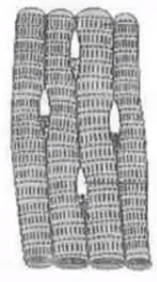
Identify the tissue shown in the diagram and match with its characteristics and its location.
  • A
    Smooth muscles, show branching, found in the wall of the heart
  • B
    Cardiac muscles, unbranched muscles, found in the walls of the heart
  • C
    Striated muscles, tapering at both­ends, attached with the bones of the ribs
  • Skeletal muscles show striations and are closely attached with the bones of the limbs
Answer
Correct option: D.
Skeletal muscles show striations and are closely attached with the bones of the limbs
d
(d) : Locomotion (performed by limbs) in humans depends on the movements of muscle fibres. Skeletal muscles are attached to the bones by tendons and help in the movement of the parts of skeleton. These muscles are under the control of conscious mind and are called voluntary muscles. Under the microscope, these muscles show transverse stripes and hence are designated as striated muscles.
View full question & answer
MCQ 381 Mark
How many of the given statements are true?

$A.$ The dry surface of the skin and the moist surface of the buccal cavity. Are lined by compound epithelium.

$B.$ Cuboidal epithelium facilitates diffusion across the epithelium.

$C.$ Intercalated discs are the cell junctions between the cardiac muscle cells.

$D.$ Skeletal muscle fibers can be located in the biceps muscle.

$E.$ In a bone, osteocytes are located in lacunae.

  • A
    Two
  • B
    Three
  • Four
  • D
    All
Answer
Correct option: C.
Four
c
Four

The important functions of the simple cuboidal epithelium are secretion and absorption. This epithelial type is found in the small collecting ducts of the kidneys, pancreas, and salivary glands. Simple squamous epithelium facilitates diffusion across the epithelium while the simple cuboidal and simple columnar epithelia are mainly concerned with secretion and absorption.

View full question & answer
MCQ 391 Mark
The major functions of loose connective tissue include
  • A
    occupying spaces between organs and supporting epithelia.
  • B
    supporting and surrounding blood vessels and nerves
  • C
    cushioning organs, storing lipids and facilitating diffusion.
  • All of the above
Answer
Correct option: D.
All of the above
d
Loose connective tissue is a category of connective tissue which includes areolar tissue, reticular tissue, and adipose tissue. It holds organs in place and attaches epithelial tissue to other underlying tissues.
View full question & answer
MCQ 401 Mark
Match the following:

$\begin{array}{|l|l|} \hline Column\;-\;I  & Column\;-\;II \\ \hline A.\;Caecum\;in\;earthworm & 1.\;Tubular \\ \hline B.\;Caecum\;in\;cockroach & 2.\;Forgut \\ \hline C.\;Gizzard\;in\;earthworm & 3.\;26^{th}\;segment \\ \hline D.\;Gizzard\;in\;cockroach & 4.\;8-9\;segment \\ \hline \end{array}$

  • A
    $A-1, B-4, C-2, D-3$
  • B
    $A-4, B-2, C-1, D-3$
  • $A-3, B-1, C-4, D-2$
  • D
    $A-3, B-1, C-2, D-3$
Answer
Correct option: C.
$A-3, B-1, C-4, D-2$
c
View full question & answer
MCQ 411 Mark
Which character is present in frog but absent in cockroach?
  • A
    Presence of reproduction system
  • B
    Presence of digestive system
  • C
    Presence of sensory organs
  • Capacity to change the skin color
Answer
Correct option: D.
Capacity to change the skin color
d
View full question & answer
MCQ 421 Mark
Choose incorrect sentence.
  • A
    Excretory material as urea in frog.
  • B
    In cockroach excretory material is uric acid.
  • C
    In frog fertilization is external and in water.
  • In cockroach fertilization is internal and direct development.
Answer
Correct option: D.
In cockroach fertilization is internal and direct development.
d
View full question & answer
MCQ 431 Mark
Choose correct group which concern with any one system in cockroach and frog.
  • Spiracles, lungs, trachea, circular muscles, nostrils.
  • B
    Ostia, sinus venous, cloaca, anal circus
  • C
    Fallopian tube, ovary, stomach, skin, appendages, mouth parts.
  • D
    Ganglia, eyes, brain liver, testis, bifid tongue
Answer
Correct option: A.
Spiracles, lungs, trachea, circular muscles, nostrils.
a
View full question & answer
MCQ 441 Mark
Cockroach and frogs
  • A
    Invertebrates animals
  • B
    Always beneficial for mankind
  • C
    Both have skeletal system
  • Oviparous
Answer
Correct option: D.
Oviparous
d
View full question & answer
MCQ 451 Mark
Match the correct pair

$\begin{array}{|l|l|} \hline Column-I  & Column-II  \\ \hline P\;-\;Cartilage & 1\;-\;PCT  \\ \hline Q\;-\;Cuboidal\;epithelium & 2\;-\;Bronchioles  \\ \hline R\;-\;Compound\;epithelium & 3\;-\;limbs  \\ \hline S\;-\;Cilliated\;epithelium & 4\;-\;Pharynx \\ \hline   & 5\;-\;Muscles\;of\;eyes \\ \hline \end{array}$


  • A
    $P-3, Q-1, R-5, S-2$
  • $P-3, Q-1, R-4, S-2 $
  • C
    $P-3, Q-5, R-4, S-2$
  • D
    $P-4, Q-5, R-2, S-1 $
Answer
Correct option: B.
$P-3, Q-1, R-4, S-2 $
b
View full question & answer
MCQ 461 Mark
Match the following:

$\begin{array}{|p{0.35\linewidth}|p{0.55\linewidth}|} \hline Column\,\,-\,\,I & Column\,\,-\,\,II  \\ \hline 1.\,\,Smooth\,\,muscles & p.\,\,Hard\,\,and\,\,not\,\,pliable\,\,ground\,\,substance \\ \hline 2.\,\,Skeletal\,\,muscles & q.\,\,Blood\,\,vessel\,\,stomach\,\,intestine  \\ \hline 3.\,\,Bone & r.\,\,Condroblast  \\ \hline 4.\,\,Cartilage  & s.\,\,A-band   \\ \hline \end{array}$

  • A
    $(1-p),(2-q),(3-r),(4-s) $
  • B
    $(1-q),(2-p),(3-s),(4-r) $
  • $(1-q),(2-s),(3-p),(4-r)$
  • D
    $(1-p),(2-r),(3-s),(4-q)$
Answer
Correct option: C.
$(1-q),(2-s),(3-p),(4-r)$
c
View full question & answer
MCQ 471 Mark
Which one of the following pairs of structures is correctly matched with their corrected description?

Description Structures
$(a)$ Tibia and fibula Both form parts of knee joint
$(b)$ Cartilage and cornea No blood supply but do require oxygen for respiratory need
$(c)$ Shoulder joint and elbow joint  Ball and socket type of joint
$(d)$ Premolars and molars $ 20$ in all and $3$ rooted


  • A
    $(a)$
  • $(b)$
  • C
    $(c)$
  • D
    $(d)$
Answer
Correct option: B.
$(b)$
b
(b) : Cartilage is avascular, as the blood vessels innervate onlyperichondrium through which nutrition diffuses into cartilage cells. Cornea is also avascular.
View full question & answer
MCQ 481 Mark
Irritability and conductivity are maximum developed in
  • A
    Muscular tissue
  • Nervous tissue
  • C
    Connective tissue
  • D
    None of the above
Answer
Correct option: B.
Nervous tissue
b
(b) Nervous tissue consists of cells having a well developed power of irritability and conductivity, forms nervous system.
View full question & answer
MCQ 491 Mark
The rate of erythropoiesis is controlled by
  • A
    An enzyme
  • A hormone
  • C
    Spleen
  • D
    Brain
Answer
Correct option: B.
A hormone
b
(b) Rate of erythropoiesis is effectively controlled by a hormone, erythropoietin, which is released into the blood by kidneys.
View full question & answer
MCQ 501 Mark
Which is not an example of tissue
  • A
    Epidermis
  • A colony of protozoa
  • C
    Grey matter of spinal cord
  • D
    Blood
Answer
Correct option: B.
A colony of protozoa
b
(b) Since they may not perform the same function commonly.
View full question & answer
MCQ 511 Mark
Match the following column $I$ with coloumn $II$ and choose the correct combination.
Column $-I$ Column $-II$
$(a)$ Earthworm $(i)$ Gizzard
$(b)$ Cockroach $(ii)$ Caecum
$(c)$ Frog $(iii)$ Clitellum
$(d)$ Rat $(iv)$ Cloaca
  • A
    $(a) -(i),\, (b) -(ii),\, (c) -(iv),\, (d) -(iii)$
  • $(a) -(iii),\, (b) -(i),\, (c) -(iv),\, (d) -(ii)$
  • C
    $(a) -(iii),\, (b) -(i),\, (c) -(ii),\, (d) -(iv)$
  • D
    $(a) -(i),\, (b) -(iii),\,(c) -(iv),\, (d) -(ii)$
Answer
Correct option: B.
$(a) -(iii),\, (b) -(i),\, (c) -(iv),\, (d) -(ii)$
b
It's Obvious
View full question & answer
MCQ 521 Mark
Match the description given in column $I$ with their examples given in column $II$ and choose the correct option.

Column $I$

(Description)

Column $II$

(Example)

$A$. Aquatic respiratory organ $I$. Skin
$B$. Organ which acts urogenital duct $II$. Ureterand opens into the cloaca
$C$. A small median chamber $III$. Cloacathat is used to pass faecal matter,urine and sperms to the exterior
$D$. A triangular structure $IV.$ Sinus venosuswhich joins the rightatrium and receives bloodthrough vena cava
  • $A -I ; B -II; C -III D - IV$
  • B
    $A -III; B - IV ; C -I ; D -II$
  • C
    $A -III ; B -I ; C - I I ; D - IV$
  • D
    $A - IV ; B -II; C - I ; D -III$
Answer
Correct option: A.
$A -I ; B -II; C -III D - IV$
a
$1-A ; 2-B ; 3-C ; 4-D$
View full question & answer
MCQ 531 Mark
Which of the following animals maintain ecological balance?
  • Frog
  • B
    Rabbit
  • C
    Earthworm
  • D
    Cockroach
Answer
Correct option: A.
Frog
a
Frog maintains ecological balance because these serve as an important link of food chain and food web in the ecosystem.
View full question & answer
MCQ 541 Mark
Left auricle of frog receives .........
  • Oxygenated blood
  • B
    Deoxygenated blood
  • C
    Mixed blood
  • D
    Blood absent
Answer
Correct option: A.
Oxygenated blood
a
View full question & answer
MCQ 551 Mark
Choose correct sentence (related frog).
  • A
    Ilium, opens into big intestine
  • B
    llium is long coiled part of digestive duct.
  • C
    Pyloric stomach opens into small intestine.
  • All above.
Answer
Correct option: D.
All above.
d
View full question & answer
MCQ 561 Mark
It is not function of skin of frog.
  • A
    Sensory organ
  • B
    Protection
  • Digestion
  • D
    Respiratory organ
Answer
Correct option: C.
Digestion
c
View full question & answer
MCQ 571 Mark
It is include in fore brain of frog.
  • A
    Medulla oblongata
  • B
    Cerebellum
  • Olfactory lobe
  • D
    All above
Answer
Correct option: C.
Olfactory lobe
c
View full question & answer
MCQ 581 Mark
This is part not include in frog digestive system
  • A
    Cloaca
  • Caecum
  • C
    llium
  • D
    Stomach
Answer
Correct option: B.
Caecum
b
View full question & answer
MCQ 591 Mark
In frog it is part of hind brain.
  • A
    Olfactory cord
  • Cerebellum
  • C
    Diencephalon
  • D
    None
Answer
Correct option: B.
Cerebellum
b
View full question & answer
MCQ 601 Mark
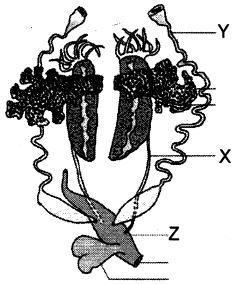
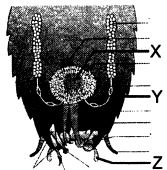
Identify $X, Y$ and $Z$ in given figure.

$X-Y-Z$

  • A
    Urinogenital duct - Cloaca - Oviduct
  • B
    Oviduct - Ureter - Cloacal aperture
  • Ureter - Oviduct - Cloaca
  • D
    Ureter - Cloaca - Urinary bladder
Answer
Correct option: C.
Ureter - Oviduct - Cloaca
c
View full question & answer
MCQ 611 Mark
Delete odd one for frog.
  • Gonapophyses
  • B
    Cloaca
  • C
    Nucleated RBC
  • D
    Three chambered heart
Answer
Correct option: A.
Gonapophyses
a
View full question & answer
MCQ 621 Mark
Dicondyllic skull and $10 $ pairs of cranial nerves are found in
  • A
    Reptilia
  • B
    Aves
  • Amphibia
  • D
    All
Answer
Correct option: C.
Amphibia
c
It's Obvious
View full question & answer
MCQ 631 Mark
The spinal cord extends from the brain through
  • Foramen Magnum
  • B
    Iter
  • C
    Anterior commissure
  • D
    Foramen of Monro
Answer
Correct option: A.
Foramen Magnum
a
It's Obvious
View full question & answer
MCQ 641 Mark
Opening of rectum in frogs is termed as
  • A
    Cloa
  • Cloaca
  • C
    Coccyx
  • D
    None of these
Answer
Correct option: B.
Cloaca
b
(b) Cloaca is terminal opening portion of digestive excretory and reproductive system.
View full question & answer
MCQ 651 Mark
Which artery is absent in frog
  • A
    Right systemic arch
  • Phrenic artery
  • C
    Carotid artery
  • D
    Renal artery
Answer
Correct option: B.
Phrenic artery
b
(b) Phrenic artery present in human but absent in frog. Right and left phrenic artery supply the blood to lower surface of the diaphragm.
View full question & answer
MCQ 661 Mark
The chief difference between $RBCs$ of Human and Frog
  • A
    Only human $RBCs$ have haemoglobin
  • B
    Human $RBCs$ have more nuclei
  • Human $RBCs$ are without nucleus
  • D
    Frog $RBCs$ are without nucleus
Answer
Correct option: C.
Human $RBCs$ are without nucleus
c
(c) The chief difference between $RBCs$ of human and frog is that the human $RBCs$ are without nucleus and therefore is not complete cell. However the absence nucleus in mammals increases respiratory efficiency of $RBCs$.
View full question & answer
MCQ 671 Mark
Ciliated epithelium in vertebrates is present in
  • A
    Kidney and stomach
  • Buccal cavity and oviduct of frog
  • C
    Stomach and urinary tubules
  • D
    Lymph vessels
Answer
Correct option: B.
Buccal cavity and oviduct of frog
b
It's Obvious
View full question & answer
MCQ 681 Mark
The development of frog is
  • A
    Direct
  • Indirect
  • C
    Parthenogenetic
  • D
    None of these
Answer
Correct option: B.
Indirect
b
(b) In indirect development, the young ones do not resemble the adults. The young ones usually pass through one or more intermediate stages before obtaining the shape of the adults.
View full question & answer
MCQ 691 Mark
How many eggs are laid by a female frog at a time
  • A
    $100 - 200$
  • B
    $500 - 1000$
  • $2500 - 3000$
  • D
    $5000 - 6000$
Answer
Correct option: C.
$2500 - 3000$
c
(c) A mature female can lay $2500$ to $3000$ eggs at a time.
View full question & answer
MCQ 701 Mark
Acrosome of the sperm of frog helps in fertilization by
  • A
    Activating the oocyte to engulf the sperm
  • B
    Inducing formation of cone of reception in oocyte
  • C
    Stimulating oocyte to undergo second maturation division
  • Secreting sperm lysin to dissolve covering membrane of oocyte
Answer
Correct option: D.
Secreting sperm lysin to dissolve covering membrane of oocyte
d
(d) During capicitation of sperms undergo acrosomal reaction and release various chemicals contained in the acrosome.

These chemicals are collectively called sperm lysin, which dissolve covering membrane of oocyte.

View full question & answer
MCQ 711 Mark
When a sperm enters an egg of frog
  • A
    First polar body is formed
  • B
    First meiotic division occurs
  • Second meiotic division occurs
  • D
    Fertilization process is compeleted
Answer
Correct option: C.
Second meiotic division occurs
c
(c) When a sperm enters into the egg of frog, second meiotic division occurs.
View full question & answer
MCQ 721 Mark
A Bidder's canal in each kidney of frog
  • A
    Runs longitudianally in lateral region of kidney
  • Runs longitudianally in medial region of kidney
  • C
    Runs tranversely across the width of anterior part of kidney
  • D
    Runs transversely across the width of posterior part of kidney
Answer
Correct option: B.
Runs longitudianally in medial region of kidney
b
It's Obvious
View full question & answer
MCQ 731 Mark
Bidder's canal in frog is found in
  • A
    Liver
  • B
    Testis
  • C
    Ovary
  • Kidney
Answer
Correct option: D.
Kidney
d
(d) Bidder’s canal is present in the kidney of male frog. It is helpful in the transfer of sperms from the vasa efferentia to water.
View full question & answer
MCQ 741 Mark
Mesorchium in frog refers to
  • Fold of peritoneum between a kidney and a testis
  • B
    Internal tissue of testes
  • C
    Capsules of testes
  • D
    None of these
Answer
Correct option: A.
Fold of peritoneum between a kidney and a testis
a
(a) Mesorchium is a thin mesentery that suspends testis from ventral anterior part of kidney.
View full question & answer
MCQ 751 Mark
A frog has
  • A
    Eyes but no lids
  • B
    Jaws but no teeth
  • C
    Hands but not fingers
  • Ears but not pinnae
Answer
Correct option: D.
Ears but not pinnae
d
It's Obvious
View full question & answer
MCQ 761 Mark
Which of the following is absent in frog
  • External ear
  • B
    Middle ear
  • C
    Internal ear
  • D
    None of these
Answer
Correct option: A.
External ear
a
(a) Presence of external ear or pinna is a typical mammalian character.
View full question & answer
MCQ 771 Mark
When an electric shock is given to the leg of a pithed frog it
  • A
    Blinks its eyes
  • B
    Shows no response
  • C
    Put out its tongue
  • None of these
Answer
Correct option: D.
None of these
d
It's Obvious
View full question & answer
MCQ 781 Mark
Number of spinal nerves in frog is
  • A
    Ten only
  • Ten pairs
  • C
    Twelve pairs
  • D
    Twenty pairs
Answer
Correct option: B.
Ten pairs
b
(b)The number of spinal nerves is definite in a particular group of animals. In frog the number is ten pairs.
View full question & answer
MCQ 791 Mark
Ninth cranial nerve of frog is
  • A
    Trochlear
  • B
    Trigeminal
  • C
    Oculomotor
  • Glossopharyngeal
Answer
Correct option: D.
Glossopharyngeal
d
(d) Glassopharyngeal is ninth cranial nerve of frog, it supplies the taste buds of tongue and muscles of the pharynx. Some fibres carry impulses from tongue,

while the other fibres are responsible for pharynx movement as they are concerned with swallowing reflex.

View full question & answer
MCQ 801 Mark
Eighth cranial nerves of frog connects the brain to
  • A
    Nose
  • Ears
  • C
    Tongue
  • D
    Pharynx
Answer
Correct option: B.
Ears
b
It's Obvious
View full question & answer
MCQ 811 Mark
The second cranial nerve of frog is distributed in
  • Retina alone
  • B
    Lens and retina
  • C
    Iris and eye muscles
  • D
    Eye muscles and retina
Answer
Correct option: A.
Retina alone
a
It's Obvious
View full question & answer
MCQ 821 Mark
The second cranial nerve of frog is
  • Optic
  • B
    Vagus
  • C
    Auditory
  • D
    Trochlear
Answer
Correct option: A.
Optic
a
(a) Optic is second ranial nerve of frog, which carries impulse of sight from the eye to the brain and its nature is sensory.
View full question & answer
MCQ 831 Mark
Which of the following is not a median part in the brain cavity of frog
  • A
    Iter
  • B
    Diocoel
  • C
    Metacoel
  • Optocoel
Answer
Correct option: D.
Optocoel
d
(d) Optocoels are paired cavities found in the optic lobes of frog. These open into iter, the canal in midbrain.
View full question & answer
MCQ 841 Mark
The medulla oblongata of the brain passes out through
  • A
    Foramen obturator
  • Foramen magnum
  • C
    Foramen of Magendie
  • D
    Foramina of Luschka
Answer
Correct option: B.
Foramen magnum
b
(b)The medulla oblongata passes out through the foramen magnum and continues into spinal cord,

which is contained in the neural canal of vertebral column.

View full question & answer
MCQ 851 Mark
If cerebral hemisphere of frog is removed it
  • A
    Dies at once
  • B
    Stops feeding
  • C
    Remain as it was
  • Dies after some time
Answer
Correct option: D.
Dies after some time
d
It's Obvious
View full question & answer
MCQ 861 Mark
Which of the following is a part of forebrain
  • A
    Olfactory lobes
  • B
    Cerebrum
  • C
    Diencephalon
  • All of these
Answer
Correct option: D.
All of these
d
(d)The fore brain of frog is consist of olfactory lobes, paired cerebral hemispheres and unpaired diencephalon.
View full question & answer
MCQ 871 Mark
Nitrogenous excretory product of tadpole of frog is
  • A
    Urea
  • B
    Guanine
  • C
    Uric acid
  • Ammonia
Answer
Correct option: D.
Ammonia
d
(d)In the tadpole, the end product of nitrogen metabolism is ammonia which is easily disposed off by diffusion in water.

After metamorphosis, the frogs excrete most of their nitrogen in the form of urea. The latter is highly toxic,

and if accumulation in terrestrial animal, it could become dangerous.

View full question & answer
MCQ 881 Mark
Frog is
  • Ureotelic
  • B
    Uricotelic
  • C
    Ammonotelic
  • D
    None of the above
Answer
Correct option: A.
Ureotelic
a
(a)The principal excretory product is urea, thus frog is a ureotelic animal.
View full question & answer
MCQ 891 Mark
The urinary bladder of frog opens into
  • A
    Ureter
  • B
    Uterus
  • C
    Urethra
  • Cloaca
Answer
Correct option: D.
Cloaca
d
It's Obvious
View full question & answer
MCQ 901 Mark
The ciliated funnels on the ventral side of the kidney in frog are called
  • A
    Ostia
  • Nephrostomes
  • C
    Corpora adiposa
  • D
    Bidder's organ
Answer
Correct option: B.
Nephrostomes
b
It's Obvious
View full question & answer
MCQ 911 Mark
Frog's kidneys are
  • A
    Pronephros
  • B
    Holonephros
  • C
    Metabephros
  • Mesonephros
Answer
Correct option: D.
Mesonephros
d
It's Obvious
View full question & answer
MCQ 921 Mark
Main excretory organs in a frog are
  • A
    Skin
  • B
    Lungs
  • Kidneys
  • D
    Malphighian tubules
Answer
Correct option: C.
Kidneys
c
(c) The main organs of excretion are paired mesonephric kidneys which are compact, dark red and bean like structure situated little posteriorly in the body cavity on both sides of vertebral column.
View full question & answer
MCQ 931 Mark
The heart of frog consists of
  • Two auricles and one ventricle
  • B
    One auricle and two ventricles
  • C
    Two auricles and two ventricles
  • D
    One sinus venosus, one auricle and one ventricle
Answer
Correct option: A.
Two auricles and one ventricle
a
It's Obvious
View full question & answer
MCQ 941 Mark
Amphibian heart is
  • A
    One-chambered
  • Three-chambered
  • C
    Two-chambered
  • D
    Four-chambered
Answer
Correct option: B.
Three-chambered
b
(b) Amphibian heart is a three-chambered structure name of two upper auricles and a single lower ventricle.
View full question & answer
MCQ 951 Mark
The sinus venosus of frog is located on
  • Dorsal surface of the heart of frog
  • B
    Ventral surface of the heart of frog
  • C
    Dorsal surface of the heart of rabbit
  • D
    Ventral surface of the heart of rabbit
Answer
Correct option: A.
Dorsal surface of the heart of frog
a
(a)Sinus venosus is a triangular chamber attached dorsally to heart formed by the union of three main vena cava.
View full question & answer
MCQ 961 Mark
Heart of frog differs from that of man by presence of
  • A
    Two aortae
  • B
    Mitral valve
  • Sinus venosus
  • D
    Four-chambers
Answer
Correct option: C.
Sinus venosus
c
It's Obvious
View full question & answer
MCQ 971 Mark
$RBCs $ are nucleated in
  • A
    Rat
  • B
    Cat
  • Frog
  • D
    Rabbit
Answer
Correct option: C.
Frog
c
(c) $RBCs$ of frog are nucleated, oval and biconvex and have haemoglobin $(respiratory\ pigment).$
View full question & answer
MCQ 981 Mark
In frog, cutaneous respiration takes place
  • Always
  • B
    Only on land
  • C
    Only in water with pulmonary respiration
  • D
    Only in water pulmonary respiration is not occurring
Answer
Correct option: A.
Always
a
(a)In frog, the cutaneous respiration is always carried out. During winter sleep and summer sleep it is the only method of respiration in frog.
View full question & answer
MCQ 991 Mark
In which of these animals, skin serves as an accessory organ of respiration
  • A
    Bird
  • Frog
  • C
    Lizard
  • D
    Rabbit
Answer
Correct option: B.
Frog
b
(b)In frog, the skin serves as an accessory organ of respiration because the skin of frog is thin and richly supplied with blood capillaries.

It is kept moist by mucus and water.

View full question & answer
MCQ 1001 Mark
In frog, respiration occurs by
  • Lungs
  • B
    Trachae
  • C
    Gills only
  • D
    Both $(a)$ and $(b)$
Answer
Correct option: A.
Lungs
a
It's Obvious
View full question & answer
MCQ 1011 Mark
The lungs in frogs are
  • A
    Compact spongy masses
  • Thin-walled elastic, hollow bags
  • C
    Thick-walled nonelastic, hollow bags
  • D
    Thick-walled nonelastic solid masses
Answer
Correct option: B.
Thin-walled elastic, hollow bags
b
(b)The lungs of frog are two delicate, elastic, pinkish, ovoid, thin walled hollow sacs lying on either side of the oesophagus.
View full question & answer
MCQ 1021 Mark
Oxygen carrier or the respiratory pigment in blood of frog and other vertebrates is
  • A
    Myoglobin
  • B
    Cytochorome
  • Haemoglobin
  • D
    Haemocyanin
Answer
Correct option: C.
Haemoglobin
c
It's Obvious
View full question & answer
MCQ 1031 Mark
During hibernation, frog respires with
  • A
    Lung only
  • Moist skin only
  • C
    Buccal cavity only
  • D
    External gills and lungs
Answer
Correct option: B.
Moist skin only
b
(b)In frog, cutaneous respiration occurs in water, during hibernation and even aestivation.
View full question & answer
MCQ 1041 Mark
Which structure is not concerned with breathing in frog
  • A
    Skin
  • B
    Lungs
  • Diaphragm
  • D
    Buccal cavity
Answer
Correct option: C.
Diaphragm
c
(c)A muscular, dome-shaped diaphragm is found in mammals which aids in breathing.
View full question & answer
MCQ 1051 Mark
A fully grown tadpole larva of frog respires through
  • Gills
  • B
    Skin
  • C
    Lungs
  • D
    Tail fin
Answer
Correct option: A.
Gills
a
It's Obvious
View full question & answer
MCQ 1061 Mark
In frog, digestion of fats occurs mostly in
  • A
    Rectum
  • B
    Stomach
  • C
    Duodenum
  • Small intestine
Answer
Correct option: D.
Small intestine
d
It's Obvious
View full question & answer
MCQ 1071 Mark
One of the main functions of frog’s skin is
  • Diffusion of respiratory gases
  • B
    Absorption of ultraviolet rays to produce vitamin $D$
  • C
    Storage of excess food in the form of subcutaneous fat
  • D
    Excretion of nitrogenous waste in the form of uric acid
Answer
Correct option: A.
Diffusion of respiratory gases
a
(a)The skin of frog provides an extensive surface for the exchange of gases (cutaneous respiration).
View full question & answer
MCQ 1081 Mark
A common cloacal aperture is found in
  • Rana
  • B
    Nereis
  • C
    Rabbit
  • D
    Pheretima
Answer
Correct option: A.
Rana
a
It's Obvious
View full question & answer
MCQ 1091 Mark
A toad is different from a frog in having
  • A
    Parotid glands
  • B
    Nocturnal habit
  • C
    Absence of teeth
  • All of these
Answer
Correct option: D.
All of these
d
It's Obvious
View full question & answer
MCQ 1101 Mark
Parotid glands are found in
  • Bufo
  • B
    Hyla
  • C
    Rana
  • D
    Alytes
Answer
Correct option: A.
Bufo
a
(a) The elevated poison secreting glands or parotid glands are present behind each tympanum of Bufo.
View full question & answer
MCQ 1131 Mark
It is found only in male frog.
  • A
    Tympanic membrane
  • Nuptial pad
  • C
    Rectum
  • D
    Cloaca
Answer
Correct option: B.
Nuptial pad
b
View full question & answer
MCQ 1141 Mark
Match the correct pair.

$\begin{array}{|l|l|} \hline Column\;-\;I & Column\;-\;II \\ \hline A.\;Skin & 1.\;Accessory\;digestive\;gland \\ \hline B.\;Pancreas & 2.\;Respiratory\;organ \\ \hline C.\;Genitalia & 3.\;Sensory\;organ \\ \hline D.\;Eye & 4.\;Reproductive\;organ  \\ \hline & 5.\;Excretory\;organ  \\ \hline \end{array}$


  • A
    $(A-1),(B-3),(C-2),(D-4) $
  • B
    $(A-2), (B-4),(C-1),(D-3) $
  • $(A-2),(B-1),(C-4),(D-3)$
  • D
    $(A-4), (B-2),(C-3),(D-1)$
Answer
Correct option: C.
$(A-2),(B-1),(C-4),(D-3)$
c
View full question & answer
MCQ 1151 Mark
In frog the urinary bladder is
  • A
    Absent
  • B
    Paired
  • Bilobed
  • D
    None of these
Answer
Correct option: C.
Bilobed
c
(c)Urinary bladder of frog is a transparent, highly distensible bilobed sac, attached to the ventral side of the cloaca.
View full question & answer
MCQ 1161 Mark
If the mouth of frog is kept open for some time, it dies because it is unable to
  • A
    Eat
  • B
    Drink
  • Breathe
  • D
    None of these
Answer
Correct option: C.
Breathe
c
(c) Frog is a positive pressure breather.

It fills its lung by forcing air in to them for this, mouth has to be kept closed.

View full question & answer
MCQ 1171 Mark
In frog, the surface of attachment of tongue is
  • A
    Palatine
  • B
    Sphenoid
  • C
    Pterygoid
  • Hyoid apparatus
Answer
Correct option: D.
Hyoid apparatus
d
It's Obvious
View full question & answer
MCQ 1181 Mark
Which of the following is mainly used in capturing the prey in frog
  • A
    Lips
  • B
    Teeth
  • Tongue
  • D
    Hand
Answer
Correct option: C.
Tongue
c
(c)The tongue is large, muscular sticky, bilobed at the tip and free from behind and is used for capturing the prey.
View full question & answer
MCQ 1191 Mark
The adult frog is
  • Carnivorous
  • B
    Herbivorous
  • C
    Omnivorous
  • D
    None of these
Answer
Correct option: A.
Carnivorous
a
(a)The adult frog is carnivorous and feeds upon insects, spiders, worms etc.
View full question & answer
MCQ 1201 Mark
What is not found in skin of frog
  • Scales
  • B
    Epidermis
  • C
    Mucous glands
  • D
    Poison glands
Answer
Correct option: A.
Scales
a
It's Obvious
View full question & answer
MCQ 1211 Mark
In the buccal cavity of frog the internal nares are
  • A
    One
  • Two
  • C
    Fused
  • D
    Absent
Answer
Correct option: B.
Two
b
(b) A pair of internal nares, in the form of two small opening are present on the roof of the buccal cavity lying outer to vomerine teeth.
View full question & answer
MCQ 1221 Mark
The number of fingers in the hindlimb of frog is
  • A
    $4$
  • $5$
  • C
    $6$
  • D
    $7$
Answer
Correct option: B.
$5$
b
It's Obvious
View full question & answer
MCQ 1231 Mark
The opening of rectum in frog is called
  • A
    Vestibule
  • Cloaca
  • C
    Coccyx
  • D
    None of the above
Answer
Correct option: B.
Cloaca
b
(b) Cloaca is common chamber where in rectum, ureters, oviducts and urinary bladder open.

It leads to outside through a cloacal aperture.

View full question & answer
MCQ 1241 Mark
The body of frog is divisible into
  • Head and trunk
  • B
    Head, neck and trunk
  • C
    Head, neck, trunk and tail
  • D
    Head, neck, thorax, abdomen tail
Answer
Correct option: A.
Head and trunk
a
(a) The body of frog is divisible into head and trunk. Neck and tail are absent.
View full question & answer
MCQ 1251 Mark
The summer sleep of frog is termed as
  • A
    Neoteny
  • Aestivation
  • C
    Paedogenesis
  • D
    Hibernation
Answer
Correct option: B.
Aestivation
b
It's Obvious
View full question & answer
MCQ 1261 Mark
Frog hibernate during
  • Winter
  • B
    Spring
  • C
    Summer
  • D
    autumn
Answer
Correct option: A.
Winter
a
(a) Being cold blooded or poikilothermous (the body temperature changes with environment) frogs undergo aestivation .

Or ‘summer sleep’ in summer and hibernation or ‘winter sleep’ in winter.

View full question & answer
MCQ 1271 Mark
The toad possesses
  • A
    Bifid tongue, slippery skin and mucous glands
  • B
    Salivary glands, mucous glands and parotid glands
  • Parotid glands, warty skin and semicircular snout
  • D
    Slippery skin, yellow pigment and abundant mucous glands
Answer
Correct option: C.
Parotid glands, warty skin and semicircular snout
c
It's Obvious
View full question & answer
MCQ 1281 Mark
The common Indian bull frog is
  • Rana tigrina
  • B
    Rana esculenta
  • C
    Rana limnocharis
  • D
    Rana cyanophlyctis
Answer
Correct option: A.
Rana tigrina
a
(a) The name Rana tigrina has been revised to $R$ tigerina by swan and leviton $(1962)$.

Still the old name is widely used.

View full question & answer
MCQ 1291 Mark
Frog is
  • A
    Arboreal
  • B
    Terrestrial
  • C
    Fully aquatic
  • Both aquatic and terrestrial
Answer
Correct option: D.
Both aquatic and terrestrial
d
(d) Frog is amphibious or stenohygrous,

$i.e.$, lives in or near fresh water bodies, like ponds, lakes, ditches, marshes and even slow running waters.

View full question & answer
MCQ 1301 Mark
Frog has
  • A
    Five fingers and four toes
  • Four fingers and five toes
  • C
    Five figners and five toes
  • D
    Four fingers and four toes
Answer
Correct option: B.
Four fingers and five toes
b
It’s obvious
View full question & answer
MCQ 1311 Mark
A frog lives in water or near water because
  • A
    It can get its food easily in water
  • B
    Its hindlimbs are webbed and help in swimming
  • C
    It can see through its transparent eyelids while swimming
  • It respires through the skin
Answer
Correct option: D.
It respires through the skin
d
It’s obvious
View full question & answer
MCQ 1321 Mark
Which of the following does not participate in excretion in cockroach?
  • A
    Fat body
  • Phallic gland
  • C
    Urecose gland
  • D
    Malpighian tubules.
Answer
Correct option: B.
Phallic gland
b
Phallic gland

Phallic gland is the part of reproductive system of make cockroach. The duct of phallic gland open in the left phallomere and its secretion forms the outermost layer of spermatophore.

View full question & answer
MCQ 1331 Mark
In male Cockroaches sperms are stored in which part of the reproductive system
  • Seminal vesicles
  • B
    Mushroom glands
  • C
    Testes
  • D
    Vas deferens
Answer
Correct option: A.
Seminal vesicles
a
Seminal vesicles
View full question & answer
MCQ 1341 Mark
Which type of mouthparts is present on the lateral side of the pre-oral cavity in cockroach?
  • A
    Labrum and mandibles
  • B
    Mandibles and labium
  • Mandibles and $1^{\text {st }}$ maxillae
  • D
    Mandibles and hypopharynx
Answer
Correct option: C.
Mandibles and $1^{\text {st }}$ maxillae
c
Mandibles and 1 st maxillae
View full question & answer
MCQ 1351 Mark
Which of the following statement(s) is/are correct regarding cockroaches?

$(i)$ The body of the cockroach is segmented and divisible into three distinct regions - head, thorax and abdomen.

$(ii)$ Blood vascular system is of closed type.

$(iii)$ They are monoecious and both seves have well developed reproductive organs.

$(iv)$ The development of P. americana is paurometabolus, meaning there is development through nymphal stage.

  • A
    Both $(i)$ and $(ii)$
  • B
    Both $(ii)$ and $(iii)$
  • Both $(i)$ and $(iv)$
  • D
    All of these
Answer
Correct option: C.
Both $(i)$ and $(iv)$
c
Blood vascular system of cockroach is an open type. They are dioecious and both sexes have well developed reproductive organs.
View full question & answer
MCQ 1361 Mark
Which of the following statement(s) is/are correct regarding excretory system of cockroach?

$(i)$ Excretion is performed by malphigian tubules.

$(ii)$ They absorb nitrogenous waste products and convert them into uric acid which is excreted out through hindgut.

$(iii)$ In addition, fat body, nephrocytes and urecose glands also help in excretion.

  • A
    Only $(i)$
  • B
    Both $(ii)$ and $(iii)$
  • C
    Both $(i)$ and $(iii)$
  • All of these
Answer
Correct option: D.
All of these
d

View full question & answer
MCQ 1371 Mark
Which of the following statement is/are correct regarding digestive system of cockroach?

$(i)$ Mouth opens into a short tubular pharynx, leading to a narrow tubular passage called oesophagus.

$(ii)$ Gizzard helps in grinding the food particles.

$(iii)$ A ring of $6-8$ blind tubules called hepatic or gastric caecae is present at the junction of foregut and midgut, which secrete digestive juice.

$(iv)$ At the junction of midgut and hindgut is present another ring of $100-150$ yellow coloured thin filamentous malphigian tubules which help in removal of excretory products from haemolymph.

  • A
    Only $(i)$
  • B
    Both $(ii)$ and $(iii)$
  • C
    Both $(i)$ and $(iv)$
  • All of these
Answer
Correct option: D.
All of these
d
Digestive system of cockroach is divided into foregut, midgut and hindgut. The mouth opens into a short tubular pharynx which further opens into a narrow tubular structure called oesophagus. The oesophagus opens into a sac-like structure called crop where food is stored. The crop is followed by gizzard and proventriculus. The gizzard helps in grinding the food particles. The entire foregut is lined by cuticle. At the junction of foregut and midgut, a ring of $6 - 8$ blind tubules are present. These are called gastric or hepatic cecae which secrete digestive juice. The hindgut is broader than the midgut. The hindgut is differentiated into ileum, colon and rectum. The rectum opens through anus. Malpighian tubules are the excretory organs which absorb nitrogenous wastes and convert them into uric acid. Uric acid is excreted out through the hindgut.
View full question & answer
MCQ 1381 Mark
Which of the following statement(s) is/are correct regarding respiratory system of cockroach ?

($i$) It consists of a network of trachea, that open through $12$ pairs of small holes called spiracles present on the lateral side of the body.

($ii$) Thin branching tubes carry oxygen from the air to all the parts.

($iii$) The opening of the spiracles is regulated by sphincters.

($iv$) Exchange of gases take place at the tracheoles by diffusion.

  • A
    Only $(i)$
  • B
    $(i), (ii) \;and \;(iii)$
  • $(ii), (iii) \;and \;(iv)$
  • D
    All of these
Answer
Correct option: C.
$(ii), (iii) \;and \;(iv)$
c
In cokroach, respiratory system consists of a network of trachea, that open through $10$ pairs of small holes called spiracles present on the lateral side of the body.
View full question & answer
MCQ 1391 Mark
Which of the following statement(s) is/are correct about nervous system of cockroach ?

($i$) It consists of a series of fused segmentally arranged ganglia joined by paired longitudinal connectives on the ventral side.

($ii$) There are six ganglia lie in the thorax, and three in the abdomen.

($iii$) The sense organs are antennae, eyes, maxillary pulps, labial pulps and anal cerci etc.

($iv$) Each eye consists of about $5000$ hexagonal ommatidia.

  • Both ($i$) and ($iii$)
  • B
    Only $(ii)$
  • C
    Both ($i$) and ($iv$)
  • D
    All of these
Answer
Correct option: A.
Both ($i$) and ($iii$)
a
There are three ganglia lie in the thorax, and six in the abdomen. Each eye consists of about $2000$ hexagonal ommatidia.
View full question & answer
MCQ 1401 Mark
Consider the following statements regarding cockroach and mark the correct option.

$(i)$ Head is formed by the fusion of $6$ -segments.

$(ii)$ Mouth parts are biting and chewing type.

$(iii)$ Crop is the part of mid gut.

  • A
    Only $(ii)$ is correct
  • B
    $(ii)$ and $(iii)$ are correct
  • $(i)$ and $(ii)$ are correct
  • D
    Only $(iii)$ is correct
Answer
Correct option: C.
$(i)$ and $(ii)$ are correct
c
Crop is the part of foregut which is used for storing of food.
View full question & answer
MCQ 1411 Mark
Select the correct statement regarding Periplanata americana
  • A
    There are $16$ very long malpighian tubules present at the junctions of midgut and hindgut.
  • B
    Grinding of food is carried out only by the mouth parts.
  • C
    Nervous system is located dorsally and consists of segmentally arranged ganglia joined by a pair of longitudinal connectives.
  • Males bear a pair of short thread like anal styles.
Answer
Correct option: D.
Males bear a pair of short thread like anal styles.
d
Anal style is a pair of short, thread-like structure present in males only. In both sexes, the $10$ th segment bears of pair of jointed filamentous structures called anal cerci.

There are about $150$ tubules in each cockroach.

The nervous system is present ventrally

Grinding of food is carried out by Gizzard

View full question & answer
MCQ 1421 Mark
The sensory papillae in frogs are associated with
  • A
    smell
  • B
    hearing
  • C
    taste
  • touch
Answer
Correct option: D.
touch
d
Frog has different type of sense organs like organs of touch (sensory papillae), taste (taste buds), smell (nasal epithelium), vision (eyes) and hearing (tympanum with internal ears).
View full question & answer
MCQ 1431 Mark
Which one of the following is not a characteristic feature of frog?
  • A
    The skin is moist and slimy
  • Each of the fore limbs and hind limbs end in five digits
  • C
    Hepatic portal and renal portal systems are present
  • D
    Skin, buccal cavity and lungs are the respiratory organs
Answer
Correct option: B.
Each of the fore limbs and hind limbs end in five digits
b
Frog having a pair of forelimb and hindlimb is appended to the trunk. The forelimb consists of the proximal upper arm, the middle fore arm, wrist and a hand bearing four fingers. The hindlimb consists of proximal thigh, the middle shank, a long ankle and a foot bearing five toes.
View full question & answer
MCQ 1441 Mark
Phallic organs in cockroach are related to
  • A
    male excretory system.
  • male reproductive system.
  • C
    female excretory system.
  • D
    female reproductive system.
Answer
Correct option: B.
male reproductive system.
b
The phallic organs (also called conglobate gland) are related to male reproductive system of cockroach. This organ is present below the utricular gland in the $6$th segment. It communicates with exterior by a pore close to gonophore.
View full question & answer
MCQ 1451 Mark
The mouth parts of cockroach are
  • cutting and biting type.
  • B
    piercing and sucking type.
  • C
    sucking and rasping type.
  • D
    sucking and siphoning type.
Answer
Correct option: A.
cutting and biting type.
a
Grasshoppers, locusts and cockroaches have biting and cutting type of mouth parts. The mouth parts of mosquito are piercing and sucking type; and of housefly is siphoning type.
View full question & answer
MCQ 1461 Mark
In cockroach, the testes are present in
  • A
    $3,4,5$ abdominal segments
  • $4,5,6$ abdominal segments
  • C
    $5,6,7$ abdominal segments
  • D
    $6,7,8$ abdominal segments
Answer
Correct option: B.
$4,5,6$ abdominal segments
b
Testes are paired, $3-4$ lobed, situated dorsolaterally in the $4 th, 5 th, 6 th$ abdominal segments.
View full question & answer
MCQ 1471 Mark
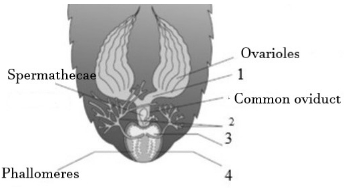
Refer the given figure of female reproductive system of cockroach and identify the correct labels (marked as $1,2,3$ and 4) which are collectively called genital pouch.
  • A
    $1\;and\;2$
  • B
    $1\;and\;3$
  • C
    $2\;and\;4$
  • $3\;and\;4$
Answer
Correct option: D.
$3\;and\;4$
d
Label $3$ and $4$ are respectively genital chamber and vestibulum which is collectively called genital pouch.
View full question & answer
MCQ 1481 Mark
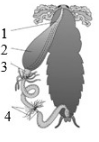
The figure given below shows the alimentary canal of cockroach with few structures labelled as $1,2,3$ and $4 .$ Identify the correct identification of the structure which is also called proventriculus and helps in grinding the food particles.
  • A
    $1$
  • B
    $2$
  • $3$
  • D
    $4$
Answer
Correct option: C.
$3$
c
In the given figure the marked label $1, 2,3$ and $4$ are oesophagus, crop, gizzard and malpighian tubules. Gizzard is a short muscular organ which is used for grinding food.
View full question & answer
MCQ 1491 Mark
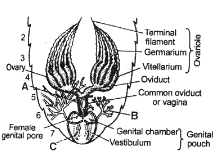
Figure given below shows reproductive system of female cockroach. The correct labellings indicated by alphabets $(A, B \& C)$ are respectively
  • $A$-Spermatheca, $B$-Collaterial glands, $C$-Gonapophyses
  • B
    $A$-Phallic gland, $B$-Collaterial glands, $C$-Gonapophyses
  • C
    $A$-Spermatheca, $B$-Seminal vesicle, $C$-Gonapophyses
  • D
    $A$-Spermatheca, $B$-Collateral glands, $C$-Tegmina
Answer
Correct option: A.
$A$-Spermatheca, $B$-Collaterial glands, $C$-Gonapophyses
a
$A$ - Spermatheca; $B$ - Collaterial gland; $C$ - Gonapophyses
View full question & answer
MCQ 1501 Mark
The given figure shows open circulatory system of cockroach. Identify the structure that facilitate the flow of haemolymph by its contraction and relaxation
  • A
    $A$
  • $B$
  • C
    $C$
  • D
    All of these
Answer
Correct option: B.
$B$
b
Alary muscles (structure marked as $B$ ) are located in pairs in the chambers of cockroach heart. They are $13$ pairs of wing shaped involuntary muscles which expand and contract to facilitate the flow of haemolymph through the heart.
View full question & answer
MCQ 1511 Mark
The given figure shows the digestive system of cockroach with few structures marked as $A , B , C$ and $D$.

Identify structures $A$ to $D$.

  • A
    $A$-Gizzard, $B$-Crop, $C$-Hepatic caecae, $D$-Malpighian tubules
  • $A$-Crop, $B$-Gizzard, $C$-Hepatic caecae, $D$-Malpighian tubules
  • C
    $A$- Crop, $B$-Gizzard,$C$-Malpighian tubules, $D$-Hepatic caecae
  • D
    $A$- Gizzard, $B$-Crop,$C$-Malpighian tubules, $D$-Hepatic caecae
Answer
Correct option: B.
$A$-Crop, $B$-Gizzard, $C$-Hepatic caecae, $D$-Malpighian tubules
b
$A$ - Crop; $B$ - Gizzard; $C$- Hepatic cecae; $D$ Malpighian tubule Crop is a sac-like structure which store food. The crop is followed by gizzard and proventriculus. The gizzard has an outer layer of thick circular muscles and thick inner cuticle; forming six highly chitinous plate called teeth. Food particles are ground in the gizzard. At the junction of foregut and midgut, a ring of $6-8$ blind tubules are present. These are called gastric or hepatic cecae and secrete digestive juice. Malpighian tubules are the excretory organs which absorb nitrogenous wastes and convert them into uric acid. Uric acid is excreted out through the hindgut.
View full question & answer
MCQ 1521 Mark
What external changes are visible after the last moult of a cockroach nymph?
  • A
    Development of anal cerci.
  • Development of both forewings and hind wings.
  • C
    Development labium.
  • D
    Mandibles become harder.
Answer
Correct option: B.
Development of both forewings and hind wings.
b
The development of cockroach is paurometabolous meaning that their development is through nymphal stage. The nymphs look very much like adults. The nymph grows by moulting about $13$ times to reach adult form. The last nymphal stage has wingpads while adult cockroaches have wings.
View full question & answer
MCQ 1531 Mark
If the head of cockroach is cut off, it will still be alive for as long as one week. This is because of
  • A
    the body which is covered with hard chitinous exoskeleton.
  • head which holds a bit of nervous system.
  • C
    head which is of no use.
  • D
    food capturing appratus which is found elsewhere.
Answer
Correct option: B.
head which holds a bit of nervous system.
b
If the head of cockroach is cut off, it will still alive for as long as one week, because the head holds a bit of a nervous system while the rest is situated along the ventral part of the body.
View full question & answer
MCQ 1541 Mark
The blood of cockroach contains no respiratory pigment. It means that
  • A
    cockroach does not respire.
  • B
    respiration is anaerobic.
  • C
    oxygen goes directly into tissues by diffusion via skin
  • oxygen reaches the tissues via haemocoel.
Answer
Correct option: D.
oxygen reaches the tissues via haemocoel.
d
Without respiration, no animal can survive. Cockroach is not as simple as Hydra where oxygen can diffuse directly into the cells. There is a system of tubes in cockroach, the tracheal system, with the help of which oxygen goes directly into the tissues through haemocoel by intracellular capillary system.
View full question & answer
MCQ 1551 Mark
Heart of cockroach is........
  • A
    Four chambered
  • Having ostia
  • C
    Open both side
  • D
    Absent
Answer
Correct option: B.
Having ostia
b
View full question & answer
MCQ 1561 Mark
What is false for the heart of cockroach?
  • A
    Lying along mid dorsal line of thorax and abdomen
  • B
    Anterior first part is opened and posterior last part is closed
  • C
    Funnel shaped chambers with ostia is present
  • Anterior aorta is divided and reached to every cell of body.
Answer
Correct option: D.
Anterior aorta is divided and reached to every cell of body.
d
View full question & answer
MCQ 1571 Mark
Structure made up of chitin in cockroach
  • A
    Mouthparts, tergites, Alimentary canal
  • B
    Anal carci, crop, testis .
  • Phallomere, tooth in gizzard, tergites
  • D
    Sternites, anal style, Malpighian tubes
Answer
Correct option: C.
Phallomere, tooth in gizzard, tergites
c
View full question & answer
MCQ 1581 Mark
It does not take part in excretion in cockroach
  • A
    Nephrocytes
  • Filliform antannae
  • C
    Urecose gland
  • D
    Fat body
Answer
Correct option: B.
Filliform antannae
b
View full question & answer
MCQ 1591 Mark
In cockroach, nephrocytes are concerned with
  • A
    Digestion
  • B
    Reproduction
  • C
    Transport of nerve impulse
  • Excretion
Answer
Correct option: D.
Excretion
d
View full question & answer
MCQ 1601 Mark
In cockroach, ootheca coveres...
  • A
    Sperms, in male
  • Fertilised eggs, in female
  • C
    Fertilised eggs, in male
  • D
    Spermatheca, in female
Answer
Correct option: B.
Fertilised eggs, in female
b
View full question & answer
MCQ 1611 Mark
Identify $X$ and $Y$
  • A
    $X$ - Hepatic caeca, $Y$ - lleum
  • B
    $X$ - Colon, $Y$ - Malpighian tubes
  • $X$ - Gizzard, $Y$ - Midgut
  • D
    $X$ - Hepatic caeca, $Y$ - Malpighian tube
Answer
Correct option: C.
$X$ - Gizzard, $Y$ - Midgut
c
View full question & answer
MCQ 1621 Mark
Identify $X$ the from the figure.
  • Chambers of heart
  • B
    Chambers of blood vessels
  • C
    Anterior aorta
  • D
    Muscles
Answer
Correct option: A.
Chambers of heart
a
View full question & answer
MCQ 1631 Mark
The nymph grow by mouthing about..... to reach the adult form
  • $13$ times
  • B
    $12$ times
  • C
    $10$ times
  • D
    $14$ times
Answer
Correct option: A.
$13$ times
a
View full question & answer
MCQ 1641 Mark
In female ......... and ....... sterna forms a genital pouch
  • A
    $7^{th}$ and $9^{th}$
  • $8^{th}$ and $9^{th}$
  • C
    $9^{th}$ and $10^{th}$
  • D
    $6^{th}$ and $7^{th}$
Answer
Correct option: B.
$8^{th}$ and $9^{th}$
b
View full question & answer
MCQ 1651 Mark
$A$-Antennae have sensory receptors

$R$-Sensory receptors help in monitoring the environment

  • $A$ and $R$ both correct
  • B
    $A$ and $R$ both incorrect
  • C
    $A$ is correct $R$ is not correct
  • D
    $A$ is not correct $R$ is correct
Answer
Correct option: A.
$A$ and $R$ both correct
a
View full question & answer
MCQ 1661 Mark
It is not part of digestive system of cockroach
  • A
    Midgut
  • B
    Rectum
  • C
    Gizzard
  • Felice gland
Answer
Correct option: D.
Felice gland
d
View full question & answer
MCQ 1671 Mark
What is not present in female cockroach ?
  • Caudal style
  • B
    Anal cercus
  • C
    Tarsus
  • D
    Mouth parts
Answer
Correct option: A.
Caudal style
a
View full question & answer
MCQ 1681 Mark
Body cavity of cockroach is also called
  • Blood cavity
  • B
    Genital chamber
  • C
    Heart chamber
  • D
    Cloaca
Answer
Correct option: A.
Blood cavity
a
View full question & answer
MCQ 1691 Mark
Which is correct for mosaic vision ?
  • More sensitivity and less resolution
  • B
    Less sensitivity and more resolution .
  • C
    More sensitivity and more resolution
  • D
    Less sensitivity and less resolution
Answer
Correct option: A.
More sensitivity and less resolution
a
View full question & answer
MCQ 1701 Mark
Match correct pair (cockroach).

 $\begin{array}{|p{0.3\linewidth}|l|} \hline Column-I   & Column-II  \\ \hline 1.\,\,Exoskeleton  & p.\;Thorax  \\ \hline 2.\,\,Three\,\,ganglion  & q.\;Chitin  \\ \hline 3.\,\,One\,\,pair\,\,of\,\,seminal\,\,vesicle & r.\;6^{th}-7^{th}\,\,segments\;\;of\;\;abdomen \\ \hline 4.\,\,Mushroom\,\,shaped  & s.\;6^{th}\,\,segments  \\ \hline \end{array}$

  • A
    $(1-p),(2-q),(3-r),(4-s) $
  • $(1-q),(2-p),(3-s),(4-r) $
  • C
    $(1-q), (2-s),(3-p),(4-r)$
  • D
    $(1-p),(2-r),(3-q),(4-s)$
Answer
Correct option: B.
$(1-q),(2-p),(3-s),(4-r) $
b
View full question & answer
MCQ 1711 Mark
Identify $X, Y$ and $Z$ given figure.

$X-Y-Z$

  • A
    Anal cercus - Caudal style - Small tubules
  • Small tubules - Vas deferens - Caudal style
  • C
    Vas deferens - phallic gland - Caudal style
  • D
    Caudal style - small tubules - phallic gland
Answer
Correct option: B.
Small tubules - Vas deferens - Caudal style
b
View full question & answer
MCQ 1721 Mark
Choose incorrect answer about characters shown in cockroach.
  • Blood vascular system - close.
  • B
    Respiratory system - network of trachea
  • C
    Head - triangular
  • D
    Eye - compound
Answer
Correct option: A.
Blood vascular system - close.
a
View full question & answer
MCQ 1731 Mark
....... is function of nephrocytes and urecose gland.
  • A
    Reproduction
  • B
    Digestion
  • Excretion
  • D
    None
Answer
Correct option: C.
Excretion
c
View full question & answer
MCQ 1741 Mark
What opens in ejaculatory duct of cockroach?
  • Vas deferens
  • B
    Oesophagus
  • C
    Salivary duct
  • D
    Oviduct
Answer
Correct option: A.
Vas deferens
a
View full question & answer
MCQ 1761 Mark
Location of hepatic caeca in cockroach.
  • A
    Junction of midgut and hindgut
  • Junction of foregut and midgut
  • C
    Junction of ileum and colon
  • D
    Junction of pharynx and oesophagus
Answer
Correct option: B.
Junction of foregut and midgut
b
View full question & answer
MCQ 1781 Mark
Body cavity also known as ........ in cockroach.
  • Haemocoel
  • B
    Ostia
  • C
    Ommitidium
  • D
    Ootheca
Answer
Correct option: A.
Haemocoel
a
View full question & answer
MCQ 1791 Mark
Function of Malpighian tubules.
  • A
    Conduction of nerve impulse
  • B
    Absorption of food
  • C
    Digestion of food
  • Excretion
Answer
Correct option: D.
Excretion
d
View full question & answer
MCQ 1801 Mark
This part is not associated with nerve ring.
  • A
    Supraoesophageal ganglion
  • B
    Suboesophageal ganglion
  • C
    Circum-oesophageal commisure
  • Abdominal ganglia
Answer
Correct option: D.
Abdominal ganglia
d
View full question & answer
MCQ 1811 Mark
Which accessory digestive gland found in cockroach?
  • A
    Liver
  • B
    Pancreas
  • Salivary gland
  • D
    All above
Answer
Correct option: C.
Salivary gland
c
View full question & answer
MCQ 1821 Mark
In cockroach, male genital open into.....
  • A
    Mid- ventral region of $8^{th}$ segment
  • Mid-ventral region of $9^{th} $ segment
  • C
    Mid-ventral region of $10^{th}$ segment
  • D
    Mid-ventral region of $7^{th}$ segment
Answer
Correct option: B.
Mid-ventral region of $9^{th} $ segment
b
View full question & answer
MCQ 1831 Mark
It is part of male cockroach
  • A
    Anterior aorta
  • B
    Mouth parts
  • C
    Vas deferens
  • All given
Answer
Correct option: D.
All given
d
View full question & answer
MCQ 1841 Mark
Which of the following have "ommatidia" as unit of eye
  • A
    Pheretima
  • House fly
  • C
    Pila
  • D
    Sepia
Answer
Correct option: B.
House fly
b
It's Obvious
View full question & answer
MCQ 1851 Mark
The unit of photoreception, in a compound eye of cockroach and other insects, is
  • A
    Ctenidium
  • B
    Osphradium
  • Ommatidium
  • D
    Rhabdome
Answer
Correct option: C.
Ommatidium
c
(c)Each eye of cockroach is a compound structure of about  $2000$ ommatidia which are the visual units of photoreception.
View full question & answer
MCQ 1861 Mark
Blood of Periplaneta does not carry oxygen because
  • ${O_2}$ is transported by respiratory tubules
  • B
    Its respiration is anaerobic
  • C
    There is no cells in its blood
  • D
    Periplaneta does not has any blood vessel
Answer
Correct option: A.
${O_2}$ is transported by respiratory tubules
a
(a) Blood of cockroach lacks respiratory pigment. Hence, ${O_2}$ is carried by the respiratory tubules.
View full question & answer
MCQ 1871 Mark
Which of the following is the correct statement about the circulatory system of cockroach
  • A
    It is closed type of circulatory system
  • B
    It is a complicated type of circulatory system
  • C
    It takes place without the participation of tissue
  • It has $13$ chambered heart and in each segment one pair of ostia are present
Answer
Correct option: D.
It has $13$ chambered heart and in each segment one pair of ostia are present
d
(d) The heart of cockroach is pulsatile and formed of $13$ inverted funnel-shaped segmental chamber, each chamber (except last one) has a pair of apertures called ostia which open into the pericardial sinus.
View full question & answer
MCQ 1881 Mark
Respiratory pigment in cockroach is
  • A
    Haemozoin
  • B
    Haemocyanin
  • C
    Haemoglobin
  • Absent
Answer
Correct option: D.
Absent
d
(d)Haemolymph is found in insect blood which is colourless.
View full question & answer
MCQ 1891 Mark
Which one does not occur in Cockroach leg
  • A
    Tibia
  • B
    Femur
  • Fibula
  • D
    Coxa
Answer
Correct option: C.
Fibula
c
(c)Leg of cockroach is five segmented, segments from base are-coxa, trochanter, femur, tibia and tarsus.
View full question & answer
MCQ 1901 Mark
Number of malpighian tubules present in Cockroach is
  • A
    $50-60$
  • B
    $80-90$
  • $100-150$
  • D
    $200-250$
Answer
Correct option: C.
$100-150$
c
(c)Malpighian tubules of cockroach are concerned with homeostasis, osmoregulation and excretion. These are between $60 $ to  $150$  in number and are arranged in $ 6 -8$  bundles.
View full question & answer
MCQ 1911 Mark
Which is characteristic of Cockroach
  • $13-$ chambered heart
  • B
    Reduced wings
  • C
    Cocoon formation
  • D
    Segmented body
Answer
Correct option: A.
$13-$ chambered heart
a
(a)The heart of cockroach is formed of  $ 13 $ chambers each chamber (except the last one) has a pair of small lateral apertures called ostia which open into the pericardial sinus.
View full question & answer
MCQ 1921 Mark
Which of the follwing statement(s) is/are correct?

$(i)$ Cockroaches are brown or black bodied animals that are included in class insecta of phylum arthropoda.

$(ii)$ Males bear a pair of short, thread like anal styles which are absent in females.

$(iii)$ Heart of cockroach consists of elongated muscular tube lying along mid dorsal line of thorax and abdomen.

$(iv)$ The nymph grows by moulting about $13$ times to reach the adult form.

  • A
    Only $(i)$
  • B
    Both$(ii)$ and $(iii)$
  • C
    Both $(i)$ and $(ii)$
  • All of the above
Answer
Correct option: D.
All of the above
d
View full question & answer
MCQ 1931 Mark
Which statement regarding anal cerci and anal style in cockroach is correct?
  • A
    Anal cerci are absent but anal styles are present in male.
  • B
    Anal cerci are absent and anal styles are present in female.
  • C
    Anal styles are absent and anal cerci are present in male.
  • Anal styles are absent and anal cerci are present in female.
Answer
Correct option: D.
Anal styles are absent and anal cerci are present in female.
d
In cockroaches, males bear a pair of short, thread like anal styles which are absent in females. In both sexes, the $10$th segment bears a pair of jointed filamentous structures called anal cerci.
View full question & answer
MCQ 1941 Mark
Male cockroach can be identified from the female by the presence of
  • A
    long antennae
  • B
    wingless body
  • C
    elongated abdomen
  • anal styles
Answer
Correct option: D.
anal styles
d
Both the sexes of cockroach have anal cerci which are jointed structures. But in the male, in addition, there is a paired unjointed needle-like anal style, which serve to distinguish between the male and the female.
View full question & answer
MCQ 1951 Mark
Cockroaches are brown or black bodied animals that are included in class of phylum
  • A
    reptilia; annelida
  • insecta; arthropoda
  • C
    insecta; annelida
  • D
    reptilia; arthropoda
Answer
Correct option: B.
insecta; arthropoda
b
Cockroaches are usually brown or black. Cockroaches belong to kingdom animalia, phylum arthropoda, class insecta and order Blattaria. Some species invade human dwellings and are considered pests. Others are beneficial to the environment as important recyclers of decayed organic material.
View full question & answer
MCQ 1961 Mark
The following figure shows the external features of cockroach with few structures labeled as $A, B, C, D$, and $E$.
  • A
    $A$- Mesothorax, $B$-Pronotum, $C$-Metathorax, $D$-Tegmina, $E$-Anal style
  • B
    $A$- Pronotum, $B$-Metathorax, $C$-Mesothorax, $D$-Tegmina, $E$-Sterna
  • $A$- Pronotum, $B$-Mesothorax, $C$-Metathorax, $D$-Tegmina, $E$-Anal cerci
  • D
    $A$- Pronotum, $B$-Mesothorax, $C$-Metathorax, $D$-Tegmina, $E$-Anal style
Answer
Correct option: C.
$A$- Pronotum, $B$-Mesothorax, $C$-Metathorax, $D$-Tegmina, $E$-Anal cerci
c
$A$ - Pronotum; $B$ - Mesothorax; $C$ - Metathorax; $D$ - Tegmina; $E$ - Anal cerci
View full question & answer
MCQ 1971 Mark
In cockroach head can move in all directions due to
  • A
    absence of neck.
  • B
    fusion of all $6$ segments of head.
  • flexible neck.
  • D
    head is small and light weight.
Answer
Correct option: C.
flexible neck.
c
The head is triangular in shape which lies anteriorly at right angles to the longitudinal body axis. The head is formed by the fusion of six segments. The flexible neck facilitates movement in all directions.
View full question & answer
MCQ 1981 Mark
Cockroach, is included in............ phylum.
  • A
    Hemichordata
  • B
    Chordata
  • C
    Mollusca
  • Arthropoda
Answer
Correct option: D.
Arthropoda
d
View full question & answer
MCQ 1991 Mark
In male and female cockroach abdominal made up of ................. segments.
  • A
    Male - $8$, female - $9$
  • Male -$10$, female -$10$
  • C
    Male - $10$, female -$7$
  • D
    Male -$9$, female - $8$
Answer
Correct option: B.
Male -$10$, female -$10$
b
View full question & answer
MCQ 2001 Mark
Head of cockroach is formed by the fusion of ...... segments
  • A
    $5$
  • $6$
  • C
    $4$
  • D
    $3$
Answer
Correct option: B.
$6$
b
View full question & answer
MCQ 2011 Mark
Structures which help in distinguishing male cockroaches from females are
  • A
    Anal cerci
  • Anal styles
  • C
    Longer antennae
  • D
    Functional wings
Answer
Correct option: B.
Anal styles
b
It’s obvious
View full question & answer
MCQ 2021 Mark
Blood of which of the following is colourless
  • A
    Earthworm
  • B
    Leach
  • Cockroch
  • D
    Frog
Answer
Correct option: C.
Cockroch
c
It’s obvious
View full question & answer
MCQ 2031 Mark
The diagram represents the reproductive organs of male cockroach. Choose the correct combination of labelling.
  • $a-8^{th}$ sternum, $ b-$ anal cercus,$ c-10th$ tergum $ d-$anal
  • B
    $a-10^{th}$ tergum, $ b- $anal cercus, $ c- $ anal style, $ d-8th$ sternum
  • C
    $a-$anal style,$ b-$ anal cercus, $c-10th$ tergum $d-8th $  sternum
  • D
    $a-8^{th}$ sternum, $ b-$ anal style, $c-10th$  tergum  $d-$ anal cercus
Answer
Correct option: A.
$a-8^{th}$ sternum, $ b-$ anal cercus,$ c-10th$ tergum $ d-$anal
a
It’s obvious
View full question & answer
MCQ 2041 Mark
Which part of Cockroach has both exoskeleton and endoskeleton
  • Head
  • B
    Thorax
  • C
    Abdomen
  • D
    All the above
Answer
Correct option: A.
Head
a
It’s obvious
View full question & answer
MCQ 2051 Mark
In Cockroach, the number of ganglia are
  • A
    Two pairs thoracic and four pairs abdominal
  • Three pairs thoracic and six pairs abdominal
  • C
    Three pairs thoracic and five pairs abdominal
  • D
    Two pairs thoracic and six pairs abdominal
Answer
Correct option: B.
Three pairs thoracic and six pairs abdominal
b
(b)The total number of ganglia in ventral nerve cord of cockroach is nine pairs, i.e. three pairs thoracic and six pairs adbominal.
View full question & answer
MCQ 2061 Mark
Periplaneta shows
  • A
    Complete metamorphosis
  • B
    Incomplete metamorphosis
  • C
    No metamorphosis
  • Gradual metamorphosis
Answer
Correct option: D.
Gradual metamorphosis
d
(d)Metamorphosis in cockroach is incomplete or paurometamolous type. Incomplete metamorphosis is also called gradual metamorphosis.
View full question & answer
MCQ 2071 Mark
Spiracles found in cockroach are
  • A
    $2$  pairs in thorax and  $ 10$  pairs in abdomen
  • B
    $2 $ pairs in thorax and   $6 $ pairs in abdomen
  • $2$  pairs in thorax and  $8$  pairs in abdomen
  • D
    $2$  pairs in thorax and  $4$  pairs in abdomen Cephalothorax is found in the
Answer
Correct option: C.
$2$  pairs in thorax and  $8$  pairs in abdomen
c
(c)In phylum Arthropoda, Book lung is respiratory organ of class Arachnida.
View full question & answer
MCQ 2081 Mark
The functional junction between the axon of one neuron and the dendrite of the next is called
  • A
    Desmosome
  • Synapse
  • C
    Oblique bridge
  • D
    Tight junction
Answer
Correct option: B.
Synapse
b
Synapse is an area of specialised junction between two neurons for transmission of impulse. Synapse between axon terminal of one and dendron terminal of another mode of neurotransmission across a synapse is chemical or electric.
View full question & answer
MCQ 2091 Mark
... exerts the greatest control over the body is responsiveness to changing conditions.
  • A
    Connective tissue
  • Neural tissue
  • C
    Bone
  • D
    Cartilage
Answer
Correct option: B.
Neural tissue
b
View full question & answer
MCQ 2101 Mark
$A$ : Smooth muscle fibres are unstriated, fusiform and uninucleate.

$R$ : These cells are involuntary in function.

  • A
    Assertion and Reason both are correct and also correct explanation.
  • Assertion and Reason both are correct but not explanation of assertion.
  • C
    Assertion is correct, but Reason is incorrect.
  • D
    Both Assertion and Reason are incorrect.
Answer
Correct option: B.
Assertion and Reason both are correct but not explanation of assertion.
b
Assertion is true as smooth muscles are non-striated, and are fusiform (elongated and spindle shaped, pointed or tapered at ends and broad in middle). Smooth muscles have centrally located single oval nucleus.
Reason is true as smooth muscles are involuntary in their activity, $i.e.$ their functioning cannot be directly controlled.
Assertion and Reason is true but Reason is not correct explanation for assertion.
View full question & answer
MCQ 2111 Mark
Contractile proteins are found in
  • A
    Bone
  • B
    Blood
  • C
    Cartilage
  • Muscles
Answer
Correct option: D.
Muscles
d
Muscles have contractile nature. The contractile structure of muscle cells are called myofibrils. Myofibrils are made of myofilaments. Myofilaments are of two types, myosin and actin. Contraction occurs due to sliding of actin filaments on myosin filaments.
View full question & answer
MCQ 2121 Mark
Cardiac muscle fibres are
  • Striated and involuntary
  • B
    Striated and voluntary
  • C
    Non-striated and involuntary
  • D
    Non-striated and voluntary
Answer
Correct option: A.
Striated and involuntary
a
Cardiac myofibrils have transverse faint dark and light bands, which alternate with each other. Cardiac muscles are involuntary muscles.
View full question & answer
MCQ 2131 Mark
Intercalated discs are present in
  • A
    Striated muscles
  • B
    Unstriated muscles
  • Cardiac muscles
  • D
    Neurons
Answer
Correct option: C.
Cardiac muscles
c
Intercalated discs are unique and distinguishing feature of cardiac muscle. They are dark, irregular zig-zag partitions between adjacent cardiac muscle cells. They have both transverse and lateral portions. Intercalated disc provide firm adhesions between adjacent cells, electrical coupling for spread of excitation as well as contraction.
View full question & answer
MCQ 2141 Mark
Which of the following muscles act involuntarily?
$(a)$ Striated muscles $(b)$ Smooth muscles
$(c)$ Cardiac muscles $(d)$ Skeletal muscles
  • A
    $(a) \;and\; (b)$
  • $(b) \;and\; (c)$
  • C
    $(c) \;and\; (d)$
  • D
    $(a) \;and\; (d)$
Answer
Correct option: B.
$(b) \;and\; (c)$
b
Skeletal muscle (striated or striped muscle) -Voluntary muscle, $e.g.$ movement of arms, legs etc.
Smooth muscle (unstriped or non-striated muscle) -Involuntary muscle $e.g.$ posterior part of oesophagus, stomach, intestine, blood vessels
Cardiac muscle -Involuntary muscle $e.g.$ cardiac muscle in wall of heart.
View full question & answer
MCQ 2151 Mark
Read the following statements.

$(i)$ It is a contractile tissue present only in the heart.

$(ii)$ Cell junctions fuse the plasma membranes of these cells and make them stick together.

$(iii)$ Communication juntions at some fusion points allow the cells to contract as a unit, i.e., when one cell receives a signal to contract, its neighbours are also stimulated to contract.

Which of the following type of tissue is being described by the above statements?

  • A
    Skeletal muscle
  • Cardiac muscle
  • C
    Smooth muscle
  • D
    Cartilage
Answer
Correct option: B.
Cardiac muscle
b
View full question & answer
MCQ 2161 Mark
Which of the following type of muscle tissue is being described on the basis of given statements?

$(i)$ These muscle fibres taper at both ends and do not show striations.

$(ii)$ The wall of internal organs such as the blood vessels, stomach and intestine contain this type of muscle tissue.

$(iii)$ They are 'involuntary' as their function cannot be directly controlled.

  • A
    Skeletal muscle
  • Smooth muscle
  • C
    Cardiac muscle
  • D
    All of these
Answer
Correct option: B.
Smooth muscle
b
The smooth muscle fibres are involuntary, taper at both ends and do not show striation. The wall of internal organs such as the blood vessels, stomach and intestine contains this type of muscle tissue.
View full question & answer
MCQ 2171 Mark
Smooth muscles are_
  • A
    voluntary, branched,uninucleate
  • B
    voluntary, multinucleate, cylindrical
  • C
    involuntary, cylindrical, multinucleate
  • involuntary, spindle shaped, uninucleated, tapering
Answer
Correct option: D.
involuntary, spindle shaped, uninucleated, tapering
d
Smooth muscle is an involuntary, spindle shaped, uninucleated, tapering and non-striated muscle. Smooth muscle is responsible for the contractility of hollow organs, such as blood vessels, the gastrointestinal tract, the bladder, or the uterus. Its structure differs greatly from that of skeletal muscle, although it can develop isometric force per crosssectional area which is equal to that of skeletal muscle.
View full question & answer
MCQ 2181 Mark
Intercalated discs are the communication junctions between the cells of
  • cardiac muscles
  • B
    striped muscles
  • C
    adipose tissue
  • D
    nerve and striated muscles
Answer
Correct option: A.
cardiac muscles
a
Cardiac muscles are involuntary, cross striated & non-fatigued fibres. Cell junctions fuse the plasma membranes of cardiac muscle cells and make them stick together. Communication junctions (intercalated discs) at some fusion points allow the cells to contract as a unit, i.e., when one cell receives a signal to contract, its neighbouring cells are also stimulated to contract.
View full question & answer
MCQ 2191 Mark
The fibres of which of the following muscles are fusiform and do not show striations
  • A
    Skeletal muscles
  • B
    Cardiac muscles
  • C
    Both $( a )$ and $( b )$
  • Smooth muscles
Answer
Correct option: D.
Smooth muscles
d
Cells of smooth muscle tissue are spindle shaped and pointed at their ends. Striations are absent due to different arrangement of actin and myosin filaments. Smooth muscle is the earliest form of muscle to evolve.
View full question & answer
MCQ 2201 Mark
The following figures $A, B$ and $C$ are types of muscle tissue. Identify $A, B$ and $C$.
  • A
    $A$ - Smooth muscle, $B$ - Cardiac muscle, $C$ - Skeletal muscle
  • $A$ - Skeletal muscle, $B$ - Smooth muscle, $C$ - Cardiac muscle
  • C
    $A$ - Cardiac muscle, $B-$ Smooth muscle, $C$ - Skeletal muscle
  • D
    $A$ - Smooth muscle, $B$ - Skeletal muscle, $C$ - Cardiac muscle
Answer
Correct option: B.
$A$ - Skeletal muscle, $B$ - Smooth muscle, $C$ - Cardiac muscle
b
The given figures $A$, $B$ and $C$ are skeletal muscle, smooth muscle and cardiac muscle respectively. Skeletal muscle fibres occur in muscles which are attached to the skeleton. They are striated in appearance and are under voluntary control. Smooth muscle fibres are located in walls of hollow visceral organs, except the heart, appear spindle-shaped, and are also under involuntary control. Cardiac muscle cells are located in the walls of the heart, appear striated, and are under involuntary control.
View full question & answer
MCQ 2211 Mark
Select correct pair.
  • A
    Skeletal muscle - fiber taper at both ends
  • B
    Smooth muscle - Closely attached to skeletal
  • Cardiac muscle - present only in the heart
  • D
    Neural tissue - help in movement.
Answer
Correct option: C.
Cardiac muscle - present only in the heart
c
View full question & answer
MCQ 2221 Mark
It is not characteristic of cardiac muscles.
  • A
    Intercalated disc
  • B
    Light-dark band
  • C
    Contract as a unit
  • Multinucleated cell
Answer
Correct option: D.
Multinucleated cell
d
View full question & answer
MCQ 2231 Mark
Their action moves the body to adjust to the changes in the environment and to maintain the positions of the various part's of the body.
  • Muscle tissue
  • B
    Squamous epithelium
  • C
    Connective tissue
  • D
    Adipose tissue
Answer
Correct option: A.
Muscle tissue
a
View full question & answer
MCQ 2241 Mark
...... fibers taper at both ends and do not showstriations.
  • Smooth muscle
  • B
    Cardiac muscle
  • C
    Skeletal muscle
  • D
    None of them
Answer
Correct option: A.
Smooth muscle
a
View full question & answer
MCQ 2251 Mark
Cardiac muscle is composed of
  • A
    Striated, branched and voluntary muscle fibres
  • B
    Unstriated (smooth), spindle shaped and voluntary muscle fibres
  • C
    Unstriated (smooth), spindle shaped and involuntary muscle fibres
  • Striated, branched and involuntary muscle fibres
Answer
Correct option: D.
Striated, branched and involuntary muscle fibres
d
It’s obvious.

View full question & answer
MCQ 2261 Mark
In metazoa one of the following is responsible for locomotion and movement of organs
  • A
    Nervous tissues
  • B
    Epithelial tissues
  • C
    Connective tissues
  • Muscular tissues
Answer
Correct option: D.
Muscular tissues
d
It's Obvious
View full question & answer
MCQ 2271 Mark
Muscular tissue is differentiated into
  • A
    Unstriped, striped
  • B
    Striped, cardiac
  • C
    Cardiac muscle, unstriped
  • Unstriped, striated and cardiac
Answer
Correct option: D.
Unstriped, striated and cardiac
d
It's Obvious
View full question & answer
MCQ 2281 Mark
Which set clearly identify striated muscles
  • Cylindrical, syncytial and unbranched
  • B
    Spindle, unbranched and uninucleated
  • C
    Cylindrical, striped and nucleated
  • D
    Cylindrical, striped and branched
Answer
Correct option: A.
Cylindrical, syncytial and unbranched
a
Striated muscles are skeletal muscles, which are striated in appearance under the microscope. Cells are cylindrical, unbranched and are multinucleate syncytia. These muscles are capable of voluntary, quick, forceful contractions.
View full question & answer
MCQ 2291 Mark
Unstriated muscles are found in
  • A
    Veins
  • B
    Arteries
  • C
    Uterus
  • All the above
Answer
Correct option: D.
All the above
d
It's Obvious
View full question & answer
MCQ 2301 Mark
Striped and branched muscle are found in
  • A
    Iris
  • Heart
  • C
    Leg
  • D
    Brain
Answer
Correct option: B.
Heart
b
(b) Cardiac muscle forms wall of the heart. Cardiac muscle are striped muscles with fibres being nucleated branched and involuntary.
View full question & answer
MCQ 2311 Mark
Involuntary muscles are
  • A
    Under the control of will
  • B
    Not under the control of will
  • C
    Controlled by autonomic nervous system
  • Both $(b)$ and $(c)$
Answer
Correct option: D.
Both $(b)$ and $(c)$
d
It's Obvious
View full question & answer
MCQ 2321 Mark
Striated and voluntary muscle fibres are found in
  • A
    Lungs
  • Leg muscles
  • C
    Gall bladder
  • D
    Blood vessels
Answer
Correct option: B.
Leg muscles
b
(b) Because skeletal muscles are striated and voluntary.
View full question & answer
MCQ 2331 Mark
The muscles immune to fatigue are
  • A
    Striped
  • B
    Unstriped
  • Cardiac
  • D
    None of these
Answer
Correct option: C.
Cardiac
c
(c) Due to long refractory period.
View full question & answer
MCQ 2341 Mark
The most abundant tissue in the body is
  • A
    Nervous
  • Muscular
  • C
    Vascular
  • D
    Epithelial
Answer
Correct option: B.
Muscular
b
(b) Because there are about $639$ muscles which constitutes the bulk of body, $40\%$ of total weight and $50\%$ of soft parts.
View full question & answer
MCQ 2351 Mark
Smooth muscle fibres are
  • A
    Cylindrical, unbranched, striated, multinucleate and voluntary
  • Spindle-shaped, unbranched, non-striated, uninucleate and involuntary
  • C
    Cylindrical, unbranched, non-striated, multinucleate and involuntary
  • D
    Spindle-shaped, unbranched, striated, uninucleate and voluntary
Answer
Correct option: B.
Spindle-shaped, unbranched, non-striated, uninucleate and involuntary
b
It's Obvious
View full question & answer
MCQ 2361 Mark
Autorhythmicity is a special property of the muscles of the
  • A
    Liver
  • B
    Intestine
  • Heart
  • D
    Kidney
Answer
Correct option: C.
Heart
c
(c) Cardiac muscles can contract without the stimulation of nerves and they contract rythmically.
View full question & answer
MCQ 2371 Mark
Striped muscles have
  • A
    One nucleus
  • Many nuclei
  • C
    Two nuclei
  • D
    No nuclei
Answer
Correct option: B.
Many nuclei
b
(b) A striped muscle fibre has many nuclei and it is a syncytium $(coenocyte).$
View full question & answer
MCQ 2381 Mark
The single unit smooth muscles are
  • A
    Neurogenic
  • Myogenic
  • C
    Cardiogenic
  • D
    None of these
Answer
Correct option: B.
Myogenic
b
It's Obvious
View full question & answer
MCQ 2391 Mark
Unstriped smooth muscles are found in
  • A
    Thigh
  • B
    Eye muscles
  • Iris
  • D
    Tongue
Answer
Correct option: C.
Iris
c
It's Obvious
View full question & answer
MCQ 2401 Mark
Cardiac muscles are having characters of
  • A
    Striped muscle
  • B
    Unstriped muscle
  • Both $(a)$ and $(b)$
  • D
    None of these
Answer
Correct option: C.
Both $(a)$ and $(b)$
c
(c) Cardiac muscles have a mixture of properties of both striated and unstriated muscles. These muscles continue rhythimc contraction throughout life under the control of $ANS$

Cardiac muscles have the property of both the striated muscles (or skeletal muscle) and unstriated muscle or smooth muscle.

Like skeletal muscle, cardiac muscle cross striations formed by rotating segments of thick and thin protein filaments and the primary structural proteins of cardiac muscle are myosin and actin.

Cardiac muscle is involuntary, which is the property of smooth muscle.

View full question & answer
MCQ 2411 Mark
Unstriped muscles are found in
  • A
    Neck
  • Urinary bladder
  • C
    Arms
  • D
    Fingers
Answer
Correct option: B.
Urinary bladder
b
(b) Unstriped muscles are the most widely distributed muscles in the body,

$e.g.$, Gastrointestinal tract, uterus, Urinary bladder, iris, ciliary body, blood vesseles etc.

View full question & answer
MCQ 2421 Mark
Smooth muscles are not
  • A
    Spindle shaped
  • B
    Under control of autonomic nervous system
  • C
    Very simple in structure
  • Multinucleated
Answer
Correct option: D.
Multinucleated
d
(d) Smooth muscle fibre is spindle-shaped, thick in the middle and thin at either ends uninucleated and has no sarcolemma.

Contraction is slow, involuntary under the control of $ANS.$

View full question & answer
MCQ 2431 Mark
Tendons connects
  • Muscle to bone
  • B
    Bone to vertebral column
  • C
    Bone to bone
  • D
    Bone to cartilage
Answer
Correct option: A.
Muscle to bone
a
Tendons : Connects muscles to bones.
Ligament : Connects bone to bone.
View full question & answer
MCQ 2441 Mark
Ligament connects
  • Bone to bone
  • B
    Bone to muscle
  • C
    Muscle to muscle
  • D
    Both $(b)$ and $(c)$
Answer
Correct option: A.
Bone to bone
a
Ligament has a high proportion of elastic fibres and white collagen fibres. This connects bone to bone.
View full question & answer
MCQ 2451 Mark
Muscle is attached to bone by
  • Tendon
  • B
    Ligament
  • C
    Insertion
  • D
    Cartilage
Answer
Correct option: A.
Tendon
a
Tendons are the white fibrous connective tissue, which joins muscles to bones.
View full question & answer
MCQ 2461 Mark
Both $RBCs$ and $WBCs$ are formed in
  • A
    Cartilage
  • B
    Thyroid
  • Bone marrow
  • D
    Plasma
Answer
Correct option: C.
Bone marrow
c
In long bones, cavity called bone marrow cavity is present. This cavity is filled with soft and semi solid fatty tissue termed as bone marrow. The bone marrow in some bones is site of production of blood cells (such as $RBCs$, $WBCs$, Platelets etc).
View full question & answer
MCQ 2471 Mark
The connective tissue which acts as an insulator and prevent loss of heat from the body is
  • A
    Areolar
  • Adipose
  • C
    Blood
  • D
    Cartilage
Answer
Correct option: B.
Adipose
b
Adipose tissue is specialised loose connective tissue which possesses abundant fat storing cells/adipocytes. Adipose tissue act as fat reservoir and act as an insulator. Being poor conductor of heat, it reduces heat loss from body.
View full question & answer
MCQ 2481 Mark
The most widely distributed connective tissue in the body of animals is
  • Areolar
  • B
    Adipose
  • C
    Cartilage
  • D
    Dense irregular
Answer
Correct option: A.
Areolar
a
Areolar tissue is most widely distributed connective tissue in animal body. Areolar tissue serves as support framework for epithelium. It is present beneath the skin.
Areolar tissue joins skin to muscles, fills space inside organs.
View full question & answer
MCQ 2491 Mark
Dense irregular connective tissue is found in
  • Skin
  • B
    Tendon
  • C
    Ligament
  • D
    All of these
Answer
Correct option: A.
Skin
a
Dense irregular connective tissue has fibroblast and many fibres (mostly collagen) and are oriented differently. This tissue is present in skin.
View full question & answer
MCQ 2501 Mark
Read the following statements and answer the question.

$(i)$ They have a hard and non-pliable ground substance rich in calcium salts and collagen fibres.

$(ii)$ They support and protect softer tissues and organs.

$(iii)$ Osteocytes are present in the spaces called lacunae.

$(iv)$ They also interact with skeletal muscles attached to them to bring about movements.

Which of the following type of tissue is being described by above statements

  • A
    Cartilage
  • Bone
  • C
    Blood
  • D
    Neurons
Answer
Correct option: B.
Bone
b
All the given statements are associated with bone. Bone is a rigid body tissue consisting of cells embedded in an abundant, hard intercellular material. This material consists of two important components - collagen and calcium phosphate. It forms the major portion of the human skeleton. Bone support and protect the various organs of the body, produce red and white blood cells, store minerals and also enable mobility.
View full question & answer
MCQ 2511 Mark
Which of the following statement (s) is/are correct?

($i$) Loose connective tissue contains fibroblasts, macrophages and mast cells.

($ii$) Adipose tissue is a type of dense connective tissue located mainly beneath the skin.

($iii$) Tendons and ligaments are examples of dense connective tissue.

($iv$) Cartilage $\&$ bones are types of specialized hard connective tissue.

  • A
    Only ($i$)
  • B
    Both ($ii$) and ($iv$)
  • C
    Both ($i$) and ($iii$)
  • ($i$), ($iii$) and ($iv$)
Answer
Correct option: D.
($i$), ($iii$) and ($iv$)
d
Adipose tissue is a type of loose connective tissue located mainly beneath the skin.
View full question & answer
MCQ 2521 Mark
Which of the following type of tissue is being described by the given statements?

$(i)$ They are named because of their special function of linking and supporting other tissues/organs of the body.

$(ii)$ They include cartilage, bone, adipose and blood.

$(iii)$ They provide strength, elasticity and flexibility to the tissue.

$(iv)$ They also secrete modified polysaccharides, which accumulate between cells and fibres and act as matrix.

  • A
    Epithelial tissue
  • Connective tissue
  • C
    Muscle tissue
  • D
    Neural tissue
Answer
Correct option: B.
Connective tissue
b
Connective tissue is a group of tissues in the body that maintains the form of the body and its organs and provides cohesion and internal support. The connective tissues include several types of fibrous tissue that vary only in their density and cellularity, as well as the more specialized and recognizable variants-bone, ligaments, tendons, cartilage, and adipose (fat) tissue.
View full question & answer
MCQ 2531 Mark
Find the incorrectly matched pair.
  • A
    Unicellular glandular cells - Goblet cell
  • B
    Saliva - Exocrine secretion
  • C
    Fusiform fibres -Smooth muscle
  • Cartilage - Areolar tissue
Answer
Correct option: D.
Cartilage - Areolar tissue
d
Cartilage is a soft skeletal tissue (a specialized connective tissue) which forms the endoskeleton of the vertebrates. It is a vascular and nutrient are

diffused through the matrix.

View full question & answer
MCQ 2541 Mark
In all connective tissues, except which of the following, the cells secrete fibres of collagen or elastin protein?
  • A
    Bone
  • B
    Cartilage
  • C
    Areolar connective tissue
  • Fluid connective tissu
Answer
Correct option: D.
Fluid connective tissu
d
In all connective tissue except blood (a fluid connective tissue), the cells secrete fibres of structural proteins called collagen or elastin.
View full question & answer
MCQ 2551 Mark
The chondrocytes of connective tissue are
  • A
    fibre secreting cells
  • B
    bone forming cells
  • cartilage cells
  • D
    bone eating cells
Answer
Correct option: C.
cartilage cells
c
Chondrocytes are the only cells found in cartilage. They produce and maintain the cartilaginous matrix, which consists mainly of collagen and proteoglycans. The chondrocytes lie between the muscle dfibres. It is found in the epiglottis (part of the larynx) and the pinnae (the external ear flaps of many mammals including humans).
View full question & answer
MCQ 2561 Mark
The type of cell seen in a tendon is
  • A
    muscle fibres
  • B
    fibroblasts
  • C
    collagenous cells
  • both $b$ and $c$
Answer
Correct option: D.
both $b$ and $c$
d
A tendon is a fibrous connective tissue which attaches skeletal muscle to bone. Tendons may also attach muscles to structures such as eyeball. A tendon help in the movement of bone or structure.
View full question & answer
MCQ 2571 Mark
Mast cells are associated with
  • A
    exocrine glands
  • B
    endocrine glands
  • areolar connective tissue
  • D
    neural tissue
Answer
Correct option: C.
areolar connective tissue
c
Mast cell are a cell found in connective tissue that contains numerous basophilic granules and release substances such

as heparin and histamine in response to injury or inflammation of tissues.

View full question & answer
MCQ 2581 Mark
Refer the given figure and identify the correct characteristic feature.

$(i)$ It is a type of loose connective tissue.

$(ii)$ It contains fibroblast, macrophages, collagen fibres and mast cells.

$(iii)$ The cells of this tissue are specialized to store fats.

$(iv)$ It forms the inner lining of blood vessels, stomach and intestine.

  • $(i) \;and\; (ii)$
  • B
    $(i) \;and\;(iii)$
  • C
    $(ii)\;and\;(iii)$
  • D
    $(iii)\;and\;(iv)$
Answer
Correct option: A.
$(i) \;and\; (ii)$
a
The given figure shows the image of areolar tissue, a type of loose connective tissue. Loose connective tissue.It is the most common type of connective tissue in vertebrates.It contains fibroblast, macrophages, collagen fibres and mast cells.

Adipose tissue is a specialised connective tissue proper for storage of fats.

Epithelial tissue form the inner lining of blood vessels and other visceral organs whereas Loose Areoral connective tissue holds organs in place and attaches epithelial tissue to other underlying tissues.

View full question & answer
MCQ 2591 Mark
The intercellular material of the given figure is solid and resists compression. Identify the figure and the label marked as $A \& B$.
  • Cartilage Collagen Chondrocyte
  • B
    Cartilage Collagen Chondroclast
  • C
    Bone Microtubule Chondroclast
  • D
    Bone Collagen fibres Osteoblast
Answer
Correct option: A.
Cartilage Collagen Chondrocyte
a
The given figure represents the image of cartilage. Cartilage is an important structural component of the body. It is a firm tissue but is softer and much more flexible than bone. It is a connective tissue found in joints between bones e.g. the elbows, knees and ankles; ends of the ribs; between the vertebrae in the spine; ears and nose; bronchial tubes or airways. Cartilage is made up of specialized cells called chondrocytes ($B$). These chondrocytes produce large amounts of extracellular matrix composed of collagen ($A$) fibres, proteoglycan, and elastin fibres. There are no blood vessels in cartilage to supply the chondrocytes with nutrients.
View full question & answer
MCQ 2601 Mark
Identify figures-$I$ and $II$.
  • Dense regular Dense irregular connective tissue, connective tissue
  • B
    Loose irregular Loose regular connective tissue, connective tissue
  • C
    Adipose tissue, Specialized connective tissue
  • D
    Connective tissue Areolar tissue proper
Answer
Correct option: A.
Dense regular Dense irregular connective tissue, connective tissue
a
The figure $I \& II$ represent dense regular and dense irregular connective tissue respectively. In the dense regular connective tissues, the collagen fibres are present in rows between many parallel bundles of fibres. Tendons and ligaments are example of this tissue. Dense irregular connective tissue has fibroblasts and many fibres (mostly collagen) that are oriented differently. This tissue is present in the skin.
View full question & answer
MCQ 2611 Mark
In the given diagram of areolar connective tissue, the different cells and parts have been marked by alphabets $(A, B , C \& D ) .$ Choose the answer in which these alphabets correctly match with the parts and cells they indicate.

Matrix

  • A
    $A$-Adipocyte, $B$-Collagen fibres, $C$-Microfilament, $D$-Mast cells
  • B
    $A$-Macrophage, $B$-Collagen fibres, $C$-Microfilament, $D$-Mast cells
  • C
    $A$-Macrophage, $B$-Collagen fibres, $C$-Microtubule, $D$-RBC
  • $A$-Macrophage, $B$-Fibroblast, $C$-Collagen fibres, $D$-Mast cells
Answer
Correct option: D.
$A$-Macrophage, $B$-Fibroblast, $C$-Collagen fibres, $D$-Mast cells
d
The given figure represents loose connective tissue (areolar tissue). Loose connective tissue has cells and fibres loosely arranged in a semi-fluid ground substances, for example, areolar tissue present beneath the skin. Often it serves as a support framework for epithelium. It contains fibroblasts (cells that produce and secrete fibres), macrophages and mast cells.
View full question & answer
MCQ 2621 Mark
What are the three basic components of connective tissues?
  • A
    Ground substance, cells and basement membrane
  • B
    Cartilage, intercellular matrix and serum
  • Cells, protein fibers and ground substance
  • D
    Collagen, elastin and reticular fibers
Answer
Correct option: C.
Cells, protein fibers and ground substance
c
Connective tissue fills the spaces between organs and tissues, and provides structural and metabolic support for other tissues and organs. The three basic components of connective tissue are cells, protein fibres and ground matrix.
View full question & answer
MCQ 2631 Mark
Which of the following is involved in the production of new blood cells?
  • A
    Adipose cell
  • Bone marrow
  • C
    Liver
  • D
    Matrix
Answer
Correct option: B.
Bone marrow
b
Bone marrow is the flexible tissue in the interior of bones. In humans, red blood cells are produced by cores of bone marrow in the heads of long bones in a process known as haematopoiesis. Bone marrow is also a key component of the Iymphatic system, producing the lymphocytes that support the body's immune system.
View full question & answer
MCQ 2641 Mark
Which of the following vertebrate tissues would be an excellent source of collagen?
  • A
    Liver
  • B
    Nerve
  • C
    Muscle
  • Tendon
Answer
Correct option: D.
Tendon
d
Collagen is the most abundant protein in the human body. In the dense regular connective tissues, the collagen fibres are present in rows between many parallel bundles of fibres. Tendons, which attach skeletal muscles to bones are example of this tissue.
View full question & answer
MCQ 2651 Mark
When cardiac muscle cells are damaged by a heart attack, they are usually replaced by
  • connective tissue cells
  • B
    new smooth muscle cells
  • C
    new cardiac muscle cells
  • D
    epithelial cells
Answer
Correct option: A.
connective tissue cells
a
Cardiac muscle cells or cardiac myocytes are the muscle cells (myocytes) that make up the cardiac muscle. When these cells are damaged by a heart attack, they are usually replaced by connective muscle cells.
View full question & answer
MCQ 2661 Mark
Cartilage tissues are likely to be slow in healing following an injury because
  • A
    cartilage cells cannot reproduce.
  • they lack direct blood supplies.
  • C
    the intercellular material is missing.
  • D
    cartilage cells are surrounded by fluids.
Answer
Correct option: B.
they lack direct blood supplies.
b
Due to the lack of blood vessels, cartilage grows and repairs more slowly than other tissues.
View full question & answer
MCQ 2671 Mark
Match the following columns.

$\begin{array}{|l|l|} \hline Column\;-\;I & Column\;-\;II  \\ \hline A.\;Areolar\;tissue & 1.\;Fat\;cells  \\ \hline B.\;Adipose\;tissue & 2.\;Osteocytes  \\ \hline C.\;Ligament & 3.\;Loose\;connective\;tissue \\ \hline D.\;Bone  & 4.\;Dense\;regular\;connective\;tissue \\ \hline \end{array}$

  • $A-3, B-1, C-4, D-2 $
  • B
    $A-1, B-2, C-3, D-4 $
  • C
    $A-4, B-3, C-2, D-1$
  • D
    $A-2, B-1, C-4, D-3 $
Answer
Correct option: A.
$A-3, B-1, C-4, D-2 $
a
View full question & answer
MCQ 2681 Mark
Identify the given $X, Y$ and $Z$ from the following figure:

$X-Y-Z$

  • Macrophage - Mast cell - Fibroblast
  • B
    Fibroblast - Collagen fibre - Mast cells
  • C
    Collagen fibre - Fibroblast - Macrophage
  • D
    Mast cells - Collagen fibre - Macrophage
Answer
Correct option: A.
Macrophage - Mast cell - Fibroblast
a
View full question & answer
MCQ 2691 Mark
$A$- Adipose tissue is connective tissue

$R$- It serve as a support frame work for epithelium

  • A
    $A$ and $R$ both correct
  • B
    $A$ and $R$ both incorrect
  • $A$ correct and $R$ incorrect
  • D
    $A$ incorrect and $R$ correct
Answer
Correct option: C.
$A$ correct and $R$ incorrect
c
View full question & answer
MCQ 2701 Mark
Identify figure.
  • Dense regular connective tissue
  • B
    Cartilage
  • C
    Bone
  • D
    Dense irregular connective tissue
Answer
Correct option: A.
Dense regular connective tissue
a
View full question & answer
MCQ 2711 Mark
It is not a function of bone.
  • A
    Provides structural frame body
  • B
    Support and protect softer organs tissue
  • To remove particles mucus in a specific direction
  • D
    Site of production of blood cells
Answer
Correct option: C.
To remove particles mucus in a specific direction
c
View full question & answer
MCQ 2721 Mark
Main function of fibroblasts.
  • Produce and fibroblasts
  • B
    Produce blood cells.
  • C
    Produce condroblasts.
  • D
    Transmission of mucus.
Answer
Correct option: A.
Produce and fibroblasts
a
View full question & answer
MCQ 2731 Mark
Identify given figure.
  • A
    Areolar
  • Adipose tissue
  • C
    Dense regular
  • D
    Dense irregular
Answer
Correct option: B.
Adipose tissue
b
View full question & answer
MCQ 2741 Mark
The major constituent of connective tissue is
  • A
    Vitamin
  • B
    carbohydrate
  • C
    Lipid
  • collagen
Answer
Correct option: D.
collagen
d
View full question & answer
MCQ 2751 Mark
Location of cartilage.
  • A
    Limbs and hands in adult
  • B
    Outer ear joints
  • C
    Tip of nose
  • All above
Answer
Correct option: D.
All above
d
View full question & answer
MCQ 2771 Mark
It is not a cell of areolar tissue.
  • Condroblasts
  • B
    Fibroblasts
  • C
    Mast cell
  • D
    Macrophage
Answer
Correct option: A.
Condroblasts
a
View full question & answer
MCQ 2781 Mark
In all connective tissue except ......$X$..... the cells secrete fibers of structural proteins called ....$Y$....
  • $X$-blood, $Y$- elastin
  • B
    $X$-blood, $Y$ - chitin
  • C
    $X$ - epithelial, $Y$ - collagen
  • D
    $X$ - Epithelial, $Y$- elastin
Answer
Correct option: A.
$X$-blood, $Y$- elastin
a
View full question & answer
MCQ 2791 Mark
Which is not correct about bones?
  • A
    Ground substance is hard and non pliable.
  • B
    It is connective tissue.
  • C
    Bones support and protect softer tissuesand organs.
  • Bone marrow is not site for production of blood cells.
Answer
Correct option: D.
Bone marrow is not site for production of blood cells.
d
View full question & answer
MCQ 2801 Mark
The excess of nutrients which are not used immediately are converted into fats and are stored in
  • Adipose tissues
  • B
    Regular dense connective tissue
  • C
    Irregular dense connective tissue
  • D
    None of them
Answer
Correct option: A.
Adipose tissues
a
View full question & answer
MCQ 2811 Mark
Tendon is a structure which connects
  • A
    A bone with another bone
  • B
    A nerve with a muscle
  • A muscle with a bone
  • D
    A muscle with a muscle
Answer
Correct option: C.
A muscle with a bone
c
(c) Tendon is a tough non-elastic connective tissue that joins a muscle to a bone. It is consists of collagen fibres.
View full question & answer
MCQ 2821 Mark
Cartilage is formed by
  • A
    Osteoblasts
  • Chondriocytes
  • C
    Fibroblasts
  • D
    Epithelium
Answer
Correct option: B.
Chondriocytes
b
(b) Like other connective tissue, cartilage consists of cells $(chondriocytes)$.
View full question & answer
MCQ 2831 Mark
Haversian system is found in
  • A
    Atlas of man
  • B
    Ilium of man
  • Femur of man
  • D
    Lumbar of man
Answer
Correct option: C.
Femur of man
c
(c) It is a characteristic feature of long bones of mammals.
View full question & answer
MCQ 2841 Mark
Cartilage is made up of
  • Collagen
  • B
    Dermin
  • C
    Matrigen
  • D
    None of these
Answer
Correct option: A.
Collagen
a
(a)The white fibres of the cartilage are collagenous.
View full question & answer
MCQ 2851 Mark
The fibrous tissue which connects the two bone is
  • A
    Connective tissue
  • B
    Tendon
  • Ligament
  • D
    Adipose tissue
Answer
Correct option: C.
Ligament
c
It's Obvious
View full question & answer
MCQ 2861 Mark
Humerous and muscles are connected with
  • A
    Ligament
  • Tendons
  • C
    Both of these
  • D
    None of these
Answer
Correct option: B.
Tendons
b
(b)Tendon is very dense, strong fibrous connective tissue made of collagen fibres, which connects a skeletal muscle to a bone.
View full question & answer
MCQ 2871 Mark
External ear $(pinna)$ contains a hard, flexible structure composed of
  • A
    Bone
  • Cartilage
  • C
    Tendon
  • D
    Ligament
Answer
Correct option: B.
Cartilage
b
(b)Due to presence of yellow fibre, elastic cartilage is very flexible. It is found in epiglottis, pinna of ear, wall of eustachian tube and at the tip of nose.
View full question & answer
MCQ 2881 Mark
Growth of young cartilage takes place by
  • A
    Division of young chondrocytes
  • B
    Formation of more intercellular substance
  • C
    Deposition of new layer of cartilage at its surface
  • All of the above
Answer
Correct option: D.
All of the above
d
It's Obvious.
View full question & answer
MCQ 2891 Mark
Cartilage is formed by
  • A
    Osteoblast
  • B
    Fibroblast
  • Chondrocyte
  • D
    Submucosa
Answer
Correct option: C.
Chondrocyte
c
(c) The cells of mature cartilage called chondrocytes, occurs singly or in groups within spaces called lacunae. The chondrocytes secretes the flexible matrix called chondrin.
View full question & answer
MCQ 2901 Mark
Lacunae are connected with
  • Canaliculae
  • B
    Sublacunae
  • C
    Both $(a)$ and $(b)$
  • D
    None of the above
Answer
Correct option: A.
Canaliculae
a
(a) A lacunae gives off numerous fine branching tubules called canaliculi which connects to the lacunae from other.
View full question & answer
MCQ 2911 Mark
Which of the following tissue is called as "homeostatic reservoir''
  • A
    Cartilage
  • Bone
  • C
    Calcified cartilage
  • D
    All the above
Answer
Correct option: B.
Bone
b
(b) Bone is also a metabolically dynamic tissue which functions as a homeostatic reservoir of ions of calcium, magnesium, phosphorous etc.

About $97\%$ of total calcium of body occurs in the endoskeleton.
 

View full question & answer
MCQ 2921 Mark
Which of the following tissue is more elastic
  • A
    Bone
  • Cartilage
  • C
    Both are equally elastic
  • D
    Both are not elastic
Answer
Correct option: B.
Cartilage
b
It's Obvious
View full question & answer
MCQ 2931 Mark
The connective tissue that connects the skin to the underlying structures is
  • Areolar tissue
  • B
    Serous membrane
  • C
    Reticular tissue
  • D
    Dense connective tissue
Answer
Correct option: A.
Areolar tissue
a
(a) Areolar tissue fixes skin to underlying muscles or joins integument with muscles.
View full question & answer
MCQ 2941 Mark
Adipose tissue is found in mammals
  • A
    In epidermis
  • B
    In muscles
  • C
    In dermis
  • Below dermis
Answer
Correct option: D.
Below dermis
d
(d)Because adipose tissue is subcutaneous.
View full question & answer
MCQ 2951 Mark
Mast cells are found in
  • Connective tissue
  • B
    Muscular tissue
  • C
    Nervous tissue
  • D
    Blood
Answer
Correct option: A.
Connective tissue
a
It's Obvious
View full question & answer
MCQ 2961 Mark
Which of the following is loose connective tissue
  • Areolar
  • B
    Bone
  • C
    Blood
  • D
    Nervous tissue
Answer
Correct option: A.
Areolar
a
It's Obvious
View full question & answer
MCQ 2971 Mark
Adipocytes are mainly found in
  • A
    Bones
  • B
    Cartilages
  • Connective tissue
  • D
    Nerves
Answer
Correct option: C.
Connective tissue
c
(c) Adipocyte are fats cells, which are drived from a fibroblast. These adipocyte are found in connective tissue.
View full question & answer
MCQ 2981 Mark
The ground substance of connective tissue is basically composed of
  • Mucopolysaccharides
  • B
    Lipids
  • C
    Monosaccharides
  • D
    Phospholipids
Answer
Correct option: A.
Mucopolysaccharides
a
It's Obvious
View full question & answer
MCQ 2991 Mark
Where would you find mast cells
  • A
    Adipose tissue
  • Areolar tissue
  • C
    Yellow fibrous tissue
  • D
    White fibrous tissue
Answer
Correct option: B.
Areolar tissue
b
It's Obvious
View full question & answer
MCQ 3001 Mark
The main function of connective tissue is
  • A
    Binding together other tissues
  • B
    Supporting various parts of the body
  • C
    Forming a packing around organs
  • All the above
Answer
Correct option: D.
All the above
d
It's Obvious
View full question & answer
MCQ 3011 Mark
A connective tissue
  • A
    Has no matrix
  • B
    Covers the skin
  • Has abundant matrix
  • D
    None of these
Answer
Correct option: C.
Has abundant matrix
c
It's Obvious
View full question & answer
MCQ 3021 Mark
The types of fibres found in connective tissues are
  • A
    Collagan fibres
  • B
    Elastic fibres
  • C
    Reticular fibres
  • All of the above
Answer
Correct option: D.
All of the above
d
(d) Three types of fibres collagen, elastic and reticular are found in connective tissue. Each fibre consist collagen, elastin and reticulin respectively.
View full question & answer
MCQ 3031 Mark
Which of the following helps in maintaining body hot
  • A
    Sweat glands
  • B
    Connective tissue
  • Adipose tissue
  • D
    Hair
Answer
Correct option: C.
Adipose tissue
c
(c) Because adipose tissue takes part in the storage of fat which has the highest calorific value.
View full question & answer
MCQ 3041 Mark
The liquid connective tissue contains no
  • Fibre
  • B
    Matrix
  • C
    Cell
  • D
    All the above
Answer
Correct option: A.
Fibre
a
It's Obvious
View full question & answer
MCQ 3051 Mark
Schneiderian membrane is found in
  • Nasal passage
  • B
    Trachea
  • C
    Bowman's capsule
  • D
    Loop of Henle
Answer
Correct option: A.
Nasal passage
a
(a)It is the mucous membrane of nasal passage.
View full question & answer
MCQ 3061 Mark
The cell junction called tight, adhering and gap junctions are found in
  • A
    Muscular tissue
  • B
    Connective tissue
  • Epithelial tissue
  • D
    Neural tissue
Answer
Correct option: C.
Epithelial tissue
c
Epithelial tissue
View full question & answer
MCQ 3071 Mark
$A$ : The inner lining of trachea, bronchi and fallopian tubes has simple epithelium with non-motile cilia.

$R$ : Cilia form the brush-border.

  • A
    Assertion and Reason both are correct and also correct explanation.
  • B
    Assertion and Reason both are correct but not explanation of assertion.
  • C
    Assertion is correct, but Reason is incorrect.
  • Both Assertion and Reason are incorrect.
Answer
Correct option: D.
Both Assertion and Reason are incorrect.
d
Assertion is false as epithelium lining inner surface of hollow organs like fallopian tubes and most of respiratory tract is ciliated columnar cells.
Reason is also false as brush bordered epithelium of intestinal mucosa bear microvilli on surface.
Both Assertion and Reason is false.
View full question & answer
MCQ 3081 Mark
$A$ : Intercellular material is minimum between the cells of epithelial tissue.

$R$ : Epithelial cells are not secretory in nature.

  • A
    Assertion and Reason both are correct and also correct explanation.
  • B
    Assertion and Reason both are correct but not explanation of assertion.
  • Assertion is correct, but Reason is incorrect.
  • D
    Both Assertion and Reason are incorrect.
Answer
Correct option: C.
Assertion is correct, but Reason is incorrect.
c
Assertion is true as epithelial tissue consist of variously shaped cells closely arranged in one or more layers. There is little intercellular material between epithelial cells.
Reason is false as epithelial cells are secretory in nature, epithelial cells secrete basal lamina (basement membrane)
Assertion is true but reason is false.
View full question & answer
MCQ 3091 Mark
$A$ : Gap junctions connect the cytoplasm of adjoining cells.

$R$ : Gap junctions facilitate the cells to communicate with each other.

  • A
    Assertion and Reason both are correct and also correct explanation.
  • Assertion and Reason both are correct but not explanation of assertion.
  • C
    Assertion is correct, but Reason is incorrect.
  • D
    Both Assertion and Reason are incorrect.
Answer
Correct option: B.
Assertion and Reason both are correct but not explanation of assertion.
b
Assertion is correct as gap junction facilitate cells to communicate with each other by connecting cytoplasm.
Reason is correct as gap junction allow rapid transfer of ions and molecules between adjoining cells.
So both Assertion and Reason are true but Reason is not correct explanation for Assertion.
View full question & answer
MCQ 3101 Mark
Which of the following is incorrect w.r.t. junction and its function?
  • Tight junction -Promotes leaking of substances across a tissue
  • B
    Adhering junction -Keep neighbouring cells together
  • C
    Gap junction -Connecting the cytoplasm of adjoining cells for rapid transfer of ions and small molecules
  • D
    Gap junction -Facilitates the cells to communicate with each other
Answer
Correct option: A.
Tight junction -Promotes leaking of substances across a tissue
a
Tight junctions do not allow leaking of substances across tissue. Plasma membranes in apical parts of adjacent epithelial cells become tightly packed together or are even fused to form tight junctions.
View full question & answer
MCQ 3111 Mark
Epithelial cells of the intestine involved in food absorption have
  • A
    Pinocytic vesicles
  • Microvilli
  • C
    Zymogen granules
  • D
    Phagocytic vesicles
Answer
Correct option: B.
Microvilli
b
Each epithelial cell of a villus (intestine) on its apical surface has many microscopic projections or microvilli, that are exposed to intestinal lumen. These finger-like projections are villi.
View full question & answer
MCQ 3121 Mark
Mark the correct option with respect to tissue, location, and its function.
  • A
    Tissue Location Function

    Reticular issue

    Spleen Secretion


  • Tissue Location Function
    Brush bordered cuboidal epithelium PCT Reabs ortion


  • C
    Tissue Location Function
    Neurosensory epithelium Taste buds and cornea Conversi on of all types pf electrical stimuli to chemical stimuli


  • D
    Tissue Location Function
    Glandular epithelium Lining of blood vessels To handle blood pressure


Answer
Correct option: B.
Tissue Location Function
Brush bordered cuboidal epithelium PCT Reabs ortion


b
Tissue Loction Function
Brush bordered cuboidal epithelium PCT Reabsorption

Reticular tissue helps in filtering blood, removing antigens, and old RBCs in the spleen. The cornea has no sensory epithelium. Simple Squamous epithelium lines the blood vessels.

View full question & answer
MCQ 3131 Mark
Read the following statements and answer the question.

($i$) It is made of a single thin layer of flattened cells with irregular boundaries.

($ii$) They are found in the walls of blood vessels and air sacs of lungs.

($iii$) They are involved in functions like forming a diffusion boundary. Which of the following characteristics of tissue is being described by the above statements?

  • Squamous epithelium
  • B
    Columnar epithelium
  • C
    Ciliated epithelium
  • D
    Compound epithelium
Answer
Correct option: A.
Squamous epithelium
a
Squamous epithelium is an epithelium whose most superficial layer consists of flat, scale-like cells called squamous epithelial cells. The epithelium may be composed of one layer of these cells, in which case it is referred to as simple squamous epithelium or it may possess multiple layers, referred to then as stratified squamous epithelium.
View full question & answer
MCQ 3141 Mark
Which of the following statement(s) regarding cell junctions is/are correct?
  • A
    Tight junctions help to stop substances from leaking across a tissue.
  • B
    Adhering junctions perform cementing to keep neighbouring cells together.
  • C
    Gap junctions facilitate the cells to communicate with each other by connecting the cytoplasm of adjoining cells, for rapid transfer of ions, small molecules and sometimes big molecules.
  • All of the above
Answer
Correct option: D.
All of the above
d
A cell junction (or intercellular bridge) is a type of structure that exists within the tissue of some multicellular organisms, such as animals. Cell junctions consist of multiprotein complexes that provide contact between neighbouring cells or between a cell and the extracellular matrix. There are three major types of cell junctions: adherens junctions, desmosomes and hemidesmosomes (anchoring junctions); gap junctions (communicating junction); tight junctions (occluding junctions).
View full question & answer
MCQ 3151 Mark
Which of the following statement(s) is/are correct regarding compound epithelium?
  • A
    It is made of more than one layer of cells and thus has a limited role in secretion and absorption.
  • B
    Their main function is to provide protection against chemical and mechanical stresses.
  • C
    They cover the dry surface of the skin, moist surface of buccal cavity, pharyn $x$, inner lining of ducts of salivary glands and pancreatic ducts.
  • All of the above
Answer
Correct option: D.
All of the above
d
Compound Epithelium consists of more than one layer of cells. Only the cells of the deepest layer rest

on the basement membrane. Being multi-layered, compound epithelia have little role in secretion or absorption, but they provide protection to underlying tissues against mechanical, chemical, thermal or osmotic stresses. Compound epithelia may be stratified or transitional.

View full question & answer
MCQ 3161 Mark
Which of the following statement is incorrect regarding cuboidal epithelium?
  • A
    It is an epithelial tissue.
  • B
    It is composed of a single layer of cube-like cells.
  • They are found in the walls of blood vessels and air sacs of lungs.
  • D
    Secretion and absorption are the main functions of these tissue.
Answer
Correct option: C.
They are found in the walls of blood vessels and air sacs of lungs.
c
They are commonly found in ducts of glands and tubular parts of nephrons in kidneys.
View full question & answer
MCQ 3171 Mark
Match the terms given in column-$I$ with their feature given in column-$II$ and choose the correct option.

Column $I$

(Terms)

Column $II$

(Features)

$A.$ Exocrine gland  $I.$ They help to stop substances fromleaking across a tissue
$B.$ Endocrine gland $II.$ Hormones are secreted directlyinto the fluid bathing the gland
$C.$ Tight junctions $III.$ They perform cementing to keepneighbouring cells together.
$D.$ Adhering junctions $IV.$ Secretes mucus, saliva, earwax,oil, milk, digestive enzymes andother cell products
  • $A - IV ; B - II ; C - I ; D - III$
  • B
    $A - II ; B - IV ; C - I ; D - III$
  • C
    $A - IV ; B - II ; C - III ; D - I$
  • D
    $A-I V ; B-II ; C-III; D-IV$
Answer
Correct option: A.
$A - IV ; B - II ; C - I ; D - III$
a
View full question & answer
MCQ 3181 Mark
Match the epithetial tissue given in column-$I$ with its location given in column-$II$and choose the correct option.

Column $I$

(Epithelial tissue)

Column $II$

(Location)

$A.$ Cuboidal $I.$ Epidermis of skin
$B.$ Ciliated $II.$ Inner lining of blood vessels
$C.$ Columnar $III.$ Inner surface of gall bladder
$D.$ Squamous $IV.$ Inner lining of fallopian tube
$E.$ Keratinized squamous $V.$ Lining of pancreatic duct
  • A
    $A - IV ; B - I ; C -III ; D -V$
  • B
    $A - I ; B - IV ; C -II ; D -II$
  • $A - IV ; B - I ; C - III ; D -II$
  • D
    $A - IV ; B - I ; C -II ;D -II$
Answer
Correct option: C.
$A - IV ; B - I ; C - III ; D -II$
c
Cuboidal epithelium is a single layer of cube shaped cells with a centrally located nucleus. Ciliated epithelium is a type of bodily tissues that is lined with "ciliated" cells, which are basically cells that have small, hair-like protrusions known as 'cilia" that can either help the cells move along the tissue or can help debris and waste move along the surface of the cells. Columnar epithelial cells occur in one or more layers. The cells are elongated and column-shaped. The nuclei are elongated and are usually located near the base of the cells. Squamous cells have the appearance of thin, flat plates. The shape of the nucleus usually corresponds to the cell form and help to identify the type of epithelium. Keratinized squamous epithelium consists of multiple layers of squamous cells. The apical layer of cells are dead and filled with the protein keratin.
View full question & answer
MCQ 3191 Mark
General function of gland is to
  • A
    protect the body.
  • B
    control the function of epithelial tissues.
  • produce and secrete specialized compounds to control and maintain different body functions.
  • D
    help to maintain blood pressure and nerve actions.
Answer
Correct option: C.
produce and secrete specialized compounds to control and maintain different body functions.
c
Gland is an organ in the human or animal body which secretes particular chemical substances for use in the body or for discharge into the surroundings.
View full question & answer
MCQ 3201 Mark
Compound squamous epithelium is found in
  • A
    stomach
  • B
    intestine
  • C
    trachea
  • pharynx
Answer
Correct option: D.
pharynx
d
Compound epithelium covers the dry surface of the skin, the moist surface of buccal cavity, pharynx, inner lining of ducts of salivary glands and pancreatic ducts.
View full question & answer
MCQ 3211 Mark
Epithelial tissue is distinguished from connective tissue, muscular, or nervous tissue by its
  • A
    large extracellular matrix.
  • B
    contractibility.
  • C
    ability to carry actionpotentials.
  • basement membrane.
Answer
Correct option: D.
basement membrane.
d
Basement membrane is a thin extracellular supporting layer that separates a layer of epithelial cells from the underlying lamina propria and is composed of the basal lamina and reticular lamina
View full question & answer
MCQ 3221 Mark
The ciliated columnar epithelial cells in humans occur in
  • A
    Eustachian tube and stomach lining
  • bronchioles and fallopian tubes
  • C
    bile duct and oesophagus
  • D
    fallopian tubes and urethra
Answer
Correct option: B.
bronchioles and fallopian tubes
b
Ciliated columnar epithelium is usually found in the respiratory tract and fallopian tubes.
View full question & answer
MCQ 3231 Mark
The kind of epithelium which forms the inner walls of blood vessels is
  • A
    cuboidal epithelium
  • B
    columnar epithelium
  • C
    ciliated columnar epithelium
  • squamous epithelium
Answer
Correct option: D.
squamous epithelium
d
Squamous epithelium is formed of thin discoidal and polygonal cells that fit like tiles in a floor, so is also called pavement epithelium. It is found in the walls of blood vessels, in the alveoli of lung for exchange of gases, and in Bowman's capsule of nephron for ultra filtration.
View full question & answer
MCQ 3241 Mark
A student was given a sample of two tissues. He observes the tissues under the microscope and draws their figures ( $1\;and\;2$) as shown below.
  • A
    $1$: Columnar cells bearing cilia; $2$: Unicellular glandular epithelium
  • B
    $1$: Cuboidal cells bearing cilia; $2$: Multicellular glandular epithelium
  • C
    $1$: Compound cells bearing cilia; $2$: Unicellular glandular epithelium
  • $1$: Columnar cells bearing cilia; $2$: Multicellular glandular epithelium
Answer
Correct option: D.
$1$: Columnar cells bearing cilia; $2$: Multicellular glandular epithelium
d
Tissue $1$ is columnar cells bearing cilia and tissue $2$ is multicellular glandular epithelium. Ciliated columnar epithelial cells possess fine hairlike outgrowths, cilia on their free surfaces. These cilia are capable of rapid, rhythmic, wavelike beatings in a certain direction. This movement of the cilia in a certain direction causes the mucus, which is secreted by the goblet cells, to move (flow or stream) in that direction. Ciliated epithelium is usually found in the air passages like the nose. It is also found in the uterus and fallopian tubes of females. Columnar epithelium with goblet cells is called glandular epithelium. Some parts of the glandular epithelium consist of such a large number of goblet cells that there are only a few normal epithelial cells left.
View full question & answer
MCQ 3251 Mark
A student was given a sample of tissue. He observes and concludes the following characters.

($i$) The cells are composed of a single layer of tall and slender cells.

($ii$) Their nuclei are located at the base.

($iii$) Free surface may have microvilli.

($iv$) It is found in the lining of stomach and intestine

($v$) They help in secretion and absorption. Based on the above features identify the epithelium.

  • A
    Cuboidal epithelium
  • Columnar Epithelium
  • C
    Squamous epithelium
  • D
    Glandular epithelium
Answer
Correct option: B.
Columnar Epithelium
b
Columnar epithelium is an epithelium consisting of one or more layers of elongated cells of cylindrical or prismatic shape. Columnar epithelial cells resemble elongated boxes. They have oval nuclei that usually are situated in the lower part of the cell. The cells are closely joined together and rest on a basement membrane, known as the basal lamina. Some cells have tiny hair-like structures known as cilia on their upper surfaces. These tiny fronds beat in unison to waft particles across the cell surface. Columnar cells with cilia can be found in the respiratory tracts. Other cells have minute finger-like projections called microvilli. These help to increase the surface area available for absorption and can be found in the lining of the intestines.
View full question & answer
MCQ 3261 Mark
Non-ciliated simple columnar epithelium often contains which increase the surface area for secretion and absorption.
  • A
    flagella
  • B
    collagen fibres
  • microvilli
  • D
    all of these
Answer
Correct option: C.
microvilli
c
The columnar epithelium is composed of a single layer of tall and slender cells. Their free surface have microvilli found in the lining of stomach and intestine and help in secretion and absorption.
View full question & answer
MCQ 3271 Mark
In which one of the following preparations, cell junctions come across most frequently?
  • A
    Ligament
  • B
    Tendon
  • C
    Cartilage
  • Ciliated epithelium
Answer
Correct option: D.
Ciliated epithelium
d
Cell junctions come across most frequently in the preparation of ciliated epithelium. A cell junction is a structure within a tissue of a multicellular organism. Cell junctions are especially abundant in epithelial tissues. They consist of protein complexes and provide contact between neighbouring cells, between a cell and the extracellular matrix, or they built up the paracellular barrier of epithelia and control the paracellular transport.
View full question & answer
MCQ 3281 Mark
The secretions of endocrine glands are released directly
  • A
    into the skin surface
  • into the blood stream
  • C
    into a gland duct
  • D
    into the brain tissue
Answer
Correct option: B.
into the blood stream
b
On the basis of the mode of pouring of secretion, gland are divided into $-(a)$ exocrine, and $(b)$ endocrine glands. Exocrine glands secrete mucus, saliva, oil, digestive enzymes and other cell products. These products are released through ducts or tubes. In contrast, endocrine glands do not have ducts. Their products called hormones are secreted directly into the fluid bathing the gland.
View full question & answer
MCQ 3291 Mark
Lack of blood supply and presence of the noncellular basement membrane are the characteristics of the
  • A
    muscular tissue
  • B
    fluid connective tissue
  • epithelial tissue
  • D
    nervous tissue
Answer
Correct option: C.
epithelial tissue
c
Epithelial tissue covers the body surface, or lines the body cavity. The cells rest upon a non-cellular basement membrane which is secreted by epithelial cells. It is not nourished by blood, so nonvascularized.
View full question & answer
MCQ 3301 Mark
Similarities of earthworm and cockroach is
  • A
    Blood circulatory system
  • B
    Sexes
  • Complete digestive tract
  • D
    Phylum
Answer
Correct option: C.
Complete digestive tract
c
View full question & answer
MCQ 3311 Mark
Tissue is
  • a group of similar cells associated by intercellular substances which perform a specific function
  • B
    a single cell with specified functions
  • C
    Composed of a single layer with cube hike cells
  • D
    A group of cells which do dissimilar function
Answer
Correct option: A.
a group of similar cells associated by intercellular substances which perform a specific function
a
View full question & answer
MCQ 3321 Mark
Which of the following is not a function of epithelium?
  • A
    Protection
  • Connection
  • C
    Secretion or excretion
  • D
    Absorption
Answer
Correct option: B.
Connection
b
View full question & answer
MCQ 3331 Mark
Identify the following figure :
  • A
    Compound epithelium
  • B
    Areolar tissue
  • C
    Adipose tissue
  • Glandular epithelium
Answer
Correct option: D.
Glandular epithelium
d
View full question & answer
MCQ 3341 Mark
Select the incorrect option for compound epithelium?
  • A
    It is made of more than one layer of cells
  • B
    Main function is to provide protection against chemical and mechanical stress
  • C
    Cover the dry surface of skin
  • Cells secrete modified polysaccharides
Answer
Correct option: D.
Cells secrete modified polysaccharides
d
View full question & answer
MCQ 3351 Mark
Function of gap junction.
  • A
    To stop substance from leaking across a tissue.
  • The cells to communicate with each other by connecting the cytoplasm of adjoining cells, for rapid transfer of ions.
  • C
    Perform to keep neighbouring cells together.
  • D
    None of them.
Answer
Correct option: B.
The cells to communicate with each other by connecting the cytoplasm of adjoining cells, for rapid transfer of ions.
b
View full question & answer
MCQ 3361 Mark
Choose correct sentences for compound epithelium

$(I)$ Compound epithelium is made of multi layered of cells.

$(II)$ Limited role in secretion and absorption.

$(III)$ To provide protection against chemical and mechanical stresses.

$(IV)$ It present in $PCT$.

  • A
    Only $I$
  • B
    $I$ and $II$
  • $I, II$ and $III$
  • D
    $I, II$ and $IV$
Answer
Correct option: C.
$I, II$ and $III$
c
View full question & answer
MCQ 3371 Mark
Which type of cells are found in the walls of blood vessels and air sacs of lungs?
  • Squamous
  • B
    Cuboidal
  • C
    Columnar
  • D
    Connective
Answer
Correct option: A.
Squamous
a
View full question & answer
MCQ 3381 Mark
The tissue has a free surface, with either a cilia or microvilli
  • A
    Neural tissue
  • B
    Muscular tissue
  • C
    Connective tissue
  • Epithelial tissue
Answer
Correct option: D.
Epithelial tissue
d
View full question & answer
MCQ 3391 Mark
Identify given figure and indicated part of '$a$'.
  • A
    Ciliated epithelium - nucleus
  • Compound epithelium -multilayered cells
  • C
    Compound epithelium - multicellular gland
  • D
    Ciliated epithelium -multilayered cells.
Answer
Correct option: B.
Compound epithelium -multilayered cells
b
View full question & answer
MCQ 3401 Mark
Which is correct sentence?
  • A
    Columnar epithelium nuclei are located at the top and it is found in trachea.
  • B
    Squamous epithelium tissue nucleus is small and boundaries are regular.
  • Cuboidal epithelium cell arranged in single layer and found in ducts of glands.
  • D
    Cuboidal epithelium cells are flattened and found in thyroid gland.
Answer
Correct option: C.
Cuboidal epithelium cell arranged in single layer and found in ducts of glands.
c
View full question & answer
MCQ 3411 Mark
Which tissue provides a covering layer for the body parts?
  • A
    Connective
  • B
    Muscular
  • C
    Neural
  • Epithelial
Answer
Correct option: D.
Epithelial
d
View full question & answer
MCQ 3421 Mark
Match the following.

 $\begin{array}{|p{0.3\linewidth}|p{0.6\linewidth}|} \hline Column\,\,-\,\,I & Column\,\,-\,\,II   \\ \hline 1.\,\,Cuboidal\,\,epithelium & a.\,\,The\,\,moist\,\,surface\,\,of\,\,buccal\,\,cavity\,\,and\,\,pharynx \\ \hline 2.\,\,Columnar\,\,epithelium & b.\,\,Inner\,\,surface\,\,of\,\,fallopian\,\,tubes \\ \hline 3.\,\,Ciliated\,\,epithelium & c.\,\,In\,\,ducts\,\,of\,\,glands   \\ \hline 4.\,\,Compound\,\,epithelium & d.\,\,Air\,\,sacs\,\,of\,\,lungs  \\ \hline  & e.\,\,In\,\,the\,\,lining\,\,of\,\,stomach\,\,and\,\,intestine \\ \hline \end{array}$


  • A
    $1-a, 2-b, 3-d, 4-a $
  • $1-c, 2-e, 3-b, 4-d$
  • C
    $1-a, 2-e, 3-b, 4-c$
  • D
    $1-c, 2-b, 3-e, 4-a$
Answer
Correct option: B.
$1-c, 2-e, 3-b, 4-d$
b
View full question & answer
MCQ 3431 Mark
........ is found in the living of stomach and intestine.
  • Columnar epithelium tissue
  • B
    Squamous epithelium tissue
  • C
    Cuboidal epithelium tissue
  • D
    Ciliated epithelium tissue
Answer
Correct option: A.
Columnar epithelium tissue
a
View full question & answer
MCQ 3441 Mark
Function of compound epithelium
  • Protection against mechanical stress
  • B
    To secrete mucus
  • C
    Synthesis of tissue
  • D
    To secrete hormones
Answer
Correct option: A.
Protection against mechanical stress
a
View full question & answer
MCQ 3451 Mark
Cuboidal epithelium is located in
  • Ducts of glands
  • B
    Cartilage
  • C
    Pharynx
  • D
    Alveoli
Answer
Correct option: A.
Ducts of glands
a
View full question & answer
MCQ 3461 Mark
It is found in the wall of blood vessels
  • A
    Columnar epithelium
  • Squamous epithelium
  • C
    Cuboidal epithelium
  • D
    Ciliated epithelium
Answer
Correct option: B.
Squamous epithelium
b
View full question & answer
MCQ 3471 Mark
Which is incorrect about compound epithelium tissue ?
  • A
    Multi layered and limited role in secretion.
  • B
    Function is to provide protection against chemical and mechanical stresses.
  • C
    They cover dry surface of the skin and moist surface of buccal cavity.
  • Produces hormone only
Answer
Correct option: D.
Produces hormone only
d
View full question & answer
MCQ 3481 Mark
Choose correct option from given characters.

$1$. Function : move particles in specific direction.

$2$. Present in the inner surface of hollow organs.

  • A
    Squamous epithelium
  • B
    Cuboidal epithelium
  • C
    Columnar epithelium
  • Ciliated epithelium
Answer
Correct option: D.
Ciliated epithelium
d
View full question & answer
MCQ 3491 Mark
Identify $A$ in given figure.
  • A
    Multilayer cell
  • Multicellular gland
  • C
    Unicellular gland
  • D
    Single layer
Answer
Correct option: B.
Multicellular gland
b
View full question & answer
MCQ 3501 Mark
How many types of cell junction found in epithelium tissue ?
  • A
    One
  • B
    Two
  • Three
  • D
    Four
Answer
Correct option: C.
Three
c
View full question & answer
MCQ 3511 Mark
Rapid healing of wounds is found in
  • Epithelial tissue
  • B
    Muscular tissue
  • C
    Connective tissue
  • D
    Nervous tissue
Answer
Correct option: A.
Epithelial tissue
a
(a) Epithelia is highly regenerative, when injured, they regenerate more rapidly than other tissues and thus facilitate rapid healing of wounds.
View full question & answer
MCQ 3521 Mark
Simple coiled tubular glands are found in
  • Dermis of skin
  • B
    Kidney
  • C
    Liver
  • D
    Spleen
Answer
Correct option: A.
Dermis of skin
a
(a) Sweat glands are simple coiled tubular glands. On the basis of shape of secretory unit, which are found in dermis of skin.
View full question & answer
MCQ 3531 Mark
The intestine and stomach in mammals are lined by
  • A
    Cuboidal epithelium
  • Columnar epithelium
  • C
    Squamous epithelium
  • D
    Stratified epithelium
Answer
Correct option: B.
Columnar epithelium
b
(b) Simple columnar epithelium lines the stomach, the small and large intestines, the digestive glands and the gall bladder.
View full question & answer
MCQ 3541 Mark
Brush bordered epithelium is found in
  • A
    Fallopian tube
  • Small intestine
  • C
    Stomach
  • D
    Trachea
Answer
Correct option: B.
Small intestine
b
It's Obvious
View full question & answer
MCQ 3551 Mark
Which of the following is the characteristic of epithelial tissues
  • A
    They are highly vascularised
  • B
    They never produce glands
  • C
    They have large intercellular spaces
  • They have a rapid rate of cell division
Answer
Correct option: D.
They have a rapid rate of cell division
d
(d) Epithelia regenerate more rapidly than other tissues when injured.
View full question & answer
MCQ 3561 Mark
Ciliated cells are found in
  • Bronchus
  • B
    Pancreas
  • C
    Liver
  • D
    Uterus
Answer
Correct option: A.
Bronchus
a
(a)Bronchus is ciliated and traps the foreign particles.
View full question & answer
MCQ 3571 Mark
The epithelium in the bronchioles is
  • A
    Pseudostratified and columnar
  • B
    Squamous and sensory
  • C
    Pseudostratified and sensory
  • Cuboidal and columnar
Answer
Correct option: D.
Cuboidal and columnar
d
It's Obvious
View full question & answer
MCQ 3581 Mark
Epithelial tissue serves as
  • Protective covering
  • B
    Reproductive structures
  • C
    Corpuscles
  • D
    Nerve cells
Answer
Correct option: A.
Protective covering
a
(a) The entire body is enveloped in a casing of cornified $(epithelium)$ dead cells that protect against drying and bacterial invasion.
View full question & answer
MCQ 3591 Mark
Compound squamous epithelium is found in
  • A
    Stomach
  • B
    Intestine
  • C
    Trachea
  • Pharynx
Answer
Correct option: D.
Pharynx
d
It's Obvious
View full question & answer
MCQ 3601 Mark
Tissue which has power of division and regeneration throughout life
  • Epithelial tissue
  • B
    Muscular tissue
  • C
    Connective tissue
  • D
    Nervous tissue
Answer
Correct option: A.
Epithelial tissue
a
(a) Epithelial tissue has great regeneration power because when epithelia are injured they regenerate more rapidly than other tissues and thus faciliate rapid healing of wounds.
View full question & answer
MCQ 3611 Mark
Pavement epithelium is another name for
  • A
    Cuboidal epithelium
  • B
    Ciliated epithelium
  • Simple squamous epithelium
  • D
    Stratified epithelium
Answer
Correct option: C.
Simple squamous epithelium
c
(c)The cells of simple squamous epithelium are flat tile like, polygonal cells with a centrally located and oval or spherical nucleus.

It is also known as tessellated or pavement epithelium.

View full question & answer
MCQ 3621 Mark
The cellular layers in epidermis of skin consists of
  • A
    Glandular cells
  • B
    Columnar cells
  • A squamous stratified cornified epithelium
  • D
    A complex stratified epithelium
Answer
Correct option: C.
A squamous stratified cornified epithelium
c
(c)The outer most layer in epidermis of skin is consist of keratinized stratified squamous epithelium cells. These cells slowly become dead, non nucleated and water proof.
View full question & answer
MCQ 3631 Mark
Simple epithelium is
  • One cell thick
  • B
    Two cells thick
  • C
    Two or three cells thick
  • D
    All are correct
Answer
Correct option: A.
One cell thick
a
(a) Cells of simple epithelial tissue are arranged in a single layer.
View full question & answer
MCQ 3641 Mark
Epithelial tissue performs the following functions
  • A
    Protection, secretion, absorption, respiration
  • Protection, secretion, sensation, absorption
  • C
    Protection, secretion, absorption, digestion
  • D
    None of these
Answer
Correct option: B.
Protection, secretion, sensation, absorption
b
It's Obvious
View full question & answer
MCQ 3651 Mark
Urethra, vagina and oesophagus have a common inner lining of
  • A
    Squamous epithelium
  • B
    Ciliated epithelium
  • C
    Columnar epithelium
  • Stratified squamous epithelium
Answer
Correct option: D.
Stratified squamous epithelium
d
(d) Stratified squamous epithelium occurs at surfaces subject to abrasion but protected from drying.

Thus it forms the cornea of eyes, inner surfaces of eye lid, and the lining of buccal cavity, lower part of pharynx, oesophagus, vagina and vestibule of nasal cavities.

View full question & answer
MCQ 3661 Mark
Internal surface of large intestine is
  • A
    Lined by muscular tissue
  • Lined by epithelial tissue
  • C
    Lined by both types of tissue
  • D
    Lined by all four types of tissue
Answer
Correct option: B.
Lined by epithelial tissue
b
It's Obvious
View full question & answer
MCQ 3671 Mark
Cells of squamous epithelium are
  • A
    Tall with elongated nuclei
  • B
    Cube like
  • Flat and tile like
  • D
    Columner or cuboidal in shape
Answer
Correct option: C.
Flat and tile like
c
(c)Cells of squamous epithelium are flattened scale like and attached to each other like a mosaic.
View full question & answer
MCQ 3681 Mark
Reproductive cells $(germinal\ \  epithelium)$ are made up of which of the following epithelial tissue
  • Cuboidal
  • B
    Columnar
  • C
    Squamous
  • D
    Sensory
Answer
Correct option: A.
Cuboidal
a
(a) Specialized cuboidal cells capable of producing gametes as found in gonads. Germinal epithelium produces gametes

$e.g.$, ova $(female\ \  gamete)$ and sperm $(male\ \ gamete)$.

View full question & answer
MCQ 3691 Mark
The ducts of mammary gland are lined by
  • Stratified columnar epithelium
  • B
    Stratified cuboidal epithelium
  • C
    Transitional epithelium
  • D
    All of the above
Answer
Correct option: A.
Stratified columnar epithelium
a
(a) Some part of larynx and pharynx and the ducts of some large glands ($e.g.$ parotid and mammary gland) are lined by stratified columnar epithelium.
View full question & answer
MCQ 3701 Mark
The intercellular matrix is negligible or absent in which of the following tissue
  • A
    Connective tissue
  • Epithelial tissue
  • C
    Muscular tissue
  • D
    Cardiac tissue
Answer
Correct option: B.
Epithelial tissue
b
It's Obvious
View full question & answer
MCQ 3711 Mark
The cells of a tissue are similar in
  • A
    Structure
  • B
    Function
  • C
    Origin
  • Both $(a)$ and $(b)$
Answer
Correct option: D.
Both $(a)$ and $(b)$
d
(d) Tissue is a grouping of one or more types of cells set in a specific extracellular materials that is specialized to perform one or more specific function.
View full question & answer
MCQ 3721 Mark
The supportive skeletal structures in the human external ears and in the nose tip are examples of
  • A
    ligament
  • B
    areolar tissue
  • C
    bone
  • cartilage.
Answer
Correct option: D.
cartilage.
d
(d) : Cartilage is a semi­rigid supportive or skeletal connective tissue in which matrix is solid and made of mucoprotein or proteoglycan called chondrin. It is of four types -hyaline, fibrous, calcified and elastic. Yellow elastic fibrocartilage is found in pinna and external auditory canal of the ear, Eustachian tubes, epiglottis and tip of the nose. Its matrix contains numerous yellow fibres which form a network by uniting with one another. Due to the presence of yellow fibres, the cartilage becomes more flexible. Hence, it provides flexibility to these organs.
View full question & answer
MCQ 3731 Mark
Given below is the diagrammatic sketch of a certain type of connective tissue. Identify the parts labelled $A, B, C$ and $D$ and select the right option about them.
  • $(a)$-Macrophage, $(b)$-Fibroblast, $(c)$-Collagen fibres, $(d)$-Mast cell
  • B
    $(a)$-Mast cell, $(b)$-Macrophage, $(c)$-Fibroblast, $(d)$-Collagen fibres
  • C
    $(a)$-Macrophage, $(b)$-Collagen fibres, $(c)$-Fibroblast, $(a)$-Mast cell 
  • D
    $(a)$-Mast cell, $(b)$-Collagen fibres, $(c)$-Fibroblast, $(d)$-Macro-phage
Answer
Correct option: A.
$(a)$-Macrophage, $(b)$-Fibroblast, $(c)$-Collagen fibres, $(d)$-Mast cell
a
(a)
View full question & answer
MCQ 3741 Mark
Frogs differ from humans in possessing
  • A
    paired cerebral hemispheres
  • B
    hepatic portal system
  • nucleated red blood cells
  • D
    thyroid as well as parathyroid.
Answer
Correct option: C.
nucleated red blood cells
c
(c) : Human erythrocytes are enucleated, discoidal while in frogs erythrocytes are large, oval and biconvex nucleated cells. Erythrocytes are the carriers of haemoglobin.
View full question & answer
MCQ 3751 Mark
Which of the following happens in the common cockroach?
  • A
    Malpighian tubules are excretory organs projecting out from the colon.
  • B
    Oxygen is transported by haemoglobin in blood.
  • C
    Nitrogenous excretory product is urea.
  • The food is ground by mandibles and gizzard.
Answer
Correct option: D.
The food is ground by mandibles and gizzard.
d
(d) : Mouth part of cockroach contain two mandibles, which bears teeth. When both the mandibles work simultaneouslyin a horizontal plane, the food matter is cut and masticated into fine and smaller pieces. Gizzard is a part of alimentary canal. It bears six muscular folds which are covered by chitinous conical plates, the teeth, used for grinding the food.
View full question & answer
MCQ 3761 Mark
The ciliated columnar epithelial cells in humans are known to occur in
  • A
    Eustachian tube and stomach lining
  • bronchioles and Fallopian tube
  • C
    bile duct and oesophagus
  • D
    Fallopian tube and urethra.
Answer
Correct option: B.
bronchioles and Fallopian tube
b
(b) : The ciliated columnar epithelial cells in humans are present in the nasal passages, oviducts (Fallopian tubes) terminal bronchioles, ventricles of the brain and central canal of the spinal cord of the embryo. Columnar ciliated epithelium consists of columnar cells, which bear cilia on the free surface.
View full question & answer
MCQ 3771 Mark
The cells lining the blood vessels belong to the category of
  • A
    smooth muscle tissue
  • squamous epithelium
  • C
    columnar epithelium
  • D
    connective tissue.
Answer
Correct option: B.
squamous epithelium
b
(b) : Simple squamous epithelium is composed of large flat cells whose edges fit closely together like the tiles in a floor, hence it is also called pavement epithelium. The nuclei of the cells are flattened and often lie at the centre of the cells and cause bulgings of cells surface. The epithelium lines the blood vessels, lymph vessels, heart, terminal bronchioles, alveoli of the lungs, walls of the Bowman’s capsules, descending limbs of loop of Henle. In the blood vessels and heart it is called endothelium.
View full question & answer
MCQ 3781 Mark
The cell junctions called tight, adhering and gap junctions are found in
  • A
    connective tissue
  • epithelial tissue
  • C
    neural tissue
  • D
    muscular tissue.
Answer
Correct option: B.
epithelial tissue
b
(b) : Epithelial tissues consist of variously shaped cells closely arranged in one or more layers. The cells are held together by intercellular junctions like tight, adhering and gap junctions.
View full question & answer
MCQ 3791 Mark
The epithelial tissue present on the inner surface of bronchioles and Fallopian tubes is
  • A
    glandular
  • ciliated
  • C
    squamous
  • D
    cuboidal.
Answer
Correct option: B.
ciliated
b
(b) : The ciliated columnar epithelial cells in humans are present in the nasal passages, oviducts (Fallopian tubes) terminal bronchioles, ventricles of the brain and central canal of the spinal cord of the embryo. Columnar ciliated epithelium consists of columnar cells, which bear cilia on the free surface.
View full question & answer
MCQ 3801 Mark
Which one of the following is the true description about an animal concerned?
  • A
    Rat -­ Left kidney is slightly higher in position than the right one
  • Cockroach -­ $10$ pairs of spiracles ( $2$ pairs on thorax and $8$ pairs on abdomen)
  • C
    Earthworm ­- The alimentary canal consists of a sequence of pharynx, oesophagus, stomach, gizzard and intestine
  • D
    Frog -­ Body divisible into three regions ­ head, neck and trunk
Answer
Correct option: B.
Cockroach -­ $10$ pairs of spiracles ( $2$ pairs on thorax and $8$ pairs on abdomen)
b
(b) : There are $10$ pairs of spiracles in cockroach. Two pairs are thoracic in which first pair is known as mesothoracic, lying infront of the mesothorax between the bases of first and second pair of legs and are the largest. The second pair is called metathoracic. Abdominal spiracles are eight pairs. The first pair is dorsal in position and lies on the lateral margins of the first abdominal tergum. The remaining are situated on the sides of their corresponding segments on the pleura between the terga and sterna. Spiracles are meant for intake of fresh air and release of foul air.
View full question & answer
MCQ 3811 Mark
In which one of the following preparations are you likely to come across cell junctions most frequently?
  • A
    Thrombocytes
  • B
    Tendon
  • C
    Hyaline cartilage
  • Ciliated epithelium
Answer
Correct option: D.
Ciliated epithelium
d
(d) : From the given four options cell junctions come across most frequently in the preparation of ciliated epithelium. A cell junction is a structure within a tissue of a multicellular organism. Cell junctions are especiallyabundant in epithelial tissues. They consist of protein complexes and provide contact between neighbouring cells, between a cell and the extracellular matrix, or they built up the paracellular barrier of epithelia and control the paracellular transport. Ciliated epithelium is a region of epithelium consisting of columnar or cuboidal cells bearing hairlike appendages that are capable of beating rapidly. Ciliated epithelium performs the function of moving particles or fluid over the epithelial surface in such structures as the trachea, bronchial tubes, and nasal cavities. It often occurs in the vicinityof mucus­ secreting goblet cells.

The other three (thrombocytes, tendon and hyaline cartilage) belongs to connective tissue. Connective tissue is widely distributed and has many functions including support, packing, defence and repair. Thrombocytes or platelets aid the formation of blood clots by releasing various protein substances. Tendon attaches a muscle to a bone and hyaline cartilage consists largely of glycosaminoglycan, giving a shiny glass like appearance and gives flexibility and support at the joints.

View full question & answer
MCQ 3821 Mark
Which one of the following has an open circulatory system?
  • A
    Octopus
  • B
    Pheretima
  • Periplaneta
  • D
    Hirudinaria
Answer
Correct option: C.
Periplaneta
c
(c) : Periplaneta has open circulatory system $i.e.$, the blood does not flow in blood vessels but flows in a haemocoel (body cavity). The circulatory systems of all vertebrates, as well as of annelids (for example, earthworms) and cephalopods (squid and Octopus) are closed, in which the blood never leaves the system of blood vessels consisting of arteries, capillaries and veins.
View full question & answer
MCQ 3831 Mark
The function of villi in the intestine is
  • A
    Absorption of food
  • Increase in the absorptive surface of food
  • C
    Control of intestinal movement
  • D
    Hinderance in the movement of food
Answer
Correct option: B.
Increase in the absorptive surface of food
b
(b) Villi of intestine provide a velvety appearance and greatly increase the absorptive surface.
View full question & answer
MCQ 3841 Mark
Collagen is
  • A
    Lipid
  • B
    Carbohydrate
  • C
    Globular protein
  • Fibrous protein
Answer
Correct option: D.
Fibrous protein
d
(d) It is albuminous protein which on boiling in water, changes into gelatin.
View full question & answer
MCQ 3851 Mark
In the matrix lies the bone cells, called
  • A
    Chondroclasts
  • B
    Osteoclasts
  • C
    Osteoblasts
  • Osteocytes
Answer
Correct option: D.
Osteocytes
d
It's Obvious
View full question & answer
MCQ 3861 Mark
The ciliated epithelium in our body may be found in
  • A
    Ureter
  • Trachea
  • C
    Stomach
  • D
    Uterine tube
Answer
Correct option: B.
Trachea
b
(b)The ciliated epithelium in trachea, is in fact pseudostratified ciliated epithelium having long ciliated columnar cells and short cuboidal cells.
View full question & answer
MCQ 3871 Mark
Most of the cells in areolar tissue are
  • A
    Fibroblasts
  • B
    Macrophages
  • C
    Mast cells
  • All the above
Answer
Correct option: D.
All the above
d
(d)Areolar tissue contains fibroblast, macrophages mast cells, plasma cells, lymphocytes and adipose cells etc.
View full question & answer
MCQ 3881 Mark
Male and female Cockroaches can be distinguished externally through
  • Anal styles in male
  • B
    Anal cerci in female
  • C
    Anal style and antennae in females
  • D
    Both $(a)$ and $ (c)$
Answer
Correct option: A.
Anal styles in male
a
(a)Cockroach is unisexual and exhibit sexual dimorphism. In male’s ninth segment bears a pair of anal styles ventrally.
View full question & answer
MCQ 3891 Mark
Ligaments and tendons are
  • A
    Connective tissue
  • B
    Muscular tissue
  • Fibrous connective tissue
  • D
    Skeletal tissue
Answer
Correct option: C.
Fibrous connective tissue
c
(c)Ligaments are yellow elastic fibrous connective tissue while tendons are white collagen fibrous connective tissue.
View full question & answer
MCQ 3901 Mark
Below the skin, the fat is in the form of
  • A
    Lipoproteins
  • Adipose tissue
  • C
    Mucous layer
  • D
    Lymphoid tissue
Answer
Correct option: B.
Adipose tissue
b
It's Obvious
View full question & answer
MCQ 3911 Mark
Characteristics of female cockroach
  • A
    Presence of anal style
  • B
    Each ovary is made up of $'6'$ ovarioles
  • One pair spermatheca present and opens in genital chamber
  • D
    Genital pouch is made up of $9^{\text {th }}, 10^{\text {th }}$ tergum and $9^{\text {th }}$ sternum
Answer
Correct option: C.
One pair spermatheca present and opens in genital chamber
c
In female cockroach, one pair of spermatheca is found in the sixth segment, which opens into a genital chamber.
View full question & answer
MCQ 3921 Mark
Position of testis in Periplaneta americana
  • A
    $7^{\text {th }}, 8^{\text {th }}, 9 t ^{ h }$ abdominal segments
  • B
    $5^{\text {th }}, 6^{\text {th }}$ abdominal segments
  • C
    $8^{\text {th }}, 9^{\text {th }}, 10^{\text {th }}$ abdominal segments
  • $4^{\text {th }}, 5^{\text {th }}, 6^{\text {th }}$ abdominal segments
Answer
Correct option: D.
$4^{\text {th }}, 5^{\text {th }}, 6^{\text {th }}$ abdominal segments
d
Periplaneta americana is known as the largest form of common cockroach. It is also called American cockroach. The location of testis in this organism lies at $4^{\text {th }}, 5^{\text {th }},$ and $6^{\text {th }}$ abdominal segments.
View full question & answer
MCQ 3931 Mark
In cockroach
  • A
    Ejaculatory duct opens in phallic gland
  • B
    Phallic gland stores sperms
  • C
    Vas deferens opens in phallic gland
  • Phallic gland opens in left phallomere
Answer
Correct option: D.
Phallic gland opens in left phallomere
d
In cockroaches, the phallic gland opens in phallomere that is present on the left side.
View full question & answer
MCQ 3941 Mark
Which is not true for cockroach?
  • A
    $1$ pair of compound eyes
  • Forewings called tegmina used for flight are attached to $1^{st}$ thoracic segment
  • C
    $1$ pair of maxilla and mandible
  • D
    Has $10$ abdominal segments
Answer
Correct option: B.
Forewings called tegmina used for flight are attached to $1^{st}$ thoracic segment
b
The forewings of the cockroach, which are also known as tegmina are attached to the middle segment of the thorax, and not the $i^{st}$ segment.
View full question & answer
MCQ 3951 Mark
Choose the correct statement for Periplaneta americana
  • A
    It has $6$ muscular hearts
  • B
    It has $10$ thoracic segments
  • C
    Anal style is present in both male and female
  • It is nocturnal and present in damp places
Answer
Correct option: D.
It is nocturnal and present in damp places
d
The Periplanetaamericana is nocturnal in natire and predominantly resides in damp places.
View full question & answer
MCQ 3961 Mark
Identify the diagram and related function
  • A
    Simple cuboidal epitheliu - Diffusion
  • B
    Simple Squamous epithelium - Secretion and absorption
  • Compound epithelium - Protection
  • D
    Compound epithelium - Diffusion
Answer
Correct option: C.
Compound epithelium - Protection
c
The cuboidal epithelium consists of cube-like cells, containing central nuclei of very big size.
View full question & answer
MCQ 3971 Mark
Identify the following diagram
  • Glandular epithelium
  • B
    Ciliated epithelium
  • C
    Squamous epithelium
  • D
    Areolar connective tissue
Answer
Correct option: A.
Glandular epithelium
a
The given diagram shows glandular epithelium. This is the epithelium which surrounds the glands, formed by one or more cells, which synthesize a specific product.
View full question & answer
MCQ 3981 Mark
Identify the given diagram of tissue performing secretion and absorption
  • Simple cuboidal epithelium
  • B
    Simple columnar epithelium
  • C
    Stratified cuboidal epithelium
  • D
    Stratified columnar epithelium
Answer
Correct option: A.
Simple cuboidal epithelium
a
The given diagram represents simple cuboidal epithelium tissue. This tissue performs specific task of absorption and secretion.
View full question & answer
MCQ 3991 Mark
Assertion : The squamous epithelium is made of a single thin layer of flattened cells with irregular boundaries.
Reason : They are found in walls of blood vessels and air sacs of lungs
  • A
    If both Assertion and Reason are correct and the Reason is a correct explanation of the Assertion.
  • If both Assertion and Reason are correct but Reason is not a correct explanation of the Assertion.
  • C
    If the Assertion is correct but Reason is incorrect.
  • D
    If both the Assertion and Reason are incorrect.
Answer
Correct option: B.
If both Assertion and Reason are correct but Reason is not a correct explanation of the Assertion.
b
View full question & answer
MCQ 4001 Mark
The figure given below shows the head region of cockroach. Identify $A$ to $F$.
  • A
    $A-$ Compound eye, $B-$ Ocellus, $C-$ Maxilla, $D-$ Mandible, $E-$ Labrum, $F-$ Labium
  • $A-$ Ocellus, $B-$ Compound eye, $C-$ Mandible, $D-$ Maxilla, $E-$ Labrum, $F-$ Labium
  • C
    $A-$ Ocellus, $B-$ Compound eye, $C-$ Mandible, $D-$ Maxilla, $E-$ Labium, $F-$ Labrum
  • D
    $A-$ Ocellus, $B-$ Compound eye, $C-$ Maxilla, $D-$ Mandible, $E-$ Labrum, $F-$ Labium
Answer
Correct option: B.
$A-$ Ocellus, $B-$ Compound eye, $C-$ Mandible, $D-$ Maxilla, $E-$ Labrum, $F-$ Labium
b
$A-$ Ocellus, $B-$ Compound eye, $C-$ Mandible, $D-$ Maxilla, $E-$ Labrum, $F-$ Labium
View full question & answer
MCQ 4011 Mark
Which of the following statement about cell junctions is false?

$(i)$ All the cells of the epithelium are held together with little intercellular materials.

$(ii)$ In almost all animal tissues specialized junction provide both structural and functional link between its individual cells.

$(iii)$ Tight junctions help to stop substances from leaking across a tissue.

$(iv)$ Adhering junctions provide cementing to keep neighbouring cells together.

$(v)$ Gap junctions provide cytoplasmic channels between cells for passage of ions, small molecules and sometimes big molecules.

  • A
    $(ii)$ and $(iii)$
  • B
    $(i)$ and $(ii)$
  • C
    Only $(v)$
  • None of these
Answer
Correct option: D.
None of these
d
All the given statements about cell functions are true
View full question & answer
MCQ 4021 Mark
Which of the following type of cell junction is not found in animal tissues ?
  • A
    Adhering junction
  • B
    Tight junction
  • C
    Gap junction
  • Plasmodesmata
Answer
Correct option: D.
Plasmodesmata
d
View full question & answer
MCQ 4031 Mark
Tadpoles of frog can be made to grow as giant sized tadpoles, if they are
  • A
    administered antithyroid substance like thiourea.
  • administered large amounts of thyroxine.
  • C
    reared on a diet rich in egg yolk
  • D
    reared on a diet rich in both egg yolk and glucose
Answer
Correct option: B.
administered large amounts of thyroxine.
b
Thyroxine helps in the metamorphosis of tadpole
View full question & answer
MCQ 4041 Mark
The type of epithelial cells which line the inner surface of fallopian tubes, bronchioles and small bronchi are known as
  • A
    squamous epithelium
  • B
    columnar epithelium
  • ciliated epithelium
  • D
    cubical epithelium
Answer
Correct option: C.
ciliated epithelium
c
Columnar ciliated epithelium posses fine hair like ongrowths, cilia on thier free surfaces. This epithelium lines the nasal passages, oviduct (fallopion tube), terminal bronchiole etc. Its major function is protection and movement of mucus, urine and egg in a particular direction.

Squamous epithelium forms the lining of cavities such as the mouth, blood vessels, heart and lungs and make up the outer layers of the skin. Columnar epithelium forms the lining of the stomach and intestines. Some columnar cells are specialized for sensory reception such as in the nose, ears and the taste buds of the tongue. Cubical epithelium is found in
glands and in the lining of the kidney tubules as well as in the ducts of the glands. They also constitute the germinal epithelium which produces the egg cells in the female ovary and the sperm cells in the male testes

View full question & answer
MCQ 4051 Mark
Assertion : Cartilage and bone are rigid connective tissues.
Reason : Blood is a connective tissue
  • A
    If both Assertion and Reason are correct and the Reason is a correct explanation of the Assertion.
  • B
    If both Assertion and Reason are correct but Reason is not a correct explanation of the Assertion.
  • C
    If the Assertion is correct but Reason is incorrect.
  • If the Assertion is incorrect but the Reason is correct
Answer
Correct option: D.
If the Assertion is incorrect but the Reason is correct
d
Cartilage is a semi rigid connective tissue that is weaker than bone, but more flexible resilient. Cartilage serves to provide structure and support to the body's other tissues and also provide a cushioning effect in points. Bone is rigid connective tissue and forms the skeleton of the body. It is composed chiefly of calcium phosphate and calcium carbonate. It also serves as a storage area for calcium, playing a large role in calcium balance in the blood. Blood is a fluid connecting tissue. Blood delivers necessary substances, such as nutrients and oxygen, to the body's cells (in animals) and transports waste products away from those same cells.
View full question & answer
MCQ 4061 Mark
Red marrows of the bone produce
  • A
    Lymphocytes
  • B
    Eosinophils
  • C
    Plasma
  • RBC
Answer
Correct option: D.
RBC
d
(d) In adult, red bone marrow $(myleoid\ tissue)$ is responsible for producing red blood cells, granular leucocytes and platelets.
View full question & answer
MCQ 4071 Mark
Inner surface of fallopian tubes, bronchi and bronchioles are lined by
  • A
    Squamous epithelium
  • Ciliated epithelium
  • C
    Columnar epithelium
  • D
    Cubical epithelium
Answer
Correct option: B.
Ciliated epithelium
b
It's Obvious
View full question & answer