MCQ 11 Mark
Match List $I$ with List $II$
| List $I$ |
List $II$ |
| $A.$ Axoneme |
$I.$ Centriole |
| $B.$ Cartwheel pattern |
$II.$ Cilia and flagella |
| $C.$ Crista |
$III.$ Chromosome |
| $D.$ Satellite |
$IV.$ Mitochondria |
Choose the correct answer from the options given below :
- A
$ A-IV, B-II, C-III, D-I$
- B
$A-II, B-IV, C-I, D-III$
- ✓
$ A-II, B-I, C-IV, D-III$
- D
$A-IV, B-III, C-II, D-I$
AnswerCorrect option: C. $ A-II, B-I, C-IV, D-III$
c
- Axoneme is seen in cilia and flagella
- Centriole shows cartwheel appearance
- Crista is found in mitochondria
- Satellite is present in chromosomes
View full question & answer→MCQ 21 Mark
The $DNA$ present in chloroplast is:
- ✓
Circular, double stranded
- B
- C
Circular, single stranded
- D
AnswerCorrect option: A. Circular, double stranded
a
The $DNA$ present in chloroplast is circular double stranded.
View full question & answer→MCQ 31 Mark
Which of the following are $NOT$ considered as the part of endomembrane system?
$A$. Mitochondria $B$. Endoplasmic reticulum $C$. Chloroplasts
$D$. Golgi complex $E$. Peroxisomes
Choose the most appropriate answer from the options given below:
Answerc
The endomembrane system include endoplasmic reticulum (ER), golgi complex, lysosomes and vacuoles.
Since the functions of the mitochondria, chloroplast and peroxisomes are not coordinated with the above components, these are not considered as part of endomembrane system.
View full question & answer→MCQ 41 Mark
Which of the following functions is carried out by cytoskeleton in a cell?
Answerd
An elaborate network of filamentous proteinaceous structures consisting of microtubules, microfilaments and intermediate filaments present in cytoplasm is collectively referred to as the cytoskeleton. It is involved in many functions such as mechanical support, motility, maintenance of the shape of the cell.
View full question & answer→MCQ 51 Mark
Given below are two statements :
Statement $I:$Mycoplasma can pass through less than 1 micron filter size.
Statement $II:$Mycoplasma are bacteria with cell wall
In the light of the above statements, choose the most appropriate answer from the options given below:
- A
Both Statement $I$ and Statement $II$ are incorrect
- ✓
Statement $I$ is correct but Statement $II$ is incorrect
- C
Statement $I$ is incorrect but Statement $II$ is correct
- D
Both Statement $I$ and Statement $II$ are correct
AnswerCorrect option: B. Statement $I$ is correct but Statement $II$ is incorrect
View full question & answer→MCQ 61 Mark
Which of the following statements with respect to Endoplasmic Reticulum is incorrect?
- A
$SER$ is devoid of ribosomes
- ✓
In prokaryotes only RER are present
- C
$SER$ are the sites for lipid synthesis
- D
$RER$ has ribosomes attached to $ER$
AnswerCorrect option: B. In prokaryotes only RER are present
View full question & answer→MCQ 71 Mark
The organelles that are included in the endomembrane system are :
- A
Endoplasmic reticulum, Mitochondria, Ribosomes and Lysosomes
- ✓
Endoplasmic reticulum, Golgi complex, Lysosomes and Vacuoles
- C
Golgi complex, Mitochondria, Ribosomes and Lysosomes
- D
Golgi complex, Endoplasmic reticulum, Mitochondria and Lysosomes
AnswerCorrect option: B. Endoplasmic reticulum, Golgi complex, Lysosomes and Vacuoles
View full question & answer→MCQ 81 Mark
Match the following columns and select the correct option
| Column $I$ |
Column $II$ |
| ($a$) Smooth endoplasmic reticulum |
($i$) Protein synthesis |
| ($b$) Rough endoplasmic reticulum |
($ii$) Lipid synthesis |
| ($c$) Golgi complex |
($iii$) Glycosylation |
| ($d$) Centriole |
($iv$) Spindle formation |
- A
$(a)-(i),(b)-(i i),(c)-(i i i),(d)-(i v)$
- ✓
$(a)-(i i),(b)-(i),(c)-(i i i),(d)-(i v)$
- C
$(a)-(i i i),(b)-(i),(c)-(i i),(d)-(i v)$
- D
$(a)-(i v),(b)-(i i),(c)-(i),(d)-(i i i)$
AnswerCorrect option: B. $(a)-(i i),(b)-(i),(c)-(i i i),(d)-(i v)$
b
(a) Smooth Endoplasmic Reticulum (SER) $\rightarrow$ Lipid synthesis
(b) Rough Endoplasmic Reticulum (RER) $\rightarrow$ Protein synthesis
(c) Golgi Complex $\rightarrow$ Glycosylation
(d) Centriole $\rightarrow$ Spindle formation
View full question & answer→MCQ 91 Mark
The biosynthesis of ribosomal RNA occurs in
Answera
Biosynthesis of rRNA occurs in nucleolus.
View full question & answer→MCQ 101 Mark
Which is the important site of formation of glycoproteins and glycolipids in eukaryotic cells$?$
View full question & answer→MCQ 111 Mark
Inclusion bodies of blue-green, purple and green photosynthetic bacteria are
Answerc
Blue green algae, purple and green photosynthetic bacteria have gas vacuole as inclusion bodies.
View full question & answer→MCQ 121 Mark
Which of the following statements about inclusion bodies is incorrect$?$
- A
These represent reserve material in cytoplasm.
- B
They are not bound by any membrane.
- ✓
These are involved in ingestion of food particles.
- D
They lie free in the cytoplasm.
AnswerCorrect option: C. These are involved in ingestion of food particles.
c
These are involved in ingestion of food particles.
View full question & answer→MCQ 131 Mark
The size of Pleuropneumonia - like organism ($PPLO$) is
- ✓
$0.1 \;\mu m$
- B
$0.02 \;\mu m$
- C
$1-2 \;\mu m$
- D
$10-20 \;\mu m$
AnswerCorrect option: A. $0.1 \;\mu m$
a
The size of PPLO is $0.1 \mu m$. It is the smallest living organism.
View full question & answer→MCQ 141 Mark
Non-membranous nucleoplasmic structures in nucleus are the site for active synthesis of
AnswerCorrect option: C. $rRNA$
View full question & answer→MCQ 151 Mark
Which of the following statements is not correct?
AnswerCorrect option: D. Lysosomes are formed by the process of packaging in the endoplasmic reticulum
View full question & answer→MCQ 161 Mark
Which of the following cell organelles is present in the highest number in secretory cells ?
MCQ 171 Mark
Match the Column$-I$ with Column$-II$
| Column$-I$ |
Column$-II$ |
| $(a)$ Golgi apparatus |
$(i)$ Synthesis of protein |
| $(b)$ Lysosomes |
$(ii)$ Trap waste and excretory products |
| $(c)$ Vacuoles |
$(iii)$ Formation of glycoproteins and glycolipids |
| $(d)$ Ribosomes |
$(iv)$ Digesting biomolecules |
Choose the right match from options given below
- ✓
$(a)-(iii), (b)-(iv), (c)-(ii), (d)-(i)$
- B
$(a)-(iv), (b)-(iii), (c)-(i), (d)-(ii)$
- C
$(a)-(iii), (b)-(ii), (c)-(iv), (d)-(i)$
- D
$(a)-(i), (b)-(ii), (c)-(iv), (d)-(iii)$
AnswerCorrect option: A. $(a)-(iii), (b)-(iv), (c)-(ii), (d)-(i)$
View full question & answer→MCQ 181 Mark
Which of the following pair of organelles does not contaln $DNA$
- A
Mitochondria and Lysosomes
- B
- ✓
- D
Nuclear envelope and Mitochondria
View full question & answer→MCQ 191 Mark
Which of the following statements regarding mitochondria is incorrect?
AnswerCorrect option: B. Enzymes of electron transport are embedded in outer membrane
View full question & answer→MCQ 201 Mark
The Golgi complex participates in
- A
- B
- C
- ✓
Formation of secretory vesicles
AnswerCorrect option: D. Formation of secretory vesicles
View full question & answer→MCQ 211 Mark
Which of the following events does not occur in rough endoplasmic reticulum?
- ✓
- B
- C
Cleavage of signal peptide
- D
View full question & answer→MCQ 221 Mark
Which of the following is true for nucleolus ?
AnswerCorrect option: A. It is a site for active ribosomal $RNA$ synthesis.
View full question & answer→MCQ 231 Mark
Which of the following cell organelles is responsible for extracting energy from carbohydrates to form $ATP$ ?
Answerc
(c) : Mitochondria are miniature biochemical factories where food stuffs or respiratory substrates are completely oxidised to carbon dioxide and water. The energy liberated in the process is initially stored in the form of reduced coenzymes and reduced prosthetic groups. The latter soon undergo oxidation and form energy rich $ATP$. $ATP$ comes out of mitochondria and helps perform various energy requiring processes of the cell like muscle contraction, nerve impulse conduction, biosynthesis, membrane transport, cell division, movement, etc. Because of the formation of $ATP$, the mitochondria are called power houses of the cell.
View full question & answer→MCQ 241 Mark
Which of the following components provides sticky character to the bacterial cell?
Answerc
(c) : Glycocalyx is the outermost mucilage layer of the cell envelope which consists of noncellulosic polysaccharides with or without proteins. It gives sticky character to the cell.
View full question & answer→MCQ 251 Mark
- A
Gas vacuoles -Green bacteria
- ✓
Large central vacuoles -Animal cells
- C
- D
AnswerCorrect option: B. Large central vacuoles -Animal cells
b
(b) : Large central vacuole is the characteristic of plant cell, not animal cell which may have many small scattered vacuoles.
View full question & answer→MCQ 261 Mark
Microtubules are the constituents of
- A
centrioles, spindle fibres and chromatin
- B
centrosome, nucleosome and centrioles
- C
cilia, flagella and peroxisomes
- ✓
spindle fibres, centrioles and cilia.
AnswerCorrect option: D. spindle fibres, centrioles and cilia.
d
(d) : Microtubules are unbranched hollow submicroscopic tubules of protein tubulin which develop on specific nucleating regions. It can undergo quick growth or dissolution at their ends by assembly or disassembly of monomers. They are present in the cytoplasm as well as in specialised structures like centrioles, basal bodies, cilia or flagella, sensory hair, equatorial ring of thrombocytes, spindle apparatus, chromosome fibres, nerve processes, sperm tails, axostyle of parasitic flagellates, fibre system of Stentor, cytopharyngeal basket of Nassula, etc.
View full question & answer→MCQ 271 Mark
Mitochondria and chloroplast are
$(A)$ semiautonomous organelles
$(B)$ formed by division of preexisting organelles and they contain $DNA$ but lack protein synthesising machinery.
Which one of the following options is correct ?
- ✓
$(A)$ is true but $(B)$ is false.
- B
Both $(A)$ and $(B)$ are false.
- C
Both $(A)$ and $(B)$ are correct.
- D
$(B)$ is true but $(A)$ is false.
AnswerCorrect option: A. $(A)$ is true but $(B)$ is false.
a
(a) : Both mitochondria and chloroplast are semi autonomous organelles. They have their own $DNA$ which produces its own, $mRNA, tRNA$ and $rRNA$. These organelles also possess their own ribosomes and hence are able to synthesise some oftheir proteins.
View full question & answer→MCQ 281 Mark
A cell organelle containing hydrolytic enzymes is
Answera
(a) : Lysosomes are small vesicles which are bounded by a single membrane and contain hydrolytic enzymes in the form of minute crystalline or semicrystalline granules of $58\ nm$. About $50$ enzymes have been recorded to occur in them. All the enzymes do not occur in the same lysosome but there are different sets of enzymes in different types of lysosomes. The important enzymes are acid phosphatases, sulphatases, proteases, peptidases, nucleases, lipases and carbohydrases. They are also called acid hydrolases because these digestive enzymes usually function in acidic medium or $pH$ of $45.$
View full question & answer→MCQ 291 Mark
Select the wrong statement.
- A
Bacterial cell wall is made up of peptidoglycan.
- ✓
Pili and fimbriae are mainly involved in motility of bacterial cells.
- C
Cyanobacteria lack flagellated cells.
- D
Mycoplasma is a wallless microorganism.
AnswerCorrect option: B. Pili and fimbriae are mainly involved in motility of bacterial cells.
b
(b) : Pili and fimbriae are bacterial appendages which are not involved in locomotion. Actually, pili are long fewer and thicker tubular outgrowths which develop in response to $F^+$ or fertility factor in Gram negative bacteria. Being long they are helpful in attaching to recipient cell and forming conjugation tube. Fimbriae are small bristlelike fibres sprouting from cell surface in large number. There are $300-400$ of them per cell. They are involved in attaching bacteria to solid surfaces.
View full question & answer→MCQ 301 Mark
The chromosomes in which centromere is situated close to one end are
Answerd
(d) : Centromere is a part of a chromosome that attaches to the spindle during cell division. A chromosome with the centromere close to one end is acrocentric.
View full question & answer→MCQ 311 Mark
$DNA$ is not present in
Answerd
(d) : Ribosome is a small spherical body within a living cell that is the site of protein synthesis. Ribosomes consist of two subunits, one large and one small, each of which comprises some $RNA$ (called ribosomal $RNA$) and protein. They do not have any $DNA.$
View full question & answer→MCQ 321 Mark
The structures that are formed by stacking of organised flattened membranous sacs in the chloroplasts are
Answerd
(d) : A chloroplast is a vesicle, bound by an envelope of two unit membranes and filled with a fluid matrix called stroma. The lamellae, after separation from the inner membrane, usually take the form of closed, flattened, ovoid sacs, the thylakoids, which lie closely packed in piles, the grana.
View full question & answer→MCQ 331 Mark
Select the correct matching in the following pairs.
- A
Rough $ER$ -Synthesis of glycogen
- B
Rough $ER$ -Oxidation of fatty acids
- C
Smooth $ER$ -Oxidation of phospholipids
- ✓
Smooth $ER$ -Synthesis of lipids
AnswerCorrect option: D. Smooth $ER$ -Synthesis of lipids
d
(d) : Smooth endoplasmic reticulum $(SER)$ is a system of smooth membranes ($i.e.$, membranes not having ribosomes) within the cytoplasm of plant and animal cells. It forms a link between the cell and nuclear membranes. It is the site of important metabolic reactions, including phospholipid and fatty acid synthesis. In animal cells lipidlike steroidal hormones are also synthesized.
View full question & answer→MCQ 341 Mark
Nuclear envelope is a derivative of
- A
- ✓
rough endoplasmic reticulum
- C
smooth endoplasmic reticulum
- D
membrane of Golgi complex.
AnswerCorrect option: B. rough endoplasmic reticulum
b
(b) : Recent developments have shown that nuclear membrane is derived from rough endoplasmic reticulum. During cell division, nuclear membrane is disintegrated. The nuclear envelope transmembrane proteins are absorbed in the $RER$. Once the division is completed, $RER$ reassembles the nuclear envelope.
View full question & answer→MCQ 351 Mark
Which one of the following is not an inclusion body found in prokaryotes?
Answerb
(b) : Polysome is a not an inclusion body. It is an aggregation of ribosomes formed under conditions of high concentration of magnesium. An inclusion body is any of various particulate structures, usually proteins, formed after viral infections in a prokaryotic or eukaryotic cell.
View full question & answer→MCQ 361 Mark
True nucleus is absent in
Answerc
(c) : Anabaena is a prokaryotic organism. It is a cyanobacteria (blue green algae) which belongs to Kingdom Monera. Like all other prokaryotes, it lacks a true nucleus and other cell organelles.
View full question & answer→MCQ 371 Mark
Answera
(a) : Mycoplasma (Kingdom Monera) are the simplest and smallest free living prokaryotes which are devoid of a cell wall. Plasma membrane forms the outer boundary of the cell of mycoplasma.Nostoc is a cyanobacterium (Kingdom Monera), in which cell wall comprises of peptidoglycans. Aspergillus is a fungus (Kingdom Fungi) in which cell wall is mainly made of chitin. Funaria is a bryophyte (Kingdom Plantae) in which cell wall is cellulosic in nature.
View full question & answer→MCQ 381 Mark
The structures that help some bacteria to attach to rocks and/or host tissues are
Answerd
(d) : Fimbriae are small bristlelike solid structures arising from bacterial cell surface. There are $300-400$ of fimbriae per cell. Their diameter is $3-10\ nm$ while length is $0.5-1.5\ \mu m$. Fimbriae are involved in attaching bacteria to solid surfaces ( $e.g.$, rock in water body) or host tissues ( $e.g.$, urinary tract in Neisseria gonorrhoeae). Some fimbriae cause agglutination of $RBCs$. They also help in mutual clinging of bacteria.
View full question & answer→MCQ 391 Mark
Which structures perform the function of mi-tochondria in bacteria?
Answerd
(d) : Mesosome is a characteristic circular to villiform specialisation of bacterial cell membrane that develops as an ingrowth. It consists of vesicles, tubules and lamellae. Mesosomes may be septal or lateral. Septal mesosome connects nucleoid with plasma membrane and assists in replication and septum formation during cells division. Lateral mesosome is not connected with nucleoid and contains respiratory enzymes and performs functions similar to eukarytoic mitochondria and hence is also called chondrioid. They also increase the surface area of plasma membrane and enzymatic contact.
View full question & answer→MCQ 401 Mark
Which of the following types of plastid does not contain stored food material?
Answera
(a) : Chromoplasts are yellow or reddish in colour because of the presence of carotenoid pigments. They do not contain stored food material. Chromoplasts are formed either from leucoplasts or chloroplasts. Chromoplasts provide colour to many flowers for attracting pollinating insects. They provide bright red or orange colour to fruits for attracting animals for dispersal.
View full question & answer→MCQ 411 Mark
A major site for synthesis of lipids is
AnswerCorrect option: D. $SER.$
d
(d) : Smooth endoplasmic reticulum $(SER) $ is a system of smooth membranes ($i.e.$, membranes not having ribosomes) within the cytoplasm of plant and animal cells. It forms a link between the cell and nuclear membranes. It is the site of important metabolic reactions, including phospholipid and fatty acid synthesis. In animal cells lipidlike steroidal hormones are also synthesized.
View full question & answer→MCQ 421 Mark
Which one of the following organelle in the figure correctly matches with its function?
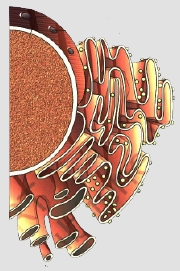
- A
Golgi apparatus, formation of glycolipids
- ✓
Rough endoplasmic reticulum, protein synthesis
- C
Rough endoplasmic reticulum, formation of glycoproteins
- D
Golgi apparatus, protein synthesis
AnswerCorrect option: B. Rough endoplasmic reticulum, protein synthesis
b
(b) : The given figure shows endoplasmic reticulum bearing ribosomes on their surface. It is called rough endoplasmic reticulum or $RER$. $RER$ is actively involved in protein synthesis and secretion.
View full question & answer→MCQ 431 Mark
The Golgi complex plays a major role
- A
as energy transferring organelles
- ✓
in post translational modification of proteins and glycosylation of lipids
- C
in trapping the light and transforming it into chemical energy
- D
in digesting proteins and carbohydrates.
AnswerCorrect option: B. in post translational modification of proteins and glycosylation of lipids
b
(b) : Post translational modification $(PTM)$ is a step in protein biosynthesis. Proteins are created on ribosomes translating $mRNA$ into polypeptide chains. These polypeptide chains undergo $PTM$, such as folding, cutting and other processes, before becoming the mature protein product. Proteins synthesized by the rough endoplasmic reticulum and lipids synthesized by smooth endoplasmic reticulum reach the cisternae of the Golgi apparatus. Here, they combine with carbohydrates to form glycoproteins and glycolipids. This process is called glycosylation.
View full question & answer→MCQ 441 Mark
The term ‘glycocalyx’ is used for
- A
a layer present between cell wall and membrane of bacteria
- B
- C
bacterial cell glycoengineered to possess Nglycosylated proteins
- ✓
a layer surrounding the cell wall of bacteria.
AnswerCorrect option: D. a layer surrounding the cell wall of bacteria.
d
(d) : Glycocalyx is a sticky, gelatinous material that collects outside the cell wall of bacteria to form an additional surface layer. When this layer is firmly attached to the surface of the cell, it is called a capsule. If it is loosely distributed around the cell, the glycocalyx is called a slime layer.
View full question & answer→MCQ 451 Mark
Why is a capsule advantageous to a bacterium ?
- A
It protects the bacterium from desiccation.
- B
It provides means of locomotion.
- ✓
It allows bacterium to “hide” from host’s immune system.
- D
It allows the bacterium to attach to the surface.
AnswerCorrect option: C. It allows bacterium to “hide” from host’s immune system.
c
(c) : $S$-type bacteria or virulent bacteria are capsulated. The capsule is made up of polysaccharides and amino acids. It is a tough and thick mucilage covering. It gives protection to bacteria against host’s immune system.
View full question & answer→MCQ 461 Mark
Pigment containing membranous extensions in some cyanobacteria are
Answerb
(b) : Chromatophore is a pigmented lamellar or vesicular structure that can be isolated from disrupted photosynthetic bacteria or cyanobacteria. Their plasma membrane may be projected in folds into the cytoplasm forming lamellae that have, therefore, double unitmembrane structure. The pigments and most of the enzymes required for the lightinduced electron transport and phosphorylation processes of photosynthesis, are located in the plasma membrane and lamellae.
View full question & answer→MCQ 471 Mark
Which of the following best illustrates “feedback” in development?
- A
Tissue $X$ secretes $RNA$ which changes the development of tissue $Y$.
- B
As tissue $X$ develops, it secretes enzymes that inhibit the development of tissue $Y.$
- ✓
As tissue $X$ develops, it secretes something that induces tissue $Y$ to develop.
- D
As tissue $X$ develops, it secretes something that slows down the growth of tissue $Y.$
AnswerCorrect option: C. As tissue $X$ develops, it secretes something that induces tissue $Y$ to develop.
c
(c) : As tissue $X$ develops it secretes something that induces tissue $Y$ to develop indicating positive feedback mechanism.
View full question & answer→MCQ 481 Mark
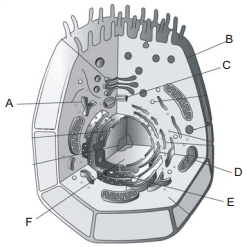
Identify the correct statements w.r.t. the given cell
$A$. Concerned with lipid and steroidal hormone synthesis
$B$. Outer non-living rigid structure which gives shape to the cell and protects from mechanical damage and infection.
$C$. Both lie perpendicular to each other and each has an organisation like the cart wheel.
$D$. Responsible for trapping light energy for the synthesis of sugar.
$E$. Present in cells actively involved in protein synthesis and secretion.
$F$. Spherical structures, rich in hydrolytic enzymes.
- A
$A, D \;and\; E$
- B
$B, C \;and\; D$
- ✓
$A, C \;and\; E$
- D
$A, B, C\; and \;F$
AnswerCorrect option: C. $A, C \;and\; E$
c
$A$ -Smooth endoplasmic reticulum
$B$ -Plasma membrane
$C$ -Centriole
$D$ -Mitochondria
$E$ -Rough endoplasmic reticulum
$F$ -Nucleus
View full question & answer→MCQ 491 Mark
A cell organelle $‘X’$ is divided into two types on the basis of a cell organelle $‘Y’$, that helps in the protein synthesis. Identify $‘X’$ and $‘Y’$ respectively
- A
Golgi complex and ribosome
- B
$ER$ and mitochondria
- ✓
$ER$ and ribosome
- D
Lysosome and $ER$
AnswerCorrect option: C. $ER$ and ribosome
c
$ER$ is divided into two types on the basis of ribosomes (helps in protein synthesis)
$ER$ having ribosomes -Rough $ER$
$ER$ without ribosomes -Smooth $ER$
View full question & answer→MCQ 501 Mark
Read the following statements:
$(i)$. Membrane-bounded inclusion bodies are not found in prokaryotic cells.
$(ii)$. Ribosomes are the site of protein synthesis.
$(iii)$. Pili are the surface structure of the bacteria which may play a role in motility.
$(iv)$. The cell membrane of prokaryotes is structurally similar to the eukaryotes.
Choose the option with the correct statements.
- A
$(i)$, $(ii)$, $(iii)$ and $(iv)$
- B
$(ii)$ $(iii)$ and $(iv)$
- ✓
$(i)$, $(ii)$ and $(iv)$
- D
$(i)$, $(iii)$ and $(iv)$
AnswerCorrect option: C. $(i)$, $(ii)$ and $(iv)$
c
$(i)$, $(ii)$ and $(iv)$
Pili are thin, hair-like appendages on the surface of bacteria. They are rigid in appearance than flagella, which have motility function. Bacteria use sex pili for the process of conjugation. Pili also function as receptors for donor-specific (male-specific) phages.
View full question & answer→MCQ 511 Mark
Which of the following statements are correct?
- ✓
$Na ^+/ K^ +$ pump is an example of active transport.
- B
In plant cells lipid like steroidal hormones are synthesized in $SER.$
- C
In plant cells, the vacuoles can occupy up to $10 \%$ of the volume of the cell.
- D
Chlorophyll and leucoplast are responsible for trapping light energy essential for photosynthesis.
AnswerCorrect option: A. $Na ^+/ K^ +$ pump is an example of active transport.
a
In animal cells lipid like steroidal hormones are synthesized in $SER$. In plant cells, the vacuoles can occupy up to $90 \%$ of the volume of the cell. Chlorophyll and carotenoid pigments are responsible for trapping light energy essential for photosynthesis.
View full question & answer→MCQ 521 Mark
Consider the following statements and choose the correct statement.
$(i)$ The endomembrane system includes mitochondria, chloroplast and peroxisomes.
$(ii)$ Smooth endoplasmic reticulum is the major site for synthesis of lipid.
$(iii)$ Rough endoplasmic reticulum is actively involved in protein synthesis.
$(iv)$ Mitochondrial matrix possesses single circular $DNA$, a few $RNA$ and $80\; s$ ribosomes.
Of the above statements.
- A
$(i)$ and $(iii)$
- B
$(ii)$ and $(iv)$
- C
$(iii)$ and $(iv)$
- ✓
$(ii)$ and $(iii)$
AnswerCorrect option: D. $(ii)$ and $(iii)$
d
Statements $(ii)$ and $(iii)$ are correct. The endomembrane system include endoplasmic reticulum $(ER)$, golgi complex, lysosomes and vacuoles. Since the functions of the mitochondria, chloroplast and peroxisomes are not coordinated with the above components, these are not considered as
part of the endomembrane system. The mitochondrial matrix possesses single circular $DNA$ molecule, a few RNA molecule, ribosomes $(70\; S)$ and the components required for the synthesis of proteins.
View full question & answer→MCQ 531 Mark
Which of the following statements are correct?
$(i)$ In prokaryotic cells, a special membranous structure formed by the extension of the plasma membrane into the cell is known as polysome.
$(ii)$ The smooth endoplasmic reticulum is the major site for synthesis of glycoproteins.
$(iii)$ $RuBisCO$ is the most abundant protein in the whole biosphere.
$(iv)$ Mitochondria, chloroplasts and peroxisomes are not considered as part of endomembrane system.
Of the above statements
- ✓
$(iii)$ and $(iv)$
- B
$(i)$ and $(ii)$
- C
$(ii)$ and $(iii)$
- D
$(i)$ and $(iv)$
AnswerCorrect option: A. $(iii)$ and $(iv)$
a
The special membranous structure formed by the extension of prokaryotic plasma membrane is known as mesosome while polysome is structure formed by combination of many ribosomes. $SER$ is the major site of synthesis of lipids. The site of protein synthesis is $RER$.
View full question & answer→MCQ 541 Mark
Which of the following statements is/are correct?
$(i)$ The endomembrane system includes plasma membrane, ER, Golgi complex, lysosomes and vacuoles.
$(ii)$ ER helps in the transport of substances, synthesis of proteins, lipoproteins and glycogen.
$(iii)$ Ribosomes are involved in protein synthesis.
$(iv)$ Mitochondria help in oxidative phosphorylation and generation of $ATP$.
- ✓
$(ii), (iii)$ and $(iv)$
- B
$(i)$ only
- C
$(ii)$ only
- D
$(iii)$ only
AnswerCorrect option: A. $(ii), (iii)$ and $(iv)$
a
Endomembrance system is a grouping of some membrane organelles which function in close coordination with one another, viz., endoplasmic reticulum, Golgi complex, and lysosomes.
View full question & answer→MCQ 551 Mark
Which of the following statements are incorrect?
$(i)$ Plant cells have centrioles which are absent in almost all animal cells.
$(ii)$ Ribosomes are the site of protein synthesis.
$(iii)$ The middle lamella is a layer mainly of calcium carbonate which holds the different neighbouring cells together.
$(iv)$ In animal cell, steroidal hormones are synthesized by smooth endoplasmic reticulum.
Of the above statements
- ✓
$(i)$ and $(iii)$
- B
$(iii)$ and $(iv)$
- C
$(ii)$ and $(iv)$
- D
$(i)$ and $(iv)$
AnswerCorrect option: A. $(i)$ and $(iii)$
a
The centrioles occur in nearly all animal cells, but absent in plant cells with few exceptions such as zoospores of algae, sperm cells of ferns, and motile algae. Middle lamella is a thin, amorphous and cementing layer between two adjacent cells. It is made up of pectates of calcium and magnesium.
View full question & answer→MCQ 561 Mark
Which of the following statement is false?
AnswerCorrect option: B. Mitochondria divide by fragmentation.
b
Mitochondria divide by fission.
View full question & answer→MCQ 571 Mark
Match Column $I$ with Column $II$ and choose the correct option.
| Column $I$ |
Column $II$ |
| $A$. Centrioles |
$I$. Non-membrane bound organelle Which helps in cell division
|
| $B$. Fimbriae |
$II$. Special structure of bacteria which help them to attach with rocks in
|
| $C$. Endomembrane |
$III$. Includes those organelles system whose functions are coordinated
|
| $D$. Mitochondria |
$IV$. Divide by fission and site of aerobic respiration
|
- ✓
$A-I ; B-II; C-III ; D-I V$
- B
$A-I I I ; B-I ; C-I I ; D-I V$
- C
$A-I I I ; B-I ; C-I V ; D-I I$
- D
$A-I; B-I V ; C-I I I ; D-I I$
AnswerCorrect option: A. $A-I ; B-II; C-III ; D-I V$
a
Centriole is a non-membrane bound organelle which helps in cell division. It is composed mainly of a protein called tubulin. Fimbria is a special structure of bacteria. It is small bristle like fibres sprouting out of the cell and help bacterias to attach with rocks in stream and also to host tissue. Endomembrane system includes those organelles (like ER, golgi body, lysosome, vacuole) whose functions are coordinated. Mitochondria are a double membrane cell organelle which divide by fission and site of aerobic respiration.
View full question & answer→MCQ 581 Mark
Which one of the following cellular parts is correctly matched with their characters?
- A
Centrioles - Sites for active $RNA$ synthesis.
- B
Lysosomes - Optimally active at a $pH$ of about $8.5$.
- ✓
Thylakoids - Flattened membranous sacs forming the grana of chloroplasts.
- D
Ribosomes - Those on chloroplasts are larger $(80\; S )$ while those in the cytoplasm are smaller $(70\; S)$.
AnswerCorrect option: C. Thylakoids - Flattened membranous sacs forming the grana of chloroplasts.
c
Centrioles serve as basal bodies for cilia and flagella. They are concerned with spindle formation during cell division. Lysosomes are membrane-bound organelles containing many hydrolytic enzymes, which are optimally active at an acid pH (near $pH\; 5$). Thylakoids are membrane-bound organelles found within chloroplasts. The thylakoid membrane, forms many flattened, fluid-filled tubules that enclose a single convoluted compartment. These tubules tend to stack on top of each other to form a structure called a granum.
View full question & answer→MCQ 591 Mark
Which of the following pair are correctly matched?
$(I)$ Amyloplasts - Store proteins
$(II)$ Mitochondrion - 'Power house' of the cell
$(III)$ Stroma - Chlorophyll pigment
$(IV)$ Axoneme $-9+2$ array
AnswerCorrect option: D. $(II)$ and $(IV)$ only
d
Amyloplasts store carbohydrates (starch), $e.g$., potato whereas proteins are stored by aleuroplasts. Chlorophyll pigments are presents in the thylakoid.
View full question & answer→MCQ 601 Mark
Which one of the following pairs is $NOT$ correctly matched?
- A
Cristae - The tubular structure formed by the folding of the inner membrane of the mitochondrion.
- ✓
Plasmodesmata- The membrane surrounding the vacuole in plants.
- C
Grana - Membrane bound discs in chloroplasts that contain chlorophylls and carotenoids.
- D
Middle lamella - Layer between adjacent cells walls in plants derived from cell plate.
AnswerCorrect option: B. Plasmodesmata- The membrane surrounding the vacuole in plants.
b
Plasmodesmata are cytoplasmic bridges between two adjacent cells which connect the neighbouring cells.
View full question & answer→MCQ 611 Mark
Which of the following pair are correctly matched?
$A$. Microtubules - Structural components of cilia
$B$. Centrioles - Store hydrolytic enzymes
$C$. Amyloplasts - Store oil protein and starch in plants
- A
$A , B$ and $C$
- B
$A$ and $B$
- ✓
$A$ only
- D
$A$ and $C$
AnswerCorrect option: C. $A$ only
c
Pair $A$ is correct. Centrioles $-$ It is composed mainly of a protein called tubulin. Lysosomes - It stores hydrolytic enzymes. Amyloplasts - They are responsible for the synthesis and storage of starch granules, through the polymerization of glucose. Elaioplasts - It stores oil and fats. Aleuroplasts - It stores proteins.
View full question & answer→MCQ 621 Mark
Match column-$I$ and column-$II$ and select the correct answer
| Column-$I$ |
Column-$II$ |
| $A$. Bacteria without walls |
$I$. Lysosome |
| $B$. Small circular DNA |
$II$. Mycoplasma cells |
| $C$. Flattened sacs in |
$III$. Thylakoid a chloroplast |
| $D$. A vesicle in which |
$IV$. Plasmid hydrolytic enzymes are stored
|
- A
$A -III; B - IV ; C -II ; D -I$
- ✓
$A -II; B - IV ; C -III D -I$
- C
$A -I ; B -II; C -III ; D - IV$
- D
$A - IV ; B -III; C -I ; D -II$
AnswerCorrect option: B. $A -II; B - IV ; C -III D -I$
b
Mycoplasma cells are bacteria without walls. Plasmid is a genetic structure in a cell that can replicate independently of the chromosomes. It is typically a small circular $DNA$ strand in the cytoplasm of a bacterium or protozoan are saclike membranes that make up grana in a chloroplast. Lysosomes are a single membrane bound vesicular structure. It contains many hydrolytic enzymes and commonly called as suicidal bag of the cells. It is involved in intracellular and extracellular digestion.
View full question & answer→MCQ 631 Mark
Match column-$I$ with column-$II$ and select the correct option.
| Column-$I$ |
Column-$II$ |
| $A$. $RER$ |
$I$. Intracellular and extracellular digestion |
| $B$. Cell wall |
$II$. Provide structural support to the cell |
| $C$. Flagella |
$III$. Protein synthesis and secretion |
| $D$. Lysosomes |
$IV$ Responsible for cell movement |
- ✓
$A -III ; B -II ; C - IV ; D -I$
- B
$A -II ; B - II ; C - IV ; D -I$
- C
$A - I ; B - III ; C -II ; D - IV$
- D
$A - IV ; B - II ; C - III ; D - I$
AnswerCorrect option: A. $A -III ; B -II ; C - IV ; D -I$
a
RER (rough endoplasmic reticulum) bears ribosomes on their surface. RER is involved in protein synthesis and secretion. Cell wall is a characteristic feature of plant cell, bacteria, fungi, algae and some archaea. The major function of the cell wall is to provide rigidity, tensile strength, structural support, protection against mechanical stress and infection. Flagella are a slender thread-like structure, especially a microscopic whip-like appendage which enables many protozoa, bacteria, spermatozoa, etc. to swim. It is responsible for cell movement. Lysosome is a single membrane bound vesicular structure and contains many hydrolytic enzymes. It is commonly called as suicidal bag of the cells and involved in intracellular and extracellular digestion.
View full question & answer→MCQ 641 Mark
Match column-$I$ with column-$II$ and select the correct option.
| Column-$I$ |
Column-$II$ |
| $A$. Golgi apparatus |
$I$. Storage |
| $B$. Mitochondria |
$II$. Photosynthesis |
| $C$. Vacuoles |
$III$. Transport |
| $D$. Grana |
$IV$. Secretion |
| |
$V$. Respiration |
- ✓
$A-I V ; B-V ; C-I: D-II$
- B
$A-I ; B-II; C-I V: D-III$
- C
$A-I V ; B-I ; C-II: D-I I I$
- D
$A-I ; B-II; C-III: D-I V$
AnswerCorrect option: A. $A-I V ; B-V ; C-I: D-II$
a
Golgi apparatus is a cellular organelle which is involved in in the modifying, sorting and packaging of proteins for secretion. Mitochondria are known as the power house of the cell as they are the site of chemical reactions that transfer energy from organic compounds in $ATP$. Vacuole is a membrane bound organelle and filled with water containing inorganic and organic molecules including enzymes in solution. Vacuoles might store food or any variety of nutrients a cell might need to survive. Grana are a stacked membranous structure within the chloroplasts of plants and green algae that contains the chlorophyll and is the site of the light reactions of photosynthesis.
View full question & answer→MCQ 651 Mark
Match column-$I$ (cell organelle) with column-$II$ membrane and select the correct option from the codes given below.
| Column-$I$ |
Column-$II$ |
| $A$. Mitochondria |
$I$. Without membrane |
| $B$. Lysosomes |
$II$. Single membrane |
| $C$. Ribosomes |
$III$. Double membrane |
AnswerCorrect option: C. $A -III; B -II ; C -I$
c
Mitochondria are double membrane cell organelles with the outer membrane and inner membrane. Lysosomes are a single membrane bound vesicular structure. It contains many hydrolytic enzymes and commonly called as suicidal bag of the cells. Ribosome is a granular structure, without membrane. It consists of $RNA$ and proteins and is the protein builders or the protein synthesizers of the cell.
View full question & answer→MCQ 661 Mark
Match the items given in column-$I$ with their role given in column-$II$ and choose the correct option.
| Column-$I$ |
Column-$II$ |
| $A$. SER |
$I$. Increase the surface area |
| $B$. Golgi apparatus |
$II$. Store oils or fats |
| $C$. Cristae |
$III$. Excretion |
| $D$. Peroxisome |
$IV$. Photorespiration |
| $E$. Elaioplasts |
$V$. Synthesis of lipid |
- ✓
$A - V ; B -III C - I ; D - IV ; E - II$
- B
$A - V ; B -III; C -II ; D - IV ; E - I$
- C
$A -II ; B - II ; C - I ; D - IV ; E - V$
- D
$A -II ; B - IV ; C -I ; D - V ; E - II$
AnswerCorrect option: A. $A - V ; B -III C - I ; D - IV ; E - II$
a
SER (smooth endoplasmic reticulum) found in both animal cells and plant cells, makes cellular products
like hormones and lipids. It also distributes those products throughout the cell and to other places in the organism. Golgi apparatus is also involved in the transport of lipids around the cell, and the creation of lysosomes. Cristae are the infoldings or inward projections of the inner membrane of the mitochondrion, which are studded with proteins and increase the surface area for chemical reactions to occur like cellular respiration. Peroxisome is a small organelle present in the cytoplasm of many cells, which contains the reducing enzyme catalase and usually some oxidases. This organelle is involved in photorespiration. Elaioplasts, a type of leucoplast, is specialized for the storage of lipids in plants. Elaioplasts house oil body deposits as rounded plastoglobuli, which are essentially fat droplets.
View full question & answer→MCQ 671 Mark
Identify the components labelled as $A$, $B$, $C$, $D$ and $E$ in the diagram given below from the list $(i)$ to $(viii)$.
$(i)$ Cristae of mitochondria $(ii)$ Inner membrane of mitochondria $(iii)$ Cytoplasm $(iv)$ Smooth endoplasmic reticulum $(v)$ Rough endoplasmic reticulum $(vi)$ Mitochondrial matrix $(vii)$ Ribosome $(viii)$ Nucleus
- ✓
$(viii)\; (v)\; (vii)\; (iii)\; (iv)$
- B
$(i)\; (iv)\; (vii)\; (vi)\; (iii)$
- C
$(vi)\; (v)\; (iv)\; (vii)\; (i)$
- D
$(v)\; (i)\; (iii)\; (ii)\; (iv)$
AnswerCorrect option: A. $(viii)\; (v)\; (vii)\; (iii)\; (iv)$
a
In the given diagram of endoplasmic reticulum, the components marked as $A, B, C, D$ and $E$ are respectively nucleus $(viii)$, rough endoplasmic reticulum $(v)$, ribosomes $(vii)$, cytoplasm $(iii)$ and smooth endoplasmic reticulum $(iv)$. Endoplasmic reticulum is a network of membranous tubules within the cytoplasm of a eukaryotic cell, continuous with the nuclear membrane. It usually has ribosomes attached and is involved in protein and lipid synthesis.
View full question & answer→MCQ 681 Mark
Choose the incorrect option
AnswerCorrect option: C. Centriole - Present in all plants and animals
View full question & answer→MCQ 691 Mark
Choose the correct option:
- A
$a-$ Some mature cells $e.g.$ erythryocytes of many mamals lack nucleus
$b-$ Sieve tube cells of vasular plants have nucleus
- B
$a-$ Centriole are surrounded by cell membrane
$b-$ Pairs of microtubules are present in centriole
- ✓
$a-$ Cytoskeleton contain microfilament made up of protein
$b-70S$ ribosomes are present in chloroplast
- D
$a-$ colour of plants is due to aleuroplasts
$b-$ Vacuoles can occupy up to $90\%$ of the volume of the animal cell.
AnswerCorrect option: C. $a-$ Cytoskeleton contain microfilament made up of protein
$b-70S$ ribosomes are present in chloroplast
View full question & answer→MCQ 701 Mark
Match the following.
$\begin{array}{|p{0.3\linewidth}|l|} \hline Column\,\,-I & Column\,\,-II \\ \hline (1)\,\,Typical\,\,bacterial & (p)\,\,Site\,\,of\,\,protein\,\,synthesis \\ \hline (2)\,\,Ribosome & (q)\,\,1-2\,\,\mu\,m \\ \hline (3)\,\,Long\,\,and\,\,branched & (r)\,\,Control\,\,of\,\,bacterial\,\,transform \\ \hline (4)\,\,Plasmid & (s)\,\,Nerve\,\,cell \\ \hline \end{array}$
- A
$(1-p), (2-q), (3-r), (4-s) $
- ✓
$(1-q), (2-p), (3-s), (4-r) $
- C
$(1-r), (2-s), (3-p), (4-q)$
- D
$(1-s), (2-r), (3-q) (4-p) $
AnswerCorrect option: B. $(1-q), (2-p), (3-s), (4-r) $
View full question & answer→MCQ 711 Mark
It is not membrane bound organell
MCQ 721 Mark
- A
Prokaryotic cell $\rightarrow$ Ostrich's egg
- B
Animal cell $\rightarrow$ Cell wall present
- C
Plant cell $\rightarrow$ Presence of centriole
- ✓
Eukaryotic cell $\rightarrow$ Presence of Nuclear membrane
AnswerCorrect option: D. Eukaryotic cell $\rightarrow$ Presence of Nuclear membrane
View full question & answer→MCQ 731 Mark
In following, which is not common for chloroplasts and mitochondria?
- ✓
Both present in animal cell.
- B
Both having their own genetic material
- C
Both present in eukaryotic cell
- D
AnswerCorrect option: A. Both present in animal cell.
View full question & answer→MCQ 741 Mark
Which is include in endomembrane system?
MCQ 751 Mark
Match the following.
$\begin{array}{|l|l|} \hline Column\;-I & Column\;-II \\ \hline A.\;Micro\;filament & i.\;Glycokalyx \\ \hline B.\;Micro\;tubule & ii.\;Actin \\ \hline C.\;Flagella & iii.\;Tubulin \\ \hline D.\;Outer\;layer\;of\;bacteria & iv.\;Outer\;compartment \\ \hline \end{array}$
- ✓
$(A-ii), (B-iii), (C-iv), (D-i) $
- B
$(A-iii), (B-ii), (C-iv), (D-i) $
- C
$(A-ii), (B-iii), (C-i), (D-iv) $
- D
$(A-iv), (B-i), (C-iii), (D-ii) $
AnswerCorrect option: A. $(A-ii), (B-iii), (C-iv), (D-i) $
View full question & answer→MCQ 761 Mark
In following, which sentence is correct?
- A
Virshow first explained that a thin outer layer at animal cell is plasma membrane
- ✓
Cell division is very speedily in prokaryotic cell.
- C
Free ribosome in cytoplasm do the lipid synthesis.
- D
Particles which are store the starch is known as phosphate particle.
AnswerCorrect option: B. Cell division is very speedily in prokaryotic cell.
View full question & answer→MCQ 771 Mark
Separate the following correct pair.
MCQ 781 Mark
Match the following.
$\begin{array}{|p{0.3\linewidth}|p{0.5\linewidth}|} \hline Column\,\,-I & Column\,\,-II \\ \hline A.\,\,Vacuole & i.\,\,Krebs\,\,cycle \\ \hline B.\,\,Mitochondria & ii.\,\,Photosynthesis \\ \hline C.\,\,Golgibody & iii.\,\,Excretion \\ \hline D. Chloroplast & iv. Synthesis site of glycolipid and glycoprotein \\ \hline \end{array}$
- A
$(A-iv), (B-iii), (C-ii), (D-i) $
- ✓
$(A-iii), (B-i). (C-iv), (D-ii) $
- C
$(A-ii), (B-i). (C-iv), (D-i) $
- D
$(A-i), (B-iv), (C-iii), (D-ii) $
AnswerCorrect option: B. $(A-iii), (B-i). (C-iv), (D-ii) $
View full question & answer→MCQ 791 Mark
View full question & answer→MCQ 801 Mark
- A
Mitochondria - single layer
- ✓
- C
- D
View full question & answer→MCQ 811 Mark
Identify correct matching
$\begin{array}{|l|l|} \hline Column\;-\;I & Column\;-\;II \\ \hline a.\;pinocytosis & 1.\;Animal\;cell \\ \hline b.\;Lysomes & 2.\;Cell\;wall \\ \hline c.\;ER & 3.\;Acidic\;pH \\ \hline d.\;Centriole & 4.\;Ribosomes \\ \hline & 5.\;liquid\;food \\ \hline \end{array}$
- A
$a-5, b-1, c-4, d-1$
- B
$a-5, b-3, c-2, d-1$
- C
$a-4, b-1, c-5, d-2$
- ✓
$a-5, b-3, c-4, d-1$
AnswerCorrect option: D. $a-5, b-3, c-4, d-1$
View full question & answer→MCQ 821 Mark
Asteroid hormone is progesteron secreted by corpus leutium (mass of cells in ovary) What is correct for corpus leutium cells ?
- A
- ✓
They have more $SER$
- C
They have more $RER$
- D
They have large amount of microvilli
AnswerCorrect option: B. They have more $SER$
View full question & answer→MCQ 831 Mark
Match List I and List II and select the correct answer using the code given below the list :
List $I$ List $II$
$a$.Lysosome $1$.Bacteria without cell walls
$b$.Mycoplasma $2$.A virus that infects bacterial cells
$c$.Thylakoid $3$.Flattened sacs in a chloroplast
$d$.Bacteriophage $4$.A vesicle in which hydrolytic enzymes are stored
Code :
- A
$a- 3 , b - 1, c- 2, d- 4$
- ✓
$a - 4, b -1 , c - 3 , d - 2$
- C
$a - 2, b - 3, c - 4 ,d - 1$
- D
$a -1 , b - 4, c- 2, d- 3$
AnswerCorrect option: B. $a - 4, b -1 , c - 3 , d - 2$
View full question & answer→MCQ 841 Mark
Match the following and choose the correct combination from the options given
| Column $-I$ |
Column $-II$ |
| $(A)$ Robert Hooke |
$(1)$ Mutation theory |
| $(B)$ Charles Darwin |
$(2)$ Swan-necked flask experiment |
| $(C)$ Hugo de vries |
$(3)$ Origin of species |
| $(D)$ Louis pasteur |
$(4)$ Micrographia |
- A
$A-3, B-4, C-1, D-2$
- B
$A-2, B-1, C-3, D-4$
- C
$A-1, B-2, C-3, D-4$
- ✓
$A-4, B-3, C-1, D-2$
AnswerCorrect option: D. $A-4, B-3, C-1, D-2$
View full question & answer→MCQ 851 Mark
Which one of the following pairs is not correctly matched
- A
Cristae The "Shelves'' formed by the folding of the inner membrane of the mitochondrion
- ✓
Plasmodesmata The membrane surrounding the vacuole in plants
- C
Grana Membrane bound discs in chloroplasts that contain chlorophylls and carotenoids
- D
Middle lamella Layer between adjacent cell walls in plants derived from cell plate
AnswerCorrect option: B. Plasmodesmata The membrane surrounding the vacuole in plants
b
(b) Because the membrane which surrounds the vacuole is known as tonoplast.
View full question & answer→MCQ 861 Mark
Circular $DNA$ molecule occurs in
- A
- ✓
Bacteria, chloroplasts and mitochondria
- C
Bacteria and chloroplasts only
- D
AnswerCorrect option: B. Bacteria, chloroplasts and mitochondria
View full question & answer→MCQ 871 Mark
The shape of chromosome is determined by
Answerb
The position of centromere determines the shape of chromosome.
View full question & answer→MCQ 881 Mark
A chromosome in which the centromere is situated close to its end so that one arm is very short and the other very long is
Answera
In acrocentric chromosomes, centromere appears sub-terminal, $i.e.,$ with a very small and a very long arm.
View full question & answer→MCQ 891 Mark
Centromere is also called
Answerc
The centromere lies within a thinner segment of chromosome, the primary constriction
View full question & answer→MCQ 901 Mark
$A$ : Telocentric chromosome has two unequal arms.
$R$ : The centromere is situated close to its end forming one extremely short arm.
- A
Assertion and Reason both are correct and also correct explanation.
- B
Assertion and Reason both are correct but not explanation of assertion.
- C
Assertion is correct, but Reason is incorrect.
- ✓
Both Assertion and Reason are incorrect.
AnswerCorrect option: D. Both Assertion and Reason are incorrect.
d
$A$ : Telocentric chromosome has only one arm.
$R$ : The centromere is situated at its one end.

View full question & answer→MCQ 911 Mark
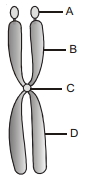
Find out the correct option on the basis of following diagrams
- A
$A$ -Satellite, $B$ -Secondary constriction
$C$ -Short arm, $D$ -Long arm
- ✓
$A$ -Satellite, $B$ -Centromere
$C$ -Short arm, $D$ -Long arm
- C
$A$ -Secondary constriction, $B$ -Satellite,
$C$ -Long arm, $D$ -Short arm
- D
$A$ -$NOR$, $B$ -Secondary constriction
$C$ -Short arm, $D$ -Long arm
AnswerCorrect option: B. $A$ -Satellite, $B$ -Centromere
$C$ -Short arm, $D$ -Long arm
b
View full question & answer→MCQ 921 Mark
Consider the following statements and choose the incorrect option
$a$. Large and more numerous nucleoli are present in cells actively carrying out protein synthesis.
$b$. Nuclear pores allow bidirectional movement of molecules.
$c$. Cytoskeleton is a glycolipid structure for mechanical support, motility and maintenance of the shape of the cell.
$d$. Steroidal hormones are synthesized by Golgi complex.
- A
$a\; and \;b$
- B
$b\; and\; c$
- ✓
$c\; and\; d$
- D
$a\; and \;d$
AnswerCorrect option: C. $c\; and\; d$
c
Correction : c $\rightarrow$ Cytoskeleton is a proteinaceous structure for maintenance motility and shape.
d $\rightarrow$ Steroidal hormones are synthesised by Smooth Endoplasmic Reticulum $(SER)$.
View full question & answer→MCQ 931 Mark
Incorrect statement in relation to nucleolus is
AnswerCorrect option: B. It is separated from nucleoplasm by nuclear envelope
b
It is not membrane bound.
View full question & answer→MCQ 941 Mark
Satellite chromosomes have
- A
Primary constriction only
- B
Secondary constriction only
- C
Tertiary constriction only
- ✓
Both primary and secondary constriction
AnswerCorrect option: D. Both primary and secondary constriction
d
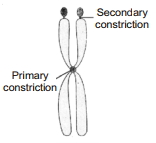
View full question & answer→MCQ 951 Mark
Match column-$I$ with column-$II$ and choose the correct option.
| Column-$I$ |
Column-$II$ |
| (Chromosome) |
(Position of Centromere) |
| $A$. Metacentric |
$I$. At the tip |
| $B$. Submetacentric |
$II$. Almost near the tip |
| $C$. Acrocentric |
$III$. At the middle |
| $D$. Telocentric |
$IV$. Slightly away from the middle |
- ✓
$A - III ; B - IV ; C -II ; D -I$
- B
$A - IV ; B - III ; C - II ; D -I$
- C
$A -I ; B - II ; C - I I I ; D - IV$
- D
$A-I V ; B-I I I ; C-I ; D-II$
AnswerCorrect option: A. $A - III ; B - IV ; C -II ; D -I$
a
Metacentric chromosomes have the centromere in the centre, such that both sections are of equal length. Human chromosome $1$ and $3$ are metacentric. Sub metacentric chromosomes are a chromosome with the centromere so placed that it divides the chromosome into two arms of strikingly unequal length. Acrocentric chromosomes have a centromere which is located almost near the tip leading to one very long and one very short section. Human chromosomes $13,15,21$, and $22$ are acrocentric. Telocentric chromosomes have centromere which is located at the terminal end. Telomeres may extend from both ends of the chromosome. Humans do not possess telocentric chromosomes.
View full question & answer→MCQ 961 Mark
- ✓
terminal part of thechromosome beyond secondary constriction.
- B
terminal part of the chromosome beyond primary constriction.
- C
terminal part of chromosome beyond tertiary constriction.
- D
AnswerCorrect option: A. terminal part of thechromosome beyond secondary constriction.
a
Satellite is a small chromosomal segment separated from the main body of the chromosome by a secondary constriction. In humans it is usually associated with the short arm of an acrocentric chromosome. They play a vital role in the formation of the nucleolus after cell division. In humans, chromosomes number $13,14,15,21$ and $22$ are examples of $SAT (satellite)$ chromosomes.
View full question & answer→MCQ 971 Mark
AnswerCorrect option: B. rounded structure inside nucleus and having $RNA$.
b
Nucleolus is a small rounded body within a resting nucleus that contains $RNA$ and proteins. It is usually associated with a specific chromosomal site and involved in ribosomal $RNA$ synthesis and the formation of ribosomes.
View full question & answer→MCQ 981 Mark
The following diagram represents a structure chromosome. Identify the structures marked as $A , B$ and $C .$
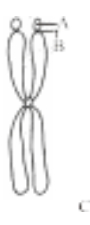
- A
$A-$ Satellite, $B -$ Primary constriction, $C -$ Acrocentric
- ✓
$A -$ Satellite, $B -$ Secondary constriction, $C -$ Metacentric
- C
$A-$ Satellite, $B -$ Centromere, $C -$ Telocentric
- D
$A -$ Satellite, $B -$ Centromere, $C -$ Submetacentric
AnswerCorrect option: B. $A -$ Satellite, $B -$ Secondary constriction, $C -$ Metacentric
b
The figure shows the structure of metacentric $(C)$ chromosomes. The parts marked as $A$ and $B$ are respectively are satellite and secondary constriction. Metacentric chromosomes have the centromere in the centre, due to which both sections are of equal
length. Human chromosome $1$ and $3$ are metacentric.
View full question & answer→MCQ 991 Mark
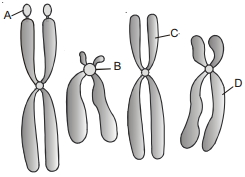
The given diagram shows the types of chromosomes (labelled as $A$, $B$, $C \; \& \;D$) based on the position of centromere. Which one is the correct option for the labelled chromosomes. $A, B, C$ and $D$ ?
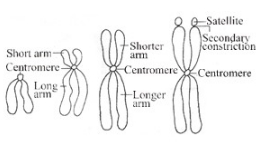
- ✓
$A-$ Telocentric chromosome, $B -$ Acrocentric chromosome, $C-$ Submetacentric chromosome, $D -$ Metacentric chromosome
- B
$A -$ Acrocentric chromosome, $B -$ Telocentric chromosome, $C-$ Metacentric chromosome, $D -$ Submetacentric chromosome
- C
$A -$ Submetacentric chromosome, $B -$ Metacentric chromosome, $C -$ Telocentric chromosome, $D-$ Acrocentric chromosome
- D
$A-$ Metacentric chromosome, $B -$ Submetacentric chromosome, $C-$ Acrocentric chromosome, $D -$ Telocentric chromosome.
AnswerCorrect option: A. $A-$ Telocentric chromosome, $B -$ Acrocentric chromosome, $C-$ Submetacentric chromosome, $D -$ Metacentric chromosome
a
The figures $(A, B, C$ and $D)$ are respectively telocentric chromosomes, acrocentric chromosomes, sub metacentric chromosomes and metacentric chromosomes. These chromosomes are classified on the basis of location of centromere.
View full question & answer→MCQ 1001 Mark
The given diagram shows a chromosomeWhich of the following data refers corectly to the chromosome ?
No.of Centromere - No. of Kinetochore - No. of Arms
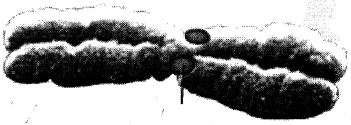
- A
$2 - 1 - 4$
- ✓
$1 - 2 - 4$
- C
$2 - 2 - 4$
- D
$1 - 2 - 2$
AnswerCorrect option: B. $1 - 2 - 4$
View full question & answer→MCQ 1011 Mark
- It is not membrane bound organell
- It is site for active ribosomal $RNA$ synthesis
- It is spherical structure
View full question & answer→MCQ 1021 Mark
View full question & answer→MCQ 1031 Mark
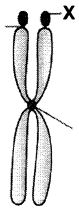
Identify $X$
View full question & answer→MCQ 1041 Mark
A single human cell has approximately......meter long thread of $DNA$ distributed among its........ chromosomes.
- A
$2, 23 $
- ✓
$2, 46 $
- C
$1, 46 $
- D
$1, 23$
AnswerCorrect option: B. $2, 46 $
View full question & answer→MCQ 1051 Mark
Chromatin having . . . ..
- A
$DNA$
- B
- ✓
$A$ and $B$ true
- D
$A$ and $B$ false
AnswerCorrect option: C. $A$ and $B$ true
View full question & answer→MCQ 1061 Mark
View full question & answer→MCQ 1071 Mark
Ribosomal $RNA$ is synthesised in
Answera
(a)Fibrillar region of nucleolus is called $NOR$. and this region contains genes coding for $18\ s$ and $28\ s$ ribosomal $RNA.$
View full question & answer→MCQ 1081 Mark
The part which does not take strain amongst the following is
MCQ 1091 Mark
Centromere may also be called as
MCQ 1101 Mark
Identify the correct match between types of chromosomes and their descriptions
| Chromosomes |
Position of centromere |
| $(A)$ Metacentric |
$(1)$ At the tip |
| $(B)$ Submetacentric |
$(2)$ Almost near the tip |
| $(C)$ Acrocentric |
$(3)$ At the middle |
| $(D)$ Telocentric |
$(4)$ Slightly away from the middle |
- A
$A-1, B-3, C-2, D-4$
- B
$A-4, B-3, C-2, D-1$
- C
$A-1, B-2, C-3, D-4$
- ✓
$A-3, B-4, C-2, D-1$
AnswerCorrect option: D. $A-3, B-4, C-2, D-1$
View full question & answer→MCQ 1111 Mark
$DNA$ genetic material occurs by itself in lower organisms and combined with proteins as nucleoproteins in higher organisms. The nucleoprotein is organized in higher forms to form
View full question & answer→MCQ 1121 Mark
Structure present over the chromosomes is
MCQ 1131 Mark
Chromosomes whose arms are equal are called
Answera
(a) Metacentric chromosomes are $'V'$ shaped in which centromere is situated in the mid portion of chromatids.
View full question & answer→MCQ 1141 Mark
Basic structure of chromatin is composed of
- A
Non-histone proteins wrapped around $DNA$
- ✓
Histone proteins wrapped around $DNA$
- C
$RNA$ wrapped around histones
- D
$DNA$ wrapped around histones
AnswerCorrect option: B. Histone proteins wrapped around $DNA$
View full question & answer→MCQ 1151 Mark
- A
- B
In association with mitochondria
- ✓
- D
View full question & answer→MCQ 1161 Mark
Four different types of chromosomes but of the same size are serialized as
- A
Telocentric, metacentric, acrocentric, submetacentric
- B
Metacentric, acrocentric, submetacentric, telocentric
- ✓
Metacentric, submetacentric, acrocentric, telocentric
- D
Metacentric, telocentric, acrocentric, submetacentric
AnswerCorrect option: C. Metacentric, submetacentric, acrocentric, telocentric
View full question & answer→MCQ 1171 Mark
A chromosome having sub-terminal centromere is called
MCQ 1181 Mark
Kinetochore is present in
Answerb
(b) Kinetochore is the place of chromosome where spindle fibres attached at the time of cell division.
View full question & answer→MCQ 1191 Mark
Which of the following is not contained in a eukaryotic nucleus
- A
- B
- C
- ✓
Circular $DNA$ molecuels
AnswerCorrect option: D. Circular $DNA$ molecuels
View full question & answer→MCQ 1201 Mark
- A
Double and non-porous layer
- ✓
- C
Single and non-porous layer
- D
View full question & answer→MCQ 1211 Mark
Which of the following regulates and governs the physiological processes of the cell
MCQ 1221 Mark
An undefined or undifferentiated fibrillar nucleus is seen in
- A
- ✓
- C
Cells of higher organisms
- D
View full question & answer→MCQ 1231 Mark
In which of the following places messenger $RNA$ is formed in a living cell
- A
- B
- ✓
Inside nucleus but outside nucleolus
- D
Inside endoplasmic reticulum
AnswerCorrect option: C. Inside nucleus but outside nucleolus
c
(c) Inside nucleus but outside nucleolus; this process is called transcription.
View full question & answer→MCQ 1241 Mark
What will happen if nucleus is removed
- A
The metabolism will increase
- ✓
- C
The metabolism will decrease
- D
Answerb
(b) Because all the metabolic activities will be ceased.
View full question & answer→MCQ 1251 Mark
True nucleus is absent in
Answerd
(d) Because bacteria are prokaryotes.
View full question & answer→MCQ 1261 Mark
The structure of nuclear membrane facilitates
- A
Synapsis of homologous chromosomes at meiosis
- ✓
Nucleo-cytoplasmic exchange of materials
- C
Anaphasic separation of daughter chromosomes
- D
AnswerCorrect option: B. Nucleo-cytoplasmic exchange of materials
View full question & answer→MCQ 1271 Mark
Histone proteins found in nuclei of eukaryotes are
MCQ 1281 Mark
The "master mind'' of the cell is
MCQ 1291 Mark
The nucleoplasm is continuous with the cytoplasm of a cell through
MCQ 1301 Mark
Nuclear material without nuclear membrane is observed in
- A
- B
Cyanobacteria and red algae
- ✓
Bacteria and cyanobacteria
- D
Mycoplasmas and green algae
AnswerCorrect option: C. Bacteria and cyanobacteria
View full question & answer→MCQ 1311 Mark
The function of nucleolus is the synthesis of
- A
$DNA$
- B
$m-RNA$
- ✓
$r-RNA$
- D
$t-RNA$
AnswerCorrect option: C. $r-RNA$
View full question & answer→MCQ 1321 Mark
View full question & answer→MCQ 1331 Mark
Controlling centre of cell is
MCQ 1341 Mark
$A$ : Centriole does not form any compartment in a cell.
$R$ : Centriole is a non-membranous cell organelle.
- ✓
Assertion and Reason both are correct and also correct explanation.
- B
Assertion and Reason both are correct but not explanation of assertion.
- C
Assertion is correct, but Reason is incorrect.
- D
Both Assertion and Reason are incorrect.
AnswerCorrect option: A. Assertion and Reason both are correct and also correct explanation.
a
Membrane bound organelles are responsible for compartmentlisation of cell.
View full question & answer→MCQ 1351 Mark
Organelle lacking $DNA$, but capable of duplication is
Answerb
Centriole duplicates itself in cytoplasm during S phase.
View full question & answer→MCQ 1361 Mark
Centrosome is an organelle containing two cylindrical structures called
Answerc
Centrioles are arranged perpendicularly to each other.

View full question & answer→MCQ 1371 Mark
Which is correct for centriole function in animal cell?
$(I)$ Formation bipolar spindle
$(II)$ Formation of lysosome
$(III)$ Formation of mesosome
$(IV)$ Formation of ribosome
- A
$I$ and $II$
- B
$I$ and $III$
- C
$III$ and $IV$
- ✓
Only $I$
AnswerCorrect option: D. Only $I$
View full question & answer→MCQ 1381 Mark
How many triplets are arranged in centromere in peripheral area ?
MCQ 1391 Mark
Which one of the following forms the spindle apparatus during cell division
MCQ 1401 Mark
Which one of the following are mainly concerned with the spindle fibre formation
MCQ 1411 Mark
The number of membranes that surround centrioles structure is
MCQ 1421 Mark
View full question & answer→MCQ 1431 Mark
- A
A cytoplasmic organelle present in plant cells
- ✓
A cytoplasmic organelle present in animal cells
- C
A cytoplasmic organelle present in plant and animal cells
- D
A nuclear structure present in animal cells
AnswerCorrect option: B. A cytoplasmic organelle present in animal cells
View full question & answer→MCQ 1441 Mark
A plant cell usually differs from an animal cell in the absence of
MCQ 1451 Mark
The main structure of centriole is
- A
$9$ + $3$ fibrils
- B
$9$ + $2$ fibrils
- ✓
- D
$13$ globular subunits
View full question & answer→MCQ 1461 Mark
View full question & answer→MCQ 1471 Mark
- ✓
Formation of spindle fibres
- B
- C
Initiation of cell division
- D
AnswerCorrect option: A. Formation of spindle fibres
a
(a) During cell division spindle fibres attached on centriole.
View full question & answer→MCQ 1481 Mark
Centrioles and centrosomes are present in cells of
MCQ 1491 Mark
Non-membranous cell organelles are
Answerd
(d) There is no membrane in ribosomes and centrioles.
View full question & answer→MCQ 1501 Mark
$A$ : The axoneme of eukaryotic flagellum possesses a number of microtubules running parallel to the long axis.
$R$ : It has a pair of peripheral doublet and a pair of centrally located microtubules.
- A
Assertion and Reason both are correct and also correct explanation.
- B
Assertion and Reason both are correct but not explanation of assertion.
- ✓
Assertion is correct, but Reason is incorrect.
- D
Both Assertion and Reason are incorrect.
AnswerCorrect option: C. Assertion is correct, but Reason is incorrect.
c
It has nine pairs of peripheral doublet.
View full question & answer→MCQ 1511 Mark
Microfilaments perform all the following functions, except
- A
Provide support to plasma membrane
- B
- ✓
Help in cell plate method during cell division
- D
Help in pseudopodia formation
AnswerCorrect option: C. Help in cell plate method during cell division
c
It is done by a small fragment of Golgi body or $ER$ which is known as phragmoplasts.
View full question & answer→MCQ 1521 Mark
Study the following statements on cilium or flagellum and answer the question.
$(i)$ Cilium / Flagellum contains an outer ring of nine doublet microtubules surrounding two singlet microtubules.
$(ii)$ Cilia are smaller which work like oars, causing the movement of either the cells or surrounding fluid.
$(iii)$ Flagella are comparatively longer and responsible for cell movement.
$(iv)$ Cilium and flagellum are covered with plasma membrane. Which of the above statements are correct?
AnswerCorrect option: B. $(i), (ii), (iii)$ and $(iv)$
b
All the given statements regarding cilia and flagella are correct.
View full question & answer→MCQ 1531 Mark
Centrioles and centrosomes occur in the cells of
- A
- ✓
- C
bacteria and cyanobacteria
- D
both $( b )$ and $( c )$
Answerb
A centriole is a barrel - shaped cell structure found in most animal eukaryotic cells, though absent in higher plants and most fungi.
View full question & answer→MCQ 1541 Mark
Prokaryotic and eukaryotic flagella differ in the
- A
type of movement and placement.
- B
location and mode of functioning.
- C
microtubular structure and function.
- ✓
microtubular organization and type of movement.
AnswerCorrect option: D. microtubular organization and type of movement.
d
Microtubular organization and type of movement differentiates prokaryotic flagella or eukaryotic flagella.
View full question & answer→MCQ 1551 Mark
Axoneme with $9+2$ microtubular arrangement occurs in
- A
- B
- ✓
both $( a )$ and $( b )$
- D
AnswerCorrect option: C. both $( a )$ and $( b )$
c
Axoneme with $9+2$ microtubular arrangement occurs in cilia and flagella. Cilia are hair like growths of the cell membrane. Flagella are comparatively longer and responsible for movement. The axoneme usually has nine pair of centrally located microtubules. Such an arrangement of axonemal microtubules is referred to as the $9+2$ array.
View full question & answer→MCQ 1561 Mark
The cytoskeleton is a proteinaceous network of fibres in the cytoplasm. It is involved in
- A
- B
- C
maintenace of cell-shape.
- ✓
Answerd
The cytoskeleton is a series of intercellular proteins that help a cell with shape, mechanical support, and movement. Cytoskeleton has three main structural components: microfilaments, intermediate filaments, and microtubules.
View full question & answer→MCQ 1571 Mark
A component of cytoskeleton is
Answera
Microtubules are the largest cytoskeletal filaments in cells and found throughout the cytoplasm. They are filamentous intracellular structures that are responsible for various kinds of movements in all eukaryotic cells. They are involved in nucleic and cell division, organization of intracellular structure, and intracellular transport, as well as ciliary and flagellar motility. They are formed by the polymerization of a dimer of two globular proteins, alpha and beta tubulin.
View full question & answer→MCQ 1581 Mark
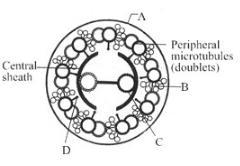
Identify the components labelled $A , B , C$ and $D$ in the given section of cilia/flagella showing different parts. Choose the option which shows the correct labelling of parts.
- ✓
$A -$ Plasma membrane, $B -$ Interdoublet bridge, $C -$ Central microtubule, $D-$ Radial spoke
- B
$A -$ Plasma membrane, $B -$ Arm, $C -$ Central microtubule, $D -$ Radial spoke
- C
$A -$ Plasma membrane, $B -$ Interdoublet bridge, $C -$ Hub, $D -$ Radial spoke
- D
$A-$ Plasma membrane, $B -$ Interdoublet bridge, $C -$ Hub, $D -$ Arm
AnswerCorrect option: A. $A -$ Plasma membrane, $B -$ Interdoublet bridge, $C -$ Central microtubule, $D-$ Radial spoke
a
In the given figure of cilia/flagella, the marked part as $A, B, C$ and $D$ are respectively plasma membrane, interdoublet bridge, central microtubule, and radial spoke.
View full question & answer→MCQ 1591 Mark
Microtubules, motor proteins, and actin filaments are all part of which of the following cell organelle
Answerc
The cytoskeleton supports the cell and allows movement of the entire cell and microtubules, motor proteins and actin filaments are part of the cytoskeleton.
View full question & answer→MCQ 1601 Mark
Microtubules are absent in
Answera
Microtubules are cylindrical rod like conractile structures that occur in the cytoplasm of all eukaryotic cells forming their cytoskeleton structure. Besides cytoplasm, microtubules occur in many specialized cellular structures like cilia, flagella, basal bodies, centrioles, astral rays, spindle apparatus, chromosome fibres etc.a
View full question & answer→MCQ 1611 Mark
............. are small structure which work like oars, causing the movement of either the cell or surrounding fluid
MCQ 1621 Mark
How many microtubules are present in peripheral region of flagella?
MCQ 1631 Mark
How many types of filament included in cytoskeleton structure?
MCQ 1641 Mark
Tubulin protein is not present in......
MCQ 1651 Mark
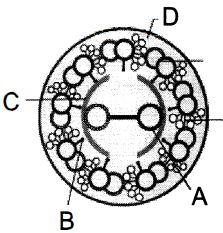
Study the diagram properly and select the correct option for labelled part $A, B, C$ and $D$
- ✓
$A-$ Central microtubule, $B-$ Radial spoke, $C-$ Central sheth, $D-$ Plasma membrane
- B
$A-$ Redial spoke, $B-$ Central sheth, $C-$ Plasma membrane, $D-$ Central microtubule
- C
$A-$ Plasma membrane, $B-$ Radial spoke, $C-$ Plasma membrane, $D-$ Central microtubule
- D
$A-$ Central sheth, $B-$ Plasma membrane, $C-$ Central microtubule, $D-$ Redial spoke
AnswerCorrect option: A. $A-$ Central microtubule, $B-$ Radial spoke, $C-$ Central sheth, $D-$ Plasma membrane
View full question & answer→MCQ 1661 Mark
Tubulin protein occurs in
- A
Rough endoplasmic reticulum
- ✓
- C
- D
View full question & answer→MCQ 1671 Mark
The cellular role for microtubule is
- A
- ✓
Intracellular communication
- C
Digestion of aged organelles
- D
Cell destruction during development
AnswerCorrect option: B. Intracellular communication
View full question & answer→MCQ 1681 Mark
Eukaryotic cells possess a cytoskeleton of
- ✓
Microtubules, microfilaments and cytoplasm
- B
Microtubules, microfilaments and protoplasm
- C
Microtubules, microfilaments and proteins
- D
AnswerCorrect option: A. Microtubules, microfilaments and cytoplasm
View full question & answer→MCQ 1691 Mark
The basal bodies at the base of flagella and cillia are
MCQ 1701 Mark
The principal protein of cilia and flagella is
MCQ 1711 Mark
Basal bodies of cilia and flagella are derived from
MCQ 1721 Mark
Flagella with single strand and composed of flagellin is found in
Answera
(a) The single stranded flagella occurs in prokaryotes e.g. Bacteria etc. They contain only single stranded and not contain $9$ + $2$ system.
View full question & answer→MCQ 1731 Mark
Pattern of organisation of cilia and flagella is
- A
$9 + 0$
- B
$9 + 1$
- ✓
$9 + 2$
- D
$9 + 3$
AnswerCorrect option: C. $9 + 2$
View full question & answer→MCQ 1741 Mark
Which of the following statement is incorrect w.r.t. ribosomes?
AnswerCorrect option: C. They are made up of $RNA$ only
c
They are made up of $rRNA$ and ribosomal proteins.
View full question & answer→MCQ 1751 Mark
Select the incorrect statement about prokaryotic ribosomes.
AnswerCorrect option: A. $50\; S$ and $30\; S$ subunits unite to form $80\; S$ ribosomes.
a
Prokaryotes have $70\; S$ ribosomes, each consisting of a small ($30\; S$) and a large ( $50\; S$) subunit. Polyribosomes (or polysomes) are a cluster of ribosomes, bound to a $RNA$ molecule in translation during the process of protein synthesis. It was first discovered and characterized by Jonathan Warner, Paul Knopf, and Alex Rich in $1963$. Polysomes indicate the synthesis of identical polvpeptide in multiple copies.
View full question & answer→MCQ 1761 Mark
Answerc
Several ribosomes may attach to a single $mRNA$ and forms a chain called polysomes. The ribosomes of a polysome translate the $mRNA$ into proteins.
View full question & answer→MCQ 1771 Mark
An organalle devoid of membrane covering is
Answerb
Ribosome is sub-spherical granular structure which is devoid of any covering membrane.
View full question & answer→MCQ 1781 Mark
What is correct for ribosome?
- A
Diameter is $7.0 \,\mu \ m$
- B
Size is $3$ to $5 \mu \ m $
- C
Length is $0.3 \mu \ m$
- ✓
Size is $15\,nm$ to $20\, nm$
AnswerCorrect option: D. Size is $15\,nm$ to $20\, nm$
View full question & answer→MCQ 1791 Mark
Which organelle common in prokaryota and eukearyotra ?
MCQ 1801 Mark
Which organelle present in large amount in cells which secrete protein ?
MCQ 1811 Mark
Prokaryotes ribosomes are $70S$ types, in this $S$ represents.
View full question & answer→MCQ 1821 Mark
View full question & answer→MCQ 1831 Mark
Ribosomes of bacteria, mitochondria, prokaryotes and chloroplast are of
- A
$50 S$ type
- B
$80 S$ type
- ✓
$70 S$ type
- D
$30 S$ type
AnswerCorrect option: C. $70 S$ type
View full question & answer→MCQ 1841 Mark
Answerc
(c)Ribosome is a combination of rRNA and protein.
View full question & answer→MCQ 1851 Mark
Polyribosomes are aggregation of
AnswerCorrect option: D. Several ribosomes held together by a stearing of $mRNA$
View full question & answer→MCQ 1861 Mark
Eukaryotic$ 80 S$ ribosome breaks into
- A
$40 S$ and $40 S$
- ✓
$60 S$ and $40 S$
- C
$60 S$ and $50 S$
- D
$50 S$ and $30 S$
AnswerCorrect option: B. $60 S$ and $40 S$
View full question & answer→MCQ 1871 Mark
Which of the following structures carries out a similar function in both plant and animal cell
Answerb
(b) Ribosomes carries out protein synthesis in both plant and animal cell.
View full question & answer→MCQ 1881 Mark
$70S$ type of ribosome shows two units whose sedimentation constants are
- A
$40 S and 30 S$
- B
$50 S and 20 S$
- ✓
$50 S and 30 S$
- D
$60 S and 20 S$
AnswerCorrect option: C. $50 S and 30 S$
View full question & answer→MCQ 1891 Mark
Which of the following organelles is present in bacterial cell
MCQ 1901 Mark
If all the ribosomes of a cell are destroyed
- A
Respiration will not take place
- B
Photosynthesis will not occur
- C
- ✓
Protein will not be formed
AnswerCorrect option: D. Protein will not be formed
View full question & answer→MCQ 1911 Mark
View full question & answer→MCQ 1921 Mark
Which of the following organelle is called as "protein factory of the cell''
Answerd
(d) Ribosomes are called site of protein synthesis because two sub-units of ribosomes are attached with the thread of $mRNA$. This $mRNA$ contains anticodes for protein synthesis.
View full question & answer→MCQ 1931 Mark
Which of the following cell organelle lacks DNA and bounding membrane
Answera
(a)Ribosomes are membraneless organelles which are made up of two sub-units and mRNA.
View full question & answer→MCQ 1941 Mark
Answera
(a) On the basis of their discovery they are called palade particles.
View full question & answer→MCQ 1951 Mark
The $80S$ ribosomes are present in
View full question & answer→MCQ 1961 Mark
Which type of ribosomes are found in Nostoc cells
- A
$50$ $S$
- B
$60$ $S$
- ✓
$70$ $S$
- D
AnswerCorrect option: C. $70$ $S$
View full question & answer→MCQ 1971 Mark
The larger sub-unit in $80$ $S$ ribosome is
- A
$50$ $S$
- ✓
$60$ $S$
- C
$40$ $S$
- D
$0$ $S$
AnswerCorrect option: B. $60$ $S$
View full question & answer→MCQ 1981 Mark
Which of the following statements is wrong for ribosomes
- A
- B
- C
- ✓
Both sub-units are bounded by a membrane
AnswerCorrect option: D. Both sub-units are bounded by a membrane
d
(d) Ribosomes are membraneless or without membraneous structure.
View full question & answer→MCQ 1991 Mark
Who discovered "ribosomes'' in animal cells
Answerd
(d)Ribosomes are also called palade particles.
View full question & answer→MCQ 2001 Mark
$A$ : Chloroplast is a semi-autonomous organelle.
$R$ : The ribosomes of the chloroplast are smaller than cytoplasmic ribosomes.
- A
Assertion and Reason both are correct and also correct explanation.
- ✓
Assertion and Reason both are correct but not explanation of assertion.
- C
Assertion is correct, but Reason is incorrect.
- D
Both Assertion and Reason are incorrect.
AnswerCorrect option: B. Assertion and Reason both are correct but not explanation of assertion.
b
It contains circular $DNA$ and $70\,S$ ribosomes.
View full question & answer→MCQ 2011 Mark
Mitochondria and chloroplasts are semi-autonomous as they possess
AnswerCorrect option: C. $DNA \;+ \;RNA\; +\; ribosomes$
c
Mitochondria and chloroplasts are semi autonomous body as they possess $DNA \;+\; RNA \;+ \;ribosomes$. But still they require nuclear genome for their functioning.
View full question & answer→MCQ 2021 Mark
Thylakoids are present in
Answerc
Thylakoid are sac-like structures containing pigments for photosynthesis.
View full question & answer→MCQ 2031 Mark
The orange colour of carrot root is due to the presence of
Answerc
Chromoplast contains carotenoids and are coloured.
View full question & answer→MCQ 2041 Mark
Which of the following plastid is coloured and contains carotenoids?
Answerd
Chromoplast - coloured plastids
View full question & answer→MCQ 2051 Mark
Which of these is wrongly matched?
- A
Chloroplasts - Chlorophyll
- ✓
- C
Chromoplasts - Carotenoids
- D
Amyloplasts - Carbohydrates
Answerb
Elaioplasts are colourless plastids which store lipids. Chromoplasts are yellow or reddish in colour because of the presence of carotenoid pigments. Chloroplasts are the most common type of plastids and are of prime biological importance as they contain
chlorophyll and provide food to all organisms through photosynthesis.
View full question & answer→MCQ 2061 Mark
- A
protein storing plastids.
- B
- ✓
- D
individual thylakoids present in stroma.
Answerc
rana is a stacked membranous structure within the chloroplasts of plants and green algae that contains the chlorophyll (green pigment). It is the site of the light reactions of photosynthesis. The sac-like membranes that make up grana are known as thylakoids.
View full question & answer→MCQ 2071 Mark
Plastids storing fat are called
Answera
Elaioplasts are a type of leucoplast that is specialized for the storage of lipids in plants. Elaioplasts house oil body deposits as rounded plastoglobuli, which are essentially fat droplets.
View full question & answer→MCQ 2081 Mark
- A
- B
- C
- ✓
all plant cells and euglenoides.
AnswerCorrect option: D. all plant cells and euglenoides.
d
Plastids are found in all plant cells and in euglenoides.
View full question & answer→MCQ 2091 Mark
Which of the following option correctly match $A, B, C,$ and $D$ indicated in the given sectional view of chloroplasts.
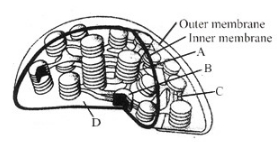
- ✓
$A -$ Thylakoid, $B -$ Stromal lamella, $C -$ Stroma, $D -$ Granum
- B
$A -$ Granum, $B -$ Thylakoid, $C -$ Stromal lamella, $D -$ Stroma
- C
$A-$ Thylakoid, $B -$ Granum, $C -$ Stromal lamella, $D -$ Stroma
- D
$A -$ Granum, $B -$ Thylakoid, $C -$ Stroma, $D -$ Stromal lamella
AnswerCorrect option: A. $A -$ Thylakoid, $B -$ Stromal lamella, $C -$ Stroma, $D -$ Granum
a
In the given diagram of chloroplast, the parts marked as $A, B, C$ and $D$ are respectively granum, thylakoid, stromal lamella and stroma. Granum is a stacked membranous structure that contains the chlorophyll and is the site of the light reactions of photosynthesis. Thylakoids are saclike membranes that make up grana. Stromal lamella are the extensions that run from one granum, through the stroma, into a neighbouring granum.The space between the inner membrane and the thylakoid membrane is filled with stroma, a matrix containing dissolved enzymes, starch granules, and copies of the chloroplast genome.
View full question & answer→MCQ 2101 Mark
Which leucoplasts are found more in number in potato ?
- ✓
- B
- C
$A$ and $B$ correct
- D
$A$ and $B$ incorrect
View full question & answer→MCQ 2111 Mark
It is not found in stroma.
MCQ 2121 Mark
…...are found in all plant cells and in euglenoides
MCQ 2131 Mark
AnswerCorrect option: C. Leucoplast - Colourless Plastids
View full question & answer→MCQ 2141 Mark
Where the starch is stored in the plant cell ?
MCQ 2151 Mark
- ✓
Plastids are found in euglenoids
- B
Diameter of cisternae of golgibody is $1.0\, \mu \,m$ to $4.1\, \mu \,m$
- C
Chloroplast is also seen in animal cell
- D
Arrangement of tubules in centriole is $9+2$
AnswerCorrect option: A. Plastids are found in euglenoids
View full question & answer→MCQ 2161 Mark
Which is correctly represents as cellular
- A
Centrosome $\rightarrow$ site of actively $RNA$ synthesis
- B
Lysosome $\rightarrow$ follicle released from nucleoplasm.
- ✓
Chloroplast $\rightarrow$ photosynthesis
- D
Ribosome $\rightarrow$ possess $DNA$
AnswerCorrect option: C. Chloroplast $\rightarrow$ photosynthesis
View full question & answer→MCQ 2171 Mark
Main function of amyloplast is
MCQ 2181 Mark
Extranuclear $DNA$ is found in
View full question & answer→MCQ 2191 Mark
Group of thylakoids is called
MCQ 2201 Mark
The parallel layering of membranes in chloroplast is suited for
- ✓
- B
Maximum exposure of enzymes
- C
Minimum light absorption so that the cells can maintain their temperature
- D
View full question & answer→MCQ 2211 Mark
If we separate the cell organelles of a living cell, then which part should be alive
Answerb
(b) Because chloroplast is a semi autonomous organelle so that able to protein synthesis.
View full question & answer→MCQ 2221 Mark
Which one of the following pigments does not occur in the chloroplast
Answerd
(d) Anthocyanin is found in cell sap of vacuoles.
View full question & answer→MCQ 2231 Mark
To which of the following aleuroplast is concerned
Answerb
(b)These cells possess aleurone grains or protein grains.
View full question & answer→MCQ 2241 Mark
The thylakoid in chloroplast are arranged as
Answerc
(c)The thylakoids of chloroplast are arranged in as stacks of coins or stacks of discs.
View full question & answer→MCQ 2251 Mark
View full question & answer→MCQ 2261 Mark
Fret channels are associated with
- ✓
Two grana of a chloroplast
- B
- C
- D
AnswerCorrect option: A. Two grana of a chloroplast
View full question & answer→MCQ 2271 Mark
When green tomatoes fruits turn to red, then
- ✓
Chloroplasts are disintegrated and get converted into chromoplasts
- B
New chromoplasts are formed
- C
Chromoplasts are changed to chloroplasts
- D
AnswerCorrect option: A. Chloroplasts are disintegrated and get converted into chromoplasts
View full question & answer→MCQ 2281 Mark
Answerd
(d) Colourless plastids amyloplast is a type of leucoplast which is responsible for storage of starch.
View full question & answer→MCQ 2291 Mark
Mark the incorrect statement
- A
All cells do not contains a true nucleus
- B
Respiration occurs in mitochondria
- C
Cell walls are generally made up of cellulose
- ✓
All living plant cells contains chlorophyll
AnswerCorrect option: D. All living plant cells contains chlorophyll
View full question & answer→MCQ 2301 Mark
Plant cells differ from animal cells in having
Answerd
(d)Plastids are present in plant cells and absent in most of the animal cells..
View full question & answer→MCQ 2311 Mark
Thylakoids are constituents of
MCQ 2321 Mark
A flattened disc-like sac in a chloroplast is called a
MCQ 2331 Mark
In which of the following cell organelle, both the photo and thermochemical reactions occur
Answerb
(b) Photosynthesis is photo and thermochemical process which occurs in chloroplast.
View full question & answer→MCQ 2341 Mark
Which of the following organelles is bounded by two unit membranes
MCQ 2351 Mark
In which plastids are not found
Answerd
(d) Plastids are the characteristic feature of photosynthetic eukaryotes. Blue green algae and bacteria are prokaryotes and fungi are saprophytic eukaryotes.
View full question & answer→MCQ 2361 Mark
Green pigment (Chlorophyll) presents in plants is
Answerb
(b)The green colour of plants is due to chlorophyll, which is found in chloroplast.
View full question & answer→MCQ 2371 Mark
Cell organelles found only in plants
Answerc
(c) Plants are autotrophs and synthesize their food in the process of photosynthesis with the help of chloroplast (plastid).
View full question & answer→MCQ 2381 Mark
The presence of $DNA$ in mitochondria and chloroplast supports the hypothesis that
AnswerCorrect option: A. Mitochondria and chloroplast both originated as independent free living organisms
View full question & answer→MCQ 2391 Mark
Select the incorrect statement w.r.t. mitochondria
AnswerCorrect option: C. The cristae decrease the surface area
c
Cristae increase surface area for enzymatic activities.
View full question & answer→MCQ 2401 Mark
The type of ribosomes found inside the mitochondria is
- A
$90\;s$
- B
$60\;s$
- C
$80\;s$
- ✓
$70\;s$
AnswerCorrect option: D. $70\;s$
d
Mitochondrial ribosomes $(70\;S)$ are smaller in size than cytosotic ribosomes.
View full question & answer→MCQ 2411 Mark
Both the membranes of mitochondrion are
- A
structurally different but functionally similar.
- ✓
structurally as well as functionally different.
- C
structurally similar but functionally different.
- D
tructurally different but functionally similar.
AnswerCorrect option: B. structurally as well as functionally different.
b
The mitochondrion is a double membrane-bound organelle found in most eukaryotic cells. It contains outer and inner membranes composed of phospholipid bilayers and proteins. The two membranes have different properties. Because of this double-membrane organization, there are five distinct parts to a mitochondrion- the outer mitochondrial membrane, the intermembrane space (the space between the outer and inner membranes), the inner mitochondrial membrane, the cristae space (formed by infolding's of the inner membrane), and the matrix (space within the inner membrane). Mitochondria are also called as the power house of the cell.
View full question & answer→MCQ 2421 Mark
The figure below shows the structure of a mitochondrion with its four parts labelled $(A), (B), (C)$ and $(D).$
Select the part correctly matched with its function.
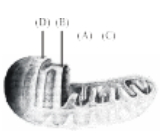
- A
$Part (D):$ Outer membrane - Gives rise to inner membrane by splitting.
- ✓
$Part (B):$ Inner membrane - Forms infoldings called cristae.
- C
$Part (C):$ Cristae - Possess single circular $DNA$ molecule and ribosomes.
- D
$Part (A):$ Matrix - Major site for respiratory chain enzymes.
AnswerCorrect option: B. $Part (B):$ Inner membrane - Forms infoldings called cristae.
b
The mitochondrial inner membrane forms infoldings known as cristae, which allow greater surface area for protein such as cytochrome to function properly and efficiently.
View full question & answer→MCQ 2431 Mark
Identify the $X, Y$ and $Z$ part from the given figure :
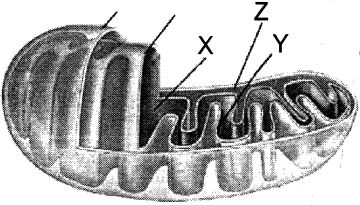
- ✓
$X-$ Matrix, $Y-$ Crista, $Z-$ Inter membranespace
- B
$X-$ Outer membrane, $Y-$ Matrix, $Z-$ Crista
- C
$X-$ Crista, $Y-$ Matrix, $Z-$ Inner membrane
- D
$X-$ Outer, $Y-$ Inner, $Z-$ Matrix
AnswerCorrect option: A. $X-$ Matrix, $Y-$ Crista, $Z-$ Inter membranespace
View full question & answer→MCQ 2441 Mark
In given figure, which alphabet shows a location of circular $DNA$?
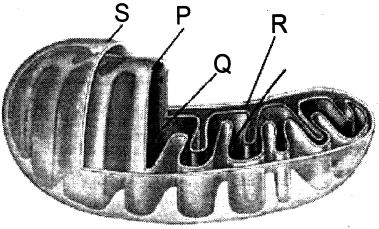
View full question & answer→MCQ 2451 Mark
The "power house" of a cell is ………
MCQ 2461 Mark
Folding of inner membrane of mitochondria are called
Answera
(a) Cristae are finger like process projecting inwards.
View full question & answer→MCQ 2471 Mark
Organelles which are regarded as $'Power house'$ of the cell and in which the oxidative reactions of the respiratory process takes place are
Answerd
(d) Mitochondria are called power house or storage batteries or ATP mills as these are sites of ATP formation (Respiration) through electron transport and oxidative phosphorylation which is used in various metabolic activities/functions of the cell.
View full question & answer→MCQ 2481 Mark
Which of the following cell organelle is considered to be rich in catabolic enzymes
Answerd
(d) Mitochondria is responsible for the process of respiration which is a destructive or catabolic process.
View full question & answer→MCQ 2491 Mark
Oxidative enzymes occurs mostly in
Answerc
(c) Mitochondria is a respiratory organelle where oxidation of stored food material takes place.
View full question & answer→MCQ 2501 Mark
Function of mitochondria is
- A
To provide $CoA$
- B
To synthesize $PGA$
- ✓
To release energy during respiration
- D
AnswerCorrect option: C. To release energy during respiration
View full question & answer→MCQ 2511 Mark
Respiratory enzymes are present in
MCQ 2521 Mark
Which organelle has electron transport system
Answerc
(c) $ETS$ present in oxysome which present on cristae of inner membrane of mitochondria.
View full question & answer→MCQ 2531 Mark
Mitochondria are usually found in
- A
- B
- ✓
Both reproductive and vegetative cells
- D
AnswerCorrect option: C. Both reproductive and vegetative cells
c
(c) Both reproductive and vegetative cells respire therefore mitochondria are present.
View full question & answer→MCQ 2541 Mark
Mitochondria supply most of the necessary biological energy by
AnswerCorrect option: B. Oxidizing substrates of $TCA$ cycle
View full question & answer→MCQ 2551 Mark
Mitochondria are non-existent in
MCQ 2561 Mark
The proteins, forming the membranes of mitochondria are called
MCQ 2571 Mark
Mitochondria are the store houses or power house of
Answerb
(b) $ATP$ is the energy currency of cell which is synthesized and stored in mitochondria.
View full question & answer→MCQ 2581 Mark
- ✓
By growth and division of pre-existing mitochondria
- B
From non-mitochondrial membranes
- C
From precursors of the cytoplasm
- D
AnswerCorrect option: A. By growth and division of pre-existing mitochondria
View full question & answer→MCQ 2591 Mark
The site for cellular respiration is
MCQ 2601 Mark
The number of mitochondria increases in cells of
MCQ 2611 Mark
Mitochondria are related to
MCQ 2621 Mark
$ATP$ is formed in
View full question & answer→MCQ 2631 Mark
View full question & answer→MCQ 2641 Mark
If living cells similar to those found on earth, were found on another planet where there was no oxygen. Which cell organelle would most probably be absent
Answerc
(c) Mitochondria is a respiratory organ. In absence of $O_2$ respiration does not take place and mitochondria would be absent.
View full question & answer→MCQ 2651 Mark
The ready source of energy in living cells is
Answerb
(b) The immediate energy source for muscle contraction is $ATP$ which is present only in small quantities at any given time in the muscle.
View full question & answer→MCQ 2661 Mark
In plants, the tonoplast facilitates the transport of a number of ions and other materials
- ✓
Against concentration gradient into vacuole
- B
Along concentration gradient into vacuole
- C
Along concentration gradient into gas vacuoles
- D
Against concentration gradient in contractile vacuole
AnswerCorrect option: A. Against concentration gradient into vacuole
a
Plant cells do not contain gas and contractile vacuole and movement of molecules across tonoplast is always against concentration gradient and require energy.
View full question & answer→MCQ 2671 Mark
- ✓
Membrane bound minute vesicles
- B
Non-membrane bound organelles
- C
- D
AnswerCorrect option: A. Membrane bound minute vesicles
a
Microbodies are present in both animals and plants.
View full question & answer→MCQ 2681 Mark
Given below are some characters of a cell organelle. Identify the correct organelle which shows all the characters described above.
$(i)$ It is a membrane bound space found in the cytoplasm.
$(ii)$ It is bound by a single membrane called tonoplast.
$(iii)$ It contains water, sap, excretory products and other materials not useful to the cell.
$(iv)$ It has higher concentration of sap than the cytoplasm.
Answerd
The given characters are related to cell organelle vacuole. Vacuole is a membrane bound organelle, found in both animal and plant cells but are much larger in plant cells. Vacuoles are essentially enclosed compartments which are filled with water containing inorganic and organic molecules including enzymes in solution, though in certain cases they may contain solids which have been engulfed. Vacuoles might store food or any variety of nutrients a cell might need to survive. They can even store waste products so the rest of the cell is protected from contamination.
View full question & answer→MCQ 2691 Mark
Read the folowing statements and identify the correct option.
$(i)$ Contractile vacuole takes part in osmoregulation and excretion.
$(ii)$ Food vacuole is formed by engulfing the food particles.
$(iii)$ The vacuole is bound by a double membrane called tonoplast.
$(iv)$ Vacuole can occupy upto $90$ percent of the volume of the cell.
- A
$(i)$ and $(ii)$
- B
$(ii)$ and $(iv)$
- ✓
$(i), (ii)$ and $(iv)$
- D
AnswerCorrect option: C. $(i), (ii)$ and $(iv)$
c
The vacuole is bound by a single membrane called tonoplast.
View full question & answer→MCQ 2701 Mark
Which of the following statement is correct regarding vacuole?
- A
It is membrane-bound and contains storage proteins and lipids.
- ✓
It is membrane-bound and contains water and excretory substances.
- C
It lacks membrane and contains air.
- D
It lacks membrane and contains water and excretorysubstances.
AnswerCorrect option: B. It is membrane-bound and contains water and excretory substances.
b
Vacuole is a membrane bound organelle, found in both animal and plant cells but are much larger in plant cells. Vacuoles are essentially enclosed compartments which are filled with water containing inorganic and organic molecules including enzymes in solution, vacuoles might store food or any variety of nutrients a cell might need to survive. They can even store waste products so the rest of the cell is protected from contamination.
View full question & answer→MCQ 2711 Mark
Match column-$I$ with column-$II$ and choose the correct option.
| Column-$I$ |
Column-$II$ |
| $A$. Tonoplast |
$I$. Contain digestive enzyme |
| $B$. Contractile vacuole |
$II$. Store metabolic gases |
| $C$. Food vacuole |
$III$. Excretion |
| $D$. Air vacuole |
$IV$. Transport of ions in plants |
- ✓
$A-I V ; B-I I I ; C-I ; D-I I$
- B
$A-I I ; B-I I I ; C-I V ; D-I$
- C
$A-I V ; B-I I ; C-I I I ; D-I$
- D
$A-I ; B-I I I ; C-I I ; D-I V$
AnswerCorrect option: A. $A-I V ; B-I I I ; C-I ; D-I I$
a
Tonoplast is a membrane separating a vacoule from the surrounding cytoplasm in a plant cell. It controls ionic movement in and around the cell. Contractile vacuole is a sub-cellular structure found in unicellular algae. It absorbs excess water and wastes from a microorganism's cell and excretes them into the environment. Food vaculole is a membraneunclosed cell vacuole with a digestive function. It contains material taken up in by the process of phagocytosis. Air vacuole is a small cavity or space in the tissues. It stores metabolic gases.
View full question & answer→MCQ 2721 Mark
Function of contractile vacuole in Amoeba is
- ✓
excretion and osmoregulation.
- B
digestion and respiration.
- C
osmoregulation and transportation.
- D
AnswerCorrect option: A. excretion and osmoregulation.
a
Contractile vacuole is a sub-cellular structure (or organelle) which is found primarily in protists (for eg, Amoeba) and unicellular algae. Contractile vacuole is responsible for excretion and osmoregulation. It absorbs excess water and wastes from a microorganism's cell and excretes them into the environment by contracting. Contractile vacuoles function in a periodic cycle by expanding while collecting water and contracting to release the water.
View full question & answer→MCQ 2731 Mark
Most of water, in mature plant cells occurs in
Answerc
In plant cells, the vacuoles can occupy upto $90$ percent of the volume of the cell. The vacuole is bound by a single membrane called tonoplast.
View full question & answer→MCQ 2741 Mark
It is not concern with protein synthesis
MCQ 2751 Mark
What is present in amoeba for excretion ?
MCQ 2761 Mark
In cytoplasm high numbers of including bodies is called........
- ✓
- B
Called intermediate filaments
- C
- D
View full question & answer→MCQ 2771 Mark
In plant cell the vacuoles can occupy upto ..............of the volume of the cell
- A
$30\% $
- B
$80\% $
- C
$100\%$
- ✓
$90\%$
AnswerCorrect option: D. $90\%$
View full question & answer→MCQ 2781 Mark
View full question & answer→MCQ 2791 Mark
The function of vacuole is
MCQ 2801 Mark
Vacuoles of plants can be involved in which of the following activity
MCQ 2811 Mark
The colour of rose petals is due to water soluble pigments present in the
MCQ 2821 Mark
- A
Covering layer of golgi complex
- ✓
Covering layer of vacuoles
- C
Covering layer of microbodies
- D
Non-living cytoplasmic content
AnswerCorrect option: B. Covering layer of vacuoles
View full question & answer→MCQ 2831 Mark
View full question & answer→MCQ 2841 Mark
pH of vacuolar cell sap is
- A
- B
- ✓
- D
Equal to cytoplasm and isotonic
View full question & answer→MCQ 2851 Mark
In plant cells the site of storage of minerals is
MCQ 2861 Mark
Most of the water in turgid plant cells occurs chiefly
MCQ 2871 Mark
Microbodies differ from lysosomes in that
- A
Microbodies are surrounded by a single unit membrane while lysosome membrane is double
- B
Microbodies are surrounded by double membrane while lysosomes membrane is single unit
- C
Microbodies contain lytic enzymes while lysosomes do not
- ✓
Lysosome contain lytic enzymes while microbodies do not
AnswerCorrect option: D. Lysosome contain lytic enzymes while microbodies do not
View full question & answer→MCQ 2881 Mark
Excretion in Amoeba occurs through
Answerc
(c)Being unicellular, no specific excretory system develop so this function can be performed by plasmalemma by diffusion process.
View full question & answer→MCQ 2891 Mark
$A$ : Lysosomes help in digestion of foreign particles in the animal cells.
$R$ : They have respiratory enzymes.
- A
Assertion and Reason both are correct and also correct explanation.
- B
Assertion and Reason both are correct but not explanation of assertion.
- ✓
Assertion is correct, but Reason is incorrect.
- D
Both Assertion and Reason are incorrect.
AnswerCorrect option: C. Assertion is correct, but Reason is incorrect.
c
Lysosomes have hydrolytic enzymes.
View full question & answer→MCQ 2901 Mark
Which sententences are correct for lysosomes ?
$1 -$ It is suicidal bag
$2-$ it posses one layer
$3 -$ It is self replicating organell.
$4 -$ It contains hydrolase type of digestive enzymes.
$5 -$ It always seen near the nucleus
$6 -$ It plays an important role in phagocytosis and pinocytosis
$7-$ It is in animal cell and also in plant cell.
- A
$1, 6, 5, 4, 2 $
- B
$2, 3, 6, 7,4 $
- C
$1, 3, 5, 7,4 $
- ✓
$1, 2, 4, 6,7 $
AnswerCorrect option: D. $1, 2, 4, 6,7 $
View full question & answer→MCQ 2911 Mark
In the cell digestive enzymes are mostly in
Answera
(a) In the cell digestive or hydrolytic enzymes mostly found in lysosomes.
View full question & answer→MCQ 2921 Mark
A lysosome in which intracellular organells is digested is called
MCQ 2931 Mark
Lysosomes are generally found in
MCQ 2941 Mark
The cell organelle showing extensive polymorphism is
Answerc
(c) Lysosomes exist as primary, secondary and tertiary lysosomes.
View full question & answer→MCQ 2951 Mark
Which is concerned with autolysis
Answerc
(c) Because lysosome contains digestive enzymes capable of lysis, thus it is a lytic body or suicidal bag.
View full question & answer→MCQ 2961 Mark
The cellular role for lysosome is not
- A
Ingestion of foreign bodies
- B
Digestion of aged organelles
- C
Cell destruction during development
- ✓
View full question & answer→MCQ 2971 Mark
Lysosomes are so called because these contain
MCQ 2981 Mark
What would happen if lysosomes get ruptured inside the cells in which they are present
Answerc
(c) Cell wall die due to the release of enzyme of lysosome (autolysis).
View full question & answer→MCQ 2991 Mark
Scavenging of worn out cell parts and denatured proteins in the cells is done by
MCQ 3001 Mark
The main function of lysosomes is
MCQ 3011 Mark
Which of the following statements is incorrect with reference to lysosomes
- A
They are filled acid hydrolase and other enzymes
- ✓
They are monomorphic and uniform in structure and function
- C
- D
They can digest proteins, nuclei acids, lipids and polysaccharides
AnswerCorrect option: B. They are monomorphic and uniform in structure and function
b
(b) Because lysosome is polymorphic (primary, secondary, tertiary, autophagic) and polyfunctional cell organelle.
View full question & answer→MCQ 3021 Mark
Certain golgian vesicles, which are budded out from the trans-face contains acid hydrolases. Such vesicles are better termed as
Answerd
As they contain hydrolytic enzymes but they are inactive.
View full question & answer→MCQ 3031 Mark
Which of the following statement is incorrect about golgi apparatus?
- A
It helps in recycling of the plasma membrane, pinched off by pinocytosis and phagocytosis
- B
Secretion is the main function of the golgi complex
- C
It helps in glycosidation and glycosylation of lipids and proteins
- ✓
Golgi body helps in animal cytokinesis
AnswerCorrect option: D. Golgi body helps in animal cytokinesis
d
Golgi apparatus helps in plant cytokinesis by initiating cell plate formation and it is known as phragmoplast.
View full question & answer→MCQ 3041 Mark
Study the organelle given below and identify its function
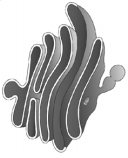
AnswerCorrect option: A. It is a site for formation of glycoproteins and glycolipids
a
The organelle in picture is Golgi complex.
View full question & answer→MCQ 3051 Mark
A number of proteins synthesised by ribosomes present on the $ER$ are transferred to
Answerd
Proteins synthesised by ribosomes are transferred to Golgi appratus for modification and packaging
View full question & answer→MCQ 3061 Mark
Which of the following is common to both $ER$ and Golgi complex?
Answerb
Both $ER$ and Golgi complex have cisternae
View full question & answer→MCQ 3071 Mark
Read the statements given below with regard to the functions performed by Golgi apparatus?
$(i)$ Transport and chemically modify the materials contained within it.
$(ii)$ Performs the function of packaging materials.
$(iii)$ Important site of formation of glycoproteins and glycolipids.
Which of the following is the correct answer?
- A
$(i)$ is wrong but $(ii)$ and $(iii)$ are correct
- B
$(ii)$ is wrong but $(i)$ and $(iii)$ are correct
- C
$(ii)$ and $(iii)$ are wrong but $(i)$ is correct
- ✓
Answerd
All the functions described are performed by Golgi apparatus. The Golgi apparatus is an organelle found in most eukaryotic cells. It was identified in $1897$ by the Italian physician Camillo Golgi and named after him in $1898$ . Golgi apparatus is the important site of formation of glycoproteins and glycolipids.
View full question & answer→MCQ 3081 Mark
Golgi apparatus is concerned with
- A
- ✓
- C
$ATP$ synthesis
- D
$RNA$ synthesis
Answerb
Golgi apparatus principally performs the function of packaging material to be delivered either to the intra -cellular targets or secreted outside the cell.
View full question & answer→MCQ 3091 Mark
_____________is the important site of formation of glycoproteins and golycolipids.
Answerc
The Golgi apparatus (also known as the Golgi complex, Golgi body) is an organelle, identified in $1897$ by the Italian physician Camillo Golgi and named after him in $1898$ . Golgi apparatus is the important site of formation of glycoproteins and glycolipids. It functions as a factory in which proteins received from the $ER$ are further processed and sorted for transport to their ultimate endpoints: lysosomes, the plasma membrane.
View full question & answer→MCQ 3101 Mark
Function of $RER$ is
Answerb
Rough endoplasmic reticulum ($RER$) is found throughout the cell but its density is higher near the nucleus and the Golgi apparatus. Ribosomes present on the rough endoplasmic reticulum are called 'membrane bound' and are responsible for the assembly of many proteins (in a process called translation (a step in protein synthesis).
View full question & answer→MCQ 3111 Mark
Identify the cell organelle given below. Which is an important site of formation of glycoproteins & glycolipids?
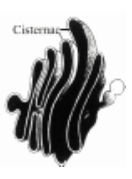
- A
Rough endoplasmic reticulum
- B
Smooth endoplasmic reticulum
- ✓
- D
Answerc
The given cell organelle is Golgi body. Golgi apparatus is found in most eukaryotic cells. It was identified in $1897$ by the Italian physician Camillo Golgi and named after him in $1898$ . Functions as a factory in which proteins received from the ER are further processed and sorted for transport to their eventual destinations: lysosomes, the plasma membrane, or secretion.
View full question & answer→MCQ 3121 Mark
The main organelle involved in modification and routing of newly synthesized proteins to their destinations is
Answerd
Endoplasmic reticulum bearing ribosomes on their surface is called rough endoplasmic reticulum (RER). RER is involved in protein synthesis and are responsible for the assembly of many proteins (in a process called translation).
View full question & answer→MCQ 3131 Mark
Golgi apparatus is absent in
- A
- B
- ✓
bacteria and blue-green algae
- D
AnswerCorrect option: C. bacteria and blue-green algae
c
Bacteria and blue green algae are $PROKARYOTIC$ unicellular organisms which are devoid of membrane bound nucleus and organelles. Golgi is present in plant cells as single unit $DICTYOSOMES$ in plant cells.
View full question & answer→MCQ 3141 Mark
Read the given statement and select the correct option
$I.$ In golgi complex, the cisternae have cis face and trans face
$II.$ The cis face and trans face of Golgi complex are called forming face and maturing face respectively
View full question & answer→MCQ 3151 Mark
Difference between rough and smooth endoplasmic reticulum is that
AnswerCorrect option: A. rough $ER$ has ribosomes
View full question & answer→MCQ 3161 Mark
What is correct for the arrangement in Golgibody?
- A
Cis is a concave part of golgibody
- B
Trans is a convex part of golgibody
- ✓
Cis and trans are interconnected
- D
Cis and trans are extremely free from eachother
AnswerCorrect option: C. Cis and trans are interconnected
View full question & answer→MCQ 3171 Mark
Which of the following order is correct for hydrolase kind of enzyme since its synthesis to pack into lysosome?
- ✓
$RER$ $\rightarrow$ Cis $\rightarrow$ Trans $\rightarrow$ Vesicle
- B
$SER$ $\rightarrow$ $RER$ $\rightarrow$ Cis $\rightarrow$ Vesicle
- C
$RER$ $\rightarrow$ Trans $\rightarrow$ Cis $\rightarrow$ Vesicle
- D
$RER$ $\rightarrow$ Vesicle $\rightarrow$ Trans $\rightarrow$ Lysosomes
AnswerCorrect option: A. $RER$ $\rightarrow$ Cis $\rightarrow$ Trans $\rightarrow$ Vesicle
View full question & answer→MCQ 3181 Mark
Trans face of golgi bodies........
- A
- ✓
Convene and developed phase
- C
Concex and not well developing
- D
Convene and not developed part
AnswerCorrect option: B. Convene and developed phase
View full question & answer→MCQ 3191 Mark
Granum bodies indirectly connected with……
- A
- B
- C
- ✓
Degeneration of senescence call
AnswerCorrect option: D. Degeneration of senescence call
View full question & answer→MCQ 3201 Mark
There compartnents of golgi bodies which are...........
- A
Membrane, tubule and vesicles
- ✓
Cisternae, tubule and vesicles
- C
Cisternae, tubule and membrane
- D
Granum, thylakoid and vesicles
AnswerCorrect option: B. Cisternae, tubule and vesicles
View full question & answer→MCQ 3211 Mark
Which organelle lisin touch with outer nuclear membrane ?
MCQ 3221 Mark
.......... produce high amount by cell which not having ribosome on its endoplasmic reticulum.
MCQ 3231 Mark
Lack of which organelle, steroid hormones do not synthesis in animal cell ?
- ✓
$SER $
- B
$RER$
- C
$A$ and $B$ true
- D
$A$ and $B$ false
AnswerCorrect option: A. $SER $
View full question & answer→MCQ 3241 Mark
In the following what is the function of $SER$ (Smooth Endoplasmic recticulum) ?
- ✓
Synthesis of steroid hormones
- B
Synthesis of glycoprotein
- C
Synthesis of hydrolaze enzymes
- D
AnswerCorrect option: A. Synthesis of steroid hormones
View full question & answer→MCQ 3251 Mark
In which of the below cisternae is found?
- A
- B
Only in $ER$
- ✓
In $ER$ and golgibody
- D
AnswerCorrect option: C. In $ER$ and golgibody
View full question & answer→MCQ 3261 Mark
In golgibody it is found …….
MCQ 3271 Mark
View full question & answer→MCQ 3281 Mark
Identify correct sequence starting from synthesis of protein transportation and Packing
- A
$RER-$ Golgi body -Nucleus - Lysosomes
- B
$SER-$ Golgi body - Lysosomes
- ✓
$RER-$ Golgi body - Lysosomes
- D
Lysosomes - Golgi body $-ER$
AnswerCorrect option: C. $RER-$ Golgi body - Lysosomes
View full question & answer→MCQ 3291 Mark
Endoplasmic reticulum is in continuation with
MCQ 3301 Mark
Which of the following structure is the functional unit in a golgi complex
MCQ 3311 Mark
Zone of exclusion is associated with
MCQ 3321 Mark
Secretory and membrane proteins are processed in
Answerc
(c) Golgi apparatus; because it secretes many types of metabolic enzymes.
View full question & answer→MCQ 3331 Mark
The golgi apparatus is bounded by
MCQ 3341 Mark
Golgi bodies are absent in
MCQ 3351 Mark
Which is not function of golgibody
- A
- B
Formation of plasmamembrane
- ✓
- D
Answerc
(c) Fat synthesis is the main function of smooth endoplasmic reticulum.
View full question & answer→MCQ 3361 Mark
Golgi body originated from
Answerb
(b) The formation/origin of new golgi body is always from endoplasmic reticulum, cisternae are similar in both.
View full question & answer→MCQ 3371 Mark
Least stable endoplasmic reticulum is
MCQ 3381 Mark
$RER$ is mainly concerned with
Answerc
(c) RER has ribosome on which protein synthesis occurs.
View full question & answer→MCQ 3391 Mark
The endoplasmic reticulum often bears
Answerd
(d) Ribosomes are bounded on RER with the help of ribophorin.
View full question & answer→MCQ 3401 Mark
Single unit membrane structure present in the cytoplasm in the form of a net is
MCQ 3411 Mark
In endoplasmic reticulum the following process take place
- A
- B
Channeling of biosynthetic processes
- C
- ✓
View full question & answer→MCQ 3421 Mark
The most important function of endoplasmic reticulum is
- ✓
- B
- C
- D
To give shape to the cell
Answera
(a) Because $E.R.$ possesses ribosomes on their membrane which are responsible for protein synthesis.
View full question & answer→MCQ 3431 Mark
Endoplasmic reticulum is more developed in
MCQ 3441 Mark
The transfer vesicle from RER fuse with which region of golgi complex
Answera
(a) The margins of cisternae of golgi body are slightly curved, so each cisternae has convex cis or forming face toward the nucleus and $ER$, whereas concave trans or maturing face towards the plasma membrane. It is believed that nuclear membrane and $SER$ the source of small vesicles that fuse with the cis form.
View full question & answer→MCQ 3451 Mark
$SER$ produces
Answerc
(c) The production of lipid is concern with the smooth ER and production of protein with RER.
View full question & answer→MCQ 3461 Mark
Select the correct combination of the statements regarding the characteristics of middle lamella
$a$. It holds the different neighbouring cells together.
$b$. It is composed of Mg pectate only.
$c$. It gets dissolved during ripening of fruits.
Correct statements is/are
- ✓
$a\;and\;c$
- B
$b \;and\; c$
- C
$Only\; a$
- D
$a, b \;and\; c$
AnswerCorrect option: A. $a\;and\;c$
a
Middle lamella is composed of $Mg$ pectate and $Ca$ pectate
View full question & answer→MCQ 3471 Mark
The cell wall consists of
- A
Lignin, hemicellulose, protein and lipid.
- B
Hemicellulose, cellulose, tubulin and lignin
- C
Lignin, hemicellulose, pectin and lipid cellulose
- ✓
Lignin, hemicellulose, pectin and cellulose
AnswerCorrect option: D. Lignin, hemicellulose, pectin and cellulose
d
Lignin, hemicellulose, pectin and cellulose
View full question & answer→MCQ 3481 Mark
Which of the following is not the function of cell wall?
$(i)$ Provides shape to the cell.
$(ii)$ Protects the cell from mechanical damage and infection.
$(iii)$ Helps in cell to cell interaction.
$(iv)$ Provides barrier to undesirable macromolecules.
Answerd
All the given function is related to cell wall. Cell wall is a very tough, flexible and fairly rigid layer that surrounds some types of cells. It surrounds the cell membrane and provides these cells with structural support and protection. It also acts as a filtering mechanism.
View full question & answer→MCQ 3491 Mark
Which of the following will determines the shape of the cells and provides a strong structural support to prevent the bacterium from bursting or collapsing?
Answerb
Cell wall is a very tough, flexible and rigid layer that surrounds the cell membrane. Cell wall determines the shape of the cells and provides a strong structural support to prevent the bacterium from bursting or collapsing.
View full question & answer→MCQ 3501 Mark
Which one of the following structures between two adjacent cells is an effective transport pathway?
Answera
Plasmodesmata is an effective transport pathway present between two adjacent cells. They are microscopic channels which traverse the cell walls of plant cells and some algal cells, enabling transport and communication between them.
View full question & answer→MCQ 3511 Mark
$A$ student placed two cells in the same solution in two different containers. The observation was given in the table
| container |
observation |
| $1$ |
cell burst |
| $2$ |
cell does not change its shape |
Which structure maintains the shape of the cell present in container $2$ and provides the most significant difference between the two cells?
Answerb
The cell wall protects the cell, maintains its shape and provides supports and strength to it. Nucleus controls the cell's activities. Chloroplast is a cell organelle that makes food for the plant cell. The cell membrane holds the parts of the cell together and also separates the cell from its surroundings.
View full question & answer→MCQ 3521 Mark
Which of the following lacks cell wall?
Answerd
Cell wall is a characteristic feature to cells of plants, bacteria, fungi, algae and some archaea. It is located outside the cell membrane. The major function of the cell wall is to provide rigidity, tensile strength, structural support, protection against mechanical stress and infection. It also help in diffusion of gases in and out of the cell. Gametes, Amoeba and Mycoplasma lack cell wall.
View full question & answer→MCQ 3531 Mark
Which of the following is correct for middle lamella of eukaryotic cell ?
MCQ 3541 Mark
Galactans and mannas are found in
- A
- B
Outer membrane of mitochondria
- ✓
- D
View full question & answer→MCQ 3551 Mark
What is present between two near by cell wall in plant?
- A
Middle lamella mede up of Suberin
- B
Middle lamela mede up of Lignin
- C
Cell wall made up of Cellulose
- ✓
Middle lamella made up of Pectin
AnswerCorrect option: D. Middle lamella made up of Pectin
View full question & answer→MCQ 3561 Mark
- A
Plasmodesmata - Nuclear membrane
- B
Glycoprotein $-ER$
- ✓
Suberin - secondary cell wall
- D
Calcium phosphate -algal cell wall
AnswerCorrect option: C. Suberin - secondary cell wall
View full question & answer→MCQ 3571 Mark
Desmosomes or Tonofibrils are
- A
- B
Another name of golgi complex
- ✓
Formed in cytoplasm by the union of plasma membrane
- D
AnswerCorrect option: C. Formed in cytoplasm by the union of plasma membrane
View full question & answer→MCQ 3581 Mark
Which of the following layer is present nearest to plasma membrane in plant cell
Answera
(a) Secondary wall situated near the plasma membrane. After the formation of primary wall.
View full question & answer→MCQ 3591 Mark
View full question & answer→MCQ 3601 Mark
View full question & answer→MCQ 3611 Mark
The possibility of being outermost layer of cell is highest for which of the following
MCQ 3621 Mark
The cell wall of plant cells are
Answerc
(c) Triple layered i.e. primary layer, secondary layer and middle lamella.
View full question & answer→MCQ 3631 Mark
Which one part of the cell is non-living
MCQ 3641 Mark
Which one is not a component of normal cell wall
MCQ 3651 Mark
- A
Present inside the primary wall
- B
Present inside the secondary wall
- ✓
Present outside the primary wall
- D
Present in between secondary and tertiary walls
AnswerCorrect option: C. Present outside the primary wall
View full question & answer→MCQ 3661 Mark
The chemical substance most abundantly present in the middle lamella is
MCQ 3671 Mark
In the middle lamella of plant cell walls, one of the main elements is
Answerb
(b) In the form of calcium pectate.
View full question & answer→MCQ 3681 Mark
Cell wall in higher plants is made up of
MCQ 3691 Mark
The strength and rigidity of a cell wall is due to the substance known as
MCQ 3701 Mark
The internal layer joining the primary walls of the two adjacent cells is known as
MCQ 3711 Mark
The minute protoplasmic connections between cells are called
Answerb
(b) Through plasmodesmata, plasmoderm or a fine thread of protoplasm is passing.
View full question & answer→MCQ 3721 Mark
$A$ : Lipids are arranged within the cell membrane with the hydrophobic tails towards the inner part.
$R$ : This ensures that non-polar tail of saturated hydrocarbons is protected from the aqueous environment.
- ✓
Assertion and Reason both are correct and also correct explanation.
- B
Assertion and Reason both are correct but not explanation of assertion.
- C
Assertion is correct, but Reason is incorrect.
- D
Both Assertion and Reason are incorrect.
AnswerCorrect option: A. Assertion and Reason both are correct and also correct explanation.
a
This ensures that they do not come in contact with water (aqueous environment).
View full question & answer→MCQ 3731 Mark
Identify the structures marked as $A, B, C$ and $D$ w.r.t fluid mosaic model of plasma membrane
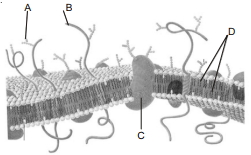
- A
| Protein |
Sugar |
Integral protein |
Lipid monolayer |
- B
| Sugar |
Protein |
Peripheral protein |
Lipid bilayer |
- C
| Protein |
Sugar |
Peripheral protein |
Lipid bilayer |
- ✓
| Sugar |
Protein |
Integral protein |
Lipid bilayer |
AnswerCorrect option: D.
| Sugar |
Protein |
Integral protein |
Lipid bilayer |
d
Plasma membrane : Most accepted model of plasma membrane is fluid mosaic model.
View full question & answer→MCQ 3741 Mark
According to widely accepted "fluid mosaic model" cell membranes are semi-fluid, where lipids and integral proteins can diffuse randomly. In recent years, this model has been modified in several respects. In this regard, which of the following statements is incorrect?
- A
Proteins in cell membranes can travel within the lipid bilayer.
- ✓
Proteins can also undergo flip-flop movements in the lipid bilayer.
- C
Proteins can remain confined within certain domains of the membrane.
- D
Many proteins remain completely embedded within the lipid bilayer.
AnswerCorrect option: B. Proteins can also undergo flip-flop movements in the lipid bilayer.
b
The quasi-fluid nature of lipid enable lateral movement of proteins within the overall bilayer. This ability to move within the membrane is measured as its fluidity.
View full question & answer→MCQ 3751 Mark
The best material for study of structure of cell membrane is
- ✓
$RBC$ of human
- B
$R B C$ of frog
- C
- D
AnswerCorrect option: A. $RBC$ of human
a
$RBC$ (red blood cell) of the human is the best material for the study of structure of cell membrane. Chemical studies on the $RBC$ cell membrane enabled the scientists to infer the possible structure of plasma membrane. The plasma membrane of the $RBC$ consists of a complex, well-ordered group of lipids and proteins stretched over the outer surface of the cell in the form of a lipid bilayer punctuated by penetrating or attached proteins. This membrane has numerous properties that arise in part from specialized interactions between specific membrane proteins or lipids, or both.
View full question & answer→MCQ 3761 Mark
The lipid component of the membrane mainly consists of
Answerb
The lipid component of the membrane is mainly consists of phosphoglycerides. Phosphoglyceride are glycerol-based phospholipids and main component of biological membranes. Each glycerophospholipid molecule consists of a small polar head group and two long hydrophobic chains.
View full question & answer→MCQ 3771 Mark
The membrane of the erythrocytes has approximately ___ $\%$ of proteins and ___$\%$ lipids.
- A
$42,50$
- ✓
$52,40$
- C
$50,50$
- D
$60,40$
AnswerCorrect option: B. $52,40$
b
The ratio of protein and lipids varies considerably in different cell types. The membrane of the erythrocytes has approximately $52 \%$ of proteins and $40 \%$ lipids.
View full question & answer→MCQ 3781 Mark
Active transport across biomembrane involves
Answerb
An energy dependent process, in which $ATP$ is utilised is called an active transport. e.g., $Na ^+/ K ^+$ Pump.
View full question & answer→MCQ 3791 Mark
The diagram given below represent a filuid mosaic model of plasma membrance. Match the components marked as $A, B, C, D$ and $E$ in the diagram below from the list $(i)$ to $(vii)$.
$(i)$ Sugar $(ii)$ Protein $(iii)$ Lipid bilayer $(iv)$ Integral protein $(v)$ Cytoplasm $(vi)$ Cell wall $(vii)$ External protein
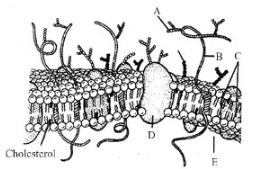
- ✓
$A-(i), B-(i i), C-(i i i), D-(i v), E-(v)$
- B
$A-(i i), B-(i), C-(i i i), D-(i v), E-(v)$
- C
$A - (i), B - (ii), C - (iii), D - (iv), E - (vi)$
- D
$A - (i), B - (ii), C - (iii), D - (vii), E - (v)$
AnswerCorrect option: A. $A-(i), B-(i i), C-(i i i), D-(i v), E-(v)$
a
The given diagram shows the fluid mosaic model of cell membrane. In the diagram the components marked as $A, B, C, D$ and $E$ are respectively $(i)$ sugar, $(ii)$ protein, $(iii)$ lipid bilayer, $(iv)$ integral proteins, and $(v)$ cytoplasm. The fluid mosaic model was devised by $SJ$ Singer and $GL$ Nicolson in $1972$ , describes the cell membrane as a two-dimensional liquid in which phospholipid and protein molecules diffuse easily.
View full question & answer→MCQ 3801 Mark
Active transport differs from passive transport in that active transport
Answera
Active transport is the transport of ions or molecules against a concentration gradient and it requires
energy to do so. That energy does not always have to be directly supplied in the form of ATP.
View full question & answer→MCQ 3811 Mark
In which method of transport, plasma membrane does not require carrier molecule?
Answerc
Simple diffusion is a process in which plasma membrane does not require any carrier molecule to pass small non- charged molecules or lipid soluble molecules between the phospholipids to enter or leave the cell. The particles move from areas of high concentration to areas of low concentration (they move down their concentration gradient). Oxygen and carbon dioxide and most lipids enter and leave cells by simple diffusion.
View full question & answer→MCQ 3821 Mark
$A-$ Acell is a closed compartment for all substances
$R -$ Plasma membrane of a cell is selectively permeable.
- A
Both $A$ and $R$ are true
- B
Both $A$ and $R$ are false
- C
$A$ is true, but $R$ is false
- ✓
$A$ is false but $R$ is true
AnswerCorrect option: D. $A$ is false but $R$ is true
View full question & answer→MCQ 3831 Mark
Which components present in plasma membrane as result it having fluid structure?
MCQ 3841 Mark
- A
- B
$WBC$
- C
- ✓
$A$ and $B$ correct
AnswerCorrect option: D. $A$ and $B$ correct
View full question & answer→MCQ 3851 Mark
- A
Works as recipient for informal moelcules
- B
Works as recipient for transportation
- C
Helps in cell recognisation
- ✓
View full question & answer→MCQ 3861 Mark
Which of the following controls permeability
MCQ 3871 Mark
- A
Transportation of only water in and out of cell
- B
- ✓
- D
View full question & answer→MCQ 3881 Mark
Biological membranes are composed of
- A
$40\%$ proteins and $60\%$ lipids
- B
$50\%$ proteins and $50\%$ lipids
- C
$70\%$ proteins and $30\%$ lipids
- ✓
$60\%$ proteins and $40\%$ lipids
AnswerCorrect option: D. $60\%$ proteins and $40\%$ lipids
View full question & answer→MCQ 3891 Mark
Who proposed "fluid mosaic model'' for plasma membrane
MCQ 3901 Mark
View full question & answer→MCQ 3911 Mark
Cell membrane carbohydrates participate in
- A
Transporting substances across the membrane
- ✓
Cell to cell recognization
- C
Attaching the membrane to cytoskeleton
- D
AnswerCorrect option: B. Cell to cell recognization
View full question & answer→MCQ 3921 Mark
Nature of plasma membrane is
MCQ 3931 Mark
The process of cell eating is called
MCQ 3941 Mark
When a cell engulfs or surrounds a particle and forms a vesicle around it, the phenomenon is known as
Answerb
(b)Endocytotic vesicles forms around a particle during endocytosis by plasma membrane called phagocytosis.
View full question & answer→MCQ 3951 Mark
View full question & answer→MCQ 3961 Mark
Which of the following structures controls the transport of the material into and out of living cells
MCQ 3971 Mark
Which of the following does not require carrier molecules during transport through cell membranes
- ✓
- B
- C
$Na^+$-$K^+$ transport
- D
Active transport of sugars and amino acids
View full question & answer→MCQ 3981 Mark
The plasma membrane is composed of
Answerd
(d) Plasma membranes are fluid mosaic or quasifluid mosaic in nature and are bimolecular layer of lipids and proteins.
View full question & answer→MCQ 3991 Mark
Ion carriers are located in
Answerd
(d) Surface of plasma membrane has the ion carriers which participates in exchange of ions.
View full question & answer→MCQ 4001 Mark
Lipid molecule in plasma membrane are arranged in
Answerd
(d) According to fluid mosaic model, the arrangement of lipid molecules in plasma membrane is head parallel. It means head of both lipid layer towards the outside.
View full question & answer→MCQ 4011 Mark
The animal cell is different from a plant cell in having
Answerd
Centrosome or centrioles are present in only animal cells.
View full question & answer→MCQ 4021 Mark
The following diagram shows some of the missing structures in a plant cell marked as$ A, B , C , D$ and $E$. Choose the option with their correct names.
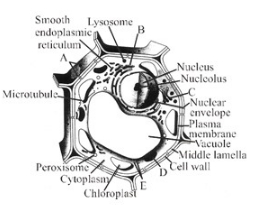
- ✓
$A -$ Plasmodesmata, $B -$ Rough endoplasmic reticulum, $C - $ Golgi apparatus, $D -$ Mitochondrion, $E -$ Ribosomes
- B
$A -$ Desmosome, $B -$ Rough endoplasmic reticulum, $C -$ Golgi apparatus, $D -$ Mitochondrion, $E -$ Ribosomes
- C
$A -$ Plasmodesmata, $B -$ Smooth endoplasmic reticulum, $C -$ Golgi apparatus, $D -$ Mitochondrion, $E -$ Ribosomes
- D
$A-$ Tight junction, $B-$ Rough endoplasmic reticulum, $C -$ Golgi apparatus, $D -$ Mitochondrion, $E -$ Ribosomes
AnswerCorrect option: A. $A -$ Plasmodesmata, $B -$ Rough endoplasmic reticulum, $C - $ Golgi apparatus, $D -$ Mitochondrion, $E -$ Ribosomes
a
In the given figure of plant cell, the structure marked as $A, B, C, D$ and $E$ are respectively plasmodesmata, rough endoplasmic reticulum, Golgi apparatus, mitochondrion and ribosomes. Plant cells are eukaryotic cell and have certain distinguishing features, including chloroplasts (Photosynthesis takes place) cell walls (allow plants to have strong, upright structures) and intracellular vacuoles (help regulate how cells handle water and storage of other molecules).
View full question & answer→MCQ 4031 Mark
Explain why the above mentioned parts belonged to a eukaryotic cell and not prokaryotic cell?
- ✓
Because eukaryotic cell have membrane bound organelles due to internal membrane system
- B
eukaryotic cell have a single membrane system
- C
eukaryotic cell are smaller and multiply more rapidly than prokaryotic cells.
- D
eukaryotic cell are primitive in origin
AnswerCorrect option: A. Because eukaryotic cell have membrane bound organelles due to internal membrane system
a
The samples belong to eukaryotic cells because eukaryotic cell is a type of cell which have enclosed membrane bound organelles and nucleus. And both the mitochondria and chloroplast are membrane bound organelles. Whereas prokaryotic cells are morphologically the most primitive cells and they don't have a membrane bound nucleus and organelles. Prokaryotic cells are generally smaller in size and multiply more rapidly than the eukaryotic cells.
View full question & answer→MCQ 4041 Mark
The best way to identify a cell as either prokaryotic or eukaryotic is to determine whether
- A
it came from a single-celled or multicellular organism.
- ✓
it has a well defined nucleus.
- C
it has a plasma membrane.
- D
AnswerCorrect option: B. it has a well defined nucleus.
b
The only definitive characteristic listed the presence or absence of a nucleus.
View full question & answer→MCQ 4051 Mark
You are asked to examine a cell using a powerful light microscope. The image you see has a clearly defined nucleus and mitochondria. It also has a large central vacuole and chloroplasts. From what group of organisms did this cell most likely come?
Answerd
We can eliminate bacteria because they lack organelles completely. of the organelles listed the only unique one is the chloroplast, which is found exclusively in plants.
View full question & answer→MCQ 4061 Mark
Organell labelled by which alphabets is absent in animal cells?
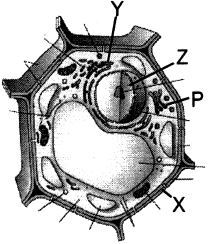
MCQ 4071 Mark
Identify $X$ from given figure :
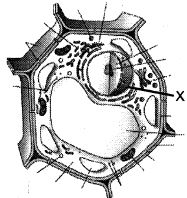
View full question & answer→MCQ 4081 Mark
It is present in plant cell but absent in animal cell.
MCQ 4091 Mark
Identify $X$ and $Y$ from figure
$X-Y$
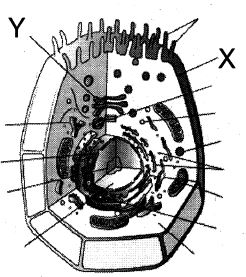
- A
- B
Golgibody - Cell membrane
- C
Microvili - Cell membrane
- ✓
Cell membrane - Golgibody
AnswerCorrect option: D. Cell membrane - Golgibody
View full question & answer→MCQ 4101 Mark
Identify $X$ from figure
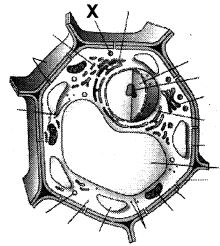
View full question & answer→MCQ 4111 Mark
- A
Lives together with chromosome
- B
Shows dependent assortment
- ✓
Can replicate independently
- D
AnswerCorrect option: C. Can replicate independently
c
(c) Plasmid is an extra chromosomal circular $DNA$ molecule which replicates independently in the host chromosome.
View full question & answer→MCQ 4121 Mark
Plant cell is differ from animal cell because of
- A
The presence of cell wall and absence of chlorophyll in plant cell
- ✓
The presence of cell wall and chlorophyll in plant cell
- C
The absence of cell wall and presence of chloroplast in animal cell
- D
The absence of cell wall and presence of chlorophyll in plant cell
AnswerCorrect option: B. The presence of cell wall and chlorophyll in plant cell
b
(b) Presence of cell wall and chlorophyll is characteristic feature of plants.
View full question & answer→MCQ 4131 Mark
- ✓
Circular movement of cytoplasm inside the cell
- B
Up and down movement of protoplasm
- C
To and fro movement of nucleoplasm
- D
AnswerCorrect option: A. Circular movement of cytoplasm inside the cell
View full question & answer→MCQ 4141 Mark
The non membranous organelles are
MCQ 4151 Mark
Which pair of structures are usually found in both plant and animal cells
- ✓
Cell membrane and nucleolus
- B
Cell membrane and cell wall
- C
Nucleolus and chloroplast
- D
AnswerCorrect option: A. Cell membrane and nucleolus
View full question & answer→MCQ 4161 Mark
The cell organelles are found in
Answerd
(d) Cell organelles like mitochondria, golgi complex, $E.R$. and lysosomes etc. are present only in eukaryotes.
View full question & answer→MCQ 4171 Mark
The main difference between plant and animal cell is
- ✓
Animal cells lack cell wall
- B
Plant cell has no cell wall
- C
Animal cell has a rigid cell wall
- D
Plant cells lack cell membrane
AnswerCorrect option: A. Animal cells lack cell wall
View full question & answer→MCQ 4181 Mark
Difference between the prokaryotic and eukaryotic cells in having
Answerb
(b) The prokaryotic cells do not have nuclear membrane while eukaryotic cell have well organised nuclear membrane.
View full question & answer→MCQ 4191 Mark
Gas vacuole, Single envelope system,Cytoskeleton, Non cellulosic wall, Microfilaments, Cytoplasmic streaming, Lackany cell organelles
How many of the above features are associated with prokaryotic cell?
Answerd
Prokaryotic cell has gas vacuole, single envelope system and non-cellulosic cell wall.
View full question & answer→MCQ 4201 Mark
Gas vacuoles are found in
- A
- B
Green and purple bacteria
- C
- ✓
More than one option is correct
AnswerCorrect option: D. More than one option is correct
d
Gas vacuoles or pseudovacuoles are present in $BGA$, green and purple bacteria.
View full question & answer→MCQ 4211 Mark
The ______ are small bristle like fibres sprouting out of the bacterial cell.
Answerd
Pili -Elongated tubular structures (of protein pilin)
Cillia -Fine hair-like outgrowth of membrane
Mesosome -Invagination of plasma membrane into cell
View full question & answer→MCQ 4221 Mark
Which of the following is not a structure of prokaryotic flagella?
Answerb
Centriole is not present in a prokaryotic flagella.
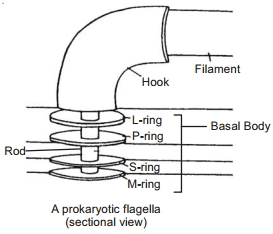
View full question & answer→MCQ 4231 Mark
The subunits of ribosomes of a prokaryotic cell are
- A
$60\,S\; and\; 40\,S$
- B
$20\,S \;and \;90\,S$
- ✓
$50\,S\; and \;30\,S$
- D
$30\,S\; and \;60\,S$
AnswerCorrect option: C. $50\,S\; and \;30\,S$
c
Prokaryotic ribosomes $70\,s$$\rightarrow$$50\,s+30\,s$
View full question & answer→MCQ 4241 Mark
The genomic $DNA$ of a bacterium is
Answera
Circular $i.e.$, close ends
View full question & answer→MCQ 4251 Mark
Choose the wrong statements regarding bacterial cell
$(i)$ Glycocalyx is the outermost envelope in bacteria.
$(ii)$ The glycocalyx could be a loose sheath called capsule.
$(iii)$ The glycocalyx may be thick and tough called slime layer.
$(iv)$ A special structure formed by the plasma membrane is called mesosome.
$(v)$ Small bristle like fibres sprouting out of the cell are called fimbriae.
- A
$(i)$ and $(iii)$
- B
$(i)$ and $(ii)$
- ✓
$(ii)$ and $(iii)$
- D
$(i)$ and $(iv)$
AnswerCorrect option: C. $(ii)$ and $(iii)$
View full question & answer→MCQ 4261 Mark
In prokaryotes, chromatophores are
- A
specialized granules responsible for colouration of cells.
- B
structures responsible for organizing the shape of the organism.
- C
inclusion bodies lying free inside the cells for carrying out various metabolic activities.
- ✓
internal membrane system which becomes extensive and complex in photosynthetic bacteria.
AnswerCorrect option: D. internal membrane system which becomes extensive and complex in photosynthetic bacteria.
d
In some prokaryotes like cyanobacteria, there are membranous extensions into the cytoplasm called chromatophores which contain pigments.
View full question & answer→MCQ 4271 Mark
Which of the following statement of a bacterial cell is/ are correct?
$(i)$ Mesosome is formed by the extensions of plasma membrane into the cell.
$(ii)$ The pili are elongated tubular structures made up of a protein.
$(iii)$ Flagellum is composed of filament, hook and basal body.
$(iv)$ Ribosomes are about $30\; nm$ by $50\; nm$ in size.
- ✓
$(i), (ii)$ and $(iii)$
- B
- C
$(ii)$ and $(iv)$
- D
AnswerCorrect option: A. $(i), (ii)$ and $(iii)$
a
Ribosomes are about $15 \,\,nm$ by $20\,\, nm$ in size.
View full question & answer→MCQ 4281 Mark
Which of the following terms is $NOT$ correctly matched with its feature?
AnswerCorrect option: C. Mesosome - Infolding of cell membrane and characteristics of eukaryotes.
c
Mesosome is special structure, formed by the extensions of plasma membrane. It helps in the formation of cell wall, $DNA$ replication and distribution to daughter cells. They also help in respiration, secretion processes, to increase the surface area of the plasma membrane and enzymatic content. It is the characteristics of prokaryotes.
View full question & answer→MCQ 4291 Mark
Which one of the following combination is mismatched?
- A
Glycocalyx - May be capsule or slime layer
- ✓
- C
Cell wall - Protective, determines shape, prevents from bursting
- D
Flagella, pili and fimbriae - Surface structures of bacterial cell
Answerb
Pili are organelles of adhesion allowing bacteria to colonize and resist flushing.
View full question & answer→MCQ 4301 Mark
Extension of plasma membrane in prokaryotic cell is
MCQ 4311 Mark
Membranous extensions in blue green algae are known as
Answerb
In some prokaryotes like cyanobacteria or Blue-Green algae, there are other membranous extensions in the cytoplasm called chromatophores.
View full question & answer→MCQ 4321 Mark
Which of the following is absent in prokaryotes?
Answerd
Mitochondria are present in the living eukaryotic cells and absent in prokaryotic cells like bacteria and blue-green algae. This organelle is known as the powerhouse of the cell as they are the site of chemical reactions that transfer energy from organic compounds in the form of $ATP$.
View full question & answer→MCQ 4331 Mark
- ✓
Prokaryotic cell, having chromatophore
- B
Eukaryotic cell, having plasmid
- C
Plant cell, having chloroplast
- D
Prokaryotic cell, having Nuclear membrane
AnswerCorrect option: A. Prokaryotic cell, having chromatophore
View full question & answer→MCQ 4341 Mark
Identify the correct group of prokaryotic cell
$1.$ egg of ostrich, $2.$ $PPLO,$$ 3.$ Tracheid, $4.$ Blue green algae, $5.$ Bacteria, $6.$ Animal cells
- A
$1,2,3 $
- B
$4,5,6$
- C
$3,2,5,6$
- ✓
$2,4,5$
AnswerCorrect option: D. $2,4,5$
View full question & answer→MCQ 4351 Mark
Gas vacuole found in.....
- A
- B
Green photosynthesis bacteria
- C
Purple photosynthesis bacteria
- ✓
View full question & answer→MCQ 4361 Mark
Which of the following is not a characteristic of prokaryotic cells ?
- A
Circular $DNA $
- B
- C
- ✓
foldings in genetic material of third stage
AnswerCorrect option: D. foldings in genetic material of third stage
View full question & answer→MCQ 4371 Mark
Which is not an example of prokaryotic cell ?
MCQ 4381 Mark
Which mistake in given sentence?
In prokaryotic cell internal extension structure called mesosome.
- A
No specification of cell wall.
- B
No specification of vacuole membrane.
- C
No specification nuclear membrane
- ✓
No specification of plasma membrane.
AnswerCorrect option: D. No specification of plasma membrane.
View full question & answer→MCQ 4391 Mark
Which is absent in prokaryotic cell ?
MCQ 4401 Mark
Cell envelop is chemicaly complex structure it consists of a tightly bound three layeyed structure, which layer is semi permeable in nature ?
MCQ 4411 Mark
Read the sentences properly and select the correct option for mesosome.
$(i)$ mesosome is a extension of plasma membrane
$(ii)$ These extensions are only in the form of Spherical
$(iii)$ Mesosomes help in cell wall formation and $RNA$ synthesis
$(iv)$ They help in respiration
- A
- B
$i, ii$ and $iii$ correct
- ✓
$i, iii$ and $iv$ correct
- D
$i, iv$ correct
AnswerCorrect option: C. $i, iii$ and $iv$ correct
View full question & answer→MCQ 4421 Mark
Full form of $PPLO$
- A
Pleuro Pneumonia Long Organisms
- ✓
Pleuro Pneumonia Like Organisms
- C
Pleuro Positive like Organisms
- D
Pleuro Pneumonia like Organ
AnswerCorrect option: B. Pleuro Pneumonia Like Organisms
View full question & answer→MCQ 4431 Mark
- A
- B
Pigments other than chlorophyll
- ✓
Chlorophyll and other pigments where colour of chlorophyll is masked by another pigment
- D
AnswerCorrect option: C. Chlorophyll and other pigments where colour of chlorophyll is masked by another pigment
View full question & answer→MCQ 4441 Mark
View full question & answer→MCQ 4451 Mark
In prokaryotes, the mitochondria are absent. Even then Krebs cycle takes place. What is the site of Krebs cycle in bacteria
Answerd
(d) Infolding of plasma membrane in bacteria are called mesosomes, which are analogous to mitochondria.
View full question & answer→MCQ 4461 Mark
Pinocytosis and phagocytosis are absent in
MCQ 4471 Mark
Which of the following is absent in prokaryotes
MCQ 4481 Mark
Which of the following shows the absence of cytoplasmic streaming
MCQ 4491 Mark
Which of the following is absent in prokaryotes
MCQ 4501 Mark
The word "Prokaryote" means a cell
MCQ 4511 Mark
Intracellular compartments are not found in cells of
Answerb
(b) Because cell organelles are absent in prokaryotes.
View full question & answer→MCQ 4521 Mark
Amoeba is eukaryotic because it possesses
MCQ 4531 Mark
Prokaryotes are not identified by
- A
- ✓
Absence of nuclear membrane
- C
- D
AnswerCorrect option: B. Absence of nuclear membrane
View full question & answer→MCQ 4541 Mark
Which of the following granules are present in cyanobacteria
MCQ 4551 Mark
Which type of organism are $PPLO$
Answerc
(c)Mycoplasma is also known as pleuropneumonia like organisms $ (PPLO)$.
View full question & answer→MCQ 4561 Mark
The outermost limiting layer of mycoplasma is made up of
Answerb
(b) Mycoplasma lacks cell wall, therefore the outermost existing layer is cell membrane.
View full question & answer→MCQ 4571 Mark
Mycoplasma are not sensitive to
Answerb
(b)Because mycoplasma lacks cell wall where as penicillin acts on cell wall.
View full question & answer→MCQ 4581 Mark
Which of the following statement is true for Mycoplasma
MCQ 4591 Mark
An organism having cytoplasm $DNA$ and $ RNA $ but no cell wall is
View full question & answer→MCQ 4601 Mark
Bacteria commonly reproduce vegetatively by
MCQ 4611 Mark
Mesosome in a bacterial cell is
- A
- B
Connection between two cells
- ✓
Plasma membrane infolded for respiration
- D
AnswerCorrect option: C. Plasma membrane infolded for respiration
c
(c) In many bacteria ($specially\, gram$ $+ve$ ) the plasma membrane gives rise to infoldings called mesosome.
It is have respiratory enzymes like succinic dehydrogenase cytochrome oxidase for respiration.
View full question & answer→MCQ 4621 Mark
Colourless, unicellular, cell wall bound, spherical or rod-shaped micro-organism and lacking organized nucleus is called
MCQ 4631 Mark
In many bacteria the cell membrane becomes invaginated and folded to form
MCQ 4641 Mark
Photosynthetic bacteria have pigments in
MCQ 4651 Mark
Many bacteria bear minute hairy structures on their cell wall, these are called
MCQ 4661 Mark
Bacteria and other monerans do not possess
MCQ 4671 Mark
Genes for antibiotic resistance are located in
Answerd
(d)$R-$ factor is type of plasmid which contains genes for antibiotic resistance.
View full question & answer→MCQ 4681 Mark
- A
- B
- ✓
Nucleic acid and proteins
- D
AnswerCorrect option: C. Nucleic acid and proteins
View full question & answer→MCQ 4691 Mark
- ✓
- B
- C
Organs which form conjugation tube through which genetic material is transferred from donor to recipient cell
- D
Answera
(a)Fimbriae are more in number, short thin straight bristle like appendages which function as organ of adhesion. Pili are similar to fimbriae but different in function.
View full question & answer→MCQ 4701 Mark
Naked $ DNA $ is that which is
- A
Not covered by nuclear envelope
- B
- C
Associated with histone proteins
- ✓
Not associated with histone proteins
AnswerCorrect option: D. Not associated with histone proteins
d
(d) Naked $ DNA$ is surrounded by some typical proteins $(polyamines)$ but not histone proteins.
View full question & answer→MCQ 4711 Mark
- ✓
- B
- C
$RNA-DNA$ hybrid
- D
Both $(a)$ and $(b)$
View full question & answer→MCQ 4721 Mark
The smallest cell of $0.3\; \mu m$ in length is
Answerd
Bacteria = $3 \;to\; 5 \;\mu m$
Ostrich $\rightarrow$ Largest isolated single cell.
View full question & answer→MCQ 4731 Mark
Which of the following statements is/are correct?
$(i)$ The shape of the cells may vary with the function they perform.
$(ii)$ Human $RBC$ is about $7.0\; mm$ in diameter.
$(iii)$ Cytoplasm is the main area of cellular activities.
$(iv)$ Various chemical reactions occur in cytoplasm to keep the cell in the living state.
AnswerCorrect option: A. $(i), (ii), (iii)$ and $(iv)$
a
All the statements are correct.
View full question & answer→MCQ 4741 Mark
Which of the following is incorrect?
AnswerCorrect option: D. Nerve cells are some of the smallest cells.
d
Nerve cells are the longest cells of the body.
View full question & answer→MCQ 4751 Mark
Match column $I$ (cell type) with column $II$ (size) and choose the correct option.
| Column-$I$ |
Column-$II$ |
| (Cell type) |
(Size) |
| $A$. Viruses |
$I$. $1-2\; mm$ |
| $B$. $PPLO$ |
$II$. $10-20\; mm$ |
| $C$. Eukaryotic cell |
$III$. About $0.1\; mm$ |
| $D$. Bacterium |
$IV$. $0.02-0.2\; mm$ |
- A
$A - I ; B - II ; C - III ; D - IV$
- ✓
$A - IV ; B -III; C -II ; D -I$
- C
$A - I ; B -III ; C -II ; D - IV$
- D
$A - IV ; B - II ; C - II ; D -I$
AnswerCorrect option: B. $A - IV ; B -III; C -II ; D -I$
b
Viruses - $0.02$ - $0.2$ micrometre $PPLO (Pleuro\; Pneumonia\; like\; Organisms)$ - About $0.1$ micrometre Eukaryotic cells $-10-20$ micrometre Bacterium $-1-2$ micrometre
View full question & answer→MCQ 4761 Mark
Arrange the following cells in an ascending order of their size and select the correct option
$I.$ Ostrich eggs
$II.$ Mycoplasma
$III.$ Bacteria
$IV.$ Human $RBCs$
- ✓
$II-III-IV-I$
- B
$I-IV-III-II$
- C
$II-I-IV-III $
- D
$I-II-IV-III$
AnswerCorrect option: A. $II-III-IV-I$
View full question & answer→MCQ 4771 Mark
Identify white blood cells.
MCQ 4781 Mark
Size of a typical eukaryotic cell is
- A
$1-2 \, \mu \,m$
- ✓
$10-20 \, \mu \,m$
- C
About $0.1\, \mu \,m$
- D
$0.02 -0.2\, \mu \,m$
AnswerCorrect option: B. $10-20 \, \mu \,m$
View full question & answer→MCQ 4791 Mark
The smallest living cells with cell wall are
MCQ 4801 Mark
The division of the plant kingdom into Prokaryota and Eukaryota is based on the characters of
MCQ 4811 Mark
Some cells of our body can be over a foot long. These are
MCQ 4821 Mark
Longest cell in human body may be
MCQ 4831 Mark
The largest egg belongs to
Answerd
(d)Egg of ostrich weights nearly $1.5 Kg. $ and requires about $50$ minutes to boil it. It is the largest egg among the animals.
View full question & answer→MCQ 4841 Mark
Size of $PPLO$ is
- ✓
$0.10$ $\mu$ to $0.15$ $\mu$
- B
$0.21$ $\mu$ to $0.25$ $\mu$
- C
$0.01$ $\mu$ to $ 0.08$ $\mu$
- D
$0.05$ $\mu$ to $ 0.10$ $\mu$
AnswerCorrect option: A. $0.10$ $\mu$ to $0.15$ $\mu$
View full question & answer→MCQ 4851 Mark
Cell is the fundamental, structural and functional unit of all living organisms because
- A
Unicellular organisms are incapable of independent existance
- ✓
The cell is the basic unit of life
- C
Anything less than a complete structure of a cell does ensure independent living
- D
Essential life functions can be performed in only multicellular organisms
AnswerCorrect option: B. The cell is the basic unit of life
b
The cell is the basic unit of life because anything less than a complete structure of cell does not ensure independent living.
View full question & answer→MCQ 4861 Mark
Select the statements which are related to Schwann.
$(i)$ He reported that cells have a thin outer layer which is today known as
plasma membrane
$(ii)$ Cell wall is a unique character of the plant cell.
$(iii)$ Body of plants and animals are composed of cells and products of cells.
- A
Only $(i)$
- B
Only $(iii)$
- C
$(i)$ and $(iii)$
- ✓
Answerd
All the given statements are related to Schwann Theodor. Schwann was a German physiologist. His contributions to biology include the development of cell theory, the discovery of Schwann cells in the peripheral nervous system, the discovery and study of pepsin, the discovery of the organic nature of yeast, and the invention of the term metabolism.
View full question & answer→MCQ 4871 Mark
Match column-$I$ (scientists) with column-$ll$ (discovery) and select the correct option.
| Column-$I$ |
Column-$II$ |
| $A$. Leeuwenhoek |
$I$. First saw and described a living cell |
| $B$. Robert Brown |
$II$. Presence of cell wall is unique to plant cells |
| $C$. Schleiden |
$III$. Discovered the nucleus |
| $D$. Schwann |
$IV$. All plants are composed of different kind of cells |
- ✓
$A-I ; B-I I I ; C-I V ; D-I I$
- B
$A-I ; B-I I I ; C-I I ; D-I V$
- C
$A-I I I ; B-I ; C-I V ; D-I I$
- D
$A-I ; B-I V ; C-I I ; D-I I I$
AnswerCorrect option: A. $A-I ; B-I I I ; C-I V ; D-I I$
a
Leeuwenhoek - He is commonly known as "the Father of Microbiology", and considered to be the first microbiologist. First saw and described a living cell. Robert Brown was a Scottish botanist and palaeobotanist who made important contributions nucleus and cytoplasmic streaming. Schleiden was a German botanist and co-founder of the cell theory, along with Theodor Schwann and Rudolf Virchow. He discovered that all plants are composed of different kind of cells. Schwann - He discovered that presence of cell wall is unique to plant cells.
View full question & answer→MCQ 4881 Mark
Who proposed the theory that "Cells arise only from the pre-existing cells"?
Answerb
Rudolf Virchow ($1855$) first explained that cells divided and new cells are formed from preexisting cells (omnis cellula-e-cellula). It is also know as law of cell lineage.
View full question & answer→MCQ 4891 Mark
The cell theory was given in year $1839$ by Schleiden and Schwann. According to this theory all organisms are composed of cell and cells are the basic unit of life. How did this theory help in the field of science?
- ✓
It helped to study the working of cells.
- B
It helped in curing diseases caused by cell.
- C
It helped in restating the earlier theories on cell.
- D
It helped in introducing the use of microscopes to study cell.
AnswerCorrect option: A. It helped to study the working of cells.
a
Cell theory explains the general principles of construction for all living things by focusing on studying the working of cells. The use of microscopes to study cell was in practice way before the cell theory was formulated.
View full question & answer→MCQ 4901 Mark
Which of the following statement was not explained in the cell theory given jointly by Schleiden and Schwann?
- A
All living organism are composed of cells and their products
- B
Cell is the structural and functional unit of living organisms
- ✓
- D
View full question & answer→MCQ 4911 Mark
Match the following:
$\begin{array}{|p{0.3\linewidth}|p{0.5\linewidth}|} \hline Column\,\,-I & Column\,\,-II \\ \hline A.\,\,Schleiden & 1.\,\,Nucleus \\ \hline B.\,\,Schwann & 2.\,\,German\,\,botanist \\ \hline C.\,\,Robert\,\,brown & 3.\,\,Living\,\,cell \\ \hline D.\,\,Leuwen\,\,hoke & 4.\,\,Britain\,\,Zoologist \\ \hline \end{array}$
- A
$(A-4), (B-2),(C-3),(D-1) $
- B
$(A-1),(B-4),(C-3),(D-2) $
- ✓
$(A-2),(B-4),(C-1),(D-3)$
- D
$(A-3),(B-1),(C-4),(D-2) $
AnswerCorrect option: C. $(A-2),(B-4),(C-1),(D-3)$
View full question & answer→MCQ 4921 Mark
View full question & answer→MCQ 4931 Mark
................examined a large number of .................and observed that all are composed of different kinds of cells which from the tissues
- A
Anton Von leuwenhoek, live cell
- B
- ✓
- D
View full question & answer→MCQ 4941 Mark
Schleiden $(1838)$ proposed that cell is the structural and functional unit of life. His idea was a
View full question & answer→MCQ 4951 Mark
The cell theory states that
- A
- B
- C
Cells reproduce by mitosis
- ✓
Cells are the basic structural units of living beings
AnswerCorrect option: D. Cells are the basic structural units of living beings
View full question & answer→MCQ 4961 Mark
Who proposed the theory that $"cells arise only from the pre-existing cells''$
Answerb
(b) Virchow gave $'Omnis cellula a cellula'$ theory.
View full question & answer→MCQ 4971 Mark
View full question & answer→MCQ 4981 Mark
How many types of cells are known
Answerc
(c) In present time three types of cells are known i.e. prokaryotic, mesokaryotic and eukaryotic.
View full question & answer→MCQ 4991 Mark
Who proposed the "Cell theory''
Answera
(a) M.J. Schleiden and T. Schwann $(183-39)$ proposed cell theory.
View full question & answer→MCQ 5001 Mark
Bacteria are grouped under four categories based on their shape. Study the given figure and identify $P,Q,R$ and $S$
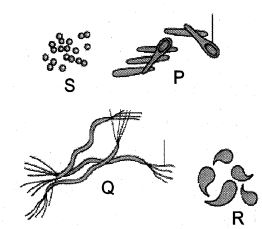
- A
$P$-Vibrio, $Q$-Cocci, $R$-Bacilli, $S$-Spirilla
- B
$P$-Cocci, $Q$-Bacilli, $R$-Spirilla, $S$-Vibrio
- ✓
$P$-Bacilli, $Q$-Spirilla, $R$-Vibrio, $S$-Cocci
- D
$P$-Spirilla, $Q$-Vibrio, $R$-Cocci,$ S$-Bacilli
AnswerCorrect option: C. $P$-Bacilli, $Q$-Spirilla, $R$-Vibrio, $S$-Cocci
View full question & answer→