Questions

M.C.Q (1 Marks)

Take a timed test

180 questions · auto-graded multiple-choice test.
MCQ 11 Mark
Frog is
  • A
    Homoeothermic
  • Poikilothermic
  • C
    Homeostatic
  • D
    Warm$-$blooded
Answer
Correct option: B.
Poikilothermic
Poikilothermic
View full question & answer
MCQ 21 Mark
In frogs, urine is temporarily stored in
  • A
    Kidneys
  • Urinary bladder
  • C
    Ureters
  • D
    Cloaca
Answer
Correct option: B.
Urinary bladder
Urinary bladder
View full question & answer
MCQ 31 Mark
Pancreatic juice helps in digestion of
  • A
    Fats
  • B
    Carbohydrates
  • C
    Protein
  • All of these
Answer
Correct option: D.
All of these
All of these
View full question & answer
MCQ 51 Mark
The liquefied semi-digested acidic food is known as
  • A
    Bile
  • B
    Bolus
  • Chyme
  • D
    Faeces
Answer
Correct option: C.
Chyme
Chyme
View full question & answer
MCQ 71 Mark
In male frog, vasa efferentia enter the kidney and open into
  • A
    Ureter
  • B
    Urinogenital duct
  • C
    Cloaca
  • Bidder's canal
Answer
Correct option: D.
Bidder's canal
Bidder's canal
View full question & answer
MCQ 81 Mark
Autonomic nervous system in frog is divided into
  • A
    Brain and spinal cord
  • B
    Cranial and spinal nerves
  • Sympathetic and parasympathetic
  • D
    Forebrain, midbrain and hindbrain
Answer
Correct option: C.
Sympathetic and parasympathetic
View full question & answer
MCQ 91 Mark
Central nervous system is divided in frog in
  • Brain and spinal cord
  • B
    Cranial and spinal nerves
  • C
    Sympathetic and parasympathetic
  • D
    Forebrain, midbrain and hindbrain
Answer
Correct option: A.
Brain and spinal cord
View full question & answer
MCQ 101 Mark
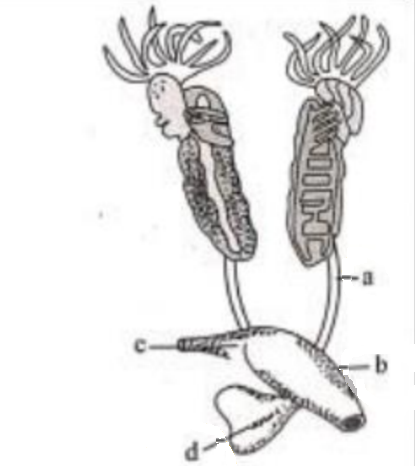
Recognise the figure and find out the correct matching.
Image
  • A
    $a-$cloaca, $b-$rectum, $c-$urinary bladder, $d-$urino genital duct
  • B
    $c-$cloaca, $d-$rectum, $a-$urinary bladder, $b-$urino$-$genital duct
  • $b-$cload, $c-$rectam, duringý blader, $a-$urino$-$genital duct
  • D
    $d-$cloaca, $a-$rectum, $b-$urinary bladder, $c-$urino$-$genital duct
Answer
Correct option: C.
$b-$cload, $c-$rectam, duringý blader, $a-$urino$-$genital duct
View full question & answer
MCQ 111 Mark
The nervous system of frog is organized into
  • Central nervous system and peripheral nervous system
  • B
    Central nervous system and autonomic nervous system
  • C
    Central nervous system, peripheral nervous system and autonomic nervous system
  • D
    Brain and spinal cord
Answer
Correct option: A.
Central nervous system and peripheral nervous system
View full question & answer
MCQ 121 Mark
Read the following statements and find out the incorrect statement about frog
  • A
    Frog never drinks water.
  • B
    In frog, neck and tail are absent.
  • The duodenum receives bile from gall blader and pancreatic juices from the pancreas through the hepato pancreatic duct.
  • D
    Eyes of frog are covered by nictitating membrane that protects them while in water
Answer
Correct option: C.
The duodenum receives bile from gall blader and pancreatic juices from the pancreas through the hepato pancreatic duct.
View full question & answer
MCQ 131 Mark
A triangular structure that joins the right atrium of heart in frog is called
  • Sinus venosus and receives blood from vena cava
  • B
    Conus arteriosus and receives blood from vena cave
  • C
    Sinus venosus and receives blood from pulmonary artery
  • D
    Conus arteriosus and receives blood from pulmonary vein.
Answer
Correct option: A.
Sinus venosus and receives blood from vena cava
View full question & answer
MCQ 141 Mark
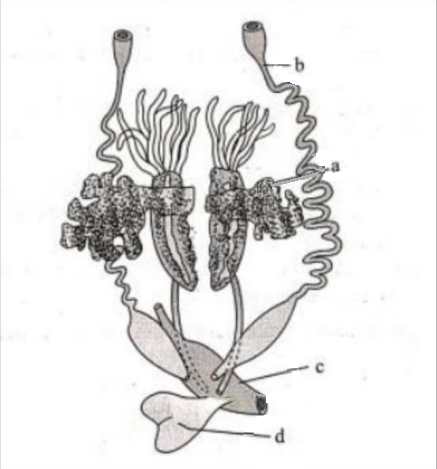
Recognise the figure and find out the correct matching.
Image
  • A
    $a-$cloaca, $b-$ovary, $d-$oviduct, $c-$urinary bladder
  • $c-$cloaca, $a-$ovary, $b-$oviduct, $d-$urinary bladder
  • C
    $b-$cloaca, $d-$ovary, $c-$oviduct, $a-$urinary bladder
  • D
    $d-$cloaca, $c-$ovary, $a-$oviduct, $b-$urinary blader
Answer
Correct option: B.
$c-$cloaca, $a-$ovary, $b-$oviduct, $d-$urinary bladder
View full question & answer
MCQ 151 Mark
Read the following statements and find out the incorrect statement about frogs.
  • A
    Frog respire on land and in water by two different methods..
  • B
    Liver secrets bile that is stored in the gall bladder
  • C
    Three chambered heart is situated in the upper part of body cavity
  • $\text{RBCS}$ Are enucleated and contain red coloured pigment called haemoglobin.
Answer
Correct option: D.
$\text{RBCS}$ Are enucleated and contain red coloured pigment called haemoglobin.
View full question & answer
MCQ 161 Mark
In water, the aquatic respiratory organ$(s)$ of frog is/are
  • Skin $($cutaneous respiration$)$
  • B
    Skin, lungs $($pulmonary respiration$)$ and buccal cavity
  • C
    Lungs and buccal cavity
  • D
    Skin and buccal cavity
Answer
Correct option: A.
Skin $($cutaneous respiration$)$
View full question & answer
MCQ 171 Mark
During the peak summer and winter the frogs take shelter in deep burrows to protect them from extreme heat and cold. This is called as
  • Summer sleep $($aestivation$)$ and winter sleep $($hibernation$)$
  • B
    Summer sleep $($hibernation$)$ and winter sleep $($aestivation$)$
  • C
    Summer sleep $($diapause$)$ and winter sleep $($suspend$)$
  • D
    Summer sleen $($dormancy$)$ and winter sleep $($diapause$)$
Answer
Correct option: A.
Summer sleep $($aestivation$)$ and winter sleep $($hibernation$)$
View full question & answer
MCQ 181 Mark
In frog, the duodenum receives bile from gall bladder and pancreatic juices from the pancreas through a
  • Common bile duct
  • B
    Hepato-pancreatic duct
  • C
    Cystic duct
  • D
    Hepatic duct
Answer
Correct option: A.
Common bile duct
Common bile duct
View full question & answer
MCQ 191 Mark
Frogs have the ability to change the colour to hide them from their enemies. This protective coloration is called
  • A
    Aestivation
  • B
    Metamorphosis
  • camouflage
  • D
    Metagenesis
Answer
Correct option: C.
camouflage
camouflage
View full question & answer
MCQ 201 Mark
Respiratory organs of frog are:
  • A
    Skin
  • B
    Lungs
  • Both $(A)$ and $(B)$
  • D
    Flame cells
Answer
Correct option: C.
Both $(A)$ and $(B)$
View full question & answer
MCQ 221 Mark
Where are the copulatory pads in male frog present?
  • A
    Second digit of the hindlimbs
  • B
    First digit of the hindlimbs
  • First digit of the forelimbs
  • D
    Second digit of the forelimbs
Answer
Correct option: C.
First digit of the forelimbs
View full question & answer
MCQ 231 Mark
How many ova are laid by a female frog at a time?
  • A
    $100-200$
  • B
    $500-1000$
  • $2500-3000$
  • D
    $5000-6000$
Answer
Correct option: C.
$2500-3000$
$2500-3000$
View full question & answer
MCQ 241 Mark
Male frogs can be distinguished from female frogs by the presence of
  • A
    Sound producing vocal sacs
  • B
    Copulatory pad
  • C
    Pair of nostrils
  • Both $(A)$ and $(B)$
Answer
Correct option: D.
Both $(A)$ and $(B)$
View full question & answer
MCQ 251 Mark
Which of these structures in frog receive sound signals?
  • A
    Webbed feet
  • B
    Skin
  • C
    Nictitating membrane
  • Tympanum
Answer
Correct option: D.
Tympanum
Tympanum
View full question & answer
MCQ 261 Mark
The chief nitrogenous waste material present in the urine of frog
  • Urea
  • B
    Uric acid
  • C
    Ammonia
  • D
    Allantois
Answer
Correct option: A.
Urea
Urea
View full question & answer
MCQ 271 Mark
Which of these structures protects the eyes of the frog in water?
  • Nictitating membrane
  • B
    Tympanum
  • C
    Bidder's canal
  • D
    Cloaca
Answer
Correct option: A.
Nictitating membrane
View full question & answer
MCQ 281 Mark
Which of these methods are utilized by frogs for protection?
  • A
    Speed
  • B
    Spikes
  • Mimicry
  • D
    Playing dead
Answer
Correct option: C.
Mimicry
Mimicry
View full question & answer
MCQ 291 Mark
Which of these statement is true about frog?
  • A
    It lives both on land and in sea water
  • B
    They cannot survive in freshwater
  • C
    Rana tigrine is a rare species
  • They belong to class Amphibia
Answer
Correct option: D.
They belong to class Amphibia
View full question & answer
MCQ 301 Mark
Histamine is secreted by:
  • Mast cells.
  • B
    Fibroblast.
  • C
    Melanocytes.
  • D
    Histocytes.
Answer
Correct option: A.
Mast cells.
Mast cells.
View full question & answer
MCQ 311 Mark
Haemophilia is:
  • A
    Royal disease.
  • B
    Faulty blood clotting.
  • Both $(a)$ and $(b)$.
  • D
    Mosquito having haemocoel.
Answer
Correct option: C.
Both $(a)$ and $(b)$.
Both $(a)$ and $(b).$
View full question & answer
MCQ 321 Mark
Columnar epithelium is found in the lining of which organ?
  • A
    Lungs.
  • Stomach.
  • C
    Liver.
  • D
    Nasal Cavity.
Answer
Correct option: B.
Stomach.
Stomach.
View full question & answer
MCQ 331 Mark
The head capsule of a cockroach is made of:
  • A
    Four segments.
  • B
    Five segments.
  • Six segments.
  • D
    One segment.
Answer
Correct option: C.
Six segments.
Six segments.
View full question & answer
MCQ 341 Mark
Brush border is characteristic of:
  • A
    Neck of nephron.
  • B
    Collecting tube.
  • Proximal convoluted tubule.
  • D
    All of the above.
Answer
Correct option: C.
Proximal convoluted tubule.
View full question & answer
MCQ 351 Mark
Choose the incorrect statement.
  • A
    Vascular system of frog is closed type.
  • Frogs have $4-$chambered heart.
  • C
    During aestivation and hibernation, skin acts as respiratory organ.
  • D
    All the statements are correct.
Answer
Correct option: B.
Frogs have $4-$chambered heart.
Vascular system of frogs is closed and they have $4-$chambered heart.
View full question & answer
MCQ 361 Mark
Which of the following is not exclusively supplied with involuntary muscles?
  • A
    Muscular coats of blood vessels.
  • Muscles of the ducts of glands.
  • C
    Muscles of iris.
  • D
    Muscles of urethra.
Answer
Correct option: B.
Muscles of the ducts of glands.
View full question & answer
MCQ 371 Mark
Which of the following is not a connective tissue?
  • A
    Bone.
  • B
    Cartilage.
  • C
    Blood.
  • Muscles.
Answer
Correct option: D.
Muscles.
Muscular tissue consists of muscle fibers, it is not a connective tissue. Bone and cartilage are specialized connective tissue and blood is fluid connective tissue.
View full question & answer
MCQ 381 Mark
Which of the following is the most abundant tissue in our body?
  • A
    Epithelial tissue.
  • B
    Muscular tissue.
  • Connective tissue.
  • D
    Neural tissue.
Answer
Correct option: C.
Connective tissue.
Connective tissue.
View full question & answer
MCQ 391 Mark
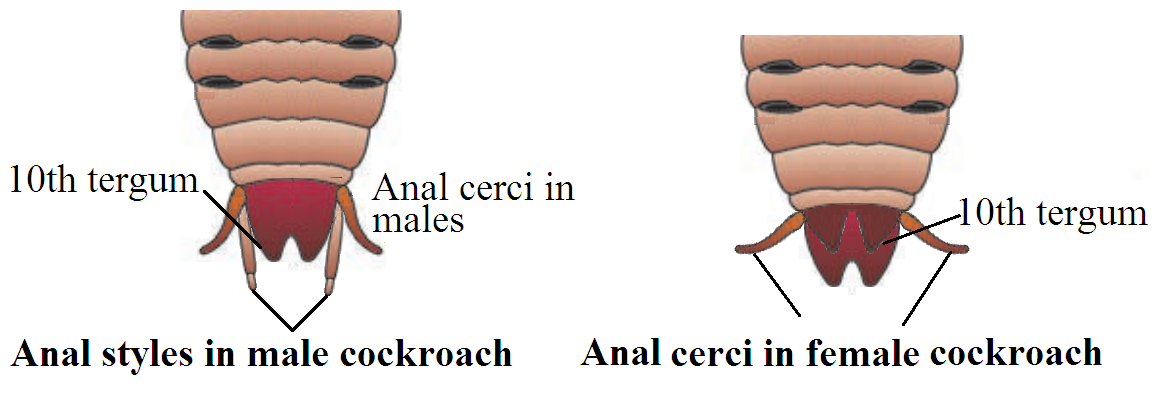
Male and female cockroaches can be distinguished externally through.
  • Anal styles in male.
  • B
    Anal cerci in female.
  • C
    Anal style and antennae in females.
  • D
    None of these.
Answer
Correct option: A.
Anal styles in male.
View full question & answer
MCQ 401 Mark
Which of the following organs will not have ciliated epithelium?
  • A
    Nasal Cavity.
  • B
    Small Intestine.
  • C
    Middle Ears.
  • All of the above.
Answer
Correct option: D.
All of the above.
All of the above.
View full question & answer
MCQ 411 Mark
The main function of the skin of frog is:
  • The exchange of respiratory gases.
  • B
    The storage of fat.
  • C
    The storage of energy.
  • D
    To convert light vitamin $D.$
Answer
Correct option: A.
The exchange of respiratory gases.
View full question & answer
MCQ 421 Mark
Ligament is a:
  • A
    Modified yellow elastic fibrous tissue.
  • Inelastic white fibrous tissue.
  • C
    Modified white fibrous tissue.
  • D
    None of the above.
Answer
Correct option: B.
Inelastic white fibrous tissue.
View full question & answer
MCQ 431 Mark
Which system transmits impulses between different parts of the body?
  • A
    Musculoskeletal system
  • B
    Endocrine system
  • C
    Circulatory System
  • Nervous system
Answer
Correct option: D.
Nervous system
A complex network of nerve cells or neurons forms the nervous system.
This system is responsible for transmitting electrical impulses throughout the body.
View full question & answer
MCQ 441 Mark
Haemoglobin is a type of:
  • A
    Carbohydrate.
  • B
    Vitamin.
  • C
    Skin pigment.
  • Respiratory pigment.
Answer
Correct option: D.
Respiratory pigment.
View full question & answer
MCQ 451 Mark
Excretory organs of Cockroach are:
  • Malpighian tubules.
  • B
    Hreen glands.
  • C
    Both.
  • D
    None of these.
Answer
Correct option: A.
Malpighian tubules.
Malpighian tubules.
View full question & answer
MCQ 461 Mark
Movement of human body parts is due to$............$
  • Muscle cells
  • B
    Nerve cells
  • C
    Gland cells
  • D
    Skin cells
Answer
Correct option: A.
Muscle cells

Muscle cells aid in the movement of body parts in humans.
These cells have the ability to contract and relax, which causes the movement of body parts.
Nerve cells send and receive signals from the brain.
Glandular cells secrete sweat, saliva, breast milk, digestive enzymes and hormones, among other substances.
Skin cell functions in protection, secretion, sensation, etc.
View full question & answer
MCQ 471 Mark
Which one of the following is a scent gland of mammals?
  • A
    Bartholin
  • Anal
  • C
    Prostate
  • D
    Adrenal
Answer
Correct option: B.
Anal
Anal
View full question & answer
MCQ 481 Mark
Formation of cartilage bones involves:
  • A
    Deposition of bony matter by osteoblasts and resorption by chondroclasts.
  • B
    Deposition of bony matter by osteoclasts and resorption by chondroblasts.
  • C
    Deposition of bony matter by osteoclasts only.
  • Deposition of bony matter by osteoblasts only.
Answer
Correct option: D.
Deposition of bony matter by osteoblasts only.
View full question & answer
MCQ 491 Mark
A person with blood group $A$ requires blood. The blood group which can be given is:
  • A
    $A$ and $B.$
  • B
    $A$ and $AB.$
  • $A$ and $O.$
  • D
    $A, B, AB$ and $O.$
Answer
Correct option: C.
$A$ and $O.$
$A$ and $O$.
View full question & answer
MCQ 501 Mark
Which cartilage is present at the end of long bones?
  • A
    Calcified cartilage.
  • Hyaline cartilage.
  • C
    Elastic cartilage.
  • D
    Fibrous cartilage.
Answer
Correct option: B.
Hyaline cartilage.
Hyaline cartilage.
View full question & answer
MCQ 511 Mark
The cell junctions called tight, adhering and gap junctions are found in:
  • Epithelial tissue.
  • B
    Muscular tissue.
  • C
    Connective tissue.
  • D
    Neural tissue.
Answer
Correct option: A.
Epithelial tissue.
Epithelial tissue.
View full question & answer
MCQ 521 Mark
Which membrane protects the eyes of frog in water?
  • A
    Tympanum
  • B
    Skin
  • C
    Sebaceous
  • Nictitating
Answer
Correct option: D.
Nictitating
Frogs have nictitating membrane which protect their eyes in water.
View full question & answer
MCQ 531 Mark
Which of the following is not a granulocyte?
  • Lymphocyte.
  • B
    Basophil.
  • C
    Neutrophil.
  • D
    Eosinophil.
Answer
Correct option: A.
Lymphocyte.
Lymphocyte.
View full question & answer
MCQ 541 Mark
Which membrane protects the eyes of frog in water?
  • A
    Tympanum
  • B
    Skin
  • C
    Sebaceous
  • Nictitating
Answer
Correct option: D.
Nictitating
Frogs have nictitating membrane which protect their eyes in water.
View full question & answer
MCQ 551 Mark
Which of the following is the correct definition of tissue?
  • A
    Group of variety of cells formed to carry out variety of functions.
  • Group of variety of cells formed to carry out similar functional.
  • C
    Group of similar cells formed to carry out variety of functions.
  • D
    Group of similar cells formed to carry out similar functions.
Answer
Correct option: B.
Group of variety of cells formed to carry out similar functional.
View full question & answer
MCQ 561 Mark
Vitamin$-K$ is required for:
  • A
    Formation of thromboplastin.
  • B
    Conversion of fibrinogen to fibrin.
  • C
    Conversion of prothrombin to thrombin.
  • Synthesis of prothrombin.
Answer
Correct option: D.
Synthesis of prothrombin.
View full question & answer
MCQ 571 Mark
How many heart does an earthworm possess?
  • A
    $6$ pairs
  • $5$ pairs
  • C
    $2$ pairs
  • D
    $1$ pair
Answer
Correct option: B.
$5$ pairs
Earthworm does not have a true heart as it is an invertebrate, but they have five pairs of aortic arches that are referred to as the heart.
These arches are present in the anterior region of the body and they connect ventral and dorsal vessels and pump blood throughout the body.
View full question & answer
MCQ 581 Mark
In a cockroach the blood/ haemolymph enters the heart through:
  • A
    Spiracles.
  • B
    Osculum.
  • Ostia.
  • D
    Glottis.
Answer
Correct option: C.
Ostia.
Ostia.
View full question & answer
MCQ 591 Mark
Tendons connect the following:
  • A
    Bone to bone.
  • B
    Muscle to muscle.
  • C
    Cartilage to muscle.
  • Bone to muscle.
Answer
Correct option: D.
Bone to muscle.
Bone to muscle.
View full question & answer
MCQ 601 Mark
Cockroach crushes food with the help of its:
  • A
    Labium
  • B
    First maxillae
  • Mandibles
  • D
    Antennae
Answer
Correct option: C.
Mandibles
Digestion begins first at the mouth where the parts like mandibles and maxillae help to chew the food.
The mandibles cut off pieces of food and crush them before they are swallowed.
The other mouthparts help select the food and manipulate it between the jaws.
View full question & answer
MCQ 611 Mark
In mouth parts of Cockroach, galea and lacinia form part of:
  • A
    Labrum
  • B
    Labium
  • C
    Mandible
  • Maxilla
Answer
Correct option: D.
Maxilla
The appendages of the $5^{th}$ segment are a pair of maxillae which can also be called side lips.
Each maxilla is made of a basal piece called cardo attached to stipes and palpiger, the last piece carries $3 - 4$ segmented palp that carries chemoreceptors.
At the apical end of the maxilla are attached galea and lacinia, the former functions like a cover and the latter is toothed and is used for chewing food.
View full question & answer
MCQ 621 Mark
The kind of epithelium which forms the inner walls of blood vessels is:
  • Squamous epithelium.
  • B
    Ciliated columnar epithelium.
  • C
    Columnar epithelium.
  • D
    Cuboidal epithelium.
Answer
Correct option: A.
Squamous epithelium.
View full question & answer
MCQ 631 Mark
Mineral found in red pigment of vertebrate blood is:
  • A
    Magnesium.
  • Iron.
  • C
    Calcium.
  • D
    Copper.
Answer
Correct option: B.
Iron.
Iron.
View full question & answer
MCQ 641 Mark
The long bones are hollow and connected by air passage. They are characteristic of:
  • Aves.
  • B
    Mammalia.
  • C
    Sponges.
  • D
    None of these.
Answer
Correct option: A.
Aves.
Aves.
View full question & answer
MCQ 651 Mark
Basement membrane is made up of:
  • A
    Epidermal cells only.
  • B
    Endodermal cells only.
  • C
    Both $(a)$ and $(b).$
  • No cell at all, but is a product of epithelial cells.
Answer
Correct option: D.
No cell at all, but is a product of epithelial cells.
View full question & answer
MCQ 661 Mark
A man with blood group $A,$ marries $AB$ blood group woman. Which type of progeny indicate that the man is not homozygous?
  • A
    $AB$
  • $B$
  • C
    $A$
  • D
    $O$
Answer
Correct option: B.
$B$
$B$
View full question & answer
MCQ 671 Mark
The functional unit of contractile system in striated muscle is:
  • A
    Myofibril.
  • Sarcomere.
  • C
    $Z-$lines.
  • D
    Cross bridges.
Answer
Correct option: B.
Sarcomere.
Sarcomere.
View full question & answer
MCQ 681 Mark
Which one engulfs pathogens rapidly?
  • A
    Acidophils.
  • B
    Monocytes.
  • C
    Basophils.
  • Neutrophils.
Answer
Correct option: D.
Neutrophils.
Neutrophils.
View full question & answer
MCQ 691 Mark
What is correct regarding leucocytes?
  • These can squeeze out through (can cross) the capillary walls.
  • B
    These are enucleated.
  • C
    Sudden fall in their number indicates cancer.
  • D
    These are produced in thymus.
Answer
Correct option: A.
These can squeeze out through (can cross) the capillary walls.
These can squeeze out through $($can cross$)$ the capillary walls.
View full question & answer
MCQ 701 Mark
The vascular tissue of blood is made up of:
  • A
    $\text{RBC}$
  • B
    Plasma
  • C
    Platelets
  • All of the above
Answer
Correct option: D.
All of the above
All of the above
View full question & answer
MCQ 711 Mark
Antigens are present.
  • A
    Inside the nucleus.
  • On cell surface.
  • C
    Inside the cytoplasm.
  • D
    On nuclear membrane.
Answer
Correct option: B.
On cell surface.
On cell surface.
View full question & answer
MCQ 721 Mark
Which of the following statements is true about cockroaches?
  • A
    There are ten ovarioles in each ovary of a cockroach.
  • B
    They are ureotelic.
  • Anal styles are absent in females.
  • D
    The larval stage is called caterpillar.
Answer
Correct option: C.
Anal styles are absent in females.
View full question & answer
MCQ 731 Mark
The alary muscles of cockroach are associated with:
  • A
    Tracheae.
  • B
    Brain.
  • C
    Wings.
  • Heart.
Answer
Correct option: D.
Heart.
Heart.
View full question & answer
MCQ 741 Mark
Characteristics of female cockroach:
  • A
    Presence of anal style.
  • B
    Each ovary is made up of $'6\ '$ ovarioles.
  • One pair spermatheca present and opens in genital chamber.
  • D
    Genital pouch is made up of $9^{th}$,$10^{th}$ tergum and $9^{th}$ sternum.
Answer
Correct option: C.
One pair spermatheca present and opens in genital chamber.
The female reproductive system consists of two large ovaries, lying laterally in the $2^{nd} -6^{th}$ abdominal segments.
Each ovary is formed of a group of eight ovarian tubules or ovarioles, containing a chain of developing ova.
Oviducts of each ovary unite into a single median oviduct $($also called vagina$)$ which opens into the genital chamber.
A pair of spermatheca is present in the $6^{th}$ segment which opens into the genital chamber.
Hence One pair spermatheca present and opens in the genital chamber is Characteristics of a female cockroach.
View full question & answer
MCQ 751 Mark
What is correct for blood group $'O\ '?$
  • No antigens but both $a$ and $b$ antibodies are present.
  • B
    A antigen and $b$ antibody.
  • C
    Antigen and antibody both absent.
  • D
    $A, B$ antigens and $a, b$ antibodies.
Answer
Correct option: A.
No antigens but both $a$ and $b$ antibodies are present.
View full question & answer
MCQ 761 Mark
Which of the following contains the largest quantity of extracellular substance?
  • A
    Striated muscle.
  • Areolar connective tissue.
  • C
    Myelinated neuron.
  • D
    Stratified epithelium.
Answer
Correct option: B.
Areolar connective tissue.
View full question & answer
MCQ 771 Mark
Stratum germinativum is an example of which kind of epithelium?
  • A
    Cuboidal.
  • B
    Ciliated.
  • Columnar.
  • D
    Squamous.
Answer
Correct option: C.
Columnar.
Columnar.
View full question & answer
MCQ 781 Mark
Protein present in the matrix of cartilage is known as:
  • Chondrin.
  • B
    Casein.
  • C
    Cartilagin.
  • D
    Ossein.
Answer
Correct option: A.
Chondrin.
Chondrin.
View full question & answer
MCQ 791 Mark
Simple epithelium is a tissue in which the cells are:
  • A
    Hardened and provide support to the organ.
  • Cemented directly to one another to form a single layer.
  • C
    Continuously dividing to provide form to an organ.
  • D
    Loosely connected to one another to form an irregular organ.
Answer
Correct option: B.
Cemented directly to one another to form a single layer.
View full question & answer
MCQ 801 Mark
The ovaries of a cockroach are located between the of abdominal segments.
  • $2^{nd}$ and $6^{th.}$
  • B
    $5^{th}$ and $8^{th.}$
  • C
    $4^{th}$ and $6^{th.}$
  • D
    $3^{rd}$ and $7^{th.}$
Answer
Correct option: A.
$2^{nd}$ and $6^{th.}$
View full question & answer
MCQ 821 Mark
Bone and cartilage are types of:
  • A
    Nervous tissues
  • B
    Muscle tissues
  • Connective tissues
  • D
    Epithelial tissues
Answer
Correct option: C.
Connective tissues
Connective tissues are the tissues that connect the different parts of the body.
Bone and cartilage are the specialized supporting connective tissues.
They give shape and size to the external and internal structure of the body.
Muscles, nerves and epithelium are separate types of tissues with distinct functions.
View full question & answer
MCQ 831 Mark
What is common among silverfish, scorpion, crab and honey bee?
  • Metamorphosis.
  • B
    Poison glands.
  • C
    Both.
  • D
    None of these.
Answer
Correct option: A.
Metamorphosis.
Metamorphosis.
View full question & answer
MCQ 841 Mark
Sugar present in blood plasma of Cockroach is$.............$
  • A
    Sucrose
  • B
    Glucose
  • Trehalose
  • D
    Lactose
Answer
Correct option: C.
Trehalose
Trehalose is the sugar circulating in the blood or haemolymph of most insects.
It is the major blood sugar in insects playing a crucial role as an instant source of energy and in dealing with abiotic stresses.
View full question & answer
MCQ 861 Mark
The cells of squamous epithelium are:
  • A
    Flat and scale$-$like.
  • B
    Polygonal and cuboidal.
  • C
    Polygonal and columnar.
  • Scale$-$like and cuboidal.
Answer
Correct option: D.
Scale$-$like and cuboidal.
View full question & answer
MCQ 871 Mark
Which of the following is a correctly matched pair?
  • A
    White blood cell $-$ No nucleus.
  • B
    Smooth muscle cell $-$ Multinucleated.
  • C
    Smooth muscle $-$ Voluntary action.
  • Cardiac muscle $-$ Involuntary action.
Answer
Correct option: D.
Cardiac muscle $-$ Involuntary action.
Cardiac muscle is the striated muscle found in the walls of heart.
It is an important type of muscular tissue which works involuntarily and thus, called an involuntary muscle.
$\text{WBCs}$ have nucleus.
Smooth muscle cells have a single nucleus and are involuntary.
They are unstriated.
View full question & answer
MCQ 881 Mark
During an injury nasal septum gets damaged and for its recovery which cartilage is preferred?
  • Hyaline cartilage.
  • B
    Elastic cartilage.
  • C
    Calcified cartilage.
  • D
    Fibrous cartilage.
Answer
Correct option: A.
Hyaline cartilage.
Hyaline cartilage.
View full question & answer
MCQ 891 Mark
In leg of Cockroach, trochanter is followed by:
  • A
    Coxa
  • Femur
  • C
    Tarsus
  • D
    Tibia
Answer
Correct option: B.
Femur
There are three pairs of walking legs in the cockroach.
Each leg is formed of $5$ podomeres.
The arrangement of podomeres is as follows: Coxa, Trochanter, Femur, Tibia and Tarsus.
View full question & answer
MCQ 901 Mark
Which of the following statements is correct about node of Ranvier?
  • A
    Axolemma is discontinuous.
  • Myelin sheath is discontinuous.
  • C
    Both neurilemma and myelin sheath are discontinuous.
  • D
    Covered by myelin sheath.
Answer
Correct option: B.
Myelin sheath is discontinuous.
View full question & answer
MCQ 911 Mark
Excretory organs of Cockroach are:
  • A
    Flame cells
  • B
    Nephridia
  • C
    Green glands
  • Malpighian tubules
Answer
Correct option: D.
Malpighian tubules
Excretion is performed by Malpighian tubules.
Each tubule is lined by glandular and ciliated cells.
They absorb nitrogenous waste products and convert them into uric acid which is excreted out through the hindgut.
Therefore, this insect is called uricotelic.
The fat body nephrocytes and urecose glands also help in excretion.
View full question & answer
MCQ 921 Mark
Protein not found in the connective tissues is:
  • Actin
  • B
    Ossein
  • C
    Collagen
  • D
    Elastin
Answer
Correct option: A.
Actin
Actin
View full question & answer
MCQ 931 Mark
Earthworm has no skeleton. During burrowing anterior end becomes turgid and acts as hydraulic skeleton. It is due to:
  • A
    Gut peristalsis
  • B
    Setae
  • Coelomic fluid
  • D
    Blood.
Answer
Correct option: C.
Coelomic fluid
The earthworm has no skeleton but during burrowing, the anterior end becomes turgid and acts as a hydraulic skeleton.
It is due to coelomic fluid.
The coelom is filled with alkaline, milky coelomic fluid.
View full question & answer
MCQ 941 Mark
Respiratory pigment present in Cockroach is:
  • A
    Malpadin
  • B
    Vanadium
  • C
    Haemocyanin
  • None of the above
Answer
Correct option: D.
None of the above
The blood in cockroaches is called hemolymph.
Hemolymph is colourless because there is no respiratory pigment.
The cockroaches lack respiratory pigment.
View full question & answer
MCQ 951 Mark
Setae help in locomotion in earthworm but are not uniformly present in all the segments. Select among the following that represents setae.
  • A
    $1^{st}$ segment.
  • B
    Last segment.
  • C
    Clitellar segment.
  • $20^{th}–22^{nd}$ segment.
Answer
Correct option: D.
$20^{th}–22^{nd}$ segment.
Setae help in locomotion in earthworm, it is present in all the segments except $1^{st}$ segment, last segment and clitellar segment.
View full question & answer
MCQ 961 Mark
Tendons and ligaments are the examples of:
  • Dense regular connective tissue.
  • B
    Loose connective tissue.
  • C
    Adipose tissue.
  • D
    Areolar connective tissue.
Answer
Correct option: A.
Dense regular connective tissue.
View full question & answer
MCQ 971 Mark
Which cells do not form layer and remain structurally separate?
  • A
    Epithelial cells.
  • B
    Muscle cells.
  • Nerve cells.
  • D
    Gland cells.
Answer
Correct option: C.
Nerve cells.
Nerve cells.
View full question & answer
MCQ 981 Mark
To which one of the following categories does adipose tissue belong?
  • A
    Epithelial.
  • Connective.
  • C
    Muscular.
  • D
    Neural.
Answer
Correct option: B.
Connective.
Adipose tissue is of mesodermal origin and hence is an example of connective tissue.
View full question & answer
MCQ 991 Mark
Enteronephric nephridia of earthworm are concerned with:
  • Excretion
  • B
    Respiration
  • C
    Digestion
  • D
    Osmoregulation
Answer
Correct option: A.
Excretion
The integumentary nephridia open directly to the exterior and so they are called as the exonephric nephridia.
As the septal and pharyngeal nephridia discharge their waste products into the alimentary canal, they are called as the enteronephric nephridia.
View full question & answer
MCQ 1001 Mark
Component of blood responsible for producing antibodies is:
  • A
    Thrombocytes.
  • B
    Monocytes.
  • C
    Erythrocytes.
  • Lymphocytes.
Answer
Correct option: D.
Lymphocytes.
Lymphocytes.
View full question & answer
MCQ 1011 Mark
Chloragogen cells are:
  • A
    Respiratory only
  • B
    Circulatory only
  • Polyfunctional
  • D
    Excretory only
Answer
Correct option: C.
Polyfunctional
The chloragogen cells are also called as $'\text{y - cells}'.$
These cells in annelids are functionally similar to liver of vertebrates.
These cells undertake many functions.
They store glycogen and also neutralize toxins.
They also take part in deamination of amino acids and synthesise urea.
View full question & answer
MCQ 1021 Mark
The polysaccharide present in the matrix of cartilage is known as:
  • A
    Cartilagin.
  • B
    Ossein.
  • Chondroitin.
  • D
    Casein.
Answer
Correct option: C.
Chondroitin.
Chondroitin.
View full question & answer
MCQ 1031 Mark
Match the following and choose the correct option.
 
Column $I$
 
Column $II$
$A$
Adiopose
$i.$
Nose
$B$
Stratified epithelium
$ii.$
Blood
$C$
Hyaline cartiage
$iii.$
Skin
$D$
Fluid connective tissue
$iv.$
Fat storage
  • A
    $A(i), B(ii), C(iii), D(iv)$
  • $A(iv), B(iii), C(i), D(ii)$
  • C
    $A(iii), B(i), C(iv), D(ii)$
  • D
    $A(ii), B(i), C(iv), D(iii)$
Answer
Correct option: B.
$A(iv), B(iii), C(i), D(ii)$
View full question & answer
MCQ 1041 Mark
Which one of the following types of cell is involved in making of the inner walls of large blood vessels?
  • A
    Cuboidal epithelium.
  • B
    Columnar epithelium.
  • Squamous epithelium.
  • D
    Stratified epithelium.
Answer
Correct option: C.
Squamous epithelium.
Simple squamous epithelium lines the inner walls of blood vessels. It is composed of largeflat cells which rest on a thin basement membrane.
View full question & answer
MCQ 1051 Mark
Blood corpuscles are formed in the:
  • A
    Haversian canal
  • B
    Endosteum
  • Red bone marrow
  • D
    Pancreas
Answer
Correct option: C.
Red bone marrow
Red bone marrow
View full question & answer
MCQ 1061 Mark
Which is absent in blood of Cockroach?
  • A
    Plasma
  • Respiratory pigment
  • C
    Nurtients
  • D
    Blood cells
Answer
Correct option: B.
Respiratory pigment
The cockroach has an open vascular system consisting of sinuses filled with blood.
The blood of cockroach is without haemoglobin or any other respiratory pigment.
This type of blood devoid of any respiratory pigment is called haemolymph.
View full question & answer
MCQ 1071 Mark
Mast cells are associated with:
  • Areolar connective tissue.
  • B
    Neural tissue.
  • C
    Endocrine glands.
  • D
    Exocrine glands.
Answer
Correct option: A.
Areolar connective tissue.
View full question & answer
MCQ 1081 Mark
Housefly possesses:
  • One pair of wings.
  • B
    Four pair of wings.
  • C
    Two pairs of wings.
  • D
    Three pairs of wings.
Answer
Correct option: A.
One pair of wings.
One pair of wings.
View full question & answer
MCQ 1091 Mark
Cilia, Flagella and microvilli are associated with the.
  • Epithelial tissue.
  • B
    Muscular tissue.
  • C
    Connective tissue.
  • D
    Nervous tissue.
Answer
Correct option: A.
Epithelial tissue.
Epithelial tissue.
View full question & answer
MCQ 1101 Mark
Characteristics of smooth muscle fibres are:
  • Spindle$-$shaped, unbranched, unstriated, uninucleate and involuntary.
  • B
    Spindle$-$shaped, unbranched, unstriped, multinucleate and involuntary.
  • C
    Cylindrical, unbranched, unstriped, multinucleate and involuntary.
  • D
    Cylindrical, unbranched, unstriated, multinucleate and voluntary.
Answer
Correct option: A.
Spindle$-$shaped, unbranched, unstriated, uninucleate and involuntary.
View full question & answer
MCQ 1111 Mark
Which of the following is agranulocyte?
  • Lymphocyte.
  • B
    Eosinophil.
  • C
    Basophil.
  • D
    Neutrophil.
Answer
Correct option: A.
Lymphocyte.
Lymphocyte.
View full question & answer
MCQ 1121 Mark
Which one of the four parts mentioned below is not part of a single uriniferous tubule?
  • A
    Bowman scapsule.
  • B
    Loop of Henle.
  • C
    Distal convoluted tubule.
  • Collecting ducts.
Answer
Correct option: D.
Collecting ducts.
Collecting ducts.
View full question & answer
MCQ 1131 Mark
Cardiac muscles are:
  • A
    Voluntary and smooth.
  • B
    Voluntary and striated.
  • C
    Involuntary and smooth.
  • Involuntary and striated.
Answer
Correct option: D.
Involuntary and striated.
View full question & answer
MCQ 1141 Mark
Where do we find areolar tissue?
  • A
    Air Sacs.
  • Beneath the skin Set.
  • C
    Prostate.
  • D
    Seminiferous tubules.
Answer
Correct option: B.
Beneath the skin Set.
View full question & answer
MCQ 1151 Mark
Frog shows which kind of excretion?
  • A
    Ammonotelic.
  • Ureotelic.
  • C
    Uricotelic.
  • D
    Ammonotelic in water and ureotelic on land.
Answer
Correct option: B.
Ureotelic.
Ureotelic.
View full question & answer
MCQ 1161 Mark
Pseudostratified epithelium is found in:
  • Respiratory tract.
  • B
    Kidney.
  • C
    Oesophagus.
  • D
    Urinary tract.
Answer
Correct option: A.
Respiratory tract.
Respiratory tract.
View full question & answer
MCQ 1171 Mark
Major inorganic component of vertebrate bone is:
  • Calcium phosphate.
  • B
    Sodium hydroxide.
  • C
    Potassium hydroxide.
  • D
    Calcium carbonate.
Answer
Correct option: A.
Calcium phosphate.
Calcium phosphate.
View full question & answer
MCQ 1181 Mark
The ciliated epithelium in our body may be found in:
  • Trachea
  • B
    Ureter
  • C
    Bile duct
  • D
    Intestines
Answer
Correct option: A.
Trachea
Trachea
View full question & answer
MCQ 1191 Mark
Removal of calcium from freshly collected blood would.
  • A
    Cause delayed clotting.
  • Prevent clotting.
  • C
    Cause immediate clotting.
  • D
    Prevent destruction of haemoglobin.
Answer
Correct option: B.
Prevent clotting.
Prevent clotting.
View full question & answer
MCQ 1201 Mark
Which of the following structure in neural tissue acts like an insulating structure?
  • A
    Axon.
  • Myelin sheath.
  • C
    Dendrite.
  • D
    Synapse.
Answer
Correct option: B.
Myelin sheath.
Myelin sheath.
View full question & answer
MCQ 1211 Mark
Match the following and choose the correct option.
 
Column $I$
 
Column $II$
$A$
Touch
$i.$
Nasal epithelium
$B$
Smell
$ii.$
Foramen magnum
$C$
Cranial nerves
$iii.$
Sensory papillae
$D$
Medulla oblongata
$iv.$
Peripheral nevous system
  • A
    $A(iii), B(i), C(ii), D(iv)$
  • B
    $A(ii), B(i), C(ii), D(iii)$
  • C
    $A(iv), B(ii), C(iii), D(i)$
  • $A(iii), B(i), C(iv), D(ii)$
Answer
Correct option: D.
$A(iii), B(i), C(iv), D(ii)$
View full question & answer
MCQ 1221 Mark
A piece of bone such as femur of frog if kept in dilute $\text{HC1}$ for about a week will.
  • A
    Assume black colour.
  • B
    Shrink in size.
  • Turn flexible.
  • D
    Crack into pieces.
Answer
Correct option: C.
Turn flexible.
Turn flexible.
View full question & answer
MCQ 1231 Mark
The type of epithelial cells which line inner surface of fallopian tubes, bronchioles and small bronchi are known as:
  • Ciliated epithelium.
  • B
    Squamous epithelium.
  • C
    Columnar epithelium.
  • D
    Cubical epithelium.
Answer
Correct option: A.
Ciliated epithelium.
View full question & answer
MCQ 1241 Mark
Myoglobin is present in:
  • Both white and red muscle fibres.
  • B
    Red muscle fibres only.
  • C
    White muscle fibres only.
  • D
    All muscle fibres.
Answer
Correct option: A.
Both white and red muscle fibres.
View full question & answer
MCQ 1261 Mark
The exoskeleton of cockroach is made of which substance?
  • Chitin.
  • B
    Lignin.
  • C
    Albumin.
  • D
    Cartilage.
Answer
Correct option: A.
Chitin.
Chitin.
View full question & answer
MCQ 1271 Mark
In mammals, histamine is secreted by:
  • A
    Fibroblasts.
  • B
    Histocytes.
  • C
    Lymphocytes.
  • Mast cells.
Answer
Correct option: D.
Mast cells.
Mast cells.
View full question & answer
MCQ 1281 Mark
How many metameres are found in an earthworm?
  • A
    $60$ to $80.$
  • B
    $70$ to $90.$
  • C
    $80$ to $100.$
  • $100$ to $120.$
Answer
Correct option: D.
$100$ to $120.$
$100$ to $120.$
View full question & answer
MCQ 1291 Mark
Which place will have cuboidal epithelium?
  • A
    Trachea.
  • B
    Artery.
  • C
    Large intestine.
  • Bile duct.
Answer
Correct option: D.
Bile duct.
Bile duct.
View full question & answer
MCQ 1301 Mark
Child death may occur in the marriage of:
  • A
    $Rh^+$ man and $Rh^+$ woman.
  • $Rh^+$ man and $Rh^+$ woman.
  • C
    $Rh^-$ man and $Rh^-$ woman.
  • D
    $Rh^-$ man and $Rh^-$ woman.
Answer
Correct option: B.
$Rh^+$ man and $Rh^+$ woman.
View full question & answer
MCQ 1311 Mark
Histamine secreting cells are found in:
  • Connective tissue.
  • B
    Lungs.
  • C
    Muscular tissue.
  • D
    Nervous tissue.
Answer
Correct option: A.
Connective tissue.
Connective tissue.
View full question & answer
MCQ 1321 Mark
Lymph differ from blood in possessing:
  • Only $\text{WBC.}$
  • B
    More $\text{RBC}$ and $\text{WBC.}$
  • C
    More $\text{RBC}$ and few $\text{WBC.}$
  • D
    More $\text{WBC}$ and few $\text{RBC.}$
Answer
Correct option: A.
Only $\text{WBC.}$
Only $\text{WBC.}$
View full question & answer
MCQ 1331 Mark
Nephridia found in Pheretima are:
  • A
    Protonephridia
  • B
    Solenocytes
  • Micronephridia
  • D
    Meganephridia
Answer
Correct option: C.
Micronephridia
Nephridia in Pheretima are of the micronephridic type.
Micronephridia is smaller in size, sometimes microscopic and are numerous in each segment.
They are networks of fine tubes lying on the body wall and septa in each segment.
View full question & answer
MCQ 1341 Mark
The number of thoracic and abdominal ganglia in a cockroach is respectively:
  • A
    Three and seven.
  • Three and six.
  • C
    Two and eight.
  • D
    Three and ten.
Answer
Correct option: B.
Three and six.
Three and six.
View full question & answer
MCQ 1351 Mark
The characteristic of simple epithelium is that:
  • A
    The cells are loosely placed.
  • They are single – layered in thickness.
  • C
    Cells are tightly packed with no intercellular spaces.
  • D
    Cells are generally ciliated.
Answer
Correct option: B.
They are single – layered in thickness.
View full question & answer
MCQ 1361 Mark
In water frogs breathe through skin. What is the name for such kind of respiration?
  • Cutaneous respiration.
  • B
    Percutaneous respiration.
  • C
    Osmosis.
  • D
    Perfusion.
Answer
Correct option: A.
Cutaneous respiration.
View full question & answer
MCQ 1371 Mark
A child of blood group $O$ cannot have parents of blood groups:
  • $AB$ and $AB/ O.$
  • B
    $A$ and $B.$
  • C
    $B$ and $B.$
  • D
    $O$ and $O.$
Answer
Correct option: A.
$AB$ and $AB/ O.$
$AB$ and $AB/ O.$
View full question & answer
MCQ 1381 Mark
A detrivorous animal of economic importance is:
  • A
    Leech
  • Earthworm
  • C
    Fowl
  • D
    Caterpillar larva
Answer
Correct option: B.
Earthworm
Earthworms eat decaying plant and animal matter in the soil.
They are classic examples of detritivores because they consume organic material from the soil.
Leech feeds on blood. Fowls feed on seeds and insects and caterpillar larva on leaves.
As earthworm is detritivorous, it is used in the preparation of compost.
View full question & answer
MCQ 1391 Mark
Ciliated epithelium is present in:
  • Fallopian tubes.
  • B
    Blood vessels.
  • C
    Mid brain.
  • D
    None of the above.
Answer
Correct option: A.
Fallopian tubes.
Ciliated epithelium is present in inner surface of hollow organs like bronchioles ando fallopian tubes.
View full question & answer
MCQ 1401 Mark
Match the following and choose the correct option.
 
Column $I$
 
Column $II$
$A$ Phallomere $i.$ Chain of developing ova
$B$ Gnopore $ii.$ Bundles of sperm
$C$ Spermatophore $iii.$ Opening of the ejaculatiry duct
$D$ Ovarloles $iv.$ The external genotalia
  • A
    $A(iii), B(iv), C(ii), D(i)$
  • $A(iv), B(iii), C(ii), D(i)$
  • C
    $A(iv), B(ii), C(iii), D(i)$
  • D
    $A(ii), B(iv), C(iii), D(i)$
Answer
Correct option: B.
$A(iv), B(iii), C(ii), D(i)$
View full question & answer
MCQ 1411 Mark
An action potential in the nerve fibre is produced when positive and negative charges on the outside and the inside of the axon membrane are reversed, because.
  • A
    More potassium ions enter the axon as compared to sodium ions leaving it.
  • More sodium ions enter the axon as compared to potassium ions leaving it.
  • C
    All potassium ions leave the axon.
  • D
    All sodium ions enter the axon.
Answer
Correct option: B.
More sodium ions enter the axon as compared to potassium ions leaving it.
View full question & answer
MCQ 1421 Mark
Haversian canals are found in $.............$
  • A
    Muscle
  • B
    Nerve
  • C
    Cartilage
  • Bone
Answer
Correct option: D.
Bone
Haversian canals are a series of microscopic tubes in the outermost region of bone called cortical bone that allows blood vessels and nerves to travel through them.
They are absent in muscles,nerves and cartilage.
View full question & answer
MCQ 1431 Mark
Collagen is:
  • Fibrous protein.
  • B
    Globular protein.
  • C
    Lipid.
  • D
    Carbohydrate.
Answer
Correct option: A.
Fibrous protein.
Fibrous protein.
View full question & answer
MCQ 1441 Mark
The Nissl’s granules of nerve cell are made up of:
  • Ribosomes.
  • B
    Protein.
  • C
    $\text{DNA.}$
  • D
    $\text{RNA.}$
Answer
Correct option: A.
Ribosomes.
Ribosomes.
View full question & answer
MCQ 1451 Mark
Which is not a part of reproductive system of female cockroach?
  • Phallic gland
  • B
    Vestibulum
  • C
    Gonapophysis
  • D
    Collateral glands
Answer
Correct option: A.
Phallic gland
Phallic gland
View full question & answer
MCQ 1461 Mark
Mast cells of connective tissue contain.
  • A
    Vasopressin and relaxin.
  • Heparin and histamine.
  • C
    Heparin and calcitonin.
  • D
    Serotonin and melanin.
Answer
Correct option: B.
Heparin and histamine.
View full question & answer
MCQ 1471 Mark
The fibrous tissue which connects the two bone is:
  • A
    Connective tissue
  • B
    Tendon
  • Ligament
  • D
    Adipose tissue
Answer
Correct option: C.
Ligament
Connective tissue is a type of tissue in which cells are loosely spaced and embedded in a rigid, jelly $-$ like, fluid matrix.
Tendon is a fibrous tissue connecting muscle to bone.
Adipose tissue is fat $-$ storing tissue, which is present below the skin and between internal organs.
A ligament is a fibrous tissue connecting bones to other bones.
View full question & answer
MCQ 1481 Mark
What is the name of muscle fibres?
  • A
    Muscular fibre.
  • B
    Fibrous tissue.
  • Myofibril.
  • D
    Fibrosa.
Answer
Correct option: C.
Myofibril.
Myofibril.
View full question & answer
MCQ 1491 Mark
Lymph differs from blood in possessing:
  • Only $\text{WBCs.}$
  • B
    More $\text{RBCs}$ and $\text{WBCs}.$
  • C
    More $\text{RBCs}$ and few $\text{WBCs.}$
  • D
    More $\text{WBCs}$ and few $\text{RBCs.}$
Answer
Correct option: A.
Only $\text{WBCs.}$
Only $\text{WBCs.}$
View full question & answer
MCQ 1501 Mark
Sickle cell anaemia is due to:
  • A
    Change of amino acid in $a-$chain of haemoglobin.
  • Change of amino acid in $b-$chain of haemoglobin.
  • C
    Change of amino acid in both $a$ and $b$ chains of haemoglobin.
  • D
    Change of amino acid in either $a$ or bchain of haemoglobin.
Answer
Correct option: B.
Change of amino acid in $b-$chain of haemoglobin.
View full question & answer
MCQ 1511 Mark
Which of the following is the excretory organs of earthworm?
  • A
    Coelom
  • B
    Flame cells
  • Nephridia
  • D
    Gizzard
Answer
Correct option: C.
Nephridia
The earthworm is an invertebrate animal which belongs to the phylum Annelida.
They are made up of many segments.
Each segment of earthworm contains two nephridia.
Each nephridia open into the body cavity of an earthworm.
The nephridia is composed of two parts, namely, nephridiostome and nephridiopore.
In earthworm, the urea, salts and water are excreted out through the nephridiopore of nephridia.
View full question & answer
MCQ 1521 Mark
Blood group $AB$ has:
  • A
    No antigen.
  • No antibody.
  • C
    Neither antigen nor antibody.
  • D
    Both $(a)$ and $(b).$
Answer
Correct option: B.
No antibody.
No antibody.
View full question & answer
MCQ 1531 Mark
What used to be described as Nissl’s granules in a nerve cell are now identified as:
  • Ribosomes.
  • B
    Mitochondria.
  • C
    Cell metabolites.
  • D
    Fat granules.
Answer
Correct option: A.
Ribosomes.
Ribosomes.
View full question & answer
MCQ 1541 Mark
Intercalated discs are the communication junctions between the cells of:
  • Cardiac muscles.
  • B
    Striped muscles.
  • C
    Adipose tissue.
  • D
    Nerve and striated muscles.
Answer
Correct option: A.
Cardiac muscles.
Cardiac muscles.
View full question & answer
MCQ 1551 Mark
Which is the principal cation in the plasma of the blood?
  • A
    Magnesium.
  • Sodium.
  • C
    Potassium.
  • D
    Calcium.
Answer
Correct option: B.
Sodium.
Sodium.
View full question & answer
MCQ 1561 Mark
Myology is the study of:
  • Muscles
  • B
    Bones
  • C
    Cartilages
  • D
    None of the above
Answer
Correct option: A.
Muscles
"Myo" refers to "Muscles".
Myology is the study of the muscular system, including the study of the structure, function, and diseases of muscle.
View full question & answer
MCQ 1571 Mark
The genotype of $B$ group father of an $O$ group child is:
  • A
    $\text{I}^\circ\text{I}^\circ$
  • B
    $\text{I}^\text{B}\text{I}^\text{B}$
  • C
    $\text{I}^\text{A}\text{I}^\text{B}$
  • $\text{I}^\circ\text{I}^\text{B}$
Answer
Correct option: D.
$\text{I}^\circ\text{I}^\text{B}$
View full question & answer
MCQ 1581 Mark
The type of cells, which line the inner surface of fallopian tubes and bronchioles is:
  • A
    Simple squamous epithelial cells.
  • Ciliated epithelial cells.
  • C
    Simple cuboidal epithelial cells.
  • D
    Stratified squamous epithelial cells.
Answer
Correct option: B.
Ciliated epithelial cells.
View full question & answer
MCQ 1591 Mark
Epithelial tissue with thin flat cells appearing like packed tiles occurs on:
  • Inner lining of cheek.
  • B
    Inner lining of stomach.
  • C
    Inner lining of fallopian tubes.
  • D
    Inner lining of ovary.
Answer
Correct option: A.
Inner lining of cheek.
View full question & answer
MCQ 1601 Mark
What is the name of structure which makes the compound eyes of a cockroach?
  • A
    Optictidium.
  • Ommatidium.
  • C
    Lens-globules.
  • D
    Microtidium.
Answer
Correct option: B.
Ommatidium.
Ommatidium.
View full question & answer
MCQ 1611 Mark
Tendon is made up of:
  • A
    Adipose tissue.
  • Modified white fibrous tissue.
  • C
    Areolar tissue.
  • D
    Yellow fibrous connective tissue.
Answer
Correct option: B.
Modified white fibrous tissue.
View full question & answer
MCQ 1621 Mark
The life span of human $\text{WBC}$ is approximately.
  • Less than $10$ days.
  • B
    Between $20$ to $30$ days.
  • C
    Between $2$ to $3$ months.
  • D
    More than $4$ months.
Answer
Correct option: A.
Less than $10$ days.
View full question & answer
MCQ 1631 Mark
Malpighian tubules are the excretory organs in:
  • Cockroach.
  • B
    Platyhelminthes.
  • C
    Ascaris.
  • D
    Pila.
Answer
Correct option: A.
Cockroach.
Cockroach.
View full question & answer
MCQ 1641 Mark
Which of the following helps in locomotion of earthworms?
  • A
    Clitellum
  • Setae
  • C
    Intersegmental grooves
  • D
    Nephridiophores
Answer
Correct option: B.
Setae
Setae helps in locomotion of earthworms.
View full question & answer
MCQ 1651 Mark
Spot the salivary gland in the following:
  • Sublingual
  • B
    Adrenal
  • C
    Brunner’s
  • D
    Lacrimal
Answer
Correct option: A.
Sublingual
Sublingual
View full question & answer
MCQ 1661 Mark
Squamous epithelium are found in which of the following places?
  • A
    Lining of small intestine.
  • B
    Lining of Heart.
  • Lining of blood vessels.
  • D
    Skin.
Answer
Correct option: C.
Lining of blood vessels.
View full question & answer
MCQ 1671 Mark
Which of the following is absent in female frog?
  • A
    Webbed feet.
  • Copulatory pads.
  • C
    Tympanum.
  • D
    All are present.
Answer
Correct option: B.
Copulatory pads.
Copulatory pads are absent in female frog. These are present on the first digit of the fore limbs.
View full question & answer
MCQ 1681 Mark
Neuroglial cells are found in:
  • A
    Liver and kidney.
  • Brain and spinal cord.
  • C
    Liver and brain.
  • D
    Spinal cord only.
Answer
Correct option: B.
Brain and spinal cord.
View full question & answer
MCQ 1691 Mark
Frogs are beneficial to us because:
  • A
    They protect crops.
  • B
    They links food web.
  • C
    They are food to man.
  • All of these.
Answer
Correct option: D.
All of these.
Frogs are beneficial to man because they protect crops and eat insects. They maintain ecological balance. They link food chain and food web. Muscular leg of frog is used as food by man.
View full question & answer
MCQ 1701 Mark
Oxygen carrying blood pigment of earthworm is:
  • A
    Haemocyanin
  • Haemoglobin
  • C
    Haemoerythrin
  • D
    Chlorocruorin
Answer
Correct option: B.
Haemoglobin
Oxygen $-$ carrying blood pigment of an earthworm is haemoglobin which is dissolved in blood plasma.
They have a closed circulatory system and thus, circulates blood through vessels.
There are three main vessels that supply the blood to organs within the earthworm.
Earthworms do not have lungs.
They breathe through their skin.
Oxygen and carbon dioxide pass through the earthworm's skin by diffusion.
View full question & answer
MCQ 1711 Mark
Which one of the following statements is true for cockroach?
  • A
    The number of ovarioles in each ovary are ten.
  • B
    The larval stage is called caterpillar.
  • Anal styles are absent in females.
  • D
    They are ureotelic.
Answer
Correct option: C.
Anal styles are absent in females.
Anal styles in male cockroach are present in the $9^{th}$ segment. These are absent infemales.

Other statement are incorrect because the female cockroach has paired ovaries, each consisting of $8$ ovarioles Cockroach possess nymphal stage instead of larval stage.
Excretory organ of cockroach is Malpighian tubules; they remove the nitrogenouswaste in the form of uric acid.
i.e., they are uricotelic.
View full question & answer
MCQ 1721 Mark
What is the function of prostomium in Pheretima?
  • A
    Covering of mouth.
  • B
    Used as wedge to dig the soil.
  • Both $(a)$ and $(b).$
  • D
    Only $(b).$
Answer
Correct option: C.
Both $(a)$ and $(b).$
Both $(a)$ and $(b)$
View full question & answer
MCQ 1731 Mark
Earthworm has:
  • A
    Simple eyes
  • B
    Compound eyes
  • C
    Apposition eyes
  • No eyes
Answer
Correct option: D.
No eyes
An earthworm is a burrowing animal, as it lives in underground burrows not exposed to light, it does not have eyes.
They have touch$-$sensitive organs which are composed of photoreceptor cells.
They have moist skin which helps in the exchange of gases.
View full question & answer
MCQ 1741 Mark
Which one of the following contains the largest quantity of extracellular material?
  • A
    Myelinated nerve fibres.
  • B
    Striated muscle.
  • Areolar tissue.
  • D
    Stratified epithelium.
Answer
Correct option: C.
Areolar tissue.
Areolar tissue.
View full question & answer
MCQ 1751 Mark
What is the phenomenon of ‘paurometabolous’ in cockroach?
  • A
    Process of external fertilisation.
  • B
    Process of internal fertilisation.
  • C
    Direct development.
  • Development through nymph stage.
Answer
Correct option: D.
Development through nymph stage.
View full question & answer
MCQ 1771 Mark
At high altitude, the RBCs in the human blood will.
  • A
    Increase in size.
  • B
    Decrease in size.
  • Increase in number.
  • D
    Decrease in number.
Answer
Correct option: C.
Increase in number.
Increase in number.
View full question & answer
MCQ 1781 Mark
Fats are richly found in:
  • A
    Alveolar tissue.
  • B
    Lymph glands.
  • Adipose tissue.
  • D
    Liver cells.
Answer
Correct option: C.
Adipose tissue.
Adipose tissue.
View full question & answer
MCQ 1791 Mark
Arolium of Cockroach helps in:
  • A
    Digestion
  • B
    Respiration
  • Locomotion
  • D
    Reproduction
Answer
Correct option: C.
Locomotion
In Cockroach, The claws and the arolium help in locomotion on rough surfaces whereas planulae are useful on smooth surfaces.
View full question & answer
MCQ 1801 Mark
Match the following and choose the correct option.
 
Column $I$
 
Column $II$
$A$ Hemaphrodite $i.$ Produces blood cells and haemoglobin
$B$ Direct development $ii.$ Tectis and ovary in the same animal
$C$ Chemoreceptor $iii.$ Larval from absent
$D$ Blood gland in earthworm $iv.$ Sense of chemical substances
  • $A(ii), B(iii), C(iv), D(i)$
  • B
    $A(iii), B(ii), C(iv), D(i)$
  • C
    $A(i), B(iii), C(ii), D(iv)$
  • D
    $A(ii), B(iv), C(iii), D(i)$
Answer
Correct option: A.
$A(ii), B(iii), C(iv), D(i)$
When both the sexes are present on the same individual, it is called hermaphrodite. When young ones resemble adult, the development is called direct development. Chemoreceptor is composed of two terms, viz. chemical and receptor. Blood gland in earthworm produce blood cells and haemoglobin.
View full question & answer