Question 11 Mark
Write Lewis dot symbols for atoms of the following elements: Na.
Answer
Na: There is only one valence electron in an atom of sodium. Hence, the Lewis dot structure is:

View full question & answer→Question 21 Mark
Which hybrid orbitals are used by carbon atoms in the following molecules?
$\mathrm{CH}_3 \mathrm{COOH}$
Answer
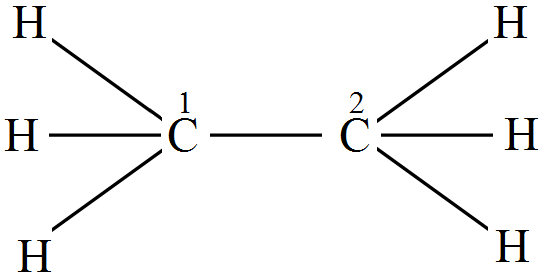
$\mathrm{C}_1$ is $\mathrm{sp}^3$ hybridized and $\mathrm{C}_2$ is $\mathrm{sp}^2$ hybridized. View full question & answer→Question 31 Mark
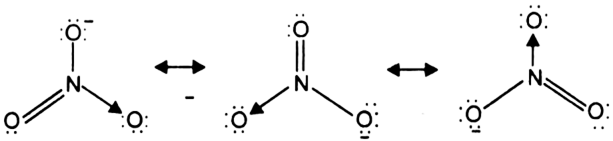
Write the resonance structures for$\text{NO}^-_3$
AnswerThe resonance structures are:$\text{NO}^-_2$
View full question & answer→Question 41 Mark
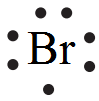
Write Lewis dot symbols for atoms of the following elements: Br.
Answer
Br: There are seven valence electrons in bromine. Hence, the Lewis dot structure is:
View full question & answer→Question 51 Mark
Discuss the shape of the following molecules using the VSEPR model:
$\text{AsF}_5$
Answer
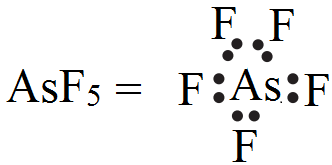
Bond pairs $=5$, lone pairs $=0$, i.e., it is of the type $A B_5$. Hence, shpe is trigonal bipyramidal. View full question & answer→Question 61 Mark
Write the resonance structures for
$\mathrm{NO}_2$.
AnswerThe resonance structures are:
$\mathrm{NO}_2$

View full question & answer→Question 71 Mark
What is the total number of sigma and pi bonds in the following molecules?
$\mathrm{C}_2\mathrm{H}_2$
View full question & answer→Question 81 Mark
Which hybrid orbitals are used by carbon atoms in the following molecules?
$\mathrm{CH}_3-\mathrm{CH}=\mathrm{CH}_2$;
Answer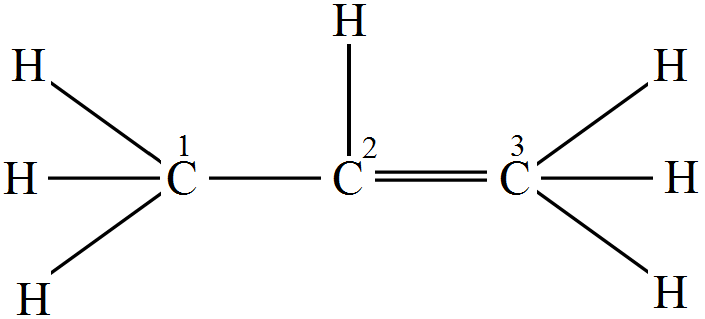
$C_1$ is $s p^3$ hybridized, while $C_2$ and $C_3$ are $s p^2$ hybridized. View full question & answer→Question 91 Mark
Which hybrid orbitals are used by carbon atoms in the following molecules?
$\mathrm{CH}_3-\mathrm{CHO}$
Answer
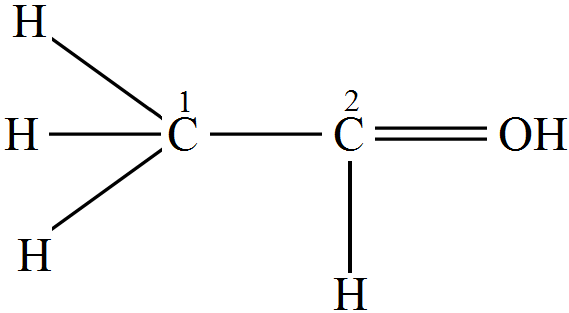
$\mathrm{C}_1$ is $\mathrm{sp}^3$ hybridized and $\mathrm{C}_2$ is $\mathrm{sp}^2$ hybridized. View full question & answer→Question 101 Mark
Considering x -axis as the internuclear axis which out of the following will not form a sigma bond and why? (a) 1 s and 1 s (b) 1 s and $2 \mathrm{p}_{\mathrm{x}}$ (c) $2 \mathrm{p}_{\mathrm{y}}$ and $2 \mathrm{p}_{\mathrm{y}}(\mathrm{d}) 1 \mathrm{~s}$ and 2 s .
AnswerIt will not form a s-bond because taking x -axis as the intemuclear axis, there will be lateral overlap between the two $2 p_y$ orbitals forming a $\Pi$-bond.
View full question & answer→Question 111 Mark
Discuss the shape of the following molecules using the VSEPR model:PH ${ }_3$
Answer
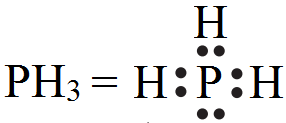
Bond pairs $=3$, lone pair $=1$, i.e., it is of the type $A B_3 L$. Hence shape is Trihonal. View full question & answer→Question 121 Mark
Write the resonance structures for
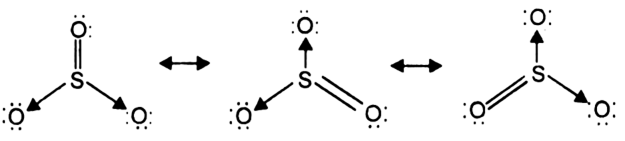
$\mathrm{SO}_3$
AnswerThe resonance structures are:
$\mathrm{SO}_3$
View full question & answer→Question 131 Mark
Write Lewis dot symbols for atoms of the following elements: B.
Answer
B: There are 3 valence electrons in Boron atom. Hence, the Lewis dot structure is:

View full question & answer→Question 141 Mark
Write Lewis dot symbols for atoms of the following elements: Mg.
Answer
Mg: There are two valence electrons in Mg atom. Hence, the Lewis dot symbol for Mg is:

View full question & answer→Question 151 Mark
Write Lewis dot symbols for atoms of the following elements: N.
Answer
N: There are five valence electrons in an atom of nitrogen. Hence, the Lewis dot structure is:

View full question & answer→Question 161 Mark
Discuss the shape of the following molecules using the VSEPR model: $\mathrm{SiCl}_4$
Answer
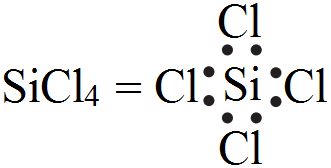
Bond pairs $=4$, lone pairs $=0$, i.e., it is of the type $A B_4$. Hence, shape is tetrahedral. View full question & answer→Question 171 Mark
Discuss the shape of the following molecules using the VSEPR model: $\mathrm{H}_2 \mathrm{S}$
Answer
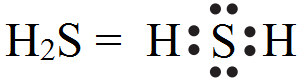
Bond pairs $=2$, Ione pairs $=$, i.e., it is of the type $A B_2 L_2$. Hence, shape is bent $/ V$ - shaped. View full question & answer→Question 181 Mark
Which hybrid orbitals are used by carbon atoms in the following molecules?
$\mathrm{CH}_3-\mathrm{CH}_2-\mathrm{OH} $;
Answer
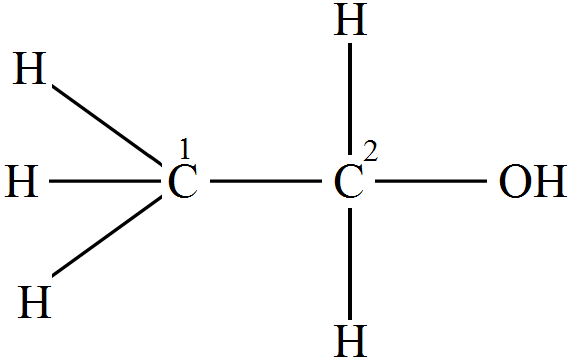
Both $\mathrm{C}_1$ and $\mathrm{C}_2$ are $\text{sp}^3$ hybridized. View full question & answer→Question 191 Mark
Write the significance of a plus and a minus sign shown in representing the orbitals.
AnswerPlus and minus sign is used to identify the nature of electrons wave. Plus (+ve) sign denotes crest, while (-ve) sign denotes trough.
View full question & answer→Question 201 Mark
What is the total number of sigma and pi bonds in the following molecules?
$\mathrm{C}_2\mathrm{H}_4$
View full question & answer→Question 211 Mark
Which hybrid orbitals are used by carbon atoms in the following molecules?
Answer
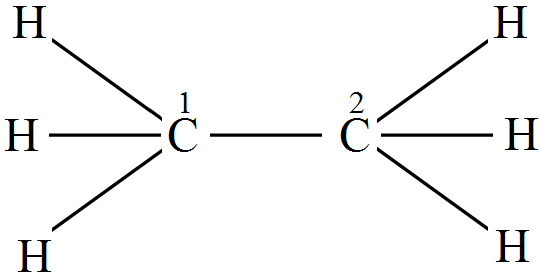
Both $\mathrm{C}_1$ and $\mathrm{C}_2$ are $\mathrm{sp}^3$ hybridized. View full question & answer→Question 221 Mark
Discuss the shape of the following molecules using the VSEPR model:
$\mathrm{BCl}_3$
Answer
The centar atom has only 3 bond pairs and no lone pair, i.e, it is type $\mathrm{AB}_3$ Hence, shape is triangular palnar. View full question & answer→Question 231 Mark
Write Lewis dot symbols for atoms of the following elements:O.
Answer
O: There are six valence electrons in an atom of oxygen. Hence, the Lewis dot structure is:

View full question & answer→Question 241 Mark
Discuss the shape of the following molecules using the VSEPR model:
$\mathrm{BeCl}_2$
Answer
the central atom has only two bond pairs and thre is no lone pair, i.e, it is of the type $\mathrm{AB}_2$. Hence,shape is linear. View full question & answer→Question 251 Mark
Why $\mathrm{KHF}_2$ exists but $\mathrm{KHCl}_2$ does not?
AnswerDue to H-bonding in HF, we have
$\text{H}-\text{F}\cdots\text{H}-\text{F}\cdots\text{H}-\text{F}\cdots$
This can dissociate to give $\text{HF}^-_2$ ion and hence, $\mathrm{KHF}_2$ exists but there is no H-bonding in $\text{H}-\text{Cl}.$ So, $\text{HCl}^-_2$ ion does not exist and hence, $\mathrm{KHCl}_2$ also does not exist.
View full question & answer→Question 261 Mark
Amongst the following elements whose electronic configurations are given below, which one has the highest ionisation enthalpy?
$[\text{Ne}]\text{3s}^2\text{3p}^1,[\text{Ne}\text{3s}^2\text{3p}^3,[\text{Ne}]\text{3s}^2\text{3p}^2,[\text{Ar}]\text{d}^{10}4\text{s}^2\text{4}\text{p}^3$
Answer$[\mathrm{Ne}] 3 \mathrm{s}^2 ~3 \mathrm{p}^3$, it is due to smaller size and stable electronic configuration.
View full question & answer→Question 271 Mark
ICl is more or less reactive than $\mathrm{C}_1$ ? Why?
AnswerIt is due to lower bond dissociation energy due to longer bond length and more polarity in ICl than $\mathrm{Cl}_2$ and less effective overlapping between 5 p orbital of I and 3 p orbital of Cl.
View full question & answer→Question 281 Mark
What is the state of hybridisation of each carbon atom in $\mathrm{C}_6 \mathrm{H}_6$?
AnswerEach 'C' is $\mathrm{sp}^2$ hybridized because each 'C' is attached to double bond.
View full question & answer→Question 291 Mark
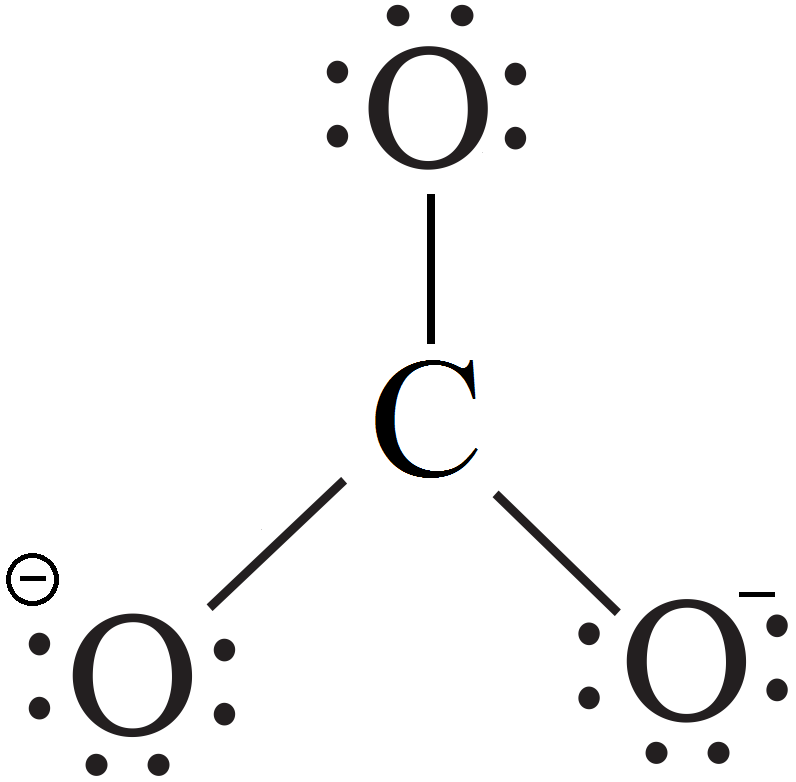
Which of the following does not show resonance and why? $\text{CO}^{2-}_3,\text{BO}^-_3,\text{SO}^{2-}_4$
Answer
$\text{BO}^{-}_3$because it does not have π-bond whereas others have $\pi-$bonds.
View full question & answer→Question 301 Mark
Why is solid NaCl non-conductor of electricity?
AnswerIn solid $\mathrm{NaCl}, \mathrm{Na}^{+}$and $\mathrm{Cl}^{-}$are not free to move, therefore, ions will not be able to carry current.
View full question & answer→Question 311 Mark
Can we have a diatomic molecule with its ground state molecular orbitals full with electrons? Give a reason for your answer.
AnswerNo, because bond order becomes zero, e.g. in case of $\mathrm{He}_2, \mathrm{Be}_2, \mathrm{Ne}_2$, etc. Note that in $\mathrm{H}_2, \sigma 1 \mathrm{s}$ molecular orbital is full but $\sigma 1 \mathrm{s}$ is empty.
View full question & answer→Question 321 Mark
Out of $\text{H}-\text{H}$ and $\text{Cl}-\text{Cl}$ bonds, which is expected to have higher bond enthalpy and why?
Answer$\text{H}-\text{H}$ bond has higher bond enthalpy because it has smaller bond length and higher bond dissociation enthalpy due to more extent of overlapping as compared to $\text{Cl}_2$.
View full question & answer→Question 331 Mark
What type of hybridisation is involved in $\mathrm{SF}_6$ ?
Answer$\mathrm{SF}_6, \mathrm{~S}$ is the central atom with six valence electrons.
$\therefore$ Number of hybrid orbitals $=\frac{1}{2}[6+6-0+0]=6$
Hence, the hybridisation involved in $\mathrm{sp}^3 \mathrm{~d}^2$.
View full question & answer→Question 341 Mark
What will be the molecular formula of the compound formed from B and C?
Answer$\text{BC}_3$ will be molecular formula.
View full question & answer→Question 351 Mark
$\text{NH}_3$ and $\text{NH}^+_4$ have what covalencies?
Answer$\text{NH}_3$ has covalency 3 because it forms 3 covalent bonds whereas in $\text{NH}^+_4$ 'N' has covalency 4 because it forms 4 covalent bodns.
View full question & answer→Question 361 Mark
What type of atomic orbitals can overlap to form molecular orbitals?
AnswerAtomic orbitals with comparable energies and proper orientation overlap to form molecular orbitals.
View full question & answer→Question 371 Mark
What type of hybridisation is present in C-atoms of $\text{C}_{60}$ allotrope called fullerene?
Answer$\text{sp}^2$, each C-atom is linked to two other C-atoms.
View full question & answer→Question 381 Mark
Why does $\mathrm{BF}_3$ behave as Lewis acid?
AnswerIn $\mathrm{BF}_3$ there are six electrons around Boron after sharing with fluorine atoms and hence Boron is electron deficient. B in $\mathrm{BF}_3$ can accept lone pair of electrons in the vacant 2 p orbital of Boron and so behaves as Lewis acid as its octet is not complete.
View full question & answer→Question 391 Mark
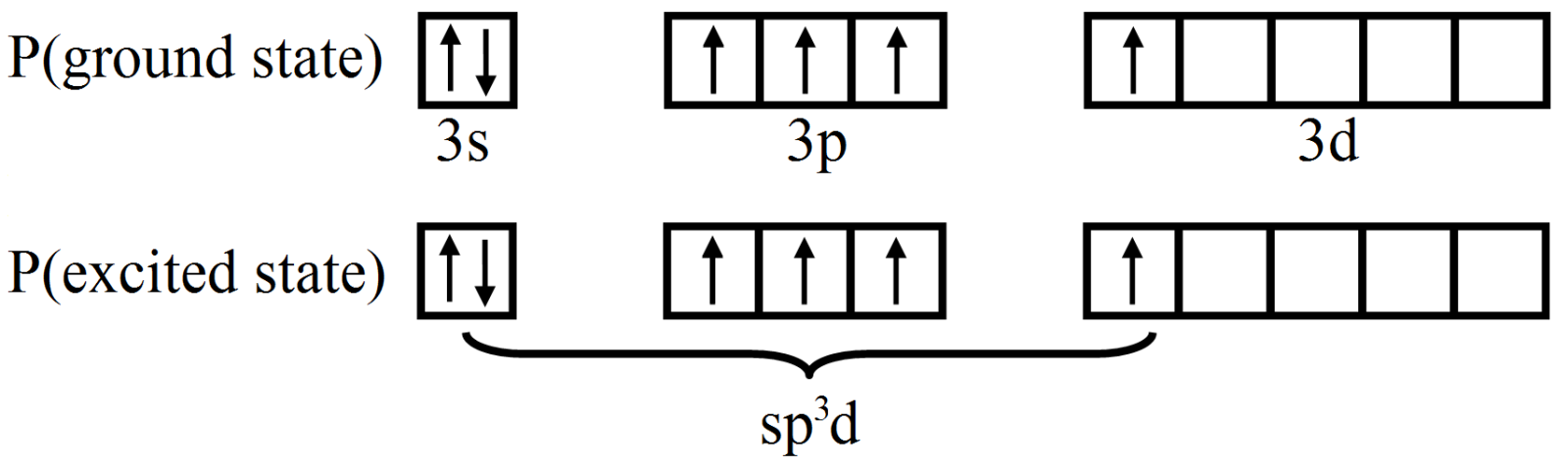
Explain why $\mathrm{PCl}_5$ is trigonal bipyramidal whereas $\mathrm{IF}_5$ is square pyramidal.
Answer$\mathrm{PCl}_5$ The ground state and the excited state outer electronic configurations of phosphorus (Z = 15) are represented below:
View full question & answer→Question 401 Mark
Which molecule/ ion out of the following does not contain unpaired electrons?
$\text{N}^+_2,\text{O}_2,\text{O}^{2-}_2,\text{B}_2$
Answer$\text{O}^{2-}_2$ does not contain unpaired electron.
View full question & answer→Question 411 Mark
Which of the following molecules show super octet?
$\mathrm{CO}_2, \mathrm{ClF}_3, \mathrm{SO}_2, \mathrm{IF}_5$
Answer$\mathrm{ClF}_3$, and $\mathrm{IF}_5$, are super octet molecules.
View full question & answer→Question 421 Mark
$\text{BH}^-_4{}$ and $\text{NH}^+_4$ are iso structural. Explain.
AnswerBoth have tetrahedral shape, i. e. four lobes of $\text{sp}^3$ hybridised orbitals so called iso structural.
View full question & answer→Question 431 Mark
What is the total number of sigma and pi bonds in the following molecules?
$\text{C}_2\text{H}_4$
View full question & answer→Question 441 Mark
Why are $\text{NH}_3$, glucose, and alcohol soluble in water, although they are covalent compounds?
AnswerThey can form H-bonds with water because they are polar covalent compounds and have 'H' attached to ‘N' and O.
View full question & answer→Question 451 Mark
In which of the following molecule/ ion all the bonds are not equal? $\text{XeF}_4,\text{BF}^-_4,\text{C}_2\text{H}_4,\text{SiF}_4$
AnswerIn $\mathrm{C}_2\mathrm{H}_4$ all bonds are not equal.
View full question & answer→Question 461 Mark
Indicate whether the following statement is true or false. Justify your answer in not more than three lines. The dipole moment of $\mathrm{CH}_3 \mathrm{F}$ is greater than that of $\mathrm{CH}_3 \mathrm{CL}$.
AnswerTrue. Explanation: This is because $\text{C}-\text{F}$ bond is more polar than $\text{C}-\text{Cl}$ bond due to larger electronegativity of F than Cl. As a result, the resultant dipole moment of $\mathrm{CH}_3 \mathrm{F}$ is more.
View full question & answer→Question 471 Mark
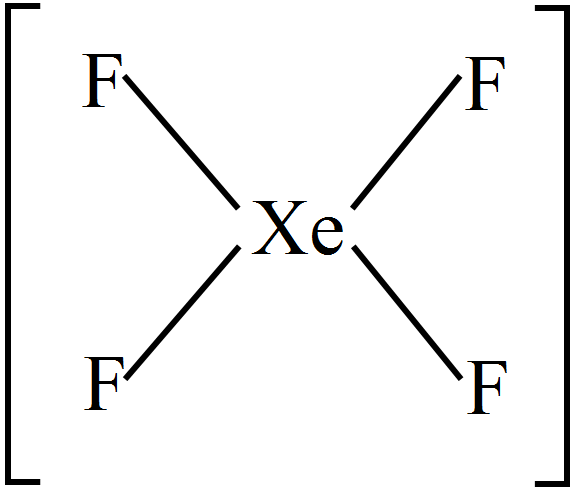
Predict the geometry of $\mathrm{XeF}_4$ molecule.
Answer$\mathrm{XeF}_4=4 \mathrm{bp}+2 \mathrm{lp}$ (This is because Xe contains 8 valence electrons) = square planar geometry.
View full question & answer→Question 481 Mark
Account for the following. The experimentally determined $\text{N}-\text{F}$ bond length in $\mathrm{NF}_3$ is greater than the sum of the single covalent radii of N and F.
AnswerThis is because both N and F are small and hence, have high electron density. So, they repel the bond pairs thereby making the N-F bond length larger.
View full question & answer→Question 491 Mark
Although very useful in a large number of cases, the octet rule has many exceptions. Give two examples to support this statement.
AnswerIn $\mathrm{BCl}_3$ and $\mathrm{PCl}_5$, after sharing, there are 6 and 10 electrons respectively.
In $\mathrm{BCl}_3$ 'B' has 3 valence electrons, it shares 3 electron with Cl and has 6 electrons after sharing. In $\mathrm{PCl}_5 \mathrm{P}$ has 5 valence electrons, it shares 5 with chlorine atoms and has 10 electrons.
View full question & answer→Question 501 Mark
Isostructural species are those which have the same shape and hybridisation. Among the given species identify the isostructural pairs.
$\text{NH}_3,\ \text{BF}_3,\ \text{BF}^-_4,\ \text{NH}^+_4,\ \text{BCl}_3,\ \text{BrCl}_3,\ \text{NH}_3,\ \text{NO}^-_3$
Answer$\text{BF}^-_4$ and $\text{Nh}^+_4$ both are $\text{sp}^3$ hybridized and tetrahedral shape.
View full question & answer→Question 511 Mark
How many nodal planes are present in $\pi(2\text{px})$ and $\pi\text{*(2px)}$ molecular orbitals?
AnswerOne and two respectively.
View full question & answer→Question 521 Mark
Why $\mathrm{NF}_3$ is pyramidal but $\mathrm{BF}_3$ is triangular planar?
AnswerIn $\mathrm{NF}_3, \mathrm{~N}$ is surrounded by three F atoms and a lone pair thus, have lp -bp repulsion along with bp-bp repulsion.
Thus, its shape is pyramidal.
In $\mathrm{BF}_3, \mathrm{~B}$ is surrounded by only three F atoms, i.e. have no lone pairs, so only repulsion present in it is bp-bp.
Thus, its shape is triangular planar.
View full question & answer→Question 531 Mark
Give the structure of an anion which is isostructural with $\mathrm{BF}_3$.
Answer$\left[\mathrm{BeF}_3\right]^{-}$is isostructural with $\mathrm{BF}_3$ because both have 3 bonded pair of electrons.
View full question & answer→Question 541 Mark
What is valence bond approach for the formation of covalent bond?
AnswerA covalent bond is formed by the overlap of half-filled atomic orbitals.
View full question & answer→Question 551 Mark
Arrange the given bonds in increasing order of polarity:
$\text{P}-\text{H},\text{H}-\text{O},\text{N}-\text{H},\text{H}-\text{F}$
Answer$\text{P}-\text{H}<\text{N}-\text{H}<\text{H}-\text{O}<\text{H}-\text{F}$
Because P < N < O < F is increasing order of electronegativity. Greater the difference in electronegativity, more will be polarity.
View full question & answer→Question 561 Mark
If the electronic configuration of an element is $1 s^2 2 s^2 2 p^6 3 s^6 3 p^6 3 d^2 4 s^2$, the four electrons involved in chemical bond formation will be.
AnswerThe given electronic configuration shows that the element is vanadium $(Z=22)$. It belongs to d-block of the periodic table. In transition elements i.e. d-block elements, electrons of $n s$ and( $n-1) d$ subshell take part in bond formation.
View full question & answer→Question 571 Mark
Five moles of o bonds are present in simple hydrocarbon with sp hybridization. Give formula of the compound.
Answer$\ \ \ \ \ \ \ \ {\text{H}\ \ \ \ \text{H}}\\\ \ \ \ \ \ \ \ \ |\ \ \ \ \ \ |\\\text{H}-\text{C}=\text{C}-\text{H}$ has 5 moles of o bonds and each 'C' is $sp^2$ hybridised.
View full question & answer→Question 581 Mark
What is the magnetic character of the anion of $\mathrm{KO}_2$?
AnswerAnion of $\mathrm{KO}_2$ is $\text{O}^-_2$ (superoxide ion) which has one unpaired electron and hence is paramagnetic.
View full question & answer→Question 591 Mark
Arrange $\text{O}^+_2\text{O}_2,\text{O}^-_2 $ in increasing order of bond dissociation enthalpy.
Answer$\text{O}^-_2<\text{O}_2<\text{O}^+_2$
View full question & answer→Question 601 Mark
Why does $\text{He}_2$ not exist?
Answer$\text{He}_2$ does not exist because repulsive forces dominate attractive forces and bond order is zero for $\text{He}_2$. Secondly its bond order is zero. $\text{He}_2(4)\sigma_{\text{ls}^2}\sigma*_{\text{ls}^2}$ $\text{B.O.}=\frac12(\text{N}_\text{b}-\text{N}_\text{a})=\frac12(2-2)=0$
View full question & answer→Question 611 Mark
Three resonating structures I, II, III have energies $\mathrm{E}_1, \mathrm{E}_2$ and $\mathrm{E}_3$ and structure III being most stable. If energy of actual structure is E , then what is the resonance energy?
Answer$\text{E}_3-\text{E}$ is resonance energy. It is difference in energy of most stable structure and actual structure.
View full question & answer→Question 621 Mark
Out of NaCl and MgO, which has higher value of lattice energy?
AnswerMgo has higher value of lattice energy due to stronger force of attraction between divalent $\mathrm{Mg}^{2+}$ and $\mathrm{O}^{2-}$ ions than monovalent $\mathrm{Na}^{+}$and $\mathrm{Cl}^{-}$ions.
View full question & answer→Question 631 Mark
What is correct electronic configuration of the outermost shell of the most electronegative element?
Question 641 Mark
Out of $\text{CCl}_4,\text{CHCl}_3,\text{CH}_2\text{Cl}$ which has zero dipole moment?
Answer$\text{CCl}_4$ has zero dipole moment because it is tetrahedral and dipole get cancelled.
View full question & answer→Question 651 Mark
Why is the energy of $\pi\text{2p}_\text{x}$ and $\pi\text{2p}_\text{y}$ molecular orbital lower than $\sigma\text{2p}_\text{z}$ molecular orbital in $\mathrm{N_2}$ molecule?
AnswerThis is because of intermixing of 2s and $2p_z$ orbitals because of their close proximity. Due to intermixing, $\sigma\text{2p}_\text{z}$ molecular orbital becomes higher in energy than $\pi\text{2p}_\text{x}$ and $\pi2\text{p}_\text{y}$ molecular orbitals.
View full question & answer→Question 661 Mark
Write electron dot structures of CO and $\mathrm{AlCl}_3$.
View full question & answer→Question 671 Mark
The molecule $\mathrm{SO_2}$ has dipole moment. Is the molecule linear or bent? Give reason.
AnswerIt is bent molecule. If it had been linear, dipole moment would have been zero.
View full question & answer→Question 681 Mark
Give the correct decreasing order of $\mathrm{C}-\mathrm{H}$ bond, lengths in the molecule $\mathrm{C}_2 \mathrm{H}_6, \mathrm{C}_2 \mathrm{H}_4$ and $\mathrm{C}_2 \mathrm{H}_2$.
Answer

This is because hybrid orbitals of carbon involved in overlapping with 1 s -orbital of hydrogen are $\mathrm{sp}^3, \mathrm{sp}^2$ and sp respectively and their sizes are in the order $\mathrm{sp}^3>\mathrm{sp}^2>\mathrm{sp}$. View full question & answer→Question 691 Mark
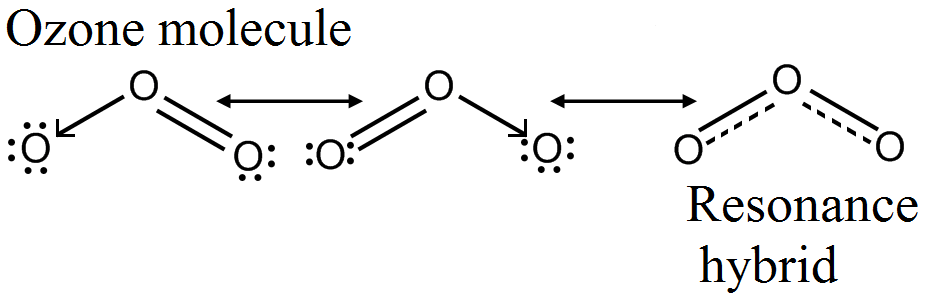
Draw the resonating structure of: Ozone molecule.
Answer
Resonating structures:
View full question & answer→Question 701 Mark
Why is NaCl harder than sodium metal?
AnswerThis is because in NaCl , there is strong ionic bond between $\mathrm{Na}^{+}$and $\mathrm{Cl}^{-}$whereas in Na metal, there is weak metallic bond.
View full question & answer→Question 711 Mark
Do all linear molecules have zero dipole moment? Explain.
AnswerNo, linear molecules having equal and opposite dipoles have zero dipole moment, e.g.

View full question & answer→Question 721 Mark
Which of the following species has tetrahedral geometry?
$\text{BH}_4^-,\text{NH}^-_2,\text{CO}^{2-}_3,\text{H}_3\text{O}^+$
Answer$\text{BH}^-_4$ has tetrahedral geometry.
View full question & answer→Question 731 Mark
Sodium chloride solution gives a precipitate of AgCl with $\mathrm{AgNO}_3$, whereas $\mathrm{CCl}_4$ does not, why?
AnswerNaCl is an ionic compound, gives $\mathrm{Cl}^{-}$which reacts with $\mathrm{Ag}^{+}$to form AgCl , whereas $\mathrm{CCl}_4$ is covalent compound, therefore, it does not give ions in aqueous solution, therefore, does not form precipitate with $\mathrm{CCl}_4$.
View full question & answer→Question 741 Mark
What is the type of hybrid orbitals associated with B atom in $\text{B}^-_4.$
Answer'B'in $\text{BH}^-_4$ is $\text{sp}^3$ hybridised because vacant $2\text{p}_\text{z}$ orbital of boron takes part in hybridisation and accepts a pair of electron from $\text{H}^-$ ion.
View full question & answer→Question 751 Mark
What is covalence of Al in $\mathrm{AlCl}_3$ ?
Answer3 because 'Al’ forms 3 covalent bonds.
View full question & answer→Question 761 Mark
Out of $\mathrm{O}_2$ and $\mathrm{N}_2$ molecules, which has greater bond dissociation enthalpy and why?
Answer$\mathrm{N}_2$ has higher bond dissociation energy than $\mathrm{O}_2$ due to presence of triple bond in $\mathrm{N}_2$ whereas $\mathrm{O}_2$ has double bond.
View full question & answer→Question 771 Mark
Why is water liquid whereas $\mathrm{H}_2 \mathrm{S}$ is gas at room temperature?
Answer$\mathrm{H}_2 \mathrm{O}$ molecules are associated with intermolecular H -bonding whereas $\mathrm{H}_2 \mathrm{S}$ is not because ' O ' is more electronegative and smaller in size than ' 5 '.
View full question & answer→Question 781 Mark
Write resonance structures of $\mathrm{SO_3}$.
View full question & answer→Question 791 Mark
Why axial bonds of $\mathrm{PCl_5}$ are longer than equatorial bonds?
AnswerThis is due to greater repulsion on the axial bond pairs by the equatorial bond pairs of electrons.
View full question & answer→Question 801 Mark
Draw the resonating structure of:
Nitrate ion.
AnswerResonating structures: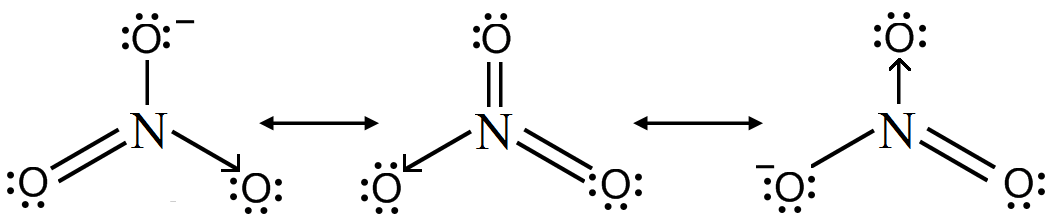
View full question & answer→Question 811 Mark
Out of p-orbital and sp-hybrid orbital which has greater directional character and why?
Answersp-orbital has greater directional character than p-orbital. This is because p-orbital has equal sized lobes, with equal electron density in both the lobes where as sp-hybrid orbital has greater electron density on one side.
View full question & answer→Question 821 Mark
What is number of π bonds and σ bonds in the following structure:
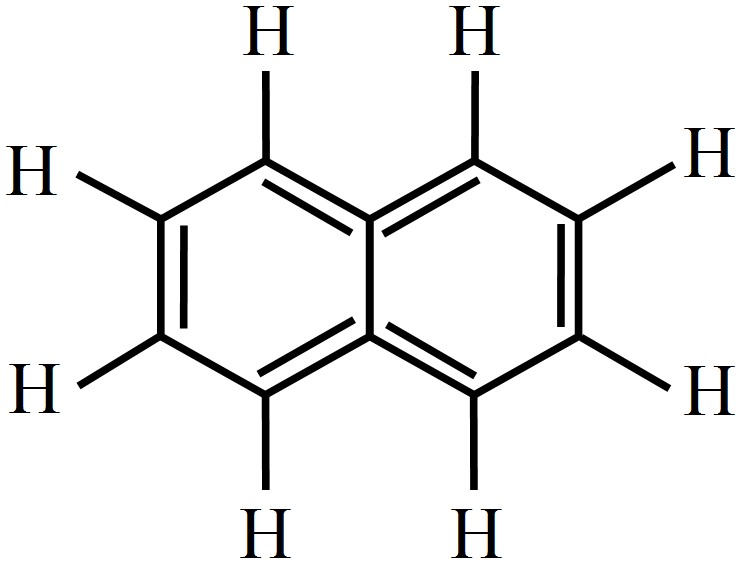
AnswerThere are $6\pi$ bonds and $19\sigma$ bonds.
View full question & answer→Question 831 Mark
What type of hybridisation explains the trigonal bipyramidal shape of $\mathrm{SF_4}$?
Answer$\mathrm{sp^3d}$ hybridisation with one lone pair.
View full question & answer→Question 841 Mark
Can a molecule with even number of electrons be paramagnetic? Give example.
AnswerYes, $\mathrm{B}_2$ has 10 electrons, $\mathrm{O}_2$ has 16 electrons, both are paramagnetic due to presence of two unpaired electrons.
View full question & answer→Question 851 Mark
In which of the following substances will hydrogen bond be strongest?
$\mathrm{HCl}, \mathrm{H}_2 \mathrm{O}, \mathrm{HI}, \mathrm{H}_2 \mathrm{~S}$
Answer$\mathrm{H}_2 \mathrm{O}$ has strongest hydrogen bonds.
View full question & answer→Question 861 Mark
Explain the following. HCl is a covalent compound but it ionises in the solution.
AnswerThis is because of the large difference in the electronegativity of H and Cl-atoms. Due to which polarity is generated which is responsible for separation of ions.
View full question & answer→Question 871 Mark
Write Lewis dot symbols for the following atoms and ions.
i. $\mathrm{O}^{2-}$
ii. $\mathrm{P}^{3-}$
iii. $\mathrm{N}^{3-}$
iv. Xenon.
View full question & answer→Question 881 Mark
Write Lewis dot structure of AlN.
Question 891 Mark
Why $\mathrm{AlF}_3$ is a high melting solid whereas $\mathrm{Sif}_4$ is a gas?
Answer$\mathrm{AlF}_3$ is an ionic compound whereas $\mathrm{SiF}_4$ is a non-polar covalent compound.
Hence, interparticle forces in $\mathrm{AlF}_3$ are much stronger that's why it is a high melting solid.
View full question & answer→Question 901 Mark
What can you say about the shapes of $\mathrm{SO}_2$ and $\mathrm{NF}_3$ molecules from the information that both have net dipole moment?
Answer$\mathrm{SO}_2$ is bent molecule whereas $\mathrm{NF}_3$ is pyramidal due to 3 bonded pair and one lone pair. 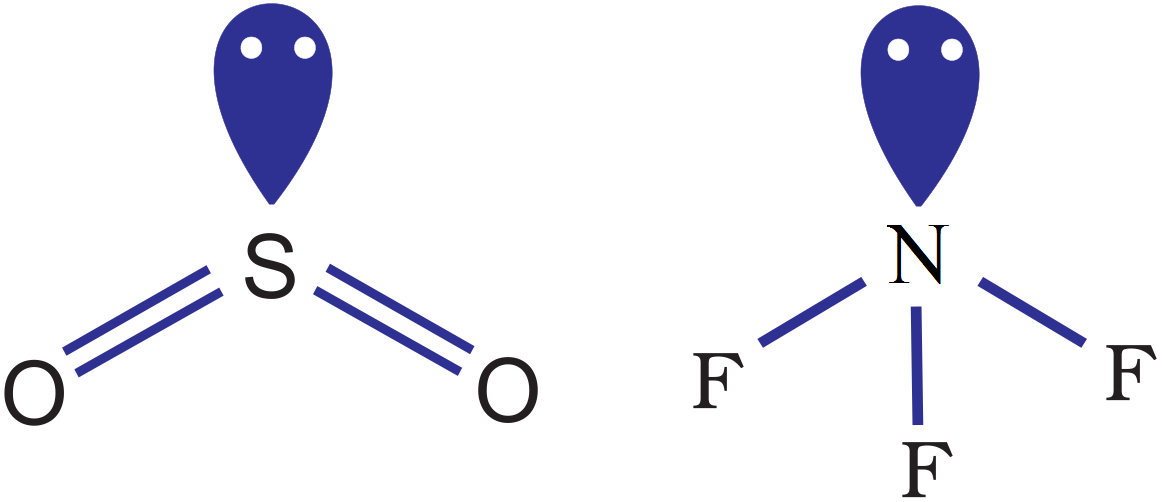
View full question & answer→Question 911 Mark
Is it correct to say that bond order always increases when an electron is lost?
AnswerBond order may increase or decrease, when an electron is lost depending upon whether the electron is lost from bonding or antibonding molecular orbital.
View full question & answer→Question 921 Mark
Calculate the number of bond pairs and lone pairs in $\mathrm{IF}_5$ molecule.
AnswerI contains 7 valence electrons, out of which five are utilised to form bond with five F atoms. Thus, it has five bond pairs. Number of lone pairs = valence $\mathrm{e}^{-}$-bond pairs $=7-5=2$ electrons or 1 lone pair.
View full question & answer→Question 931 Mark
What are the types of hybrid orbitals of nitrogen in $\text{NO}^+_2,\text{NO}^-_3$ and $\text{NH}^+_4$ respectively?
Answer$\text{NO}^+_2$ is sp, $\text{NO}^-_3$ is $\text{sp}^2$ and $\text{NH}^+_4$ is $\text{sp}^3$ hybridised.
View full question & answer→MCQ 941 Mark
Diethyl ether is mostly used in solvent extraction due to all of the following reasons except :
- A
Its solvation capacity is very high.
- B
Being inert, it does not react with most organic compound.
- ✓
There are two lone pairs in it, therefore it acts as a strong nucleophile.
- D
Its boiling point is low, therefore, it can be easily separated by distillation.
AnswerCorrect option: C. There are two lone pairs in it, therefore it acts as a strong nucleophile.
$\mathrm{C}_2 \mathrm{H}_5 \mathrm{OC}_2 \mathrm{H}_5$
There are two lone pairs in it but being inert, it does not react with most organic compound.
View full question & answer→Question 951 Mark
Arrange $\text{F}_2,\text{Cl}_2,\text{Br}_2,\text{I}_2$ in increasing order of bond dissociation enthalpy?
Answer$\text{I}_2<\text{F}_2<\text{Br}_2<\text{Cl}_2.\text{F}_2$ has exceptionally low bond dissociation enthalpy due to repulsion between lone pair as it has smallest size among halogens.
View full question & answer→Question 961 Mark
$\mathrm{AIF}_3$ or $\mathrm{AICI}_3$, which is covalent?
Answer$\mathrm{AlCl}_3$ is covalent because 'Cl' is less electronegative than 'F' due to bigger size.
View full question & answer→Question 971 Mark
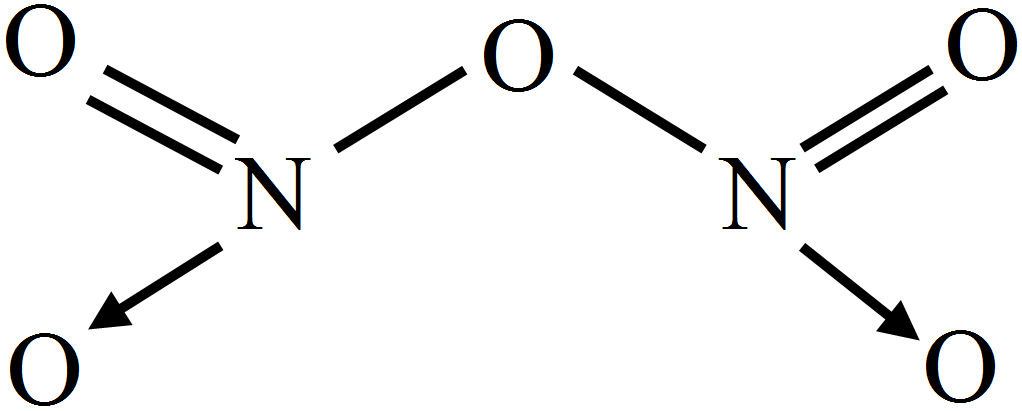
What is covalence of 'N' in $\text{N}_2\text{O}_5$.
AnswerIt is equal to 4 because 'N' forms 4 covalent bonds.
View full question & answer→Question 981 Mark
Write the increasing order of energies of molecular orbitals of $\text{N}_2$ in the following: $\pi2\text{p}_\text{y},\ \pi*\text{2p}_\text{x},\ \pi*2\text{p}_\text{y},\ \sigma2\text{p}_\text{z}$
Answer$\pi2\text{p}_\text{y}<\sigma2\text{p}_\text{z}<\pi*2\text{p}_\text{x}=\pi*2\text{p}_\text{y}$
View full question & answer→Question 991 Mark
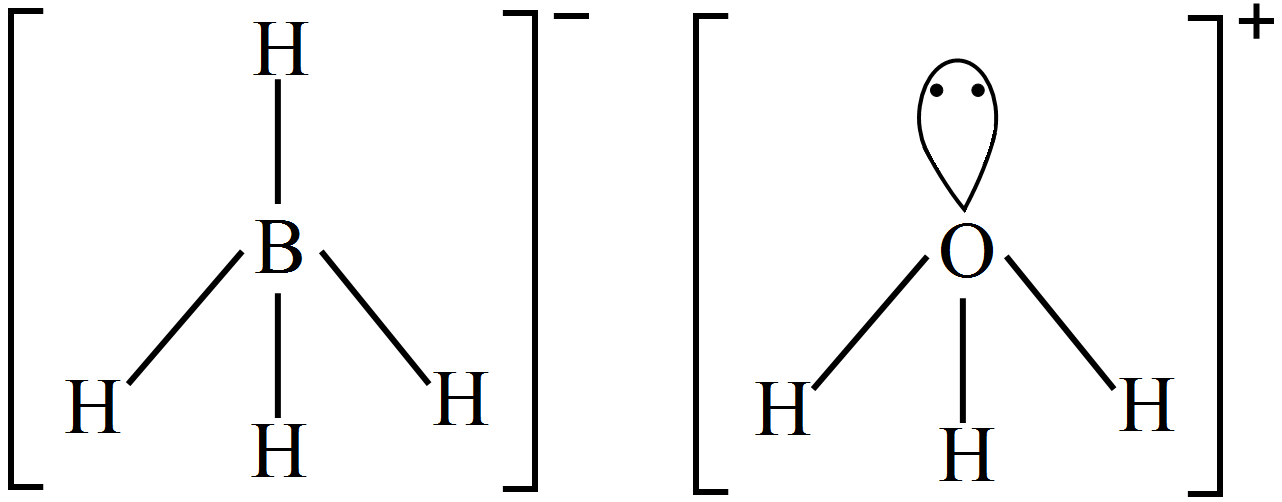
Explain giving reasons whether $\text{BH}^-_4$ and $\mathrm{H}_3 \mathrm{O}^{+}$ will have same or different geometry.
AnswerCentral atom in both the ions is surrounded by same number of pairs of valence electrons, i.e. 4. Hence, they have the same geometry, viz., tetrahedral.
View full question & answer→Question 1001 Mark
If the electronic configuration of an element is $\text{ls}^\ \text{2s}^2\ \text{2p}^6\ 3\text{s}^2\ \text{3p}^6\ 3\text{d}^2\ \text{4s}^2,$ the four electrons involved in chemical bond formation will be:
Answer$3 d^2 ~4 s^2$ will take part in bond formation.
View full question & answer→Question 1011 Mark
Which of the following has maximum bond angle?
$\text{H}_2\text{O},\text{CO}_2,\text{NH}_3,\text{CH}_4$
Answer$\mathrm{CO}_2$ has the maximum bond angle of $180^{\circ}$ because it is linear molecule.
$\mathrm{H}_2 \mathrm{O}$ has bond angle $104.5^{\circ}$, bent molecule with two lone pair of electrons.
$\mathrm{NH}_3$ has bond angle $107^{\circ}$, pyramidal shape with one lone pair of electrons.
$\mathrm{CH}_4$ has bond angle $109.5^{\circ}$, tetrahedral, with four bonded pair of electrons.
View full question & answer→Question 1021 Mark
Which of the following has highest lattice energy and why?
CsF, CsCl, CsBr, CsI
AnswerCsF has highest lattice energy because 'F' is smallest in size and is more electronegative, therefore, it has maximum ionic character and maximum force of attraction, hence, highest lattice energy.
View full question & answer→Question 1031 Mark
Which end of ICl will be positive and which will be negative and why? Is it covalent or ionic?
AnswerI will be positive, Cl will be negative because Cl is more electronegative than I. It is a covalent compound with some ionic character due to polarity.
View full question & answer→Question 1041 Mark
Out of $\sigma$ and $\pi-$bonds, which one is stronger and why?
Answer$\sigma-$bond is stronger. This is because $\sigma-$bond is formed by head-on overlapping of atomic orbitals and therefore, the overlapping is large. $\pi-$bond is formed by sideway overlapping which is small.
View full question & answer→Question 1051 Mark
Out of $\text{H}_2$ and $\text{H}^+_2$ which is more stable and why?
Answer$\text{H}_2$ is more stable because its bond order is 1 whereas $\text{H}^+_2$ has $\text{B.O.}=\frac12$
View full question & answer→Question 1061 Mark
How many types of bonds are present in $\mathrm{NH}_4 \mathrm{Cl}$?
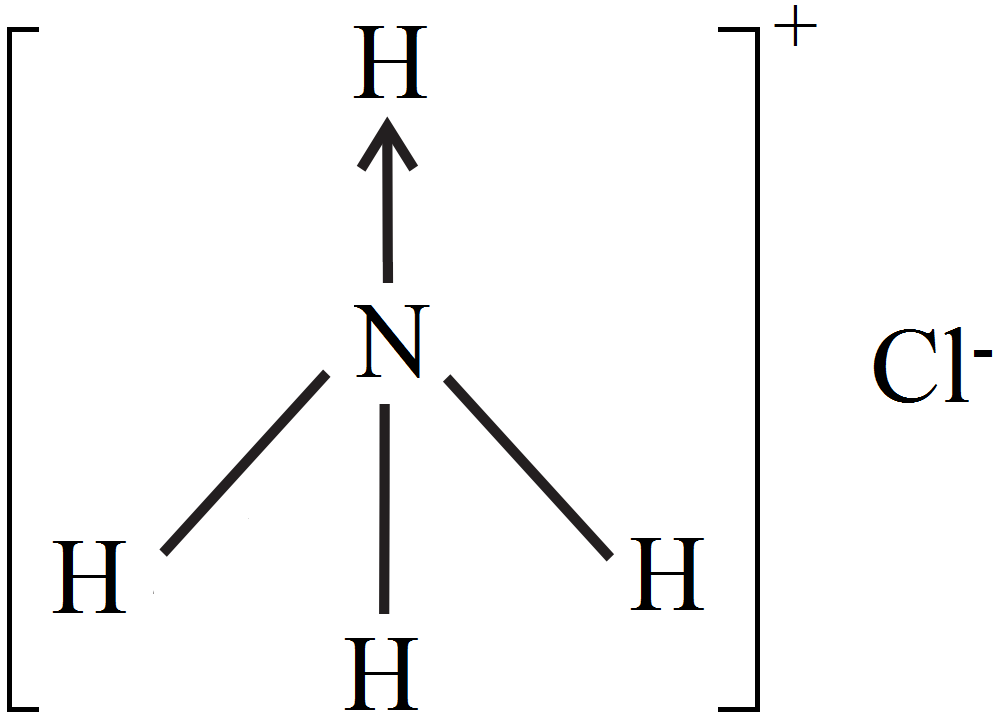
AnswerIonic, co-ordinate and covalent bonds are present in $\mathrm{NH}_4 \mathrm{Cl}$.
View full question & answer→Question 1071 Mark
Out of $\mathrm{H}_2 \mathrm{O}$ and $\mathrm{H}_2 \mathrm{S}$, which is more polar?
Answer$\mathrm{H}_2 \mathrm{O}$ is more polar than $\mathrm{H}_2 \mathrm{S}$ as oxygen is more electronegative than sulphur due to smaller size.
View full question & answer→Question 1081 Mark
Identify the compounds which do not follow octet rule.
$\mathrm{PCl}_3, \mathrm{SO}_2, \mathrm{SO}_3, \mathrm{NO}_2, \mathrm{SF}_4, \mathrm{NO}, \mathrm{BF}_3, \mathrm{H}_2 \mathrm{S}, \mathrm{SF}_6 .$
Answer$\mathrm{SF}_4, \mathrm{NO}_2, \mathrm{NO}, \mathrm{BF}_3, \mathrm{SF}_6$ do not follow octet rule.
View full question & answer→Question 1091 Mark
Which of the following has maximum bond angle?
$\text{H}_2,\text{NH}_3,\text{CH}_4,\text{C}_2\text{H}_4$
Answer$\mathrm{C}_2 \mathrm{H}_2$ has bond angle equal to 120° which is maximum.
View full question & answer→Question 1101 Mark
Given is the electron dot structure for carbon suboxide, $\mathrm{C}_3 \mathrm{O}_2$. Write its structural formula.
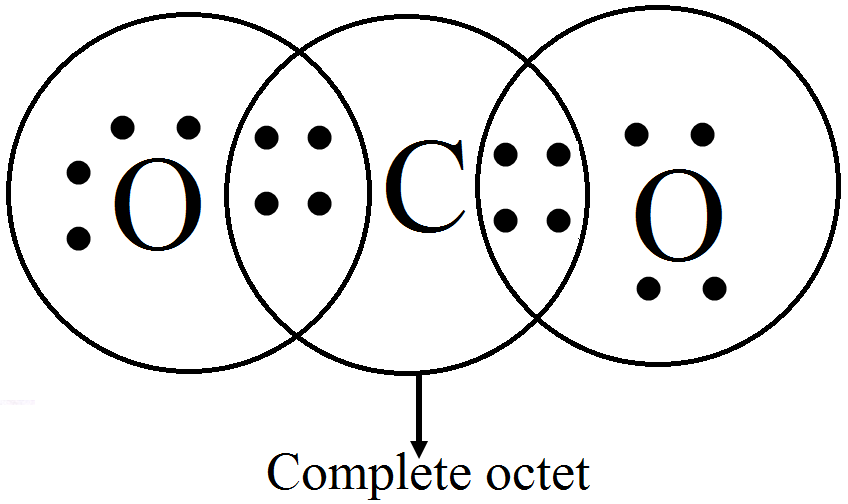
Answer$\text{O}=\text{C}=\text{C}=\text{C}=0$
View full question & answer→Question 1111 Mark
What will be nature of the bond formed between B and C?