MCQ 11 Mark
A majority of farmers in India depend upon $ ......... $ for irrigating their crops :
AnswerThe Indian economy is heavily dependent on agriculture and the livelihood of the Indian farmer largely depends on the Monsoon rains for irrigating their crops.
View full question & answer→MCQ 21 Mark
Dihydrogen can be prepared on commercial scale by different methods. In its preparation by the action of steam on hydrocarbons, a mixture of $CO$ and $H_2$ gas is formed. It is known as $ .........$
AnswerThe maximum of $CO$ and $H_2$ is called water gas. As this mixture of $CO$ and $H_2$ is used for the synthesis of methonol and a number of hydrocarbons, it is also called synthesis gas or 'syngas'.
View full question & answer→MCQ 31 Mark
Hydrogen is evolved by reaction of cold $\ce{HNO}_3 \ (5\%)$ on :
Answer$\text{Mn}+2\text{HNO}_3(\text{dil})\xrightarrow{\ \ \ \ \ \ }\text{Mn}(\text{NO}_3)_2+\text{H}_2$
View full question & answer→MCQ 41 Mark
Volume strength of $500\ ml$ solution containing $3.4\ gm$ of $\ce{H_2O_2}$ is
- A
$11.2$
- B
$6.8$
- C
$1.12$
- ✓
$2.24$
AnswerCorrect option: D. $2.24$
View full question & answer→MCQ 51 Mark
Sodium on reaction with cold water produces a residue. The nature of residue is :
- A
colourless, slippery and slightly cold
- B
colourful, soapy and slightly warm
- ✓
colourless, soapy and slightly warm
- D
colourful, slippery and slightly cold
AnswerCorrect option: C. colourless, soapy and slightly warm
Sodium reacts with cold water to form $\text{NaOH}.$
It is colourless, soapy and slightly warm.
View full question & answer→MCQ 61 Mark
In which of the following respect, electronic configuration of hydrogen has resemblance to alkali metals and halogens respectively?
- ✓
It lose one electron to form unipositive ion and gain one electron to form uninegative ion.
- B
It gain one electron to form uninegative ion and lose one electron to form unipositive ion.
- C
It has the ability only to gain one electron.
- D
AnswerCorrect option: A. It lose one electron to form unipositive ion and gain one electron to form uninegative ion.
Hydrogen has resemblance to the alkali metals, which lose one electron to form unipositive ions, as well as with halogens, which gain one electron to form uninegative ion.
View full question & answer→MCQ 71 Mark
Which of the following equations depicts reducing nature of $\ce{H_2O_2}\ ?$
- A
$ 2\left[\mathrm{Fe}(\mathrm{CN})_6\right]^{4-}+2 \mathrm{H}^{+}+\mathrm{H}_2 \mathrm{O}_2 \rightarrow 2\left[\mathrm{Fe}(\mathrm{CN})_6\right]^{3-}+2 \mathrm{H}_2 \mathrm{O} $
- ✓
$\mathrm{I}_2+\mathrm{H}_2 \mathrm{O}_2+2 \mathrm{OH}^{-} \rightarrow 2 \mathrm{I}^{-}+2 \mathrm{H}_2 \mathrm{O}+\mathrm{O}_2 $
- C
$ \mathrm{Mn}^{2+}+\mathrm{H}_2 \mathrm{O}_2 \rightarrow \mathrm{Mn}^{4+}+2 \mathrm{OH}$
- D
$ \mathrm{PbS}+4 \mathrm{H}_2 \mathrm{O}_2 \rightarrow \mathrm{PbSO}_4+4 \mathrm{H}_2 \mathrm{O} $
AnswerCorrect option: B. $\mathrm{I}_2+\mathrm{H}_2 \mathrm{O}_2+2 \mathrm{OH}^{-} \rightarrow 2 \mathrm{I}^{-}+2 \mathrm{H}_2 \mathrm{O}+\mathrm{O}_2 $
Iodile gets reduced from zero to $-1.$
View full question & answer→MCQ 81 Mark
Interstitial hydride can be formed by :
MCQ 91 Mark
The decomposition of $\ce{H_2O_2}$ is prevented by :
- A
$\ce{MnO}_2$.
- B
$\ce{NaOH}.$
- ✓
- D
View full question & answer→MCQ 101 Mark
Which of the following ions will cause hardness in water sample?
- ✓
$ \mathrm{Ca}^{2+}$
- B
$ \mathrm{Na}^{+} $
- C
$ \mathrm{Cl}^{-}$
- D
$\mathrm{K}^{+}v$
AnswerCorrect option: A. $ \mathrm{Ca}^{2+}$
Explanation: (A) $ \mathrm{Ca}^{2+}$
$\mathrm{Ca}^{++}$inos in the from $\mathrm{Ca}\left(\mathrm{HCO}_3\right)_2$ or $\mathrm{CaCl}_2$ or $\mathrm{CaSO}_4$ cause hardness in water, i.e., soluble salts of calcium can cause hardness in water.
View full question & answer→MCQ 111 Mark
Which of the following compounds is used for water softening?
- A
$\ce{Ca _3\left( PO _4\right)_2}$
- B
$ \mathrm{Na}_3 \mathrm{PO}_4 $
- ✓
$ \mathrm{Na}_6 \mathrm{P}_6 \mathrm{O}_{18} $
- D
$ \mathrm{Na}_2 \mathrm{HPO}_4 $
AnswerCorrect option: C. $ \mathrm{Na}_6 \mathrm{P}_6 \mathrm{O}_{18} $
$($Sodium hexametaphosphate$)$ commercially known as calgon is used for water softening.
$2 \mathrm{CaCl}_2+\mathrm{Na}_2\left[\mathrm{Na}_4\left(\mathrm{PO}_3\right)_6\right] \rightarrow \mathrm{Na}_2\left[\mathrm{Ca}_2\left(\mathrm{PO}_3\right)_6\right]+4 \mathrm{NaCl}$
View full question & answer→MCQ 121 Mark
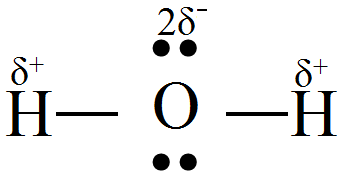
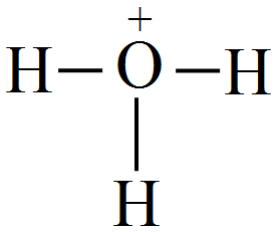
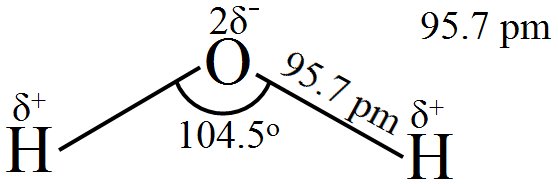
Identify the structure of water in the gaseous phase.
MCQ 131 Mark
Hydrogen is the $ ......... $ element on the earth :
Answer$H$ is the lightest element on earth as there is only $1$ proton and $1e^-$.
All the other elements have more than $1$ electrons and protons along with neutrons.
View full question & answer→MCQ 141 Mark
Which of the following statements are not true for hydrogen?
- A
It exists as diatomic molecule.
- B
It has one electron in its outermost shell.
- C
It can lose electron to form a cation which can exist freely.
- ✓
It forms a large number of ionic compounds by losing an electron.
AnswerCorrect option: D. It forms a large number of ionic compounds by losing an electron.
View full question & answer→MCQ 151 Mark
Hydrogen has the tendency to lose one electron and form $H^+$. In this respect, it resembles :
Answerlkali metals also have a tendency to lose one electron and form cations, so this similar property of hydrogen matches with alkali metals.
Carbon has a tendency to form covalent bonds.
Alkaline earth metals have a tendency to lose two electrons and Halogens have a tendency to gain electrons.
View full question & answer→MCQ 161 Mark
Metal hydride on treatment with water gives $ ........ :$
- A
$\ce{H_2O_2}$
- B
$\ce{H_2O}$
- C
- ✓
AnswerMetal hydrides react with water to form hydrogen gas and the metal hydroxide.
Example : $\ce{LiH + H_2O \rightarrow H_2 + LiOH.}$
View full question & answer→MCQ 171 Mark
Pure water is a $ ......... $ conductor of electricity :
AnswerPure water is free of impurities $($salts and minerals$).$
Impurities are necessary for electrical conductivity so pure water is a bad conductor of electricity.
View full question & answer→MCQ 181 Mark
Which of the following hydrides is electron $-$ precise hydride?
- A
$\ce{B_2H_6}$
- B
$\ce{NH_3}$
- C
$\ce{H_2O}$
- ✓
$\ce{CH_4}$
AnswerCorrect option: D. $\ce{CH_4}$
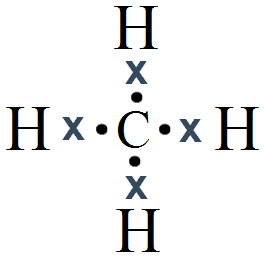
$\ce{CH_4}$ is an electron precise hydride since there are exact number of electrons to form normal covalent bonds.
View full question & answer→MCQ 191 Mark
Change of $H$ into $ H^+$ is :
AnswerChange of $H$ into $H^+$ is the oxidation of hyrogen because $H$ has zero oxidation number and $H^+$ has $+1$ oxidation number,loss of electrons is oxidation.
View full question & answer→MCQ 201 Mark
Which of the following is the example of interstitial or non $-$ stoichiometric hydrides?
- A
$\text{LaH}_{2.87,}\text{YbH}_{2.55}$
- B
$\text{TiH}_{1.5-1.8,}\text{ZrH}_{1.3-1.75}$
- C
$\text{VH}_{0.56,}\text{NiH}_{0.6-0.7,}\text{PdH}_{0.6-0.8}$
- ✓
View full question & answer→MCQ 211 Mark
Concentration of $\ce{H_2O_2}$ by vacuum distillation gives hydrogen peroxide which is :
- A
about $99\%$ pure
- ✓
about $90\%$ pure
- C
$30\%$ pure
- D
about $50\%$ pure
AnswerCorrect option: B. about $90\%$ pure
Vacuum distillation avoids decomposition of peroxide and gives crystalline $\ce{H_2O_2}$ with negligible amount of impurities.
View full question & answer→MCQ 221 Mark
Which of the following properties of dihydrogen is incorrect?
- A
It is colourless, odourless, tasteless.
- B
- C
- ✓
View full question & answer→MCQ 231 Mark
Which element forms hydride?
- ✓
$\text{Cr}$
- B
$\text{Mo}$
- C
$\text{W}$
- D
$\text{Sg}$
AnswerCorrect option: A. $\text{Cr}$
Chromium forms hydride when it reacts with hydrogen.
It forms the hydrides having the following formula $\ce{CrH_{0.5}, CrH, CrH_2}$.
View full question & answer→MCQ 241 Mark
$\text{NaH}(\text{s})+\text{H}_2\text{O}(\text{aq})\xrightarrow{\ \ \ \ \ \ \ \ }\text{NaOH}(\text{aq})+\text{H}_2(\text{g})$ and $8\text{LiH}+\text{Al}_2\text{Cl}_6\xrightarrow{\ \ \ \ \ \ \ }2\text{LiAlH}_4+6\text{LiCl}$ In the above reactions, $\text{NaH}$ and $\text{LiH}$ are the examples of :
AnswerCorrect option: A. ionic or saline or salt like hydrides.
$\text{LiH}$ and $\text{NaH}$ are the examples of ionic or saline hydrides.
View full question & answer→MCQ 251 Mark
Which of the following types of water is not in its free state?
AnswerDistilled water is purified water free of all dissolved salts.
River, well and rain water is water in free state as collected in nature.
View full question & answer→MCQ 261 Mark
Lead pipe for supplying the drinking water are :
- ✓
- B
- C
May be safe for some countries
- D
Nothing can be said about it
AnswerLead pipes for supplying the drinking water are not safe. The lead concentration in drinking water should be below $\text{ETA}$ level of $15\ \text{ ppm}$. If we will use lead pipes, it will increase the lead concentration above critical level, hence, should not be used. Use of lead pipes were banned in year $1970$ due to safety purposes.
View full question & answer→MCQ 271 Mark
Rogue element in the periodic table is $ ........ :$
AnswerRogue element in the periodic table is hydrogen, as its properties are similar with several groups. $($alkali metals and halogens$)$
View full question & answer→MCQ 281 Mark
Where is false about $\ce{H_2O_2}\ ?$
AnswerCorrect option: B. Two $\text{OH}$ bonds lie in same plane.
View full question & answer→MCQ 291 Mark
Advantage of hydrogen economy is the :
- A
Transmission of energy in the form of electric power.
- B
Transmission of energy in the form of chemical energy.
- ✓
Transmission of energy in the form of dihydrogen and not as electric power.
- D
Transmission of mechanical energy.
AnswerCorrect option: C. Transmission of energy in the form of dihydrogen and not as electric power.
Advantage of hydrogen economy is that energy is transmitted in the form of dihydrogen and not as electric power.
View full question & answer→MCQ 301 Mark
Why does $H^+$ ion always get associated with other atoms or molecules?
- A
Ionisation enthalpy of hydrogen resembles that of alkali metals.
- B
Its reactivity is similar to halogens.
- C
It resembles both alkali metals and halogens.
- ✓
Loss of an electron from hydrogen atom results in a nucleus of very small size as compared to other atoms or ions. Due to small size it can not exist freely.
AnswerCorrect option: D. Loss of an electron from hydrogen atom results in a nucleus of very small size as compared to other atoms or ions. Due to small size it can not exist freely.
$\mathrm{H} \rightarrow \mathrm{H}^{+}+\mathrm{e}^{-}$
$H^+$ has a very small size $(~1.5 \times 10^{-3}\ \text{pm})$ compared to normal atomic and ionic sizes of $50$ to $220\ \text{pm}$. It does not exist freely and is always associated with other atoms or molecules.
View full question & answer→MCQ 311 Mark
Which one of the following metals cannot evolve $\ce{H_2}$ from acids or $\ce{H_2O}$ or from its compounds?
- ✓
$\text{Hg}$
- B
$\text{Al}$
- C
$\text{Pb}$
- D
$\text{Fe}$
AnswerCorrect option: A. $\text{Hg}$
$\text{Hg}$ has greater reduction potential than that of $H^+$ and hence cannot displace hydrogen from acid.
View full question & answer→MCQ 321 Mark
Which position for hydrogen explain all its properties?
- A
- B
At the top of alkali metals
- C
At the top of carbon family
- ✓
AnswerPosition of hydrogen is not justified in the periodic table because it has properties of more than $1$ group elements.
View full question & answer→MCQ 331 Mark
The characteristics of hydrogen resemble the elements of $ ......... $ as well as $ ....... $ groups :
- A
$\text{IIA}$ and $\text{VA}$
- B
$\text{IIIA}$ and $\text{VIA}$
- C
$\text{IIA}$ and $\text{VIA}$
- ✓
$\text{IA}$ and $\text{VIIA}$
AnswerCorrect option: D. $\text{IA}$ and $\text{VIIA}$
Because hydrogen has $1 e^{-}$ in its outermost shell which is ready to be donated like that a group $1 A$
$($alkali metals$)$.
Also hydrogen can accept an $\mathrm{e}^{-}$ to from $\mathrm{H}^{-}$ having $2 \mathrm{e}^{-}$in outer shell which is stable this resembles to $\text{VIIA}$ group $($Halogen family$),$ as they also require only one $\mathrm{e}^{-}$ to fulfill their incomplete octet.
View full question & answer→MCQ 341 Mark
Which of the following is not used for disinfection of drinking water?
AnswerFor chemical disinfection a water following disinfectant are used : Chlorine, Chlorine dioxide, Hypochlorite, Ozone, Halogen etc.
Chlorine chemicals are very effective against bacteria, viruses and fungi that contaminate water.
View full question & answer→MCQ 351 Mark
The isotopes of hydrogen have the same electronic configurations and chemical properties. The only difference is in their rates of reaction. It is mainly due to their different :
- A
- B
Enthalpy of vaporisation.
- ✓
Bond dissociation enthalpy.
- D
AnswerCorrect option: C. Bond dissociation enthalpy.
View full question & answer→MCQ 361 Mark
Which of the following is not an example of ionic hydride :
- A
$\text{LeH}.$
- B
$\text{CaH}_2$.
- C
$\text{CsH}$.
- ✓
$\text{CeH}_2$.
AnswerCorrect option: D. $\text{CeH}_2$.
View full question & answer→MCQ 371 Mark
How many neutrons are present in protium, deuterium and tritium respectively?
- A
$1, 0$ and $2$
- B
$0, 2$ and $1$
- ✓
$0, 1$ and $2$
- D
$2, 1$ and $0$
AnswerCorrect option: C. $0, 1$ and $2$
Ordinary hydrogen, protium, has no neutrons, deuterium $($also known as heavy hydrogen$)$ has one and tritium has two neutrons in the nucleus.
Number of neutrons $=$ Mass number $-$ atomic number
View full question & answer→MCQ 381 Mark
In all its properties, hydrogen resembles :
- A
- B
- ✓
both alkali metals and halogens
- D
neither alkali metals nor halogens
AnswerCorrect option: C. both alkali metals and halogens
Hydrogen resembles alkali metals and halogens in all its properties. The electronic configuration of hydrogen, alkali metals and halogens are $1 s^1, \mathrm{~ns}^1$ and $ n s^2, n p^3$ respectively. All are short by one electron from noble gas configuration. Hence, all have similar chemical properties.
View full question & answer→MCQ 391 Mark
$ ........ $ give lather even with hard water due to the formation of $ ......... :$
- A
- B
Detergents, soluble salts
- ✓
Detergents, insoluble salts
- D
Soaps, insoluble precipitates
AnswerCorrect option: C. Detergents, insoluble salts
Detergents give lather even with hard water their $\text{Ca}$ and $\text{Mg}$ salts are ionic in nature and therefore soluble in water.
These salts of soap are covalent and form an insoluble precipitate in hard water.
View full question & answer→MCQ 401 Mark
Which of the following is incorrect statement?
- A
$s-$ block elements, except $\text{Be}$ and $\text{Mg},$ form ionic hydrides.
- B
$\text{BeH}_2,\text{MgH}_2,\text{CuH}_2,\text{Znh}_2,\text{CaH}_2$ and $\text{HgH}_2$ are intermediate hydrides.
- C
$p-$ block elements form covalent hydrides.
- ✓
$d$ and $f-$ block elements form ionic hydrides.
AnswerCorrect option: D. $d$ and $f-$ block elements form ionic hydrides.
$d$ and $f-$ block elements form metallic hydrides. $p-$ block elements form covalent hydrides, $s-$ block elements except $\text{Be}$ and $\text{Mg}$ form ionic hydrides. Hydrides of $\text{Be, Mg, Cu, Zn, Ca}$ and $\text{Hg}$ are intermediate hydrides.
View full question & answer→MCQ 411 Mark
The lightest element in the periodic table is $ ........:$
AnswerThe lightest element in the periodic table is hydrogen.
Its atomic weight is $1.008$ amu.
View full question & answer→MCQ 421 Mark
The co $-$ ordination number of $\text{Na}$ in solid $\text{NaH}$ is :
AnswerCoordination number of $\text{Na}$ in $\text{NaH}$ is $6$ as its shape is octahedral.
View full question & answer→MCQ 431 Mark
Which of the following is the industrial method of preparation of $\ce{H_2O_2}?$
- A
$\text{BaO}_2.8\text{H}_2\text{O}(\text{s})+\text{H}_2\text{SO}_4(\text{aq})\xrightarrow{\ \ \ \ \ \ \ }\text{BaSO}_4(\text{s})\\+\text{H}_2\text{O}_2(\text{aq})+8\text{H}_2\text{O}(\text{l})$
- B
$2\text{HSO}^-_4(\text{aq})\xrightarrow{\text{Elecrolysis}}\text{HO}_3\text{SOOSO}_3\text{H}(\text{aq})\\\xrightarrow{\text{Hydrolysis}}2\text{HSO}^-_4(\text{aq})+2\text{H}^+(\text{aq})+\text{H}_2\text{O}_2(\text{aq})$
- C
$\text{K}_2\text{S}_2\text{O}_8(\text{s})+2\text{H}_2\text{O}(\text{l})\xrightarrow{\ \ \ \ }2\text{KHSO}_4(\text{aq})+\text{H}_2\text{O}_2(\text{l})$
- ✓
$2-$ethylanthraquinol Big $\underset{\mathrm{H}_2 / \mathrm{Pd}}{\stackrel{\mathrm{O}_2(\text {air})}{\rightleftharpoons}} \mathrm{H}_2 \mathrm{O}_2+($oxidised product$)$
AnswerCorrect option: D. $2-$ethylanthraquinol Big $\underset{\mathrm{H}_2 / \mathrm{Pd}}{\stackrel{\mathrm{O}_2(\text {air})}{\rightleftharpoons}} \mathrm{H}_2 \mathrm{O}_2+($oxidised product$)$
View full question & answer→MCQ 441 Mark
Hydrogen loses its electron to form $H^+,$ in this respect, it resembles :
AnswerAlkali metals are electro positive in nature it readily lose its valence shell electron, and hydrogen resembles like alkali metals.
View full question & answer→MCQ 451 Mark
Which compound is formed when calcium carbide reacts with heavy water?
- A
$\text{CH}_4$
- B
$\text{C}_2\text{H}_2$
- C
$\text{C}_2\text{HD}$
- ✓
$\text{C}_2\text{D}_2$
AnswerCorrect option: D. $\text{C}_2\text{D}_2$
View full question & answer→MCQ 461 Mark
Which of the following is not correct regarding the electrolytic preparation of $\ce{H_2O_2}\ ?$
AnswerCorrect option: C. Hydrogen is liberated at anode.
$\ce{H_2O_2}$ can be prepared by electrolysis of $50\%$ solution of $\ce{H_2SO_4}$. In this method, hydrogen is liberated at cathode.
$\text{H}_2\text{SO}_4\rightleftharpoons2\text{H}^++\text{HSO}^-_4$
At anode $2\text{HSO}_4^-\xrightarrow{\ \ \ \ \ \ \ \ \ }\text{H}_2\text{S}_2\text{O}_8+2\text{e}^-$
$\text{H}_2\text{S}_2\text{O}_8+2\text{H}_2\text{O}\xrightarrow{\ \ \ \ \ \ \ }2\text{H}_2\text{SO}_4+\text{H}_2\text{O}_2$
At cathode $2\text{H}^++2\text{e}^-\xrightarrow{\ \ \ \ \ \ \ }\text{H}_2\uparrow$
View full question & answer→MCQ 471 Mark
Which of the following is a reducing agent and undergoes hydrolysis?
AnswerCorrect option: D. $\mathrm{SiH}_4$
Carbon compounds are unable to undergo hydrolysis due to absence of $d$ orbitals.
However, $Si$ compounds can easily undergo hydrolysis due to the same fact that it has vacant $d$ orbitals.
View full question & answer→MCQ 481 Mark
Radioactive elements emit $a, p$ and $y$ rays and are characterized by their half lives. The radioactive isotope of hydrogen is :
AnswerThe tritium concentration is about ane atom per $10^{18}$ atom protium. Of these isotopes, only tritum is radioactive and emits low energy beta particles.
View full question & answer→MCQ 491 Mark
In which of the following proportion listed below, hydrogen does not resemble with halogens?
- ✓
- B
Electro positive character.
- C
Combination with alkali metal.
- D
Answer
- Nature of oxide.
- Electro positive character.
It forms $H_2O$ which is neutral $(pH = 7)$ and it can form positive ion. View full question & answer→MCQ 501 Mark
$\text{H}_2\text{O}(\text{l})+\text{H}_2\text{O}(\text{l})\xrightarrow{\ \ \ \ \ \ \ \ \ \ }\text{H}_3\text{O}^+(\text{aq})+\text{OH}^-(\text{aq})\\\ \ ^\text{Acide-1}\ \ \ \ \ \ ^\text{Base-2}\ \ \ \ \ \ \ \ \ \ \ \ \ \ \ \ \ \ \ \ ^\text{Acide-2}\ \ \ \ \ \ \ \ \ ^\text{Base-1}\\ \ \ ^\text{(Acid)}\ \ \ \ \ \ \ ^\text{(Base)}\ \ \ \ \ \ \ \ \ \ \ \ \ \ ^\text{(Conjugate acide)}\ \ ^\text{(Conjugate base)}$ The above reaction is known as:
AnswerCorrect option: D. Both $(a)$ and $(b)$
The auto$-$protolysis $($self$-$ionisation$)$ of water takes place as follows.
$\text{H}_2\text{O}(\text{l})+\text{H}_2\text{O}(\text{l})\xrightarrow{\ \ \ \ \ \ \ \ \ \ }\text{H}_3\text{O}^+(\text{aq})+\text{OH}^-(\text{aq})\\\ \ ^\text{Acide-1}\ \ \ \ \ \ ^\text{Base-2}\ \ \ \ \ \ \ \ \ \ \ \ \ \ \ \ \ \ \ \ ^\text{Acide-2}\ \ \ \ \ \ \ \ \ ^\text{Base-1}\\ \ \ ^\text{(Acid)}\ \ \ \ \ \ \ ^\text{(Base)}\ \ \ \ \ \ \ \ \ \ \ \ \ \ ^\text{(Conjugate acide)}\ \ ^\text{(Conjugate base)}$
View full question & answer→MCQ 511 Mark
Which of the following process is not used in the concentration of $\ce{H_2O_2}$?
- A
Distillation under reduced pressure
- B
Evaporation on a water bath
- C
Fractional crystallization
- ✓
AnswerSublimation is not involved in concentration of $\ce{H_2O_2}$.
Concentration of Hydrogen peroxide involves the following steps:
- Evaporation of solution to obtain $30\%$ solution.
- Distillation under pressure to get $90\%$ pure solution.
- Fractional Distillation to get $100\%$ pure $\ce{H_2O_2}$
View full question & answer→MCQ 521 Mark
The melting point of ice is:
- ✓
$0^{\circ}C$
- B
$37^{\circ}C$
- C
$4^{\circ}C$
- D
$100^{\circ}C$
AnswerCorrect option: A. $0^{\circ}C$
Melting point of solid is defined as the temperature at which solid changes into liquid.
Melting point of ice is $0^{\circ}C.$
View full question & answer→MCQ 531 Mark
Which of the following can not be reduced by $\ce{H_2O_2}$ :
- ✓
$ \mathrm{K}_2 \mathrm{Cr}_2 \mathrm{O}_7 / \mathrm{H}_2 \mathrm{SO}_2$
- B
$ \mathrm{KMnO}_4 / \mathrm{H}_2 \mathrm{SO}_4 $
- C
$ \mathrm{Ag}_2 \mathrm{O} $
- D
$ \mathrm{Fe}^{3+}(\mathrm{eq}) $
AnswerCorrect option: A. $ \mathrm{K}_2 \mathrm{Cr}_2 \mathrm{O}_7 / \mathrm{H}_2 \mathrm{SO}_2$
It forms $\ce{CrO_5}$, in $+ 6$ oxidation state.
View full question & answer→MCQ 541 Mark
Which of the following is a true structure of $\ce{H_2O_2}$?
View full question & answer→MCQ 551 Mark
Elements of which of the following group$(s)$ of periodic table do not form hydrides?
- ✓
Groups $7, 8, 9$
- B
Group $13$
- C
Group $15, 16, 17$
- D
Group $14$
AnswerCorrect option: A. Groups $7, 8, 9$
The metals of group $7, 8, 9$ do not form hydrides.
View full question & answer→MCQ 561 Mark
Which of the following reactions increases production of dihydrogen from synthesis gas?
- A
$\text{CH}_4(\text{g})+\text{H}_2\text{O}(\text{g})\xrightarrow[\text{Ni}]{1270\text{k}}\text{CO(g)}+3\text{H}_2(\text{g})$
- B
$\text{C(s)}+\text{H}_2\text{O(g)}\xrightarrow{1270\text{k}}\text{CO(g)}+\text{H}_2(\text{g})$
- ✓
$\text{CO(g)}+\text{H}_2\text{O}(\text{g})\xrightarrow[\text{Catalyst}]{673\text{k}}\text{CO}_2\text{(g)}+\text{H}_2\text{(g)}$
- D
$\text{C}_2\text{H}_6+2\text{H}_2\text{O}\xrightarrow[\text{Ni}]{1270\text{ k}}2\text{CO}+5\text{H}_2$
AnswerCorrect option: C. $\text{CO(g)}+\text{H}_2\text{O}(\text{g})\xrightarrow[\text{Catalyst}]{673\text{k}}\text{CO}_2\text{(g)}+\text{H}_2\text{(g)}$
To increase the production of $H_2$ from synthesis gas, $CO$ is oxidized to $CO_2$ by passing it over steam at $673K$ in presence of a catalyst.
$\text{CO(g)}+\text{H}_2\text{O}(\text{g})\xrightarrow[\text{Catalyst}]{673\text{k}}\text{CO}_2\text{(g)}+\text{H}_2\text{(g)}$
Thus, option $(c)$ is correct.
View full question & answer→MCQ 571 Mark
Hydrogen resembles halogens in many respects for which several factors are responsible. Of the following factors which one is most important in this respect?
- A
Its tendency to lose an electron to form a cation.
- ✓
Its tendency to gain a single electron in its valence shell to attain stable electronic configuration.
- C
Its low negative electron gain enthalpy value.
- D
AnswerCorrect option: B. Its tendency to gain a single electron in its valence shell to attain stable electronic configuration.
Halogens have the tendency to gain one electron and acquire inert gas configuration. Hydrogen also accepts one electron and acquires helium configuration.
$\text{F}\xrightarrow{ \ \ \ \ \ \ \ \ \ \ \ \ \ \ \ \ \ \ \ \ }\text{Ne};\ \ \ \ \ \ \ \ \ \text{Cl}\xrightarrow{\ \ \ \ \ \ \ \ \ \ \ \ \ \ \ \ \ \ \ }\text{Ar};\ \ \ \ \ \ \ \ \ \text{Br}\xrightarrow{\ \ \ \ \ \ \ \ \ \ \ \ \ \ \ \ \ \ \ \ \ }\text{Kr}\ \ \ \ \ \ \ \ \ \ \text{H}\xrightarrow{\ \ \ \ \ \ \ \ \ \ \ \ \ \ \ \ \ \ \ \ \ \ \ }\text{He}\\2\text{s}^22\text{p}^5\ \ \ \ 2\text{s}^22\text{p}^6\ \ \ \ \ \ \ \ \ \ 3\text{s}^23\text{p}^5\ \ \ \ \ 3\text{s}^23\text{p}^6\ \ \ \ \ \ \ \ \ \ 4\text{s}^24\text{p}^5\ \ \ \ \ 4\text{s}^24\text{p}^6\ \ \ \ \ \ \ \ \ \ 1\text{s}^1\ \ \ \ \ \ \ \ \ \ \ \ \ \ \ \ 1\text{s}^2$
View full question & answer→MCQ 581 Mark
Decomposition of $\ce{H_2O_2}$ is retarded by $.........$
AnswerDecomposition of $\ce{H2O2}$ can be retarded small amounts of acid, glycerol, alcohol, acetanilide.
View full question & answer→MCQ 591 Mark
Which one of the following will not produce hydrogen?
AnswerCorrect option: C. Copper and $\ce{HCl}$
It is became $'Cu\ '$ is less reactive than $H_2$.
View full question & answer→MCQ 601 Mark
Which one of the following is not a physical property of water?
AnswerCorrect option: A. Water has low specific heat capacity
Water has high specific heat capacity.
The other options are physical properties of water.
View full question & answer→MCQ 611 Mark
Which one of the following reactions represent the oxidising property of $\ce{H_2O_2}$?
- A
$2\text{KMnO}_4+3\text{H}_2\text{SO}_4+5\text{H}_2\text{O}_2\xrightarrow{\ \ \ \ \ \ \ \ }\\\text{K}_2\text{SO}_4+2\text{MnSO}_4+8\text{H}_2\text{O}+5\text{O}_2$
- B
$2\text{K}_3[\text{Fe}(\text{CN})_6]+2\text{KOH}+\text{H}_2\text{O}_2\xrightarrow{\ \ \ \ \ }2\text{K}_4[\text{Fe}(\text{CN})_6]\\+2\text{H}_2\text{O}+\text{O}_2$
- C
$\text{HOCl}+\text{H}_2\text{O}_2\xrightarrow{\ \ \ \ \ \ \ \ \ }\text{H}_3\text{O}^++\text{Cl}^-+\text{O}_2$
- ✓
$2\text{KI}+\text{H}_2\text{SO}_4+\text{H}_2\text{O}_2\xrightarrow{\ \ \ \ \ \ \ }\text{K}_4\text{SO}_4+\text{I}_2+2\text{H}_2\text{O}$
AnswerCorrect option: D. $2\text{KI}+\text{H}_2\text{SO}_4+\text{H}_2\text{O}_2\xrightarrow{\ \ \ \ \ \ \ }\text{K}_4\text{SO}_4+\text{I}_2+2\text{H}_2\text{O}$
The reaction in which $\ce{H2O}$, is reduced while the other reactant is oxidised, represents the oxidizing property of $\ce{H_2O_2}$.
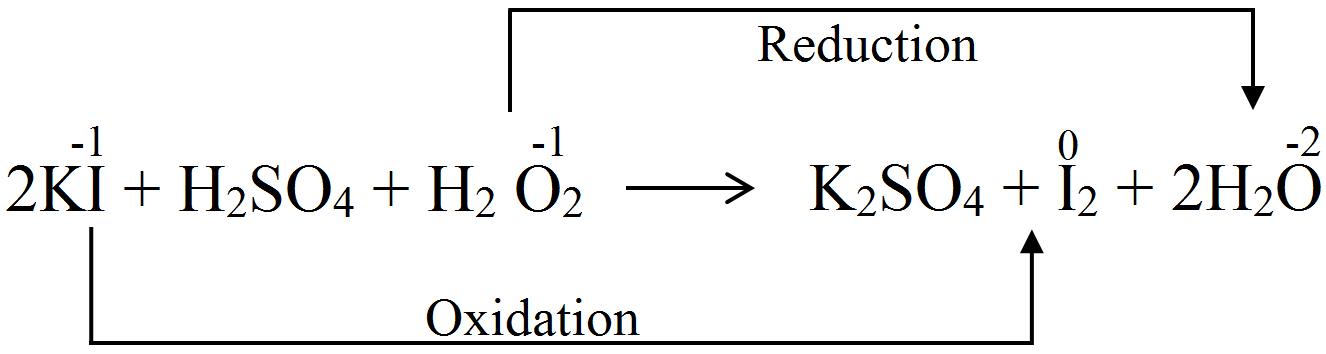
View full question & answer→MCQ 621 Mark
Sodium reacts with cold water to form a compound that burns with a flame. Guess the colour of flame:
AnswerSodium reacts with cold water to form a compound that burns with a golden yellow flame.
View full question & answer→MCQ 631 Mark
Calgon is used as water softening agent because it:
- ✓
Forms soluble complexes with cationic species.
- B
Frms soluble complexes with anionic species.
- C
Forms soluble complexes with both cationic and anionic species.
- D
Forms precipitate with cation species.
AnswerCorrect option: A. Forms soluble complexes with cationic species.
View full question & answer→MCQ 641 Mark
Heavy water is obtained by :
AnswerCorrect option: C. Prolonged electrolysis of $\ce{H_2O}$.
View full question & answer→MCQ 651 Mark
The co-ordination number of $Na$ in solid $\ce{NaH}$ is:
AnswerCoordination number of $Na$ in $\ce{NaH}$ is $6$ as its shape is octahedral.
View full question & answer→MCQ 661 Mark
Hydrogen has the tendency to lose one electron and form $H+$. In this respect, it resembles:
AnswerAlkali metals also have a tendency to lose one electron and form cations, so this similar property of hydrogen matches with alkali metals.
Carbon has a tendency to form covalent bonds.
Alkaline earth metals have a tendency to lose two electrons and Halogens have a tendency to gain electrons.
View full question & answer→MCQ 671 Mark
Water boils and freezes exactly at $100^{\circ} C$ and $0 ^{\circ}C$ respectively; find the reason for it from the following:
- A
Water desolve anything however springly the dissolution will be
- B
Water is a polar molecule
- ✓
Boiling and freezing temperature of water is used to define temperature scales
- D
AnswerCorrect option: C. Boiling and freezing temperature of water is used to define temperature scales
This is a fact that boiling and freezing temperature of water at atmospheric pressure is used to define temperature scale as it makes easy.
View full question & answer→MCQ 681 Mark
Which of the following equatibns depicts the oxidizing nature of $\ce{H_2O_2}$?
- A
$ 2 \mathrm{MnO}_4^{-}+6 \mathrm{H}^{+}+5 \mathrm{H}_2 \mathrm{O}_2 \rightarrow 2 \mathrm{Mn}^{2+}+8 \mathrm{H}_2 \mathrm{O}+5 \mathrm{O}_2 $
- B
$ 2 \mathrm{Fe}^{3+}+2 \mathrm{H}^{+}+\mathrm{H}_2 \mathrm{O}_2 \rightarrow 2 \mathrm{Fe}^{2+}+2 \mathrm{H}_2 \mathrm{O}+\mathrm{O}_2 $
- ✓
$ 2 \mathrm{I}^{-}+2 \mathrm{H}^{+}+\mathrm{H}_2 \mathrm{O}_2 \rightarrow \mathrm{I}_2+2 \mathrm{H}_2 \mathrm{O} $
- D
$ \mathrm{KIO}_4+\mathrm{H}_2 \mathrm{O}_2 \rightarrow \mathrm{KIO}_3+\mathrm{H}_2 \mathrm{O}+\mathrm{O}_2$
AnswerCorrect option: C. $ 2 \mathrm{I}^{-}+2 \mathrm{H}^{+}+\mathrm{H}_2 \mathrm{O}_2 \rightarrow \mathrm{I}_2+2 \mathrm{H}_2 \mathrm{O} $
$2\stackrel{{-1}}{\hbox{I}^-}+2\stackrel{{+1}}{\hbox{H}^+}+\stackrel{{+1}}{\hbox{H}_2}\stackrel{{-1}}{\hbox{O}_2}\xrightarrow{ \ \ \ }\stackrel{{0}}{\hbox{I}_2}+2\stackrel{{+1}}{\hbox{H}_2}\stackrel{{-2}}{\hbox{O}}$
ions are oxidized to $I_2 ($increases in $O.N$. from $-1$ to $0)$. Hence, $\ce{H_2O_2<}$ acts as an oxidizing agent.
View full question & answer→MCQ 691 Mark
Temporary hardness of water is due to the presence of:
- A
Calcium and magnesium chlorides.
- B
Calcium and magnesium sulphates.
- C
Calcium and magnesium phosphate.
- ✓
Calcium and magnesium hydrogen carbonates.
AnswerCorrect option: D. Calcium and magnesium hydrogen carbonates.
Temporary hardness of water is due to the presence of calcium and magnesium hydrogen carbonates.
View full question & answer→MCQ 701 Mark
When sodium peroxide is treated with dilute sulphuric acid, we get.
- A
Sodium sulphate and water.
- B
Sodium sulphate and oxygen.
- C
Sodium sulphate, hydrogen and oxygen.
- ✓
Sodium sulphate and hydrogen peroxide.
AnswerCorrect option: D. Sodium sulphate and hydrogen peroxide.
$\ \ \text{Na}_2\text{O}_2\ \ \ \ \ +\ \ \ \ \ \ \ \text{H}_2\text{SO}_4\ \xrightarrow{\ \ \ \ \ \ \ \ \ \ \ \ \ \ \ \ \ }\ \text{Na}_2\text{SO}_4\ \ \ \ \ \ \ \ \ +\ \ \ \ \ \ \ \ \ \ \text{H}_2\text{O}_2\\\text{Sodium peroxide}\ \ \ \ \ \ \ \ \ \ \ \ \ \ \ \ \ \ \ \ \ \ \ \text{Sodium sulphate}\ \ \ \ \ \ \ \ \ \ \text{Hydrogen peroxide}$
View full question & answer→MCQ 711 Mark
The major components of water gas $($or synthesis gas or syn gas$)$ which is used for the synthesis of methanol and a number of hydrocarbons are:
AnswerCorrect option: B. $\text{CO}+\text{H}_2$
View full question & answer→MCQ 721 Mark
Which of the following is a true structure of $\ce{H_2O_2}$ ?
View full question & answer→MCQ 731 Mark
Which of the following is a universal solvent?
AnswerWater is a universal solvent. Water is capable of dissolving a variety of different substances.
It dissolves more substances than any other liquid.
Water is important to every living thing on earth.
Wherever water goes, either through the ground or through our bodies, it takes along valuable chemicals, minerals, and nutrients.
View full question & answer→MCQ 741 Mark
Water is a kind of $.........$ oxide:
AnswerWater is a neutral oxide.
Neutral oxides are oxides which are neither acidic nor basic.
View full question & answer→MCQ 751 Mark
As the rain water is the purest form of water, this can be used in lab due to:
AnswerRainwater is considered to the purest form of water. Impurities and salts present in the water on earth are left behind during vapourization by the sun.
This water can be used in labs due to the absence of ions. This water is similar to distilled water. Distilled water is used in Labs because of a little combination of impure water could affect the experiment.
View full question & answer→MCQ 761 Mark
In $\ce{H_2O_2}$, the degree of hydrogen bonding is:
AnswerDue to the presence of two oxygen atoms in $\ce{H_2O_2}$, there would be four hydrogen bonds corresponding to each molecule.
Whereas, in water there would be only three hydrogen bonds per molecule.
View full question & answer→MCQ 771 Mark
Aquatic animals use $.........$ dissolved in water to respire:
- A
$\ce{CO_2}$
- B
$H_2$
- ✓
$O_2$
- D
$\ce{H_2O_2}$
AnswerCorrect option: C. $O_2$
Aquatic animals use oxygen gas dissolved in water to respire.
The oxygen dissolve in marine water by diffusion from the surrounding air.
This dissolved oxygen is then used by marine animals for respiration.
View full question & answer→MCQ 781 Mark
Elements of which of the following groups do not form hydrides?
- A
$1, 2, 3$
- B
$3, 4, 5$
- ✓
$7, 8, 9$
- D
$6, 7, 8$
AnswerCorrect option: C. $7, 8, 9$
The region of the periodic table from the group $7$ to $9$ is referred to as the hydride gap as they do not form hydrides.
Examples of such elements are $Mn, Fe, Co, Ru$ etc. These elements do not form hydrides on account of low affinity for hydrogen in their normal oxidation states.
View full question & answer→MCQ 791 Mark
The metal which gives $H_2$ with dil acid as well as $\ce{NaOH}$ is.
Answer$\text{Zn}+2\text{HCl}\text{ dil}\rightarrow\text{Zn cl}_2+\text{H}_2$
$\text{Zn}+2\text{NaOH}\rightarrow\text{Na}_2\text{NaO}_2+\text{H}_2$
View full question & answer→MCQ 801 Mark
Ionic hydrides are usually:
- A
good electrical conductors when solid
- B
- ✓
- D
liquid at room temperature
AnswerIonic hydrides are usually good reducing agents.
$ 2 \mathrm{CO}+\mathrm{NaH} \rightarrow \mathrm{HCOONa}+\mathrm{C} $
$ \mathrm{PbSO}_4+2 \mathrm{CaH}_2 \rightarrow \mathrm{PbS}+2 \mathrm{Ca}(\mathrm{OH})_2 $
$ \mathrm{Fe}_3 \mathrm{O}_4+\mathrm{NaH} \rightarrow 3 \mathrm{Fe}+4 \mathrm{NaOH} $
View full question & answer→MCQ 811 Mark
Last molecule of $\ce{H_2O}$ is evolved from $\ce{H_2O_2}$ by :
- ✓
- B
- C
Distillation under reduced pressure
- D
AnswerThe last molecule of water is separated from hydrogen peroxide by crystallization.$ 90\%$ solution of hydrogen peroxide is concentrated by cooling with solid carbon dioxide and ether bath. The crystals of hydrogen peroxide are separated, melted and refrozen.
View full question & answer→MCQ 821 Mark
Hydrogen resembles $\text{IV-A}$ elements in what respect?
AnswerCorrect option: D. They have half$-$filled electronic configuration.
$\text{IV A}$ group has half filled valence shell like carbon or silicon and it shares it with the hydrogen singly filled $s$ orbital. They resemble have comparable $I.P.$ and $E.A.$
View full question & answer→MCQ 831 Mark
Which of the following statements is$/$are correct about fuel cells?
- A
- B
- C
They run till reactants are active.
- ✓
View full question & answer→MCQ 841 Mark
Water in its pure form is a :
- A
- ✓
bad conductor of electricity
- C
good conductor of electricity
- D
AnswerCorrect option: B. bad conductor of electricity
Water in pure form is a bad conductor of electricity because of the absence of free electrons $($salts and minerals$)$ that allow the flow of electricity.
View full question & answer→MCQ 851 Mark
Temporary hardness of water is due to the presence of :
AnswerPermanent hardness is the hardness that cannot be removed by boiling. It is usually caused by the presence of calcium sulphate or magnesium sulphates or chlorides, nitrates of $Ca, Mg$ in the water which does not precipitate out as the temperature increases
View full question & answer→MCQ 861 Mark
Among $I-A$ elements which is the only non-metal?
AnswerIn alkali metals group, hydrogen is the only non metal diatomic hydrogen gas.
View full question & answer→MCQ 871 Mark
When water is cooled it contracts until it reaches $.........$ and then it starts expanding :
- A
$37^{\circ}C$
- B
$40^{\circ}C$
- C
$0^{\circ}C$
- ✓
$4^{\circ}C$
AnswerCorrect option: D. $4^{\circ}C$
Lowering of a temperature of water reduces the translation motion and thus brings the molecules closer. This is apparent in the contraction of water upon cooling. But at $4^{\circ}C$, the water molecules form extensive hydrogen bonding. As a result, each water molecules is surrounded by four molecules and this increases the vacant space between the molecules. This results in expansion of the system.
View full question & answer→MCQ 881 Mark
In which property listed below hydrogen does not resemble alkali metals?
- A
- ✓
- C
Combination with halogens
- D
AnswerHydrogen shows all other properties like alkali metals $($form cation, combine with halogens, reducing nature$)$ but nature of oxide is different than metals because oxide of metals are basic in nature whereas oxide of Hydrogen are amphoteric in nature i.e. $\ce{H_2O}$.
View full question & answer→MCQ 891 Mark
Consider the reactions.
A. $\mathrm{H}_2 \mathrm{O}_2+2 \mathrm{HI} \rightarrow \mathrm{I}_2+2 \mathrm{H}_2 \mathrm{O}$
B. $\mathrm{HOCl}+\mathrm{H}_2 \mathrm{O}_2 \rightarrow \mathrm{H}_3 \mathrm{O}^{+}+\mathrm{Cl}^{-}+\mathrm{O}_2$
Which of the following statements is correct about $\ce{H_2O_2}$ with reference to these reactions? Hydrogen peroxide is $.........$
- A
An oxidizing agent in both $(A)$ and $(B)$
- ✓
An oxidizing agent in $(A)$ and reducing agent in $(B)$
- C
A reducing agent in $(A)$ and oxidizing agent in $(B)$
- D
A reducing agent in both $(A)$ and $(B)$
AnswerCorrect option: B. An oxidizing agent in $(A)$ and reducing agent in $(B)$
$\stackrel{{+1}}{\hbox{H}}_2\stackrel{-1}{\hbox{O}}_2+2\stackrel{+1}{\hbox{H}}\stackrel{-1}{\hbox{I}}\xrightarrow{\ \ \ \ \ \ \ }\stackrel{0}{\hbox{I}}_2+2\stackrel{+1}{\hbox{H}}_2\stackrel{-2}{\hbox{O}}$
$O.N$. of oxygen is decreased from $\ce{-1(H_2O_2)}$ to $\ce{-2 (H_2O})$, therefore, it is reduced and acts as an oxidizing agent.
$\text{HOCl}+\text{H}_2\stackrel{-1}{\hbox{O}}_2\xrightarrow{\ \ \ \ \ \ \ }\text{H}_3\text{O}^++\text{Cl}^-+\stackrel{0}{\hbox{O}}_2$
$O.N$. of oxygen is increased from $\ce{-1 (H_2O_2)}$ to $O(O_2$), therefore, it is oxidized and acts as a reducing agent.
View full question & answer→MCQ 901 Mark
Metal hydride on treatment with water give:
- A
- B
- ✓
Metal hydroxide $+ H_2$
- D
AnswerCorrect option: C. Metal hydroxide $+ H_2$
$\text{NaH}+\text{H}_2\text{O}\xrightarrow{\ \ \ \ }\text{N}\text{aOH}+\text{H}_2$
$\because\text{E}^{\circ}\text{Zn}^{2+}/\text{Zn}=-0.76\text{V}.$ It is more reactive than $H_2$.
View full question & answer→MCQ 911 Mark
The element symbol for hydrogen is:
AnswerExplanation: (B) H
Hydrogen is a chemical element with chemical symbol H and atomic no.1 with atomic weight 1.00794 amu, hydrogen is the lightest element on the periodic table. Its monatomic form is the most abundant in nature.
View full question & answer→MCQ 921 Mark
Dihydrogen is prepared by the reaction of $Zn$ with $\ce{(aq) NaOH}$. Which of the following compounds is produced with dihydrogen during the course of reaction?
View full question & answer→MCQ 931 Mark
Which one of the following methods can be used to test the presence of water?
- A
- ✓
Add anhydrous copper sulphate and look for a colour change
- C
- D
Litmus paper with the solution
AnswerCorrect option: B. Add anhydrous copper sulphate and look for a colour change
The reaction between anhydrous copper sulfate and water is reversible:
Anhydrous copper sulfate $($white$) +$ water $=$ Hydrated copper sulfate $($blue$)$
$\mathrm{CuSO}_4+5 \mathrm{H}_2 \mathrm{O} \rightarrow \mathrm{CuSO}_4 \cdot 5 \mathrm{H}_2 \mathrm{O}$.
White anhydrous amorphous copper sulfate combines with $5$ molecules of water to form hydrous blue copper sulfate $($blue vitriol$)$.
View full question & answer→MCQ 941 Mark
Which of the following reactions is an example of use of water gas in the synthesis of other compounds?
- A
$\text{CH}_4(\text{g})+\text{H}_2\text{O}(\text{g})\xrightarrow[\text{Ni}]{1270\text{ k}}\text{CO(g)}+\text{H}_2\text{(g)}$
- B
$\text{CO(g)}+\text{H}_2\text{O(g)}\xrightarrow[\text{Catalyst}]{673\text{ k}}\text{CO}_2\text{(g)}+\text{H}_2(\text{g})$
- C
$\text{C}_\text{n}\text{H}_{2\text{n}+1}+\text{nH}_2\text{O(g)}\xrightarrow[\text{Ni}]{1270\text{ k}}\text{nCO}+(2\text{n}+1)\text{H}_2$
- ✓
$\text{CO(g)}+2\text{H}_2(\text{g})\xrightarrow[\text{Catalyst}]{\text{Cobalt}}\text{CH}_3\text{OH}(1)$
AnswerCorrect option: D. $\text{CO(g)}+2\text{H}_2(\text{g})\xrightarrow[\text{Catalyst}]{\text{Cobalt}}\text{CH}_3\text{OH}(1)$
The reaction shown in equation $(iv)$ shows the synthesis of methanol from water gas.
View full question & answer→MCQ 951 Mark
Pure water is a $.........$ conductor of electricity:
AnswerPure water is a bad conductor of electricity. This is because free electrons are not present in pure water which allow the flow of electricity.
Pure water is a bad conductor of electricity.
View full question & answer→MCQ 961 Mark
What are the percentages of water present in human body and plants, respectively?
- A
$95$ and $65$
- ✓
$65$ and $95$
- C
$90$ and $70$
- D
$30$ and $70$
AnswerCorrect option: B. $65$ and $95$
The major part of all living organisms is made up of water. Human body has about $65\%$ and some plants have as much as $95\%$ water.
View full question & answer→MCQ 971 Mark
Hydrogen is a non$-$metal having $.........$ electron in the valence shell:
AnswerHydrogen is a non$-$metal having $1e^-$ in its outer most shell $($valence shell$)$.
View full question & answer→MCQ 981 Mark
$\mathrm{CH}_3, \mathrm{NH}_3, \mathrm{H}_2 \mathrm{O}$ and $HF$ are the examples of:
AnswerDihydrogen forms molecular compounds with many $p-$block elements. Most familiar examples are $\mathrm{CH}_3, \mathrm{NH}_3, \mathrm{H}_2 \mathrm{O}$ and $HF$.
View full question & answer→MCQ 991 Mark
$.........$ does not expand on melting and does not contract on freezing:
AnswerIn melting process, ice changes to water and in freezing, water changes to ice. Both occur at $0^{\circ}C$ only.
Only change of state occurs here and not volume.
View full question & answer→MCQ 1001 Mark
Aluminium carbide reacts with water to give $.........$
AnswerAluminium carbide reacts with water gives methane gas.
View full question & answer→MCQ 1011 Mark
Which of the following reactions represents Haber's process?
- A
$2\text{H}_2(\text{g})+\text{O}_2(\text{g})\xrightarrow{\text{Catalyst}}2\text{H}_2\text{O}(\text{l});$ $\Delta\text{H}^\circ=-285.9\text{Kj}\text{/ mol}^{-1}$
- ✓
$3\text{H}_2(\text{g})+\text{N}_2(\text{g})\xrightarrow[\text{Fe}]{673\text{K, 200}\text{ atm}}2\text{NH}_3(\text{g});$ $\Delta\text{H}^\circ=-92.6\text{KJ}\text{/ mol}^{-1}$
- C
$\text{H}_2(\text{g})+\text{I}_2(\text{g})\xrightarrow{\ \ \ \ \ \ \ \ }2\text{HI}(\text{g})$
- D
$\text{H}_2(\text{g})+\text{Pd}^{2+}(\text{aq})\xrightarrow{\ \ \ \ \ \ \ \ }\text{Pd}(\text{s})+2\text{H}^+(\text{aq})$
AnswerCorrect option: B. $3\text{H}_2(\text{g})+\text{N}_2(\text{g})\xrightarrow[\text{Fe}]{673\text{K, 200}\text{ atm}}2\text{NH}_3(\text{g});$ $\Delta\text{H}^\circ=-92.6\text{KJ}\text{/ mol}^{-1}$
View full question & answer→MCQ 1021 Mark
AnswerCorrect option: D. $\mathrm{Al}_2$
$\because Al'$ itself is strong reducing agent.
View full question & answer→MCQ 1031 Mark
The correct statement about the structure of water:
- A
H-O-H bond angle is 109°, 28'.
- ✓
O-H bond length is 95.7 pm.
- C
In liquid phase there occurs intramolecular H-bonding.
- D
AnswerCorrect option: B. O-H bond length is 95.7 pm.
- O-H bond length is 95.7 pm.
View full question & answer→MCQ 1041 Mark
- A
- B
- ✓
Both electronpositive as well as electronegative
- D
Neither electropositive nor electronegative
AnswerCorrect option: C. Both electronpositive as well as electronegative
- Both electronpositive as well as electronegative
View full question & answer→MCQ 1051 Mark
Hydrogen peroxide is _________.
- A
- B
- ✓
Both an oxidizing and a reducing agent.
- D
Neither oxidizing nor reducing agent.
AnswerCorrect option: C. Both an oxidizing and a reducing agent.
- Both an oxidizing and a reducing agent.
Explanation:
$H_2O_2$ acts both as oxidizing and reducing agent. View full question & answer→MCQ 1061 Mark
Among I-A elements, which element is gas at room temperature?
Answer
- Hydrogen
Explanation:
At standard temperature and pressure, hydrogen is a colorless, odorless, tasteless, non-toxic, non-metallic, highly combustible diatomic gas. It is highly flammable and forms an explosive mixture with air.
View full question & answer→MCQ 1071 Mark
Which of the following gas is/are obtained by electrolysis of acidified water using platinum electrodes?
AnswerCorrect option: D. $\text{H}_2$ and $\text{O}_2$
- $\text{H}_2$ and $\text{O}_2$
Explanation:
Electrolysis of acidified water using platinum electrodes gives dihydrogen along with oxygen. View full question & answer→MCQ 1081 Mark
Silver reacts with hydro chloric acid to give ________:
Answer
- No reaction
Explanation:
Silver cannot replace H from HCl as it is placed at bottom of H in reactivity series, hence less reactive then H.
View full question & answer→MCQ 1091 Mark
Which of the following statement(s) is/are correct in the case of heavy water?
- A
Heavy water is used as a moderator in nuclear reactor.
- B
Heavy water is more effective as solvent than ordinary water.
- C
Heavy water is more associated than ordinary water.
- ✓
AnswerExplanation:
Heavy water is used as a moderator in nuclear reactor and is more associated than ordinary water.
View full question & answer→MCQ 1101 Mark
Among I-A elements which can form ionic as well as covalent bonds?
Answer
- Hydrogen
Explanation:
Hydrogen is the lightest element on the periodic table. Hydrogen forms covalent compounds with non metals.
In ionic compounds hydrogen can take the form of negative charge when it is known as hydride or a cation.
View full question & answer→MCQ 1111 Mark
Which of the following statements are correct?
- ✓
Hydrides of group 13 act as Lewis acids.
- B
Hydrides of group 14 are electron deficient hydrides.
- C
Hydrides of group 14 act as Lewis acids.
- D
Hydrides of group 15 act as Lewis bases.
AnswerCorrect option: A. Hydrides of group 13 act as Lewis acids.
- Hydrides of group 13 act as Lewis acids.
- Hydrides of group 15 act as Lewis bases.
Explanation:
All elements of group 13 will form electron deficient compounds which acts as Lewis acids.
All elements of group 14 will form electron precise compounds.
Electron rich hydrides have excess electrons which are present as lone pairs.
Elements of group 15-17 form such compounds. $NH_3$ has one lone pair, $H_2O$ has two lone pairs and HF has three lone pairs, and so these compounds act as Lewis bases. View full question & answer→MCQ 1121 Mark
In which of the following reactions $H_2O$ acts only as a Bronsted acid?
- ✓
$\text{H}_2\text{O}(\text{l})+\text{NH}_3(\text{aq})\rightleftharpoons\text{OH}^-(\text{aq})+\text{NH}^+_4(\text{aq})$
- B
$\text{H}_2\text{O}(\text{l})+\text{H}_2\text{S}(\text{aq})\rightleftharpoons\text{H}_3\text{O}^+(\text{aq})+\text{HS}^-(\text{aq})$
- C
$\text{H}_2\text{O}(\text{l})+\text{H}_2\text{O}(\text{l})\rightleftharpoons\text{H}_3\text{O}^+(\text{aq})+\text{O}\overline{\text{H}}(\text{aq})$
- D
AnswerCorrect option: A. $\text{H}_2\text{O}(\text{l})+\text{NH}_3(\text{aq})\rightleftharpoons\text{OH}^-(\text{aq})+\text{NH}^+_4(\text{aq})$
- $\text{H}_2\text{O}(\text{l})+\text{NH}_3(\text{aq})\rightleftharpoons\text{OH}^-(\text{aq})+\text{NH}^+_4(\text{aq})$
Explanation:
$H_2O$ has the ability to act as an acid as well as base, i.e. it behaves as an amphoteric substance. In Bronsted concept, it acts as an acid with $NH_3$ and a base with $H_2S$.
$\text{H}_2\text{O}(\text{l})+\text{NH}_3(\text{aq})\rightleftharpoons\text{OH}^-(\text{aq})+\text{NH}^+_4(\text{aq})$
$\text{H}_2\text{O}(\text{l})+\text{H}_2\text{S}(\text{aq})\rightleftharpoons\text{H}_3\text{O}^+(\text{aq})+\text{HS}^-(\text{aq})$ View full question & answer→MCQ 1131 Mark
___________ element has one electron in its outermost shell and attains duplet configuration after one more electron and attains stability.
Answer
- Hydrogen
Explanation:
Hydrogen has one electron in its outermost shell and attains duplet configuration after one more electron and attains stability.
View full question & answer→MCQ 1141 Mark
It is difficult to cook rice in an open vessel by boiling it at high altitudes because of:
- A
low boiling point and high pressure
- B
high boiling point and low pressure
- ✓
low boiling point and low pressure
- D
high boiling point and high pressure
AnswerCorrect option: C. low boiling point and low pressure
- low boiling point and low pressure
Explanation:
At high altitude pressure is low and therefore the boiling point is also low. In this case, water starts boiling below its boiling point but rice cooks at 100. So, it is difficult to cook rice at high altitudes.
View full question & answer→MCQ 1151 Mark
The oxide that gives $H_2O_2$ on treatment with dilute $H_2SO_4$ is:
- A
PbO$_2$
- ✓
BaO$_2$ -8H$_2$O
- C
MnO$_2$
- D
TiO$_2$
AnswerCorrect option: B. BaO$_2$ -8H$_2$O
- BaO$_2$ -8H$_2$O
Explanation:
Oxides such as $\mathrm{BaO}_2, \mathrm{Na}_2 \mathrm{O}_7$ tc. which contain peroxide linkage (i.e., ${ }^{-} \mathrm{O}-\mathrm{O}^{-}$ or $\text{O}_2^{2-}$) on treatment with dil. $H_2SO_4$ give $H_2O_2$ but dioxides (O = M = O, where M is the metal atom) such as PbO$_2$, TiO$_2$ do not give $H_2O_2$ on treatment with dil. $H_2SO_4$. View full question & answer→MCQ 1161 Mark
The molecular weight of heavy water is _________ than ordinary water:
Answer
- Higher
Explanation:
The molecular weight of heavy water is higher than ordinary water.
In a molecule of heavy water, the hydrogen atoms are isotopes in which the nuclei of each contain a proton and a neutron, and hence are twice as heavy as normal hydrogen atom
. View full question & answer→MCQ 1171 Mark
When we heat water, we can find bubbles coming from it. This shows that:
- ✓
- B
- C
hot water becomes bubbles
- D
Answer
- water contains air
Explanation:
When we heat water, we can find bubbles coming from it. This is because the solubility of gases decreases as the temperature increases and that is why the dissolved air bubbles go out from the water. Then as the boiling point of the water is reached (100$^\circ$C), water vapour starts to form inside the liquid in the form of bubbles. View full question & answer→MCQ 1181 Mark
$H^2$ does not show litmus test. From this, we can say, that the oxide of hydrogen is _______ in nature.
Answer
- Neutral
Explanation:
$H_2$ does not affect litmus paper as it is neutral. If it would have been acidic then it would have turn blue litmus red or if basic then vice-versa. View full question & answer→MCQ 1191 Mark
ater consists of hydrogen and oxygen in the ratio of ______by volume:
Answer
- 2 : 1
Explanation:
Water consists of hydrogen and oxygen in the ratio of 2 : 1 by volume.
$2 \mathrm{H}_2 \mathrm{O}+\mathrm{O}_2 \rightarrow 2 \mathrm{H}_2 \mathrm{O}$. View full question & answer→MCQ 1201 Mark
Answer
- Neutral
Explanation:
Water is a neutral oxide because it does not show any change in the colour of litmus paper.
View full question & answer→MCQ 1211 Mark
Which property of water is used while washing clothes?
Answer
- Solubility
Explanation:
Water is preferred substance for cleaning due to its odourless and colourless properties. But what makes it actually good at cleaning is the fact that it's an excellent solvent meaning that hydrophilic dirt will dissolve in water.
View full question & answer→MCQ 1221 Mark
Only one element of forms hydride.
Answer
- Group 6
Explanation:
Only one element chromium from group 6 forms hydride, (CrH).
View full question & answer→MCQ 1231 Mark
Which of the following statements regarding protium, deuterium and tritium is not correct?
- A
They are isotopes of hydrogen.
- B
They have similar electronic configurations.
- ✓
They exist in the nature in the ratio of 1:2:3
- D
Their atomic masses are in the ratio of 1:2:3
AnswerCorrect option: C. They exist in the nature in the ratio of 1:2:3
- They exist in the nature in the ratio of 1:2:3
View full question & answer→MCQ 1241 Mark
The number of proton and electron in atomic form of hydrogen respectively are:
Answer
- 1 and 1
Explanation:
In atomic form, hydrogen $(_1\text{H}^1$ or $_1\text{H}^2$ or $_1\text{H}^3)$ consists of only one proton and one electron. View full question & answer→MCQ 1251 Mark
Metal hydrides are ionic, covalent or molecular in nature. Among LiH, NaH, KH, RbH, CsH, the correct order of increasing ionic character is:
- A
LiH > NaH > CsH > KH > RbH
- ✓
LiH < NaH < KH < RbH < CsH
- C
RbH > CsH > NaH > KH > LiH
- D
NaH > CsH > RbH > LiH > KH
AnswerCorrect option: B. LiH < NaH < KH < RbH < CsH
- LiH < NaH < KH < RbH < CsH
Explanation:
In ionic hydride as it is formed by s-Block element, down the group, electropositive character increases.
View full question & answer→MCQ 1261 Mark
Which of the following compounds is used for water softening?
- A
$\text{Ca}_3(\text{PO}_4)_2$
- B
$\text{Na}_3\text{PO}_4$
- ✓
$\text{Na}_6\text{P}_6\text{O}_{18}$
- D
$\text{Na}_2\text{HPO}_4$
AnswerCorrect option: C. $\text{Na}_6\text{P}_6\text{O}_{18}$
- $\text{Na}_6\text{P}_6\text{O}_{18}$
Explanation:
For water softening, sodium hexametaphosphate is used. The chemical formula is:
$\text{Na}_2[\text{Na}_4(\text{OP}_3)_6]=\text{Na}_6\text{P}_6\text{O}_{18}.$ The trade name is calgone.
$2\text{CaCl}_2+\text{Na}_2[\text{Na}_4(\text{PO}_3)_6]\rightarrow\text{Na}_2[\text{Ca}_2(\text{PO}_3)_6]+4\text{NaCl}\\^\text{(From hard}\ \ \ \ \ \ \ ^\text{Sodium}\ \ \ \ \ \ \ \ \ \ \ \ \ \ \ \ \ \ \ \ \ \ ^\text{Complex salt (soluble)}\\\ \ \ \ ^\text{water)}\ \ \ \ \ \ ^\text{hexametaphosphate}$ View full question & answer→MCQ 1271 Mark
The adsorption of hydrogen by metals is called:
Answer
- Occlusion
Explanation:
Occlusion is the phenomenon of adsorption of hydrogen on metal surface.
View full question & answer→MCQ 1281 Mark
Which element has neither definite shape nor volume?
Answer
- Hydrogen
Explanation:
Hydrogen is a gas, hence it has neither definite shape nor volume.
View full question & answer→MCQ 1291 Mark
Hydrogen behaves as a metal:
Answer
- at high pressure
Explanation:
Metallic hydrogen is a phase of hydrogen when it behaves as electrical conductor. At the high pressure of gigapascals hydrogen might exist as a liquid metal. Liquid metallic hydrogen is thought to be present in large amount in gravitationally compressed interiors of Jupiter and Saturn.
View full question & answer→MCQ 1301 Mark
Decomposition of $H_2O_2$ is retarded by__________:
Answer
- Acetanilide
Explanation:
Decomposition of $H_2O_2$ can be retarded small amounts of acid, glycerol, alcohol, acetanilide. View full question & answer→MCQ 1311 Mark
View full question & answer→MCQ 1321 Mark
In nuclear reactors, ordinary water is not used as a moderator because:
- A
It cannot slow down the fast moving neutrons.
- B
It cannot remove the heat from the reactor core.
- C
It has corrosive action on the metallic parts of the nuclear reactor.
- ✓
View full question & answer→MCQ 1331 Mark
Temporary hardness of water is due to the presence of:
Answer
- Magnesium bicarbonate
Explanation:
Permanent hardness is the hardness that cannot be removed by boiling. It is usually caused by the presence of calcium sulphate or magnesium sulphates or chlorides, nitrates of Ca, Mg in the water which does not precipitate out as the temperature increases.
View full question & answer→MCQ 1341 Mark
Which of the following metal and acid are used to prepare dihydrogen respectively?
- A
Crystalline zinc with dil. HCI
- ✓
Granulated zinc with dil. HCI
- C
Granulated zinc with conc. HCI
- D
Crystalline zinc with conc. HCI
AnswerCorrect option: B. Granulated zinc with dil. HCI
- Granulated zinc with dil. HCI
Explanation:
Hydrogen is prepared by the reaction of granulated zinc with dilute hydrochloric acid.
$\text{Zn}+2\text{H}^+\xrightarrow{\ \ \ \ \ \ \ \ \ }\text{Zn}^{2+}+\text{H}_2$ View full question & answer→MCQ 1351 Mark
The structure of $H_2O_2$ is:
Answer
- non-planar
Explanation:
The structure of $H_2O_2$ is open book shaped, and thus non-planar. View full question & answer→MCQ 1361 Mark
A water sample is said to contain permanent hardness if water contains:
- ✓
Sulphates and chlorides of calcium and magnesium.
- B
Carbonates of calcium and magnesium.
- C
Bicarbonates of calcium and magnesium.
- D
Culphates and chlorides of sodium and potassium.
AnswerCorrect option: A. Sulphates and chlorides of calcium and magnesium.
- Sulphates and chlorides of calcium and magnesium.
View full question & answer→MCQ 1371 Mark
Which is polymeric hydride?
- A
$\mathrm{CaH}_2$
- ✓
$\mathrm{MgH}_2$
- C
$\mathrm{BaH}_2$
- D
$\mathrm{SrH}_2$
AnswerCorrect option: B. $\mathrm{MgH}_2$
- $\mathrm{MgH}_2$
Explanation:
$\mathrm{MgH}_2$ forms a polymeric hydride by forming bridge bonds with hydrogen. View full question & answer→MCQ 1381 Mark
Ionic hydrides are formed by:
- A
- ✓
Elements of very high electropositivity
- C
Elements of very low electropositivity
- D
AnswerCorrect option: B. Elements of very high electropositivity
- Elements of very high electropositivity
Explanation:
Ionic hydrides are formed by metals that are electropositive with respect to hydrogen i.e., alkali and alkaline earth (except Be and Mg). They involve an electron transfer from metal to H forming hydride ion H$^-$. View full question & answer→MCQ 1391 Mark
Molecular mass, melting point and boiling point of water respectively are:
- A
$20.02 \mathrm{~g} \mathrm{~mol}^{-1}, 276.8 \mathrm{~K}$ and 373 K .
- ✓
$18.0151 \mathrm{~g} \mathrm{~mol}^{-1}, 273 \mathrm{~K}$ and 373 K .
- C
$18.0151 \mathrm{~g} \mathrm{~mol}^{-1}, 273 \mathrm{~K}$ and 274 K .
- D
$20.02 \mathrm{~g} \mathrm{~mol}^{-1} .273 \mathrm{~K}$ and 373 K .
AnswerCorrect option: B. $18.0151 \mathrm{~g} \mathrm{~mol}^{-1}, 273 \mathrm{~K}$ and 373 K .
- $18.0151 \mathrm{~g} \mathrm{~mol}^{-1}, 273 \mathrm{~K}$ and 373 K .
View full question & answer→MCQ 1401 Mark
Steam reacts with red hot iron to produce?
- ✓
Ferric oxide and hydrogen
- B
Ferric oxide and hydrogen gas
- C
Ferrous oxide and hydrogen
- D
Ferrous oxide and hydrogen gas
AnswerCorrect option: A. Ferric oxide and hydrogen
- Ferric oxide and hydrogen
Explanation:
Steam reacts with red hot iron to produce ferric oxide and hydrogen.
View full question & answer→MCQ 1411 Mark
Which symbol is used for the element hydrogen?
Answer
- H
Explanation:
Hyrogen is represented as H.
View full question & answer→MCQ 1421 Mark
The reagent commonly used to determine hardness of water volumeterically (titrimetrically) is:
Answer
- Sodium thiosulphate.
Explanation:
EDTA is used for estimating $\mathrm{Ca}^{2+}$ and $\mathrm{Mg}^{2+}$ present in hard water. View full question & answer→MCQ 1431 Mark
As oxygen is ______ soluble in water. Air dissolved in water contains a higher percentage of oxygen (30-35%) than ordinary air (21%):
Answer
- more
Explanation:
Air dissolved in water contains higher percentage of oxygen because solubility of oxygen gas is more than nitrogen and other gases present in ordinary air.
Since the size of oxygen molecules is such that it gets trapped in the vacant space of water molecules (formed due to hydrogen bonding).
View full question & answer→MCQ 1441 Mark
Nascent hydrogen can be prepared by:
- A
$ \mathrm{Na}+\mathrm{C}_2 \mathrm{H}_5 \mathrm{OH} $
- B
$ \mathrm{Al}+\mathrm{NaOH} $
- C
$ \mathrm{Zn}+\mathrm{H}_2 \mathrm{SO}_4 \text { oil }$
- ✓
View full question & answer→MCQ 1451 Mark
Some of the properties of water are described below. Which of them is/ are not correct?
- A
Water is known to be universal solvent.
- B
Frozen water is heavier than liquid water.
- C
There is no hydrogen bonding in the frozen state of water.
- ✓
AnswerExplanation:
There is extensive hydrogen bonding in ice. Ice is lighter than water due to empty spaces present in tetrahedrons formed by hydrogen bonds.
View full question & answer→MCQ 1461 Mark
Which of the following reactions are incorrect?
- A
$8\text{LiH}+\text{Al}_2\text{Cl}_6\xrightarrow{\ \ \ \ \ \ }2\text{LiAlH}_4+6\text{LiCl}$
- B
$2\text{LiH}+\text{B}_2\text{H}_6\xrightarrow{\ \ \ \ \ \ \\ \ }2\text{LiBH}_4$
- ✓
$2\text{LiH}+\text{Al}_2\text{Cl}_6\xrightarrow{\ \ \ \ \ \ }\text{LiCl}+\text{LiH}+\text{LiAlH}_4$
- D
$\text{NaH}(\text{s})+\text{H}_2\text{O}\xrightarrow{\ \ \ \ \ \ \ }\text{NaOH}(\text{aq})+\text{H}_2(\text{g})$
AnswerCorrect option: C. $2\text{LiH}+\text{Al}_2\text{Cl}_6\xrightarrow{\ \ \ \ \ \ }\text{LiCl}+\text{LiH}+\text{LiAlH}_4$
- $2\text{LiH}+\text{Al}_2\text{Cl}_6\xrightarrow{\ \ \ \ \ \ }\text{LiCl}+\text{LiH}+\text{LiAlH}_4$
View full question & answer→MCQ 1471 Mark
As the rain water is the purest form of water, this can be used in lab due to:
Answer
- Absence of ions
Explanation:
Rainwater is considered to the purest form of water. Impurities and salts present in the water on earth are left behind during vapourization by the sun.
This water can be used in labs due to the absence of ions. This water is similar to distilled water. Distilled water is used in Labs because of a little combination of impure water could affect the experiment.
View full question & answer→MCQ 1481 Mark
The usual valency of hydrogen is:
Answer
- +1 or sometimes −1
Explanation:
The electronic configuration of hydrogen is $1s^1$ as it has only one electron in its single orbital. So, it can gain one or lose one electron from its s orbital, thereby, showing +1 or −1 valency. View full question & answer→MCQ 1491 Mark
Silver reacts with hydro chloric acid to give ________:
Answer
- no reaction
Explanation:
Silver cannot replace H from HCl as it is placed at bottom of H in reactivity series, hence less reactive then H.
View full question & answer→MCQ 1501 Mark
Which ionic hydride is stable upto its melting point?
Answer
- LiH
Explanation:
All ionic hydrides of group I and group II decompose before their melting point except LiH.
LiH is stable upto its melting point.
The ionic character of the bonds in hydrides increases from LiH to CsH and their stability decreases in the same order.
View full question & answer→MCQ 1511 Mark
- ✓
- B
are formed by transition metals
- C
are very poor reducing agents
- D
are stable towards water and alcohol
Answer
- are dehydrating agents
Explanation:
Saline hydrides are formed by alkali metals and alkaline earth metals (not transition metals). They are good reducing agents and are readily decomposed by water and alcohol to liberate hydrogen. They also act as powerful dehydrating agents.
View full question & answer→MCQ 1521 Mark
- A
electropositive character
- B
- ✓
- D
Answer
- Both A and B
Explanation:
Hydrogen has one electron in its outermost shell.
It can lose electron as well as gain electron to complete its octet.
So it can exhibit both characters.
View full question & answer→MCQ 1531 Mark
$H_2O_2$ is sold in market as an antiseptic. The name of this antiseptic is:
View full question & answer→MCQ 1541 Mark
The chemical behaviour and relative inertness of dihydrogen at room temperature depends upon:
- A
H-H bond dissociation enthalpy.
- B
- C
- ✓
Enthalpy of vaporisation.
AnswerCorrect option: D. Enthalpy of vaporisation.
- H-H bond dissociation enthalpy.
View full question & answer→MCQ 1551 Mark
Which of the following fuels is used for running the automobiles first time in the history of India during October $2005$?
AnswerCorrect option: D. $\mathrm{H}_2$
$\mathrm{H}_2$ is used for running automobiles first time in the history of India during October, $2005.$
View full question & answer→MCQ 1561 Mark
Under what conditions of temperature and pressure, the formation of molecular hydrogen from atomic hydrogen will be favoured most?
- ✓
High temperature and high pressure
- B
Low temperature and low pressure
- C
High temperature and low pressure
- D
Low temperature and high pressure
AnswerCorrect option: A. High temperature and high pressure
$2H \rightarrow \mathrm{H}_2 +$ heat So, according to Le Chatelier's principle, low temperature and high pressure is favored.
View full question & answer→MCQ 1571 Mark
Hydrogen peroxide is obtained by ‘the electrolysis of $.........$
AnswerHydrogen peroxide is obtained by electrolysis of sulphuric acid.
$\text{H}_2\text{SO}_4\xrightarrow{\ \ \ \ \ \ }\text{H}^++\text{HSO}^-_4$
$2\text{HSO}^-_4\xrightarrow{\text{electrolysis}}\text{HO}_3\text{SOOSO}_3\text{H}+2\text{e}^-$
$\text{HO}_3\text{SOOSO}_3\text{H}+2\text{H}_2\text{O}\xrightarrow{\text{Hydrolysis}}2\text{H}_2\text{SO}_4+\text{H}_2\text{O}_2$
View full question & answer→MCQ 1581 Mark
When electric current is passed through an ionic hydride in the molten state:
- ✓
Hydrogen is liberated at the anode.
- B
Hydrogen is liberated at the cathode.
- C
- D
Hydride ion migrates towards cathode.
AnswerCorrect option: A. Hydrogen is liberated at the anode.
Lonic hydrides in their molten state can conduct electricity and on electrolysis liberate dihydrogen gas at anode, which confirms the existence of $H^-$ ion.
$2\text{H}^-(\text{melt})\xrightarrow{\text{Anode}}\text{H}_2(\text{g})+2\text{e}^-$
View full question & answer→MCQ 1591 Mark
Saline water is useful for:
AnswerSaline water is not useful for washing clothes, drinking purposes and also for agriculture purposes.
Saline water is not useful for drinking as it contains high levels of salts in it.
It cannot be used for agriculture. Irrigation with saline water can result in dangerous levels of salinity building up in the root zones of the crops.
View full question & answer→MCQ 1601 Mark
Which of the following metal reacts with steam to liberate hydrogen?
AnswerLess reactive metals such as Magnesium, aluminum, zinc and iron react with steam to liberate hydrogen.
View full question & answer→MCQ 1611 Mark
Hydrogenation of vegetable oils using nickel as a catalyst gives edible fat which is:
- A
- B
- ✓
margarine and vanaspati ghee.
- D
AnswerCorrect option: C. margarine and vanaspati ghee.
View full question & answer→MCQ 1621 Mark
$.........$ element has one electron in the outermost shell and attains duplet configuration after accepting one more electron and attains stability.
AnswerHydrogen has $1e^-$ in outermost shell, in order to achieve stability either $e^-$ to be removed or added.
When added it acquires a stable configuration forming duplet.
View full question & answer→MCQ 1631 Mark
Density of water in the solid state is $.........$ than the density of water in the liquid state.
AnswerThe solid form of most substances is denser than the liquid phase so a block of most solids will sink in the liquid but a block of ice floats in liquid water because ice is less dense. Upon freezing the density of water decreases by about $9\%$. This is due to cooling of intermolecular vibrations allowing the molecules to form steady hydrogen bonds and locking into positions of hexagonal packing upon freezing to ice. These bonds are shorter in the crystal than in the liquid.
View full question & answer→MCQ 1641 Mark
- A
- B
colourless and transparent
- C
- ✓
colourless, odourless and transparent
AnswerCorrect option: D. colourless, odourless and transparent
Pure water, also known as purified water, is water from a source that has removed all impurities. Distilled water is the most common form of pure water. The water can be purified by carbon filtration, microporous filtration and ultraviolet oxidation. Some places use a combination of purification processes. Pure water is colorless, odorless and transparent.
View full question & answer→MCQ 1651 Mark
- A
- B
- C
Closed book type structure
- ✓
Half open book type structure
AnswerCorrect option: D. Half open book type structure
The structure of $\ce{H_2O_2}$ is not planar but open book structure.
The $\ce{O-O-H}$ bond angle is $101.5^{\circ}$ and the $O-O$ single bond distance is $1.48A^{\circ}$
View full question & answer→MCQ 1661 Mark
From the following statements regarding $\ce{H_2O_2}$, choose the incorrect statement:
- ✓
It can act only as an oxidising agent.
- B
It decompose on exposure to light.
- C
It has to be stored in plastic or wax lined glass bottles in dark.
- D
It has to be kept away from dust.
AnswerCorrect option: A. It can act only as an oxidising agent.
$H_2O_2$ acts as an oxidising as well as reducing agent, because oxidation number of oxygen in $H_2O_2$ is $-1$. So, it can be oxidised to oxidation state $0$ or reduced to oxidation state $-2.$
Thus, statement $(1)$ is incorrect. Rest of the given statements are correct.
View full question & answer→MCQ 1671 Mark
Which of the following is not the use of $\ce{H_2O_2}$ in the environmental chemistry?
- A
In pollution control treatment of domestic effluents.
- B
Restoration of aerobic conditions to sewage wastes.
- C
- ✓
In the synthesis of hydroquinone.
AnswerCorrect option: D. In the synthesis of hydroquinone.
View full question & answer→MCQ 1681 Mark
Hydrolith, a source of hydrogen is:
- A
$\ce{NaH}$
- ✓
$\ce{CaH_2}$
- C
$\ce{LiH}$
- D
$\ce{BaH_2}$
AnswerCorrect option: B. $\ce{CaH_2}$
A salt like binary compound $\ce{(CaH_2),}$ calcium hydride used as a reducing agent and source of hydrogen.
View full question & answer→MCQ 1691 Mark
Why does $H^+$ always get associated with other atoms or molecules?
- A
Ionisation enthalpy of hydrogen resembles that of alkali metals.
- B
Its reactivity is similar to halogens.
- C
It resembles both alkali metals and halogens.
- ✓
Loss of an electron from hydrogen atom results in a nucleus of very small size as compared to other atoms or ions. Due to small size it cannot exist freely.
AnswerCorrect option: D. Loss of an electron from hydrogen atom results in a nucleus of very small size as compared to other atoms or ions. Due to small size it cannot exist freely.
Hydrogen has one electron in its s orbital and it can lose its electron like alkali metals which are highly electropositive in nature for their tendency to lose single electron from its outer shell. So hydrogen is similar to alkali metals. Positive hydride ions react with oxides and hydroxides to form water and with carbonates to form water and carbon dioxide.
View full question & answer→MCQ 1701 Mark
Which of the following isotopes of hydrogen is radioactive?
AnswerTritium is the radioactive isotope of hydrogen which emits low energy $B-$particle whose half$-$life period $(t_{1/2})$ is $12.33$ years.
View full question & answer→MCQ 1711 Mark
Water $\ce{(H_2O)}$ is liquid while all other molecules of equivalent and even higher molecular weight are present in gaseous state because of:
- A
Covalent bonding between Hydrogen and Oxygen.
- B
Electrostatic attraction among water molecules.
- ✓
- D
AnswerIn $\ce{H_2O}$ there is hydrogen bonding because oxygen has a high electronegativity $($only second to flourine$)$. so, the hydrogen atoms from other molecules of water forms a hydrogen bonds with oxygen resulting in intermolecular hydrogen bonding, which results liquid form of water.
View full question & answer→MCQ 1721 Mark
Hydrogen has three isotopes$-$protium $(^1_1\text{H}),$ deuterium $(^2_1\text{H})$ and tritium $(^3_1\text{H}).$ These isotopes differ from one another in respect of the presence of
AnswerHydrogen has three isotopes$-$protium $(^1_1\text{H}),$ deuterium $(^2_1\text{H})$ and tritium $(^3_1\text{H}).$ hese isotopes differ from one another in respect of the presence of neutrons. In protium, deuterium and tritium number of neutrons respectively are $0,1$ and $2$.
View full question & answer→MCQ 1731 Mark
Among the following elements, which one has the highest ionisation potential?
AnswerIonization potential is the amount of energy required to remove an electron from an atom or a molecule in the gaseous state. Hydrogen has only one electron in its valence shell or s orbital and ionisation energy decreases from top to bottom in a group as the atomic size increases and as electron cloud goes farther away from the nucleus. So, hydrogen has the highest ionisation potential.
View full question & answer→MCQ 1741 Mark
AnswerHeavy water is deuterium oxide $\ce{(D_2O)}$. Ordinary water contains a fraction $(1$ in $6000$ parts$)$ of heavy water. On large scale, it is produced by repeated electrolysis of ordinary water containing alkali. It is also produced by repeated distillation and condensation.
View full question & answer→MCQ 1751 Mark
Why water is called an universal solvent?
- A
Because plants use water for taking minerals from the soil
- ✓
Water can dissolve a wide variety of substances
- C
Water is clear and transparent
- D
AnswerCorrect option: B. Water can dissolve a wide variety of substances
Water can dissolve a wide variety of substances that is why water is known as a universal solvent. Plant use this property of water for taking minerals from the soil.
View full question & answer→MCQ 1761 Mark
The gas used in the fuel cells for generating the electrical energy which has many advantages over the conventional fossil fuels and electric power is:
MCQ 1771 Mark
Hydrogen resembles alkali metals in many respect for which several factors are responsible. Of the following factors which one is the most important in this respect?
- ✓
Its tendency to lose electron
- B
Its tendency to gain electron in its valence shell
- C
It has high ionisation enthalpy.
- D
AnswerCorrect option: A. Its tendency to lose electron
Hydrogen has one electron in its s orbital and it can lose its electron like alkali metals which are highly electropositive in nature for their tendency to lose single electron from its outer shell. So hydrogen is similar to alkali metals.
View full question & answer→MCQ 1781 Mark
Water turns blue cobalt chloride paper:
AnswerCobalt chloride, $\ce{CoCl_2}$, is a fascinating compound that changes color in response to humidity. Ashumidity increases, cobalt chloride changes color from sky blue to purple to pink. Such striking changes in color make cobalt chloride useful as a humidity indicator in weather instruments.
View full question & answer→MCQ 1791 Mark
The element having no neutron in the nucleus of its atom is:
AnswerHydrogen has atomic number $1$. It has monatomic form is the most abundant chemical substance and it has single proton and zero neutrons. It exists in diatomic form.
View full question & answer→MCQ 1801 Mark
The $pH$ of water is:
AnswerAlthough the $pH$ of pure water is $7$, drinking water and neutral water exhibits a large $pH$ range because it contains dissolved minerals and gases.
Surface waters typically range from $pH\ 6.5$ to $8.5$ while groundwater ranges from $pH\ 6$ to $8.5$. Water with a $pH$ less than $6.5$ is considered acidic.
View full question & answer→