Questions

5 Marks Questions

Take a timed test

5 questions · self-marked practice — reveal the answer and mark yourself.

Question 15 Marks
1. Suggest a method to purify
i. a liquid which decomposes at its boiling point.
ii. kerosene oil containing water.
iii. camphor containing traces of common salt.
2. Differentiate between the principle of estimation of nitrogen in an organic compound
i. Dumas method
ii. Kjeldahl's method.
Answer
(1). i. Distillation under reduced pressure.
ii. Since the two liquids are immiscible, the technique of solvent extraction with a separating funnel is used. Kerosene being lighter than water forms the upper layer while water forms the lower layer. The lower water layer is run off when kerosene oil is obtained. It is dried over anhydrous $CaCl _2$ or $M _{ g } SO _4$ and then distilled to give pure kerosene oil.
iii. Sublimation Camphor sublimes while common salt remains as residue in the China dish.
(2). (i) Dumas method: The organic compound is heated strongly with excess of CuO (Cupric oxide) in an atmosphere of $CO _2$ when free nitrogen, $CO _2$ and $H _2 O$ are obtained.
(ii) Kjeldahl's method: A known mass of the organic compound is heated strongly with conc. $H _2 SO _4$ and a little potassium sulphate and a little mercury (a catalyst). As a result of reaction the nitrogen present in the organic compound is converted to ammonium sulphate.
View full question & answer
Question 25 Marks
1. Why is nitric acid added to sodium extract before adding silver nitrate for testing halogens?
2. How does
i. an electron withdrawing group (EWG) and
ii. an electron donating group (EDG) influence the acid strength of carboxylic end?
Answer
1. Nitric acid is added to sodium extract so as to decompose
$
NaCN+HNO_3 \longrightarrow NaNO_3+HCNNa_2 S+2 HNO_3 \longrightarrow 2 NaNO_3+H_2 S
$
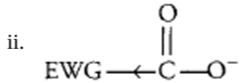
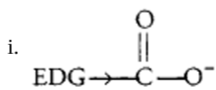
2. The influence of the inductive effect on acidity is best understood in terms of the conjugate base, $RCOO ^{-}$and can be summarised as follows
Image
Electron withdrawing group destabilises $RCOO ^{-}$because there exists a repulsion between electrons from EDG and negative charge of O. Hence, EDG weakens the acid.
Image
Electron withdrawing group stabilities $RCOO ^{-}$by taking negative charge from O . Hence, EWG strengthens the acid.
View full question & answer
Question 35 Marks
Write a relation between $\triangle G$ and Q and define the meaning of each term and answer the following:
a. Why a reaction proceeds forward when $Q < K$ and no net reaction occurs when $Q = K$.
b. Explain the effect of an increase in pressure in terms of reaction quotient Q for the reaction:
$
CO(g)+3 H_2(g) \rightleftharpoons CH_4(g)+H_2 O(g)
$
Answer
a. We know that, $\Delta G=\Delta G^{\circ}+R T \ln Q$
Where,
$\Delta G^{\circ}=$ Change in free energy as the reaction proceeds
$\Delta G=$ Standard free energy change
$Q =$ Reaction quotient
$T =$ Absolute temperature
Also, $\Delta G^{\circ}=-R T \ln K$
$
\begin{aligned}
& \Rightarrow \Delta G=-R T \ln K+R T \ln Q \\
& \therefore \Delta G=R T \ln \frac{Q}{K}
\end{aligned}
$
If $Q < K , \Delta G$ will be negative. So, the reaction proceeds in the forward direction.
If $Q = K , \Delta G=0$, reaction will be at equilibrium.
b. Reaction:
$
CO(g)+3 H_2(g) \rightleftharpoons CH_4(g)+H_2 O(g)
$
On increasing the pressure equilibrium will shift in forward direction, it means $Q < K$.
View full question & answer
Question 45 Marks
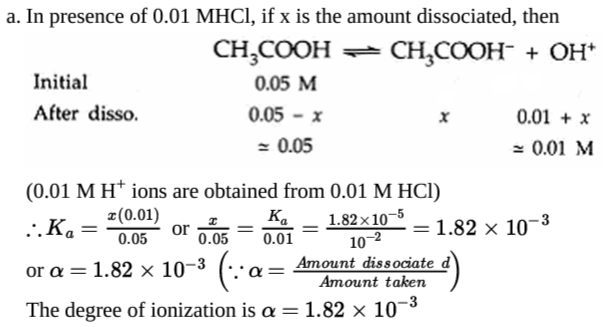
Calculate the degree of ionization of 0.05 M acetic acid if its $pK _{ a }$ value is 4.74 . How is the degree of dissociation affected when its solution also contains
a. 0.01 M
b. 0.1 M HCl ?
Answer
$
pK_{a}=-\log K_{a}=4.74
$
or $\log K _{ a }=-4.74=\overline{5} .26 \therefore K_a=1.82 \times 10^{-5}$
$
\alpha=\sqrt{K_a / C}=\sqrt{\left(1.82 \times 10^{-5}\right) /\left(5 \times 10^{-2}\right)}=1.908 \times 10^{-2}
$
In presence of HCl , due to high concentration of $H ^{+}$ion, dissociation equilibrium will shift backward, i.e. dissociation of acetic acid will decrease.
Image
b. In the presence of 0.1 M HCl , if y is the amount of acetic acid dissociated, then at equilibrium
$
\begin{aligned}
& {\left[CH_3 COOH\right]=0.05-y \simeq 0.05 M} \\
& {\left[CH_3 COO^{-}\right]=y,\left[H^{+}\right]=0.1 M+y \simeq 0.1 M} \\
& K_a=\frac{y(0.1)}{0.05} \text { or } \frac{y}{0.05}=\frac{K_2}{0.1}=\frac{1.82 \times 10^{-5}}{10^{-1}}=1.82 \times 10^{-4} \text { i.e. } \\
& \alpha=1.82 \times 10^{-4}
\end{aligned}
$
The degree of ionization is $\alpha=1.82 \times 10^{-4}$
View full question & answer
Question 55 Marks
Attempt any five of the following:
1. Can a catalyst change the position of equilibrium in a reaction?
2. To which category of compounds does cyclohexane belong?
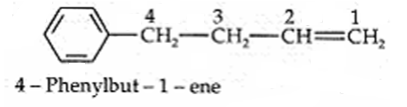
3.
Image
4. What is hydrogenation?
5. What are conformations?
6. The intermediate carbocation formed in the reactions of $HI , HBr$ and HCl with propene is the same and the bond energy of $HCl , HBr$ and HI is $430.5 kJ mol ^{-1}, 363.7 kJ mol ^{-1}$ and $296.8 kJ mol ^{-1}$ respectively. What will be the order of reactivity of these halogen acids?
7. State Le chatelier's principle.
Answer
1. A catalyst speeds up the forward and back reaction to the same extent. Because adding a catalyst doesn't affect the relative rates of the two reactions, a catalyst cannot change the position of equilibrium in a chemical reaction
2. Cyclohexane belongs to saturated alicyclic hydrocarbons.
3.
Image
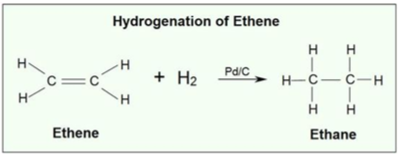
4. Hydrogenation: Addition of hydrogen to alkenes and alkenes in the presence of finely divided catalysts like $Pt , Pd$ or Ni to form alkanes is known as hydrogenation.
Example:
Image
5. Conformations are spatial arrangements which are obtained by rotation around sigma bonds.
Explanation : In chemistry, conformational isomerism is a form of sterioisomers in which the isomers can be interconverted just by rotations about formally single bonds (refer to figure on single bond rotation). Such isomers are generally referred to as conformational isomers or conformers.
6. The bond dissociation enthalpy decreases in the order $HCl > HBr > Hl$, the order of reactivity of these halogen acids is in the reverse order i.e., $Hl > HBr > HCl$.
7. Le chatelier's principle: If a system at equilibrium is subjected to change in the temperature, pressure or concentration of the reactants or the products that govern the equilibrium, then the equilibrium shifts in that direction in which this change is reduced or nullified.
View full question & answer