Questions

2 Marks Questions

Take a timed test

6 questions · self-marked practice — reveal the answer and mark yourself.

Question 12 Marks
Prove that the density of the nucleus is constant.
Answer
Let the volume of nucleus $= V =\frac{4}{3} \pi r ^3$, the mass of the nucleus $= M$.
Also, $r=r_{\circ} A^{\frac{1}{3}} \Rightarrow r^3=r_{\circ}^3 A$
Now, Density $(\rho)=\frac{\text { Mass }(M)}{\text { Volume }(V)}=\frac{M}{\frac{4}{3} \pi r^3}=\frac{M}{\frac{4}{3} \pi r_0^3 A}$.
Since, M, $r_{\circ}$ and A for the given nucleus is constant . Therefore The density of nucleus is constant, independent of the element under consideration.

View full question & answer
Question 22 Marks
Write hydrocarbon radicals that can be formed as intermediates during monochlorination of 2-methylpropane. Which of them is more stable? Give reasons.
Answer
During monochlorination of 2-methylpropane, 2-methylpropane gives two types of radicals:
Image

Radical (II) is less stable because it is $1^{\circ}$ and stabilised by one hyper conjugative structure (as it has only $1 \alpha$-hydrogen).
Radical (I) is more stable because it is $3^{\circ}$ and stabilised by nine hyper conjugative structures (as it has $9 \alpha$-hydrogens).
Hence, Radical (I)is more stable.
View full question & answer
Question 32 Marks
Write the structure and IUPAC names of different structural isomers of alkenes corresponding to $C _5 H _{10}$.
View full question & answer
Question 42 Marks
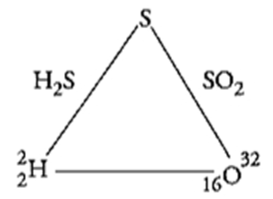
The element H and O combine separately with the third element S to form $H _2 S$ and $SO _2$ respectively, then show that they combine directly with each other to from $H _2 O$.
Image
Answer
As shown in figure, the masses of H and O which combine with the fixed mass of S , i.e. 32 parts are 2 and 32 i.e. they are in the ratio $2: 32$ or $1: 16$. When H and O combine directly to form $H _2 O$, the ratio of their combining , masses are 2:16 or $1: 8$.
These ratio are related to each other as $\frac{1}{16}: \frac{1}{8}=1: 2$
i.e. they are simple multiple of each other.
View full question & answer
Question 52 Marks
The electron gain enthalpy of bromine is 3.36 eV . How much energy in kcal is released when 8 g of bromine is completely converted to $Br ^{-}$ions in the gaseous state?
$
\left(1 eV=23.06 kcal mol^{-1}\right)
$
Answer
According to the question, electron gain enthalpy of bromine is 3.36 eV .
Number of moles of $Br =\frac{\text { Given weight }}{\text { Molecular weight }}=\frac{8}{80}=0.1 mol$
Therefore, required energy $=0.1 \times 3.36 \times 23.06=7.748 kcal$.
View full question & answer
Question 62 Marks
Calculate the solubility of $A _2 X _3$ in pure water, assuming that neither kind of ion reacts with water. The solubility product of $A _2 X _3, K_{ sp }=1.1 \times 10^{-23}$.
Answer
$
\begin{aligned}
& A_2 X_3 \rightarrow 2 A^{3+}+3 X^{2-} \\
& K_{\text {sp }}=\left[A^{3+}\right]^2\left[X^{2-}\right]^3=1.1 \times 10^{-23}
\end{aligned}
$
If $S=$ solubility of $A _2 X _3$, then
$
\left[A^{3+}\right]=2 S ;\left[X^2\right]=3 S
$
therefore, $K _{ sp }=(2 S)^2(3 S)^3=108 S^5$
$
\begin{aligned}
& =1.1 \times 10^{-23} \\
& \text { thus, } S^5=1 \times 10^{-25} \\
& S=1.0 \times 10^{-5} mol / L
\end{aligned}
$
View full question & answer