Questions

3 Marks Question

Take a timed test

7 questions · self-marked practice — reveal the answer and mark yourself.

Question 13 Marks
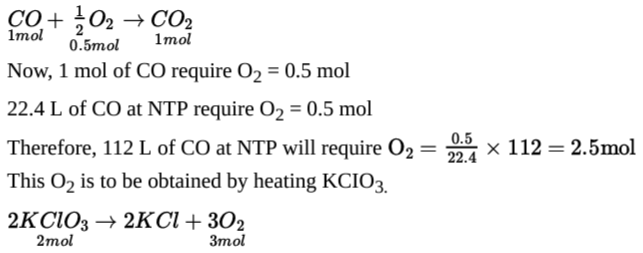
Calculate the amount of $KCIO _3$ needed to supply sufficient oxygen for burning 112 L of CO gas at NTP.
Answer
Burning of CO takes place in the presence of oxygen as represented by chemical equation: 
Image
$\begin{aligned} & \text { Molecular mass of } KClO _3=1 \times K +1 \times Cl +3 \times O =39+35.5+3 \times 16=39+35.5+48=122.5 \\ & 1 mol \text { of } O _2 \text { is produced from }=2 mol \text { of } KClO _3 \\ & 1 mol \text { of } O _2 \text { is produced from }=2 \times 122.5=245 g \text { of } KClO _3 \\ & 3 \text { moles of } O _2 \text { are produced from } KClO _3=\frac{245 \times 2.5}{3}=204.167 g\end{aligned}$
View full question & answer
Question 23 Marks
Write characteristics of all seven periods of the periodic table.
Answer
First period is the shortest period of the periodic table. It contains 2 elements, ${ }_1 H$ and ${ }_2 He$.
Second and third periods contain 8 elements each called short periods. The second period contain elements ${ }_3 Li$ to ${ }_{10} Ne$ and ${ }_{11} Na$ to ${ }_{18} Ar$.
Fourth and fifth period contains 18 elements each namely ${ }_{19} K$ to ${ }_{36} Kr$ and ${ }_{37} Rb$ to ${ }_{54} Xe$ and are long periods.
Sixth period contains 32 elements from ${ }_{55} Cs$ to ${ }_{86} Rn$ and is the longest period.
Seventh period is incomplete period. It has all other elements starting with ${ }_{87} Fr$ onwards. Elements from 93 onwards are purely synthetic and are called trans-uranium elements and their properties have not been studied properly yet.
View full question & answer
Question 33 Marks
The Balmer series in the hydrogen spectrum corresponds to the transition from $n_1=2$ to $n_2=3,4$, .... This series lies in the visible region. Calculate the wave number of line associated with the transition in Balmer series when the electron moves to $n =4$ orbit. $\left( R _{ H }=109677 cm^{-1}\right)$
View full question & answer
Question 43 Marks
Depict the galvanic cell in which the reaction $Zn ( s )+2 Ag ^{+}( aq ) \longrightarrow Zn ^{2+}( aq )+2 Ag ( s )$ takes place, Further show:
i. which of the electrode is negatively charged,
ii. the carriers of the current in the cell, and
iii. individual reaction at each electrode.
Answer
i. The given redox reaction is,
$
Zn(s) 2 Ag^{+}(aq) \longrightarrow Zn^{2+}(aq)+2 Ag(s)
$
Since Zn (s) gets oxidized, to $Zn ^{2+}$ (aq) ions, and $Ag ^{+}$(aq) ions gets reduced to Ag (s) metal, therefore, oxidation occurs at the zinc electrode (acting as anode) and reduction occurs at the silver electrode (as cathode). Thus, the galvanic cell corresponding to the above redox reaction is depicted as:
$
Zn_{(s)}\left|Zn^{2+}(aq) \| Ag^{+}(aq)\right| Ag_{(s)}
$
ii. a. Since oxidation occurs at the zinc electrode, therefore, electrons accumulate on the zinc electrode,/ anode. Hence, zinc electrode is negatively charged.
b. Electrons move from Zn anode to Ag cathode in the external circuit. Since the direction of current in the external circuit is opposite to that of the electrons so, The carriers of current are silver cathode and Zinc anode through an external circuit in a direction from silver cathode to zinc anode.
c. The reactions occurring at the two electrodes are
At anode:
$
Zn(s) \longrightarrow zn^{2+}(aq)+2 e^{-}
$
At cathode
$
Ag^{+}(aq)+e^{-} \longrightarrow Ag(s)
$
View full question & answer
Question 53 Marks
221.4J is needed to heat 30 g of ethanol from $15^{\circ} C$ to $18^{\circ} C$. Calculate (a) specific heat capacity, and (b) molar heat capacity of ethanol.
Answer
According to the question, 221.4 J is needed to heat 30 g of ethanol from $15^{\circ} C$ to $18^{\circ} C$.
$
\begin{aligned}
& \text { a. We know that, Specific heat capacity }=C=\frac{\text { Heat absorbed by thesubstance }}{\text { Mass of the substance } \times \text { Rise in temp. }} \\
& =\frac{221.4 J}{30 g\left(18^{\circ} C-15^{\circ} C\right)} \\
& =\frac{221.4}{30 \times 3} Jg^{-1 \circ} C^{-1} \\
& =2.46 Jg^{-1}{ }^{\circ} C^{-1}
\end{aligned}
$
b. Molar heat capacity, $C _{ m }=$ specific heat $\times$ molar mass
$
\begin{aligned}
& =2.46 \times 46 \\
& =113.2 Jmol^{-1}{ }^{\circ} C^{-1}
\end{aligned}
$
The molar heat capacity of ethanol is $113.2 J mol ^{-1}{ }^{ o } C ^{-1}$.
View full question & answer
Question 63 Marks
1. Define intensive properties.
2. One mole of acetone requires less heat to vaporise than 1 mole of water. Which of the two liquids has the higher enthalpy of vaporisation?
3. Define standard enthalpy.
Answer
1. Properties which depend on the nature of the substance and not on the amount of the substance are called intensive properties.
2. Lesser the heat required to vaporise 1 mole of a liquid less is its enthalpy of vaporisation. Hence, water has a higher enthalpy of vaporisation.
3. Standard enthalpy: The standard enthalpy of reaction is the enthalpy change for a reaction when all the participating substances are in their standard states.
Standard conditions are denoted by adding the superscript $\Theta$ to the symbol $\Delta H$, e.g., $\Delta H^{\ominus}$
View full question & answer
Question 73 Marks
Predict the dipole moment of
1. a molecule of the type $AX _2$ having a linear geometry.
2. a molecule of the type $AX _4$ having tetrahedral geometry.
3. a molecule of the type $AX _2$ having angular geometry.
4. a molecule of the type $AX _4$ having square planar geometry.
Answer
1. In $AX _2$ molecule with a linear geometry, the individual bond moments of $A - X$ bonds will cancel being equal in magnitude and opposite in direction. This will cause the overall dipole moment of the molecule to be 0 .
2. In $AX _4$ molecule having tetrahedral geometry, the individual dipole moments of $A - X$ bonds will cancel out being equal in magnitude and opposite in direction. This will cause the overall dipole moment of the molecule to be zero.
3. In $AX _2$ molecule having angular geometry, the individual bond moments of $A - X$ bonds will add up and thus the molecule will have a net non-zero dipole moment.
4. In $AX _4$ molecule having square planar geometry the individual dipole moments of $A - X$ bonds will cancel out being equal in magnitude and opposite in direction. This will cause the overall dipole moment of the molecule to be zero.
View full question & answer