Questions

2 Marks Questions

Take a timed test

6 questions · self-marked practice — reveal the answer and mark yourself.

Question 12 Marks
Calculate the wavelength of the radiation which would cause photochemical dissociation of a chlorine molecule.
The bond dissociation energy $Cl - Cl$ of bond is $245 kJ mol ^{-1}$.
Answer
Bond dissociation energy required to break 1 mole of $Cl - Cl$ bonds $=245 kJ$ (Given)
Therefore, Energy required to break one $Cl - Cl$ bond $=\frac{245 \times 10^3}{6.023 \times 10^{23}}=4.068 \times 10^{-19} J$
Now, $E=b v=\frac{b c}{\lambda}$
$
\lambda=\frac{h c}{E}=\frac{6.626 \times 10^{-34} \times 3.0 \times 10^8}{4.068 \times 10^{-19}}=4.89 \times 10^{-7} m
$
View full question & answer
Question 22 Marks
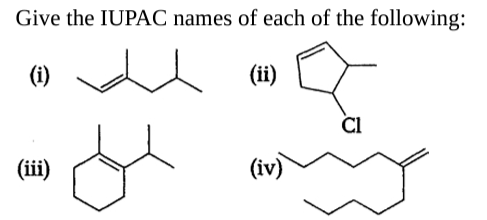
Image
Answer
IUPAC name
i. 3, 5-dimethyl-2-hexene or 3, 5 -dimethylhex-2-ene
ii. 4-chloro-3-methylcyclopentene
iii. 1-sec-butyl-2-methylcyclohexene or 1-methyl-2-(1-methylpropyl) cyclohexen
iv. 2-pentyl-1-heptene or 2-pentylhept-1-ene
View full question & answer
Question 32 Marks
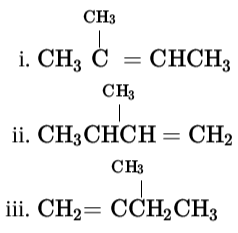
Arrange the following alkenes in the decreasing order of stability.
Image
Answer
Stability of an alkene increases with increase in the number of electron donating substituent at the position of double bonded carbon atom. Thus, the order is (i) $>$ (iii) $>$ (ii).
View full question & answer
Question 42 Marks
How much potassium chlorate should be heated to produce 2.24 L of oxygen at NTP?
Answer
When potassium chlorate is heated, then following reaction takes place:
$
2 KClO_3 \rightarrow 2 KCl+3 O_2
$
Molecular mass of $1 mol_{ KClO _3}=39+35.5+3 \times 16=122.5 g$
Molecular mass of 2 mols of $KClO _3=2 \times 122.5 g=245 g$
Volume occupied by 3 mol of oxygen $=3 \times 22.4 L=67.5 L$
Therefore, 67.2 L of oxygen is produced from 245 g of $KClO _3$
2.24L of oxygen is produced from $=\frac{245}{67.2} \times 2.24=8.17 g$ of $KClO _3$
View full question & answer
Question 52 Marks
Why does electronegativity value increases across a period and decreases down period?
Answer
Electronegativity is the tendency of an element to attract the shared pair of electrons towards itself in a covalently bonded molecule. Electronegativity of an element is inversely proportional to its atomic size. It means with increase in atomic size , electronegativity of an element decreases.
1. We know that atomic size increases down the group. Therefore electronegativity decreases down the group.
2. The attraction between the outer electrons and the nucleus increases, as the atomic radius decreases in a period. The electronegativity also increases.
View full question & answer
Question 62 Marks
The dissociation of HI is independent of pressure, while dissociation of $PCl _5$ depends upon the pressure applied. Why?
Answer
For, the dissociation of HI , we have the equation $2 HI ( g ) \rightleftharpoons H _2(g)+ I _2(g)$. Here 2 moles of reactants give 2 moles of products.
Hence $\Delta n =0$ and so according to Le Chatelier's principle, dissociation of HI is independent of pressure. For the dissociation of $PCl _5$, we have $PCl _5(g) \rightleftharpoons PCl _3(g)+ Cl _2(g)$. Here 1 mole of reactant gives 2 moles of products. Hence $\Delta n =1$ and so according to
Le Chatelier's principle, dissociation of $PCl _5$ depends on pressure.
View full question & answer