Questions

5 Marks Questions

Take a timed test

5 questions · self-marked practice — reveal the answer and mark yourself.

Question 15 Marks
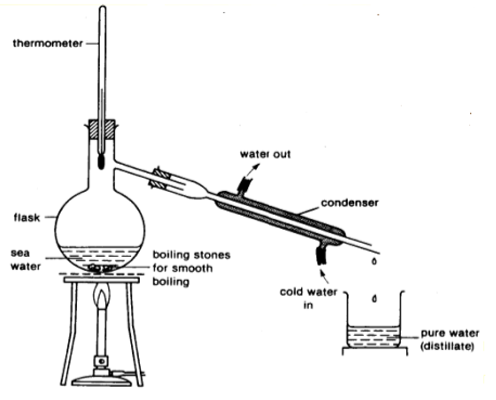
1. Two liquids (A) and (B) can be separated by the method of fractional distillation. The boiling point of a liquid (A) is less than the boiling point of a liquid (B). Which of the liquids do you expect to come out first in the distillate? Explain.
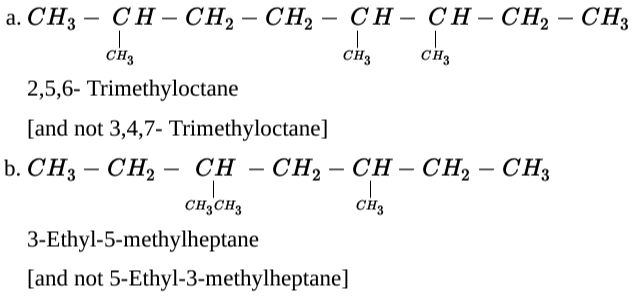
2. Structures and IUPAC names of some hydrocarbons are given below. Explain why the names given in the parentheses are incorrect.
Image
Answer
1. If the difference in boiling points of two liquids is not much, simple distillation cannot be used to separate them. The vapours of such liquids are formed within the same temperature range and are condensed simultaneously. The technique of fractional distillation is used in such cases. In this technique, vapours of a liquid mixture are passed through a fractionating column before condensation. The fractionating column is fitted over the mouth of the round bottom flask. The liquid [B] with a higher boiling point condense before the vapours of [A] with a lower boiling point.
Image
2. a. Lowest locant number, $2,5,6$ is lower than $3,5,7$
b. substituents are in equivalent position; lower number is given to the one that comes first in the name according to alphabetical order.

View full question & answer
Question 25 Marks
1. a. Define the following terms:
i. Enantiomers
ii. Racemic mixture
b. Why is chlorobenzene resistant to nucleophilic substitution reaction?
2. What is the general molecular formula of saturated monohydric alcohols?
Answer
1. a. i)The stereoisomers related to each other as non superimposable mirror images are called enantiomers.
ii)Equimolar mixture of d - and 1 - form is known as racemic mixture.
b. In chlorobenzene the lone pair of electrons on halogen atom is delocalized on the benzene ring. These are stabilized by resonance, hence, the energy of activation for displacement of halogen is much greater than alkyl halides.
2. Monohydric alcohols are the compounds derived from an alkane by replacing one H by - OH group.
Example:
Image
Therefore, the general molecular formula of saturated monohydric alcohols is $C _n H _{2 n+1} OH$.
View full question & answer
Question 35 Marks
The ionization constant of benzoic acid is $6.46 \times 10^{-5}$ and $K _{\text {sp }}$ for silver benzoate is $2.5 \times 10^{-13}$. How many times is silver benzoate more soluble in a buffer of pH 3.19 compared to its solubility in pure water?
Answer
$
C_6 H_5 COOAg \rightarrow C_6 H_5 COO^{-}+Ag^{+}
$
Solubility of water. Suppose solubility in water $= x mol L L ^{-1}$ then
$
\begin{aligned}
& x^2=K_{sp} \text { or } x=\sqrt{K_{s p}}=\sqrt{2.5 \times 10^{-13}}
\end{aligned}
$
$
=5 \times 10^{-7} mol L^{-1}
$
Solubility in buffer of $pH =3.19$
$
\begin{aligned}
& pH=3.19 \text { means }-\log \left[H^{+}\right]=3.19 \\
& \text { or } \log \left[H^{+}\right]=-3.19=\overline{4} .81 \text { or }\left[H^{+}\right]=6.457 \times 10^{-4} M
\end{aligned}
$
$C _6 H _5 COO ^{-}$ions now combine with the $H ^{+}$ions to form benzoic acid but $\left[ H ^{+}\right]$remains almost constant because we have buffer solution. Now
$
C_6 H_5 COOH \rightleftharpoons C_6 H_5 COO^{-}+H^{+}
$
$
\therefore K_a=\frac{\left[C_6 H_5 COO^{-}\right]\left[H^{+}\right]}{\left[C_6 H_5 COOH\right]} \text { or } \frac{\left[C_6 H_5 COOH\right]}{\left[C_6 H_5 COO^{-}\right]}=\frac{\left[H^{+}\right]}{K_a}=\frac{6.457 \times 10^{-4}}{6.46 \times 10^{-5}}=10 \ldots (i)
$
Suppose solubility in the buffer solution is ' $y^{\prime} mol L ^{-1}$. Then as most of the benzoate ions are converted into benzoic acid molecules (which remain almost ionized), we have
$
\begin{aligned}
& y=\left[Ag^{+}\right]=\left[C_6 H_5 COO^{-}\right]+\left[C_6 H_5 COOH\right]=\left[C_6 H_5 COO^{-}\right]+10\left[C_6 H_5 COO^{-}\right]=11\left[C_6 H_5 COO^{-}\right] \text {using equation (i) } \\
& \therefore\left[C_6 H_5 COO^{-}\right]=\frac{y}{11} \therefore K_{s p}=\left[C_6 H_5 COO^{-}\right]\left[Ag^{+}\right] \\
& 2.5 \times 10^{-3}=\frac{y}{11} \times y \text { or } y^2=2.75 \times 10^{-12} \text { or } y=1.66 \times 10^{-6} \\
& \frac{y}{x}=\frac{1.66 \times 10^{-6}}{5 \times 10^{-7}}=3.32
\end{aligned}
$
Note that in case of salts of weak acids, the solubility is more in the acidic solution than in water. The reason, in general, may be explained as follows: Taking example of $C _6 H _5 COOAg$, we have
$
C_6 H_5 COOAg \rightleftharpoons C_6 H_5 COO^{-}+Ag^{+}
$
In acidic solution, the anions $\left( C _6 H _5 COO ^{-}\right.$in the present case) undergo protonation in presence of acid. Thus, $C _6 H _5 COO ^{-}$ions are removed. Hence, equilibrium shifts forward producing more $Ag ^{+}$ions. Alternatively, as $C _6 H _5 COO ^{-}$ions are removed, $Q _{ sp }$ decreases. In order to maintain solubility product equilibrium $\left( Q _{ sp }= K _{ sp }\right), Ag ^{+}$ion concentration must increase. Hence, solubility is more.
View full question & answer
Question 45 Marks
Determine the solubilities of silver chromate, barium chromate, ferric hydroxide, lead chloride and mercurous iodide at 298 K from their solubility product constants.
1. $K _{ sp }\left( Ag _2 CrO _4\right)=1.1 \times 10^{-12}$,
2. $Ksp \left( BaCrO _4\right)=1.2 \times 10^{-10}$,
3. $K _{ sp }\left[ Fe ( OH )_3\right]=1.0 \times 10^{-3}$,
Determine also the molarities of individual ions.
Answer
$
\begin{aligned}
& \text { 1. } Ag_2 CrO_4 \rightleftharpoons \underset{2 S}{2 Ag^{+}}+\underset{S}{CrO_4^{2-}} ; K_{\text {sp }}=1.1 \times 10^{-12} \\
& K_{\text {sp }}=\left[Ag^{+}\right]^2 \cdot\left[CrO_4^{2-}\right] \\
& K_{\text {sp }}=[2 S]^2 \cdot[S]=4 S^3, S^3=\frac{K_{\text {sp }}}{4} \\
& \text { or } S^3=\frac{1.1 \times 10^{-12}}{4}=0.275 \times 10^{-12} \\
& \text { On solving } S=6.503 \times 10^{-5} M \\
& {\left[Ag^{+}\right]=2 S=2 \times 6.503 \times 10^{-5} M} \\
& =13.006 \times 10^{-5} \approx 1.3 \times 10^{-4} M \\
& \text { and }\left[CrO_4^{2-}\right]=S=6.503 \times 10^{-5} M
\end{aligned}
$
$
\begin{aligned}
& \text { 2. } BaCrO_4 \rightleftharpoons Ba_S^{2+}+CrO_4^{2-} ; \\
& K_{\text {sp }}=1.2 \times 10^{-10} \text { (Solubility of } BaCrO_4 \text { is } S mol L^{-1} \text { ) } \\
& K_{\text {sp }}=1.2 \times 10^{-10}=\left[Ba^{2+}\right] \cdot\left[CrO_4^{2-}\right]=S^2 \\
& S=\sqrt{1.2 \times 10^{-10}}=1.1 \times 10^{-5} M \\
& {\left[Ba^{2+}\right]=\left[CrO_4^{2-}\right]=1.1 \times 10^{-5} M}
\end{aligned}
$
$
\begin{aligned}
& \text { 3. } Fe(OH)_3 \rightleftharpoons \underset{S}{Fe^{3+}}+\underset{3 S}{3 OH^{-}} \text {; } \\
& K_{\text {sp }}=1.0 \times 10^{-38} \text { (Solubility of } Fe(OH)_3 \text { is } S mol L^{-1} \text { ) } \\
& K_{sp}=\left[Fe^{3+}\right]\left[OH^{-}\right]^3 \\
& K_{sp}=S \cdot(3 S)^3=27 S^4 \text { or } S^4=\frac{K_{s p}}{27} \\
& S^4=\frac{1.0 \times 10^{-38}}{27}=0.037 \times 10^{-38} \\
& S=1.387 \times 10^{-10}, S \approx 1.39 \times 10^{-10} \\
& {\left[Fe^{3+}\right]=1.39 \times 10^{-10} M} \\
& {\left[OH^{-}\right]=3 S=3 \times 1.39 \times 10^{-10}} \\
& =4.17 \times 10^{-10} M
\end{aligned}
$

View full question & answer
Question 55 Marks
Attempt any five of the following:
1. Convert 1-bromopropane to 2-bromopropane.
2. Although benzene is highly unsaturated it does not undergo addition reactions.
3. How is alkene produced by vicinal dihalide?
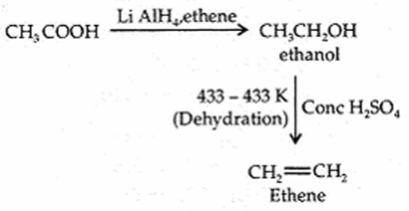
4. How will you convert ethanoic acid into ethene?
5. What is the number of $\sigma$ and $\pi$ bond in $N \equiv C - CH = CH - C \equiv N$ ?
6. Write the general formula for alkynes.
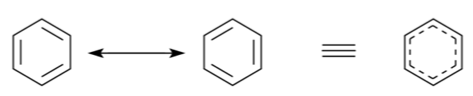
7. What do you mean by delocalization?
Answer
1. We can convert 1-Bromopropne into 2-Bromopropane in two steps. In the first step, the dehydrohalogenation of 1-bromo propane with alcoholic KOH gives propene which on reacting with HBr gives 2-bromo propane due to Markovnikov's rule for addition.
Image
2. It is due to delocalization of $\pi$-electrons in benzene it is highly stable.
3. Alkene are produced from Vicinal dihalide by the process of dehalogenations. Vicinal dihalide on treatment with Zn metal lose a molecule of $ZnX _2$ to from an alkene.
$
CH_2 Br-CH_2 Br+Zn \rightarrow CH_2=CH_2+ZnBr_2
$
4.
Image
5. In Triple bond, there are two $\pi$-bonds and one $\sigma$ bond and in double bond, one is $\sigma$ bond and one $\pi$-bond. Therefore, in this compound there are $7 \sigma$ bonds and $5 \pi$-bonds.
6. General formula of alkynes is $C _{ n } H _{2 n -2}$
7. Delocalisation implies that pairs of bonding electrons extend over three or more atoms and belong to the whole molecule.
Due to delocalization, compound becomes stable.
Example: Delocalization in benzene
Image
View full question & answer