Questions

3 Marks Question

Take a timed test

7 questions · self-marked practice — reveal the answer and mark yourself.

Question 13 Marks
10 mL of $H _2$ combine with 5 mL of $O _2$ to form water. When 200 mL of $H _2$ at STP is passed over heated CuO , the CuO loses 0.144 g of its weight. Does the above data correspond to the law of constant composition?
Answer
$
CuO+H_2 \rightarrow Cu+H_2 O
$
For First experiment;
Ratio of hydrogen to oxygen $=10: 5=2: 1$
For Second Experiment:
Here, 0.144 g is lost from CuO.
Therefore, 0.144 g of oxygen combines with 200 mL of hydrogen
32 g oxygen occupies volume at STP. $=22400 mL$
So 0.144 g oxygen occupies volume at $STP =\frac{22400 \times 0.144}{32} 100.8 mL$ oxygen
Now, The ratio of hydrogen to oxygen $=200: 100.8=2: 1$
As the ratios are same, Therefore, Law of constant proportion is obeyed.
View full question & answer
Question 23 Marks
The first (IE) and second (IER) ionization enthalpy: $\left( KJ mol ^{-1}\right)$ of three elements $A , B$ and C are given below:
 ABC
$IE _1$4035491142
$IE _2$264010602080
Identify the element which is likely to be
i. a non-metal
ii. an alkali metal
iii. an alkaline earth metal
Answer
i. C is non-metal
ii. A is alkali metal
iii.B is alkaline earth metal
View full question & answer
Question 33 Marks
Lifetimes of the molecules in the excited states are often measured by using pulsed radiation source of duration nearly in the nano second range. If the radiation source has the duration of 2 ns and the number of photons emitted during the pulse source is $2.5 \times 10^{15}$, calculate the energy of the source.
Answer
$\begin{aligned} & \text { Frequency }=\frac{1}{2 \times 10^{-9} s}=0.5 \times 10^9 s^{-1} \\ & \text { Energy }= Nhv \\ & =\left(2.5 \times 10^5\right)\left(6.26 \times 10^{-39} Js \right)\left(0.5 \times 10^9 s^{-1}\right) \\ & =8.28 \times 10^{-10} J\end{aligned}$
View full question & answer
Question 43 Marks
Which of the following species, do not show a disproportionation reaction and why?
$ClO ^{-}, ClO _2^{-}, ClO _3^{-}$and $ClO _4^{-}$
Also, write the reaction for each of the species that disproportionate.
Answer
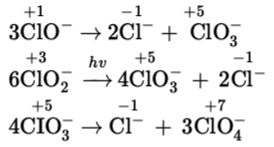
Among the oxoanions of chlorine listed above, $ClO _4^{-}$does not disproportionate because in this oxoanion chlorine is present in its highest oxidation state that is, +7 . The disproportionation reactions for the other three oxoanions of chlorine are as follows:
Image
View full question & answer
Question 53 Marks
For the reaction, $2 A( g )+ B ( g ) \longrightarrow 2 D ( g ) ; \Delta U^o=-10.5 kJ$ and $\Delta S^o=-44.1 JK ^{-1}$. Calculate $\Delta G^o$ for the reaction and predict whether the reaction may occur spontaneously. $\left( R =8.314 \times 10^{-3} kJ K ^{-1} mol^{-1}, T=298 K\right)$
Answer
According to the question, $\Delta U^o=-10.5 kJ$ and $\Delta S^o=-44.1 JK ^{-1}, R =8.314 \times 10^{-3} kJ mol ^{-1}, T=298 K$.
Reaction:
$
\begin{aligned}
& 2 A(g)+B(g) \longrightarrow 2 D(g) \\
& \Delta n_{g}=n_{p}-n_{r}=2-3=-1
\end{aligned}
$
We know that, $\Delta H^o=\Delta U^o+\Delta n_g R T$
$
\begin{aligned}
& \Delta H^o=-10.5+\left(-1 \times 8.314 \times 10^{-3} \times 298\right) \\
& =-12.977 kJ mol^{-1}
\end{aligned}
$
Now, $\Delta G^o=\Delta H^o-T \Delta S^o$
$
\Delta G^o=-12.977-\left(298 \times-44.1 \times 10^{-3}\right)
$
$
=0.165 kJ mol^{-1}
$
The reaction will not occur spontaneously because $\Delta G^o$ is positive.
View full question & answer
Question 63 Marks
1. Define reaction enthalpy.
2. How can you say that universe is going towards chaos?
3. Neither q nor W is a state function but $q + W$ is a state function. Explain why?
Answer
1. Reaction enthalpy: The enthalpy change accompanying a reaction is called the reaction enthalpy. The enthalpy change of a chemical reaction, is given by the symbol $\Delta_{ r } H$.
2. Most of the naturally occurring processes are accompanied by increase of randomness. Hence, randomness of the universe is continuously increasing. Thus, we are going towards chaos
3. q and W are not state functions. But as we know that, $q + W =\Delta U$, which is a state function.
Hence, $q + W$ is a state function.
View full question & answer
Question 73 Marks
Write the Lewis dot structure of the CO molecule.
Answer
Step 1. Count the total number of valence electrons of carbon and oxygen atoms. The outer (valence) shell configurations of carbon and oxygen atoms are:
$2 s^2 2 p^2$ and $2 s^2 2 p^4$, respectively. The valence electrons available are $4+6=10$.
Step 2. The skeletal structure of CO is written as: CO
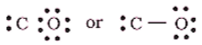
Step 3. Draw a single bond (one shared electron pair) between $C$ and $O$ and complete the octet on $O$, the remaining two electrons are the lone pair on C .
Image
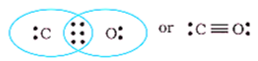
This does not complete the octet on carbon and hence we have to resort to multiple bonding (in this case a triple bond) between C and O atoms. This satisfies the octet rule condition for both atoms. 
Image
View full question & answer