Questions

5 Marks Questions

Take a timed test

5 questions · self-marked practice — reveal the answer and mark yourself.

Question 15 Marks
1. Will $CCl _4$ give a white precipitate of AgCl on heating it with $AgNO _3$ ?
2. Identify the functional groups present in the following compounds.
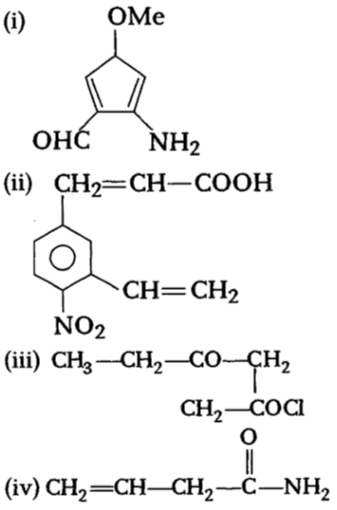
Image
Answer
1. Carbon tetrachloride contains chlorine but it is bonded to carbon by covalent bond. Hence, it is not in ionic form. So, it does not combine with $AgNO _3$ solution.
Therefore, $CCl _4$ does not give white precipitate with silver nitrate solution.
$CCl _4+ AgNO _3 \rightarrow$ No reaction.
2. i. Functional groups are $- NH _2$ (amino), - OMe (methoxy) and -CHO (aldehydic)
ii. Carbon-carbon double bond, $- NO _2$ (nitro) and - COOH (carboxylic)
iii. -CO- (keto), -COCl (acylchloride)

Image
View full question & answer
Question 25 Marks
1. During estimation of nitrogen present in an organic compound by Kjeldahl's method, the ammonia evolved from 0.5 g of the compound in Kjeldahl's estimation of nitrogen, neutralized 10 mL of $1 M H _2 SO _4$. Find out the percentage of nitrogen in the compound.
2. Explain why $\left( CH _3\right)_3 \stackrel{+}{ C }$ is more stable than $CH _3 \stackrel{+}{ C } H _2$ and $\stackrel{+}{ C } H _3$ is the least stable cation.
Answer
$\begin{aligned} & \text { 1. } 1 M \text { of } 10 mL H _2 SO _4=1 M \text { of } 20 mL NH _3 \\ & 100 mL \text { of } 1 M \text { ammonia contains nitrogen }=14 g \\ & 20 mL \text { of } 1 M \text { ammonia will contain nitrogen }=\frac{14 \times 20}{1000} g \\ & \therefore \text { Percentage of nitrogen }=\frac{14 \times 20 \times 100}{1000 \times 0.5}=56.0 \%\end{aligned}$
2. Hyperconjugation interaction in $\left( CH _3\right)_3 \stackrel{+}{ C }$ is greater than in $CH _3 \stackrel{+}{ C } H _2$ as the $\left( CH _3\right)_3 \stackrel{+}{ C }$ has nine C -H bonds. In $\stackrel{+}{ C } H _3$, vacant p orbital is perpendicular to the plane in which $C - H$ bonds lie; hence cannot overlap with it. Thus, $\stackrel{+}{ C } H _3$ lacks hyperconjugative stability. Therefore, $\left( CH _3\right)_3 \stackrel{+}{ C }$ is more stable than $CH _3 \stackrel{+}{ C } H _2$ and $\stackrel{+}{ C } H _3$ is the least stable cation.
View full question & answer
Question 35 Marks
What is the pH of 0.001 M aniline solution? The ionisation constant of aniline is $4.27 \times 10^{-10}$. Calculate the degree of ionisation of aniline in the solution. Also calculate the ionisation constant of the conjugate acid of aniline.
Answer
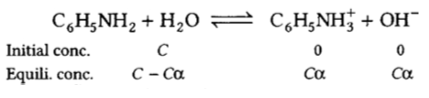
$\begin{aligned} & C _6 H _5 NH _2+ H _2 O \rightleftharpoons C _6 H _5 NH _3^{+}+ OH ^{-} \\ & K_b=\frac{\left[ C _6 H _5 NH _3^{+}\right]\left[ OH ^{-}\right]}{\left[ C _6 H _5 NH _2\right]} \\ & =\frac{\left[ OH ^{-}\right]^2}{\left[ C _6 H _5 NH _2\right]} \\ & {\left[ OH ^{-}\right]=\sqrt{K_b \cdot C}=\sqrt{4.27 \times 10^{-10} \times 0.001}} \\ & {\left[ OH ^{-}\right]=6.534 \times 10^{-7}} \\ & \text { pOH }=-\log \left[ OH ^{-}\right]=-\log \left[6.534 \times 10^{-7}\right] \\ & \text { pOH }=-0.8152+7=6.18 \\ & \text { From, pH }+ \text { pOH }=14 \\ & \text { pH }=14-6.18=7.82\end{aligned}$
Image
$
\begin{aligned}
& K_b=\frac{C \alpha \cdot C \alpha}{C(1-\alpha)}[(1-\alpha) \approx 1 \text { for weak base }] \\
& K_{b}=C \alpha^2=\alpha=\sqrt{\frac{K_b}{C}}
\end{aligned}
$
Degree of ionisation,
$
\alpha=\sqrt{\frac{4.27 \times 10^{-10}}{0.001}}=6.53 \times 10^{-4}
$
$K _{ a }$ of conjugate acid of aniline,
$
\begin{aligned}
& K_a=\frac{K_w}{K_b} \\
& =\frac{10^{-14}}{4.27 \times 10^{-10}}=2.34 \times 10^{-5}
\end{aligned}
$
View full question & answer
Question 45 Marks
Ethyl acetate is formed by the reaction of ethanol and acetic acid and the equilibrium is represented as:
$
CH_3 COOH(l)+C_5 H_5 OH(l) \rightleftharpoons CH_3 COOC_2 H_5(l)+H_2 O(l)
$
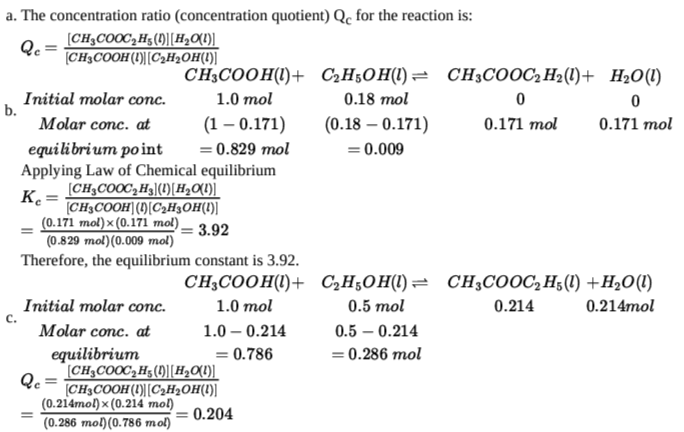
a. Write the concentration ratio (reaction quotient), $Q _{ C }$, for this reaction (note: water is not in excess and is not a solvent in this reaction)
b. At 293 K , if one starts with 1.00 mol of acetic acid and 0.18 mol of ethanol, there is 0.171 mol of ethyl acetate in the final equilibrium mixture. Calculate the equilibrium constant.
c. Starting with 0.5 mol of ethanol and 1.0 mol of acetic acid and maintaining it at $293 K, 0.214$ mol of ethyl acetate is found after some time. Has equilibrium been reached?
Answer

Image
Since $Q_c$ value 0.204 is less than $K_c$, value 3.92 this means that the equilibrium has not been reached. The reactants are still taking part in the reaction to form the products.
View full question & answer
Question 55 Marks
Attempt any five of the following:
1. What is electrophile in sulphonation?
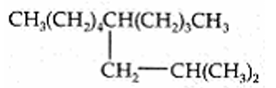
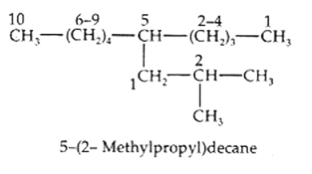
2. Write IUPAC name of following:
Image
3. Write IUPAC name: $CH _3 CH - C \left( CH _3\right)_2$
4. Methane does not react with chlorine in dark. Why?
5. How would you convert ethene to ethane molecule?
6. What is Huckel rule?
7. What is decarboxylation? Give an example.
Answer
1. $SO _3$
2.
Image
3. 2-methylbutane
4. Chlorination of methane is a free radical substitution reaction and the initiation step involves the formation of free radical $Cl _2 \rightarrow 2 Cl$.This requires more energy than is available at ambient temperatures and light of enough high energy will break the bond and initiate the reaction. In dark, chlorine is unable to be converted into free radicals, hence the reaction does not occur.
5. Unsaturated alkene (ethene) is get converted into saturated alkane (ethane) by the process of reduction in the presence of reducing agents like $Pt / Pd / Ni$ etc.
$
CH_2=CH_2 \text { (ethene) }+H_2 \xrightarrow{P t / P d / N i} CH_3-CH_3 \text { (ethane) }
$
6. Huckel rule states that a compound is said to be aromatic if it has $(4 n+2) \pi$ electrons delocalized where $n=$ an integer 0 , $1,2,3, \ldots$
7. The process by which carbon dioxide is removed from sodium acetate (or any sodium salt of acid) with the help of sodalime is called decarboxylation.
Image
View full question & answer