Question 15 Marks
1. What are electrophiles and nucleophiles? Explain with examples.
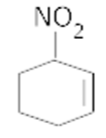
2. Derive the structure of 3 - Nitrocyclohexene.
2. Derive the structure of 3 - Nitrocyclohexene.
Answer
View full question & answer→1. Electrophiles: The name electrophiles means electron loving. Electrophiles are electron defficient. They may be positive ions or neutral molecules.
$
Ex: H^{+}, Cl^{+}, Br^{+}, NO_2^{+}, R_3 C^{+}, RN_2^{+}, AlCl_3, BF_3
$
Nucleophiles: The name nucleophiles means 'nucleus loving' and indicates that it attacks the region of low electron density (positive centres) in a subtracts molecule. They are electron rich they may be negative ions or neutral molecules.
$
\text { Ex: } Cl^{-}, Br^{-}, CN^{-}, OH^{-}, RCH_2^{-}, NH_3, RNH_2, H_2 O, ROH \text { etc. }
$
2. A six-membered ring containing a carbon - carbon double bond is called as cyclohexene. Now giving numbers to the carbons:
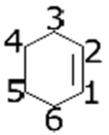
Attach nitro group to 3rd carbon.
Hence the structure of 3 - Nitrocyclohexene is:
$
Ex: H^{+}, Cl^{+}, Br^{+}, NO_2^{+}, R_3 C^{+}, RN_2^{+}, AlCl_3, BF_3
$
Nucleophiles: The name nucleophiles means 'nucleus loving' and indicates that it attacks the region of low electron density (positive centres) in a subtracts molecule. They are electron rich they may be negative ions or neutral molecules.
$
\text { Ex: } Cl^{-}, Br^{-}, CN^{-}, OH^{-}, RCH_2^{-}, NH_3, RNH_2, H_2 O, ROH \text { etc. }
$
2. A six-membered ring containing a carbon - carbon double bond is called as cyclohexene. Now giving numbers to the carbons:
Attach nitro group to 3rd carbon.
Hence the structure of 3 - Nitrocyclohexene is: