Questions

3 Marks Question

Take a timed test

7 questions · self-marked practice — reveal the answer and mark yourself.

Question 13 Marks
Commercially available concentrated hydrochloric acid $( HCl )$ contains $38 \% HCI$ by mass.
1. What is the molarity $( M )$ of the solution (density of solution $=1.19 g mL ^{-1}$ )
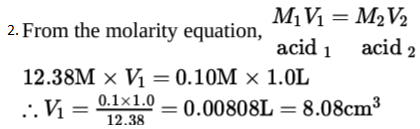
2. What volume required of concentrated HCI is required to make 1.0 L of an 0.10 M HCI ?
Answer
1. Let assume the total mass of the solution is 100 g .
$38 \% HCI$ by mass means 38 g of HCI is present in 100 g of solution.
The volume of solution $( V )=\frac{\text { mass }}{\text { density }}=\frac{100}{1.19}=84.03 mL$ (Density of solution $=1.19 g / mL$ )
Number of moles of $HCl \left( n _{ B }\right)=\frac{38}{36.5}=1.04$
Molarity $=\frac{n_B \times 1000}{V(\text { in } m L)}=\frac{1.04 \times 1000}{84.03 mL}=12.38 M$
Image
View full question & answer
Question 23 Marks
Give the electronic configuration of the transition elements. Write their four important characteristics.
Answer
General electronic configuration of Transition elements:
The d-block elements are known as transition elements with general outer electronic configuration as $( n -1) d ^{1-10} ns^{0-2}$.
Characteristics of d-block elements:
(i) They show variable oxidation states.
(ii) Their compounds are generally paramagnetic in nature.
(iii) Most of the transition elements form coloured compounds
(iv) They are all metals with high melting and boiling points.
View full question & answer
Question 33 Marks
According to de Broglie, matter should exhibit dual behaviour, that is both particle and wave like properties. However, a cricket ball of mass 100 g does not move like a wave when it is thrown by a bowler at a speed of 100 $km / h$. Calculate the wavelength of the ball and explain why it does not show wave nature.
Answer
Given, $m =100 g=0.1 kg$.
Velocity, $v =100 km / hr =\frac{100 \times 1000}{60 \times 60}=\frac{10000}{36} ms^{-1}$.
According to be Broglie, Wavelength $\lambda=\frac{h}{m v}$; Where $h =6.626 \times 10^{-34} Js$.
Now, Put the values in above equation, we get
$
\begin{aligned}
& \lambda=\frac{6.626 \times 10^{-34} Js}{0.1 kg \times \frac{1000}{36} ms^{-1}}=6.626 \times 10^{-36} \times 36 m \\
& \lambda=238.5 \times 10^{-36} m
\end{aligned}
$
Since the wavelength is too small to be detected, so, it does not show wave nature.
View full question & answer
Question 43 Marks
Justify giving reactions that among halogens, fluorine is the best oxidant and among hydrohalic compounds, hydroiodic acid is the best reductant.
Answer
i. Halogens have a strong tendency to accept electrons. Therefore, they are strong oxidizing agents. Their relative oxidizing power is however, measured in terms of their electrode potentials.
Since the electrode potentials of halogens decrease in the order :
$
F_2<(2.87 V)>Cl_2(+1.36 V)>Br_2(+1.09 V)>I_2(+0.54 V),
$
Therefore, their oxidizing power decreases in the same order.
This is evident from the observation that
a. $F _2$ oxidizes $Cl ^{-}$to $Cl _2, Br ^{-}$to $Br _2, I ^{-}$to $I _2$
b. $Cl _2$ oxidizes $Br ^{-}$to $Br _2$ and $I ^{-}$to $I _2$ but not $F ^{-}$to $F _2$.
c. $Br _2$, however oxidizes $I ^{-}$to $I _2$. But $Br _2$ fails to oxidise $F ^{-}$to $F _2$ and $Cl ^{-}$to $Cl _2$
The related above reactions are,
$
\begin{aligned}
& F_2(g)+2 Cl^{-}(aq) \rightarrow 2 F^{-}(aq)+Cl_2(g) ; F_2(g)+2 Br^{-}(aq) \rightarrow 2 F^{-}(aq)+Br_2(l) \\
& F_2(g)+2 I^{-}(aq) \rightarrow 2 F^{-}(aq)+I_2(s) ; Cl_2(g)+2 Br^{-}(aq) \rightarrow 2 Cl^{-}(aq)+Br_2(l) \\
& Cl_2(g)+2 I^{-}(aq) \rightarrow 2 Cl^{-}(aq)+I_2(s) \text { and } Br_2(l)+2 I^{-} \rightarrow 2 Br^{-}(aq)+I_2(s)
\end{aligned}
$
Thus, $F _2$ is the best oxidant.
ii. Conversely, halide ions have a tendency to lose electrons and hence can act as reducing agents. Since the electrode potentials of halide ions decrease in the following order,
$
I^{-}(-0.54 V)>Br^{-}(-1.09 V)>CI^{-}(-1.36 V)>F^{-}(-2.87 V),
$
Therefore, the reducing power of the halide ions or their corresponding hydrohalic acids decreases in the same order: 
$
HI >HBr>HCl>HF .
$
Thus, hydroiodic acid is the best reductant. This is supported by the following reactions.
For example,
HI and HBr reduces $H _2 SO _4$ to $SO _2$ while HCI and HF do not.
$
2 HBr+H_2 SO_4 \rightarrow Br_2+SO_2+2 H_2 O ; 2 HI+H_2 SO_4 \rightarrow I_2+SO_2+2 H_2 O
$
Further $I ^{-}$reduces $Cu ^{2+}$ to $Cu ^{+}$but $Br ^{-}$does not.
$
\begin{aligned}
& 2 Cu^{2+}(aq)+4 I^{-}(aq) \rightarrow Cu_2 I_2(s)+I_2(aq) \\
& Cu^{2+}(aq)+2 Br^{-} \rightarrow \text { No reaction }
\end{aligned}
$
So, HI is a stronger reductant than HBr .
Further, among HCl and $HF , HCl$ is a stronger reducing agent than HF because HCl reduces $MnO _2$ to $Mn ^{2+}$ but HF does not.
Image
Thus, the reducing character of hydrohalic acids decreases in the order: $H I > H B r > H C l > H F$.
View full question & answer
Question 53 Marks
Give the relationship between $\Delta U$ and $\Delta H$ for gases.
Answer
Let $V _{ A }$ be the total volume of gaseous reactants,
 $V _{ B }$ be the total volume of gaseous product.
Let $n _{ A }$ be the number of moles of the reactant, 
$n _{ B }$ be the number of moles of the product,
At constant pressure and temperature,
$
\begin{aligned}
& p V_A=n_A R T, \\
& p V_B=n_B R T \\
& \Rightarrow pV_{B}-pV_{A}=\left(n_{B}-n_{A}\right) RT \\
& \Rightarrow p \Delta V=(\Delta n)_g RT
\end{aligned}
$
Here, $(\Delta n)_g=n_B-n_A$ is equal to the difference between the number of moles of gaseous products and gaseous reactants. 
We know that,
$
\Delta H=\Delta U+(\Delta n)_g R T
$
Now, $\Delta H = q _{ p }$ (heat change under constant pressure),
$\Delta U = q _{ v }$ (heat change under constant volume).
Therefore, $q_p=q_v+(\Delta n)_g R T$
View full question & answer
Question 63 Marks
1. The fact that the enthalpy is a state function forms the basis of a very useful law. Name the law.
2. If the combustion of 1 g of graphite produces 20.7 kJ of heat, what will be molar enthalpy change? Give the significance of the sign also.
3. Consider the same expansion, but this time against a constant external pressure of 1 atm.
Answer
1. The name of the law is Hess's law of heat summation.
2. According to the question, the combustion of 1 g of graphite produces 20.7 kJ of heat.
The molar enthalpy change for the combustion of graphite, $\Delta H=$ enthalpy of combustion of 1 g graphite $\times$ molar mass
$
\begin{aligned}
& \Delta H=-20.7 kJ g^{-1} \times 12 g mol^{-1} \\
& =-2.48 \times 10^2 kJ mol^{-1}
\end{aligned}
$
Here, a negative sign indicates that the reaction is exothermic.
3. We have $q =- w = p _{ ex }(8)=8$ litre-atm
View full question & answer
Question 73 Marks
Discuss the concept of hybridisation. What are the different types of hybridization that carbon can exhibit?
Answer
Hybridization: This concept was put forward by Pauling. He suggested that the atomic orbitals mix together to generate a new set of equivalent orbitals, called as hybrid orbitals or hybridized orbitals.
Types of hybridization in the carbon atom
a. Diagonal or sp-hybridization- Carbons involved in forming $C \equiv C$ (triple bond) like in ethyne $\left( C _2 H _2\right)$ exhibit sphybridization.
b. Trigonal or $sp ^2$-hybridization- Carbons involved in forming $C = C$ (double bond) like in ethene $\left( C _2 H _4\right)$ exhibit sp ${ }^2$ hybridization.
c. Tetrahedral or $sp ^3$-hybridization- Carbons involved in forming single bonds only like in ethane $\left( C _2 H _6\right)$ exhibit sp ${ }^3$ hybridization.
View full question & answer
