Questions

2 Marks Questions

Take a timed test

20 questions · self-marked practice — reveal the answer and mark yourself.

Question 12 Marks
$N _2$ have bond order 3 and it is diamagnetic. Explain this on basis of MOT.
Answer
The electronic configuration of nitrogen in ground state :
$
{ }_7 N=1 s^2 2 s^2 2 p^3
$
According to MOT, electronic configuration of $N _2$
$
\begin{array}{l}
=(\sigma 1 s)^2\left(\sigma^* 1 s\right)^2(\sigma 2 s)^2\left(\sigma^* 2 s\right)^2 \\
\left(\pi 2 p_x\right)^2=\left(\pi 2 p_y\right)^2\left(\sigma 2 p_z\right)^2
\end{array}
$
$
\begin{aligned}
\text { Bond order } & =\frac{1}{2}(Nb-Na) \\
& =\frac{1}{2}(10-4)=3
\end{aligned}
$
Hence, bond order of $N =3$ and as all electrons of it are paired, it is diamagnetic.
View full question & answer
Question 32 Marks
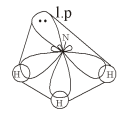
Explain hybridisation in $NH _3$.
Answer
In $NH _3, N$ is $s p^3$ hybridised.
The electronic configuration of N in ground state is :
Image
Out of four $s p^3$ hybrid orbitals three are have unpaired electrons while fourth one have one 1.p electron. Three $s p^3$ hybrid orbitals of nitrogen overlapped with $1 s$ orbitals of three hybrogen atoms and form three $N - H$ bond. The repulsion between l.p-b.p is more than b.p-b.p. Hence in molecule of $NH _3$ bond order get decreased from $109.5^{\circ}$ to $107^{\circ}$ and geometry of molecule get distorted and become pyramidal.
View full question & answer
Question 42 Marks
Give reason of following :
(a) HF is a liquid while HCl is gas.
(b) In $C _2 H _5 OH$ and $CH _3 COOH$ covalent bond is present, still it is soluble in water.
Answer
(a) In HF strong intermolecular H-bond is present and they get attracted by them and comes
closer to each other. Hence it is a liquid while in HCl molecules weak Van der Waals force is present. Hence it is gas.
(b) $C _2 H _5 OH$ and $CH _3 COOH$ are polar. Hence they form H -bond with water. Therefore they are soluble in $H _2 O$.
View full question & answer
Question 72 Marks
Why volume of water get decreased on melting of ice?###Why density of ice is less than that $H _2 O$ ?
Answer
When water gets cooled up to $4^{\circ} C$ density increases. After that if it is more cooled due to H -bond, $H _2 O$ molecule get arranged in open cage like structure whose volume is more than mass. Hence density of ice is less than that of water and on melting of ice, volume of water reduces.
View full question & answer
Question 82 Marks
Why geometry of $BF _3$ is triangular while that of $NH _3$ is pyramidal? Give reason.
Answer
In $BF _3, B$ have $s p^2$ hybridisation ( $3 \sigma$ bond). Hence its geometry is triangular. While in $NH _3, N$ have $3 \sigma$ bond and as it have one 1.p electron it have $s p^3$ hybridisation. Hence its geometry is pyramidal.
View full question & answer
Question 92 Marks
In following compound calculate the hybridisation in each carbon.
(i) $CH _3 Cl$
(ii) $H C O N H _2$
(iii) $CH _3 CN$
View full question & answer
Question 102 Marks
Why $PCl _5$ exist and $NCl _5$ do not?
Answer
Nitrogen is an element of second period which have 5 electrons in valence shell but have only 3 unpaired electrons.
Image
Nitrogen do not have vacant d-orbital. Hence in this electron do not get in excited state. Hence in this octet do not get expanded, hence its valency can't be 5. Due to this $NCl _5$ do not exist. While P of $PCl _5$ is the element of third period. Hence in this electron get in excited state and valency get 5 and $PCl _5$ get easily formed.
Image
View full question & answer
Question 112 Marks
$CCl _4$ do not react with water while $SiCl _4$ easily react with water, why?
Answer
In $CCl _4$ the octet of carbon is complete and carbon do not have $d$-orbital. Hence it is not capable to accept electron pair from water. Hence it do not react with water. But in $SiCl _4, Si$ have vacant d-orbitals so that it easily accepts electron pair. Hence $SiCl _4$ easily react with $H _2 O$.
$
SiCl_4+2 H_2 O \longrightarrow SiO_2+2 HCl
$
View full question & answer
Question 122 Marks
Sn form two compounds in different oxidation states : $S n C l _{ 2 }$ and $S n C l _{ 4 }$ but in these $S n C l _{ 2 }$ is solid while $SnCl _4$ is volatile liquid, why?
Answer
In $SnCl _2$ and $SnCl _4$ the oxidation state of Sn is +2 and +4 respectively. Due to the small size of $Sn ^{+4}$ its polarising power is more. Hence it easily polarise the anions due to which $SnCl _4$ is covalent while in $SnCl _2$, due to the small size of $Sn ^{+2}$ it have more ionic character. Due to this $SnCl _2$ is solid and $SnCl _4$ is volatile liquid.
View full question & answer
Question 132 Marks
What do you meant by ionisation enthalpy? On basis of this explain the acidic nature of oxides and stability of carbonates.
Answer
self
View full question & answer
Question 142 Marks
(i) Bond length, depends on hybridization Explain.
(ii) The bond enthalpy of $F - F$ is less than that of Cl-Cl, why?
Answer
(i) The bond length decreases with increase in $s$-character. Example : The bond length of $C - C$ is as follows:Imagedisation
$s$ character $25 \%$
$33 \%$
50%
(ii) The bond enthalpy of F-F is less than that of $Cl - Cl$ because due to small size of fluorine atom the 1.p-l.p repulsion between both fluorine molecule is more due to which bond get easily breaked.
View full question & answer
Question 162 Marks
$CO _2$ is non-polar while $SO _2$ is polar, why?
Answer
In $CO _2$ and $SO _2$ both compounds have polar bond but the geometry of $CO _2$ is linear. Hence due to the moments of both its $C - O$ bonds being in opposite directions, their effect gets cancelled due to which its dipole moment is zero, hence $CO _2$ is non-polar whereas it is not in case of $SO _2$. This happens because the geometry is angular, hence its dipole moment is not zero. Hence it is polar.
Image
View full question & answer
Question 172 Marks
In ionic bond, how partial covalent character is developed? Explain.
Answer
In a compound when cation attracts the electron layer of the anion towards itself, the amount of charge between them increases, due to which the electron charge density between two nuclei increases. This is called polarization of anion and it gives partial covalent character to ionic bond.As the polarizability of cation and degree of polarization of anion increases, the bond becomes more covalent. The necessary conditions are as :
(1) As size of cation decreases and size of anion increases covalent character in ionic bond increases.
(2) Increasing the amount of charge on cation and anion, it increases the covalent characteristic in ionic bond.
(3) Among cations of same size and charge the polarization of that cation is relatively higher, whose electronic configuration is almost simlar to $( n -1) d ^{ n }$ $n s^{\circ}$ of transition metals in comparison to $n s^2 n p^6$ of inert gases.
View full question & answer
Question 182 Marks
What is dipole moment? Explain with example.
Answer
The product of value of charge and distance between charges in polar molecule is called dipole moment.
Dipole moment $(\mu)=$ Charge $( Q ) \times( r )$ distance between charges
$
\text { or } \mu=Q \times \operatorname{r} \text { or } \mu=Q \times d
$
The unit of dipole moment is Debye (D) :
$
1 D=3.3 \times 10^{-30} Cm
$
C = Coulomb
$m =$ meter
It is a vector quantity.Image
The dipole moment of polyatomic molecules is the vector sum of bond moments of its various polar bonds.
Those molecules in which all the bonds are equal and whose geometry is symmetric and regular, such as linear, triangular planar and tetrahedral etc. then the resultant dipole moment of the molecule is absolutely zero. The dipole moment of $BF _3$ is zero because its geometry is triangular planar and all the bonds in it are equal which cancel each other's effect.
Image
Due to the bent shape of $H _2 O$, its dipole moment is high.
Image
View full question & answer
Question 192 Marks
What do you meant by bond enthalpy? In polyatomic molecules in which way it can be calculated?
Answer
Bond enthalpy : The energy required to break one mole of specific bonds between two atoms in gaseous state is called bond enthalpy. Its unit is $kJ mol ^{-1}$.
$
H_{2(g)} \longrightarrow H_{(g)}+H_{(g)} \quad \Delta_{a} H^{\ominus}=435.8 kJ mol^{-1}
$
Polyatomic molecules like $H _2 O$ have two $- O - H$ bonds but the value of their bond enthalpy is different. Hence average bond enthalpy is used is them.
Average bond enthalpy
$
=\frac{\text { Total bond dissociation enthalpy }}{\text { No. of bonds of same type }}
$
View full question & answer
Question 202 Marks
What do you meant by formal charge? Explain with example.
Answer
The formal charge of an atom of a polyatomic molecule or ion is equal to the difference between total number of valence electrons in its melted state (i.e. free atomic state) and the number of electrons assigned to that atom in Lewis structure.
Formal charge can be calculated by following formula :
Formal charge on atom $=$
$
\left[\begin{array}{l}
\text { Total no. of } \\
\text { valence electrons } \\
\text { in free atom }
\end{array}\right]-\left[\begin{array}{l}
\text { Total no. of } \\
\text { l.p electrons }
\end{array}\right]-\frac{1}{2}\left[\begin{array}{l}
\text { Total no. of } \\
\text { b.p electrons }
\end{array}\right]
Example : $O _3$ (Ozone)
Image
Formal charge on atom (1) $( F . C )=.6-4-\frac{1}{2}(4)=0$
Formal charge on atom $(2)=6-2-\frac{1}{2}(6)=1$
Formal charge on atom $(3)=6-6-\frac{1}{2}(2)=-1$
henceImage
View full question & answer