Questions

SECTION - A [CHEMISTY - MCQ]

Take a timed test

20 questions · 19 auto-graded MCQ + 1 self-marked written.

MCQ 14 Marks
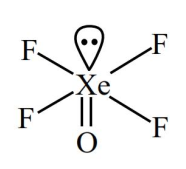
A molecule with the formula AX4Y has all it's elements from p-block. Element A is rarest, monoatomic, non-radioactive from its group and has the lowest ionization enthalpy value among A, X and Y. Elements X and Y have first and second highest electronegativity values respectively among all the known elements. The shape of the molecule is :
  • A
    Square pyramidal
  • B
    Octahedral
  • C
    Pentagonal planar
  • D
    Trigonal bipyramidal
View full question & answer
MCQ 24 Marks
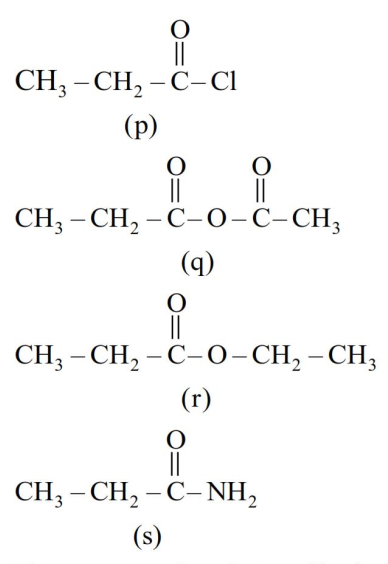
Consider the following molecules :
Image
The correct order of rate of hydrolysis is :
  • A
    r > q > p > s
  • B
    q > p > r > s
  • C
    p > r > q > s
  • p > q > r > s
Answer
Correct option: D.
p > q > r > s
(D) p > q > r > s
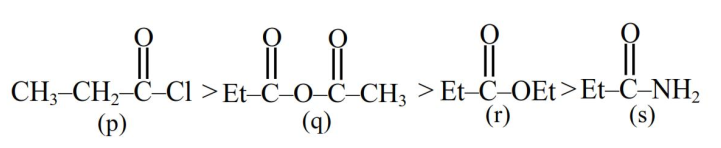
Explanation: Rate of hydrolysis $\propto$ Leaving group ability
Image
View full question & answer
MCQ 34 Marks
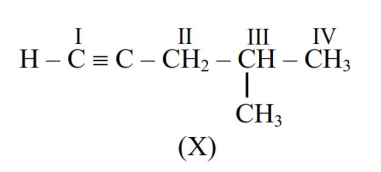
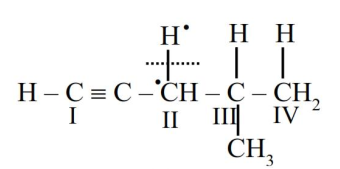
Consider the following compound (X)
Image
The most stable and least stable carbon radicals, respectively, produced by homolytic cleavage of corresponding C - H bond are :
  • A
    II, IV
  • B
    III, II
  • C
    I, IV
  • II, I
Answer
Correct option: D.
II, I
(D) II, I
Explanation:
Image
II most stable carbon radical due to resonance stablise
I least stable carbon radical due to no stabilising factor.
View full question & answer
MCQ 44 Marks
On complete combustion 1.0 g of an organic compound (X) gave 1.46 g of $CO _2$ and 0.567 g of $H _2 O$. The empirical formula mass of compound ( X ) is __________ g.
(Given molar mass in $g mol ^{-1} C : 12, H : 1, O : 16$ )
  • 30
  • B
    45
  • C
    60
  • D
    15
Answer
Correct option: A.
30
(A) 30
Explanation: Moles of ' C ' $= n _{ CO _2}=\frac{1.46}{44}=0.033$
Moles of ' C ' $= W _{ C }=0.033 \times 12$
Moles of 'H' $=2 \times n _{ H _2 O }=2 \times \frac{0.567}{18}=0.063$
Mass of 'H' $=0.0063$
Mass of Oxygen $( O )=1-\left( W _{ C }+ W _{ H }\right)$
$=1-(0.033 \times 12+0.063 \times 1)=0.541 gm$
Moles of ' O ' $=\frac{0.541}{16}=0.033$
Empirical formula $= CH _2 O$
Empirical formula mass $=30$.
View full question & answer
MCQ 54 Marks
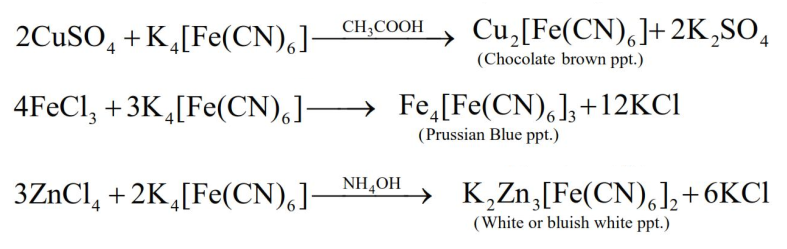
Choose the correct tests with respective observations.
(A) $CuSO _4$ (acidified with acetic acid) + $K _4\left[ Fe ( CN )_6\right] \rightarrow$ Chocolate brown precipitate.
(B) $FeCl _3+ K _4\left[ Fe ( CN )_6\right] \rightarrow$ Prussian blue precipitate.
(C) $ZnCl _2+ K _4\left[ Fe ( CN )_6\right]$, neutralised with $NH _4 OH$ $\rightarrow$ White or bluish white precipitate.
(D) $MgCl _2+ K _4\left[ Fe ( CN )_6\right] \rightarrow$ Blue precipitate.
(E) $BaCl _2+ K _4\left[ Fe ( CN )_6\right]$, neutralised with NaOH $\rightarrow$ White precipitate.
Choose the correct answer from the options given below:
  • A
    A, D and E only
  • B
    B, D and E only
  • A, B and C only
  • D
    C, D and E only
Answer
Correct option: C.
A, B and C only
(C) A, B and C only
Explanation:
Image
View full question & answer
MCQ 64 Marks
Given below are two statements :
Statement (I): In octahedral complexes, when $\Delta_{ o }$ < P high spin complexes are formed. When $\Delta_{ o }$ > P low spin complexes are formed.
Statement (II): In tetrahedral complexes because of $\Delta_{ t }$ <P, low spin complexes are rarely formed. In the light of the above statements, choose the most appropriate answer from the options given below:
  • A
    Statement I is correct but Statement II is incorrect
  • B
    Both Statement I and Statement II are incorrect
  • C
    Statement I is incorrect but Statement II is correct
  • Both Statement I and Statement II are correct
Answer
Correct option: D.
Both Statement I and Statement II are correct
(D) Both Statement I and Statement II are correct
Explanation: In octahedral complex (CN = 6)
If $\Delta_0$ <P.E., then high spin complexes are formed
If $\Delta_0$ > P.E., then low spin complexes are formed
But in tetrahedral complex (CN = 4)
$\Delta_t$ < P.E., then mainly high spin complexes are formed and rarely low spin complexes are formed.
View full question & answer
MCQ 74 Marks
Given below are two statements :
Statement (I): The metallic radius of Al is less than that of Ga.
Statement (II) : The ionic radius of $Al ^{3+}$ is less than that of $Ga ^{3+}$.
In the light of the above statements, choose the most appropriate answer from the options given below :
  • A
    Both Statement I and Statement II are incorrect
  • Statement I is incorrect but Statement II is correct
  • C
    Statement I is correct but Statement II is incorrect
  • D
    Both Statement I and Statement II are correct
Answer
Correct option: B.
Statement I is incorrect but Statement II is correct
(B) Statement I is incorrect but Statement II is correct
Explanation: ⇒ The metallic radius order of Al & Ga is
$B <\underbrace{ Ga < Al }_{\downarrow}< In < T \ell$
(due to poor shielding of d-subshell electrons)
$\Rightarrow$ The ionic radius order of $Al ^{+3} \& Ga ^{+3}$ is
$B ^{+3}< Al ^{+3}< Ga ^{+3}< In ^{+3}< T \ell^{+3}$
View full question & answer
MCQ 84 Marks
The correct order of basic nature on aqueous solution for the bases $NH _3, H _2 N- NH _2, CH _3 CH _2 NH _2$, $\left( CH _3 CH _2\right)_2 NH$ and $\left( CH _3 CH _2\right)_3 N$ is :
  • A
    $NH _3< H _2 N- NH _2<\left( CH _3 CH _2\right)_3 N< CH _3 CH _2 NH _2<$ $\left( CH _3 CH _2\right)_2 NH$
  • B
    $NH _3< H _2 N- NH _2< CH _3 CH _2 NH _2<\left( CH _3 CH _2\right)_2 NH <$ $\left( CH _3 CH _2\right)_3 N$
  • C
    $H _2 N- NH _2< NH _3<\left( CH _3 CH _2\right)_3 N< CH _3 CH _2 NH _2<$ $\left( CH _3 CH _2\right)_2 NH$
  • $NH _2- NH _2< NH _3< CH _3 CH _2 NH _2<\left( CH _3 CH _2\right)_3 N<$ $\left( CH _3 CH _2\right)_2 NH$
Answer
Correct option: D.
$NH _2- NH _2< NH _3< CH _3 CH _2 NH _2<\left( CH _3 CH _2\right)_3 N<$ $\left( CH _3 CH _2\right)_2 NH$
(D) $NH _2- NH _2< NH _3< CH _3 CH _2 NH _2<\left( CH _3 CH _2\right)_3 N<$ $\left( CH _3 CH _2\right)_2 NH$
Explanation: Basic strength of amine depends on hydrogen bonding and electronic inductive effect.
$NH ( Et )_2> N ( Et )_3> NH _2 Et >\ddot{ N }_3> NH _2- NH _2$
View full question & answer
MCQ 94 Marks
Identify the correct statement among the following:
  • A
    All naturally occurring amino acids except glycine contain one chiral centre.
  • B
    All naturally occurring amino acids are optically active.
  • C
    Glutamic acid is the only amino acid that contains a -COOH group at the side chain.
  • Amino acid, cysteine easily undergo dimerization due to the presence of free SH group.
Answer
Correct option: D.
Amino acid, cysteine easily undergo dimerization due to the presence of free SH group.
(D) Amino acid, cysteine easily undergo dimerization due to the presence of free SH group.
Explanation: * Isoleucine has 2 chiral centre
* Glycine is optically inactive
* Aspartic acid also contain COOH group at the side chain.
* Cysteine easily dimmerise due to free SH group
View full question & answer
MCQ 104 Marks
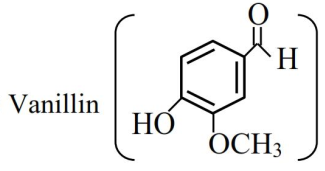
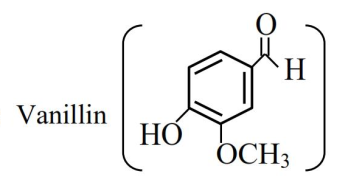
Given below are two statements:
Statement (I):

Image

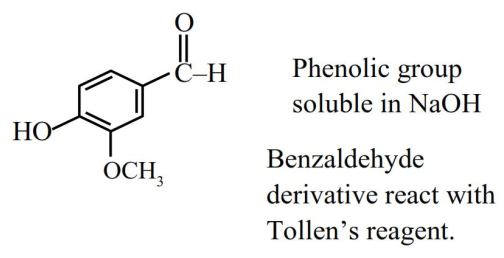
will react with NaOH and also with Tollen's reagent.
Statement (II):

Image

will undergo self aldol condensation very easily.
In the light of the above statements, choose the most appropriate answer from the options given below:
  • A
    Statement I is incorrect but Statement II is correct
  • Statement I is correct but Statement II is incorrect
  • C
    Both Statement I and Statement II are incorrect
  • D
    Both Statement I and Statement II are correct
Answer
Correct option: B.
Statement I is correct but Statement II is incorrect
(B) Statement I is correct but Statement II is incorrect
Explanation:
Image

Vanillin does not give self-aldol reaction due to lack of acidic H for condensation.
View full question & answer
MCQ 114 Marks
Among $SO _2, NF _3, NH _3, XeF _2, ClF _3$ and $SF _4$, the hybridization of the molecule with non-zero dipole moment and highest number of lone-pairs of electrons on the central atom is
  • A
    $sp ^3$
  • B
    $dsp ^2$
  • C
    $sp ^3 d^2$
  • $sp ^3 d$
Answer
Correct option: D.
$sp ^3 d$
(D) sp3d
Explanation:
MoleculeHybridisationDipole MomentLone pair on the central atom
$SO _2$sp2Non-zero1
$NF _3$sp3Non-zero1
$NH _3$sp3Non-zero1
$XeF _2$sp3dzero3
$C \ell F _3$sp3dNon-zero2
$SF _4$sp3dNon-zero1
View full question & answer
MCQ 124 Marks
If equal volumes of AB2 and XY (both are salts) aqueous solutions are mixed, which of the following combination will give a precipitate of AY2 at 300 K?
(Given Ksp (at 300 K) for AY2 = $5.2 \times 10^{-7}$)
  • A
    $3.6 \times 10^{-3} M AB _2, 5.0 \times 10^{-4} M XY$
  • B
    $2.0 \times 10^{-4} M AB _2, 0.8 \times 10^{-3} M XY$
  • $2.0 \times 10^{-2} M AB _2, 2.0 \times 10^{-2} M XY$
  • D
    $1.5 \times 10^{-4} M AB _2, 1.5 \times 10^{-3} M XY$
Answer
Correct option: C.
$2.0 \times 10^{-2} M AB _2, 2.0 \times 10^{-2} M XY$
(C) $2.0 \times 10^{-2} M AB _2, 2.0 \times 10^{-2} M XY$
Explanation: When equal volumes are mixed molarity reduce to half.
For precipitation $Q _{ SP }=\left[ A ^{+2}\right][ Y ]^2> K _{ SP }$
(1) $Q _{ SP }=\left(1.8 \times 10^{-3}\right)\left(\frac{5}{2} \times 10^{-4}\right)^2< K _{ SP }$
(2) $Q _{ SP }=\left(10^{-4}\right)\left(0.4 \times 10^{-3}\right)^2< K _{ sP }$
(3) $Q _{ SP }=\left(10^{-2}\right)\left(10^{-2}\right)^2> K _{ SP }$
(4) $Q _{ SP }=\left(\frac{1.5}{2} \times 10^{-4}\right)\left(\frac{1.5}{2} \times 10^{-3}\right)^2< K _{ SP }$
View full question & answer
MCQ 134 Marks
CaCO3(s) + 2HCl(aq) → CaCl2(aq) + CO2(g) H2O(l)
Consider the above reaction, what mass of CaCl2 will be formed if 250 mL of 0.76 M HCl reacts with 1000 g of CaCO3?
(Given: Molar mass of Ca, C, O, H and Cl are 40, 12, 16, 1 and 35.5 g mol-1, respectively)
  • A
    3.908 g
  • B
    2.636 g
  • 10.545 g
  • D
    5.272 g
Answer
Correct option: C.
10.545 g
(C) 10.545 g
Explanation:
$\begin{array}{l} CaCO _3+2 HCl \rightarrow CaCl _2+ CO _2+ H _2 O \\
\text { Moles of } CaCO _3=\frac{1000}{100}=10 \\
\text { Moles of } HCl =0.76 \times \frac{250}{1000}=0.19 \text { (L.R.) } \\
\text { Moles of } CaCl _2 \text { formed }=\frac{0.19}{2} \\
\text { Mass of } CaCl _2=\frac{0.19}{2} \times 111=10.545 gm \end{array}$
View full question & answer
MCQ 144 Marks
A solution is made by mixing one mole of volatile liquid A with 3 moles of volatile liquid B. The vapour pressure of pure A is 200 mm Hg and that of the solution is 500 mm Hg. The vapour pressure of pure B and the least volatile component of the solution, respectively, are:
  • A
    1400 mm Hg, A
  • B
    1400 mm Hg, B
  • C
    600 mm Hg, B
  • 600 mm Hg, A
Answer
Correct option: D.
600 mm Hg, A
(D) 600 mm Hg, A
Explanation: $P _{ S }= P _{ A }^{ o } \cdot X _{ A }+ P _{ B }^0 \cdot X _{ B }$
$500=200 \times \frac{1}{4}+ P _{ B }^{ o } \cdot \frac{3}{4}$
$P _{ B }^0=$ 600 mm Hg
As $P _{ A }^{ o }< P _{ B }^{ o } \Rightarrow A$ is least volatile.
View full question & answer
MCQ 154 Marks
Image
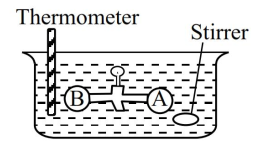
Two vessels A and B are connected via stopcock. The vessel A is filled with a gas at a certain pressure. The entire assembly is immersed in water and is allowed to come to thermal equilibrium with water. After opening the stopcock the gas from vessel A expands into vessel B and no change in temperature is observed in the thermometer. Which of the following statement is true?
  • A
    $d w \neq 0$
  • B
    $dq \neq 0$
  • C
    $dU \neq 0$
  • The pressure in the vessel B before opening the stopcock is zero.
Answer
Correct option: D.
The pressure in the vessel B before opening the stopcock is zero.
(D) The pressure in the vessel B before opening the stopcock is zero.
Explanation: It is free expansion of gas $\Rightarrow P_{\text {ext }}=0$
Where $w =0, q =0$ and $\Delta U =0$
View full question & answer
MCQ 164 Marks
According to Bohr's model of hydrogen atom, which of the following statement is incorrect?
  • A
    Radius of 3rd orbit is nine times larger than that of 1st orbit.
  • B
    Radius of 8th orbit is four times larger than that of 4th orbit.
  • Radius of 6th orbit is three time larger than that of 4th orbit.
  • D
    Radius of 4th orbit is four times larger than that of 2nd orbit.
Answer
Correct option: C.
Radius of 6th orbit is three time larger than that of 4th orbit.
(C) Radius of 6th orbit is three time larger than that of 4th orbit.
Explanation: $r \propto n ^2$
(1) $\frac{ r _3}{ r _1}=\frac{9}{1}$
(2) $\frac{ r _8}{ r _4}=\frac{64}{16}=4$
(3) $\frac{r_6}{r_4}=\left(\frac{6}{4}\right)^2=\frac{9}{4}$
(4) $\frac{r_4}{r_2}=\left(\frac{4}{2}\right)^2=4$
View full question & answer
MCQ 174 Marks
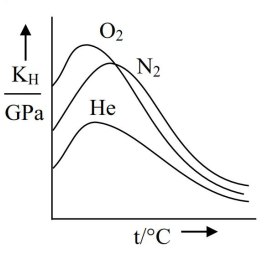
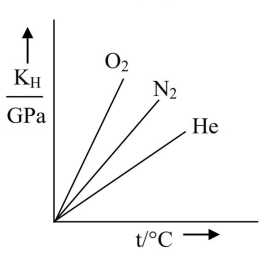
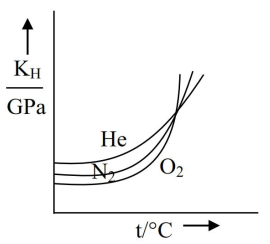
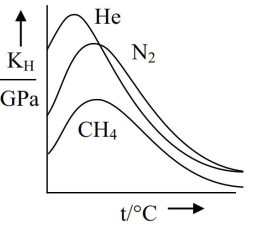
Which of the following graph correctly represents the plots of KH at 1 bar gases in water versus H temperature?
  • A
    Image
  • B
    Image
  • C
    Image
  • Image
Answer
Correct option: D.
Image
(D)
Image
Explanation: As temperature increases solubility first decrease then increase hence $K _{ H }$ first increase than decrease also at moderate temperature $K _{ H }$ value $He > N _2>$ $CH _4$.
View full question & answer
MCQ 184 Marks
The property/properties that show irregularity in first four elements of group-17 is/are:
(A) Covalent radius
(B) Electron affinity
(C) Ionic radius
(D) First ionization energy
Choose the correct answer from the options given below:
  • A
    B and D only
  • B
    A and C only
  • B only
  • D
    A, B, C and D
Answer
Correct option: C.
B only
(C) B only
Explanation: The order of first four elements of group-17 are as follows.
F < Cl < Br < I (Covalent radius)
Cl > F > Br > I (Electron affinity)
F- < Cl- < Br- < I- (Ionic radius)
F > Cl > Br > I (Ist ionization energy)
Electron affinity order is irregular.
View full question & answer
MCQ 194 Marks
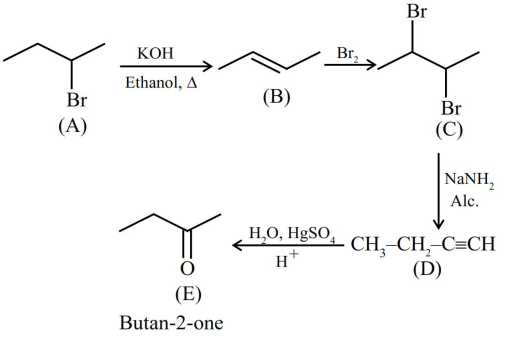
An optically active alkyl halide $C _4 H _9 Br [ A ]$ reacts with hot KOH dissolved in ethanol and forms alkene [B] as major product which reacts with bromine to give dibromide [C]. The compound [C] is converted into a gas [D] upon reacting with alcoholic $NaNH _2$. During hydration 18 gram of water is added to 1 mole of gas [D] on warming with mercuric sulphate and dilute acid at 333 K to form compound [E]. The IUPAC name of compound $[ E ]$ is :
  • A
    But-2-yne
  • B
    Butan-2-ol
  • Butan-2-one
  • D
    Butan-1-al
Answer
Correct option: C.
Butan-2-one
(C) Butan-2-one
Explanation:
Image
View full question & answer
MCQ 204 Marks
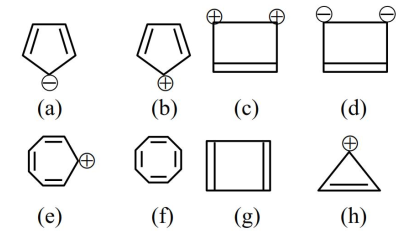
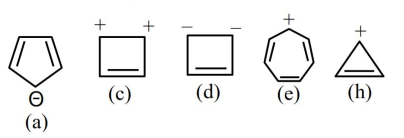
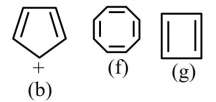
Designate whether each of the following compounds is aromatic or not aromatic.
Image
  • A
    e, g aromatic and a, b, c, d, f, h not aromatic
  • B
    b, e, f, g aromatic and a, c, d, h not aromatic
  • C
    a, b, c, d aromatic and e, f, g, h not aromatic
  • a, c, d, e, h aromatic and b, f, g not aromatic
Answer
Correct option: D.
a, c, d, e, h aromatic and b, f, g not aromatic
(D) a, c, d, e, h aromatic and b, f, g not aromatic
Explanation: Aromatic compounds
Image
a, c, d, e, h follow Huckel's rule
(Not Aromatic)
Image
b, f, g, are not aromatic, these compounds do not 
follow Huckel's rule.
View full question & answer