MCQ 14 Marks
Let the focal chord PQ of the parabola $y^2=4 x$ make an angle of $60^{\circ}$ with the positive x -axis, where P lies in the first quadrant. If the circle, whose one diameter is PS, S being the focus of the parabola, touches the $y$-axis at the point $(0, \alpha)$, then $5 \alpha^2$ is equal to :
Answer(A) 15
Explanation:
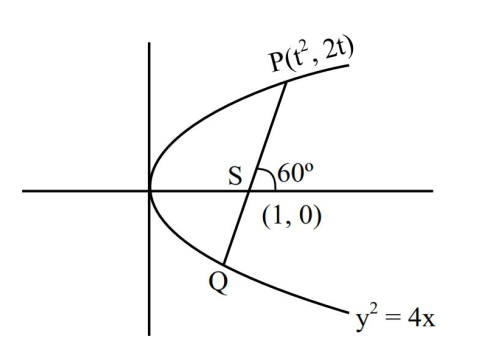
$\tan 60^{\circ}=\frac{2 t -0}{ t ^2-1}=\sqrt{3} \Rightarrow t =\sqrt{3}$
$\therefore P(3,2 \sqrt{3})$
Circle :
$\begin{array}{l}(x-1)(x-3)+(y-0)(y-2 \sqrt{3})=0 \\
\text { at } x=0 \\
\Rightarrow 3+y^2-2 \sqrt{3} y=0 \\
\Rightarrow y=\sqrt{3}=\alpha \\
5 \alpha^2=15\end{array}$ View full question & answer→MCQ 24 Marks
Let $a \in R$ and $A$ be a matrix of order $3 \times 3$ such that $\operatorname{det}(A)=-4$ and $A+I=\left[\begin{array}{lll}1 & a & 1 \\ 2 & 1 & 0 \\ a & 1 & 2\end{array}\right]$, where $I$ is the identity matrix of order $3 \times 3$.
If $\operatorname{det}((a+1) \operatorname{adj}((a-1) A))$ is $2^{ m } 3^{ n }, m , n \in$ $\{0,1,2, \ldots \ldots 20\}$, then $m + n$ is equal to :
Answer(D) 16
Explanation: $A=\left[\begin{array}{lll}1 & a & 1 \\ 2 & 1 & 0 \\ a & 1 & 2\end{array}\right]-I=\left[\begin{array}{lll}0 & a & 1 \\ 2 & 0 & 0 \\ a & 1 & 1\end{array}\right]$
$|A|=-4 \Rightarrow 2-2 a=-4 \Rightarrow a=3$
$|( a +1) \operatorname{adj}( a -1) A |=|4 \operatorname{adj} 3 A|$
$=4^3|\operatorname{adj} 3 A|$
$=4^3 \times|3 A|^{3-1}=64|3 A|^2$
$=64 \times\left(3^3\right)^2|A|^2$
$=2^6 \times 3^6 \times 16$
$2^m \times 3^{ n }=2^{10} \times 3^6$
$\therefore m =10, n =6$
$\Rightarrow m + n =16$
View full question & answer→MCQ 34 Marks
Let $A B C D$ be a tetrahedron such that the edges $AB , AC$ and AD are mutually perpendicular. Let the areas of the triangles $ABC , ACD$ and ADB be 5,6 and 7 square units respectively. Then the area (in square units) of the $\triangle BCD$ is equal to :
- A
$\sqrt{340}$
- ✓
- C
$\sqrt{110}$
- D
$7 \sqrt{3}$
Answer(B) $=\sqrt{110}$
Explanation: $\operatorname{Ar}(\triangle BCD )$
$=\sqrt{(\operatorname{Ar}(\triangle ABC ))^2+( Ar ( ACD ))^2+( Ar (\triangle ADB ))^2}$
$=\sqrt{5^2+6^2+7^2}$
$=\sqrt{110}$
View full question & answer→MCQ 44 Marks
Let the vertices $Q$ and $R$ of the triangle $P Q R$ lie on the line $\frac{x+3}{5}=\frac{y-1}{2}=\frac{z+4}{3}, Q R=5$ and the coordinates of the point P be $(0,2,3)$. If the area of the triangle PQR is $\frac{ m }{ n }$ then :
- A
$m -5 \sqrt{21} n =0$
- ✓
$2 m-5 \sqrt{21} n =0$
- C
$5 m-2 \sqrt{21} n =0$
- D
$5 m-21 \sqrt{2} n=0$
AnswerCorrect option: B. $2 m-5 \sqrt{21} n =0$
(B) $2 m-5 \sqrt{21} n =0$
Explanation:
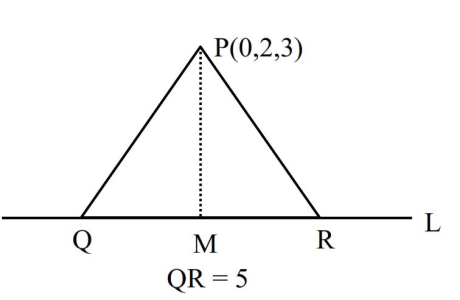
$M (5 \lambda-3,2 \lambda+1,3 \lambda-4)$
Drs of $PM \Rightarrow 5 \lambda-3,2 \lambda-1,3 \lambda-7$
Drs of line $L \Rightarrow 5,2,3$
PM $\perp L$
$\begin{array}{l}\Rightarrow(5 \lambda-3) 5+(2 \lambda-1) 2+(3 \lambda-7) 3=0 \\
\Rightarrow \lambda=1 \\
\therefore M(2,3,-1) \\
PM=\sqrt{4+1+16}=\sqrt{21} \\
\text { Area }=\frac{1}{2} \times 5 \times \sqrt{21}=\frac{m}{n} \\
2 m-5 \sqrt{21} n=0\end{array}$ View full question & answer→MCQ 54 Marks
If $S$ and $S^{\prime}$ are the foci of the ellipse $\frac{x^2}{18}+\frac{y^2}{9}=1$ and $P$ be a point on the ellipse, then $\min \left(S P . S^{\prime} P\right)+$ $\max \left( SP ^{\prime} . S ^{\prime} P \right)$ is equal to :
- A
$3(1+\sqrt{2})$
- B
$3(6+\sqrt{2})$
- C
- ✓
Answer(D) 27
Explanation:
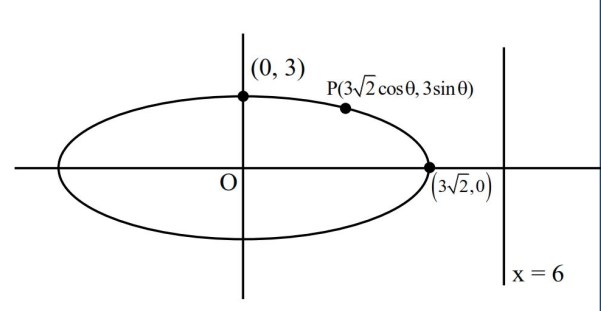
$PS + PS ^{\prime}=2 \times 3 \sqrt{2}$
$b ^2= a ^2\left(1- e ^2\right) \Rightarrow 9=18\left(1- e ^2\right)$
$\Rightarrow e =\frac{1}{\sqrt{2}}$
Directrix $x =\frac{ a }{ e }=\frac{3 \sqrt{2}}{\frac{1}{\sqrt{2}}}=6$
PS.PS' $=\left|\frac{1}{\sqrt{2}}(3 \sqrt{2} \cos \theta-6) \frac{1}{\sqrt{2}}(3 \sqrt{2} \cos \theta+6)\right|$
$=\frac{1}{2}\left|18 \cos ^2 \theta-36\right|$
$( PS \cdot PS )_{\max }=18 ;( PS \cdot PS )_{\min }=9$
sum $=27$ View full question & answer→MCQ 64 Marks
Let $P_n=\alpha^n+\beta^n, n \in N$. If $P_{10}=123, P_9=76$, $P_8=47$ and $P_1=1$, then the quadratic equation having roots $\frac{1}{\alpha}$ and $\frac{1}{\beta}$ is :
- A
$x^2-x+1=0$
- ✓
$x^2+x-1=0$
- C
$x^2-x-1=0$
- D
$x^2+x+1=0$
AnswerCorrect option: B. $x^2+x-1=0$
(B) $x^2+x-1=0$
Explanation: $\alpha^{10}+\beta^{10}=123$
$\alpha+\beta=1$
$\alpha^9+\beta^9=76$
$\alpha^8+\beta^8=47$
$P_{10}=P_9+P_8$
$x^2=x+1 \Rightarrow x^2-x-1=0$
$\alpha+\beta=1, \alpha \beta=-1$
$\frac{1}{\alpha}+\frac{1}{\beta}=\frac{\alpha+\beta}{\alpha \beta}=\frac{1}{-1}=-1, \frac{1}{\alpha \beta}=-1$
View full question & answer→MCQ 74 Marks
If the system of linear equations
$\begin{array}{l}3 x+y+\beta z=3 \\
2 x+\alpha y-z=-3 \\
x+2 y+z=4\end{array}$
has infinitely many solutions, then the value of $22 \beta-9 \alpha$ is :
Answer(B) 31
Explanation: $\Delta=\left|\begin{array}{ccc}3 & 1 & \beta \\ 2 & \alpha & -1 \\ 1 & 2 & 1\end{array}\right|=0$
$3 \alpha+4 \beta-\alpha \beta+3=0$
$\Delta_3=\left|\begin{array}{ccc}3 & 1 & 3 \\ 2 & \alpha & -3 \\ 1 & 2 & 4\end{array}\right|=0$
$9 \alpha+19=0$
$\alpha=\frac{-19}{9}, \beta=\frac{6}{11}$
$\Rightarrow 22 \beta-9 \alpha=31$
View full question & answer→MCQ 84 Marks
For $\alpha, \beta, \gamma, \in R$, if $\lim _{x \rightarrow 0} \frac{x^2 \sin \alpha x +(\gamma-1) e ^{ x ^2}}{\sin 2 x -\beta x }=3$, then $\beta+\gamma-\alpha$ is equal to:
Answer(A) 7
Explanation: $\lim _{x \rightarrow 10} \frac{x^2(\alpha x)+(\gamma-1)\left(1+\frac{x^2}{1}\right)}{2 x-\frac{8 x^3}{6}-\beta x}=3$
$\lim _{x \rightarrow 0} \frac{(\gamma-1)+(\gamma-1) x^2+\alpha x^3}{(2-\beta) x-\frac{4}{3} x^3}=3$
$\gamma-1, \beta=2, \frac{-3 \alpha}{4}=+3 \Rightarrow \alpha=-4$
$\beta+\gamma-\alpha=7$
View full question & answer→MCQ 94 Marks
Let A be the set of all functions $f: Z \rightarrow Z$ and R be a relation on A such that $R =\{( f , g ): f(0)= g (1)$ and $f(1)= g (0)\}$. Then R is:
- A
Symmetric and transitive but not reflective
- ✓
Symmetric but neither reflective nor transitive
- C
Reflexive but neither symmetric nor transitive
- D
Transitive but neither reflexive nor symmetric
AnswerCorrect option: B. Symmetric but neither reflective nor transitive
(B) Symmetric but neither reflective nor transitive
Explanation: $R =\{( f , g ): f (0)= g (1)$ and $f (1)= g (0)\}$
Reflexive: $( f , f ) \in R$
$=f(0)=f(1)$ and $f(1)=f(0) \rightarrow$ must hold
$\Rightarrow$ but this is not true for all function so not reflexive
Symmetric: If $( f , g ) \in R \Rightarrow( g , f ) \in R$
Now, $g(0)=f(1)$ and $g(1)=f(0) \rightarrow$ true
$\therefore$ symmetric
Transitive : $\operatorname{If}( f , g ) \in R$ and $( g , h ) \in R$
$\Rightarrow( f , h ) \in R$
$\operatorname{Now} (f, g) \in R \Rightarrow f(0)=g(1)$ and $f(1)=g(0)$
$(g, h) \in R \Rightarrow g(0)=h(1)$ and $g(1)=h(0)$
For $(f, h) \in R$ we need $f(0)=h(1)$ and $f(1)=h(0)$
Now $f(0)=g(1)=h(0)$ and $f(1)=g(0)=h(1)$
Hence not transitive
View full question & answer→MCQ 104 Marks
If $\vec{a}$ is nonzero vector such that its projections on the vectors $2 \hat{i}-\hat{j}+2 \hat{k}, \hat{i}+2 \hat{j}-2 \hat{k}$ and $\hat{k}$ are equal, then a unit vector along $\vec{a}$ is:
- A
$\frac{1}{\sqrt{155}}(-7 \hat{ i }+9 \hat{ j }+5 \hat{ k })$
- B
$\frac{1}{\sqrt{155}}(-7 \hat{ i }+9 \hat{ j }-5 \hat{ k })$
- ✓
$\frac{1}{\sqrt{155}}(7 \hat{ i }+9 \hat{ j }+5 \hat{ k })$
- D
$\frac{1}{\sqrt{155}}(7 \hat{ i }+9 \hat{ j }-5 \hat{ k })$
AnswerCorrect option: C. $\frac{1}{\sqrt{155}}(7 \hat{ i }+9 \hat{ j }+5 \hat{ k })$
(C) $\frac{1}{\sqrt{155}}(7 \hat{ i }+9 \hat{ j }+5 \hat{ k })$
Explanation: Let $\overline{ a }= a _1 \hat{ i }+ a _2 \hat{ j }+ a _3 \hat{ k }$
$a _1^2+ a _2^2+ a _3^2=1$
Let $\overline{ b }=2 \overrightarrow{ i }-\hat{ j }+2 \hat{ k }, \overline{ c }=\overrightarrow{ i }-2 \hat{ j }-2 \hat{ k }$
$\overline{ d }=\hat{ k }$
$\frac{\overline{ a } \cdot \overline{ b }}{| b |}=\frac{\overline{ a } \cdot \overline{ c }}{| c |}=\frac{\overline{ a } \cdot \overline{ d }}{| d |}$
$\frac{2 a _1- a _2+2 a _3}{3}=\frac{ a _1+2 a _2-2 a _3}{3}= a _3$
By solving
$a_1=\frac{7}{\sqrt{155}}, a_2=\frac{9}{\sqrt{155}}, a_3=\frac{5}{\sqrt{155}}$
View full question & answer→MCQ 114 Marks
Let $z$ be a complex number such that $|z|=1$. If $\frac{2+ k ^2 z }{ k +\overline{ z }}= kz , k \in R$, then the maximum distance of $k+i k^2$ from the circle $|z-(1+2 i)|=1$ is:
- ✓
$\sqrt{5}+1$
- B
- C
- D
$\sqrt{3}+1$
AnswerCorrect option: A. $\sqrt{5}+1$
(A) $\sqrt{5}+1$
Explanation: $\frac{2+ k ^2 z }{ k +\overline{ z }}= kz$
$\begin{array}{l}|z|^2 k=2 \\
k=2\end{array}$
point $p(2,4)$; center $(1,2)$
distance from circle
$(x-1)^2+(y-2)^2=1$ is max.
if $( OP + r )=\sqrt{1+4}+1=\sqrt{5}+1$
View full question & answer→MCQ 124 Marks
If the function $f(x)=2 x^3-9 a x^2+12 a^2 x+1$, where $a>0$, attains its local maximum and local minimum values at p and q , respectively, such that $p ^2= q$, then $f(3)$ is equal to:
Answer(D) 37
Explanation: $f^{\prime}(x)=6 x^2-18 a x+12 a^2$
$f(x)=6\left(x^2-3 a x+2 a^2\right)$
roots are $a , 2 a$
$p^2=q \Rightarrow a^2=2 a$
$\begin{array}{l}a=2 \\
f(x)=2 x^3-18 x^2+48 x+1\end{array}$
$f(3)=37$
View full question & answer→MCQ 134 Marks
Let $a_1, a_2, a_3 \ldots$ be in an A.P. such that $\sum_{k=1}^{12} a_{2 k-1}=-\frac{72}{5} a_1, a_1 \neq 0$. If $\sum_{k=1}^n a_k=0$, then $n$ is:
Answer(A) 11
Explanation: Let $a_1=a$, common difference $=d$
$a_1+a_3+a_5+\ldots \ldots+a_{23}=-\frac{72}{5} a$
$\frac{12}{2}[2 a+11 \times 2 d]=-\frac{72}{5} a$
$12 a +132 d=-\frac{72}{5} a$
$132 a+132 \times 5 d=0$
$a =-5 d$
$\frac{n}{2}(2 a+(n-1) d)=0 \Rightarrow-10 d+n d-d=0$
$n =11$
View full question & answer→MCQ 144 Marks
If $\theta \in[-2 \pi, 2 \pi]$, then the number of solutions of $2 \sqrt{2} \cos ^2 \theta+(2-\sqrt{6}) \cos \theta-\sqrt{3}=0$, is equal to:
Answer(C) 8
Explanation: $2 \sqrt{2} \cos ^2 \theta+2 \cos \theta-\sqrt{6} \cos \theta-\sqrt{3}=0$
$(2 \cos \theta-\sqrt{3})(\sqrt{2} \cos \theta+1)=0$
$\cos \theta=\frac{\sqrt{3}}{2}, \frac{-1}{\sqrt{2}}$
Number of solution $=8$
View full question & answer→MCQ 154 Marks
The term independent of $x$ in the expansion of
$\left(\frac{(x+1)}{\left(x^{2 / 3}+1-x^{1 / 3}\right)}-\frac{(x+1)}{\left(x-x^{1 / 2}\right)}\right)^{10}, x>1$ is:
Answer(A) 210
Explanation: $\left(\frac{(x+1)}{\left(x^{\frac{2}{3}}+1-x^{\frac{1}{3}}\right)}-\frac{(x-1)}{\left(x-x^{\frac{1}{2}}\right)}\right)^{10}$
$=\left(\left(x^{\frac{1}{3}}+1\right)-\left(\frac{\sqrt{x}+1}{\sqrt{x}}\right)\right)^{10}$
$=\left(x^{\frac{1}{3}}-\frac{1}{\sqrt{x}}\right)^{10}$
$T _{ r +1}={ }^{10} C _{ r }( x )^{\frac{10- r }{3}}(-1)^{ r }( x )^{-\frac{ r }{2}}$
$\frac{10-r}{3}-\frac{r}{2}=0$
$\begin{array}{c}(20-2 r)-3 r=0 \\
r=4\end{array}$
$\Rightarrow{ }^{10} C _4(-1)^4=210$
View full question & answer→MCQ 164 Marks
Let $A=\left[\begin{array}{cc}\alpha & -1 \\ 6 & \beta\end{array}\right], \alpha>0$, such that $\operatorname{det}(A)=0$ and $\alpha+\beta=1$. If I denotes $2 \times 2$ identity matrix, then the matrix $(1+ A )^8$ is:
- A
$\left[\begin{array}{ll}4 & -1 \\ 6 & -1\end{array}\right]$
- B
$\left[\begin{array}{cc}257 & -64 \\ 514 & -127\end{array}\right]$
- C
$\left[\begin{array}{cc}1025 & -511 \\ 2024 & -1024\end{array}\right]$
- ✓
$\left[\begin{array}{cc}766 & -255 \\ 1530 & -509\end{array}\right]$
AnswerCorrect option: D. $\left[\begin{array}{cc}766 & -255 \\ 1530 & -509\end{array}\right]$
(D) $\left[\begin{array}{cc}766 & -255 \\ 1530 & -509\end{array}\right]$
Explanation:
$\begin{array}{l}|A|=0 \\
\alpha \beta+6=0 \\
\alpha \beta=-6 \\
\alpha+\beta=1\end{array}$
$\Rightarrow \alpha=3, \beta=-2$
$A=\left[\begin{array}{ll}3 & -1 \\ 6 & -2\end{array}\right]$
$A^2=\left[\begin{array}{ll}3 & -1 \\ 6 & -2\end{array}\right]\left[\begin{array}{ll}3 & -1 \\ 6 & -2\end{array}\right]=\left[\begin{array}{ll}3 & -1 \\ 6 & -2\end{array}\right]$
$\begin{array}{l}\therefore A ^2= A
\\ A = A ^2= A ^3= A ^4= A ^5\end{array}$
$( I + A )^8$
$= I +{ }^8 C _1 A^7+{ }^8 C _2 A^6+\ldots . .+{ }^8 C _8 A^8$
$= I + A \left({ }^8 C _1+{ }^8 C _2+\ldots . .+{ }^8 C _8\right)$
$= I + A \left(2^8-1\right)$
$=\left[\begin{array}{ll}1 & 0 \\ 0 & 1\end{array}\right]+\left[\begin{array}{cc}765 & -255 \\ 1530 & -510\end{array}\right]$
$=\left[\begin{array}{cc}766 & -255 \\ 1530 & -509\end{array}\right]$
View full question & answer→MCQ 174 Marks
Let $f: R \rightarrow R$ be a twice differentiable function such that $(\sin x \cos y)(f(2 x+2 y)-f(2 x-2 y))=(\cos x$ $\sin y )(f(2 x +2 y )+f(2 x -2 y ))$, for all $x , y \in R$.
If $f^{\prime}(0)=\frac{1}{2}$, then the value of $24 f^{\prime \prime}\left(\frac{5 \pi}{3}\right)$ is:
Answer(B) -3
Explanation: $(\sin x \cos y)(f(2 x+2 y)-f(2 x-2 y))=(\cos x \sin y)$
$(f(2 x+2 y)+f(2 x-2 y))$
$f(2 x+2 y)(\sin (x-y))=f(2 x-2 y) \sin (x+y)$
$\frac{f(2 x+2 y)}{\sin (x+y)}=\frac{f(2 x-2 y)}{\sin (x-y)}$
Put $2 x+2 y=m, 2 x-2 y=n$
$\frac{f(m)}{\sin \left(\frac{m}{2}\right)}=\frac{f(n)}{\sin \left(\frac{n}{2}\right)}=K$
$\Rightarrow f(m)=K \sin \left(\frac{m}{2}\right)$
$\therefore f(x)=K \sin \left(\frac{x}{2}\right)$
Put $x=0 ; \frac{1}{2}=\frac{K}{2} \Rightarrow K=1$
$f^{\prime}(x)=\frac{1}{2} \cos \frac{x}{2}$
$f^{\prime \prime}(x)=-\frac{1}{4} \sin \frac{x}{2}$
$4 f ^{\prime \prime}\left(\frac{5 \pi}{3}\right)=\left(-\frac{1}{4} \sin \left(\frac{5 \pi}{6}\right)\right) 24$
$=\frac{-24}{8}=-3$
View full question & answer→MCQ 184 Marks
The number of sequences of ten terms, whose terms are either 0 or 1 or 2, that contain exactly five 1s and exactly three 2s, is equal to
Answer(C) 11111 222 00
Explanation: No. of sequences $=\frac{10!}{5!3!2!}=2520$
Note: Sequence can start with 0.
View full question & answer→MCQ 194 Marks
Let one focus of the hyperbola $H: \frac{x^2}{a^2}-\frac{y^2}{b^2}=1$ be at $(\sqrt{10}, 0)$ and the corresponding directrix be $x =\frac{9}{\sqrt{10}}$. If e and $l$ respectively are the eccentricity and the length of the latus rectum of H , then $9\left( e ^2+l\right)$ is equal to:
Answer(C) 16
Explanation: $ae =\sqrt{10}$ and $\frac{ a }{ e }=\frac{9}{10}$
$\Rightarrow a ^2=9$ and $e =\frac{\sqrt{10}}{3}$
Now $\quad(a e )^2= a ^2+ b ^2$
$10=9+b^2 \Rightarrow b^2=1$
$\ell=\frac{2 b^2}{ a }=\frac{2(1)}{3}$
$\Rightarrow \quad 9\left( e ^2+\ell\right)$
$=9\left(\frac{10}{9}+\frac{2}{3}\right)$
$\begin{array}{l}=10+6 \\
=16\end{array}$
View full question & answer→MCQ 204 Marks
The largest $n \in N$ such that $3^n$ divides 50 ! is:
Answer(B) 22
Explanation: $2^\alpha \cdot 3^\beta \cdot 5^\gamma$
$\begin{array}{l}B=\left[\frac{50}{3}\right]+\left[\frac{50}{3^2}\right]+\left[\frac{50}{3^3}\right]+\left[\frac{50}{3^4}\right] \\
=16+5+1 \\
=2\end{array}$
Maximum value of n is 22
View full question & answer→