Questions

SECTION - B [MATHS - NUMERIC]

Take a timed test

5 questions · self-marked practice — reveal the answer and mark yourself.

Question 14 Marks
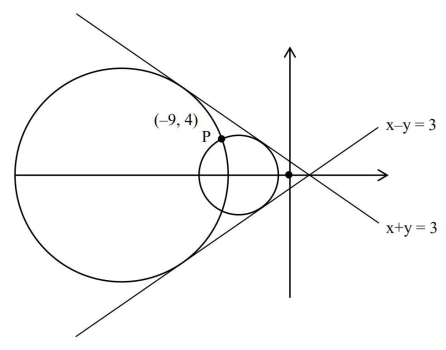
The absolute difference between the squares of the radii of the two circles passing through the point $(-9,4)$ and touching the lines $x+y=3$ and $x-y=3$, is equal to __________.
Answer
(768)
Explanation:
Image
Centre (a, 0)
$r=\left|\frac{a-0-3}{\sqrt{2}}\right|$
$\operatorname{circle}(x-a)^2+y^2=\left(\frac{a-3}{\sqrt{2}}\right)^2$
$\begin{array}{l}\text { passes through }(-9,4) \\
2\left( a ^2+18 a +81+16\right)=\left( a ^2-6 a +9\right) \\
a ^2+42 a +185=0 \\
( a +37)( a +5)=0 \\
\Rightarrow a =-37,-5 \\
r _1=\left|\frac{-37-3}{\sqrt{2}}\right|=20 \sqrt{2} \\
r _2=\left|\frac{-5-3}{\sqrt{2}}\right|=4 \sqrt{2} \\
\left| r _1^2- r _2^2\right|=|800-32|=768\end{array}$
View full question & answer
Question 24 Marks
Three distinct numbers are selected randomly from the set $\{1,2,3, \ldots \ldots, 40\}$. If the probability, that the selected numbers are in an increasing G.P. is $\frac{ m }{ n }$, $\operatorname{gcd}( m , n )=1$, then $m + n$ is equal to __________.
Answer
(4949)
Explanation: $1 \leq a < ar < ar ^2 \leq 40$
$($ If $r \in N)$
If r=2
$1 \leq a<2 a<4 a \leq 40$
$a \in\{1, \ldots \ldots, 10\} \quad(10 GP )$
If r=3
$1 \leq a<3 a<9 a \leq 40$
$a \in\{1,2,3,4\} \quad(4 GP )$
If r=4
$1 \leq a<4 a<16 a \leq 40$
$a \in\{1,2\} \quad(2 GP )$
If r=5
$1 \leq a<5 a<25 a \leq 40$
$a \in\{1\} \quad(1 GP )$
If r=6
$1 \leq a<6 a<36 a \leq 40$
$a \in\{1\} \quad(1 GP)$
$\left( P =\frac{18}{9880}=\frac{9}{4940}\right)$ as per NTA for $r \in N$
$m + n =4949$
If $r \notin N$ (also possible)
$r=\frac{3}{2}$
$ar ^2=\frac{9 a }{4} ; a =4 k$
$\left.\begin{array}{l}(4,6,9) \\ (8,12,18) \\ (12,18,27) \\ (16,24,36)\end{array}\right\} 4 GP$
$r =\frac{5}{2} \quad ar ^2=\frac{25 a }{4} ; a =4 k$
$(4,10,25)$........(1) GP
$r =\frac{4}{3} \quad ar ^2=\frac{16 a }{9} \rightarrow a =9 k$
$(9,12,16),(18,24,32) \ldots \ldots . .(2)$ GP
$r =\frac{5}{3} \quad ar ^2=\frac{25 a }{9} ; a =9 k$
$(9,15,25) \ldots . . . . .(1)$ GP
$r =\frac{5}{4} \quad ar ^2=\frac{25 a }{16} ; a =16 k$
$(16,20,25) \ldots . . . . . . . .(1) GP$
$r =\frac{6}{5} \quad ar ^2=\frac{36 a }{25} ; a =25 k$
$(25,30,36)$.............(1) GP
Total $=18+10=28$
$P =\frac{28}{{ }^{40} C _3}=\frac{28}{9880}=\frac{7}{2470}$
$m + n =2477$
View full question & answer
Question 34 Marks
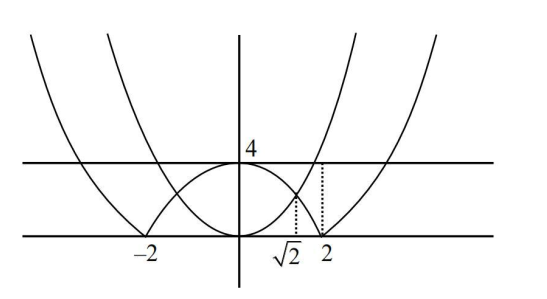
If the area of the region
$\left\{(x, y):\left|4-x^2\right| \leq y \leq x^2, y \leq 4, x \geq 0\right\}$is $\left(\frac{80 \sqrt{2}}{\alpha}-\beta\right), \alpha, \beta \in N$, then $\alpha+\beta$ is equal to __________.
Answer
(22)
Explanation:
Image

$A =\int_0^4 \sqrt{4+ y } d d-\int_0^2 \sqrt{4- y } dy -\int_2^4 \sqrt{ y } d y$
$=\left(\frac{(4+y)^{\frac{3}{2}}}{\frac{3}{2}}\right)_0^4+\left(\frac{(4-y)^{\frac{3}{2}}}{\frac{3}{2}}\right)_0^2-\left(\frac{y^{\frac{3}{2}}}{\frac{3}{2}}\right)_0^4$
$\frac{80 \sqrt{2}}{3}-16=\frac{40 \sqrt{2}}{3}-16$
$\alpha=6, \beta=16$
$\alpha+\beta=22$
View full question & answer
Question 44 Marks
Let $f: R \rightarrow R$ be a thrice differentiable odd function satisfying $f^{\prime}( x ) \geq 0, f^{\prime}( x )=f( x ), f(0)=0, f^{\prime}(0)=3$. Then $9 f\left(\log _{ c } 3\right)$ is equal to __________.
Answer
(36)
Explanation: $f^{\prime \prime}(x)=f(x)$
$\Rightarrow f ^{\prime}( x ) \cdot f ^{\prime \prime}( x )= f ^{\prime}( x ) \cdot f ( x )$
$\Rightarrow \frac{\left( f ^{\prime}( x )\right)^2}{2}=\frac{( f ( x ))^2}{2}+ C$
$\Rightarrow\left( f ^{\prime}( x )\right)^2=( f ( x ))^2+ C ^{\prime}$
$f(0)=0, f^{\prime}(0)=3 \quad \Rightarrow C^{\prime}=9$
$\therefore\left( f ^{\prime}( x )\right)^2=( f ( x ))^2+9$
$f ^{\prime}( x )=\sqrt{( f ( x ))^2+9} \quad \because f ^{\prime}( x ) \geq 0$
$\int \frac{ dy }{\sqrt{ y ^2+9}}=\int dx \Rightarrow \ln \left| y +\sqrt{ y ^2+9}\right|= x + C$
$\Rightarrow f (0)=0 \Rightarrow C =\ln 3$
$\Rightarrow y +\sqrt{ y ^2+9}=3 e ^{ x }$
$\begin{array}{l}\text { at } x=\ln 3 ; y=4 \\
\therefore 9 f(\ln 3)=36\end{array}$
View full question & answer
Question 54 Marks
Let [•] denote the greatest integer function. If $\int_0^{ e ^3}\left[\frac{1}{ e ^{ x -1}}\right] dx =\alpha-\log _{ e } 2$, then $\alpha^3$ is equal to __________.
Answer
(8)
Explanation: $f(x)=\frac{1}{e^{x-1}}=e^{1-x}$
$f(x)=2$ / $f(x)=1$
$\frac{1}{ e ^{ x -1}}=2$ / $x=1$
$x=1-\ln 2$
$f(0)=e^1=2.71$
$f\left(e^3\right)=e^{1-e^3} \in(0,1)$
$I =\int_0^{1-\ell n 2} 2 dx +\int_{1-\ell n 2}^1 1 dx +\int_1^{ e ^3} 0 dx$
$=2(1-\ell n 2-0)+1(1-1+\ell n 2)+0$
$\alpha-\ell n 2=2-\ell n 2$
$\alpha=2$
$\alpha^3=8$
View full question & answer