Questions

SECTION - B [PHYSICS - NUMERIC]

Take a timed test

5 questions · self-marked practice — reveal the answer and mark yourself.

Question 14 Marks
A person travelling on a straight line moves with a uniform velocity $v _1$ for a distance x and with a uniform velocity $v _2$ for the next $\frac{3}{2} x$ distance. The average velocity in this motion is $\frac{50}{7} m / s$. If $v _1$ is $5 m / s$ then $v _2=$ __________ $m / s$.
Answer
(10)
Explanation: $v_{\text {avg }}=\frac{x_1+x_2}{t_1+t_2}$
$\Rightarrow \frac{50}{7}=\frac{x+\frac{3 x}{2}}{\frac{x}{5}+\frac{3 x}{2 v_2}}$
$\Rightarrow \frac{50}{7}=\frac{5 / 2}{\frac{1}{5}+\frac{3}{2 v _2}}$
$\Rightarrow \frac{1}{5}+\frac{3}{2 v _2}=\frac{7}{20}$
$\Rightarrow \frac{3}{2 v _2}=\frac{7}{20}-\frac{1}{5}=\frac{7-4}{20}$
$\Rightarrow \frac{3}{2 v _2}=\frac{3}{20}$
$\Rightarrow v _2=10 m / s$
View full question & answer
Question 24 Marks
$\gamma_{ A }$ is the specific heat ratio of monoatomic gas A having 3 translational degrees of freedom. $\gamma_{ B }$ is the specific heat ratio of polyatomic gas $B$ having 3 translational, 3 rotational degrees of freedom and 1 vibrational mode. If $\frac{\gamma_{ A }}{\gamma_{ B }}=\left(1+\frac{1}{ n }\right)$, then the value of n is __________.
Answer
(3)
Explanation:
$\begin{array}{l}\frac{\gamma_A}{\gamma_B}=\frac{f_A+2}{f_A} \times \frac{f_B}{f_B+2} \\
=\frac{3+2}{3} \times \frac{(6+2)}{(6+2)+2} \\
=\frac{5}{3} \times \frac{8}{10}=\frac{40}{30} \\
\because \frac{40}{30}=1+\frac{1}{n} \\
\Rightarrow \frac{40}{30}-1=\frac{1}{n} \\
\Rightarrow n =3\end{array}$
View full question & answer
Question 34 Marks
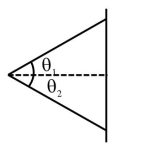
If the measured angular separation between the second minimum to the left of the central maximum and the third minimum to the right of the central maximum is $30^{\circ}$ in a single slit diffraction pattern recorded using 628 nm light, then the width of the slit is __________ $\mu m$.
Answer
(6)
Explanation:
Image
$\theta_1=\sin ^{-1}\left(\frac{2 \lambda}{a}\right)$
$\theta_2=\sin ^{-1}\left(\frac{3 \lambda}{a}\right)$
$\because \quad \theta_1+\theta_2=30^{\circ}$
$\Rightarrow \sin ^{-1}\left(\frac{2 \lambda}{ a }\right)+\sin ^{-1}\left(\frac{3 \lambda}{ a }\right)=\frac{\pi}{6}$
$\Rightarrow \frac{2 \lambda}{ a } \sqrt{1-\left(\frac{3 \lambda}{ a }\right)^2}+\frac{3 \lambda}{ a } \sqrt{1+\left(\frac{2 \lambda}{ a }\right)^2}=\sin \frac{\pi}{6}$
Here $\lambda=628 nm$
After solving$A=6.07 \mu m$
Approximate Method :
$\theta=\theta_1+\theta_2$
$\Rightarrow \frac{\pi}{6}=\frac{2 \lambda}{ a }+\frac{3 \lambda}{ a }$
$\Rightarrow \frac{\pi}{6}=\frac{5}{ a }(628 nm)$
$\Rightarrow a =6 \mu m$
View full question & answer
Question 44 Marks
A steel wire of length 2 m and Young's modulus $2.0 \times 10^{11} Nm ^{-2}$ is stretched by a force. If Poisson ratio and transverse strain for the wire are 0.2 and $10^{-3}$ respectively, then the elastic potential energy density of the wire is __________ $\times 10^5$ (in SI units)
Answer
(25)
Explanation: $\ell=2 m ; Y =2 \times 10^{11} \frac{N}{ m ^2}$
$\mu=-\frac{\left(\frac{\Delta r}{r}\right)}{\left(\frac{\Delta \ell}{\ell}\right)} \Rightarrow \frac{\Delta \ell}{\ell}=\frac{1}{\mu} \times\left(\frac{\Delta r}{r}\right)$
$=\frac{1}{0.2} \times\left(10^{-3}\right)$
$\Rightarrow \frac{\Delta \ell}{\ell}=5 \times 10^{-3}$
$u =\frac{1}{2} y \varepsilon_{\ell}^2=\frac{1}{2} \times 2 \times 10^{11} \times\left[5 \times 10^{-3}\right]^2$
=25
View full question & answer
Question 54 Marks
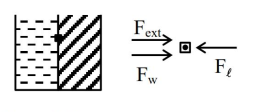
A vessel with square cross-section and height of 6 m is vertically partitioned. A small window of $100 cm^2$ with hinged door is fitted at a depth of 3 m in the partition wall. One part of the vessel is filled completely with water and the other side is filled with the liquid having density $1.5 \times 10^3 kg / m ^3$. What force one needs to apply on the hinged door so that it does not get opened ?
(Acceleration due to gravity $=10 m / s ^2$ )
Answer
(150)
Explanation:
Image
in equilibrium
$F _{ cxt }+ F _{ w }= F _{\ell}$
$\Rightarrow F _{ ext }= F _{\ell}- F _{ w }$
$=\left( P _0+\rho_l gh \right) A -\left( P _0+\rho_{ w } gh \right) A$
$=\left(\rho_{\ell}-\rho_w\right) \operatorname{ghA}$
$\begin{array}{l}=(1500-1000) \times 10 \times 3 \times\left(100 \times 10^{-4}\right) \\
=150 m\end{array}$
View full question & answer