MCQ 14 Marks
Let the foci of a hyperbola be $(1,14)$ and $(1,-12)$. If it passes through the point $(1,6)$, then the length of its latus-rectum is :
- A
$\frac{25}{6}$
- B
$\frac{24}{5}$
- ✓
$\frac{288}{5}$
- D
$\frac{144}{5}$
AnswerCorrect option: C. $\frac{288}{5}$
(C) $\frac{288}{5}$
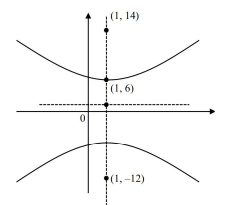
$\begin{array}{l} be =13, b=5 \\ a ^2= b ^2\left( e ^2-1\right) \\ = b ^2 e ^2- b ^2 \\ =169-25=144 \\ \ell(\text { LR })=\frac{2 a ^2}{b}=\frac{2 \times 144}{5}=\frac{288}{5}\end{array}$ View full question & answer→MCQ 24 Marks
Two balls are selected at random one by one without replacement from a bag containing 4 white and 6 black balls. If the probability that the first selected ball is black, given that the second selected ball is also black, is $\frac{ m }{ n }$, where $\operatorname{gcd}( m , n )=1$, then $m + n$ is equal to :
Answer(A) 14
$
\begin{array}{l}
Sol.P=\frac{\frac{6}{10} \times \frac{5}{9}}{\frac{4}{10} \times \frac{6}{9}+\frac{6}{10} \times \frac{5}{9}}=\frac{5}{9} \\
m=5, n=9 \\
m+n=14
\end{array}
$
View full question & answer→MCQ 34 Marks
The area of the region, inside the circle $(x-2 \sqrt{3})^2+y^2=12$ and outside the parabola $y^2=2 \sqrt{3} x$ is
- A
$6 \pi-8$
- B
$3 \pi-8$
- ✓
$6 \pi-16$
- D
$3 \pi+8$
AnswerCorrect option: C. $6 \pi-16$
(C) $6 \pi-16$
Sol :
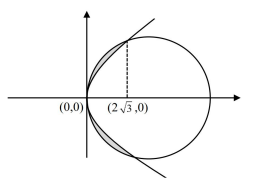
$\begin{array}{l} y ^2=2 \sqrt{3} x \\ ( x -2 \sqrt{3})^2+ y ^2=(2 \sqrt{3})^2 \\ A=\frac{\pi r ^2}{2}-2 \int_0^{2 \sqrt{3}} \sqrt{2 \sqrt{3} x } dx \\ \frac{\pi(12)}{2}-2 \sqrt{2 \sqrt{3}} \frac{\left( x ^{3 / 2}\right)_0^{2 / 3}}{3 / 2} \\ =6 \pi-16\end{array}$ View full question & answer→MCQ 44 Marks
Answer(A) 31
Sol. $A=\{1,2, \ldots .10\}$
$B \left\{\frac{ m }{ n }= m , n \in A , m < n , \operatorname{gcd}( m , n )=1\right\}$
n(B)
$n =2 \quad\left\{\frac{1}{2}\right\}$
$n =3 \quad\left\{\frac{1}{3}, \frac{2}{3}\right\}$
$n =4 \quad\left\{\frac{1}{4}, \frac{3}{4}\right\}$
$n =5 \quad\left\{\frac{1}{5}, \frac{2}{5}, \frac{3}{5}, \frac{4}{5}\right\}$
$n =6 \quad\left\{\frac{1}{6}, \frac{5}{6}\right\}$
$n =7 \quad\left\{\frac{1}{7}, \frac{2}{7}, \frac{3}{7}, \frac{4}{7}, \frac{5}{7}, \frac{6}{7}\right\}$
$n =8 \quad\left\{\frac{1}{8}, \frac{3}{8}, \frac{5}{8}, \frac{7}{8}\right\}$
$n =9 \quad\left\{\frac{1}{9}, \frac{2}{9}, \frac{4}{9}, \frac{5}{9}, \frac{7}{9}, \frac{8}{9}\right\}$
$n =10 \quad\left\{\frac{1}{10}, \frac{3}{10}, \frac{7}{10}, \frac{9}{10}\right\}$
$n(B)=31$
View full question & answer→MCQ 54 Marks
Let $f( x )$ be a real differentiable function such that
$f(0)=1$ and $f( x + y )=f( x ) f^{\prime}( y )+f^{\prime}( x ) f( y )$ for all
$x , y \in R$. Then $\sum_{ n =1}^{1 \infty 0} \log _{ e } f( n )$ is equal to :
Answer(B) 2525
$\begin{array}{l}Sol. f(x+y)=f(x) f(y)+f^{\prime}(x) f(x) \\ \text { Put }=x=y=0 \\ f(0)=f(0) f(0)+f^{\prime}(0) f(0) \\ f(0)=\frac{1}{2} \\ \text { Put } y=0 \\ f(x)=f(x) f(0)+f^{\prime}(x) f(0) \\ f(x)=\frac{1}{2} f(x)+f^{\prime}(x) \\ f^{\prime}(x)=\frac{f(x)}{2} \\ \frac{d y}{d x}=\frac{y}{2} \Rightarrow \int \frac{d y}{y}=\int \frac{d x}{2} \\ \Rightarrow \ell n y=\frac{x}{2}+c\end{array}$
$\begin{array}{l}\because f(0)=1 \Rightarrow C=0 \\ \text { $\ell$ny }=\frac{\pi}{2} \Rightarrow f(x)=e^{x / 2} \\ \text { $\ell$n } f(n)=\frac{n}{2} \\ \sum_{n=1}^{100} \ell f(n)=\frac{1}{2} \sum_{n=1}^{100} n=\frac{5050}{2} \\ =2525\end{array}$
View full question & answer→MCQ 64 Marks
Let for $f( x )=7 \tan ^3 x +7 \tan ^6 x -3 \tan ^4 x -3 \tan ^2 x$, $I_1=\int_0^{\pi / 4} f(x) dx$ and $I _2=\int_0^{\pi / 4} x f(x) d x$. Then $7 I _1+12 I _2$ is equal to:
Answer(C) 1
$
\begin{array}{l}Sol.
f(x)=(7 \tan x-3 \tan x)(\sec x) \\
I_1=\int_0^{\pi / 4}\left(7 \tan ^6 x-3 \tan ^2 x\right)\left(\sec ^2 x\right) d x\end{array}
$
Put $\tan x=t$
$
\begin{array}{l} I_1=\int_0^1\left(7 t^6-3 t^2\right) dt=\left[t^{\top}-t^3\right]_0^1=0 \\I_2=\int_0^{\pi / 4} x \underbrace{\left(7 \tan ^6 x-3 \tan ^2 x\right)\left(\sec ^2 x\right)}_0 dx \\
=\left[x\left(\tan ^7 x-\tan ^3 x\right)\right]_0^{\pi / 4}-\int_0^{\pi / 4}\left(\tan ^7 x-\tan ^3 x\right) dx \\
=0-\int_0^{\pi / 4} \tan ^3 x\left(\tan ^2 x-1\right)\left(1+\tan ^2 x\right) dx
\end{array}
$
Put $\tan x=t$
$
\begin{array}{l}
=-\int_0^1\left(t^5-t^3\right) d t=-\left[\frac{t^6}{6}-\frac{t^4}{4}\right]=\frac{1}{12} \\
7 I_1+12 I_2=1
\end{array}
$
View full question & answer→MCQ 74 Marks
A circle C of radius 2 lies in the second quadrant and touches both the coordinate axes. Let r be the radius of a circle that has centre at the point $(2,5)$ and intersects the circle C at exactly two points. If the set of all possible values of $r$ is the interval $(\alpha, \beta)$, then $3 \beta-2 \alpha$ is equal to :
Answer(A) 15
Sol :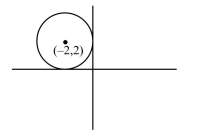
$
\begin{array}{l}
S_1:(x+2)^2+(y-2)^2=2^2 \\
S_2:(x-2)^2+(y-5)^2=r^2
\end{array}
$
Both circle intersect at two points
$
\begin{array}{l}
\therefore\left|r_1-r_2\right|<c_2 c_2<r_1+r_2 \\
|r-2|<5<2+r \\
\Rightarrow 3<r<7 \\
r \in(3,7) \\
\alpha=3, \beta=7 \\
3 \beta-2 \alpha=15
\end{array}
$ View full question & answer→MCQ 84 Marks
Let the parabola $y=x^2+p x-3$, meet the coordinate axes at the points $P , Q$ and R . If the circle C with centre at $(-1,-1)$ passes through the points $P, Q$ and $R$, then the area of $\triangle P Q R$ is :
Answer(B) 6
Sol. $y=x^2+p x-3$
Let $P (\alpha, 0), Q (\beta, 0), R (0,-3)$
Circle with centre $(-1,-1)$ is $(x+1)^2+(y+1)^2=r^2$
Passes through $(0,-3)$
$
\begin{array}{l}
\left.1^2+(-2)^2=r^2\right] \\
r^2=5
\end{array}
$
$
(x+1)^2+(y+1)^2=5
$
Put $y=0$
$
\begin{array}{l}
(x+1)^2=5-1 \\
(x+1)^2=4 \\
x+1= \pm 2 \\
x=1 \text { or } x=-3
\end{array}
$
$\therefore P (1,0)$ and $Q (-3,0)$
Area of $\triangle PQR =\frac{1}{2}\left|\begin{array}{ccc}1 & 0 & 1 \\ -3 & 0 & 1 \\ 0 & -3 & 1\end{array}\right|=6$
View full question & answer→MCQ 94 Marks
Let $x=x(y)$ be the solution of the differential equation $y^2 d x+\left(x-\frac{1}{y}\right) d y=0$. If $x(1)=1$, then $x\left(\frac{1}{2}\right)$ is :
- A
$\frac{1}{2}+ e$
- B
$\frac{1}{2}+ e$
- ✓
$3- e$
- D
$3+e$
AnswerCorrect option: C. $3- e$
(C) $3- e$
Sol.
$
\begin{array}{l}
\frac{d x}{d y}+\left(\frac{1}{y^2}\right) x=\frac{1}{y^3} \\
\text { I.F. }=e^{\int -\frac{1}{y^2} d y}=e^{-\frac{1}{y}} \\
\Rightarrow x \cdot e^{-\frac{1}{y}}=\int\left(e^{-\frac{1}{t}}\right) \cdot \frac{1}{y^3} d y \\
\text { Put }-\frac{1}{y}=t \\
+\frac{1}{y^2} d y=d t \\
x . e^{-\frac{1}{y}}=-\int t \cdot e^t d t \\
x . e^{-\frac{1}{y}}=-t e^t+e^t+C \\
x . e^{-\frac{1}{y}}=\frac{+1}{y} e^{-\frac{1}{y}}+e^{-\frac{1}{y}}+C \\
x=1, y=1
\end{array}$
$\begin{array}{l}\frac{1}{ e }=\frac{1}{ e }+\frac{1}{ e }+ C \\ \Rightarrow C =-\frac{1}{ e } \\ \text { Put } y =\frac{1}{2} \\ \frac{ x }{ e ^2}=\frac{2}{ e ^2}+\frac{1}{ e ^2}-\frac{1}{ e } \\ x =3- e \end{array}$
View full question & answer→MCQ 104 Marks
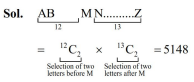
From all the English alphabets, five letters are chosen and are arranged in alphabetical order. The total number of ways, in which the middle letter is ' M ', is :
Answer(D) 5148
View full question & answer→MCQ 114 Marks
If $\sum_{r=1}^n T_r=\frac{(2 n-1)(2 n+1)(2 n+3)(2 n+5)}{64}$, then
$\lim _{n \rightarrow \infty} \sum_{r=1}^n\left(\frac{1}{T_r}\right)$ is equal to:
- A
- B
$0$
- ✓
$\frac{2}{3}$
- D
$\frac{1}{3}$
AnswerCorrect option: C. $\frac{2}{3}$
(C) $\frac{2}{3}$
$\begin{array}{l}Sol. T_n=S_n-S_{2-1} \\ \Rightarrow T_n=\frac{1}{8}(2 n-1)(2 n+1)(2 n+3) \\ \Rightarrow \frac{1}{T_n}=\frac{8}{(2 n-1)(2 n+1)(2 n+3)} \\ \lim _{n \rightarrow \infty} \sum_{r=1}^n \frac{1}{T_r}=\lim _{n \rightarrow \infty} 8 \sum_{r=1}^n \frac{1}{(2 n-1)(2 n+1)(2 n+3)} \\ =\lim _{n \rightarrow \infty} \frac{8}{4} \sum\left(\frac{1}{(2 n-1)(2 n+1)}-\frac{1}{(2 n+1)(2 n+3)}\right) \\ =\lim _{n \rightarrow \infty} 2\left[\left(\frac{1}{1.3}-\frac{1}{3.5}\right)+\left(\frac{1}{3.5}-\frac{1}{5.7}\right)+\ldots\right] \\ =\frac{2}{3}\end{array}$
View full question & answer→MCQ 124 Marks
The product of all solutions of the equation $e ^{5\left(\log _e x\right)^2+3}= x ^8, x >0$, is :
- ✓
$e^{8/5}$
- B
$e^{6 / 5}$
- C
$e^2$
- D
AnswerCorrect option: A. $e^{8/5}$
(A) $e ^{8 / 5}$
$
\begin{array}{l}
Sol.e^{5(\ell nx)^2+3}=x^8 \\
\Rightarrow \ell ne^{5(\ell nx)^2+3}=\ell nx^8 \\
\Rightarrow 5(\ell nx)^2+3=8 \ell nx \\
(\ell nx=t) \\
\Rightarrow 5 t^2-8 t+3=0 \\
t_1+t_2=\frac{8}{5} \\
\quad \ell nx_1 x_2=\frac{8}{5} \\
x_1 x_2=e^{85}
\end{array}
$
View full question & answer→MCQ 134 Marks
Let $L_1: \frac{x-1}{2}=\frac{y-2}{3}=\frac{z-3}{4}$ and
$L_2: \frac{x-2}{3}=\frac{y-4}{4}=\frac{z-5}{5}$ be two lines. Then which of the following points lies on the line of the shortest distance between $L _1$ and $L _2$ ?
- A
$\left(-\frac{5}{3},-7,1\right)$
- B
$\left(2,3, \frac{1}{3}\right)$
- C
$\left(\frac{8}{3},-1, \frac{1}{3}\right)$
- D
$\left(\frac{14}{3},-3, \frac{22}{3}\right)$
Answer(D) $\left(\frac{14}{3},-3, \frac{22}{3}\right)$
Sol :
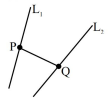
$P (2 \lambda+1,3 \lambda+2,4 \lambda+3)$ on $L _1$
$Q (3 \mu+2,4 \mu+4,5 \mu+5)$ on $L _2$
Dr's of $PQ =3 \mu-2 \lambda+1,4 \mu-3 \lambda+2,5 \mu-4 \lambda+2$
$
P Q \perp L_1
$$
\begin{array}{l}
\Rightarrow(3 \mu-2 \lambda+1) 2+(4 \mu-3 \lambda+2) 3+(5 \mu-4 \underline{\lambda}+ 2) 4=0 \\
38 \mu-29 \lambda+16=0 \qquad\ldots(1)\\
PQ \perp L_2 \\
\Rightarrow(3 \mu-2 \lambda+1) 3+(4 \mu-3 \lambda+2) 4+(5 \mu-4 \underline{\lambda}+ 2) 5=0 \\
50 \mu-38 \lambda+21=0 \qquad\ldots(2)\\
By(1) \&(2) \\
\lambda=\frac{1}{3} ; \mu=\frac{-1}{6} \\
\end{array}
$
$
\therefore P\left(\frac{5}{3}, 3, \frac{13}{3}\right) \& Q\left(\frac{3}{2}, \frac{10}{3}, \frac{25}{6}\right)
$
Line PQ
$
\frac{x-\frac{5}{3}}{\frac{1}{6}} \quad \frac{y-3}{\frac{-1}{3}} \quad \frac{z-\frac{13}{3}}{\frac{1}{6}}
$
$
\frac{x-\frac{5}{3}}{1}=\frac{y-3}{-2}=\frac{z-\frac{13}{3}}{1}
$
$
\text { Point }\left(\frac{14}{3},-3, \frac{22}{3}\right)
$
lies on the line PQ
View full question & answer→MCQ 144 Marks
Let $a_1, a_2, a_3, \ldots$. be a G.P. of increasing positive terms. If $a_1 a_5=28$ and $a_2+a_4=29$, the $a_6$ is equal to
Answer(C) 784
$\begin{array}{l}Sol. a_1 \cdot a_5=28 \Rightarrow a \cdot a r^4=28 \Rightarrow a^2 r^4=28 \qquad\ldots(1)\\a_2+a_4=29 \Rightarrow a r+a r^3=29 \\\Rightarrow \operatorname{ar}\left(1+r^2\right)=29 \\\Rightarrow a^2 r^2\left(1+r^2\right)^2=(29)^2\qquad\ldots(2)\end{array}$
By Eq. (1) & (2)
$\begin{array}{l}\frac{r^2}{\left(1+r^2\right)^2}=\frac{28}{29 \times 29} \\\Rightarrow \frac{r}{1+r^2}=\frac{\sqrt{28}}{29} \Rightarrow r=\sqrt{28} \\\because a^2 r^4=28 \Rightarrow a^2 \times(28)^2=28 \\\Rightarrow a=\frac{1}{\sqrt{28}} \\\therefore a_6=a^5=\frac{1}{\sqrt{28}} \times(28)^2 \sqrt{28}=784\end{array}$
View full question & answer→MCQ 154 Marks
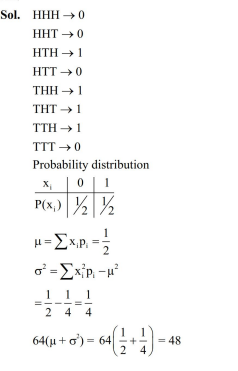
A coin is tossed three times. Let X denote the number of times a tail follows a head. If $\mu$ and $\sigma^2$ denote the mean and variance of $X$, then the value of $64\left(\mu+\sigma^2\right)$ is :
View full question & answer→MCQ 164 Marks
Using the principal values of the inverse trigonometric functions the sum of the maximum and the minimum values of $16\left(\left(\sec ^{-1} x\right)^2+\left(\operatorname{cosec}^{-1} x\right)^2\right)$ is :
- A
$24 \pi^2$
- B
$18 \pi^2$
- C
$31 \pi^2$
- ✓
$22 \pi^2$
AnswerCorrect option: D. $22 \pi^2$
(D) $22 \pi^2$
Sol. $\quad 16\left(\sec ^{-1} x\right)^2+\left(\operatorname{cosec}^{-1} x\right)^2$
$
\begin{array}{l}
\operatorname{Sec}^{-1} x=a \in[0, \pi]-\left\{\frac{\pi}{2}\right\} \\
\operatorname{cosec}^{-1} x=\frac{\pi}{2}-a \\
=16\left[a^2+\left(\frac{\pi}{2}-a\right)^2\right]=16\left[2 a^2-\pi a+\frac{\pi^2}{4}\right] \\
\max ]_{a=\pi}=16\left[2 \pi^2-\pi^2+\pi \frac{2}{4}\right]=20 \pi^2 \\
\min ]_{a=\frac{\pi}{4}}=16\left[\frac{2 \times \pi^2}{16}-\frac{\pi^2}{4}+\frac{\pi^2}{4}\right]=2 \pi^2 \\
\text { Sum }=22 \pi^2
\end{array}
$
View full question & answer→MCQ 174 Marks
Let $z_1, z_2$ and $z_3$ be three complex numbers on the circle $|z|=1$ with $\arg \left(z_1\right)=\frac{-\pi}{4}, \arg \left(z_2\right)=0$ and $\arg \left(z_3\right)=\frac{\pi}{4}$. If $\left|z_1 \bar{z}_2+z_2 \bar{z}_3+z_3 \bar{z}_1\right|^2=\alpha+\beta \sqrt{2}, \alpha, \beta \in Z$, then the value of $\alpha^2+\beta^2$ is :
Answer(C) 31
$
\begin{array}{l}
Sol. Z_1=e^{-i \pi /4}, Z_2=1, Z_3=e^{i \pi / 4} \\
\left|z_1 \bar{z}_2+z_2 \bar{z}_3+z_3 \bar{z}_1\right|^2=\left|e^{-i \frac{\pi}{4}} \times 1+1 \times e^{-i \frac{\pi}{4}}+e^{i \frac{\pi}{4}} \times e^{i \frac{\pi}{4}}\right|^2 \\
\left|e^{-i \frac{\pi}{4}}+e^{-i \frac{\pi}{4}}+e^{i \frac{\pi}{4}}\right|^2 \\
=\left|2 e^{-i \frac{\pi}{4}}+i\right|^2==|\sqrt{2}-\sqrt{2} i+i|^2 \\
=(\sqrt{2})^2+(1-\sqrt{2})^2=2+1+2-2 \sqrt{2}=5-2 \sqrt{2} \\
\alpha=5, \beta=-2 \\
\Rightarrow \alpha^2+\beta^2=29
\end{array}
$
View full question & answer→MCQ 184 Marks
Let the triangle $P Q R$ be the image of the triangle with vertices $(1,3),(3,1)$ and $(2,4)$ in the line $x+2 y-2$. If the centroid of $\triangle P Q R$ is the point $(\alpha, \beta)$, then $15(\alpha-\beta)$ is equal to :
Answer(D) 22
Sol. Let ' $G$ ' be the centroid of $\Delta$ formed by $(1,3)(3,1)$ & $(2,4)$
$
G \cong\left(2, \frac{8}{3}\right)
$
Image of G w.r.t. $x +2 y -2=0$
$
\begin{array}{l}
\frac{\alpha-2}{1}=\frac{\beta-\frac{8}{3}}{2}=-2 \frac{\left(2+\frac{16}{3}-2\right)}{1+4} \\
=\frac{-2}{5}\left(\frac{16}{3}\right) \\
\Rightarrow \alpha=\frac{-32}{15}+2=\frac{-2}{15}, \beta=\frac{-32 \times 2}{15}+\frac{8}{3}=\frac{-24}{15} \\
15(\alpha-\beta)=-2+24=22
\end{array}
$
View full question & answer→MCQ 194 Marks
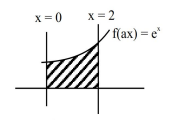
Let $f: R \rightarrow R$ be a twice differentiable function such that $f( x + y )=f( x ) f( y )$ for all $x , y \in R$. If $f^{\prime}(0)=4 a$ and $f$ staisfies $f^{\prime \prime}( x )-3 a f^{\prime}( x )-f( x )=0$, $a>0$, then the area of the region
$R =\{( x , y ) \mid 0 \leq y \leq f( ax ), 0 \leq x \leq 2\}$ is :
- A
$e^2-1$
- B
$e^4+1$
- C
$e^4-1$
- D
$e^2+1$
View full question & answer→MCQ 204 Marks
The number of non-empty equivalence relations on the set {1,2,3} is:
Answer(C) 5
Sol. Let R be the required relation
$
A=\{(1,1)(2,2),(3,3)\}
$
(i) $| R |=3$, when $R = A$
(ii) $| R |=5$, e.g. $R = A \cup\{(1,2),(2,1)\}$
Number of $R$ can be [3]
(iii) $R =\{1,2,3\} \times\{1,2,3\}$
Ans. (5)
View full question & answer→