Questions

SECTION - A [CHEMISTY - MCQ]

Take a timed test

20 questions · 17 auto-graded MCQ + 3 self-marked written.

MCQ 14 Marks
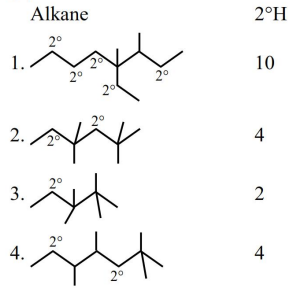
The alkane from below having two secondary hydrogens is :
  • A
    4-Ethyl-3,4-dimethyloctane
  • B
    2,2,4,4-Tetramethylhexane
  • 2,2,3,3-Tetramethylpentane
  • D
    2,2,4,5-Tetramethylheptane
Answer
Correct option: C.
2,2,3,3-Tetramethylpentane
(C) 2,2,3,3-Tetramethylpentane
Sol.
Image
View full question & answer
MCQ 24 Marks
Given below are two statements :
Statement (I) : Corrosion is an electrochemical phenomenon in which pure metal acts as an anode and impure metal as a cathode.
Statement (II) : The rate of corrosion is more in alkaline medium than in acidic medium.
In the light of the above statements, choose the correct answer from the options given below :
  • A
    Both Statement I and Statement II are false
  • B
    Statement I is false but Statement II is true
  • C
    Both Statement I and Statement II are true
  • Statement I is true but Statement II is false
Answer
Correct option: D.
Statement I is true but Statement II is false
(D) Statement I is true but Statement II is false
Sol. Statement I :
Corrosion is an example of electrochemical phenomenon
In which pure metal act as anode and impure metal (rusted metal) act as cathode.
Statement II :
Corrosion is more favourable in acid medium than alkaline so rate of corrosion is high is acid medium then alkaline.
View full question & answer
MCQ 34 Marks
Image
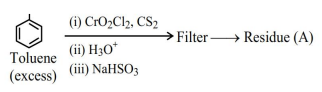
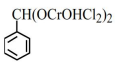
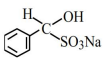
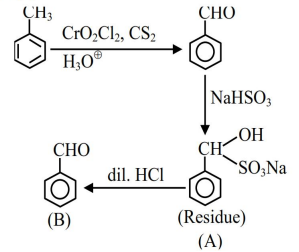
Residue (A) + HCl (dil.) $\rightarrow$ Compound (B)
Structure of residue (A) and compound (B)
Formed respectively is :
  • A
     [A][B]
    (1)ImageImage
  • B
     [A][B]
    (2)ImageImage
  • C
     [A][B]
    (3)ImageImage
  •  [A][B]
    (4)ImageImage
Answer
Correct option: D.
 [A][B]
(4)ImageImage
(D)
 [A][B]
(4)ImageImage

Sol.
Image
View full question & answer
MCQ 44 Marks
Identify the homoleptic complex(es) that is/are low spin.
(A) $\left[ Fe ( CN )_5 NO \right]^{2-}$
(B) $\left[ CoF _6\right]^{3-}$
(C) $\left[ Fe ( CN )_6\right]^{+}$
(D) $\left[ Co \left( NH _3\right)_6\right]^{3+}$
(E) $\left[ Cr \left( H _2 O \right)_6\right]^{2+}$
Choose the correct answer from the options given below :
  • A
    (B) and (E) only
  • B
    (A) and (C) only
  • (C) and (D) only
  • D
    (C) only
Answer
Correct option: C.
(C) and (D) only
(C) (C) and (D) only
Sol. (A) $\left[ Fe ( CN )_5 NO \right]^{-2} \rightarrow$ Heteroleptic, $Fe ^{+2}, 3 d^6$, $t _{2 g}{ }^6 e _{ g }{ }^0, d^2 sp ^3$, Low spin (3d series + SFL)
(B) $\left[ CoF _6\right]^{-3} \rightarrow$ Homoleptic, $sp ^3 d^2$, High spin, $Co ^{+3}, 3 d^6(3 d$ series + WFL $)$
(C) $\left[ Fe ( CN )_6\right]^{-4} \rightarrow$ Homoleptic
$Fe ^{+2}, 3 d^6, d^2 sp ^3, t _{2 g}{ }^6 eg ^0$ Low spin
(3d series + SFL)
(D) $\left[ Co \left( NH _3\right)_6\right]^{+3} \rightarrow$ Homoleptic, $Co ^{+3} 3 d^6, d^2 sp ^3$, $t _{2 g}{ }^6 eg ^{\circ}$, Low spin (3d series + SFL)
(E) $\left[ Cr \left( H _2 O \right)_6\right]^{+2} \rightarrow$ Homoleptic
$Cr ^{+2} 3 d^4, d^2 sp ^3$, High spin $t _{2 g}{ }^3 e _{ g }{ }^1$
(3d series + WFL)
View full question & answer
MCQ 54 Marks
Given below are two statement :
Statement (I) : Nitrogen, sulphur, halogen and phosphorus present in an organic compound are detected by Lassaigne's Test.
Statement (II) : The elements present in the compound are converted from covalent form into ionic form by fusing the compound with Magnesium in Lassaigne's test.
In the light of the above statements, choose the correct answer from the options given below :
  • A
    Both Statement I and Statement II are true
  • B
    Both Statement I and Statement II are false
  • Statement I is true but Statement II is false
  • D
    Statement I is false but Statement II is true
Answer
Correct option: C.
Statement I is true but Statement II is false
(C) Statement I is true but Statement II is false
Sol. The elements present in the compound are converted from covalent form into ionic form by fusing the compound with sodium in Lassigne's test
View full question & answer
MCQ 64 Marks
Given below are two statements :
Statement (I) : A spectral line will be observed for a $2 p_x \rightarrow 2 p_y$ transition.
Statement (II) : $2 p _{ x }$ and $2 p _{ y }$ are degenerate orbitals.
In the light of the above statements, choose the correct answer from the options given below :
  • A
    Both Statement-I and Statement-II are true.
  • B
    Both Statement-I and Statement-II are false.
  • C
    Statement-I is true but Statement-II is false
  • Statement-I is false but Statement-II is true.
Answer
Correct option: D.
Statement-I is false but Statement-II is true.
(D)Statement-I is false but Statement-II is true.
Sol. No spectral line will be observed for a $2 p_x \rightarrow 2 p_y$ transition because $2 p_x$ and $2 p_y$ orbitals are degenerate orbitals.
View full question & answer
MCQ 74 Marks
Given below are two statements :
Statement (I) : An element in the extreme left of the periodic table forms acidic oxides.
Statement (II) : Acid is formed during the reaction between water and oxide of a reactive element present in the extreme right of the periodic table.
In the light of the above statements, choose the correct answer from the options given below :
  • Statement-I is false but Statement-II is true.
  • B
    Both Statement-I and Statement-II are false.
  • C
    Statement-I is true but Statement-II is false.
  • D
    Both Statement-I and Statement-II are true.
Answer
Correct option: A.
Statement-I is false but Statement-II is true.
(A) Statement-I is false but Statement-II is true.
Sol. Statement-I : False but Statement-II is true.
On moving left to right in periodic table nonmetallic character increases and we know that nonmetal oxides are acide in nature.
Non metallic character $\uparrow$ Acidic strength of oxide $\uparrow$
View full question & answer
MCQ 94 Marks
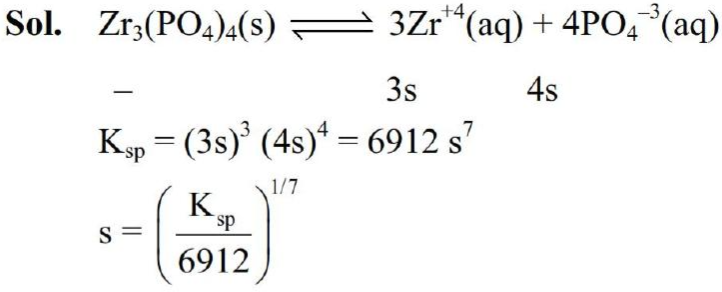
The molar solubility(s) of zirconium phosphate with molecular formula $\left( Zr ^{4+}\right)_3\left( PO _4^{3-}\right)_4$ is given by relation :
  • A
    $\left(\frac{ K _{sp }}{6912}\right)^{\frac{1}{7}}$
  • B
    $\left(\frac{ K _{ sp }}{5348}\right)^{\frac{1}{6}}$
  • C
    $\left(\frac{ K _{ sp }}{8435}\right)^{\frac{1}{7}}$
  • D
    $\left(\frac{ K _{ sp}}{9612}\right)^{\frac{1}{3}}$
View full question & answer
MCQ 104 Marks
Density of 3 M NaCl solution is $1.25 g / mL$. The molality of the solution is :
  • A
    1.79 m
  • B
    2 m
  • C
    3 m
  • 2.79 m
Answer
Correct option: D.
2.79 m
(D) 2.79 m
Sol. $3 M NaCl , d _{ sol }=1.25 gm / mol$
$\begin{aligned} \text { Molality } & =\frac{ M \times 1000}{1000 d- M \times M _{ w }} \\ & =\frac{3000}{1250-175.5}=2.79\end{aligned}$
View full question & answer
MCQ 114 Marks
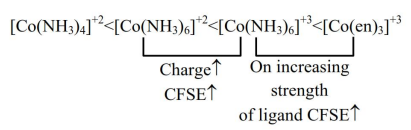
The correct order of the following complexes in terms of their crystal field stabilization energies is :
  • A
    $\left[ Co \left( NH _3\right)_4\right]^{2+}<\left[ Co \left( NH _3\right)_6\right]^{2+} \leq\left[ Co ( en )_3\right]^{3+} \leq\left[ Co \left( NH _3\right)_6\right]^{3+}$
  • B
    $\left[ Co \left( NH _3\right)_4\right]^{2+}<\left[ Co \left( NH _3\right)_6\right]^{2+}<\left[ Co \left( NH _3\right)_6\right]^{3+}<\left[ Co ( en )_3\right]^{3+}$
  • C
    $\left[ Co \left( NH _3\right)_6\right]^{2+}<\left[ Co \left( NH _3\right)_6\right]^{3+}<\left[ Co \left( NH _3\right)_4\right]^{2+}<\left[ Co ( en )_3\right]^{3+}$
  • D
    $\left[ Co ( en )_3\right]^{3+}<\left[ Co \left( NH _3\right)_6\right]^{3+}<\left[ Co \left( NH _3\right)_6\right]^{2+}<\left[ Co \left( NH _3\right)_4\right]^{2+}$
View full question & answer
MCQ 124 Marks
Match List-I with List-II.
List-I (Partial Derivatives) List-II
(Thermodynamic Quantity)
(A)$\left(\frac{\partial G }{\partial T }\right)_{ P }$(I)$C_P$
(B)$\left(\frac{\partial H }{\partial T }\right)_{ P }$(II)-S
(C)$\left(\frac{\partial G }{\partial P }\right)_{ T }$(III)$C_V$
(D)$\left(\frac{\partial U }{\partial T }\right)_{ V }$(IV)V
Choose the correct answer from the options given below :
  • A
    (A)-(II), (B)-(I), (C)-(III), (D)-(IV)
  • (A)-(II), (B)-(I), (C)-(IV), (D)-(III)
  • C
    (A)-(I), (B)-(II), (C)-(IV), (D)-(III)
  • D
    (A)-(II), (B)-(III), (C)-(I), (D)-(IV)
Answer
Correct option: B.
(A)-(II), (B)-(I), (C)-(IV), (D)-(III)
(B) (A)-(II), (B)-(I), (C)-(IV), (D)-(III)
Sol. (A) $dG = VdP - SdT$
Constant pressure
$
\begin{array}{l}
dG=-SdT \\
\left(\frac{\partial G}{\partial T}\right)_{p}=-S\end{array}$

(B) $dH =( dq )_{ p }= nCpdT$
$
\left(\frac{\partial H}{\partial T}\right)_{P}=C_{p}
$

(C) $dG = VdP - SdT$
At constant temperature
$
\begin{array}{l}
dG=VdP \\
\left(\frac{\partial G}{\partial P}\right)_{T}=V
\end{array}
$
(D)$
\begin{array}{l}\\dU=nC_{V} dT=(q)_{V} \\
\left(\frac{\partial U}{\partial T}\right)_{V}=C_{V}
\end{array}
$
View full question & answer
MCQ 134 Marks
Image
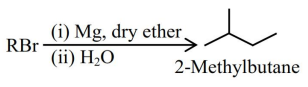
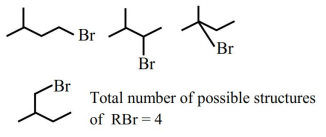
The maximum number of RBr producing 2-methylbutane by above sequence of reactions is _________. (Consider the structural isomers only)
  • 4
  • B
    5
  • C
    3
  • D
    1
Answer
Correct option: A.
4
(A) 4
Sol.
Image
View full question & answer
MCQ 144 Marks
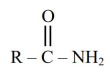
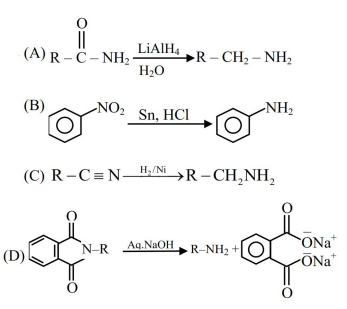
Match the Compounds (List-I) with the appropriate Catalyst/Reagents (List-II) for their reduction into corresponding amines.
 List-I (Compounds)List-II (Catalyst/Reagents)
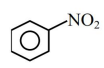
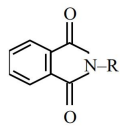
(A)ImageNaOH (aqueous)
(B)Image$\quad H _2 / Ni$
(C)$R - C \equiv N$$LiAlH _4, H _2 O$
(D)Image$Sn , HCl$

Choose the correct answer from the options given below:
  • A
    (A)-(III), (B)-(II), (C)-(IV), (D)-(I)
  • B
    (A)-(II), (B)-(IV), (C)-(III), (D)-(I)
  • C
    (A)-(II), (B)-(I), (C)-(III), (D)-(IV)
  • (A)-(III), (B)-(IV), (C)-(II), (D)-(I)
Answer
Correct option: D.
(A)-(III), (B)-(IV), (C)-(II), (D)-(I)
(D) (A)-(III), (B)-(IV), (C)-(II), (D)-(I)
Sol.
Image
View full question & answer
MCQ 154 Marks
The species which does not undergo disproportionation reaction is :
  • A
    $ClO _2^{-}$
  • $ClO _4^{-}$
  • C
    $ClO ^{-}$
  • D
    $ClO _3^{-}$
Answer
Correct option: B.
$ClO _4^{-}$
(B) $ClO _4^{-}$
Sol. $ClO _4^{-} \rightarrow x+\{(-2) \times 4\}=-1 \Rightarrow x=+7$
Chlorine is in its maximum oxidation state, so disproportionation not possible in $ClO _4^{-}$.
View full question & answer
MCQ 164 Marks
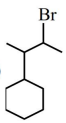
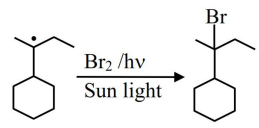
When sec-butylcyclohexane reacts with bromine in the presence of sunlight, the major product is :
  • A
    Image
  • B
    Image
  • C
    Image
  • Image
Answer
Correct option: D.
Image
(D) Image
Sol.
Image
Formation of more stable free radical intermediate
View full question & answer
MCQ 174 Marks
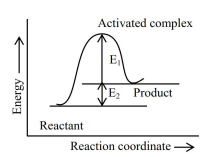
Consider the given figure and choose the correct option :
Image
  • A
    Activation energy of backward reaction is $E_1$ and product is more stable than reactant.
  • B
    Activation energy of forward reaction is $E _1+ E _2$ and product is more stable than reactant.
  • Activation energy of forward reaction is $E _1+ E _2$ and product is less stable than reactant.
  • D
    Activation energy of both forward and backward reaction is $E_1+E_2$ and reactant is more stable than product.
Answer
Correct option: C.
Activation energy of forward reaction is $E _1+ E _2$ and product is less stable than reactant.
(C) Activation energy of forward reaction is $E _1+ E _2$ and product is less stable than reactant.
Sol. Activation energy of forward reaction $=E_1+E_2$
Energy of product > Energy of reactant
Stability
Reactant $>$ Product
View full question & answer
MCQ 184 Marks
The maximum covalency of a non-metallic group 15 element 'E' with weakest $E - E$ bond is :
  • A
    5
  • B
    3
  • C
    6
  • 4
Answer
Correct option: D.
4
(D) 4
Sol. $N - N < P - P$ : single ( $\sigma$ ) bond strength Due to L.P.-L.P. replusion and maximum possible covalency of nitrogen is 4.
View full question & answer
MCQ 194 Marks
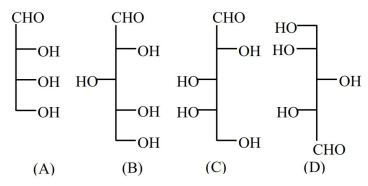
Identify the number of structure/s from the following which can be correlated to D-glyceraldehyde.
Image
  • three
  • B
    two
  • C
    four
  • D
    one
Answer
Correct option: A.
three
(A) three
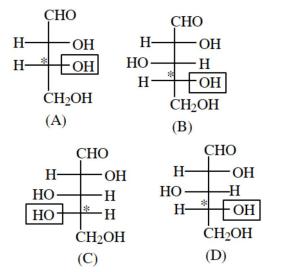
Sol.
Image
In $A , B , D - OH$ group in right hand side then D-configuration is assigned
View full question & answer