Questions

SECTION - B [MATHS - NUMERIC]

Take a timed test

5 questions · self-marked practice — reveal the answer and mark yourself.

Question 14 Marks
Let $A =\{1,2,3\}$. The number of relations on A, containing (1, 2) and (2, 3), which are reflexive and transitive but not symmetric, is _________.
Answer
(3)
Sol. Transitivity
$
(1,2) \in R,(2,3) \in R \Rightarrow(1,3) \in R
$
For reflexive $(1,1),(2,2)(3,3) \in R$
Now $(2,1),(3,2),(3,1)$
$(3,1)$ cannot be taken
(1) $(2,1)$ taken and $(3,2)$ not taken
(2) $(3,2)$ taken and $(2,1)$ not taken
(3) Both not taken
therefore 3 relations are possible.
View full question & answer
Question 24 Marks
If $\sum_{ r =1}^{30} \frac{ r ^2\left({ }^{30} C _{ r }\right)^2}{{ }^{30} C _{r-1}}=\alpha \times 2^{29}$, then $\alpha$ is equal to _________ .
Answer
View full question & answer
Question 34 Marks
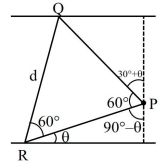
Let the distance between two parallel lines be 5 units and a point P lie between the lines at a unit distance from one of them. An equilateral triangle PQR is formed such that Q lies on one of the parallel lines, while R lies on the other. Then $(Q R)^2$ is equal to _________.
Answer
(28)
Sol.
Image

$
PR=\operatorname{cosec} \theta, PQ=4 \sec (30+\theta)
$
For equilateral
$
\begin{array}{l}
d=PR=PQ \\
\Rightarrow \cos \left(\theta+30^{\circ}\right)=4 \sin \theta \\
\Rightarrow \frac{\sqrt{3}}{2} \cos \theta-\frac{1}{2} \sin \theta=4 \sin \theta \\
\Rightarrow \tan \theta=\frac{1}{3 \sqrt{3}} \\
QR^2=d^2=\operatorname{cosec}^2 \theta=28
\end{array}
$
View full question & answer
Question 44 Marks
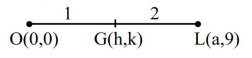
Let $A (6,8), B (10 \cos \alpha,-10 \quad \sin \alpha)$ and C $(-10 \sin \alpha, 10 \cos \alpha)$, be the vertices of a triangle.If $L(a, 9)$ and $G(h, k)$ be its orthocenter and centroid respectively, then $(5 a-3 h+6 k+100 \sin 2 \alpha)$ is equal to _________.
View full question & answer
Question 54 Marks
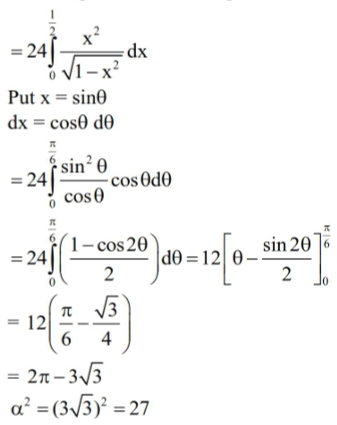
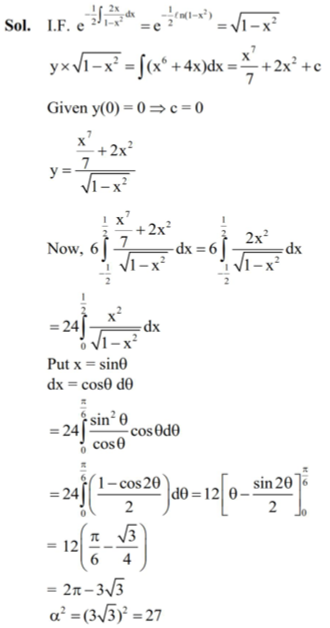
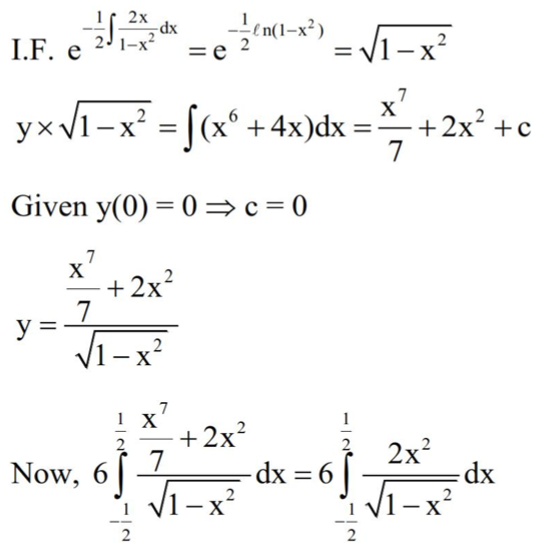
Let $y=f(x)$ be the solution of the differential equation $\frac{d y}{d x}+\frac{x y}{x^2-1}=\frac{x^6+4 x}{\sqrt{1-x^2}}$, -1 < x < 1 such that $f(0)=0$. If $6 \int_{-1 / 2}^{1 / 2} f(x) d x=2 \pi-\alpha$ then $\alpha^2$ is equal to _____________.
Answer
View full question & answer