Questions

SECTION - B [CHEMISTY - NUMERIC]

Take a timed test

5 questions · self-marked practice — reveal the answer and mark yourself.

Question 14 Marks
The standard enthalpy and standard entropy of decomposition of $N _2 O _4$ to $NO _2$ are $55.0 kJ mol ^{-1}$ and $175.0 J / K / mol$ respectively. The standard free energy change for this reaction at $25^{\circ} C$ in $J mol ^{-1}$ is __________ (Nearest integer)
Answer

Sol. (2850)
$\begin{array}{l}\Delta H _{ rxn }^{ o }=55 kJ / mol , \quad T =298 K \\ \Delta S _{ rxn }^{ o }=175 J / mol \\ \Delta G _{ rxn }^{ o }=\Delta H _{ rxn }^{ o }- T \Delta S _{ rxn }^{ o } \\ \Rightarrow \Delta G _{ rxn }^{ o }=55000 J / mol -298 \times 175 J / mol \\ \Rightarrow \Delta G _{ rxn }^{ o }=55000-52150 \\ \Rightarrow \Delta G _{ rxn }^{ o }=2850 J / mol \end{array}$
View full question & answer
Question 24 Marks
For the thermal decomposition of $N _2 O _5(g)$ at constant volume, the following table can be formed, for the reaction mentioned below :
$
2 N_2 O_5(g) \rightarrow 2 N_2 O_4(g)+O_2(g)
$
S.No.Time/sTotal pressure / (atm)
 100.6
 2100('X')
$x=$ __________ $\times 10^{-3} atm$ [nearest integer] Given : Rate constant for the reaction is $4.606 \times 10^{-2} s^{-1}$.
Answer

$\begin{array}{l}
K_{N_2 O_5}=2 \times 4.606 \times 10^{-2} S^{-1} \\
2 N_2 O_5(g) \longrightarrow 2 N_2 O_4(g)+O_2(g) \\
\begin{array}{cccc}
P_i & 0.6 & 0 & 0 \\
P_f & 0.6-P & P & \frac{P}{2}
\end{array} \\
2 \times 4.606 \times 10^{-2}=\frac{2.303}{100} \log \frac{0.6}{0.6-P} \\
4 \log _{10} \frac{0.6}{0.6-P} \\
10^4=\frac{0.6}{0.6-P} \\
\Rightarrow 0.6 \times 10^4-10^4 P=0.6
\end{array}
$
$\begin{aligned} \Rightarrow & 10^4 P =0.6\left(10^4-1\right) \\ P & =(6000-0.6) \times 10^{-4} \\ & =5999 . \times 10^{-4} \\ & =0.59994 \\ P _{\text {Total }} & =0.6+\frac{ P }{2} \\ & =0.6+0.29997 \\ & =0.89997 \\ =899.97 & \times 10^{-3}\end{aligned}$
Given by NTA
$
\begin{array}{llcc}
\text { Given : } 2 N_2 O_5(g) \rightarrow 2 N_2 O_4(g)+O_2(g) \\
t=0 \quad0.6 \quad 0 \quad 0 \\
t=100 s \quad 0.6-x \quad x \quad x / 2
\end{array}
$$
P_{\text {Total }}=0.6+\frac{x}{2}
$
As given in equation
$
K_{r}=4.606 \times 10^{-2} sec^{-1}
$
(Here language conflict in question)
$
\begin{array}{l}
\left(K_{r}=\frac{KA}{2} \text { not considered }\right) \\
K_{r} t=\ln \frac{0.6}{0.6-x} \\
4.606 \times 10^{-2} \times 100=2.303 \log \frac{0.6}{0.6-x} \\
P_{\text {Total }}=0.6+\frac{0.594}{2}=0.897 atm \\
\quad=897 \times 10^{-3} atm
\end{array}
$
View full question & answer
Question 34 Marks
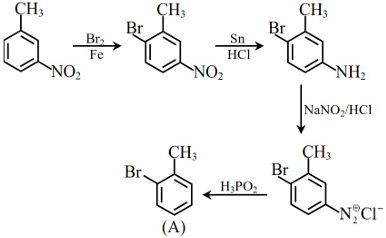
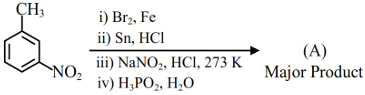
Consider the following sequence of reactions to produce major product $( A )$
Image

Molar mass of product $( A )$ is __________ $g mol ^{-1}$.
(Given molar mass in $g mol ^{-1}$ of $C : 12, H : 1$,
$
O: 16, Br: 80, N: 14, P: 31)
$
Answer
Image
Molar mass of product $\left( C _7 H _7 Br \right)( A )$ is $171 g mol ^{-1}$
View full question & answer
Question 44 Marks
During "S" estimation, 160 mg of an organic compound gives 466 mg of barium sulphate. The percentage of Sulphur in the given compound is __________ %.
(Given molar mass in $g mol ^{-1}$ of $Ba : 137, S: 32$, O:16)
Answer
Millimoles of $BaSO _4=\frac{466}{233}=2 m mol$
$
\% S=\frac{\frac{466}{233} \times 32}{160} \times 100=40 \%
$
View full question & answer
Question 54 Marks
If 1 mM solution of ethylamine produces $pH =9$, then the ionization constant $\left( K _{ b }\right)$ of ethylamine is $10^{-x}$. The value of $x$ is _________ (nearest integer).
[The degree of ionization of ethylamine can be neglected with respect to unity.]
View full question & answer