Questions

SECTION - B [MATHS - NUMERIC]

Take a timed test

5 questions · self-marked practice — reveal the answer and mark yourself.

Question 14 Marks
If the equation $a(b-c) x^2+b(c-a) x+c(a-b)=0$ has equal roots, where $a + c =15$ and $b =\frac{36}{5}$, then $a ^2+ c ^2$ is equal to __________.
Answer
$
a(b-c) x^2+b(c-a) x+c(a-b)=0
$
$x=1$ is root $\therefore$ other root is 1
$
\begin{array}{l}
\alpha+\beta=-\frac{b(c-a)}{a(b-c)}=2 \\
\Rightarrow-bc+ab=2 ab-2 ac \\
\Rightarrow 2 ac=ab+bc \\
\Rightarrow 2 ac=b(a+c) \\
\Rightarrow 2 ac=15 b \ldots(1) \\
\Rightarrow 2 ac=15\left(\frac{36}{5}\right)=108
\end{array}
$
$
\Rightarrow ac=54
$
$
a+c=15
$
$
a^2+c^2+2 ac=225
$
$
a^2+c^2=225-108=117
$
View full question & answer
Question 24 Marks
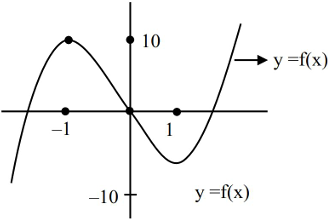
If the set of all values of a, for which the equation $5 x^3-15 x-a=0$ has three distinct real roots, is the interval $(\alpha, \beta)$, then $\beta-2 \alpha$ is equal to __________.
Answer
$5 x ^3-15 x - a =0$
$
\begin{array}{l}
f(x)=5 x^3-15 x \\
f(x)=15 x^2-15=15(x-1)(x+1)
\end{array}
$
Image
$
a \in(-10,10)
$
$
\alpha=-10, \beta=10
$
$
\beta-2 \alpha=10+20=30
$
View full question & answer
Question 34 Marks
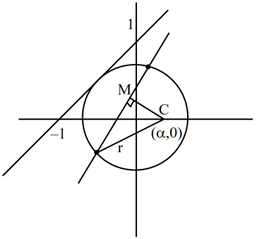
Let the circle $C$ touch the line $x-y+1=0$, have the centre on the positive $x$-axis, and cut off a chord of length $\frac{4}{\sqrt{13}}$ along the line $-3 x+2 y=1$. Let H be the hyperbola $\frac{ x ^2}{\alpha^2}-\frac{y^2}{\beta^2}=1$, whose one of the foci is the centre of C and the length of the transverse axis is the diameter of C . Then $2 \alpha^2+3 \beta^2$ is equal to __________.
Answer
Image

$
x-y+1=0
$
$
\begin{array}{l}
p=r \\
\left|\frac{\alpha-0+1}{\sqrt{2}}\right|=r \Rightarrow(\alpha+1)^2=2 r^2 \ldots (1).
\end{array}
$
$
\begin{array}{l}
\text { now }\left(\frac{-3 \alpha+0-1}{\sqrt{9+4}}\right)^2+\left(\frac{2}{\sqrt{13}}\right)^2=r^2 \\
\Rightarrow(3 \alpha+1)^2+4=13 r^2 \ldots \ldots .(2)
\end{array}
$
(1) \& $(2) \Rightarrow(3 \alpha+1)^2+4=13 \frac{(\alpha+1)^2}{2}$
$
\begin{aligned}
& \Rightarrow 18 \alpha^2+12 \alpha+2+8=13 \alpha^2+26 \alpha+13 \\
\Rightarrow & 5 \alpha^2-14 \alpha-3=0 \\
\Rightarrow & 5 \alpha^2-15 \alpha+\alpha-3=0 \\
\Rightarrow & \alpha=\frac{-1}{5}, 3 \\
\therefore & r=2 \sqrt{2}
\end{aligned}
$
How $\alpha e =3$ and $2 \alpha=4 \sqrt{2}$
$\begin{array}{l}\alpha^2 e ^2=9 \Rightarrow \alpha=2 \sqrt{2} \Rightarrow \alpha^2=8 \\ \alpha^2\left(1+\frac{\beta^2}{\alpha^2}\right)=9 \\ \alpha^2+\beta^2=9 \\ \therefore \beta^2=1 \\ \therefore 2 \alpha^2+3 \beta^2=2(8)+3(1)=19\end{array}$
View full question & answer
Question 44 Marks
The sum of all rational terms in the expansion of $\left(1+2^{1 / 3}+3^{1 / 2}\right)^6$ is equal to __________.
View full question & answer
Question 54 Marks
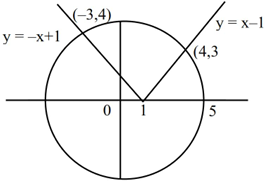
If the area of the larger portion bounded between the curves $x^2+y^2=25$ and $y=|x-1|$ is $\frac{1}{4}(b \pi+c)$, $b , c \in N$, then $b + c$ is equal to $\qquad$
Answer
Image
$\begin{array}{l}x^2+y^2=5 \\ x^2+(x-1)^2=25 \Rightarrow x=4 \\ x^2+(-x+1)^2=5 \Rightarrow x=-3 \\ A=25 \pi-\int_{-3}^4 \sqrt{25-x^2} d x+\frac{1}{2} \times 4 \times 4+\frac{1}{2} \times 3 \times 3 \\ A=25 \pi+\frac{25}{2}-\left[\frac{x}{2} \sqrt{25-x^2}+\frac{25}{2} \sin ^{-1} \frac{x}{5}\right]_{-3}^4 \\ A=25 \pi+\frac{25}{2}-\left[6+\frac{25}{2} \sin ^{-1} \frac{4}{5}+6+\frac{25}{2} \sin ^{-1} \frac{3}{5}\right] \\ A=25 \pi+\frac{1}{2}-\frac{25}{2} \cdot \frac{\pi}{2} \\ A=\frac{75 \pi}{4}+\frac{1}{2} \\ A=\frac{1}{4}(75 \pi+2) \\ b =75, c =2 \\ b+ c =75+2=77\end{array}$
View full question & answer