MCQ 14 Marks
$\lim _{x \rightarrow \infty} \frac{\left(2 x^2-3 x+5\right)(3 x-1)^{\frac{x}{2}}}{\left(3 x^2+5 x+4\right) \sqrt{(3 x+2)^x}}$ is equal to:
- A
$\frac{2}{\sqrt{3 e }}$
- B
$\frac{2 e }{\sqrt{3}}$
- C
$\frac{2 e }{3}$
- ✓
$\frac{2}{3 \sqrt{e}}$
AnswerCorrect option: D. $\frac{2}{3 \sqrt{e}}$
(D)
$\begin{array}{l}\lim _{x \rightarrow \infty} \frac{\left(2-\frac{3}{x}+\frac{5}{x^2}\right)\left(1-\frac{1}{3 x}\right)^{x / 2}}{\left(3+\frac{5}{x}+\frac{4}{x^2}\right)\left(1+\frac{2}{3 x}\right)^{x / 2}} \\ =\lim _{x \rightarrow \infty} \frac{2}{3} \cdot \frac{e^{\frac{x}{2}\left(1-\frac{1}{3 x}-1\right)}}{e^{\frac{x}{2}\left(1+\frac{2}{3 x}-1\right)}} \\ =\frac{2}{3} \cdot \frac{e^{-\frac{1}{6}}}{e^{1 / 3}}=\frac{2}{3} e^{-\frac{1}{2}}\end{array}$
View full question & answer→MCQ 24 Marks
If $I=\int_0^{\frac{\pi}{2}} \frac{\sin ^{\frac{3}{2}} x}{\sin ^{\frac{3}{2}} x+\cos ^{\frac{3}{2}} x} d x$, then $\int_0^{21} \frac{x \sin x \cos x}{\sin ^4 x+\cos ^4 x} d x$ equals:
- ✓
$\frac{\pi^2}{16}$
- B
$\frac{\pi^2}{4}$
- C
$\frac{\pi^2}{8}$
- D
$\frac{\pi^2}{12}$
AnswerCorrect option: A. $\frac{\pi^2}{16}$
(A)
For I
Apply king ( $P -5$ ) and add
$
\begin{array}{l}
2 I=\int_0^{\pi / 2} d x=\frac{\pi}{2} \Rightarrow I=\frac{\pi}{4} \\
I_2=\int_0^{\pi / 2} \frac{x \sin x \cos x}{\sin ^4 x+\cos ^4 x} d x
\end{array}
$
Apply king and add
$
I_2=\frac{\pi}{4} \int_0^{\pi / 2} \frac{\tan x \sec ^2 xdx}{\tan ^4 x+1}
$
put $\tan ^2 x = t$
$
\begin{aligned}
& \frac{\pi}{8} \int_0^{\infty} \frac{dt}{t^2+1} \\
= & \frac{\pi}{8} \cdot \frac{\pi}{2}=\frac{\pi^2}{16}
\end{aligned}
$
View full question & answer→MCQ 34 Marks
If the square of the shortest distance between the lines $\frac{x-2}{1}=\frac{y-1}{2}=\frac{z+3}{-3}$ and $\frac{x+1}{2}=\frac{y+3}{4}=\frac{z+5}{-5}$ is $\frac{ m }{ n }$, where $m , n$ are coprime numbers, then $m + n$ is equal to:
Answer(B)
$\begin{array}{l}\overrightarrow{ a }=(2,1,-3) \\ \overrightarrow{ b }=(-1,-3,-5) \\ \overrightarrow{ p } \times \overrightarrow{ q }=\left|\begin{array}{ccc}\hat{ i } & \hat{ j } & \hat{ k } \\ 1 & 2 & -3 \\ 2 & 4 & -5\end{array}\right| \\ =2 \hat{ i }-\hat{ j } \\ \overrightarrow{ b }-\overrightarrow{ a }=-3 \hat{ i }-4 \hat{ j }-2 \hat{ k } \\ S _{ d }=\frac{|(\overrightarrow{ b }-\overrightarrow{ a }) \cdot(\overrightarrow{ p } \times \overrightarrow{ q })|}{|\overrightarrow{ p } \times \overrightarrow{ q }|}- \\ =\frac{2}{\sqrt{5}} \\ \left(S_{ d }\right)^2=\frac{4}{5} \\ m=4, n =5 \Rightarrow m+ n =9\end{array}$
View full question & answer→MCQ 44 Marks
The number of complex numbers $z$, satisfying $|z|=1$ and $\left|\frac{ z }{\overline{ Z }}+\frac{\overline{ z }}{ z }\right|=1$, is :
Answer(D)
$
\begin{array}{l}
z=e^{i \theta} \\
\frac{z}{\bar{z}}=e^{i 2 \theta} \\
\left|\frac{z}{\overline{Z}}+\frac{\bar{z}}{z}\right|=1 \Rightarrow\left|e^{i 2 \theta}+e^{-12 \theta}\right|=1 \Rightarrow|\cos 2 \theta|=\frac{1}{2}
\end{array}
$
8 solution in $[0,2 \pi)$
View full question & answer→MCQ 54 Marks
Let $A =\left[ a _{ ij }\right]$ be a $3 \times 3$ matrix such that $A \left[\begin{array}{l}0 \\ 1 \\ 0\end{array}\right]=\left[\begin{array}{l}0 \\ 0 \\ 1\end{array}\right], A \left[\begin{array}{l}4 \\ 1 \\ 3\end{array}\right]=\left[\begin{array}{l}0 \\ 1 \\ 0\end{array}\right]$ and $A \left[\begin{array}{l}2 \\ 1 \\ 2\end{array}\right]=\left[\begin{array}{l}1 \\ 0 \\ 0\end{array}\right]$, then $a _{23}$ equals:
Answer(A)
Let $A=\left[\begin{array}{lll}a_{11} & a_{12} & a_{13} \\ a_{21} & a_{22} & a_{23} \\ a_{31} & a_{32} & a_{33}\end{array}\right]$
$A\left[\begin{array}{l}0 \\ 1 \\ 0\end{array}\right]=\left[\begin{array}{l}0 \\ 0 \\ 1\end{array}\right] \Rightarrow\left[\begin{array}{l}a_{12} \\ a_{22} \\ a_{32}\end{array}\right]=\left[\begin{array}{l}0 \\ 1 \\ 0\end{array}\right] \Rightarrow \begin{array}{l}a_{22}=0 ; a_{12}=0 \\ a_{32}=1\end{array}$
$A \left[\begin{array}{l}4 \\ 1 \\ 3\end{array}\right]=\left[\begin{array}{l}0 \\ 1 \\ 0\end{array}\right] \Rightarrow \begin{array}{l}4 a _{11}+ a _{12}+3 a _{13}=0 \\ 4 a _{21}+ a _{22}+3 a _{23}=1 \\ 4 a _{31}+ a _{32}+3 a _{33}=0\end{array} \Rightarrow 4 a _{21}+3 a _{23}=1$
$\begin{array}{l} A\left[\begin{array}{l}2 \\ 1 \\ 2\end{array}\right]=\left[\begin{array}{l}1 \\ 0 \\ 0\end{array}\right] \Rightarrow \begin{array}{l}2 a_{11}+a_{12}+2 a_{13}=1 \\ 2 a_{21}+a_{22}+2 a_{23}=0 \\ 2 a_{31}+a_{32}+2 a_{33}=0\end{array} \Rightarrow a_{21}+a_{23}=0 \\ -4 a_{23}+3 a_{23}=1 \Rightarrow a_{23}=-1\end{array}$
View full question & answer→MCQ 64 Marks
The length of the chord of the ellipse $\frac{x^2}{4}+\frac{y^2}{2}=1$, whose mid-point is $\left(1, \frac{1}{2}\right)$, is:
- ✓
$\frac{2}{3} \sqrt{15}$
- B
$\frac{5}{3} \sqrt{15}$
- C
$\frac{1}{3} \sqrt{15}$
- D
$\sqrt{15}$
AnswerCorrect option: A. $\frac{2}{3} \sqrt{15}$
(A)
$
\begin{array}{l}
T=S_1 \\
\frac{x \cdot 1}{4}+\frac{y \cdot 1 / 2}{2}=\frac{1}{4}+\frac{1}{8} \\
x+y=\frac{3}{2}
\end{array}
$solve with ellipse$
\begin{aligned}
PR & =\sqrt{\left(x_2-x_1\right)^2+\left(y_2-y_1\right)^2} \\
& =\sqrt{2}\left|x_2-x_1\right|
\end{aligned}
$
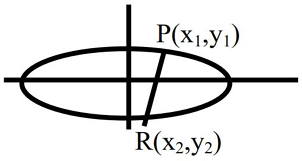
$\begin{array}{l}y_2=\frac{3}{2}-x_2 \\ y_1=\frac{3}{2}-x_1 \\ y_2-y_1=x_2-x_1 \\ x^2+2 y^2=4 \\ x^2+2\left(\frac{3}{2}-x\right)^2=4 \\ 6 x^2-12 x+1=0 \\ x_1+x_2=2 \\ x_1 x_2=1 / 6 \\ \left|x_2-x_1\right|=\sqrt{\left(x_2+x_1\right)^2-4 x_1 x_2} \\ \quad=\sqrt{4-4 / 6} \\ \operatorname{PR}=\sqrt{2} \cdot 2 \cdot \frac{\sqrt{5}}{\sqrt{2} \sqrt{3}}=\frac{2}{3} \sqrt{15}\end{array}$ View full question & answer→MCQ 74 Marks
Let $X=R \times R$. Define a relation $R$ on $X$ as:
$
\left(a_1, b_1\right) R\left(a_2, b_2\right) \Leftrightarrow b_1=b_2 .
$
Statement - I : R is an equivalence relation.
Statement - II : For some $(a, b) \in X$, the set $S=\{(x, y) \in X:(x, y) R(a, b)\}$ represents a line parallel to $y = x$.In the light of the above statements, choose the correct answer from the options given below:
- A
Both Statement-I and Statement-II are false.
- ✓
Statement-I is true but Statement-II is false.
- C
Both Statement-I and Statement-II are true.
- D
Statement-I is false but Statement-II is true.
AnswerCorrect option: B. Statement-I is true but Statement-II is false.
(B)
Statement - I :
Reflexive : $\left(a_1, b_1\right) R\left(a_1, b_1\right) \Rightarrow b_1=b_1 \quad$ True
$\left.\begin{array}{rl}\text { Symmetric: } & \left(a_1, b_1\right) R\left(a_2, b_2\right) \Rightarrow b_1=b_2 \\ & \left(a_2, b_2\right) R\left(a_1, b_1\right) \Rightarrow b_2=b_1\end{array}\right\}$ True
$\left.\begin{array}{rl}\text { Transitive: } & \left(a_1, b_1\right) R\left(a_2, b_2\right) \Rightarrow b_1=b_2 \\ & \&\left(a_2, b_2\right) R\left(a_3, b_3\right) b_2=b_3 \\ & \Rightarrow\left(a_1, b_1\right) R\left(a_3, b_3\right) \Rightarrow \text { True }\end{array}\right\} b_1=b_3$
Hence Relation $R$ is an equivence relation Statement-I is true.
For statement - II $\Rightarrow y = b$ so False
View full question & answer→MCQ 84 Marks
Let the shortest distance from $(a, 0), a>0$, to the parabola $y^2=4 x$ be 4 . Then the equation of the circle passing through the point $(a, 0)$ and the focus of the parabola, and having its centre on the axis of the parabola is:
- ✓
$x^2+y^2-6 x+5=0$
- B
$x^2+y^2-4 x+3=0$
- C
$x^2+y^2-10 x+9=0$
- D
$x^2+y^2-8 x+7=0$
AnswerCorrect option: A. $x^2+y^2-6 x+5=0$
(A)
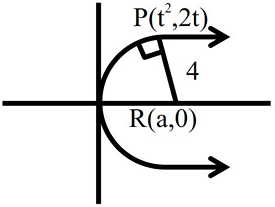
Normal at P
$
\begin{array}{l}
y+tx=2 t+t^3 \\
\uparrow \\
\quad(a, 0) \\
at=2 t+t^3 \\
a=2+t^2 \\
R\left(2+t^2, 0\right)
\end{array}
$
$
\begin{array}{l}
PR=4 \Rightarrow 4+4 t^2=16 \\
4 t^2=12 \Rightarrow t^2=3
\end{array}
$
$
a=5, R(5,0)
$
Focus $(1,0)$
$(1,0) \&(5,0)$ will be the end points of diameter
$\Rightarrow E q^{ n }$ of circle is
$
\begin{array}{l}
(x-1)(x-5)+y^2=0 \\
x^2+y^2-6 x+5=0
\end{array}
$ View full question & answer→MCQ 94 Marks
Let the range of the function $f(x)=6+16 \cos x \cdot \cos \left(\frac{\pi}{3}-x\right) \cdot \cos \left(\frac{\pi}{3}+x\right) \cdot$ $\sin 3 x \cdot \cos 6 x, x \in R$ be $[\alpha, \beta]$. Then the distance of the point $(\alpha, \beta)$ from the line $3 x+4 y+12=0$ is :
Answer(A)
$
\begin{aligned}
f(x) & =6+16\left(\frac{1}{4} \cos 3 x\right) \sin 3 x \cdot \cos 6 x \\
& =6+4 \cos 3 x \sin 3 x \cos 6 x \\
& =6+\sin 12 x
\end{aligned}
$
Range of $f(x)$ is [5,7]
$
\begin{array}{l}
(\alpha, \beta) \equiv(5,7) \\
\text { distance }=\left|\frac{15+28+12}{5}\right|=11
\end{array}
$
View full question & answer→MCQ 104 Marks
Let $x = x ( y )$ be the solution of the differential equation
$
y=\left(x-y \frac{d x}{d y}\right) \sin \left(\frac{x}{y}\right), y>0 \text { and } x(1)=\frac{\pi}{2} .
$
Then $\cos (x(2))$ is equal to :
- A
$1-2\left(\log _{ c } 2\right)^2$
- ✓
$2\left(\log _{ c } 2\right)^2-1$
- C
$2\left(\log _{ e } 2\right)-1$
- D
$1-2\left(\log _{ e } 2\right)$
AnswerCorrect option: B. $2\left(\log _{ c } 2\right)^2-1$
(B)
$y d y=(x d y-y d x) \sin \left(\frac{x}{y}\right)$
$\frac{d y}{y}=\left(\frac{x d y-y d x}{y^2}\right) \sin \left(\frac{x}{y}\right)$
$\frac{d y}{y}=\sin \left(\frac{x}{y}\right) d\left(-\frac{x}{y}\right)$
$\Rightarrow \quad \ln y=\cos \frac{x}{y}+C$
$x(1)=\frac{\pi}{2} \Rightarrow 0=\cos \frac{\pi}{2}+C \Rightarrow C=0$
$\ell n y=\cos \frac{x}{y}$
but $y=2 \Rightarrow \cos \frac{x}{2}=\ell \ln 2$
$\begin{aligned} \cos x & =2 \cos ^2 \frac{x}{2}-1 \\ & =2(\ln 2)^2-1\end{aligned}$
View full question & answer→MCQ 114 Marks
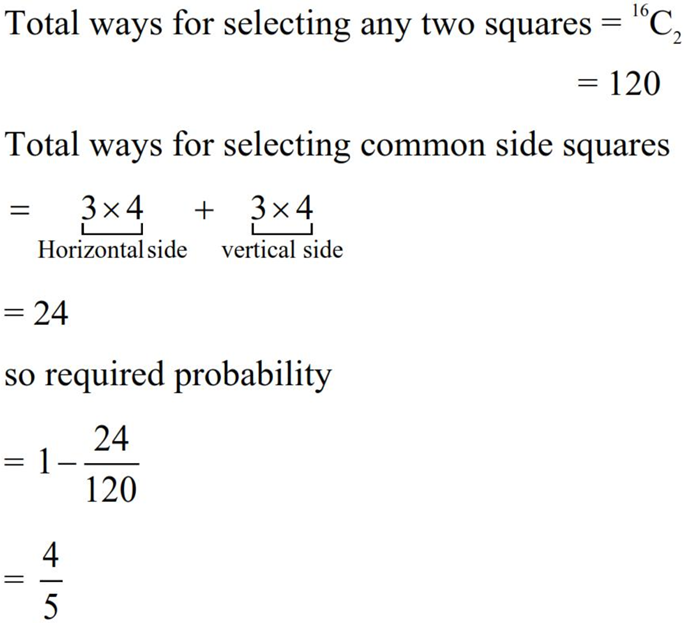
A board has 16 squares as shown in the figure :

out of these 16 squares, two squares are chosen at random. the probality that they have no side in common is :
- ✓
$\frac{4}{5}$
- B
$\frac{7}{10}$
- C
$\frac{3}{5}$
- D
$\frac{23}{30}$
AnswerCorrect option: A. $\frac{4}{5}$
(A)
View full question & answer→MCQ 124 Marks
A spherical chocolate ball has a layer of ice-cream of uniform thickness around it. When the thickness of the ice-cream layer is 1 cm , the ice-cream melts at the rate of $81 cm^3 / min$ and the thickness of the ice-cream layer decreases at the rate of $\frac{1}{4 \pi} cm / min$. The surface area (in $cm ^2$ ) of the chocolate ball (without the ice-cream layer) is :
- A
$225 \pi$
- B
$128 \pi$
- C
$196 \pi$
- ✓
$256 \pi$
AnswerCorrect option: D. $256 \pi$
(D)
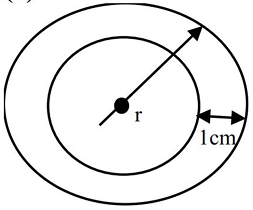
$
\begin{array}{l}
v=\frac{4}{3} \pi r^3 \\
\frac{dv}{dt}=4 \pi r^2 \frac{dr}{dt} \\
81=4 \pi r^2 \times \frac{1}{4 \pi} \\
r^2=81 \\
r=9
\end{array}
$
surface area of chocolate $=4 \pi(r-1)^2=256 \pi$ View full question & answer→MCQ 134 Marks
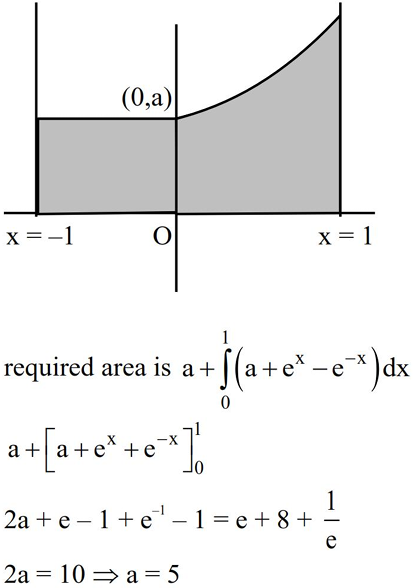
If the area of the region $\left\{(x, y):-1 \leq x \leq 1,0 \leq y \leq a+e^{|x|}-e^{-x}, a>0\right\}$ is $\frac{ e ^2+8 e +1}{ e }$, then the value of a is :
Answer(D)
View full question & answer→MCQ 144 Marks
Let the point A divide the line segment joining the points $P (-1,-1,2)$ and $Q (5,5,10)$ internally in the ratio $r : 1( r >0)$. If O is the origin and $(\overrightarrow{ OQ } \cdot \overrightarrow{ OA })-\frac{1}{5}|\overrightarrow{ OP } \times \overrightarrow{ OA }|^2=10$, then the value of r is :
Answer(D)
$
\begin{array}{l}
A \equiv\left(\frac{5 r-1}{r+1}, \frac{5 r-1}{r+1}, \frac{10 r+2}{r+1}\right) \\
(\overrightarrow{OQ} \cdot \overrightarrow{OA})-\frac{|\overrightarrow{OP} \times \overrightarrow{OA}|^2}{5}=10 \\
\overrightarrow{OQ} \cdot \overrightarrow{OA}=\frac{10}{r+1}(15 r+1) \\
|\overrightarrow{OP} \times \overrightarrow{OA}|^2=\frac{r^2}{(r+1)^2}(800)
\end{array}
$
so by equation (1)
$
\begin{array}{l}
\frac{10}{r+1}(15 r+1)-\frac{1}{5} \frac{r^2(800)}{(r+1)^2}=10 \\
2 r^2-14 r=0 \\
r=7, r \neq 0
\end{array}
$
View full question & answer→MCQ 154 Marks
The distance of the line $\frac{x-2}{2}=\frac{y-6}{3}=\frac{z-3}{4}$ from the point $(1,4,0)$ along the line $\frac{x}{1}=\frac{y-2}{2}=\frac{z+3}{3}$ is :
- A
$\sqrt{17}$
- ✓
$\sqrt{14}$
- C
$\sqrt{15}$
- D
$\sqrt{13}$
AnswerCorrect option: B. $\sqrt{14}$
(B)
Let the parallel line is
$
\frac{x-1}{1}=\frac{y-4}{2}=\frac{z-0}{3}
$
so their point of intersection is
$
\begin{array}{l}
(\lambda+1,2 \lambda+43 \lambda)=(2 t+2,3 t+6,4 t+3) \\
\lambda=2 t+1 \\
2 \lambda+4=3 t+6 \Rightarrow t=0
\end{array}
$
so POI is $(2,6,3)$
so distance $=\sqrt{(2-1)^2+(6-4)^2+(3-0)^2}=\sqrt{14}$
View full question & answer→MCQ 164 Marks
A rod of length eight units moves such that its ends $A$ and $B$ always lie on the lines $x-y+2=0$ and $y+2=0$, respectively. If the locus of the point $P$, that divides the rod AB internally in the ratio $2: 1$ is $9\left(x^2+\alpha y^2+\beta x y+\gamma x+28 y\right)-76=0$, then $\alpha-\beta-\gamma$ is equal to :
Answer(B)
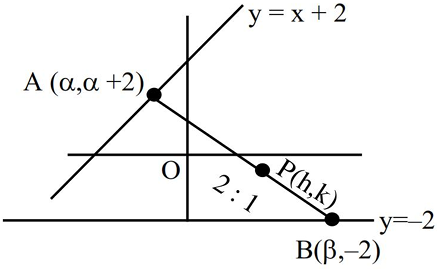
$\begin{array}{l} h =\frac{3 \beta+\alpha}{3} \\ k =\frac{-4+\alpha+2}{3} \\ \alpha=3 k +2 \\ 2 \beta=3 h- a =3 h-3 k -2 \\ \text { so } AB =8 \\ (\alpha-\beta)^2+(\alpha+4)^2=64 \\ \left(3 k +2-\left(\frac{3 h-3 k -2}{2}\right)\right)^2+(3 k +2+4)^2=64 \\ \frac{(9 k -3 h+6)^2}{4}+(3 k +6)^2=64 \\ 9\left[(3 k - h +2)^2+4( k +2)^2\right]=64 \times 4 \\ 9\left( x ^2+13 y ^2-6 xy -4 x +28 y \right)=76 \\ \alpha-\beta-\gamma=13+6+4=23\end{array}$ View full question & answer→MCQ 174 Marks
Let $\int x^3 \sin x d x=g(x)+C$, where $C$ is the constant of integration.
If $8\left(g\left(\frac{\pi}{2}\right)+g^{\prime}\left(\frac{\pi}{2}\right)\right)=\alpha \pi^3+\beta \pi^2+\gamma, \alpha, \beta, \gamma \in Z$,
Then $\alpha+\beta-\gamma$ equals :
Answer(A)
$
\begin{array}{l}
\int x^3 \sin x d x=-x^3 \cos x+\int 3 x^2 \cos x d x \\
=-x^3 \cos x+3 x^2 \sin x-\int 6 x \sin x d x \\
=-x^3 \cos x+3 x^2 \sin x+6 x \cos x-6 \sin x+c
\end{array}
$
So $g(x)=-x^3 \cos x+3 x^2 \sin x+6 x \cos x-6 \sin x$
$
\begin{array}{l}
g\left(\frac{\pi}{2}\right)=\frac{3 \pi^2}{4}-6 \\
g^{\prime}(x)=x^3 \sin x \\
g^{\prime}\left(\frac{\pi}{2}\right)=\frac{\pi^3}{8} \\
8\left(g\left(\frac{\pi}{2}\right)+g^{\prime}\left(\frac{\pi}{2}\right)\right)=\pi^3+6 \pi^2-48
\end{array}
$
So $\alpha+\beta-\gamma=55$
View full question & answer→MCQ 184 Marks
The system of equations
$
\begin{array}{l}
x+y+z=6 \\
x+2 y+5 z=9 \\
x+5 y+\lambda z=\mu
\end{array}
$
has no solution if
- ✓
$\lambda=17, \mu \neq 18$
- B
$\lambda \neq 17, \mu \neq 18$
- C
$\lambda=15, \mu \neq 17$
- D
$\lambda=17, \mu=18$
AnswerCorrect option: A. $\lambda=17, \mu \neq 18$
(A)
$
\begin{array}{l}
D=\left|\begin{array}{lll}
1 & 1 & 1 \\
1 & 2 & 5 \\
1 & 5 & \lambda
\end{array}\right|=0 \\
\lambda=17 \\
D_z=\left|\begin{array}{lll}
1 & 1 & 6 \\
1 & 2 & 9 \\
1 & 5 & \mu
\end{array}\right| \neq 0 \\
\mu \neq 18
\end{array}
$
View full question & answer→MCQ 194 Marks
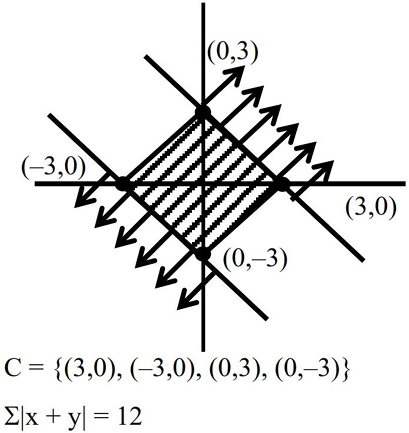
Let $A=\{(x, y) \in R \times R :|x+y| \geq 3\}$ and $B=\{(x, y) \in R \times R :|x|+|y| \leq 3\}$.
If $C=\{(x, y) \in A \cap B : x=0$ or $y=0\}$, then $\sum_{(x, y) \in C}|x+y|$ is :
Answer(D)
View full question & answer→MCQ 204 Marks
If in the expansion of $(1+x)^p(1-x)^q$, the coefficients of $x$ and $x^2$ are 1 and -2 , respectively, then $p^2+q^2$ is equal to :
Answer(C)
$
\begin{array}{l}
(1+x)^{p}(1-x)^{q}=\left({ }^{p} C_0+{ }^{p} C_1 x+{ }^{p} C_2 x^2+\ldots\right)\left({ }^{q} C_0-{ }^{q} C_1 x+{ }^{q} C_2 x^2+\ldots\right) \\
\text { coff of } x \equiv{ }^{p} C_0{ }^{q} C_1-{ }^{p} C_1{ }^{q} C_0=1 \\
p-q=1 \\
\text { coff of } x^2 \equiv{ }^{p} C_0{ }^{q} C_2-{ }^{p} C_1{ }^{q} C_1+{ }^{p} C_2{ }^{q} C_0=-2 \\
\frac{q(q-1)}{2}-pq+\frac{p(p-1)}{2}=-2 \\
q^2-q-2 pq+p^2-p=-4 \\
(p-q)^2-(p+q)=-4 \\
p+q=5 \\
p=3 \\
q=2 \\
\text { so } p^2+q^2=13
\end{array}
$
View full question & answer→