MCQ 14 Marks
A massless spring gets elongated by amount $x_1$ under a tension of 5 N . Its elongation is $x _2$ under the tension of 7 N . For the elongation of $\left(5 x_1-2 x_2\right)$, the tension in the spring will be,
Answer(C)
$
\begin{array}{l}
kx_1=5 N \\
kx_2=7 N \\
k\left(5 x_1-2 x_2\right)=5 kx_1-2 kx_2 \\
=5 \times 5-2 \times 7=11 N
\end{array}
$
View full question & answer→MCQ 24 Marks
A concave mirror of focal length $f$ in air is dipped in a liquid of refractive index $\mu$. Its focal length in the liquid will be :
- A
$\frac{f}{\mu}$
- B
$\frac{f}{(\mu-1)}$
- C
$\mu f$
- ✓
$f$
Answer(D)
Focal length of mirror will not change because focal length of mirror doesn't depend on medium.
View full question & answer→MCQ 34 Marks
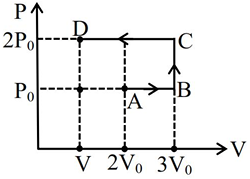
Using the given P-V diagram, the work done by an ideal gas along the path ABCD is -
- A
$4 P_0 V_0$
- B
$3 P _0 V_0$
- C
$-4 P_0 V_0$
- ✓
$-3 P _0 V_0$
AnswerCorrect option: D. $-3 P _0 V_0$
(D)
$\begin{array}{l} w _{ ABCD }= w _{ AB }+ w _{ BC }+ w _{ CD } \\ = P _0 V_0+0+\left(-2 P _0 \times 2 V_0\right) \\ = P _0 V_0-4 P _0 V_0 \\ =-3 P _0 V_0\end{array}$
View full question & answer→MCQ 44 Marks
A plane electromagnetic wave of frequency20 MHz travels in free space along the $+x$ direction. At a particular point in space and time, the electric field vector of the wave is $E _{ y }=9.3 Vm ^{-}$ ${ }^1$. Then, the magnetic field vector of the wave at that point is-
- A
$B _{ z }=9.3 \times 10^{-8} T$
- B
$B _{ z }=1.55 \times 10^{-8} T$
- C
$B _{ z }=6.2 \times 10^{-8} T$
- ✓
$B_z=3.1 \times 10^{-8} T$
AnswerCorrect option: D. $B_z=3.1 \times 10^{-8} T$
(D)
$E=B C$
$9.3= B \times 3 \times 10^8$
$B=\frac{9.3}{3 \times 10^8}=3.1 \times 10^{-8} T$
View full question & answer→MCQ 54 Marks
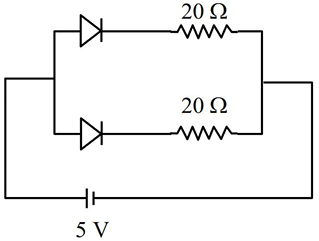
What is the current through the battery in the circuit shown below?
Answer(C)
Both are forward biased hence $R_{\text {eq }}=10 \Omega$
$
i=\frac{V}{R}=\frac{5}{10}=\frac{1}{2} A
$
View full question & answer→MCQ 64 Marks
Water of mass $m$ gram is slowly heated to increase the temperature from $T_1$ to $T_2$. The change in entropy of the water, given specific heat of water is $1 Jkg ^{-1} K^{-1}$, is :
AnswerCorrect option: D. $m \ln \left(\frac{T_2}{T_1}\right)$
(D)
$dQ = msdT$
$
\begin{array}{l}
dS=\frac{dQ}{T}=\frac{msdT}{T} \\
\Delta S=\int \frac{msdT}{T}=ms \ln \frac{T_{f}}{T_{i}} \\
\Delta S=m \ln \frac{T_2}{T_1}
\end{array}
$
View full question & answer→MCQ 74 Marks
Given below are two statements. One is labelled as Assertion (A) and the other is labelled as Reason (R).
Assertion (A) : The binding energy per nucleon is found to be practically independent of the atomic number A , for nuclei with mass numbers between 30 and 170.
Reason (R): Nuclear force is long range.
In the light of the above statements, choose the correct answer from the options given below :
- A
(A) is false but (R) is true
- ✓
(A) is true but (R) is false
- C
Both (A) and (R) are true and (R) is the correct explanation of (A)
- D
Both (A) and (R) are true and (R) is the correct explanation of (A)
AnswerCorrect option: B. (A) is true but (R) is false
View full question & answer→MCQ 84 Marks
The width of one of the two slits in Young's double slit experiment is d while that of the other slit is xd . If the ratio of the maximum to the minimum intensity in the interference pattern on the screen is $9: 4$ then what is the value of $x$ ?
(Assume that the field strength varies according to the slit width.)
Answer(C)
I $\propto(\text { width })^2$
$
\begin{array}{l}
\left(\frac{\sqrt{I_1}+\sqrt{I_2}}{\sqrt{I_1}-\sqrt{I_2}}\right)^2=\frac{9}{4} \\
\frac{\sqrt{I_1}+\sqrt{I_2}}{\sqrt{I_1}-\sqrt{I_2}}=\frac{3}{2} \\
\frac{(x+1) d}{(x-1) d}=\frac{3}{2} \\
\Rightarrow 3 x-3=2 x+2 \\
x=5
\end{array}
$]
View full question & answer→MCQ 94 Marks
A galvanometer having a coil of resistance $30 \Omega$ need 20 mA of current for full-scale deflection. If a maximum current of 3 A is to be measured using this galvanometer, the resistance of the shunt to be added to the galvanometer should be $\frac{30}{ X } \Omega$, where X is
Answer(C)
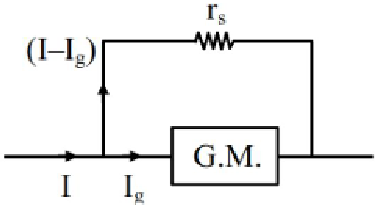
$\begin{array}{l} I _{ g } R _{ g }=\left( I - I _{ g }\right) r _{ s } \\ 20 \times 10^{-3} \times 30=(3-0.02) \times r _{ s } \\ r _{ s }=\left(\frac{0.6}{2.98}\right)=\frac{30}{ x } \\ x =\left(\frac{2.98 \times 30}{0.6}\right)=149\end{array}$ View full question & answer→MCQ 104 Marks
Two point charges $-4 \mu c$ and $4 \mu c$, constituting an electric dipole, are placed at $(-9,0,0) cm$ and $(9,0,0) cm$ in a uniform electric field of strength $10^4 NC ^{-1}$. The work done on the dipole in rotating it from the equilibrium through $180^{\circ}$ is :
Answer(A)
$U=-P E \cos \theta$
$
\begin{array}{l}
w_{ext}=\Delta U=U_{f}-U_{i}=-PE \cos 180^{\circ}+PE \cos 0^{\circ} \\
w_{ext}=2 PE \\
=2 \times\left(4 \times 10^{-6}\right)(18) \times 10^4 \\
=144 \times 10^{-2} \\
=14.4 mJ
\end{array}
$
View full question & answer→MCQ 114 Marks
If a satellite orbiting the Earth is 9 times closer to the Earth than the Moon, what is the time period of rotation of the satellite? Given rotational time period of Moon $=27$ days and gravitational attraction between the satellite and the moon is neglected.
Answer(A)
$\quad T ^2 \propto R ^3$
$
\begin{array}{l}
\left(\frac{T_{m}}{T_{s}}\right)^2=\left(\frac{R}{R / 9}\right)^3 \\
\frac{T_{m}}{T_{s}}=(3)^3 \\
\Rightarrow T_{s}=\left(\frac{27}{27}\right)=1 \text { day }
\end{array}
$
View full question & answer→MCQ 124 Marks
Match list - i with list - ii.| LIST – I | LIST - II |
| (A) Permeability of free space | (I) $\left[ M L ^2 T^{-2}\right]$ |
| (B) Magnetic field | (II) $\left[ M T ^{-2} A^{-1}\right]$ |
| (C) Magnetic moment | (III) $\left[ M L T ^{-2} A^{-2}\right]$ |
| (D) Torsional constant | (IV) $\left[ L ^2 A\right]$ |
- A
(A)-(I), (B)-(IV), (C)-(II), (D)-(III)
- B
(A)-(II), (B)-(I), (C)-(III), (D)-(IV)
- C
(A)-(IV), (B)-(III), (C)-(I), (D)-(II)
- ✓
(A)-(III), (B)-(II), (C)-(IV), (D)-(I)
AnswerCorrect option: D. (A)-(III), (B)-(II), (C)-(IV), (D)-(I)
(D)
$
\begin{array}{l}
B=\frac{\mu_0 I}{2 \pi r} \\
\Rightarrow\left[\mu_0\right]=\left[\frac{B \times r}{I}\right]=\left[\frac{MT^{-2} A^{-1} \times L}{A}\right]=\left[MLT^{-2} A^{-2}\right]
\end{array}
$
magnetic field $F = qvB$
$
\begin{array}{c}
B=\left[\frac{MLT^{-2}}{AT L / T}\right]=\left[MT^{-2} A^{-1}\right] \\
{[M]=[NTA]=[M]=\left[ML^2\right]} \\
\tau=c \theta \Rightarrow c=\left[\frac{\tau}{\theta}\right]=\left[ML^2 T^{-2}\right]
\end{array}
$
View full question & answer→MCQ 134 Marks
Water flows in a horizontal pipe whose one end is closed with a valve. The reading of the pressure gauge attached to the pipe is $P _1$. The reading of the pressure gauge falls to $P_2$ when the valve is opened. The speed of water flowing in the pipe is proportional to
AnswerCorrect option: A. $\sqrt{P_1-P_2}$
(A)
By Bernoulli equation
$
\begin{array}{l}
P_1+\frac{1}{2} \times \rho \times 0^2=P_2+\frac{1}{2} \rho V^2 \\
v=\sqrt{2 \rho\left(P_1-P_2\right)}
\end{array}
$
View full question & answer→MCQ 144 Marks
A circular disk of radius R meter and mass M kg is rotating around the axis perpendicular to the disk. An external torque is applied to the disk such that $\theta( t )=5 t ^2-8 t$, where $\theta( t )$ is the angular position of the rotating disc as a function of time $t$.
How much power is delivered by the applied torque, when $t =2 s$ ?
- A
$60 MR ^2$
- B
$72 MR ^2$
- ✓
$108 MR ^2$
- D
$8 M R^2$
AnswerCorrect option: C. $108 MR ^2$
(C)
$
\begin{array}{l}
\theta=5 t^2-8 t \\
\omega=\frac{d \theta}{dt}=10 t-8 \\
\alpha=\frac{d \omega}{dt}=10 \\
\therefore p=\tau \omega \\
=(I \alpha) \omega \\
=\left(\frac{mR^2}{2}\right) \alpha \omega \\
=\left(\frac{mR^2}{2}\right)(10)(10 t-8)
\end{array}
$
Put $t =2$
$
p=60 mR^2
$
View full question & answer→MCQ 154 Marks
In photoelectric effect an em-wave is incident on a metal surface and electrons are ejected from the surface. If the work function of the metal is 2.14 eV and stopping potential is 2 V , what is the wavelength of the em-wave?
(Given hc $=1242 eVnm$ where h is the Planck's constant and c is the speed of light in vaccum.)
Answer(D)
$
\begin{array}{l}
eV_{s}=E-\phi \\
2 eV=E-2.14 eV \\
E=4.14 eV \\
E=\frac{hc}{\lambda} \\
\lambda=\frac{1242}{4.14}=300 nm
\end{array}
$
View full question & answer→MCQ 164 Marks
The energy of a system is given as $E(t)=\alpha^3 e^{-\beta t}$, where $t$ is the time and $\beta=0.3 s^{-1}$. The errors in the measurement of $\alpha$ and $t$ are $1.2 \%$ and $1.6 \%$, respectively. At $t =5 s$, maximum percentage error in the energy is :
- A
$4 \%$
- B
$11.6 \%$
- ✓
$6 \%$
- D
$8.4 \%$
AnswerCorrect option: C. $6 \%$
(C)
$E=\alpha^3 e^{-\beta t}$
$\ln E =3 \ln \alpha-\beta t$
$
\begin{array}{l}
\left(\frac{dE}{E}\right)_{\max }=\frac{3 d \alpha}{\alpha}+\beta \frac{dt}{t} \times t \\
=3 \times 1.2 \%+(0.3 \times 1.6 \times 5) \% \\
=6 \%
\end{array}
$
View full question & answer→MCQ 174 Marks
The equation of a transverse wave travelling along a string is $y ( x , t )=4.0 \sin \left[20 \times 10^{-3} x +600 t \right] mm$, where x is in the mm and t is in second. The velocity of the wave is :
- A
$+30 m / s$
- B
$-60 m / s$
- ✓
$-30 m / s$
- D
$+60 m / s$
AnswerCorrect option: C. $-30 m / s$
(C)
$y=4 \sin \left(20 \times 10^{-3} x+600 t\right)$
Here
$
\begin{array}{l}
\omega=600 s^{-1} \\
k=20 \times 10^{-3} mm^{-1}
\end{array}
$
$
\therefore \quad v=\frac{w}{k}=\frac{600}{20 \times 10^{-3}}
$
$
=30 \times 10^3 mm / s
$
$
=30 m / s
$\
& direction is towards -ve x axis
$
\therefore v=-30 m / s
$
View full question & answer→MCQ 184 Marks
The refractive index of the material of a glass prism is $\sqrt{3}$. The angle of minimum deviation is equal to the angle of the prism. What is the angle of the prism?
- A
$50^{\circ}$
- ✓
$60^{\circ}$
- C
$58^{\circ}$
- D
$48^{\circ}$
AnswerCorrect option: B. $60^{\circ}$
(B)
$\mu=\frac{\sin \left(\frac{A+\delta_{\text {min }}}{2}\right)}{\sin \frac{A}{2}}$
Given $\delta_{\text {min }}= A$
$
\begin{array}{l}
\sqrt{3}=\frac{\sin A}{\sin \frac{A}{2}}=\frac{2 \sin \frac{A}{2} \cos \frac{A}{2}}{\sin \frac{A}{2}} \\
\cos \frac{A}{2}=\frac{\sqrt{3}}{2} \\
A=60^{\circ}
\end{array}
$
View full question & answer→MCQ 194 Marks
Two charges $7 \mu c$ and $-4 \mu c$ are placed at ( -7 cm , $0,0)$ and ( $7 cm, 0,0$ ) respectively. Given, $\in_0=8.85 \times 10^{-12} C ^2 N^{-1} m^{-2}$, the electrostatic potential energy of the charge configuration is :
Answer(D)
P.E. of two charges
$
\begin{array}{l}
u=\frac{1}{4 \pi \varepsilon_0} \frac{q_1 q_2}{r} \\
r=\sqrt{\left(x_2-x_1\right)^2+\left(y_2-y_1\right)^2+\left(z_2-z_1\right)^2} \\
=14 cm \\
\therefore u=\frac{9 \times 10^9 \times 7 \times 10^{-6} \times(-4) \times 10^{-6}}{14 \times 10^{-2}} \\
=-1.8 J
\end{array}
$
View full question & answer→MCQ 204 Marks
A ball having kinetic energy KE , is projected at an angle of $60^{\circ}$ from the horizontal. What will be the kinetic energy of ball at the highest point of its flight?
- A
$\frac{( KE )}{8}$
- ✓
$\frac{( KE )}{4}$
- C
$\frac{( KE )}{16}$
- D
$\frac{( KE )}{2}$
AnswerCorrect option: B. $\frac{( KE )}{4}$
(B)
Initial K.E,
$
\text { K.E. }=\frac{1}{2} mu^2
$
Speed at heighest point
$
\begin{array}{l}
V=u \cos 60^{\circ}=\frac{u}{2} \\
\therefore KE_2=\frac{1}{2} m\left(\frac{u}{2}\right)^2 \\
=\frac{1}{4} \times \frac{1}{2} mu^2 \\
=\frac{KE}{4}
\end{array}
$
View full question & answer→