Questions

SECTION - B [PHYSICS - NUMERIC]

Take a timed test

5 questions · self-marked practice — reveal the answer and mark yourself.

Question 14 Marks
In a series LCR circuit, a resistor of $300 \Omega$, a capacitor of 25 nF and an inductor of 100 mH are used. For maximum current in the circuit, the angular frequency of the ac source is $\qquad$ $\times 10^4$ radians $s ^{-1}$.
Answer
$\omega=\frac{1}{\sqrt{ LC }}$
$
\begin{array}{l}
\omega=\frac{1}{\sqrt{25 \times 10^{-9} \times 100 \times 10^{-3}}} \\
\omega=\frac{10^{+6}}{5 \times 10}=2
\end{array}
$
View full question & answer
Question 24 Marks
A time varying potential difference is applied between the plates of a parallel plate capacitor of capacitance $2.5 \mu F$. The dielectric constant of the medium between the capacitor plates is 1 . It produces an instantaneous displacement current of 0.25 mA in the intervening space between the capacitor plates, the magnitude of the rate of change of the potential difference will be __________ $Vs ^{-1}$.
Answer
$\frac{ CdV }{ dt }= I _{ d }$
$
\begin{array}{l}
\frac{dV}{dt}=\frac{I_{d}}{C} \\
=\frac{0.25 \times 10^{-3}}{2.5 \times 10^{-6}} \\
=100
\end{array}
$
View full question & answer
Question 34 Marks
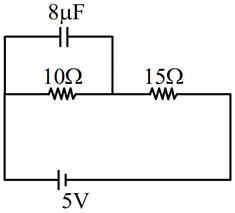
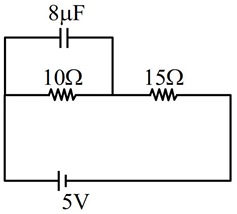
At steady state the charge on the capacitor, as shown in the circuit below, is $\qquad$ $\mu C$.
Image
Answer
Image
$\begin{array}{l} i =\left(\frac{5}{25}\right) \\ Q = CV \\ Q =\left(8 \times 10^{-6}\right)\left(\frac{5}{25} \times 10\right) \\ Q =\left(\frac{8 \times 5 \times 10^{-2}}{25}\right)=16 \mu C \end{array}$
View full question & answer
Question 44 Marks
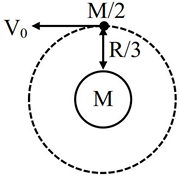
A satellite of mass $\frac{M}{2}$ is revolving around earth in a circular orbit at a height of $\frac{R}{3}$ from earth surface. The angular momentum of the satellite is $M \sqrt{\frac{G M R}{x}}$. The value of $x$ is __________ , where M and $R$ are the mass and radius of earth, respectively. (G is the gravitational constant)
Answer
(i) If earth is assumed to be stationary
Image
$
\text { orbital velocity } v_0=\sqrt{\frac{GM}{4 R / 3}}=\sqrt{\frac{3 GM}{4 R}}
$
$
\text { Angular momentum of satellite }=\frac{M}{2} v_0 \frac{4 R}{3}
$
$
\begin{array}{l}
=\frac{M}{2} \cdot \sqrt{\frac{3 G M}{4 R}} \cdot \frac{4 R}{3} \\
=M \sqrt{\frac{G M R}{3}} \\
x=3
\end{array}
$
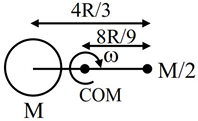
(ii) Since mass of satellite is comparable to the mass of earth.
Image
$
\begin{array}{l}
\frac{\text { G.M. } \frac{M}{2}}{\left(\frac{4 R}{3}\right)^2}=\frac{M}{2} \omega^2 \cdot \frac{8 R}{9} \\
\omega=\sqrt{\frac{81 GM}{128 R^3}}
\end{array}
$
Angular momentum of satellite about common centre of mass,
$
\begin{array}{l}
L=\frac{M}{2} \cdot\left(\frac{8 R}{9}\right)^2 \cdot \omega \\
L=M \sqrt{\operatorname{GMR}\left(\frac{8}{81}\right)} \\
x=\frac{81}{8} \simeq 10
\end{array}
$
View full question & answer
Question 54 Marks
An air bubble of radius 1.0 mm is observed at a depth of 20 cm below the free surface of a liquid having surface tension $0.095 J / m ^2$ and density $10^3 kg / m ^3$. The difference between pressure inside the bubble and atmospheric pressure _________ $N / m ^2$. $\left(\right.$ Take $\left.g=10 m / s ^2\right)$
View full question & answer